They Dug Through His Family Ranch While He Buried His Father, Then Demanded He Open the Water Valve
Chapter 1: The Trench Was There When Jonathan Came Home
The cattle were standing where the fence was supposed to be.
Jonathan Harris stopped his truck halfway down the ranch lane and stared through the windshield. Twenty black cows had crowded shoulder to shoulder behind a strip of orange plastic mesh stretched across the lower pasture. Beyond them, a raw trench cut through the ground like somebody had dragged a blade across the ranch.
For several seconds, Jonathan did not move.
Then he shut off the engine.
The quiet that followed was wrong. No wind through wire. No low groan of the old windmill. Instead he heard the uneven idle of a diesel excavator somewhere beyond the rise.
He had left the ranch four days earlier to bury his father.
The same fence had been standing then.
Jonathan stepped down from the truck in the dark jacket he had worn to the funeral. Dust had collected on the boots he had polished for the church service. He crossed the lane slowly, as if getting closer might change what he was seeing.
It did not.
The three-strand barbed-wire fence had been cut cleanly in two places. The posts were still upright, but the wire had been rolled into a tight coil and tossed beside a pile of disturbed dirt.
He bent and picked it up.
The weight of it settled into his palm with a familiarity that made his jaw tighten. He and his father had stretched that section twenty-three years earlier after a spring flood knocked the old line flat.
His father had complained the whole morning about Jonathan pulling the wire too tight.
“You building a fence or tuning a piano?”
Jonathan could hear the words so clearly that for one second he almost turned toward the barn.
Nothing was there.
Only the trench.
He dropped the coil.
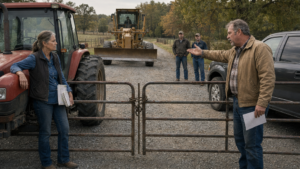
A man in a reflective vest walked toward him from the lower field.
“Sir, you can’t be inside the work zone.”
Jonathan looked past him. “This is my field.”
The man hesitated.
Another worker near the excavator stopped what he was doing.
Jonathan pointed at the missing fence. “Who cut that?”
“I’m just operating equipment.”
“Then who told you to bring equipment through it?”
The operator glanced toward the county road.
That answer was enough.
Jonathan walked along the trench.
It was deeper than he first thought, nearly shoulder-high in places, with black soil stacked along both sides. Gray utility pipe lay exposed at the bottom. Fresh boot prints crossed the mud. Wooden stakes with bright flags marked a line that ran diagonally through the pasture instead of following the road.
The cattle shifted behind the orange barrier as he passed.
One cow pushed her nose against the plastic mesh, then jumped back when it snapped.
Jonathan looked at the temporary enclosure.
“They been in there since when?”
The worker followed at a distance. “Friday, I think.”
Friday.
Jonathan had been standing beside his father’s coffin on Friday.
He continued walking.
The trench angled toward the old pump enclosure near the west side of the ranch. That stopped him harder than the cut fence had.
The pump house was little more than a concrete pad, a weathered metal housing, and a collection of pipes his father had patched and rebuilt over decades. Beside it stood the master valve, an iron wheel painted red once, though most of the paint had worn away.
Jonathan had turned that wheel hundreds of times.
Freeze coming. Shut it.
Line repair. Shut it.
Summer tank low. Open it another quarter turn.
It belonged to the rhythm of the ranch.
Now a new gray pipe ran toward it.
Jonathan stepped closer.
Someone had poured a fresh concrete footing beside the old assembly and bolted a junction housing onto it.
“No,” he said.
The worker stopped behind him.
Jonathan crouched and rubbed mud from the side of the new pipe. “This tied in?”
“I don’t know.”
“You dug it.”
“I dug where they marked.”
Jonathan stood. “Who’s they?”
A white utility pickup rolled down the lane before the worker answered.
It stopped beside the trench.
The man who climbed out wore khaki pants, clean work shoes, and a white polo shirt that looked untouched by the dust hanging over the field. He took off his sunglasses as he approached.
“Mr. Harris?”
Jonathan said nothing.
“I’m Michael Green. Project manager.”
Jonathan pointed at the trench. “That your project?”
Michael looked at it as though Jonathan had pointed to a completed driveway.
“Yes.”
“You cut my fence.”
“We needed equipment access.”
“You needed permission.”
Michael’s expression shifted slightly. Not guilt. Irritation.
“We have approval for the utility corridor.”
“From who?”
“The development approvals went through the county.”
“That wasn’t my question.”
Michael glanced toward the workers, then back to Jonathan.
“We’ve been coordinating this for months.”
“Not with me.”
“There were prior discussions.”
Jonathan felt something cold move through him.
“With who?”
Michael paused just long enough for Jonathan to notice.
“Your family.”
Jonathan stared at him.
“My family is standing in a cemetery.”
The words came out flatter than he intended.
Michael’s face changed, but only briefly.
“I’m sorry about your father.”
Jonathan looked toward the trench again.
The soil piled beside it was still damp beneath the surface. The excavator tracks had hardened around the edges but not enough to be old.
“You dug this when?”
“Work started Friday.”
Jonathan nodded once.
Friday.
His father’s burial service had started at ten-thirty.
Jonathan had turned his phone off before walking into the church.
Afterward there had been three missed calls from an unfamiliar number. He had deleted the notifications without listening to the messages. He had assumed they were insurance or sales calls.
He looked at Michael.
“You knew I was gone?”
“I knew you weren’t available.”
“That wasn’t my question either.”
Michael slid his sunglasses into his shirt opening.
“We had crews scheduled. Equipment rented. Inspection windows. We couldn’t hold everything indefinitely.”
Jonathan looked down at the cut fence wire in the dirt.
“You couldn’t wait four days.”
“We didn’t think there was an ownership issue.”
Jonathan took two steps toward him.
Michael did not move.
“There’s always an ownership issue when you cut somebody’s fence.”
The excavator engine shut off behind them.
Silence widened across the pasture.
Michael exhaled through his nose.
“Mr. Harris, nobody is trying to take your ranch. This utility improvement benefits the entire area.”
Jonathan looked at the new pipe.
“What improvement?”
“Water and service infrastructure for the homes east of your property.”
“You connected houses to my well?”
“No. The system uses a shared transmission route.”
“That pipe runs into my valve.”
“It ties into the existing assembly.”
Jonathan felt his anger change shape.
Until then, the trench had been damage. The fence had been trespass.
The valve made it control.
“Who authorized you to touch that assembly?”
Michael’s voice hardened.
“We have what we need.”
“Show me.”
“The paperwork isn’t in my truck.”
“Then get it.”
“We’re testing the line this afternoon.”
Jonathan stared at him.
“You’re not touching that valve.”
Michael’s jaw tightened.
“We have inspectors scheduled.”
“That’s your problem.”
“And several contractors standing here by the hour.”
“That’s also your problem.”
Michael looked past Jonathan toward the pump enclosure.
“We’ll settle the access question after the test.”
Jonathan stepped between him and the valve.
“No.”
For the first time, Michael’s calm slipped.
“Mr. Harris, this work has already been approved.”
“Then bring me the approval with my name on it.”
Michael said nothing.
Jonathan bent, picked up the coil of cut barbed wire, and held it between them.
“Bring me the paper that says you could do this too.”
The loose end of wire trembled slightly in his hand.
He hated that Michael might see it and think the shaking came from age.
It did not.
He had barely slept since his father died.
He had spent the previous night in the farmhouse staring at an empty chair and wondering why he had ignored those last phone calls two weeks earlier when his father had kept trying to discuss “something about the west boundary.”
Jonathan had told him they would talk when the cattle buyer left.
They never had.
Michael glanced toward the workers.
“Secure the line,” he called. “We test at three.”
Jonathan’s hand tightened around the wire.
Michael looked directly at him.
“You can be here when we do it.”
Then he turned and walked back toward his pickup.
Jonathan remained beside the old valve, listening to the crews start moving again.
At three o’clock, they intended to run water through a system that crossed his land.
And Jonathan still did not know whether the one man who could have explained it had given them permission.
Chapter 2: Open the Valve or Get Out of the Way
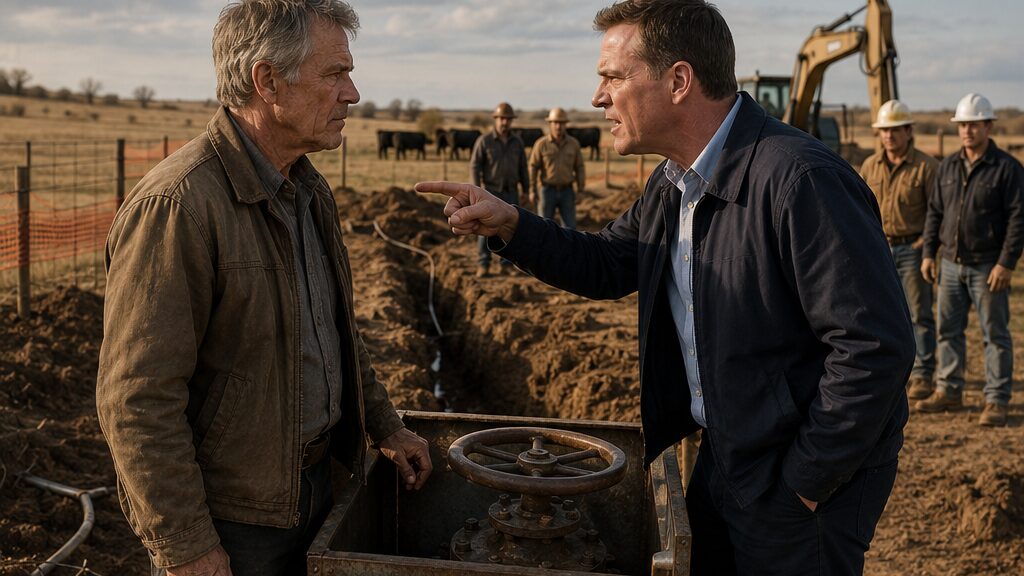
At two fifty-eight, three contractors were standing beside Jonathan’s master valve waiting for him to cooperate.
Jonathan came down the slope carrying the padlock from the pump enclosure in one hand.
Michael Green was already there.
Two board members Jonathan did not recognize stood several yards back near the white pickup. A county inspection vehicle was parked along the road, though whoever had driven it remained inside.
The excavator sat silent beside the open trench.
Michael checked his watch.
“Good. You’re here.”
Jonathan stopped at the concrete pad.
“I live here.”
Michael ignored that.
“We need the valve open fully for approximately six minutes. After the pressure test, we can isolate the new section.”
Jonathan looked at the contractors.
One had a pressure gauge and a radio. The other stood near the new junction housing.
Neither met Jonathan’s eyes.
He looked down at the pipe.
During the morning he had traced as much of the new installation as the open trench allowed. Something had bothered him about it ever since.
Now he saw it.
“You can’t test it like that.”
Michael’s expression tightened. “Excuse me?”
Jonathan pointed.
“That elbow comes off the old stock line.”
“Yes.”
“That line isn’t constant pressure.”
One of the contractors glanced toward the gauge.
Michael said, “Our engineer reviewed the system.”
“Then your engineer reviewed a drawing.”
Jonathan crouched beside the old pipe.
“This feeds the west tank before it feeds anything beyond it. When the float closes, pressure changes here.”
The contractor holding the radio stepped closer.
“Is there a bypass?”
Jonathan looked at him. “There was.”
“Where?”
“Dad capped it fifteen years ago.”
Michael turned sharply. “That’s not in the utility plan.”
“No.”
“Why not?”
Jonathan stood.
“Because it’s my ranch plumbing, not county infrastructure.”
For a moment, nobody spoke.
The contractor with the gauge rubbed his jaw.
“We’d need to know the static behavior before commissioning.”
Michael turned on him. “We’ve already covered this.”
“With the plan we got.”
“The plan was approved.”
Jonathan almost smiled.
There it was again.
Approved.
As if repeating the word could replace knowing what had actually been approved.
Michael faced Jonathan.
“Open the valve.”
“No.”
“We just established that your system needs to be part of the test.”
“You established you don’t understand the system you tied into.”
Michael lowered his voice.
“We’re not doing this all afternoon.”
Jonathan put the padlock into his jacket pocket.
“Then leave.”
One of the board members walked closer.
“Michael?”
“Stay out of it.”
Jonathan looked from Michael to the new junction housing.
“Where’s the easement?”
Michael sighed.
“I told you this morning. There were prior discussions.”
“With who?”
“Your father.”
The words landed differently this time.
Jonathan kept his face still.
Michael saw something anyway.
“Yes,” he said. “Your father.”
“What discussion?”
“He knew about the corridor.”
“Knew about it isn’t permission.”
“He agreed in principle.”
Jonathan stared at him.
“To what?”
Michael gestured toward the trench.
“This route. Utility access. Shared infrastructure.”
“My father agreed to let you cut across the cattle pasture?”
“He understood development was coming.”
“That isn’t what I asked.”
Michael stepped closer.
“He understood this ranch wasn’t sitting in the middle of nowhere anymore.”
Jonathan’s eyes narrowed.
The board members had gone quiet.
The contractor with the radio backed a step away.
Michael continued.
“He was practical.”
Jonathan felt heat climb his neck.
“You knew him?”
“I met him twice.”
“Then don’t tell me what he was.”
Michael’s voice sharpened.
“I’m telling you he wasn’t opposed.”
“You got his signature?”
“There are records.”
“Show me.”
“We will.”
“When?”
“After we get through today.”
Jonathan shook his head.
Michael stepped toward the valve.
Jonathan moved in front of him.
The space between them disappeared.
“Open it,” Michael said.
“No.”
“Mr. Harris—”
“No.”
“We have families waiting on this system.”
“Then you should’ve got permission before you built it.”
Michael’s face reddened.
“We have spent months and hundreds of thousands of dollars getting this project here.”
Jonathan nodded toward the cut fence.
“You spent some of it on wire cutters.”
One of the board members muttered something under his breath.
Michael heard it.
His jaw worked.
“Move.”
Jonathan did not.
For several seconds the only sound was the soft ticking of cooling metal from the excavator.
Michael leaned close enough that Jonathan smelled coffee on his breath.
“You think because that valve is old and sitting on your side of a fence, you can hold an entire project hostage?”
Jonathan kept his voice low.
“I think you’re standing on my land telling me to operate equipment you don’t own.”
Michael put a hand against Jonathan’s upper chest.
Not hard.
At first.
Jonathan looked down at it.
“Take your hand off me.”
Michael did not.
“You’re creating a problem you don’t understand.”
Jonathan raised his eyes.
“Take your hand off me.”
The hand pushed.
Jonathan’s heel caught the raised edge of the concrete pad.
He went backward.
His shoulder struck the gravel first, then his hip.
Pain flashed down his side.
For a second, the sky filled his vision.
Nobody moved.
Michael looked as startled as anyone.
Then the surprise left his face.
“Stay out of the work area.”
Jonathan rolled onto one knee.
The contractor with the radio started toward him.
Jonathan lifted a hand.
“I’m fine.”
He was not.
His palm was scraped. His hip throbbed. Worse was the heat behind his eyes—the humiliation of looking up from the ground at men waiting to see what an old rancher would do next.
Twenty years earlier, he would have stood and swung.
Ten years earlier, he might have.
Today, he thought of his father lying beneath six feet of earth.
He stood slowly.
Michael watched him.
Jonathan brushed gravel from his sleeve.
Then he walked to the valve enclosure.
Michael stiffened.
Jonathan opened the metal cover.
The old red wheel sat beneath it.
The contractors leaned forward.
Jonathan did not turn it.
He touched the casting on the side of the housing instead.
A raised manufacturer’s mark had nearly worn smooth. Beside it, under years of grease, was a threaded coupling the new line had been attached to.
Jonathan ran his thumb over it.
“You tied into the wrong side.”
The contractor with the gauge frowned. “What?”
“This isn’t the service outlet.”
Michael said, “We have drawings.”
Jonathan pointed to a thinner line disappearing toward the stock tank.
“That’s the outlet. This one is a maintenance bypass. Dad used it when the pump froze.”
The contractor crouched.
“You sure?”
Jonathan gave him a look.
“I’ve repaired it since before you were old enough to drive.”
The contractor studied the junction.
His expression changed.
“Michael.”
Michael did not look at him.
“What?”
“We need to verify this.”
Michael’s eyes stayed on Jonathan.
“Later.”
“No,” the contractor said. “If he’s right, we could dead-head part of the system.”
Jonathan closed the metal cover.
The sound was flat and final.
He slipped the padlock through the latch.
Michael stepped forward.
“What are you doing?”
Jonathan snapped the lock shut.
“I’m not opening it.”
“You can’t lock us out of commissioned infrastructure.”
“It isn’t commissioned.”
“It will be.”
“When you show me who owns the right to use it.”
Michael’s mouth tightened.
“You’re going to regret turning this into a fight.”
Jonathan put the key in his pocket.
“You brought the fight.”
He walked away before his anger could choose for him.
Halfway toward the lane, something bright beside the trench caught his eye.
An orange survey flag had been driven near a weathered wooden stake almost hidden under disturbed grass.
Jonathan stopped.
The stake was old—far older than the new project.
He crouched.
Two letters had been cut into the wood with a pocketknife.
J.H.
Jonathan touched them.
His father had marked boundary stakes that way for decades.
Behind him, Michael was arguing with the contractors.
Jonathan barely heard them.
His father had known something about this exact corridor.
Maybe much more than Jonathan wanted to believe.
Chapter 3: The County File Had a Hole in It
Christine Baker slid the index sheet across the counter and tapped an empty line with the end of her pencil.
“That’s the problem.”
Jonathan leaned closer.
The county records office smelled of paper, dust, and the burnt coffee sitting on a warmer behind the clerk’s station. Outside, Tuesday morning traffic moved around the courthouse square. Inside, the only sounds were a scanner feeding documents and somebody turning pages in the back room.
Jonathan looked at the entry Christine had marked.
Parcel number.
Grantor.
Utility reference.
Recording date.
Then nothing.
“No book and page?” he asked.
“No instrument number either.”
“So it doesn’t exist.”
Christine’s pencil stopped.
“I did not say that.”
Jonathan looked up.
Christine Baker was somewhere in her late fifties, with silver beginning at her temples and reading glasses hanging from a cord around her neck. She had known his father well enough to recognize the Harris parcel number without asking Jonathan twice.
She had also spent the last forty minutes refusing to tell him what he wanted to hear.
“There’s no easement recorded,” Jonathan said.
“There’s no easement where this index says one should be.”
“What’s the difference?”
“The difference is why people hire title companies and attorneys.”
Jonathan sat back.
“You always talk like this?”
“Yes.”
“Dad liked you?”
“He complained about me regularly.”
That almost pulled a smile from him.
Almost.
Christine turned toward a computer terminal.
“The entry could be an abandoned reference. It could point to something filed under a neighboring parcel. Somebody may have started indexing an instrument that was never recorded.”
“Or there was never an easement.”
“Or that.”
Jonathan rubbed the scrape on his palm.
Christine noticed.
“What happened?”
“Gravel.”
She looked at him for one second longer than necessary, then turned back to the screen.
“You planning to sue somebody?”
“I’m planning to find out who gave them permission to dig through my ranch.”
“That isn’t the same question.”
“It is to me.”
“That’s what worries me.”
Jonathan’s jaw tightened.
Christine pulled up a scanned plat.
The original Harris property appeared as a long rectangle divided by old handwritten measurements. A blue line marked the historic well system.
Jonathan leaned forward.
“There.”
The old valve symbol sat near the west boundary.
The new trench route was not on the document, of course, but Jonathan could see how somebody studying the old plat might have made the mistake.
A narrow utility notation crossed the parcel near the same area.
“What’s that?”
Christine enlarged the image.
“Old agricultural service access.”
“For what?”
“Looks like pump maintenance.”
Jonathan traced the line with one finger against the glass.
“That’s not where they dug.”
“No.”
“And it doesn’t say sewer.”
“No.”
“Or residential water.”
“No.”
Jonathan sat back again.
A small piece of certainty returned.
Christine saw it.
“Don’t.”
“Don’t what?”
“Turn one document into a verdict.”
“They don’t have the route.”
“We haven’t finished.”
Jonathan exhaled.
That was the trouble with records. They did not behave like fences. A fence was either there or it was cut. A gate was either closed or open.
Paper left room for somebody else’s interpretation.
Christine disappeared into the rear archive room and returned several minutes later with a thin gray folder.
She set it down carefully.
“Your father asked about this parcel last winter.”
Jonathan looked at her.
“What for?”
“I don’t remember exactly.”
“You just happened to forget that part?”
“I see hundreds of people.”
“You knew him.”
“I knew he brought me peppermints and refused to use the online portal.”
That sounded right.
Christine opened the folder.
Inside were photocopies of correspondence, handwritten notes, and a preliminary utility sketch.
Jonathan’s father’s handwriting appeared on the first page.
Not much.
Just a few numbers beside the boundary dimensions.
Jonathan touched the paper.
The handwriting affected him more than the funeral program had.
His father’s hands had made those marks.
“Where did this come from?”
“Planning office sent copies when they asked us to check prior easements.”
“When?”
“February.”
Jonathan looked at the date.
He remembered February.
Cold snap. Broken stock-tank heater. His father had called him twice about “county people.” Jonathan had been hauling feed and told him to leave the paperwork on the kitchen table.
He had never seen it.
Christine turned several pages.
“There.”
A typed line referenced a proposed utility corridor across the western section of the ranch.
Jonathan read it twice.
“They proposed it.”
“Yes.”
“That doesn’t mean Dad agreed.”
“No.”
The next page included several handwritten comments.
MOVE SOUTH OF WELL.
MAINTAIN CATTLE ACCESS.
OWNER APPROVAL BEFORE EXCAVATION.
Jonathan stared at the last line.
“Owner approval.”
Christine nodded.
“So they needed his approval.”
“According to this draft.”
“And there’s no signature.”
“Not on this copy.”
Jonathan looked through the folder faster.
“No signature anywhere.”
“Jonathan.”
He stopped.
Christine pointed toward a notation in the lower corner.
A file code.
“See that?”
“Yes.”
“That references a negotiation file, not a recorded instrument.”
“So?”
“So your father got farther with this than a casual conversation.”
Jonathan felt the old anger rise again, but this time it had nowhere simple to land.
“How far?”
Christine entered the file code into the computer.
Nothing appeared.
She tried another database.
Still nothing.
“Where is it?”
“Could be planning. Could be engineering. Could be archived off-site.”
“Or missing.”
Christine gave him a tired look.
“You really want everything to be missing today.”
“I want somebody to tell me what happened.”
“That I understand.”
The gentleness in her voice irritated him more than her caution had.
He stood and walked toward the window.
Across the courthouse lawn, a maintenance worker was trimming around a flagpole. Ordinary Tuesday. Ordinary county business.
Jonathan thought of the three calls he had ignored.
His father had left one voicemail he never deleted, though he had not listened to it until after the funeral.
Call when you get a minute. Need to talk about the west side.
That was all.
Jonathan had assumed it meant fence repair.
Christine spoke behind him.
“Your father never recorded a permanent easement that I can find.”
Jonathan turned.
The sentence was what he had come for.
Instead of relief, he felt an unexpected pressure in his chest.
“Then they had no right.”
“I said I can’t find a recorded easement.”
“What else do they need?”
“They may claim license, prior consent, temporary access, some agreement outside this office. I’m not saying those claims are valid.”
“But they aren’t an easement.”
“No.”
“And verbal permission doesn’t turn into a permanent property right because somebody rented an excavator.”
Christine nodded.
“That part is fair.”
Jonathan returned to the counter.
“Can I get copies?”
“Yes.”
“Everything.”
Christine gathered the file.
While the copier ran, Jonathan looked again at the old utility sketch.
The master valve symbol had been circled in pencil.
His father’s pencil.
Beside it were three words.
PROTECT THIS FIRST.
Jonathan read them until the copier stopped.
Christine returned with the stack.
“One more thing.”
She held a loose sheet apart from the others.
“I almost missed this because it was filed behind the map.”
Jonathan took it.
It was a draft agreement between the development project and the Harris property.
Near the bottom was a blank signature line.
Above it, in his father’s handwriting, was a note.
Jonathan leaned closer.
Need Jonathan here before anything permanent.
He did not speak.
Christine waited.
Jonathan read it again.
His father had not simply been fighting the project.
He had been negotiating.
And somewhere between those notes and the trench now crossing the pasture, somebody had decided Jonathan’s absence no longer mattered.
Chapter 4: Winning the Argument Shut Off Someone Else’s Water
Jonathan closed the master valve at seven twelve Wednesday morning.
The iron wheel resisted for the first quarter turn, then moved with the heavy, familiar drag he had known most of his life. Metal complained inside the housing. Somewhere beneath the concrete pad, water pressure began to fall.
He kept turning until the wheel stopped.
Then he stood with both hands resting on it.
For the first time since he had come home from the funeral, the ranch was quiet.
No excavator.
No contractors.
No Michael Green telling him what had already been decided.
Jonathan took the county copies from under his arm and set them on the hood of his truck. He had spent most of Tuesday evening reading every line Christine Baker had given him.
No recorded permanent easement.
No completed agreement.
No signature from his father.
The new line remained locked to a right nobody had been able to prove.
Jonathan had called the project number printed on one of the construction sheets before shutting the valve. He had left a short message.
“Jonathan Harris. The connection across my property is disputed. The valve is closed until you produce recorded authority.”
Nothing more.
He had expected Michael.
He had not expected the woman in house slippers.
She came down the county road twenty minutes later in an aging SUV, stopped too hard at the ranch entrance, and climbed out wearing jeans, a sweatshirt, and the expression of someone who had left home before thinking about how she looked.
“Are you Jonathan Harris?”
He remained beside the valve enclosure.
“Yes.”
“Did you shut our water off?”
Jonathan frowned.
“Who’s ‘our’?”
“The houses on Ridge View.”
He knew the development by sight: pale roofs beyond the eastern rise where open pasture had been three years earlier.
“I shut my valve.”
The woman stared at him.
“My kitchen faucet stopped while I was making breakfast.”
“That line isn’t supposed to be carrying household water yet.”
“Well, it is.”
Jonathan felt the first movement of doubt.
“How many houses?”
“I don’t know. Mine. The Martins next door. At least three people were outside when I left.”
“What’s your name?”
“Heather Martin.”
She folded her arms.
“They told us yesterday the final connection was done.”
“Who told you?”
“The project office.”
Jonathan looked toward the trench.
“They told you it was permitted?”
“They told us everything was approved.”
A truck horn sounded at the road.
Another vehicle pulled in behind Heather’s SUV.
Then another.
Jonathan swore under his breath.
Heather heard him.
“You think I wanted to come fight with a rancher before eight in the morning?”
“No.”
“I’ve got two kids who need showers and a washing machine full of wet clothes.”
“I didn’t know they had you live on this line.”
She gave a short laugh without humor.
“You turned it off.”
“I turned off equipment on my property.”
“That distinction isn’t helping my sink.”
Jonathan’s jaw tightened.
He had expected satisfaction when the valve closed.
Instead, the old wheel now looked different.
Not like a boundary.
Like a hand around a pipe.
A white pickup came fast down the lane.
Michael Green got out before the engine fully stopped.
“What did you do?”
Jonathan looked at him.
“You know what I did.”
Michael walked straight toward the enclosure.
“Open it.”
“No.”
“You just cut water to occupied homes.”
“You connected occupied homes through a disputed line.”
“That system passed preliminary testing.”
“On whose permission?”
Michael glanced toward Heather and the other residents gathering near the entrance.
“This is not the place.”
Jonathan lifted the county papers from the truck hood.
“It became the place when you dug it up.”
Michael lowered his voice.
“Open the valve first.”
“Show me an easement.”
“We have a lawful project.”
“Show me the right to cross my property.”
Michael looked toward Heather.
She stepped closer.
“Did you know this line wasn’t settled?”
Michael’s expression changed.
“The property documentation is being reconciled.”
Heather stared at him.
“That means what?”
“It means there’s an administrative issue.”
Jonathan held up the papers.
“There’s no recorded easement.”
Michael’s eyes flashed toward him.
“Stop giving legal conclusions you aren’t qualified to give.”
“I’m giving you what the county file says.”
One of the residents behind Heather spoke.
“So whose water line is it?”
Nobody answered.
That silence did more damage to Michael than anything Jonathan could have said.
A county utility vehicle arrived fifteen minutes later.
The county engineer stepped out with a tablet and walked the connection with Michael while Jonathan watched from beside his truck.
Heather remained nearby.
After several minutes she said, “You really didn’t know we were already on it?”
“No.”
“You didn’t ask?”
Jonathan looked at her.
The question irritated him because it was fair.
“I knew the line was unauthorized.”
“That isn’t what I asked.”
He turned away.
The wording struck him because Michael had heard the same thing from Jonathan only two days earlier.
Not my question.
Jonathan rubbed the scrape on his palm.
“I should’ve checked.”
Heather’s anger softened by one degree.
“So what happens now?”
“I don’t know.”
“That’s comforting.”
“No point lying to you.”
The county engineer returned.
“Mr. Harris, we need to understand whether you intentionally interrupted a residential supply.”
Jonathan looked at him.
“I intentionally closed my private master valve after discovering an unrecorded connection had been made to it.”
The engineer glanced at the enclosure.
“You were aware the new line went east.”
“I was aware it crossed my ranch.”
“But you did not verify whether homes were receiving service?”
Jonathan said nothing.
The engineer made a note.
Michael stood several feet away, arms folded.
For the first time, Jonathan understood the position he had handed him.
Michael had trespassed.
But Jonathan had acted without knowing the consequence.
Both could be true.
“Can we restore temporary flow?” the engineer asked.
Jonathan looked at Michael.
“Not until I know what right they’re claiming.”
Michael stepped forward.
“We’ll resolve that today.”
“You’ve had months.”
“Jonathan.”
It was the first time Michael had used his first name.
“There are families without water.”
Jonathan looked toward Heather.
She did not plead.
That made it worse.
He looked at the old valve wheel through the open enclosure.
His father had written three words beside it.
PROTECT THIS FIRST.
Jonathan had assumed he knew what that meant.
Protect ownership.
Protect the well.
Protect the ranch.
Maybe his father had meant something broader.
Michael walked to his pickup.
He opened the passenger door, pulled out a leather portfolio, and returned with a single sheet protected in a plastic sleeve.
“I didn’t want to do this roadside.”
Jonathan’s stomach tightened before he even saw the page.
Michael held it out.
At the bottom was a signature.
His father’s.
Jonathan took the sheet.
The date was eight months old.
The first paragraph described a proposed utility corridor.
Halfway down the page, one sentence was underlined.
I am agreeable to shared utility access across the western portion of the Harris property subject to final route and operating terms.
Jonathan read it twice.
Heather watched his face.
Michael said quietly, “Your father said yes.”
Jonathan lifted his eyes.
“Then why didn’t you show me this Monday?”
“Because I thought the full file had already been recorded.”
“That isn’t an answer.”
“It’s the answer I have.”
Jonathan looked again at his father’s signature.
The county copies in his truck suddenly felt lighter.
Not worthless.
But incomplete.
His father had said yes to something.
Jonathan folded the letter carefully along its existing crease.
“What else is in this file?”
Michael did not answer immediately.
That pause was enough.
Jonathan held the page toward him.
“This isn’t the whole agreement.”
Michael’s expression hardened.
“No.”
Jonathan looked toward the silent valve.
For the first time since he had closed it, he no longer knew whether the wheel represented his strongest position or his biggest mistake.
Chapter 5: His Father Had Said Yes, But Never Like This
The sentence looked worse on Jonathan’s kitchen table than it had beside the road.
I am agreeable to shared utility access across the western portion of the Harris property subject to final route and operating terms.
His father’s signature sat beneath it in blue ink.
Jonathan had spent the afternoon trying to make the words mean less.
They did not.
Michael stood on the other side of the table with his hands resting on the back of a chair.
Heather had gone home after the county arranged bottled water and temporary tanks for the affected houses. The development remained without normal service.
Jonathan had allowed Michael inside for one reason.
“The rest of it.”
Michael took a thin folder from his bag.
Jonathan looked at him.
“You had this Monday?”
“Most of it.”
“Tuesday?”
“Yes.”
“And you let me drive to the county thinking there was nothing.”
“I told you there had been discussions.”
“You told me enough to make yourself sound right.”
Michael’s jaw tightened.
“I was trying to keep a project moving.”
Jonathan pulled the folder toward himself.
“That answer getting easier every time you say it?”
Michael did not respond.
The first page duplicated the letter.
The next contained a proposed route sketch.
Jonathan recognized the west pasture immediately.
His father had drawn a thick pencil line below the printed utility route.
MOVE SOUTH.
Another note pointed toward the old pump assembly.
NO PERMANENT CONNECTION TO MASTER WITHOUT SEPARATE CONTROL.
Jonathan turned the page.
A compensation table.
Fence restoration.
Cattle access.
Well-protection requirements.
Every section had handwritten marks.
His father had not dismissed the proposal.
He had worked on it.
Carefully.
Jonathan felt something close to betrayal, then hated himself for feeling it.
His father had owned the ranch too.
“Why didn’t he tell me?”
Michael looked at him.
“He tried to include you.”
Jonathan’s eyes lifted.
“You don’t know anything about what he tried.”
“I know he asked us to delay the final meeting twice because you weren’t available.”
Jonathan went still.
Michael continued more carefully.
“He said you were handling cattle sales. Then there was a pump problem.”
Jonathan remembered both weeks.
He also remembered the calls.
Call when you get a minute.
He had never found the minute.
Jonathan turned another page.
Blank signature lines.
His father’s.
Jonathan’s.
Neither signed.
At the bottom, handwritten in capital letters:
NO DIGGING UNTIL FINAL APPROVAL FROM BOTH OWNERS.
Jonathan put his finger on the line.
Michael looked away.
“You saw this.”
“Yes.”
“When?”
“Before construction.”
The kitchen seemed to shrink.
Jonathan closed the folder.
“Get out.”
Michael did not move.
“I’m not asking you to forgive the decision.”
“I said get out.”
“If you don’t hear the rest, you’re going to make tomorrow worse.”
Jonathan stood.
The chair legs scraped hard against the floor.
Michael held up one hand.
“The wells in Ridge View started failing in June.”
Jonathan stared at him.
“Then drill new wells.”
“Some lots can’t support reliable replacements. The development’s financing required a consolidated system. The county gave us a deadline. The contractor had a six-week window before moving equipment to another job.”
“So you cut my fence.”
“I believed we could finish the property documents while construction started.”
“You believed I’d give up once the pipe was underground.”
Michael looked at him.
That was the first accusation he did not reject.
Jonathan’s voice went quiet.
“You counted on the cost of undoing it.”
Michael swallowed.
“Yes.”
The admission landed harder than another argument would have.
Jonathan sat back down.
Michael stayed standing.
“We thought your father’s letter and the negotiation history gave us enough basis for temporary access.”
“You knew it wasn’t final.”
“Yes.”
“And you dug anyway.”
“Yes.”
The room went silent except for the refrigerator motor.
Jonathan opened the folder again.
This time he read more slowly.
On the last page, he found another handwritten instruction.
Jonathan must approve operating control. Do not burden ranch permanently without him.
He ran his thumb along the edge.
For two days he had imagined his father as a man defending the ranch exactly the way Jonathan would have defended it.
No.
His father had been willing to let something cross.
Under conditions.
South of the well.
Cattle access maintained.
Separate controls.
Fair compensation.
No permanent burden without Jonathan.
His father had not been protecting the ranch from change.
He had been protecting the ranch from careless change.
There was a difference.
The realization hurt.
Jonathan closed his eyes briefly.
“You said he asked for me.”
Michael said nothing.
“How many meetings?”
“Two.”
Jonathan remembered refusing one call because the cattle buyer had finally arrived after being three hours late.
The second had come while Jonathan was under the pump house replacing a cracked coupling.
His father had died eleven days later.
Jonathan opened his eyes.
“Leave the folder.”
Michael hesitated.
“It contains project originals.”
“Then copy it.”
“I can’t leave—”
Jonathan pushed it across the table.
“Fine. Sit there.”
He photographed every page with his phone.
Michael waited.
When Jonathan finished, he handed the folder back.
“You’ll restore the fence.”
Michael nodded. “Yes.”
“You’ll move the line away from my well.”
“We need engineering review.”
“That wasn’t a question.”
“The route may have to move.”
“It will.”
Michael rubbed his forehead.
“If the county orders a complete relocation, we’re looking at months.”
“Then you should’ve started months ago.”
“And the residents?”
Jonathan looked toward the dark window.
He had no answer that satisfied him.
Michael gathered the papers.
“If this system stays shut through the week, the temporary water plan is expensive but manageable. After that, the project lender can declare us out of compliance.”
Jonathan turned.
“What happens then?”
“Work stops.”
“That sounds like your problem.”
“It becomes theirs too.”
Michael nodded toward the east, though the development could not be seen from the kitchen.
“Contractors don’t get paid. The utility association can’t complete turnover. Homeowners may be assessed for emergency service. Some families bought there because their private wells were already failing.”
Jonathan’s irritation rose.
“You keep bringing families into this like they cut the fence.”
“They didn’t.”
“Exactly.”
Michael looked at him steadily.
“That’s why I’m bringing them into it.”
Jonathan said nothing.
Michael picked up his bag.
At the door, he stopped.
“I was wrong to push you Monday.”
Jonathan’s face hardened.
“Don’t make that sound like paperwork.”
“I’m not.”
“You put me on the ground.”
Michael looked at the floor.
“I know.”
“That was a choice too.”
“Yes.”
Jonathan opened the door.
Michael stepped onto the porch.
“Tomorrow the county engineer is coming back,” he said. “If we can’t establish a temporary arrangement, he’ll recommend the new line be abandoned in place until formal action.”
“Good.”
Michael turned.
“No, Jonathan. Not good.”
For the first time, there was no anger in his voice.
Only exhaustion.
“If they abandon it now, the lender can freeze the project. The residents still need water. Your ranch still has a trench through it. Everybody loses while lawyers decide who was most right.”
Jonathan stood inside the doorway.
Michael went down the steps.
Jonathan looked back at the kitchen table where he had left one county copy.
His father’s handwritten instruction remained visible.
Jonathan must approve operating control.
For the first time, those words did not feel like a gift of power.
They felt like a responsibility he had spent years avoiding.
Chapter 6: The Man Who Dug First Finally Explained Why
Michael came back Thursday evening without sunglasses, board members, contractors, or paperwork.
Jonathan saw his pickup stop beside the machine shed and almost ignored it.
He was replacing a hinge on a feed gate, more because he needed something mechanical to occupy his hands than because the hinge could not wait.
Michael got out and stood beside the truck.
“You busy?”
“Yes.”
“I need ten minutes.”
Jonathan drove the hinge pin through with two hammer blows.
“You used your ten minutes Monday.”
Michael accepted that.
He walked no closer.
Jonathan set the hammer on the workbench.
“What?”
“The county engineer gave me his preliminary position.”
Jonathan waited.
“He says the permanent line can’t stay where it is.”
The words should have felt like victory.
They did not.
Jonathan wiped grease from his fingers.
“Because of the easement?”
“Partly. Mostly because our connection plan interferes with your existing agricultural system and the route violates the well-protection distance your father requested.”
Jonathan nodded.
“So you’re moving it.”
“Yes.”
The answer surprised him.
Michael saw that.
“I’m not here to argue about that.”
“Then what?”
“We need temporary access.”
“No.”
Michael looked toward the open side of the machine shed.
Beyond it, the trench crossed the lower pasture under a line of fading orange flags.
“Through Monday.”
“No.”
“Let me finish.”
Jonathan leaned against the workbench.
Michael drew a breath.
“The residents have temporary tanks. They’re enough for basic use, but not normal pressure and not reliable fire flow. The county can keep them on emergency service for a few days. After that, the utility association has to find another source.”
“Then find one.”
“We are.”
“Good.”
“It won’t be ready by Monday.”
Jonathan picked up the hammer again.
Michael did not move.
“Why did you do it?”
Michael frowned.
“Do what?”
“Not the shove.”
Jonathan looked at him.
“The digging.”
Michael was quiet long enough that Jonathan almost turned back to the hinge.
Then he said, “Because I thought stopping would kill the project.”
“That simple?”
“No.”
“Try again.”
Michael leaned against his pickup.
“The first well failed in May. Another started producing sand in June. We had houses under contract, families already moved in, and a county requirement to move to a consolidated system once the development crossed a certain number of occupied lots.”
Jonathan listened.
“The utility route around your property added nearly a mile,” Michael continued. “More pumping. Road crossing. Another permit. More money than the project reserve had.”
“So you chose the cheap route.”
“We chose the route your father had been discussing.”
“Without finishing the discussion.”
“Yes.”
Michael looked toward the trench.
“When title review flagged that no final easement was recorded, I had two choices. Stop construction and tell the lender we had a major access problem, or keep the contractor moving while we closed the paperwork.”
“You picked the one that protected you.”
“At the time, I told myself I was protecting everybody.”
Jonathan said nothing.
Michael gave a tired half laugh.
“That’s probably the part you want to hear.”
“No. I want the part you didn’t tell yourself.”
Michael looked at him.
The wind pushed one loose sheet of metal against the shed wall with a dull tap.
Finally Michael said, “I didn’t want to be the man who stopped a multimillion-dollar project because I couldn’t get one rancher’s signature.”
There it was.
Not families.
Not infrastructure.
Status.
Fear.
Jonathan understood that better than he wanted to.
Michael continued.
“I’d already told the board the access issue was manageable. I’d told the lender it was paperwork. If I stopped the excavation, I had to admit I was wrong.”
“So instead you made it harder for me to say no.”
“Yes.”
“And when I did?”
Michael looked down.
“I got angry.”
Jonathan’s hand closed around the hammer handle.
Michael raised his eyes.
“I’m not asking you to forget that.”
“Good.”
“I’m asking you not to make the residents pay for it.”
Jonathan almost answered that he had heard enough about the residents.
Then Heather’s question came back.
You didn’t ask?
He set the hammer down.
“What happens if I reopen it temporarily?”
Michael straightened.
“We isolate the temporary connection from your agricultural system as much as possible. County monitors pressure. We use it only until the alternate route is ready.”
“How long?”
“Thirty days.”
“No.”
“Three weeks.”
“No.”
Michael exhaled.
“Jonathan—”
“You said through Monday.”
“That gets us through the immediate county deadline. It doesn’t solve the engineering schedule.”
“Not my engineering schedule.”
“No.”
Jonathan walked out of the shed.
Michael followed at a distance.
They crossed toward the valve enclosure.
The old red wheel sat locked beneath its cover.
Jonathan rested one hand on the metal lid.
“What did my father want?”
“You read the conditions.”
“I’m asking what you heard from him.”
Michael considered.
“He wanted the line south of the well. He wanted cattle access restored every evening during construction. He wanted separate control so nobody could use your master valve without permission.”
Jonathan nodded.
“Money?”
“He negotiated compensation.”
“Was that what mattered?”
“No.”
The answer came quickly.
Jonathan looked at him.
Michael continued.
“He kept saying the ranch had to stay usable after we were gone.”
Jonathan’s throat tightened.
That sounded like his father.
Not sentimental.
Usable.
A fence should hold cattle.
A well should pump water.
A road should carry a truck in February mud.
If something did not work after you left, you had not taken care of it.
A county vehicle turned into the lane.
The engineer stepped out carrying a rolled set of plans.
He joined them beside the valve.
“I’ve reviewed the field connection,” he said. “Permanent configuration cannot remain. We’ll issue that in writing tomorrow.”
Michael nodded.
The engineer looked at Jonathan.
“For temporary operation, the county could accept a short-term private license if you choose to grant one. Your existing well system would need isolation measures and pressure monitoring.”
“And if I don’t?”
“Emergency supply continues while the development finds another source.”
“How long?”
The engineer’s mouth tightened.
“That gets expensive quickly.”
Jonathan looked toward the east.
From this point he could see the highest roofs of Ridge View beyond the pasture.
For two days, he had wanted somebody to acknowledge that the ranch was his.
Now everybody did.
The county.
Michael.
The residents.
The problem was what came after being right.
The engineer unrolled the plans on the hood of Michael’s pickup.
A revised route curved around the southern edge of Jonathan’s parcel without crossing it.
“This is our preferred permanent correction.”
Jonathan studied it.
“How long?”
“Several weeks if permitting moves cleanly.”
Michael said, “Which it won’t.”
The engineer ignored him.
Jonathan pointed at the trench.
“And that?”
“Removed or abandoned according to your settlement and county requirements. Disturbed ground restored.”
“Fence?”
“Project responsibility.”
Jonathan looked at Michael.
Michael nodded.
“All of it.”
Jonathan rubbed his thumb across the edge of the valve cover.
His father had wanted separate control.
Not no water.
Control.
Terms.
A ranch that remained usable after everybody else left.
Jonathan looked at the engineer.
“If I give temporary access, it’s not an easement.”
“Correct.”
“Doesn’t create one.”
“Not if properly drafted.”
“Ends automatically.”
“It can.”
“Doesn’t give them the right to enter anywhere else.”
“Yes.”
Michael watched him carefully.
Jonathan turned to him.
“One condition before I even consider opening this.”
Michael waited.
Jonathan pointed across the pasture toward the raw trench.
“You don’t write the temporary license.”
Michael frowned.
“Who does?”
“I do.”
The engineer raised an eyebrow.
Jonathan continued.
“And it starts with my father’s conditions, not yours.”
Michael looked at the locked valve, then at Jonathan.
For the first time since the trench appeared, Jonathan was not deciding whether to surrender or fight.
He was deciding exactly where the boundary would stand.
Chapter 7: Jonathan Opened the Valve on His Own Terms
By nine Friday morning, twelve people were standing beside Jonathan’s valve, and every one of them was waiting for his hand to move.
The county engineer had parked near the trench. Two project board members stood beside Michael Green. Heather Martin was there with several Ridge View residents, all of them quieter than they had been two days earlier.
Jonathan arrived carrying a manila folder.
The valve key was in his shirt pocket.
Michael noticed the folder first.
“What did you bring?”
“The terms.”
Jonathan set the folder on the hood of his truck.
The county engineer stepped closer.
“You had counsel review these?”
“No.”
Michael exhaled sharply.
Jonathan looked at him.
“My father didn’t have counsel standing beside him when he wrote half the conditions you ignored.”
“That doesn’t make this enforceable.”
“No. The county recording it will.”
The engineer held out his hand.
“Let me see.”
Jonathan passed him the document.
He had spent most of Thursday night at the kitchen table, comparing his father’s notes with the county sketches and the engineer’s temporary-access requirements.
He had not tried to write like a lawyer.
He had written like a landowner.
Temporary license only.
No permanent easement created.
Access limited to the existing trench corridor.
No additional excavation without written approval.
Separate isolation control installed before full temporary operation.
Pressure monitoring required.
Fence repair begun immediately.
Permanent line rerouted outside the Harris parcel.
License terminated automatically after twenty-one days unless Jonathan approved an extension in writing.
Michael read over the engineer’s shoulder.
“Twenty-one days?”
“That’s what you get.”
“We asked for thirty.”
“You asked for permanent access without finishing the first agreement.”
Michael’s jaw tightened.
The engineer kept reading.
“This is restrictive.”
Jonathan nodded.
“It’s supposed to be.”
“The isolation-control installation can be done today.”
“Then do it.”
Michael pointed to another paragraph.
“You’re requiring the project to cover pasture restoration before the temporary license expires.”
“You made the hole.”
“That work can’t finish while the temporary line is operating.”
“Then start what can be started.”
One of the board members stepped forward.
“This is unreasonable.”
Jonathan looked at him.
“Which part?”
The man opened his mouth, then stopped.
Jonathan waited.
“The project has already incurred substantial costs.”
“That wasn’t one of my conditions.”
Michael closed his eyes for a second.
“Let me handle this.”
The board member stepped back.
Heather moved closer to the truck.
“Does this get our water back today?”
Jonathan looked at the engineer.
“If they install the isolation control and the county signs off.”
The engineer nodded.
“Yes.”
Heather looked at Jonathan again.
“And your ranch?”
“The temporary line stays only until the new route is ready.”
Michael said, “Assuming we can finish that in three weeks.”
Jonathan faced him.
“If you can’t, you ask.”
Michael gave a humorless laugh.
“That simple?”
“No.”
Jonathan took the paper back from the engineer.
“You ask before you use somebody else’s land. That’s the part that was supposed to be simple.”
Nobody said anything.
Heather looked toward the trench.
Two days earlier she had stood at this same place furious with Jonathan.
Now she said, “He could’ve kept it shut.”
Michael glanced at her.
Heather did not look at him.
“He could have told all of us it wasn’t his problem.”
Jonathan felt uncomfortable with the attention.
“That doesn’t make me generous.”
“No,” Heather said. “It makes this different than what we were told.”
One of the residents behind her asked, “What were we told?”
Heather turned.
“That he was refusing the connection because he didn’t want the development here.”
Michael’s face tightened.
Jonathan looked at him.
“You told them that?”
Michael shook his head.
“I didn’t personally—”
“You ran the project.”
Michael stopped.
The distinction sounded as thin aloud as Jonathan knew it would.
The engineer tapped the document.
“I can work with this if the county attorney confirms the license language. We can record the temporary instrument this morning.”
Jonathan nodded.
“Then nothing opens until it’s recorded.”
Michael stared at him.
“You’re going to make everyone wait another few hours over a filing stamp?”
Jonathan looked toward the valve.
“Yes.”
Michael took a breath, then another.
“You really don’t trust me.”
“No.”
The answer came without heat.
That seemed to affect Michael more than anger would have.
He looked down at the trench.
“Fair.”
By eleven thirty, the county had approved the temporary license.
The isolation valve arrived just before noon.
Jonathan watched the crew install it downstream of his master assembly. The same contractor who had questioned the pipe configuration on Monday handled the work.
When he finished, he pointed toward the new control.
“Your valve can shut the ranch side without killing their temporary supply once we balance it.”
Jonathan crouched beside the assembly.
“That should’ve been there from the beginning.”
“Yes, sir.”
Jonathan ran his hand along the new metal housing.
Separate control.
His father had written those words months earlier.
Not because he opposed sharing water.
Because sharing without control became dependence.
And dependence without clear terms became somebody else making decisions for you.
Michael approached with the recorded document.
“Filed.”
Jonathan examined the county stamp.
Then he looked at Michael’s signature near the bottom.
A separate paragraph acknowledged that the project had proceeded before permanent property rights were completed and accepted responsibility for fence restoration, pasture repair, temporary-service costs, and design of the alternate route.
Jonathan tapped that paragraph.
“You understand what you signed?”
Michael met his eyes.
“Yes.”
“Say it.”
One board member shifted impatiently.
Michael ignored him.
“We proceeded before the access rights were final.”
Jonathan waited.
Michael’s mouth tightened.
“And that was my decision.”
No cheering followed.
No one clapped.
The statement simply hung between them.
It was enough.
Jonathan folded the document and handed it to the engineer.
“Test your isolation valve.”
The crew pressurized the temporary section slowly.
Gauges rose.
A radio crackled.
The contractor watched the dial.
“Stable.”
The engineer nodded.
Jonathan unlocked the old metal cover.
For a second his hand rested on the key.
He remembered Michael pushing him beside this same concrete pad.
He remembered gravel tearing his palm.
He remembered Heather asking a question he had not wanted to answer.
You didn’t ask?
He opened the cover.
The old red wheel waited beneath it.
Michael stood six feet away.
This time he did not tell Jonathan what to do.
Jonathan put both hands on the wheel and began turning.
Metal resisted.
Then moved.
One rotation.
Another.
The pipe beneath them gave a dull shudder as pressure returned.
The contractor watched the gauge.
“Flow coming up.”
A radio voice answered from Ridge View.
“Pressure confirmed.”
Heather exhaled.
One resident lowered his head and rubbed both hands over his face.
Jonathan kept turning until the engineer raised one hand.
“Hold there.”
Jonathan stopped.
The valve was open.
Not because Michael had demanded it.
Not because the board had approved something.
Not because Jonathan had lost.
Because Jonathan had decided the conditions were right.
Heather came over after the others began leaving.
“Thank you.”
Jonathan looked at the valve.
“Don’t thank me yet. You’ll have equipment outside your neighborhood for weeks.”
“We already had that.”
She hesitated.
“I was wrong about you.”
Jonathan glanced at her.
“You weren’t wrong that I shut your water off without checking.”
Heather considered that.
“No.”
The word was gentle but honest.
Jonathan nodded.
“Then we both learned something.”
She smiled faintly.
Michael remained beside his pickup after everyone else dispersed.
Jonathan walked toward him.
“When does the reroute start?”
“Survey this afternoon. Excavation Monday.”
“And this trench?”
“We start removing unused sections as soon as the temporary route no longer needs them.”
Jonathan looked across the pasture.
The cut still seemed enormous.
Michael followed his gaze.
“I can’t put it back exactly.”
“No.”
“I can repair it.”
“That’s different.”
Michael nodded.
A low diesel rumble sounded from the county road.
Jonathan turned.
A yellow excavator came through the ranch entrance on a flatbed trailer.
For one sharp second, his body tensed automatically.
Then he saw the new survey stakes along the southern road boundary.
Outside his pasture.
The excavator was not coming to dig the trench deeper.
It had returned to begin taking Michael’s line out.
Chapter 8: The Fence Went Back Where His Father Left It
The last length of unauthorized pipe came out of Jonathan’s pasture on a Thursday morning three weeks later.
The excavator operator lifted it slowly from the reclaimed trench, gray pipe dripping dark soil as it rose.
Jonathan stood beside the lower fence line watching.
Michael was not there.
He had stopped coming every day once the reroute reached the county road. The board sent progress reports now. The county engineer copied Jonathan on each one.
Ask before entering.
Specify what work.
Wait for an answer.
The rules were ordinary.
That was what made them satisfying.
The excavator swung the pipe onto a flatbed.
The operator shut down the machine.
“That’s the last of it.”
Jonathan looked toward the pasture.
The trench had been backfilled, compacted, and graded. It was still visible as a darker scar through the grass, but the cattle could cross it again without orange mesh blocking them.
“How long before you seed?”
“Tomorrow.”
Jonathan nodded.
“Use the dryland mix on the sheet.”
“Yes, sir.”
The operator climbed back into the cab.
A pickup came rattling down the lane.
Stephen Rivera parked beside the fence and got out carrying something coiled over one shoulder.
Jonathan recognized it before Stephen reached him.
Barbed wire.
Old barbed wire.
“What’s that?”
Stephen dropped the coil into the grass.
“What does it look like?”
“Rust.”
“It’s your rust.”
Jonathan crouched.
The cut ends were familiar.
“This is the section they took down?”
“Found it behind the machine shed after the repair crew started cleaning up.”
Jonathan lifted the coil.
The metal creaked.
Stephen watched him.
“You going to save it for evidence?”
“Case is settled.”
“So throw it away.”
Jonathan looked toward the new fence.
The project had replaced the entire damaged section with fresh posts and wire. It was straighter than the old line had ever been.
Too straight, Jonathan thought.
His father would have complained that it made the rest of the fence look bad.
Stephen nudged the coil with his boot.
“You know, your dad used to reuse everything.”
“Because he was cheap.”
“Because you’re cheap too.”
Jonathan looked at him.
Stephen grinned.
It was the first joke about his father that had not felt like somebody touching a bruise.
Jonathan carried the wire toward the gate.
They spent the next hour replacing a short section of old fence farther north where a cottonwood branch had bent the top strand the previous winter.
Stephen stretched the salvaged wire while Jonathan worked the come-along.
“Too tight,” Stephen said.
Jonathan stopped.
“What?”
Stephen looked at him.
Then Jonathan understood.
You building a fence or tuning a piano?
He stared at the wire.
Stephen had heard Jonathan’s father say it hundreds of times.
Jonathan loosened the tension one notch.
“Better?”
“Marginally.”
They finished without discussing it again.
Near noon, Stephen leaned against the truck and looked toward Ridge View.
The new utility line now ran along the county right-of-way before curving toward the development.
No pipe crossed Jonathan’s pasture.
“You hate those houses any less?” Stephen asked.
“I never hated the houses.”
“You hated what they meant.”
Jonathan put the tools away.
“What did they mean?”
“That people were coming whether you wanted them or not.”
Jonathan closed the toolbox.
Stephen waited.
Jonathan looked east.
Years ago, that entire rise had belonged to another cattle family. Then the owner died. The children sold. Roads appeared. Foundations. Mailboxes. Streetlights.
Jonathan had treated every new roof as proof that his world was shrinking.
His father had noticed.
Maybe that was why he had talked to Michael’s project in the first place.
Not because he wanted development.
Because development already existed.
The question was whether the ranch would survive beside it.
“I still don’t like them much,” Jonathan said.
Stephen laughed.
“That sounds healthier.”
A vehicle stopped near the entrance.
Heather got out.
She carried a paper sack.
Stephen looked at Jonathan.
“I’m leaving before you become sociable.”
“You’ve been here all morning.”
“Exactly.”
He climbed into his pickup and drove away.
Heather walked over.
“I brought something.”
Jonathan eyed the bag.
“If it’s paperwork, put it in the burn barrel.”
“It’s bread.”
“That’s less dangerous.”
She handed it to him.
“My neighbor made too much.”
Jonathan looked inside.
A loaf wrapped in wax paper.
“You didn’t have to.”
“I know.”
Heather looked toward the repaired pasture.
“They’re almost done.”
“Tomorrow, supposedly.”
“The water’s been steady since the new route opened.”
Jonathan nodded.
The temporary license had ended two days earlier, automatically, exactly as written.
At midnight, access across the Harris parcel had expired.
No argument.
No emergency.
No extension.
The separate isolation control remained on Jonathan’s system because it improved the ranch plumbing, and the project had paid for it under the settlement.
Heather glanced toward the pump enclosure.
“Did Michael ever apologize?”
Jonathan looked at her.
“For which part?”
She smiled.
“Fair.”
“He apologized for putting his hands on me.”
“And?”
“I believed he meant it.”
“That enough?”
Jonathan considered.
“It’s what he owed me. Doesn’t make us friends.”
Heather nodded.
“He resigned from the project board.”
Jonathan had heard.
The board had not fired him. Michael had stayed long enough to finish the correction plan and then stepped away from management.
Jonathan was not sure how he felt about that.
There had been a time when he wanted Michael punished enough to feel smaller.
Now he mostly wanted him to remember what happened the next time a boundary looked inconvenient.
Heather turned to leave.
“Jonathan?”
“Yeah?”
“I’m glad you reopened the valve.”
He looked toward the enclosure.
“So am I.”
After she left, he carried the bread to the house and returned with a grease gun.
The pump assembly needed servicing.
Ordinary work.
He opened the metal cover.
The old red wheel sat where it always had.
The new isolation valve gleamed beside it, still too clean to belong.
Jonathan checked the packing nut, wiped dust from the stem, and worked grease into the fitting.
Then he walked to the stock tank.
The float was low.
He returned to the master valve.
For weeks, every time he had touched that wheel, somebody had been watching.
Michael.
Contractors.
County officials.
Residents.
Men waiting for him to prove something.
Now there was nobody.
Jonathan put one hand on the iron rim and opened the valve another quarter turn.
Water moved through the ranch line.
A few seconds later, the pipe feeding the stock tank shuddered softly.
Jonathan walked over and watched clear water spill into the trough.
The cattle came slowly from the pasture.
One lowered her head to drink.
Beyond them, the repaired fence ran across the land where his father had placed it.
Not untouched.
Not unchanged.
Repaired.
Jonathan looked at the darker strip of earth where the trench had been.
Grass would cover most of it by next spring.
He did not need it to disappear.
He only needed the ranch to work.
A fence that held cattle.
A well that pumped water.
A road that carried a truck through mud.
A valve that opened when water was needed and closed when it was not.
His father had spent a lifetime making those things seem simple.
Jonathan finally understood that simplicity had required choices.
Some boundaries had to be defended.
Some gates had to open.
He turned away from the trough and walked toward the barn without looking back to see whether anyone had noticed what he had done.
No one had.
That was exactly right.
The story has ended.