When My Dying Grandfather’s Farm Trust Vanished, One Wrong Signature Exposed What the Board Had Buried
Chapter 1: The Check That Failed Before Harvest
The payment failed at 8:17 on Monday morning.
Maria Carter was standing at her grandfather’s kitchen counter with one hand around a cup of coffee she had forgotten to drink when the bank alert appeared on her phone.
TRANSFER UNAVAILABLE.
She read it twice.
Then the hospice nurse called.
“Maria, I wanted to speak with you before I came by this afternoon.”
The nurse’s voice was careful enough that Maria set the cup down.
Raymond had been sleeping more. His breathing had changed over the weekend. Nothing was exact, the nurse explained, but if Maria had family who needed to come, this was the time.
“How much time?”
A pause.
“Possibly a few weeks.”
Maria looked through the kitchen window toward the soybean field behind the house. Raymond had planted that field almost every spring since before she was born.
Three weeks.
On the table lay the paperwork for the distribution that was supposed to cover hospice expenses, overdue equipment repairs, and the final property taxes before harvest income arrived.
The money had come from Raymond’s reserve account with the county agricultural land-and-water cooperative. He had paid into the cooperative for decades, building a separate beneficiary reserve alongside shared assessments for irrigation infrastructure.
Maria opened the banking app again.
Nothing.
She called the bank.
The first representative transferred her. The second put her on hold. By nine-thirty, she was standing in Raymond’s bedroom holding the phone while he slept beneath a faded quilt.
His old red farm ledger sat on the bedside table.
Maria knew that ledger.
As a child, she had watched him write in it after supper, his hands still marked by soil or grease. Seed invoices. Diesel. Fence wire. Shared ditch repairs. Who owed him twenty dollars. Who he had forgiven.
He trusted handwriting more than memory.
The bank representative came back on the line.
“There isn’t an error on our side.”
Maria lowered her voice.
“So where is the distribution?”
“The originating institution did not release funds to us.”
“The cooperative?”
“Yes.”
“They sent confirmation last month.”
“I can only tell you what we received. The account tied to that distribution showed an earlier reduction.”
Maria felt the room become very still.
“How much?”
The representative gave her the amount.
Nearly all of it.
Maria stared at Raymond.
He had worked forty years without ever calling himself poor, even during years when repairs got postponed and machinery stayed running through stubbornness rather than good sense.
“Who authorized the reduction?”
“I don’t have that information.”
Maria thanked the representative because she had been raised to thank people even when she wanted to throw something.
Then she called the cooperative.
A clerk answered.
“I’m calling about Raymond Carter’s beneficiary reserve.”
There was a silence short enough to be polite and long enough to matter.
“I’ll need to transfer you to the board office.”
Carolyn Baker came on several minutes later.
Her voice was crisp.
“Maria.”
“You know why I’m calling?”
“I assume this is about your grandfather’s account.”
“The bank says the reserve was reduced before the scheduled distribution.”
“That’s correct.”
Maria gripped the back of the chair beside Raymond’s bed.
“Reduced for what?”
“Community infrastructure.”
“What infrastructure?”
“There was emergency drainage and irrigation work earlier this year.”
“You took money out of his private reserve?”
“It wasn’t private in the way you’re describing it.”
“It was assigned to him.”
“It was held within a cooperative structure.”
“That doesn’t answer me.”
On the bed, Raymond shifted slightly.
Maria stepped into the hallway and pulled the door nearly closed.
Carolyn sighed.
“Maria, your grandfather participated in this cooperative longer than either of us. He understood that extraordinary situations sometimes require extraordinary measures.”
“Did he authorize it?”
“He approved the reallocation.”
Maria stopped walking.
“When?”
“That’s in the record.”
“Then tell me.”
“I’m not discussing board documentation over the phone.”
“He’s in hospice.”
“I’m aware.”
“His money is gone.”
“His money was used for work that protected multiple farms, including infrastructure connected to his acreage.”
Maria looked through the open doorway toward the red ledger.
“How much was taken?”
Carolyn repeated a figure almost identical to the bank’s.
Maria felt heat climb into her face.
“And you were going to tell us when?”
“You were notified through the cooperative process.”
“No, we weren’t.”
“Then you need to review his records.”
Maria nearly laughed.
“I am reviewing his records.”
Another silence.
Carolyn’s tone changed. Not warmer. Firmer.
“Your grandfather signed the authorization.”
Maria pressed her fingers against her forehead.
“He was sick most of this year.”
“That doesn’t mean he was incapable.”
“I didn’t say incapable.”
“Then what are you saying?”
“I’m saying I want the document.”
“You can come to the office.”
“Today.”
“If you like.”
The call ended.
Maria stood in the hallway for several seconds before returning to Raymond’s room.
His eyes were open.
“You mad at somebody?” he asked.
His voice was thin but still carried the dry amusement she remembered.
“Apparently.”
“Good.”
She sat beside him.
“Grandpa, do you remember the cooperative doing a big drainage project this spring?”
His brow tightened.
“Drainage?”
“And irrigation repairs.”
He looked toward the window.
“Always repairing something.”
“Did you let them use your reserve?”
Raymond’s eyes came back to her.
“My reserve?”
“The beneficiary account.”
He seemed tired by the question.
Maria regretted asking it immediately.
“I handled what I handled,” he said.
“That doesn’t answer me.”
“No.”
She waited.
He closed his eyes again.
“No what?”
“No, it doesn’t answer you.”
Despite herself, Maria smiled.
Then his face softened.
“Red book.”
“The ledger?”
He nodded.
“Don’t let people tell you what I meant when I wrote it down.”
Maria looked at the book.
She picked it up before leaving.
At eleven-thirty, she returned to the farmhouse kitchen and spread everything across the table: the failed payment notice, cooperative statements, Raymond’s beneficiary agreement, medical paperwork, and the red ledger.
The reserve had existed.
The bank confirmed it.
The cooperative confirmed it had been moved.
And Carolyn claimed Raymond had signed.
Maria found the section of the ledger covering spring.
There were entries for seed, a repaired hydraulic line, a neighbor’s diesel reimbursement, two shared ditch cleanouts.
Nothing resembling the amount missing from the reserve.
At 12:06, Maria called Carolyn again.
“I’m coming in.”
“Fine.”
“And I want the authorization ready.”
Carolyn did not answer immediately.
Then she said, “Bring whatever records you think you have.”
Maria closed the ledger.
For the first time that morning, the failed payment no longer felt like the worst part.
The worst part was how certain Carolyn sounded.
Chapter 2: The Signature Beside the Red Ledger
Carolyn Baker slid the authorization across the desk as if she were settling a bill for lunch.
“There.”
No apology.
No explanation.
Just one page on cream cooperative letterhead and a dark signature near the bottom.
Maria did not touch it.
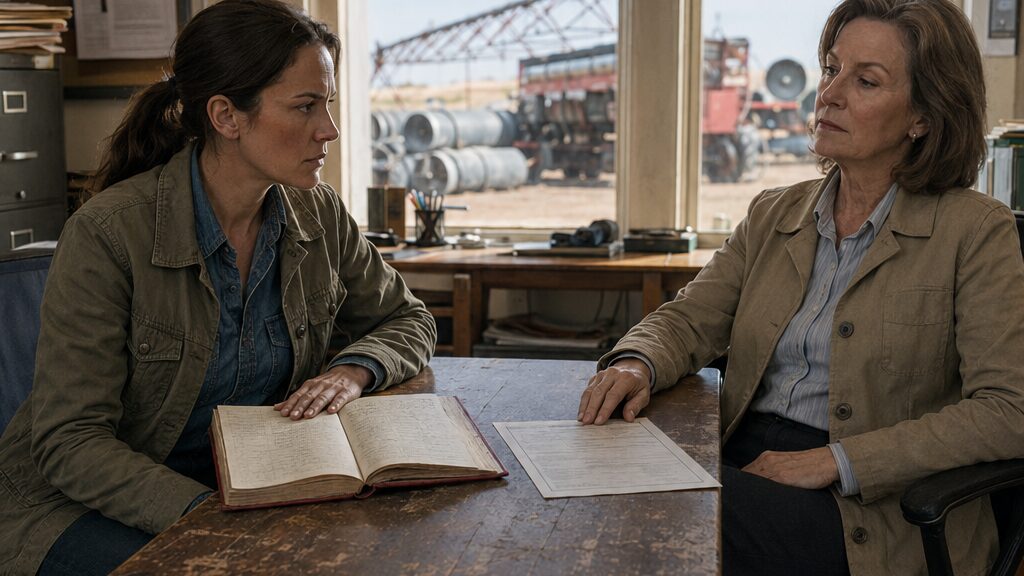
The cooperative office sat beside the equipment yard, a narrow building that smelled faintly of paper, dust, and fertilizer from the supply room next door. Through the blinds, Maria could see irrigation pipe stacked against a chain-link fence.
Carolyn folded her hands.
“You wanted the record.”
“I wanted to know where his money went.”
“This is part of that answer.”
Maria finally pulled the page toward her.
The heading described an emergency infrastructure reallocation.
Below it were paragraphs of formal language about drainage stabilization, shared irrigation capacity, member protection, and reserve flexibility.
At the bottom:
Raymond Carter.
Maria looked at the signature.
It was close.
Close enough that she understood why someone who had never watched Raymond write might accept it.
“You said he signed this himself?”
“Yes.”
“Here?”
“No.”
“Where?”
“I’d have to check.”
“You just told me this was the record.”
“It is.”
Maria opened the red ledger beside the authorization.
Carolyn’s eyes dropped to it.
“What is that?”
“His farm ledger.”
Maria turned to an entry from February.
Raymond’s handwriting leaned slightly right. His capital R had a narrow upper loop. His dates were written month, slash, day, then a two-digit year. He pressed hard enough with a ballpoint pen that marks often transferred onto the next page.
The signature on the authorization looked smoother.
Not obviously false.
Just wrong enough to make Maria’s stomach tighten.
Carolyn watched her.
“Your grandfather signed hundreds of things.”
“Not like this.”
“People’s handwriting changes.”
Maria looked up.
Carolyn added, “Especially when they’re older.”
The words sat between them.
Maria closed the ledger halfway.
“What exactly are you suggesting?”
“I’m suggesting Raymond has had health problems. Memory problems can come with that.”
“His memory isn’t the issue.”
“You just told me he doesn’t remember the project.”
“I told you he didn’t remember authorizing his reserve.”
Carolyn leaned back.
“Maria, I know you’re upset. But the cooperative maintained drainage through his lower acreage, kept access open during the spring flooding, and handled vegetation around the lateral ditch while he was in and out of medical care.”
“You’re listing maintenance like it’s a favor.”
“I’m explaining that he benefited.”
“So that makes the signature irrelevant?”
“I didn’t say that.”
Maria felt the anger rise again.
At the bank, she had been frightened.
At the farmhouse, suspicious.
Sitting across from Carolyn, she wanted to accuse her outright.
“You took money from a dying man and now you’re telling me he should be grateful because somebody cleared weeds from a ditch.”
Carolyn’s expression hardened.
“That is not what happened.”
“Then give me the vote.”
“The authorization is in front of you.”
“The board vote.”
“That’s internal.”
“Who approved the transfer?”
“The board.”
“Which members?”
“I’m not going through board deliberations with you.”
Maria pushed the paper away.
“So you won’t tell me who voted, you won’t show me the minutes, and you expect me to accept one signature.”
“A valid signature.”
Maria almost responded.
Then something in the top-right corner of the page caught her attention.
The date.
April 16.
Maria looked again.
April 16.
Her anger went quiet.
She opened her phone and pulled up the calendar she had kept during Raymond’s hospitalization.
April 12: admitted.
April 13: CT scan.
April 14: cardiology consult.
April 15: fever overnight.
April 16: still inpatient.
April 17: discharge postponed.
Maria placed the phone beside the document.
“Which day did you say he signed this?”
Carolyn’s eyes moved to the screen.
“The date is on the page.”
“April sixteenth.”
“Yes.”
“He was in the hospital.”
“That doesn’t mean someone couldn’t bring him paperwork.”
Maria looked up sharply.
“Did someone?”
Carolyn hesitated.
Barely.
But Maria saw it.
“I’d need to check.”
“You just said he signed it.”
“He did.”
“Did you see him?”
“No.”
“Who did?”
“I said I would have to check.”
Maria turned back to the ledger.
She found an April entry written two weeks before Raymond entered the hospital.
Then a May entry after he returned home.
Both used the same cramped, heavy handwriting.
She laid the authorization between them.
On the cooperative form, the R was rounder.
The final stroke of Carter lifted instead of dragging down.
And the date was written out as “April 16, 2026.”
Raymond almost never wrote dates that way.
Maria ran her finger beneath it.
Carolyn said, “You’re not a handwriting expert.”
“No.”
“Then I suggest you not make accusations.”
Maria looked at her.
“I haven’t made one.”
“You practically walked in with one.”
That was true.
Maria hated that it was true.
She had come expecting theft.
But now she had something better than expectation.
A contradiction.
She took out her phone.
“I want a copy.”
Carolyn’s mouth tightened.
“You can request one through the office.”
“I’m sitting in the office.”
“The clerk handles records.”
“Fine.”
Maria stood and took the ledger with her.
Carolyn remained seated.
“You should be careful with this.”
Maria stopped.
“With what?”
“With turning a difficult cooperative decision into something uglier than it was.”
Maria faced her.
“Then help me keep it simple.”
Carolyn said nothing.
“Send me the recorded vote. Send me the authorization trail. Tell me who took this form to my grandfather in the hospital.”
“The vote is internal.”
“Then I’ll start with what isn’t.”
Carolyn’s eyes narrowed.
“What does that mean?”
“County filings. Permits. Recorded project documents. Whatever the cooperative submitted publicly.”
For the first time, Carolyn smiled.
Not warmly.
It was the expression of someone who believed Maria was about to waste several days discovering how complicated paperwork could be.
“Go ahead.”
Maria picked up the photocopy the clerk had brought.
At the door, she turned back.
“If this was legitimate, the records should agree.”
Carolyn’s smile faded slightly.
Maria walked outside.
The equipment yard was loud with a loader reversing near a stack of pipe.
She stood beside her truck and studied the copied authorization again.
April 16.
Hospital.
Wrong date style.
Wrong pressure in the handwriting.
Not proof.
Not yet.
But enough that she no longer wanted Carolyn to explain anything.
She wanted the records to do it.
Chapter 3: The Drainage Project Was Real
The county file contained no approval for a project as large as Carolyn had described.
Maria checked the number twice.
Then she asked the county recorder to check it again.
The recorder turned the monitor slightly.
“This is what was filed.”
Maria leaned closer.
A drainage stabilization permit.
An irrigation crossing repair.
Temporary equipment access.
All real.
But the estimated project value was nowhere near the amount removed from Raymond’s reserve and nowhere near the total figure Maria had seen referenced in the cooperative paperwork.
“Is there another phase?”
“Not under this parcel group.”
“Another permit?”
“Not that I see.”
Maria wrote down the filing numbers.
“Could work have been done without appearing here?”
“Depends on the work.”
“What about major drainage excavation?”
The recorder pointed to the permit.
“That would be this one.”
By noon, Maria had copied everything available.
At home, she covered the kitchen table again.
County permit.
Cooperative authorization.
Raymond’s ledger.
A contractor invoice she had requested through a public grant attachment.
She circled numbers until the page looked bruised with ink.
The project existed.
That should have made things clearer.
Instead, it made them worse.
Maria had spent two days telling anyone who would listen that Carolyn had invented an improvement project to drain Raymond’s account.
She had said it in the cooperative parking lot where two member farmers were standing near a pickup.
She had said it to the county clerk.
She had nearly said it to the bank.
But there was dirt under excavator tracks along the drainage corridor.
There was new pipe in the ground.
There were fresh concrete headwalls.
The project was not imaginary.
Late that afternoon, Maria drove out to the lower drainage corridor herself.
The land dipped gently behind several fields before feeding into a narrow channel that carried runoff toward the creek. Raymond had complained about that corridor for years.
After heavy rain, water used to stand against the low side of his property for days.
Now the ditch had been widened.
The banks were newly graded.
A reinforced crossing carried a service road over the water.
Maria parked and walked along the edge.
A pickup pulled onto the gravel behind her.
Jessica Roberts stepped out wearing work boots and a faded long-sleeved shirt.
Maria recognized her immediately.
Jessica farmed acreage downstream.
“You looking for something?” Jessica asked.
“Trying to understand what they spent.”
Jessica glanced toward the ditch.
“More than anybody wanted.”
“You knew Raymond’s reserve paid for it?”
Jessica’s face changed.
“No.”
“The cooperative says he approved it.”
“I heard they used emergency funds.”
“His beneficiary reserve was part of the emergency funds.”
Jessica looked genuinely unsettled.
“I didn’t know that.”
Maria crossed her arms.
“You didn’t ask?”
Jessica’s expression hardened.
“I had seventy acres underwater.”
Maria said nothing.
Jessica pointed toward the drainage line.
“That old culvert collapsed in March. Water backed up across my south field and two others. If we’d gotten another storm before they opened this channel, I would’ve lost most of the planting window.”
“That doesn’t give them the right to take his money.”
“I didn’t say it did.”
“You benefited.”
“Yes.”
The answer came without apology.
Maria felt her jaw tighten.
Jessica walked toward the ditch.
“My operating loan was already stretched. I couldn’t put another twenty thousand into drainage on short notice. Neither could the farm east of mine.”
“So everybody was comfortable as long as Raymond paid.”
Jessica turned.
“That’s not fair.”
“Was what happened to him fair?”
“No.”
The immediate answer stopped Maria.
Jessica looked back at the new crossing.
“I thought the money came from the cooperative emergency reserve and a county cost-share. That’s what we were told.”
“By Carolyn?”
“By the board.”
Maria studied her.
“You never saw the numbers?”
“No.”
“Didn’t want to?”
Jessica exhaled.
“Probably not.”
There it was.
Not conspiracy.
Not innocence either.
Just desperation.
Jessica rubbed dirt from the heel of one boot against the gravel.
“When your crop is sitting in water, you stop asking some questions you should ask.”
Maria looked down the corridor.
For the first time, the new ditch did not look like evidence of theft.
It looked like something more dangerous.
A real need.
Real work.
Real people saved from losses.
And money that still might have been taken without permission.
Back at the farmhouse, Maria opened Raymond’s red ledger to older entries about shared drainage work.
“Roberts ditch tile—split three ways.”
“North crossing—loaned cooperative 2,400. Paid back Dec.”
“Pump repair—my share only.”
Every shared expense had a note.
Every loan had a line.
Every gift, even small ones, was marked differently.
Raymond helped people.
But he recorded the terms.
Maria sat with that realization until dark.
She had wanted the ledger to prove Carolyn wrong.
Instead, it was beginning to show Maria something about Raymond she had stopped noticing years ago.
He had believed in helping neighbors.
He had also believed help required clarity.
The next morning, Maria compared the county estimate with the contractor invoice again.
The first numbers matched.
Excavation.
Pipe.
Concrete.
Equipment rental.
Then came a management charge.
Then another administrative line.
Then a project coordination fee large enough to make Maria sit back.
She added the totals.
The county filing showed an estimated project cost in the low six figures.
The cooperative invoice package was far higher.
She recalculated.
Same result.
Maria called the contractor’s office and asked whether the county-filed estimate reflected the full physical scope.
The person who answered would only confirm that the filed permit covered the excavation, pipe installation, crossing reinforcement, and grading.
Maria hung up.
She placed the contractor invoice beside the county estimate.
The difference was more than a hundred thousand dollars.
For two days, Maria had been wrong about one thing.
The project was real.
Now she had a worse question.
If the ditch, pipe, concrete, and equipment accounted for only part of the money, where had the rest gone?
Chapter 4: The Money Beyond the Fence Line
“The totals don’t reconcile.”
Andrew Green said it without looking up.
Maria stood across from his desk with Raymond’s red ledger tucked beneath one arm and the cooperative invoice package spread between them. Andrew’s office occupied two rooms behind an equipment insurance agency, the sort of place farmers used because nobody minded mud on the floor.
Maria pulled out the chair.
“How far off?”
Andrew tapped his calculator.
“Far enough that I don’t want to guess.”
“That sounds reassuring.”
“It shouldn’t.”
He moved three sheets into separate piles.
“This is physical work. Excavation, pipe, concrete, equipment hours. This is administrative expense. And this—”
He lifted a page by one corner.
“—I don’t know what this is.”
Maria leaned forward.
PROJECT MANAGEMENT AND COORDINATION.
The amount beneath it was larger than Raymond’s annual farm income in several of the lean years Maria remembered.
“That’s the line I found.”
“It isn’t the only one.”
Andrew turned another page toward her.
A second fee appeared under a different description.
Then a third.
The wording changed slightly each time, but the destination account was the same.
Maria felt the familiar heat rise behind her ribs.
“So they skimmed it.”
Andrew looked at her.
“I didn’t say that.”
“They moved six figures into an account that didn’t pour concrete or dig a ditch.”
“I said I don’t have supporting work for those charges.”
“What’s the difference?”
“The difference is whether you want to know what happened or whether you want somebody to agree with what you already think.”
Maria sat back.
The words irritated her because Jessica had already forced her to confront the same problem.
The drainage project had been real.
The water had moved.
Fields had been saved.
And Maria had spent the first two days treating everyone connected to it as if they had been standing in Raymond’s bedroom taking cash from his wallet.
Andrew slid the contractor invoices closer.
“The county estimate is lower because it covers permitted construction. The cooperative package includes other costs.”
“Like what?”
“Some legitimate things. Engineering review. Temporary pumping. Access grading. Emergency equipment rental.”
“And the rest?”
“I need bank records.”
Maria had brought what she could obtain from Raymond’s beneficiary file.
Andrew traced several transfers.
One left the cooperative’s general project account.
Another moved through a reserve consolidation account.
A third landed in a private management account.
“Whose?”
“That’s what I’m trying to establish.”
Maria looked at the name printed beside it.
It sounded official enough to pass without notice.
Agricultural Resource Management Services.
“Is that the contractor?”
“No.”
“The county?”
“No.”
“Then who?”
Andrew opened his laptop.
Twenty minutes later, he found a registration record.
The entity shared a mailing address with a small administrative firm that had handled cooperative paperwork for several years.
Maria stared at the screen.
“Board-linked.”
“Linked,” Andrew said. “Not necessarily owned by a board member.”
“You really hate simple sentences.”
“I like accurate ones.”
He searched further.
The same management account appeared in two prior cooperative projects.
A pump replacement.
A boundary-drainage assessment.
Neither involved Raymond.
Maria leaned closer.
“So this wasn’t a one-time emergency.”
Andrew’s expression changed.
“No.”
That single word landed harder than the rest.
Maria had been prepared to find one bad decision tied to Raymond’s illness.
Now the same account sat inside unrelated cooperative transactions.
Andrew printed the records.
“Don’t call this theft yet.”
“What would you call it?”
“A pattern that deserves records.”
Maria stood and walked toward the window.
Across the parking lot, a grain truck waited at the intersection.
“I want the state involved.”
“Maybe.”
She turned.
“Maybe?”
“If you file broad allegations and the state or bank treats the entire project as tainted, money can get frozen.”
“Good.”
Andrew’s face remained neutral.
“Payroll can get frozen.”
Maria stopped.
“So?”
“Maintenance crews. Pump operators. Emergency repairs.”
“That’s not Raymond’s responsibility.”
“No. But if the project is declared invalid rather than the questionable charges separated from the legitimate work, cooperative members could be assessed to return funds.”
Maria thought of Jessica standing beside the ditch.
Seventy acres underwater.
An operating loan already stretched.
“You’re saying they could make farmers repay money they never knew came from Raymond.”
“I’m saying the accounting structure matters.”
Maria looked down at the red ledger.
She opened it without thinking.
Raymond’s entries were almost annoyingly precise.
Fence posts—half to Roberts.
Diesel reimbursement—received.
Pump bearing—my share.
Even when he forgave somebody, he wrote it.
Paid enough. Closed.
Maria ran a thumb along the edge of the paper.
“He would have written this down.”
Andrew glanced toward the ledger.
“What?”
“If he gave them that kind of money.”
“Maybe.”
“No. He would.”
Andrew did not argue.
Maria flipped through several years.
Small shared expenses.
Loans.
Crop storage charges.
Road gravel.
One entry from years earlier recorded a four-hundred-dollar contribution toward a neighbor’s failed well.
Gift. No repayment.
Another showed a temporary advance to the cooperative during a pump emergency.
Loan. Return by December.
Raymond had helped people constantly.
But he had distinguished between helping and surrendering ownership.
Maria closed the ledger.
“So what can I prove?”
Andrew pulled a legal pad toward him.
“That the permit amount and cooperative billed amount do not match.”
He wrote a second line.
“That the difference includes management charges for which we currently have no supporting description.”
A third.
“That some of those charges reached an account used in other cooperative projects.”
A fourth.
“And that Raymond’s beneficiary reserve was one of the sources.”
Maria waited.
“And the signature?”
“Separate issue. Stronger if a document examiner agrees with you.”
Maria nodded.
For the first time since Monday, her anger felt useful instead of hot.
She did not need to call every dollar stolen.
She needed to force the cooperative to explain each one.
Back at the farmhouse that evening, Maria spread Raymond’s beneficiary agreement beside the ledger.
The hospice nurse had already left.
Raymond was asleep.
Maria read the agreement from the beginning.
Most of it was old cooperative language about voting rights, water access, assessments, reserve obligations, succession, and dispute procedures.
She nearly skipped the section titled Beneficiary Review.
Then one sentence stopped her.
A designated beneficiary whose individual reserve had been materially reallocated could request an independent accounting review upon written challenge to authorization.
Maria read it again.
No board vote required.
No permission from the chair.
She carried the agreement into Raymond’s bedroom.
He was awake, staring toward the ceiling.
“I found something,” she said.
“Money?”
“Not yet.”
“Then keep looking.”
She smiled despite herself.
Maria sat beside him.
“If they used your reserve without proper authorization, your agreement lets me force an independent review.”
Raymond turned his head toward her.
“Force?”
“That’s the word I’m using.”
“Careful with that word.”
“Why?”
“Because people use it when they’re tired of asking.”
Maria looked down.
“I am tired of asking.”
He closed his eyes again.
“Then know what you’re forcing.”
Maria sat quietly.
The agreement rested on her lap.
By morning, the board could move more money.
But if Maria triggered the review, she might freeze funds farmers actually needed.
For the first time, the question was no longer whether she could stop Carolyn.
It was whether she could stop the right thing.
Chapter 5: What Carolyn Thought Raymond Would Allow
Carolyn called at 7:08 Monday morning, twenty-two minutes before Maria planned to send the independent-review notice.
“Don’t file it yet.”
Maria stood at Raymond’s kitchen counter with the beneficiary agreement open beside her laptop.
“How do you know I’m filing anything?”
“You requested the review procedures Friday.”
“So?”
“So I know what comes next.”
Maria looked at the clock.
“Then you know I’m within my rights.”
“I know you can trigger something you may not be able to control.”
Maria almost ended the call.
Instead, she said, “You have twenty minutes.”
Carolyn exhaled.
“Come to the pump station.”
“Why?”
“Because if we’re going to argue about what happened, you should see what everyone was looking at when the decision was made.”
The pump station sat beside the main irrigation lateral, a low concrete building surrounded by pipe, valves, and electrical cabinets. Maria arrived to find Carolyn standing near the fence with a folder tucked beneath one arm.
Water moved through the channel behind her with a steady mechanical rush.
Carolyn did not offer a greeting.
“This pump nearly failed in March.”
Maria looked toward the building.
“I know there were repairs.”
“Not just repairs.”
Carolyn pointed downstream.
“When the culvert collapsed, we were pushing more water through less functioning drainage. Jessica’s fields were already under water. Two farms east of her were days away from the same problem.”
“So you took Raymond’s reserve.”
Carolyn’s jaw tightened.
“You always jump to the last line.”
“The last line is his money disappearing.”
“The first line is that we had farms about to miss planting.”
“Then assess the members.”
“We did.”
“Not enough.”
“No.”
“Apply for emergency funding.”
“We did.”
“Not enough.”
Carolyn looked toward the pump station.
“There wasn’t time.”
Maria folded her arms.
“That explains urgency. It doesn’t explain his signature.”
Carolyn said nothing.
Maria waited.
“Did you know he hadn’t signed it properly?”
“I knew the authorization process was imperfect.”
“That’s a careful sentence.”
“It’s an accurate one.”
Maria almost laughed.
“You sound like Andrew.”
“I know Andrew.”
“Everybody does.”
Carolyn’s eyes narrowed.
Maria continued.
“Did Raymond sign that page?”
“I believed he approved the use.”
“That wasn’t my question.”
Carolyn shifted the folder beneath her arm.
“The board discussed Raymond’s reserve because he had supported emergency cooperative work before.”
“Did he sign?”
“There had been conversations.”
“With whom?”
“Board members.”
“While he was in the hospital?”
Carolyn looked away.
There it was again.
Not the answer.
The space before it.
Maria stepped closer.
“You knew he wasn’t at the meeting.”
“Yes.”
The word seemed to cost Carolyn something.
Maria felt her anger return, but colder now.
“And you let the document say otherwise.”
“It does not say he attended.”
“The approval is dated that day.”
“Yes.”
“Who signed his name?”
“I don’t know.”
Maria stared at her.
“You expect me to believe that?”
“I expect you to understand that the board received an authorization we believed reflected his intention.”
“His intention.”
Carolyn nodded.
“He helped people, Maria.”
“Don’t use that against him.”
“I’m not.”
“You used his reserve because you decided a generous man would say yes.”
Carolyn’s voice sharpened.
“We had people facing crop failure.”
“And that made you his voice?”
“No.”
“It did when you accepted that form.”
The water behind them kept moving.
Carolyn opened the folder and removed several pages.
“Raymond contributed to emergency ditch repairs in 2018.”
“I know.”
“He advanced money for the west pump in 2021.”
“I know.”
“He waived repayment for two small member assessments after the drought.”
Maria hesitated.
She had seen the entries.
Carolyn noticed.
“Exactly.”
“Those were written down.”
“That doesn’t change who he was.”
“It changes what he agreed to.”
Carolyn looked toward her.
For the first time since Maria had entered the cooperative office, Carolyn did not appear dismissive.
She appeared tired.
“We were trying to keep farms operating.”
Maria said nothing.
Carolyn lowered her voice.
“I was looking at three families who might not make another season. I was looking at a failed drainage system and a county reimbursement that wouldn’t arrive for months. Raymond had money sitting in a reserve he had used for community needs before.”
“Sitting.”
“You know what I mean.”
“Yes. I do.”
Carolyn rubbed a hand across her forehead.
“I told myself if he were sitting in that board room, he would have said yes.”
“And if he said no?”
Carolyn did not answer.
That silence changed Maria’s understanding more than any document had.
Carolyn had not believed she was stealing from Raymond.
She had believed she knew him well enough to skip asking.
And once the money moved, admitting doubt would have meant admitting the board had built emergency financing on consent it did not actually possess.
Maria thought of how easily she herself had decided Jessica was complicit simply because Jessica’s fields had benefited.
Different scale.
Same habit.
Deciding what another person must have meant because the answer was convenient.
Carolyn looked toward Maria’s truck.
“You file that review and the bank may restrict cooperative accounts.”
“Andrew already told me.”
“Then you know payroll could stop.”
“I know.”
“Pump maintenance. Emergency purchases. Contractor payments.”
“I know.”
“Do you?”
Maria’s temper flashed.
“My grandfather has weeks left. His reserve is gone. Don’t ask me whether I understand consequences.”
Carolyn flinched slightly.
Maria regretted the sharpness but not the meaning.
She took the review notice from her bag.
Carolyn stared at it.
“You already prepared it.”
“Yes.”
“Then why come?”
“Because I needed to know whether I was dealing with a mistake or a choice.”
Carolyn’s expression hardened again.
“And?”
“A choice.”
Maria walked back to her truck.
Carolyn called after her.
“If you freeze everything, you won’t just hurt me.”
Maria stopped with her hand on the door.
She looked down at the review notice.
The original draft requested examination of all cooperative accounts, all emergency infrastructure funding, all assessments, and every transaction connected to the spring project.
She had written it angry.
At home, she opened the document again.
Then she deleted half of it.
She limited the challenge to Raymond’s beneficiary reserve, the disputed authorization, related transfers, management charges, and any account receiving those funds.
She added a request that ordinary operating expenses and essential irrigation maintenance remain outside the restriction unless directly connected to the disputed transactions.
At 8:41, she attached the beneficiary agreement.
At 8:43, she added the hospital admission record.
At 8:46, she added the county permit totals.
Her finger hovered over Send.
From the bedroom, Raymond coughed.
Maria closed her eyes.
Know what you’re forcing.
At 8:47, she sent the request.
Not to punish the cooperative.
Not to rescue Carolyn.
To make someone outside both of them look at the records.
Chapter 6: The Audit That Could Hurt Everyone
The bank halted the cooperative’s discretionary transfers on Wednesday afternoon.
By Thursday morning, Jessica Roberts was standing in Maria’s driveway.
“My pump repair is on hold.”
Maria had not even finished buttoning her jacket.
“What?”
“The service company won’t come until the cooperative confirms payment.”
Maria looked toward Jessica’s pickup.
“Your pump isn’t part of the disputed project.”
“I know that.”
“Then it shouldn’t be frozen.”
“Tell the bank.”
Maria felt the first real weight of what she had triggered.
The independent accounting review had moved quickly once the state agricultural-finance office acknowledged Raymond’s beneficiary challenge. The bank had not frozen everything, but it had restricted transfers from several accounts pending classification.
Apparently one of those accounts paid emergency maintenance.
Maria grabbed her keys.
“Come on.”
At the bank, the branch manager would not discuss cooperative account details with Maria beyond confirming that restrictions followed the review notice and the state inquiry.
“What about essential operations?”
“If the cooperative documents them properly, there are procedures for release.”
“So nobody can pay a pump repair until paperwork clears?”
“That depends on the account and the documentation.”
Jessica stared at Maria.
Outside, neither woman spoke for several steps.
Then Jessica said, “This is what Carolyn warned you about?”
“Yes.”
“And you filed anyway.”
“Yes.”
Jessica looked away.
Maria waited for the accusation.
Instead, Jessica said, “Then fix the part you can fix.”
That was worse.
By noon, Maria was at the county agricultural office with Andrew and an investigator assigned to the accounting review.
Folders covered a conference table.
The investigator separated expenses into categories.
Physical drainage construction.
Pump work.
Emergency equipment rental.
Administrative fees.
Management transfers.
Maria watched the piles grow.
Some of the charges she had suspected were clean.
Invoices matched work.
Equipment hours matched contractor logs.
County records supported the scope.
Other charges had almost nothing behind them.
No work descriptions.
No subcontractor records.
No explanation beyond broad management language.
Andrew pointed to one.
“This amount moved two days after the main contractor was paid.”
The investigator nodded.
“And we have no matching service record.”
Maria asked, “Can that stay frozen while normal maintenance is released?”
“Potentially.”
“Potentially isn’t helping Jessica’s pump.”
The investigator glanced at her.
“This process is not built around one pump.”
“No. But the cooperative is.”
Andrew looked at Maria.
She opened Raymond’s red ledger.
She had brought it because the document examiner wanted handwriting samples, but now she turned to older cooperative entries.
“Raymond separated shared operating costs from special advances.”
The investigator looked at the book.
Maria pointed.
“Routine ditch cleaning. Pump maintenance. His share of electric costs. Those were normal obligations.”
Another page.
“Emergency advance to repair the west pump. Separate. Repayment date written beside it.”
Andrew leaned closer.
Maria continued.
“If the cooperative’s own history treats daily operation differently from special project financing, can you isolate the operating account?”
The investigator did not answer immediately.
Then he asked for the cooperative agreement.
Two hours later, they had a framework.
Essential irrigation maintenance and verified payroll could move through a protected operating account under temporary oversight.
Disputed management transfers could not.
Project reimbursements tied directly to the challenged reserve would remain restricted.
It was not elegant.
But Jessica’s pump repair could proceed once documented.
When Maria told her, Jessica nodded once.
“Thank you.”
Maria shook her head.
“I’m the reason it stopped.”
“You’re the reason they have to show where it comes from now.”
The distinction stayed with Maria.
The next three days were less satisfying than she had imagined accountability would feel.
There were no dramatic confessions.
No single ledger entry that solved everything.
Just boxes.
Statements.
Receipts.
Missing attachments.
Emails with careful wording.
Some management charges could be tied to legitimate coordination work.
Others could not.
The private management account had been used across multiple cooperative projects, but that fact alone did not prove improper ownership.
The state investigator requested organizational records and supporting contracts.
Andrew reconstructed transfers.
The document examiner collected Raymond’s known signatures from the ledger and beneficiary forms.
Maria kept going back to the farmhouse between meetings.
Raymond was weaker now.
His sentences came shorter.
One afternoon, she sat beside his bed and told him the cooperative could still pay for necessary pump repairs.
“Good,” he whispered.
“They’re separating the disputed money.”
He nodded.
“Good.”
“And they’re checking your signature.”
His eyes opened.
“Mine?”
“The one they say you signed.”
Raymond looked at the red ledger on the chair.
“Ugly writing.”
Maria smiled.
“Very.”
He closed his eyes.
“But mine.”
“Yes.”
That was all.
On Monday, Carolyn agreed to open the cooperative records room to the investigator.
Maria arrived expecting resistance.
Instead, Carolyn was already there with file boxes stacked along the wall.
“You decided to cooperate,” Maria said.
Carolyn did not look up.
“I decided I’m tired of pretending missing paper is better than bad paper.”
Maria watched her.
That was as close to an admission as Carolyn had come.
The investigator asked for project notes, board communications, reserve authorizations, and management-service agreements.
Carolyn produced most of them.
Not all.
By late afternoon, the investigator had identified unsupported management charges substantial enough to remain frozen.
At the same time, verified emergency construction costs were cleared as legitimate cooperative expenses.
The truth had divided itself almost exactly where Maria had resisted allowing it to divide.
Some money had saved farms.
Some charges could not be justified.
Raymond’s reserve should not have been treated as a blank check for either.
As the investigator packed up, Carolyn remained seated at the end of the table.
“There’s one more file.”
Maria turned.
Carolyn opened a drawer beneath the records cabinet.
From it, she removed a thin folder.
The state investigator stopped moving.
“What is that?”
“Board notes.”
“We requested all board notes.”
“I know.”
Maria felt her body go still.
Carolyn set the folder on the table.
“Why weren’t these provided?”
Carolyn looked at Maria rather than the investigator.
“Because I knew which paragraph she would read first.”
Maria stepped closer.
Carolyn pushed the folder across the table.
Her hand remained on it for one second before she let go.
“Read the final paragraph yourself.”
Chapter 7: The Difference Between Helping and Taking
The final paragraph was only four lines long.
Maria read it twice before she trusted herself to speak.
The board notes stated that Raymond Carter had not attended the April 16 meeting. They also recorded that his verbal support for earlier cooperative repairs had been “understood as continuing approval” for the emergency reserve transfer.
There was no mention of anyone taking paperwork to the hospital.
No description of Raymond signing anything.
No recorded vote authorizing someone else to sign on his behalf.
Maria lifted her eyes from the page.
“You knew.”
Carolyn sat across the records-room table, hands folded loosely in front of her.
“I knew he wasn’t there.”
“You knew the authorization didn’t match the meeting.”
“Yes.”
“And you still used it.”
Carolyn looked toward the window.
The equipment yard outside was nearly empty now. Most of the day’s work had ended, leaving only a utility truck and several lengths of irrigation pipe stacked near the fence.
“The board had already voted to proceed with the emergency work,” Carolyn said.
“That isn’t what I asked.”
“No.”
Maria waited.
Carolyn finally looked at her.
“I accepted the authorization because I believed it reflected what Raymond would have wanted.”
There it was.
Not theft confessed in some dramatic sentence.
Something quieter.
Something almost worse.
Carolyn had decided that knowing Raymond gave her permission to replace him.
Maria closed the folder.
“He wrote everything down.”
Carolyn’s eyes shifted toward the red ledger beside Maria’s elbow.
“I know.”
“No, I don’t think you did.”
Carolyn’s expression tightened.
Maria opened the ledger.
She turned to the entries she had shown Andrew.
“Shared ditch repair. His share only.”
Another page.
“Pump advance. Loan. Return by December.”
Another.
“Gift. No repayment.”
Maria tapped the paper.
“He helped people. Constantly. But he never acted like helping meant nobody had to ask.”
Carolyn stared at the ledger.
For a moment, Maria saw something in her face that had not been there in their first meeting.
Shame, perhaps.
Or exhaustion.
“He would have supported the project,” Carolyn said quietly.
“Maybe.”
Carolyn looked up.
Maria continued.
“That’s the part you still don’t understand. Maybe he would have said yes.”
She closed the ledger.
“But you took away his chance to say it.”
Neither woman spoke.
The state investigator stood near the filing cabinet, giving them enough distance to make the silence feel private without actually leaving.
Finally Carolyn said, “What happens now?”
Maria glanced toward the investigator.
The financial reconstruction had already separated most of the legitimate emergency construction from the unsupported management charges.
The drainage work would not be unwound.
The pump repairs would remain funded.
Verified operating expenses could continue.
But the unsupported charges were still frozen, and Raymond’s estate would have a formal repayment claim against the improperly used portion of his beneficiary reserve.
The investigator had also recommended temporary restrictions on Carolyn’s authority over cooperative accounts.
Maria looked back at her.
“You step away from financial approvals while the review continues.”
Carolyn did not argue.
Maria had expected resistance.
“You’re agreeing?”
Carolyn gave a tired laugh.
“What exactly would I be defending now?”
“The project.”
“I’ll defend the project.”
Carolyn looked at the folder.
“I’m not going to defend that.”
The answer did not absolve her.
But it mattered.
By the end of the week, the cooperative board voted to place financial authorization under dual review until the state process concluded.
Carolyn remained on the board temporarily but lost unilateral control over project transfers.
The unsupported management charges were classified for recovery.
The legitimate drainage and irrigation expenses stayed in place.
Jessica’s pump was repaired on Friday morning.
Maria stopped by the drainage corridor that afternoon.
Water moved cleanly beneath the reinforced crossing.
Jessica stood near the edge of her field watching the repair crew pack up.
“They cleared it,” Jessica said.
“I heard.”
“And the repayment assessment?”
“Still being calculated.”
Jessica nodded.
“We’ll probably pay more next year.”
“Probably.”
Jessica looked toward the ditch.
“You could’ve tried to blow the whole project apart.”
“I almost did.”
Jessica gave her a sideways glance.
“I know.”
Maria felt the embarrassment again.
“I was angry.”
“You had a reason.”
“That doesn’t make everything I said true.”
Jessica considered that.
“No.”
It was not forgiveness.
It was better.
It was accurate.
Maria went back to Raymond’s farmhouse before dark.
The hospice nurse met her at the door.
One look at her face and Maria knew.
She stopped in the entryway.
“When?”
“About twenty minutes ago.”
Maria did not cry immediately.
That surprised her.
She walked into the bedroom and sat beside Raymond.
His hands rested loosely over the quilt.
The red ledger remained on the chair where she had left it.
Maria picked it up.
The last page with his handwriting held an entry she had somehow missed.
It was dated several weeks before his hospital stay.
Shared gate repair—west lateral.
Below it, in smaller writing:
Help when it’s needed. Write down who gives what.
Maria read the sentence again.
Then she laughed once through the tears that finally came.
Of course.
Even his generosity had instructions.
Two weeks later, the cooperative held a special meeting.
There was no crowd waiting for Maria.
No applause.
No dramatic resignation.
Just folding chairs, paper cups of coffee, tired farmers, and a long table covered in revised accounting schedules.
Andrew sat near the state investigator.
Jessica sat two rows behind Maria.
Carolyn sat at the far end of the table.
The repayment structure was read aloud.
Legitimate emergency construction would remain cooperative expense.
Unsupported management charges would be recovered through the responsible administrative accounts and insurance where applicable.
Raymond’s estate would receive a formal reimbursement claim for the portion of his reserve used without valid authorization.
Carolyn would remain removed from direct financial authority pending final review.
When the chair asked whether there were objections, Carolyn raised one hand.
Maria looked at her.
“I have one correction,” Carolyn said.
The room became quiet.
She looked down at the document.
“The minutes say Raymond’s reserve was used under presumed member consent.”
Carolyn swallowed.
“That should be changed.”
The acting chair asked, “To what?”
Carolyn looked at Maria.
“Without verified consent.”
No one applauded.
No one needed to.
The sentence was entered.
After the meeting, Maria drove alone to the irrigation gate near Raymond’s lower field.
She carried the red ledger and the rusted gate key he had used for years.
The metal key was rough beneath her thumb.
She unlocked the gate, walked through, then locked it behind her again.
For most of her life, Maria had thought the farm represented everything she had escaped.
Work that never ended.
Neighbors who knew too much.
Obligations nobody wrote down because everyone assumed somebody remembered.
She understood now why Raymond had written so much.
Memory was not enough.
Good intentions were not enough.
Even love could become a kind of arrogance when one person decided they knew what another would choose.
Maria sat on the wooden rail beside the irrigation line.
She opened the ledger to a fresh page.
The reimbursement had not arrived yet.
The state review was not finished.
Trust inside the cooperative would take years to rebuild.
But the record could begin correctly.
Maria wrote the date.
Her handwriting looked nothing like Raymond’s.
Under it, she wrote:
Raymond Carter reserve correction—claim accepted.
Then, after a moment, she added:
Shared repairs remain shared. Permission remains personal.
Maria closed the ledger.
She placed the rusted gate key on top of it and listened to the water moving through the lateral toward the fields beyond Raymond’s fence.
The cooperative had needed his help.
That had never been the lie.
The lie was believing need gave anyone the right to choose for him.
Maria picked up the ledger and walked back toward the farmhouse.
This time, she carried it as a record of what Raymond had given willingly—and of what no one would ever be allowed to give away for him again.
The story has ended.