The HOA Chained Off His Driveway Before Sunrise—Then an Eighteen-Inch Boundary Changed Everything
Chapter 1: The Chain Was Waiting Before Sunrise
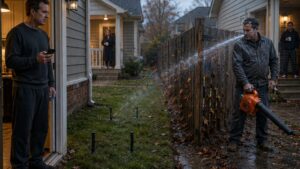
Anthony Hall saw the chain before he understood what he was looking at.
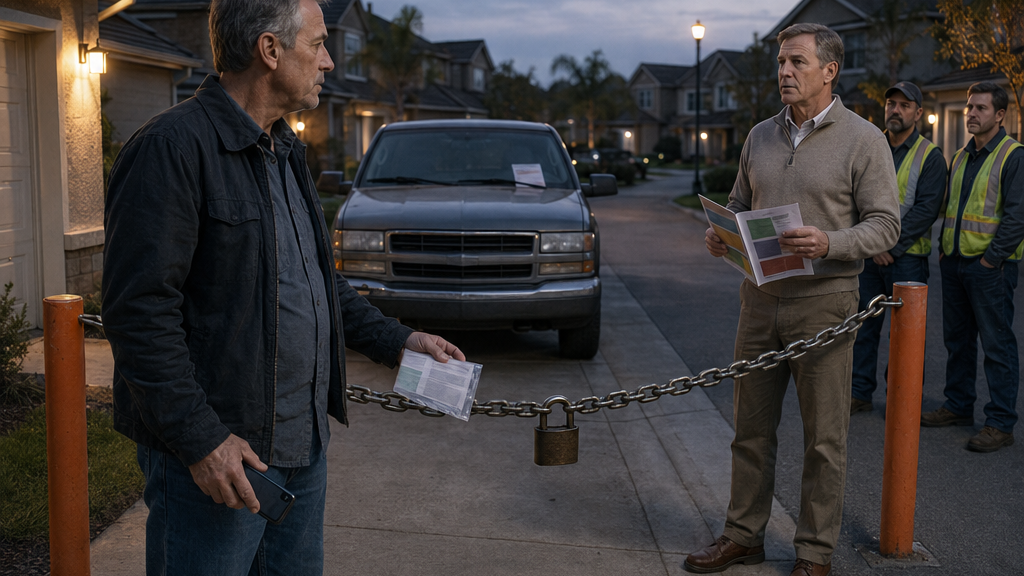
It hung waist-high across the lower end of his driveway, looped between two bright orange steel posts that had not been there when he went to bed. A brass-colored padlock caught the beam from his porch light. Beyond it sat his pickup, nose pointed toward the street, effectively trapped on his own property.
For several seconds Anthony stood on the concrete in his work shoes, coffee cooling in one hand.
It was 5:43 Tuesday morning.
Two men in reflective vests were tightening a bracket around one of the posts. Donald Roberts stood ten feet away with a folder tucked under his arm.
Anthony set the coffee on the brick ledge beside the garage.
“What is this?”
Donald turned as though he had been expecting the question.
“Association enforcement.”
Anthony looked from him to the chain.
“Across my driveway?”
“The portion beyond this point is common area.”
Anthony stared at him.
For twelve years, he had backed trucks, lawn trailers, visiting relatives’ cars, and once an ambulance down that same stretch of concrete. No one had ever called it common area.
One of the workers avoided his eyes.
Anthony walked toward the truck. A laminated notice had been tucked beneath the driver-side windshield wiper. He pulled it free.
COMMON AREA. NO PRIVATE PARKING.
Below that was several paragraphs of smaller language about unauthorized use and corrective action.
“You put this on my truck?”
“The board authorized the notice,” Donald said.
Anthony looked down the street. Porch lights glowed on two neighboring houses. A garage door had opened across the cul-de-sac, then stopped halfway, as if the owner had decided watching from inside was safer.
Anthony felt the first sharp urge to unhook the chain himself.
He could have done it. The orange posts were bolted into metal bases, not buried. A wrench and ten minutes would have ended the scene.
Instead, he took out his phone.
Donald’s expression changed.
“What are you doing?”
“Documenting it.”
Anthony photographed the chain, the padlock, each post, the truck, the notice, and the wider driveway. Then he stepped to one side and photographed the point where the concrete met the grass.
Donald exhaled through his nose.
“This doesn’t need to become a confrontation.”
Anthony lowered the phone.
“I woke up and found a lock across my driveway.”
“You’ve been using association property for private parking.”
Anthony almost laughed, but Donald’s face made clear that nothing about the statement was rhetorical.
“According to what?”
Donald opened the folder.
He removed a color copy of a subdivision map. Several areas had been shaded green, blue, and pale yellow. A red line ran beside Anthony’s lot.
Donald tapped the yellow strip.
“That’s the common parcel.”
Anthony leaned closer.
The map was clean. Too clean.
Lot numbers appeared inside rectangles. Street names were printed in block letters. A colored band marked what appeared to be open space running behind three properties.
But Anthony had spent thirty years managing warehouse operations before retiring. He had learned to distrust any document that looked precise without telling you who had made it precise.
He looked at the lower corner.
No surveyor’s seal.
No recording stamp.
No plat book reference.
“What is this?” he asked.
“The association property exhibit.”
“I can see the title.”
Donald stiffened.
Anthony tapped the bottom margin. “Where was it recorded?”
Donald pulled the sheet back.
“It’s the map we use.”
“That isn’t what I asked.”
For the first time, uncertainty flickered across Donald’s face. It was brief.
“The board has reviewed this.”
“With a surveyor?”
“Anthony, you’ve had eleven years to ask these questions.”
That landed harder than Anthony expected.
He had ignored almost every association meeting since moving into Pinecrest Commons. The annual envelopes went into a kitchen drawer. He paid assessments on time, trimmed the shrubs before anyone complained, and regarded neighborhood politics as something other people voluntarily did to themselves.
There had been a mapping notice two years earlier. He remembered enough to picture the envelope.
He had thrown it into the same drawer without reading beyond the first page.
Donald took another sheet from the folder.
“This gives you thirty days to discontinue unauthorized use and remove any personal items or improvements from association property.”
Anthony read it once.
Then again.
“What improvements?”
“The board will specify as needed.”
“So you don’t know.”
Donald’s jaw tightened.
“I’m telling you the matter has already been reviewed.”
Anthony handed the page back.
“No. I’ll keep my copy.”
A worker glanced toward Donald.
Donald nodded reluctantly.
Anthony folded the notice once and tucked it under his arm.
“Unlock the chain so I can leave.”
Donald shook his head.
“Not until the vehicle is moved from the common area.”
Anthony looked at the truck behind the chain.
“You locked the exit, and now you want the truck moved through the lock?”
One worker stared at the ground.
Donald said, “You can move it farther up your driveway.”
Anthony let the absurdity sit between them.
Then he walked back toward the house.
Behind him, Donald called, “We’re trying to handle this professionally.”
Anthony stopped but did not turn.
“So am I.”
Inside, he cancelled the appointment he had planned that morning and set the laminated notice on the kitchen table.
Through the window above the sink, the chain was visible between the orange posts.
It looked less like a boundary than an accusation.
Anthony opened the drawer where he kept old association mail. He found meeting notices, landscaping reminders, two ballots he had never returned, and the mapping letter he vaguely remembered.
He read it now.
It referred residents to an “updated property exhibit” for maintenance purposes. Nothing in the letter said a licensed survey had been performed.
Anthony pushed the drawer shut.
Upstairs, in the closet of the spare bedroom, he had kept the closing papers from when he purchased the property. The box had not been opened in years.
He carried it downstairs and spread its contents across the kitchen table.
Title policy.
Deed.
Tax map.
Closing statement.
Then an older folded sheet marked with a county recording reference.
Anthony opened it carefully.
It was a subdivision plat.
His finger followed the line along the east side of his lot until it reached the driveway.
There, beside the line, was a plat-book number that appeared nowhere on Donald’s color-coded exhibit.
Anthony picked up his phone.
For the first time that morning, the chain outside no longer looked permanent.
Chapter 2: The Map They Used Was Not the Plat
The line on the recorded plat did not run through Anthony’s driveway.
It ran beyond it.
Anthony leaned closer to the kitchen table, one hand flattening the brittle fold while the other held a ruler against the printed scale. The drawing was old enough that the ink had faded slightly, but the boundary notation was clear.
His driveway sat inside the lot line.
At least on paper.
Outside the window, the chain remained stretched across the concrete.
Anthony took a photograph of the plat number and opened the county records website.
The portal was slow and badly designed. He searched by parcel number first, then subdivision name, then plat-book reference. After twenty minutes, a scanned image appeared.
Same plat.
Same recording number.
Same boundary.
He enlarged the eastern edge until the pixels blurred.
There was no colored common-area strip crossing the driveway.
Anthony sat back.
For a moment he felt the easy satisfaction of being right.
Then he remembered Donald’s words.
You’ve had eleven years to ask these questions.
Anthony opened the old association mapping letter again.
The date was eighteen months earlier.
He had never attended the meeting referenced at the bottom.
That irritated him more now than it had when Donald said it. Not because Donald was right about the boundary, but because Anthony had made it easier for someone else’s version of the boundary to become normal.
He began building a timeline.
2013: purchased house.
Recorded plat: already on file.
Association mapping notice: eighteen months earlier.
Chain installed: Tuesday morning.
By nine o’clock, his kitchen table looked like an audit.
He called the management office.
Ruth Mitchell answered on the third ring.
“Pinecrest Commons management.”
“This is Anthony Hall. I need to ask about the property exhibit the board is using.”
There was a small pause.
“I’m familiar with the issue.”
“I assumed you might be.”
Her voice stayed professional. “What do you need?”
“The date that exhibit was recorded.”
Another pause.
“It isn’t a recorded plat.”
Anthony looked toward the window.
“So what is it?”
“It’s an association maintenance exhibit.”
“Who prepared it?”
“I’d have to check.”
“Licensed surveyor?”
“I said I’d have to check.”
Anthony rubbed his thumb along the edge of the table.
“How long has the HOA been using it?”
Ruth’s answer came more carefully this time.
“Several years.”
“For enforcement?”
“For maintenance, landscaping, reserve planning, and sometimes boundary reference.”
“Boundary reference.”
“Yes.”
Anthony let the words settle.
“Does the board have a survey supporting it?”
“I don’t have that information in front of me.”
“Can you find out?”
“I can review the file.”
He almost said, You should have reviewed it before chaining my driveway.
Instead he said, “Thank you.”
Ruth must have heard what he did not say.
“Anthony, I understand you’re upset.”
“I’m trying not to be.”
“That would probably help everyone.”
“Then finding the document would help.”
She was quiet for a second.
“I’ll look.”
By afternoon Anthony had pulled his deed history from the county site and compared the legal description with the plat. Nothing in the chain of title suggested the driveway had been transferred to the association.
He also found the developer’s original parcel map.
Again, the same boundary.
The discovery should have settled him.
Instead it widened the problem.
If Donald’s exhibit was wrong, how long had the board been using it?
And where else?
At 4:17 p.m., Donald called.
Anthony answered from the kitchen.
“I understand you contacted management,” Donald said.
“Yes.”
“This is a board matter.”
“It became my matter when you locked my driveway.”
Donald ignored that.
“The board’s position has not changed.”
“I found the recorded plat.”
“We’ve reviewed the documents.”
“Which documents?”
“The association records.”
“Have you reviewed the county plat?”
Silence.
Then Donald said, “The board is not going to debate this piecemeal over the phone.”
Anthony looked again at the scanned plat open on his laptop.
“Fine. Unlock the chain and schedule a survey.”
“We are not paying for a survey every time an owner disagrees with a boundary.”
“That sounds like exactly when you should pay for one.”
Donald’s tone cooled.
“You have thirty days to comply with the notice.”
“With what, specifically?”
“The unauthorized use.”
“My truck is on my driveway.”
“According to you.”
“According to the recorded plat.”
Donald exhaled.
“If you continue using the disputed area after the compliance period, the association can assess a two-hundred-dollar monthly fine until the violation is cured.”
Anthony’s hand tightened around the phone.
There it was.
Not just inconvenience.
A recurring penalty built on a map nobody had yet shown him was legally authoritative.
“Are you threatening to fine me while refusing to verify the boundary?”
“I’m informing you of the enforcement schedule.”
Anthony nearly answered too quickly. He stopped himself.
For most of his career, the worst mistakes happened when someone reacted before checking the paperwork.
“Send that to me in writing.”
Donald hesitated.
“We already sent the notice.”
“The two hundred dollars. Send it in writing.”
Another pause.
“Fine.”
The call ended.
Anthony set the phone down.
At six that evening, an email arrived from Ruth.
She had located older board packets showing that the colored exhibit had been circulated for maintenance purposes for years. She did not yet see a separate recorded survey attached to the version in current use.
Her final sentence was careful.
I am continuing to review the association file.
Anthony read it twice.
Then he searched for licensed surveyors.
The first office could not come for three weeks. The second quoted a date in the following month.
The third surveyor asked for the plat number.
Anthony gave it.
There was typing on the other end.
“You have the recorded subdivision plat?”
“Yes.”
“And the association is disputing the driveway?”
“Yes.”
“Any existing corner pins visible?”
“I don’t know.”
The surveyor said, “I can be there tomorrow morning if you’re available.”
Anthony looked through the kitchen window.
The chain was black against the last light of the day.
“I’ll be here.”
Chapter 3: Eighteen Inches Changed the Entire Argument
The first survey stake went into the grass on the far side of the driveway.
Anthony watched the surveyor press it into the ground, step back, check the instrument, and move it less than half an inch.
Not toward the concrete.
Farther away.
Anthony said nothing.
The surveyor returned to the tripod positioned near the street and looked through the instrument again.
Donald Roberts was standing beside the orange chain post with his arms folded.
He had arrived ten minutes after the survey crew.
No one had invited him.
The chain still blocked the lower driveway.
“Where does that put the line?” Anthony asked.
The surveyor pointed.
“Through the stake.”
Anthony looked at the concrete edge.
The stake stood in the grass beyond it.
“How far?”
“I’ll give you the exact measurement when I finish.”
Donald shifted his weight.
“This is one point.”
The surveyor looked at him.
“That’s why I’m setting more than one.”
Donald did not answer.
Anthony almost smiled, but the feeling died before it reached his face.
He had imagined this morning too many times since finding the plat. In those versions, a stake went into the ground, Donald saw it, the lock opened, and everyone went home embarrassed but finished.
Instead, the chain remained closed.
The surveyor moved along the eastern side of the lot, locating an old iron pin near a line of shrubs. Soil had nearly buried it. He scraped around the top, checked its position, then compared it with the recorded plat.
“This one is consistent.”
“With what?” Donald asked.
“The recorded monumentation.”
The second point confirmed the first.
Then the third.
By midmorning, small stakes marked a line running parallel to Anthony’s driveway.
Every one of them fell outside the concrete.
The surveyor measured from the driveway edge to the boundary near the section Donald had labeled common area.
He read the tape.
“Eighteen inches, approximately.”
Anthony looked at Donald.
Donald looked at the tape.
“That depends where the concrete was poured,” he said.
The surveyor straightened.
“It does not change the boundary.”
“I understand that.”
“Good.”
Anthony turned away before his irritation showed.
The surveyor spent another forty minutes checking the lot corners and comparing field measurements with the recorded plat.
Finally, he came back toward Anthony with a field notebook.
“The driveway is inside your parcel.”
Anthony waited.
“All of it?”
“All of the section you asked me to verify.”
Donald stepped closer.
“You’re saying none of that concrete is common area?”
“I’m saying the boundary I located from the recorded plat and existing monuments lies beyond the concrete.”
Anthony pointed toward the narrow grass strip.
“So the HOA line is on the other side.”
“The recorded property line is.”
The distinction was professional and precise.
It was enough.
Anthony felt something loosen in his chest.
For three days, he had carried the possibility that he had misunderstood his own property for more than a decade. That the chain, humiliating as it was, might have exposed an error he had made.
Now the evidence sat in the ground in plain view.
Eighteen inches.
Not much more than the width of a lawn mower deck.
Yet those eighteen inches placed every disputed foot of concrete on his side.
Anthony walked to the chain.
He put one hand on the cold links.
“Donald.”
Donald did not move.
“Unlock it.”
“I can’t do that yet.”
Anthony turned.
The surveyor glanced between them.
“What do you mean, you can’t?”
“The board’s counsel needs to review this.”
“You said the area was common property.”
“That remains the association’s position until we receive legal advice.”
Anthony stared at him.
“You had enough certainty to install steel posts.”
Donald’s face reddened slightly.
“We acted on the records available to us.”
“You had the county plat available.”
“We had the association’s exhibit.”
“And now you have a licensed survey.”
Donald lowered his voice.
“Anthony, if I remove enforcement every time someone brings me a contrary document before counsel reviews it, I’m not doing my job.”
The sentence stopped Anthony.
Not because he agreed with it.
Because Donald sounded less like a man defending a driveway line and more like a man defending the idea that his decisions had to remain decisions until someone more powerful released him from them.
Anthony looked at the chain again.
For Donald, unlocking it now would mean admitting the board had acted before verifying its authority.
The surveyor gathered his equipment.
“I’ll prepare the field sketch and certification,” he told Anthony. “You’ll have it as soon as possible.”
“How soon?”
“Tomorrow, likely.”
Donald said, “Send a copy to management.”
Anthony answered before the surveyor could.
“I’ll decide where it goes.”
Donald’s expression hardened.
Anthony immediately regretted the tone.
That was the trap he had been trying to avoid: turning every sentence into territory.
He took a breath.
“I’ll send it to Ruth when I receive it.”
Donald gave a short nod.
The surveyor left.
The stakes remained.
Anthony stood between one of them and the orange post supporting the chain.
The contrast was almost absurd.
One thin wooden stake showed a measured boundary.
One steel post enforced an assumed one.
By noon, two neighbors had walked past more slowly than usual. Neither stopped.
Anthony went inside.
At 1:30, Ruth called.
“I heard the fieldwork supports your plat.”
“It does.”
“How much?”
“About eighteen inches beyond the concrete.”
She was quiet.
“That is not a small discrepancy for this issue.”
“No.”
“I need the survey certification when you get it.”
“You’ll have it.”
There was paper moving on her end.
“Anthony, I’m reviewing the board records.”
He waited.
“I cannot find the resolution Donald referenced.”
“What resolution?”
“The one formally adopting the current property exhibit for boundary enforcement.”
Anthony sat down.
“You’re saying there isn’t one?”
“I’m saying I haven’t found one.”
“Is there a survey behind the exhibit?”
“I haven’t found that either.”
Anthony looked through the window toward the driveway. The chain was still there, motionless between the orange posts.
“Then what exactly have you been enforcing?”
Ruth did not answer immediately.
When she did, her voice had lost some of its office polish.
“That is what I’m trying to determine.”
Anthony leaned back in the chair.
The survey had answered the question he thought mattered.
Where was the boundary?
Now a different question had taken its place.
If no recorded survey supported the HOA’s map, and no clear board resolution had formally adopted it for enforcement, then the problem was no longer eighteen inches of grass.
It was how an assumption had acquired the force of a rule.
Chapter 4: The Board Had Been Enforcing an Assumption
Ruth Mitchell called Anthony at 8:12 Friday morning with a sentence that changed the shape of the dispute.
“I still can’t find it.”
Anthony stood at the kitchen counter with the certified survey open beside him.
“Find what?”
“The resolution Donald said adopted the property exhibit for boundary enforcement.”
Outside, the chain remained stretched across the driveway. The orange posts had begun to look strangely permanent, as if they belonged there simply because no one had removed them.
Anthony picked up the survey.
“You checked the board minutes?”
“Back seven years.”
“And the management files?”
“Yes.”
“The legal files?”
“What we have access to.”
Anthony waited.
Ruth continued. “There are references to the exhibit. Landscaping contracts use it. Reserve studies use it. Maintenance vendors were given copies. But I haven’t located a vote adopting it as a replacement for the recorded plat.”
“Was it ever surveyed?”
“I haven’t found evidence that it was.”
Anthony walked toward the window.
“So Donald locked my driveway based on a maintenance drawing.”
“That is not how I would phrase it.”
“How would you phrase it?”
Ruth was quiet long enough that he regretted the question.
Finally she said, “I would say the association appears to have treated one document as more authoritative than the file presently shows it was.”
It was careful language, but the meaning was plain.
Anthony thanked her and ended the call.
For three days he had wanted one thing: the chain removed.
Now he could have called Donald immediately and demanded it again.
Instead, he stared at the surveyor’s certification.
The document showed his parcel line in precise measurements. The disputed concrete sat inside it. The eighteen-inch strip of grass beyond the driveway seemed almost ridiculous beside the weight the board had placed on it.
His phone rang again.
This time it was Maria Sanchez.
Anthony had contacted her the previous afternoon after receiving the certified survey. Her office handled boundary and title disputes, and she had agreed to review the documents before deciding whether formal representation made sense.
“I’ve gone through what you sent,” she said.
Anthony sat at the table.
“And?”
“Your survey is strong. The recorded plat is strong. Your chain of title doesn’t show a transfer of the disputed strip.”
“That sounds straightforward.”
“Property disputes are straightforward right until people start protecting decisions instead of property.”
Anthony looked through the glass toward the chain.
“What would you do?”
“I wouldn’t start with a lawsuit.”
He appreciated that answer more than he expected.
Maria continued. “I’d send a formal notice. Recorded plat, survey certification, demand to remove the barrier, suspension of any fines, preservation of records.”
“And if they unlock it?”
“That depends what you want.”
“My driveway back.”
“That’s the immediate problem.”
Anthony frowned.
“What’s the other one?”
“The map.”
He glanced down at Donald’s color-coded exhibit.
Maria said, “If they quietly remove the chain but leave their internal records unchanged, what happens when you sell? What happens when a future board president sees the same exhibit?”
Anthony had not thought that far.
“You’re saying this could happen again.”
“I’m saying an informal retreat doesn’t necessarily correct the underlying record.”
Anthony rubbed his forehead.
He hated the direction of the conversation because it was beginning to require something from him beyond proof.
For years, he had deliberately stayed out of neighborhood affairs. He had believed privacy was a kind of responsibility: pay what you owe, maintain your property, leave other people alone.
Now Maria was telling him that getting his own truck out might not be enough.
“I don’t want to turn this into a crusade.”
“Then don’t.”
“That sounds simple.”
“It isn’t. But there’s a difference between demanding correction and demanding humiliation.”
Anthony looked again at the chain.
“What would correction look like?”
“A written acknowledgment of the surveyed boundary. Withdrawal of enforcement. Removal of the physical barrier. Ideally, correction of whatever association record produced the conflict.”
“And if they won’t?”
“Then we decide whether declaratory relief is worth pursuing.”
The phrase sounded heavier than the dispute had felt four days earlier.
Anthony had wanted to leave for an appointment.
Now he was discussing court.
After the call, he walked outside.
Christopher Walker was standing at the curb beside his mailbox.
Christopher had lived three houses down for nearly as long as Anthony. They exchanged tools occasionally, waved from their trucks, and once spent forty minutes fixing a sprinkler leak that crossed beneath the sidewalk. Christopher also served on the HOA board.
He looked at the survey stakes.
“Eighteen inches?”
“That’s what the survey says.”
Christopher nodded slowly.
“I heard.”
Anthony waited for congratulations.
None came.
Instead Christopher said, “Donald’s probably going to pull the chain.”
“Probably?”
“Counsel’s looking at it.”
Anthony stepped closer.
“The survey is done.”
“I know.”
“The plat is recorded.”
“I know that too.”
“Then what are we waiting for?”
Christopher lowered his voice.
“There’s a way to solve this without making it bigger.”
Anthony felt his shoulders tighten.
“What does that mean?”
“Take the win. They remove the chain. They cancel anything pending. You go back to using the driveway.”
“And the map?”
Christopher looked toward the intersection.
“Anthony, you’ve got what you wanted.”
“No. I’ve got stakes in my lawn and a chain still locked across my driveway.”
“You know what I mean.”
Anthony did.
That was what bothered him.
Christopher was offering the exact outcome Anthony would have accepted forty-eight hours earlier.
He should have been relieved.
Instead, Maria’s question stayed with him.
What happens when you sell?
“What happens to the exhibit?”
Christopher sighed.
“It stays an internal maintenance document.”
“The one they used to call my driveway common property.”
“You can have a note put in your file.”
“My file?”
Christopher’s patience thinned.
“Why turn one mistake into a neighborhood-wide review?”
Anthony looked at him carefully.
“I didn’t say anything about a neighborhood-wide review.”
Christopher’s eyes shifted.
The movement was small.
But Anthony saw it.
“What review?”
Christopher shook his head.
“Forget it.”
“No.”
“I’m saying there are consequences.”
“For fixing a bad map?”
“For reopening boundaries people have treated the same way for years.”
Anthony felt the eighteen inches suddenly widen.
“How many boundaries?”
Christopher looked back toward his house.
“I shouldn’t have said anything.”
“But you did.”
Christopher took a breath.
“This isn’t the first time someone questioned that exhibit.”
Anthony said nothing.
Christopher’s face tightened as if he had realized too late exactly what he had admitted.
“When?”
“Anthony—”
“When did the board know there might be a problem?”
Christopher did not answer.
He closed his mailbox and walked back toward his house.
Anthony remained beside the curb.
Behind him, the chain gave a faint metallic rattle in the breeze.
Until that moment, he had believed the board’s mistake began Tuesday morning.
Now he knew someone had questioned the map before the first orange post ever touched his driveway.
Chapter 5: The Neighbor Who Had Already Seen the Problem
“I knew the line might be wrong.”
Christopher said it before Anthony could sit down.
It was Monday morning, and the two men stood on Christopher’s porch with untouched coffee between them.
Anthony had spent the weekend resisting the urge to knock on the door.
He had failed at 8:05 Monday.
Christopher leaned against the porch railing.
“How long?”
“Months.”
Anthony stared at him.
“You were on the board.”
“I still am.”
“That isn’t an answer.”
Christopher rubbed both hands over his face.
“There was another owner who questioned the exhibit last winter. Not your driveway. Different section of common landscaping.”
“What happened?”
“They dropped it.”
“The owner?”
“The board.”
Anthony waited.
Christopher corrected himself. “Both, eventually.”
“Why?”
“The cost.”
Anthony almost laughed.
“You chained off my driveway over cost?”
“No. That’s not what I mean.”
“Then explain it.”
Christopher looked toward the street before answering.
“The subdivision was built in phases. Some of the old developer drawings don’t align perfectly with the maintenance exhibits that came later. Most of the differences don’t matter because nobody is fighting over six inches of mulch or where the landscaper stops mowing.”
“Mine mattered.”
“Yes.”
“But you still voted for enforcement.”
Christopher’s expression changed.
There was the part Anthony had wanted to hear: shame.
It did not feel as satisfying as he had expected.
Christopher picked up his coffee, then set it down without drinking.
“When the earlier question came up, we asked what a full survey review could cost.”
“And?”
“Enough that the board didn’t want to do it unless we had to.”
“So you decided not knowing was cheaper.”
Christopher looked at him.
“That’s not fair.”
Anthony heard himself answer too quickly.
“Neither is a chain.”
Silence followed.
A lawn service truck turned onto the street, its engine filling the space between them for several seconds.
Christopher finally said, “Donald was dealing with three things at once. Reserve contributions were already behind. People were furious about dues. We’d had two complaints that the board was letting owners treat common space like private property. He wanted consistent enforcement.”
“That doesn’t make the map accurate.”
“No.”
“And you knew that.”
“I knew it had been questioned.”
“That is not the same sentence.”
Christopher’s jaw tightened.
Anthony realized he was doing exactly what he had accused Donald of doing—forcing language into a corner until only one acceptable answer remained.
He sat down.
Christopher remained standing.
Anthony spoke more quietly.
“Why didn’t you say anything before they installed the chain?”
Christopher looked at him for a long time.
“Because I thought Donald was probably right.”
“Probably?”
“And because if he wasn’t, I knew what happened next.”
“What?”
“We’d have to look at everything.”
There it was.
Not corruption.
Not some hidden land grab.
Fear.
Expensive, ordinary, administrative fear.
Christopher continued.
“If your line is off from the exhibit, maybe the open-space line behind the Walkers’ old lot is off. Maybe the drainage strip near the entrance is off. Maybe it isn’t. But once you start reviewing, you can’t pretend you don’t know there are questions.”
Anthony looked toward his own house three doors away.
From Christopher’s porch, he could just see one orange post.
“So everyone agreed not to look too closely.”
“No.”
Christopher paused.
“Some of us agreed not to spend money answering questions nobody was actively forcing us to answer.”
“That sounds worse.”
“I know.”
The admission took some of Anthony’s anger with it.
Not all.
Enough.
Christopher sat in the chair opposite him.
“I should have said something Tuesday.”
“Yes.”
“I thought if Donald was wrong, counsel would catch it quickly.”
“You let him chain the driveway first.”
“Yes.”
Anthony studied him.
Christopher did not defend himself again.
That was the surprise Anthony had not prepared for.
Donald had become easier to understand over the weekend. He wanted certainty, authority, consistent rules. He was stubborn enough to keep defending a decision after the facts had weakened it.
Christopher was different.
He had seen uncertainty and done nothing.
Anthony had always considered silence the safer moral choice when neighborhood disputes turned petty.
Now he was looking at a man who had used the same reasoning.
The similarity made him uncomfortable.
“How many meetings did I skip?” Anthony asked.
Christopher blinked.
“What?”
“Over the years.”
“I don’t know.”
“Most of them.”
Christopher gave a faint nod.
“I saw that mapping notice eighteen months ago,” Anthony said. “I didn’t read it.”
“That doesn’t make this your fault.”
“No. But I’m beginning to understand how assumptions survive.”
Christopher leaned back.
The front door opened briefly behind him, then closed again.
Anthony said, “I’m not asking the association to survey every lot tomorrow.”
Christopher looked relieved too soon.
“I’m asking them to correct mine.”
The relief disappeared.
“In the official records?”
“Yes.”
“That’s what Donald doesn’t want.”
“Why?”
“Because once the board admits the exhibit was wrong here, people may ask where else it’s wrong.”
Anthony nodded.
“That sounds like their right.”
“And if the answer costs fifty thousand dollars?”
“Then the board decides what actually needs checking.”
“Homeowners won’t hear it that calmly when assessments go up.”
“No.”
Anthony thought of his own reaction to dues increases over the years. He had grumbled, mailed the check, and avoided the meeting where the decisions were explained.
Christopher picked at a rough spot on the porch rail.
“Donald isn’t trying to steal your property.”
“I know.”
“He thinks backing down publicly makes enforcement impossible.”
“That’s his mistake.”
Christopher looked at him.
“And yours?”
Anthony almost rejected the question.
Instead he said, “Thinking staying out of everything meant none of it could reach me.”
Christopher gave a tired half smile.
“That’s probably most of Pinecrest Commons.”
Later that afternoon, Anthony met Maria at the association office to review the records Ruth had assembled.
There were maintenance exhibits, reserve-study diagrams, landscaping schedules, and board packets. References to the color-coded map appeared repeatedly.
What Anthony did not see was equally important.
No survey certification.
No recorded replacement plat.
No formal resolution saying the maintenance exhibit superseded recorded boundaries.
Ruth stood across the table.
“I should have pushed harder on this years ago.”
Anthony looked up.
“You knew?”
“I knew the file was inconsistent. I did not know your driveway was affected.”
“That sounds familiar.”
Ruth accepted the criticism.
“The board asks management for practical answers. Which contractor cuts which grass. Which account pays for which strip. Over time, a practical drawing can start looking official because everyone keeps using it.”
Anthony touched the margin of the exhibit.
Convenience again.
Not conspiracy.
That somehow made the problem more believable and more dangerous.
Maria closed the file.
“The association’s counsel has proposed a resolution.”
Anthony looked at her.
“They’ll remove the chain?”
“Yes.”
“Cancel the fine?”
“Yes.”
“And correct the map?”
Maria’s expression told him the answer before she spoke.
“They’re offering a letter stating that enforcement against your driveway is withdrawn based on your survey. They do not want to amend or formally disavow the association exhibit.”
Anthony leaned back.
There it was: the victory he had wanted on Tuesday.
His driveway.
His truck.
His peace.
All he had to do was accept a private exception and leave the machinery that created the problem untouched.
Ruth said nothing.
Christopher’s porch conversation came back to him.
Questions nobody was actively forcing us to answer.
Anthony picked up the copy of the recorded plat.
“Tell them no.”
Maria studied him.
“Be certain.”
“I am.”
“What do you want instead?”
Anthony looked at Ruth, then at the map.
“The surveyed boundary goes into the association record. The enforcement notice is withdrawn. The fine is canceled. And future boards don’t get to treat this exhibit as a survey.”
Maria nodded once.
“That is a larger demand.”
“I know.”
“It may mean a formal board vote.”
“Then they can vote.”
Anthony had spent twelve years avoiding that room.
Now he was choosing to make the board put the truth into its minutes where silence could not erase it later.
Chapter 6: He Refused the Quiet Deal
“The chain can come down tomorrow morning.”
Donald Roberts said it before Anthony had even taken his seat.
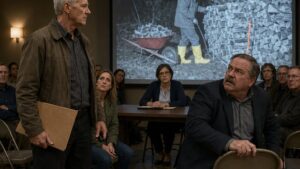
The Tuesday evening board meeting was being held in the small association room beside the neighborhood pool. Folding chairs faced two pushed-together tables. A dozen homeowners had come, more than usual but not enough to turn the meeting into a spectacle.
Anthony carried only three documents.
The laminated notice.
The certified survey.
The recorded plat.
Donald sat at the center of the board table. Ruth was to his right with a laptop open. Christopher sat two chairs away and had barely looked at Anthony since he entered.
Donald continued.
“Counsel has reviewed the matter. The association is prepared to withdraw enforcement regarding Mr. Hall’s driveway and remove the temporary barrier.”
Anthony should have felt relief.
Instead he heard the missing part immediately.
“What happens to the map?”
Donald’s mouth tightened.
“We’ll get there.”
The meeting moved through routine business first.
Minutes.
Treasurer’s report.
Landscaping contract.
Anthony listened while his truck remained blocked three streets away.
It struck him as almost absurd that ordinary business could coexist with a conflict that had consumed his week.
When Donald finally called his item, Ruth distributed copies of a proposed settlement letter.
Anthony read the first paragraph.
The association would suspend and withdraw enforcement related to the disputed driveway area based upon the recently submitted boundary survey.
Second paragraph: pending monetary penalties would be rescinded.
Third paragraph: the arrangement did not constitute an admission regarding the accuracy or applicability of association mapping to other parcels.
Anthony read it again.
Maria sat behind him rather than at the board table. She had told him before the meeting that she would speak only if legal clarification became necessary.
This was his decision.
Donald folded his hands.
“This gives you everything you originally asked for.”
Anthony placed the paper down.
“No.”
A murmur moved through the chairs behind him.
Donald frowned.
“You want the barrier removed.”
“Yes.”
“You want the fine withdrawn.”
“Yes.”
“Both are in writing.”
“The document that caused the problem stays untouched.”
Donald’s expression hardened.
“The exhibit did not cause the problem.”
Anthony took out the laminated notice and set it on the table.
“This notice says I was using common property.”
He placed the survey beside it.
“This says the driveway is entirely inside my parcel.”
Then the recorded plat.
“And this is the document the surveyor used.”
Donald looked at the three sheets.
Anthony kept his voice level.
“I’m not asking you to survey every property in Pinecrest Commons tonight.”
“Then what exactly are you asking?”
“That the association record state that the boundary at my property is the surveyed boundary, not the colored line on the maintenance exhibit.”
Donald shook his head.
“The board cannot casually modify association mapping every time an owner submits a private survey.”
“It wasn’t casual when you installed a chain.”
“Anthony—”
“No. That matters.”
The room went quiet.
Anthony did not raise his voice.
“You had enough confidence in that exhibit to block my vehicle before sunrise. Enough confidence to issue a thirty-day notice. Enough confidence to threaten two hundred dollars a month.”
Donald’s face reddened.
“And once there was contrary evidence, we sent it to counsel. That is what responsible boards do.”
“After enforcement.”
Donald leaned forward.
“We manage common property for hundreds of owners. If every challenge freezes enforcement, rules become meaningless.”
Anthony looked at him.
“I’m not asking you to stop enforcing rules.”
He tapped the survey.
“I’m asking you to verify what belongs to you before you physically take control of it.”
No one spoke.
That was the point Anthony had struggled toward all week.
Not that the HOA should have no authority.
That authority had a boundary too.
Donald looked toward Maria.
“Counsel advised us to resolve the individual dispute.”
Ruth spoke for the first time.
“Counsel also advised that continued enforcement after receipt of the survey creates avoidable exposure.”
Donald turned to her.
“I know what counsel advised.”
The sharpness in his voice surprised the room.
Ruth did not react.
She opened a folder.
“There is also the records issue.”
Donald’s shoulders stiffened.
“What records issue?”
“The management file does not contain a recorded survey supporting the property exhibit, and I have not located a resolution adopting it as controlling for boundary enforcement.”
Donald looked at Christopher.
Then back at Ruth.
“We have used that exhibit for years.”
“Yes.”
“That did not become a problem until this week.”
Christopher shifted in his chair.
Anthony saw it.
Donald did too.
“What?” Donald asked.
Christopher stared at the tabletop.
Nothing happened for several seconds.
Then he said, “That’s not completely true.”
Donald’s face changed.
Christopher continued.
“The map was questioned before.”
A woman in the audience whispered something to the person beside her.
Donald said, “We discussed a landscaping discrepancy.”
“We discussed whether the exhibit matched recorded boundaries.”
“That was not the same issue.”
“No.”
Christopher finally looked up.
“But it was enough that I knew there might be a problem.”
Anthony did not move.
This was Christopher’s truth to carry.
Donald stared at him.
“You voted for enforcement.”
“Yes.”
“Then why are you saying this now?”
“Because I should have said it before Tuesday.”
The room became very still.
Christopher looked at Anthony.
“I thought if the board pushed forward and the map was wrong, counsel would correct us. I didn’t want to open a subdivision-wide review over something that might amount to a few inches in places.”
Donald said, “Because a full boundary review could cost this association tens of thousands of dollars.”
“I know.”
“And owners complain every year about assessments.”
“I know that too.”
Donald turned toward the homeowners.
“This is the position the board is actually in. We are expected to enforce common property rules consistently, control costs, maintain reserves, and respond to complaints. Those demands do not always point in the same direction.”
For the first time, Anthony heard Donald describe the pressure rather than the authority.
It did not excuse the chain.
But it made the man behind it easier to see.
Anthony said, “Then say you made the decision under pressure.”
Donald looked at him.
“Don’t say the map became correct because the decision was difficult.”
A long silence followed.
Donald looked down at the proposed settlement.
When he spoke again, his voice was lower.
“What correction are you requesting?”
Anthony slid a single page across the table.
Maria had helped him draft it, but the demand was his.
“Withdraw the violation. Cancel any fines. Remove the chain. Add the certified survey to the association property file. Note that the maintenance exhibit cannot be used as controlling boundary evidence when it conflicts with a recorded plat or licensed survey.”
Donald read it.
“And require verification before future physical enforcement,” Ruth added.
Donald looked at her.
She met his eyes.
“A survey, recorded instrument, or counsel review when ownership is genuinely disputed. Before barriers are installed.”
Donald leaned back.
Anthony could see what agreeing would cost him.
Not money.
Certainty.
A president who had built his role around decisive enforcement would have to put into the minutes that the board itself needed limits.
Anthony understood that better now than he would have Tuesday morning.
He also understood that sympathy was not the same as surrender.
Donald looked toward Christopher.
“You support this?”
Christopher nodded.
“Yes.”
The treasurer asked, “Does adopting this mean we’re committing to survey the whole subdivision?”
Ruth answered.
“No. It means we stop treating the maintenance exhibit as a substitute for legal boundary evidence when a genuine dispute arises.”
Donald looked again at the three documents Anthony had placed before him.
The notice.
The survey.
The plat.
The meeting room’s air conditioner clicked off.
Without its hum, Anthony could hear someone shifting in a folding chair behind him.
Donald picked up the proposed correction.
He read it one last time.
Then he reached for the gavel he almost never used.
“We have a motion before us to withdraw enforcement against the Hall property, rescind associated penalties, incorporate the certified survey into the association record, and adopt a verification requirement for disputed boundaries before physical enforcement.”
Anthony felt his pulse in his throat.
Donald looked down the board table.
“All in favor?”
Chapter 7: The Chain Came Down, but the Lesson Stayed
The first hand went up almost immediately.
Christopher’s.
Anthony watched him hold it there, palm open, while Donald looked down the table.
A second board member raised a hand.
Then the treasurer.
Ruth recorded the votes without expression.
Donald remained still for several seconds before lifting his own hand.
“All in favor,” he said quietly.
The motion passed.
There was no applause.
Anthony was grateful for that.
Donald set the gavel down.
“The enforcement notice against the Hall property is withdrawn. Any associated monetary penalties are rescinded. Management will incorporate the certified survey into the association property file and prepare a boundary-verification procedure consistent with counsel’s recommendations.”
Anthony looked at the laminated notice lying beside the survey.
For a week, those two documents had represented different versions of reality.
Now one of them had lost its authority.
Donald turned toward him.
“The barrier will be removed tomorrow morning.”
Anthony nodded.
“Thank you.”
The words felt strange, but he meant them.
Not as forgiveness.
As acknowledgment that the decision had finally moved.
People began gathering their papers. A few homeowners stopped beside Anthony on their way out. Most said little.
One man told him he was glad the driveway issue was settled.
A woman asked whether the board would now survey the entire subdivision.
Anthony said he did not know.
That answer seemed to disappoint her.
He understood why. People preferred stories in which one discovery solved everything.
This one had only corrected what had been proven wrong.
Christopher waited until most of the room had cleared.
“I’m sorry,” he said.
Anthony looked at him.
Christopher did not add an explanation.
That helped.
“You should have said something earlier.”
“I know.”
“So should I.”
Christopher frowned.
Anthony picked up the old mapping notice.
“I got this eighteen months ago.”
“You didn’t know what it meant.”
“I didn’t bother finding out.”
“That still isn’t the same as what I did.”
“No.”
Anthony folded the letter.
“But silence helped both of us avoid something until avoiding it stopped working.”
Christopher nodded.
There was no handshake.
Not yet.
The next morning, Anthony was outside before the maintenance workers arrived.
It was 7:16, much later than the morning the chain had gone up.
The truck still sat behind it.
He had left it there deliberately.
Donald came with the workers.
Anthony had not expected him.
No folder this time.
No color-coded map.
One worker knelt at the base of the first orange post while the other held the chain slack.
Donald approached the padlock.
For a second, the scene looked almost identical to Tuesday morning.
Same driveway.
Same truck.
Same orange posts.
Same heavy links.
But now three survey stakes stood in the grass beyond the concrete.
Donald inserted a key.
The lock clicked.
Anthony heard the sound clearly.
Donald pulled the shackle free and handed the padlock to one of the workers.
The chain dropped.
It struck the concrete with a hard metallic slap, then settled in a loose curve across the driveway.
Anthony had imagined that moment several times.
He had expected satisfaction.
Instead he felt something quieter.
Relief, mostly.
And fatigue.
One worker began unbolting the orange posts.
Donald stood beside Anthony.
Neither man spoke until the first post came free.
Finally Donald said, “We should have verified the boundary before installing it.”
Anthony looked at him.
It was not an apology exactly.
Donald did not say he had been arrogant or unfair. He did not offer excuses either.
Anthony decided not to force the sentence into something larger.
“Yes,” he said.
Donald watched the worker carry the post toward the truck.
“We were getting complaints about common areas. People wanted enforcement.”
“I understand that better now.”
Donald glanced at him.
“That doesn’t mean I think the chain was justified.”
“I know.”
Another bolt rattled loose.
Donald put his hands in his pockets.
“When you sit in that chair, everyone wants consistency until consistency affects them.”
Anthony looked toward the survey stake nearest the driveway.
“Consistency still has to start with the right line.”
Donald nodded once.
“That’s going to be in the new procedure.”
It was the closest they came to reconciliation.
Ten minutes later the second post was gone.
The workers coiled the chain into the bed of their utility vehicle.
The concrete underneath the bases showed pale circular marks where the metal had covered it for eleven days.
Anthony ran his shoe over one.
The mark would fade.
The memory probably would not.
When the workers left, he got into his pickup.
He backed toward the street slowly.
The tires crossed the exact section of concrete that had started the dispute.
Nothing happened.
No chain.
No notice.
No one standing there to tell him he was crossing from his property into theirs.
He stopped near the survey stake and looked through the open window.
Eighteen inches of grass.
That was all.
The strip seemed almost too small to deserve the week it had consumed.
Then he thought of the maintenance exhibit.
The board minutes.
Christopher’s silence.
His own unread notices.
Small things could carry weight when everyone agreed not to examine them.
Later that afternoon, Ruth asked Anthony to stop by the association office.
She had a binder open on the conference table.
The certified survey was inside, filed behind the recorded plat.
Ahead of it was a newly adopted policy.
Anthony read the first paragraph.
When ownership or boundary location was genuinely disputed, the association could not install barriers, remove improvements, or impose property-specific physical enforcement until the relevant recorded instrument, licensed survey, or legal review had been verified.
Anthony looked up.
“This is final?”
“Approved last night and entered this morning.”
“What about the old exhibit?”
“Still useful for landscaping and maintenance.”
“But not as a survey.”
Ruth gave a small smile.
“Not as a survey.”
She closed the binder.
“There may be other places we need to review eventually.”
Anthony nodded.
“Christopher told me.”
Ruth’s smile disappeared.
“That will be a board decision.”
“A real one this time?”
She accepted the jab.
“A documented one.”
Anthony stood to leave.
At the door, Ruth stopped him.
“You know, we sent three notices asking for resident comments when that exhibit was updated.”
Anthony turned.
“I know.”
“You never responded.”
“No.”
She did not say anything else.
She did not need to.
Anthony drove home with that sentence beside him.
He had spent years believing the best neighbor was the one nobody had to deal with.
He paid his dues. He maintained his yard. He did not complain.
He had mistaken withdrawal for responsibility.
The mistake was smaller than Donald’s, perhaps, but it belonged to him.
Over the following days, Pinecrest Commons settled back into its normal rhythms.
Sprinklers clicked on before dawn.
Trash cans appeared on Thursdays and vanished by evening.
Children rode bicycles along the sidewalk.
The chain marks on Anthony’s driveway grew less noticeable.
The social marks took longer.
One neighbor who used to wave from his porch now seemed suddenly fascinated by his phone whenever Anthony passed.
Another stopped him to ask whether her fence might be over the common line.
Anthony told her to hire a surveyor if she was concerned.
He refused to become the neighborhood boundary expert.
Christopher waved the next time they saw each other.
Anthony waved back.
That was enough for now.
Donald remained HOA president.
Some residents disliked that.
Anthony did not demand his resignation.
The board had corrected the action, changed the procedure, and entered the survey into the record.
Punishment had never been Anthony’s goal.
A month later, another HOA meeting notice arrived.
Anthony found it in the mailbox with a utility bill and two advertisements.
He carried everything inside.
For years, the notice would have gone directly into the kitchen drawer.
Instead he opened it.
There were six agenda items.
Landscaping renewal.
Pool maintenance.
Reserve funding.
Boundary-verification policy review.
Anthony read the page twice.
Then he wrote the meeting date on his calendar.
On Tuesday evening, he walked into the association room ten minutes early.
Christopher was arranging chairs.
Ruth was setting out board packets.
Donald sat at the front table reading the agenda.
No one seemed particularly surprised to see Anthony, though Christopher gave him a small nod.
Anthony chose a chair in the second row.
From there, he could see the entire board table.
He could also see the door.
He sat down before anyone had to ask him.
The story has ended.