The Midnight Dog That Refused The Corrupt Highway Command
CHAPTER 1: THE CHAIN ON THE ASPHALT
The biting Panhandle wind off the high prairie tasted of alkali dust, frozen cedar, and the sour, pervasive reek of feedlot cattle. At three o’clock in the morning, the vast commercial parking lot of the Panhandle Star Travel Plaza—forty miles west of Amarillo along Interstate 40—was an island of buzzing sulfur-yellow sodium light surrounded by hundreds of miles of empty, black Texas plains.
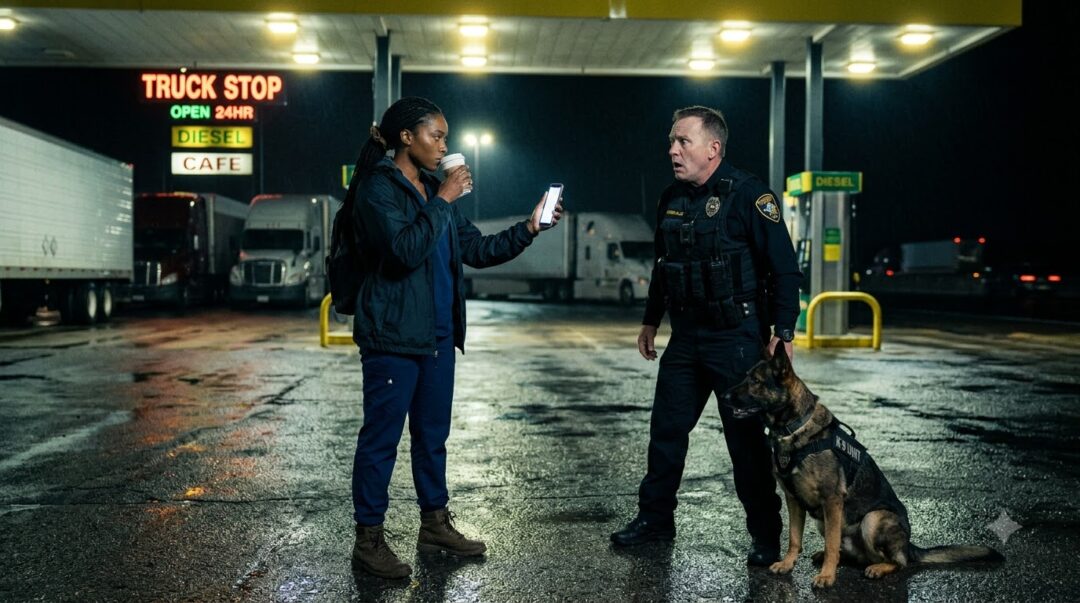
Denise Okafor leaned against the front fender of her dark green Honda Civic, both hands wrapped around a paper cup of scalding black coffee. Her dark hair was pulled back into neat, tight braids beneath her dark knit cap. Beneath her unzipped black Gore-Tex windbreaker, her hospital scrubs bore the faded embroidered emblem of Northwest Texas Hospital’s Level One Trauma Center. She had just completed a grueling fourteen-hour shift in the resuscitation bay, managing three hemorrhagic gunshot wounds and an eight-car pileup on the ice near Vega. Her shoulder muscles ached with deep, throbbing exhaustion, but her eyes—wide, dark, and observant—were as clear and sharp as a surgeon’s scalpel.
A sudden, savage snarl shattered the nocturnal hum of the idling diesel semi-trucks.
Twenty feet away, a massive, black-and-tan German shepherd lunged against a stainless-steel choke chain, its teeth snapping three inches from the asphalt. The heavy chain snapped taut with a harsh metallic clang that vibrated through the freezing air.
Holding the thick leather lead with gloved fists was Officer Bradley Rusk.
Rusk was forty-four years old, thick-set and heavy-jawed, wearing a black tactical jumpsuit tucked into polished eight-inch jump boots. His tactical vest was emblazoned with gold embroidered lettering: Potter-Carson Criminal Interdiction Task Force / K-9 Division. A heavy key-ring clicked against his duty belt, and his mirrored aviator sunglasses were propped arrogantly on the brim of his black patrol cap despite the pitch-black prairie night.
“Easy, Kaiser,” Rusk growled with a casual flick of his wrist, though his eyes never left Denise’s face. He stepped forward onto the stained concrete apron, planting his boots wide, letting his gaze sweep over her vehicle with theatrical suspicion. “My partner here says you have been loitering around this commercial parking apron for over forty-five minutes, ma’am.”
Denise did not lower her coffee cup. She took a slow, measured sip, letting the hot, bitter liquid warm her throat, her expression completely undisturbed.
“I purchased a large coffee and a bagel inside the travel center twenty minutes ago, Officer,” Denise said, her voice quiet, clinical, and even. “I sat in my vehicle to drink my coffee before driving forty miles home to Pampa. Resting before operating a motor vehicle on an interstate corridor is recommended by the Texas Department of Transportation.”
Rusk smirked—a smug, self-satisfied sneer that pulled up the left corner of his thick mustache. He rested his right hand heavily upon the dog’s leather harness, giving the animal a firm, intentional shove forward. “That is real thoughtful of you, nurse. But Kaiser here is a trained patrol interdiction asset. When he hit the air coming off your driver’s side door, he gave me an active behavioral alert for narcotics.”
Denise looked past Rusk’s hand, down at the German shepherd.
The dog was not alerting. It was not scratching at the weather stripping. It was not sitting with its muzzle pointed toward the door seam in a passive odor freeze. In fact, the moment Rusk stopped yanking on the lead, the dog let out a soft, bored sigh, circled once in the gravel, and dropped into a relaxed sitting position on the cold asphalt, its pink tongue lolling out, looking up at Denise’s coffee cup with mild canine curiosity.
Denise lowered her cup half an inch. Her eyes met Rusk’s cold stare.
“Is that dog certified by the Texas Commission on Law Enforcement, Officer?” Denise asked quietly.
Rusk scuffed his boot against the concrete, letting out a sharp, dismissive bark of laughter. “Excuse me? Did you just ask if my K-9 partner is certified? He is an eight-hundred-dollar-an-hour federal interdiction asset, lady. He has more drug seizures on Route Forty than any dog in West Texas. He knows what he smells.”
“Then why is he sitting down and waiting for a biscuit?” Denise asked, her tone entirely polite, devoid of malice or fear.
Rusk’s face flushed a deep, mottled red under the sodium lights. He yanked the leather lead upward violently, jerking the dog’s head back. “Kaiser! Find it! Search! Find it!”
The dog whined, bewildered by the aggressive jerk on its neck, shifting uncomfortably on its haunches, but it stubbornly refused to rise. It looked up at Rusk with wide, confused eyes, its tail giving two faint, placating wags against the asphalt.
“Get on your feet, damn it!” Rusk hissed under his breath, his knuckles turning white on the lead.
Denise reached into her windbreaker pocket, brought out her smartphone, and tapped the screen twice. Her father had served twenty-eight years as a Texas Ranger sergeant in Lubbock; before she had ever learned how to insert an arterial line or administer epinephrine, she had learned how to read peace officer licensing profiles.
“Texas Administrative Code Title Thirty-Seven, Part Seven, Chapter Two-Seventeen dash two,” Denise recited with crisp, effortless authority. “All law enforcement canines deployed for criminal interdiction must maintain an active, annual narcotics detection certification registered with TCOLE. Every certified canine has a state-issued microchip number logged on the public verification portal.”
Denise turned her phone screen toward Rusk.
The display glowed brightly in the 3 AM darkness. It showed the active database portal of the Texas Commission on Law Enforcement. In the search box, Denise had entered the agency code for the Potter-Carson Interdiction Task Force.
The search results for active K-9 certifications were displayed in bold red letters across the screen: Zero Records Found.
“His name is not on the state registry, Officer Rusk,” Denise said, stepping forward until the screen was twelve inches from the officer’s chest. “Nor is your agency registered for active interdiction deployments.”
Rusk stood frozen. The wind howled across the prairie, whipping a discarded paper napkin across his boots, but he did not move. The blood drained from his cheeks, leaving his jaw pale and slack.
Then Denise’s eyes dropped to the small black rectangular housing mounted to the center of Rusk’s chest harness: his department-issued body camera.
Over the glass recording lens of the camera was a clean, carefully trimmed square of black electrical tape.
“And your camera is covered, Officer,” Denise added, her voice dropping into a register that made the hair on Rusk’s neck prickle. “Which makes this stop an unlogged federal civil rights violation.”
CHAPTER 2: THE SCENT OF SCALDED COFFEE
The cold wind seemed to freeze the breath in Officer Bradley Rusk’s throat. He stared at the glowing phone screen, then down at the square of black electrical tape covering his body camera lens.
For six years, Rusk had run the midnight corridor of Interstate 40 between Conway and Vega like a private hunting preserve. He targeted lone travelers, commercial couriers, and minority motorists driving late-model commuter cars at two and three in the morning—people who were exhausted, disoriented, and terrified of having their vehicles impounded hundreds of miles from home. He would stage a bogus canine alert, claim his dog smelled trace quantities of fentanyl or methamphetamine, and offer the terrified driver a choice: submit to a destructive roadside strip-search and twenty-four hours in holding, or sign a ‘voluntary civil asset disclaimer’ surrendering all cash on their person in exchange for a roadside warning.
Ninety percent of them signed. The cash was split between Rusk, his shift supervisor, and a private training account in Oklahoma.
And now a twenty-nine-year-old trauma nurse was standing on the asphalt at 3 AM, reading state administrative code to him like a municipal judge.
“You think you’re smart, girl,” Rusk snarled, his voice trembling with a terrifying blend of humiliation and malice. He took a heavy step forward, his chest bumping against Denise’s shoulder, trying to force her to yield ground. “You think having a phone makes you a lawyer? You are standing in Potter County. Out here, what I smell is probable cause.”
Denise did not take half a step backward. She stood balanced, her feet shoulder-width apart, holding her coffee cup in her left hand and her phone in her right.
“I smell scalded coffee, cold exhaust, and an unlicensed patrolman operating without statutory authority,” Denise said, her gaze steady and unrelenting. “Step back from my person, Officer. You are within my six-foot safety perimeter.”
Rusk’s hand dropped to his duty belt, unsnapping the retention loop on his heavy pepper-spray canister. “I am ordering you to step to the rear of your vehicle! You are interfering with an active narcotics investigation! I smell synthetic opioids coming from your clothing!”
Denise let out a short, cold breath of laughter. She reached inside her windbreaker, pulled out her plastic hospital identification badge on its blue lanyard, and held it to his face.
“I am the trauma charge nurse at Northwest Texas Hospital, Officer,” she said. “I spent the last fourteen hours in a sterile surgical suite. If you believe my clothing is contaminated with fentanyl, we will call the regional hazmat unit and the Texas Department of Public Safety immediately. I will submit to an immediate certified blood draw and chain-of-custody urinalysis at the county clinic in Amarillo. Would you like to call the state lab right now?”
Rusk’s jaw tightened until the tendons stood out like cordwood along his neck. He knew that the moment a certified medical professional demanded a state-monitored blood draw, the local prosecutor would be forced to review the dashcam logs and the canine deployment records.
Suddenly, the deep rumble of an un-muffled V8 engine approached from the service road.
An unmarked black Dodge Charger with black steel wheels and dark tinted windows pulled to the curb behind Denise’s Civic. The driver’s door swung open, and Sergeant Kyle Mercer stepped out into the biting wind.
Mercer was forty-nine, tall, gaunt, with slicked-back gray hair and cold, reptilian eyes behind rimless spectacles. He wore a heavy sheepskin rancher’s coat over a khaki uniform shirt, carrying an aluminum citation clipboard under his arm.
“What is the delay, Brad?” Mercer asked, his voice low, gravelly, and sharp as broken glass. “We have two commercial transports hitting the weigh scales at four o’clock. Why are you wrestling a Honda?”
Rusk turned to his supervisor, his face pale and frantic. “Sarge… she’s refusing a search. She is claiming the dog isn’t registered on the TCOLE database. She’s got her phone recording.”
Mercer didn’t blink. He walked up to Denise, his cold eyes sweeping over her scrubs, her calm posture, and the leather purse sitting on the front passenger seat of her car.
Through the window, Mercer’s sharp eyes caught the corner of an official certified bank document resting in the open pocket of her purse: a cashier’s check issued by the Amarillo National Bank for fourteen thousand eight hundred dollars—funds Denise had withdrawn yesterday afternoon to pay her younger brother David’s emergency college tuition installment.
Mercer’s thin lips curled into a predatory smile.
“Good evening, ma’am,” Mercer said, his voice deceptively smooth. “I am Sergeant Mercer, task force commander. It seems we have a misunderstanding. Traveling with large quantities of undeclared commercial negotiable instruments along a known drug pipeline constitutes reasonable articulable suspicion under the Texas Code of Criminal Procedure.”
“That is a certified bank cashier’s check payable to Texas Tech University for my brother’s tuition, Sergeant,” Denise said, her voice dropping into a tone of absolute warning. “It is fully documented, taxed, and legal.”
“We will determine that after a ninety-day administrative audit in our forfeiture holding division,” Mercer said calmly. He reached into his coat, pulled out a pre-printed form on pink carbon paper, and clicked a ballpoint pen. “You sign this voluntary property waiver right now, and Officer Rusk will allow you to drive home to Pampa with a non-moving safety citation. Or I impound your car, lock you in the county holding tank until Monday morning, and let the forfeiture judge seize the tuition check as abandoned contraband.”
Denise looked at Mercer. She saw no law in his eyes—only the cold, calculating greed of an organized criminal syndicate wearing state badges.
She slowly brought her phone to her lips, pressing the red emergency icon on her screen.
“Mercer,” Denise spoke clearly into the microphone. “This audio stream is connected directly to the Texas Ranger dispatch center in Lubbock. My father is retired Sergeant Thomas Okafor. And he is listening to every word you say.”
Mercer’s smile vanished instantly. His hand shot forward, violently swatting the phone from Denise’s grip, sending the glass screen shattering across the frozen asphalt.
CHAPTER 3: THE HIGHWAY INTERDICTION WIRE
The glass screen of Denise’s phone shattered against the concrete with a sharp, sickening crunch.
Denise didn’t flinch. She kept her balance, her boots planted firmly on the cold asphalt, her eyes locked onto Sergeant Kyle Mercer’s face.
“That phone was transmitting over an open cellular data channel, Mercer,” Denise said, her voice dropping into a register that made the wind seem warm by comparison. “The audio buffer was stored on the regional cloud server the instant you touched me.”
Mercer didn’t answer. He was a professional predator who had spent twenty years navigating the gray borders of county jurisdiction. He crushed the broken phone beneath the heavy lug sole of his jump boot with a deliberate, grinding twist of his heel, reducing the motherboard to fragments of silicon and copper.
“Brad, cuff her,” Mercer ordered, his voice flat, devoid of emotion. “Custodial arrest for resisting a peace officer and possession of suspected unmanifested financial contraband.”
Officer Bradley Rusk moved in from the left, reaching for the heavy steel handcuffs on his belt. The German shepherd sat between them, its ears pinned back, letting out a soft, nervous whine as it sensed the rising violence in its handler’s posture.
“Put your hands behind your back, nurse,” Rusk sneered, trying to mask his panic with physical aggression.
Denise did not resist. She knew the law. Resisting a corrupt officer on a dark highway gave them the legal justification to use lethal force. She turned slowly, placing both hands flat against the cold steel hood of her Civic, crossing her wrists cleanly.
“Mark the timestamp, Officer,” Denise said quietly. “Three-eighteen AM. You are arresting a state-licensed healthcare provider without probable cause, without reading Miranda warnings, and after destroying private digital property.”
The cold steel jaws of the handcuffs bit into Denise’s wrists with a harsh, ratcheting click. Rusk wrenched her arms upward with unnecessary force, but Denise didn’t give him the satisfaction of a gasp.
Mercer reached through the open window of her Civic, seized her leather purse, and unzipped the main compartment. He pulled out the blue cashier’s check for fourteen thousand eight hundred dollars, along with her hospital employee card and her driver’s license.
He held the check up to the yellow sodium floodlight, examining the bank watermarks with greedy, narrowed eyes.
“Fourteen thousand eight hundred dollars,” Mercer murmured softly, sliding the check into his sheepskin coat pocket. “Funny how these ‘tuition’ checks always come in just under the fifteen-thousand-dollar federal currency reporting threshold. That is classic structuring, nurse. That is an automatic forfeiture flag under federal interdiction guidelines.”
“It is the exact tuition assessment for two semesters of mechanical engineering, Mercer,” Denise said, turning her head to meet his cold gaze. “And my brother has the official invoice from the university bursar sitting on our kitchen counter.”
“Your brother can explain that to the county forfeiture magistrate in ninety days,” Mercer said, pocketing her car keys. “Brad, call Black Fork Towing out of Amarillo. Tell them to hook this Honda and take it to the secondary holding yard on Highway Two-Fourteen. The private yard. Not the municipal impound.”
Denise’s eyes narrowed. The private yard.
She knew the geography of Potter County. The official county impound was located behind the sheriff’s office on Sixth Street in downtown Amarillo. The private yard on Highway 214 was an abandoned cotton gin five miles north of Vega, completely isolated from public view by ten-foot berms of caliche dirt and rusted corrugated iron.
Rusk grabbed Denise by the upper arm, shoving her toward the rear passenger door of his patrol SUV.
As Rusk pushed her into the back seat, the vehicle’s interior dome light clicked on, illuminating the rear cargo area behind the wire security partition.
Denise’s breath caught in her throat.
Stowed beneath a heavy canvas tarp in the rear cargo bay were six olive-drab tactical duffel bags. The zipper of the top bag had slid open half an inch, revealing thick, banded bricks of hundred-dollar bills wrapped in vacuum-sealed plastic. Stenciled in black marker across the plastic wraps were dates, highway mile-markers, and handwritten names: Nov 12 – Mile 74 – $42,000… Nov 18 – Conway Scale – $68,000.
It was the complete operational haul of the Potter-Carson Interdiction Task Force for the month of November. Hundreds of thousands of dollars in cash, seized from commercial travelers under the guise of civil forfeiture, sitting in the back of an unlogged patrol vehicle without a single evidence tag or court docket number.
Rusk slammed the heavy steel door shut, locking the tinted window.
Through the wire partition, Denise watched Rusk climb into the driver’s seat, his face slick with sweat despite the freezing cold. He keyed his private tactical radio, speaking into the handset with hurried, nervous urgency:
“Unit Fourteen to Base. We have a Code Seven civilian transport. We are heading to the gin on Two-Fourteen right now. Have the magistrate ready with the pre-signed disclaimer forms.”
A tinny, electronic voice crackled back from the receiver:
‘Copy, Unit Fourteen. Magistrate Vance is already at the site. Bring the cash bags. We have word that the Texas Rangers deployed a mobile audit team out of Lubbock forty minutes ago.’
Rusk’s hand jerked on the steering wheel. He threw the SUV into drive, the heavy tires spinning against the frozen asphalt as he rocketed out of the travel plaza onto the deserted lanes of Interstate 40, heading west toward the dark, forgotten cotton fields of Vega.
CHAPTER 4: THE HOLDING PEN AT VEGA
The abandoned cotton gin on Highway 214 rose out of the frozen Texas plains like the rusted carcass of an industrial dinosaur.
The facility had been shuttered since the mid-1980s. A high perimeter fence of chain-link and rusted barbed wire surrounded four massive corrugated-tin storage sheds, a dilapidated seed silo, and a concrete weigh station overgrown with dead tumbleweeds. No lights showed from the highway, but as Officer Bradley Rusk’s patrol SUV navigated the washboard caliche lane behind the silo, two high-intensity portable floodlights flared into life, illuminating an open loading bay.
Rusk parked beside Mercer’s black Charger, killed the engine, and stepped out into the freezing wind.
“Out of the vehicle, Okafor,” Rusk barked, yanking the rear door open and grabbing Denise by the shoulder harness of her windbreaker.
Denise stepped down into the frozen mud, her handcuffed wrists cold and stiff behind her back. Her scrub pants were thin against the prairie gale, but she held her chin high, her dark eyes scanning every detail of the compound: the tire tracks in the mud, the surveillance cameras mounted to the timber poles, and the three passenger sedans parked in the shadows behind the loading dock.
Every one of those sedans had out-of-state license plates—Oklahoma, New Mexico, and Arizona—and every one of them had its driver-side door standing open, its interior panels ripped away and discarded in the dirt.
Rusk shoved Denise through a rusted steel pedestrian door into the lower office of the gin.
The room smelled of damp cotton lint, mouse droppings, and diesel fuel from an old kerosene space heater glowing red in the corner. Sitting behind a battered folding table was a sixty-year-old man wearing a stained sheepskin vest and reading glasses: Magistrate Donald Vance, the part-time county justice of the peace who handled rural traffic warrants for the western precinct.
On the table before Vance lay a stack of pre-printed legal documents bearing the official gold seal of the county court: Affidavit of Voluntary Property Relinquishment and Disclaimer of Contraband Currency.
Standing against the wall, drinking bourbon from a paper cup, was Sergeant Kyle Mercer.
“Bring her in, Brad,” Mercer said, not looking up from a black ledger where he was tallying columns of numbers with a red pencil. “Sign the paper, nurse, and we drive you back to the highway. Refuse, and you spend the weekend in the holding cell behind the grain hopper.”
Denise stood before the folding table, the heat from the kerosene stove washing over her face, but her expression remained as cold as limestone.
“You are holding judicial hearings inside an unlicensed private salvage warehouse, Magistrate Vance,” Denise said, her voice clear, steady, and sharp. “That constitutes official oppression under Section thirty-nine-oh-two of the Texas Penal Code. That is a third-degree felony.”
Magistrate Vance paused, his pen hovering over the signature line. He looked up at Mercer, his watery gray eyes flickering with sudden, nervous hesitation. “Kyle… she’s an emergency department charge nurse. Her father was a Ranger captain in Lubbock. If the state attorney general looks into this file—”
“The state attorney general isn’t looking at anything, Donald!” Mercer snapped, slamming his fist onto the table, making the bourbon cup jump. “Her phone is destroyed, her car is in the ditch, and by sunrise, every dollar in those duffel bags will be converted into cashier’s checks in Oklahoma! Sign the forfeiture warrant!”
Vance swallowed hard, wiping a drop of sweat from his chin, and scribbled his name across the bottom of the pink carbon sheet.
Mercer picked up the signed warrant and shoved it toward Denise’s chest. “Fourteen thousand eight hundred dollars, nurse. You sign the waiver acknowledging this cash was recovered from an unmanifested narcotics interdiction, and you walk.”
“I will never sign that paper, Mercer,” Denise replied, looking straight into his eyes. “And neither will the families whose cars you have stripped outside.”
Mercer’s face darkened with savage fury. He reached across the table, grabbed Denise by the collar of her windbreaker, and dragged her toward a heavy wooden door reinforced with steel strap-hinges at the back of the office.
“Brad, throw her in the grain vault,” Mercer ordered. “Put the dog on the door. If she makes a sound before the money truck clears the state line, let Kaiser have a turn at her.”
Rusk grabbed Denise’s arm, shoving her through the heavy door into pitch darkness.
The heavy timber door slammed shut with the boom of a tomb, followed by the slide of a heavy iron bolt on the outside.
Denise stumbled across the wooden floorboards, her boots kicking against an empty burlap sack. The air inside the vault was frigid, smelling of dry grain dust and ancient timber.
From the darkness across the room, a weak, trembling voice spoke:
“Who… who is there? Please… do they have the keys?”
Denise froze. Her eyes adjusted to the faint slivers of moonlight piercing the wooden roof boards.
Sitting huddled together on a wooden pallet in the corner were two people: an elderly Hispanic man in a trucker’s jacket, his face bruised and swollen, and a young woman in college clothing, shivering violently under a thin moving blanket.
“I am Denise Okafor,” Denise said, kneeling beside them, her hands still cuffed behind her back. “I am an emergency room trauma nurse. Are you injured?”
“They… they took my commercial transport pay,” the old man choked out, tears running down his weathered cheeks. “Nine thousand dollars in cash for my trucking lease. They said their dog smelled drugs. They have held us here since yesterday afternoon.”
Outside the heavy timber door, the sudden sound of a vehicle engine roaring down the caliche road shattered the prairie silence.
A high-output diesel siren began to wail across the frozen fields—the unmistakable, rising-and-falling siren of a Texas Department of Public Safety highway pursuit cruiser.
CHAPTER 5: THE MICROCHIP IN THE DARK
The wail of the siren outside the cotton gin sent a shockwave of panic through the building.
Through the heavy timber door of the grain vault, Denise heard Magistrate Vance drop his bourbon cup with a wet shatter against the floorboards. Chair legs screeched violently across the concrete office floor as boots scrambled in frantic confusion.
“Mercer!” Rusk’s voice screamed through the door, cracking with hysteria. “That is a state trooper unit! They just turned off Two-Fourteen onto the access road! They are running code three!”
“Shut your mouth and grab the cash bags!” Mercer roared back. “Load the duffel bags into the Charger! Vance, burn the carbon sheets! Burn every single paper on that table right now!”
Inside the darkened vault, Denise knew they had less than ninety seconds. If Mercer and Rusk destroyed the paper ledgers and fled with the cash, the three of them would be left locked inside a freezing wooden tomb with no food, no water, and no record of their detention.
Denise turned her back toward the elderly trucker sitting on the pallet.
“Sir,” Denise whispered urgently. “My hands are cuffed behind me. Reach into the right cargo pocket of my scrub pants. There is a steel trauma shear with a blunt tip. Can you reach it?”
The old trucker scrambled to his knees, his trembling, calloused hands feeling along Denise’s hip until his fingers closed around the textured plastic handle of the medical shears. He pulled the tool from her pocket.
“I have it,” the man whispered. “What do I do?”
“Do not try to cut the steel,” Denise said. “Insert the blunt tip of the shear into the keyway of the handcuff ratchets. Push up hard against the release pawl. I will twist my wrists.”
The old man worked with desperate speed. His hands were shaking violently, but he had spent forty years working on diesel injector lines; his mechanical instincts took over. He wedged the hardened stainless-steel tip into the cuff’s double-locking slot, levering the internal pawl upward.
With a sharp, metallic click, the left cuff sprang open.
Denise ripped her hands apart, rubbing her bruised wrists for half a second before taking the trauma shears from the trucker’s hands.
She vaulted across the wooden floor to the small square access window set high in the vault wall—an opening eighteen inches wide used fifty years ago to monitor grain levels from the conveyor platform outside. The wooden shutter was secured by a rusted iron hook.
Denise shoved the blunt blade of the shears under the hook, throwing her entire body weight against the tool.
The rusted iron screw-eye sheared free from the rotten pine framing with a sharp crack. The wooden shutter swung open, letting in a blast of freezing winter wind and a blinding shaft of blue-and-white strobe light.
Denise pulled herself up onto the sill, looking out over the gin’s rear staging apron.
The scene below was pure chaos.
A marked Texas Department of Public Safety pursuit cruiser had skidded to a halt in the frozen mud beside the main loading dock, its light bar slicing through the darkness. Standing beside the cruiser, his hand resting on the holster of his service weapon, was Texas Ranger Captain Marcus Holt—a tall, lean man in a white western hat and a pressed tan wool jacket, looking like the wrath of the Texas frontier.
Beside the loading bay, Officer Bradley Rusk was desperately hauling two heavy tactical duffel bags toward Mercer’s Charger, while Mercer stood near the kerosene stove inside the office, shoving armloads of pink carbon forms into the open burner.
And standing on the wooden loading platform, leashed to an iron support post, was the German shepherd, Kaiser.
The dog was barking furiously, not at the Ranger, but at the rising black smoke pouring from the office door.
“Captain Holt!” Denise shouted from the high window, her voice cutting through the howl of the wind and the siren. “The records are inside the office! They are burning the forfeiture ledgers in the kerosene stove!”
Captain Holt’s head snapped upward toward the sound of her voice. His sharp gray eyes took in the young woman in the window, the handcuffs dangling from her left wrist, and the smoke pouring from the office roof.
Holt didn’t wait for backup. He drew his polished nickel-plated Colt .45 from his western holster with a lightning-fast pull, his voice thundering across the compound:
“Texas Rangers! Step away from that vehicle! Hands where I can see them!”
Mercer panicked. He dropped the burning papers, kicked open the office door, pulled his Glock from beneath his sheepskin coat, and aimed it directly at the Ranger across the muddy apron.
“Rusk! Shoot the dog’s leash!” Mercer screamed, his eyes wild with homicidal desperation. “Let the dog take the Ranger! Shoot the leash!”
Rusk drew his sidearm, but instead of firing at Captain Holt, the panicked officer aimed his pistol at the leather lead holding the German shepherd, intending to sever the strap and unleash the animal into the confrontation.
The dog sensed the violent, erratic movement of the gun barrel. Decades of working-line instincts kicked in. The animal lunged forward, not toward the Ranger, but straight at Rusk’s gun hand, clamping its heavy jaws onto the officer’s forearm with a bone-crushing impact.
Rusk shrieked in agony as his pistol was ripped from his grip, splashing into the mud, the heavy dog pinning the screaming officer to the frozen gravel.
Captain Holt fired one round.
The heavy .45 slug struck the front engine block of Mercer’s Charger with a deafening metallic clang, shattering the alternator bracket in a shower of sparks, ending any possibility of escape.
“Drop the weapon, Mercer!” Holt roared, stepping through the mud with his pistol leveled at the sergeant’s eye. “Drop it or I will put you in the ground right where you stand!”
Mercer looked at his ruined car, looked at Rusk screaming under the teeth of his own canine partner, and slowly, with trembling fingers, let his pistol drop into the slush.
CHAPTER 6: THE RANGER ON ROUTE FORTY
The silence that settled over the abandoned cotton gin after Mercer’s pistol hit the frozen mud was absolute, broken only by the bitter prairie wind and the deep, throbbing idle of the Texas Ranger’s pursuit cruiser.
“Stay down, Brad! Don’t move a muscle!” Captain Marcus Holt commanded, his voice cutting through Rusk’s whimpering sobs like a whip.
The German shepherd remained clamped to Rusk’s heavy canvas sleeve, its low, rhythmic growl vibrating through the officer’s arm, but it did not tear the flesh. The animal was holding him with disciplined restraint, looking up at Captain Holt with steady, intelligent amber eyes.
“Kaiser, out!” Denise’s voice rang out from the loading dock.
She had kicked through the rotten boards of the grain vault door, leading the elderly trucker and the shivering college student out into the raw morning air.
At the sound of Denise’s clear, firm command, the German shepherd instantly released Rusk’s arm, backing away two paces, dropping into a calm, perfect sit-stay beside Denise’s knee, its tail giving a single, loyal thump against the wooden deck.
Rusk lay in the freezing mud, clutching his bruised, bleeding forearm, sobbing with a mixture of pain and total humiliation.
Captain Holt stepped forward, keeping his nickel-plated .45 trained on Sergeant Kyle Mercer. With his left hand, the Ranger unclipped a pair of heavy stainless steel handcuffs from his belt, tossing them onto the hood of Mercer’s Charger.
“Put them on, Mercer,” Holt said softly. “Behind your back. You know the drill.”
Mercer’s face was the color of curdled milk. His thin lips trembled, but he slowly turned around, placing his hands behind his back, clicking the steel cuffs over his own wrists with a defeated, hollow snap.
“Captain Holt,” Mercer whispered, his voice cracking. “This is an administrative task force matter. We have interdiction authority granted by the county commissioner’s court—”
“You have no authority in this state, Mercer,” Holt interrupted, his voice dropping into a register of icy, contemptuous disgust. “The Texas Department of Public Safety revoked your interdiction charter six weeks ago after the state auditor flagged your seizure ledgers. You have been operating an armed highway piracy ring out of this abandoned gin.”
Holt walked up to the open loading bay, holstering his sidearm, his eyes sweeping over Denise and the two shivering civilians standing behind her.
He took off his heavy tan western coat, draping it over the shoulders of the trembling college student, then looked at Denise. His stern face softened into a look of profound, respectful admiration.
“Nurse Okafor?” Holt asked.
“I am Denise Okafor, Captain,” she replied, holding out her left wrist where the dangling handcuff still clicked against her scrubs.
Holt pulled a universal handcuff key from his vest pocket, unlocking the cuff with a gentle, practiced turn. “Your father radioed our regional command center in Lubbock forty minutes ago. He said his daughter was holding a line against two crooked highway cops at a truck stop outside Vega, and that if we didn’t have cars on scene within forty-five minutes, he was driving up from Lubbock with his old service rifle himself.”
A faint, tearful smile touched the corners of Denise’s mouth. “That sounds like my father.”
“He taught you well, ma’am,” Holt said, turning his gaze toward the office where smoke was still drifting from the kerosene stove.
Denise didn’t wait. She ran into the office, grabbed a gallon jug of water from the water cooler, and poured it directly into the open belly of the stove. The flames hissed and died in a cloud of white steam, saving the remaining half of the paper ledgers.
She reached into the charred ash with her gloved fingers, retrieving the blue cashier’s check for fourteen thousand eight hundred dollars. The edges were singed with black soot, but the payee line, the bank seal, and the dollar amount were completely intact and legible.
She walked back out onto the loading dock, holding the check in her hand as the high prairie horizon began to glow with the pale violet and gold light of a Panhandle dawn.
From the east, the distant roar of a dozen sirens approached along Highway 214.
Six State Trooper cruisers, a mobile crime scene laboratory, and two county ambulances came speeding down the caliche lane, their headlights cutting through the morning ground mist.
Magistrate Donald Vance came stumbling out of the office on his knees, holding his hands high in the air, blubbering incoherently: “I didn’t know! Holt, I swear to God I didn’t know they were holding people here! Mercer told me it was all commercial abandoned property!”
“Save it for the federal grand jury, Donald,” Holt said without looking at him. “Because you are going to spend the next ten years explaining why your signature is on thirty-four fraudulent property waivers.”
Two state troopers moved in, pulling Rusk and Mercer to their feet, marching them toward the rear of a secure transport van. As Rusk passed Denise, his eyes were fixed on the German shepherd sitting calmly at her side.
“That dog was supposed to be mine,” Rusk muttered through his bruised lips, his voice venomous and pathetic. “I paid eight hundred dollars for him.”
Denise looked down at the magnificent animal, her hand resting gently on the soft fur between its ears.
“You didn’t buy a police dog, Rusk,” Denise said softly. “You bought a companion who knew how to recognize a coward when he saw one.”
Kaiser let out a soft, happy chuff, leaning his seventy-pound frame against Denise’s knee as the morning sun broke over the Panhandle plains.
CHAPTER 7: THE BLUE DAWN OVER AMARILLO
The sun rose over the Texas Panhandle in a magnificent blaze of crimson and gold, burning away the ground fog that clung to the vast winter wheat fields along Interstate 40.
Outside the Northwest Texas Hospital in Amarillo, the trauma center parking lot was bathed in clean, crisp morning light.
Denise Okafor stood beside the front entrance of the hospital’s administrative pavilion, wearing a clean pair of navy blue scrubs and a fresh fleece jacket. Her hands were warm around a ceramic mug of hot tea, her eyes bright and rested despite forty-eight hours without sleep.
Parked in the circular driveway was her dark green Honda Civic, its driver-side door freshly cleaned and detailed, the keys resting securely in her pocket.
Beside her stood her younger brother, David.
The seventeen-year-old was tall, slender, wearing a gray Texas Tech hoodie, holding the singed, blue cashier’s check in his trembling fingers. His eyes were wide with wonder and relief as he looked down at the certified document that guaranteed his future.
“Denise…” David whispered, his voice cracking with emotion. “Captain Holt said… he said Mercer had four hundred thousand dollars in cash in those bags. He said they had been robbing people out there for two years.”
Denise smiled gently, reaching up to adjust the hood of his sweatshirt, her touch full of protective maternal pride. “It doesn’t matter what they had in those bags, David. What matters is that your tuition is paid, and that nobody is going to get pulled over in that county again without a badge being held to the light.”
A clean, white Ford Expedition bearing the official blue crest of the Texas Department of Public Safety pulled up to the curb.
The driver’s door opened, and a tall, broad-shouldered man with silver hair and the weathered, lined face of an old frontier lawman stepped down onto the concrete. He wore a crisp white western hat, a tweed jacket over a bolo tie, and carried an antique leather briefcase under his arm.
“Daddy,” Denise called out, her voice softening with profound warmth.
Thomas Okafor walked across the pavement with long, easy strides, opening his arms and wrapping his daughter in a fierce, trembling embrace that lifted her feet off the ground.
“You gave me gray hair on my gray hair, Denise,” Thomas whispered into her hair, his voice thick with tears that he wiped away with the back of his hand. “When your phone pinged the emergency frequency at three in the morning, I nearly put my truck through the garage door.”
“I remembered everything you taught me, Daddy,” Denise said, pulling back to look into his proud, smiling eyes. “Document the scene, demand statutory authority, and never let a bully see your hands shake.”
“You did better than document the scene, sweetheart,” Thomas said, turning to look at the vehicle parked behind his truck.
Sitting in the open cargo bay of an official state veterinary transport unit was Kaiser.
The German shepherd had been bathed, brushed, and fitted with a brand-new leather service collar bearing a polished brass medallion stamped with the state crest.
A veterinarian from the Texas A&M Veterinary Medical Center stepped forward, holding a blue folder containing certified health and training records.
“Nurse Okafor,” the veterinarian said with a respectful nod. “The state court has officially completed the forfeiture review on the canine asset formerly held by Bradley Rusk. Under Texas statutory authority, canines recovered from unlicensed and abusive handling rings may be assigned to certified civilian therapy and security custody.”
The veterinarian handed the leather lead to Denise.
“Kaiser passed his certified medical and temperament evaluation with a score of ninety-nine out of one hundred,” the vet said, smiling broadly. “The hospital board of Northwest Texas Hospital has unanimously approved Kaiser as the official trauma facility companion animal for the emergency department. He is assigned directly to you, Nurse Okafor.”
Kaiser trotted forward on the concrete, his tail wagging with joyful enthusiasm, resting his broad, handsome head directly against Denise’s palm.
Denise knelt on the pavement, burying her face into the thick, clean fur of the dog’s neck, feeling the steady, rhythmic beat of the animal’s heart against her chest.
“Welcome to the team, partner,” Denise whispered softly.
Thomas Okafor stood beside his son, watching his daughter with a look of boundless pride as the morning traffic moved in a steady, unbroken rhythm along the interstate.
“Come on, kids,” Thomas said, putting his arms around both of them as the morning bells of the cathedral began to chime across Amarillo. “Your mama’s sister made a pan of buttermilk biscuits and sausage gravy big enough to feed the entire Texas Ranger division. And it is about time we sat down together as a family.”
The crisp Panhandle breeze rustled through the yellowing cottonwood trees that lined the hospital driveway, carrying the clean scent of damp prairie earth and early winter frost. Denise looked across the wide parking apron where ambulances arrived in steady succession, their crews moving with practiced efficiency to deliver patients to the trauma bays. The emergency room was a sanctuary of healing that belonged to everyone regardless of wealth or status; protecting its integrity was the calling she had chosen, and she would defend it against any force that tried to corrupt it.
They walked together across the sunlit plaza, the young woman, the proud father, the hopeful student, and the faithful dog who had chosen honor over corruption—walking forward into the clean, bright promise of an honest Texas morning.