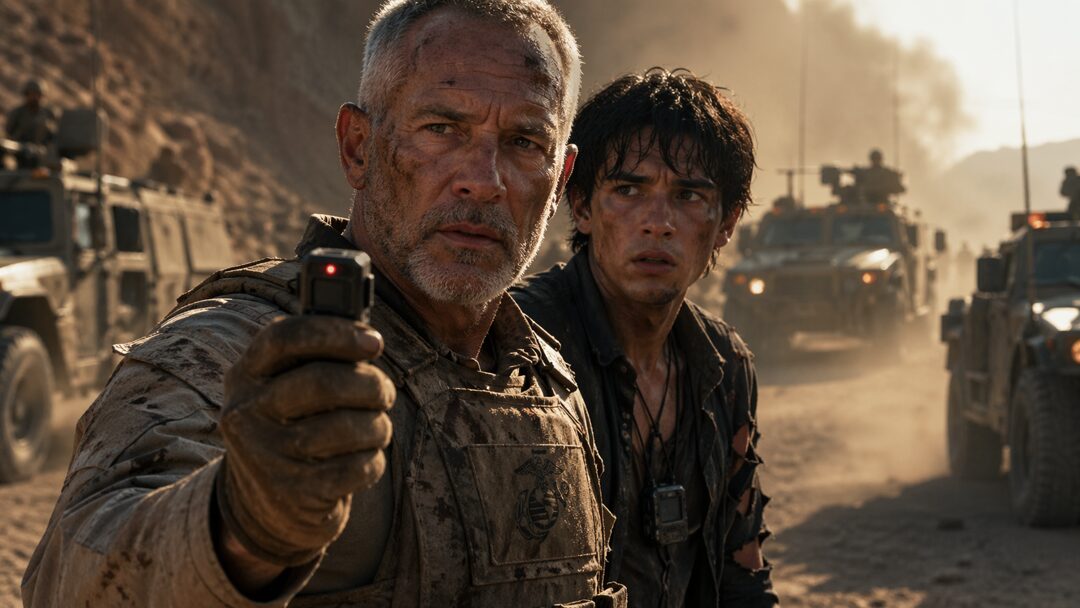
The Woman on the Ridge
Part I — The Shot She Was Not Allowed to Take
Sergeant Mara Voss had the young man centered in her scope when Colonel Elias Rourke’s hand clamped down on her shoulder hard enough to bruise.
“Do not take that shot.”
The order came low, almost calm, which made it worse.
The young man was twenty yards ahead, stumbling into the desert road with both hands raised. Dust hung behind him in a dirty wall. His dark jacket was torn across one sleeve. His mouth kept opening and closing, but the wind dragged his words apart before they reached her.
Mara did not move her cheek from the stock.
“He’s carrying something,” she said.
“I see it.”
“Then move your hand, sir.”
Rourke did not.
Through the scope, the young man’s face sharpened between waves of heat. Thin. Young. Terrified. Not the clean terror of innocence. Battlefield terror. The kind worn by people who had already survived one thing and knew another was coming.
His left hand twitched toward his chest.
Mara’s finger settled closer to the trigger.
Rourke said, “Mara.”
One word. Rankless. Personal.
That was when she knew something was wrong.
Colonel Elias Rourke never used first names under fire. He had commanded extractions in three countries, lost men in two, and carried his authority like an old injury that still knew how to stand straight. To his team, he was always Colonel. Sir. Rourke if someone was angry enough to forget themselves.
Never Elias.
Never desperate.
Mara kept the crosshairs on the young man’s sternum.
Behind them, their armored vehicle idled sideways across the road, its tires half-sunk in powdery sand. Corporal Henson was down on one knee near the rear axle, weapon up, scanning the pale slopes to the east. Lieutenant Briggs shouted something into the radio and got nothing but static back.
The drone feed had cut out ninety seconds earlier.
The road had gone too quiet after that.
Then the young man had appeared out of the dust.
Now a convoy was moving behind him.
Mara could hear it before she could see it clearly—the low mechanical growl of engines pushing through the valley, too fast for caution, too steady for panic. Dust rolled ahead of the vehicles like weather.
“Colonel,” Mara said. “If he gets closer—”
“He doesn’t die here.”
That was not an answer.
The young man shouted again. This time one word broke loose from the wind.
“Ridge!”
Mara shifted the scope upward for half a second.
Nothing but sand, stone, glare.
She came back to the young man.
“Hands!” Briggs yelled from the road. “Keep your hands where I can see them!”
The young man did. Then he pointed upward anyway.
Three rifles snapped tighter on him.
Mara heard Rourke breathe once beside her.
Not fear.
Recognition.
That made her colder than the rifle under her cheek.
“Who is he?” she asked.
Rourke’s jaw worked. No sound came out.
The young man took another step.
Mara tracked him perfectly.
She had trained for this. For wind, distance, movement, partial obstruction, panic. She had trained to make the world simple when everyone else made it loud. A target was a target. A threat was a threat. A second was a lifetime if you knew how to spend it.
But Rourke’s hand stayed on her shoulder.
And the convoy did not slow.
“Permission to disable,” she said.
“No.”
“He’s closing distance.”
“No.”
“Sir, if he’s bait—”
Rourke was already moving.
He rose from behind the scrub bank and stepped into the open road.
For one stupid second Mara thought he had lost his mind.
“Colonel!” she hissed.
Rourke did not look back.
He walked straight toward the young man with his weapon lowered but ready, boots sinking into the loose sand, gray stubble bright with dust. The young man saw him coming and froze.
Then he started shaking his head.
“No, no, no,” he said, suddenly close enough for Mara to hear. “Not there. Not road. Ridge is wrong.”
Rourke seized him by the front of his vest and yanked him close.
Every gun on the team tightened.
Every shadow on the hills became possible movement.
The young man’s hands flew up higher. Something small and black swung from a cord around his neck. Not a detonator. Not a grenade. A recorder, maybe. A cheap field unit, cracked at one corner.
Rourke saw it too.
His face changed.
Only for a second.
But Mara had spent two years watching him from behind scopes, across briefing rooms, in the blue glow of satellite maps and the red glow of medevac lights. She knew his command face. She knew his anger. She knew his grief when he thought no one saw it.
This was different.
This was a ghost reaching up through the dust and taking him by the throat.
The young man grabbed Rourke’s wrist.
“She waits for you,” he said.
Rourke went still.
Mara’s scope drifted, almost against her will, back to the ridge.
This time, high above the road, something dark moved against the sand.
Part II — The Boy in the Road
“Contact high east,” Henson called. “Possible one shooter.”
“Hold fire,” Rourke snapped.
The order hit the team like a thrown stone.
Mara swung the rifle upward, searching. The eastern ridge was broken into shelves of pale rock and wind-cut sand. Too many folds. Too many places for a muzzle to hide. Heat shimmered across everything.
The convoy emerged through the dust behind the young man.
Three vehicles.
Tan. Armored. No clear markings except a dark square painted on the lead hood, half-hidden beneath sand. Not local militia. Not regular coalition escort. The vehicles moved with professional spacing but no visible distress signal, no friendly light code, no attempt to hail on the open channel.
That was wrong.
A rescue convoy announced itself.
A recovery convoy approached like a closed fist.
“Rourke,” Briggs called, voice tight. “We’ve got inbound unidentified.”
The young man heard the engines and tried to twist around.
Rourke slammed him back.
“Eyes on me,” Rourke said. “Name.”
“Sami.”
“Full name.”
“Sami Darzi.”
Rourke’s grip tightened.
Mara saw it from the slope.
Sami saw it too.
His fear flared into something hotter. Recognition answering recognition.
“You know,” Sami whispered.
Rourke said nothing.
“You know what they did.”
“Down,” Rourke ordered.
Sami did not go down. He pointed toward the ridge again, hand shaking so violently Mara thought one of the others might shoot him just from nerves.
“She is not shooting you,” he said. “She is waiting.”
“For what?” Rourke asked.
Sami’s eyes flicked to the convoy.
“For you to choose different.”
The sentence cut through the road harder than gunfire.
Mara felt it and hated that she felt it. This was not the moment for riddles. Not with three vehicles closing in. Not with one possible shooter above them. Not with a frightened informant and a commander suddenly acting like a man who had stepped into a memory instead of a mission.
“Colonel,” Mara said into comms, “I need authority to cover the ridge.”
“Cover,” Rourke said. “Do not engage unless I give the word.”
“Sir—”
“That is an order.”
She swallowed the rest.
The lead vehicle was close enough now for Mara to see the shape of the driver behind armored glass. The second vehicle’s roof hatch was open. A man stood half out of it in desert gear with no flag patch visible, weapon angled down but ready.
Private military, Mara thought.
Not official enough to salute.
Too official to ignore.
Briggs switched channels. “Inbound convoy, identify yourself. You are approaching an active Marine extraction lane. Identify.”
Static.
Then a voice answered, crisp and male.
“Rourke Actual, this is Recovery Unit Six. Stand by for sealed directive transfer.”
Rourke closed his eyes for half a second.
Mara saw it.
So did Sami.
The young man’s face crumpled.
“No,” Sami said. “No, no. Not them.”
Rourke shoved him down behind the disabled vehicle’s front wheel and crouched over him like a shield.
That motion rewired the whole scene.
Until that second, Sami had been a possible threat.
Now Rourke had made him something else.
Protected.
Valuable.
Condemned.
The convoy slowed fifty yards out, engines growling. Dust rolled over the Marines and turned everyone into silhouettes. Mara blinked grit out of one eye and stayed on the ridge.
Movement again.
A black sleeve.
A shape lower than standing, higher than prone.
A rifle barrel resting against sand.
Mara’s breathing narrowed.
“I have the ridge shooter,” she said.
Rourke looked up.
For a moment, the old colonel was not on the desert road anymore. He was somewhere years behind it.
Mara knew that look too. Men got it when a place remembered them.
“Describe,” he said.
“Dark field gear. Scarf. Rifle. Female, possibly. She has angle on all of us.”
Sami whispered something Mara could not hear.
Rourke heard.
His hand dropped from the radio.
Mara adjusted the scope.
The woman on the ridge turned her face slightly. The scarf covered her mouth and nose, but her eyes were visible through the dusty light.
Calm.
Too calm for an ambush.
Too steady for panic.
Mara put the crosshairs on her center mass.
“Say the word,” she said.
Rourke’s answer came after two heartbeats.
“Leila.”
The name did not sound like an identification.
It sounded like a debt.
Part III — The Woman Above Them
Leila fired before anyone else could speak.
The shot hit the sand six feet left of Briggs and exploded the road into dust.
Briggs dropped. Henson swung his rifle upward. Mara nearly fired from instinct alone.
“Hold!” Rourke barked.
Another shot cracked from the ridge.
This one struck the hood of the lead convoy vehicle. Sparks jumped. The driver swerved, corrected, and stopped hard enough to throw dust over the windshield.
She had not missed.
Mara understood that immediately.
Leila was not trying to kill the Marines.
She was drawing lines in the sand.
“Colonel,” Mara said, her voice lower now, “who is she?”
Rourke did not answer.
The convoy radio cut in again.
“Rourke Actual, surrender the local national immediately. This is a classified recovery action under Lantern authority.”
Lantern.
The word changed Rourke’s face more than the gunfire had.
Mara had heard code phrases before. Most meant nothing without clearance. This one meant something to Rourke. Something old enough to have gathered rot.
Sami pressed both hands over his ears, though the shooting had stopped.
“They used that word,” he said. “That night. My father heard it. He told me hide when he heard it.”
Rourke looked down at him.
For a moment, no one moved.
The desert held its breath.
Mara kept one eye through the scope and one ear on the road. The woman on the ridge had shifted position. Still visible. Still exposed enough for Mara to take her if ordered.
But Leila’s rifle was pointed at the convoy now.
Not them.
“Talk,” Mara said.
Rourke looked at her.
It was not the tone a sergeant used with a colonel. They both knew it.
Still, she did not take it back.
The convoy commander’s voice sharpened. “Rourke Actual, acknowledge directive. Transfer Darzi into our custody. Your mission is complete upon handoff.”
Sami laughed once. A broken sound.
“Custody,” he said. “They like clean words.”
Rourke pulled him lower behind the tire.
Years earlier, Mara had heard men joke that Rourke had no past before the uniform. He seemed carved out of command itself. Gray hair, field maps, hard decisions. He could tell where a road would turn bad by how dogs stopped barking near it. He could hear panic in a radio operator’s silence. He could look at a young Marine shaking after a firefight and say exactly three words that kept him alive until morning.
Mara had trusted him because he never wasted certainty.
Now every second of his silence felt like a loaded weapon.
“There was a withdrawal,” Rourke said at last.
Not to the team.
Not to the convoy.
To Mara.
“Same province. Different road. We had a local evacuation route. Families, interpreters, scouts, anyone marked for retaliation. Someone leaked the route.”
Sami stared at the dust between his knees.
“My father drove the first truck.”
Rourke’s mouth tightened.
“Leila’s family was in the second.”
Up on the ridge, Leila did not move.
The convoy commander broke in. “Colonel Rourke, you are ordered to comply. Darzi is wanted for debrief and containment. Failure to comply will constitute obstruction of a classified recovery.”
Containment.
Mara felt the word settle in her stomach.
Not rescue.
Not protection.
Containment.
She moved the scope down to the lead vehicle. The man in the roof hatch had his weapon trained loosely toward Rourke’s position. Not at Leila. Not at the ridge.
At Sami.
Rourke continued, voice stripped flat.
“The after-action report blamed insurgent interception.”
“And was it?” Mara asked.
He did not answer fast enough.
That was the answer.
Sami lifted his head. Dust had pasted tear tracks to his face.
“You signed it,” he said to Rourke. “My father said the Americans would tell the truth. He died believing that. You signed paper instead.”
Rourke looked as if the bullet had already entered him and was taking its time.
“I signed what command sent back.”
“No,” Sami said. “You signed what let you sleep.”
No one spoke.
Even the convoy seemed to wait.
Then the man in the roof hatch raised a bullhorn.
“Darzi,” he called. “Stand and walk toward my voice. You are being taken into protective custody.”
Sami flinched as if struck.
Leila fired again.
The round punched into the sand in front of Sami, close enough to cover him in grit.
He jerked back with a cry.
Rourke grabbed him before he bolted.
Mara shifted to Leila.
“Colonel, she just fired at him.”
“No,” Rourke said. “She fired to stop him from standing.”
Mara held her breath.
The old man was right.
Leila had drawn another line.
One between Sami and the convoy.
The battlefield tilted.
Everything Mara had thought she was seeing became suspect.
The woman above them had the clearest shot and had killed no one.
The convoy had arrived under authority and aimed at the witness.
The boy in the road was not bait.
He was evidence with a heartbeat.
Part IV — Lantern Authority
The convoy commander stepped out of the lead vehicle.
He wore clean desert armor and mirrored glasses, the kind that turned his eyes into two small pieces of sky. No rank visible. No name tape. His rifle hung low, but four men behind him carried theirs higher.
“Colonel Rourke,” he called. “This can remain orderly.”
Rourke stood with one hand on Sami’s shoulder.
Mara hated that he stood. He made himself a target on purpose, and everyone knew it.
“Identify yourself,” Rourke said.
“Major Callan Reed, attached recovery authority. You received the directive.”
“I received a phrase.”
“That phrase is sufficient.”
“Not today.”
Reed’s head tilted slightly.
He was not angry. That was what made him frightening. He spoke like a man reading from a document that had already decided the outcome.
“Your extraction request was approved on condition of local transfer,” Reed said. “Darzi belongs to the inquiry.”
Sami whispered, “They killed the last inquiry.”
Rourke’s hand tightened on him.
Reed continued, “You are emotionally compromised by prior theater involvement. Stand down.”
Mara watched Rourke absorb the words.
Prior theater involvement.
Clean words again.
So clean they left no fingerprints.
Briggs shifted near the armored vehicle. Henson’s breathing rasped over comms. No one knew which order mattered now. Rourke’s command. Reed’s directive. The invisible authority behind Lantern. The woman above them who could turn any sentence into blood.
Mara had built her life around chain of command because chaos killed faster than bullets. Orders made men move when fear froze them. Orders kept grief from spreading through a unit like fire.
But an order could also be a locked door.
And sometimes the person screaming on the other side was still alive.
Reed lifted one hand.
“Last instruction. Transfer Darzi.”
“No,” Sami breathed.
Rourke looked down at him. “What proof do you have?”
Sami fumbled at the cord around his neck. His fingers shook so badly he nearly dropped the recorder.
“Voice,” he said. “My father’s. Leila found old radio copy. Names. Route. The one who gave it.”
Rourke went pale under the dust.
“Who?”
Sami looked toward the convoy.
Reed said, “The object around Darzi’s neck is classified material.”
Mara almost laughed.
There it was.
The shape of it.
Not a rescue. Not a recovery. A cleanup.
Rourke held out his hand to Sami. “Give it to me.”
Sami recoiled.
“No.”
“Sami.”
“You signed before.”
The accusation landed harder because it was quiet.
Rourke lowered his hand.
“You’re right.”
Mara looked at him.
So did Reed.
So did the ridge.
Rourke reached slowly to his own vest and removed a small military recorder clipped near his radio harness. He held it up.
Reed took one step forward. “Colonel, do not.”
Rourke pressed the recorder on.
A tiny red light blinked to life.
He switched channels.
Briggs turned sharply. “Sir, that’s emergency open-band.”
“I know.”
“That goes to every receiver in range.”
“I know.”
Reed’s voice lost its calm.
“Rourke. Shut that off.”
Rourke did not.
He stood in the road with Sami beside him, dust scraping across both of them, Leila’s rifle above, Reed’s convoy below, Mara’s crosshairs moving between them all.
For the first time since Mara had known him, Rourke looked like a man without a shield.
“This is Colonel Elias Rourke,” he said into the open channel. “Marine special extraction unit, grid follows. I am refusing a sealed Lantern directive ordering transfer of local witness Sami Darzi to private recovery custody.”
Reed raised his hand higher.
Mara shifted her rifle toward him.
Rourke kept speaking.
“In 2017, during the Marwan withdrawal, I signed an after-action report attributing civilian convoy loss to insurgent interception. That report was false.”
The desert seemed to go silent under the words.
Sami stared at him.
Up on the ridge, Leila lowered her rifle half an inch.
Rourke swallowed once.
“The evacuation route was compromised through coalition intelligence channels. I knew the report did not account for that possibility. I signed anyway.”
Reed’s arm dropped.
“Fire.”
Part V — The Right Target
The first rounds tore into the road around Rourke’s boots.
Mara fired before she had permission from anyone.
Her shot shattered the lead vehicle’s front tire. The convoy lurched sideways, metal screaming, men ducking. She worked the bolt and fired again, punching the engine block hard enough to spill smoke into the dust.
Not bodies.
Not yet.
A disabled vehicle could not chase Sami uphill.
That was the target.
Leila fired from the ridge, fast and controlled. One round struck the ground in front of Reed’s men. Another hit the side mirror of the second vehicle. Another clipped the radio antenna clean off.
She was not missing.
She was herding wolves.
“Move!” Rourke shouted, shoving Sami toward the slope. “Run to her!”
Sami froze.
All his courage had carried him to the road. The ridge looked impossible now—steep, exposed, bright with gunfire.
Rourke grabbed his collar and pulled him close.
“Your father got you this far,” he said. “Do not die in my silence.”
Sami’s face broke open.
Then he ran.
Mara covered him through the scope.
For the first time, she did not see a possible threat.
She saw a young man with too-thin shoulders climbing loose sand with a recorder clutched in one fist, slipping, catching himself, rising again because the dead had no voice except the living.
Reed shouted something she could not hear.
His men spread.
One aimed toward Sami.
Mara found the rifleman’s weapon, not his chest, and fired. The round kicked the rifle from his grip and spun him backward into the side of the vehicle.
A second later, the ridge cracked.
Leila’s shot drove the same man flat into the dust.
Still alive.
Done fighting.
Rourke was still transmitting.
“Witness Darzi is in possession of corroborating audio,” he said, voice rougher now. “Any unit receiving, record and relay. Repeat, record and relay.”
Reed drew his sidearm.
Mara saw it.
So did Rourke.
There are seconds that do not feel like time. They feel like verdicts.
Mara swung the scope toward Reed.
But Rourke stepped into the line first.
The shot hit him high in the side.
His body twisted as if the desert had yanked him downward. He fell hard, one hand still closed around the recorder, the red light blinking against the dust.
“Colonel!” Mara shouted.
Sami stopped halfway up the slope.
“No!” Rourke roared from the ground. Blood darkened the sand under him. “Run!”
The word broke something in Sami.
He turned and climbed.
Not fast.
Not cleanly.
He clawed at the ridge like a man digging himself out of his own grave.
Mara fired again, this time at the ground near Reed’s feet, close enough to make him stagger back. She could have killed him. Part of her wanted to. The clean math of it offered itself: remove the commander, reduce the threat.
But clean math had put Sami in a rifle scope.
Clean words had buried a convoy.
Clean reports had let old men sleep.
She adjusted and fired into the second vehicle’s radiator.
Steam burst white through the dust.
Briggs dragged Rourke behind the armored wheel well. Henson laid suppressing fire that chewed sand into smoke. The road became noise, heat, metal, grit.
Above them, Leila rose from the ridge for the first time.
She was taller than Mara expected. Still. Black against the pale sky. The scarf had slipped from her face.
Her eyes were on Rourke.
Not Reed.
Not Sami.
Rourke saw her too.
He lay half on his side, breathing like every breath had to be negotiated. Blood covered his glove. The recorder remained clenched in his hand, still transmitting unless the fall had broken it.
Leila lifted her rifle.
For one long second, the whole battle narrowed to the space between them.
Mara had her in the scope.
This was the shot Rourke had forbidden.
This was the shot that would be easiest to explain.
Hidden shooter. Armed. Clear threat.
Mara’s finger found the trigger.
Below her, Rourke moved his head once.
No.
Not an order now.
A plea.
Or maybe trust.
Mara held.
Leila’s rifle settled on Rourke’s chest.
Sami reached the ridge behind her and collapsed to his knees. He held out the cracked recorder from around his neck, arm shaking.
Leila did not take it immediately.
She kept looking at Rourke.
The convoy fired again. Rounds struck stone near her boots.
She did not flinch.
Mara whispered, “Don’t.”
She did not know who she meant.
Leila’s mouth moved.
The wind took the words.
Then she lowered the rifle from Rourke and turned it on the convoy.
Mara exhaled so hard the scope blurred.
Part VI — What the Dust Carried
The firing did not stop all at once.
Nothing clean ever did.
It broke apart in pieces.
First the lead vehicle died completely, smoke pouring from under the hood. Then the second reversed too fast, slammed its rear bumper into the third, and boxed them both crooked across the road. Then someone on an open channel—some distant unit, some listening command, some bored operator suddenly sitting upright—asked Rourke to repeat.
He did not.
He could not.
So Mara took the recorder from his hand.
“This is Sergeant Mara Voss,” she said, and was surprised by how steady she sounded. “Rourke Actual is down. Witness Darzi is alive. Lantern recovery unit engaged Marine personnel after refusal to transfer witness. Recording and relaying all traffic.”
Reed screamed that she had no authority.
Mara almost smiled.
Authority had become a strange word.
Briggs pressed gauze into Rourke’s side with both hands. “Stay with me, sir.”
Rourke’s eyes found Mara.
“Darzi?”
She looked up.
Sami was on the ridge beside Leila. He had one hand on the sand, one hand still wrapped around the old recorder. Leila crouched near him but did not touch him. Her rifle remained trained down the road.
“Alive,” Mara said.
Rourke closed his eyes.
“Good.”
It was not triumph. It was barely relief.
A minute later, Reed’s men stopped firing. Not because they had surrendered. Because too many radios were awake now. Too many voices were demanding identification, status, authority. The sealed directive had cracked open into the air, and whatever lived inside it did not like sunlight.
Leila kept her rifle raised anyway.
Mara understood.
Truth transmitted was not truth protected.
Briggs got Rourke behind the armored vehicle. Henson watched the convoy. Mara kept her rifle across her knees and looked up at the ridge.
Leila stood there like the answer to a question no one had wanted to ask.
For years, Mara had believed high ground meant advantage.
Now it looked like grief.
Sami came down first.
Slowly.
Leila followed several paces behind him, rifle lowered but ready. No one aimed at him. Mara made sure of that. When Henson’s barrel drifted out of habit, she touched his wrist and pushed it down.
Sami saw.
His face shifted, not into gratitude exactly. Something harder. Something that said he would remember both the rifle and the lowering of it.
He stopped near Rourke.
The colonel opened his eyes.
Sami held up the cracked recorder.
“My father,” he said. “He said names.”
Rourke nodded once.
“I believe you.”
Sami’s jaw trembled.
“That is late.”
Rourke’s mouth tightened. “Yes.”
No apology came after it.
Maybe there were apologies too small for the dead.
Maybe Rourke knew better than to offer one as if it could cover a road full of bodies from years ago.
Leila approached last.
Up close, she was not younger or older than Mara had thought. She was simply more real. Dust in the lines around her eyes. A scar along one cheek. Hands steady on the rifle. Grief held so tightly it had become posture.
Rourke looked at her.
“Leila.”
She stared down at him for a long moment.
Then she raised the rifle.
Briggs reached for his sidearm.
Mara stopped him.
Not because she trusted Leila.
Because she understood the moment belonged to someone else.
Leila aimed at Rourke’s face.
Rourke did not look away.
Sami whispered something in his own language. Leila’s eyes flicked toward him, then back.
The road went quiet again.
This time, no one mistook the quiet for safety.
Leila lowered the rifle.
Not forgiveness.
Never that.
A worse mercy.
She turned away from Rourke and faced the smoking convoy.
“Live,” she said, her English careful and cold. “Hear it spoken.”
Rourke’s eyes closed.
Mara did not know whether the words hurt him or kept him alive.
Above them, the open channel continued to spit voices into the desert. Questions. Demands. Callsigns. The machinery of the world waking up too late, as it often did.
Sami sat in the sand beside the armored wheel, both recorders in his lap now—the old one and Rourke’s. One carried the voice of his father. One carried the confession of the man who had failed him.
He held them like they were too heavy for their size.
Mara looked at her rifle.
For most of her life, she had thought the hardest part was making the shot.
Now she knew better.
The hardest part was knowing when not to.
Rourke turned his head slightly. His eyes opened just enough to find her.
“You had the shot,” he said.
Mara looked toward Sami. Then toward Leila. Then toward the convoy, stalled and smoking in the road.
“Yes, sir.”
“Why didn’t you take it?”
She thought of the young man in her scope. The woman above them. The convoy that had called itself rescue. The old report that had turned the dead into language.
Then she set the rifle down across her knees, muzzle lowered into the dust.
“Because I finally saw the target.”
Rourke breathed out, almost a laugh, almost pain.
No one said they had won.
No one there was foolish enough.
The desert kept the bullet marks. The road kept the blood. The ridge kept its silence. Somewhere beyond the valley, the transmission had already left them, traveling through radios and records and men who would try to bury it or save it or pretend they had not heard.
But Sami was alive.
Leila had not fired the last shot.
Mara had lowered her rifle from the wrong enemy.
And in the dust between the road and the ridge, the truth had finally become harder to kill than the boy carrying it.