What The Old Man Carried Into The Desert That Morning
Part I — The Man at the Gate
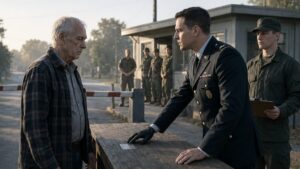
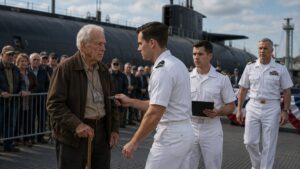
The old man looked wrong the moment he stepped out of the pickup.
Not dangerous. Not impressive. Wrong.
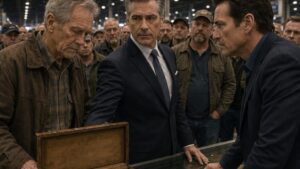
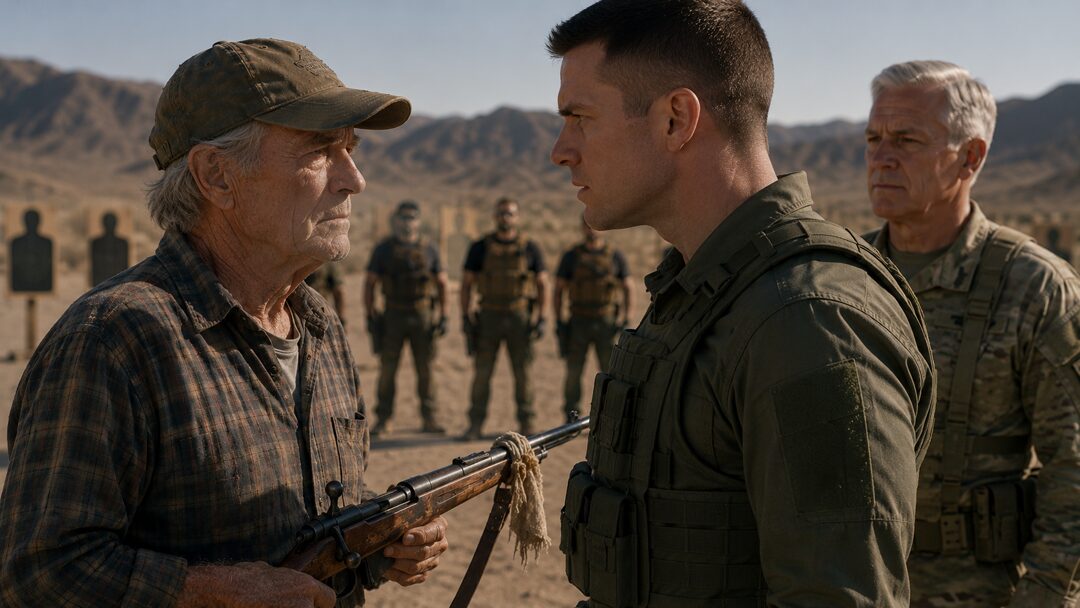
He wore a faded cap pulled low over a face the desert had already worked on for years. His plaid shirt hung loose from narrow shoulders. His boots were dusty before they touched the ground. In one hand he carried a long wooden case, scratched pale at the corners, the kind of thing that looked like it belonged in a garage beside fishing rods and broken tools.
Across the range, six younger men in green training gear stopped talking.
Jason Carter saw them looking and felt irritation move through him before the old man had even closed the truck door.
They had been waiting on the base commander, not someone’s grandfather.
“Keep the line hot,” Jason said.
No one moved.
The old man shut the pickup door with his hip, lifted the wooden case, and walked toward them slowly. Not weakly. Slowly. There was a difference, but Jason was too annoyed to care.
The desert training range stretched behind him in flat, bright bands: gravel, sand, steel stands, black silhouette targets shimmering in the heat. Beyond that, the hills sat colorless and still. It was the kind of morning where every sound carried too far.
Jason stepped forward before the old man reached the firing line.
“Sir,” he said, controlled and polite, “this is a closed evaluation.”
The old man stopped. His eyes lifted under the cap.
“I know.”
Jason waited.
The old man did not add anything.
That was the first thing Jason disliked about him. Not the age. Not the clothes. The silence. It made everybody else aware of what they had said.
Jason nodded at the wooden case. “We’re not running civilian demonstrations today.”
“I was invited.”
“By who?”
The old man looked past Jason toward the line of targets. His thumb rested against the brass latch of the case, worn smooth from years of use.
“Commander.”
One of Jason’s men shifted behind him. Someone tried to hide a smile.
Jason kept his expression flat. “Commander Jerry?”
The old man gave a small nod.
That irritated Jason more. Not because it might be true, but because the man did not seem interested in making it easier for anyone.
Jason had spent the last eight months building his unit toward this evaluation. Every drill had been timed, every miss recorded, every adjustment made under pressure. The base commander had hinted that only one training team would be selected for the memorial qualification that fall.
Jason wanted it.
Not because it looked good on paper, though it did.
Because his father’s name was tied to that old tradition, and Jason had spent his life trying to stand close enough to it without looking like he was reaching.
Now an old man in a plaid shirt had wandered into the middle of it carrying a case like a question.
Jason turned slightly toward his second shooter. “Hold the first drill.”
Then, to the old man, “You can wait by the shade structure until the commander arrives.”
“I’ll wait here.”
“This is an active line.”
“I noticed.”
The younger men went very still.
Jason smiled once, without humor. “Sir, I’m responsible for safety and schedule on this range.”
The old man looked at him then. Really looked.
“Then be responsible.”
Nothing in his voice rose. That made it worse.
Jason felt heat crawl up the back of his neck. He had been spoken to by generals, instructors, auditors, and men who enjoyed making younger officers feel small. This old man was doing none of that. He simply stood there as if Jason’s authority was real but not the only real thing in the world.
Jason lowered his voice.
“Name?”
“Donald Hayes.”
The name touched nothing in Jason’s memory.
“Mr. Hayes,” Jason said, “stand clear of the firing line.”
Donald did not argue. He moved two steps back, set the case upright beside his boot, and placed one sun-darkened hand on the top.
The hand was thin, veined, spotted with age.
It did not tremble.
Yet.
Jason turned away first.
That bothered him too.
Part II — A Tradition Without a Story
Commander Jerry Whitaker arrived seven minutes late in a white range vehicle, which was the closest thing Jason had seen to panic from him.
Jerry was not a loud commander. He never had to be. Silver hair, pressed field uniform, calm eyes that made excuses sound childish before anyone offered them. He stepped out, looked once at Jason, once at Donald, and the entire range seemed to understand that something had already happened.
Jason came to attention.
“Commander.”
Jerry returned the greeting, then turned to Donald.
“Mr. Hayes. Thank you for coming.”
The way he said it changed the air.
Not “thanks for helping.” Not “glad you could make it.” Thank you for coming, like the old man had crossed something harder than distance to be there.
Donald nodded. “You asked.”
“I did.”
Jason kept his face still.
Jerry turned toward him. “Captain Carter, Mr. Hayes is here as an evaluator.”
One of Jason’s men glanced down at Donald’s old case, then away.
Jason felt the words land and chose, with effort, not to react too quickly.
“Evaluator, sir?”
“For the memorial qualification.”
Jason looked at Donald again.
That could not be right.
The memorial qualification was not public. Not officially, anyway. It was old, half tradition and half test, connected to a classified evacuation decades ago. Men spoke about it with that particular reverence reserved for stories they did not fully know. The final drill had an unofficial name passed around quietly.
The last shot.
Jason had grown up hearing fragments about it. His father, Brandon Carter, had been part of the evacuation. Brandon never told the story straight. He would say the weather was bad, the route collapsed, the timing got ugly. Then he would go quiet and find some reason to leave the room.
After he died, other men spoke for him.
Clean operation. Strong command. Discipline under pressure.
Jason had believed them because he needed to.
Jerry gestured toward the firing line. “Mr. Hayes will observe the evaluation.”
Jason heard the restraint in that sentence. Observe. Not assist. Not advise. Observe.
“Understood,” Jason said.
Donald’s face revealed nothing.
Jason turned to his men. “We continue on schedule. Precision series one. Modern platform. Timed callouts. No warm-up.”
The team moved with relief. Work gave everyone somewhere to put the awkwardness.
Rifles came up. Optics were checked. Range data was confirmed. Wind was called from the tower. The men settled behind their weapons with the familiar efficiency Jason trusted more than almost anything.
Donald stayed behind the line beside Jerry, both hands folded over the top of the wooden case.
He did not speak.
Jason wanted him to.
He wanted one foolish comment, one outdated correction, one proof that this had become exactly what he suspected: an old-timer morale visit dressed up as tradition.
Instead Donald watched.
The first shooter fired on command. Clean hit, high center.
The second adjusted and fired. Good.
The third corrected for angle, waited half a beat, fired. Better.
Jason called times, corrections, target numbers. His voice was sharp and steady. The range answered him.
By the fifth shooter, the rhythm had returned. Jason felt the men settling into themselves. This was what they did. This was where they were strong.
When the first series ended, Jason lowered his timer.
“Good work. Reset for series two.”
Jerry said nothing.
Donald said nothing.
Jason turned before he could stop himself.
“Any notes, Mr. Hayes?”
It was not disrespectful. Not on paper.
Donald looked at the targets for a long moment. Then his eyes moved to Jason.
“You’re shooting at targets,” he said. “That’s not always the same as seeing them.”
No one moved.
Jason almost laughed, which would have been a mistake.
Instead he nodded once. “We’ll try to see the paper better.”
A few of his men smiled.
Donald did not.
Jerry’s eyes lowered briefly, as if Jason had stepped on something fragile without knowing it.
That bothered Jason more than the sentence itself.
He turned back to the line. “Series two. Hard wind call. Move.”
Behind him, the old man’s thumb tapped once on the wooden case.
Not impatiently.
Like he was counting something only he could hear.
Part III — What the Wind Took
The second drill was designed to expose false confidence.
Jason had built it himself.
The men had to transition between marked silhouettes while a digital readout fed shifting range data. The correct shooter would trust the system, but not worship it. That was the point. Tools gave answers. Good men knew when answers changed.
The first two shooters performed well. Not perfect, but within standard.
The third shooter was Jason’s best.
Brandon Miller—no relation to Jason’s father, though Jason had always noticed the coincidence—was steady under pressure, a little too proud, but good enough to earn it. He settled behind his rifle and waited for Jason’s command.
“Target four,” Jason called. “Hold correction. Execute.”
The shot cracked flat across the range.
The target shook.
“Impact,” the spotter called.
Jason lifted his binoculars.
It was not bad.
But something in Donald shifted before the official call came.
Not his body. His face barely changed. But his attention sharpened, and Jason saw it from the corner of his eye.
The spotter checked again. “Hit. Slight right.”
Jason lowered the binoculars.
Donald said, “Left edge of the heat line pulled him. Wind changed low. He corrected for the flag, not the ground.”
The spotter looked up.
Jason turned slowly. “Excuse me?”
Donald nodded toward the target corridor. “The flag lied.”
The words were simple.
The problem was that they were right.
Jason raised the binoculars again. He tracked the low shimmer near the gravel berm, watched dust feather left across the base of the target stands while the higher flag still moved in the opposite rhythm.
He had missed it.
Not completely. Not disastrously. But enough.
His best shooter had followed the clean data and missed the honest air.
Jason felt his men waiting for his reaction.
He could dismiss it. He could say it did not matter. He could bury the moment under another command.
Instead Jerry spoke first.
“Captain?”
Jason’s jaw tightened.
“Correction noted,” he said.
Donald did not look satisfied. That was the worst part. He looked almost sorry.
Jason stepped closer, keeping his voice low enough that only Donald and Jerry could hear.
“You’ve worked this range before?”
“No.”
“Then how did you see it?”
Donald’s eyes stayed on the targets. “Same way you hear a man lying. You stop listening to the loudest part.”
Jason had no answer ready.
That line stayed with him while the men reset.
It stayed with him because his father used to say something close to it, though Jason could not remember the exact wording. Brandon Carter had rarely given advice directly. He left it scattered around the house in fragments.
Don’t trust a clean story too fast.
Watch what men don’t explain.
Weather has more patience than pride.
Jason had filed those things under grief and old habits. Now they came back sounding less like sayings and more like warnings.
The third drill began badly.
Not because the men failed. They were too good for that.
It began badly because they knew Donald was watching differently now.
The old man had moved from inconvenience to measurement.
Every correction Jason called felt suddenly louder. Every clean hit felt like it was being weighed against something older than the range.
When the drill ended, the targets showed a tight cluster. Any commander would have called it a strong performance.
Jerry did not.
Donald did not.
Jason could feel his patience thinning.
He approached Jerry while the men cleared equipment.
“Sir, may I speak freely?”
Jerry glanced at Donald, then back at Jason. “Walk with me.”
They moved toward the shade structure, far enough that the team would not hear, not so far that Donald disappeared from view.
Jason kept his voice controlled.
“With respect, if Mr. Hayes is evaluating us, I need to understand the standard. We’re running modern qualification procedures. If this is ceremonial, say it’s ceremonial.”
Jerry looked across the range. “It isn’t.”
“Then who is he?”
Jerry took a breath. “Someone your father knew.”
Jason’s throat closed before he could stop it.
Jerry continued quietly. “They were on the same evacuation route. Northern ridge corridor. Late winter. Border collapse. The report you’ve seen is clean because reports often are.”
Jason looked at Donald.
The old man stood alone beside the wooden case, hat brim low, watching the silhouettes shift in the heat.
“My father never mentioned him,” Jason said.
“No,” Jerry said. “I don’t imagine he did.”
The answer hit harder than it should have.
Jason’s father had been a decorated man. A hard man to impress, harder to know. He had taught Jason discipline by silence and love by showing up to things early. After he died, the service photo on Jason’s wall became less a picture than a standard.
If Donald Hayes belonged in that photo somehow, Jason hated that he did not know it.
“What happened on that route?” Jason asked.
Jerry’s eyes stayed forward. “Enough that the men who came home did not enjoy being called heroes.”
“That’s not an answer.”
“No,” Jerry said. “It’s the only one I’m giving you before the evaluation ends.”
Jason turned back toward the line.
Donald had opened the wooden case.
Part IV — The Old Case Opens
No one spoke when Donald lifted the rifle out.
Even the younger men who did not know what they were looking at understood enough to go quiet.
It was not sleek. It had no modern optic, no clean black finish, no rail system, no digital attachment, no polished arrogance. The stock was dark wood rubbed smooth in places and scarred in others. The metal was worn but cared for. A small notch sat near the stock, shallow and deliberate. Near the sling, a faded strip of cloth had been tied so long it seemed part of the rifle itself.
Donald’s hands changed when they touched it.
They did not become younger. That would have been a lie.
They became certain.
Jason watched the old man check the bolt, the chamber, the sight, the sling. Each movement was slow, not because he did not know what came next, but because he refused to treat any part of it casually.
Jason felt his irritation look small in hindsight.
He disliked that feeling, so he reached for authority.
“Mr. Hayes,” he said, “if this evaluation has a final standard, we should see it.”
Jerry looked at him sharply.
Donald did not.
Jason continued, the words already moving faster than his judgment. “If the qualification is built around this old last-shot tradition, then let’s run it. Same range. Same target. You demonstrate it.”
The silence after that was different.
The men heard the challenge.
Jerry heard the disrespect.
Donald heard something else.
He looked at Jason for a long moment, and Jason saw, for the first time, that the old man was tired. Not physically, though that was there too. Tired of being asked by younger men to make grief useful.
Jerry said, “Captain.”
Jason knew he had gone too far.
But pride is a door that locks from the inside.
Donald closed the bolt with a soft metallic sound.
“You asked me to shoot,” he said.
The sentence was not angry.
That made it worse.
Jason lowered his eyes for half a second. “Yes, sir.”
He had not meant the sir to sound like an apology. It did anyway.
Donald carried the rifle to the line. The men stepped back without being told.
The target was set farther out than the morning drills. Not absurd. Not impossible. But enough that the old rifle looked suddenly more fragile, as if distance itself had become part of the judgment.
Jason watched Donald kneel.
That was when he saw the tremor.
It appeared in Donald’s left hand first, a small betrayal under the skin. The fingers flexed once around the stock. Donald paused. Breathed. Reset.
For the first time all morning, Jason wanted to stop him.
The old man was not a symbol now. Not a lesson. Not a threat to Jason’s pride.
He was seventy-eight years old, kneeling in hot dust because Jason had forced the question into the open.
Jason took one step forward. “Mr. Hayes—”
Donald did not look back.
“No.”
One word.
Jason stopped.
Donald settled the rifle into his shoulder.
His cheek pressed to the stock. His cap shadowed his eyes. The faded cloth near the sling moved lightly in the wind.
Jason looked at it and thought of his father’s hands.
Big hands. Careful with tools. Awkward at birthdays. Steady when Jason broke his arm at twelve and tried not to cry.
Brandon Carter had never told him much about the old evacuation. Once, when Jason was seventeen and stupid enough to ask whether his father had ever been afraid, Brandon had stared at the kitchen window for so long that Jason thought he had not heard.
Then he said, “The brave ones weren’t the ones who weren’t scared.”
That was all.
Now Donald was kneeling in the dust with a rifle from that silence.
Jerry stood beside Jason.
Softly, without looking at him, he said, “Your father tied that cloth.”
Jason turned.
“What?”
Jerry’s expression did not change. “Not now.”
But it was already too late. The present had cracked.
Jason looked back at Donald.
The old man had not fired.
He was waiting.
A younger shooter might have forced the moment. The range was watching. The challenge had been made. The body wanted release.
Donald waited through all of it.
Heat shimmer lifted between him and the black silhouette. The flag moved one way. Dust near the berm moved another. Somewhere metal clicked as one of Jason’s men shifted his weight and immediately regretted it.
Donald breathed out.
Still did not fire.
Jason felt impatience rise in him out of habit, then shame rose faster and buried it.
He understood then, not fully, but enough.
Patience was not delay.
Patience was part of the shot.
Part V — The Distance Between Knowing and Seeing
The sound came once.
One clean crack across the desert.
No second round. No correction. No performance after the fact.
The target rocked, then stilled.
For a moment, no one called the hit.
The silence stretched so long that Jason thought maybe Donald had missed and everyone was trying to decide how to survive the embarrassment of it.
Then the spotter lowered his scope.
His face had changed.
“Impact,” he said.
Jason lifted his binoculars.
At first he looked for the center.
Then he saw it.
Not dead center. Not where a showman would have placed it. The round had passed through an older mark near the heart zone, a small dark opening already worn into the silhouette, now made clean again.
A hole inside a memory of a hole.
Jason lowered the binoculars slowly.
None of the men cheered.
No one said “nice shot.” No one clapped Donald on the shoulder. No one dared reduce it that quickly.
Donald remained kneeling for a few seconds after the shot, the rifle still settled against him. Then he lowered it carefully, as if something fragile had just ended.
Jason’s first feeling was humiliation.
His second was worse.
Gratitude.
Not because Donald had corrected him. Because Donald had not corrected him sooner.
The old man had let Jason arrive at shame slowly enough to learn from it.
Jerry walked to the target himself. He did not need to, but he did. He stood before the silhouette for a long moment, then turned back and gave Donald one nod.
Donald nodded once in return.
It was not victory.
It was recognition.
Jason approached while Donald sat back on one heel and worked the bolt open. Up close, the tremor was more visible. So were the lines in his face, deeper now that the shot was over.
“Mr. Hayes,” Jason said.
Donald looked up.
Jason had speeches available. Apologies. Explanations. A clean officer’s paragraph about respect and misunderstanding.
None of them deserved to be spoken.
So he said, “I didn’t know.”
Donald’s eyes stayed on him.
“No,” he said. “You didn’t.”
It could have been cruel.
It was not.
Jason swallowed. “My father never told me.”
Donald looked down at the rifle. His fingers found the faded cloth near the sling.
“He tried once.”
Jason went still.
Donald untied the cloth carefully. It resisted at first, stiff with age, then loosened. What came free was not impressive. A thin, faded strip of fabric, sun-washed to no clear color, frayed at one end.
Donald held it in his palm.
“Your father tore this from his sleeve,” he said. “My hand was open. I couldn’t hold the sling right. He tied it for me before they moved the last group down.”
Jason looked at the cloth and saw nothing at first.
That was the cruelty of objects. They could carry everything and still look like almost nothing.
Donald continued, voice low enough that only Jason and Jerry could hear.
“He told me not to miss.”
A faint breath moved through Jason, almost a laugh, almost pain.
“That sounds like him.”
Donald’s mouth softened, but not into a smile. “He was scared when he said it.”
Jason’s eyes rose.
Donald looked toward the target. “We all were.”
The sentence took something from Jason and gave something back in the same motion.
His father became smaller.
Then more human.
Then larger in a way that did not need polish.
Jason had spent years protecting a clean version of Brandon Carter because he thought love required it. The perfect survivor. The decorated man. The disciplined father whose silences had to mean strength because the alternative hurt too much.
Now an old man with shaking hands was telling him that his father had been afraid, had torn his own sleeve, had tied cloth around another man’s hand, had survived because another man stayed steady in a place no report could make clean.
Jason looked at the cloth again.
“Why didn’t he tell me about you?”
Donald folded the strip once over his fingers.
“Maybe he thought owing a life was easier than explaining one.”
That line went into Jason quietly and stayed there.
Donald held out the cloth.
Jason did not take it at first.
It felt wrong. Too private. Too late.
Donald waited.
Finally Jason opened his hand.
The cloth landed there almost weightless.
It felt heavier than the rifle.
Part VI — The Range Afterward
Donald packed the rifle as slowly as he had unpacked it.
No one rushed him now.
That was the first change.
The men who had smirked at the old case looked away when Donald’s hands moved over the stock. Not out of embarrassment only. Out of respect. They had seen the same object become different without changing at all.
Jason stood beside the firing line with the strip of cloth folded in his hand.
Jerry came up next to him.
“You let me make a fool of myself,” Jason said.
Jerry watched Donald close the case. “A little.”
Jason almost smiled, but it did not last. “Why?”
“Because if I told you who he was, you would have respected the story. Not the man.”
Jason had no defense against that.
Across the line, Donald lifted the wooden case. The movement cost him more now. Jason saw it and hated that he had not seen it before.
He stepped forward.
“Mr. Hayes.”
Donald paused.
Jason looked at his men. Then at the targets. Then back at the old man.
“Would you stay for the next run?”
It was the wrong question, and Jason knew it as soon as he asked. It sounded too much like asking the old man to keep performing until everyone felt forgiven.
Donald saved him from it.
“No.”
Jason nodded once. “Understood.”
Donald shifted the case in his hand. “They shoot well.”
The men heard that. Jason did too.
Then Donald added, “Teach them what they’re looking at.”
Jason felt the sentence settle over the whole range.
“Yes, sir.”
This time there was no apology in the sir.
Only recognition.
Donald walked toward his pickup. No escort. No ceremony. No final speech. The old man crossed the desert gravel in his plaid shirt and faded cap, carrying the wooden case like he had carried it for years and would carry it alone again.
Before he reached the truck, Jason turned to his unit.
“Reset the targets.”
The men moved quickly.
Jason looked at the timer in his hand, then clipped it back to his belt.
One of the shooters glanced at him. “Same drill, Captain?”
Jason looked downrange.
The targets stood black against the pale earth. The wind moved the flags one way. Low dust moved another.
“No timer first,” Jason said.
The men looked at him.
Jason unfolded his hand. The strip of cloth lay across his palm, faded and ordinary and impossible.
He closed his fingers around it.
“Run it again,” he said. “See the range.”
Behind him, an old pickup door closed.
The engine turned over once, then caught.
No one watched openly as Donald drove away, but every man on the line knew the exact moment the truck passed through the gate.
Jason did not turn around.
Some debts did not need an audience.
He raised his binoculars and looked downrange, not at the center of the paper, but at the spaces around it—the shimmer, the dust, the small movements that had been there all morning while he had been too proud to see them.
For the first time that day, the range looked larger than his command.
And in his closed fist, his father’s silence finally had weight.