The Old Man Who Heard What Everyone Else Had Learned to Ignore
Part I — Five Minutes on the Tarmac
The old man should not have been anywhere near the plane.
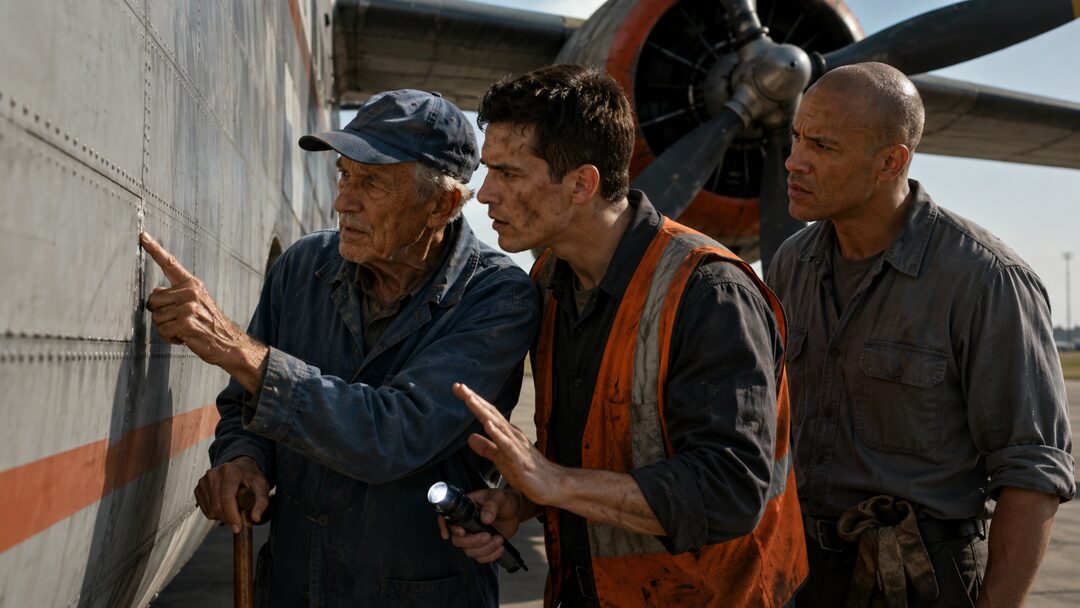
That was the first thing Jason thought when he saw him stepping out of the base truck with one hand on the doorframe and the other wrapped around a wooden cane polished smooth from years of use. The man wore a faded blue work jacket, a matching cap, and pants that hung loose on a body time had narrowed. His left leg came down carefully, like every step had to be negotiated.
Behind Jason, the transport plane waited with its nose angled toward the runway.
Gray body. Orange panels. Twin propellers. Heat trembling above the tarmac.
It was supposed to leave in forty-seven minutes.
Jason checked his watch, then looked at the old man again.
“You’ve got to be kidding me,” he said under his breath.
The driver helped the old man down. The old man didn’t thank him. He didn’t complain either. He just stood there for a moment, chin raised slightly, eyes narrowed at the aircraft as if he were listening to it from across the ramp.
Jason walked over in his orange safety vest, wiping grease from his cheek with the heel of his hand.
“Sir,” he said, sharper than he meant to. “We’re on a tight launch window.”
The old man looked at him.
His face was thin and sun-cut, the skin around his eyes creased into permanent squint lines. He looked tired, but not confused. That was what bothered Jason first. A confused old man would have been easier.
“You’re the crew chief?” the old man asked.
“Yes.”
“Then walk me to the left side.”
Jason glanced toward the operations trailer, where Karen stood with a radio in one hand and a clipboard in the other. She saw him look. She gave him one short nod.
Five minutes.
That was what she had said.
Give him five minutes.
Jason had argued before the truck ever arrived. The inspection had been completed. The signatures were in. The transport had passed engine run-up. The evacuation team was waiting at a temporary strip north of the border road, with weather closing in from the west. Every delay mattered.
But Karen had only said, “He asked to see it.”
“People ask for a lot of things,” Jason had replied.
Karen’s eyes had flicked from the aircraft to him. “Not him.”
Now Jason stood beside the man and wished he had argued harder.
“What did you hear?” he asked.
The old man started walking.
“Enough.”
The answer irritated Jason more than silence would have.
They moved slowly across the tarmac. Too slowly. Jason had to shorten his stride until each step felt like an apology to the clock. The old man’s cane touched asphalt with a dry, steady tap. Tap. Tap. Tap. The sound was small against the rumble of generators and distant radio chatter, but Jason kept hearing it anyway.
A few mechanics looked up from the equipment cart.
One of them smirked.
Jason saw it and hated that he understood.
To them, the old man looked like ceremony. Like someone invited to bless the plane before younger men did the actual work. A memory in a cap. A story from a framed photo.
The old man did not look at any of them.
He looked only at the plane.
Jason said, “Full inspection was completed at 0900. No major discrepancies. No visible fluid issues. Run-up stable.”
The old man kept walking.
Jason tried again. “If there’s something specific you’re looking for, it would help if you told me.”
The old man stopped near the wing root. Not fully beside the propeller yet. Just close enough for its black blades to dominate the left edge of Jason’s vision.
“Does telling you make it true?” the old man asked.
Jason’s jaw tightened.
“No, sir. Evidence does.”
For the first time, the old man almost smiled.
“Good.”
Then he continued toward the propeller.
Jason followed, and the plane seemed to grow as they approached it. The transport had always looked large, but beside the old man it became massive. Metal skin, rivet lines, panels patched in slightly different shades, orange paint dulled by sun and use. It was old, but not fragile. That was what Jason had told himself all week.
Old did not mean unsafe.
Old did not mean done.
He had said that to his crew twice.
Now he was walking beside a man who looked like the plane’s human reflection, and the thought made him uncomfortable.
Karen’s voice cracked over the handheld radio clipped to Jason’s vest.
“Status?”
Jason pressed the button. “Walking the left side now.”
“How long?”
He looked at the old man’s pace.
“Still within five.”
There was a pause.
“Keep it there.”
Jason released the button.
The old man stopped in front of the left propeller housing.
Not at the engine access panel.
Not at the oil lines.
Not at the parts Jason would have expected an old mechanic to inspect if he wanted to prove something.
He stopped in front of the skin.
Jason waited.
The old man leaned forward slightly, his left hand tightening around the cane. The propeller blade threw a hard crescent of shadow across his jacket.
For several seconds, he did nothing.
Then he said, “Kill the auxiliary power.”
Jason stared at him. “Sir?”
“Kill it.”
“That’s not necessary.”
The old man did not look away from the plane. “It is if you want to hear what’s left.”
Jason’s patience thinned. “This aircraft has already been cleared.”
The old man lifted his cane and tapped it once against the tarmac.
Not loudly.
Once.
The mechanics nearby stopped moving.
Jason felt the small humiliation of it crawl up his neck. The old man had not raised his voice. He had not pulled rank. He had not insulted him.
He had simply waited as if Jason’s resistance were weather that would pass.
Jason turned and signaled to the cart.
“Aux power off,” he called.
One of the younger mechanics hesitated.
Jason’s glare moved him.
The generator hum faded.
The silence that followed was not complete. No airfield was ever silent. Radios muttered. A truck reversed somewhere behind the hangar. Wind pushed grit along the concrete.
But around the plane, something changed.
The old man closed his eyes.
Jason almost said something. He stopped himself because Karen was watching from the operations trailer, because the crew was watching from the cart, and because the old man’s face had altered in a way Jason could not name.
He was not performing.
He was listening.
Part II — The Sound Beneath the Checklist
“Remove that cover,” the old man said.
Jason followed his gaze.
The safety cover sat near the lower edge of the propeller nacelle, exactly where no open issue had been recorded.
“No,” Jason said before he could soften it.
The old man looked at him then.
Jason heard himself continue. “With respect, sir, we don’t start pulling covers because someone doesn’t like a sound. We’ve got a mission. We’ve got people waiting. This plane passed.”
“Planes don’t pass,” the old man said. “People pass them.”
Jason felt that one land.
Behind him, Jeffrey, the senior mechanic in the gray work shirt, walked over with his gloves tucked into his belt. He was steady, older than Jason but not old enough to carry mystery with him. The crew trusted him because he never hurried and never dramatized.
“What’s going on?” Jeffrey asked.
Jason kept his eyes on the old man. “He wants the cover off.”
Jeffrey looked at the area, then back at Jason. “We inspected there.”
“I know.”
Jeffrey waited, then turned to the old man. “What are you seeing?”
“Not seeing yet,” the old man said.
Jason exhaled through his nose.
Karen arrived before he could answer. She came fast but not rushed, radio still in hand, jaw set. Her uniform looked too clean for the heat. Or maybe she just carried herself that way, like dust needed permission to settle on her.
“Dennis,” she said.
The old man turned his head.
That was the first time Jason heard his name.
Dennis.
Not “sir.” Not “the old mechanic.” Not “the veteran from town,” as someone had called him earlier by the coffee urn.
Dennis.
Karen’s voice lowered. “I gave you five minutes.”
“And I took three to get here.”
“You know what’s at stake.”
“Yes.”
“Then tell me what you think you found.”
Dennis looked back at the plane. “I think you should open the cover.”
Jason almost laughed, but there was nothing funny in Karen’s face.
She turned to him. “Can it be done quickly?”
Jason wanted to say no. Not because it couldn’t, but because giving in felt like admitting the crew had missed something. He thought of the inspection form with his initials. He thought of the mission board. He thought of the younger mechanics watching him for a signal about whether this was serious or embarrassing.
“Quickly, yes,” he said. “Usefully, I don’t know.”
Karen’s radio hissed.
A voice came through, clipped and urgent. “Evac convoy reports winds increasing at the strip. Request updated launch confirmation.”
Karen turned away, answered with controlled brevity, and turned back.
“Seven minutes,” she said.
Jason looked at her. “Ma’am—”
“Seven. Not eight.”
He nodded once, hard.
Jeffrey grabbed a tool pouch from the cart. Jason took it from him before he could kneel.
“I’ll do it.”
That was pride speaking. Jason knew it. Jeffrey probably knew it too.
Dennis said nothing.
Jason crouched by the cover, the hot tarmac pressing through the fabric at his knee. He loosened the fasteners quickly, cleanly. He had done this a hundred times. His hands knew the movements even while his mind ran ahead to the delay report he would have to file, the questions he would get, the way the younger crew would retell this if nothing came of it.
Old man hears a ghost.
Crew chief chases it.
Mission slips.
He removed the cover and set it aside.
“There,” he said.
Dennis did not kneel. He bent with effort, one hand on his cane, and looked past the opening.
Jason watched his eyes.
That was the second thing that bothered him.
Dennis did not look everywhere.
He looked at one place.
“Light,” Dennis said.
Jason pulled a small flashlight from his vest and aimed it where Dennis indicated.
“Higher.”
Jason moved the beam.
“No. Not inside. On the skin.”
Jason froze.
“The skin?”
Dennis extended a hand.
It trembled slightly until it reached the aircraft. Then it steadied.
He pointed with one finger to a row of rivets near the seam where the orange paint met gray metal. Nothing about the spot looked important. A faint curve of discoloration. A slight unevenness. Paint worn by age. The kind of thing every old aircraft had if you stared long enough.
Jason heard a mechanic behind him whisper, “That’s it?”
Dennis did not react.
Jason leaned closer despite himself.
For three seconds, he saw nothing.
For five, he saw old paint.
For seven, he saw the rivet.
One rivet head sat just a fraction higher than the others.
Not loose. Not obvious. Not enough to shout.
Enough to whisper.
Jason moved the light.
A pale crescent near the seam caught and vanished.
He moved the light again.
There.
A curved stress mark in the paint, so faint it looked like a trick of sun.
Jason’s mouth went dry.
Jeffrey crouched beside him. “Hold that light.”
Jason held it.
Jeffrey leaned in.
He did not speak for several seconds.
That silence did what Dennis’s words had not. It pulled the smirks off the younger mechanics’ faces.
Karen stepped closer. “What is it?”
Jason waited for Jeffrey to dismiss it.
Jeffrey didn’t.
“It may be nothing,” Jeffrey said slowly.
Dennis’s finger remained near the rivet.
“That’s not paint,” Dennis said.
Jason looked up at him.
Dennis’s eyes were not on the rivet anymore. They were somewhere behind it.
“That’s memory.”
No one answered.
The radio hissed again.
Karen lifted it, listened, and the muscles in her jaw shifted once.
Jason kept staring at the tiny crescent mark.
A minute ago he had wanted the old man gone.
Now he wanted the mark to vanish.
Part III — The Signature in the Log
Karen stepped away from the aircraft and spoke into the radio in a voice so controlled it sounded almost calm.
“Stand by for launch confirmation.”
The answer came back sharp.
“Command is requesting immediate wheels-up estimate.”
Karen closed her eyes for half a second.
Jason had seen her make hard decisions before. She did not flinch, not in front of crews, not in front of visitors, not when weather maps turned red and fuel numbers turned ugly. But this was different. This was not just a decision.
This was a delay without proof.
She turned to Dennis. “Can it fly?”
The question hung there.
Jason hated that he wanted Dennis to say yes.
Dennis looked at the propeller, then at the seam. “It can take off.”
Karen’s shoulders eased a fraction.
Then Dennis said, “That’s not the question.”
Jason felt the air change.
“What is?” Karen asked.
“Whether it keeps taking off once the vibration settles in.”
Jeffrey stood. “We’d have to open the panel to confirm anything structural.”
“How long?” Karen asked.
Jason answered before Jeffrey could. “Ten minutes if everything cooperates. Longer if it doesn’t.”
Karen looked toward the runway, then toward the western sky.
Clouds had thickened there, flat and dark on the underside.
Her radio spoke again. “Weather window narrowing. Evac convoy has limited ground security.”
Nobody moved.
Jason could feel every second becoming expensive.
Karen looked at Dennis. “Can you prove it without opening the panel?”
“No.”
“Can you be wrong?”
“Yes.”
The answer was immediate.
It should have weakened him.
Somehow it didn’t.
Karen stared at him.
Dennis added, “I’d rather be wrong here.”
Jason looked down at the seam again.
That line would stay with him.
I’d rather be wrong here.
There were men who said things to win arguments. Dennis said it like he had already lost one a long time ago.
Karen turned to Jason. “Pull the maintenance log.”
“It’s already reviewed.”
“Pull it.”
Jason ran to the cart faster than he meant to. He grabbed the binder from the sealed case, flipped it open on the nearest work surface, and scanned the entries. Inspections, part swaps, panel repairs, sign-offs, dates layered across decades.
Jeffrey came beside him. “What are we looking for?”
“Left nacelle. Skin repairs. Anything near this section.”
They moved through the pages quickly.
Too quickly.
Jason forced himself to slow down.
There were recent entries from their crew. Then older ones. Then scanned copies from transfer records. Some were faded, the ink ghosted by time. He turned a laminated page and stopped.
There it was.
A repair note from decades earlier.
Left-side fuselage skin section. Rivet line reinforcement. Nacelle-adjacent panel replacement after hard-field landing. Inspected and returned to service.
The signature at the bottom was thin, slanted, unmistakably old.
Dennis.
Not printed. Signed.
Jason looked back toward the plane.
Dennis stood where they had left him, cane planted, one hand resting at his side, blue cap pulled low against the sun. He seemed smaller now, but not weaker.
Jason carried the binder to Karen.
“Ma’am.”
She took it, read, then looked at Dennis.
“You signed this?”
Dennis did not ask to see the page. “Yes.”
Jason felt something cold move through him.
Karen’s voice was careful. “Same section?”
“Close enough.”
“You remember this aircraft?”
Dennis’s mouth tightened.
“I remember what we asked it to do.”
That was all.
Jason wanted more, but the radio interrupted again, louder this time because Karen had turned the volume up.
“Command wants launch confirmation now.”
Karen did not answer.
Jason looked at the binder. “Sir, if you repaired this section, then maybe you’re just recognizing your own work.”
Dennis looked at him, not offended.
“That’s what I’m afraid of.”
The words made no sense at first.
Then Dennis reached for the binder. Jason handed it over.
The old man did not read the entry. His thumb moved to the signature, touched it once, and stopped.
“There was another plane,” Dennis said.
No one spoke.
His voice stayed even. That made it worse.
“Same kind of mark. Different crew. Different year. We were told it was surface wear. We wanted it to be surface wear. Weather was turning. People needed moving. Officers needed answers. I signed what I could prove.”
Jason watched his thumb press harder into the page.
“That plane didn’t come back.”
The airfield noise seemed to pull away.
Karen’s face did not change much, but something in her eyes did.
Jeffrey lowered his gaze.
Jason felt heat climb behind his ears, not from embarrassment this time.
Dennis closed the binder and handed it back.
“I don’t know that this is the same,” he said. “That’s why I’m still standing here.”
Jason had heard older men tell stories before. Most polished them smooth. Made themselves braver, funnier, better placed in the center of events.
Dennis had done the opposite.
He had taken one memory out, shown only its edge, and put it away before anyone could comfort him.
Karen looked at the plane.
Then at the sky.
Then at Jason.
“Can you open it in ten?”
Jason looked at the seam, then at Dennis.
Ten minutes ago he would have protected the schedule.
Now the schedule felt like a thing with teeth.
“Yes,” Jason said.
Karen held his gaze. “That is not optimism I’m asking for.”
“I know.”
“You back this inspection?”
Jason heard the crew behind him go still.
This was the moment.
If the panel came off clean and nothing was there, the delay would belong to him too. Not the old man. Not the guest. Him. His name on the inspection. His name on the delay. His judgment in front of everyone he was trying to lead.
He looked at the tiny raised rivet.
Then at Dennis’s cane.
Then at the old signature in the log.
“Yes, ma’am,” Jason said. “I back it.”
Karen lifted the radio.
“Delay launch. Maintenance hold. Ten minutes.”
The response came back immediately, angry and clipped.
Karen listened without blinking.
Then she said, “That is my decision.”
And cut the transmission.
Part IV — What the Plane Was Holding
The crew moved fast after that.
Not loud. Fast.
Jeffrey took over tool distribution. Jason worked the panel. Two younger mechanics stood ready with lights and a tray for fasteners. Nobody smirked now. Nobody asked if this was necessary.
Dennis stood by the propeller with his cane planted in front of him, both hands resting on the handle.
He looked like a man waiting outside a room where someone else was being told the truth.
Jason loosened the first row of fasteners.
One stuck.
Of course it stuck.
He adjusted pressure, kept his hand steady, and freed it without stripping the head. Sweat ran down his temple. He ignored it.
Karen stood several feet away, radio at her shoulder, taking one update after another.
“No, not cleared.”
“Because I ordered a hold.”
“No, I will not launch an aircraft I have reason to question.”
Then, quieter: “I understand what they’re waiting on.”
That line hit the crew harder than the sharper ones.
The people at the strip were not numbers. They were waiting in heat and dust with bags they probably had not packed well, with injured workers, with children maybe, though Jason did not let himself picture that. He could not afford faces right now.
He focused on the screws.
One. Two. Three.
The panel resisted when the fasteners came free.
Jeffrey stepped in. “Easy.”
“I’ve got it,” Jason said.
“Then get it gently.”
Jason almost snapped back. He didn’t.
That was new.
They eased the panel loose.
It came away with a soft metallic complaint.
At first, nothing happened.
No dramatic break. No terrible gap. No obvious failure.
Just shadow, brackets, old reinforcement, dull metal, and dust gathered where hands had not been in a while.
Jason heard someone exhale.
Maybe relief.
Maybe disappointment.
Then Jeffrey leaned in with the light.
“Wait.”
The single word tightened every body around the plane.
Jason shifted closer.
Jeffrey pointed, not touching.
Inside, near the line Dennis had marked from the outside, a thin structural crack had begun to travel from the reinforced seam toward the propeller mount. It was not wide. It was not spectacular. It did not look like the kind of thing that would change a mission.
But Jason knew enough to understand.
The danger was not what it looked like sitting still.
The danger was what it could become under load, under vibration, under the stress of flight, when the plane was heavy and committed and there was no tarmac left beneath it.
Jeffrey stared at it.
Then he stepped back.
He took off his cap.
That was when Jason knew everyone else understood too.
Karen came forward. “Confirm.”
Jeffrey swallowed. “Structural cracking beginning at the seam. Nacelle-adjacent. It’s early, but it’s real.”
Karen looked at Jason.
Jason’s throat felt tight. “He was right.”
No one said Dennis’s name.
They all turned toward him anyway.
The old man had not moved.
His eyes were on the open panel, but his face gave nothing away. No victory. No satisfaction. No old-man pride. If anything, he looked older than he had when he arrived.
Jason stepped aside so Dennis could see clearly.
“Sir,” Jason said.
Dennis moved forward.
Slowly.
The crew parted without being asked.
He bent as far as his body allowed and looked into the opened space. His hand rose, hovered near the crack, then dropped without touching it.
For one second, Jason thought Dennis might say something technical.
Instead, the old man whispered, “Not this time.”
Jason heard it because he was closest.
He wished he hadn’t.
Karen did not ask what it meant. Maybe she already knew enough.
She turned away and raised the radio.
“Ground the transport. Initiate alternate evacuation plan. Two helicopters on first lift. Request secondary transport for staggered pickup.”
The radio erupted.
Karen listened.
Her face held.
“I said ground it.”
Jason had never heard three words carry so much cost.
The first helicopter lift would take fewer people. The later transport might reach the strip after the weather worsened. Security would have to hold longer. Someone somewhere would curse Karen’s name into a headset and never know about the thin crack in the shadowed panel.
That was command, Jason realized.
Not looking certain.
Choosing anyway.
Karen lowered the radio.
Jeffrey began issuing instructions for securing the aircraft. The younger mechanics moved with subdued precision. The panel stayed open. The tiny crescent mark outside the seam caught the light again, now impossible to unsee.
Jason remained where he was.
He looked at Dennis.
For the first time all day, he did not see a delay.
He saw a man who had walked all the way across a hot tarmac carrying a sound no one else had believed in.
Jason wiped his hand on his pants, then stopped.
His palm was streaked with grease.
He offered it anyway.
“Mr. Dennis,” he said, then corrected himself because even that sounded wrong. “Dennis.”
The old man looked at the hand.
Then at Jason.
Jason lowered it slightly, embarrassed.
“I’m sorry,” he said.
Dennis did not take the apology quickly.
That made it feel deserved.
Finally, he reached out.
His grip was light, dry, steady.
“Don’t be sorry you wanted proof,” Dennis said. “Be sorry only when you stop looking.”
Jason nodded once.
He could not think of anything good enough to say back.
So he asked the only question that still mattered.
“What should we do next?”
Around them, the crew kept working.
But Jason felt the silence turn.
It was not stunned now.
It was listening.
Part V — The Weight of Being Right
The alternate plan took shape badly, then better.
That was how real plans formed under pressure, Jason thought. Not clean lines on a board. Not confident arrows. People arguing over fuel, weather, space, weight, time, and the unbearable math of who could leave first.
Karen stood near the operations trailer with two radios now, one pressed to her ear, the other clipped high on her vest. She did not pace. She did not waste movement. But every time the strip reported worsening wind, her fingers tightened around the radio casing.
Jason watched her from beside the grounded transport.
He had wanted, earlier, to be seen as reliable.
Now he understood reliability differently.
Sometimes it meant stopping the thing everyone wanted to see move.
Jeffrey came up beside him. “Crew’s securing the left side.”
Jason nodded.
Jeffrey looked at the open panel, then at Dennis, who had moved a few steps away and stood facing the aircraft as if it had asked him to stay.
“We missed it,” Jeffrey said.
Jason expected the words to sound defensive.
They didn’t.
“Yes,” Jason said.
Jeffrey rubbed a hand over the back of his neck. “I looked there.”
“So did I.”
“Not like that.”
Jason said nothing.
Jeffrey exhaled. “That’s going to sit with me.”
“It should.”
The answer came from Dennis.
Both men turned.
Dennis had not raised his voice, but he had heard them.
Jeffrey looked ashamed. “I didn’t mean—”
“I know what you meant,” Dennis said. “Let it sit. Just don’t let it rot.”
Jeffrey absorbed that.
Then he nodded.
Jason watched him walk back toward the crew with a different posture, not broken, not smaller, but more careful. There was dignity in that too, Jason realized. Not in never missing anything. In letting a miss change you.
Karen approached Dennis a few minutes later.
“First helicopters lift in twelve,” she said. “Secondary transport is being pulled from the south field. It may be late.”
Dennis nodded.
“You understand what that means,” she added.
“Yes.”
Her eyes stayed on him. “I need to ask you something.”
Dennis waited.
“If I hadn’t held the launch, would you have stood in front of the plane?”
Jason looked at her, startled.
Dennis did not answer at once.
The wind moved across the tarmac, pushing the smell of fuel and hot dust between them.
“No,” he said finally.
Karen’s face changed by almost nothing.
“Why not?”
“Because I’ve stood in the wrong place before and called it duty.”
Jason felt the sentence pass through the three of them and keep going.
Karen looked down at her radio.
For the first time that day, she seemed tired.
Not weak.
Tired.
“I almost sent it,” she said.
Dennis looked at the plane. “Almost is where most of us live.”
No one answered that.
The first helicopters lifted minutes later, beating the air into dust. Everyone turned to watch them rise.
Jason counted without meaning to.
Two aircraft.
Not enough seats.
Not enough time.
Still better than sending a loaded transport into the sky with a crack growing beside its propeller mount.
The grounded plane sat huge and silent beside them, its open panel exposed like a truth nobody could put back.
Jason wondered how many times he had walked past small warnings because the big things seemed fine.
When the helicopters became dots, Karen turned back to operations.
Jeffrey returned to the repair crew.
Jason stayed with Dennis.
“You don’t have to wait out here,” Jason said. “I can walk you back.”
Dennis looked at him.
Earlier, Jason had used the same kind of sentence to move him along.
Now it sounded different.
Dennis seemed to hear the difference.
“All right,” he said.
They began crossing the tarmac together.
Jason instinctively moved a half step behind him, then corrected himself.
He walked beside him.
The cane tapped the asphalt again.
Tap.
Tap.
Tap.
Same sound as before.
But it no longer irritated him.
Halfway across, Dennis stopped.
Jason stopped too.
The old man turned back toward the aircraft.
For a moment Jason thought he had heard something else.
“What is it?” he asked.
Dennis did not answer.
He walked back.
Not all the way. Just to the aircraft steps that had been rolled near the side entrance. His cane clicked against the metal edge. He leaned it carefully against the bottom step.
Without the cane, he looked dangerously unbalanced.
Jason moved forward.
Dennis lifted one hand slightly.
Not yet.
So Jason stopped.
Dennis placed his palm against the aircraft skin.
Not near the crack.
Not near the open panel.
Higher. On the gray metal warmed by sun.
His fingers spread as much as age allowed.
Jason watched his face.
There were no tears. No trembling confession. No dramatic farewell.
Just an old man standing with one hand on a machine that had carried too much of his life.
“Was it your friend?” Jason asked quietly.
Dennis kept his hand on the metal.
“What?”
“The other plane.”
The old man’s eyes stayed on the fuselage.
“For a long time,” Dennis said, “I told myself it was the plane.”
Jason waited.
Dennis swallowed.
“Then I told myself it was the weather. Then the order. Then the clock.”
His fingers curled slightly against the aircraft skin.
“All those things were true.”
Jason felt the sentence coming before Dennis said it.
“And none of them were enough.”
The wind moved between them.
Jason did not offer comfort. It would have been too small.
Behind them, Karen’s voice carried from the operations trailer, calm and hard, building the next imperfect plan. Jeffrey called for supports. The younger mechanics answered. The world kept requiring action.
Dennis took his hand from the plane.
He reached for his cane.
Jason picked it up first and held it out.
Not like helping a helpless man.
Like returning a tool.
Dennis accepted it.
They started back across the tarmac.
This time, no one watched with amusement.
One young mechanic near the cart straightened as they passed. Another stepped aside and lowered his eyes, not in shame exactly, but in respect he did not know how to show.
Jason walked at Dennis’s pace.
It was still slow.
The clock was still running.
The mission was still unfinished.
But for the first time all morning, Jason did not confuse speed with seriousness.
At the truck, Dennis paused before climbing in.
Jason opened the door but did not touch his elbow.
Dennis noticed.
A faint smile moved across his face and disappeared.
“Thank you,” Jason said.
Dennis looked past him at the aircraft, at the open panel, at the orange paint and the gray metal and the propeller that had not turned.
“Don’t thank me yet,” he said.
Jason frowned slightly.
Dennis put one hand on the truck door and one on his cane.
“Thank me twenty years from now,” he said, “if you still stop for the small things.”
Then he climbed in.
Jason closed the door gently.
The truck pulled away from the airfield, carrying the old man back toward wherever forgotten people waited after they had given the world one more warning.
Jason stood on the tarmac until the truck passed through the gate.
Then he turned back to the plane.
The crescent mark by the seam was almost invisible from where he stood.
Almost.
That was the part that stayed with him.
Not the grounded aircraft.
Not the angry radio calls.
Not even the crack inside the panel.
What stayed with him was how close they had come to calling almost nothing good enough.
Jason walked back to his crew.
Jeffrey handed him the inspection log.
The old signature was still there, thin and faded at the bottom of the page.
Jason looked at the empty line beneath the new entry.
Then he picked up a pen.
For a long moment, he did not write.
He listened.
Only after the air around the plane had settled, only after he had let the silence speak, did he bend over the log and begin.