The Day an Old Promise Came Back to the Airfield
Part I — Over His Heart
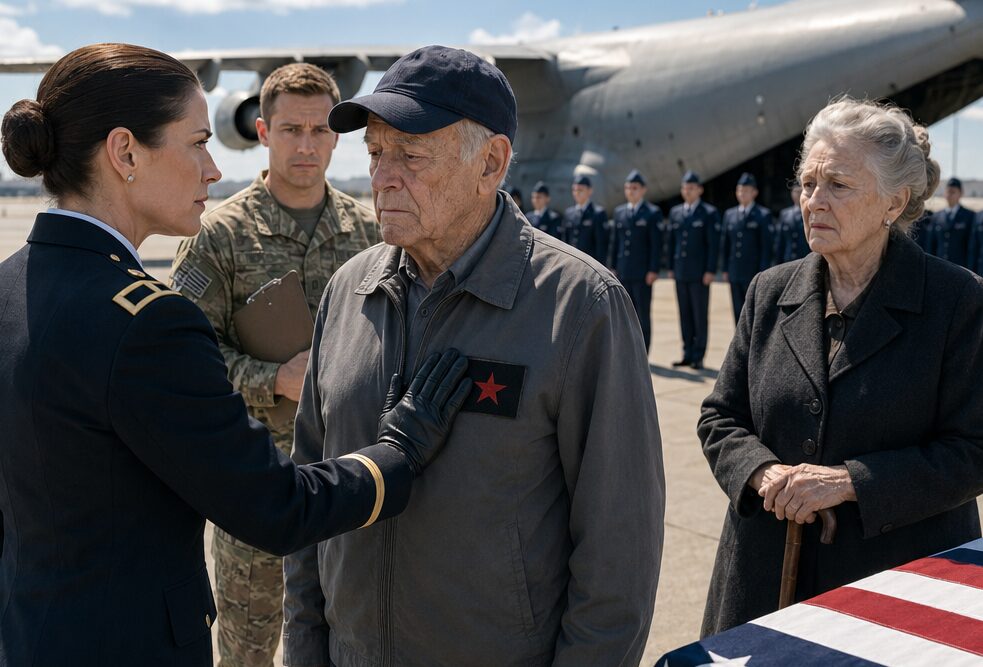
The first thing Major Susan Hayes noticed was not the old man’s face.
It was the patch over his heart.
Black cloth. Rough edges. A red star stitched in the center by a hand that had not cared about beauty, only about making it hold.
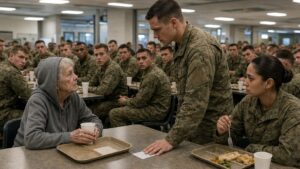
The old man had stepped off the shuttle with one hand on the rail and the other pressed flat against his gray jacket, as if the wind might take something from him. He wore polished black shoes, a navy cap pulled low, and the cautious posture of someone who had learned to move slowly so no one would offer help too quickly.
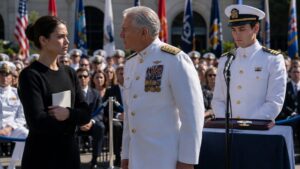
Behind Susan, two lines of uniformed service members stood in formation near the waiting aircraft.
Ahead of her, the old man walked straight toward the ceremony.
Susan moved before she had finished deciding to move.
“Sir,” she said.
He stopped.
She placed one gloved hand against his chest, not hard, but firm enough to stop him from taking another step.
Her fingers landed on the patch.
The old man looked down at her hand. Then he looked up at her face.
Susan’s voice stayed level.
“Sir, you can’t wear that here.”
The airfield seemed to widen around them.
A young sergeant, Scott Price, turned from the guest table with a clipboard still in his hand. Several service members in formation shifted their eyes without moving their heads. The transport aircraft behind them sat with its rear door closed, its metal body bright under the pale morning light.
The old man did not pull away.
He did not apologize.
He did not explain.
He only said, “I was invited.”
Susan kept her hand on the patch for one second longer than she needed to.
“By whom?”
The old man’s gaze moved past her to the aircraft.
“Captain Timothy Miller.”
Scott’s expression changed first.
Not much. Just enough.
Susan had spent the morning reading that name on programs, placards, sealed transfer documents, and the small card placed beside the family seating area.
Captain Timothy Miller had been missing for seventy years.
Captain Timothy Miller was the reason they were all standing on that airfield.
Captain Timothy Miller was coming home in a flag-draped transfer case inside that aircraft.
Susan lowered her hand from the old man’s chest.
“Sir,” Scott said gently, stepping closer, “maybe you’re looking for the visitor tent.”
The old man turned toward him.
His face was thin and clean-shaven, deeply lined but dry-eyed. He looked less confused than tired of being mistaken for it.
“I know where I am.”
Scott softened his voice. That made it worse.
“Let’s just get you checked in, okay?”
The old man’s mouth tightened.
Susan saw it. The small injury of being handled kindly by someone who had already decided you did not understand the room.
“What’s your name?” Susan asked.
“David.”
“Last name?”
He hesitated, not from uncertainty but from old habit.
“David Walker.”
Scott scanned the clipboard.
Susan watched the patch.
The red star looked wrong against the old gray jacket. Wrong on this base. Wrong on this morning. It was not factory-made. The thread crossed itself unevenly. One point of the star sat lower than the rest, as if stitched in darkness or haste.
Scott flipped to the second page. Then the third.
“No David Walker on the guest list, ma’am.”
A service member near the second row whispered something under his breath.
Susan did not catch every word.
She caught enough.
Looks like enemy stuff.
David heard it too.
His chin lifted half an inch.
That was all.
Susan felt the pressure of the morning gather behind her. The family seating area was ready. The chaplain was waiting near the lectern. A small media pool stood behind a rope line near the hangar. The base had spent weeks preparing for a ceremony that had to be perfect because it had already been delayed by history, weather, paperwork, and grief.
Now an old civilian wearing a questionable symbol claimed he had been invited by the man whose remains were on the aircraft.
Susan could not let him proceed.
She also could not look away from his stillness.
“Sergeant Price,” she said, “verify his identity.”
“Yes, ma’am.”
Scott took a step toward David. “Sir, if you’ll come with me—”
“No,” David said.
The word was quiet, but it stopped Scott as cleanly as an order.
Susan’s eyes narrowed.
David looked at her, not pleading.
“I don’t need a seat,” he said. “I don’t need anyone to say my name. I only need to stand close enough to see him come down.”
Susan glanced at the patch again.
The red thread seemed brighter now.
“Not with that on your chest.”
For the first time, David’s hand moved.
He touched the edge of the patch with two fingers.
Not defensively.
Not proudly.
Like a man checking whether a wound had opened.
Then he said, “That’s why I came.”
Part II — The Name Not Listed
Susan had learned early that command was mostly deciding what could not be allowed.
Not what was cruel.
Not what was kind.
Allowed.
An airfield ceremony had rules. Security had rules. Symbols had meanings, and meanings had consequences. One unauthorized object could become a photograph. One photograph could become a headline. One headline could turn a solemn return into a public argument before the family had even received the casket.
She looked at David Walker and tried to sort him into a category.
Confused elderly visitor.
Attention seeker.
Former service member with old bitterness.
Security risk.
Grieving man.
None of them fit cleanly.
“Sir,” she said, “until I know what that patch represents, you will remain here.”
David’s eyes moved to the formation.
“They’re young.”
Susan did not answer.
“Young people always look at old men like we were born old,” he said. “Like nothing important happened before our hands started shaking.”
Scott’s face colored.
“I didn’t mean disrespect, sir.”
“I know,” David said. “That’s usually how it arrives.”
Susan heard the line land. She saw Scott absorb it.
She also saw two more service members staring at the red star.
She stepped closer to David, lowering her voice.
“Do you understand what that symbol resembles?”
“Yes.”
“Then you understand why it’s a problem.”
“I understand why you think it is.”
“That is not an answer.”
“No,” David said. “It isn’t.”
Scott returned from the guest table with his phone in hand. His clipboard was tucked under his arm now, forgotten.
“Ma’am,” he said, “no match on the ceremony list. But public records show a David Walker, age eighty-eight, local address. No active warrants. No immediate security flags.”
Susan gave him a look.
Scott swallowed. “I’m still checking historical files.”
David’s gaze shifted sharply.
Susan caught it.
“Historical files?” she asked.
Scott nodded. “There’s an archived transfer packet linked to Captain Miller’s case. I don’t have full access, but there’s an index.”
David’s hand dropped from the patch.
For the first time, Susan saw fear cross his face.
Not fear of her.
Fear of something being opened.
Before she could press him, an aide approached from the ceremony area.
“Major Hayes,” the aide said softly, “the aircraft crew is five minutes from beginning transfer preparation.”
Susan looked toward the aircraft.
Five minutes.
The family representative had not yet arrived at the seating area. The chaplain stood with his binder closed. The formation remained still, but tension traveled through stillness faster than through movement.
Susan turned back.
“Mr. Walker, if Captain Miller invited you, you’ll understand why I need more than your word.”
David almost smiled.
It was not amusement.
“My word is mostly what I have left.”
“That may not be enough today.”
“It wasn’t enough then either.”
Susan felt the sentence open a door and close it immediately.
Scott looked down at his phone again, scrolling faster.
“Sir,” he said carefully, “were you attached to Captain Miller’s unit?”
David did not answer.
“Were you family?”
“No.”
“Did you serve with him?”
The old man’s eyes stayed on the aircraft.
At last he said, “I walked with him.”
Susan studied him.
“That is not a military answer.”
“I wasn’t military.”
Scott looked up.
Susan felt the situation tilt again.
“You just said you walked with him.”
“I did.”
“In what capacity?”
David’s shoulders sank, not from weakness but from the weight of choosing what not to say.
“I carried messages.”
“Officially?”
He looked at her then.
“Nothing that mattered was official.”
Susan disliked that answer. She disliked how true it sounded.
Scott’s phone buzzed in his hand.
He read the screen.
Then he stopped moving.
“Ma’am.”
Susan did not take her eyes off David.
“What?”
Scott’s voice lowered. “There is a David Walker in the archived file.”
The wind crossed the tarmac.
Susan waited.
Scott looked from the phone to David, then back again.
“Status says civilian auxiliary.”
David closed his eyes.
Scott continued, slower now.
“Presumed killed.”
The formation did not move.
But something changed in the air around them.
Susan looked at the old man in front of her. Gray jacket. Navy cap. Polished shoes. Forbidden-looking patch.
Presumed killed.
David opened his eyes.
“They always did like tidy paperwork.”
Susan’s voice came out quieter than before.
“You were with Captain Miller.”
David nodded once.
“On the mission connected to today’s transfer?”
Another nod.
Susan looked again at the red star.
“What happened out there?”
David’s face hardened with an old discipline.
“I’ll tell her.”
“Tell who?”
His gaze moved past Susan toward the empty family chairs.
“His daughter.”
Susan exhaled through her nose.
“Mr. Walker, Captain Miller’s daughter is here to receive her father’s remains. She is not here to be confronted by an unauthorized guest wearing a symbol connected to the worst day of her family’s life.”
David flinched.
It was small.
It was enough.
Susan saw she had struck something real.
“That symbol,” she said, “was mentioned in one of the enemy reports.”
David’s eyes lowered.
“So she knows.”
Scott looked between them.
“Knows what?”
David did not answer.
The aircraft’s rear door began to move.
A heavy mechanical hum rolled across the tarmac.
Every head turned.
The ceremony had started without them.
David took one step forward.
Susan stepped into his path.
“Not yet.”
His eyes filled then, not with tears exactly, but with something that had spent too many years without permission.
“Major,” he said, “I have waited seventy years to give back what was never mine.”
Susan looked at the patch.
For the first time, she wondered whether she had stopped him from entering the ceremony, or from finishing it.
Part III — The Woman With the Cane
Barbara Miller arrived with a cane she clearly hated.
She stepped out of a black sedan near the family seating area, silver hair pinned neatly back, dark coat buttoned high, one hand gripping the cane more like an argument than a support.
Susan saw the resemblance to the portrait on the memorial display immediately.
Not in the face.
In the posture.
Barbara Miller walked like someone who had spent her whole life being told to be proud of an absence.
An escort led her toward the chairs, but she stopped when she noticed Susan standing off to the side with Scott and the old man.
Then her eyes found the patch.
Everything in her face changed.
She did not walk over quickly. She walked carefully, which made her anger look even sharper by the time she reached them.
“Why is he wearing that?”
No greeting.
No confusion.
Just the question.
Susan straightened. “Mrs. Miller, we’re verifying—”
Barbara cut her off.
“I asked why he is wearing that.”
David lowered his eyes.
That told Susan more than any answer.
Barbara stared at him.
“Do you know what that is?”
“Yes, ma’am,” David said.
Her mouth trembled once before she controlled it.
“My mother had a copy of the report. Not the whole thing. Just enough. That symbol was on the men who surrounded my father’s position.”
David said nothing.
“She kept that page in a drawer,” Barbara continued. “I found it when I was twelve. I thought it was a drawing at first. A child could draw a star. That was the worst part.”
David’s hand moved toward the patch, then stopped before touching it.
Barbara noticed.
“Don’t,” she said.
He let his hand fall.
Scott shifted uncomfortably. Susan saw his instinct to help and his fear of making anything worse.
Barbara turned to Susan.
“Major, is this man part of the ceremony?”
Susan hesitated.
That hesitation cost her authority, and she knew it.
“He claims he served with your father.”
Barbara looked back at David.
“My father served with men whose names we were given.”
“I know,” David said.
“Your name was not one of them.”
“No.”
“Then why are you here?”
David’s face tightened.
“To return something.”
Barbara’s eyes stayed on the patch.
“That?”
“Yes.”
A bitter laugh escaped her. “You thought you could walk in here wearing that and call it a return?”
Scott spoke before Susan could stop him.
“Ma’am, his name appears in an archived file.”
Barbara did not look at him.
“Lots of things appear in files. That doesn’t make them true.”
David accepted the sentence like he had accepted the stares.
Susan watched him and felt an irritation she could not fully justify.
“Mr. Walker,” she said, “this is no longer just a security concern. If you have information about Captain Miller’s final mission, you need to share it now.”
David looked at Barbara.
“Not here.”
Barbara’s voice sharpened. “You don’t get to choose where my father’s truth is spoken.”
That line struck him harder than Susan’s hand had.
His eyes closed briefly.
When he opened them, he looked older.
“You’re right.”
The aircraft door locked into place with a hollow metallic sound.
Inside, movement began.
The transfer team was preparing.
Susan felt time narrow.
“Then speak,” Barbara said.
David looked toward the aircraft.
“When your father gave me this, it wasn’t a trophy.”
Barbara’s face went pale with anger.
“Gave you?”
David nodded.
“He cut it off a dead courier’s coat.”
Scott stared at the patch.
Susan felt the old file in her memory stir. Her father, years ago, sitting at a kitchen table with a glass of water he never drank, mentioning a red-star marker from a failed extraction. He had never told her details. Only one sentence.
Sometimes the record is clean because the truth is not.
David continued.
“We needed to cross a checkpoint. They were looking for uniforms, not for a half-starved local runner in a dirty jacket. Your father said if I wore their sign and kept my head down, I might get through.”
Barbara’s grip tightened on her cane.
“You wore it willingly?”
“No.”
His answer was immediate.
Then he added, “But I wore it.”
The formation behind them remained silent, but Susan could feel the listening now. Not curiosity anymore. Attention.
David’s voice stayed low.
“There were wounded men trapped beyond the creek line. Two of them couldn’t walk. The radio was gone. The flares were wet. Your father had one plan left.”
Susan asked, “The patch was the plan?”
“The patch was the lie that bought us ten minutes.”
Barbara swallowed.
“And my father?”
David’s mouth opened.
No sound came.
The transfer team appeared inside the aircraft.
White gloves. Measured movement. A flag waiting to be lifted.
Barbara stepped closer to David.
“My father what?”
David looked at the ground.
“He ordered me not to come back if the crossing failed.”
“Did it fail?”
“No.”
Barbara’s eyes searched his face.
“Then why is he in there?”
The question hung between them with the aircraft open behind it.
David did not answer.
That silence changed everything again.
Part IV — The Folded Message
Susan had minutes.
Maybe less.
The ceremony could be paused, but not without everyone knowing something had gone wrong. The family was present. The formation was in place. The transfer team was waiting. The aircraft held a man whose name had been spoken for seventy years in past tense.
And in front of Susan stood another man the past had mistakenly buried.
She turned to Scott.
“Clear the media line farther back.”
“Yes, ma’am.”
He looked relieved to be given an order, then ashamed of the relief.
Before he left, he glanced at David.
It was not the same look as before.
Not gentle.
Not pitying.
Almost careful.
David noticed. His face did not change, but his shoulders seemed to lose a fraction of their bracing.
Barbara did not move.
“Why did you keep it?” she asked.
David touched the patch at last.
His fingers rested on the red thread.
“Because he told me to.”
“My father told you to wear that?”
“Until every man who came out because of it was home.”
Barbara’s eyes hardened again. “And then?”
David looked toward the aircraft.
“I didn’t know where home was anymore.”
Susan felt that line before she understood it.
Barbara did too. Her anger faltered, but did not disappear.
“You expect me to believe my father gave an enemy symbol to a civilian courier and told him to carry it for seventy years?”
“No.”
David reached slowly inside his jacket.
Susan’s hand moved instinctively toward her side.
David saw it and stopped.
Then, with deliberate care, he used two fingers to pull out a folded strip of dark oilcloth tied with faded string.
Scott, halfway to the media rope, stopped dead.
Susan stepped closer.
“What is that?”
David held it in both hands.
“Something I should have given her before now.”
Barbara’s cane tapped once against the tarmac.
“Give it to me.”
David did not.
Not yet.
His thumb moved over the string.
“I tried,” he said.
Barbara’s jaw tightened.
“When?”
“1961. Your mother wouldn’t see me.”
Barbara blinked.
“Don’t lie.”
“I don’t blame her.”
“My mother never mentioned you.”
“She wouldn’t have wanted to.”
Barbara took a breath that shook despite her effort.
David looked at the oilcloth, not at her.
“I was twenty. I looked older when I came back. Everyone did. I had the patch on my coat because I didn’t know how to take it off. I went to your house. Your mother opened the door, saw it, and closed it before I said your father’s name.”
Barbara’s face changed.
Not softened.
Opened.
Like a locked drawer had been pulled out an inch.
“I remember that,” she whispered.
Susan went still.
Barbara’s voice dropped further.
“I was behind the stairs. My mother told me not to look.”
David nodded.
“I heard you crying.”
Barbara’s eyes filled quickly, angrily, as if tears had betrayed her.
“You left.”
“Yes.”
“You should have come back.”
“I know.”
“No,” she said, sharper now. “You don’t get to say that like it makes it smaller. You had something of his.”
David absorbed it.
“You’re right.”
Barbara stared at the oilcloth.
“What is it?”
David’s fingers worked the string loose.
His hands shook, but not from age alone.
Inside the oilcloth was a folded paper, browned and soft at the creases. The writing on it had faded, but the letters remained.
Susan saw only a few words from where she stood.
Tell Barbara.
Not tell my wife.
Not notify command.
Tell Barbara.
Barbara saw it too.
Her cane slipped slightly against the tarmac.
Susan reached out, but Barbara steadied herself before anyone could help.
“My name,” she said.
David nodded.
“He knew you were six.”
“I was five.”
“He said six.”
“He missed my birthday.”
David closed his eyes.
The words had found their way through armor no rank could provide.
Barbara’s voice changed.
“What did he write?”
David held the paper out.
She did not take it.
Not yet.
“Read it,” she said.
David looked at Susan.
The transfer team was waiting now. The casket had not yet moved, but the pause had become visible. The formation knew it. The family escort knew it. The media knew enough to lift cameras and be told sharply to lower them.
Susan could end this.
She could remove David, take the document, move Barbara to her seat, and preserve the ceremony in its intended shape.
But the intended shape was beginning to look like another kind of lie.
“Major,” David said.
It was the first time he had addressed her by title without resistance.
“I need one minute before he comes down.”
Susan shook her head once. Reflex.
“No.”
Barbara turned to her.
“Susan.”
It was improper. Familiar. Human.
Susan looked at her.
Barbara’s face had lost its anger and found something more dangerous.
Need.
“If that paper has my name on it,” Barbara said, “then this ceremony already changed.”
Susan looked back at the aircraft.
The flag waited inside.
David waited before her.
Scott had returned to the edge of the group, breathing hard, eyes fixed on the old man.
Susan thought of her father at the kitchen table. The glass of water. The sentence he would not explain.
Sometimes the record is clean because the truth is not.
She stepped closer to David.
“One minute,” she said. “Not for the cameras. Not for a performance. For her.”
David nodded.
“For her,” he said.
Then he looked at the formation and added, almost too quietly, “And for him.”
Part V — One Minute
Susan raised one hand.
The transfer team held.
The airfield did not go silent. Airfields never did. Wind moved. Engines hummed somewhere beyond the hangar. A flag rope clicked against a pole in the distance.
But the people went quiet.
That was different.
David walked forward without anyone touching him.
He did not stand at the lectern. He did not face the cameras. He stopped halfway between the formation and the aircraft, where Barbara could hear him and the young service members could not pretend they were not listening.
Susan stood to one side.
Scott stood behind David, no longer as an escort.
As a witness.
David looked very small in the open space.
Then he unfolded the paper.
His voice, when it came, was rough but steady.
“Miss Barbara,” he read.
Barbara’s hand flew to her mouth.
David paused.
Then he continued.
“If this reaches you, it means I asked somebody braver than me to carry words I could not carry myself.”
The paper trembled.
David held it tighter.
“I am sorry I missed your birthday. I am sorry I told you I would bring you a blue ribbon from overseas and did not. I am sorry your mother has to answer questions I should be there to answer.”
Barbara closed her eyes.
David swallowed.
“I am with good men. Do not let anyone tell you otherwise. If they come home and I do not, be kind to them if you can. They will bring pieces of me nobody else knows how to hold.”
Susan looked at Scott.
His eyes were fixed forward, wet and unblinking.
David’s voice thinned on the next line.
“Tell her I was not alone.”
He lowered the paper.
Barbara whispered, “Keep reading.”
David shook his head.
“That part was for you.”
Barbara’s face twisted. “Then why did you stop?”
“Because the rest is for me.”
No one moved.
David folded the paper once along an old crease.
Then he looked at the open aircraft.
“Your father gave me this patch after cutting it from a courier’s coat. He knew what it looked like. He knew what people would think if I made it back wearing it. He said sometimes a man has to let the wrong people misunderstand him long enough to get the right people home.”
The red star sat over David’s heart.
Ugly.
Bright.
No longer simple.
“There were three men across the creek,” he said. “Two wounded. One barely breathing. Your father stayed behind the ridge with a rifle that had almost nothing left in it and a voice that sounded like command even when he was bleeding through his sleeve.”
Barbara flinched, but David did not linger there.
He had promised restraint to the dead too.
“He told me, ‘Walk like you belong to them. Don’t run unless they ask your name.’”
A faint sound moved through the formation.
David heard it and looked at the young faces.
“I hated him for that. For asking me to look like what I feared. For making survival feel dirty before I had even survived.”
His hand touched the patch.
“But it worked.”
Susan felt the sentence pass through everyone.
“It bought me ten minutes. Ten minutes was enough for two men to cross back under fog. Not clean. Not easy. Not all of us.”
Barbara stared at him as if she could force the missing piece out by looking hard enough.
David turned to her.
“Your father was alive when I left him.”
She almost stepped back.
“He was alive,” David repeated. “He was clear. He knew what he was doing. He knew I wanted to come back.”
“Did you?” Barbara asked.
“Yes.”
“Then why didn’t you?”
The question was not accusation now.
It was a child asking from behind a staircase.
David’s face broke, but only slightly. A crack in old stone.
“Because he ordered me not to waste the lives he had just bought.”
The wind moved between them.
David continued.
“I disobeyed halfway. I went back as far as the creek. I heard them searching. I heard his voice once.”
Barbara’s lips parted.
“What did he say?”
David looked at the paper.
“Not my name.”
He lifted his eyes.
“Yours.”
Barbara made a sound that was almost not a sound.
David’s voice dropped.
“He didn’t die believing he was abandoned. He didn’t die thinking his men failed him. He died giving one more order to a man who didn’t deserve to live longer than he did.”
Scott whispered, “Sir.”
David did not seem to hear him.
He looked at the formation now.
At the young faces. The straight backs. The polished shoes. The clean record waiting to receive an unclean truth.
“I kept the patch because Captain Miller told me to wear it until every surviving man was home. After that, I told myself I kept it because it belonged to him.”
He breathed in.
“That was not the whole truth.”
Barbara watched him.
David’s fingers curled into the edge of the patch.
“I kept it because it was the only thing heavier than guilt.”
No one rescued him from the sentence.
No one should have.
The transfer team stood waiting inside the aircraft. The flag lay smooth and bright.
David turned to Susan.
“May I?”
She knew what he meant before he touched the thread.
Susan nodded.
David unbuttoned his gray jacket with slow, deliberate fingers. The patch had been sewn through the outer layer, not pinned, not tacked for ceremony. He had to work a small penknife from his pocket and cut each thread one by one.
Susan almost stopped him when she saw the blade.
She did not.
Scott stepped closer, shielding the motion from the cameras without being told.
The old thread resisted.
David’s hands shook harder.
Barbara stepped forward.
For a moment, Susan thought she would take the knife from him.
Instead, Barbara held the cloth steady.
Together, they freed the patch from the jacket.
When it came loose, the gray fabric beneath it showed a darker square where years of sun had not reached.
David held the black cloth in his palm.
Without it, his jacket looked strangely bare.
He walked toward the aircraft.
The transfer team carried the casket down the ramp.
Every movement was formal, measured, exact.
David waited until the casket reached the tarmac.
Then he stepped forward and placed the patch gently on top of the flag, near the place where a heart would have been if flags and caskets had hearts.
The red star rested there.
Not forgiven.
Not erased.
Returned.
David bowed his head.
“Timothy,” he said, so softly only those closest could hear, “I brought it as far as I could.”
Part VI — What Was Carried
Barbara was the first to move.
Not Susan.
Not Scott.
Not anyone in formation.
Barbara walked to the casket with her cane tapping once, twice, then stopping when she reached the flag. She stared at the patch for a long moment.
Then she laid her fingertips on it.
The red thread disappeared beneath her hand.
David stood beside her, empty-handed now.
Without the patch, he looked smaller.
Or maybe everyone else had finally understood how much weight he had been carrying.
Barbara turned to him.
For a second, Susan expected anger to return. It would have been fair. Seventy years did not become gentle because one minute of truth had arrived.
But Barbara only reached for David’s hand.
He hesitated.
She took it anyway and placed it over the patch, beneath her own.
The old man’s breath caught.
No salute could have done what that did.
Scott moved before Susan gave an order.
He raised his hand to his brow.
The salute was not perfect at first. Too quick. Too young. Then he corrected it and held it.
David turned his head slightly, startled.
Scott’s face had changed completely.
Not pity.
Not embarrassment.
Respect, and the shame of having arrived at it late.
Susan felt every eye in the formation waiting for her.
She could have made it official. She could have commanded the gesture and turned it into procedure.
She did not.
Instead, she removed her cap, held it at her side for one breath, then put it back on and raised her own hand.
Not to the patch.
Not to the casket.
To David.
The formation followed, but the sound was almost nothing. Cloth shifting. Heels settling. Hands rising.
David looked at them and did not smile.
His eyes were wet now, openly.
That felt braver than keeping them dry.
Barbara leaned closer to him.
“You should have come back,” she said.
“I know.”
“I might have hated you then.”
“I know that too.”
She looked at the patch under their hands.
“I don’t know what I feel now.”
David nodded.
“That’s all right.”
The transfer team waited.
Susan let them wait.
Some pauses were not delays. Some pauses were the ceremony finally telling the truth.
Barbara withdrew her hand from the patch but kept hold of David.
“My mother kept that report,” she said. “All those years. She must have thought it was the last piece of him.”
David looked at the flag.
“It wasn’t.”
“No,” Barbara said. “I suppose it wasn’t.”
The chaplain approached quietly, asking with his eyes if they were ready.
Barbara did not answer him.
She looked at David instead.
“Can you walk?”
“Yes.”
“I mean with me.”
David’s face changed then.
Not relief. Not joy.
Something smaller and harder won after a long fight.
“I can.”
Barbara slipped her arm through his.
The casket began its slow path across the tarmac.
David walked beside Barbara, not behind the rope line, not stopped at the edge of the ceremony, not separated from the grief he had carried longer than many of the young service members had been alive.
Susan watched them pass.
On the flag, the black patch with the red star moved with the casket, bright against the clean folds.
It no longer looked like an accusation.
It did not look like honor either.
It looked like what remained when duty had outlived all the people who could explain it.
As they reached the family seating area, Barbara leaned toward David.
Her voice was soft, but Susan heard it.
“You carried him long enough.”
David closed his eyes.
For one step, he seemed unable to continue.
Then Barbara tightened her arm around his, and he walked on.
The young formation stayed still.
The cameras stayed back.
The aircraft stood open behind them, emptied at last of what it had brought home.
And the old man in the gray jacket walked forward with nothing over his heart but a square of unfaded cloth, pale and plain, where the past had finally been lifted away.