The Old Map He Brought Into The Brightest Room That Morning
Part I — The Hand on His Sleeve
The first person to touch Patrick Miller in the command room did not shake his hand.
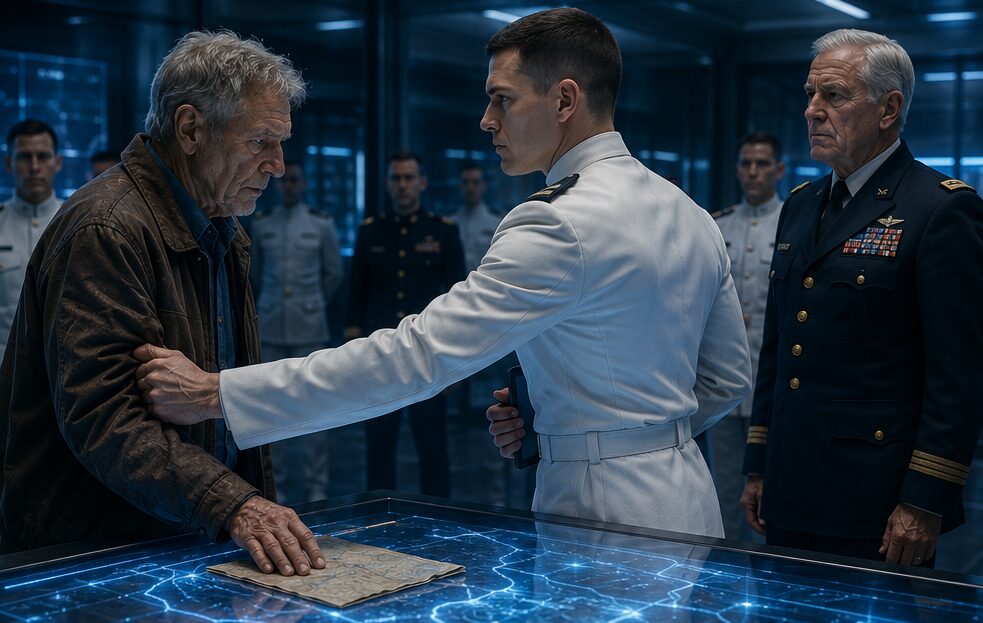
Captain Benjamin Daniels caught the old man by the sleeve.
Not hard enough to bruise. Not rough enough to make a scene. Just firm enough to tell everyone in the room that the man in the brown jacket did not belong near the glowing table.
“Sir,” Benjamin said, with the polished patience of someone already annoyed, “you need to step back.”
Patrick looked down at the young officer’s hand.
The fingers were clean. The nails trimmed. The white cuff crisp beneath the uniform sleeve. A hand trained for control, not yet old enough to understand what control could cost.
Around them, the command room kept breathing in quiet blue light.
Screens climbed the glass walls. A digital map hovered above the central table, throwing pale rivers and red markers across the faces of analysts, officers, and aides. Somewhere beyond the sealed doors, phones were ringing in rooms where no one used full names.
Patrick had entered with a plastic grocery bag in one hand and a folded paper map in the other.
That was his first mistake, Benjamin seemed to think.
His second was reaching for the table.
“Who cleared him through?” Benjamin asked without looking away from Patrick.
A young analyst near the door lifted a hand halfway. “He was on the access list, Captain.”
“Contractor?”
“Temporary consultant.”
Benjamin’s jaw tightened, almost invisibly. “Temporary consultants don’t touch the live board.”
Patrick did not pull his sleeve free. He let the young man hold it a moment longer than either of them expected.
Then he said, “Your map is wrong.”
The room lost a sound.
It was not silence. It was something sharper. The soft movement of chairs stopped. A stylus froze above a tablet. Someone at the far wall turned from a screen.
Benjamin stared at him.
Patrick’s voice had been too quiet to sound like a challenge, which somehow made it worse.
“Excuse me?” Benjamin said.
Patrick nodded at the glowing table. “They’re not moving toward Hill Twelve.”
A line of red indicators pulsed over the display. Hill Twelve was circled twice, marked with projected movement, estimated risk, and a neat string of possible routes. The table made everything look clean. That was the danger of good technology. It made guesses look finished.
Benjamin released Patrick’s sleeve but did not step aside.
“And you know this because?”
Patrick opened the plastic bag.
Inside was an old paper map, folded into soft squares, its edges rubbed almost cloth-thin. He placed it gently beside the luminous display. The paper looked embarrassing there, like a candle brought into a server room.
One of the younger officers gave a short breath that might have become a laugh if the general had not been expected.
Patrick heard it anyway.
He had heard worse in quieter rooms.
“They’re going under Hill Nineteen,” he said. “Through the dry river.”
Benjamin looked to the digital table, then to his tablet. “There is no usable route under Hill Nineteen.”
“There is.”
“It was marked impassable in the last terrain review.”
“It was marked impassable by people who never had to walk it.”
Benjamin’s face cooled.
That line reached the room differently. Not louder. Deeper.
“Sir,” Benjamin said, “this is an active operations floor. Whatever you were brought here to consult on, it can wait until—”
“It can’t.”
The old man’s voice stayed level, but his hand had shifted on the paper map. One finger pressed near a faded blue line that no longer appeared on the glowing table.
Benjamin noticed. Everyone did.
The captain lowered his voice. “You’re out of process.”
Patrick looked at him then. Not angrily. Almost sadly.
“Some roads disappear from maps before they disappear from the ground.”
The analyst by the door swallowed.
Benjamin’s patience finally thinned. “Escort him to the waiting room.”
Two security staff moved from the rear wall.
Patrick did not move.
He unfolded the paper map once, and the old crease snapped softly in the cold room.
“You built the new map on top of the old one,” he said. “You just forgot the old one was still there.”
Benjamin’s face flushed, not much, but enough.
“You don’t get to walk in here with a grocery bag and override live intelligence.”
“No,” Patrick said. “I don’t.”
He looked at the glowing table again.
“But the ground does.”
Part II — Hill Nineteen
The first report came in before security reached him.
“Captain,” said the communications officer at the east wall. “Recon drone Three just went dark.”
Benjamin turned fast. “Location?”
“Gridline east of Hill Twelve.”
Patrick closed his eyes.
Only for a second.
But Benjamin saw it.
So did the analyst by the door.
“That supports the projection,” Benjamin said, too quickly. “They’re baiting near Twelve.”
The communications officer listened to his headset. “Stand by. Signal loss may have occurred farther south than expected.”
“How far south?”
A pause.
“Near the old riverbed.”
The room changed again.
No one looked at Patrick directly at first. They looked near him, around him, past him, the way people look at a crack that appears in a wall they thought was solid.
Benjamin stepped back to the table. His fingers moved across the interface, expanding terrain overlays, satellite grids, archived routes.
Hill Nineteen appeared as a dull shape on the table’s southern edge.
No route.
No blue line.
No dry river.
Patrick’s paper map had one.
“Bring up hydrology from thirty years back,” Benjamin ordered.
“Already checking,” an analyst said. “Nothing live.”
“Then historical.”
The analyst hesitated. “Earliest integrated dataset is twenty-two years old.”
Patrick looked at the paper under his hand.
“Too young,” he said.
Benjamin heard him and did not like that he had.
The command room doors opened.
Before anyone announced him, everyone straightened.
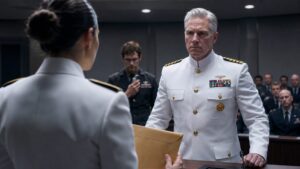
General Joseph Hayes entered with a slight limp, his dark dress uniform carrying rows of ribbons that caught the blue light and held it like small pieces of weather. He had the tired face of a man who had spent his life entering rooms after the first mistake had already been made.
“What happened?” he asked.
Benjamin stepped forward at once. “General, we have a civilian consultant interrupting the live board. Drone Three lost signal near the southern terrain, but our primary projection still supports Hill Twelve. I was about to remove—”
Joseph stopped walking.
His eyes had found Patrick.
For one long second, the general said nothing.
Patrick looked back with the expression of a man watching a door open that he had not touched in forty years.
Joseph’s voice changed.
Not softened. Lowered.
“Major Miller.”
Benjamin went still.
So did everyone else.
Patrick’s mouth tightened almost imperceptibly. “I haven’t used that in a long time.”
“No,” Joseph said. “But some names don’t stop belonging to a person just because the record gets quiet.”
Benjamin looked from the general to Patrick, then down at the old map.
The room had not saluted. Not yet.
That mattered.
Joseph moved to the table, slower than Benjamin would have, but no one mistook the limp for weakness. He stopped across from Patrick.
“What are we missing?” the general asked.
The question landed harder than any salute could have.
It gave Patrick the table.
Not fully. Not publicly. But enough.
Patrick unfolded the map another square.
Benjamin watched the old man’s careful hands.
There was a tremor in them, but it did not touch the finger Patrick placed on Hill Nineteen.
“Your enemy knows you trust clean lines,” Patrick said. “They know Hill Twelve looks urgent. It has height, road access, obvious pressure. That is why it is useful.”
“As a decoy,” Joseph said.
Patrick nodded.
Benjamin forced himself back into the conversation. “Sir, with respect, we have current sensor modeling. We have thermal history. We have movement signatures. That riverbed is listed as collapsed.”
“It is collapsed in two places,” Patrick said. “Not three.”
Benjamin’s eyes narrowed. “How could you possibly know that?”
Patrick did not answer.
Instead, his phone vibrated inside his jacket.
For the first time since entering, Patrick looked unsettled.
Joseph noticed. “Take it.”
Patrick shook his head.
The phone vibrated again.
Benjamin saw the name flash on the old screen before Patrick turned it over.
Nancy.
Patrick declined the call.
Almost immediately, a message appeared.
They only call when they need the part of you they broke.
Patrick stared at it for less than a second, but the words hit him harder than Benjamin’s hand had.
Joseph saw enough to understand.
Benjamin saw enough to feel like he had stepped into a room inside the room.
“Major,” Joseph said quietly.
Patrick slid the phone back into his pocket. “Don’t call me that unless you’re ready to use what comes with it.”
The general absorbed that without defense.
“Then tell us.”
Patrick looked around the room.
Young faces. Fast screens. Clean uniforms. No one old enough to remember the smell of dust before sunrise in that valley. No one old enough to know that a place could keep a mistake alive longer than a file could hide it.
“A convoy followed the official route there,” Patrick said. “Forty years ago.”
No one typed.
No one breathed loudly.
“The map said the high road was clear. Local scouts said the dry river was safer. Command chose the clean map.”
Benjamin’s gaze flicked to the glowing table.
Patrick saw it.
“Yes,” Patrick said. “Like that.”
Joseph’s face did not move, but something in him lowered.
“You guided six men out,” he said.
Patrick’s eyes stayed on Hill Nineteen. “Seven started walking.”
The room had no answer for that.
Part III — The Old Line Beneath the New One
The second report made the table flash amber.
“Advisory Team Echo is off route,” the communications officer said. “They moved south to avoid obstruction near Twelve. They are requesting updated extraction.”
Benjamin stepped to the table. His training returned because it had to.
“Overlay their last position.”
A cluster of blue dots appeared near the southern slope.
Too close to Hill Nineteen.
Patrick did not say I told you.
That would have been easier for Benjamin to bear.
Instead, the old man leaned closer to the map, not the glowing one but the paper one, and pressed two fingers along a line so faded it looked like an old vein.
“Tell them not to climb,” Patrick said.
Benjamin looked up. “The north ridge gives them elevation.”
“The north ridge gives them a skyline.”
“Sir—”
Patrick finally looked at him sharply.
“Do not put them where they can be counted.”
The words were not loud.
They did not need to be.
Benjamin’s throat worked. “General?”
Joseph looked at the table, then at Patrick. “Patch Team Echo through command audio.”
“General,” Benjamin said, “if we deviate from the approved plan, we delay the support package.”
“If we follow the approved plan into a trap,” Joseph said, “we don’t need a support package. We need next-of-kin calls.”
The sentence landed flat and terrible.
No one argued.
The communications officer adjusted a channel. Static filled the room, then a young voice came through, strained but controlled.
“Command, Echo actual. We have poor visibility, intermittent signal, and one mobility-compromised team member. Request clean route north.”
Patrick closed his eyes again.
This time, when he opened them, he looked older.
Benjamin saw it. The room saw it. Even the screens seemed too bright around him.
Joseph leaned closer. “Patrick.”
The first name did what the rank had not. It pulled the man, not the file, into the room.
Patrick’s hand curled at the edge of the paper map.
“Ask him what he sees to the south,” Patrick said.
Benjamin hesitated for only half a second. Then he nodded to communications.
“Echo actual,” Benjamin said, “describe southern terrain.”
Static.
Then: “Dry channel. Rock shelf. Looks unstable. Not on our route.”
Patrick whispered, “It never was.”
Benjamin heard him.
He wished he had not.
“Ask about the willow stump,” Patrick said.
Benjamin blinked. “The what?”
“Ask.”
Benjamin relayed it.
There was a burst of interference, then the field voice came back. “Affirm. Dead stump. Split trunk. How the hell do you—”
Patrick turned away before the sentence finished.
For a moment, he was not in the bright room.
He was in a valley with dust in his teeth and a young man named Samuel asking if the split tree meant they were close to water. He was hearing boots slide on shale. He was hearing someone laugh too loudly because fear needed somewhere to go.
Then he was back.
The room waited.
Patrick swallowed once.
“There is a shelf behind the stump,” he said. “It drops into the dry river. They can follow it east for eight hundred yards.”
Benjamin entered the line into the table.
The glowing system rejected it.
Route invalid.
Benjamin looked at the red warning.
Patrick did not.
“The system says no passage,” Benjamin said.
“The system wasn’t there.”
The words cut cleaner than anger.
Joseph turned to Benjamin. “Relay it.”
Benjamin’s eyes stayed on the warning.
He had built his life on systems because systems did not tremble. They did not carry guilt. They did not remember wrong. They produced answers in clean boxes, and clean boxes could be defended.
Patrick’s paper map had no boxes.
Only lines made by people who had suffered their way through ground that did not care who outranked whom.
Benjamin pressed the transmit key.
“Echo actual, proceed south to the split stump. Descend behind the shelf and follow the dry channel east. Do not climb north. Repeat, do not climb north.”
A long silence followed.
Too long.
Then: “Command, confirm route source?”
Benjamin looked at Patrick.
Patrick gave no answer.
So Benjamin gave one.
“Verified command guidance.”
The old man’s eyes lifted.
Just once.
Not gratitude. Not forgiveness. Something smaller and more difficult.
A first correction.
Part IV — The Room Learns to Listen
The route worked for six minutes.
Six minutes was long enough for the room to start believing.
The blue dots moved east along a channel the glowing map still insisted did not exist. Analysts began pulling archived terrain fragments from disconnected databases. Someone found an old drainage survey. Someone else found a declassified agricultural scan with a shadow in the right place.
Each discovery arrived too late to be useful except as apology.
Patrick gave directions with his eyes on the paper.
“Slow at the bend.”
“Stay left of the black rock.”
“No lights after the shelf.”
Benjamin repeated every word.
He did not add to them. He did not smooth them into procedure. He became, for the first time that morning, exactly what the room needed him to be: a clear voice for someone who knew more.
Then Echo stopped.
The blue dots froze.
Static sharpened.
“Command,” the field voice said. “We have blockage. Channel is sealed ahead. Fallen stone. No passage.”
Benjamin’s hand hovered over the table.
Joseph looked at Patrick.
Patrick did not move.
“Can they go back?” Benjamin asked.
The communications officer listened, then shook his head. “Movement detected behind them. Unknown numbers.”
The room shrank around Patrick.
He could feel the sleeve again. Benjamin’s hand. The young man stopping him.
But beneath that he felt another hand, decades older, slipping from his grip in the dry channel while the high road burned orange behind them. He had never told Nancy that part. He had told her there were things a father should not bring to breakfast. She had grown up with empty places in his sentences and learned to resent the institution that kept filling them.
His phone vibrated again.
He did not look at it.
Joseph said, “Patrick, is there another way?”
Patrick stared at the blocked route on the glowing table.
There had been one.
Once.
Not on the official map. Not even clearly on his own. A narrow irrigation tunnel cut before the valley belonged to anyone’s flag. Half-collapsed then. Maybe gone now.
He had not used it forty years ago.
He had chosen the channel.
The tunnel had seemed too risky for the wounded.
He had been twenty-six and certain enough to be wrong.
Patrick’s lips parted, but no words came.
Benjamin saw fear then.
Not confusion.
Not age.
Fear.
It unsettled him more than anything the old man had said.
“Sir?” Benjamin asked, and this time the word meant something different.
Patrick looked at him.
“I have been uncertain for forty years about the men I could not save,” he said. “I am not uncertain about this ground.”
Joseph’s eyes held his.
“Then bring them through.”
Patrick placed both hands on the table.
No one stopped him.
The room seemed to notice that fact all at once.
His old paper map lay beside the glowing surface. His fingers moved from one to the other, joining the dead line with the living dots.
“There is a tunnel behind the stonefall,” he said. “Not straight ahead. Down. They will think it’s a drainage cut.”
Benjamin relayed it.
Echo came back through static. “Negative visibility. We see rock and brush.”
“Tell him to move the brush.”
Benjamin did.
A pause.
Then: “There’s an opening. Too narrow for gear.”
Patrick’s face tightened. “They’ll have to strip packs.”
Benjamin looked toward Joseph.
The general gave one nod.
“Strip packs,” Benjamin said into the channel. “Carry only medical, comms, and water.”
Another burst of static. A curse from far away. Then shuffling, breathing, metal scraping stone.
Patrick shut his eyes while he listened.
He could hear the old channel again. Samuel breathing behind him. Daniel asking whether anyone would know they came this way. A boy from Georgia saying his mother would kill him if the valley did not.
All the names came back when he could least afford them.
The room waited.
The field voice returned, thinner now. “Command, we have one injured. Tunnel too tight to carry him normally.”
Patrick opened his eyes.
There it was.
The old choice wearing a new face.
Benjamin looked at him, pale now. “What do we tell them?”
Patrick’s answer came slowly.
“Tell them to put him through first.”
Benjamin repeated it.
“Then send one man ahead to pull, two behind to push. No one climbs over him. No one leaves him for last.”
His voice cracked on the last word.
Only slightly.
But enough.
Joseph looked down.
Benjamin did not.
He kept his eyes on Patrick and relayed every word exactly.
Part V — The Bright Room Goes Quiet
The tunnel took nine minutes.
No one in the command room sat down.
The digital map kept rejecting the route even as the blue dots moved through it. Red warnings blinked uselessly. Invalid passage. Obstructed terrain. Insufficient confidence.
Patrick almost laughed once, but the sound never left him.
Insufficient confidence.
That was what the official report should have been called forty years ago.
Not communication failure.
Not unforeseen terrain complication.
Just that.
Insufficient confidence in the people who knew the ground.
“Echo actual,” Benjamin said, “status?”
Static.
Then nothing.
The room held its breath.
Benjamin tried again.
Nothing.
Patrick’s hand pressed flat over the old map.
The paper wrinkled beneath his palm.
Joseph spoke quietly. “Patrick.”
The old man did not look up.
“Do not make me hear them twice,” Patrick whispered.
No one asked what he meant.
They knew enough now.
The communications officer adjusted the signal. “Trying alternate band.”
A burst of sound broke through.
Breathing.
Someone coughing.
Then the field voice returned.
“Command, Echo actual. We are through the cut. Injured member is alive. Repeat, alive. We have visual cover east of the channel.”
No one cheered.
The room did not know how.
Relief moved through it in a way too heavy for celebration. Shoulders dropped. Someone put a hand over their mouth. The analyst by the door sat down without meaning to.
Benjamin closed his eyes.
When he opened them, he looked at Patrick’s sleeve.
The brown fabric still held the faint crease where his fingers had gripped it.
He remembered the certainty of that small act. How easily he had reduced a man to an obstacle. How clean it had felt for three seconds to be the person who belonged.
He stepped back.
Then another step.
“I’m sorry,” Benjamin said.
The words were quiet.
Patrick heard them, but his eyes stayed on the map.
“Sorry is for accidents,” he said.
Benjamin absorbed it.
No defense. No protest.
Joseph moved around the table.
The general’s limp sounded once in the quiet.
He stopped in front of Patrick.
For a moment, he looked not like a commander, but like a man standing before a debt that had finally grown too large to ignore.
Then Joseph raised his hand.
The salute was formal. Still. Unmistakable.
The room froze around it.
Patrick looked at him.
For the first time that morning, the old man seemed unguarded enough to be wounded.
“Major Patrick Miller,” Joseph said, “you were right then. You were right today.”
The words did not repair forty years.
They did not return the seventh man.
They did not give Nancy back the breakfasts where her father had stared through the window while coffee went cold.
But they entered the room and stayed there.
One by one, the officers followed.
Benjamin was last.
Not because he resisted.
Because his hand shook.
When he raised it, Patrick looked directly at him.
There was no triumph in the old man’s face.
That almost made it harder.
Patrick folded the paper map along its old creases. Slowly. Carefully. The way someone might close a letter from a person no longer alive.
Then he placed it in the center of the glowing table.
The digital light shone through the worn paper, turning the faded river line blue again.
“I don’t need my name corrected first,” Patrick said.
Joseph lowered his salute.
Patrick touched the map once.
“There were seven on the old route. The report named three. I want all seven restored.”
Joseph’s face tightened.
“Yes.”
“Not privately.”
A pause.
Then Joseph said, “Not privately.”
Patrick nodded.
Only then did he step away from the table.
His phone vibrated again.
This time, he answered.
“Nancy,” he said.
The room heard nothing from the other end, but they saw what it did to his face.
The old distance in him shifted. Not gone. Not healed. But moved, like a door finally unlatched.
“No,” he said softly. “I’m all right.”
He listened.
His eyes went to the paper map under the blue light.
Then to the officers still standing around it.
“I told them,” he said.
His daughter must have asked what.
Patrick swallowed.
“Enough to start.”
Part VI — What the Map Remembered
Later, after Echo reached extraction and the room returned to motion with a different kind of quiet, Benjamin found Patrick near the outer corridor.
The old man was standing alone by the glass wall, looking down at the city lights beyond the facility. Without the table in front of him, he looked smaller again. Brown jacket. Worn boots. Plastic grocery bag folded in one hand.
But Benjamin could not make the earlier mistake twice.
“Major Miller,” he said.
Patrick turned.
Benjamin’s posture was straight, but not stiff now. His tablet was tucked under one arm, unused.
“I owe you more than an apology,” Benjamin said.
Patrick studied him for a moment.
“You owe the next old man a longer look.”
Benjamin’s face tightened.
“Yes, sir.”
Patrick almost smiled at that. Almost.
“I was not always old,” he said.
“I know.”
“No,” Patrick said, not unkindly. “You know it as information. That’s different.”
Benjamin looked down.
The line would stay with him. Patrick could see that. It was a small thing, but small things had started the morning too. A hand on a sleeve. A paper map beside a glowing table. A name spoken in a room that had not expected it.
Joseph approached from behind them, slower now that the crisis had passed.
“The record review begins tonight,” he said.
Patrick nodded, but did not thank him.
There were gifts that became smaller if gratitude was demanded for them.
Joseph understood. “Nancy is cleared to receive the unsealed portion when it’s ready.”
Patrick looked at him then.
That mattered more than the salute.
“She waited a long time to know what kind of silence raised her,” Patrick said.
Joseph had no answer good enough.
So he gave none.
For a while, the three men stood in the corridor as people moved past them with lowered voices. Some looked at Patrick. Some looked away. Not out of dismissal now, but because recognition can embarrass the people who arrived late to it.
Finally, Patrick held out the folded plastic bag to Benjamin.
Benjamin stared at it, confused.
Patrick said, “Throw that away for me.”
Benjamin took it carefully.
It weighed nothing.
That seemed to be the point.
Patrick walked back into the command room one last time.
The paper map still lay on the table, surrounded by light, no longer ridiculous in that bright place. Officers had begun building the old river into the digital model. Someone had marked Hill Nineteen with a cautious yellow ring. Someone else had opened an archive request.
Late, all of it.
But late was not the same as never.
Patrick stood beside the table and read the seven names from memory.
He did not raise his voice.
He did not ask the room to repeat them.
He simply said each one clearly enough that the walls, the screens, and the young people with clean hands could no longer pretend the old route had been empty.
When he finished, no one saluted again.
They did something harder.
They remained silent.
Patrick folded his hands in front of him. The tremor had returned, but it no longer looked like weakness. It looked like a body finally setting down what it had carried too long.
Then he turned from the table and walked toward the door.
Benjamin moved as if to help him.
Patrick saw it and shook his head.
Not sharply.
Just enough.
He left on his own feet.
Behind him, the glowing table held the old paper map in its center, the faded river line shining beneath the blue light like it had been waiting all these years to be believed.