The Winter Weekend When Everyone Finally Heard What Had Been Quiet for Years
Part I — The Sound That Stayed in the Room
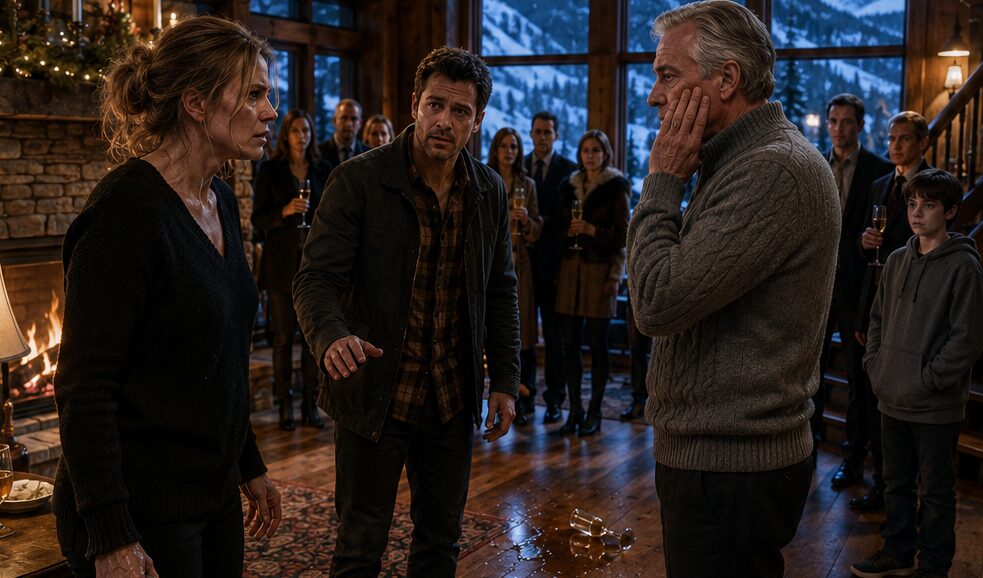
The champagne glass rolled in a slow circle across the hardwood floor before tipping onto its side.
Nobody moved to pick it up.
Melissa stood beside the fireplace with her hand still half-raised in the air, breathing too hard, her six-year-old daughter clutching her sweater so tightly the fabric stretched sideways. Across from her, Andrew touched his cheek in stunned silence.
The room had gone impossibly still.
Not quiet. Still.
The kind of stillness where people suddenly became aware of their own posture.
Someone near the kitchen coughed and immediately regretted it.
Melissa looked at her son first.
Joseph stood near the staircase in his gray hoodie, staring at her with wide eyes. She expected fear. Maybe shame.
Instead, she saw recognition.
As if something he had felt for years had finally taken physical shape in front of him.
That hurt worse than the look on Andrew’s face.
Her husband, Michael, stepped between them too late to stop anything. His mouth opened once, then closed again. He looked exhausted in a way that had nothing to do with sleep.
Andrew lowered his hand slowly.
“Melissa,” he said softly, almost kindly, which somehow made everything worse.
Nobody else spoke.
Outside the massive lodge windows, snow drifted through the dark pines. Inside, the fire snapped quietly while twenty people pretended not to witness the collapse of an entire family.
Melissa became aware of tiny details all at once.
The smell of rosemary from dinner.
Her daughter crying against her ribs.
The heat from the fireplace.
A smear of champagne spreading toward the rug.
And the terrible understanding that every person in the room would replay this moment for years.
She swallowed hard.
“I’m taking the kids upstairs.”
No one stopped her.
That was somehow worse too.
As she crossed the room, she heard whispers begin behind her—not cruel whispers, not even dramatic ones. Just the nervous sounds people made when politeness had failed them.
Her daughter buried her face against Melissa’s side.
“Mom?”
“It’s okay,” Melissa lied immediately.
Joseph followed without speaking.
Michael did not come after them right away.
That frightened her more than the slap itself.
The guest room upstairs was too warm.
Melissa closed the door and leaned against it while her daughter climbed silently onto the pullout couch.
Joseph stayed standing near the window.
Downstairs, laughter tried to restart and failed.
The lodge belonged to Andrew. Everything belonged to Andrew eventually.
The house in Denver they’d nearly lost three years ago.
The emergency loan for Michael’s shop.
The braces for Joseph.
The winter coats hanging downstairs in the mudroom because Andrew “didn’t want the kids cold.”
Help always arrived before disaster.
That was the problem.
Melissa sat beside her daughter and brushed tangled hair away from her face.
“You scared Grandpa,” the little girl whispered.
Melissa closed her eyes.
“I know.”
Joseph finally spoke from the window.
“Were you going to tell me?”
She looked up sharply. “Tell you what?”
“That Grandpa’s taking Dad’s shop.”
The room seemed to tilt slightly.
“You heard that?”
He gave a small shrug. “Everybody heard it.”
Of course they had.
This house carried sound too easily. Hallways opened into staircases. Bedrooms shared thin walls. Privacy disappeared the moment people arrived.
Downstairs, the Carter family liked to call it “cozy.”
Melissa called it surveillance with good lighting.
She stood abruptly.
“I need to talk to your father.”
Joseph looked at her for another long second.
“You weren’t wrong,” he said quietly.
Then he turned back toward the window.
Melissa felt something crack open inside her.
Not relief.
Something sadder.
Because twelve-year-olds should never sound that tired.
Michael was alone in the kitchen when she came downstairs.
He stood at the marble island rinsing champagne from his hands.
He didn’t look up immediately.
The party had dispersed into careful little clusters throughout the lodge. People pretending normalcy in expensive sweaters.
Melissa crossed her arms tightly.
“How long?”
Michael stared into the sink.
“Melissa—”
“How long did you know?”
He exhaled once.
“Three weeks.”
The answer landed clean and cold.
Three weeks.
Three weeks of bedtime conversations. Grocery budgeting. Christmas shopping. Bills spread across their kitchen table.
Three weeks of him saying nothing.
“You signed papers?”
“A preliminary agreement.”
“You signed papers.”
“It wasn’t finalized.”
She laughed once under her breath.
That sound made him finally look at her.
“You think that matters?”
Michael rubbed both hands over his face. “I didn’t know how to tell you.”
“No. You knew exactly how.”
The kitchen lights reflected softly against the dark windows behind him. Snow drifted outside like static.
“I was trying to keep us afloat,” he said.
“There it is.”
“What does that mean?”
“You always say that when someone else starts steering your life.”
His shoulders tightened.
“Do you think I wanted this?”
“I think you let it happen.”
A silence settled between them.
Not empty. Crowded.
Full of unpaid bills. Repair invoices. Credit card balances. Exhaustion.
Michael spoke quietly.
“We’re drowning.”
Melissa looked away because part of her hated how true that was.
The shop had barely survived the last year. Some weeks they delayed utilities just to make payroll. Michael worked constantly, but lately he moved through life like a man apologizing for existing.
Still.
The shop was theirs.
Or she had thought it was.
Andrew appeared in the doorway then, carrying two empty wineglasses.
Perfect timing. Perfect posture.
Silver hair. Calm expression. Expensive knit sweater.
A man who had never once raised his voice because he never needed to.
“There you are,” he said gently to Melissa. “I was worried about you.”
Melissa stared at him.
Andrew set the glasses down.
“I shouldn’t have announced things publicly,” he admitted. “That was inconsiderate.”
Michael immediately jumped in.
“It’s fine, Dad.”
Melissa almost laughed.
Andrew rested a light hand on Michael’s shoulder.
That touch.
Always that touch.
Calming. Steadying. Quietly possessive.
“We’ll sort everything out tomorrow,” Andrew said. “No decisions need to happen tonight.”
Melissa spoke before she could stop herself.
“You already made the decisions.”
Andrew looked at her with genuine confusion.
“I made arrangements to help my family.”
The sentence hung there beautifully.
Reasonably.
Dangerously.
Melissa suddenly understood why everyone always sided with him.
Because he never sounded cruel.
He sounded helpful.
Part II — Everything That Was Paid For
The next morning began with borrowed ski gloves and carefully managed embarrassment.
Melissa woke before everyone else and found herself standing alone in the massive kitchen staring at a coffee machine complicated enough to require instructions.
Outside, the mountains looked untouched and expensive.
She heard footsteps behind her.
Andrew.
Already dressed. Already composed.
“Couldn’t sleep?” he asked.
Melissa shook her head once.
Andrew moved around the kitchen easily, like a man inside his natural climate.
“You embarrassed yourself last night,” he said gently.
Not angry.
Not accusing.
Just factual.
Melissa gripped her coffee mug tighter.
“You embarrassed Michael.”
Andrew paused.
“He’s my son.”
“That’s exactly the problem.”
He studied her for a moment.
“You think I enjoy watching him struggle?”
“You enjoy fixing it.”
Something shifted faintly in his expression then.
Not guilt.
Recognition.
As though she had finally said something honest enough to interest him.
Before either could continue, guests began drifting downstairs in wool socks and expensive fleece jackets.
The performance resumed immediately.
Laughter.
Coffee.
Travel mugs.
Plans for skiing.
Melissa watched the social machinery restart itself around Andrew. He moved through conversations effortlessly, paying for lift tickets before anyone reached their wallets.
Paying always looked generous.
That was how it worked.
At breakfast, Joseph sat unusually quiet while Michael tried too hard to sound normal.
Their daughter spilled orange juice accidentally.
Melissa reached for napkins immediately, apologizing before anyone complained.
Andrew smiled warmly.
“Relax,” he said. “Kids make messes.”
But Melissa still cleaned the table faster than necessary.
Because when people paid for everything, even accidents started to feel expensive.
By afternoon, the lodge felt smaller.
Guests drifted in and out of rooms carrying wineglasses and half-finished conversations. Privacy dissolved every time someone entered a hallway.
Melissa found Michael in the garage mudroom searching for ski boots.
“You lied to me for three weeks,” she said quietly.
He didn’t look surprised she’d followed him.
“I was trying to figure it out.”
“You figured it out with your father.”
“That’s not fair.”
She stared at him.
“Then tell me when the last major decision in our life didn’t involve him.”
Michael stopped moving.
That answer took too long.
Melissa looked away first.
The silence hurt because she suddenly remembered how different he used to be.
When they first married, Michael talked constantly about expanding the shop. A second location someday. Maybe training programs for local kids.
Now he mostly talked about surviving until next month.
“You think I don’t know what this looks like?” he asked quietly.
“Then why let him do it?”
Michael leaned against the wall.
“Because I’m tired.”
The honesty in his voice startled her.
Not dramatic. Just exhausted.
“I’m tired of payroll panic. Tired of pretending every repair bill isn’t a disaster. Tired of watching you stretch groceries for another week.”
Melissa swallowed hard.
“And selling everything fixes that?”
“It fixes something.”
She looked at him carefully then.
Really looked.
The bent shoulders.
The cautious tone.
The permanent apology in his face.
And for one terrible second, she understood why Andrew frightened her so much.
Because part of her wanted the relief too.
That evening, the lodge filled again.
Neighbors from nearby vacation homes arrived carrying desserts and wine. Someone started music near the fireplace.
Melissa stood in the kitchen plating appetizers while conversations floated around her.
“Andrew says the merger’s finally happening.”
“That’ll take pressure off Michael.”
“Good for them honestly.”
Good for them.
As if her family were a leaking roof finally getting repaired.
She carried a tray into the living room and overheard Andrew talking near the fireplace.
“Michael never had the temperament for business,” he said calmly to another guest. “Too trusting.”
The group laughed lightly.
“And Melissa’s passionate,” Andrew continued. “But practicality has never been her strength.”
Melissa stopped walking.
No cruelty in his tone.
That was what made it unbearable.
Just polished disappointment disguised as affection.
Then she saw Michael nearby.
Listening.
Saying nothing.
Not even reacting.
As though he had heard versions of this his entire life.
Something inside her shifted quietly then.
Not rage.
Grief.
Later that night, Joseph found her alone on the upstairs landing.
“Are we moving?” he asked.
“No.”
“But Grandpa said maybe you guys could finally get a bigger house.”
Melissa stared at him.
Children heard everything.
“He shouldn’t have said that.”
Joseph shoved his hands into his hoodie pocket.
“I don’t care about a bigger house.”
Melissa sat beside him on the stairs.
“What do you care about?”
He thought for a second.
“That Dad stops looking scared all the time.”
The sentence landed harder than anything Andrew had said.
Below them, laughter echoed upward from the party.
Melissa suddenly realized the children had been carrying this tension far longer than she wanted to believe.
Part III — What the Shop Really Meant
The next morning snow trapped everyone inside.
Roads iced over. Ski plans disappeared.
The lodge became a pressure cooker.
People spread into corners pretending comfort while irritation quietly accumulated.
Melissa escaped downstairs early and found Michael sitting alone near the fireplace with paperwork spread across the coffee table.
He tried to cover it instinctively when he saw her.
Too late.
She picked up the top page.
Employee transition details.
Severance terms.
One name caught immediately.
David.
The old mechanic.
Melissa frowned. “He’s being let go?”
Michael rubbed his forehead.
“It’s part of the restructuring.”
“He’s been with you for fifteen years.”
“I know.”
“He practically raised Joseph in that garage.”
Michael looked away.
That told her everything.
“Your father pushed for this.”
Silence.
Then finally:
“He said David costs too much.”
Melissa lowered the papers slowly.
Images flashed through her mind.
David fixing Joseph’s bike for free.
David covering shifts when Michael disappeared into depressive spirals after slow business months.
David staying late because Michael couldn’t afford another employee.
The shop had never only been a business.
It was the last place Michael still looked like himself.
And Andrew was taking even that.
Melissa sat down across from him.
“Why didn’t you fight harder?”
Michael laughed softly.
Not amused.
“You think I don’t know how pathetic this looks?”
“That’s not what I said.”
“It’s what I hear.”
The fire cracked between them.
Michael stared down at the papers.
“When I was thirteen,” he said quietly, “Dad used to redo my homework after I went to bed.”
Melissa blinked.
“What?”
“He said he was helping.” Michael smiled faintly without humor. “He’d erase answers that were technically correct because he thought there was a better way to solve them.”
Melissa said nothing.
“He never understood why it upset me.”
That was the closest Michael had ever come to criticizing his father directly.
And suddenly the whole story of their marriage rearranged itself.
Not because Andrew controlled everything.
Because Michael no longer believed he could do things correctly without him.
By afternoon, Melissa could barely breathe inside the lodge.
Every room carried someone else’s voice.
Someone else’s judgment.
Someone else’s version of her family.
She stepped outside onto the back deck for air.
Snow drifted softly across the railing.
Andrew joined her a few minutes later.
Of course he did.
He handed her a fresh mug of coffee.
“You didn’t have to bring that.”
“I know.”
He leaned against the railing beside her.
For a moment neither spoke.
Then Andrew said quietly, “You think I enjoy being resented.”
Melissa stared out at the trees.
“I think you need people to need you.”
That hit somewhere real.
She saw it in the slight tightening around his eyes.
Andrew took a careful breath.
“When Michael’s mother got sick, I built everything around keeping the family stable.” His voice remained controlled. “After she died, stability became… habit.”
Melissa looked at him then.
For the first time, he looked old.
Not weak.
Just tired in a private way.
“I’m not trying to hurt him,” he said.
“I know.”
That was the worst part.
Andrew nodded slowly, almost relieved she understood.
Then he delivered the line that broke her all over again.
“I can help you buy a better place after the merger closes.”
Melissa looked down at her coffee.
“We’re fine.”
“You’re not.” His tone stayed soft. “The kids deserve consistency.”
Consistency.
Such a clean word for ownership.
And still—
Part of her imagined it immediately.
A bigger kitchen.
No overdraft panic.
Joseph finally getting his own room.
Relief flooded her so fast it frightened her.
Andrew saw it happen too.
That was the real humiliation.
Not that he offered help.
That she wanted it.
Part IV — The Toast Everyone Heard
By New Year’s Eve night, the lodge had transformed into performance again.
Candles glowed across the dining room. Music drifted through hidden speakers. Neighbors arrived carrying desserts and expensive bourbon.
Melissa wore the same black sweater she had packed three winters in a row because she didn’t own anything that matched this house.
She caught herself apologizing twice for nothing before dinner even started.
Michael stayed close to her all evening, nervous and careful.
That almost made things worse.
Because it felt less like partnership and more like damage control.
Joseph spent most of the night near the staircase listening quietly to adults. Their daughter fell asleep early on the upstairs couch beneath a blanket.
Around eleven, everyone gathered near the fireplace with champagne.
Andrew stood near the center naturally.
Not demanding attention.
Simply receiving it.
He raised his glass with an easy smile.
“I’m grateful this year,” he began. “Family survives because we take care of each other.”
People nodded warmly.
Melissa already felt something tightening in her chest.
Andrew continued.
“And I’m especially proud that Michael’s finally making the smart transition with the shop.”
There it was.
Public ownership.
Michael flinched almost invisibly.
“Partnering with Hastings Automotive gives him security, flexibility, and room to breathe.”
Polite applause moved through the room.
Melissa looked at her husband.
He smiled.
Weakly.
Automatically.
Like a child being praised for agreeing.
Then she saw Joseph.
Walking quietly out of the room.
Something inside her snapped into clarity.
Not anger.
Recognition.
Her son was leaving because he could not bear watching his father disappear publicly.
Melissa set down her champagne glass.
“Actually,” she said.
The room shifted immediately.
Andrew looked at her calmly. “Melissa—”
“No.” Her voice trembled once before steadying. “You don’t get to tell this story like you saved us from something.”
Silence dropped hard across the room.
Michael stepped closer. “Melissa, not now.”
“When then?”
Her heartbeat thundered in her ears.
Andrew lowered his glass carefully.
“I understand emotions are high.”
“There it is again.”
“Melissa—”
“You make people feel grateful while you slowly take over their lives.”
A few guests glanced away immediately.
Michael touched her arm. “Please.”
She pulled away.
“You paid our mortgage when we needed help. You paid for the kids. You paid for the shop. And every single time, it came with another piece of control.”
Andrew’s expression finally hardened slightly.
“That’s unfair.”
“No. What’s unfair is making Michael feel like he’s twelve years old forever.”
The room had become unbearable now.
Nobody moved.
Nobody interrupted.
Andrew spoke carefully.
“I kept your family afloat.”
Melissa laughed once shakily.
“You made sure we couldn’t stand without you.”
Michael looked devastated.
Not angry.
Exposed.
And suddenly Melissa realized the real horror of the moment:
Everything she was saying about Andrew was also about her husband.
Andrew took one slow step forward.
“Melissa,” he said gently, reaching for her shoulder. “You’re upset because you’re tired.”
That sentence did it.
Not because it was cruel.
Because it erased her completely.
Years of sacrifice. Fear. Stretching groceries. Quiet humiliations. Protecting Michael from his own shame.
Reduced to exhaustion.
Something broke loose inside her before thought could catch it.
Her hand struck his face sharply enough that the sound echoed against the high wooden ceiling.
The room froze.
Andrew’s head turned slightly sideways.
Champagne spilled somewhere behind her.
Then silence.
Absolute silence.
Her daughter started crying upstairs.
Michael stepped forward instinctively but stopped halfway, staring at both of them like he no longer knew where to stand.
Andrew slowly touched his cheek.
Melissa’s own hand shook violently.
And across the room, Joseph stood completely still.
Watching.
Not shocked.
Just awake somehow.
As if the family had finally stopped pretending in front of him.
Part V — What Belonged to Them
The next morning the lodge felt emptied out emotionally.
People spoke too softly at breakfast.
No one mentioned the previous night directly.
Neighbors left early.
Coats zipped. Keys collected. Smiles stretched thin.
Melissa packed in silence upstairs while snowlight filled the bedroom.
She expected Michael to stay behind with Andrew after they left.
Expected some version of apology and repair to happen without her.
Instead, Michael folded clothes slowly beside her.
Finally he said, “Dad offered us the house money again.”
Melissa kept packing.
“What did you say?”
“I told him no.”
Her hands stopped moving.
Michael sat down heavily on the edge of the bed.
“I don’t even know if it’s the right decision.”
Melissa looked at him carefully.
For the first time all weekend, he sounded like himself instead of somebody waiting for permission.
“We still might lose the shop,” he admitted.
“I know.”
“We’ll probably have to move eventually anyway.”
“I know.”
He nodded once.
Then quietly:
“But I want at least one thing in our life to belong to us.”
Melissa sat beside him.
Neither spoke for a long moment.
Downstairs, dishes clinked softly.
Cars started outside.
Life continuing.
Finally she said, “I’m sorry I hit him.”
Michael stared at the floor.
“Yeah,” he said honestly. “Me too.”
Then after a pause:
“But I understood it.”
The sentence hurt more than anger would have.
When they carried bags downstairs, Andrew stood alone near the front windows watching snow fall over the driveway.
He turned as they approached.
Michael cleared his throat first.
“We’re heading out.”
Andrew nodded.
His cheek showed no mark now.
Only age.
Only distance.
“You’re making a mistake,” he said quietly.
Michael looked terrified for half a second.
Then he answered anyway.
“Maybe.”
Andrew waited.
Michael swallowed hard.
“But I think I need to make one myself.”
Something unreadable crossed Andrew’s face then.
Pride.
Loss.
Recognition.
Maybe all three.
Melissa stood beside the children near the door while the silence stretched.
No reconciliation came.
No dramatic forgiveness.
Just four adults standing inside the ruins of a family performance none of them fully knew how to rebuild.
Finally Andrew crouched beside Joseph.
“You take care of your sister for me.”
Joseph nodded once.
Then Andrew stood and stepped back.
That was all.
The drive down the mountain was quiet.
Snow blurred past the windows in soft gray streaks.
Their daughter slept curled against Melissa’s coat in the backseat.
Joseph stared forward beside her.
About halfway down the mountain, he finally asked:
“So… are we still losing the shop?”
Michael gripped the steering wheel tighter.
“Yes.”
No sugarcoating.
No rescue language.
Just yes.
Joseph absorbed that quietly.
Then Michael added, after a long silence:
“But we’re going to decide what happens next ourselves.”
The car stayed quiet after that.
Not peaceful exactly.
Not healed.
But honest.
And for the first time in years, honesty felt a little more stable than help.