The Evening Everyone Tried Too Hard To Look Like A Family
Part I — The Wrong Place in the Photograph
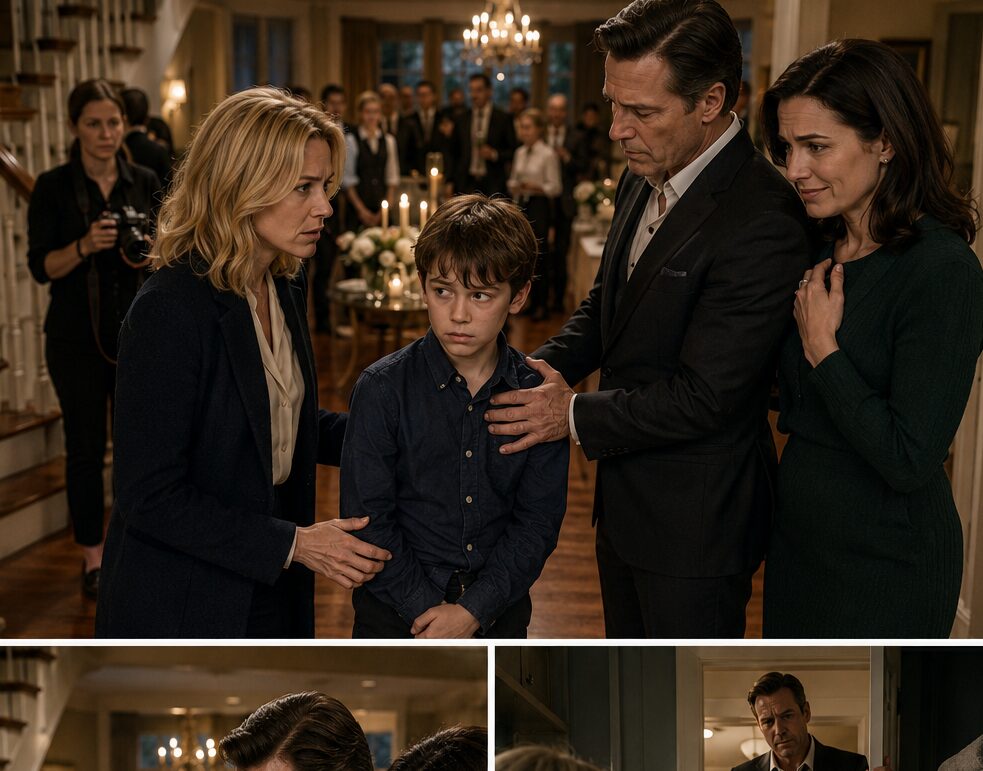
“Robert, maybe let her stand there.”
The photographer smiled too brightly when she said it, the way people did in expensive houses when they sensed trouble but hoped politeness could outrun it.
Robert ignored her.
“A little closer,” he said instead, touching eight-year-old Jack lightly on the shoulder. “Come on, buddy. Just one photo before everybody eats.”
In the next room, glasses clinked softly. Laughter drifted through the open archway. The caterers were carrying trays of crab cakes through the dining room while people from the neighborhood pretended not to watch the foyer.
But they were watching.
Everyone was watching.
Maria crouched beside Jack, smoothing the collar of his wrinkled navy shirt. She could feel the tension in his small body before he even spoke. He kept shifting his feet across the polished hardwood floor like he wanted to disappear into it.
Kathleen stood on Robert’s other side in a dark green sweater dress, smiling too carefully. One hand rested against the engagement ring she still seemed surprised to be wearing.
“Jack,” she said gently, “if you stand still for ten seconds, I’ll let you have two desserts.”
He didn’t answer.
Robert adjusted positions again.
“Maria, maybe move a little left.”
There it was again.
Positioning.
For the past year, Robert had treated emotions the way he arranged furniture. Shift this. Soften that. Smooth the edges until everything looked calm from a distance.
Maria rose slowly.
“You already moved me twice.”
“I’m trying to make this work.”
The sentence landed harder than he intended.
Kathleen looked down immediately.
The photographer pretended to check her camera settings.
Jack stared at all of them with the terrible concentration children sometimes had when adults thought they weren’t paying attention.
Then he asked, very quietly:
“Why does Kathleen always stand where Mom used to stand?”
The room stopped breathing.
Not dramatically. No dropped glasses. No shouting.
Just silence so complete Maria could hear the soft hum of the wine refrigerator from the kitchen.
Robert blinked once.
Kathleen’s smile disappeared first.
The photographer lowered the camera.
And Jack — suddenly aware something irreversible had happened — looked down at his shoes.
“Oh,” one of Robert’s cousins murmured awkwardly from the hallway. “Kids say the wildest things.”
Nobody laughed.
Maria felt heat rise behind her eyes, not because of the question itself, but because of the exhaustion inside it. Jack hadn’t meant to embarrass anyone. He had simply noticed something true.
Robert recovered first.
“Buddy,” he said carefully, “that’s not—”
“I didn’t mean bad,” Jack whispered quickly.
Kathleen folded her arms like she suddenly felt cold.
Maria saw it then: the panic underneath Kathleen’s composure. Not anger. Fear.
Fear of being visibly unwanted.
“We should probably eat,” Maria said softly.
She reached for her purse.
Robert caught her arm before she could leave.
“Please don’t do this.”
Her jaw tightened. “Do what?”
“Leave dramatically.”
“I’m trying to leave quietly.”
“People are already talking about how tense things are between us.”
Maria stared at him.
There it was again. Not Are you okay? Not Jack is overwhelmed.
People are talking.
Across the foyer, Kathleen looked like she wished the floor would open beneath her.
Jack drifted silently toward the staircase instead of standing beside either woman.
Nobody stopped him.
The guests began moving awkwardly toward the dining room, carrying their discomfort with them like coats.
As Maria stepped aside to let Robert’s neighbors pass, she heard one woman whisper to another:
“She could at least try to make tonight easier.”
Maria almost turned around.
Instead, she smiled politely and said, “Excuse me.”
That was the problem with neighborhoods like this. Nobody raised their voice. They simply arranged blame elegantly.
Inside the dining room, candles glowed against polished silver. Place cards rested beside crystal glasses. Everything looked curated for a magazine spread about successful second marriages.
Jack stood near the doorway holding a dinner roll in both hands without eating it.
Kathleen approached him carefully.
“Do you want to sit next to me tonight?”
He shook his head immediately.
The speed of it hurt her visibly.
Maria saw Kathleen inhale once before forcing another smile.
“That’s okay.”
But it wasn’t okay.
And everyone knew it.
Especially Robert, who kept trying to steer conversations louder whenever silence threatened to settle too long.
“Maturity,” he said later while pouring wine for a neighbor, “is learning how to move forward gracefully.”
Maria nearly laughed.
Not because it was funny.
Because she suddenly realized Robert believed that. Completely.
As if emotional pain became childish the longer it remained inconvenient.
Across the table, Jack quietly pushed peas around his plate while the adults discussed kitchen renovations and school auctions and summer plans in Martha’s Vineyard.
Then Kathleen’s friend Janet pulled out her phone.
“Oh my God,” she said brightly, “show Maria the room. It came out gorgeous.”
Maria looked up.
“What room?”
Kathleen hesitated.
Too late.
Janet was already turning the screen around.
It was Jack’s bedroom at Robert’s house.
Except it barely looked like Jack’s room anymore.
The blue walls were now gray. The framed dinosaur posters were gone. His reading corner had disappeared beneath sleek shelves and decorative storage boxes.
“It felt more age-appropriate,” Kathleen said quickly. “He’s growing up.”
Maria stared at the photos.
“You redecorated his room?”
Robert answered before Kathleen could.
“We wanted it to feel more cohesive.”
Cohesive.
Jack finally looked up from his plate.
Very softly, he said, “I liked the dinosaur wall.”
Nobody spoke.
And for the first time that evening, Maria saw something flicker across Kathleen’s face that looked dangerously close to regret.
Part II — The Kitchen Conversation
The kitchen became a refuge for people who wanted to pretend they were helping.
Neighbors carried dishes that didn’t need carrying. Robert’s aunt rearranged flowers twice. Someone kept opening the refrigerator without taking anything out.
Maria stood near the sink rinsing a wineglass she hadn’t used.
She heard Kathleen before she saw her.
“Can we talk?”
Maria kept the water running a second longer.
“Depends.”
Kathleen folded her arms tightly. Up close, the careful makeup and controlled smile were starting to crack around the edges.
“Have you been saying things to Jack about me?”
There it was.
Not screamed. Not dramatic.
Worse because it sounded rehearsed.
Maria set the glass down carefully.
“No.”
“He doesn’t just invent those comments.”
“Yes,” Maria said quietly. “Sometimes children notice things without being coached.”
Kathleen looked wounded by that.
“I’m trying.”
“I know.”
“No, I don’t think you do.”
The kitchen suddenly felt smaller.
Through the doorway, Maria could see guests laughing too loudly at something Robert’s brother had said.
Kathleen lowered her voice.
“Every woman at that school still treats me like I stole someone’s life.”
Maria said nothing.
“Do you know what happens at pickup?” Kathleen continued. “They invite you to things while I’m standing there.”
“That isn’t my fault.”
“I know it isn’t.”
But the hurt remained.
Kathleen leaned against the counter.
“I redecorated the room because I thought if it felt more grown up, maybe he’d feel more comfortable staying over longer.”
Maria almost softened.
Almost.
Then she remembered Jack standing silently over his untouched dinner.
“You changed his room before asking what made him feel safe in it.”
Kathleen looked away immediately.
The truth had landed.
At that exact moment, Robert entered the kitchen.
His eyes moved between them once.
Instant tension assessment.
“What’s happening?”
Maria laughed under her breath.
That annoyed him instantly.
“Seriously.”
Kathleen answered too quickly. “Nothing.”
But Robert was already looking at Maria.
“Can tonight not become a thing?”
Maria stared at him in disbelief.
“A thing?”
“You know what I mean.”
“No,” she said quietly. “Actually, I don’t.”
He lowered his voice further.
“Jack’s already confused enough.”
Something sharp moved across Maria’s face.
“You keep saying that like confusion appeared naturally.”
Robert exhaled through his nose.
“This is exactly what I mean. Every conversation becomes emotional warfare.”
Kathleen closed her eyes briefly.
Maria suddenly understood something painful.
Robert genuinely believed he was the reasonable one.
Not because he was cruel.
Because he thought discomfort itself was failure.
Across the room, Jack appeared in the doorway holding his plate.
“I’m done.”
Robert smiled instantly, grateful for interruption.
“Good. We’re about to do toasts.”
Jack hesitated.
“Do I have to?”
“Yes,” Robert said.
“No,” Maria said at the same time.
Silence again.
Jack looked between them carefully before handing Maria his plate.
“I’m not hungry.”
Then he walked upstairs alone.
Nobody stopped him.
Part III — The Room Upstairs
By the time the engagement toast began, half the room had become professionally cheerful.
People in wealthy neighborhoods had years of training in this skill.
You lowered your voice around tension.
You complimented the food.
You laughed slightly harder than necessary.
You never acknowledged the exact thing everyone was thinking.
Robert stood near the fireplace raising a champagne glass.
Kathleen beside him.
Maria near the back wall.
Jack nowhere visible.
Maria noticed first.
Her stomach dropped instantly.
“Where’s Jack?”
Robert turned.
The room shifted subtly.
Nobody panicked loudly. That would have been socially unacceptable.
But conversations thinned. Eyes moved. People checked corners without appearing to.
Robert set down his glass.
“I’ll look upstairs.”
Maria was already moving.
She checked the guest rooms first. Then Robert’s office. Then the upstairs den.
Nothing.
The house suddenly felt enormous.
She found him in the laundry room.
The lights were off except for the thin hallway glow spilling across the floor.
Jack sat between baskets of folded towels holding an old framed photograph against his chest.
Maria recognized it immediately.
A beach picture from three summers earlier. Before the divorce. Before Kathleen. Before every interaction became negotiation.
Jack didn’t look up when she entered.
“There you are.”
“I wanted quiet.”
She sat beside him carefully on the tile floor.
From downstairs came faint laughter that sounded painfully fake now.
Jack traced the edge of the frame with one finger.
“In this picture nobody was practicing.”
Maria swallowed.
“What do you mean?”
He shrugged.
“Everybody keeps practicing being nice.”
The sentence landed with frightening precision.
Then he asked, “When do they actually become nice?”
Maria closed her eyes briefly.
Children were not supposed to carry questions like that.
“You don’t have to fix everybody,” she whispered.
“I know.”
But he sounded unconvinced.
A moment later Robert appeared in the doorway.
Relief crossed his face so quickly it almost looked like anger afterward.
“There you are.”
Jack stiffened slightly.
Robert noticed.
So did Maria.
Nobody mentioned it.
Robert crouched down.
“People were worried.”
Jack stared at the photograph instead.
“We’re doing the toast.”
“I don’t want to.”
Robert glanced toward Maria before speaking carefully.
“You can’t disappear during important moments.”
Maria finally looked up.
“He’s eight.”
“And tonight matters.”
“To who?”
The question hung there.
Robert rubbed his forehead.
“We’re trying to build something stable.”
Jack finally spoke.
“Then why does it feel weird all the time?”
Nobody answered immediately.
Because there wasn’t a clean answer.
Part IV — What Mature People Do
The party began unraveling slowly after that.
Not explosively.
Just small fractures spreading quietly through expensive rooms.
Guests started checking watches. Coats reappeared. Conversations shortened.
Kathleen stood near the dining room smiling through exhaustion while Robert’s relatives complimented the catering with increasing desperation.
Maria found herself beside Kathleen near the staircase while two neighborhood mothers whispered nearby.
“They really should’ve waited longer before getting engaged.”
“I heard Jack still cries after weekends there.”
The women stopped instantly when they noticed Maria listening.
Kathleen heard it too.
For the first time all evening, neither woman pretended otherwise.
Kathleen stared down at her untouched wine.
“You know what the funny part is?” she said quietly. “I spent an hour picking that sweater because your friend Sandra once said green photographs as ‘approachable.’”
Maria blinked.
Kathleen laughed once, humorless.
“I sound insane.”
“No,” Maria admitted. “You sound tired.”
Kathleen looked at her carefully then.
“I thought if I tried hard enough, eventually everybody would stop comparing me to you.”
Maria didn’t know what to say to that.
Because part of her had been doing the comparison too.
Kathleen continued softly, “I wasn’t trying to erase you.”
The sentence hurt more because it sounded true.
Then Robert’s sister walked past holding a champagne glass.
“She still won’t call you Mom?” she asked Kathleen quietly, not realizing Maria could hear.
Kathleen looked confused.
“What?”
“Robert mentioned he’s been encouraging it at home.”
The world seemed to stop for one long second.
Maria turned slowly.
Kathleen’s face drained of color.
“He said what?”
Robert’s sister immediately realized something had gone wrong.
“Oh God,” she whispered. “I thought you knew.”
Maria felt cold all at once.
Not because Jack had said it.
Because suddenly dozens of moments rearranged themselves in her mind.
Jack hesitating before saying names.
Jack asking whether “real moms” could be shared.
Jack apologizing randomly after weekends with Robert.
Kathleen stared toward the living room where Robert was laughing too loudly beside the fireplace.
“He told him to call me Mom?”
Maria’s voice came out dangerously calm.
“When?”
Kathleen shook her head immediately.
“I didn’t ask for that.”
For the first time all evening, Maria believed her completely.
And somehow that made it worse.
Robert entered the hallway seconds later.
One look at their faces and he knew.
“What?”
Maria stepped toward him.
“You told our son to call her Mom?”
People nearby went silent instantly.
Robert lowered his voice.
“Can we not do this here?”
“There shouldn’t have been a here.”
“It wasn’t like that.”
Kathleen stared at him. “Then what was it like?”
Robert looked genuinely confused by their reaction.
“I was trying to normalize things.”
Maria actually laughed.
Not kindly.
“Normalize?”
“He was struggling with the transition.”
“So you solved that by making him responsible for your comfort?”
“That’s not fair.”
“No,” Maria said softly. “What’s unfair is asking a child to rearrange his emotions so adults can feel successful.”
Several guests began gathering coats immediately.
Robert’s face tightened.
“This is exactly what I mean. Everything becomes conflict instead of progress.”
Kathleen looked at him like she was seeing someone unfamiliar.
“You didn’t even tell me.”
“I was trying to help us become a family.”
“You can’t schedule that,” Maria snapped.
Her voice finally rose enough to cut through the room.
Years of restraint cracked open at once.
“I spent this entire divorce making myself smaller so everyone could call us mature. I smiled through holidays. I sat beside your girlfriend at school concerts. I let neighbors compliment how civilized we were while I went home and cried in my car afterward.”
The room had gone completely silent now.
Robert whispered harshly, “Maria—”
“No. You don’t get to turn emotional honesty into bad behavior just because it embarrasses you.”
Upstairs, a floorboard creaked.
Jack.
Maria saw Robert hear it too.
And suddenly his composure vanished for the first time all evening.
Not anger.
Fear.
Real fear.
Part V — Just Be Kathleen
People left quickly after that.
Quietly.
Politely.
Like witnesses escaping weather.
No one mentioned the argument directly. They hugged too long instead. Thanked Robert for a beautiful evening. Told Kathleen the flowers were lovely.
By ten-thirty, the house felt hollow.
Maria stood in the foyer helping Jack into his coat while Robert lingered near the staircase looking emotionally wrecked.
Kathleen remained near the dining room doorway, arms folded tightly around herself.
Nobody knew what shape the night had become anymore.
Robert finally stepped forward.
“Jack, come on. I’ll drive you back after school Sunday like usual.”
Jack looked down at the floor.
“Buddy?”
Very slowly, Jack walked past him.
Then he reached for Maria’s hand.
The movement was tiny.
Devastating because it wasn’t dramatic at all.
Robert froze.
“Jack.”
Jack looked up finally, eyes tired in a way children’s eyes should never look tired.
Then he turned toward Kathleen.
And in the quietest voice imaginable, he asked:
“Can you just be Kathleen for a while?”
Nobody moved.
Kathleen’s face broke first.
Not because he rejected her.
Because he hadn’t.
He was asking for less.
Less pressure.
Less performance.
Less pretending everyone had adjusted faster than they had.
Robert sat down heavily on the bottom stair like his legs had stopped cooperating.
For months he had been arranging holidays and schedules and photographs and language like careful architecture.
And his son had experienced all of it as emotional homework.
Jack leaned against Maria’s side.
“I don’t want two moms,” he whispered. “I just want everybody to stop acting weird when I love people.”
Robert covered his eyes with one hand.
That was the moment something finally cracked inside him.
Not his pride.
The illusion that he could manage grief into efficiency.
Kathleen walked over slowly and crouched in front of Jack.
“You never have to call me anything except Kathleen,” she said.
Jack nodded once.
A child accepting terms after a long negotiation he never wanted.
Then Kathleen added quietly, “And I’m sorry about the dinosaur wall.”
For the first time all night, Jack almost smiled.
Part VI — The Seats They Chose
Three weeks later, Maria arrived at the elementary school auditorium expecting discomfort.
The spring concert always felt like a neighborhood summit disguised as children singing slightly off-key songs.
Parents clustered in familiar groups.
Mothers compared camps and tutors.
Everyone noticed who sat beside whom.
Maria spotted Kathleen near the back row before Kathleen saw her.
For one brief second, both women hesitated.
Then Kathleen walked over carrying a small white envelope.
“Hi.”
“Hi.”
Kathleen sat carefully beside her.
No performance this time.
No forced warmth.
Just two exhausted women in folding chairs while children practiced recorder music backstage.
“I brought something,” Kathleen said.
She handed over the envelope.
Inside were printed photographs from before the engagement dinner.
Maria looked through them slowly.
Jack laughing beside the staircase.
Jack leaning naturally against her shoulder.
One photo where Robert stood farther away while Maria fixed Jack’s collar.
Nobody looked arranged.
Nobody looked coached.
“He looked calmer in those,” Kathleen said quietly.
Maria swallowed hard.
There was no apology speech after that.
No emotional summit.
Just understanding.
A few rows behind them, someone entered quietly.
Robert.
He noticed them sitting together.
For a second Maria thought he might walk over automatically, still trying to force closeness into existence.
Instead, he stopped.
Then he chose a seat several rows behind them.
Not excluded.
Not punished.
Just finally understanding distance could also be respect.
The auditorium lights dimmed.
Children flooded onto the stage in crooked lines.
Jack spotted all three adults almost immediately.
For one nervous second, Maria saw him brace himself.
Waiting.
Measuring the room.
Then he realized nobody was repositioning him.
Nobody was signaling where to stand emotionally.
Nobody was asking him to fix the atmosphere.
And slowly, almost cautiously, he relaxed.
The music began.
Kathleen folded her hands in her lap.
Maria kept the photographs resting lightly against her knee.
Behind them, Robert sat quietly alone with the expression of a man finally understanding how much damage could be done by trying to make every difficult thing look easy.
And for the first time in a long while, nobody tried to rearrange the moment.