She Removed the Neighborhood’s Old Green Bench Before Learning What Everyone Had Promised There
Chapter 1: The Orange Tag on the Green Bench
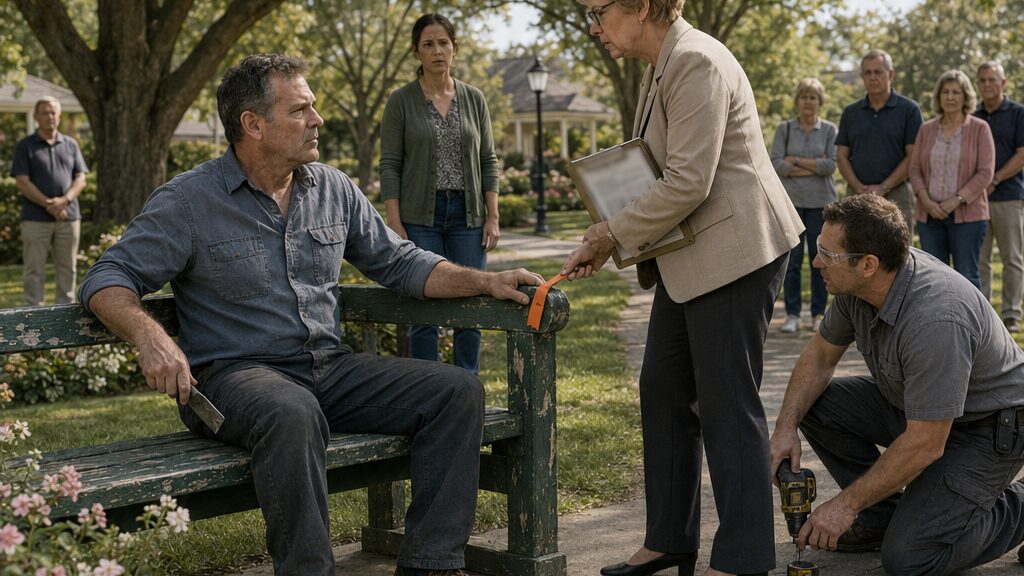
The drill bit struck concrete six inches from Jonathan Brown’s shoe.
He felt the vibration through the sole before he heard the contractor swear and pull the machine back. Gray dust drifted across the toe of Jonathan’s worn work boot and settled on the flaking green paint beneath his hand.
“You need to move,” the contractor said.
Jonathan stayed seated.
The old bench shifted faintly under his weight, not enough for anyone else to notice. He noticed everything about it: the loose vibration in the left arm, the rust blooming around the rear bolt, the shallow split beneath the third seat slat. He had tightened what could be tightened two Saturdays earlier.
The contractor glanced toward the paved path. “Ma’am?”
Elizabeth Walker approached with a clipboard tucked against her beige jacket. Her shoes were too clean for the damp edge of the park, and she stepped carefully around the dirt kicked up by the drill.
“Jonathan,” she said, “this is a scheduled common-area inspection.”
“You’ve inspected it.”
“We’re marking the removal points.”
The orange tag in her hand was bright enough to be seen from the playground. Several parents had already slowed. Two children stood by the drinking fountain, watching the contractor set metal anchors and measuring tape beside Jonathan’s feet.
Elizabeth looped the tag through the bench arm.
UNAPPROVED FIXTURE—REMOVAL PENDING.
Jonathan read it once.
Then he tore it off.
The paper made a dry ripping sound that carried farther than his voice would have.
Elizabeth’s expression tightened. “That belongs to the association.”
“So does the bench.”
“That has not been established.”
“It was established fifteen years ago.”
“Not in the records.”
Jonathan folded the orange tag once and placed it on the seat beside him.
The contractor looked away. He had the practiced stillness of a man who knew exactly when a job had become someone else’s argument.
Elizabeth lowered the clipboard. “You’ve been told repeatedly that personal items cannot remain on common property.”
Jonathan’s thumb rested against a ridge of peeling paint beneath the right armrest. “It isn’t personal.”
“You repair it.”
“Because no one else does.”
“You repaint it without approval.”
“Because no one else does.”
“You replace hardware, sand the boards, and decide when it stays closed.”
“When one of the bolts is loose.”
“That is exactly the problem.”
She spoke quietly, but the people near the path had gathered into a loose semicircle. Jonathan recognized Maria Nelson near the playground gate, one hand resting on her child’s shoulder. Brandon Hill stood farther back with his phone lowered at his side, not recording, though the posture suggested he had considered it.
Elizabeth turned so that the residents could hear her.
“The association’s insurer has asked us to identify aging fixtures and remove anything without documented ownership or a current maintenance plan. This bench has neither.”
Jonathan looked past her toward the dogwood tree at the curve in the path. The branches had grown across the view since the bench was installed. Years ago, the entire park could be seen from this seat.
Now only sections appeared between leaves.
“You could have asked me about the maintenance,” he said.
“I did.”
The answer came too quickly.
A few people shifted.
Elizabeth continued. “Twice in writing. Once through the property manager. You declined to provide records.”
“I declined to turn over private papers.”
“Then you cannot claim those papers prove association ownership.”
Jonathan’s fingers closed around the edge of the seat.
She had found the exact place where his certainty narrowed into something less defensible. He could feel it in the silence behind her. The residents did not know what she had requested, or why he had refused. They only knew that she had asked and he had said no.
Elizabeth lifted the orange tag from beside him and fastened it again, this time through the metal bracket where he could not tear it free without a knife.
“The bench is old,” she said. “It is visibly deteriorated. It does not appear in the asset inventory, and no current board has accepted responsibility for it.”
“It was donated.”
“By whom?”
He said nothing.
The park seemed to sharpen around him: the squeak of a swing chain, the contractor winding up his cord, a sprinkler clicking somewhere beyond the hedge.
Elizabeth waited.
Jonathan looked down at the green armrest. Paint had sealed the small brass plate almost completely. Only one narrow gold-colored edge showed beneath the layers.
His wife had wanted the plate visible.
He had covered it the first time the paint began lifting, telling himself he would strip and refinish the entire bench properly when he had time. Then the years had added their own coats. Green over green. Protection over memory until the names disappeared.
Elizabeth mistook his silence for surrender.
She tapped the contractor’s clipboard. “Mark it abandoned property.”
Jonathan stood.
The movement stopped the contractor before he could write.
Jonathan took a narrow scraper from the side pocket of his work pants. He crouched beside the armrest and set the blade against the flaking paint.
“Don’t damage association property,” Elizabeth said.
He looked up at her. “You just said it wasn’t association property.”
No one spoke.
He slid the scraper under the first layer.
A curled strip of green paint fell onto the dirt. Then another. The brass widened beneath his hand, dull and spotted but intact. He worked carefully, using the corner of the blade near the engraved letters.
Maria stepped closer.
“What is that?” Brandon asked.
Jonathan kept scraping until the first surname appeared.
NELSON.
Maria’s hand dropped from her child’s shoulder.
Jonathan uncovered the next line. RAMIREZ. BROWN. HILL. CAMPBELL. SMITH.
The plate held eleven family names in all, engraved in two narrow columns. Beneath them, smaller words emerged:
GIVEN BY THE FAMILIES OF CEDAR GLEN
A PLACE TO SIT. A PLACE TO STAY.
Jonathan wiped the brass with his thumb.
For a moment, he could not look at the final line.
Elizabeth extended her hand. “Let me see.”
He removed the two small screws holding the plate, though both resisted. When it came free, the rectangle left a raw brass-colored shadow beneath the paint.
Jonathan placed the plate in Elizabeth’s palm.
“You can remove the bench,” he said, “after you read those names into the board record.”
Elizabeth stared down.
Maria had moved close enough to read over her shoulder. “My parents are on there.”
“So are mine,” Brandon said.
Elizabeth’s face changed, but not in the way the watching residents seemed to expect. There was no collapse, no apology. Her mouth tightened as she studied the plate, then the bench, then Jonathan.
“This proves families contributed,” she said. “It does not prove the association accepted ownership.”
The distinction sounded cold, but Jonathan knew it was not meaningless.
That made it worse.
Maria stepped forward. “You called it abandoned.”
“I called it undocumented.”
“The tag says abandoned.”
Elizabeth turned the plate over. The back was blank.
“Where is the donation agreement?” she asked Jonathan.
He slid the scraper back into his pocket.
“You know there was one.”
“I know there should have been one.”
The contractor shifted his weight. “Do you want me to continue marking?”
Elizabeth handed the brass plate back to Jonathan. Her fingers remained on it for one extra second.
“Yes,” she said.
Maria protested, but Elizabeth raised the clipboard.
“This authorization was signed by the board secretary and issued through the property manager. Unless Jonathan produces evidence that changes the status, the contractor is permitted to remove the fixture.”
She showed the paper to him.
At the bottom was Brandon Hill’s signature.
Above it, in clean typed language, the bench was described as an ownerless, deteriorated structure located on common property.
Jonathan looked toward Brandon.
The younger man’s face had gone pale.
“I signed a work authorization,” Brandon said. “I thought there had already been a vote.”
“There was committee approval,” Elizabeth replied.
“That isn’t the same thing.”
“It is sufficient for hazard mitigation under the maintenance rules.”
Jonathan took the authorization and read it twice. It had a work-order number, a property-management stamp, and a scheduled removal window ending Thursday afternoon.
It looked official because it was official enough to make trouble.
He handed it back.
Elizabeth refastened the orange tag.
“This is not about disrespecting anyone’s family,” she said. “It is about what the association can legally maintain and insure.”
Jonathan held the brass plate against his palm, its edges pressing into his skin.
“You could stop the order.”
“You could provide the file.”
Neither moved.
The contractor began drilling again.
Jonathan stepped away from the bench, but only far enough to keep the concrete dust from reaching the plate.
Elizabeth checked her clipboard. “The bench will be gone before Friday.”
He watched the drill bite into the ground beside the rusted bolts.
She did not know that the file existed.
She did not know why it had never been completed.
And Jonathan, with the engraved names warm in his hand, still could not make himself tell her.
Chapter 2: Three Empty Bolt Holes by Morning
Fresh tire tracks curved through the damp grass and ended at three empty bolt holes.
Jonathan stopped at the edge of the concrete pad.
The bench had been there at nine the previous night. He knew because he had walked past after closing the cabinet shop, carrying a flashlight and a wrench he never used. The orange tag had moved in the wind. The bench had remained fixed beneath it.
Now rust-colored stains spread from the holes like old watermarks.
He stepped onto the pad.
A square of darker dirt showed where the rear leg had sheltered the ground. Two green paint chips lay near the path. Jonathan bent and picked one up. It was no larger than a fingernail, curved from the bench’s metal frame.
He closed it inside his fist.
The work order allowed removal through Thursday afternoon. It was barely six in the morning.
Someone had wanted the job finished before residents woke.
A truck slowed on the street beyond the hedge. For an instant Jonathan thought it might be the contractor returning. It continued past.
He called the number printed on the work order.
The answering service transferred him twice before a man from the landscape company came on.
“I’m asking where the bench was taken,” Jonathan said.
There was a pause. Keyboard keys clicked.
“Common-area fixture, Cedar Glen?”
“Yes.”
“Removed at five twelve this morning.”
“Where is it?”
“I can’t release disposal or storage locations directly to residents.”
“It isn’t trash.”
“I didn’t classify it.”
“Then tell me who did.”
Another pause. “The work order says ownerless debris.”
Jonathan looked at the three holes.
“Who signed the disposal instruction?”
“The association’s authorized contact.”
“Elizabeth Walker?”
“I can’t discuss client information.”
“You just told me the time it was removed.”
“That’s job status. Location is restricted.”
“Why?”
“Because we’ve had residents enter contractor yards and retrieve items after disposal authorization.”
Jonathan pressed the phone harder to his ear. “Is it in a yard?”
“I didn’t say that.”
“Was it destroyed?”
“I didn’t say that either.”
The man’s tone had softened, but not enough to help.
Jonathan ended the call before anger pushed him into words he would regret.
By seven, parents had begun arriving at the park. Children ran past the empty pad before noticing anything. Adults noticed first. They slowed, looked at the holes, then looked toward Jonathan as though he had been appointed to explain.
Maria Nelson crossed the grass with a folded paper in her hand.
“They took it?”
He nodded.
“Elizabeth said Thursday afternoon.”
“It is Thursday.”
“She knew what people heard.”
Jonathan crouched and brushed dirt from one bolt hole. The anchor had been cut flush rather than pulled. Whoever removed the bench had worked cleanly.
Maria unfolded the paper. It was a photocopy of an old check, the bank details faded.
“My mother found this in a tax folder,” she said. “Two hundred dollars. Memo line says park bench.”
Jonathan stood.
The check was made payable to Cedar Glen Community Fund, not the homeowners association. The date was fifteen years earlier.
“Do you remember the fund?” Maria asked.
“Yes.”
“Was it separate?”
“For the first year.”
“Why?”
Jonathan looked toward the path.
The community fund had been a practical invention during a bad season: grocery cards, utility help, small emergency repairs. The bench had come later, when money remained and his wife suggested something permanent.
“It was easier than asking the board for every expense,” he said.
Maria studied him. “That sounds like something that becomes a problem fifteen years later.”
“It did.”
Her expression sharpened. “My mother says six families gave cash. No receipts. She remembers your wife keeping a notebook.”
Jonathan said nothing.
Maria folded the check slowly.
“You have it, don’t you?”
“Have what?”
“The notebook. Records. Something.”
“I have some papers.”
“Then why didn’t you show them?”
“They’re not complete.”
“That is different from having nothing.”
He looked down at the paint chip in his palm.
Maria lowered her voice. “People are already saying Elizabeth stole a memorial bench.”
“It wasn’t a memorial.”
“She removed it before daylight.”
“That doesn’t make the story accurate.”
“She called it debris.”
“She may have believed the paperwork allowed it.”
Maria stared at him. “You’re defending her?”
“No.”
“Then what are you doing?”
Jonathan did not have an answer that would not expose more than he was ready to give.
A child stepped onto the concrete pad and placed both feet over the rust stains, pretending to balance. The child’s father pulled him away and said there might be sharp metal.
Jonathan checked the holes again. The cut anchors were rough at the edges.
He went home for a hammer and cold chisel.
By the time he returned, Maria had photographed the pad and posted a message to the neighborhood group asking anyone with donation records to contact her. She did not name Elizabeth, but the comments did.
Jonathan covered the anchor edges with temporary rubber caps from his garage. It was the first repair he had ever made to the place where the bench was missing.
At nine, Brandon Hill arrived in office clothes without a jacket. He held a printed copy of the work order.
“I called the property manager,” he said. “They said Elizabeth marked it urgent.”
Jonathan kept working.
“I signed this because she told me the committee had voted,” Brandon continued. “I thought my signature confirmed the vendor code.”
“You signed the authorization.”
“I know what I signed now.”
Jonathan struck the chisel once. “That does not change what it did.”
Brandon flinched at the sound.
“The manager won’t tell me where it went either,” he said. “Elizabeth is the listed contact.”
“Then ask her.”
“She isn’t answering.”
Maria approached. “I have four families who remember paying.”
“Do they have receipts?” Brandon asked.
“Do you have minutes approving the removal?”
His face tightened. “I’m looking.”
Maria held up her phone. “People want an emergency meeting.”
Jonathan stood between them. “First find the bench.”
Maria looked at him. “And if they destroyed it?”
The possibility had been present since dawn, but hearing it spoken made the empty pad seem larger.
Jonathan put the hammer into his toolbox.
At home, he went through the front closet, then the metal filing cabinet in the spare room. Maintenance receipts filled one drawer: screws, primer, outdoor enamel, replacement slats, concrete anchors. Every purchase had been made in his name. Every year, he had told himself the association did not need to reimburse him.
He had treated independence as proof of care.
On paper, it looked like private ownership.
At noon, Sandra Ramirez called.
“I found old board minutes,” she said without greeting. “Not the complete set.”
Jonathan sat at the kitchen table.
“What do they say?”
“That the board approved placement of a resident-funded bench near the east path.”
He closed his eyes.
“That should stop the disposal.”
“Maybe. There’s another line.”
Paper rustled on her end.
Sandra read carefully. “‘Acceptance into the association’s common asset schedule pending completion of transfer documents and maintenance designation.’”
Jonathan looked toward the closed door of his workshop.
“Pending,” Sandra repeated. “Then the next month’s minutes are missing.”
He did not answer.
“Jonathan,” she said, “why would the transfer be unfinished?”
Through the kitchen window, he could see the corner of the workbench where the old green paint cans were stored.
Sandra waited.
Finally, she said, “You know, don’t you?”
He looked down at Maria’s photocopied check and the green paint chip beside it.
“I know where the papers stopped,” he said.
Chapter 3: The Missing Page in the Board File
The official asset inventory contained a blank line between “east-path drinking fountain” and “playground shade structure.”
Jonathan ran his finger over the empty space.
The document was not damaged. Nothing had been erased. The numbering simply jumped from item forty-three to item forty-five.
Item forty-four had never been entered.
Across the HOA office table, Elizabeth Walker closed a binder.
“That is what I have been telling you.”
Jonathan looked up. “The minutes approved placement.”
“Placement is not acceptance.”
“The bench stood on association land for fifteen years.”
“So have resident planters, temporary signs, and several unapproved basketball goals.”
“None of those were bolted into a common-area pad built by the association.”
Elizabeth’s gaze flicked toward Brandon, who sat at the end of the table with a laptop open.
“Do we have proof the association built the pad?” she asked.
Brandon typed, searched, then shook his head.
The property manager occupied the chair nearest the file cabinet. She had arranged the meeting after Sandra emailed the scanned minutes and Maria’s neighborhood post drew more than sixty comments.
“The records before the management transition are incomplete,” she said. “We have board minutes, annual budgets, and some vendor invoices. We do not have a complete asset-transfer file.”
Jonathan held the copied minutes flat against the table. “But you have approval.”
“For installation,” Elizabeth said. “Not ownership.”
“Why does that distinction matter after fifteen years?”
“Because ownership creates maintenance duty. Maintenance duty creates liability. Liability requires inspection and insurance classification.”
Her voice was level. No one watching her now would have mistaken her for someone acting only from dislike.
That irritated Jonathan more than anger would have.
Brandon turned the laptop so they could see. “The removal authorization cites maintenance rule nine, emergency hazard mitigation.”
“Was there an emergency?” Jonathan asked.
Elizabeth placed a photograph beside the blank inventory.
It showed the underside of the bench. A dark split ran through one support joint.
Jonathan recognized the angle. The image had been taken from ground level, close enough to exaggerate the depth.
“That can be reinforced,” he said.
“That is not the question.”
“It is if you removed it for safety.”
“The question is whether the association had authority to spend money repairing property it did not own.”
“You had authority to spend money removing it.”
Elizabeth’s jaw shifted.
The property manager intervened. “Removal was charged under hazard mitigation.”
“Without a board vote,” Brandon said.
Elizabeth looked at him. “The architectural committee has delegated authority over unapproved common-area structures.”
“Only after written notice and an appeal period.”
“The insurer’s recommendation allowed expedited action.”
“Recommendation,” Brandon said. “Not an emergency declaration.”
The room tightened around the distinction.
Jonathan saw Elizabeth’s fingers press against the binder cover. She was not accustomed to Brandon challenging her, and Brandon was not accustomed to doing it.
The property manager cleared her throat. “We need to separate two issues. First, whether the removal followed internal procedure. Second, who owns the bench and what happens next.”
“Where is it?” Jonathan asked.
Elizabeth did not answer immediately.
That hesitation changed the room.
“You know,” he said.
“I know it was transported under the vendor agreement.”
“To where?”
“The contractor’s secured yard.”
Jonathan’s breath left him slowly.
Not destroyed.
The relief arrived so sharply that he had to grip the edge of the table.
“Why didn’t you tell anyone?” Brandon asked.
“Because residents were posting the contractor’s name and discussing going there.”
“Did anyone threaten them?” the property manager asked.
“Not directly.”
“Then you withheld the location because you expected people to interfere.”
“I withheld it because the association remains responsible for vendor access and safety.”
Jonathan stood.
Everyone looked at him.
“I want the yard address.”
Elizabeth shook her head. “Not until ownership is resolved.”
“It is still intact?”
“As of this morning.”
“As of this morning?”
“The contractor charges storage after twenty-four hours. If the association declines ownership, disposal proceeds under the work order.”
Brandon looked at the property manager. “Can we suspend that?”
“With board direction.”
“The board does not meet until next week.”
“Then call a special meeting,” Jonathan said.
Elizabeth gathered the photograph and binder. “A special meeting costs money, as does storage, inspection, repair, and legal review. Sentiment does not answer who pays.”
Jonathan stepped closer to the table.
“No,” he said. “But your decision created the storage charge.”
“And years of undocumented private maintenance created the uncertainty.”
The words landed cleanly because they were true enough.
Jonathan looked at the blank inventory again.
Sandra’s minutes proved the board had invited the bench into the park. They did not prove the final transfer. Maria’s check proved families gave money. It did not show what entity ultimately received the finished structure. His maintenance receipts could support either side.
Every piece answered one question and opened another.
The meeting ended with no order to retrieve the bench.
That evening, Sandra spread three boxes of old association papers across her dining-room table. She had marked dates with yellow sticky notes and arranged the documents in rows.
Jonathan arrived carrying the copied plate inscription.
Sandra took it from him and placed it beside the minutes.
“I always wondered why the names disappeared,” she said.
“The paint protected the brass.”
“It also hid it.”
He removed his jacket.
Sandra opened a ledger. “The board approved the site in May. The community fund paid for materials in June. You installed the bench in July.”
“We installed it.”
“You and your wife.”
Jonathan looked away.
Sandra did not press the name or the memory. She pointed to the ledger instead.
“Then in August, the treasurer issued a note asking for transfer documents. September’s board packet is missing. October says the matter was deferred.”
“Deferred to what?”
“It doesn’t say.”
She pulled out a photocopy of a letter. “This is from the old insurance agent. They wanted a designated maintenance party before adding it to the common-property schedule.”
Jonathan read the sentence twice.
The wording was familiar.
Sandra watched him. “You’ve seen this.”
“Yes.”
“Where?”
He set the letter down.
“Jonathan.”
The dining room clock ticked over the silence.
He could have said he did not remember. He could have blamed the old board, the management change, or the chaos of that year. All of it would have contained some truth.
Instead, he said, “There was a transfer packet.”
Sandra leaned back.
“Completed?”
“Partly.”
“Signed?”
“By some people.”
“By the association?”
“Not the final page.”
“Who has it?”
Jonathan looked at the plate inscription between them.
“I do.”
Sandra’s face did not harden at once. The disappointment came slowly, which was worse.
“You let Maria search her mother’s tax files,” she said.
“I didn’t ask her to.”
“You let Brandon take blame for signing a bad authorization.”
“He did sign it.”
“And you let Elizabeth stand there saying there were no records.”
“There are no completed records.”
Sandra pushed back from the table.
“That is a lawyer’s answer, and you are not a lawyer.”
Jonathan’s voice lowered. “The papers are private.”
“They concern a bench donated by eleven families and installed on association land.”
“They also concern my wife.”
Sandra became still.
The name remained unspoken between them, but its presence changed the air.
Jonathan picked up the photocopied inscription. “She handled the fund. She handled the signatures. The last page was on her desk when she went into the hospital.”
Sandra’s anger softened but did not disappear.
“And after?”
“I put everything away.”
“For fifteen years?”
“I maintained the bench.”
“That was not the same as finishing what she started.”
He looked toward the boxes of records.
“I know.”
Sandra sat down again.
“Did Elizabeth ever ask you for the packet?”
Jonathan did not answer.
Her eyes narrowed. “She did.”
“Her letters called it an unauthorized private fixture.”
“That is not what I asked.”
“Twice,” he said.
Sandra closed the ledger.
“And you ignored her.”
“I told the manager I had nothing the association was entitled to.”
“You had the only papers that might have kept the bench from being removed.”
“They were unfinished.”
“They were evidence.”
Jonathan folded the inscription copy once, then flattened it again.
The property manager’s email alert sounded on Sandra’s laptop.
She opened it.
A notice filled the screen.
SPECIAL BOARD MEETING—SUNDAY, 6:00 P.M.
PURPOSE: REVIEW OF UNBUDGETED STORAGE AND DISPOSAL COSTS ASSOCIATED WITH UNCLAIMED PARK FIXTURE.
Sandra read the final line aloud.
“Unless ownership documentation is submitted before the meeting, the board will consider authorization for final disposal.”
Jonathan stared at the words unclaimed park fixture.
The papers in his workshop could prove the bench had not been abandoned.
They could also prove that he had allowed the uncertainty to survive because part of him had preferred being the only person who understood what the bench meant.
Chapter 4: Why Elizabeth Signed the Work Order
The photograph showed a split Jonathan had not reported.
It ran through the underside of the left support, beginning as a dark hairline near the bolt and widening toward the joint. The flash had caught pale wood beneath the green paint.
Jonathan held the print closer.
“That angle makes it look worse,” he said.
Elizabeth stood across the HOA office table, one hand resting on the closed insurance file. “Does the angle create the crack?”
“No.”
“Did you know it was there?”
He set the photograph down.
The property manager had called him before eight Friday morning and said the contractor would permit an inspection at ten. When Jonathan arrived, Elizabeth was already waiting with a folder of dated photographs.
“I saw a surface split,” he said. “I planned to reinforce it.”
“When?”
“This weekend.”
Elizabeth opened the folder. “The first photograph was taken three weeks ago.”
Jonathan recognized the muddy edge of the pad and the fresh scrape beneath the armrest. He had sanded that area the following day.
“You inspected it without telling me.”
“It is on common property.”
“And you decided it was dangerous without asking someone who works with wood.”
“I sent the photographs to the insurer.”
“You sent photographs to a claims office.”
“I sent them to the risk representative assigned to the association.”
She slid a printed email toward him.
The recommendation did not order removal. It advised the board to restrict access to any deteriorated fixture until its ownership, structural condition, and maintenance responsibility could be confirmed. A second paragraph referred to a recent claim involving a failed bench support at another managed property.
Jonathan read that paragraph twice.
An older resident had fallen when a seat separated from its frame. The injuries were described only as significant.
“You could have closed ours temporarily,” he said.
“With what authority? The same authority you now say I did not have?”
“You could have put up tape.”
“And waited for someone to move it? Or for you to decide the crack was not serious?”
The accusation was quiet. That gave it weight.
Jonathan looked again at the split. He had pressed his thumb against that joint two Saturdays before. It had held. He had told himself the wood would last until he had time to cut a steel brace at the shop.
He had not told anyone.
Elizabeth closed the file. “The board delayed replacing two playground components last year because no one wanted to approve the expense. One failed during a birthday party.”
“No one was hurt.”
“A child was standing beside it.”
“That is not the same as this bench.”
“No. This bench had no maintenance owner, no inspection schedule, and no budget.”
Her voice sharpened for the first time.
“I asked Jonathan Brown for records. He told the property manager the association had no right to them. I asked for an inspection history. There was none. I asked whether he would accept written responsibility for repairs. He did not answer.”
Jonathan met her eyes. “You called it unauthorized.”
“Because that is what the inventory said.”
“The inventory said nothing.”
“Exactly.”
For a moment, neither spoke.
The property manager entered carrying two visitor badges. “The contractor will meet you at the yard. No one touches the bench until the supervisor is present.”
The yard stood behind a chain-link fence near the industrial edge of town. Stacks of pavers, bent signposts, irrigation pipe, and broken playground panels filled marked lanes. The air smelled of wet soil and diesel.
A supervisor led them past two flatbed trucks.
The bench rested on wooden blocks beneath an open-sided shelter.
Jonathan saw the curved green armrests first.
Relief loosened something inside him. Then he noticed the rear support.
Without the concrete pad hiding its underside, the damage was obvious. The crack continued almost through the full depth of the wooden joint. A rusted bolt had swollen inside the wood, forcing the grain apart.
Jonathan crouched.
The supervisor pointed without touching. “We lifted from the frame, not the slats. It flexed when we set it down.”
“Did it break further during removal?” Jonathan asked.
“Hard to say. We photographed before and after.”
Elizabeth remained several feet away.
Jonathan ran his hand near the split, stopping before contact. He could imagine the repair: remove the support, cut a matching piece, preserve the original side panels, replace the hidden hardware. It was possible.
It was also more than a Saturday tightening job.
“How long will you hold it?” he asked.
The supervisor checked his tablet. “Storage started yesterday at five twelve. Association rate is seventy-five dollars a day.”
“And after Sunday?”
“If we receive no hold extension or retrieval order, it moves to dismantling Monday morning.”
“Dismantling?”
“Metal separated from wood. Recyclable material sorted. Disposal fee added.”
Jonathan stood.
Elizabeth looked at the bench, not at him. “I told them not to destroy it before the meeting.”
“That was your decision?”
“Yes.”
It was the first thing she had done since Monday that he could accept without qualification.
“Then extend the hold,” he said.
“I cannot commit association funds indefinitely without board approval.”
“You committed them to removal.”
“I believed emergency authority applied.”
“Believed?”
She finally looked at him. “Yes.”
The word carried no apology, but it was not a defense either.
The supervisor stepped away to answer a radio call.
Elizabeth moved closer to the broken joint.
“My father fell from a porch step when I was twelve,” she said. “The board at his condominium had discussed repairing it for months. Everyone assumed someone else would authorize the work.”
Jonathan waited.
“He never walked normally afterward. The association settled. The settlement did not change the fact that the repair would have cost less than two hundred dollars.”
She touched the edge of the green armrest with one finger.
“I know this is not that step,” she said. “But when people say an old structure has always been fine, what I hear is that no one wants to be responsible before it fails.”
Jonathan looked at the crack again.
“And when you called it debris,” he said, “what I heard was that none of the years before you mattered.”
Elizabeth withdrew her hand.
“Those are not mutually exclusive problems.”
He almost answered, then stopped.
The bench had not been destroyed. Elizabeth had acted beyond her authority, but not without reason. He had protected its meaning while neglecting the part that could injure someone.
Both truths stood in the yard with them.
The supervisor returned. “I need a decision for the account.”
Elizabeth checked her phone. “The special meeting remains Sunday evening.”
“That is after the standard hold.”
“What would two additional days cost?”
“One hundred fifty, plus tax.”
Elizabeth nodded. “Add the extension through Monday morning.”
“On whose authorization?”
She glanced at Jonathan.
“Mine,” she said. “Pending board review.”
The supervisor entered it.
As they walked toward the gate, Jonathan turned back once. The brass plate was no longer attached, but its cleaner rectangle remained visible beneath the armrest.
The supervisor called after them.
“One more thing. The extension expires at eight Monday morning. If the association has not arranged pickup by then, we dismantle it.”
Forty-eight hours remained, and for the first time Jonathan could no longer claim that saving the bench meant putting it back exactly as it had been.
Chapter 5: The Promise Beneath the Peeling Paint
Jonathan opened the hidden toolbox compartment with a screwdriver because the small brass key had not turned in years.
The panel released with a dry snap.
Dust rose from the narrow space beneath the lower tray. Inside lay a cream-colored envelope, a spiral notebook, two carbon-copy forms, and a square of wood painted the same dark green as the bench.
He had moved the toolbox from house to house within Cedar Glen without opening that compartment. He had replaced the workbench beneath it, changed jobs, buried his wife, and repainted the bench six times.
The papers had remained where she left them.
Sandra stood at the workshop door with Maria and Brandon behind her. No one entered until Jonathan stepped aside.
He placed the contents on the workbench.
The spiral notebook opened to columns of names and amounts. Some entries were checks. Others read CASH in his wife’s compact handwriting. Beside each family name was a date and, occasionally, a note.
Nelson—mother recovering, brought soup money anyway.
Ramirez—asked that no plaque mention illness.
Hill—paid in two parts.
Maria leaned over the page. “That is my mother’s handwriting next to the amount.”
A small note had been stapled beside the entry: For the place by the dogwood. No dedication ceremony.
Brandon examined the carbon forms. “This is the transfer packet.”
“Part of it,” Jonathan said.
One form documented the donation of materials and labor. The second assigned future maintenance to the association after acceptance into the common asset schedule. Eleven donor signatures filled the first page.
The line for the HOA president was blank.
Sandra lifted the cream envelope. “May I?”
Jonathan nodded.
Inside was a letter written on plain paper.
Sandra read silently, then stopped and handed it to him.
He knew the words before seeing them.
The bench should not be treated as a memorial. It should be used. Please do not put my name on it. We have had too many people in this neighborhood sitting alone inside their homes because they think grief needs an invitation.
Jonathan’s wife had written the letter during the worst winter Cedar Glen had known as a community—not because of weather, but because illness, layoffs, and two sudden deaths had left half the neighborhood carrying casseroles between houses.
The community fund began with grocery cards.
The bench came from what remained.
Maria read the letter over his shoulder. “A place to sit. A place to stay.”
Jonathan touched the unfinished transfer page.
“She chose those words for the plate.”
“Why hide the plate?” Maria asked.
“I didn’t mean to.”
“That is not an answer.”
He picked up the green paint sample. It had her handwriting on the back: second coat too dark.
“The first winter, water got behind the brass. I painted around it. The next year, I sealed the edges. After that, I covered the whole arm because I thought I would strip it properly later.”
“And later became fifteen years,” Sandra said.
“Yes.”
Maria looked toward the toolbox compartment. “Did you hide the letter too?”
Jonathan’s hand tightened around the wood sample.
“I put everything away after she died.”
The workshop seemed smaller with the sentence spoken.
Brandon took off his glasses and cleaned them, though they were not dirty. “When was the final board signature supposed to happen?”
“The week she went into the hospital.”
“And afterward?”
“The old president brought the form to the house. I told him it could wait.”
Sandra’s eyes closed briefly. “I remember him asking at a meeting whether anyone wanted to handle the community-fund transfer.”
“You were treasurer,” Jonathan said.
“Former treasurer. I had already resigned.”
“You still knew the records.”
“I knew enough to ask. I did not because the room was tired of bad news.”
They stood around the bench’s history as though it were another damaged object on the workbench.
Maria broke the silence. “We take all of this to the meeting.”
Jonathan gathered the papers into a stack. “Not the letter.”
“Why?”
“It is personal.”
“It explains why the bench exists.”
“The donation ledger explains that.”
“No,” Maria said. “The ledger explains who paid. The letter explains why people cared.”
Jonathan slid the letter back into the envelope.
“That part belongs to her.”
Maria’s face tightened. “You keep saying things belong to you because they hurt you.”
Sandra looked sharply at her, but Jonathan raised one hand.
Maria continued.
“You kept the records because they were private. You kept the plate covered because the repair was yours. You kept the maintenance to yourself because no one else would do it correctly. And now the bench is in a contractor yard.”
Her voice did not rise. That made each sentence harder to dismiss.
Jonathan looked at the envelope.
He had believed he was protecting his wife from becoming a neighborhood story. She had refused a memorial because she did not want attention placed on her. He had honored that refusal so completely that he had hidden the purpose with the person.
Brandon set his glasses back on.
“There is another problem,” he said. “Even with these documents, the association may argue it never accepted ownership.”
“The board approved the site,” Sandra said.
“But the maintenance form is unsigned.”
“Then the donor families still own it,” Maria said.
“Collectively?” Brandon asked. “Through a fund that no longer exists? That could create a worse legal problem.”
Maria folded her arms. “You always find the sentence that stops people.”
“It is my job to find the sentence that becomes expensive later.”
“And signing Elizabeth’s order?”
His expression changed.
“That was me assuming someone else had checked.”
Maria looked away.
Brandon touched the transfer form. “I am not saying we cannot save it. I am saying sentiment will not create a maintenance owner.”
Jonathan pulled a blank legal pad from the shelf.
“What would?”
Brandon hesitated. “A board-approved covenant. Defined inspection schedule. Repair authority. Funding source. Liability accepted by the association after a qualified structural review.”
Sandra moved closer. “And the ownership transfer?”
“We could ratify the original donation, attach these records, and formally accept the rebuilt structure.”
“Rebuilt,” Jonathan repeated.
“Not restored exactly as it was. The support is unsafe.”
Jonathan saw the bench in the contractor yard, lifted off its pad, the split forced open around a rusted bolt.
He wrote four words on the legal pad:
ORIGINAL PANELS. NEW SUPPORTS.
Maria read them. “You would agree to that?”
“If the original material is sound.”
“And the plate?”
“Visible.”
Sandra sat at the end of the workbench. “Then the remaining question is who pays.”
Maria unlocked her phone. “Residents are already asking.”
“No public shaming,” Jonathan said.
She looked at him.
“No photographs of Elizabeth’s house. No demands that she move. No reporter.”
“A reporter contacted me this morning.”
“Tell them no.”
“She removed the bench before daylight.”
“And I withheld records that might have stopped her.”
Maria lowered the phone.
Brandon stared at him. “Are you planning to say that at the meeting?”
Jonathan looked at the unfinished signature line.
“Yes.”
Sandra reached for the envelope again. “And the letter?”
He kept his hand on it.
Before he could answer, Sandra said, “Elizabeth requested these records twice.”
Maria turned. “Twice?”
Sandra nodded. “Jonathan admitted it Thursday.”
The accusation in Maria’s face was immediate.
Jonathan did not defend himself.
“The first request came after she took over the committee,” he said. “It called the bench an undocumented visual deficiency.”
Maria gave a humorless breath.
“The second said removal would be considered if I did not establish ownership. I thought she was trying to force me to surrender it.”
“So you ignored her,” Brandon said.
“I told myself unfinished papers would only give her another reason.”
“But you never gave anyone else a chance to read them,” Sandra said.
Jonathan looked around the workshop: at the maintenance receipts he had paid alone, the paint cans marked by year, the plate wrapped in cloth, the tools arranged exactly where he wanted them.
He had kept the bench alive.
He had also made himself indispensable to it.
“She asked badly,” he said. “I answered worse.”
No one rushed to soften the admission.
Jonathan drew a line beneath the four words on the legal pad and began outlining the covenant. Annual inspection. Immediate closure upon reported defect. Board-controlled maintenance fund. Qualified repair approval. Shared access to records.
When he finished, he placed the cream envelope on top.
Maria glanced at it. “You are bringing the letter?”
“I will read only the part about the bench.”
“That is enough.”
He called Brandon before he could change his mind.
Brandon’s phone rang in his hand.
Jonathan looked directly at him.
“Put me first on the agenda tomorrow.”
“For the ownership presentation?”
“For my admission.”
Brandon did not ask him to reconsider.
“I will revise the agenda,” he said.
Jonathan closed the toolbox compartment but did not lock it.
Chapter 6: The Meeting Where Nobody Got Everything
Jonathan stood before the board and told the room why the bench had been removed.
“Elizabeth authorized it without a full vote,” he said. “Brandon signed a work order he had not verified. The property manager processed an emergency classification that was never formally declared.”
A restless sound moved through the clubhouse.
Elizabeth sat at the board table with her hands folded. Brandon stared at the printed agenda.
Jonathan placed the unfinished transfer packet beside the brass plate and orange removal tag.
“Those facts matter,” he continued. “So does this one: I had records that could have changed the discussion, and I withheld them.”
The room became quiet.
Maria stood along the wall near a group of residents holding copies of a petition. Sandra sat in the front row with the old minutes on her lap.
Jonathan explained the letters from Elizabeth, his refusal to answer, and the unfinished signature page he had kept in his workshop for fifteen years.
A resident near the back said, “Why would you do that?”
Jonathan looked at the brass plate.
“Because the papers belonged to a period of my life I did not want the association handling. Because I did not trust the committee. Because I thought maintaining the bench gave me the right to decide what anyone else needed to know.”
No one interrupted.
“I was wrong.”
The HOA president leaned toward the microphone. “Thank you, Jonathan. We will enter the documents into the record.”
Elizabeth lifted one hand. “I would also like the insurance correspondence entered.”
A few residents objected.
The president tapped the microphone. “Everyone will be heard.”
The risk representative had joined by video. A structural inspector sat near the end of the table with photographs from the contractor yard. He confirmed the rear support had split around corroded hardware and that the bench should not be returned to service in its current condition.
“Can it be repaired?” the president asked.
“Parts can be reused,” the inspector said. “The metal side frames appear serviceable after corrosion treatment. Several slats can be refinished. The failed supports must be replaced, and I recommend new hidden bracing.”
Maria raised her hand. “So it can be saved.”
“The object can be reconstructed,” he said. “Not preserved unchanged.”
That distinction passed through the room like a draft.
Several residents had arrived expecting the bench to be recovered, bolted back down, and the people responsible punished. The inspector’s answer removed that simple ending.
The president turned to Elizabeth. “Explain your decision.”
She opened the insurance file.
“The association received a written recommendation to restrict access to aging fixtures with uncertain maintenance responsibility. I photographed the bench and requested records from Jonathan. None were provided.”
“You could have closed it,” Maria said.
Elizabeth looked toward her. “With cones? Tape? A sign residents might remove? And under whose authority would repairs be ordered?”
“Under common sense.”
“Common sense is what everyone invokes before asking the association to pay a claim.”
Disapproval spread through the room.
Elizabeth waited for it to settle.
“My father was injured because a condominium board delayed a repair everyone knew was needed. That history affected my judgment. It does not excuse every choice I made.”
Jonathan watched several residents shift in their seats.
“I believed the committee’s hazard authority was sufficient,” she said. “I also believed delay would be treated as weakness if someone was hurt.”
The HOA president asked, “Did the committee vote?”
“Two members agreed by email. One did not respond.”
“That is not a recorded vote.”
“No.”
“Did you represent to the property manager that the bench was abandoned?”
“I used the phrase undocumented ownerless fixture.”
“The work order says ownerless debris.”
“I approved the work order without correcting the vendor description.”
Maria held up the orange tag. “And this?”
Elizabeth looked at it.
“That was unnecessary.”
The answer was smaller than an apology, but it was the first time she had named one of her actions without defending it.
The president turned to Brandon. “Your signature appears on the authorization.”
Brandon removed his glasses.
“Elizabeth told me committee approval had been obtained. I believed I was confirming the account code and vendor charge. I did not review the minutes or ask for the actual vote.”
“Did you have authority to sign?”
“As board secretary, yes.”
“Did you exercise it responsibly?”
“No.”
A murmur followed, less angry than the one directed at Elizabeth. Jonathan noticed Brandon hear the difference.
The property manager explained the current costs: removal, four days of storage, inspection, transport, and potential disposal. The total drew an audible reaction.
A resident stood. “Elizabeth should pay it.”
Another called for her removal from the committee.
Maria raised the petition. “We have eighty-three signatures demanding censure and full restoration.”
Jonathan looked at her.
She read his expression and lowered the pages slightly.
The president asked whether the petition specified a funding source.
“It specifies accountability,” Maria said.
“That is not a funding source.”
The room began dividing into familiar camps—punishment, procedure, sentiment, cost. Voices overlapped.
Jonathan picked up the brass plate and struck it once against the table.
The sound was not loud, but the room stopped.
“My wife did not organize this bench so people could gather around it and decide who should be driven out of the neighborhood.”
Elizabeth looked at him.
Jonathan unfolded the letter.
He did not read the personal lines. He read only the final paragraph.
“The bench should not be treated as a memorial. It should be used. We have had too many people in this neighborhood sitting alone inside their homes because they think grief needs an invitation.”
He placed the letter down.
“That was the promise,” he said. “Not that every original board would last forever. Not that the paint would never peel. Not that I would be the only person allowed to care for it.”
Maria’s petition lowered another inch.
Jonathan handed copies of the proposed covenant to the board.
“The association formally accepts the original donation and the rebuilt bench. A restricted maintenance fund covers annual inspection and repair. Any resident may report damage. No one person controls access to the records or the work.”
The president read the first page.
“Who funds reconstruction?”
“I will donate the labor.”
“That still leaves materials, transport, and storage,” Brandon said.
Maria looked at the residents behind her.
Then she tore the cover sheet from the petition.
“We already have eighty-three names,” she said. “We can ask them for ten dollars before we ask them for another signature.”
A few people laughed, not because it was especially funny, but because the room needed another kind of sound.
Sandra stood. “The original community fund began with smaller amounts than that.”
The president looked toward the risk representative on the screen. “Would this covenant satisfy the insurer?”
“Not as written,” the representative said.
The room tightened again.
“You need a designated maintenance owner,” she continued. “A committee, manager, or board officer must have authority to close the bench immediately after a reported defect. Shared responsibility cannot mean no responsibility.”
Elizabeth spoke before anyone else.
“The architectural committee can manage the inspection calendar.”
Maria stared at her. “After this?”
“Under board oversight,” Elizabeth said. “With every inspection entered into the shared records.”
The president studied her. “You may not remain chair after tonight.”
“I understand.”
Jonathan looked down at the covenant. He had written responsibility as though goodwill itself could hold it. Elizabeth had identified the same gap that had existed fifteen years earlier.
He crossed out a sentence and wrote a new one.
The association board would own the maintenance duty. The committee would schedule inspections. The property manager would retain the reports. Emergency closure would require photographs and written notice within twenty-four hours.
He passed the revision to Elizabeth.
She read it, then nodded once.
The motions came in order.
First, the board accepted the original donation records into the association archive.
Second, it authorized retrieval before Monday’s deadline.
Third, it approved reconstruction using sound original components, subject to inspection.
Fourth, it established the restricted maintenance fund.
Brandon made the motion for each one, his voice steadier every time.
The censure motion came last.
Elizabeth did not argue against it.
Before the vote, the president asked for her response to the covenant.
She looked at the brass plate beside the orange tag.
“In favor,” she said.
The vote for the covenant was unanimous.
The vote censuring Elizabeth and removing her as committee chair passed four to one.
No one applauded.
Jonathan preferred that.
Afterward, residents surrounded Maria to pledge money. Sandra gave the property manager copies of the old minutes. Brandon stayed at the table correcting the work-order record.
Elizabeth gathered her insurance file alone.
Jonathan approached.
“You kept it from being destroyed,” he said.
“I also put it there.”
“Yes.”
She closed the folder.
“I am not asking you to excuse that.”
“I am not.”
For a moment, they stood without the protection of argument.
Then Elizabeth held out the orange removal tag.
“It belongs in the file,” she said.
Jonathan looked at it, then at the brass plate still resting on the table.
“No,” he said. “Put them together.”
She placed the tag beside the plate inside the clear archive sleeve.
The record would preserve both: the promise and the failure to protect it properly.
At seven forty the next morning, the contractor’s truck entered Cedar Glen carrying the bench back in pieces, forty minutes before the disposal deadline.
Chapter 7: The First Person Who Sat There Again
Someone was already sitting on the rebuilt bench.
Jonathan stopped beside the drinking fountain with the maintenance key in his hand.
The park had not officially reopened around the east path. A temporary barrier still stood near the flower bed, and the dedication was not scheduled for another hour. Yet a figure sat at the far end of the green seat, one hand resting on the curved metal arm.
Elizabeth Walker looked toward him.
“I checked the sign,” she said. “It says the path is closed for landscaping. It does not say the bench is closed.”
Jonathan looked at the two orange cones he had placed beside the pad. One had been moved neatly under the dogwood tree.
“It was supposed to imply that.”
“You have spent six weeks insisting implication is not documentation.”
He almost smiled.
Almost.
The rebuilt bench looked familiar from a distance, but up close the differences were plain. The original metal side frames had been cleaned and treated, leaving faint pits beneath the new green finish. Four of the old seat slats had been saved. The others had been replaced with matching cedar from Jonathan’s shop.
The failed supports were new.
So were the stainless-steel bolts, the hidden braces, and the inspection label mounted beneath the right armrest.
The brass plate sat where everyone could see it.
No paint covered the names.
Elizabeth shifted slightly. “It does not move.”
“It should not.”
“I tried.”
Jonathan gave her a look.
“With my hand,” she said. “I did not jump on it.”
He walked closer and checked the base anyway. The contractor had set the new anchors two days earlier. Jonathan had watched the torque measurements, photographed the hardware, and uploaded the inspection record to the association’s shared folder before allowing himself to run one hand along the restored armrest.
Now he inserted the maintenance key into the small lockbox attached beneath the drinking fountain. The box contained a duplicate key for the barrier chain, inspection tags, and a laminated card listing the reporting procedure.
Elizabeth noticed.
“You brought the last key.”
“Yes.”
“You could keep one.”
“There is one in the property-management office.”
“That is not what I meant.”
Jonathan shut the lockbox without answering.
Six weeks earlier, he would have kept a duplicate in his toolbox. He would have told himself it was practical. He would have inspected the bench before sunrise and corrected small defects without troubling anyone.
The new covenant required every repair to be logged.
It required photographs.
It required another person to know.
Elizabeth looked down at the brass plate. “The names are easier to read than I expected.”
“They were never meant to be hidden.”
“No.”
The word rested between them.
Beyond the path, Maria Nelson and Sandra Ramirez were arranging paper cups and a coffee dispenser on a folding table. Brandon Hill stood with the property manager near the clubhouse entrance, checking printed copies of the maintenance covenant. Several children had begun circling the barrier, asking when they could use the path.
Elizabeth watched them.
“I did not think anyone would care this much about a bench,” she said.
Jonathan sat at the opposite end.
The new cedar gave a dry, clean sound beneath his weight. No shift. No complaint from the supports.
“That was part of the problem,” he said.
“Mine or yours?”
“Both.”
She accepted that without looking at him.
A small metal inspection disk had been fixed beneath the center slat. Elizabeth reached under and touched its edge.
“The first formal review is in six months,” she said. “Then annually unless someone reports movement, corrosion, splintering, or visible joint separation.”
“I read the schedule.”
“I know.”
“Then why are you reciting it?”
“Because I arranged it.”
Jonathan turned toward her.
Elizabeth kept her eyes on the playground.
“The property manager was going to use the same general maintenance vendor who inspects the picnic tables,” she said. “They do visual checks only. I contacted the structural inspector from the meeting and negotiated a lower rate if Cedar Glen adds the bench to the common-fixture review.”
“You are not committee chair anymore.”
“No.”
“You did that anyway.”
“The board approved the expense.”
“That is not what I asked.”
She folded her hands in her lap.
“I removed it because I believed no one else would act before it failed,” she said. “Then I helped create a system that does not depend on me believing that.”
The answer was careful, but not polished. Jonathan could hear the effort in it.
“That sounds almost like an apology,” he said.
“It is not a request for forgiveness.”
“I know.”
She looked at him then.
The weeks since the meeting had not been easy for her. Residents had stopped conversations when she entered the clubhouse. Someone had placed a photocopy of the orange removal tag beneath her windshield wiper. Maria had taken it away before Elizabeth returned to the car, but Jonathan had seen it.
The censure remained in the board record.
So did Jonathan’s admission.
Neither document allowed the neighborhood to keep only the version of the story it preferred.
Elizabeth traced one of the names on the plate without touching the engraved letters.
“My house is listed,” she said.
Jonathan looked at her.
“For sale?”
“Not yet. I have spoken to an agent.”
“Because of the committee?”
“Because I am tired of wondering whether every person who waves at me is being polite or has not heard what happened.”
“That will follow you less than you think.”
“You cannot know that.”
“No.”
A child ducked beneath the temporary ribbon. Maria caught him before he reached the concrete pad and guided him back with one hand on his shoulder.
Elizabeth watched the exchange.
“I thought staying here meant proving I could survive being disliked,” she said. “Now I am not sure that is the same as belonging.”
Jonathan rested his palm on the green slat between them.
His wife’s letter had not promised that everyone who sat there would be welcomed warmly. It had promised a place where a person could sit without first explaining why they needed it.
“You are sitting here,” he said.
“That is not an answer.”
“It is the only one I have.”
Sandra called across the grass. “Jonathan, we need the key for the barrier.”
He lifted his hand toward the lockbox. “Inside.”
Sandra stopped.
“You put it in already?”
“Yes.”
She glanced at him, then at Elizabeth. Something softened in her expression.
“Good,” she said.
She opened the box, signed the small access sheet clipped inside, and removed the key. The act took less than a minute.
Jonathan watched her carry it away.
For fifteen years, every tool connected to the bench had passed through his hands. Even when others offered help, he had found reasons to do the work himself. Their sanding was uneven. Their paint was too thick. Their hardware was wrong. Their records were careless.
Now Sandra unlocked the barrier without asking him where the key was hidden.
The loss of control felt smaller than he had feared.
Maria approached with two cups of coffee. She handed one to Elizabeth first.
Elizabeth looked surprised.
“This does not mean I have withdrawn the censure petition,” Maria said.
“The vote already happened.”
“I know. I am clarifying the coffee.”
Elizabeth accepted it. “Thank you for the clarification.”
Maria gave Jonathan the second cup and looked over the bench.
“My mother is coming,” she said. “She wants to see her name.”
“It was always there,” Jonathan said.
Maria raised one eyebrow.
He nodded. “That came out wrong.”
“Yes.”
She walked back toward the table.
Elizabeth held the cup between both hands. “Nobody got everything.”
“No.”
“You did not get the original bench.”
“No.”
“I did not get an association run entirely by documented risk controls.”
“That sounds difficult to mourn.”
“It is a very specific dream.”
This time Jonathan smiled.
The dedication itself was brief. The HOA president described the reconstruction, thanked the donors, and read the maintenance covenant’s first sentence aloud. No one gave a speech about heroes or villains.
Jonathan preferred that too.
Maria’s mother ran her fingers over the Nelson engraving and cried without trying to hide it. Children took the seat before the adults finished folding the tables. An older resident rested at one end while a parent tied a child’s shoe at the other.
The bench became crowded, then empty, then occupied again.
It did not behave like a memorial.
By late afternoon, the paper cups were gone and the temporary barrier had been folded into the property manager’s vehicle. Elizabeth left without telling Jonathan whether she would list her house.
He did not ask.
Before walking home, he inspected the bench once more. He checked the visible hardware, pressed gently against each arm, and looked beneath the center slat at the dated inspection disk.
Everything held.
At the drinking fountain, he opened the shared lockbox.
The maintenance key lay inside beside Sandra’s signed access entry.
Jonathan took the duplicate from his pocket—the one he had nearly kept—and placed it next to the first.
He closed the metal door and spun the combination dial.
Then he returned to the bench, not to repair it or guard it, but to sit while two neighbors he barely knew made room for him.
The story has ended.