Her Children Sold The Black Car Before She Could Say Goodbye To Her Husband
Chapter 1: The Label On The Garage Door
The first thing Susan Bennett saw when she stepped from the kitchen into the garage was not the boxes.
It was the label.
A rectangle of blue painter’s tape had been pressed to the inside of the garage door, right above the old brass hook where Edward had kept the keys. Someone had written SELL in thick black marker, the letters tall and practical and final.
The hook below it was empty.
Susan stood with one hand on the doorframe and waited for the garage to settle into the shape she knew. It did not. The Saturday morning light came through the small square windows in the garage door and fell across cardboard boxes, open plastic tubs, black trash bags, and three folding tables her children must have brought from somewhere. They had divided Edward’s world into islands.
KEEP.
DONATE.
SELL.
The words appeared again and again on strips of tape. On a box of extension cords. On a stack of coffee cans filled with screws. On two wooden crates of rags and polish and unopened spark plugs. On the dented radio that still sat on the workbench, unplugged now, its cord coiled around it like something prepared for storage.
Samuel was bent over near the shelves, pulling old paint cans into a row. Carolyn stood by the driveway with a clipboard, her cardigan sleeves pushed to her elbows, a pen tucked behind one ear. Neither of them noticed Susan at first.
The car sat beneath its gray cover in the center of the garage.
Even covered, it had a shape Susan could have drawn with her eyes closed: the long hood, the soft drop toward the windshield, the proud shoulders over the front wheels. Edward used to say a good car kept its posture even when it slept.
A strip of tape had been placed on the windshield beneath the cover’s edge.
SELL.
Susan’s fingers tightened on the doorframe.
“Mom,” Carolyn said when she finally turned. Her voice came out too bright. “You’re up.”
Susan looked at the tables, then at the garage floor. Someone had swept. Not well, but enough to move the familiar dust into strange gray lines near the walls.
“I was already up.”
Samuel straightened with a paint can in each hand. He wore his good jeans and the old college sweatshirt he used for work around the house. At fifty-two, he still looked like Edward from the side when he clenched his jaw.
“We didn’t want to wake you,” he said.
Susan stepped down into the garage. The concrete was cold through her slippers. “So you started without me.”
Carolyn put the clipboard against her chest. “We were only sorting first. Nothing important is gone.”
Susan looked at the empty hook.
Samuel followed her gaze. “The keys are in the kitchen drawer.”
“They were on that hook.”
“For forty years,” he said, as if that explained why they had to be moved.
The garage smelled wrong. Not bad, exactly. It smelled of cardboard and marker ink instead of oil, wax, warm dust, and Edward’s pipe tobacco that had somehow survived six years after he stopped smoking and nine months after he died.
Susan walked toward the covered car. Samuel set the paint cans down too quickly.
“Mom, wait. Don’t pull that off yet. The dealer said he’d rather handle the cover himself when—”
“The dealer?”
Carolyn’s face changed. Just a little. A tightening at the mouth.
Samuel rubbed his hands on his jeans. “We were going to talk to you.”
Susan stopped beside the driver’s side door. The gray fabric was soft under her fingertips, thinner where Edward’s hands had always pulled it down near the mirror.
“Then talk.”
Samuel glanced at Carolyn. That was the part Susan hated most: the glance. The silent exchange above her head, across her kitchen, around her chair, over the phone while she sat close enough to hear the pauses.
“We found a buyer who handles classics,” Samuel said. “Not a final buyer. A dealer. He’ll inspect it, make an offer, maybe put it on consignment. It’s better than letting it sit here.”
“It is sitting here because I put it here.”
“It’s not good for it,” he said. “Cars aren’t meant to sit.”
Susan almost smiled, but there was no kindness in it. “Your father said the same thing about people.”
Carolyn came closer, careful, as if approaching a bird that might strike the window. “Mom, we know this is hard.”
“No,” Susan said. “You know it is inconvenient.”
The words landed quietly. Samuel looked away first.
A black trash bag slumped near the back wall. The open mouth of it showed a corner of Edward’s old flannel work shirt, the green one with the repaired cuff. Susan crossed to it and bent, slower than she wanted to. Her knees complained. She pulled the shirt free and shook it once. A few curled shavings of dried leaves fell from the pocket.
Carolyn hurried over. “That one had stains all over it.”
“It was his.”
“Mom.”
Susan folded the shirt over her arm. “That is not an answer.”
Samuel exhaled. “We can’t keep every shirt. Every rag. Every old receipt. This garage is packed wall to wall. You can barely move in here.”
“I move fine.”
“You tripped last month.”
“I stepped on the mat.”
“Because there’s too much stuff around.”
The word stuff seemed to echo among the shelves.
Susan looked at the car again. “And the Mustang is stuff too?”
Samuel did not answer fast enough.
Carolyn said, “It’s different.”
“It has a label.”
Samuel’s face hardened with the tired authority he had been wearing since Edward’s funeral. “Mom, the insurance alone is ridiculous. The battery’s dead. The tires need work. Dad isn’t here to maintain it anymore.”
Susan closed her eyes for a moment. She could hear Edward’s voice from another Saturday years ago: Sue, don’t let anybody rush you around a car. A person shows you who they are by how they wait.
When she opened them, Samuel was watching her with concern, but concern had become a kind of fence around him.
“Where are the keys?” she asked.
“In the drawer,” he repeated.
“Which drawer?”
“The one by the phone.”
She turned toward the kitchen.
Samuel stepped into her path. Not touching her. Not blocking her with force. Just placing his body where it did not belong.
“We have an appointment this afternoon,” he said.
“With whom?”
“The dealer. Gary Cooper. He runs a showroom across town.”
The garage seemed suddenly smaller.
“This afternoon,” Susan said.
“It’s only an evaluation.”
“Then why is there a SELL label on the car?”
Carolyn pressed her lips together. Samuel took the label from the windshield and folded it in half, sticky side in, as if that could undo what it had already said.
“We’re trying to make this easier,” he said.
“For whom?”
He looked wounded then, which made her angrier than if he had looked cruel. Carolyn lowered her clipboard.
Outside, a truck passed slowly, rattling over the uneven street. For a moment Susan saw the driveway as it had been when Edward first brought the car home, black paint dull, bumper crooked, one headlight missing, him grinning like a boy with a secret. He had spent thirteen years making it beautiful again. Not all at once. Not because they had money. Because he believed some things deserved patience.
She held his stained shirt against her ribs.
“Cancel it,” she said.
Samuel shook his head. “Mom.”
“Cancel it.”
“We can talk after he looks at it.”
“No. You can talk before you touch it.”
Carolyn’s eyes filled, but she blinked it away. “We’re not trying to hurt you.”
Susan looked at the labeled boxes, the empty hook, the car under its cover like a body someone had already pronounced gone.
“You should have thought about that before you started sorting my life while I was asleep.”
Samuel’s phone buzzed on the workbench. He glanced at it and did not pick it up.
Then it buzzed again.
Susan knew from his face before he spoke.
“That’s probably him,” Samuel said. “He said the tow driver might come earlier if the showroom schedule changed.”
Carolyn whispered, “Samuel.”
Susan looked from her son to her daughter, then to the empty hook beneath the folded blue tape.
The keys were not on the hook.
The dealer was already expecting the car.
Chapter 2: They Called It A Safety Problem
By the time Susan reached the kitchen drawer, Samuel was behind her.
Not close enough to grab her. Close enough to remind her that he could.
The drawer by the phone stuck the way it always had. Edward used to fix everything in the house except that drawer because Susan kept telling him she liked the little jerk it made before opening. It gave warning, she said. Edward had laughed and told her drawers were not supposed to announce themselves.
Now the drawer announced itself with a wooden crack, and Susan searched beneath rubber bands, takeout menus, batteries, and a roll of masking tape until her fingers closed around the Mustang key ring.
The ring was heavy. Edward had made it from a smooth piece of walnut in the shape of a small oval, sanded until it fit the palm. The metal key hung from it with a newer fob Samuel had once insisted on adding. Edward never used the fob. He preferred keys that had to be turned.
Samuel reached the kitchen doorway just as Susan lifted it out.
“Mom, please don’t make this harder than it has to be.”
She looked down at the keys. “That is a sentence people use when they have already decided.”
Carolyn came in behind him, carrying Edward’s green shirt and looking sorry for holding it. “Maybe we should all sit.”
“No,” Samuel said. “We need to be practical.”
Susan turned back toward the garage. “Then be practical after you cancel the tow.”
He followed her. “The car hasn’t moved since the funeral.”
“It moved the day before.”
“That was Dad.”
“Yes.”
“And Dad is gone.”
The words were not shouted. That was why they cut. Susan stopped on the step down into the garage and felt Carolyn go still behind them.
Samuel closed his eyes briefly. “I’m sorry.”
Susan waited until her breathing steadied. “Do not use him as an argument against me.”
In the driveway, the first of the boxes had already been carried outside. DONATE sat beside SELL beside TRASH, the letters facing the street. A neighbor walking a small dog slowed down, saw Susan, and looked away too late.
Susan stepped into the garage and found a cardboard box on the SELL table filled with Edward’s garage things: a tire gauge, a cracked leather pair of driving gloves, two cans of wax, the old chrome hood ornament from a car he never finished, and a bundle of soft cotton cloths.
She reached in and pulled one free.
It was yellowed with age, clean but permanently darkened in places from polish. One corner had been folded and stitched by hand after it tore years ago. Not well. Edward’s stitches were crooked, impatient little crosses. He had been proud of them anyway.
Samuel looked at the rag in her hand and let out a tired sound.
“Mom, that is exactly what I mean.”
Susan folded the rag once. “What do you mean?”
“It’s a rag.”
“Yes.”
“You have boxes of them.”
“This one is not a box.”
Carolyn shifted. “Samuel, maybe—”
“No, we keep doing this.” He pointed toward the shelves. “Every object becomes sacred. Every broken tool has a story. Every shirt, every receipt, every empty tin. We can’t even throw away a rag without it becoming a trial.”
Susan felt the neighbor’s presence at the edge of the yard before she saw her. A shape pausing too long near the mailbox. The dog tugged at its leash. The woman pretended to look at her phone.
“I didn’t ask you to throw anything away,” Susan said.
“That’s the problem. You won’t ask. You won’t decide. So it just sits here.”
“It is my garage.”
“It’s a fire hazard.”
“It is not.”
“Mom, the furnace is in here. The water heater. There are oily rags, extension cords, paint cans from twenty years ago. If something happens and you’re alone—”
“I have lived alone for nine months, not ninety years.”
Samuel’s expression cracked, then sealed again. “You were in the hospital two weeks ago.”
“For observation.”
“You fell.”
“I was dizzy.”
“You didn’t tell us until Carolyn found the discharge papers.”
Carolyn lowered her eyes.
Susan looked at her daughter. “You went through my papers?”
“I was looking for your insurance card.”
“In my bedroom drawer.”
“It was on the dresser. I didn’t mean—”
“You keep not meaning things while doing them.”
A silence spread through the garage. Outside, the neighbor finally walked on.
Samuel picked up the box from the SELL table. “This is why I made the appointment. We need outside help. Someone who knows what the car is worth. Someone who can move it properly.”
Susan held the rag tighter. “You made the appointment because you knew I would say no.”
“I made it because you say no to everything right now.”
“That is not confusion. That is an answer.”
His face flushed. “And what’s my answer supposed to be when the pipes freeze because you won’t let me clear space? When you trip again? When the insurance lapses? When the roof needs work and half your savings are tied up in a car you don’t drive?”
“You could ask.”
“I have asked.”
“You asked me if you could help clean. You did not ask if you could sell your father’s car.”
Samuel turned away and carried the box toward the driveway.
Susan followed him, the rag in one hand and the keys in the other.
The sunlight outside was too sharp. The driveway showed everything without mercy: the boxes with labels, the trash bags, Edward’s shirt now folded on a lawn chair, Carolyn standing between house and street as if she could hold both sides together by occupying the middle.
A white donation truck turned onto the block.
Susan heard it before she saw it. The soft grind of brakes, the clink of something metal in the back. Carolyn’s hand went to her mouth.
“You called a truck?” Susan asked.
Carolyn looked stricken. “Only for the boxes we agreed were donation.”
“We agreed?”
Samuel set the box down. “Mom, you told Carolyn last month the pantry dishes could go.”
“The pantry dishes. Not the garage.”
“It’s the same process.”
“No. It is not.”
The truck pulled to the curb. The driver stayed inside, glancing at a clipboard.
Samuel spoke lower now. “Please don’t do this out here.”
Susan almost laughed. Out here. As if she had put the boxes in the driveway. As if she had taped words to her husband’s tools and invited strangers to watch.
“You brought it out here,” she said.
His jaw worked. “You’re making us look like we’re robbing you.”
Susan looked at the rag in her hand, then at the box he had carried. She reached past him and removed Edward’s driving gloves. They were stiff, cracked along the knuckles, one snap missing. Samuel did not stop her, but his shoulders sagged with impatience.
“You are not robbing me,” she said. “You are deciding I will thank you later.”
Carolyn began to cry silently, which made Susan’s throat ache. She did not want to hurt her daughter. She did not want to be the old woman neighbors whispered about. She did not want the garage to stay exactly as it was forever, dust thickening over grief.
But Samuel had put a SELL label on a car before asking her where the first mile had been driven.
The tow truck arrived at the end of the street just after the donation truck driver stepped out.
It was not large, but it carried its purpose plainly. A flatbed. Clean chains. A driver in a dark cap.
Samuel looked relieved and miserable at once.
“No,” Susan said.
The word was quiet enough that only Carolyn heard it. She turned.
“No,” Susan said again, louder.
Samuel walked toward the tow driver before the man could reach the driveway. Susan followed. Her slipper caught in a crack in the concrete, and for one terrible second she stumbled.
Samuel’s arm shot out.
She caught herself on the side mirror of Carolyn’s car.
“See?” Samuel said, too quickly. Then softer, ashamed but still using it. “Mom, this is what I’m talking about.”
Susan straightened slowly. Her hand hurt. Her pride hurt worse.
“You think that proves something,” she said.
“It proves I’m scared.”
“Then say you’re scared. Don’t sell the car and call it love.”
The tow driver stopped near the curb, suddenly very interested in his paperwork.
Carolyn moved close to Susan. “Mom, the title transfer isn’t final today.”
Susan looked at her.
Carolyn swallowed. “But the appointment is scheduled. Samuel sent the paperwork. The dealer wants to inspect it before they take it into the showroom.”
Susan turned toward Samuel.
He did not deny it.
The walnut key ring pressed into her palm. The old polishing rag hung from her other hand, soft and useless and unbearable.
“You had no right,” she said.
Samuel’s eyes reddened. “Maybe not. But I’m the one here every weekend trying to keep this place from swallowing you.”
Susan looked at the garage behind him: open, labeled, exposed.
Then she looked at the black car under its cover and felt, for the first time that morning, not anger but fear.
Not that they would take the car.
That they already had.
Chapter 3: The Fingerprint On The Black Hood
Susan took the bus to the showroom because she did not want Samuel to know she was going.
She dressed in the beige blouse Carolyn had bought her for a church luncheon two summers earlier, the one with pearl-colored buttons and sleeves loose enough not to pinch her wrists. She brushed her gray hair until it lay flat, then put Edward’s polishing rag in her purse. Not for use. Not really. She could not have explained why she needed it with her, except that leaving it behind felt like walking into court without a witness.
The bus smelled of damp coats and old pennies. Susan sat near the front and kept one hand over her purse clasp, not because she feared theft, but because the rag inside made the purse feel alive. At each stop, people stepped on and off carrying coffee, backpacks, grocery bags, a bouquet wrapped in paper. Their lives moved forward with the small ordinary confidence of people whose belongings had not been sorted into categories before breakfast.
The showroom was across town, in a strip of businesses that had been fields when Susan and Edward first bought their house. Now there were glass fronts, stone planters, and signs in brushed metal. COOPER CLASSIC MOTORCARS was written above double doors polished so clean they reflected the sky.
Susan stood outside for a full minute.
Through the glass she saw the black Mustang.
Not under a cover now.
The sight stopped her breath in the middle.
They had washed it. Waxed it. Turned it slightly beneath the showroom lights so the hood caught a white ribbon of brightness from ceiling to bumper. Edward would have approved of the shine and hated the angle. He always parked a car straight unless there was a reason not to.
A young couple walked past Susan into the showroom. The door opened with a soft mechanical sigh. Warm air came out smelling of leather, coffee, and expensive floor cleaner.
Susan followed them in.
No one greeted her.
That helped.
She walked slowly, as though she had come to look at everything, though she saw nothing but the car. There were other vehicles under lights, red and blue and cream-colored, each with small placards near the windshield. Men in fitted jackets spoke in low voices. A woman laughed near a counter where a coffee machine hissed. Somewhere, soft music played without a melody Susan could keep.
The Mustang had a small sign beside it.
1968 Ford Mustang Fastback
Restored
Pending Private Sale
Pending.
Susan touched the word with her eyes and felt something inside her harden.
The driver’s side window was rolled up. The interior looked darker than she remembered, but the seat was the same. Black vinyl, worn slightly on the outer edge where Edward would slide in with one hand on the roof and one hand bracing his knee. She had told him to fix that tear. He had said some wear marks were signatures.
Susan moved closer.
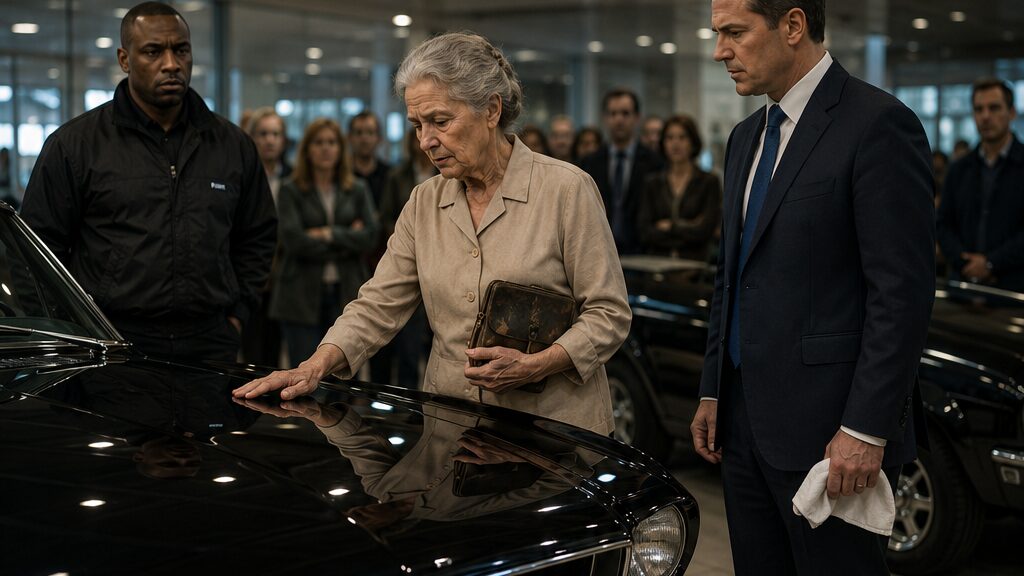
The hood was so polished she could see her face in it, though not kindly. The reflection showed every line around her mouth, the soft sag beneath her chin, the eyes that had looked older since last winter. Behind her reflection, showroom lights floated like white coins.
She lifted her hand.
Just before her fingers touched the paint, she remembered Edward in the driveway the summer after his first surgery, his breath short but his smile stubborn. He had placed her hand on the hood and said, There. If I’m not around when she’s done, you’ll know her by touch.
Her fingertips settled on the black surface.
Cool.
Smooth.
Real.
For three seconds, the showroom vanished.
Then a voice snapped behind her.
“Ma’am, please don’t touch the vehicle.”
Susan did not move.
She watched her fingers rest against the shine. There was no oil on them, no dirt, no harm. Just four pale fingertips and the faint oval blur of her palm.
“Ma’am.”
A man stepped into the reflection beside her. Dark suit. Blue tie. Neat hair. His face arranged into professional patience already beginning to fail.
Susan turned.
“I’m only looking,” she said.
“You can look without touching.” He smiled at the young couple nearby, then lowered his voice. “These are private collector vehicles.”
Private.
Collector.
Vehicles.
Not Edward’s car. Not the machine that had idled outside the hospital when Susan came home with Samuel bundled in a yellow blanket. Not the car Edward had restored from rust while she stretched grocery money and pretended not to notice how many nights he stayed up sanding parts by the garage radio.
The man reached into his jacket pocket and pulled out a white microfiber cloth.
Susan looked at it before she understood.
He leaned over the hood and wiped where her hand had been.
A single careful pass.
Then another.
Her fingerprints disappeared under the cloth.
Heat rose into Susan’s face. Not embarrassment first. Disbelief. As if he had wiped her name off a guest book while she was still holding the pen.
“I didn’t hurt it,” she said.
“I’m sure you didn’t mean to.” His voice had softened in the way people used for children and confused patients. “But we have policies.”
Susan kept her hand at her side. It wanted to go back to the hood, not to defy him but to prove the car had not forgotten her.
“My husband polished it with cotton diapers,” she said.
The man paused. “Excuse me?”
“Old ones. After our youngest outgrew them. He said shop towels scratched if you bought cheap.”
The man’s expression tightened. “Do you have an appointment?”
“No.”
“Then I’m going to ask you to step back.”
A few people had begun to look. Not openly. Worse than openly. Sideways, over shoulders, through pauses in conversation. The young couple pretended to read the placard.
Susan looked at the driver’s seat. “Did Samuel bring the key?”
The man stilled.
“You know Mr. Bennett?”
“I raised him.”
His eyes moved quickly over her blouse, her purse, her shoes. She saw the calculation and the correction fail to become respect.
“I see,” he said. “Family matters need to be handled outside the showroom.”
“This is a family matter.”
“This is a place of business.”
The sentence was not cruel. That was part of its cruelty. It left no room for anything that could not be invoiced.
Susan took one step toward the front fender.
The man raised a hand. “Ma’am, stop.”
She stopped, but not because he told her to. She stopped because the angle showed the small uneven line near the driver’s side headlight where Edward had once dropped a wrench, cursed for ten full seconds, then touched the mark every time he waxed around it like apologizing.
The man turned toward the counter. “Could you come here a moment?”
A security guard approached from near the office door. He was younger than Samuel, broad through the shoulders, wearing a black jacket with a small embroidered logo. He looked bored until he saw Susan. Then he looked uncomfortable, which was almost worse.
“Ma’am,” the guard said, “let’s give the vehicle some space.”
Susan did not answer him. She looked at the suited man. “Your name?”
“Gary Cooper.”
“Mr. Cooper,” she said, “did he tell you why the driver’s seat is worn only on one side?”
Gary blinked.
“Did he tell you why there’s a line under the headlight that never buffed out? Did he tell you why the glove compartment sticks unless you lift it first? Did he tell you why there’s a silver dime under the ashtray?”
The guard’s hand closed gently around her upper arm.
Gently was still holding.
Susan looked down at his hand. For a moment she was not in a showroom. She was in the hospital corridor after Edward’s last bad night, a nurse holding her elbow and telling her she needed to sit down before she fell. Everyone so careful. Everyone so certain her body gave them rights over her direction.
“Please don’t,” she said.
The guard released her at once, startled.
Gary’s face had changed, but not enough. “Mrs. Bennett, if this car belonged to your family, then I’m sorry. But the vehicle was brought in through proper channels. If you have concerns, you need to speak with the person who sold it.”
Susan looked past him to the black hood. Under the lights, where her hand had been, nothing showed.
No fingerprint.
No proof.
No trace of the woman who had ridden beside Edward through three states in August heat with the windows down because the air conditioner had quit and they were too young to care.
Gary folded the cloth once, then again.
That small neat motion broke something loose in her.
“Your cloth won’t change whose hands built it,” she said.
The showroom went very quiet.
Gary glanced toward the office, then back at her. “Mrs. Bennett—”
“I am not confused,” Susan said.
No one moved.
“I know exactly where I am. I know exactly what car this is. I know exactly who sold it.” Her voice did not rise. It did not need to. “I came because I wanted to see whether my son had the courage to tell you why it had to leave my garage before I said goodbye.”
The young woman near the placard covered her mouth. The guard stepped back half a pace.
Gary’s professional mask faltered. “Then perhaps we should call him.”
Susan almost said no. Pride rose in her, sharp and hot. But pride had not kept the car in the garage. Silence had not kept the labels off Edward’s things.
She opened her purse and took out the old polishing rag.
Gary looked at it as if she had produced something both worthless and sacred.
Susan laid it across her palm. The stitched corner faced up.
“My husband kept this in the passenger door,” she said. “Not the trunk. Not the shelf. The passenger door.”
“Why?” Gary asked before he could stop himself.
Susan looked at him then, and for the first time he looked less like a wall and more like a man who had chosen the wrong side of a locked door.
She closed her fingers around the rag.
“That,” she said, “is what Samuel forgot to ask.”
Gary said nothing.
The guard said, almost softly, “Ma’am, would you like to sit?”
Susan turned back to the Mustang.
“No,” she said. “I would like my son.”
Gary took out his phone. His thumb hovered.
“Then you need to speak to the person who sold it,” he said, though now the sentence sounded different, stripped of its polish.
Susan kept her eyes on the black hood, on the place where her touch had been erased.
“I know,” she said. “I raised him.”
Chapter 4: What Samuel Thought He Was Saving
Samuel arrived at the showroom twenty-six minutes after Gary called him.
Susan knew because she watched the clock above the reception counter and counted every minute as if it were a bead on a rosary. Gary had offered her a chair near the office. She refused the office, accepted the chair, and kept the polishing rag folded inside both hands.
The Mustang remained where it was, angled under the lights, no longer just beautiful but exposed. People had resumed their conversations, though their eyes slid toward her and away. The young couple left without speaking to anyone. The security guard stood near the counter with his arms loose, looking anywhere except at Susan’s purse.
Gary stayed busy with unnecessary tasks. He moved a brochure stack. He checked his phone. He spoke briefly with a clerk and lowered his voice when he said “family.” Once he glanced at the hood and then at the cloth in his hand, as though he had only just realized what the wiping had looked like.
When Samuel came through the glass doors, he looked first at the car.
Not at Susan.
That told her more than she wanted to know.
His coat was unbuttoned, his face pale beneath the flush of hurry. Carolyn came in behind him, breathless, hair pulled back unevenly as if she had dressed while moving. She saw Susan and stopped.
“Mom,” Carolyn said.
Susan did not stand.
Samuel crossed the floor with his keys still in his hand. “What are you doing here?”
The question came out sharp, then immediately ashamed. He glanced at Gary, at the guard, at the customers pretending not to listen.
Susan looked down at the rag. “I came to see what you did.”
Samuel’s mouth tightened. “I didn’t do anything behind your back.”
Carolyn looked at him.
Susan saw that look. Samuel did too.
“I mean,” he said, lowering his voice, “not in the way you’re making it sound.”
Gary stepped forward carefully. “Mr. Bennett, perhaps we should discuss this in my office.”
“No,” Susan said.
The word stopped all three of them.
She had not meant to make a scene. She hated scenes. Edward used to tease her for leaving restaurants if a couple two tables over started arguing. But something about Gary’s office, with its glass walls and framed certificates and leather chairs, felt too clean for what had happened.
“This began in my garage,” she said. “Then it came here without me. We can speak where the car can hear us.”
Samuel shut his eyes for half a second. “Mom.”
“Don’t use that voice.”
“What voice?”
“The one that makes me smaller.”
Carolyn’s face crumpled and steadied. Gary stepped back.
Samuel looked at the car again, and for a moment Susan saw the boy who had slept in the back seat with his mouth open on the way back from camping trips, one sneaker always finding its way beneath the front seat. Then he was fifty-two again, tired and angry and carrying a fear he had decided should become everyone else’s orders.
“I’m trying to keep you safe,” he said.
Susan nodded once. “I heard that yesterday.”
“You fell.”
“I got dizzy.”
“You were alone.”
“I called the doctor.”
“You didn’t call us.”
“Because I knew what would happen.”
Samuel laughed once, without humor. “This? You think I wanted this?”
“I don’t know what you wanted. You did not ask me.”
His face reddened. “I have been asking you for months. About the garage. The papers. The bills. The roof. You smile and say you’ll think about it, and then nothing changes.”
Carolyn stepped closer to Susan’s chair. “Samuel, not here.”
“Where, then? At her kitchen table, where she pretends she doesn’t hear me? In the garage, where Dad’s things are stacked like he’s coming back Saturday?”
Susan’s fingers closed around the rag.
Samuel saw it and looked away too late.
“Say it,” Susan said.
He swallowed.
“No,” Carolyn whispered.
Susan kept her eyes on her son. “Say what you mean.”
Samuel’s voice dropped. “He is not coming back.”
The showroom had been quiet before. Now it seemed emptied of sound.
Susan did not flinch. She wished she had. It might have satisfied him to see the wound open. Instead she sat with Edward’s rag in her lap and felt the words pass through a place already scarred.
“I know,” she said.
Samuel’s shoulders fell.
“I was there,” she added.
Carolyn put a hand over her eyes.
Samuel looked suddenly older than his age. “Then why are we living like he might?”
Susan’s first answer rose hot and bitter: because you never learned how to sit with anything you could not fix. She did not say it. Not there. Not yet.
Gary cleared his throat. “Mr. Bennett, just so I understand, the paperwork you sent indicated you had family authorization to begin consignment review.”
Susan looked at Samuel.
Samuel’s eyes shifted. “I had power of attorney for certain financial things after Mom’s hospital visit.”
“For the bank,” Susan said.
“For emergencies.”
“Was this an emergency?”
“It was becoming one.”
Gary’s polished expression thinned.
Carolyn stared at Samuel. “You told me she agreed to the evaluation.”
“She agreed we needed to discuss options.”
“That is not the same thing.”
Samuel rounded on her. “You were there. You saw the garage.”
“I saw the garage,” Carolyn said. “I did not see permission.”
Susan rose then. Slowly, because her knees did not care about dignity. The security guard moved as if to help, then wisely stopped.
She walked to the car and stood beside the driver’s door, not touching it. The black paint reflected her body in a wavering line. She looked narrow, almost transparent.
“When your father first bought this,” she said, “I told him it was foolish.”
Samuel’s face changed at the mention of Edward, but he said nothing.
“We had a mortgage, two children, and a washing machine that shook the whole kitchen. He brought home a car that barely started. I told him love did not make bad math better.”
Gary looked down. Carolyn gave a small, watery smile despite herself.
Susan continued, “He said he did not buy it because it was useful. He bought it because someday usefulness would not be the only measure left.”
Samuel’s eyes shone now, though his jaw stayed hard.
“I understand bills,” Susan said. “I understand roofs. I understand falling. I understand that a house can become too much. Do not stand here and explain age to me like I haven’t noticed my own hands.”
Samuel looked at her hands then, the swollen knuckles, the faint blue veins.
“But you don’t get to take a thing I have not released and call that care.”
His voice broke. “I thought if I waited, you’d never release anything.”
“There it is,” Susan said.
He stared at her.
“That was the decision. Not the car. Not the garage. Me. You decided I could not decide.”
Samuel looked as if he wanted to deny it. He did not.
Gary shifted uncomfortably. “Mrs. Bennett, the car has not been sold to a final buyer yet. There is interest, and there are transport arrangements being discussed, but technically—”
Susan lifted one hand, and he stopped.
“Technically,” she said, “is a room men enter when they do not want to say wrong.”
Gary took that quietly.
Carolyn stepped between her mother and brother, not as a shield this time but as a witness. “Samuel, we need to stop the transfer.”
His head snapped toward her. “And then what? Put everything back? Pretend Mom doesn’t need help?”
“No,” Susan said.
Both of them turned.
She was surprised by the word herself. No came easier now, but this one carried a different weight.
“No,” she repeated. “We are not putting everything back. I know the house has to change.”
Samuel looked wary, as if hope might be another trap.
“But not like this,” she said. “Not with labels made while I sleep.”
Carolyn wiped under one eye with her thumb.
Samuel put both hands on top of his head and turned away from them. He stood like that for a moment, facing the showroom windows, his reflection ghosted over the street outside.
“I don’t know how to do this,” he said at last.
Susan almost went to him. Her body leaned before her pride caught it. He was still her son. He was also the man who had sent Edward’s car away.
“You begin,” she said, “by asking what the rag is for.”
Samuel turned back.
His eyes dropped to her hand.
“What rag?” he asked, though he could see it plainly.
Susan unfolded the polishing cloth just enough to show the stitched corner.
Samuel frowned. “Dad had hundreds of those.”
“No,” she said. “He had one of this.”
Carolyn came closer.
Susan folded it again before either of them could touch it.
“Not today,” she said.
Samuel’s face tightened with frustration, but he held his tongue.
That, Susan thought, was something.
Gary’s phone buzzed on the counter. He looked at the screen, then at Samuel. “The interested buyer is asking whether transport is still confirmed for Wednesday morning.”
“Cancel it,” Carolyn said.
Samuel did not answer.
Susan watched him.
“Samuel,” she said.
He looked at the Mustang. Then at the rag. Then at his mother.
“I’ll pause it,” he said.
Susan felt the familiar disappointment, but this time it did not crush her. It clarified him.
“Pause is a word for people who still think the decision is theirs,” she said.
Samuel opened his mouth.
She walked past him toward the doors.
“Come to the kitchen tonight,” she said. “If you want to talk about safety, bring the bills. If you want to talk about your father, bring courage.”
No one followed her immediately.
Outside, the air was colder than when she had arrived. Susan stood beneath the brushed metal sign and took one breath, then another. Through the glass, she saw Samuel still beside the Mustang, his reflection broken across the black hood.
For the first time that day, he looked less like a man protecting something.
He looked like a boy who had broken it.
Chapter 5: The Promise In The Passenger Seat
Carolyn came alone the next afternoon.
Susan saw her daughter’s car pull into the driveway and looked automatically toward the garage, though the Mustang was not there. The empty space in the center of the concrete seemed louder than the car had ever been. Sunlight fell through the small windows and landed on the floor where the hood should have been.
Carolyn sat in her car for several minutes before getting out.
Susan let her.
She was at the kitchen table with three piles in front of her, though none had labels. Bills in one. House papers in another. Edward’s things in a third: the driving gloves, the walnut key ring, the polishing rag, and the green flannel shirt folded into a square.
When Carolyn knocked, Susan did not say come in. She waited until her daughter opened the door with the key Susan had given her twelve years earlier, back when a key meant trust instead of access.
“Hi,” Carolyn said.
Susan looked at the clock. “Samuel?”
“At work.” Carolyn set her purse on the chair but did not sit. “Or pretending to be.”
Susan nodded.
Carolyn’s gaze moved to the table. “You’re sorting.”
“I know how.”
“I didn’t mean—”
“I know.”
The apology stayed between them, unused but present.
Carolyn took off her cardigan and folded it over the back of a chair. Her eyes were red, though her face was composed. She had always been like that. As a little girl, she could scrape both knees and ask for a bandage in a voice steadier than the adults around her.
“I called the showroom,” Carolyn said. “Gary said the car is still there.”
Susan placed a gas bill on top of the proper pile. “How kind of him not to sell my life before supper.”
Carolyn absorbed that without protest.
“He also said the buyer wants it shipped tomorrow morning.”
Susan’s hand paused.
Tomorrow.
The word entered the kitchen and took a chair.
Carolyn sat across from her. “Mom, if there’s something we need to know, I need you to tell me.”
Susan looked out the window above the sink. The backyard maple had begun to lose its leaves at the edges. Edward had meant to cut back the low branch before winter. He had left a red string tied around it to remind himself. The string was still there, faded pink now, fluttering whenever the wind found it.
“I told you enough,” Susan said.
“You told us Dad loved the car.”
Susan looked back. “That should have been enough.”
Carolyn flinched.
Susan regretted it, but not enough to take it back.
Carolyn reached toward the polishing rag and stopped before touching it. “Yesterday you said Samuel should ask what this was for.”
“He didn’t.”
“I’m asking.”
Susan stared at her daughter’s hand, hovering politely above the cloth. That hovering hurt more than if she had grabbed it. At least Carolyn was trying now. At least she had learned there was a line.
Susan lifted the rag and placed it between them.
“Your father kept it in the passenger door.”
“You said that at the showroom.”
“He used it before every anniversary drive.”
Carolyn’s brow creased. “Anniversary drive?”
Susan ran her thumb over the stitched corner. “Not every anniversary. Not when you were little. Not when money was tight. But once the car could be trusted, and once you and Samuel had your own lives, he’d polish the passenger side before we went out.”
“The passenger side?”
“He said a husband’s side could look like work, but his wife’s door ought to shine.”
Carolyn laughed once, softly, and covered her mouth. “That sounds like him.”
“It was nonsense,” Susan said.
But her voice thinned around the word.
She let herself touch the rag flat on the table. “The first time, I told him I did not need a polished door to get hamburgers. He said it wasn’t for the hamburgers.”
“What was it for?”
Susan looked past Carolyn, through the kitchen doorway, down the hall toward the front room where Edward’s chair still faced the television.
“For remembering we were more than what needed fixing.”
Carolyn lowered her eyes.
Susan did not want to talk. The story had been safe inside her because no one could mishandle what they did not know. But silence had not protected it. Silence had allowed Samuel to turn the key over to strangers.
“After his first surgery,” Susan said, “he couldn’t work on the car for months. He hated that. He would sit in the garage and tell me what to check. I pretended not to know which wrench was which so he could correct me.”
Carolyn smiled through tears.
“He recovered enough to drive again that fall. Not far. Just out past Miller’s Pond, around the old road, then home. He polished the passenger side before we left. Took him nearly forty minutes because he kept stopping to breathe.”
Susan pressed the cloth into her palm.
“Last year, before he got so tired, he made me promise something.”
Carolyn was very still.
“He said if he went first, I was not to let the car become a shrine. His word. Shrine. He said machines were made to move, same as grief.”
“What did he want?”
Susan swallowed. “One last anniversary drive.”
The refrigerator hummed. A car passed outside. Carolyn did not speak.
“He said I should drive it myself if I wanted. Or ask Samuel. Or sell it afterward. Or keep it if I truly wanted to. But not before the drive.” Susan folded the rag, unfolded it, then stopped. “He said I would know what to do after the road had its say.”
Carolyn wiped her cheek. “Why didn’t you tell us?”
Susan looked at her daughter. “When?”
Carolyn opened her mouth and closed it.
“At the funeral, while people were balancing paper plates on their knees? When Samuel was walking around with that list of death certificates? When you were crying in the laundry room because his coat still smelled like him?” Susan shook her head. “Then the months went by. Every time I meant to say it, someone asked about bills, or stairs, or whether I had eaten, or what should go to donation.”
Carolyn reached for her hand this time. Susan let her take it.
“I didn’t know,” Carolyn said.
“No.”
“We didn’t ask.”
Susan looked at their joined hands. Carolyn’s fingers were smooth and cold.
“No,” Susan said again, but softer.
Carolyn drew a shaky breath. “Samuel thinks if he keeps moving, nothing will catch him.”
Susan almost smiled. “He was like that at six. If he broke something, he cleaned the whole room before I saw the lamp.”
“He’s scared.”
“I know.”
“He’s wrong.”
“I know that too.”
Carolyn looked toward the garage. “He thought selling the car would help pay for repairs. He said Dad would hate seeing the roof leak while a valuable car sat under a cover.”
“Your father would hate being used as permission.”
Carolyn nodded. “Yes.”
Susan pulled her hand back and reached into the pile of bills. She removed the roof estimate Samuel had printed and left on the counter the week before. The number at the bottom was ugly. Susan had looked at it every morning and then turned it facedown.
“I am not blind to the house,” she said.
“I know.”
“I may need help.”
“I know.”
Susan looked at her. “Do you? Or do you know the way Samuel knows?”
Carolyn did not answer quickly. That was answer enough.
“I want to know better,” she said.
Susan accepted that because it was not too large a promise.
Carolyn’s phone chimed. She glanced at it, then turned the screen facedown.
Susan saw her daughter’s face change anyway.
“What?”
“It’s Samuel.”
“Read it.”
Carolyn hesitated. “He says Gary called again. The buyer is pushing. Transport is scheduled for eight tomorrow morning unless Samuel confirms a stop tonight.”
Susan sat back.
Tomorrow morning at eight.
The anniversary was tomorrow evening.
For nine months Susan had avoided the calendar, and now the date had found her with a truck.
Carolyn looked up. “Mom, tell me what you want me to do.”
The old answer rose automatically: nothing, I’ll handle it. Pride again. Fear wearing a better dress.
Susan looked at the rag, the key ring, the roof estimate, Edward’s shirt. She thought of the showroom cloth wiping her touch away. She thought of Samuel’s face when he said Dad is gone. She thought of Edward’s voice: A person shows you who they are by how they wait.
“I want you to call your brother,” Susan said.
Carolyn picked up the phone.
“And tell him,” Susan continued, “that if the car leaves that showroom before I do, he will not be helping me move out of this house.”
Carolyn looked at her.
Susan’s voice stayed level. “He will be helping himself understand why I changed the locks.”
Chapter 6: Before Anyone Else Decides
Susan arrived at Cooper Classic Motorcars at seven thirty-eight the next morning.
This time she did not take the bus.
Carolyn drove, both hands tight on the wheel, saying almost nothing except to ask twice if the heater was too high. Susan wore her dark wool coat over a blue dress she had not worn since Edward’s burial luncheon. In her purse were the walnut key ring, the polishing rag, and a folded sheet of yellow legal paper covered in Edward’s handwriting.
Carolyn had offered to carry the purse when Susan got out of the car.
Susan said no.
The delivery bay was behind the showroom, where the pavement sloped slightly toward a drain darkened by old water. A flatbed truck waited with its ramp lowered. The black Mustang sat just inside the open bay door, half in shadow, half under fluorescent lights. The showroom polish looked harsher back here. Less like admiration. More like preparation.
Samuel stood near the truck with Gary Cooper and the delivery driver.
He turned when Carolyn parked.
Susan watched his face travel through surprise, worry, irritation, and something like defeat before he walked toward them.
“Mom,” he said, “you shouldn’t have come this early.”
Susan stepped carefully onto the pavement. “That is not your decision.”
Carolyn came around the car and stood beside her. Susan noticed. Samuel did too.
Gary approached with the caution of a man entering a room after breaking something fragile. He wore another suit, gray this time, with no cloth in his hand.
“Mrs. Bennett,” he said. “I’m glad you came before we proceeded.”
“Are you?”
He took that without smiling. “Yes.”
Samuel looked exhausted. There were shadows beneath his eyes. “I was going to call you.”
“When?”
“After I talked with Gary.”
“About my car.”
He flinched. “About Dad’s car.”
Susan looked at him until he corrected himself.
“Your car,” he said.
The delivery driver shifted near the ramp, pretending not to hear. Gary murmured something to him, and the man walked back toward the truck cab.
Susan moved toward the Mustang. No one stopped her.
That alone nearly undid her.
The driver’s side door reflected the bay lights in long pale bars. Dust had gathered along the tire despite the showroom shine. Susan stood near the hood and lifted her hand, then paused. She did not want this touch to be only defiance. She wanted it to be true.
She placed her palm on the black paint.
Cool, smooth, waiting.
Behind her, nobody moved to wipe it away.
She closed her eyes.
Edward, she thought, I am late.
When she opened them, Samuel was watching her hand.
“I didn’t know about the drive,” he said.
“You didn’t ask.”
Carolyn lowered her head.
Samuel nodded once, taking the blow because there was no way around it. “Carolyn told me last night.”
Susan looked at her daughter. Carolyn’s mouth trembled, but she held still.
“I thought she misunderstood,” Samuel said.
Susan almost laughed. “That would be convenient.”
“I’m not saying—” He stopped. His hands opened and closed at his sides. “I don’t know what to say without making it worse.”
“Then say less.”
Gary looked toward the office door as if wishing himself elsewhere.
Susan took the legal paper from her purse and unfolded it. The creases had softened from being opened and closed too many times. Edward’s handwriting leaned to the right, impatient even near the end.
Samuel stared at it.
“This is not a title,” Susan said before he could ask. “It is not a legal trick. It will not embarrass you in court or make strangers clap.”
Samuel’s eyes met hers, wet and guarded.
“It is your father being bossy from a recliner.”
Carolyn made a sound between crying and laughing.
Susan read only the part she had underlined months ago.
“Sue, don’t let the kids turn the car into either a burden or a trophy. Take one more ride when you’re ready. After that, keep her, sell her, give her away, set her on fire if you must, but make the choice while your hands are on the wheel, not while grief is driving.”
No one spoke.
The delivery bay seemed to hold its breath.
Samuel looked at the paper as if it had rearranged the floor beneath him. “He wrote that?”
Susan folded it. “Two weeks before he died.”
“Why didn’t he tell me?”
“Maybe he knew you would make a spreadsheet.”
Carolyn wiped her eyes with her sleeve. Gary looked down at his polished shoes.
Samuel’s voice came out rough. “I was trying to help.”
“I know.”
“I was trying to keep the house from falling apart.”
“I know.”
“I was trying not to lose you too.”
That one struck where she had no defense.
Susan looked at her son, really looked. The worry lines at his forehead. The gray in his hair. Edward’s stubborn mouth on a man who had spent months trying to manage what could not be managed. He had frightened her. He had wronged her. He had also been afraid.
She let both truths stand.
“Samuel,” she said, “you are allowed to be scared.”
He looked away.
“You are allowed to be tired. You are allowed to tell me the roof needs repair and the garage needs clearing and you cannot do everything alone.”
His mouth tightened.
“But you are not allowed to make my choices smaller so your fear feels useful.”
A truck passed on the street beyond the building. The delivery ramp gave a faint metallic creak in the morning air.
Gary cleared his throat. “Mrs. Bennett, from the dealership side, I can hold the car pending family instruction. The buyer may walk.”
“Let him walk,” Carolyn said quickly.
Susan turned to her. “That is also not your decision.”
Carolyn’s face flushed. “Right. Sorry.”
Susan looked back at the car. Her handprint had begun to fade, not from cloth, only from air.
“I am taking the drive tonight,” she said.
Samuel looked up. “Mom, the battery—”
“Has been charged,” Gary said. Everyone turned to him. He seemed embarrassed. “Our mechanic checked it when it came in. Fluids too. It’s roadworthy for a local drive.”
Samuel’s objection died.
Susan looked at Gary. “Thank you.”
He nodded. “And Mrs. Bennett, about yesterday—”
“Not now.”
His mouth closed.
She turned to Samuel. “You will give me the keys.”
He glanced toward Gary, then caught himself and reached into his coat pocket. The walnut key ring lay in his palm. Susan wondered when he had taken it from the kitchen drawer again. She wondered how many small removals she had missed because they were quieter than a tow truck.
He held it out.
She did not take it right away.
“Do you understand what you are giving back?” she asked.
His eyes reddened. “The car.”
“No.”
He swallowed.
“The decision,” he said.
Only then did Susan take the keys.
The walnut oval was warm from his hand. She closed her fingers around it and felt the shape Edward had sanded, the smoothness worn by years of use.
Samuel rubbed both hands over his face. “Do you want me to drive?”
Susan looked through the windshield, at the empty driver’s seat. Her body answered before fear did. Her knees ached. Her hands were stiff. She had not driven the Mustang in years, not alone.
The old pride tried to rise again. It wanted her to say yes, I will drive myself, because needing help felt too close to surrender.
But Edward had not written while your hands are on the wheel so she could turn courage into stubbornness.
“I want to start it,” she said. “I want to sit where he sat. Then I want you to drive the first road out.”
Samuel breathed in.
“And Carolyn will sit in the back,” Susan said.
Carolyn laughed through tears. “Like when we were kids?”
“For once,” Susan said, “yes.”
Samuel looked at the truck, then at Gary. “Cancel the transport.”
Gary nodded. “I’ll handle it.”
“No,” Susan said.
Gary stopped.
She looked at Samuel.
Samuel took out his phone. His hands shook slightly as he called the buyer’s number Gary provided. He did not step away. He did not soften the truth into business language.
“This is Samuel Bennett,” he said. “The transport is canceled. The car is not available today.”
A pause.
“No,” he said, looking at Susan. “I don’t know when it will be.”
Another pause.
“Because it wasn’t mine to send.”
Susan turned back to the hood.
Her handprint had vanished now, but she did not mind. No cloth had erased it. No one had hurried to remove the evidence of her being there.
She ran her fingers once along the edge of the hood and then stepped toward the driver’s door.
Samuel opened it for her.
The smell came out first: old vinyl, faint oil, warm dust awakened by morning light. Susan held the doorframe and lowered herself into the seat. The wheel looked larger than she remembered. The dashboard looked both familiar and strange, like a face seen after illness.
She set the polishing rag on the passenger seat.
Edward’s seat, she almost thought, then corrected herself.
Her seat.
Samuel crouched outside the open door. “Mom?”
Susan slid the key into the ignition but did not turn it.
Not yet.
She looked at her son, then at Carolyn standing behind him with both hands pressed to her mouth.
“Tonight,” Susan said, “you may come with me.”
Samuel nodded.
“But after tonight, we talk about the house my way. Not with labels. Not with trucks already called. Not with decisions hidden under the word safety.”
“Yes,” he said.
“If I sell the car, I sell it.”
“Yes.”
“If I keep it, we discuss how.”
“Yes.”
“If I clear the garage, I choose what leaves.”
His voice broke. “Yes.”
Susan turned the key.
The engine coughed once, then caught, rough and deep and alive enough to make everyone in the bay go still.
For a moment Susan could not see through her tears.
Then Samuel reached into the car and placed one hand on the dashboard, not claiming it, only steadying himself beside it.
Susan looked at him through the open door.
“Are you coming with me,” she asked, “or watching me leave alone?”
Chapter 7: The Things She Chose To Keep
That evening, Samuel drove with both hands on the wheel and his mouth shut.
Susan sat in the passenger seat.
For the first five minutes, that was enough.
The Mustang did not purr the way Edward used to claim it did. It rumbled, complained, and settled, its old engine sending a low vibration through the floorboards and up into Susan’s knees. The windows held the faint scent of vinyl, dust, gasoline, and something warmer beneath it, something the showroom’s polish had not managed to bury.
Carolyn sat in the back seat with her knees angled sideways, just as she had when she was twelve and angry that Samuel always got the window. She had cried before they left the delivery bay, then wiped her face and said she was fine, which meant she was trying.
Susan had put the polishing rag on her lap.
Samuel turned out of the showroom lot and onto the road that led past the grocery store, the pharmacy, the bank, and the intersection where the town had widened itself without asking anyone’s permission. For a while, none of them spoke. The silence inside the car was not easy, but it was not empty either. It held engine noise, turn signals, breath, memory.
At the first red light, Samuel glanced at her.
“Too fast?”
Susan looked at the speedometer. “You’re going thirty-two.”
He nodded and faced forward again.
Carolyn made a sound in the back seat that might have been a laugh if she trusted it more.
Susan touched the stitched corner of the rag. “Your father never stopped fully at this light after nine at night.”
Samuel’s eyes flicked toward her.
“He said if the whole town was asleep, there was no reason to ask permission from a machine.”
“That sounds illegal,” Carolyn said.
“It was,” Susan said.
For one small second, the three of them smiled in the same car.
Then the light changed.
Samuel drove out past the newer subdivisions, where identical porch lights were beginning to come on, and toward the old road by Miller’s Pond. The trees bent closer there. The pavement narrowed. Fallen leaves collected along the shoulders in damp gold and brown lines. Susan watched the road open ahead and felt time fold oddly, not backward exactly, but close enough that she could sense Edward beside her without needing to pretend.
He would have had one wrist loose over the top of the wheel. He would have complained about Samuel braking too soon. He would have reached across at some point and tapped the passenger door with his knuckles, checking the shine where no one else could see.
Susan slid the rag over the inside of the door panel once.
Samuel saw the motion.
“Do you want to drive?” he asked.
The question came softly.
Susan looked at the wheel, then at her hands. They were not the hands she remembered. They ached when rain came. They trembled when she was tired. They had held Edward’s wrist in the hospital and felt the pulse leave it.
“Yes,” she said.
Samuel slowed near the pond overlook and pulled off onto the gravel shoulder. The pond lay beyond a strip of reeds, darkening under the evening sky. No one else was there.
He put the car in park and left the engine running.
No one moved.
Then Samuel got out and came around to open her door.
Susan almost told him not to fuss. The old answer rose by habit. She stopped it. There was a difference between being handled and being helped. She was still learning the shape of it.
She took his arm.
He did not pull. He waited until she stood.
They changed places slowly. Carolyn stepped out too, standing near the rear fender with her arms wrapped around herself. When Susan lowered herself into the driver’s seat, the wheel seemed larger than it had that morning, but not impossible. Samuel stood by the open door.
“The brake is firm,” he said. “Steering pulls a little left. Gary said the tires—”
“Samuel.”
He stopped.
Susan rested both hands on the wheel.
The dashboard lights glowed faintly. Her foot found the brake. The seat held Edward’s shape and not Edward’s shape. It was only a seat. It was also the place where he had sat through decades of errands, arguments, Sunday drives, bad weather, good news, and ordinary returns home.
She did not drive far.
Only from the overlook down the old road, past the pond, around the bend where Edward used to say the trees made a tunnel, and back toward town. Samuel sat rigid in the passenger seat, one hand hovering near the dashboard until Susan gave him a look and he lowered it to his knee.
The car pulled left. Her shoulders worked harder than expected. At the bend, her heart thudded with fear, then steadied as the tires followed the road.
Carolyn leaned forward between the seats. “You okay?”
Susan kept her eyes ahead. “I am driving.”
Neither child spoke again until she pulled into her own driveway twenty minutes later.
The garage door stood open. The empty space inside waited, but it did not look the same now. Not filled. Not fixed. Just waiting.
Susan turned off the engine.
The sudden quiet made her ears ring.
For a moment, none of them got out.
Then Samuel said, “I’m sorry.”
Susan looked at the walnut key ring in the ignition.
“I know.”
“That isn’t enough.”
“No.”
He nodded, his eyes wet. “I don’t know how to make it right.”
“You start by not trying to make it right all at once.”
Carolyn wiped her cheek in the back seat. “What happens now?”
Susan removed the key and held it in her palm. The walnut was warm again.
“Now,” she said, “we put the car in the garage.”
Samuel turned toward her, startled. “You’re keeping it?”
“For now.”
He accepted that with visible effort. “Okay.”
“And tomorrow,” Susan said, “we call Gary. We tell him the car is not available.”
“Okay.”
“Next week, we discuss the roof.”
Carolyn nodded quickly. “Yes.”
“And the garage.”
Samuel looked toward the open door.
“But not with those labels,” Susan said.
The next week, the three folding tables returned to the garage.
This time Susan placed them herself.
The first table held things she knew could leave: duplicate tools, hardened paint, cracked plastic bins, two broken fans Edward had meant to repair but never would. The second held things she was not ready to decide. The third held things staying because she said so.
Samuel did not bring blue tape.
Carolyn brought lunch, a notebook, and a stack of plain white cards. She set the cards near Susan without writing on them.
Susan picked up the marker.
For a long time, she stood in front of the shelves.
The old instinct told her that choosing anything to release betrayed the rest. If she let go of the broken fan, would the driving gloves be next? If she threw out the paint, would Edward fade faster? Grief had made strange laws in the garage, and she had obeyed some of them longer than she needed to.
But Samuel had been wrong about one thing, and right about another.
The house did need room to breathe.
So did she.
Susan wrote her first card and placed it beside the hardened paint cans.
ASK ME FIRST.
Carolyn looked at it and smiled through tears.
Susan wrote another and placed it beside Edward’s green flannel shirt.
KEEP.
Samuel picked up a box of old receipts. “These?”
Susan glanced through them. Hardware store. Gas station. Tire shop. A grocery receipt with Edward’s handwriting on the back: Sue likes the peach ones.
She took that one and placed it near the rag.
“The rest can go.”
Samuel did not hide his surprise quickly enough.
Susan raised an eyebrow.
He cleared his throat. “Okay.”
Not good. Not finally. Just okay.
It was enough.
By afternoon, the garage looked worse before it looked better. Boxes shifted. Dust rose. Carolyn sneezed twice and accused Samuel of stirring it up on purpose. Samuel found an old baseball glove and stood holding it too long before putting it in the undecided pile. Susan saw him do it and said nothing.
Near sunset, Gary Cooper arrived in a sedan and parked at the curb.
Samuel stiffened when he saw him.
“I asked him to come,” Susan said.
Samuel turned. “You did?”
Susan nodded.
Gary came up the driveway carrying a flat envelope and wearing no suit jacket. He stopped just outside the garage, as if waiting to be invited into a place he had not earned.
“Mrs. Bennett,” he said.
“Mr. Cooper.”
He held out the envelope. “All consignment materials voided. No fees. No storage charge. I also printed the inspection notes, in case you decide later that you want the work done elsewhere.”
Susan took the envelope.
“Thank you.”
He looked toward the Mustang, now back in its place. The black hood had a thin layer of dust already beginning to soften the showroom shine.
“I owe you an apology,” he said. “For yesterday. For the cloth. For assuming.”
Susan studied him. The apology was simple. Not dramatic. That helped.
“You saw an old woman touching an expensive car,” she said.
“Yes.”
“And decided which part mattered.”
Gary lowered his eyes. “Yes.”
Susan nodded once. “Don’t do that again.”
“I won’t.”
She believed that he meant it. Whether meaning it would be enough in the future was his work, not hers.
After he left, Samuel stood beside the Mustang with his hands in his pockets.
“I hated him yesterday,” he said.
Susan placed the inspection envelope on the workbench. “That was easier than hating yourself.”
Carolyn looked sharply at her mother, but Samuel let out a breath that was almost a laugh.
“Yeah,” he said. “Probably.”
Susan walked to the front of the car. The hood reflected the garage ceiling, the dangling pull cord, the edge of the open door, the three of them standing around it like people unsure where to put their hands.
She touched the paint.
No one moved to stop her.
No one moved to preserve the mark either.
That was better.
The fingerprint appeared faintly, then began to fade as the warmth left it.
“I may sell it,” Susan said.
Samuel’s face changed, but he stayed quiet.
“Not today. Not this month. Maybe not this year. Maybe never. But if I do, it will not be because someone labeled it for me.”
Carolyn nodded. “We understand.”
Susan looked at Samuel.
He swallowed. “I understand.”
She wanted to forgive him cleanly. A part of her did. Another part still saw the empty hook, the SELL label, the white cloth moving across the hood. Love did not erase that. Neither did apology. But love might teach them how to stand beside what had happened without pretending it had not.
Susan reached into her pocket and took out a white card.
She had written it while Carolyn packed up lunch and Samuel swept the corner near the furnace.
She placed the card on the workbench beneath the old brass key hook.
ASK ME FIRST.
Then she hung the walnut key ring on the hook below it.
The sound it made was small. Wood against brass. A click barely louder than a breath.
But everyone in the garage heard it.
The story has ended.