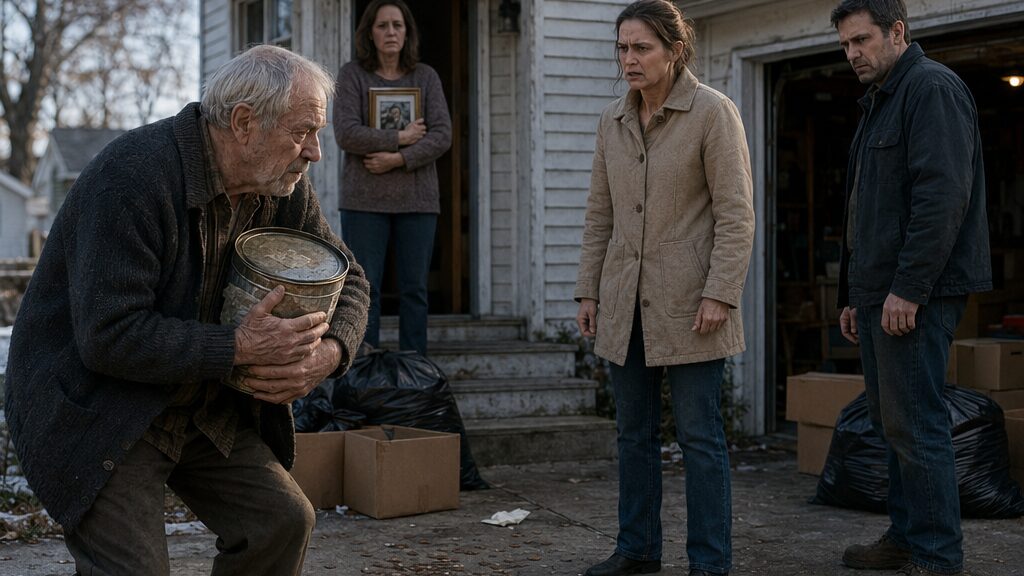
His Children Threw Away The Coffee Can Of Coins Before Learning Why He Still Counted Them
Chapter 1: The Coins He Counted Before Breakfast
Dennis Bennett kept the coffee can on the second shelf of the kitchen cabinet, behind the chipped blue mugs his wife had refused to throw away and beside the glass sugar bowl that no longer had a lid.
He had owned better containers. A wooden box with brass hinges. A bank envelope folded into thirds. A cookie tin with red cardinals printed on the top. But the coffee can had been the one Kathleen Reed set on their table twenty years ago when the diner changed brands and Dennis’s wife said, “Don’t throw that out. It’s got a good lid.”
So it had stayed.
The can was silver under a faded paper label, dented near the bottom where Dennis had dropped it once on the basement stairs. A strip of masking tape crossed the lid. His wife had written COFFEE MONEY on it in blue marker, though the letters had softened and blurred where her thumb used to rest.
Dennis took it down with both hands.
The kitchen was still dim. Morning light pressed against the curtains but had not yet entered. The old refrigerator hummed and clicked. A furnace pipe knocked once in the wall. Somewhere outside, a pickup passed too fast over the broken pavement, rattling the loose pane over the sink.
Dennis set the can on the table and sat in the chair facing the window.
Not her chair.
Never her chair.
Her chair still sat on the opposite side, close enough to the wall that no one could pull it out by mistake. A folded dish towel lay over its back. Under the chair’s front leg was a square of cardboard he had placed there the winter before she died because the floor dipped and she had said the wobble made her coffee nervous.
He opened the can.
Coins shifted with a dry, familiar weight. Quarters, dimes, nickels, pennies dark as old leaves. A few folded diner receipts rested along the inside wall, tucked where the metal curled. Two paper napkins from Kathleen’s Diner were pressed flat against the bottom, though Dennis did not move enough coins to see them. He did not need to see them.
He counted by touch first. Quarters into one small pile. Dimes into another. Nickels when he had to. Pennies only when there was nothing else.
His fingertips had stiffened over the last few years, and some mornings they took offense at small work. A dime slipped twice before he trapped it beneath his thumb. He frowned at it, not angry, just disappointed that his hands had begun keeping separate opinions from the rest of him.
“Don’t start,” he muttered.
The house answered with its ordinary silence.
He had not eaten breakfast at Kathleen’s every Friday since his wife died. That was what Stephanie said, because Stephanie liked sentences that sorted life into true and false. He had missed Fridays. Snow, fever, the week the toilet valve broke, the morning he could not find his good shoes because he had placed them in the freezer while looking for ice packs. He remembered that one because Stephanie remembered it louder.
But most Fridays, Dennis went.
He ordered coffee, two eggs over medium, one slice of rye toast, and a side of sliced tomatoes when Kathleen had them. He sat at the table near the window. Sometimes he read the paper. Sometimes he did not. Sometimes Kathleen touched the back of the chair across from him and said nothing, and that was better than any speech.
He counted out enough for breakfast, tax, and tip.
Then he counted a little more.
The extra coins went into his jacket pocket, wrapped in one of the diner napkins. Not because he could not pay without them. Not always. Not yet. But because the pocket felt wrong without their weight.
He had just closed the lid when he heard the scrape of cardboard in the front room.
Dennis held still.
For a moment he thought the sound had come from memory. There had been a season after his wife’s funeral when every room had spoken in her voice. A cabinet shutting. A floorboard. The whisper of a coat sleeve. He had learned not to answer.
Then came the sound again.
Cardboard dragged over wood.
Dennis rose slowly, one hand on the table until his hip accepted the request. He carried the coffee can to the cabinet, then stopped. Something white lay on the edge of the table where it had not been yesterday.
A label.
TRASH, written in black marker.
The word had been peeled from something and left behind, its sticky corner collecting dust.
Dennis looked toward the front room.
He walked through the narrow doorway, past the wall where family photographs climbed the plaster in mismatched frames. The first thing he saw was a stack of flattened boxes leaning against the sofa. Then three open boxes lined up beneath the front window.
KEEP.
DONATE.
TRASH.
Stephanie’s handwriting. Large, determined, slightly slanted, the way she wrote grocery lists and medical instructions and holiday menus she expected everyone to follow.
Dennis stood in the doorway in his house slippers, still holding the loose label between two fingers.
The front room had been moved.
Not ruined. Not emptied. But touched.
The stack of old magazines beside his chair had been tied with string. The lamp table had been cleared except for the coaster his wife had made from a square of tile. The basket of winter gloves by the door had been dumped into the box marked DONATE. One glove hung over the side like a hand asking to be pulled back in.
Dennis stepped forward and lifted it.
It was his wife’s left glove. Brown wool. The thumb patched twice.
He looked at the boxes again.
On the sofa lay a yellow legal pad with Stephanie’s list.
Hall closet
Back bedroom
Kitchen duplicates
Garage shelves
Mom’s sewing things?
Dad’s newspapers
Expired food
Trip hazards
Apartment brochures
Dennis read the last words twice.
The furnace knocked again in the wall, louder this time, as if the house had also read them.
He returned the glove to the basket by the door. Not the donation box. The basket. Then he folded the loose TRASH label in half and placed it in his shirt pocket.
A car door shut outside.
Then another.
Dennis did not move.
Through the front window, he saw Stephanie crossing the walk with a paper cup in one hand and a ring of keys in the other. Jacob Harris followed behind her, carrying more flat boxes under his arm. He wore the expression of a man arriving to finish a job begun late and poorly by others.
Behind them, at the curb, a white van slowed and parked.
Dennis felt, somewhere under his ribs, the small inward sinking that came before bad weather.
Stephanie let herself in without knocking.
“Dad?” she called, though she was already inside.
“I’m here.”
She stopped when she saw him in the doorway. For half a second, her face softened into the child she used to be when she came downstairs before school, hair wet from the shower, asking if he had seen her blue sweater. Then she looked past him at the boxes and tightened again.
“You’re up,” she said.
“I live here.”
Jacob came in behind her and tried to smile. “Morning, Dennis.”
Dennis nodded.
Stephanie set her paper cup on the cleared lamp table, noticed the coaster, and moved the cup onto it as if that small correction could excuse everything else.
“We talked about this,” she said.
“No,” Dennis said. “You talked about this.”
Her mouth pressed flat. “Dad, we agreed we would start small.”
“We agreed you’d come by Saturday and look at the hallway rug.”
“It’s Friday.”
“I know what day it is.”
Jacob lowered the boxes beside the wall. “The organizer had an opening.”
Dennis looked at him. “The what?”
Stephanie took off her coat but did not sit. “Just someone to help sort. Not a big deal.”
“A stranger?”
“She’s not a stranger. She does this professionally.”
Dennis looked again at the labels. KEEP. DONATE. TRASH. Three words waiting open-mouthed in his front room.
Stephanie saw where he was looking and softened her voice in the way she used when she wanted him to hear concern instead of command. “Dad, nobody’s taking anything important.”
Dennis put one hand into his shirt pocket and touched the folded label.
“You already decided what that means,” he said.
A knock sounded at the open door. A woman stood on the porch holding a clipboard, smiling with practiced sympathy. Behind her, the white van idled by the curb.
Stephanie turned quickly, relieved to have someone else arrive before the silence deepened.
“Great,” she said. “You’re here.”
Dennis looked from the woman to the boxes, then back toward the kitchen cabinet where the coffee can waited behind the blue mugs.
The morning had begun with coins in his palm and the promise of rye toast.
Now strangers had come to help his children decide what parts of his life were still allowed to stay.
Chapter 2: The Trash Bag In The Driveway
By ten o’clock, Dennis’s house had learned a new language.
Tape tearing from a roll. Marker squeaking across cardboard. Cabinet doors opening and shutting before he reached the room. Stephanie saying, “That can go.” Jacob saying, “Careful, that’s heavy.” The organizer saying, “The question is whether it serves your life now.”
Dennis hated that one most.
Serves your life now.
As if every object in a house had to stand trial.
He sat at the kitchen table because Stephanie had asked him to sit. Then because Jacob had suggested it. Then because the organizer had placed a box beside him and said, “You can help us make decisions from here, Mr. Bennett.”
Mr. Bennett.
In his own kitchen.
The box by his chair held things they had decided were safe for him to decide about. A stack of old church bulletins. Rubber bands. A manual for a toaster he had not owned in twelve years. Three lids with no matching containers. He could feel the insult of that box without looking at it.
From the hallway came Cynthia’s voice.
“Steph, maybe slow down.”
“We don’t have all day.”
“I know, but he’s sitting right there.”
“He won’t let us do anything if we ask about every single thing.”
Dennis looked at his hands. They rested on the table, knuckles high, veins raised, fingers bent slightly inward. Hands that had fixed boilers, patched gutters, sanded crib rails, opened jars, carried sleeping daughters from the car. Now everyone spoke around them as though they were evidence.
The organizer came into the kitchen carrying a plastic bin of utensils.
“Duplicates,” she said brightly. “We can probably reduce by half.”
Dennis said nothing.
Stephanie entered behind her, hair pulled back, face flushed from work. “Dad, you don’t need four spatulas.”
“One is for eggs.”
“You can use any spatula for eggs.”
“No,” Dennis said.
Jacob appeared at the back door with two black trash bags. “Garage is worse than I thought.”
Dennis turned his head.
Stephanie shot Jacob a look.
“What?” Dennis asked.
“Nothing,” Stephanie said.
“What in the garage?”
Jacob shifted his grip on the bags. Something metal clinked inside one of them. “Old cans. Rusted screws. Broken parts. Stuff that’s been sitting there forever.”
Dennis pushed back from the table.
Stephanie stepped toward him. “Dad, please. Let Jacob handle the garage. There are chemicals out there. Sharp things.”
“My tools are sharp because they’re tools.”
“That’s not what I mean.”
“I know what you mean.”
Cynthia came into the kitchen holding a framed photograph against her chest. She looked from Dennis to Stephanie and stopped near the stove. “Maybe we should take a break.”
“No,” Stephanie said. “The donation truck comes at eleven-thirty.”
Dennis rose fully then.
The organizer smiled too quickly. “Mr. Bennett, it can feel intense at first, but once we clear the excess—”
“Don’t call my life excess.”
The kitchen went quiet.
The organizer’s smile faded.
Stephanie closed her eyes for a second. When she opened them, she looked tired enough that Dennis almost forgave her. Almost.
“No one is calling your life excess,” she said.
“You hired someone to put it in boxes.”
“Because you won’t let us help.”
“You keep using that word.”
“Because that’s what this is.”
Dennis looked toward the back door. Jacob had lowered one trash bag onto the porch. The other remained in his hand. Through the plastic, Dennis saw a round shape press against the side. A familiar dent near the bottom.
His breath shortened.
He moved past Stephanie.
“Dad,” she said.
Dennis did not answer. He crossed the kitchen, opened the back door, and stepped onto the small porch. Cold air touched his face. The driveway was crowded with proof of other people’s decisions: three donation boxes near the garage, two trash bags by the steps, a stack of old boards, a lamp his wife had hated but refused to discard because her sister had given it to them.
Jacob stood in front of the open garage with the second trash bag.
Inside it was the coffee can.
The paper label was partly torn. The masking tape on the lid had curled at one edge. COFFEE MONEY faced outward, blurred but visible, pressed against black plastic like a face against glass.
Dennis reached for the bag.
Jacob lifted it back. “Careful. There’s loose junk in there.”
“Give it to me.”
Stephanie came out behind him. “What is it?”
Dennis did not look at her. “Give it to me.”
Jacob exhaled. “Dennis, it’s old change and coffee smell. I didn’t even think banks took half that stuff anymore.”
Cynthia appeared in the doorway. “Jacob.”
“What? It was on a garage shelf with rusted nails and mouse traps.”
“It wasn’t on a garage shelf,” Dennis said.
Jacob paused.
Dennis’s voice stayed low. “It was in my kitchen cabinet.”
Stephanie looked at Jacob.
Jacob looked uncomfortable for the first time that morning. “I thought—”
“You thought what?”
He glanced at Stephanie, then back at Dennis. “I thought it was part of the pile.”
“The pile.”
Stephanie came down one step. “Dad, okay. We can keep the can if it matters to you.”
“If it matters.”
“That’s not what I meant.”
Dennis took hold of the trash bag and pulled. Jacob did not release it at first, not out of cruelty but surprise, and that made it worse. Dennis had to tug a second time before the bag came free.
It was heavier than he expected. The sudden weight pulled at his shoulder. The plastic stretched. Something inside shifted and tore through.
Coins spilled across the driveway.
They struck concrete in bright, scattered notes, rolling under the donation boxes, bouncing against Stephanie’s shoe, sliding into cracks where weeds had died brown and flat. A receipt fluttered down after them. One of Kathleen’s napkins skidded toward the gutter.
Dennis bent before anyone else moved.
His knees objected. His back sent a hot warning up his spine. Still he bent, one hand on the driveway, the other reaching for quarters before they rolled out of sight.
“Dad, stop,” Stephanie said. “You’ll hurt yourself.”
He picked up a dime.
“Please, just let us—”
He picked up a quarter.
Jacob crouched. “I’ve got it.”
Dennis covered the coffee can with his palm.
“No.”
The word was not loud, but it landed hard enough that Jacob froze.
Cynthia stepped off the porch and began gathering coins near the steps. She did not speak. The organizer remained in the doorway, clipboard hugged to her chest, suddenly aware she was standing inside something no training had named.
Stephanie’s face had gone red. “This is exactly what I’m talking about.”
Dennis looked up.
She swallowed, but the words came anyway. “You’re on the ground in the driveway over a can of pennies.”
He slowly rose, the torn trash bag in one hand, the dented coffee can in the other. Several coins remained stuck to the black plastic. A penny fell and spun near his slipper.
“I am on the ground,” he said, “because my daughter threw away something she never asked about.”
“I didn’t throw it away. Jacob made a mistake.”
“Jacob made your mistake with his hands.”
Jacob stood. “That’s not fair.”
Dennis turned to him. “No. It isn’t.”
Stephanie’s eyes shone, but her voice sharpened. “Do you think this is easy for me? Do you think I wanted to spend my Friday digging through expired soup cans and broken tools and piles of newspapers because you refuse to admit this house is too much?”
Dennis held the can against his ribs. “Then don’t.”
“I can’t not. I get the calls. I get the neighbor telling me you left the hose running. I get the pharmacy calling because you didn’t pick up your prescription. I get to wonder if one day you’ll fall and nobody will know until the mail piles up.”
“I left the hose running once.”
“And the stove?”
Dennis looked away.
Stephanie’s voice lowered. “You scared me.”
The driveway stilled around that sentence.
A car moved slowly past the house. The driver looked toward the boxes, the old man in slippers, the grown daughter with her hands shaking at her sides. Then the car continued.
Dennis felt the publicness of it settle over him. The open garage. The boxes. The trash bags. His coins scattered in full view of the street.
Stephanie wiped under one eye quickly, angry at the tear.
“I’m trying to keep you safe,” she said.
Dennis looked at the labels on the boxes. DONATE. TRASH. KEEP.
“When did safe start meaning I don’t get asked?”
She did not answer.
He lifted the coffee can slightly. Not high, not dramatic. Just enough that she had to look at it.
“Did you ask me before you decided what my life was done meaning?”
Stephanie flinched.
Cynthia stopped gathering coins.
Jacob’s jaw tightened. “Dennis, come on. It’s a can. You’re making this bigger than it is.”
Dennis looked at him for a long moment.
“It was already bigger than you knew.”
No one moved.
Stephanie’s voice changed, becoming thin with frustration and fear. “Then tell us. Tell us why every broken thing has to stay. Tell us why every drawer is a museum. Tell us why Mom’s chair can’t move three inches. Tell us why we’re all supposed to guess what will break your heart next.”
Dennis’s grip tightened on the can.
There it was. The opening. The place where he could say his wife’s name and let them all watch what happened to him when he did.
He closed it.
“Not in the driveway.”
Stephanie gave a bitter little laugh. “Of course.”
Dennis stepped past her toward the house.
Jacob said, under his breath but not quietly enough, “If you can’t let go of a can of pennies, that proves our point.”
Dennis stopped at the porch.
For a moment, everyone seemed to stop with him.
He did not turn around.
“The point,” he said, “is that you still think they’re pennies.”
Then he went inside carrying the coffee can against his chest, while loose coins continued to glitter in the cracks of the driveway behind him.
Chapter 3: The Table Near The Window
Dennis should not have gone to the diner.
He knew it by the time he reached the end of the block, one hand on the steering wheel, the other resting over the torn place on the coffee can label. His shoulder ached from the driveway. His knee throbbed from bending. His slippers had been replaced by shoes, but he had tied one lace poorly, and the uneven pressure nagged at him with every press of the pedal.
Still, he drove.
The house had become too crowded with other people’s intentions. Stephanie’s voice was in the walls. Jacob’s words were in the garage. Cynthia’s silence was in the kitchen. Even after he had set the coffee can back on the table, he could hear boxes breathing in the front room.
So he drove to Kathleen’s.
The diner sat at the corner of Maple and Third, between a closed barber shop and a laundromat with three missing letters in its sign. Its windows were wide and always a little fogged at the edges. A bell over the door announced every customer with the same tired jingle it had used for thirty years.
Dennis parked in the side lot and sat for a moment.
He checked the can.
The lid was crooked from the tear in the bag. Coins remained inside, but not enough. He knew from the sound before he opened it. A full can had a dense, muffled shift. This one rattled with spaces.
Some coins were still in the driveway. Some had rolled into the gutter. Some were probably trapped in the torn trash bag, which Jacob would either throw out or empty with offended patience.
Dennis had picked up what he could. Cynthia had placed a handful on the kitchen table before he left. Stephanie had stood by the sink, arms wrapped around herself, saying nothing.
He had not counted properly.
Now he sat in the parking lot, looking at the diner door, too tired to go in and too stubborn to go home.
Finally, he took a handful of coins and slipped them into his jacket pocket. The coffee can he left on the passenger seat, partly covered by a folded grocery bag, as though it needed privacy.
The bell rang when he entered.
Warmth struck him first. Coffee, toast, butter on the grill, tomato soup beginning somewhere in the kitchen. The sounds came next: forks tapping plates, low conversation, the register drawer snapping shut, Kathleen calling an order through the pass window.
The diner did not stop when Dennis entered. That was one of the reasons he loved it. It had never treated his grief like weather.
Kathleen Reed looked up from behind the counter.
Her hair was pinned in its usual knot, silver at the temples, pencil tucked above one ear. Her face shifted when she saw him, not into pity, but recognition.
“Morning, Dennis.”
He nodded. “Kathleen.”
“You’re late.”
“Had company.”
“That kind?”
“That kind.”
She glanced toward the window table. Empty. Waiting.
Dennis walked to it slowly and sat with his back to the wall. The chair across from him remained untouched. Kathleen brought coffee without asking, then set down a paper menu he never used.
“Tomatoes came in good today,” she said.
“Then I’ll have them.”
“Eggs?”
“Over medium.”
“Rye?”
“If you’ve got it.”
“For you, always.”
She said it lightly. Too lightly, maybe. Her eyes had already fallen to his hand.
Dennis realized he was holding three quarters, two dimes, and a nickel against the tabletop.
He closed his fingers.
Kathleen pretended not to see. That was kindness too.
She walked away to put in the order, and Dennis opened his hand.
The coins looked smaller under diner light than they had in his kitchen. Meaner, somehow. Quarters with old scratches. A dime dark near the edge. The nickel sticky with something from the driveway. He counted them once. Then again.
Not enough.
He knew the menu prices. He knew tax. He knew what tip Kathleen deserved and what he refused to leave. He knew the difference between being unable to pay and being unwilling to insult someone who had carried his grief with coffee refills for years.
He searched his other pocket.
A penny. A receipt from the hardware store. The folded TRASH label from Stephanie’s box, still stuck to itself.
He put the label on the table without meaning to.
TRASH.
The word stared up at him.
He covered it with his palm.
At the next table, a young mother was cutting pancakes into small squares for a boy with dark hair and solemn eyes. The boy watched Dennis with the open steadiness children had before adults taught them to look away.
Dennis turned toward the window.
Outside, a delivery truck backed into the alley. Two teenagers crossed the street laughing. A man in a suit hurried past with a phone pressed to his ear. The world was full of people who had enough money to leave food unfinished.
Kathleen returned with a small plate of sliced tomatoes.
“Eggs are coming.”
Dennis looked at the plate, then at his hand.
“Kathleen.”
Something in his voice made her stop.
“I might just take the coffee today.”
Her face did not change much. Only the corners of her eyes tightened.
“Kitchen already started.”
“I can pay for coffee.”
“Dennis.”
He disliked the gentleness more than he would have disliked impatience.
“I said I can pay for coffee.”
A few heads turned. Not many. Enough.
Kathleen lowered her voice. “We can settle up next time.”
“No.”
“It’s breakfast.”
“No.”
The word came sharper than he intended. The boy at the next table stopped chewing.
Dennis felt heat climb into his neck.
He gathered the coins into a pile. They slipped under his stiff fingers and spread again, a small silver failure across the table.
“I’ll come back another day,” he said.
He began to stand.
The chair leg scraped.
The boy moved before his mother noticed.
He slid from his booth, one sneaker landing untied on the floor, and crossed the narrow aisle with something folded in his hand. He was maybe nine, maybe ten, old enough to understand embarrassment and young enough to disobey it.
Dennis froze halfway up.
The boy stopped beside the table and held out a folded bill.
Not high. Not proudly. Just between them.
Dennis stared at it.
The bill had been folded twice, soft at the creases, probably carried in a pocket with gum wrappers and arcade tickets. One corner was bent. A child’s fortune.
The diner sounds thinned.
The boy’s mother whispered, “Michael.”
But Michael Cooper did not pull his hand back.
Dennis looked at the boy’s face. Serious. Worried. Not pitying. That nearly undid him.
“I don’t need—” Dennis began.
Michael interrupted softly. “My mom says nobody should have to leave hungry.”
The words struck Dennis in a place he had spent years boarding over.
His hand opened.
Two coins rolled from his palm and clicked against the edge of the plate.
Kathleen stood behind the counter, one hand pressed flat beside the register. Her eyes had filled, though she made no move toward him.
Dennis lowered himself back into the chair.
“I’m not hungry like that,” he said, but his voice had lost its strength.
Michael kept holding out the bill. “It’s okay. I have more at home.”
His mother gave a small, helpless laugh that was almost a sob. “Not much more.”
Michael glanced back at her, then at Dennis. “Enough.”
Dennis looked at the folded bill again.
Once, years ago, his wife had placed four quarters under the sugar jar after watching a young man search his pockets at this same table. She had waited until he went to the restroom, then slipped the coins beside his check.
“He gets to find it without being watched,” she had said.
Dennis had told her a dollar would not change anyone’s life.
She had looked at him over her coffee.
“It might change the part of the day where they thought nobody saw.”
Now a child stood beside him offering more than money, and Dennis could not decide whether taking it would honor the lesson or break what little pride he had left.
“What’s your name?” he asked.
“Michael.”
“Michael,” Dennis repeated, because names mattered when someone gave you kindness. “That money yours?”
Michael nodded.
“You earned it?”
“I helped wash my grandpa’s truck.”
Dennis almost smiled. “That right?”
“He missed a spot,” Michael’s mother said quietly from the booth.
Michael ignored her. “You can have it.”
Dennis reached out, but not for the bill. He touched the edge of it with two fingers and gently folded Michael’s hand closed around it.
“You keep that,” he said.
Michael frowned. “But you need it.”
Dennis looked at the coins on the table, at the folded TRASH label half-hidden beneath his palm, at Kathleen watching from the counter as though she already knew which memory had entered the room.
“I needed you to offer it,” Dennis said.
Michael did not understand. Of course he did not. That was all right.
Kathleen came then, carrying a plate with eggs, rye toast, and tomatoes. She set it in front of Dennis as if no argument had happened.
“Breakfast,” she said.
Dennis looked up.
She held his gaze just long enough to make clear that if he argued in front of the boy, she would win.
Then she placed a small empty saucer beside his coffee.
“Settle whatever you need to settle,” she said.
Dennis sat very still.
Michael returned to his booth after his mother touched his shoulder. He looked back once, still worried.
Dennis picked up the folded TRASH label from the table and turned it over so the word faced down. Then, slowly, he placed his coins into the saucer.
Quarter. Quarter. Quarter. Dime. Dime. Nickel. Penny.
Not enough for breakfast.
Enough to sound like the beginning of something.
Kathleen saw the saucer and closed her eyes for a second.
Dennis understood then that she remembered too.
Or maybe she had never forgotten.
He looked at Michael’s folded bill, now back in the boy’s hand. He looked at the chair across from him, empty in the sunlight.
His throat tightened.
The child had not solved anything. The house was still full of boxes. Stephanie still believed the coffee can proved decline. Jacob still thought pennies could be evidence. The driveway still held coins in its cracks.
But for the first time that morning, Dennis felt the old promise breathing.
A stranger’s child had seen what his own family had stopped asking about.
He reached for his fork, but his hand trembled too much to lift it.
Michael noticed.
With the solemn authority of someone who believed kindness should be completed once begun, the boy slid out of the booth again and came back to Dennis’s table.
He placed the folded bill beside the saucer.
Then he said, “You don’t have to take it. It can just sit there.”
Dennis stared at the bill until the green blurred.
Kathleen turned away quickly toward the coffee pots.
Dennis leaned back in his chair and covered his eyes with one hand, not crying exactly, not where people could see, but close enough that he could no longer pretend this was about breakfast.
The folded bill sat beside the coins.
Small. Quiet. Waiting.
Chapter 4: What His Wife Used To Leave Under The Sugar
Dennis did not eat much.
He cut the eggs once, then moved the pieces with the side of his fork. The toast cooled in its little triangle stack. The tomato slices bled pale juice into the edge of the plate.
Michael had gone back to his booth, but every few minutes Dennis felt the boy’s eyes return to him. Not staring. Checking. The way children checked on injured birds, unsure whether attention helped or frightened.
The folded bill still sat beside the saucer.
Dennis had not touched it.
Kathleen refilled his coffee without asking and lingered a moment longer than usual.
“You want me to wrap the toast?” she asked.
“No.”
“You used to say toast wasn’t worth eating unless it cut the roof of your mouth.”
“That sounds like me.”
“It was your wife who said you were wrong.”
Dennis looked at the chair across from him.
Kathleen followed his gaze, then looked away. She had known how to do that for years. She knew when memory needed a witness and when it needed a door closed.
The lunch crowd had not arrived yet. The diner had softened into the lull between breakfast plates and soup bowls. A man at the counter read the sports page. A woman near the window wrote in a notebook. Michael’s mother counted coins of her own for the tip, and Michael whispered something that made her shake her head, smiling despite herself.
Dennis placed one finger on the edge of the saucer and turned it slowly.
The coins whispered against porcelain.
Kathleen sat down across from him.
He looked up sharply.
She rested both hands around the coffee pot as if she had merely needed somewhere to set it. “I’ll move if you want.”
Dennis looked at the empty chair, at the place where his wife’s purse used to hang from the corner, strap looped twice so it would not fall.
“No,” he said.
Kathleen stayed.
For a while neither of them spoke.
Then she said, “That can got damaged.”
Dennis’s hand went automatically to the side of his jacket, though the coffee can was outside in the car.
“Trash bag,” he said.
Kathleen’s jaw tightened, but her voice stayed even. “Family?”
He gave one short nod.
“Stephanie?”
“And Jacob.”
“Cynthia too?”
“She tried not to be.”
Kathleen accepted that. “They know?”
“No.”
She looked at the saucer. “About this?”
Dennis’s mouth moved before sound came. He took longer than he liked to answer.
“No.”
Kathleen’s eyes lifted. “Dennis.”
“Don’t.”
“I wasn’t scolding.”
“You were getting ready to.”
“I was getting ready to say your wife would have told them.”
That almost made him smile, which irritated him. “My wife told everybody everything.”
“Not everything.”
No. Not everything.
His wife had been generous in public and private in pain. She could talk ten minutes to a stranger about tomatoes and say nothing for a week about a hospital result. When she first began leaving coins under the sugar jar, she had made it seem like mischief. A quarter here, two dimes there, once a folded five-dollar bill because a woman at the counter had cried quietly over a declined card.
Dennis had watched her do it.
At first he had teased her. “You planning to save the whole town one breakfast at a time?”
She had dropped three nickels into his palm and closed his fingers over them.
“Not the whole town,” she said. “Just the person in front of us.”
He had never known when the joke became a habit, or when the habit became a vow.
After she died, Kathleen kept seating him at the same table. The first Friday he came alone, Dennis had found two quarters beneath the sugar jar. He thought Kathleen had placed them there out of pity. Then he saw his wife’s handwriting on the napkin folded beneath them.
Keep going.
It was the only note he had not put in the box with the sympathy cards.
He had put it in the coffee can.
Kathleen said, “She used to wait until people weren’t looking.”
Dennis looked down at the saucer. “That was the point.”
“She said nobody should have to be watched while they’re short.”
Across the aisle, Michael laughed at something his mother said. The sound rose and faded quickly, bright as a struck glass.
Dennis rubbed his thumb over the edge of the table. There was a nick in the laminate there. His wedding ring had made it once when he slapped his hand down laughing, years ago, after his wife accused him of flirting with Kathleen for extra hash browns.
“She started it after Cooper’s Hardware closed,” he said.
Kathleen nodded. “I remember.”
“You remember everything.”
“I remember people who sit in the same booth for twenty-eight years.”
Dennis breathed out through his nose. “A man came in. Work boots. Paint on his sleeve. Ordered coffee and toast, then counted change three times. Same as me today.”
Kathleen said nothing.
“She put coins under the sugar after he went outside to smoke. Told me if he found them, he could decide whether to use them. Said that was different from handing them to him.”
“It is different.”
“I told her it was silly.”
Kathleen’s expression softened. “And then you saved every coin you could.”
Dennis’s throat tightened again, but this time he was ready for it. He picked up his coffee and drank, though it had gone bitter.
The folded bill remained untouched beside the saucer.
“Michael embarrassed you?” Kathleen asked.
“No.”
“Helped you?”
Dennis watched the boy drag a fry through ketchup from his mother’s early lunch plate.
“He saw me,” he said.
Kathleen looked toward Michael too. “Children do that before they learn not to.”
Dennis wanted to say his own children had seen him once. Stephanie used to run to him with both arms raised when he came home from work, before he even got his boots off. Cynthia used to fall asleep on his chest during ball games and wake only when he cheered. They had seen him as tall, then useful, then stubborn, then fragile. Somewhere in those changes, they had stopped seeing the space between.
“My daughters think the can is proof I can’t let go,” he said.
“And what is it?”
Dennis looked at the saucer. Quarter. Quarter. Quarter. Dime. Dime. Nickel. Penny. Michael’s folded bill beside them like a flag in surrendered ground.
“It’s proof I was asked to keep going.”
Kathleen’s eyes shone.
He hated that she understood. He was grateful that she did.
The kitchen bell rang behind the counter. Kathleen did not move.
“You could tell them,” she said.
“I shouldn’t have to defend a coffee can in court.”
“No.”
“They want reasons for everything. Reasons become arguments. Arguments become votes. Then somebody decides whether my reason is good enough.”
Kathleen sat with that.
Outside, a cloud crossed the sun. The light at the table dimmed, and for a moment the diner window reflected Dennis back to himself: old man, gray beard, shoulders rounded, one hand near a saucer of insufficient coins. He looked like someone a child would help.
Maybe that was what frightened him.
Kathleen reached into the pocket of her apron and took out a small paper square, folded once.
Dennis stared at it.
“What is that?”
“I wasn’t sure I should keep it,” she said.
He did not touch it.
Kathleen unfolded the paper and smoothed it on the table between them.
It was a receipt. Old thermal paper, the print faded to ghost-gray. Two coffees. Rye toast. Tomato side. No eggs. The date ran across the top.
The morning after the funeral.
Dennis remembered that morning in pieces. The collar of his white shirt rubbing his neck raw. The impossible quiet of the passenger seat. Kathleen setting down coffee without asking him what he wanted. His hand opening the coffee can and finding his wife’s note.
Keep going.
“I found this under the register last month,” Kathleen said. “Must have slipped behind the drawer. I was going to give it to you, but then I thought maybe you had enough ghosts.”
Dennis kept looking at the date.
He had paid that morning with coins from the can. He remembered because his hands had shaken so badly Kathleen had pretended to wipe the table while he counted. He had left four quarters under the sugar jar before he went home.
First time alone.
Kathleen refolded the receipt and slid it toward him. “Maybe this belongs in the can.”
Dennis placed his hand over it.
It was only paper. Fading ink. A record of toast and coffee.
His daughters would call it trash.
His wife would know better.
He drew the receipt toward him and tucked it inside his jacket pocket, beside Stephanie’s folded TRASH label.
Then he picked up Michael’s bill.
Across the aisle, Michael stopped mid-bite.
Dennis held the bill out to him.
Michael’s face fell.
“You won’t take it?”
Dennis considered the question carefully. Then he folded the bill once more and placed it in the boy’s hand.
“I’m asking you to hold it for me until I know where it belongs.”
Michael looked at his mother, then back at Dennis. “Like saving it?”
“Like saving it.”
The boy nodded with great seriousness and tucked the bill into his front pocket.
Dennis stood slowly. Kathleen reached for his plate.
“You sure you won’t take the toast?”
“Wrap it,” he said. “I lied earlier.”
Kathleen smiled without showing teeth. “You usually do when you’re hungry.”
He left enough coins in the saucer to make no mathematical sense. Kathleen did not count them. She only covered them with one hand before any customer could see.
Outside, the cold air met him cleanly.
Dennis sat in his car and looked at the coffee can on the passenger seat. He opened the lid and placed the faded receipt inside, careful to tuck it against the inner wall.
Then he drove home.
When he turned onto his street, the white donation truck was still in his driveway.
One man was lifting the lamp his wife had hated into the back.
Another box marked TRASH sat open on the porch.
And through the front window, Dennis could see Stephanie holding the dish towel from the back of his wife’s chair.
Chapter 5: The Boxes Marked For Someone Else’s Future
Cynthia Bennett had always believed there were two kinds of silence in her father’s house.
There was the old silence, the one that lived in the hallway photographs and under the good china and in the careful space around her mother’s chair. That silence had weight, but it did not accuse. It simply waited.
Then there was the silence that arrived whenever Stephanie made a decision and dared everyone else to object.
That was the silence filling the house now.
Cynthia stood in the living room with a framed photograph pressed against her sweater, watching her sister fold their mother’s dish towel into a square too neat to be natural. Stephanie was not looking at it. She was looking at the box marked KEEP, as if putting the towel there would prove she had not crossed some line.
Jacob was outside speaking to the donation truck driver. His voice came through the front window in practical pieces.
“Not that box yet.”
“Garage items mostly.”
“Careful with the lamp.”
The organizer had left after the driveway argument. She had claimed another appointment, but she had packed her clipboard too fast and touched Stephanie’s elbow before leaving, murmuring, “Family systems can be complicated.” Cynthia had almost laughed. It was the kind of sentence people used when they wanted distance from the damage they had been paid to manage.
Stephanie set the towel in the KEEP box.
Cynthia said, “That was on Mom’s chair.”
“I know where it was.”
“Then why move it?”
Stephanie’s hands paused. “Because it needs washing.”
“It’s been there three years.”
“That’s not a reason to leave it dirty.”
Cynthia looked down at the photograph in her arms. Their parents stood outside Kathleen’s Diner, younger and windblown, squinting in sunlight. Their mother had one hand lifted, blocking the glare. Their father had his arm around her waist but looked embarrassed by the camera, as if affection had caught him in public.
Cynthia did not remember taking the picture. She remembered finding it years later tucked in the drawer with takeout menus and batteries.
“Steph,” she said quietly. “Maybe we should stop for today.”
Stephanie gave a small, hard shake of her head. “If we stop, nothing changes.”
“Maybe nothing should change this fast.”
“Easy for you to say.”
The words landed before Stephanie seemed to decide whether she meant them.
Cynthia set the photograph carefully on the piano bench. “What does that mean?”
Stephanie folded another towel. This one was plain white, frayed at one corner. “It means you can say slow down because you’re not the one getting calls.”
“I get calls.”
“You get calls when Dad wants to tell you about birds in the yard.”
Cynthia flinched.
Stephanie looked sorry for half a second, then tiredness swallowed it. “I didn’t mean—”
“Yes, you did.”
Outside, something heavy scraped across the driveway.
Stephanie turned toward the window. “Jacob, not the cedar chest!” she called, then hurried to the door.
Cynthia followed.
On the porch, a box had split at one corner, spilling old magazines and a rusted curtain rod. The donation truck driver stood awkwardly beside the cedar chest from the guest room, hands lifted as if he had been caught trespassing.
Jacob looked annoyed. “I asked about this one.”
Stephanie stepped down. “That stays.”
“I thought we said furniture upstairs goes unless marked.”
“That was Mom’s blanket chest.”
“Then mark it.”
Cynthia watched Stephanie’s face tighten again. Control rushed back into her like breath after being underwater.
“I am marking it now.”
Jacob raised both hands. “Fine.”
The driver looked from one of them to the other and chose silence.
Cynthia bent to gather the spilled magazines. One cover showed a Christmas table from fifteen years earlier. Another was a hardware catalog. A folded diner napkin slid from between them, landing near her knee.
Kathleen’s Diner.
Blue ink stained one corner, not a word exactly, maybe a smear from a pen. Cynthia picked it up.
Another napkin lay inside the broken box. Then another, folded around a penny.
Her stomach tightened.
She looked toward the driveway cracks where, an hour ago, coins had scattered like something broken open. She had picked up as many as she could while Stephanie and Dad stared at each other across years of unsaid things. She had not understood why her father’s hands shook when he reached for the can. She had told herself it was age. Anger. Embarrassment.
Now the napkin in her hand felt like a clue she had been stepping over for years.
“Cyn,” Stephanie said. “Can you help me tape this?”
Cynthia tucked the napkin into her pocket. “In a minute.”
Stephanie heard the change in her voice and looked at her. “What?”
“Why was Dad’s coffee can in the garage trash?”
Jacob answered from behind the cedar chest. “Because it was with junk.”
“It wasn’t.”
He sighed. “I already said I made a mistake.”
“Did you?” Cynthia asked.
Stephanie came up the steps slowly. “Don’t start.”
“I’m asking.”
“No, you’re doing that thing where you wait until I’m exhausted and then decide to become the conscience of the family.”
Cynthia stared at her.
Stephanie looked away first.
The driver cleared his throat. “Ma’am, I can come back later if this is a bad time.”
“It’s fine,” Stephanie said.
“It’s not,” Cynthia said.
Jacob muttered something under his breath and walked toward the truck.
Stephanie turned on her sister. “Do you know what’s not fine? Dad almost falling last month and not telling anyone. The back steps rotting. The stove burner left on low. Bills in three different drawers. Mom’s things sitting exactly where she left them like she’s going to walk in and need them.”
Her voice cracked on the last words.
Cynthia felt her anger loosen, not disappear.
Stephanie pressed her fingers to her eyes. “I came over after work last week and found him asleep in the chair with the front door unlocked. The house smelled like gas because he turned the knob wrong. Do you know what he said? He said he was resting his eyes.”
Cynthia said nothing.
“I can’t sleep,” Stephanie continued. “I lie there wondering if I’m going to get a call from a neighbor or a hospital or the police. And then I come here and he acts like I’m stealing from him because I want to throw away expired cans and newspapers from 2016.”
“The coffee can wasn’t expired soup.”
“I know that now.”
“Do you?”
Stephanie’s face hardened again, but tears had already gathered in her eyes. “I don’t know what everything is. That’s the problem. He won’t tell me. He just looks at me like I should already know.”
Cynthia looked through the open door into the living room, where boxes divided their childhood into categories.
Maybe Stephanie was wrong.
Maybe Stephanie was frightened.
Maybe both could stand in the same room and still hurt their father.
The driver lifted another box, waiting for direction.
Cynthia said, “He shouldn’t have to prove something matters before you stop throwing it away.”
Stephanie’s mouth opened, then closed.
Jacob returned with packing tape. “Are we doing this or not?”
Stephanie took the tape from him and pulled a strip too hard. It shrieked off the roll.
Cynthia went back inside before she said something she could not soften.
She carried the photograph from the piano bench into the kitchen. The table was cluttered with what remained of the morning’s sorting: loose screws, old coupons, a cracked tape measure, three rubber bands, a pair of reading glasses nobody recognized.
At the far edge sat the coffee can.
Its lid was crooked. The paper label torn. A few coins lay beside it where she had placed them after the driveway. Her father had not put them back before leaving.
Cynthia touched the masking tape.
COFFEE MONEY.
Her mother’s handwriting.
She remembered suddenly being small at Kathleen’s, bored under the table, tying and untying her shoelaces while her parents talked above her. She remembered her mother sliding something across the table and whispering, “Don’t look.” She remembered her father laughing softly. She remembered the sugar jar.
The memory vanished before she could catch it.
Cynthia opened the can.
Inside were fewer coins than she expected and more paper than she understood. Receipts folded along the wall. Napkins. One corner of blue ink. Not trash. Not exactly keepsakes either. Something in between, which meant something more dangerous: a meaning that would not explain itself on command.
From the front room, Stephanie called, “Cynthia?”
Cynthia closed the can.
She took the diner napkin from her pocket and placed it beside the loose coins on the table.
The front door opened.
Her father stepped inside carrying a white takeout box from Kathleen’s. Cold air followed him. He looked older than when he left, but his eyes were clearer.
He saw Cynthia by the table. Then he saw the open boxes beyond her.
Stephanie came in from the porch, dish towel still in one hand, tape in the other.
For a second no one spoke.
Dennis’s gaze moved from the coffee can to the diner napkin Cynthia had found. Then to Stephanie.
The takeout box trembled once in his hand.
“Leave the truck,” he said.
Stephanie frowned. “Dad—”
“Leave it.”
Jacob appeared in the doorway behind her. “We already loaded half of it.”
Dennis set the takeout box on the table.
Cynthia watched him reach into his jacket pocket and take out a faded receipt, folded small and handled carefully. He placed it beside the coffee can.
Then he took out Michael’s folded bill.
No one asked where it came from.
Not yet.
Dennis looked at the three of them, and his voice was quiet enough that they had to lean toward it.
“Sit down,” he said. “If you’re going to throw away your mother’s promises, you ought to know what they look like first.”
Chapter 6: The Receipt Folded Behind The Napkin
No one sat at first.
Stephanie stood near the kitchen doorway with the dish towel bunched in one hand. Jacob stayed behind her, filling the space between kitchen and hall as if he could prevent the room from becoming something he did not know how to handle. Cynthia remained beside the table, close to the coffee can, afraid that if she moved too quickly the moment would close.
Dennis took his own chair.
Not his wife’s.
He placed both hands flat on the table and waited.
The house clicked around them. A baseboard settling. The refrigerator motor catching. Outside, the donation truck idled with a low mechanical patience.
Stephanie looked toward the front window. “The driver is waiting.”
“Then he can wait,” Dennis said.
“Dad, we can talk, but—”
“No.” He looked at the towel in her hand. “Put that back.”
Stephanie glanced down, surprised to find she still held it.
“It needs washing,” she said weakly.
“Maybe. But not while you’re angry.”
Her face changed. The words had reached something.
Slowly, she walked into the living room. Cynthia heard the small wooden sound of her mother’s chair being touched, then the soft placement of cloth over its back.
When Stephanie returned, she did not stand as tall.
Dennis nodded toward the chairs.
Cynthia sat first. Stephanie followed, choosing the chair beside her sister. Jacob remained standing.
Dennis looked at him.
Jacob sighed and pulled out the chair nearest the stove. Its legs scraped too loudly. He sat with his knees angled away from the table, as though unwilling to fully join it.
Dennis opened the coffee can.
The sound of coins shifting was small, but every person in the kitchen looked at it.
He did not dump them out. He reached inside and removed the faded receipt Kathleen had given him, then two napkins, then a folded paper so soft at the edges it seemed more cloth than paper.
Stephanie’s eyes fixed on the handwriting before he unfolded it.
Cynthia saw it too.
Their mother’s blue marker, thinner than on the masking tape, written in three words.
Keep going.
Stephanie inhaled and looked away.
Dennis placed the note in the center of the table.
“She put that in the can before she died,” he said.
Cynthia covered her mouth with her fingers.
Stephanie stared at the note, but her expression did not soften all at once. It fought itself. Grief, anger, guilt, defense — all of it moved across her face, none winning.
“What does that mean?” Jacob asked.
Stephanie shot him a look.
“No,” Dennis said. “It’s a fair question.”
He picked up a quarter from the table and rolled it once beneath his thumb.
“Your mother and I used to eat at Kathleen’s every Friday. Before you girls were born, after you were born, after you left, after the house got too quiet. Same table when we could get it. Window side.”
“We know that,” Stephanie said.
“You know we ate breakfast.”
Her mouth closed.
Dennis looked at the note. “One morning, years ago, a man came in short. Not much. Enough to make him count twice and look at the door. Your mother saw it.”
Cynthia’s memory flickered: sugar jar, whisper, her mother’s hand moving.
“She waited until he stepped away,” Dennis continued. “Then she put change under the sugar jar. Didn’t hand it to him. Didn’t make him thank her. Just left it where he could decide whether to use it.”
Stephanie whispered, “Mom did that?”
“Your mother did many things without asking for a witness.”
Jacob shifted in his chair.
Dennis picked up one of the napkins. “After that, she started saving change in this can. Coffee money, she called it. Sometimes it paid for our breakfast. Sometimes it paid for someone else’s. A little here. A little there. Never enough to fix a life. Enough to keep a person from having to leave hungry while everybody watched.”
The kitchen was very still.
Cynthia looked at the folded bill on the table. “Where did that come from?”
Dennis rested his fingers beside it.
“A boy at the diner today.”
Stephanie’s face tightened. “What boy?”
“Michael. Maybe nine.”
“What happened?”
Dennis could have made it easier for her. He could have said the morning had been long, that he had miscounted, that Kathleen would have covered it, that it was nothing. He had spent years making hard things smaller so his daughters would not have to carry them.
He was tired of shrinking pain until other people could call it manageable.
“I didn’t have enough coins for breakfast,” he said.
Stephanie’s face drained.
Cynthia shut her eyes.
Jacob looked down at the table.
Dennis went on. “Not because I don’t have money in the bank. Not because I don’t know where my checkbook is. Because my coffee can had been torn open in a trash bag and half the coins were in the driveway.”
“Dad,” Stephanie said, barely audible.
“I was going to leave. Michael brought me a folded bill from his pocket. Said nobody should have to leave hungry.”
The words sat between them.
Stephanie put one hand to her mouth.
Dennis looked at her, and though there was anger in him, he did not feed it. Anger had been easy in the driveway. This was harder.
“A stranger’s child knew what you forgot to ask.”
Stephanie flinched as if he had raised his voice.
He had not.
Cynthia reached across the table and touched the edge of the coffee can. “Why didn’t you tell us?”
Dennis almost laughed, but it came out as a breath.
“When?”
No one answered.
“When your mother was dying and you both looked at me like I was the only thing standing between you and losing her?” he asked. “When the funeral was over and everyone kept saying call if you need anything, but what I needed was for one person to sit in that chair and not tell me it was time to move it? When Stephanie came with brochures? When Jacob measured the hallway for grab bars without asking me where I wanted them? When you all started every sentence with Dad, we need to talk?”
Stephanie looked down.
Dennis touched the folded note. “Reasons become things people vote on. I didn’t want your mother’s last note voted on.”
Cynthia began to cry quietly.
Stephanie did not. That somehow made her look more broken.
“I wasn’t trying to erase her,” she said.
“I know.”
The quickness of his answer surprised all of them.
Dennis looked at his older daughter. He saw the girl with wet hair asking for the blue sweater. He saw the woman holding medication charts beside a hospital bed, jaw set, eyes red. He saw the daughter who had stayed too late and come too early and then turned her exhaustion into rules because rules did not ask to be comforted.
“I know you’re scared,” he said.
Stephanie pressed her lips together.
“I know I scared you with the stove.”
“You did.”
“I know the steps need fixing.”
“They do.”
“I know the garage is a mess.”
Jacob made a small sound that might have become agreement if he had not stopped himself.
Dennis looked at him. “Some of it is junk.”
That startled Jacob more than any accusation.
“But not everything you don’t understand is junk,” Dennis said. “And not everything old is a danger waiting to sue you.”
Jacob looked ashamed, then defensive, then tired. “I shouldn’t have grabbed the can.”
“No.”
“I thought it was trash.”
Dennis nodded once. “That is the problem.”
Stephanie finally sat back. Her shoulders lowered as though some wire inside had snapped.
“What are we supposed to do?” she asked. “Leave everything exactly as it is until something happens?”
“No.”
“What then?”
Dennis lifted the coffee can and set it closer to himself.
“You ask.”
Stephanie wiped her cheek quickly. “About every newspaper? Every jar? Every broken thing?”
“About my wife’s chair. About the coffee can. About anything your hand hesitates over. About rooms before you empty them. About me before you decide for me.”
Cynthia nodded, tears still slipping down her face.
Jacob looked toward the front room. “The truck’s loaded.”
“Unload what came from inside the house,” Dennis said.
Stephanie looked up. “Dad, some of it—”
“Unload what came from inside the house,” he repeated. “Garage can wait. Basement can wait. Everything can wait until I’m standing there.”
Outside, the truck engine rumbled.
Stephanie looked at Jacob. For a moment Dennis thought she might argue. Her mouth had the shape of it. Her hands curled around each other.
Then she said, “Okay.”
The word cost her. He could hear it.
Jacob pushed back his chair. “I’ll talk to the driver.”
Cynthia stood. “I’ll help.”
Stephanie remained seated.
Dennis watched her stare at the note.
Keep going.
“I thought if I got the house under control,” she said, “I’d stop feeling like I failed her.”
Dennis’s chest hurt.
“You didn’t fail her.”
Stephanie gave a small, bitter smile. “You don’t know everything.”
“No,” he said. “I don’t.”
She looked at him then.
He did not ask. Not yet. Some confessions deserved not to be dragged out just because the room was open.
Instead he slid the note toward her.
She did not touch it.
“She left that for you,” Stephanie said.
“She left it in a coffee can full of coins for whoever needed it next.”
Stephanie’s fingers hovered over the paper, then withdrew.
Outside, the truck’s rear door clattered open.
Cynthia’s voice carried faintly from the driveway, telling the driver which boxes to set down first. Jacob answered, quieter than before.
Dennis took Michael’s folded bill and placed it beside his wife’s note.
Stephanie looked at it.
“A child gave you that?”
“Tried to.”
“What did you do?”
“Told him to hold it until I knew where it belonged.”
For the first time all day, Stephanie’s face did not fight what she felt. It simply crumpled.
“I’m sorry,” she said.
Dennis looked at the boxes in the front room, at the labels waiting to divide a life into simple piles.
He wanted to accept the apology and be done. He wanted the day to end. He wanted his wife’s chair, his coffee can, his daughters, his house, and his own failing body to stop asking him for decisions.
But sorry was not the same as changed.
He placed one finger on the TRASH label he had taken from the table that morning, still folded in his pocket, and left it there.
“We’ll see,” he said.
Stephanie nodded because she deserved no more than that.
Outside, a box thudded back onto the porch.
Dennis closed the coffee can and held the lid down until it sealed.
Chapter 7: Before Anything Leaves This House Again
By the next morning, the house looked worse than it had before anyone tried to help.
Boxes sat half-open in the living room, their labels curling at the corners. A lamp leaned against the piano bench. The cedar chest blocked the hallway because Jacob had brought it back in but not known where to place it. A line of coins, missed by everyone the day before, still dotted the driveway cracks like bits of weathered brass.
Dennis saw them when he opened the front door.
He had slept badly, not because of the argument, though that had followed him into dreams, but because of the apology. Apologies had edges. If you picked them up too quickly, you could cut yourself on the part that had not changed yet.
Stephanie had gone home late, after unloading the truck with Jacob and Cynthia in near silence. She had asked if he wanted her to stay. He had said no. She had asked if he wanted her to come back in the morning. He had said, “Only if you can knock.”
At eight-thirty, she knocked.
Dennis stood in the kitchen, already dressed, one hand on the coffee can. He let the knock sound twice before walking to the door.
Stephanie waited on the porch with her hands empty.
No cardboard. No tape. No paper cup. No ring of keys ready in her fist.
Behind her, Jacob stood near the driveway with his phone in his pocket and his jaw set. Cynthia leaned against her car, holding two grocery bags and watching the porch as if the house might reject them.
Dennis opened the door.
Stephanie looked at him. “Morning.”
“Morning.”
She glanced past him at the boxes. “Can we come in?”
Dennis did not move aside right away.
Stephanie noticed.
Her shoulders lowered. “May we come in?”
The correction was small. It mattered anyway.
Dennis stepped back.
Cynthia entered first and kissed his cheek, quick and uncertain. She smelled like cold air and dish soap. “I brought soup,” she said, lifting the bags.
“You always bring soup when you don’t know what to say.”
“I brought bread too.”
“That’s better.”
Her mouth trembled into a smile.
Jacob came in last. He paused on the threshold. “Dennis.”
Dennis nodded.
For several minutes, no one touched anything. Cynthia put soup in the refrigerator. Stephanie stood in the living room with her coat still on, looking at the interrupted work. Jacob took a step toward a box, then stopped himself.
Dennis watched all of them learn how not to move.
It should not have satisfied him. It did.
A truck engine sounded outside.
Stephanie turned toward the window.
Dennis knew the sound before the white truck appeared at the curb. Same donation company. Same driver, or close enough. The truck slowed, reversed slightly, and stopped in front of the house.
Jacob winced. “I canceled the pickup.”
Stephanie looked at him.
“I did,” he said. “I left a message.”
The driver stepped down from the cab with a clipboard.
Dennis walked to the front window. His slippers made no sound on the rug. He saw the driver check the address, then look toward the porch where a few boxes still sat from yesterday.
Stephanie moved beside Dennis. “I’ll handle it.”
“No.”
“Dad, I can tell him—”
“No,” Dennis said again.
He picked up his jacket from the chair and put it on slowly. The sleeve caught at his wrist. Cynthia stepped forward, then stopped before helping. Dennis freed it himself.
He took the coffee can from the kitchen table.
Stephanie noticed. “You don’t have to bring that.”
Dennis looked at her.
She looked away. “Sorry.”
He carried it outside.
The morning was pale and cold. The donation driver waited at the foot of the porch steps, clipboard tucked under one arm.
“Mr. Bennett?” he asked.
“Yes.”
“I’ve got a pickup scheduled. Some confusion yesterday, I think.”
“There was.”
The driver glanced at the boxes. “You still donating these?”
Dennis looked back.
Stephanie stood just inside the open door. Cynthia was behind her. Jacob had come out onto the porch but stayed near the railing.
The boxes looked harmless in daylight. Cardboard, tape, black marker. The danger had never been in them. It had been in the speed of the hands filling them.
Dennis walked down the steps carefully. His right knee protested at the second step. He did not let his face show it.
He set the coffee can on the hood of Cynthia’s car.
The sound was dull and final.
“Nothing leaves this house today,” he said.
The driver nodded immediately. He had the relieved expression of a man glad to be told a clear thing. “No problem. Want us to reschedule?”
Dennis turned toward Stephanie. She looked at him, not answering for him this time.
“In a week,” Dennis said. “Maybe.”
The driver wrote something on his clipboard. “You can call when you’re ready.”
Ready.
Not finished. Not sorted. Not safe. Ready.
Dennis liked the word more than he expected.
The truck left a minute later, air brakes sighing at the corner. No speech. No drama. Just a truck that came to take things away and left empty.
Jacob shoved his hands in his pockets. “I really did cancel.”
“I believe you,” Dennis said.
Jacob looked surprised.
They stood in the driveway. A penny lay near Dennis’s shoe, dark with dirt. He bent halfway, then stopped. His back tightened. Before anyone could rush, he looked at Cynthia.
“Would you pick that up?”
She did.
He held out the coffee can.
Cynthia dropped the penny in. It struck the bottom with a sound smaller than a spoon tap and bigger than yesterday.
Stephanie crossed her arms against the cold. “What do you want us to do?”
Dennis looked at the porch boxes. “Bring the ones from inside back to the rooms they came from.”
“Even if we know they’re donations?”
“You know they’re boxes.”
Stephanie nodded once. “Okay.”
“After that, we start over.”
Jacob shifted. “Start how?”
Dennis walked to the nearest porch box. Its label said TRASH. Inside were newspapers, an old phone charger, one cracked picture frame, and a stack of mailers.
He peeled the label off.
The paper tore, leaving white fuzz on the cardboard.
From his jacket pocket, he took out the folded TRASH label he had kept since yesterday. He opened it and looked at the word. Then he tore it in half.
Stephanie watched silently.
Dennis went into the house and returned with a black marker. His fingers were stiff in the cold, so the letters came uneven, but readable.
ASK FIRST.
He wrote it across the box where TRASH had been.
Cynthia pressed her lips together.
Jacob looked down.
Stephanie stared at the words a long time.
Dennis capped the marker. “That’s the rule.”
No one argued.
The first hour went slowly. That was the point.
Cynthia carried the cedar chest back to the guest room, then returned to ask whether the crocheted blanket inside should stay there. Dennis said yes. Stephanie carried the lamp back into the living room and admitted, with an embarrassed breath, that her mother had hated it. Dennis said, “She did,” and then, after a pause, “But her sister gave it to her.” Stephanie nodded and placed it by the piano bench, undecided but no longer condemned.
Jacob brought a box from the porch into the hallway and asked about every item in it. At first his questions sounded forced.
“This?”
“Old extension cord.”
“Keep?”
“No.”
“This?”
“Paint scraper. Keep.”
“This?”
Dennis looked at the cracked picture frame. The glass was gone. The wood corner had split.
“Trash,” he said.
Jacob blinked. “Really?”
“It’s broken.”
“Yesterday you said—”
“Yesterday you didn’t ask.”
Jacob accepted that.
By midmorning, the kitchen table had become the only sorting place Dennis allowed. One box at a time. One room named before it was touched. One hand on each object before a label was written.
Stephanie struggled most.
She did not grab, exactly, but her body leaned ahead of permission. Her fingers twitched toward piles. She began sentences with “You don’t need—” and stopped herself so often Dennis almost felt sorry for her.
Once, while sorting a drawer of old batteries and rubber bands, she held up a stack of expired coupons. “Can these go?”
Dennis nodded.
She placed them in the trash bag gently, as if they were fragile.
“They’re coupons,” Dennis said.
“I’m practicing.”
He did not smile until she turned away.
Near noon, they reached the back hallway closet. Dennis had avoided it for years, though he would not have admitted that yesterday. Coats pressed together in the dark. Scarves. A vacuum attachment. A shoebox of bulbs for a fixture they no longer owned.
Stephanie touched a blue raincoat sleeve.
“Mom’s?”
Dennis nodded.
“Keep?”
His first answer rose automatically.
Yes.
Then he saw the coat clearly. Not as his wife wearing it, but as fabric that had hung untouched through four springs and three winters. The cuffs were stiff. One pocket sagged where tissues had been forgotten and washed years before. His wife had worn it to Kathleen’s the day rain came sideways and she laughed so hard under the awning that Dennis had spilled coffee on his shoe.
Memory did not need the coat to survive.
But he was not ready for a donation box either.
“Not today,” he said.
Stephanie’s hand fell away. “Okay.”
He looked at her.
Her eyes were wet, but she did not press.
That was new too.
They stopped after the hallway closet. Dennis’s back hurt, and Cynthia saw it before he said so. She set soup on the stove without announcing care as if it were an achievement. Jacob fixed the loose hinge on the lower cabinet while the soup warmed, asking first where Dennis kept the screwdriver.
The answer was the garage.
Dennis hesitated.
Then he said, “I’ll show you.”
The garage smelled of dust, oil, and cold wood. Yesterday’s disturbance remained visible: spaces on shelves, shifted cans, a trash bag half-full of things Jacob had not known how to value.
Dennis walked to the workbench. His tools hung above it in outlines his own hand had traced years ago. Hammer, pliers, saw. Some belonged there. Some could go. Some he had not used in a decade but could still name by the job they finished.
Jacob stood beside him, quieter in this room.
“I was out of line,” Jacob said.
Dennis reached for a screwdriver and handed it to him. “You were in a hurry.”
“That’s not an excuse.”
“No.”
Jacob accepted the tool. “Stephanie worries.”
“I know.”
“She doesn’t know how to do it without turning it into orders.”
Dennis looked at him. “Neither do you.”
Jacob almost smiled. Almost. “No.”
They returned to the kitchen.
After lunch, Stephanie took the black marker and crossed out DONATE on one of the boxes herself. Beneath it, in slower letters than Dennis expected from her, she wrote ASK FIRST.
The room changed then. Not fixed. Not healed. But changed.
Dennis watched his daughter set the marker down beside the coffee can.
She touched the torn label on the can with one finger. “Do you want me to fix that?”
“No.”
“All right.”
“It can stay torn.”
She looked at him.
“So I remember,” he said.
Stephanie swallowed.
Later, when Cynthia washed the soup bowls and Jacob retaped the box bottoms without labeling them, Dennis opened the coffee can and looked inside. Kathleen’s receipt rested against the wall. His wife’s note lay folded beneath it. The coins had less weight than before, but not less meaning.
Michael’s folded bill was not there.
That still bothered him.
Not because he wanted to keep it. Because he knew now where it belonged.
He closed the lid.
“Cynthia,” he said.
She turned from the sink. “Yeah?”
“Can you drive me to Kathleen’s tomorrow?”
Stephanie looked up quickly. She did not ask why.
Cynthia dried her hands. “Of course.”
Dennis tapped the lid of the can.
“I need to take this where it can do what it was meant to do.”
Chapter 8: The Jar That Stayed On The Counter
Kathleen had saved the table by the window.
Dennis saw it before he reached the door, the empty chair facing the room, the sunlight across the laminate, the sugar jar sitting where it always had. Cynthia held the diner door open for him, and the bell rang over his head with the same tired jingle.
He carried the coffee can under one arm.
Not hidden. Not hugged to his chest. Carried.
Stephanie came behind him, then Jacob. Dennis had not asked them to come. Cynthia had told them when she was leaving, and Stephanie had stood in the kitchen doorway with her purse in her hand, waiting to be invited without asking to be forgiven.
Dennis had looked at her for a long moment.
“You can come,” he said. “But you don’t talk for me.”
“I won’t,” she said.
Now she stood inside Kathleen’s Diner looking younger than she was, eyes moving from the counter to the window table to the sugar jar as if she were trying to see a room she had visited as a child and never understood.
Kathleen came out from behind the counter.
She saw the coffee can first. Then Dennis’s daughters. Then Jacob. Her face shifted carefully, making room for all of it.
“Morning,” she said.
Dennis nodded. “Kathleen.”
“Window table’s open.”
“I see that.”
Cynthia helped him take off his jacket, though she waited for him to lift his arm first. Stephanie noticed. Dennis saw her notice.
They sat at the table near the window. Dennis took his usual chair. Cynthia sat beside him. Stephanie sat across from him, in the place that was not her mother’s but had belonged to her mother long enough that everyone felt the difference. Jacob took the chair at the end, too large for the table, knees turned sideways.
Kathleen poured coffee.
“Tomatoes came in good again,” she said.
Dennis glanced at Stephanie. “Your mother used to say tomatoes in winter were optimism with seeds.”
Stephanie closed her eyes for half a second. “I forgot that.”
“You forgot a lot. So did I.”
Kathleen set down four menus. Dennis pushed his away.
“Eggs over medium?” she asked.
“Yes. Rye.”
“Tomatoes.”
“If they’re as good as you’re bragging.”
Kathleen’s mouth lifted. “They are.”
Stephanie looked at the sugar jar. Her fingers rested near it but did not touch.
“Was it always this table?” she asked.
“When we could get it,” Dennis said.
“And the coins were under there?”
“Sometimes.”
“How did people know?”
“They didn’t always.”
“But if they didn’t know—”
“That was fine too.”
Stephanie sat with that.
The door bell rang. Michael Cooper came in with his mother, tugging off one glove with his teeth. He stopped when he saw Dennis. Then he looked at the coffee can and smiled with sudden recognition, as if a loose end in his world had been tied.
Dennis lifted one hand.
Michael approached slowly, checking with his mother first. She nodded.
“You came back,” Michael said.
“I did.”
Michael patted his front pocket. “I kept it.”
Dennis’s chest tightened.
“May I see?”
Michael pulled out the folded bill. It was softer now, corners worn from being checked too often. He placed it carefully on the table beside the sugar jar.
Stephanie stared at it.
Jacob looked away toward the window.
Dennis took the bill but did not unfold it. He held it between both hands.
“You remember what you said?” he asked.
Michael looked uncertain. “About nobody leaving hungry?”
Dennis nodded.
“My wife used to say almost the same thing.”
Michael glanced at the empty chair beside Stephanie, as if trying to understand where the wife was.
Dennis spared him from asking.
“She’s gone now,” he said. “But she left me a job.”
Michael’s mother touched the boy’s shoulder.
Dennis opened the coffee can. Coins shifted, the sound familiar but changed by the larger room. He removed his wife’s note and Kathleen’s faded receipt, placing both beside his plate. Then he poured the coins into the sugar jar’s saucer. Not all at once. Slowly. Quarters first. Dimes. Nickels. Even the pennies.
The sound drew eyes from nearby booths.
Dennis did not look around.
Stephanie leaned forward. “Dad?”
He lifted one finger. Not unkindly. Not yet.
Kathleen returned from the kitchen and stopped.
Dennis looked at her. “Do you have an empty jar?”
Her eyes moved to the coins. “I might.”
“Something with a lid.”
Kathleen went behind the counter. The diner had grown quieter, though no one had been asked to listen. She came back with a clear glass pickle jar, washed clean, label removed but a faint rectangle still visible where glue had once been.
Dennis accepted it.
“Paper?” he asked.
Kathleen handed him a guest check and a pen.
His hand was not steady enough for pretty letters. He wrote slowly. The pen skipped once. Cynthia reached as if to help, then folded her hands in her lap.
Dennis finished and turned the paper around.
FOR ANYONE WHO COMES UP SHORT
He looked at the words. They were plain. His wife would have made them warmer. She would have said something about coffee or weather or not making a fuss. But plain was what he had.
Michael leaned in. “That’s what the money’s for?”
Dennis nodded. “If somebody needs it.”
“Do they have to ask?”
“No.”
“How will they know?”
Kathleen answered softly, “They’ll know enough.”
Dennis folded Michael’s bill once more and placed it in the jar first.
Michael’s eyes widened. “Mine?”
“If you still want it there.”
The boy stood very straight.
“I do.”
Dennis poured in the coins. They struck the folded bill, bright and uneven. The jar grew heavier. Not full. Not even close. But started.
Stephanie looked at the jar as though it had become a language she had almost learned too late.
Kathleen took the guest check sign and taped it to the glass.
“I can keep it by the register,” she said.
Dennis looked at the sugar jar.
For a moment, he saw his wife’s hand sliding quarters beneath it. Her nail polish chipped. Her ring loose because she had lost weight and pretended not to. Her smile when she thought she had gotten away with kindness.
He placed her note back inside the coffee can.
Not in the jar.
That was his.
The faded receipt followed. The can was nearly empty now, holding paper, a few pennies he had chosen not to pour, and the smell of old coffee that had somehow survived everything.
Stephanie watched him close it.
“You’re keeping the can?” she asked.
Dennis heard the care in her voice. Not judgment this time. A question.
“Yes.”
She nodded.
Then she reached into her purse.
Dennis stiffened before he could stop himself.
Stephanie saw it and paused. “May I?”
He waited, then nodded.
She took out a folded ten-dollar bill and placed it beside the jar, not inside.
“I don’t want to take over,” she said. “I just want to add it if that’s okay.”
Dennis looked at the bill.
The easy thing would have been to say yes immediately and let the moment become soft. But he had promised himself not to trade truth for peace.
“Ask Michael,” he said.
Stephanie blinked.
Michael looked startled. “Me?”
“It started with your bill today,” Dennis said. “So you get the first vote.”
Stephanie’s face changed at the word vote, remembering the kitchen.
Michael considered the matter with solemn weight. “She can put it in.”
Stephanie folded the ten smaller and slipped it through the jar mouth.
Jacob cleared his throat. He took out his wallet, then hesitated.
Dennis looked at him.
Jacob said, “I don’t have to.”
“No,” Dennis said.
Jacob put the wallet away. Then, after a moment, he took three quarters from his pocket and placed them in the jar.
“That’s better,” Dennis said.
Jacob gave a small, rueful nod. “Feels like it.”
Breakfast arrived.
Dennis ate slowly, and this time he ate all of it. The tomatoes were as good as Kathleen had claimed. Michael returned to his booth but kept looking at the jar by the register, pleased and a little proud. His mother wiped her eyes twice with a napkin and pretended both times to have sneezed.
After the plates were cleared, Stephanie touched the back of the chair across from Dennis.
“I’m sorry I sat here,” she said.
Dennis looked at the chair. “It’s a chair.”
“No, it isn’t.”
He appreciated that she knew enough now to contradict him.
“It can be both,” he said.
On the drive home, Cynthia took the long way without asking. They passed the park where he had pushed the girls on swings, the pharmacy he sometimes forgot, the hardware store that had become a tax office, the corner where snowplows always buried the curb cut.
At the house, the boxes remained.
They did not look smaller.
They looked possible.
Stephanie stood in the living room with the black marker in her hand. Jacob waited beside the first box from the hallway closet. Cynthia leaned against the kitchen doorway, watching Dennis.
He set the coffee can on the table.
Its torn label faced outward.
COFFEE MONEY.
Stephanie touched one of the boxes. “Where do you want to start?”
Dennis looked around the room. At the photographs. At the glove basket. At the hallway. At his wife’s chair with the dish towel over the back, washed now, folded differently, still there.
“The garage,” he said.
Jacob’s eyebrows rose.
Dennis picked up the marker and handed it to Stephanie.
She did not take the cap off.
He walked to the first box and crossed out the old label himself. Then he wrote two words in large, uneven letters.
ASK FIRST.
The marker squeaked across the cardboard.
When he finished, he held it out.
Stephanie took it with both hands.
“All right,” she said.
Dennis nodded toward the garage door. “Some of it can go.”
Cynthia smiled faintly.
“Some of it stays,” he added.
Jacob said, “We’ll ask.”
Dennis looked at him, then at Stephanie, then at Cynthia.
The house was still too full. His body was still unreliable. Grief still waited in corners and under chair legs and inside objects no one else would ever fully understand.
But the labels had changed.
That was enough for one day.
Dennis opened the garage door and stepped inside first.
The story has ended.