The HOA Chained His Old Truck Before Learning Why He Still Kept It There
Chapter 1: The Chains Were Already On The Truck
Gregory Bennett heard the chain before he saw it.
It came through the kitchen window as a dry metallic rattle, too sharp for the wind and too heavy for the trash cans. He had been standing at the sink, rinsing the same coffee cup he had used since dawn, watching sunlight slide across the cracked concrete of the driveway. For three seconds, he told himself it was nothing. A delivery truck. A neighbor dragging a ladder. One of the loose gate latches catching wrong again.
Then came the second sound.
A hook striking metal.
Gregory set the cup down so hard that water splashed over his wrist. He did not wipe it off. He moved toward the front room with the uneven hurry of a man whose bones had learned caution but whose heart had not. At the doorway, he caught the porch rail with one hand and looked past the steps.
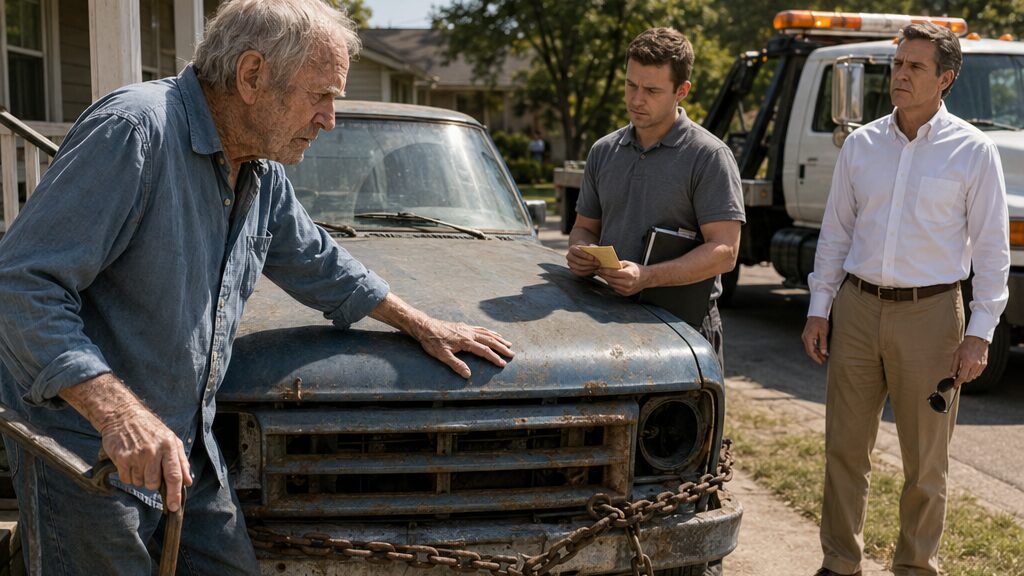
Two men stood beside the pickup.
One was in a reflective vest, holding a chain thick enough to pull a stump. The other wore a clean gray polo with a small company logo on the chest and held a clipboard tucked under one arm. Behind them, a white tow truck sat at the curb with its amber light turning in slow, indifferent circles.
The chain had already been looped around the front frame of the old pickup.
Gregory opened his mouth, but for a moment no sound came out.
The pickup sat where it had sat for years, angled slightly toward the garage, its faded blue paint worn thin by weather and time. The hood was down but not latched. A patch of primer showed along the passenger door. One headlight was missing, not broken, just removed, waiting in a box on the garage shelf until Gregory’s hands had a good day. The tires held air. The cab windows were dusty but not cracked. To anybody driving past, it looked like a tired old truck that had outstayed its welcome.
To Gregory, it looked like a promise with rust on it.
“Stop,” he said.
The man with the chain glanced up.
Gregory came down the porch steps too fast and felt the jolt in his left knee. He grabbed the railing at the bottom, then pushed away from it. “I said stop.”
The man in the gray polo turned. He had a young face, not cruel, not kind, just arranged into the professional blankness of someone who expected trouble and had practiced not taking it personally.
“Mr. Bennett?” he asked.
“You take that chain off.”
“Sir, I’m Ryan Cooper with Cooper Compliance Services.” He lifted the clipboard a few inches. “We’re here on behalf of the Hollow Creek Homeowners Association.”
“I know who you’re here for.” Gregory’s voice cracked and anger rushed in to cover it. “You take that chain off my truck.”
The tow driver paused with one hand on the hook. He looked from Gregory to Ryan, waiting for someone else to own the decision.
Ryan flipped the top sheet on his clipboard. “Mr. Bennett, this vehicle has been cited as a visible derelict item under Article Seven, Section Four of the community standards. You were issued written notice on March third, April first, and final removal notice on April eighteenth.”
Gregory stared at the paper as if it were written in another language. He knew the notices. One had sat unopened beneath the grocery store flyer for two weeks. One had been stuffed in the brass mailbox during the rain and dried with the corners curled. The final one Carolyn had found and read aloud at the kitchen table, softening her voice as if that would soften the words.
“Not today,” Gregory said. “I sent a letter.”
“The board reviewed it.”
“No, I sent a letter saying I needed more time.”
“The extension request was denied.”
The tow driver shifted his weight. A neighbor across the street had come out to retrieve a newspaper that had been on the lawn since morning. She did not bend for it. She stood beside her mailbox, watching.
Gregory saw movement in the doorway behind him. Carolyn had arrived early for lunch, as she did on Thursdays, still wearing her navy pharmacy jacket. She stood half-hidden behind the screen door, one hand at her throat.
“Dad?” she called.
He did not turn. “Stay inside.”
Ryan took a breath. “Mr. Bennett, I understand this is upsetting.”
“No,” Gregory said. “You don’t.”
The words came out quieter than he expected. The quiet seemed to bother Ryan more than shouting would have. He glanced at Patrick Harris, who had just stepped out of a dark SUV parked behind the tow truck.
Patrick was dressed like a man who believed casual clothes could still declare authority: pressed khakis, white shirt, belt polished, sunglasses folded neatly in one hand. He had been president of the Hollow Creek board for eleven months and had spoken at the last annual meeting about consistency, standards, and protecting everyone’s investment. Gregory had sat in the third row, hands folded over his cane, and thought of all the words people used when they did not want to say control.
“Gregory,” Patrick said, walking up the driveway. “We didn’t want it to come to this.”
“Then why did you bring chains?”
Patrick’s mouth tightened. “The board gave you every opportunity.”
“This is my property.”
“And you agreed to community rules when you bought here.”
Gregory gave a hard, humorless breath. “I bought here before half those rules were printed.”
“That may be true,” Patrick said, keeping his tone even, “but the recorded covenants apply to every homeowner now. The truck is visible from the street. It has been in noncompliance for more than ninety days.”
The tow driver bent again toward the chain.
Gregory moved before he thought. He stepped between the men and the truck, putting one palm flat against the hood. Heat from the sun had warmed the old metal. He felt the shallow dip near the front edge where Katherine had once sat with a sandwich wrapped in wax paper, laughing because he told her no woman should sit on a hood he had just polished.
The memory hit so plainly that the driveway seemed to tilt.
The tow driver straightened. “Sir, I need you to step back.”
Gregory did not move.
Carolyn came out onto the porch. “Dad, please.”
“You are not taking it,” Gregory said.
Patrick looked toward the neighbor across the street, then toward another house where blinds had opened. “Gregory, don’t make this harder than it needs to be.”
“It already is.”
Ryan turned the clipboard toward him. “Sir, this is the removal authorization. If you interfere with the contracted tow, additional fees can be added to your account.”
Gregory stared at the page. The letters swam for a moment. Removal. Noncompliant. Derelict. At owner’s expense.
Owner.
As if owning a thing meant nothing more than paying for it.
“That truck is not derelict,” he said.
Patrick’s voice softened into the tone people used for the old when they thought firmness was kindness. “Gregory, it hasn’t moved in years.”
“It has moved.”
“It has not left this driveway.”
“That’s not the same thing.”
Patrick blinked. “I don’t understand what that means.”
Gregory looked at him then, really looked. Patrick was not young, but he had the smooth impatience of someone who had never had to argue for the meaning of a battered object. He saw a violation. A line item. A problem visible from the curb.
Gregory saw Katherine in the passenger seat with her bare feet on the dash, telling him blue was better than red because red trucks looked like they were trying too hard. He saw her hair tied in a scarf. He saw the paper bag of peaches between them. He saw her hand on the radio dial. He saw the oxygen tube years later, tucked carefully beneath her sweater because she hated pity.
His fingers curled against the hood.
“She asked me not to let it go unfinished,” he said.
The driveway went still.
Carolyn made a small sound behind him.
Patrick’s face changed, not enough to be surrender, but enough to show the words had landed somewhere he had not prepared for. Ryan looked down at the clipboard. The tow driver looked away.
Gregory wished he had not said it. The sentence had been private. It had lived in the garage with the boxes of parts and the smell of oil, not out here in the open air where neighbors could pick it apart.
Patrick cleared his throat. “I’m sorry for your loss, Gregory. Truly. But personal attachment doesn’t exempt a homeowner from—”
“Don’t finish that sentence.”
Patrick stopped.
Gregory’s hand shook on the hood. He pressed harder until the tremor hid itself inside the truck’s old metal.
Carolyn came down the steps. “Maybe we can talk about this inside.”
Ryan shook his head slightly. “The order is active today.”
“Then make it inactive,” she said.
“I don’t have that authority.”
Gregory turned toward him. “Who does?”
Ryan looked at Patrick.
Patrick exhaled through his nose. “The board can review if new documentation is presented. But for today, the contractor has been dispatched. Costs have already been incurred.”
“You hear yourself?” Gregory asked. “You sent a truck to take a truck and now you say that’s the reason it has to be taken.”
The neighbor across the street had her phone in her hand now. Gregory saw the small black rectangle lifted at chest height. He felt the blood come into his face. Not from embarrassment exactly. From the knowledge that his pain was becoming something other people might replay.
Carolyn saw it too. “Put that phone down,” she called across the street.
The neighbor lowered it but did not go inside.
Ryan shifted the clipboard again, uncomfortable. “Mr. Bennett, I can call my office and request a temporary hold. That doesn’t cancel the violation.”
Patrick turned sharply. “Ryan.”
“I said temporary,” Ryan replied, still looking at Gregory. “If he’s blocking the vehicle, we have a safety issue anyway.”
Gregory stayed where he was.
The tow driver let the chain slacken.
Patrick’s jaw worked. He looked at the porch, the truck, the watching windows, and finally Gregory. “Forty-eight hours,” he said. “I can authorize a pause until the board has a chance to formally review your response. But you need to understand this is not a reversal.”
Gregory did not thank him.
Ryan tore a yellow copy from the clipboard and held it out. “This states the removal is stayed pending review. The hearing notice is attached.”
Gregory looked at the paper. He did not reach for it.
Carolyn came forward and took it instead. Her hand brushed his sleeve, tentative, as if she were afraid he might break under the touch.
Ryan gave the tow driver a nod. The man unhooked the chain from the truck’s frame. It fell loose with a heavy scrape, leaving a bright raw line across a patch of rust.
The sound made Gregory flinch.
Patrick turned toward the SUV. Before he left, he looked back. “Gregory, I hope you use this time wisely.”
Gregory kept his hand on the hood until the tow truck pulled away, until the neighbor crossed back into her yard, until Ryan’s white vehicle disappeared around the bend.
Only then did he remove his palm.
A print remained in the dust.
Carolyn stood beside him with the yellow notice in both hands. “Dad,” she said quietly. “Who asked you not to let it go unfinished?”
Gregory looked at the truck, at the chain mark, at the empty space where the tow hook had been.
For a long time, he said nothing.
Chapter 2: The Notice On The Kitchen Table
The yellow notice lay on the kitchen table between Gregory and Carolyn like something alive enough to bite.
Carolyn had smoothed it flat with both hands, then set a saltshaker on one corner and Gregory’s coffee mug on the other. The paper still curled where Ryan Cooper had torn it from the clipboard. Across the top, in bold print, it named Gregory’s home, his lot number, and the violation category.
VISIBLE DERELICT VEHICLE.
Gregory sat at the end of the table with his hands in his lap.
The kitchen had not changed much since Katherine was alive. Carolyn had tried, once, to suggest new curtains, and Gregory had said the old ones still worked. That had ended the conversation. They were yellowing now at the edges, printed with tiny blue flowers faded almost white. The clock above the stove ticked too loudly. In the corner, Katherine’s recipe box sat untouched, though Gregory had not cooked anything more complicated than eggs and soup in years.
Carolyn read the notice again, slower this time. She had a way of reading official language as if it might become less harsh if spoken carefully.
“Temporary stay of removal,” she said. “Pending formal review. Homeowner must present remediation plan, proof of compliance, or appeal request within forty-eight hours.”
Gregory looked toward the window over the sink. From where he sat, he could see the nose of the pickup.
“It’s not derelict,” he said.
“I know you don’t think it is.”
His eyes came back to her.
Carolyn winced. “That came out wrong.”
“You said what you meant.”
“No, Dad. I mean I know it isn’t junk to you.”
“To me.”
She folded her hands over the paper. She had Katherine’s hands, though she would not have liked anyone telling her that when she was young. Long fingers, practical nails, little half-moon scar near the thumb from a kitchen knife. Gregory remembered the day Carolyn got that scar. She had been fourteen, angry because Katherine insisted she learn how to slice onions properly before she went off into the world thinking speed was the same as skill.
Carolyn had cried then, more from frustration than pain. Katherine had wrapped the thumb and said, “Good. Now you’ll remember to slow down.”
Carolyn was trying to slow down now. Gregory could see the effort.
“I’m scared for you,” she said.
“That’s not new.”
“No. But this is different. They can fine you. They can put it on your account. They can make this ugly.”
Gregory gave a small snort. “They brought a tow truck to my driveway before lunch. We’re past ugly.”
She looked down. “I should have come sooner.”
“You come plenty.”
“I mean with the letters. I should have pushed you to answer them.”
“You did.”
“I pushed you to call. You said you would.”
“I wrote.”
“You wrote two lines on the back of their own notice.”
“It was a clear two lines.”
“Dad.”
He looked away again.
The first notice had made him angry. The second had embarrassed him. The third had scared him enough that he put it under the phone book, though he had not used the phone book in years. Carolyn found it while looking for the number of the plumber. She had read it aloud, then waited for him to say something reasonable.
Instead, he had gone to the garage and tightened a bolt that did not need tightening.
Carolyn stood and filled the kettle. The old burner clicked three times before catching. “Maybe,” she said, not facing him, “maybe we need to think about what keeping it is costing you.”
Gregory’s chair creaked as he shifted. “Don’t.”
“I’m not saying it doesn’t matter.”
“You are.”
“No. I’m saying maybe it can matter somewhere else. Behind the garage. At a storage yard. Under a cover. Somewhere they can’t keep coming after you.”
“That truck belongs here.”
“Why?”
He heard the question as a challenge, though her voice held no challenge. Only exhaustion. Only fear.
Carolyn turned from the stove. “I’m not trying to hurt you. I’m trying to understand why it has to be in the driveway.”
Gregory pushed back from the table. “Because that’s where I can work on it.”
“You haven’t worked on it in months.”
“I changed the fuel line.”
“That was last fall.”
“I cleaned the carburetor.”
“In January.”
He stared at her. “You keeping a log?”
“No. I’m paying attention.”
The kettle began to whistle softly. Carolyn shut it off before it became loud. Neither of them moved for the mugs.
Gregory hated the concern in her face. It was worse than Patrick Harris’s rulebook certainty, worse than Ryan’s clipboard, worse than the neighbor’s phone. Concern came dressed like love, but sometimes it carried the same demand: let go, be easier, become someone we can manage.
“You think I’m losing my mind,” he said.
Carolyn’s face tightened. “No.”
“You think I’m an old man sitting out there talking to a dead truck.”
“I think you’re my father and you’ve been alone too much.”
“That’s not the same thing.”
“It can become the same thing if you won’t let anyone in.”
Gregory stood. The movement was too quick, and his knee punished him for it. He gripped the back of the chair until it passed.
Carolyn started toward him. “Dad—”
“I’m fine.”
“You’re not.”
“No one is fine all the time.”
That silenced her.
He went to the counter where the mail had collected in a shallow ceramic bowl Katherine had made in a class at the community center. The bowl was lopsided, glazed green, and useless for anything wet. He moved envelopes aside until he found a stack of folded receipts, oil-stained at the corners.
Carolyn watched but did not ask.
He carried them to the table and set them beside the notice. Parts invoices. A handwritten list from the salvage yard. A receipt for four tires bought used but matched. Registration paperwork stamped non-operational, because he had not lied about the truck’s condition. Insurance papers for limited restoration coverage, though Patrick would probably not care about that.
“It’s maintained,” Gregory said. “It’s not abandoned.”
Carolyn touched the top receipt. “I didn’t know you had all this.”
“You didn’t ask.”
The hurt crossed her face before she could hide it.
Gregory regretted the words immediately, but pride held his apology behind his teeth. There had been a time when Carolyn asked about everything. Why transmissions slipped. Why her mother planted marigolds around the mailbox. Why Gregory never bought cheap screwdrivers. Then she grew up, moved out, came back after Katherine got sick, left again when grief made the house too crowded even with only two people in it.
People thought distance happened all at once. Gregory knew better. It happened by teaspoons.
Carolyn sat again. “Tell me about the truck.”
He sorted the receipts into a neater stack. “It’s a 1978 pickup.”
“I know what year it is.”
“Your mother bought it before she married me.”
That made Carolyn look up.
Gregory nodded toward the window. “She saved for two years. Worked weekends at the diner off Route Six. Everyone told her to buy something sensible. She bought that.”
Carolyn’s expression softened. “Mom bought it?”
“With cash. In a coffee can, mostly. Man at the lot tried to talk her into a sedan. She told him if she wanted something small that complained on hills, she’d marry one.”
Carolyn laughed once, surprised by it. The sound filled the kitchen and vanished too quickly.
“She never told me that,” she said.
“She liked having stories that were hers.”
Gregory looked toward the recipe box. He could almost see Katherine leaning against the counter, arms crossed, daring him to make her more sentimental than she had been.
“She named it?” Carolyn asked.
“No.”
“Mom named everything.”
“She refused to name vehicles. Said once you named them, they started expecting favors.”
Carolyn smiled again, then the smile faded. “Is that why you kept it?”
Gregory rubbed his thumb along the edge of one receipt. “Partly.”
“What’s the other part?”
The clock ticked. Outside, a bird landed on the truck’s side mirror, stayed for one breath, then flew off.
Gregory stood without answering. He went to the pantry and reached up to the highest shelf, where Carolyn would not have looked because she believed, as Katherine had, that things on high shelves either belonged to tall people or dead people. Behind a box of unused canning jars sat an old coffee can with a red plastic lid.
He brought it down carefully.
Carolyn’s eyes followed it.
The can had once held decaf, though Gregory and Katherine both agreed decaf was a sad misunderstanding. Now the label was sun-faded and soft at the seam. Gregory sat, worked his fingers under the lid, and pried it open.
Inside were bolts, washers, small clips, two keys on a wire ring, and folded scraps of paper. Each piece of metal had been cleaned and separated in little envelopes. On the front of each envelope was Katherine’s handwriting.
Passenger hinge.
Dash screws.
Radio knob, stubborn one.
Carolyn reached toward the can, then stopped before touching it. “That’s Mom’s writing.”
Gregory nodded.
She pulled one envelope out as gently as if it might bruise. “Why did she label these?”
“She helped me take it apart.”
“When?”
“Before she got too sick.”
Carolyn stared at the small envelope. “You never told me.”
“You had enough to carry.”
“That wasn’t your choice to make.”
He looked at her then. There was Katherine again in the lift of her chin, not soft now, not careful, but wounded.
Gregory closed his eyes briefly.
“She wanted to ride in it again,” he said. “Just once. To the overlook.”
Carolyn’s hand tightened around the envelope.
He had not meant to say that much. Not yet. Maybe not ever. But the chain had scraped something open, and now things were coming out whether he allowed them or not.
“The place off County Road?” she asked.
Gregory nodded.
“Where you proposed?”
“Where she said yes before I asked properly.”
Carolyn looked down at the can. The yellow notice sat beside it, harsh and flat. Katherine’s handwriting curled across the envelope in blue ink, alive in a way the printed violation never could be.
Gregory put the lid back on the can.
Carolyn wiped under one eye with the heel of her hand. “Dad, why didn’t you tell me this was about Mom?”
He looked through the window at the truck.
“Because once I say it out loud,” he said, “people start telling me what grief is supposed to do next.”
Carolyn did not answer.
In the quiet, the notice shifted under the weight of the saltshaker, its curled edge lifting as if trying to rise.
Chapter 3: What The Neighborhood Called Junk
By the next morning, the truck had become a story other people were telling.
Gregory learned this not from the internet, which he did not check, and not from Carolyn, who avoided looking at her phone while she made his toast. He learned it from the way the street behaved.
A dog walker slowed in front of the driveway, then pretended to study the sky. A delivery driver looked twice at the pickup before leaving a padded envelope by the door. The neighbor across the street, the one who had lifted her phone during the confrontation, came out to water a strip of flowers that had survived without her attention for years. She held the hose in one hand and the phone in the other.
Gregory stood inside the garage with the door half-open, watching through the gap.
The chain mark on the pickup’s front frame had turned brighter overnight. It caught the sun like a fresh scrape on skin.
“You don’t have to stand there,” Carolyn said from behind him.
“I know what I have to do.”
“That’s not what I said.”
She had stayed the night in the room that used to be hers, though she still called it “the back room” as if not naming it made the past less crowded. In the morning, she had put on yesterday’s jacket and called the pharmacy to say she would be late. Gregory had pretended not to hear the worry in her voice.
He picked up a rag from the workbench and wiped dust from a wrench. The wrench was already clean.
Carolyn stepped beside him. “I called the HOA office.”
He looked at her.
“The hearing is tomorrow evening. Patrick Harris wants any documentation submitted by noon.”
“Patrick Harris wants a lot of things.”
“He also said there are additional complaints.”
Gregory tossed the rag onto the bench. “Of course there are.”
“Dad.”
“What?”
“We need to be ready.”
He turned toward the truck. “I am ready.”
“No, you’re angry.”
“That too.”
She did not argue. That was one of the ways she had changed as an adult. As a girl, she would have argued every word until the whole house felt like a courtroom. Now she saved her arguments, which made each one heavier when it came.
“Betty Miller filed one of them,” Carolyn said.
Gregory knew the name. Betty lived three houses down in a one-story with white shutters and a lawn kept so even it looked ironed. Her husband had died years before Katherine, and afterward Betty replaced every plant in her yard with something evergreen and symmetrical. She served on the architectural committee and used the word tasteful as if it had been handed down from a higher authority.
“She told the office the truck makes the street look neglected,” Carolyn said.
Gregory laughed under his breath. “The street?”
“She said visible disrepair affects everyone.”
“Her mailbox leans.”
“Dad.”
“It does.”
Carolyn folded her arms, but a reluctant smile touched her mouth and disappeared.
Gregory looked past her, toward the driveway. “She got a problem, she can come say it to me.”
“She may.”
As if called by the words, Betty Miller appeared at the end of the driveway.
She wore beige slacks, a pale sweater, and gardening gloves so clean Gregory doubted they had ever met soil. In one hand she carried a folded paper. In the other, her phone.
Carolyn muttered, “Please don’t.”
Gregory stepped out of the garage.
Betty paused when she saw him, then continued up the driveway with the brisk expression of someone who had rehearsed being reasonable.
“Gregory,” she said.
“Betty.”
Carolyn stayed near the garage, close enough to intervene, far enough not to insult him by doing it too soon.
Betty looked at the truck, then at Gregory. “I wanted to make sure you were all right after yesterday.”
“That why you filmed it?”
Color rose in her cheeks. “I did not film you.”
“You held up your phone.”
“I was documenting the process.”
“The process looked like me.”
Her mouth pressed thin. “I stopped when Carolyn asked.”
“You stopped because you got caught.”
Betty drew herself taller. “I know this is difficult for you. But the neighborhood has standards for a reason.”
Gregory let the silence stretch.
She glanced toward Carolyn, perhaps hoping for rescue from the awkwardness. Carolyn gave none.
Betty unfolded the paper. “Several of us have concerns. It isn’t personal.”
Gregory looked at the paper but did not take it. “Things people say before making it personal.”
“It’s visible from the street. Children walk past it. Visitors see it. Last month, the garden club came through and—”
“The garden club survived?”
Her lips tightened again. “You may find this funny, but property values matter to people.”
“That truck isn’t hurting your property value.”
“You don’t know that.”
“And you do?”
“I know buyers notice neglect.”
The word landed harder than Gregory expected.
Neglect.
It was a word with teeth. It suggested laziness, decay, failure of care. It made the truck into evidence against him. Worse, it made Katherine’s memory into something dirty left too long in the sun.
He stepped closer, not enough to frighten, just enough that Betty had to meet his eyes.
“That truck gets covered in storms,” he said. “Battery’s out and stored. Fuel tank is drained. Tires are checked. Frame’s treated. I got receipts for every part I bought and every part I’m waiting on. You want to call something neglected, pick something I forgot.”
Betty’s face shifted. Just slightly. Not surrender. Surprise.
“I didn’t know that,” she said.
“You didn’t ask.”
Carolyn looked down.
Betty refolded the paper. “The issue is not only safety. It’s appearance.”
“There it is.”
“Gregory, people are not trying to hurt you.”
“People don’t have to try all that hard.”
Betty looked at the truck. For the first time, Gregory saw something uncertain move behind her eyes. Then it closed again.
“The board has to be fair,” she said. “If they make an exception for you, they have to make one for everyone.”
“Maybe everyone has a reason you don’t see from the sidewalk.”
“That sounds nice, but rules can’t run on feelings.”
“No,” Gregory said. “They run on paper. That’s cleaner.”
Betty’s phone buzzed. She glanced at it before she could stop herself.
Carolyn noticed. “Is that about Dad?”
Betty hesitated too long.
Gregory felt his stomach go cold.
“Show me,” Carolyn said.
“It’s just the neighborhood group.”
“Show me.”
Betty pulled the phone closer to her chest. “I don’t think that would be helpful.”
Gregory turned away. “Then it’s about me.”
Carolyn crossed the driveway before Betty could retreat. “If people are talking about him, I want to know what they’re saying.”
“They’re talking about the truck,” Betty said.
“No. They’re talking about the old man attached to it.”
Betty’s expression changed at that. Shame, maybe. Or annoyance at being made to feel shame in public.
She held out the phone.
Carolyn read silently. Gregory watched her face, which was worse than reading the words himself. Her mouth tightened. Her eyes hardened. She scrolled once, then stopped.
“What?” Gregory asked.
“Nothing.”
“Carolyn.”
She looked at Betty. “Someone posted a picture from yesterday.”
Gregory’s hands curled.
“Not the video,” Betty said quickly. “Just a picture. From across the street.”
Carolyn still held the phone. “The caption says, ‘This is why rules matter. Hollow Creek is not a junkyard.’”
Gregory looked at the pickup.
For a moment, the driveway blurred around the edges. He imagined the image traveling from phone to phone: his thin shoulders, his hand on the hood, the chain at the frame. People would not know what he had said. They would not hear Katherine’s sentence break loose from his chest. They would see an old man blocking a tow truck and decide what kind of old man he was.
Stubborn. Confused. Embarrassing.
Betty took the phone back. “I didn’t post that.”
“But you agree with it,” Carolyn said.
“I agree the situation needs to be handled.”
Gregory looked at Betty then. “Go home.”
She drew in a breath. “Gregory—”
“Please.”
The please did what anger had not. Betty’s face softened around the edges, and for a second she looked like a widow standing in someone else’s driveway holding the wrong kind of paper.
“I’m sorry,” she said, though it was not clear for what.
She left without giving him the folded complaint.
Carolyn waited until Betty was halfway down the sidewalk before turning to him. “We should report the post.”
“No.”
“Dad, they can’t just—”
“They already did.”
“That doesn’t mean we let them.”
He went back into the garage. The air inside smelled of rubber, dust, and old oil. The smell steadied him.
On the workbench lay the headlight assembly he had removed weeks ago. He picked it up and turned it in his hands. The chrome rim was pitted, but the glass was whole. Katherine had found it at a swap meet, tucked under a table between lawn mower parts and a cracked motorcycle helmet. She had held it up like treasure.
“See?” she had said. “Still has one good eye.”
He set the headlight down carefully.
Carolyn stood in the garage doorway. “I’m going to print the receipts. The registration too. Anything that shows it’s not abandoned.”
Gregory nodded.
“And tomorrow, you’re going to the hearing.”
He looked at her. “Wasn’t planning to hide.”
“I know.”
Outside, a car slowed in front of the house, then sped up when Carolyn stepped into view.
Gregory reached for the coffee can on the shelf and held it against his ribs. The metal was cool through his shirt. Inside, Katherine’s labeled envelopes shifted with a small, dry whisper.
From the street came the faint laughter of two passing walkers, not necessarily about him, not certainly about anything. Still, Gregory stood very still until the sound was gone.
That evening, a white envelope appeared in the mailbox.
No stamp. No return address.
Carolyn brought it in and opened it at the kitchen table. Inside was a single-page notice printed on HOA letterhead.
Formal Compliance Hearing Scheduled.
Gregory read the first line, then the second.
His account would be reviewed in three days.
The removal order would remain pending.
He folded the paper once, carefully, and set it beside the yellow notice.
Carolyn touched the back of his hand. “We’ll go together.”
Gregory looked at the window, where the truck sat half-lit in the lowering sun.
“No,” he said. “I’ll go standing on my own feet.”
Chapter 4: The Promise Under The Rust
The evening before the hearing, Gregory opened the garage door all the way.
He had avoided doing that since the tow truck came. Half-open felt safer. Half-open let him work without offering the whole truck to the street. But the air inside had gone stale, and he needed light. The overhead bulb flickered when he pulled the cord, buzzing against the dusk, while the open doorway caught the last orange wash of sun across the driveway.
The pickup waited in its usual place, hood lifted now, one front corner shadowed by the garage roof. Gregory stood beside it with the coffee can under one arm and a cardboard box of receipts at his feet.
Carolyn had gone to the pharmacy for half a shift and returned with her hair coming loose from its clip. She said nothing when she found him in the garage. She set her purse on an old lawn chair and rolled up her sleeves.
“What do you need?” she asked.
Gregory almost said nothing. It was the answer he knew best. Instead he pointed to the metal cabinet near the back wall.
“Bottom drawer. There’s a red folder.”
Carolyn crossed to it and pulled. The drawer stuck, then came free with a rusty shriek. Inside were oil filters, a cracked flashlight, two shop manuals, and a red folder thick with papers.
“This one?”
He nodded.
She brought it to the workbench and opened it. “Dad.”
He did not look up from the coffee can. “What?”
“These are organized.”
“Don’t sound so surprised.”
“I mean, they’re dated.”
“Your mother liked dates.”
The folder held repair notes from six years of slow work. Some pages were in Gregory’s handwriting: short, square, direct. Ordered gasket set. Sanded passenger door. Checked brake line. Others were in Katherine’s rounder script, the letters leaning forward as if they were on their way somewhere.
Gregory heard the change in Carolyn’s breathing when she saw the first page with her mother’s writing.
“What does this say?” she asked softly.
Gregory knew without looking. “‘Gregory says the carburetor is not personal. The carburetor disagrees.’”
Carolyn laughed, then pressed her fingers to her mouth.
He removed the lid from the coffee can and tipped the small envelopes onto the bench. Bolts clicked against wood. For months after Katherine died, he had not been able to open the can. Then, one winter morning, he found himself standing in the garage before sunrise with the can in his hand, as if his body had walked there while the rest of him slept.
He had opened it. He had cried so hard he sat on the concrete.
After that, he opened it only when he could be useful.
Carolyn sorted the papers into stacks: registration, insurance, receipts, handwritten notes. She moved carefully, but not timidly. That mattered to him. Pity made objects fragile. Respect let them remain what they were.
Outside, a car rolled slowly past the house.
Neither of them looked up.
Gregory took the missing headlight from the workbench and held it against the front housing. “Bracket’s bent.”
“Can it be fixed?”
“Most things can.”
She looked at him.
He pretended not to notice.
For a while, they worked in a silence that was almost peaceful. Carolyn copied dates onto a yellow legal pad. Gregory checked the plastic bins along the wall, pulling out labeled parts. The truck’s open hood made a dark roof above him. Its engine bay was cleaner than the outside suggested. He had wiped, sealed, drained, covered, and checked. He had done everything slowly, but he had done it.
Carolyn came to a page near the back of the folder and went still.
Gregory knew that stillness too.
“What is this?” she asked.
He set down the headlight.
She held the page by its edges. It was not a repair note exactly. It had been torn from a spiral notebook, folded twice, then unfolded so often the creases had gone soft. Katherine had written across the top in blue ink.
Before the overlook.
Underneath was a list.
Passenger seat cleaned. Radio working. Peaches if in season. Blue blanket. No hospital talk. No crying before the hill.
Carolyn’s eyes moved over the words again and again. “She wrote this?”
“Yes.”
“When?”
“After the second surgery. Before the oxygen tank came.”
Carolyn lowered herself onto the lawn chair. It creaked beneath her. “I thought she stopped caring about things like this near the end.”
Gregory leaned against the truck’s fender. “She cared more. She just had less room to show it.”
A moth flickered near the overhead light.
Carolyn touched the edge of the paper. “She wanted to go to the overlook?”
Gregory nodded.
“In the truck?”
“Not in my sedan. She said if she was going to be hauled up that road, it wouldn’t be in a car that beeped when she forgot her seat belt.”
Carolyn smiled through tears. “That sounds like her.”
“She wanted the truck running before the leaves turned.” He looked into the engine bay, where the empty headlight socket faced him like a dark eye. “I told her I’d make it happen.”
Carolyn did not ask why he had not. He was grateful and ashamed at once.
“She got worse,” he said anyway. “Then there were appointments. Then the stairs got hard. Then the doctor said we should think in weeks, not months.” He rubbed his thumb against a rust spot on the fender. “I kept telling her, almost. Almost got it. Almost ready.”
The word almost stayed between them.
Carolyn looked down at the note. “Did she blame you?”
Gregory’s head came up.
“No,” Carolyn said quickly. “I didn’t mean—”
“She never blamed me for anything that mattered.” His voice roughened. “That made it worse.”
The garage darkened inch by inch. Outside, the streetlights clicked on. The pickup’s faded blue body turned gray in the artificial light.
Carolyn folded the note along its old creases. “Why keep it in the driveway?”
Gregory took a long breath. This question had followed him through every notice, every neighbor’s glance, every practical suggestion. He had answered it with irritation because irritation was easier than the truth.
“After she died,” he said, “the house got too quiet. Everywhere I looked, something was finished. Her chair was empty. Her shoes were put away. The bed was made. People brought casseroles and took the dishes back, and then even that stopped. The truck was the only thing still asking something of me.”
Carolyn’s face crumpled, but she did not interrupt.
“If I put it behind a fence, I was afraid I’d stop hearing it ask.”
“That’s why you wouldn’t move it.”
He nodded.
She looked toward the driveway. “Dad, Mom wouldn’t want people hurting you over it.”
“She wouldn’t want me bullied into pretending she didn’t leave anything behind.”
“No,” Carolyn said. “She wouldn’t.”
The firmness in her voice surprised him.
He opened the passenger door. It complained on its hinges, a long dry sound that made him wince. Inside, the seat had been stripped and covered with an old sheet. The dash was partly disassembled. A small blue blanket lay folded on the floorboard, sealed in a clear plastic bag.
Carolyn stepped closer.
Gregory reached behind the seat and pulled out a narrow tin box. He had not touched it in nearly a year. The lid bore scratches from decades of sliding under seats and across workbenches. Inside were photographs: Katherine at twenty-four standing beside the pickup with one boot on the bumper; Katherine at forty holding Carolyn as a toddler on the tailgate; Katherine years later, thinner but still bright-eyed, pointing at the open hood while Gregory scowled theatrically at the camera.
Carolyn picked up the last photo. Her voice came small. “I took this.”
“You did.”
“I remember she made you pose.”
“She made everyone do everything.”
Carolyn gave a soft laugh.
At the bottom of the tin was one more folded note. Gregory hesitated before taking it out. This one was not part of the repair file. He had found it in Katherine’s robe pocket two days after the funeral.
Carolyn watched him unfold it.
The paper had only one line.
Don’t let them make it disappear.
Carolyn read it and went pale.
“She didn’t mean the HOA,” Gregory said.
“I know.”
“She meant time. Me. Everybody moving on because that’s what people say you have to do.”
Carolyn reached for his hand. This time he let her take it.
The garage light hummed above them. The truck stood open, imperfect, accused by the neighborhood and defended by two people who had not known how much they were both still grieving.
After a while, Carolyn wiped her face and set Katherine’s note on top of the red folder.
“We bring this tomorrow,” she said.
Gregory shook his head. “Not that one.”
“Dad—”
“No. They don’t get all of her.”
Carolyn looked as if she might argue, then stopped. “Then what do they get?”
He looked at the repair logs, the receipts, the registration papers, the photographs. His gaze rested on the yellow notice lying half-under the folder, bright and official and empty.
“Enough,” he said. “Only enough.”
Chapter 5: The Board Measured Only The Driveway
The Hollow Creek clubhouse smelled faintly of floor polish and burnt coffee.
Gregory had not been inside since Katherine’s last Christmas potluck, when someone’s slow cooker had blown a fuse and half the room sang carols in the dark. Now the folding chairs were arranged in straight rows facing a long table where the HOA board sat with nameplates, bottled water, and the practiced solemnity of people who believed order began with furniture.
Carolyn offered Gregory her arm at the entrance.
He shook his head once.
She did not look hurt. She simply walked beside him.
Patrick Harris sat at the center of the table. Betty Miller sat two seats to his left with a folder in front of her and reading glasses on a chain around her neck. Ryan Cooper stood near the side wall, not at the table, clipboard held low. The tow driver was not there. Gregory was glad. There were only so many men with chains a room needed.
A few neighbors occupied the chairs behind him. Not many, but enough. Gregory felt their presence as pressure between his shoulder blades.
Carolyn carried the red folder. Gregory carried the yellow notice and one photograph.
Patrick tapped the microphone, though the room was small enough for whispers. “We’ll call this special compliance review to order. The matter concerns Lot Forty-Two, owned by Gregory Bennett, regarding a visible derelict vehicle in violation of Article Seven, Section Four.”
Gregory looked at the framed print hanging behind the board table. It showed Hollow Creek’s entrance sign surrounded by flowers. Beneath it, in script, were the words A Community That Cares.
He nearly laughed.
Patrick continued. “Mr. Bennett, you have requested reconsideration of the removal order.”
“I requested you not tow my truck.”
A faint rustle moved through the chairs.
Patrick paused. “This is your opportunity to present relevant information.”
Gregory stepped to the small podium. It had been placed ten feet from the board table, as if he were a citizen petitioning a town council instead of a man asking his neighbors not to haul away part of his life.
Carolyn stayed seated in the first row with the folder on her lap.
Gregory laid the yellow notice on the podium. The paper looked brighter under fluorescent lights.
“My truck is not abandoned,” he said.
Patrick folded his hands. “The issue before the board is not ownership.”
“I didn’t say ownership. I said abandoned.”
Betty looked down at her notes.
Gregory continued. “It has current non-operational registration. It is insured for restoration. Fuel is drained. Battery is stored. Tires are maintained. I have receipts for parts and repairs.”
Carolyn rose and passed copies to the HOA secretary, who distributed them along the table.
Patrick skimmed the first page. “This does show some maintenance activity.”
“Not some,” Gregory said. “Years of it.”
A board member leaned toward his microphone. “Mr. Bennett, the photographs submitted with the complaint show visible rust, missing trim, and an exposed primer patch.”
Gregory nodded. “That’s what restoration looks like before it’s finished.”
“From the street,” the board member said, “it looks like a derelict vehicle.”
There it was again. From the street. As if the curb were the only honest judge.
Gregory took the photograph from his pocket and placed it on the podium but did not hold it up yet. “May I ask something?”
Patrick looked cautious. “Briefly.”
“When you measure a thing from the street, how much of it do you think you’re seeing?”
No one answered.
Gregory looked down at the photograph. Katherine at twenty-four beside the truck, one boot on the bumper, chin lifted like she had just won an argument with the whole world.
“This was my wife’s truck,” he said.
Betty raised her eyes.
A few chairs creaked behind him.
Gregory kept his voice steady. “She bought it before we were married. She kept it running longer than I kept some jobs. It hauled lumber, groceries, one Christmas tree too tall for our living room, and my daughter’s first dresser.”
Carolyn looked at her hands.
Patrick’s expression softened, but only slightly. “Gregory, I appreciate the history. I do. But the board has to apply the covenants as written.”
“I’m not finished.”
Patrick leaned back.
Gregory did not hold up Katherine’s last note. He had left it at home in the tin box. They did not get that part. But he took out the repair list labeled Before the overlook and unfolded it.
“She wanted one more ride in it,” he said. “There’s a road past County Road Twelve. Overlook at the top. That’s where she said yes to marrying me before I got the question out right.”
A small sound came from Carolyn. Gregory did not turn.
“My wife got sick before the truck was ready. I didn’t finish in time.”
The room went too still.
He could feel the danger of pity gathering. He stopped it before it reached him.
“I’m not asking you to grieve for her,” he said. “She wouldn’t like strangers doing that on schedule. I’m telling you the truck isn’t trash to be cleared for curb appeal. It’s a restoration project. Slow, yes. Mine, yes. But not abandoned.”
Patrick removed his glasses and rubbed the bridge of his nose. “The board is sympathetic.”
Gregory almost closed his eyes.
Sympathetic was a word people used when they wanted credit for feeling before they said no.
Patrick continued, “However, the rule does not provide an exception for sentimental value.”
“It provides an exception for project vehicles,” Carolyn said from the front row.
Patrick looked at her. “Only when stored out of public view or actively worked on within a board-approved timeframe.”
“Then approve one,” she said.
A murmur moved through the room.
Gregory turned slightly. “Carolyn.”
She stood, holding the folder against her chest. “He has proof it’s maintained. He has proof it’s registered. He has proof he’s been working on it.”
Patrick’s tone became careful. “Ms. Bennett, the board allowed homeowners to submit statements, but this is Mr. Bennett’s hearing.”
“She’s right,” Gregory said.
Carolyn sat, but her eyes stayed on Patrick.
Betty cleared her throat. “May I ask a question?”
Patrick nodded.
Betty looked not at Gregory, but at the photograph on the podium. “If the board granted time, where would the vehicle remain?”
“In my driveway,” Gregory said.
Patrick’s expression tightened again.
Betty’s voice stayed measured. “Visible from the street?”
“That’s where I can work on it.”
A board member leaned forward. “Could it be moved behind the side gate?”
Gregory looked at him. “The side gate opening is too narrow.”
“Could the gate be modified?”
“With money, most things can be modified.”
Patrick tapped the papers into a neat stack. “The board cannot base its decision solely on personal hardship. If the truck remains visible, we have an enforcement problem.”
Gregory looked at the table. At the nameplates. At the water bottles. At the careful faces of people trying to be fair inside a rule too narrow to hold the truth.
“You keep saying visible,” he said. “Like being seen is the offense.”
No one answered.
Patrick glanced toward the secretary. “We need to resolve the active removal order. Based on documentation provided, I’m willing to recommend a short extension for voluntary compliance.”
Carolyn’s head snapped up. “Voluntary compliance means removal.”
“It means Mr. Bennett would have time to relocate or screen the vehicle before contracted towing resumes.”
“How much time?” Gregory asked.
Patrick looked down at his papers. “Forty-eight hours.”
The words dropped into the room with a soft finality.
Gregory stared at him. “You paused it yesterday for forty-eight hours.”
“And now the board would formalize that period from tonight.”
“You’re giving me what I already had and calling it mercy.”
Patrick’s cheeks colored. “I’m trying to find a workable compromise.”
“No,” Gregory said. “You’re trying to make the same answer sound kinder.”
The board member beside Betty frowned. “Mr. Bennett, the tone is not helpful.”
Gregory turned toward him. “Neither is the rule.”
Carolyn stood again, but Gregory raised one hand slightly. Not to silence her. To tell her he was still standing.
He gathered the yellow notice, the repair list, and the photograph. The photograph he held a moment longer. Katherine looked back at him from a time before illness, before covenants, before anyone would have dared call her truck a neighborhood problem.
Patrick spoke more quietly. “Gregory, if you do nothing, the removal will proceed. I don’t want that.”
“Then don’t do it.”
“I have a duty to the community.”
“So do I,” Gregory said. “I live in it.”
He stepped away from the podium.
Behind him, someone shifted. Someone else whispered. Betty Miller looked at the photo, not at him. Ryan Cooper stood by the wall, his clipboard lowered now, his face unreadable.
Carolyn met Gregory in the aisle.
“You okay?” she whispered.
“No.”
She nodded as if that were the most sensible answer he had given all night.
At the door, Patrick called after him. “Mr. Bennett. Forty-eight hours. Please use them.”
Gregory stopped with one hand on the metal push bar.
For a moment, he thought of turning back, of saying something sharp enough to leave a mark. Instead, he opened the door and stepped into the cooler night air.
The parking lot lights buzzed overhead. His truck was not there, of course. It was at home in the driveway, waiting beneath the street-facing sky.
Carolyn walked beside him toward her car.
After several steps, she said, “What are you going to do?”
Gregory looked at the folded notice in his hand.
For the first time since the chain hit the frame, he did not feel only cornered.
“I’m going to give them something to vote on,” he said.
Chapter 6: Forty-Eight Hours To Let Go
Gregory did not sleep much, but he did not waste the dark.
By six in the morning, the kitchen table had become an orderly mess. Receipts lay in rows. Registration papers sat beneath a soup can so they would not curl. Carolyn’s laptop glowed beside Katherine’s old recipe box. The yellow notice was there too, but Gregory had turned it face down.
Carolyn came in wearing yesterday’s jeans and one of his old flannel shirts over her T-shirt. She looked at the table, then at him.
“You made coffee?”
“I made coffee badly.”
“That’s still coffee.”
He poured her a cup. They drank without talking for the first few minutes, the way people do when worry has made them into coworkers.
Then Gregory slid a sheet of lined paper toward her.
Carolyn read the first line aloud. “‘Legacy restoration exemption.’”
“Too much?”
“No.” She sat. “It sounds official enough to scare them.”
“That was the goal.”
He had written the proposal three times in the night. The first draft had been angry. The second sounded like begging. The third, written near dawn, was the only one he could stand to let another person read.
It did not ask the board to admire the truck. It did not ask them to care about Katherine. It asked for a category the rules did not have: a maintained inherited or family-significant item under active restoration, allowed if registered, insured, mechanically safe, screened when feasible, and reviewed on a schedule. No piles. No hazards. No rotting junk under a sentimental name.
Carolyn read silently, her finger following the lines.
“This is good,” she said.
Gregory waited.
“It’s not just about you.”
“That’s the point.”
She looked up. “Did you mean it that way?”
“I got tired of them acting like fairness means pretending people don’t have lives.”
Carolyn’s eyes softened. “We need copies.”
“And a clerk stamp on the registration.”
“The county office opens at eight-thirty.”
“I know.”
“You looked it up?”
“I called the recorded message. Twice. It talks slow.”
She smiled into her coffee.
By nine, they were at the county clerk’s office, standing beneath fluorescent lights while a clerk behind glass examined Gregory’s non-operational registration as if it might be forged by sentiment. Carolyn held the folder. Gregory stood with both hands on the counter and answered only what was asked.
“Restoration vehicle?” the clerk said.
“Yes.”
“Stored at residence?”
“Yes.”
“Operable?”
“Not yet.”
The clerk stamped a copy with a heavy thump. Gregory liked the sound more than he wanted to admit. Not because it solved anything. Because it was proof that somewhere outside Hollow Creek’s rulebook, the truck existed as something other than derelict.
At the mechanic’s shop, the mechanic wiped his hands on a towel and walked slowly around the truck documents Gregory had brought instead of the truck itself.
“You want me to say it’s being worked on?” the mechanic asked.
“I want you to say what’s true.”
The mechanic studied him, then nodded. “Truth costs less to remember.”
He wrote a short statement on shop letterhead: truck maintained as restoration project; no leaking fluids reported; parts ordered intermittently; work slowed by owner’s age but not abandoned. He did not make it prettier than that.
Gregory thanked him.
The mechanic shrugged. “Katherine would haunt me if I didn’t.”
Carolyn looked at Gregory, startled.
He gave the smallest shake of his head. Later.
By afternoon, the sun had turned harsh. Carolyn drove them home, and neither mentioned how tired Gregory looked. In the driveway, the pickup sat under the same judgment as before. But when Gregory stepped out of the car, he saw it differently. The chain mark was still there. So was the primer patch. So was the missing headlight. Nothing had changed, except that he had stopped asking the truck to explain itself alone.
Carolyn carried the folder inside. Gregory stayed by the pickup.
He ran his hand over the hood, stopping at the place where dust still held the faint edge of his palm print from the day before.
“I’m trying,” he said.
The screen door opened behind him.
Carolyn came back with two glasses of water. “Are you talking to the truck or Mom?”
“Yes.”
She handed him a glass and leaned against the fender beside him. For once, she did not tell him to come inside.
After a while, she said, “I called someone about the side gate.”
Gregory looked at her.
“Just for an estimate.”
“I didn’t ask you to do that.”
“I know.”
“The opening’s too narrow.”
“That’s why I called.”
He looked toward the side yard. The gate was old cedar, built when the neighborhood still allowed people to build things without three forms and a committee. Katherine had painted it blue one summer because she said brown fences looked like everyone had given up. The paint had faded to gray-blue now, peeling along the top rail.
“The board wants it hidden,” Gregory said.
“Maybe.” Carolyn took a breath. “Or maybe you get to decide what visible means.”
He did not answer.
“I’m not saying let them erase it,” she said. “I’m saying if the truck stays because you choose where it belongs, that’s different from them dragging it away.”
Gregory looked at the gate again.
Behind it was the side yard, wide enough if the opening changed. He could put down gravel. Build a simple cover. Keep the truck where he could still reach it from the garage. It would no longer face the street. The thought stung more than he expected.
“You think I should move it,” he said.
“I think Mom didn’t write, ‘Make sure it stays in the driveway.’”
That should have angered him. Instead it landed gently because Carolyn’s voice held no victory.
He looked at her. “You’re getting bold.”
“I inherited it.”
“Yes,” he said. “You did.”
A car slowed near the curb. Both of them looked. It was Betty Miller’s. She did not stop, but she lifted one hand from the steering wheel in a small uncertain gesture.
Gregory did not wave back in time.
Carolyn noticed and said nothing.
Inside, they made copies at Carolyn’s portable printer until the machine complained and flashed red. Gregory sorted each packet: proposal, registration, insurance, mechanic statement, repair receipts, two photographs, and a short cover page written in his plain hand. He included the picture of Katherine at twenty-four with one boot on the bumper. He did not include the last note.
Near dusk, a new email arrived from the HOA office. Carolyn read it from the laptop.
“Special meeting tomorrow at six. Agenda item: Lot Forty-Two appeal and proposed variance.”
Gregory sat back. “Variance. Not amendment.”
“It’s a start.”
“It’s a smaller word.”
“It got you on the agenda.”
He grunted, but he did not argue.
Later, after Carolyn went to shower, Gregory carried the tin box from the truck into the kitchen. He sat alone and opened it. Katherine’s photographs lay in their careful stack. Beneath them was the folded note.
Don’t let them make it disappear.
For months, he had thought keeping the truck in the driveway was the only way to obey. Now he was less certain. Maybe disappearance had more than one shape. Maybe a thing could disappear under a tarp of shame, or in a storage lot, or in a crowd’s laughter. But maybe it could also disappear if he turned it into a battle so bitter that no one could remember love was the reason.
He folded the note and placed it back in the tin.
When Carolyn returned, he was writing on the back of a fresh copy of the yellow notice.
“What’s that?” she asked.
“My remarks.”
“For the meeting?”
“Yes.”
She came closer. “Do you want help?”
He thought of saying no. Then he handed her the page.
Carolyn read the first lines, and her eyes grew wet again. “Dad.”
“Too much?”
“No.”
“Too little?”
“No.”
He waited.
She set the paper down carefully. “It sounds like you.”
That was enough.
The next afternoon, with the folder prepared and the truck still in the driveway, Carolyn asked if she should drive him to the clubhouse.
Gregory put on his clean shirt, the blue one Katherine had once said made him look less like a man arguing with a lawn mower. He combed his hair, took the folder, and paused at the front window.
The pickup sat in full view of the street. Weathered. Accused. Waiting.
“No,” he said.
Carolyn picked up her keys anyway. “No?”
“I don’t want to hide the truck overnight. I don’t want to hide me either.”
At the porch, he stopped and turned back toward the driveway. He could still see the raw place where the chain had scraped the frame.
Then he walked to Carolyn’s car carrying the folder against his chest, not like evidence, and not like a weapon, but like something entrusted to him.
Chapter 7: He Did Not Ask Them To Applaud
The special meeting drew more people than the first one.
Gregory saw them as soon as Carolyn turned into the clubhouse parking lot. Cars filled the front spaces and lined the curb beneath the live oaks. Through the clubhouse windows, he could see silhouettes moving between rows of folding chairs. Someone had opened the blinds, and the fluorescent light spilled out onto the walkway in pale rectangles.
Carolyn parked near the side entrance and shut off the engine.
“You can still let me do part of the talking,” she said.
Gregory looked down at the folder in his lap. Its corners had softened from being carried, opened, closed, sorted, and carried again. On top lay the yellow notice. Beneath it were the proposal, the stamped registration, the mechanic’s note, receipts, insurance papers, and two photographs.
“No,” he said.
“I know.”
But she had needed to offer. He understood that. Love sometimes knocked even when it knew the door would stay closed.
He touched the folder once with the flat of his hand. “If I lose my place, you can hand me the page.”
“I can do that.”
“If I get angry—”
“You won’t.”
He glanced at her.
Carolyn gave him a small, tired smile. “You’ll get quiet. That’s worse for them.”
The remark almost made him laugh. It loosened something in his chest.
They walked inside together.
The clubhouse had been rearranged since the hearing. The board table still stood at the front, but now there were more chairs, and nearly all of them were full. Neighbors turned as Gregory entered. Some looked away too quickly. Some held his gaze with a sympathy that made him uncomfortable. A few faces were unfamiliar, people from other streets who had come because the neighborhood group had turned one man’s driveway into everyone’s argument.
At the side wall, Ryan Cooper stood with his clipboard. No tow driver this time. Gregory noticed that before he noticed anything else.
Betty Miller sat in the second row, not at the board table. Her folder was on her lap, unopened. When Gregory passed, she looked up.
“Gregory,” she said.
He stopped.
“I took my comment down,” she said quietly.
He did not know what to do with that. “All right.”
“And I asked the person who posted the picture to remove it.”
“Did they?”
Her mouth tightened. “Not yet.”
Gregory nodded once and continued to the front.
Patrick Harris sat at the center of the board table. His shirt sleeves were rolled to the forearms tonight, and there were lines around his eyes that had not been as visible before. He watched Gregory approach with the expression of a man trying to look fair while already knowing fairness had become harder than he expected.
The HOA secretary called the meeting to order. Minutes were approved. A landscaping invoice was mentioned and postponed. Gregory stood at the edge of the room with the folder under his arm, listening to the normal business of shrubs and sprinkler heads while his heart worked harder than the subject deserved.
Finally Patrick looked up.
“Next agenda item,” he said. “Lot Forty-Two appeal and proposed variance.”
Gregory walked to the podium.
The microphone was set too low. He adjusted it, and the stand gave a small squeal. Someone in the back coughed. Carolyn sat in the first row, both hands folded tight in her lap.
Gregory opened the folder.
He had planned to begin with the registration. Safe things first. Papers. Dates. Proof. He had written it that way because proof fit in a room like this. Proof did not shake. Proof did not wake at night hearing a chain hit metal.
But when he looked up, he saw Patrick’s water bottle, the HOA secretary’s pen, Betty’s lowered eyes, Ryan’s clipboard, and the faces behind him reflected in the dark clubhouse windows.
He took the yellow notice from the folder and laid it on the podium.
“Two days ago,” he said, “a chain was put on my wife’s truck.”
The room stilled.
He reached into the folder again and took out the short length of chain he had borrowed from the garage that afternoon. It was not the same chain the tow driver had used, but it was close enough in weight and sound. Carolyn had asked why he wanted to bring it. He had said he did not want to describe the noise.
Now he placed it beside the notice.
Metal struck wood with a dull, final sound.
Several people flinched.
Gregory rested one hand near the chain but did not touch it. “That sound is different when it’s on something you love.”
Patrick’s gaze dropped to the chain.
Gregory continued before the room could turn soft. “I am not here to ask this board to turn my driveway into a museum. I am not here to ask anyone to like my truck. Some of you don’t. That has been made clear.”
A few people shifted.
“I am here because your rule has only two words for what you see from the street. Compliant or violation. Maintained or derelict. Acceptable or eyesore.” He lifted the yellow notice. “This paper called my truck derelict.”
He set it down again.
“It is registered as a non-operational restoration vehicle. It is insured. It is drained of fuel. The battery is stored. The tires are maintained. The frame has been treated. I have kept receipts, not because I expected to defend myself in front of my neighbors, but because my wife believed there were two kinds of men in this world: men who kept receipts and men who had to buy the same part twice.”
A small laugh moved through the room. It faded gently.
Gregory looked at the photograph of Katherine at twenty-four. He had not meant to hold it up. But his hand found it.
“This is Katherine Bennett,” he said.
Carolyn lowered her head.
Gregory held the photograph so the board could see, not high enough to perform, just enough to make the person behind the truck harder to ignore.
“She bought that pickup before she married me. She worked weekends for it. She drove it badly for two weeks and beautifully for thirty years after that. It was not expensive. It is not rare. If it vanished tomorrow, no collector would come looking. That is not why it matters.”
He put the photograph down.
“She wanted one more ride in it before she died. I did not finish it in time.”
The room did not move.
He looked at Patrick now. “I am not asking you to punish anyone for not knowing that. You could not know. Betty could not know. The person who posted my picture could not know. Ryan Cooper could not know when he came with the clipboard.”
Ryan’s eyes lifted.
“But the rule did not ask either. It saw rust and made a conclusion. It saw age and called it neglect. It saw something unfinished and decided it had no place here.”
He turned a page in his notes, though he did not need to read the words. He had carried them all day.
“I am not the only person in Hollow Creek with something that looks ordinary from the street and carries more than the street can see. A bench. A gate. A tree. A porch chair. A garden bed. A color on a door. Maybe some of those things are unsafe. Maybe some are neglected. Rules have a job. But if a rule cannot tell the difference between trash and a kept promise, the rule is incomplete.”
Patrick leaned back slightly.
Gregory removed the proposal and placed copies on the table nearest the secretary. She passed them down the board.
“I am asking you to amend Article Seven to include a legacy restoration provision. Not a free pass. Not an excuse to pile junk in a driveway and name it memory. A narrow category. Registered. Insured. Safe. Maintained. Screened when feasible. Reviewed every six months. If the owner cannot meet those conditions, the board acts. If they can, the board does not send chains before it asks questions.”
He looked toward the second row. Betty held the paper with both hands.
Gregory’s voice lowered. “I will widen my side gate.”
Carolyn looked up sharply. He had not told her he would say it tonight.
“The truck can move behind it once the opening is made and gravel is set. I will cover it properly. I will keep working on it. I will not pretend that visibility is the same as dignity. But I will also not let you drag it away as if it were nothing.”
A board member whispered to Patrick. Patrick listened, then looked at Gregory.
“Mr. Bennett,” Patrick said, “your proposal is thoughtful. But an amendment cannot be adopted tonight without notice to the membership.”
“I know.”
“Then what exactly are you asking us to do tonight?”
Gregory took the yellow notice and placed it on top of the chain.
“Suspend the removal order long enough to vote on a humane rule.”
The room breathed around him.
One neighbor in the back raised a hand though it was not yet public comment. “My father’s flagpole would’ve been cited under this same rule if he was still alive.”
Patrick frowned. “We’re not taking comments yet.”
Another voice said, “Let him talk.”
Patrick looked toward the room. “Please.”
Betty stood.
Gregory turned slightly.
She did not look comfortable. That made him trust her more.
“I filed one of the complaints,” she said. “I thought I was protecting standards. I still think standards matter.” Her fingers tightened on the proposal. “But I also saw the picture that was posted. I saw what people wrote. We were not talking about standards anymore. We were talking about a neighbor like he was clutter.”
No one answered.
Betty looked at Gregory. “I’m sorry.”
He nodded. It was not forgiveness exactly. It was a place to start.
Ryan Cooper stepped forward from the wall. “For what it’s worth, the vehicle was secure when I inspected it. No fluid leaks. Tires inflated. It didn’t meet the visual standard, but I wouldn’t call it a safety hazard.”
Patrick looked at him. “Your report said visible derelict condition.”
Ryan’s jaw moved. “That’s the category on the form.”
Gregory watched the words reach Patrick. Category. Form. The thin machinery by which a thing became easier to remove.
Patrick looked down at Gregory’s proposal. For a long moment, he said nothing.
Then he removed his glasses.
“I owe you an apology for the way the removal was handled,” Patrick said.
The room went very quiet.
Gregory did not help him.
Patrick continued, “I believed we were applying the rules evenly. I still believe equal enforcement matters. But equal enforcement is not the same as careful enforcement.” He looked toward the board members on either side. “I will move to suspend the removal order for Lot Forty-Two for sixty days, conditional on Mr. Bennett beginning the gate modification and submitting a screening plan. During that period, the board will draft and notice a proposed amendment based on the legacy restoration language.”
The board member who had spoken at the first hearing leaned toward his microphone. “Second.”
Carolyn closed her eyes.
The vote was not unanimous. One board member voted no, citing precedent. But the motion passed.
There was no applause. Gregory was grateful for that. Applause would have made the room too simple.
Patrick looked at him. “Mr. Bennett, will that condition be acceptable?”
Gregory looked at the chain on the podium. Then at the notice. Then at the photograph of Katherine, young and defiant beside a truck nobody had yet tried to erase.
“Yes,” he said. “If the work is mine to choose.”
Patrick nodded. “It is.”
Gregory gathered the papers slowly. Carolyn came to help, but stopped when he shook his head. He placed the chain in the folder last. It did not fit well. The folder bulged around it.
As people began to stand, Patrick came around the table.
“Gregory,” he said.
Gregory waited.
Patrick looked older up close. “I should have come to your door before sending Ryan.”
“Yes,” Gregory said.
Patrick accepted that without flinching. “I’ll do better.”
“That’s all rules can ask of people too.”
Patrick gave a tired half-smile.
Outside, the night air smelled of cut grass and rain that had not yet fallen. Carolyn walked beside Gregory to the car.
“You didn’t tell me about the gate,” she said.
“I didn’t know until I said it.”
She opened the passenger door for him. “Mom would’ve liked that.”
Gregory looked back through the clubhouse windows. Betty was still inside, speaking to Ryan. Patrick stood at the table, reading the proposal again.
“What part?” he asked.
Carolyn smiled. “The part where you made them vote on your terms.”
Gregory lowered himself into the seat. The folder rested on his lap, heavy with paper and chain.
“No,” he said, watching the clubhouse lights blur in the windshield. “She’d like the part where the truck comes home by my hand, not theirs.”
Chapter 8: What Stayed Visible From The Street
Two weeks later, the chain mark was still on the truck, but Gregory no longer hated it.
He noticed it every morning when he came down the porch steps with his coffee. The raw scrape had darkened some, losing its bright wound. It remained visible along the front frame, a thin line where metal had met metal and been forced to remember. Gregory had thought about sanding it smooth. Twice he had taken a rag and compound from the garage. Twice he had put them back.
Some marks were not damage once you knew what they had stopped.
The side gate stood open now, wider by almost four feet. The contractor had removed the old posts carefully after Gregory insisted the blue boards be saved. The new frame was stronger, set deeper, with hinges that swung without complaint. Carolyn had argued for hiring out all the work. Gregory had argued back for no good reason except that surrender had begun to feel too close to convenience. In the end, the contractor set the posts, Carolyn painted the new boards, and Gregory reattached the old blue slats across the center so Katherine’s weathered color still showed.
Behind the gate, the side yard had been leveled and covered with fresh gravel. A simple metal carport stood there now, plain but neat. Not hidden. Not displayed. Kept.
The HOA had approved the temporary screening plan in an email so bland Carolyn printed it and laughed for nearly a minute. The proposed amendment had been mailed to residents for comment. Betty Miller had stopped by with a typed suggestion about review periods and a grocery bag of peaches.
“I wasn’t sure if they were in season enough,” she had said, holding the bag as if it might be refused.
Gregory had taken it. “They’ll do.”
That was all. It had been enough.
The truck was moved on a Saturday morning.
Not towed. Moved.
The mechanic came with a small crew and a flatbed, though Gregory made him park at the curb until everything was ready. Ryan Cooper arrived too, not with a clipboard this time, but wearing jeans and an old cap. He said he had come to make sure the paperwork matched the work, then spent twenty minutes helping the mechanic guide the front wheels onto the ramps.
Carolyn stood near the porch, holding the tin box with the photographs and Katherine’s note. Gregory had asked her to bring it out, then nearly changed his mind. She had not pushed. She had simply waited.
Neighbors appeared and pretended not to gather. One trimmed a hedge already trimmed. Another carried a recycling bin to the curb though collection was three days away. Betty stood at the edge of her driveway with her arms folded, watching openly.
Gregory walked around the pickup before the move began.
He checked the hood latch. He checked the loose headlight housing. He checked the passenger door, though he knew it was closed. Finally, he placed one hand on the fender.
The mechanic came beside him. “You ready?”
Gregory looked toward the side gate. The new opening stood wide. Beyond it, the gravel waited under clean morning light.
“For this part,” he said.
The winch line was attached gently, not around the frame where the chain had bitten, but to the tow point Gregory indicated. The truck creaked when it first moved. Not much. Just enough to wake the old suspension. Dust fell from the wheel wells. The tires rolled, slow and obedient, leaving faint tracks on the driveway where they had rested too long.
Gregory walked beside it.
Carolyn came down from the porch but stayed back. This was his procession, and she seemed to know it.
At the gate, the mechanic paused. “Angle’s tight.”
Gregory looked once, then lifted his hand. “Bring the nose left. Slow.”
The mechanic grinned faintly. “Yes, sir.”
It took twelve minutes to move the truck through the widened gate. Gregory felt every inch in his shoulders. Once, the rear bumper came close to the post, and Ryan reached out, then stopped when Gregory shook his head.
“Let me see it,” Gregory said.
Ryan stepped back.
Gregory crouched, ignoring the protest in his knee, sighted along the bumper, and tapped the air twice.
“Now.”
The truck cleared the post with less than two inches to spare.
From across the street, Betty let out a breath loud enough for everyone to hear.
When the pickup finally settled under the carport, the side yard seemed to change around it. What had looked like a storage space became a place with purpose. The blue slats of the gate framed the truck without hiding it completely. From the street, only the front corner would be visible when the gate was closed: a suggestion of old blue paint, a curve of fender, nothing more.
The mechanic unhooked the winch line. Ryan picked up a loose strap and coiled it.
Carolyn approached with the tin box. “Where do you want this?”
Gregory looked at the truck’s cab.
“In the house,” he said.
She blinked. “Not in the truck?”
“Not anymore.”
A softness moved through her face.
He took the tin from her and held it against his chest. “Some things don’t need to sit in the weather to be remembered.”
Carolyn looked away quickly.
The mechanic cleared his throat. “I can come by next week for the headlight and fuel line.”
Gregory nodded. “Bring your patience.”
“I charge extra for that.”
“You always did.”
After the crew left, after Ryan gave a small awkward wave and drove away, after the neighbors ran out of excuses to remain outside, Gregory closed the new side gate.
It latched with a clean sound.
He stood on the sidewalk and looked at his house the way others had looked at it for months. Porch. curtains. driveway. garage. gate. From the street, Hollow Creek saw less of the truck now.
Gregory saw more.
He saw that the thing had not disappeared. It had changed places because he had chosen the terms. It no longer had to stand exposed to prove Katherine had lived. It no longer had to invite judgment to keep a promise alive.
Carolyn came beside him. “How does it look?”
He considered lying and saying fine. Instead he said, “Different.”
She nodded. “Different can take a while.”
He glanced at her. “Your mother say that?”
“No. I did.”
He smiled. “Not bad.”
That afternoon, Carolyn spread the repair papers on the workbench while Gregory installed the headlight bracket under the carport. The mechanic had promised to come the following week, but Gregory wanted one piece done by his own hands before sunset. Carolyn read the shop manual aloud when his eyes tired. Twice she corrected herself before he could. Once he corrected her and she told him not to get smug.
The old rhythm did not return exactly. Nothing returned exactly. But something moved between them that had been stuck for a long time.
Near evening, Gregory went into the house alone.
He placed the tin box on the kitchen table. Katherine’s recipe box sat in the corner. The yellow notice, now hole-punched and filed in a binder marked HOA, no longer lay like a threat. On the counter, the peaches Betty had brought gave off a soft summer smell.
Gregory opened the tin and removed Katherine’s final note.
Don’t let them make it disappear.
He read it once, then folded it and put it in his shirt pocket.
Outside, Carolyn was standing by the truck with a set of keys in her hand. Not the old keys from the coffee can. A newer set, cut from the ignition after the mechanic had cleaned and reset it enough for a test. The truck was not road-ready. Not close. But the battery had been charged. The starter had been checked. There was enough temporary fuel in a safe canister for one careful attempt.
“You don’t have to,” Carolyn said when he came out.
Gregory took the keys.
“I know.”
He climbed into the driver’s seat slowly. The cab smelled of dust, vinyl, and the faint ghost of sun-warmed metal. Carolyn stood outside the open door. The blue blanket sat on the passenger seat now, still inside its clear cover. Gregory touched it with two fingers, then let his hand fall to the ignition.
For a moment, he did not turn the key.
He could feel Katherine beside him—not as a ghost, not as a voice, but as the shape of a promise that had stopped hurting long enough to be held.
Carolyn leaned into the doorway. “Dad?”
He looked at the windshield. Through the new gate slats, he could see a narrow piece of the street. Not the whole neighborhood. Not the watching windows. Just light.
Gregory turned the key.
The engine coughed once. Then again.
He almost stopped. Then the old pickup shuddered, caught, and filled the side yard with a rough, uneven idle.
Carolyn covered her mouth.
Gregory sat very still, both hands on the wheel. The sound was not pretty. It knocked, hesitated, fought itself, then held. It was not ready for the overlook. Not yet. But it was no longer silent.
He reached into his shirt pocket and pressed Katherine’s note against his heart.
From the street, the truck could barely be seen.
From where Gregory sat, it was everything.
The story has ended.