The Officer Saluted the Old Man on the Bench After Reading the Name He Refused to Let Disappear
Chapter 1: The Old Man on the Winter Bench
William Bennett arrived before the flags were raised.
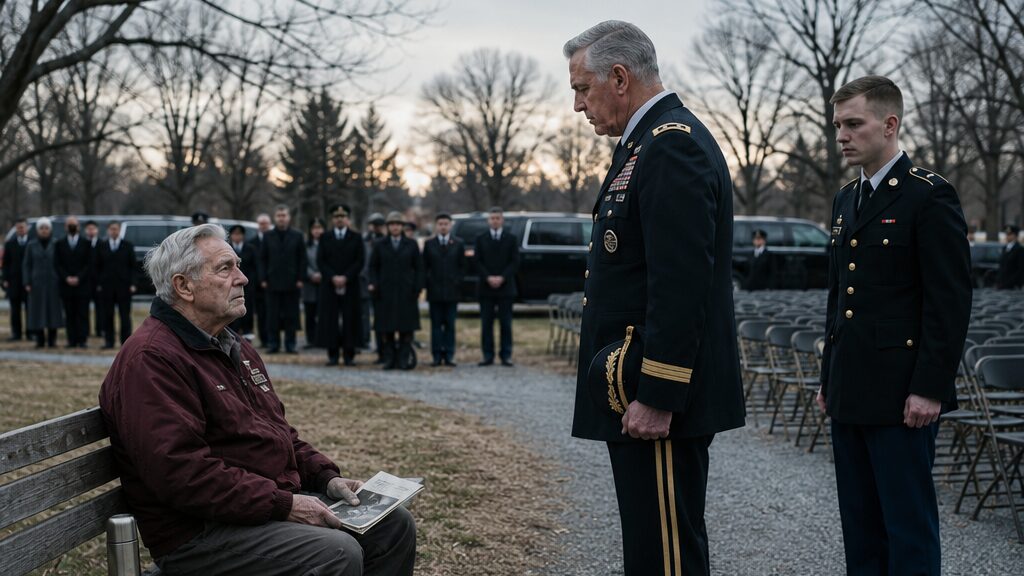
The cemetery gates were open, but the morning still felt closed, as if the cold had folded itself over the grounds and tucked every sound beneath it. Frost silvered the grass between the flat stones. Bare trees stood beyond the memorial wall with their branches lifted into a pale sky. Down the drive, two black cars idled near the curb, their windows dark, their exhaust drifting low like breath that did not want to be seen.
William paused at the entrance and let the younger people pass him.
A woman in a black coat hurried by with a box of folded programs pressed against her chest. Two cemetery workers carried a portable speaker toward the paved circle. A pair of uniformed men crossed the lawn with careful steps, their shoes shining even in the weak morning light. Nobody pushed William. Nobody was unkind. They simply moved around him the way people moved around a bench, a tree, a stone already set in place.
He kept one hand in the pocket of his burgundy jacket. The other held his cane, though he did not lean on it as much as people expected him to. His gray trousers were brushed clean. His brown shoes had been polished the night before until the leather took a dull shine under the kitchen lamp. He had stood there in his socks after midnight, polishing them with slow circles, because he could not sleep and because some habits outlived the men who taught them.
At the registration table, the woman with the programs looked up.
“Good morning, sir. Are you here for the remembrance service?”
William nodded.
“Family section is to the left. General seating is along the walkway. If you need assistance, just let one of us know.”
Her voice was warm. Practiced. She handed him a program without asking his name.
William took it carefully, the way he had taken orders once, the way he had taken letters, photographs, folded flags. He did not open it yet. He looked past her toward the memorial wall.
The bench was still there.
It sat a little left of the paved circle, under the bare limbs of an oak tree. The wood had darkened with years of rain and sun. Someone had repaired the right armrest with a newer piece of lumber that did not match. The bench faced the wall where names were cut into stone, and beyond the wall the land dipped gently toward rows of markers. William had sat there last November, and the November before that, and on a hot day in July when no ceremony was scheduled and no one had asked him why he had come.
He crossed the path slowly.
The cane tip clicked on the pavement. A young serviceman glanced at him, then at the cane, then back toward the speaker cables he was arranging. William noticed without turning his head. He had grown used to being measured by the speed of his walk.
The bench was cold when he sat down. The chill came through his trousers at once, but he did not shift away from it. He set the cane beside his right knee and rested the program across both hands.
For a moment, he did not open it.
The memorial park smelled of damp leaves and cut grass. Somewhere behind him, a vehicle door closed with a heavy, respectful sound. Voices moved in fragments.
“Honor guard at ten.”
“Chaplain’s here.”
“Family cars come through first.”
“Where do you want the wreath?”
William looked at the memorial wall. Not at all the names. Just one place. The place where his eyes always went first, though the name he searched for had never been carved there. It belonged on another list, another paper, another record that had been copied wrong so long ago that the mistake had hardened into fact.
He lowered his gaze and opened the program.
The first page held the seal of the memorial park, printed in blue. Beneath it, in formal lettering, were the words: Annual Remembrance Service for Veterans of the Winter Convoy. William’s thumb stopped on the phrase. Winter Convoy. So clean on paper. So smooth. Nobody who had written it had smelled the fuel in the snow, or heard metal crack in the dark, or tried to count men by the sound of their breathing.
He turned the page.
There was the order of service. Invocation. Posting of colors. Reading of names. Moment of silence. Wreath placement. Closing prayer.
He turned another page.
Names.
They were arranged in two columns, alphabetized, each one followed by rank and branch. Some he knew. Some he had only heard over a radio. Some were men whose faces had blurred after sixty years until only a laugh or a cough or a way of tying boots remained.
His finger moved down the first column.
Brooks.
Carter.
Coleman.
Ellis.
Foster.
Graham.
Harris.
His breathing changed before his mind admitted why.
He went to the second column. Slowly. Carefully. He had learned long ago not to trust panic.
Miller.
Mitchell.
Morgan.
Parker.
Sullivan.
Turner.
Walker.
Ward.
He looked again.
Then again.
His hand tightened, wrinkling the lower corner.
Dennis Reed was not there.
William sat so still that a woman passing behind him glanced over, perhaps wondering whether he had fallen asleep with his eyes open. He did not hear her steps fade. He did not hear the speaker crackle as someone tested the microphone. He saw only the white space where the name should have been.
Dennis Reed.
Not Reed, Dennis. Not D. Reed. Not Private Reed, as if rank could hold what the man had been. Dennis Reed, who had whistled through his teeth when he was nervous. Dennis Reed, who had written home every Sunday even when there was nothing new to say. Dennis Reed, who had taken the last cigarette in a pack and then broken it in half because William had been watching.
William smoothed the program on his knee.
The paper trembled once. He pressed it flat.
He had come that morning prepared for cold, for stiff chairs, for the ache that settled in his hip after standing too long. He had prepared for people mispronouncing names. He had prepared for the chaplain to say service and sacrifice in the soft, rounded way of people who meant well. He had prepared to sit through all of it, say nothing, and leave before the black cars pulled out.
He had not prepared for absence.
A young cemetery worker carried a bundle of small flags past the bench. One slipped loose and fell near William’s shoe. The worker stopped, embarrassed.
“Sorry, sir.”
William bent before the young man could reach it. His fingers were slower than they used to be, but they closed around the small wooden stick. He lifted the flag and handed it back.
“Thank you,” the worker said.
William nodded.
The worker went on.
William looked at the program again. The blankness had not changed.
He searched the page for a footnote. He checked the back. He looked at the list of donors, sponsors, committee members, acknowledgments. Dennis was nowhere. Not in ink. Not in print. Not in the ceremony that had brought everyone here in dark coats and polished shoes.
He turned toward the registration table.
The woman in the black coat was speaking into a handheld radio now. A line of attendees had formed in front of her. A man asked about parking. Someone else wanted to know where the restrooms were. The ceremony had begun its own movement, one that did not wait for old men on benches.
William folded the program once along its crease.
He placed his palm over it and held it against his knee.
For several seconds he did not move. He listened to the flags snapping softly where the honor guard had begun to prepare. He listened to the cars idling. He listened to voices arranging grief into a schedule.
Then he reached for his cane.
Getting up took longer than he wanted. First the cane, then his right foot planted square, then one hand on the bench arm. Pain traveled from his hip down into his knee, bright and familiar. He stood anyway.
Halfway to the registration table, a gust of cold wind lifted the open edge of the program. William caught it against his coat. The paper made a small cracking sound.
The woman in the black coat saw him approaching and gave him the same kind smile she had given everyone else.
“Sir, did you need help finding your seat?”
William stopped in front of the table. Behind her, stacks of programs sat in clean piles. Boxes. Lists. Clipboards. Pens tied with string.
He laid his program down and touched the empty place with one finger.
“You left him out,” he said.
Chapter 2: The Name Nobody Had Time to Check
Patricia Miller looked first at William’s finger, then at his face.
“I’m sorry?”
William did not lift his hand from the program. “A name is missing.”
Behind Patricia, a radio popped with static. Someone asked whether the second family car had arrived. Patricia turned her head just enough to answer, “Copy, have them wait by the drive,” then looked back at William with the patient attention of a person trained to solve small emergencies before they became visible.
“Which name, sir?”
“Dennis Reed.”
Patricia reached for the program, and William let her take only the top edge. She glanced down the printed columns quickly.
“Reed,” she murmured. Her finger moved through the second column. “I don’t see it.”
“That is what I said.”
Her smile faltered, not from offense but from schedule. She looked toward the paved circle where the honor guard stood in partial formation. “These lists came from the records office. We had them confirmed last week.”
“They confirmed wrong.”
A man in a dark coat leaned around William to pick up two programs from the table. Patricia handed them over without looking away from William.
“Sir, are you a family member of Mr. Reed?”
William did not answer immediately. The question had a clean shape, but there was no clean answer to fit inside it.
“No.”
“Were you invited by his family?”
“No.”
“Then may I ask how you know he belongs on this list?”
William’s mouth tightened. Not anger. Not yet.
“I was there.”
Patricia’s expression softened too quickly. It was the softness William had come to distrust, not because it was cruel, but because it lowered the person receiving it into a chair before they had chosen to sit.
“I understand. A lot of people here knew someone from the convoy.”
William looked at her.
“I was there,” he repeated.
A younger uniformed serviceman approached from the walkway, carrying a coil of black cable in one hand. His nameplate read Carter. Daniel Carter, from the sharp way Patricia said his name before he reached them.
“Daniel, could you help this gentleman? He has a question about the printed names.”
Daniel shifted the cable under one arm and gave William a respectful nod. “Sir.”
William nodded back.
Patricia slid the program toward Daniel. “He says there’s a missing name. Dennis Reed. I don’t have time to call records before we begin.”
Daniel looked down. He was young enough that his face had not yet learned how to hide impatience completely. It showed in the brief tightening around his eyes, then vanished beneath courtesy.
“We can take your information, sir,” Daniel said. “If there’s an error, the office can review it after the service.”
“After the service, his name will not be read.”
Daniel paused. “I understand that matters to you.”
“It mattered to him first.”
The answer landed a little harder than Daniel expected. He glanced at Patricia. She checked her watch.
“Daniel, the front bench needs to be cleared before the family arrives,” she said quietly. “Could you make sure he’s seated with general attendees? We’re at twelve minutes.”
William picked up the program before Daniel could.
Daniel’s voice stayed mild. “Sir, do you have a place to sit? I can walk with you.”
“I had a place.”
“The bench by the front?”
“Yes.”
Daniel looked toward it. The bench stood empty now under the oak tree, facing the memorial wall. The repaired armrest caught a pale strip of light.
“That section is reserved,” Daniel said. “Family, senior officers, and ceremony participants.”
William looked past him to the wall. “Dennis has no family in that section?”
“I don’t know, sir.”
“Then it is not full.”
Daniel’s jaw moved once. He was trying to be kind. William could see the effort, and the effort made him tired.
Patricia lowered her voice. “Mr.—I’m sorry, I didn’t get your name.”
“William Bennett.”
“Mr. Bennett, we want everyone honored properly. We do. But the program is already printed, and the ceremony is about to start. I can write the name down and give it to the office.”
She reached for a pen.
William covered the program with his hand.
“No.”
The word was not loud. It did not need to be. Patricia’s pen stopped above the clipboard.
Daniel shifted his weight. The cable coil tapped against his leg.
“Sir,” he said, “nobody is trying to disrespect anyone. We just have to keep the event moving.”
William looked at the black cars near the drive. One of the drivers stood outside now, hands folded in front of him. People in dark coats were gathering in small groups, speaking softly. Beyond them, the flags had been placed near the lectern. Everything was moving. That was the problem.
“They kept the convoy moving too,” William said.
Daniel did not know what to do with that.
Patricia’s face changed. For a second she looked less like a coordinator and more like a daughter who had once watched her father refuse help with a jar lid. Then the radio at her waist spoke again, and the moment disappeared.
“Daniel, please,” she said.
Daniel turned slightly, inviting William to walk with him. “Let’s get you settled, Mr. Bennett. I’ll make sure someone follows up.”
William held the program folded in half.
“You keep saying that like the name can wait.”
“I’m saying I don’t have authority to change the program five minutes before the service.”
“You have authority to move me.”
Daniel’s eyes dropped.
The words were fair, and because they were fair, they stung.
A gust of wind moved across the table and lifted the top program from a stack. Patricia caught it with one hand and pressed it back into place. Her fingers were red from the cold.
“Mr. Bennett,” she said, more softly now, “the bench really is reserved.”
“For whom?”
“For immediate family of the men being specially acknowledged.”
William looked at the program again. The two columns of names had become too clean. Too final. He remembered muddy paper in a field office. A manifest written by a shivering clerk. A radio call broken by weather. A name repeated twice and still entered wrong.
“Dennis Reed was immediate,” he said.
Patricia did not respond. She could not. The sentence did not fit any of the categories on her clipboard.
Daniel took a breath. “Sir, do you have documentation? A photo, a letter, a service card, anything that would help us verify before—”
William almost laughed. The sound rose in his chest and died there.
Documentation.
For a moment he was back in a truck with no doors, holding a canvas strap with one hand and a folded envelope with the other, while Dennis yelled something William could not hear over the engine. For a moment he felt snow sting the left side of his face and smelled oil burning under cold metal. For a moment he saw Dennis’s grin, quick and crooked, before the dark took it.
William opened his coat enough to reach the inside pocket. Daniel straightened a fraction, not alarmed, only attentive.
From the pocket William drew a small photograph in a cloudy plastic sleeve. The sleeve had cracked at one corner. The picture inside was black and white, worn almost silver along the edges. Five young men stood beside a transport vehicle, shoulders pressed together against wind. One had his cap tilted back. One held up two fingers behind another’s head. William, twenty-two and unsmiling, stood at the end. Dennis Reed stood beside him with one hand on William’s shoulder, as if holding him in the frame.
William handed it to Daniel.
Daniel accepted it with both hands, more carefully than he had held the program.
Patricia leaned closer.
“There,” William said, tapping the plastic over Dennis’s face. “That is Dennis.”
Daniel studied the photograph. “Do you know what year this was?”
“Yes.”
The answer came too sharply. William closed his eyes once.
“Do you know which unit?” Daniel asked.
William opened them. “Yes.”
Daniel waited.
William did not give the unit. Not yet. To say it was to open a door that had stayed shut for most of his life. He had not come to talk about himself. He had come for a name.
Patricia checked the time again, and guilt crossed her face before she could hide it.
“I’m sorry,” she said. “This may be real. I’m not saying it isn’t. But we can’t verify a photograph in the next few minutes.”
William took the photograph back. His fingers lingered over Dennis’s face before he slid it into his pocket.
The first notes of a bugle warm-up drifted from the far side of the path, not a melody yet, just a thin, uncertain sound.
Daniel touched William’s elbow lightly. “Mr. Bennett, please. Let me help you to a seat.”
William looked at the hand, and Daniel removed it at once.
The old man turned away from the table.
For a second Daniel thought he had agreed.
But William walked back toward the front bench.
His steps were slow. The cane clicked once, then again. People moved aside without understanding why. Patricia whispered Daniel’s name behind him, urgent now.
“Mr. Bennett,” Daniel called.
William reached the bench and sat down with the same careful order as before: cane first, right foot planted, hand to armrest, body lowered against pain. He laid the folded program across his knees. Then he placed the old photograph on top of it, cloudy sleeve shining in the cold light.
Daniel stopped in front of him.
“Sir,” he said, quieter than before, “I need to ask you to move.”
William looked up at him.
Behind Daniel, black vehicles rolled closer. Doors opened. The first family members stepped out, wrapped in dark coats. A senior officer in formal dress uniform emerged from the second car and adjusted his cap before turning toward the memorial path.
William saw the officer. He saw the rows of chairs. He saw Patricia watching him with worry and frustration and something like pity.
Then he looked back at Daniel.
“No,” William said. “Not until someone checks the name.”
Chapter 3: When the Officer Read the Blank Space
Daniel Carter had been taught how to stand in front of confusion.
You kept your voice even. You left space between words. You did not crowd. You did not argue. You gave a simple instruction and repeated it if necessary. Most problems at ceremonies, he had learned, came from grief moving in the wrong direction: a widow who wanted to sit somewhere already assigned, a brother who arrived with a folded flag from another funeral, an old man who thought one list was supposed to include another unit from another year.
He told himself this was that.
William Bennett sat on the bench under the oak tree with a folded program and an old photograph on his knees. His cane rested against the armrest. His burgundy jacket looked too thin for the wind. His brown shoes were lined squarely beneath him, polished but worn at the toes.
“Mr. Bennett,” Daniel said, “the family cars are here.”
William did not turn.
Patricia came up behind Daniel, her clipboard held tight against her coat. Her face had gone pale from the cold and the pressure of being watched.
“Sir,” she said gently, “we have people coming who need this space.”
William’s gaze stayed on the memorial wall. “Dennis needed space too.”
A few attendees had begun to notice. Not stare, exactly. They looked, looked away, then looked again. The honor guard stood still near the lectern, uncertain whether to continue setting formation. One of the cemetery workers held a wreath halfway between the supply table and the stand, waiting for someone else’s decision.
Daniel felt the ceremony beginning to tilt.
He stepped closer, careful not to loom. “I can bring a chair beside the walkway. You’ll still be able to see everything.”
William looked at him then. “Will Dennis be able to hear his name?”
Daniel swallowed. “Sir, I don’t know Dennis.”
“No,” William said. “You don’t.”
The senior officer from the second black car had reached Patricia. His dress uniform was dark, the creases sharp enough to catch light. Silver touched his hair at the temples. He carried himself not with hurry, but with the habit of being obeyed when hurry was unnecessary.
“Ms. Miller,” he said. “Is there a problem?”
Patricia turned with visible relief. “Colonel Sullivan. I’m sorry. We have a gentleman concerned about a missing name in the program.”
The officer’s eyes moved to William.
Daniel straightened. “Sir, he says Dennis Reed was left off the Winter Convoy list.”
Colonel Paul Sullivan did not respond immediately. He looked at William, then at the program on his knees, then at the photograph in its cloudy sleeve.
“Mr. Bennett,” Patricia said, “this is Colonel Sullivan. He’s leading today’s remembrance.”
William held the officer’s gaze. “Then he should know the names.”
The words drew a small breath from Patricia. Daniel felt heat rise under his collar.
But Paul Sullivan did not take offense. He stepped closer to the bench.
“May I see the program?” he asked.
William studied him. It was the first time that morning anyone had asked as if the paper belonged to him.
After a moment, he lifted it.
Paul took the program by the edges. He did not snatch it. He did not flatten the crease impatiently. He opened it and read the two columns. His face remained controlled, but Daniel saw the slight narrowing of his eyes.
“Dennis Reed,” Paul said.
“Yes.”
“Do you know his branch?”
“Army.”
“Rank?”
William’s jaw worked once. “Private first class when I knew him. Should have been more if papers made men.”
Paul looked up.
The wind moved through the oak branches, dry and brittle.
“Unit?” Paul asked.
William’s hand closed over the photograph. “You do not need mine to write his.”
“That may be true,” Paul said. “But I need to know which record to check.”
Daniel watched William’s face. Something moved under the old man’s restraint, not confusion and not pride. It was pain drawn tight enough to hold its shape.
William looked past Paul to the line of black vehicles, to the people in dark coats, to the flag waiting beside the lectern. When he spoke, his voice was low.
“Third transport section,” he said. “Northern supply route. Winter convoy. We called it the long road home because nobody believed it.”
Paul went very still.
Daniel noticed it before Patricia did. The colonel’s posture changed by almost nothing, yet the air around him seemed to sharpen. His shoulders squared, not in command now, but recognition.
“What did you say?” Paul asked.
William’s eyes flicked back to him. “I said we called it the long road home.”
Paul looked down at the photograph. “May I?”
William hesitated.
Then he handed it over.
Paul held the sleeve in both gloved hands. Daniel moved nearer without meaning to. The picture showed five young men beside a transport vehicle. Their faces were worn by the old film, but clear enough. Paul studied the faces, then the writing along the bottom border, faded to the color of dust.
D. Reed. W. Bennett. Supply road. Winter.
Paul’s thumb stopped before it touched the plastic. He did not let himself smudge it.
“Where did you get this?” he asked.
“I was standing there when it was taken.”
Patricia looked from the photograph to William. Her lips parted, then closed.
Daniel felt the cable coil still hanging from his hand. He had forgotten he carried it.
Paul lifted his eyes. “You’re William Bennett.”
William said nothing.
“Private William Bennett,” Paul continued, softer. “Third transport section.”
“I have not been private anything for a long time.”
“No,” Paul said. “You have not.”
The colonel turned slightly. “Daniel.”
“Yes, sir.”
“Get the records clerk on the phone. Tell them I need the Winter Convoy supplemental list. Not the ceremony packet. The supplemental list.”
Daniel moved at once, then stopped. “Sir, records may not answer before we start.”
“Then tell them I am standing in front of William Bennett and asking why Dennis Reed is missing.”
The name went through the small gathering like a change in weather. Not loud, but felt. Patricia’s eyes lowered to the clipboard she had been holding like a shield.
William reached for the program. Paul returned it carefully.
“Colonel,” Patricia said, voice tight, “we’re already behind.”
Paul looked at her. Not sharply. That made it worse.
“Then we will be behind correctly.”
Patricia nodded once and stepped back.
Daniel moved toward the registration table, phone already in hand, but he kept looking over his shoulder. William remained seated. Paul remained standing before him. The difference between them should have looked simple: officer and old man, uniform and burgundy jacket, authority and guest. Instead Daniel felt he had been looking at the scene backward all morning.
He called the records number printed on Patricia’s clipboard. It rang. Rang again. Someone answered with the flat voice of a clerk already busy.
“This is Specialist Carter at the memorial service,” Daniel said. “I need verification on a Winter Convoy supplemental list. Name Dennis Reed. Associated with William Bennett. Third transport section.”
The clerk began to ask him to repeat the request.
Behind Daniel, Paul removed his cap.
The motion was small. It quieted everyone nearby more effectively than a command.
Paul tucked the cap under his arm and stood directly before William Bennett. The colonel’s face held no performance, no smile prepared for cameras, no grand public emotion. Only a careful gravity.
“Mr. Bennett,” he said, “I owe you an apology.”
William looked up at him, and for the first time that morning, uncertainty crossed his face.
“You do not owe me.”
“I do,” Paul said. “I looked at the program this morning. I did not look hard enough.”
William’s hand shifted on the bench, fingers curling around the edge of the seat.
Paul brought his heels together.
Daniel heard the clerk speaking in his ear, but the words blurred as he watched the colonel raise his right hand.
The salute was not quick. It was not ceremonial in the usual way. It was held long enough for the people near the front path to understand that something had changed, and not so long that it became spectacle.
William sat beneath the bare oak tree, photograph and program on his knees, his face lifted toward the officer. He did not salute back. His right hand twitched once near the edge of the program, then stilled. His eyes shone, but he did not lower them.
Patricia stood with her clipboard against her chest. The honor guard watched from beside the lectern. A family member halfway out of a black car paused with one hand on the door.
No one spoke.
The wind moved the corner of the program on William’s knee, lifting the page where Dennis Reed’s name was not.
Daniel pressed the phone harder to his ear.
The clerk returned, less bored now. “I found a supplemental note,” the voice said. “Reed, Dennis. Attached to casualty correction. There’s a cross-reference with Bennett, William. But it looks like the ceremony packet pulled from the primary list only.”
Daniel closed his eyes for half a second.
“Send it,” he said. “Now.”
Paul lowered his salute.
William kept looking at him, not as if honored, exactly, but as if the salute had opened a door he had been holding shut with both hands.
“Mr. Bennett,” Paul said, “were you with Dennis Reed the night the convoy turned back?”
William’s fingers closed over the old photograph.
For a moment the ceremony, the cars, the people, the flags, even the cold seemed to wait for his answer.
“Yes,” William said.
His voice was almost too quiet to hear.
“And he did not turn back.”
Chapter 4: The Man Who Took William’s Seat
They took William inside because the wind had begun to bite through his jacket, and because Paul Sullivan did not want the next part of the morning to happen in front of people who had not earned it.
The cemetery office was small, with a low ceiling and a space heater humming near a filing cabinet. A framed photograph of the memorial wall hung above a desk stacked with visitor forms. Through the narrow window, William could see the bench under the oak tree, empty now except for his cane leaning against the armrest where Daniel had left it. The sight unsettled him more than he expected. Without him on it, the bench looked like any other bench. A place to wait. A place to rest. A piece of wood that had no idea what it held.
Patricia stood near the door, her clipboard lowered to her side. Daniel was at the desk with the phone pressed to his ear, copying something onto a yellow pad. Colonel Sullivan remained standing, cap tucked beneath one arm, holding the old photograph in its cracked sleeve as carefully as if it were a folded flag.
William sat in the only chair by the wall. He had not asked for it. Daniel had brought it, and William had accepted because his hip had begun to burn and because refusing a chair out of pride would not bring Dennis back.
The office smelled of paper, wet wool, and weak coffee.
Daniel covered the phone. “They’re sending the scan. The clerk said there was a casualty correction attached to a transport manifest.”
Paul nodded once. “Ask for the original notation if they have it.”
Daniel spoke into the phone again.
William looked at the photograph in Paul’s hands. “You do not need all that.”
Paul turned to him. “I need enough to correct what we’re about to say in front of his family.”
William’s gaze moved to the window. Outside, people had begun to shift restlessly. A few chairs scraped against pavement. The honor guard remained in place, disciplined but waiting. Delay had a sound. Not loud. Just the small friction of people trying not to show impatience.
“His family came?” William asked.
Paul looked to Patricia.
Patricia straightened. “One daughter signed in. Brenda Reed. She’s listed as next of kin for Dennis Reed in our guest sheet, but because his name wasn’t in the ceremony packet, she was placed with general attendees.” Her voice thinned on the last words. “I didn’t make the connection.”
William closed his eyes.
A daughter.
He had known Dennis had a baby girl. Not from meeting her. From the photograph Dennis carried tucked behind his pay card: a tiny child in a white cap, asleep with one fist against her cheek. Dennis had shown it to anyone who stood still long enough.
“She’s got my ears,” Dennis had said once, proud as if he had built the child himself.
William opened his eyes. “How old?”
Patricia looked down at the guest sheet. “Early sixties, maybe. I don’t know.”
Of course, William thought. Babies became old women while men stayed young in photographs.
Paul set the photograph on the desk between them. “Mr. Bennett, I know this is not easy. But the official program was built from the primary list. If Dennis Reed was attached through a correction, and the correction wasn’t transferred, we need to know whether he belongs in today’s reading.”
William looked at him sharply. “He belongs.”
“I believe you.”
“No. You asked like you believe paper.”
Paul accepted that without flinching. “This morning, paper failed him. So I’m asking the man who knew him.”
The space heater clicked. Patricia looked down at her shoes. Daniel’s pen slowed against the yellow pad.
William rubbed his thumb against the side seam of his trousers. The room, the uniforms, the questions—all of it pressed gently and firmly against a door inside him.
“You want the night?” William asked.
“I want only what you are willing to give.”
That answer was worse than a demand. It left William responsible.
He leaned back, feeling the hard chair through his coat.
“We were supposed to move supplies before the pass closed. Five trucks. Bad weather coming from the west. Nobody wanted to wait because waiting meant men at the next post went without fuel.” His mouth dried. “Dennis and I were in the second truck at first. Then they changed the load order.”
Daniel was still on the phone, but he had stopped writing.
William stared at the photograph. “I had a letter from home that morning. My mother was sick. I had read it three times and was still holding it like reading could change the words. Dennis saw me. He kept making jokes. Bad ones. He had a talent for making you want to hit him and thank him in the same minute.”
No one smiled. William almost did, but it did not hold.
“The manifest had me on the lead transport after the stop at the supply shed. I was angry about something. Tired. Not thinking straight. Dennis said he needed to ride up front because he knew the driver better. That was a lie. He took my place because he thought I needed ten minutes in the back to get my head right.”
He looked toward the window again. The bench waited.
“I let him.”
The words came out flat.
Paul’s face remained still, but his hand closed once around his cap.
William continued before anyone could soften the silence. “The lead truck made the turn before the road gave. The second stopped. We heard the break over the wind. Metal first. Then men shouting. Then nothing we could reach fast enough.”
Patricia’s hand rose to her mouth and lowered again.
William’s voice did not shake. That had taken decades.
“They called it weather. Then route failure. Then enemy action in one correction and accident in another. Paper could never decide what killed him.” He tapped the photograph. “I knew what put him there.”
Daniel whispered something into the phone, then hung up. He did not speak.
Paul looked at the yellow pad. “The clerk confirmed Dennis Reed appears in a supplemental casualty correction. Cross-referenced to William Bennett. The original manifest had Bennett on the lead transport. Later notation shows Reed in that position.”
William closed his eyes again. He could hear Dennis’s voice with insulting clarity.
Move over, Bennett. You look like boiled coffee.
Such a stupid last kindness. Such a small shift of bodies. One man sitting where another had been written.
“You understand now?” William asked.
Paul’s voice lowered. “Yes.”
“No,” William said. “You understand the record. That is not the same.”
Paul did not answer.
From outside came a soft knock on the office door. Patricia turned. Before she opened it, she looked to Paul, then to William. Paul gave a small nod.
The door opened only halfway.
A woman stood on the threshold, wrapped in a dark blue coat, silver hair pinned neatly at the back of her head. Her face was composed in the careful way of people who had learned not to expect much from ceremonies. In one hand she held a program, folded open to the list of names.
“I’m sorry,” she said. “They told us there was a delay.”
Patricia stepped aside. “Mrs. Reed?”
The woman’s eyes moved from Patricia to Paul, then to William seated by the wall. She noticed the photograph on the desk.
Her fingers tightened around the program.
“Yes,” she said. “I’m Brenda Reed.”
William felt the room narrow.
Brenda looked at the photograph again. “Is that my father?”
No one answered quickly enough.
She stepped into the office, the door closing softly behind her.
William reached for the edge of the desk, not to stand, only to steady himself.
Brenda looked directly at him. “Why is my father’s name suddenly delaying the service?”
Chapter 5: The Daughter Who Only Had a Photograph
Brenda Reed did not look angry.
That would have been easier.
She stood just inside the office door with the program folded in one hand, her eyes fixed on the photograph as if she feared it might be taken away if she blinked. The room had already grown too small for the people inside it. Daniel moved back from the desk. Patricia held the clipboard against her coat again. Paul remained between the desk and the window, but he no longer looked like a man leading a ceremony. He looked like a man trying to decide whether the truth belonged to him.
William knew it did not.
Brenda took one step closer. “May I see it?”
William’s hand moved before thought. He picked up the photograph by its sleeve and held it out.
She accepted it with both hands.
For a moment she was silent. Her thumb hovered above the young man standing beside William in the picture. She did not touch the plastic. She only looked.
“I have this same face in a smaller photograph,” she said. “My mother kept it in a drawer with his last letter. But there was no truck in that one. No other men.” She looked up. “Which one are you?”
William pointed to himself at the edge of the frame.
Brenda studied the young William, then the old one. “You knew him.”
“Yes.”
The answer was too small, but it was all William had.
Brenda held the photograph nearer to the light from the window. “They told me his records were incomplete. When I was younger, I thought that meant there was something shameful.” She gave a faint, humorless breath. “Children invent things when adults leave blank spaces.”
“No shame,” William said.
Her eyes came back to him quickly.
He looked at the program in her hand. “There was never shame in Dennis Reed.”
Brenda folded the program more tightly. “Then why isn’t he there?”
Patricia lowered her gaze.
Paul said, “Because the list used for today’s program was incomplete. That is our responsibility.”
Brenda looked at him. “But you found him now?”
“Yes.”
“Because of him?” She looked at William.
Paul nodded. “Because of Mr. Bennett.”
The title sat uneasily on William. Mr. Bennett. Not Bill, as Dennis had called him only when teasing. Not Private Bennett. Not the survivor. Just a man in a chair beside a desk, unable to meet the daughter’s eyes for more than a second.
Brenda stepped toward him. “Did my father know you well?”
William’s throat worked. “Well enough to steal my socks once.”
The room shifted. Not laughter. But something like air returning.
Brenda’s mouth trembled at one corner. “He stole socks?”
“He said mine were drier. They were not. He was just too lazy to unpack his.”
A small smile appeared and vanished. “My mother said he was ridiculous.”
“He worked at it.”
Brenda looked back down at the photograph. “She didn’t talk about him much. Not because she didn’t love him. I think because people got uncomfortable. They wanted her grief to be tidy.” Her fingers pressed the sleeve. “By the time I was old enough to ask real questions, everyone who knew anything either moved away or died.”
William looked at the space heater. Its red coils glowed through the grate. “Questions are heavy things to leave a child.”
“I’m not a child now.”
“No.”
“Then tell me something true.”
Patricia shifted near the door, but Paul held up one hand slightly. Not to stop Brenda. To stop everyone else.
William looked through the window. Outside, the bench waited in the cold. Its repaired armrest caught the same pale light as before. He had sat there year after year and told Dennis nothing useful. Weather. Who had died. How the town had changed. He had never told Dennis that his daughter had grown old enough to stand in a cemetery office and ask for truth.
“He liked peanut brittle,” William said.
Brenda blinked.
“Kept it in his pocket until it stuck to the wrapper. Offered it anyway. Sang badly. Not regular bad. Special bad.” William rubbed his thumb along his trouser seam. “He wrote letters every Sunday. Even when there was no paper, he found some. Even when there was nothing to say, he said it.”
Brenda’s eyes shone now, but she did not wipe them.
“He had a picture of you,” William continued. “White cap. Tiny fist. He showed it like he was presenting evidence in court. Said you had his ears.”
Brenda covered her mouth. The sound she made was not quite a laugh.
“My mother hated those ears,” she whispered.
“He was proud of them.”
She looked again at the photograph. “Was he afraid?”
William felt the old door inside him move.
The office went quiet in a different way.
Brenda seemed to understand the question had gone somewhere she had not meant to send it. “I’m sorry.”
“No,” William said. “You have a right.”
He had thought about this question for sixty years, though no one had asked it so plainly. Was Dennis afraid? Men liked to clean the dead after they were gone. Brave. Steady. Fearless. Words polished until no fingerprints remained. Dennis had been brave. He had also cursed when the road iced. He had checked the sky too often. He had gone quiet when the engines coughed wrong.
“Yes,” William said. “He was afraid sometimes.”
Brenda closed her eyes.
William leaned forward, both hands now on the head of his cane. “But fear did not make him smaller. He carried it and still did what he thought was needed. That is different from not being afraid.”
Brenda nodded once, slowly.
“Did he die alone?” she asked.
The question entered the room and stayed there.
William could not stop seeing the road. The snow slanting hard. The front transport tilted beyond the turn, one wheel still spinning. Men calling names into weather that swallowed them. A lantern swinging. Someone holding William back because the ground would not hold.
He had told himself for years that the answer was mercy: quick, probably quick, no time to know. But Brenda had not asked whether death came fast. She had asked whether her father had been alone.
“No,” William said.
The word cost more than he expected.
Brenda stared at him.
William held her gaze because looking away would be another kind of cowardice. “We were calling him. I do not know what he heard. I will not pretend I do. But he had men trying to reach him. He had his name in our mouths.”
Brenda pressed the photograph to her chest.
“He had his name in our mouths,” William repeated, softer. “That is why I could not sit out there and let them skip it.”
Paul looked down. Daniel turned toward the window. Patricia wiped quickly beneath one eye and pretended to check the door.
Brenda lowered the photograph. “Why didn’t anyone tell us about you?”
William breathed in. The air caught.
“Because I did not come.”
Her expression changed.
“My mother’s funeral?” she asked. “The veterans’ dinner? The dedication ten years ago? There were places you could have come.”
“Yes.”
The word was bare.
“Why didn’t you?”
William looked at the old photograph in her hand. Five young men. Two who came home. One who never should have taken his seat.
“I thought your mother had enough grief without mine standing at her door.”
Brenda’s face tightened. Not cruelly. Truthfully.
“That wasn’t your choice to make for her.”
William bowed his head.
“No,” he said. “It was not.”
For the first time since entering the office, Brenda looked less like someone seeking a record and more like someone who had found another absence.
Outside, a microphone gave a low hum and then went silent. The service was still waiting. The people were still waiting. Dennis Reed was still not on the printed page.
Paul stepped forward, careful. “Mrs. Reed, Mr. Bennett. We can delay a few more minutes. I have confirmation enough to add Dennis Reed to the reading. But how we do that—how much is said—should not be decided by me alone.”
Brenda looked at William.
William looked at the program in her hand, creased where her fingers had held it too tightly.
He had come to restore a name, not open a wound. But the wound had already been open. It had simply been carried by more people than he knew.
Brenda held the photograph out to him. “I want them to say his name.”
William took it.
Then she asked, very quietly, “And I want to know what place he took.”
William’s fingers tightened around the sleeve.
Daniel looked from Brenda to William, understanding arriving slowly and painfully. Patricia’s lips parted. Paul did not move.
William looked past them all, through the window, to the empty bench.
“He took mine,” he said.
Chapter 6: Permission to Speak the Name
When William stepped back outside, the cold met him like a hand against the chest.
The ceremony grounds had gone still in the way crowds become still when they know something has happened but have not been told what. People stood near their chairs with programs folded in gloved hands. The honor guard waited beside the lectern. The black cars lined the drive. A wreath rested on its stand, red ribbon lifting and falling in the wind.
William saw his cane leaning against the bench, exactly where Daniel had left it. He had the strange thought that the cane looked patient.
Daniel reached it first. He picked it up and brought it to William, but this time he did not offer his elbow or guide him by the arm.
He held the cane horizontally across both palms.
William looked at it, then at him.
Daniel’s face had changed. Not dramatically. He still looked young. Still formal. But something had settled in him. He was not handling an old man now. He was standing before one.
“Sir,” Daniel said, “your cane.”
William took it. “Thank you.”
Daniel nodded once and stepped back.
That was the first correction of the day.
Paul walked to the lectern while Patricia moved quickly between the registration table and the chairs, carrying a small stack of freshly printed inserts. The office printer had produced them badly at first, the ink streaking Dennis Reed’s name across the page like a wound. Patricia had thrown those sheets away with shaking hands and tried again. Now the corrected inserts moved through the first rows one by one.
Brenda stayed beside William.
She had not taken his arm. He had not offered it. They walked slowly together toward the bench, not as family and not as strangers anymore, but as two people approaching the same name from opposite sides of a long silence.
“Do you want to sit?” she asked.
William looked at the bench.
For years it had been his place to disappear. He would sit, say a few words no one heard, and leave before anyone could ask him what he had lost. That morning it had become a place others tried to remove him from. Now the whole front of the ceremony seemed arranged around it, and that made him want to turn and walk to the farthest row.
“Yes,” he said.
Brenda let him sit first.
The wood was still cold. His body remembered the shape of it. The program rested in his lap, opened now to the insert Patricia had placed inside.
Dennis Reed
Private First Class, United States Army
Third Transport Section, Winter Convoy
William read the lines once. Then again. The words were too small for the man, but they were there.
Paul stood at the lectern and adjusted the microphone. A low hum passed through the speaker and faded. He looked out at the crowd, then toward the bench.
He did not begin.
Instead, he stepped away from the lectern and walked across the paved circle to William.
The movement drew every eye.
William felt Brenda stiffen beside him. Daniel stood near the front row, hands folded behind his back. Patricia stopped halfway down the aisle with the last of the inserts pressed to her chest.
Paul halted before the bench, close enough to speak without the microphone.
“Mr. Bennett,” he said, “Mrs. Reed. Before we begin again, I need your permission.”
William looked at him.
Paul held a corrected insert in his left hand. “I can read Private First Class Dennis Reed’s name with the others. I can also state that his omission was an error in our program. I will not say more unless you both want more said.”
Brenda looked at William. He could feel the question between them.
Tell them.
Do not tell them.
Let the dead keep what little privacy they have.
Let the living stop guessing.
William looked at the crowd. Faces in dark coats. Veterans standing with canes. Families holding programs. Young uniformed men trying not to stare. He did not owe them the whole night. Dennis did not owe them a story polished for ceremony. But Brenda deserved not to leave with another blank space.
William touched the corrected insert.
“Say his name,” he said.
Paul waited.
William swallowed. The wind moved under the collar of his burgundy jacket.
“Say there was a record error,” William continued. “Say he was there. Say he did not come home.” His eyes moved to Brenda, then back to Paul. “Do not make him larger than he was. He was already enough.”
Paul’s expression tightened, not with disagreement but with respect.
Brenda’s voice was soft. “And say he was not alone.”
William closed his eyes for one second.
Paul bowed his head. “I will.”
He returned to the lectern.
No one whispered now.
Paul placed the corrected insert beside his notes, but when he spoke, he did not look down immediately.
“Ladies and gentlemen,” he said, his voice carrying across the cold grounds, “thank you for your patience. Before this remembrance service continues, we must correct an omission.”
William gripped the edge of the bench.
“This morning’s printed program was prepared from an incomplete record. A supplemental casualty correction was not included. That failure belongs to the record and to those of us who relied on it too quickly. It does not belong to the man whose name was left out.”
Patricia lowered her head.
Paul looked down at the insert.
“Private First Class Dennis Reed, United States Army, Third Transport Section, Winter Convoy.”
Brenda’s breath broke beside William. She did not sob. She only leaned forward slightly, as if the name had reached her from far away and she needed to meet it halfway.
Paul continued, “Private Reed was present on the winter route being remembered today. He did not return home. He was not alone.”
The words moved through the crowd without drama. That made them stronger. There was no swelling music, no burst of applause, no grand gesture. Just the name, corrected in the air.
William looked at the program in his lap. The ink blurred. He blinked until it sharpened again.
Paul resumed the ceremony.
The chaplain gave the invocation. The honor guard posted the colors. The names began. One by one, each was read into the cold morning. William listened to them all because each name deserved at least that. Brooks. Carter. Coleman. Ellis. Foster. Graham. Harris. Miller. Mitchell. Morgan. Parker.
Reed.
William heard it the second time, placed where it belonged among the others. Not delayed. Not explained. Not rescued from the margins. Simply there.
His hand moved to the photograph in his coat pocket.
For the first time in years, he did not press his thumb over Dennis’s face to keep it safe. He left the photograph alone.
When the moment of silence came, the cemetery seemed to hold its breath. Even the idling cars were shut off now. No engines. No radio chatter. Only wind in bare branches and a flag rope tapping lightly against its pole.
William did not pray in words.
He sat on the bench and remembered Dennis badly, which was to say honestly. Dennis complaining about cold coffee. Dennis singing off-key. Dennis cheating at cards and acting wounded when accused. Dennis holding up the picture of his baby daughter. Dennis looking at William’s letter from home and saying, Move over, Bennett.
The silence ended.
The wreath was placed. The closing prayer was spoken. Chairs scraped softly as people began to stand.
William remained seated.
He was tired now in a way that had nothing to do with his hip. Brenda sat beside him, her hands folded over the corrected program. She did not speak. He was grateful for that.
Then Daniel approached carrying a folding chair.
William looked up.
For one brief, absurd moment he thought Daniel had come to move him after all.
But Daniel unfolded the chair beside the bench, angled slightly away so it did not crowd Brenda. He did it carefully, pressing each leg into the grass until it stood firm. Then he stepped back.
“Colonel Sullivan may have a few people who want to speak with you,” Daniel said. “Only if you want that. I thought I’d put this here in case you’d rather they not stand over you.”
William looked at the chair.
A small thing.
A changed thing.
Brenda turned her face away.
William looked at Daniel. “You learned fast.”
Daniel’s jaw tightened. “Not fast enough, sir.”
William did not correct the sir.
Beyond Daniel, Paul Sullivan was speaking quietly with Patricia near the lectern. Patricia had a corrected insert in one hand and a stack of flawed programs in the other. One by one, she was removing the old pages from the table.
William watched her work.
Then Paul looked toward him, not with command, not with ceremony, but with a question.
William understood what he was asking from across the grass.
Is this enough?
William looked at Brenda’s hands holding Dennis’s printed name. He looked at the bench beneath him, no longer quite the same place it had been that morning.
He gave one small nod.
Paul returned it.
Daniel did not go back to formation. He stood a little behind the chair, not guarding, not managing, simply waiting in case he was needed.
Brenda finally spoke.
“When you’re ready,” she said, “I want to hear about the socks.”
William’s laugh came out rough and surprised, like something pulled from a drawer after years of being folded away.
He looked at the corrected program between them.
Then he looked toward the memorial wall, where the stone names caught the winter light.
“I can start there,” he said.
Chapter 7: Someone Finally Sat Beside Him
Most people did not leave all at once.
They lingered in the cold with their programs folded against their chests, as if the paper had become heavier after the ceremony ended. Some moved toward the memorial wall. Some stood by the black cars and spoke in low voices. A few approached Colonel Sullivan, shook his hand, and glanced toward the bench without coming closer. It was not fear that held them back. It was the sense that the place around William had changed, and that stepping into it required permission.
William was grateful for the distance.
His hip ached. His hands were cold inside his gloves. The morning had taken more from him than he had expected, though he could not say exactly what had been removed. For years he had carried Dennis Reed’s name like a match cupped against the wind. Now the name had been spoken aloud, printed cleanly, placed in other hands. The match had not gone out. It had become a small flame in a place where others could see it.
That should have relieved him.
Instead, it left him unsure what to do with his empty hands.
Brenda sat beside him on the bench, the corrected program open across her lap. The old photograph rested on top of it in its cloudy sleeve. She had not asked more after the ceremony. Not at once. She had watched the wreath placed near the memorial wall, watched Paul salute the flag, watched Daniel stand with his shoulders set and his eyes forward. When the final prayer ended, she had remained seated as if rising too soon would disturb something fragile.
Now her thumb rested beside her father’s printed name.
“Every year?” she asked.
William looked at her.
“You said you came here before.”
He nodded. “Most years.”
“To this bench?”
“When I could drive. Later, when someone from the veterans’ home brought a group, I came with them and slipped away.”
Brenda looked along the length of the bench. The repaired armrest, the weathered seat, the dark grain worn smooth where people had sat. “Why here?”
William considered giving her the easy answer: because it faced the wall, because it was quiet, because his legs needed rest. All true. None enough.
“The first time I came,” he said, “there were too many people near the wall. I did not want to explain myself. So I sat here until they left.”
“And after that?”
“After that, it knew me.”
Brenda’s eyes softened, but she did not smile.
A few feet away, Daniel stood beside the folding chair he had placed earlier. He was not listening openly, but he could hear enough if he wished. William did not mind. The young man had earned the right to overhear by learning to be still.
Patricia approached from the registration table with a cardboard box tucked under one arm. She stopped before she reached them, glanced at Brenda, then at William.
“Mr. Bennett,” she said.
William looked up.
Patricia held out a corrected insert. Not the one from Brenda’s program. Another one, freshly printed, flat and clean. “I’m going to mail these to every family who signed in today. And to the records office.” She swallowed. “I also asked them to send a formal correction for our archive.”
William took the insert.
Dennis’s name sat alone in the center of the page because Patricia had not tried to squeeze it between other lines.
“That is good,” William said.
Her eyes reddened. “I should have listened sooner.”
He looked at her for a moment. In her face he saw the morning again: the watch-checking, the clipboard, the hurry, the kindness that had not known how to stop itself from becoming dismissal.
“Yes,” he said.
Patricia accepted the word as if it weighed what it should.
Then William added, “You listened before the day ended.”
Her mouth trembled. She nodded once and stepped back, holding the box tighter as she returned to the table.
Brenda watched her go. “You let people off easier than I do.”
“No,” William said. “I am old. I save my strength for the important parts.”
That brought the smallest laugh from her. It did not last, but it warmed the air between them.
Colonel Sullivan came next, but he did not bring others with him. He stopped near the folding chair Daniel had placed and waited until William noticed him.
“May I sit?” Paul asked.
William glanced at the chair, then back at him. “You brought your own.”
“Specialist Carter did.”
Daniel’s eyes flicked down.
William nodded.
Paul sat, careful not to crowd the bench. For a few moments the three of them looked toward the memorial wall. Paul held his cap in both hands. Without the height and distance of the lectern, he looked older.
“The records clerk sent more after the service,” Paul said. “The correction existed. It was filed under an alternate transport manifest and never merged into the main list. That will be fixed.”
“Paper fixing paper,” William said.
“Yes.” Paul turned the cap slowly in his hands. “But people will read it.”
William accepted that.
Paul looked at him. “You said earlier that I understood the record, not the night.”
William kept his gaze forward.
“You were right,” Paul said. “I still don’t understand the night. I won’t pretend to. But I can make sure my part of the record stops failing him.”
William breathed out through his nose. The cold made it visible.
“That is a part worth doing.”
Paul nodded, and for a while no one spoke.
Then Brenda lifted the photograph from her lap. “Colonel Sullivan, do you know if there are more pictures like this somewhere?”
Paul leaned forward enough to look but not touch. “There may be. Unit archives. Local collections. Sometimes families donate copies.” He looked toward Daniel. “Specialist Carter can help start that request.”
Daniel stepped closer. “Yes, ma’am. I can write down the office contacts before you leave.”
Brenda nodded. “Thank you.”
Daniel looked at William. “And if you’re willing, sir, I can make a copy of that photograph for the archive. Only if you want.”
William looked at the cloudy sleeve.
For decades, the photograph had lived in drawers, coat pockets, cigar boxes, and one winter under the lining of his suitcase when he moved from the house after his wife died. It had been proof, burden, conversation, and accusation. He had guarded it so long that the thought of copying it felt, at first, like betrayal.
Then Brenda touched the edge of the sleeve.
“Not today if you don’t want,” she said.
William looked at her hand near Dennis’s young face.
“He showed everyone your baby picture,” he said.
“So you told me.”
“He would hate that I kept this one mostly to myself.”
Brenda’s fingers stilled.
William handed the photograph to Daniel.
“Make one copy for her,” he said. “One for the archive. Bring this back.”
Daniel took it with the same two-handed care Paul had used earlier. “I will.”
He walked toward the office, not fast, not slow. Like someone carrying something breakable because it was.
Paul stood. “Mr. Bennett, Mrs. Reed.”
Brenda looked up.
Paul put his cap under his arm again and gave them both a small bow of the head, not a salute this time. Something quieter. Less official. More human.
Then he left them on the bench.
The crowd thinned. The black cars started one by one and pulled away from the curb. The honor guard packed its flags. Patricia removed the last old program from the registration table and placed it facedown in her box.
The cemetery returned slowly to itself.
Brenda stayed.
At last she said, “Tell me about the socks.”
William looked at her, and this time the laugh came easier.
“He stole them during a rain week,” William said. “Not good rain. Cold rain. The kind that gets into everything and sits there. We were all pretending our feet were not rotting off.”
Brenda smiled faintly.
“Dennis said dry socks were a constitutional right. I told him he did not know what the Constitution was. He said that was why he was defending it in spirit.”
“That sounds like something my mother would have hated.”
“He had a talent.”
William told her the story, not well at first. He doubled back. Lost a detail. Found it again. The order mattered less than he had always believed. Brenda listened not like someone collecting evidence, but like someone warming her hands over a small fire.
He told her about the peanut brittle. The singing. The letters. The time Dennis tried to cut his own hair and had to wear a cap for two weeks. He did not make Dennis noble in every sentence. He let him be foolish, irritating, generous, afraid, young.
Brenda cried when he told her about the baby picture, though he had already mentioned it once. Sometimes truth needed to arrive twice before it found the place it belonged.
Daniel returned with the photograph and two copies in a plain envelope. He gave the original back to William first.
William held it for only a moment before placing it on top of Brenda’s corrected program.
“You keep it until you make your own copy,” he said.
Brenda looked at him. “Are you sure?”
“No.”
She waited.
He tapped the bench once with two fingers. “But I am doing it.”
She covered the photograph with her hand.
The sun had risen higher, though it gave little warmth. Light touched the memorial wall and caught in the engraved names. William looked at them, then at the corrected insert in Brenda’s lap. Dennis’s name was not on the stone, not yet. Perhaps it would never be. But it was no longer only in William’s mouth.
Brenda folded the program carefully around the insert and photograph.
“Will you come next year?” she asked.
William leaned back against the bench. His body was tired. His chest hurt in an old, hollow way, but beneath it there was space he did not recognize.
“If I can.”
“I’ll sit here,” she said. “If you don’t mind.”
William looked at the other half of the bench.
For a long time, that half had belonged to the dead because the living had not known how to ask.
“I do not mind,” he said.
Brenda slipped the corrected program into her coat. Daniel had moved away to help Patricia with the last box. Paul stood near the drive, speaking to a cemetery worker, but his posture had eased. No one was watching William now as if he were a problem to solve. No one was rushing him from the bench.
He placed his cane across his knees.
The wind lifted a loose corner of the insert Brenda had left beside him, the extra copy Patricia had given him. William caught it before it could slide away. He looked at Dennis’s name one more time.
Then he set the paper on the bench between himself and Brenda.
Not hidden in his pocket. Not folded inside his coat. Not held down by his palm.
Just there.
Brenda reached over and rested two fingers lightly on the edge of it, sharing the weight.
William looked toward the winter trees, toward the memorial wall, toward the place where the road inside him had turned for sixty years and never found its way back.
For the first time, he did not sit alone with it.
The story has ended.