The Navy Officer Saluted the Old Man in the Plaid Shirt Outside the Restaurant
Chapter 1: The Old Man Blocking the Restaurant Door
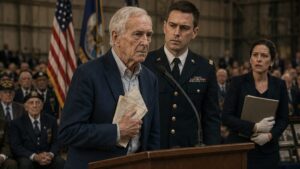
Ronald Bennett arrived before the flags were straightened.
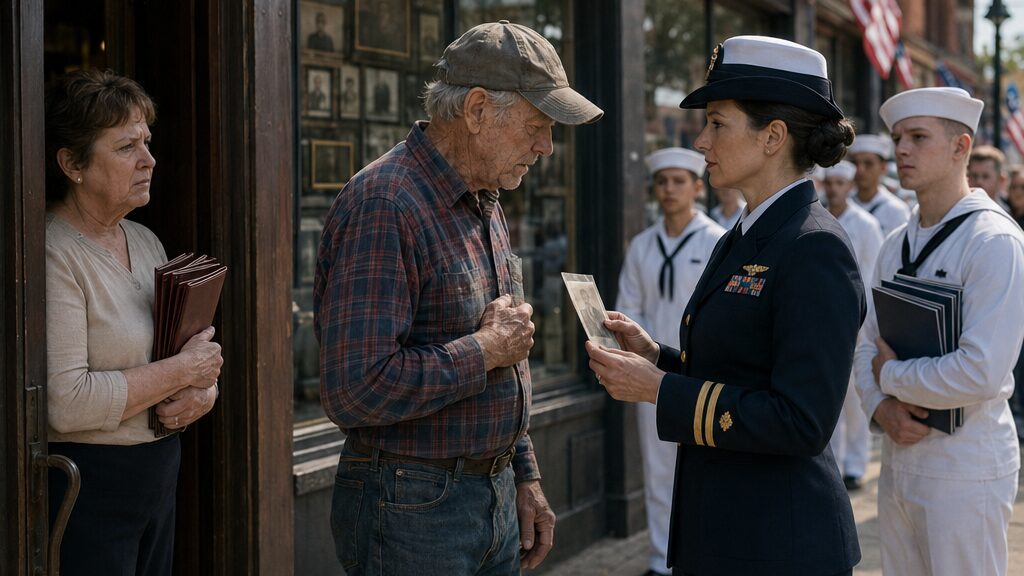
He came walking slowly up Maple Street with one hand tucked close to his chest, not because the morning was cold, but because the pocket of his red-and-blue plaid shirt held something that had already survived too much handling. The shirt was clean but old, soft at the collar and faded where the sun had reached it over many summers. His jeans had a pale line above the knee from years of bending in a garage. His shoes were polished only at the toes, the way a man might polish them while sitting at the kitchen table and deciding that was enough.
Downtown had changed since the last time he had let himself stop in front of Miller’s Harbor Grill. The barber pole on the opposite corner was gone. The hardware store was now a phone repair shop. The old movie theater had become a church with black letters on a white sign. But the restaurant still stood where it always had, with its green awning and brass door handle and windows that reflected the parked cars along the curb.
An American flag hung from a pole bracket two storefronts down, shifting lightly in the May air. Someone had tied blue ribbons around the lampposts. A chalkboard near the restaurant entrance read, WELCOME NAVY GUESTS, in careful white letters, with an anchor drawn underneath.
Ronald stopped before the chalkboard.
He looked at the anchor longer than he meant to.
Behind the restaurant windows, staff moved quickly, carrying trays, folding napkins, setting glasses at long tables. White tablecloths had been laid in rows. Small flags stood in coffee mugs along the counter. On the far wall, just visible through the glass, hung the restaurant’s old memory display: framed photographs of ships, sailors, homecomings, fishing boats, and town celebrations.
Ronald’s hand moved to his shirt pocket.
The photograph inside was no bigger than his palm. Its corners were soft, almost furred with age. He had kept it in a clear sleeve that had yellowed near the seam. He could feel its stiff edge beneath the cotton of his shirt.
He stepped toward the door.
Before he could reach the handle, it swung open from inside and a woman carrying a stack of folded menus nearly collided with him.
“Oh,” she said, stopping sharply. “Sir, I’m sorry, we’re not open yet.”
Ronald took one step back. “I’m not here for lunch.”
The woman looked past him toward the street, then back at him. She was in her late fifties, maybe early sixties, with short brown-gray hair, a pressed blouse, and the distracted expression of someone whose morning had already gotten away from her.
“I understand,” she said, though her tone made clear she did not. “But we have a private event today.”
“I know.”
That made her pause.
Ronald removed his cap and held it against his side. His gray hair, thin and flattened, lifted a little in the breeze. “I was hoping to speak to whoever handles the wall.”
“The wall?”
“The photographs.”
The woman tightened her grip on the menus. “That would be me, but this isn’t a good time.”
From inside, someone called, “Carol, where do you want the extra chairs?”
The woman half turned. “Along the back until I say otherwise.”
So this was Carol Miller. Ronald remembered the Millers only as a name painted on the side of delivery trucks. Her father, maybe grandfather, had owned the place when it was still called Miller’s Lunch Room, when sailors came in with sea bags and got coffee before the buses took them inland.
Carol looked back at him. “Sir, I’m sorry. We’re expecting officers from the base, the mayor, half the town council, and a photographer who was supposed to be here twenty minutes ago.”
“I won’t take long.”
“That’s what everyone says on event days.”
Ronald nodded once, accepting the truth of it. He shifted to the side of the doorway, but not away from it. The movement made the photograph press against his ribs.
Carol’s eyes dropped to his hand.
He realized he was covering the pocket again and lowered his arm.
“I need to put something back,” he said.
Carol glanced through the window at the memory wall. “If you have a picture for the display, you can leave it with me. I’ll look at it next week.”
“Today would be better.”
Her face changed—not cruelly, not with anger, but with that brisk public smile people used when they had already decided no. “Today is impossible.”
Ronald looked past her into the restaurant. A young worker set plates at a long table and checked them against the light. Another employee wiped a frame on the wall. The memory display seemed brighter than he remembered, cleaner, newly arranged under small brass lamps.
But the gap was still there.
Not an obvious hole. Not to anyone else. Just a space where the frames were too evenly spread, as if someone had tried to make absence look intentional.
Ronald stared at that space until Carol stepped slightly into his line of sight.
“Sir?”
“There was a photograph there,” he said.
“There have been a lot of photographs there.”
“This one had five men standing by the east window.”
Carol drew a breath. “The wall was redone last winter. Some of the older items were damaged. We scanned what we could.”
“This one wasn’t damaged when I last saw it.”
“When was that?”
Ronald put his cap back on slowly. “A while ago.”
From farther down the sidewalk came the sharp sound of car doors closing. Carol looked over Ronald’s shoulder and stiffened.
“Oh, no,” she said under her breath. “They’re early.”
Ronald turned.
A small group of sailors in white dress uniforms was forming near the curb. Their covers caught the light. A few carried garment bags. One held a folded banner. They moved with the controlled efficiency of people trained to make waiting look organized.
Behind them, a woman in a dark Navy dress uniform stepped from a black vehicle. She had dark hair pinned beneath her cover, a composed face, and the posture of someone who could hear disorder from across a street. She spoke briefly to a young sailor, then looked toward the restaurant.
Carol tucked the menus under one arm and lowered her voice. “Sir, please. I need this entrance clear.”
Ronald moved another half step aside, but the doorway was narrow, and his body still occupied the patch of sidewalk between the chalkboard and the open door.
“I can wait,” he said.
“That’s the problem. You can’t wait here.”
A couple of bystanders had gathered near the neighboring storefront. One elderly regular stood with a hand on a cane, watching. A woman from the restaurant leaned out, saw Ronald, then disappeared inside.
The officer in dark uniform crossed the sidewalk with two sailors behind her. Her eyes moved from Carol to Ronald to the open doorway. She took in the chalkboard, the blocked entrance, the staff inside, the line of sailors trying to form neatly along the building.
“Mrs. Miller?” she asked.
“Carol, please. You must be Commander Carter.”
“Patricia Carter,” the officer said. Her voice was calm but clipped by purpose. “We’re a little ahead of schedule. Where would you like the color guard to stand?”
Carol gave a relieved laugh that had no humor in it. “Anywhere except in the doorway.”
Patricia’s attention settled on Ronald.
He knew that look. Not contempt. Not even suspicion. Assessment. A person measuring a small problem before it became a larger one.
“Sir,” Patricia said, respectful enough to be proper and distant enough to be efficient, “are you waiting for someone?”
Ronald met her eyes. “In a manner.”
Carol pressed her lips together.
Patricia glanced toward the line of sailors, then back at him. “We have a formal event beginning shortly. Would you be willing to step down toward the bench while Mrs. Miller gets set?”
Ronald looked to the bench near the lamppost. It was new, black metal, with a dedication plaque on the back. Too far from the wall. Too far from the doorway. Too far from the empty space he had spent three nights deciding to face.
“I came to return something,” he said.
Patricia’s expression did not change, but her voice lowered a degree. “To the restaurant?”
“To the wall.”
Carol said, “I told him I’d take it next week.”
Ronald’s hand rose again before he could stop it.
Over the pocket.
The officer noticed.
So did the young sailor nearest her, a fair-haired man with a stack of programs tucked beneath his arm. He shifted his weight, impatient, then caught himself and stood straighter.
Patricia extended one gloved hand—not touching Ronald, not reaching for the pocket, just opening a space in the conversation.
“What is it you’re returning, sir?”
Ronald looked at the doorway, at the sailors, at the American flag down the street lifting and settling in the breeze. He could leave. He had done that before. He had left the first time he saw the wall rearranged. He had left the second time, too, after standing outside in the rain until the restaurant closed.
This morning he had promised himself he would not leave again with George folded against his chest.
He drew the photograph from his pocket, keeping it covered by his palm.
The clear sleeve had cracked at one corner.
“I came,” Ronald said, “to put this back where it belonged.”
Patricia looked at the photograph, but Ronald did not yet let it go.
Behind her, the sailors along the wall quieted into stillness.
Chapter 2: The Photograph in the Plaid Shirt Pocket
Patricia Carter had spent the morning thinking about timing.
The color guard had to stand near the front window but not block the fire exit. The mayor wanted the Navy guests visible from the street. The restaurant owner wanted photographs beside the memory wall before the luncheon began. The junior sailors needed to remember that small-town events were still official events when uniforms were involved, maybe especially then.
She had not planned for an elderly man in a plaid shirt holding up the entrance with something trembling inside his hand.
At first, he was a delay. She did not like that thought, but it was true. He was a person in the wrong place at the wrong minute, and the morning was already full of those. The banner had been creased in transport. The printed programs had listed one lieutenant’s title incorrectly. The mayor’s assistant had asked if “Anchors Aweigh” could be played from a phone speaker because the sound system had failed.
Now Carol Miller was watching Patricia with pleading eyes, asking without saying it: Please handle this.
Patricia stepped closer to Ronald Bennett. She did not know his name yet. She only saw a thin elderly man with work-worn hands, faded clothes, and a guarded expression that made him seem both fragile and immovable.
“May I see it?” she asked.
His fingers tightened around the photograph.
The young sailor beside Patricia, Kevin Hayes, shifted the programs under his arm. One slipped, and he caught it against his chest.
Ronald’s eyes flicked to the movement, then back to Patricia. “It’s old.”
“I’ll be careful.”
“It isn’t mine.”
Patricia understood then that the object mattered more than the conversation. She removed her right glove. It was a small choice, but one she wanted him to see. She held the glove in her left hand and offered her bare right hand, palm up.
Ronald watched her fingers for a moment.
Then he placed the photograph sleeve into her hand.
It was lighter than she expected, the kind of lightness that made people careless. Patricia steadied it with both hands. The plastic sleeve was cloudy, its seam split along one edge. Inside was a black-and-white photograph, sun-faded to gray. Five young sailors stood outside a restaurant window that looked almost like the one behind her. Their uniforms belonged to another era. Their faces were bright with the unfinished arrogance of youth, all squinting into sunlight, all trying not to smile too widely.
At the bottom edge, someone had written in blue ink that had bled into the paper.
Miller’s Lunch Room, May 1969.
A list of names appeared on the back, visible through the sleeve where the plastic had thinned. Patricia turned it slightly, not enough to bend it.
Bennett. Sullivan. Ward. Coleman. Reed.
Her thumb stopped before she touched the first name.
Bennett.
She looked up.
The old man’s face had not changed, but the photograph had changed it for her. The line of his jaw, the narrow set of his eyes, the long shape of his ears. Time had folded him down and silvered him over, but the young sailor second from the left was there, hidden under the plaid shirt and tired eyelids.
“You’re Bennett,” she said softly.
Ronald did not answer.
Carol leaned closer. “What?”
Patricia kept her eyes on Ronald. “Sir, is this you?”
Ronald’s mouth pressed into a line. He seemed to consider denying it, not because he was ashamed, but because being identified felt like a door opening too quickly.
“Long time ago,” he said.
Kevin Hayes’s gaze dropped to the photograph. He leaned forward before he remembered himself and straightened again.
Carol’s face flushed. “Mr. Bennett, I didn’t realize—”
Ronald lifted a hand, stopping her before apology could turn the sidewalk into a stage. “I came for George. Not me.”
The name made no sense to Patricia yet. But Ronald said it as if it belonged between the restaurant and the street, as if George should have been standing there too.
“George Sullivan?” Patricia asked, reading the back.
Ronald nodded once.
Carol looked through the restaurant window toward the memory wall. “I don’t know that name.”
“That’s why I came.”
The answer settled over them.
Around them, the sidewalk had gone quiet. The sailors in white had lined themselves along the wall, waiting for orders that did not come. A bystander near the neighboring storefront held a phone at chest height, not quite recording, not quite lowering it. The American flag down the street snapped once in the breeze.
Patricia felt the morning’s urgency shift under her feet.
This was no longer a delay.
She turned to Kevin. “Hold the programs.”
“I am, ma’am.”
“With both hands and without dropping another one.”
His face reddened. “Yes, ma’am.”
She looked back at Ronald and lowered her voice so the words would not travel too far. “Mr. Bennett, may I ask what happened to the original?”
“The wall was changed,” Ronald said. “The frame was gone.”
“When?”
“Last winter, I suppose.” His fingers moved toward the pocket and found it empty. “I came by after my doctor’s appointment. Thought maybe it had been moved. Then I came again.”
Carol swallowed. “We boxed a lot of old frames during renovation. Some were damaged. Some didn’t have labels.”
“This one did.”
There was no accusation in his voice. That made it harder for Carol to stand beneath.
Patricia turned the sleeve again. The names were faint, but present. Five of them. The restaurant’s old name. The date. The evidence was small, but enough to open a larger room.
“Mr. Bennett,” she said, “were you Navy?”
Ronald gave her a look then, not sharp, not offended. Just tired.
Patricia regretted the question as soon as it left her mouth. Not because it was wrong to ask, but because the photograph had already answered. His posture had answered. The way he had protected another man’s name before his own had answered.
“Yes,” he said. “Enlisted. I wasn’t anybody important.”
A sound moved through the line of sailors, almost too quiet to hear. A breath taken together.
Patricia had heard older veterans say that before. Not anybody important. As if ships ran on important people alone. As if watches were stood by important people alone. As if names on walls belonged only to important people.
She placed the photograph against her left palm, careful not to bend it, and drew herself to attention.
Ronald saw the movement and his eyes widened slightly.
“Commander—”
Patricia raised her right hand in a clean, restrained salute.
She did not do it for the bystanders. She did not do it for the mayor’s photographer, who had just arrived at the corner and was fumbling with a camera bag. She did it because the man in front of her had been asked to step aside from a doorway leading to a room decorated with the kind of history he had helped make.
Behind her, the young sailors straightened. Kevin’s programs pressed flat against his chest. One by one, without command, they held their silence.
Ronald stood very still.
For a moment, he looked not honored but caught. His right hand twitched toward his shirt pocket, found nothing there, and lowered again. His eyes shifted past Patricia to the restaurant window, to the memory wall, to the space where something had once hung.
“Please don’t,” he said quietly.
Patricia held the salute one second longer, then lowered it.
“Then I won’t make more of it than you want,” she said. “But I will not treat this like an interruption.”
Ronald looked down.
Carol’s eyes shone, though she blinked the wetness back quickly. “Mr. Bennett, please come inside.”
He did not move.
“Not yet,” he said.
Patricia waited.
Ronald looked at the photograph in her hand. “If that goes inside, George goes first.”
Patricia followed his gaze to the name written behind the cloudy plastic.
George Sullivan.
A man she had never heard of, on a photograph that had almost been dismissed as another old thing brought at the wrong time.
“Then tell us where he belongs,” Patricia said.
Ronald’s face tightened. He seemed to grow smaller and taller at once.
“He had a chair by the east window,” he said. “And a laugh you could hear from the bus station.”
No one spoke.
Inside the restaurant, someone dropped a fork. The sound rang bright and ordinary against the silence.
Ronald reached for his cap with both hands, turning the brim slowly between his fingers. “I didn’t come to be saluted.”
“I understand,” Patricia said.
He looked at her then.
“No,” he said, not unkindly. “Not yet.”
Chapter 3: The Wall With One Empty Space
Carol Miller had polished the memory wall herself that morning.
She had stood on a chair at seven-thirty with glass cleaner in one hand and a rag tucked over her shoulder, wiping fingerprints from framed photographs that most of the luncheon guests would glance at for three seconds before turning toward the buffet. She had straightened the old ship picture twice. She had moved the brass lamp so it shone evenly over the largest frame. She had replaced one cracked hook, dusted the shelf beneath the display, and told herself her father would have liked how it looked.
Now, standing beside Ronald Bennett, she saw the wall as a stranger might see it.
Neat. Balanced. Arranged.
Incomplete.
The dining room held the waiting smell of hot coffee, lemon oil, and yeast rolls. Long tables stretched across the floor, covered in white cloths Carol had rented from a company two towns over. Small paper flags stood in little silver holders at each table. Along the back, extra chairs had been lined against the wall.
The Navy sailors entered quietly, no longer laughing among themselves. Patricia Carter came in last with the old photograph held carefully in both hands. Kevin Hayes followed her, still carrying the programs as if they had become breakable too.
Ronald stopped just inside the doorway.
Carol almost told him to watch the step, then caught herself. He had crossed ship decks, surely. He could manage her restaurant floor.
But his pause had nothing to do with balance.
His eyes had found the wall.
Carol walked toward it, then turned when she realized he was not following. “Mr. Bennett?”
He came forward slowly. Each step seemed chosen. Not weak. Chosen.
The memory wall occupied the long stretch between the east window and the hallway to the restrooms. Carol’s grandfather had begun it with one photograph of a fishing crew after a storm. Her father added Navy pictures during the years when sailors passed through town on their way to the base. Over time, families had brought in framed portraits, ship snapshots, newspaper clippings, postcards, and old menus signed by men who were now names on plaques or stones or holiday speeches.
During the renovation, Carol had tried to save what she could. The wall had been crowded and uneven before, frames overlapping, nails bent, paper browned by grease and sunlight. She had paid a local framer to make the display cleaner. Respectful, she had thought. Worthy of the luncheon.
Ronald stood before it without touching anything.
Patricia placed the photograph on the nearest table, sleeve flat, her hand resting lightly beside it as if guarding it.
Carol folded her arms, then unfolded them. “The old frames were in rough shape.”
Ronald nodded.
“We didn’t throw away anything important on purpose.”
“I didn’t say you did.”
That was worse. Carol would have preferred anger. Anger gave a person something to push back against. Ronald’s calm left her alone with the facts.
He lifted one hand, not pointing exactly, but indicating the section between a framed newspaper clipping and a photograph of three sailors standing beside a bus. “There.”
Carol looked.
“There’s nothing there.”
“There was.”
The space was only a few inches wider than the others. She had arranged the frames so no gap showed. But when Ronald stood before it, the wall seemed to reveal its own lie.
“The frame had a dark nick in the bottom left corner,” he said. “George dropped it once. Your grandfather told him he’d have to buy pie for everyone if he broke it.”
Carol stared at the space. She had no memory of that story. Of course she didn’t. It had happened before she was born, or when she was too young to care about men in uniform taking up counter stools and leaving coffee rings.
“My father kept boxes in the storage room,” she said. “When we renovated, I went through them. There were things with no names.”
“This had names.”
Patricia turned the photograph over inside its sleeve so Carol could see the back.
Bennett. Sullivan. Ward. Coleman. Reed.
Carol read them twice.
George Sullivan meant nothing to her, and the absence of recognition felt like a failure she had inherited and continued.
Kevin came closer, then stopped at a respectful distance. “Ma’am,” he said to Patricia, “where do you want these programs?”
Patricia did not look away from Ronald. “Not on that table.”
Kevin moved them immediately to another chair.
Carol noticed how he now kept both hands under the stack.
Ronald’s gaze remained on the empty place. His lips moved once, as if counting something. Then he glanced toward the east window. Sunlight fell across the first table there, catching dust in the air.
“He sat there?” Patricia asked.
Ronald nodded. “Back to the wall. Said he liked to see who was coming in.”
“George?”
“Yes.”
Carol said, “Was he from here?”
“No. None of us were, not really. But this place made a man feel claimed for an hour.” Ronald looked at the counter. “Coffee was terrible.”
A small laugh escaped Kevin before he could stop it.
Ronald turned slightly toward him, and for the first time that morning, the old man’s expression softened. “Still drank it.”
Kevin’s smile faded into something gentler.
Carol looked toward the kitchen, where staff were pretending not to listen. “Mr. Bennett, if the frame is still here, I’ll find it. I promise.”
Ronald’s face closed a little at the word promise.
Carol heard herself and wished she could take it back.
He looked at her then, not unkind, but directly enough that she felt the morning rush fall away.
“A promise is a heavy thing to make in a hurry,” he said.
Carol had no answer.
Patricia did. “Then we won’t hurry it.”
From outside, a voice called through the open door. “Carol? The mayor just pulled up.”
Carol turned toward the street. The day snapped back at her: the luncheon, the guests, the photographer, the table settings, the program, the speeches. All of it waiting.
But Ronald still stood before the wall, looking at the place where a frame had been made invisible by neatness.
Carol drew a breath. “We have a few minutes before everyone sits.”
“No,” Ronald said.
She looked at him.
He took the photograph from Patricia only after she offered it with both hands. He slid it back into his shirt pocket, slow and careful, covering it once with his palm.
“You have your event,” he said. “I shouldn’t have come this way.”
“This way?” Patricia asked.
“In the middle of things.”
Carol wanted to say something graceful. What came out was smaller. “You came when you could.”
Ronald looked toward the doorway, where the mayor’s silhouette appeared beside the American flag outside. “I came before I lost my nerve.”
The words landed quietly, but everyone near the wall heard them.
Patricia’s expression changed, not with surprise now, but with recognition of a different kind. Not rank. Not service. Pain.
Carol touched the back of the nearest chair. “Mr. Bennett, don’t leave.”
Ronald looked at the memory wall one more time. “I won’t go far.”
He turned toward the hallway instead of the door, toward the shadowed back of the restaurant where storage boxes and old frames might still be waiting.
Carol felt a sudden flush of fear.
Not that he would disrupt the event.
That he would find what she had failed to protect.
Then Kevin, still holding the stack of programs, looked toward the back room and said, “Mrs. Miller, are the renovation boxes the ones by the alley?”
Carol’s stomach dropped.
“What boxes by the alley?”
“The ones the morning crew said were being tossed after lunch.”
Ronald stopped.
The dining room went quiet again.
Carol looked from Kevin to the hallway, and then to the wall with its one empty space.
Chapter 4: The Name No One Practiced Saying
Ronald had learned, late in life, that there were places a man could avoid so well they began avoiding him back.
For years he had driven past Miller’s Harbor Grill without turning his head. He knew the timing of the traffic light at the corner. He knew where to look so the green awning passed only as color at the edge of his sight. If someone mentioned the restaurant, he remembered an errand elsewhere. If a doctor’s appointment sent him downtown, he parked two blocks away and walked the long way around.
Then, last winter, he had made the mistake of stopping.
The new lamps had been shining over the memory wall. The frames were straighter. The photographs had been arranged by size instead of by the old disorder of families and sailors and time. He stood outside in a cold rain, one hand on the glass, and saw at once what had been removed.
Not lost, he told himself then.
Just moved.
He came back a week later and saw the same carefully balanced space. He went home with his coat wet at the shoulders and took the photograph from the drawer where he kept it wrapped in an old handkerchief. For three nights he placed it on his kitchen table after supper, then put it away before bed.
This morning, he had folded it into his shirt pocket and driven downtown before he could change his mind.
Now the restaurant buzzed around him like a ship preparing to leave port without checking the manifest.
The mayor had arrived with a practiced smile and a folded sheet of remarks. A local photographer moved chairs two inches to get a better line of sight on the memory wall. Carol’s staff carried pitchers of tea and trays of rolls. Sailors in white uniforms stood near the entrance, clean and bright beneath the lamps, their faces young enough to make Ronald look away.
He sat at a small table near the hallway because Patricia had asked, not told, him to sit there.
That mattered.
The photograph lay inside his shirt pocket again, but it felt heavier after being seen. The empty space on the wall was no longer a private injury. Carol had seen it. Patricia had seen it. Kevin had seen it. That should have made the burden easier.
It did not.
Patricia approached with a printed program in one hand. She had removed both gloves now. Without them, she seemed less like the officer from the sidewalk and more like a woman trying to keep something important from being flattened by schedule.
“Mr. Bennett,” she said, “may I sit?”
He glanced at the chair across from him. “It’s your event.”
“That is not an answer.”
A corner of his mouth moved. “Sit, then.”
She sat, placing the program on the table between them. Ronald did not touch it. The front showed a blue anchor and the words HONORING SERVICE IN OUR COMMUNITY. Beneath that were the mayor’s name, the restaurant’s name, and a list of honored guests.
Patricia turned the page.
“Carol gave me this before you arrived,” she said. “It has a short section about the memory wall.”
Ronald looked at the print because she waited until he did.
The paragraph was polished and wrong in the way polished things could be wrong. It spoke of generations of sailors, of local pride, of photographs donated by families, of the restaurant’s commitment to preserving history. Several names were listed. Some Ronald knew. Others he did not.
George Sullivan was not among them.
Ronald read the list once, then again, as if the name might appear through force of wanting. His hand went to his pocket. He stopped it halfway and laid his fingers flat on the table instead.
“He should be there,” Patricia said.
Ronald looked up sharply. “Don’t say that because of me.”
“I’m saying it because his name is on the photograph.”
“A photograph isn’t a whole life.”
“No,” Patricia said. “But it is a place to begin.”
Across the room, Carol spoke to the mayor near the counter. Her voice was low but strained. The mayor’s smile had thinned. Ronald caught pieces of the exchange.
“Program is already printed.”
“Just a correction.”
“During the remarks?”
“It matters.”
“Everything matters to somebody, Carol.”
Ronald turned away.
He knew that tone too. Not cruel. Practical. The tone of people who had too many tasks to let one name become an anchor.
Patricia followed his gaze. “I can speak with him.”
“No.”
“Mr. Bennett—”
“No,” he repeated, not louder. “He won’t learn George’s name because somebody in uniform tells him to.”
Patricia sat back.
The words had surprised Ronald as much as they seemed to surprise her. He was not used to saying what he wanted. He was better with tasks. Fix the hinge. Return the wrench. Pay the bill. Send the card. Put the photograph back.
Wanting was messy.
Patricia folded the program closed. “Then how should he learn it?”
Ronald looked toward the east window. The table there had been set for guests, four chairs tucked neatly beneath it. Sunlight crossed one place setting and shone through the water glass.
“He sat there,” Ronald said.
“George?”
Ronald nodded. “Every time. Back to the wall. Said he liked to watch the door. Not because he was nervous. Just because he liked seeing who came in. He could call a man by name after hearing it once.”
Patricia waited.
“He was from Ohio,” Ronald said. “Told everybody he hated the ocean. Joined the Navy anyway because his older brother dared him, or that’s what he said when he wanted a laugh.”
Ronald could see him so clearly for one dangerous second: George Sullivan leaning back in a wooden chair, sleeves rolled, cap pushed too far back, grin turned toward the waitress who pretended not to like him. He could hear him tapping a spoon on a coffee mug, could hear him say, Save me a chair, Bennett, I’ll be right back.
“He had family?” Patricia asked.
“A mother. Two sisters. No wife.” Ronald swallowed. “We were twenty years old. That seemed young even then, but not as young as it does now.”
Patricia’s eyes lowered to the program. “Did he die in service?”
Ronald looked at his hands. The knuckles had thickened over the years. A scar near his thumb, pale and narrow, had almost vanished into wrinkles.
“He didn’t come home with us,” he said.
Patricia accepted the boundary. She did not ask how. She did not lean forward with the hunger people sometimes had for sorrow when they believed it would make them kinder.
“Is that why you kept the photograph?” she asked instead.
Ronald breathed out slowly. “I kept it because his mother asked if there was a picture of him smiling. This was the only one I had where he wasn’t making a face. I made a copy for her. Kept the original because I told her this place had one too.”
“And then it disappeared.”
“Then it disappeared.”
Carol approached the table before Patricia could answer. She carried a cardboard storage label in one hand and worry in the other.
“Mr. Bennett,” she said, “I checked the back room. The renovation boxes by the alley haven’t been picked up yet.”
Ronald looked at her.
“There are frames in them,” Carol continued. “Old frames, clippings, things I thought were duplicates. I didn’t go through all of them myself. I should have.”
The last sentence cost her something. Ronald could hear it.
The mayor called from across the room, “Carol, are we starting soon?”
“In a minute,” Carol called back, then looked at Ronald. “Would you come look before the luncheon starts? Please.”
Ronald stood too quickly. The chair legs scraped the floor, and for a moment his knee resisted him. Patricia began to rise, then stopped when he steadied himself.
Carol noticed that too. This time, she did not reach for him or tell him to be careful.
She simply waited.
Ronald touched his pocket to make sure the photograph was there.
As they moved toward the hallway, Kevin appeared from the back with dust on the sleeve of his white uniform and alarm on his face.
“Mrs. Miller,” he said, “I think you need to see this now.”
Carol closed her eyes briefly. “What is it?”
Kevin held up both hands, palms slightly gray.
“There are more pictures in the alley box,” he said. “And one of them has Mr. Bennett’s name on the back.”
Ronald stopped walking.
Kevin looked at him, then at Patricia, then back toward the hallway.
“It also says,” he added, quieter now, “‘Save him a chair.’”
Chapter 5: What the Young Sailor Almost Threw Away
Kevin Hayes had almost thrown the box away.
That fact beat in his head harder than any command Patricia Carter had ever given him.
It had been sitting beside the service entrance, sagging at one corner, marked RENOVATION DISCARD in black marker. One of the kitchen workers had asked him to move it because the trash pickup was due after lunch, and Kevin, eager to be useful, had carried it toward the alley without looking inside.
He had been thinking about the programs.
He had been thinking about not dropping anything else.
He had been thinking about whether the photographer had caught the salute outside and whether his mother would see the picture online if it spread around town.
He had not been thinking about the weight of old cardboard.
Then the bottom flap loosened, and a frame slid halfway out.
Kevin caught it against his knee. Dust streaked his white trouser leg. He almost cursed, swallowed it, and knelt on the concrete beside the back door. The frame was cheap wood, darkened with age, its glass cracked diagonally from corner to corner. Behind it was a faded image of men at a counter, coffee mugs raised in a toast. A paper label on the back had curled away but not fallen off.
He saw the first name by accident.
Bennett.
After that, he looked.
Now he stood in the narrow storage hallway with Carol, Patricia, and Ronald Bennett watching him as if he had become responsible for the past ten minutes and the past fifty years at once.
“It’s out back,” Kevin said. “I didn’t bring the whole box in. I wasn’t sure if—”
“If what?” Carol asked.
“If touching it more would make it worse.”
Ronald’s expression changed at that. Not much. But enough that Kevin felt he had finally said one thing right.
“Show me,” Ronald said.
The alley behind Miller’s Harbor Grill smelled of fryer oil, wet cardboard, and sun-warmed brick. A delivery truck idled at the far end, blocking half the light. The box sat near the wall beside two black trash bins. Its top flaps had been folded inward, and several frames leaned against one another inside, wrapped in old newspaper or nothing at all.
Kevin moved toward it quickly, then slowed. He looked at Ronald.
“May I?”
Ronald nodded.
Kevin knelt and lifted the first frame with both hands, as Patricia had held the photograph. It seemed foolish that he had not known before that old things needed two hands. Not because they were weak. Because someone had carried them this far.
The frame he had caught in the alley showed four sailors at the restaurant counter. Their faces were blurred by age and cracked glass, but one of them was unmistakably Ronald Bennett. Younger, thinner, alive with an expression Kevin had not yet seen on the old man’s face. He had one arm raised with a mug in his hand. Beside him, a sailor with a wide grin was leaning toward the camera, mouth open mid-laugh.
On the back, written in faded blue ink, were the names.
Bennett. Sullivan. Ward. Coleman.
And beneath them, in a different hand: Save him a chair.
Ronald stared at the words.
The alley seemed to pull every sound away. Even the delivery truck’s engine faded behind the silence.
Carol crouched beside the box and began lifting newspaper carefully. “I remember these now,” she said, voice tight. “Not these exactly, but the stack. The framer said some were too damaged to hang without repair. I put them aside. I meant to call someone.”
Kevin expected Ronald to accuse her. He almost wanted him to. Accusation would have given the moment shape.
Ronald only looked into the box.
“There were more of them,” he said.
Carol nodded quickly. “We’ll bring them all in.”
“Not all at once.” Ronald’s voice was soft but firm. “Flat. One at a time.”
Kevin moved before anyone asked. He slipped the programs he had still somehow been carrying onto a clean chair just inside the door, then returned with a stack of unused white napkins from the service station.
“For under them,” he said.
Carol looked at him, surprised.
Patricia’s glance held him for half a second. Approval, but not praise. The difference mattered.
Together they carried the frames inside to a cleared prep table in the back hallway. The kitchen staff went quiet as they passed. One worker turned off the radio without being asked.
Ronald stood beside the table but did not touch the frames until everyone else had stepped back.
His fingers found the cracked edge of the first frame.
“This was before we shipped out,” he said.
Kevin stood across from him, hands clasped behind his back because he did not trust them loose.
Ronald lifted the frame slightly, enough to see the photograph without catching the glare. “George said if he didn’t come back before the bus left, I was to save him a chair. He was in the restroom. We all left without him as a joke.”
Carol’s hand covered her mouth.
“He caught the bus at the next stop,” Ronald said. “Banged on the door until the driver let him on. Told us none of us had character.”
A small breath of laughter moved through the hallway, gentle and brief.
Ronald’s mouth softened. “After that, every place we went, somebody said it. Save him a chair. It meant he was coming back.”
The words changed in Kevin’s mind as Ronald said them. They had looked almost playful on the frame. Now they carried a weight he did not know how to hold.
Patricia asked, “Who wrote it on the back?”
Ronald did not answer at once.
“I did,” he said finally. “Later.”
Carol touched the edge of the table, careful not to touch the frame. “After he didn’t come back?”
Ronald’s face closed.
Kevin wished she had not asked it like that. But Ronald did not flinch away.
“Yes.”
There was no more explanation. None was needed yet, and Kevin sensed that forcing it would break something more fragile than glass.
He looked down at the next item in the box. It was not framed, just a loose photograph curled at two edges. He lifted it with the napkin beneath it, his fingers spread wide. This one showed the outside of the restaurant, the same east window visible behind a line of young men. The copy Ronald carried in his pocket was cleaner. This one had been on the wall for years, sun-faded and smoke-stained.
“It’s the same picture,” Kevin said.
Ronald looked.
For the first time all day, his hand went to his pocket not to protect the photograph, but to compare it with something that had been found.
He drew out his sleeve and placed it beside the damaged original. Two versions of the same moment lay next to each other: one carried privately, one nearly thrown away publicly.
Carol whispered, “I am so sorry.”
Ronald kept looking at the images.
Kevin braced for him to say it was all right. Older people said that sometimes when nothing was all right, just to spare everyone the work of sitting with it.
Ronald did not spare them.
“You cleaned the wall,” he said. “But you stopped reading it.”
Carol’s eyes filled.
Kevin looked down. The words were not loud, but they struck harder than shouting.
Patricia stood still near the doorway, letting the correction remain Carol’s to receive.
After a moment, Carol nodded. “Yes.”
Ronald looked at Kevin. “You almost threw it away?”
Kevin’s throat tightened. “Yes, sir.”
“Why didn’t you?”
“The frame slipped.” He forced himself not to look away. “I caught it because I didn’t want Commander Carter to see me drop something else.”
Ronald studied him, then gave a faint nod. “Poor reasons save things too.”
Kevin did not know whether to laugh or apologize, so he did neither.
The mayor’s voice carried from the dining room. “Commander? Mrs. Miller? People are seated.”
Patricia turned toward the sound, then back to Ronald. “Mr. Bennett, the program can wait.”
Ronald shook his head. “No. People are seated. Don’t punish them for coming.”
Carol wiped her eyes quickly with the heel of her hand. “Then what do we do?”
Ronald looked at the photograph with the handwritten phrase.
Save him a chair.
“There’s an empty table by the east window,” he said.
Carol nodded. “Yes.”
“Put one chair under the wall.”
Patricia watched him carefully. “For George?”
Ronald took the damaged frame in both hands.
“For the name no one practiced saying,” he said.
Chapter 6: Save Him a Chair
Patricia Carter had been trained to keep ceremonies from drifting.
A ceremony, if left alone, could become a meal, a meeting, a photo opportunity, or a performance. Her job was to preserve the line of it. Begin on time. Stand when appropriate. Speak clearly. Honor the purpose. Do not let confusion spread through the ranks. Do not let emotion become disorder.
But as she stood at the edge of the dining room and watched Carol Miller carry a single chair toward the memory wall, Patricia understood that order was not always the same as respect.
The guests had already taken their seats. The mayor stood near the front with his remarks folded in one hand, smiling at no one in particular. The local photographer crouched by the window, adjusting his lens. Sailors in white uniforms filled one side of the room. Town council members and restaurant regulars filled the other. The low murmur of conversation thinned when Carol set the chair beneath the wall.
It was a plain wooden restaurant chair, one of the old ones Carol had not replaced because it still held steady. Its back had a worn shine where thousands of hands had moved it over the years. She placed it carefully beneath the empty space Ronald had identified.
No one explained it.
That was what made the room look.
Patricia turned to Ronald. “You do not have to speak.”
He held the cracked frame against his chest, not hidden in his pocket now, but not displayed either. The old photograph in the clear sleeve rested on top of it.
“I know,” he said.
“Would you like me to?”
His answer took a moment. “Not first.”
Carol came back from the wall and stood near him. Her face was composed, but only barely. “Mr. Bennett, I can tell them we found a missing photograph from the old display. I can say we’ll restore it.”
“That’s true,” Ronald said.
“It isn’t enough.”
“No.”
Carol accepted that too.
The mayor approached with the careful patience of a man whose schedule had been touched without permission. “Commander Carter, Mrs. Miller, we have guests waiting. Perhaps this can be folded into the remarks after the invocation.”
Patricia kept her voice even. “The remarks may need to change.”
The mayor’s smile held, but his eyes shifted to Ronald. “And this gentleman is?”
Ronald answered before anyone could dress him in titles. “Ronald Bennett.”
The mayor waited for more.
Ronald gave him nothing.
Patricia saw the mayor’s confusion and felt, briefly, the pull to explain Ronald into importance. Navy veteran. Photograph. Missing name. Salute. Service. She resisted it. Ronald had stopped her once already without saying much at all.
Carol said, “Mr. Bennett brought back part of the wall.”
The mayor blinked. “I see.”
He did not, but he sensed the room might.
The photographer lifted his camera.
Patricia stepped slightly into the line of the lens. Not dramatically. Just enough.
The photographer lowered it.
Ronald noticed.
His eyes flicked toward Patricia, and she saw gratitude there, small and troubled.
Then he looked toward the chair beneath the wall.
“I need to say his name,” Ronald said.
Carol nodded.
Patricia turned to the room. She did not use a parade voice. “Ladies and gentlemen, before we begin the scheduled remarks, Mr. Ronald Bennett has asked for a moment.”
Chairs creaked. Conversations stopped.
Ronald did not move at first. His body seemed to argue with his will. Then he walked forward, one measured step after another, carrying the frame and sleeve.
Patricia walked beside him, not leading, not guiding. Just close enough that if he asked for help, help would be there.
He stopped beside the empty chair.
From this place, the room could see his plaid shirt, his worn shoes, his thin gray hair, the old frame in his hands. He looked nothing like the polished photographs around him. He looked like a man who had not expected so many faces.
He cleared his throat.
“This chair is for George Sullivan,” he said.
The words were plain. No flourish. No explanation.
The name entered the room and found no immediate place to land.
Ronald looked at the photograph. “He sat by that window when this place was Miller’s Lunch Room. Coffee was bad. Pie was good. He said both things every time.”
A few quiet smiles appeared.
Ronald’s fingers tightened on the frame.
“He was Navy,” he continued. “So were we. We were young enough to think leaving was the same as going somewhere. George used to tell us to save him a chair if he stepped out. After a while it meant more than that.”
His voice thinned, but he kept it.
“When he didn’t come home with us, I wrote it on the back of this picture. Save him a chair. I thought if his name stayed here, then some part of him had made it back to a place that knew his laugh.”
The room was still now.
Not politely still.
Listening still.
Ronald looked at Carol. “The picture came down. I don’t know when. I don’t need to know who. Things get moved. People get busy. Walls get cleaned.”
Carol lowered her eyes.
Ronald turned back to the room. “But names are easy to lose when nobody says them.”
Patricia felt the sentence pass through the sailors like a command none of them had been given but all of them understood.
The mayor’s folded remarks hung at his side.
Ronald looked down at the cracked glass. “I didn’t come here so anybody would salute me. Commander Carter already did more than I was comfortable with.”
A faint, careful ripple moved through the room, not quite laughter.
Patricia stood straighter but did not smile.
Ronald touched the top of the frame. “I came because I told George’s mother there was a place in this town where his face was on a wall. She died believing that. I decided I was done letting it be untrue.”
Carol pressed a hand to her chest.
Kevin stood near the back with the other sailors. Patricia saw his eyes fixed on the frame, his hands clasped tightly behind him.
Ronald turned to Carol. “May the chair stay through lunch?”
Carol’s answer came quickly. “Yes.”
He looked at Patricia.
She understood he was not asking permission from the Navy. He was asking whether the ceremony could bend without breaking.
Patricia turned to the sailors. “Stand by.”
The movement was immediate. Every sailor rose, chairs shifting softly beneath them. Not a salute. Not yet. Just standing.
Across the room, the town guests began to rise too. The mayor was among the last, but he stood.
Ronald’s face changed, and for a moment Patricia thought he might step back. But he did not. He looked at the chair, then at the photograph, then at the empty place on the wall.
“Thank you,” he said.
Two words. Barely enough air behind them.
Carol moved to take the frame, then stopped herself. “Would you like to place it?”
“Not cracked like this.”
“We’ll repair it.”
“No,” Ronald said.
Carol froze.
He looked at the damaged frame, then at the old sleeve he had carried against his heart. “Repair the frame if you want. But don’t make it look new.”
The answer unsettled Carol, then settled her. “I won’t.”
Ronald nodded.
Kevin stepped forward suddenly, then stopped as if surprised by his own feet. Patricia turned.
“Ma’am,” he said to her, then looked at Ronald. “Sir. The chair by the window is set for four. We can move one place setting.”
Ronald looked toward the east window.
Sunlight still rested on the water glass there.
“For who?” Ronald asked.
Kevin’s voice was careful. “For you, sir. If you want it.”
The room waited.
Ronald’s mouth tightened, and Patricia saw the old reflex in him: refuse, retreat, make himself smaller than the moment. He looked at the doorway, the way out. He looked at the wall, the chair beneath it, the photograph in his hands.
Then he looked at Kevin.
“Not by myself,” he said.
Kevin did not understand at first.
Ronald touched the frame once. “If George gets a chair, I’ll take the one beside him.”
Kevin’s face shifted.
Carol turned quickly toward the table by the window. “We can do that.”
The mayor unfolded his remarks, then slowly folded them again along a different crease.
Patricia watched that small motion and knew the program had changed.
Not because the Navy had taken over. Not because the town had been shamed into reverence. Because an old man in a plaid shirt had brought back a name and asked for a chair.
Ronald lowered himself into the seat beside the empty one near the wall. He placed the photograph on the table before him, both hands resting on either side of it.
For the first time that day, his shirt pocket was empty.
Chapter 7: The Salute Was Not the Ending
Ronald had expected the empty pocket to feel like relief.
Instead it felt exposed.
All afternoon he caught himself reaching for the place where the photograph had rested against him. His fingers would rise, touch soft plaid, find nothing but cloth and bone, then fall back to the table. No one seemed to notice at first. Then Kevin did, and quietly moved the water glass closer to Ronald’s right hand, as if giving it somewhere else to go.
The luncheon did not become the event anyone had planned.
The mayor spoke, but not from his printed remarks. He kept the folded paper beside his plate and looked more often at the chair beneath the memory wall than at the photographer. He said George Sullivan’s name carefully, once, then again when he stumbled over the year and corrected himself. He did not make a grand apology. He only said the town had mistaken a clean wall for a complete one, and Carol Miller would be asking families to help identify every old photograph before any piece was displayed or stored again.
Carol stood beside the wall while he said it.
Her hands were folded so tightly that her knuckles had whitened. When the mayor finished, she did not add a speech. She walked to Ronald’s table and placed a small handwritten card beside the damaged frame.
GEORGE SULLIVAN
U.S. NAVY
FRIEND OF MILLER’S LUNCH ROOM
“Save him a chair.”
Ronald read it without touching it.
Carol waited.
“The last line,” he said.
“I can remove it.”
“No.” His voice came rougher than he intended. He cleared his throat. “Leave it.”
Carol nodded once. “I’ll have a proper placard made after you approve the words.”
That after you approve would have meant nothing to most people. To Ronald, it was the difference between being honored and being used.
The damaged frame lay on the table between him and the empty chair. Carol had found a clean cloth to place beneath it. The cracked glass still crossed the sailors’ faces, a bright diagonal wound over George’s grin. Ronald had refused to let anyone remove the glass during lunch. Not yet. Not with all these hands around, however careful they had become.
Across the room, the line of sailors had loosened into people. They drank coffee, listened to restaurant regulars, looked at the photographs with a patience Ronald had not expected from the young. Kevin moved between the wall and the tables, writing names on a notepad when older guests recognized a face or a year.
He had dust on one sleeve and did not seem to know it.
Patricia sat at the end of Ronald’s table, angled so she could watch the room without making him feel watched. She had eaten almost nothing. Her gloves rested folded beside her plate.
“You should eat,” Ronald said.
She looked at him, surprised.
“So should you.”
“I had a roll.”
“You broke a roll in half and forgot both halves.”
He glanced down. She was right. One piece sat near his napkin. The other had disappeared, probably taken by a staff member who thought he was finished.
Patricia smiled faintly. “My father would have liked you.”
Ronald did not ask why. He had reached the limit of stories he could hold from other people.
Patricia seemed to understand. She let the sentence pass.
After the plates were cleared, Carol brought a small toolkit from the office. Not to repair the frame—that would wait for someone trained—but to remove the old wall hook and mark the place where George’s photograph would return.
“Here?” she asked.
Ronald stood.
The room went quiet again, but softer this time. Not the startled quiet of the sidewalk. Not the listening quiet of the speech. This quiet made room.
He walked to the wall with the photograph in both hands. Patricia remained seated until he looked at her. Only then did she rise. Kevin stood too, then stopped himself, uncertain whether he was intruding.
Ronald saw the uncertainty and nodded toward him. “You found it.”
Kevin came forward.
Together they stood before the empty space: the old man in the plaid shirt, the officer in dark uniform, the young sailor with dust on his sleeve, and Carol with a pencil tucked behind her ear.
Ronald lifted the damaged frame, then lowered it. His hand trembled, not enough to drop it, enough to anger him. He had carried heavier things. He had held lines in storms. He had fixed engines with burned fingers. But the frame seemed to know exactly how old he was.
Kevin stepped closer, but did not reach.
Ronald looked at him. “Ask.”
Kevin swallowed. “May I help you hold it, sir?”
Ronald gave him one side.
Kevin took it with both hands.
Carol marked the wall lightly. Patricia held the level without comment. The photographer, standing near the counter, raised his camera, then lowered it when Patricia glanced his way. Ronald noticed and was grateful again for what did not happen.
They did not hang the frame permanently. The cracked glass needed care. The backing was weak. The paper had bowed. But Carol placed a temporary shelf beneath the marked space, and together Ronald and Kevin set the photograph there, leaning safely against the wall.
For the first time since winter, George Sullivan had a place at Miller’s.
Ronald stepped back.
The photograph looked smaller on the wall than it had in his pocket. More vulnerable, somehow. But also less alone. Around it were other faces, other ships, other years. Men who had been young beside men who had grown old. Names written neatly, names smudged, names still waiting to be found.
Ronald touched his shirt pocket.
Empty.
The emptiness did not hurt in the same way now.
Carol came to stand beside him. “I’ll keep the chair there tonight,” she said. “Longer, if you want.”
Ronald looked at the chair beneath the wall. During lunch no one had sat in it. No one had piled coats on it. A server had even moved around it carefully with a tray, as though the empty space had weight.
“Not forever,” Ronald said.
Carol’s face fell slightly.
He looked at her. “If it stays forever, people stop seeing it. Leave it for today. Then bring it out every May.”
Carol nodded slowly. “Every May.”
“And whenever somebody’s name comes back.”
She looked at the wall, then at the boxes still waiting near the hallway. “There may be more.”
“There usually are.”
Patricia stepped near them, but not too close. “Mr. Bennett, when we were outside, I saluted without asking. I apologize if that put attention on you that you didn’t want.”
Ronald watched the photograph.
“You meant it?”
“Yes.”
“Then don’t apologize for meaning it.” He looked at her then. “Just don’t let that be the only thing.”
“It won’t be.”
He believed her because of the way she said it: not as a promise made in a hurry, but as an order she had given herself.
The guests began to leave in small groups. Some stopped near Ronald, but Patricia and Carol had learned how to protect him without surrounding him. No one was allowed to press him for details. No one asked him to pose. A few people simply said George’s name and thanked Ronald for bringing him back. That was enough. Sometimes more than enough.
The mayor came last. He held his folded remarks in both hands.
“Mr. Bennett,” he said, “I hope you’ll come when we rededicate the wall properly.”
Ronald glanced at Carol.
She said, “Only if he wants to.”
The mayor absorbed the correction. “Only if you want to.”
Ronald nodded. “Ask me later.”
The mayor accepted that and left.
When the dining room had mostly emptied, Ronald stepped outside for air. The afternoon sun had moved across the street. The flag down the block hung quieter now. Cars passed slowly, their tires whispering over warm pavement. The chalkboard still read WELCOME NAVY GUESTS, but someone had added beneath it in smaller letters: AND WELCOME HOME, GEORGE.
Ronald stood before the words for a long moment.
Patricia came out behind him. She stopped at his side, leaving space between them.
“I didn’t write that,” she said.
“I know.”
“Carol?”
“Probably.”
The line of sailors had formed along the building again, preparing to leave. Kevin stood among them. He saw Ronald and straightened, but did not perform anything more than attention.
Patricia looked at Ronald. “Permission, Mr. Bennett?”
He knew what she meant.
This time the choice did not catch him unprepared. He looked through the restaurant window at the photograph resting beneath the lamp, at the empty chair below it, at Carol speaking quietly with a staff member near the boxes. He looked at his own reflection in the glass: plaid shirt, worn shoes, thin shoulders, empty pocket.
He was still just an old man.
He was also not just an old man.
Ronald gave one small nod.
Patricia turned toward him and raised her hand in a restrained salute.
No one cheered. No one clapped. The sailors stood still. Kevin’s face had changed from awe to something steadier, something that might last longer.
Ronald did not salute back. His right hand rose halfway, then settled over his empty pocket.
“Thank you, Commander,” he said.
Patricia lowered her hand. “Thank you, Mr. Bennett.”
He put on his cap and stepped away from the doorway. For once, the restaurant did not feel like a place he had to avoid.
Inside, beneath the memory wall, George Sullivan’s chair waited until closing.
The story has ended.