The Old Veteran In The Red Jacket Saw What The Young Soldiers Missed At The Range
Chapter 1: The Old Man At The Firing Line
By the time Donald Bennett reached the gate, the morning sun had already turned the desert gravel white.
The guard checked his name twice.
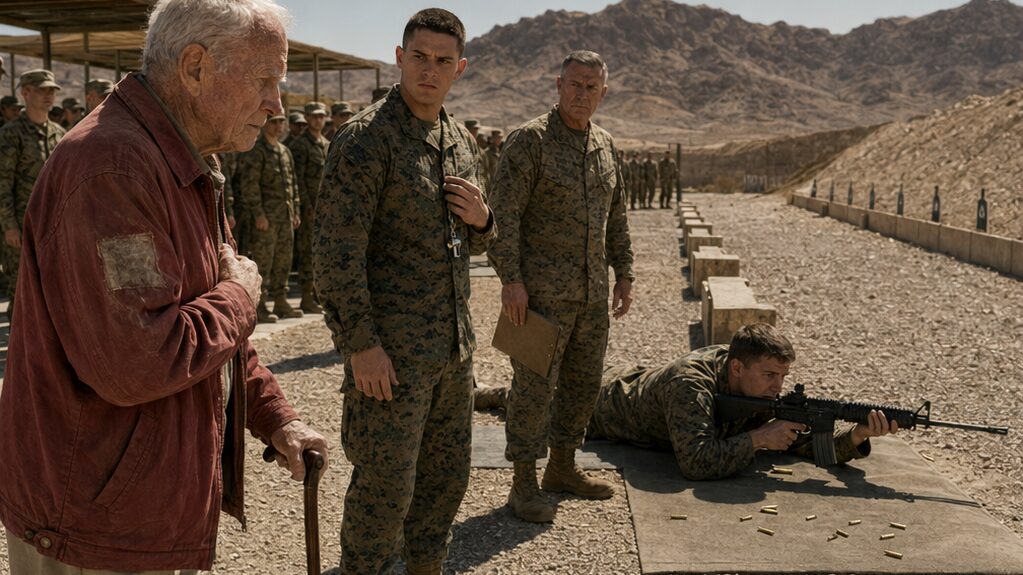
Donald stood beside the little booth with both hands resting on the head of his cane, his red jacket zipped halfway despite the heat. It was not a military jacket, not regulation, not anything a young soldier would know how to place at first glance. The cloth had faded at the elbows. The zipper caught if pulled too fast. On the left sleeve, near the shoulder, a patch had gone pale with age until its colors looked more like memory than thread.
The gate guard looked from Donald’s driver’s license to the printed list on his clipboard.
“You’re here for the remembrance range event, sir?”
Donald nodded once.
“Yes.”
The guard’s eyes dropped to the cane. Not rudely. Not kindly either. Just automatically, the way people checked for weakness before they checked for anything else.
“Somebody coming to pick you up?”
“I was told to report to Range Four.”
“That’s about a half mile in.”
“I remember where Range Four is.”
The guard gave him the small smile people used when they thought an old man had mistaken memory for current fact.
“Yes, sir. But the roads changed a little.”
Donald looked beyond the barrier arm. Heat shimmered over the road. Past the administrative buildings, the hills sat brown and still. Somewhere beyond them came the flat crack of rifle fire, organized and distant. Not one rifle. A line. The sound rolled across the open ground and faded into dry air.
His right hand moved without permission and touched the patch on his sleeve.
The guard noticed.
“You all right, sir?”
Donald lowered his hand.
“Yes.”
A range cart arrived a minute later, driven by a young serviceman in camouflage. He was broad-shouldered, clean-shaven, and serious in the practiced way of someone still new enough to believe seriousness could cover uncertainty. His name tape read CARTER.
He stepped out quickly. “Mr. Bennett?”
“Donald is fine.”
“Yes, sir. Joshua Carter. I’m the range officer assigned to escort you today.”
Assigned to escort. Donald had heard softer words for the same thing.
Joshua reached for the small canvas bag at Donald’s feet, but Donald lifted it before the young man could take hold.
“I can carry it.”
Joshua’s hand paused in the air, then dropped. “Of course, sir.”
The ride to Range Four was slow. Joshua drove carefully over every rut, glancing now and then as if Donald might break loose from the seat. Donald watched the range complex pass by in pieces: target berms, ammo cans, sun shelters, water coolers, stacks of sandbags, faded signs warning about hearing protection and hot brass.
It had changed. The gate guard had been right about that. The old control tower was gone. The road had been widened. The target carriers looked newer. But the range itself had not changed where it mattered. Wind still came low off the flats. Dust still gathered in the corners of equipment no one thought to clean. Young men still stood a little taller when rifles were nearby.
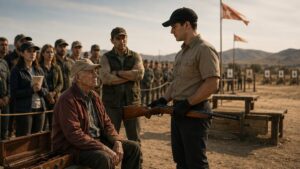
At Range Four, soldiers were already lined up under a shade canopy. Some checked magazines. Some adjusted slings. A few turned when the cart approached.
Donald saw the looks before they vanished.
Curiosity first. Then the cane. Then the red jacket. Then the white hair. Then the question no one asked aloud.
Joshua parked near the observation area. “We’ve got a tight schedule today, sir. Qualification block in the morning, remembrance remarks before lunch, then a short demonstration after that.”
“Demonstration?”
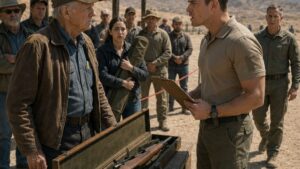
Joshua looked slightly uncomfortable. “They said you might want a picture at the line. Holding one of the rifles. We can do that safely before the next block begins.”
Donald turned his head toward him.
“A picture.”
“Yes, sir. For the event page. The families like it. The older soldiers too.”
Donald sat still long enough for Joshua to realize the words had landed poorly.
“I mean no disrespect,” Joshua added.
“No,” Donald said. “Most people don’t.”
He stepped down from the cart before Joshua could come around to help him. The gravel shifted under his shoes. His knees complained, sharp and familiar, but he kept his face steady. He had learned long ago that pain became louder when others were waiting for it.
A senior training officer emerged from beneath the shade canopy with a folded schedule in one hand. He was older than Joshua but still young to Donald, perhaps late forties, with a sun-browned face and the clipped walk of a man who lived by time blocks.
“Mr. Bennett,” he said. “Richard Sullivan. Good to have you with us.”
Donald shook his hand. Richard’s grip was careful, reduced for age.
“Thank you for the invitation.”
“Your old unit association sent over your name. We’re honored. We’ll have you say a few words later if you’re comfortable.”
“If they need saying.”
Richard gave a short laugh, not sure whether that was humor. “We’ll keep it simple. We know the heat can be hard.”
The soldiers behind him pretended not to listen.
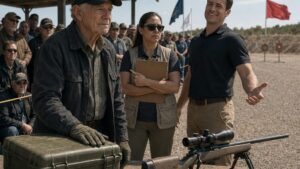
Donald looked toward the firing line. Black rifles lay on benches, each one angled the same way, each one tagged and logged. The sight of them did not stir excitement in him. It stirred inventory. Muzzles. Bolts. Chambers. Ejection ports. Sand. Spacing. Hands.
“You running them in relays?” Donald asked.
Richard’s eyebrows lifted. “Yes, sir. Two groups. Carter here has the line.”
Donald nodded.
A rifle cracked downrange. Then another. The cadence was controlled but uneven, a nervous rhythm from nervous shooters. Donald could hear the difference between haste and discipline. He had not come to judge them. He had told himself that twice on the drive.
Joshua appeared at his side again. “We’ve got a chair for you in the shade, sir.”
Donald looked at the plastic chair placed near the back, apart from the working tables and the line.
“That where guests sit?”
“Yes, sir.”
“And where do old instructors sit?”
Joshua did not answer immediately.
Richard cleared his throat. “Mr. Bennett, we do appreciate your background, but we’ve got current safety protocols. Nothing personal.”
Donald almost smiled at that. Nothing personal was what people said when they had already made it personal and wanted credit for politeness.
“I understand protocols.”
“I’m sure you do,” Richard said. “But for today, we’d like you to relax.”
Relax.
The word floated between them while rifles popped in the distance.
Donald made himself look at the chair again. Its legs pressed shallow dents into the dust. A bottle of water waited on it, unopened, as if someone had already imagined exactly what his day would be: sit, smile, hold something unloaded, be thanked.
He touched the patch on his sleeve.
Joshua’s eyes followed the movement. “Is that from your unit, sir?”
Donald’s hand dropped. “Something like that.”
“We’ll make sure it shows in the photo.”
Donald turned toward the firing line. A young soldier was clearing a rifle under supervision, movements quick but uncertain. Another soldier behind him shifted from foot to foot. Brass flashed in the dust like fish scales.
Donald’s back ached. His right knee felt full of sand. His hands were not as strong as they had been, and he knew that better than anyone watching him. But his eyes still worked. His ears still separated sounds. His mind still found patterns before pride covered them.
Joshua gestured toward the chair again. “This way, sir.”
Donald walked to it. He did not sit right away. He stood behind the chair with one hand on the backrest and watched the line.
A rifle sounded.
Then another.
Then a third, late and dragged by hesitation.
Donald closed his eyes for one breath. The smell of dust and oil moved through him. He was not back in any one year. Memory did not work that cleanly. It came as pressure. A hot afternoon. A young voice insisting he was fine. A small sign ignored because everyone wanted to finish before dark.
He opened his eyes.
Joshua had noticed the change in his face. “Sir?”
Donald sat slowly.
“Nothing,” he said.
But the range had already begun speaking.
Chapter 2: The Rifle Made The Wrong Sound
Donald listened longer than he watched.
That was the habit people forgot to teach once everything became screens and checklists. A range did not only show you things. It spoke. Boots on gravel told you who was rushing. A magazine seated too hard told you who was trying to hide nerves. A bolt released cleanly had a sound. A bolt dragging through grit had another. The smallest metal complaint could vanish under voices if a man cared more about looking certain than being certain.
From the chair behind the line, Donald kept his cane across his knees and his hands folded over it. Joshua moved between shooters with a tablet and a whistle. Richard Sullivan stayed near the shade tent, checking the schedule clipped to his board. The soldiers worked in pairs at the benches.
Nobody asked Donald anything.
That should have suited him. He had come prepared for ceremony, not instruction. Yet each shot tightened something behind his ribs.
The first relay ended. Rifles were cleared and set on the tables. Soldiers stepped back. A few looked toward Donald again, this time more openly. One of them, a nervous young man with narrow shoulders and careful hands, caught Donald’s eye before looking away.
Eric Harris. Donald had heard someone call the name.
Joshua approached with a black rifle held at inspection angle. “Mr. Bennett? This one’s been cleared. We can take that photo now if you’d like.”
Donald looked at the rifle before he looked at Joshua.
It was newer than the rifles he had trained on, but not so new that principles had changed. Nothing important had changed as much as people liked to say. Metal still wore. Springs still tired. Dust still entered places no checklist could flatter clean.
Joshua held it out.
Donald did not take it immediately. “You sure this is the one you want in the photo?”
Joshua glanced down. “It’s cleared.”
“That wasn’t my question.”
A faint crease appeared between Joshua’s brows. Behind him, two soldiers slowed their conversation.
Richard called from the canopy, “Everything good?”
“Yes, sir,” Joshua answered, then lowered his voice. “It’s just for a photo, Mr. Bennett.”
Donald took the rifle.
Its weight entered his hands like an old sentence in a language he still knew. His fingers were slower now. The knuckles bent stubbornly. But he held the rifle safely, muzzle downrange, trigger finger straight along the receiver. The young soldier closest to him noticed and stood a little straighter.
Donald checked nothing dramatically. He did not snap parts or spin the rifle or perform for the watching line. He simply settled the weapon into his hands and felt.
The surface was warm from the sun. A smear of dust lay near the forward assist. The sling had a twist in it. The rifle had been cleaned enough to pass inspection, not enough to be loved.
He angled it slightly and worked the action once under Joshua’s supervision.
Click.
The sound was almost right.
That was why it bothered him.
Donald’s thumb stopped near the receiver.
Joshua shifted. “Sir, please keep it pointed downrange.”
“It is.”
“I know, sir, but—”
Donald worked the action again, slower.
Click.
Not a failure. Not a jam. Not something a checklist would catch if the rifle behaved twice for the armorer and once for the log. But the sound had a small catch in it, like a man clearing his throat before lying.
Donald looked toward the firing lanes. “Which lane had this rifle last?”
Joshua stared at him.
“Sir?”
“Which lane?”
Joshua gave a polite laugh without humor. “It rotates. We log by serial and shooter.”
“Then check the last shooter.”
Richard was walking toward them now.
Joshua’s patience tightened. “Mr. Bennett, we’re not stopping a qualification block over a sound.”
Donald kept the rifle low and safe. “Not stopping. Checking.”
Richard arrived beside Joshua. “What’s the issue?”
Donald did not look at Richard yet. He worked the action once more.
Click.
“There,” Donald said.
The two younger men listened to the empty air after the sound.
Richard’s face softened in the careful way of a man humoring someone. “I don’t hear anything unusual.”
“I do.”
Joshua held out his hand. “Let me take that back, sir.”
Donald did not resist, but he did not hand it over carelessly. He turned the rifle, checked the muzzle, and placed it into Joshua’s waiting hands with the precision of a man refusing to be made unsafe in order to prove he was safe.
Joshua’s fingers closed around it too quickly.
Donald saw that too.
“Don’t rush the thing you’re afraid of,” he said.
Joshua looked up, stung. “I’m not afraid of it.”
“I didn’t mean the rifle.”
The silence around them widened.
A soldier at the nearest bench looked down at his boots. Another pretended to adjust his ear protection.
Richard stepped in. “Mr. Bennett, I appreciate your concern. Really. But this rifle cleared inspection this morning.”
“Inspections are mornings. Problems happen all day.”
“That may be, but we’ve got armorers, line safeties, current procedure—”
“And a rifle that is telling you something.”
Joshua’s face hardened. “With respect, sir, you handled it for ten seconds.”
“With respect,” Donald said quietly, “ten seconds is longer than it takes to hear a wrong note if you know the song.”
The young soldier nearest them looked up again.
Richard exhaled through his nose. “Carter, return that rifle to the table. We’ll inspect it after the relay if needed.”
Donald turned fully to Richard. “Not after.”
“Sir—”
“Not after it goes hot again.”
There it was. The line he had not meant to cross.
Joshua’s expression changed from polite control to embarrassment. He glanced at the soldiers listening behind him, then lowered his voice. “Mr. Bennett, I need you to step back to the guest area.”
Donald felt the words in his knee, his spine, the tired muscles of his hands. Guest area. Chair. Photo. Patch showing in the sun. Thank you for your service, now please stand where you cannot interfere.
He touched his sleeve patch before he could stop himself.
Joshua saw it and softened, just a little. “Sir, I’m trying to keep this safe.”
“So am I.”
Richard’s voice stayed level. “The safest thing right now is for trained range personnel to run the range.”
Donald looked past him to the rifle table. The black rifle lay among the others again, identical to anyone who did not know how to distrust identical things.
“Which lane?” Donald asked once more.
Joshua did not answer.
A command assistant called from the shade tent, “Sir, second relay is staged.”
Richard checked his schedule. The paper snapped softly in the hot breeze.
“Proceed,” he said.
Joshua hesitated for half a second. Then he lifted his whistle.
Donald watched the rifle move down the line.
Eric Harris stepped forward when his name was called. He accepted the rifle from the table and tried not to look nervous. His hands were clean, his face young, his jaw set in the fragile determination of someone who would rather fail loudly than ask for one quiet correction.
The rifle’s sling still had a twist in it.
Donald’s fingers tightened around the cane.
Joshua glanced back once, as if to make sure Donald had returned to the chair.
Donald had not sat.
The whistle sounded.
The line went hot.
Chapter 3: Nobody Wanted A Delay Today
Joshua Carter had learned early that a range rewarded order and punished hesitation.
At least, that was what he had been taught. Clear commands. Clear lanes. Clear authority. If something went wrong, the line looked to the person holding the whistle, and the person holding the whistle could not look uncertain.
He stood behind the second relay with the sun pressing into the back of his neck and Donald Bennett’s warning pressing somewhere worse.
The old man was still standing near the guest chair.
Not wandering. Not confused. Not making a scene. Just standing with both hands on his cane, eyes fixed on lane six, where Eric Harris lay behind the rifle Donald had questioned.
Joshua hated that he knew the lane number without checking.
“Shooters, assume firing position,” he called.
Bodies settled into the dust. Elbows found mats. Rifles came forward. Eric adjusted his shoulder, swallowed, adjusted again.
Joshua walked behind the line, checking muzzles and safeties. He moved steadily, the way training demanded. But when he reached lane six, he paused half a step longer than he should have.
“You good, Harris?”
Eric nodded too fast. “Yes, Sergeant.”
Joshua was not a sergeant, but on the range nervous soldiers promoted anyone with a whistle.
“Slow your breathing,” Joshua said.
“Yes, Sergeant.”
Joshua almost corrected him, then didn’t. There was no room for small corrections now.
Behind the line, Richard Sullivan watched from the shade with the schedule in his hand. A command visit was expected after lunch. Two relays had to qualify before then. A delay meant reports, explanations, rescheduling ammunition draw, maybe a lecture about planning. None of it was unbearable. All of it was avoidable.
Avoidable if the old man was wrong.
Joshua had seen elderly guests before. Some were sharp. Some were lonely. Some wanted to tell stories too long for the heat and too detailed for the young soldiers trapped listening. A few became emotional at the sound of weapons and tried to hide it. That was understandable. Honorable, even. But understandable did not make them range personnel.
Donald Bennett had held the rifle correctly. Joshua could admit that.
Too correctly, maybe. That was part of the problem. It had unsettled him. The old man had not fumbled. He had not smiled for the imagined photo. He had taken the weapon as if accepting responsibility for everything connected to it.
Then he had heard something Joshua had not heard.
“Line ready?” Joshua called.
One by one, the soldiers answered.
“Ready.”
“Ready.”
Eric’s voice came last. “Ready.”
Joshua lifted his whistle.
The first shots cracked cleanly. Dust jumped below the targets. The line settled into rhythm.
From behind him came the faint sound of Donald’s cane shifting on gravel.
Joshua did not turn.
Richard approached, keeping his voice low. “Carter.”
“Sir?”
“You handled that fine.”
Joshua kept his eyes on the shooters. “Yes, sir.”
“Don’t let guests run your line.”
“No, sir.”
“He seems like a good man. But this is exactly why we set boundaries.”
“Yes, sir.”
A shot from lane six came late.
Joshua looked there.
Eric reset his cheek weld, blinked hard, and fired again. The rifle cycled. Brass ejected. Nothing dramatic happened. No visible malfunction. No shouted ceasefire. No proof.
Joshua felt something in him loosen.
Then Eric lifted his head slightly and worked his shoulder.
Joshua stepped closer. “Problem?”
Eric’s right hand hovered near the magazine well. “Feels sticky.”
Joshua’s throat tightened.
“What feels sticky?”
“The pull? Or maybe the—” Eric stopped, aware of the soldiers on both sides. “It’s fine.”
Joshua heard Richard’s voice in his head. Don’t let guests run your line.
He also heard Donald’s.
Inspections are mornings. Problems happen all day.
“Keep it pointed downrange,” Joshua said.
“Yes, Sergeant.”
Again with sergeant. Again Joshua did not correct him.
“Cycle once. Slow.”
Eric did. The rifle made a small sound under the larger noise of the line.
Joshua heard metal.
Only metal.
Nothing more.
He glanced back.
Donald stood in the sun now, no longer near the chair. He had moved three steps closer to the line. Not past the boundary. Not unsafe. But closer. His eyes were on the rifle, not on Joshua.
Richard noticed too.
“Mr. Bennett,” Richard called, polite but firm, “please remain behind the marked area.”
Donald did not move back.
Joshua felt heat rise in his face. The soldiers were aware of it now, the old man and the officers and the command voice from the shade. Public uncertainty spread faster than fire in dry grass.
He stepped toward Donald, lowering his tone. “Sir, I need you behind the line.”
Donald’s gaze stayed on lane six. “Ask him where the brass landed.”
Joshua blinked. “What?”
“The brass. Ask him.”
Richard came closer. “This is not the time.”
Donald finally looked at Joshua. His eyes were pale and steady under white brows. Not wild. Not pleading. Not proud. That was what made it harder.
“Ask him,” Donald said again.
Joshua turned despite himself.
“Harris. Last casing. Where did it land?”
Eric froze. “Sir?”
“Where?”
Eric glanced right, then back. “Short. Near my elbow.”
Joshua looked at the dust. Brass from the other lanes had thrown cleanly outward. Lane six had two casings too close to the shooter.
Richard spoke from behind him. “Could be position. Could be weak shoulder pressure.”
“It could,” Donald said.
Joshua hated that answer. Hated that Donald did not make it easier by sounding dramatic.
Richard checked the schedule again as though time itself might settle the matter. “Carter, continue the relay. Watch lane six. If it fails, we clear it.”
If it fails.
Joshua looked at Eric. The young soldier’s face had gone tight with embarrassment. He knew everyone was watching his lane now. That alone could ruin a qualification. Joshua remembered being that young, wanting more than anything not to be the reason a line stopped.
“You good to continue?” Joshua asked.
Eric nodded. “Yes.”
The answer meant less than it sounded like.
Joshua lifted his whistle halfway.
Donald took one more step forward, still outside the marked boundary, but close enough that his shadow touched the painted line in the dust.
“Carter,” Donald said.
Joshua turned.
The old man’s hand was on his sleeve patch. Not rubbing it. Holding it, as if keeping something from tearing open beneath the cloth.
“The rifle is already talking,” Donald said. “You don’t have to wait for it to shout.”
For one second, Joshua almost lowered the whistle.
Then Richard’s voice cut through the heat.
“Proceed.”
Joshua looked at the line, at the soldiers waiting, at Eric trying to be brave, at Richard with the schedule, at Donald with the cane and the red jacket and the old patch nobody had explained.
He blew the whistle.
The relay continued.
Chapter 4: The Shot That Did Not Prove Him Right
The next three rounds from lane six sounded clean enough to fool anyone who wanted to be fooled.
Donald stayed where he was, just behind the marked boundary, the toe of his shoe nearly touching the painted line in the dust. Heat came up through the gravel and into his legs. His bad knee had begun its slow burn. The sun pressed against the back of his neck. None of that mattered as much as Eric Harris’s right elbow.
The boy kept adjusting it.
Not after every shot. Not in panic. Just enough.
A shooter could lie with his mouth. His body usually told the truth.
Eric fired again. The rifle cycled, but the brass dropped short and mean, landing close beside his mat instead of kicking out with the others. Donald saw Joshua see it too.
There was still no failure. That was the dangerous part.
A true failure stopped a line. A half-failure asked men to make excuses.
“Lane six,” Donald said.
Joshua’s shoulders tightened, but he did not turn. “Observe only, Mr. Bennett.”
Donald looked at Richard. The senior officer stood with his jaw set and schedule board tucked under one arm. His expression said that every minute now had become a contest of authority.
Eric fired.
This time the rifle’s report came a fraction late after the trigger press. Not enough for most ears. Enough for Donald’s stomach to remember an afternoon from decades ago when dust had hung in the air just like this.
A young private then. A different range. A different rifle. A small hitch everyone blamed on nerves until the weapon answered them in a way no one forgot. Donald had been younger than Joshua was now, old enough to be responsible and too green to challenge the man above him twice. He had challenged once. The officer had waved him off. The line had continued.
Afterward, everyone had found words.
Mechanical wear. Environmental grit. Unusual sequence. Unfortunate timing.
Donald had hated that last phrase most of all.
Unfortunate timing was what people called a warning after they had stepped over it.
On lane six, Eric paused again.
Joshua moved closer. “Harris?”
“It’s fine,” Eric said too quickly.
“Keep your cheek down.”
“Yes, Sergeant.”
Donald closed his hand over the sleeve patch. The fabric was hot. Under his thumb, the old stitching rose in a rough shape he could still trace from memory.
The rifle clicked as Eric worked it.
Donald heard the drag now. Clearer. A little catch before the bolt seated.
“Ceasefire,” Donald said.
His voice was not loud, but it carried.
Several heads lifted.
Joshua spun toward him. “Mr. Bennett—”
“Ceasefire.”
Richard took a step forward. “You do not call commands on this range.”
Donald’s face remained still. “Then you call it.”
The line wavered. A few muzzles shifted upward by instinct before Joshua barked, “Muzzles downrange. Stay in position.”
Eric lay frozen behind the rifle, eyes wide, finger straight but tense beside the trigger guard.
Richard’s voice dropped. “Mr. Bennett, step back now.”
Donald looked at Joshua, not Richard. “Ask him to clear it.”
Joshua’s whistle hung against his chest. His hand was halfway to it, stopped by the weight of being watched.
“There has been no malfunction,” Richard said.
“Not yet.”
“That is not how we run a live line.”
“No,” Donald said. “It’s how you keep one from becoming a bad one.”
Joshua’s lips parted. Donald saw the conflict in him, real and painful. The young man was not stupid. He was trapped between what he had heard, what he had been told, and what everyone would think if he yielded command to an old man in a red jacket.
Eric shifted behind the rifle.
That decided it.
Donald moved.
Not fast. He could not move fast, and he did not pretend otherwise. He stepped over the boundary only after pointing one hand sharply toward the ground and saying, “Stay still.” His cane struck gravel once. Twice. The range seemed to inhale.
Joshua reacted at once, intercepting him before he reached the lane.
“Sir, stop.”
Donald stopped.
He had no desire to make the line less safe by proving a point.
“Then call it,” he said.
Joshua stared at him.
Donald kept his voice low enough that only Joshua and the nearest lanes heard. “Your pride can survive a pause. His face might not survive your schedule.”
Joshua flinched as if the words had struck skin.
Richard said, “Carter.”
Joshua closed his eyes for half a second.
Then he blew the whistle.
“Ceasefire! Ceasefire! Safeties on. Fingers straight. Keep muzzles downrange.”
The command cracked harder than any shot.
The line froze into procedure. Soldiers repeated the command down the row. Dust drifted. For a moment nothing happened, and Donald knew that would be held against him if the rifle cleared clean.
Joshua crouched beside Eric. “Do not move until I tell you. Finger straight.”
“Yes, Sergeant.”
“I’m not a sergeant,” Joshua said, almost under his breath.
Eric swallowed. “Yes, sir.”
Joshua guided the clearing sequence carefully. Magazine out. Chamber check. Bolt locked. Weapon safe.
The rifle obeyed.
For one humiliating second, it obeyed perfectly.
Richard’s expression hardened.
Donald felt the weight of the watching soldiers. He had been wrong before in his life. More than once. He could live with wrong. He could not live with silent.
Joshua stood with the rifle in his hands. “It cleared.”
Donald nodded. “Bring it to the table.”
Richard spoke sharply. “The relay is stopped. We’ll inspect it. But Mr. Bennett, you crossed my line.”
Donald turned to him. “Yes.”
“That cannot happen again.”
“No.”
Richard waited, perhaps expecting an argument.
Donald gave none.
The soldiers began to sit back from their rifles, glancing at one another. Eric remained on his mat, pale and embarrassed. Donald saw shame settle over the young man’s shoulders though he had done nothing wrong except be the center of older men’s disagreement.
Donald looked at him. “You felt it before we said it.”
Eric blinked. “Sir?”
“You felt it.”
Eric glanced at Joshua, then Richard. “It just felt… not smooth.”
Donald nodded. “That is worth saying the first time.”
Eric lowered his eyes.
Amanda Reed arrived from the armorer table, wiping her hands with a cloth as she approached. She looked at the stopped line, then the rifle in Joshua’s hands, then Donald.
“What happened?”
Richard answered before anyone else. “Mr. Bennett believed he heard a cycling issue.”
Amanda’s eyes moved to the red jacket, the cane, the sleeve patch, and back to the rifle.
“Believed?”
Donald said nothing.
Joshua held the rifle out. “Lane six. Short ejection twice. Shooter reported sticky feel.”
Amanda’s expression changed slightly at that. Not belief. Not yet. But attention.
“Bring it over,” she said.
Richard looked toward the schedule board lying on the bench, its pages lifting in the wind.
Donald stepped back across the boundary with care. His knee sent a bolt of pain up his leg and he hid it badly enough that Joshua noticed.
For the first time all morning, the young man reached out and then stopped himself before touching Donald’s arm.
Donald appreciated the stopping more than he would have appreciated the help.
Behind them, Eric stayed kneeling on the mat, staring at the rifle as Amanda carried it away.
Donald knew the day had changed, but not enough. The rifle had not yet proved him right.
And that meant the hardest part was still coming.
Chapter 5: Amanda Opened The Bolt Twice
Amanda Reed did not like mysteries near loaded weapons.
She liked logs, parts, tolerances, clean benches, labeled trays, and tools placed back where hands could find them without looking. The armorer table at Range Four was not perfect, but it was hers for the day, and until Donald Bennett stepped into the matter, she had believed she understood every rifle on it.
She set the lane six rifle down on a padded mat and looked at Joshua.
“Tell me exactly what happened.”
Joshua did not glance at Richard before answering. Amanda noticed that.
“Mr. Bennett heard something when he worked the action. Later, Harris reported a sticky feel. Ejection was short on at least two rounds.”
“At least?”
Joshua’s mouth tightened. “I saw two.”
Amanda turned to Donald. “And you heard what?”
Donald stood on the far side of the table, his cane planted carefully between his shoes. He looked tired now in a way he had not looked while confronting the line. The heat had found him. His face had gone pale under the red of his jacket.
“A catch before seating,” he said. “Not much. Enough.”
Amanda waited for more. He did not perform for her.
She picked up the rifle and cleared it again, though she trusted Joshua’s clear. Trust did not replace habit. Magazine well empty. Chamber empty. Bolt to rear. Visual. Physical. Safe.
Then she ran the action.
Click.
Clean enough.
She ran it again.
Click.
Still clean enough.
Richard exhaled behind her. “Could be shooter input.”
Amanda ignored him and ran it a third time, slower.
The sound changed only because she was listening for it now. A faint rub inside the motion, almost swallowed by the stronger metal note. Not failure. Not proof. A suggestion.
She looked at Donald.
His eyes did not say I told you so.
That bothered her more than if they had.
“Again,” he said.
Amanda opened the bolt a fourth time, then held it halfway and looked into the receiver. Dust was everywhere on a range. Dust alone did not impress her. She removed what needed removing, checked what could be checked without a full teardown, and turned the rifle slightly so the light entered from the side.
Joshua stood silent beside her.
Richard checked his watch.
Amanda wanted to tell him to stop doing that. Instead she reached for a small tool and tested the movement more carefully.
There.
Not a break. Not a dramatic flaw. A wear point interacting badly with grit and heat. Something that might pass in a cool room and complain under a hot relay. She felt it through the tool before she fully saw it.
She worked the action again.
Click.
This time the catch had a shape.
Donald’s thumb moved slightly, as if echoing the motion from memory.
Amanda lowered the rifle. “This one comes off the line.”
Richard’s head turned. “Confirmed?”
“Confirmed enough.”
“That’s not a maintenance category.”
“It is when I’m the armorer.”
Joshua looked down at the table.
Amanda field-stripped what she could without turning the range into a workshop. The part was not destroyed. That was almost the worst of it. Destroyed parts made people grateful. Borderline parts made them argue. She found wear, grit polished into the wrong place, and a small pattern that explained the short ejection under heat.
Richard leaned closer. “Would it have failed?”
Amanda did not answer right away. She disliked questions that wanted certainty where only risk existed.
“It was beginning to,” she said.
“That’s not what I asked.”
“No,” she said. “But it’s the honest answer.”
Joshua looked at Donald then. “How did you hear that?”
Donald’s gaze was on the open rifle. “I heard what changed.”
“From what?”
“From what it should have been.”
Amanda set the bolt assembly down on the mat. “You worked with these?”
“Not this model.”
“But rifles.”
“Yes.”
She studied his hands. The fingers were bent at the joints, marked with age spots, one nail ridged from an old injury. They were not steady in the way young hands were steady. But when he had touched the rifle earlier, Joshua had said, they had known where to pause.
“What did you do?” Amanda asked.
Donald looked up.
The question came out rougher than she intended. She softened it. “Before today.”
“Trained soldiers.”
“Marksmanship?”
“And safety.”
Richard shifted his stance. “Mr. Bennett is here with the old unit association.”
Amanda heard what he did not say: guest, not authority.
Donald heard it too. His face did not change.
Amanda wiped a line of grit from the part with her cloth. The dark smear stood out against the pale fabric.
“I inspected this rifle this morning,” she said.
“No one said you didn’t.”
“It passed.”
“I believe you.”
She looked at him sharply, expecting accusation hidden under politeness. There was none.
“That almost makes it worse,” she said.
Donald nodded once. “Most bad things pass something before they fail something.”
The words settled over the table.
Joshua rubbed the back of his neck. “I should’ve paused it sooner.”
Richard said, “You followed procedure.”
Joshua did not look relieved.
Amanda reassembled enough to tag the rifle out and wrote the fault note herself. Her handwriting pressed hard into the paper. She added: heat-related cycling resistance, short ejection observed, remove pending full inspection.
Then she hesitated and added one more line.
Audible irregularity identified by guest veteran before line use.
She felt Richard reading over her shoulder.
“Is that necessary?” he asked.
“Yes.”
Donald looked away toward the range.
The line had resumed with another rifle. Shots cracked again, but the cadence was different now. Slower. Joshua had changed it. More space between commands. More attention to brass. It was subtle, but Amanda noticed.
So did Donald.
Eric Harris sat under the shade with his helmet in his hands. He looked smaller without the rifle. Embarrassment still clung to him though the fault had not been his. Donald followed Amanda’s gaze.
“Someone ought to tell him he did right,” Donald said.
Joshua heard. His face tightened with shame.
Amanda waited for Richard to speak. He did not.
Joshua walked to the shade and crouched beside Eric. Amanda could not hear every word, but she saw Eric’s shoulders drop after a moment, saw him nod once, saw Joshua tap two fingers against the bench as if marking a lesson.
Donald watched without satisfaction.
Amanda picked up the tagged rifle. “There’s still something I don’t understand.”
Donald looked back.
“You weren’t just listening to the rifle,” she said. “You were watching the brass, the shooter, the lane, the wind off the berm. All of it.”
He did not deny it.
“You caught too much too fast,” she said. “Where did you learn that?”
His hand went to the faded patch on his sleeve.
Not a touch this time. A hold.
The range noise seemed to thin around him. For a second Amanda saw him not as a guest, not as an old veteran brought in for a remembrance photo, but as someone standing beside a door he had kept closed for years.
Donald released the patch.
“Some lessons,” he said, “don’t leave much choice about being learned.”
Amanda waited, but he offered nothing else.
Richard’s command assistant called from the tent that the visiting group was fifteen minutes out.
The schedule returned. The range returned. The heat returned.
But Amanda looked at the tagged rifle in her hands and knew the day had made a permanent mark, whether Richard found a place for it on his board or not.
Chapter 6: The Patch Was Not For Decoration
Richard Sullivan wanted to fix the moment by naming it.
He gathered Joshua, Amanda, and Donald near the observation area while the soldiers broke for water. Behind them, the range sat in an uneasy quiet. Rifles lay open on benches. Brass glittered in the dust. Farther off, families and command visitors were beginning to arrive under the shade canopies, their voices bright and unaware of what had nearly become something else.
“We should address it cleanly,” Richard said. “A short safety note before the remembrance remarks. We’ll say the line identified a mechanical concern and corrected it.”
Donald sat on the plastic chair at last. Not because anyone had told him to. Because his knee had reached the end of what pride could hide.
“The line did not identify it,” Amanda said.
Richard gave her a look.
She did not look away.
Joshua stood with his hands behind his back, eyes lowered toward the gravel. The whistle still hung at his chest. It looked heavier than before.
Richard turned to Donald. “Mr. Bennett, I don’t want this to become uncomfortable.”
Donald almost laughed.
That was the day’s strangest mercy, the urge to laugh at men trying to keep discomfort neat after asking him all morning to sit inside it.
“What part?” Donald asked.
Richard looked confused.
“What part are you trying to keep from becoming uncomfortable?”
Richard’s mouth closed.
A gust of wind pushed dust across the open ground. Donald watched it move in a low sheet toward the firing line. Dust had its own patience. It waited for openings.
Joshua finally spoke. “Sir, I owe you an apology.”
Donald looked at him.
“I should’ve paused the line when you first said something.”
“Yes,” Donald said.
Joshua swallowed. Amanda’s eyes flicked to Donald, perhaps expecting more gentleness.
Donald gave the young man the truth, not cruelty.
“You should have.”
Joshua nodded. “I was worried about losing control of the range.”
“You nearly did.”
The words were quiet. They landed anyway.
Richard drew a breath. “Carter made a judgment call under pressure.”
Donald turned to him. “So did you.”
Richard’s face reddened slightly.
Donald rested both hands on the cane. He could feel the tremor in his left thumb and tucked it under his right hand. The tremor embarrassed him more than the cane ever had.
“I did not come here to take your range from you,” he said.
“No one thinks that,” Richard replied.
Donald looked at the chair, the unopened bottle of water, the place they had set him apart from the working line.
Richard followed his gaze.
“No one meant that,” he corrected.
That was better. Not enough, but better.
Families gathered near the rope line. A child pointed toward a target berm until a parent lowered the small hand. Two soldiers carried a cooler. Eric Harris stood alone near the shade, watching Joshua without wanting to be seen watching.
Donald touched his sleeve patch.
Joshua’s eyes moved to it. This time he did not look away quickly.
“May I ask what that patch is?” he said.
Donald rubbed the edge with his thumb. The threads had frayed where years of the same gesture had worried them loose.
“It was not for decoration,” Donald said.
No one interrupted.
He looked toward the firing line, because it was easier than looking at their faces.
“There was a training company,” he said. “Long time ago. Hot range. Long day. Everybody wanted to finish. A young man reported something that sounded small. A hitch. A feel in the rifle. He was new, and he said it like he was apologizing for wasting our time.”
The wind moved through the canopies.
“I heard it too,” Donald continued. “Not enough to win an argument, I thought. I said something once. The officer above me said continue. I let him be the louder man.”
Joshua’s face changed. He understood before Donald finished.
“No one died,” Donald said. “People like the clean edges of that kind of story. They want either nothing happened or everything did. It wasn’t that. The rifle failed badly enough to hurt the boy and ruin the hand he’d planned his whole future around. That was enough.”
Amanda looked down at the tagged rifle as if it had become heavier.
Donald’s voice stayed even. That took effort. He had told the story only a few times, and never at a range.
“This patch came from that unit. Afterward, they changed procedures. Wrote new notes. Held briefings. Put men in rooms to say the right things. But the lesson I kept was simpler.”
He lifted his hand from the patch.
“If a small thing bothers you for a good reason, don’t make it small just because someone else is in a hurry.”
Richard said nothing.
A command vehicle rolled in beyond the canopy, tires crunching gravel. The visitors stepped out in clean uniforms and pressed shirts. The remembrance portion was minutes away. The day still wanted to move on.
Donald could feel that pull. People loved ceremonies because they told pain where to stand and when to speak. He had planned to let that happen. A few remarks. A photograph. A ride back to the gate. He could have gone home tired and vaguely ashamed without quite admitting why.
But the rifle had spoken, and then the boy had said sticky, and then Joshua had lifted the whistle while still fighting the thought of being seen as weak.
Donald looked at Joshua.
“You are not a bad range officer.”
Joshua’s eyes lifted.
“You were listening to the wrong pressure.”
The young man’s jaw tightened, not with anger this time.
Richard cleared his throat. “Mr. Bennett, with your permission, I’d still like to mention what happened. The command group should know the system worked.”
Amanda’s eyebrows rose slightly.
Donald shook his head. “Do not make me proof that the system worked.”
Richard took that one without defending himself.
Donald leaned back. The plastic chair creaked. His knee throbbed. Sweat had gathered under the collar of his red jacket, but he did not unzip it. The patch stayed visible.
“What do you want, then?” Richard asked.
The question was not graceful, but it was honest.
Donald looked at the soldiers drifting back toward the line. Young faces. Tired faces. Proud faces. Faces trying not to show uncertainty in front of one another.
“I want him told he did right,” Donald said, nodding toward Eric.
“Done,” Joshua said.
“I want the rifle logged honestly.”
“Done,” Amanda said.
“I want the next line briefed that a pause is not an embarrassment.”
Richard looked toward the visitors, then toward his schedule. Donald watched the contest happen plainly across his face.
Then Richard folded the schedule in half.
“All right,” he said.
It cost him something. Not enough to wound him, but enough to mark the choice.
Joshua took one step closer to Donald. “Would you brief them?”
Donald’s first answer was no. He felt it rise from his bones. No, because he was tired. No, because being made useful after being dismissed was not the same as being respected. No, because he did not want to become a story they told to make themselves feel humble for an afternoon.
Joshua seemed to understand some part of that, because he added, “Not for the visitors. For the line.”
Donald looked at him then.
The young man’s posture had changed. Not collapsed. Not theatrical. Just lowered enough to make room for another man’s experience.
Donald’s hand returned to the patch, but lightly now.
“What do you want me to tell them?” he asked.
Joshua glanced toward the firing benches, the open rifles, the soldiers waiting for instruction.
“What you heard,” he said. “And what we didn’t.”
Chapter 7: Before You Touch The Trigger, Listen
The soldiers came back to the line quieter than before.
Not solemn, exactly. They were still young, still hot, still thinking about scores and lunch and who had seen them miss. But something had changed in the space between them. The easy noise had thinned. Men checked their rifles with less impatience. A few looked down at their brass before kicking it aside. Eric Harris stood near lane six with his hands clasped behind his back, no rifle in them now, watching Donald Bennett as if he had been handed a question he did not yet know how to ask.
Joshua walked with Donald toward the firing benches.
He did not offer an arm. He matched Donald’s pace.
That was the first respectful thing he had done without trying too hard.
The sun had begun to lower, though the heat still held to the gravel. Donald’s knee hurt badly enough that every step sharpened the world. He kept the cane steady, one clean tap at a time. He did not want the soldiers watching him limp. Then he caught himself resenting the truth of his own body and almost smiled.
Age did not become dignity by pretending it was not age.
At the firing line, Joshua turned toward the gathered soldiers. Richard stood off to one side, schedule folded and tucked into his back pocket now. Amanda had placed the tagged rifle on a separate table, open and marked, not hidden away. That mattered.
Joshua lifted his voice. “Listen up.”
The small movements stopped.
“This morning, Mr. Bennett identified a problem with a rifle before the rest of us treated it like a problem.” He paused. “I did not respond as quickly as I should have.”
No one moved. A few eyes flicked toward Richard.
Joshua continued anyway. “He’s going to speak to the line for a minute. Not for ceremony. For training.”
Donald felt the word training settle differently than remarks would have.
Joshua stepped back.
For a moment, Donald looked at the soldiers and saw three groups at once: the young men before him, the young men he had trained, and the young man he had been when he had failed to be stubborn enough. Time folded at ranges. Maybe it always had.
He set his cane against the bench and placed both hands on the edge of the table.
“I’m not here to tell you old ways are better,” he said.
The soldiers watched him.
“They are not. Not because they are old.”
A few faces shifted, surprised.
“New ways are not better because they are new either. A good way is one that keeps you honest when you’re tired, rushed, embarrassed, or being watched.”
He reached for the repaired rifle Amanda had set out for demonstration, not the tagged one. Joshua moved half a step by reflex, then stopped. Donald noticed. So did Amanda.
Donald picked up the rifle carefully and kept it pointed downrange. His hands trembled a little. He let them. There was no use hiding what everyone could see. Instead he showed them what mattered: trigger finger straight, muzzle disciplined, action open, eyes checking what hands claimed to know.
“You were taught to clear a rifle,” Donald said. “Good. Clear it. But don’t worship the motion. Pay attention to what the motion tells you.”
He worked the action once.
The sound was clean.
“Again.”
He did it slower.
Clean.
“You hear that?”
No one answered at first.
Eric said, “Yes, sir.”
Donald looked at him. “What do you hear?”
Eric swallowed. “It’s smooth.”
“Not a bad word. But don’t stop there.”
Eric listened as Donald worked it again.
“No catch,” Eric said. “No drag.”
Donald nodded.
The young soldier’s face changed, just slightly. Not pride. Relief that he had been allowed to notice something without being mocked for needing help.
Donald set the rifle down and gestured toward the tagged one on Amanda’s table.
“That one did not shout at us. That is what makes it worth remembering. Most things that hurt people do not announce themselves like they do in stories. They arrive as small changes somebody explains away.”
He glanced at Joshua, not to accuse him, but because the lesson belonged there too.
“A short ejection. A shooter adjusting twice. A sound that almost belongs. A young man saying something feels sticky and then taking it back because he does not want to be the problem.”
Eric looked down.
Donald softened his voice. “You were not the problem.”
Eric looked up again.
“The problem was almost that nobody wanted to pause long enough to believe you.”
The line held still.
Richard’s jaw worked once, but he said nothing.
Donald touched the faded patch on his sleeve. This time he did not hide the gesture. “This patch came from men who learned some lessons too late. I keep it because forgetting is easier than people admit.”
He let his hand fall.
“But this is not about my patch. It is not about my age. Do not listen to a man because his hair is white. Plenty of fools get old.”
A small breath moved through the soldiers, almost laughter, almost release.
Donald looked from face to face. “Listen because the details are talking. Listen because the quietest person on your line may be the one who noticed the thing you missed. Listen because safety is not pride. It is attention.”
Joshua’s eyes stayed forward, but Donald saw the words reach him.
Amanda stepped nearer with the tagged rifle part held in a cloth. “The fault is real,” she said. “Borderline, heat-related, easy to miss in a cold inspection. It’s being pulled for full maintenance.”
That was enough. She did not decorate it.
Richard moved beside her. His voice was rougher than before. “The pause should have happened sooner. That correction starts with me.”
No one clapped. Donald was grateful for that. Applause would have made the moment smaller.
Joshua turned to Eric. “Harris, you’ll requalify with another rifle after a rest cycle. No penalty for reporting the feel.”
Eric nodded. “Yes, sir.”
“And next time?”
Eric looked at Donald before answering. “I say it the first time.”
Joshua nodded. “Good.”
The line reset slowly. Not because procedure had vanished, but because it had gained weight. Donald remained near the bench while Joshua gave commands for a dry sequence. No live fire yet. Just hands, rifles, checks, voices. Donald watched Eric work the action on a replacement rifle and pause to listen.
That was the moment that reached deeper than any apology.
The boy listened.
When the line finally went hot again, Donald stood behind Joshua, not in the guest chair. The first shots cracked into the late afternoon. Brass kicked cleanly into the dust. Joshua watched it land. Amanda watched Joshua watching it. Richard watched the line without looking at his watch.
Donald closed his eyes for one breath.
The sound was not peace. A firing range was never peace. But it was order with humility inside it, and that was close enough for one old man at the end of a long day.
When the relay finished, Eric’s target came back acceptable. Not perfect. Good enough. He looked more proud of having spoken than of having passed.
The visitors drifted toward the shade canopy afterward, unsure whether they had witnessed ceremony or training. Richard did not ask Donald to pose with an unloaded rifle for a photo. Instead, he approached with his cap in one hand.
“Mr. Bennett,” he said, “I’m sorry we treated you like a symbol before we treated you like a man.”
Donald studied him.
Richard’s face held discomfort, and he did not try to escape it. That counted for something.
“Do better next time,” Donald said.
Richard nodded. “We will.”
Joshua walked Donald back toward the cart as the sun dropped behind the berm. The gravel had become harder under Donald’s feet. His knee wavered once.
This time Joshua did offer his arm.
Donald looked at it.
The young man did not say, Are you okay? He did not say, Let me help you. He simply stood there, arm offered, eyes on the road ahead, leaving Donald the dignity of choosing.
Donald took it.
They walked several steps that way, cane in Donald’s right hand, Joshua steady on his left. No one made a fuss over it. No one looked away either.
At the cart, Joshua stopped. “Sir?”
Donald waited.
“I thought listening to you would make me look like I wasn’t in control.”
Donald looked back at the firing line. Soldiers were policing brass in the sunset. Amanda carried the tagged rifle case toward her truck. Eric bent to pick up a casing, studied where it had landed, then dropped it into the bucket.
“Control is not getting everyone to ignore what you missed,” Donald said. “It is making room for the truth before the truth has to raise its voice.”
Joshua absorbed that quietly.
Then he gave a small, careful nod. “Would you come back sometime? Not for a photo. For the line.”
Donald looked at him long enough for the young man to feel the difference between invitation and use.
“Maybe,” Donald said.
Joshua accepted that as the gift it was.
Before Donald climbed into the cart, he touched the patch on his red sleeve one last time. The gesture no longer felt like holding something closed. It felt, for the first time in years, like setting something down without abandoning it.
Joshua started the cart.
Behind them, Range Four continued in the fading light, slower now, more attentive. The rifles sounded clean. The commands sounded clear. And under them, in the spaces between metal and dust and young breath, Donald could almost hear the lesson taking root.
As they rolled toward the gate, Joshua glanced at him once.
Donald did not look back. He kept his eyes on the road ahead and said, “Don’t listen to me because I’m old.”
Joshua waited.
Donald’s hand rested lightly over the faded patch.
“Listen when the details are talking.”
The story has ended.