The Young Pilot Laughed When The Old Veteran Checked The Helicopter Step
Chapter 1: The Old Man Beside The Gray Helicopter
The helicopter sat on the airfield like something that had never learned to age.
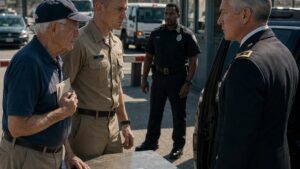
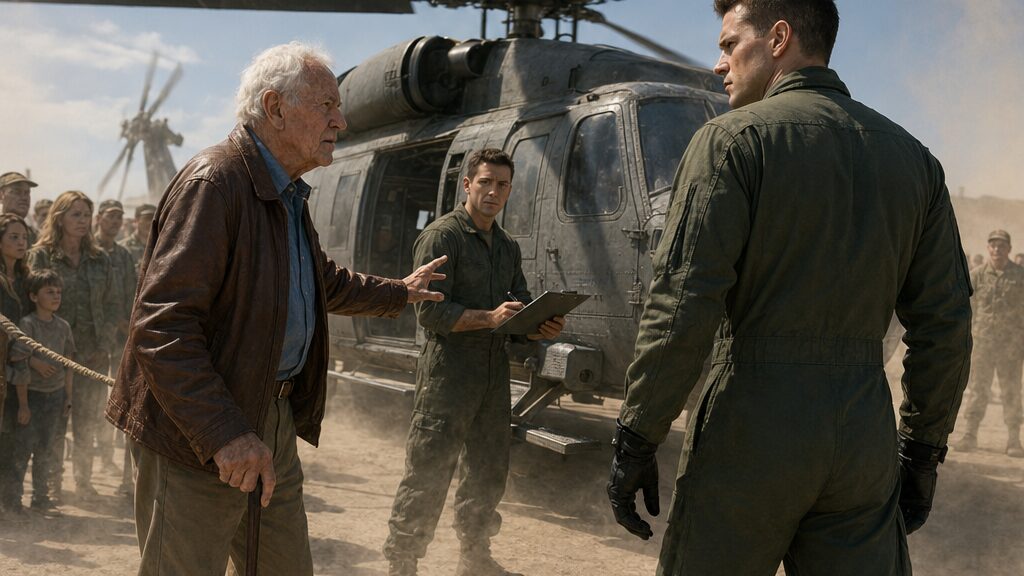
Its gray skin caught the late morning sun in hard planes. Dust gathered along the skid shadows. The rotor blades stretched over the concrete, still for now, cutting thin lines across the ground where families, soldiers, and base staff moved between folding chairs and temporary rope barriers. Beyond the flight line, dry grass trembled in a wind that smelled of fuel, hot rubber, and the faint metallic bite William Bennett had not forgotten, though he had been away from active aircraft for years.
He stopped just inside the marked visitor lane and looked at the machine.
Not stared. Not gawked.
Looked.
His daughter noticed the difference immediately.
“Dad?” Sarah Bennett said softly.
William did not answer at first. He stood in his red-brown leather jacket with one hand tucked against his side and the other loose at his thigh. The jacket was too warm for the day, but he had worn it anyway. Its cuffs had gone dark with age. The left sleeve still held a flattened crease where a flight-line patch had once been sewn before he removed it after retirement. Sarah had asked that morning whether he wanted something lighter. He had shaken his head.
Some clothes held weather. Some held memory.
Across the field, a crewman laughed at something a pilot said. The sound carried strangely in the open air, bright and easy. A row of soldiers stood near the helicopter, polished boots and sunglasses, uniforms clean enough for photographs. The event had been called a memorial readiness demonstration. A speech first, then a short flight with selected personnel, then a static display for families. William had read the printed invitation twice at the kitchen table, his thumb resting on the unit insignia.
Sarah had found him there long after dinner, the paper still in front of him, the house quiet.
“You don’t have to go,” she had said.
“I know.”
“Then why?”
He had folded the invitation along its original crease.
“Because some names shouldn’t only be spoken indoors.”
Now, standing under the clean sun, William wondered whether he should have left the names where they were.
A young pilot in a green flight suit crossed near the helicopter’s nose, black gloves tucked under one arm, sunglasses hiding his eyes. He moved with the loose confidence of a man who knew people were watching and had decided that being watched suited him. Another soldier pointed toward the visitors gathering behind the rope, and the pilot gave a practiced nod.
William’s gaze drifted lower.
Not to the cockpit. Not to the weapon mounts that had already been made safe for public viewing. Not to the smooth panels polished for display.
To the step.
The side step sat below the cabin opening, a black-edged foothold fixed near the frame where crew and passengers climbed in. A handle rose beside it, worn in the ordinary places hands found under stress or hurry. At first, it was only an old habit that pulled William’s attention there. Aircraft were not entered casually. You learned where hands went. You learned where weight shifted. You learned which surfaces lied by looking clean.
He took two slow steps closer to the rope.
“Dad,” Sarah said again, a little sharper now.
William lifted his chin, as if he had only wanted a better look at the aircraft. He did not want to worry her. Sarah had the same look her mother used to wear when trying not to tell him he was doing too much. Soft mouth. Tight eyes. One hand already half-raised in case he stumbled.
“I’m fine,” he said.
“I didn’t say you weren’t.”
He smiled faintly. “You said it with your shoulders.”
She let out a breath, but stayed beside him.
A gust pushed dust along the concrete. The dust ran under the helicopter and caught briefly against the step mount. William watched it gather in a thin uneven seam near the bracket. It should have blown clean. Instead, it clung, trembling at the edge of a shallow rub line.
His smile faded.
There were a thousand harmless reasons for a mark near a step. Boots. Tools. A rushed washdown. A replacement part sitting a little proud. He knew that. Age could make a man suspicious of harmless things. Memory could turn dust into ghosts. He had promised himself on the drive in that he would not be that kind of old veteran—the one who corrected every young soldier’s posture, every young pilot’s grip, every updated procedure he did not recognize.
The Army had moved on. Machines changed. Checklists changed. Men retired. The sky did not owe him a place in it.
Still, the dust kept trembling wrong.
William took another step.
Sarah’s fingers touched his sleeve. “The visitors are supposed to stay behind the rope.”
“I see it.”
“Then what are you doing?”
He looked past the rope toward the step. Not at the aircraft as a monument. At the place where weight met metal.
“Looking.”
A staff member near the chairs began testing a microphone. A brief squeal cut across the field, and several people turned. William did not. The sound vanished, replaced by voices, bootsteps, the distant cough of a utility cart. Somewhere behind him a child asked whether the helicopter was going to fly. Someone answered yes, after the ceremony.
William’s right knee ached. It always did on concrete. He shifted his weight and disliked how slowly his body obeyed him. In his mind, the distance to the aircraft was nothing: five strides, one hand on the handle, left foot on the step, weight forward, eyes inside. His body counted it differently. Heat, knee, breath, balance.
He did not resent the body. It had carried him longer than several better men had been allowed to live. But he knew its limits, and he knew how young people saw them before they saw anything else.
The pilot in the green flight suit noticed him then.
The young man turned from the crew and watched William at the rope. Even with sunglasses on, his attention had a shape. Quick appraisal. Old man. Leather jacket. Visitor badge. Too close.
William felt Sarah stiffen beside him.
The pilot said something to the crewman beside him and walked over with an easy half-smile. His boots clicked on the concrete. His name tape read MILLER.
“Morning, sir,” the pilot called.
William nodded once. “Morning.”
“You looking for the seating area? Ceremony’s over that way.”
“I know where the chairs are.”
The pilot’s smile stayed, but it narrowed. “Flight line’s restricted beyond the rope.”
William looked at the helicopter step again. The dust had gathered back after the gust, thin as a pencil line.
“What model year is this airframe?” he asked.
The young pilot’s eyebrows lifted behind the glasses. “Sir?”
“The airframe.”
Sarah whispered, “Dad.”
William did not turn.
The pilot gave a short laugh, not loud, just enough for the nearby crew to hear. “She’s current enough for what we need today.”
“That wasn’t my question.”
“No, sir,” the pilot said. The politeness had a shine on it now. “But today’s not a maintenance tour.”
Behind him, one of the soldiers glanced over. Another folded his arms. The moment, which had been private a breath earlier, became visible.
William felt it happen. The airfield had always been good at that. A small exchange could gather witnesses faster than smoke.
He should have let it go. A man his age learned to choose which rooms needed his voice. He could tell Daniel Harris later, if Daniel remembered him beyond a name on a program. He could mention it to someone in maintenance, if anyone had time before the demonstration. He could let procedure be procedure.
The pilot took another step closer and rested one black-gloved hand on the rope stanchion.
“What exactly are you trying to see?” he asked.
William looked at the young man’s clean flight suit, the mirrored lenses, the confident tilt of his head. Then he looked back at the step.
“A mark,” he said.
The pilot turned slightly, following his gaze. His smile returned, easier now.
“On the step?”
“Near the mount.”
“Sir, people have been climbing in and out of this bird all morning.”
“Not there,” William said.
The young pilot looked toward the watching crew, then back at William. “Tell you what. After the demonstration, public affairs might let you take photos from behind the barrier. Until then, I need you to stay clear.”
Sarah’s hand tightened on William’s sleeve.
William could feel the old leather under her fingers. He could feel the sun on the back of his neck, the concrete through the soles of his shoes, the fine grit moving in the wind. He could feel, more than hear, the helicopter waiting.
The pilot stepped fully between him and the aircraft.
Chapter 2: Ryan Miller Points At The Step
Ryan Miller pointed at the helicopter step as if it were part of a lesson prepared for children.
“You see that, sir?” he said, turning enough that the nearby soldiers could hear. “That’s not a porch step. It’s not built for sightseeing. It’s part of an active aircraft.”
William looked at the finger, then at the black-edged foothold beyond it.
The crewman closest to the cabin lowered his chin to hide a grin. Another soldier shifted his weight, interested now. No one laughed outright. That made it worse in a way. Open cruelty could be answered. Polite amusement settled over a man like dust.
Sarah moved beside William. “We’re sorry. My father used to—”
William lifted one hand slightly.
She stopped.
The pilot noticed. “Used to?”
William said, “Work around these.”
Ryan’s mouth twitched. “A lot of people used to work around a lot of things.”
The line got the small laugh he wanted. Not much. Enough.
William let the sound pass.
Up close, the helicopter looked cleaner than it had from the visitor lane. Fresh wash, recent wipe-down, display-ready. But clean skin could hide tired joints. The step bracket sat under the cabin edge, bolted into the side with the kind of innocent stiffness that could fool an eye trained only to see whether a part was present, not whether it had begun telling a story.
A pale crescent showed near the lower mount. Barely anything. A rub mark where dust should not collect in that shape. William saw it, then saw the memory of another one, years earlier, under different paint, in different heat, while a younger version of himself had argued with a man who wanted to save ten minutes before weather moved in.
He pushed the memory away before it could put names in his mouth.
“When did it last fly full cabin?” he asked.
Ryan angled his head. “Excuse me?”
“With a full load. Not empty. Not repositioning. Full cabin.”
The pilot’s expression lost a degree of amusement. “Sir, that’s not information we give to visitors.”
“I don’t need numbers. I asked when.”
“And I’m telling you that’s not your lane.”
William nodded once, as if that answer itself had told him something.
Ryan seemed to take the nod as surrender. He raised his voice slightly. “Look, I respect that you’re interested. I really do. But we’ve got crews, inspections, procedures, and people responsible for this aircraft. Nobody needs a visitor climbing around because he sees a smudge.”
The word visitor landed harder than William expected.
He had been many things on flight lines. Crew chief. Pilot. Escort. The man younger men found when a sound changed between takeoff and return. The man who could tell which mechanic had tightened a panel by the way the screw heads sat. Later, retiree. Then widower. Then the old man Sarah drove to appointments.
Visitor was not wrong.
That did not make it true enough.
Sarah stepped forward. “He’s not trying to cause trouble.”
“No, ma’am,” Ryan said quickly, and gave her a softer version of the same smile. “I’m trying to prevent it. We have safety lines for a reason.”
William glanced at his daughter. She looked embarrassed and angry and afraid he would push too far. He hated that he had put that look on her face.
His knee throbbed. He took his cane from where it hung over his left wrist and set it firmly on the concrete. The sound was small. Tap. In the open air, it seemed too old.
Ryan looked down at the cane.
There it was. Not contempt exactly. Certainty.
“Sir,” he said, more quietly, “you don’t want to climb up there.”
William could have answered that he had climbed into aircraft with blood on his sleeves and rain blowing sideways across the pad. He could have said that he had once slept sitting against a cabin wall because the bird was needed again before his legs stopped shaking. He could have said he had earned the right to know a step from a warning.
Instead, he said, “No. I don’t.”
Ryan blinked.
William handed the cane to Sarah.
“Dad,” she said.
“I’m only going to touch the mount.”
“No, you’re not,” Ryan said, the smile gone now.
William moved before the young man could decide whether to make a scene of stopping him. He did not move fast. He could not. But he moved with the particular economy of someone who had long ago learned that wasted motion got people hurt. One hand found the handle. His fingers closed around the metal. He placed his left foot on the step.
Pain flashed up his knee.
He waited half a breath, not because he wanted drama, but because the body demanded negotiation. Then he shifted weight and rose.
The watching soldiers went still.
Ryan reached out, then stopped short of grabbing him. “Sir, step down.”
William did not look at him. At step height, the mark was clearer. Dust had caught along a faint crescent below the bracket, but another line crossed it, thinner, almost hidden in the shadow where the mount met the frame.
He drew his thumb across the dust.
It came away gray.
Under it, the line remained.
Not proof. Not yet.
He leaned closer, feeling the handle tremble faintly under his hand. Any aircraft sitting in wind would speak through its frame. Old men heard too much sometimes. Old grief filled silence with patterns. He knew that. He distrusted himself enough to check again.
He pressed two fingers near the lower mount, then tapped the edge once with his knuckle.
A dull response. Not alarming. Not clean either.
Ryan stood below him, face tilted up, sunglasses reflecting William’s jacket and the underside of the cabin.
“This is exactly what I’m talking about,” the pilot said. “You can’t just climb onto an aircraft because you remember doing things a certain way.”
William looked down at him.
“I didn’t climb because I remembered,” he said. “I climbed because that mark shouldn’t be there.”
One of the crewmen shifted. The small grin had disappeared from his face.
Ryan’s jaw tightened. “It’s a scuff.”
“It might be.”
“Then get down.”
William wiped the dust from his thumb onto his jacket cuff, leaving a pale smear on the old leather. “Who signed the last step-side inspection?”
“That is not your concern.”
“Who checked it after washdown?”
Ryan took one step closer. His voice dropped. “Sir, I’m not going to have you embarrass yourself in front of everyone.”
The words reached the rope line. Sarah’s face changed.
William felt heat rise in his chest, not anger at first, but something older and more dangerous: the desire to make the young man understand by force of memory. To open the locked room inside him and drag out the day when a dismissed vibration became a folded flag. To put a name into the air and let it do damage.
He kept the door shut.
“Embarrassment isn’t the thing I’m worried about,” he said.
Ryan stared up at him.
For the first time, the pilot did not have an answer ready.
A darker-uniformed figure had begun walking from the operations tent across the concrete. Daniel Harris, broader through the shoulders than William remembered, with silver at his temples and a clipboard under one arm. He had the look of a man trained to notice disturbances before they became reports. His gaze moved from Ryan to William, then to William’s hand on the aircraft.
William saw recognition try to surface in Daniel’s face and fail to fully arrive.
That was fair. Men aged. Names faded. Old units became plaques in hallways.
“Is there a problem here?” Daniel called.
Ryan stepped back at once, posture tightening into professional shape. “No problem, sir. Just getting a visitor clear of the aircraft.”
William descended before anyone could help him. The step punished his knee on the way down, and he took the cane from Sarah without looking at her. He could feel her anger beside him like a held breath.
Daniel stopped a few feet away. His eyes stayed on William’s face a second longer than courtesy required.
“Mr. Bennett?” he said.
“William,” he answered.
Daniel’s expression sharpened slightly. “William Bennett.”
Ryan turned his head.
For a moment, the air changed. The crew heard it. Sarah heard it. William wished they had not.
Daniel looked toward the helicopter. “What were you checking?”
William glanced at Ryan, then at the step. The mark sat in the shadow again, small and quiet, giving away nothing to anyone who had not already learned to fear such things.
“Maybe nothing,” William said.
Ryan let out the smallest breath.
Daniel frowned. “Maybe?”
William set his cane tip against the concrete. “I asked when it last flew full cabin.”
Daniel looked at Ryan.
Ryan answered too quickly. “Preflight is in order, sir. The aircraft is cleared for today’s demonstration.”
“That wasn’t what he asked,” Daniel said.
A silence opened.
William did not enjoy it. He did not want the young pilot dressed down on his account. Public correction was a blade. Sometimes necessary. Often misused.
“I don’t need to make trouble,” William said.
Daniel studied him. “Are you making trouble?”
William looked once more at the step.
“No,” he said. “I’m trying not to.”
Chapter 3: The Warning No One Wanted Logged
Joseph Carter had been near enough to hear the old man’s question and far enough away to pretend he had not.
That was a useful distance on an airfield.
He stood under the maintenance shade tent with a clipboard, a grease pencil, and a half-finished bottle of warm water sweating against a folding table. From there, he could see the helicopter through the tent opening. He could also see Captain Ryan Miller standing with shoulders squared while Daniel Harris spoke to him in low tones. The old man—William Bennett, apparently—had been guided back toward the visitor side by his daughter, though guided was not quite the word. The daughter held his arm. The old man allowed it. There was a difference.
Joseph watched William pause once before the rope line and look back at the step.
Not at Ryan. Not at Daniel.
At the step.
That bothered Joseph more than the argument had.
Old men at ceremonies liked cockpits. They liked unit patches, nose art, photographs beside machines they once knew in younger paint. Some told stories too loudly. Some stood too quietly and looked as if the aircraft had taken something from them. Joseph had learned to make room for both kinds.
But William Bennett had not looked hungry for memory. He had looked busy.
“Carter,” Ryan called.
Joseph straightened. “Sir.”
Ryan came under the tent with the hard walk of a man who had been made to look uncertain in front of people and wanted the world put back in order. He removed his sunglasses, wiped one lens with a black glove, then put them on the table instead of his face.
“Do me a favor,” Ryan said. “Check the step-side mount visually so we can put this to bed.”
Joseph kept his expression neutral. “Yes, sir.”
“Visually,” Ryan repeated. “Don’t start pulling panels because somebody’s granddad saw a scuff.”
Joseph glanced toward Daniel Harris, who had remained near the aircraft speaking with the ceremony coordinator.
Ryan caught the glance. “Major Harris said verify. I’m saying verify without turning a memorial event into a maintenance circus.”
“Understood.”
Ryan leaned closer. “And don’t write it up unless there’s something to write.”
Joseph disliked that sentence.
He had heard versions of it before from men better than Ryan and worse than Ryan. Usually it meant, Let the paperwork match the preferred outcome. Sometimes that was harmless. A loose strap corrected before inspection. A smudge cleaned before visitors arrived. Sometimes it was how small things survived long enough to become large ones.
Still, Ryan was the aircraft commander for the demonstration. Joseph was maintenance. Rank and role mattered, especially in front of visitors.
He took the grease pencil and walked out.
The heat hit him beyond the tent shade. The helicopter’s gray side threw sunlight back at his face. He crouched near the step, resting one hand lightly against the frame for balance, and saw the scuff immediately.
At first, he was almost relieved.
It looked ordinary.
A dirty crescent below the lower mount. Boot traffic, maybe. Wash water had dried unevenly. Nothing dramatic. Nothing that would justify delaying a ceremony filled with families, veterans, and officers who hated surprises.
He wiped the area with a rag.
The dirt came off.
The fine line beneath it did not.
Joseph leaned closer.
It was not a crack. He told himself that first because the word crack had weight. It was a hairline in paint, maybe. A rub line. A place where a bracket edge had worried the surface. The old man had called it a mark, not a failure. That was either caution or luck.
Joseph pressed his thumb near the mount. Solid. He tapped once with his knuckle.
Dull.
He tapped the other side.
Sharper.
He looked over his shoulder.
Ryan stood outside the tent watching him. Daniel was now at the chairs, being pulled into some schedule question. The daughter had William near the rope, but William’s gaze had not left Joseph.
Joseph looked back at the mount.
He took out his small notepad and copied the shape of the line.
Not a report. Not yet. Just a note.
When he stood, William had somehow come closer again, still on the visitor side. The rope divided them cleanly. Old man outside. Maintainer inside. Joseph felt foolish for thinking of it that way.
“You saw it?” William asked.
Joseph slid the notepad halfway into his pocket. “I saw a mark.”
“Lower edge?”
Joseph hesitated. “Yes, sir.”
William’s mouth tightened, not in triumph. More like disappointment.
“Does it move under load?” William asked.
“I haven’t tested it under load.”
“When did it last fly full cabin?”
Joseph looked toward Ryan.
William saw the look and understood it. That was uncomfortable too.
“I’m not asking you to cross your officer,” William said.
“No, sir?”
“I’m asking you not to let him cross physics.”
Joseph almost smiled despite himself. “That sounds like something a maintenance instructor would say.”
“Mine used worse language.”
A pause settled between them. The airfield noise seemed to move around it.
Joseph said, “You worked these?”
“Not this model.”
“But helicopters.”
“Yes.”
“What did you do?”
William glanced at the step, then beyond it to the cabin interior. For a second, Joseph thought he would give a veteran’s résumé, the kind people at ceremonies expected. Dates, ranks, deployments, names that made civilians straighten. Instead, William rubbed his thumb and forefinger together, feeling the dust that was no longer there.
“I listened when they changed their minds,” he said.
Joseph did not know what to do with that.
Behind him, Ryan called, “Carter?”
Joseph turned. “Sir.”
Ryan’s voice was clipped. “Status?”
Joseph looked at the step once more. If he said nothing, the event would continue. If he said too much, Ryan would accuse him of feeding an old man’s imagination. Daniel would ask for evidence. Public affairs would panic. Families would watch soldiers scramble over a helicopter that had been polished for trust.
He said, “I want to check the mount after the ceremony.”
Ryan walked toward him. “After?”
“Yes, sir.”
“That means you found nothing urgent.”
Joseph felt William watching.
“I found something worth checking.”
Ryan stopped in front of him. Without sunglasses, his eyes looked younger. More tired, too. “That’s not the same thing.”
“No, sir.”
“Can it fly?”
Joseph hated that question most of all, because aircraft often could. Right up until they could not.
“Based on a visual check only, I can’t call it unsafe.”
Ryan nodded as if the matter had closed itself. “Good. Then don’t.”
William lowered his eyes.
Joseph felt the old man’s disappointment more sharply than Ryan’s pressure.
Daniel Harris returned from the chairs, clipboard under his arm again. “Do we have an issue?”
Ryan answered before Joseph could. “No grounding issue, sir. Sergeant Carter found a cosmetic mark. He’ll check it later.”
Daniel looked to Joseph.
Joseph had served long enough to recognize a door when it opened only an inch. He could step through and make trouble. Or he could let a captain’s summary become the record.
“Sergeant?” Daniel said.
Joseph swallowed. “There’s a line near the lower step mount. I’d prefer to inspect it before a full-load flight.”
Ryan’s head turned slowly.
Daniel’s face did not change. “Prefer?”
“Yes, sir.”
“Required?”
Joseph heard the ceremony microphone crackle. A coordinator announced that the demonstration flight would begin shortly after final remarks. People clapped politely under the sun.
He thought of William’s hand wiping dust from the bracket. Not shaking. Not wandering. Going straight to the place that now sat in Joseph’s mind like a stone in a boot.
“I don’t have enough to require it,” Joseph said.
The inch-wide door closed.
Daniel nodded once. “Then we stay on schedule. Inspect immediately after.”
Ryan picked up his sunglasses from the table and put them back on. His relief looked almost like victory.
William said nothing.
Joseph turned toward him, but the old man had already stepped back from the rope. Sarah was speaking to him urgently, one hand on his arm. William listened with his head slightly bowed, as if accepting correction, but before he turned away he lifted two fingers and touched the cuff of his leather jacket where the dust had smeared.
Joseph looked down at his notepad.
The crescent line he had drawn seemed too small to matter.
He folded the page anyway and kept it in his pocket.
Chapter 4: Sarah Bennett Tries To Take Him Home
Sarah kept one hand around her father’s arm and tried not to hold him like he was breakable.
That had become one of the difficult arts of loving him.
Too little help, and he would hide the pain until it put him on the floor. Too much, and his face would close in that quiet way that made her feel as if she had taken something from him she could not give back. So she walked beside him toward the parking area near the airfield fence, matching his pace without seeming to match it, letting the cane set the rhythm.
Tap.
Step.
Tap.
Step.
Behind them, the microphone crackled again. A ceremony coordinator thanked the families for their patience and asked everyone to remain behind the marked safety lines until the demonstration began. The words floated over the concrete, cheerful and thin. People shifted in folding chairs. Children shaded their eyes. The helicopter waited on the pad, gray and polished, with soldiers moving around it as if nothing had happened.
Sarah heard a small laugh from somewhere behind her and felt her jaw tighten.
“Don’t,” William said.
She looked at him. “I didn’t say anything.”
“You were about to.”
“You don’t know that.”
“I raised you.”
That should have softened her. It almost did. But the image of Ryan Miller pointing at the step while the crew watched had fixed itself in her chest like a nail.
“He had no right to talk to you that way,” she said.
William kept his eyes on the ground ahead. “He had a job to do.”
“Humiliating you was not his job.”
“No.”
The answer was quiet enough that Sarah had to look at him again. His face had changed since they left the helicopter. Not broken. Not even angry. He looked far away in a way that frightened her more than anger would have.
“Dad,” she said, “please let’s just go.”
They reached the strip of shade beside the parked cars. The air smelled less sharply of fuel there, more of sun-baked vinyl and dry grass. Sarah guided him toward the passenger side of her sedan. He did not resist, but he did not get in either. He stood with one hand on the roof and looked back through the chain-link fence toward the airfield.
“You heard what Major Harris said,” she continued. “They’re inspecting it later. If there was really a problem, they’d stop.”
William’s thumb moved slowly over the head of his cane.
“Would they?” he asked.
The question was not sharp. That made it worse.
Sarah crossed her arms. “They’re trained professionals.”
“Yes.”
“You taught me not to assume everyone younger than you is careless.”
“I did.”
“Then why are you assuming?”
He turned his head toward her. The sun showed every line around his eyes. “I’m not assuming they’re careless.”
“What are you assuming?”
“That they’re busy.”
Sarah had no answer for that.
Across the field, Joseph Carter crouched near the step again, then rose with a rag in one hand. Ryan Miller stood outside the shade tent, sunglasses back on, arms folded. Whatever disagreement remained among them had been pressed flat by schedule, ceremony, and the need for things to appear orderly.
William watched all of it.
Sarah opened the passenger door. “Please get in.”
He looked at the seat as if it belonged to someone else.
“I brought you because you said this mattered,” she said, quieter now. “I didn’t bring you here so some pilot could make you look foolish in front of a crowd.”
A faint smile touched his mouth, but it held no humor. “Sarah.”
“What?”
“I’ve looked foolish before.”
“That doesn’t mean you have to stand there and take it.”
“No,” he said. “It doesn’t.”
For a moment she thought he was agreeing to leave. Then he reached carefully into the inside pocket of his leather jacket.
Sarah stiffened. “What are you doing?”
He took out a folded paper, worn soft at the edges. Not the printed invitation. This paper was older, opened and closed many times, its crease gone white. She had seen it once before in his desk drawer and had not asked.
William unfolded it just enough to look at the names.
The airfield noise seemed to move farther away.
Sarah knew one of the names. Not because he had told her a full story, but because her mother had once said it at the kitchen sink when Sarah was twelve and had asked why her father sat outside every September evening until dark.
Joseph Carter.
No. Not Carter. That was the maintenance sergeant today.
Joseph had been someone else, long ago. A friend. A crewman. A name her father did not use lightly.
William folded the paper again.
“Dad,” Sarah said, “what happened?”
He put the paper away with care. “A sound changed.”
She waited.
He looked through the fence. “We were tired. Weather was moving in. There was a patient waiting at a forward site, and nobody wanted to be the man who delayed the bird over a noise we couldn’t prove on the pad.”
His voice did not tremble. That almost made it harder to hear.
“I was younger than Miller,” he said. “Maybe not as polished. But young enough to think urgency and courage were the same thing.”
Sarah let her arms fall.
“You told them?” she asked.
“I told one man. Not loud enough. Not soon enough. Not in a way that made stopping easier than going.”
The ceremony coordinator’s voice rose again in the distance. Applause followed. It sounded wrong.
William rested both hands on the cane now. “Afterward, everyone found the part that had been talking to us. It looked small too.”
Sarah’s throat tightened. She looked toward the helicopter step, barely visible from the parking area.
“That was a long time ago.”
“Yes.”
“And this might not be the same.”
“I know.”
“Then let them handle it.”
He looked at her then, fully. “That’s what I’ve been trying to do.”
The words stung because they were true. He had not shouted. He had not demanded. He had asked one question, touched one mark, and stepped back when told. Sarah saw suddenly how much effort that restraint had cost him. She had mistaken silence for surrender because that was easier than admitting he might be carrying a weight no one else could see.
Still, fear rose in her.
“What if you’re wrong?” she asked.
“Then a young pilot thinks an old man embarrassed himself.”
“And if you’re right?”
He did not answer.
He did not need to.
A utility cart rolled past the far side of the fence, carrying two crew members toward the operations tent. Beyond it, rotor blades caught sunlight as a crewman began clearing the area around the aircraft. The demonstration was moving forward.
Sarah shut the passenger door without putting him inside.
William noticed.
“I don’t want you hurt,” she said.
“I know.”
“I don’t want them laughing at you.”
“I know that too.”
“And I don’t want to be the person dragging you away if you really think something is wrong.”
His hand tightened once around the cane, then loosened.
For a moment, he looked older than he had beside the aircraft. Not weaker. Just tired from being pulled between the body that wanted rest, the memory that would not rest, and the daughter who loved him from both sides at once.
“I don’t need to win an argument,” he said. “I need that helicopter not to lift if the step mount is talking.”
Sarah glanced toward the airfield. “What can you do?”
William looked past the fence, past the chairs, past the soldiers in clean uniforms, to the gray machine waiting for its moment in the sun.
“Listen,” he said.
A gust moved across the field. The rotor blades shifted slightly in their stillness, and from somewhere near the pad came a low metallic tick, soft enough that Sarah might have missed it if her father had not raised his head at the exact same instant.
William turned back toward the flight line.
Chapter 5: The Sound Under The Rotor Wash
The first sound was not the one William feared.
It was only the starter sequence carrying across the pad, familiar in shape though different in detail from the aircraft he had known best. The helicopter woke in stages. A whine gathered inside the gray body. Crew voices moved through headsets. A soldier near the rope lifted one hand to keep families back as the rotor blades began their slow, heavy turn.
People leaned forward in their chairs.
Children pointed.
Phones rose.
William stood at the fence with Sarah beside him and felt the years between then and now narrow to the width of a breath.
The body remembered before the mind chose to. His shoulders settled. His head angled slightly. One hand released the cane and touched the fence, not gripping it, only making a point of contact. Metal carried truth differently than air. Not much through a chain-link fence at that distance, but enough to remind him how listening had never only belonged to the ears.
The rotor gathered speed. Dust lifted from the concrete and ran outward in flat, nervous sheets. The crew around the helicopter moved with practiced purpose. Ryan Miller stood near the cabin, helmet now under one arm, his sunglasses gone. Joseph Carter was near the maintenance tent, still holding his clipboard, not quite part of the launch and not quite apart from it.
Daniel Harris stood with the ceremony coordinator, watching the schedule become visible.
Sarah leaned close. “Is that normal?”
William did not answer.
Most of it was. The rising pitch. The blade slap beginning to fold itself into the air. The tremor passing across panels as the aircraft shook off stillness. A helicopter never came alive politely. It argued its way into motion.
But under the expected sound, there was another.
Not loud. Not regular enough to accuse. A faint answering chatter when the airframe took vibration from the rotor and sent it through places that were supposed to absorb, transfer, and hold. It came, vanished, came again. A dry little shiver near the cabin side.
William closed his eyes.
There.
Again.
His hand flattened against the fence.
For an instant, the airfield was gone. He was thirty-two, rain stinging sideways across his face, one boot slipping on mud-darkened matting. A younger crewman shouting over rotor wash. A patient waiting where the tree line broke. A mechanic wiping water from a panel and saying it was probably nothing. A pilot looking at the sky and making the decision everyone wanted him to make.
Probably nothing.
William opened his eyes.
The gray helicopter sat in sunlight. No rain. No mud. No young friend with a grin too large for his narrow face. Only Ryan Miller preparing to command a memorial demonstration with families watching and a small line near the step mount that had not been checked under load.
Sarah’s face had gone pale.
“What is it?” she asked.
He looked toward the safety rope, the chairs, the open space between him and the pad.
“Dad.”
He handed her the cane.
Her fingers closed around it automatically. “No.”
“Stay here.”
“No.”
But he had already turned.
He did not move fast. Fast would have been impossible and foolish. He moved with the same economy he had used at the step, cutting diagonally along the fence until he reached the opening near the visitor lane. A soldier there lifted an arm.
“Sir, you need to remain behind—”
William did not shove past him. He stopped, looked the soldier in the eye, and said, “Get Sergeant Carter.”
The soldier blinked. “Sir?”
“Now.”
Something in his voice worked where rank and explanation might not have. The soldier looked toward the tent and waved sharply.
Joseph saw him.
The maintenance sergeant started across the concrete at a quick walk. Ryan saw Joseph move and turned, irritation already forming in the set of his shoulders. Daniel Harris noticed both of them and broke away from the coordinator.
The rotor wash pushed dust into William’s jacket. The old leather flapped once against his ribs. He held one hand up, palm outward—not dramatic, not panicked. A stop signal, clean and old as traffic.
Ryan’s eyes narrowed.
William saw the moment the young pilot recognized him as a problem returning.
“Sir!” Ryan called over the growing noise. “You cannot be inside the line.”
William stopped at the edge of it. He would not cross without need. Not yet.
Joseph reached him first. “Mr. Bennett?”
“Put weight on the step,” William said.
Joseph leaned closer. “What?”
“Full weight. Then listen at the lower mount.”
Ryan arrived behind him. “Absolutely not.”
William kept his eyes on Joseph. “Rotor at ground idle changes the talk. You won’t hear it cold.”
Ryan stepped between them. Again. Same body, same instinct, but now the helicopter was alive behind him and the dust made everything harsher.
“This is finished,” Ryan said. “We checked it.”
“You wiped it,” William said.
“We checked it.”
William looked past him toward the step. The blades turned faster. The cabin side gave that faint answering chatter again, half-swallowed by the rotor.
“Then check it with load.”
Ryan’s face flushed. “Do you understand how many procedures you are interrupting?”
“Yes.”
“Do you understand this is a controlled flight line?”
“Yes.”
“Then act like it.”
Daniel Harris reached them, one hand holding his cap against the wash. “What’s going on?”
Ryan turned at once. “Sir, Mr. Bennett is interfering again.”
William raised his voice only enough to be heard. “The lower step-side mount is moving under vibration.”
Ryan gave a sharp laugh. “He can’t see that from there.”
“I can hear it.”
The words sounded weak even to William. An old man at a safety line, claiming he could hear what younger men with checklists had cleared. He saw Ryan’s disbelief harden. He saw Daniel’s calculation. He saw Joseph’s eyes flick toward the helicopter, then back to the notepad in his pocket.
Sarah had reached the visitor side of the rope behind him, still holding his cane. “Dad, please.”
The sound came again.
This time Joseph heard something. William saw it in the minute turn of his head.
“Sergeant?” Daniel asked.
Joseph hesitated.
Ryan snapped, “You heard rotor wash.”
“Maybe,” Joseph said.
William pointed, not at the whole aircraft, but with two fingers toward the lower mount. “Not the blade. There. Weight on. Listen through your glove if you have to.”
Ryan looked at Daniel. “Sir, we are minutes from lift.”
“Then two minutes matters less than one bad one,” William said.
For the first time, anger cut into his voice.
It silenced them more than shouting would have.
William felt it and regretted it immediately. Not because it was untrue. Because anger invited people to dismiss the feeling and miss the fact.
He drew a breath through dust.
“I’m not asking to be right,” he said, quieter. “I’m asking you to make sure I’m wrong.”
Joseph looked at Daniel.
Daniel’s jaw worked once. The rotor beat pressed against them. Families watched from beyond the rope, phones still raised but now uncertain, sensing interruption without knowing its shape.
Ryan said, “Major, with respect—”
Daniel lifted one hand. Not angry. Final.
“Carter,” he said. “Check it under step load. Now.”
Ryan stared at him.
Joseph was already moving. He signaled to a crewman, then approached the helicopter low and careful, staying clear of what needed clearing, one hand up to the cabin crew. The crewman placed weight on the step, first light, then full. Joseph crouched, gloved hand near the lower mount.
At first nothing happened.
Ryan looked at William as if the silence had proved something.
Then Joseph’s head snapped closer to the bracket.
William did not move. His hand remained raised, palm outward, but the fingers had begun to tremble.
Joseph tapped the mount once.
The answering chatter came through the frame.
He looked back across the pad, and even through the rotor wash William saw the expression change.
Not fear.
Recognition.
Joseph reached for his grease pencil.
Chapter 6: The Flight That Did Not Leave
Ryan Miller watched the grease pencil touch the helicopter’s gray skin and felt the day tilt away from him.
Joseph Carter marked a short line beside the lower step mount, then another just beneath it. He did not look hurried. That was the worst part. Panic could be argued with. Caution had weight.
Ryan strode toward him, keeping low as the rotor wash pressed dust against his flight suit. “What are you marking?”
Joseph did not stand. “Movement.”
“What movement?”
Joseph placed one gloved hand against the mount and nodded to the crewman on the step. “Again.”
The crewman shifted his weight.
The line near the bracket opened by less than the thickness of a breath.
Ryan saw it.
For a second, his mind refused to name it. Paint flex. Shadow. Vibration. Nothing. Anything but the thing the old man had touched before all of them.
Joseph looked up at him. “Lower mount’s not holding clean under vibration.”
Ryan crouched beside him. “It passed preflight.”
“Yes, sir.”
“It was inspected.”
“Yes, sir.”
“Then why wasn’t it there?”
Joseph’s mouth tightened. “Maybe it was. Maybe it didn’t show cold. Maybe washdown hid it. Maybe we saw a scuff because we expected a scuff.”
Ryan heard the answer under the answer.
Because an old man saw it first, and we didn’t want him to.
Behind them, Daniel Harris gave a sharp order into his radio. The rotor began to wind down. The change in sound moved across the airfield like weather. Families turned to one another. Phones lowered. The ceremony coordinator stood near the chairs with a frozen smile and no announcement ready.
Ryan remained crouched, staring at the mount.
He remembered William Bennett’s hand on the step. The slow climb. The dust wiped away by a thumb. The question about full cabin load.
When did it last fly full cabin?
Ryan had heard challenge. Maybe insult. Maybe a relic trying to prove he still belonged.
He had not heard warning.
Daniel came up behind him. “Captain Miller.”
Ryan rose. “Sir.”
“Aircraft is grounded pending inspection.”
“Yes, sir.”
The words were automatic, but they scraped on the way out.
Daniel’s eyes held his. Not cruel. Not forgiving either. “Get your crew clear and start the paperwork.”
“Yes, sir.”
Ryan turned away before he looked toward the visitor line, but his eyes went there anyway.
William Bennett stood just beyond the rope with Sarah beside him. She still held his cane. Dust had settled across the old man’s leather jacket, pale along the shoulders and sleeve. He did not look victorious. He did not even look relieved in the way Ryan expected. His gaze was on the helicopter, not on the people who had doubted him.
Ryan wanted, absurdly, for the old man to glare.
A glare would have given him something to resist.
Instead William watched the machine with the expression of someone listening until the last echo died.
The rotor slowed. The blades became individual again. The air loosened. Dust fell back to the concrete.
Joseph stepped away from the aircraft and approached Daniel with his notepad open. Ryan joined them because it was his aircraft, his flight, his responsibility, though the words now carried a weight he had not felt that morning.
Joseph held out the drawing he had made earlier: a small crescent near the mount.
Daniel glanced at it. “You documented this before startup?”
“Not formally, sir. I sketched it after Mr. Bennett pointed it out.”
Ryan looked sharply at him.
Joseph did not apologize. “I should have pushed harder.”
“No,” William said.
The three uniformed men turned.
William had come closer, slowly, Sarah at his side. She had returned his cane, but he carried it lightly, as if saving it for when he truly needed it. He stopped outside the working space.
“No,” he repeated. “You listened before anyone else did.”
Joseph looked down.
Ryan felt heat move up his neck. “Mr. Bennett—”
William lifted one hand, stopping him without force. “Not yet.”
Ryan closed his mouth.
Daniel looked from William to the helicopter. “Can you explain what you heard?”
William’s eyes remained on the marked bracket. “Not in the way your report will want.”
“Try.”
He nodded once. “The step is tied to more than the step. Cabin load talks through it. Most days, it sounds like vibration because it is vibration. But if the lower mount starts answering after the frame takes rotor wash, the sound gets dry. Not loose exactly. Unfaithful.”
Ryan almost objected to the word.
Then he remembered hearing Joseph tap the mount. Dry. Not loose. Unfaithful.
William looked at Joseph. “When he put weight on it, the bracket didn’t carry it evenly. That line showed where it was asking the paint to forgive the metal.”
No one spoke for a moment.
Daniel’s expression changed slightly. He understood enough. More importantly, he understood that William was not performing. He was translating the old way into whatever words he could find.
Ryan said, “Why didn’t you just say that?”
Sarah’s face turned toward him, sharp.
William looked at Ryan then. The old man’s eyes were pale, steady, and tired.
“I did,” he said. “You heard an old man talking.”
The sentence landed without volume.
Ryan looked away first.
A maintenance crew moved in with tools. The memorial demonstration, once smooth and ceremonial, had become work. Panels were opened. The step assembly was supported and checked. A trainee took photographs. Joseph spoke into a radio. Daniel began making the first of several calls that would disappoint people who cared about schedules.
After twenty minutes, the cosmetic mark became an inspection discrepancy.
After forty, it became a grounded aircraft.
After an hour, with the step-side assembly exposed and the lower mount under proper light, Joseph found enough stress and improper seating to make the earlier confidence feel like a dangerous costume. It was not dramatic to look at. No gaping failure. No movie-sign of disaster. Just a small betrayal of metal under the wrong load at the wrong time.
That was enough.
Ryan stood beside the tent while Joseph briefed Daniel. He heard phrases he would later have to repeat in his own report: stress indication, load transfer, further inspection required, flight not authorized.
The families were told the flight demonstration had been canceled for safety reasons. Some groaned. Some applauded politely because the word safety trained people to accept disappointment. A few looked toward William, then toward the helicopter, then back again, trying to assemble the story from fragments.
William had retreated to the shade near the fence.
Ryan watched Sarah hand him a bottle of water. The old man took it, thanked her, and sat on a low concrete barrier with care. His right hand rested on his knee. It trembled now, visibly. Not from fear, Ryan thought. From cost.
Daniel approached Ryan after the last of the crew cleared the immediate area.
“You understand what happens next?” Daniel asked.
“Yes, sir.”
“Your report includes the first contact with Mr. Bennett.”
“Yes, sir.”
“All of it.”
Ryan swallowed. “Yes, sir.”
Daniel looked toward William. “He saved you from a bad day.”
Ryan said nothing.
Daniel’s voice hardened slightly. “That is not the same as embarrassing you.”
Ryan turned back to him.
“You’re a good pilot,” Daniel said. “Don’t be the kind who needs the lesson twice.”
Then he walked away.
Ryan stood alone with his helmet under one arm and his sunglasses tucked into a pocket where they suddenly seemed childish. The helicopter behind him was quiet now, surrounded by tools and men who had no interest in his pride. The step hung partly exposed, marked with grease pencil where an old man’s thumb had cleared dust.
He crossed the concrete.
Sarah saw him coming first. Her posture changed. Protective, but not loud. William noticed and turned his head.
Ryan stopped a few feet away.
Up close, the dust on William’s jacket looked like ash. The smear on the cuff remained where he had wiped his thumb after touching the mark. Ryan stared at it for half a second too long.
“Mr. Bennett,” he said.
William waited.
Ryan had imagined apologizing, but the words he had practiced while walking over now seemed polished in the wrong way. I apologize for my conduct. I should have listened. Thank you for your intervention. They were all true. They were also easier than looking at him.
He took a breath.
“I thought you wanted to be seen,” Ryan said.
Sarah’s eyes flashed, but William did not move.
Ryan forced himself to continue. “I didn’t understand you were trying to get me to see.”
The old man looked at him for a long moment.
“That’s closer,” William said.
Ryan nodded once, accepting the correction.
“I’m sorry,” he said.
William looked past him at the helicopter. “For which part?”
Ryan’s throat tightened.
For the laugh. For the pointing. For the word visitor. For seeing the cane before the man. For needing proof before respect. For treating age like an obstruction until it became useful.
“All of it,” Ryan said, and this time the answer was not automatic.
William’s fingers moved once on the cane handle.
“I don’t need you ashamed,” he said. “Ashamed pilots get distracted.”
Ryan gave a short breath that was almost a laugh and almost not.
“What do you need?”
William looked at the marked step, then at the maintenance crew working around it.
“Remember this feeling before the next old voice bothers you.”
Ryan followed his gaze.
Joseph called from the helicopter, asking for another light. A trainee hurried to bring one. The airfield had lost its ceremony, but not its purpose. People were working now because a small thing had been heard before it became large.
Ryan turned back to William.
“Yes, sir,” he said.
This time, the sir sounded different.
William did not smile, but something in his face eased. He shifted forward on the barrier, preparing to stand. Sarah moved to help him, then paused, uncertain again where care ended and taking over began.
Ryan saw the hesitation.
He stepped aside, leaving space instead of filling it.
William planted the cane, gathered himself, and rose slowly. Pain crossed his face and vanished almost before Ryan could be sure he had seen it.
The old man looked once more at the helicopter step.
Then Daniel’s voice cut across the pad from behind them.
“Captain Miller. Sergeant Carter. We need statements before this aircraft is touched again.”
Ryan turned toward duty, but the mark on the step seemed to follow him, thin and pale beneath the grease pencil, asking what kind of pilot he intended to be now.
Chapter 7: The Handle Offered The Right Way
By evening, the airfield had emptied itself of ceremony.
The folding chairs were stacked near the operations tent. The families had gone home with half-finished stories and phone videos that caught only pieces of what had happened: an old man raising his hand, a pilot turning, a helicopter winding down instead of lifting into the bright afternoon. The public affairs clerk had made three announcements and then stopped trying to make disappointment sound graceful. The maintenance crew had taken over the pad with lights, tags, tools, and the calm seriousness of people who no longer cared how the day looked.
The gray helicopter sat open and quiet.
Without rotor wash, it seemed less like a monument and more like what it had always been: a machine made of parts that needed respect from everyone near it.
William Bennett stood several yards away with both hands on his cane.
Sarah had wanted him to sit in the car while Daniel Harris finished the paperwork. William had agreed to walk that way, then stopped near the edge of the pad and not gone farther. She had not pushed. Not after the sound, not after the grounding, not after watching Ryan Miller cross the concrete with his apology held awkwardly in both hands and somehow leave lighter than he came.
Now the heat had softened. Long shadows stretched under the aircraft. The old leather jacket hung heavy on William’s shoulders, streaked with dust at the cuff where he had wiped his thumb. Sarah had brushed at it once, then stopped when she saw him watching the smear.
Some dirt was not dirt to him.
Daniel Harris approached from the operations tent with a folder under one arm. His cap was tucked against his side, and fatigue had loosened the official set of his face.
“Mr. Bennett,” he said.
“William.”
Daniel nodded. “William.”
That small correction mattered more than it should have. Sarah saw it in the way her father’s grip eased on the cane.
Daniel glanced toward the helicopter. “Preliminary inspection confirms enough damage to keep it grounded until the assembly is replaced and the surrounding frame is examined.”
William looked at the aircraft, not Daniel. “Good.”
“It could have been ugly under load.”
“Yes.”
Daniel studied him. “You don’t sound surprised.”
“No.”
The major looked down at the folder, then back up. “I owe you a better response than the one you got earlier.”
William’s mouth shifted slightly. “You were managing a flight line.”
“I was managing a schedule.”
Neither man filled the silence that followed. The difference between those two things sat plainly enough without help.
Daniel cleared his throat. “Your statement is in the report. Sergeant Carter’s too. Captain Miller’s. Mine.”
William nodded.
“I also added your service history.”
William turned then. “Why?”
Daniel seemed caught by the question. “Because it explains why your observation carried weight.”
“No,” William said.
Sarah’s chest tightened, expecting the older stiffness in him. But his voice stayed quiet.
“It explains why someone should have listened faster after the fact,” William said. “It doesn’t explain why the mark mattered. The mark mattered because it was there.”
Daniel took that in.
William looked toward the tent where Joseph Carter was packing tools into a case. “Put Sergeant Carter’s first sketch in the report. That’s the record that matters.”
“I will.”
“And don’t bury Captain Miller to make the report look cleaner.”
Sarah looked at her father sharply.
Daniel did too. “He was wrong.”
“Yes.”
“He dismissed you.”
“Yes.”
William’s gaze moved across the pad to Ryan, who stood alone near the grounded aircraft, flight suit sleeves pushed up, helmet hanging from one hand. He was no longer wearing sunglasses.
“He can learn from wrong,” William said. “He can’t learn from being turned into the whole problem.”
Daniel’s face changed in a way Sarah could not name. Respect, maybe. Or discomfort at receiving mercy where discipline would have been easier.
“You always this generous?” Daniel asked.
William gave a faint breath that was almost a laugh. “No.”
For the first time that day, Sarah smiled.
Daniel closed the folder. “There’s one more thing. The crew chief trainee asked if you’d show him what you meant by listening through contact. Not tonight. Another day, if you’re willing.”
William’s eyes lowered.
Sarah expected him to refuse. He had never liked being made into an exhibit. He had never wanted the veteran breakfasts, the plaques, the framed certificates people presented so they could photograph gratitude and leave before the stories got difficult.
But Daniel had not asked for a speech.
He had asked for a method.
William looked at the helicopter step, still partly exposed under the work light.
“Maybe,” he said.
Daniel nodded as if maybe were a complete answer. “That’s enough for tonight.”
He stepped away, leaving them near the quiet pad.
Sarah moved closer to her father. “You okay?”
He considered the question honestly, which she appreciated and feared.
“No,” he said.
She slipped her hand around his arm.
This time, he did not stiffen.
After a while, he said, “But I’m all right.”
They started toward the parking area. The cane clicked softly on the concrete. Halfway there, William stopped again.
Ryan Miller stood beside the helicopter, facing them.
Sarah’s hand tightened automatically, but Ryan did not have the look of a man coming to speak. He looked as if he had been waiting and was not sure he deserved to be noticed. His helmet rested on the ground beside one boot. In his bare hand, he held a work rag stained gray from the step mount.
William waited.
Ryan picked up the helmet, crossed the few yards between them, and stopped at a respectful distance.
“Mr. Bennett,” he said.
William gave him a tired look. “If this is another apology, save it. You already spent one.”
Ryan nodded once. “It’s not.”
He looked toward the helicopter. The work lights gave the side step a pale edge, the handle above it bright where many hands had polished it over time.
“They’re done for the night,” Ryan said. “Maintenance said I could secure the cabin.”
William glanced at him, unsure why he was being told.
Ryan’s face tightened with embarrassment, but he continued. “I thought you might want to see it once without everyone watching.”
Sarah felt the air shift.
William did not answer right away. Across the pad, Joseph Carter glanced over, then deliberately turned back to his tool case. Daniel Harris stood near the tent speaking to the coordinator, giving them privacy by pretending not to.
The helicopter waited.
Sarah looked at her father’s profile. The day had worn him down. She could see it now in the angle of his shoulders, in the careful way he conserved breath, in the tremor he kept trying to hide by resting both hands on the cane. Part of her wanted to say no for him. To take him home. To put dinner in front of him, make him drink water, tell him he had done enough.
But enough was not hers to decide.
William took one slow step toward the aircraft.
Ryan did not move ahead of him. He walked beside him, a pace back, neither guiding nor hovering. Sarah followed on the other side. The three of them crossed the cooling concrete in a silence that felt different from the afternoon’s silence. Less sharp. More careful.
When they reached the step, William stopped.
The mount was tagged now. A red warning streamer hung from the exposed area. Grease-pencil marks circled the line Joseph had found. Under the artificial light, the defect looked smaller than the trouble it had caused. That seemed fitting to William. Most things that changed lives did not look large enough afterward.
Ryan set his helmet inside the cabin, then turned back.
The step was still usable with care, under maintenance permission and no rotor, no load, no urgency. Even so, William looked at it as if it were both invitation and test.
Sarah held the cane.
Ryan saw the old question pass between father and daughter.
He reached for the handle, then stopped. Not to claim it. Not to show him where it was. He simply placed his own hand below it, steadying the space without taking over, and waited.
William looked at him.
Ryan said, “Take your time.”
Nothing more.
No crowd watched. No phones were raised. No young crewmen smirked. The airfield had lost the appetite of an audience. There was only the gray helicopter, the evening light, the old step, the daughter holding a cane, and the young pilot who had finally learned that respect sometimes meant leaving room.
William put his hand on the handle.
The metal was cool now. Earlier, under the sun, it had burned faintly through his skin. He remembered another handle, another aircraft, a younger hand closing fast because everything had needed doing fast. He remembered rain, shouting, the sound that changed, the name he had carried folded in paper for years.
He did not climb right away.
Instead he rested his palm there and listened.
No chatter now. No dry answer. Just quiet metal, opened and marked, no longer pretending.
Ryan stood below, waiting.
William placed his foot on the step. His knee objected at once. Pain flared, bright and humiliating, and for a second his weight shifted wrong. Sarah moved, but caught herself.
Ryan did not grab him.
He lifted his hand slightly, close enough to help, far enough to ask.
William saw that too.
He breathed once, adjusted his foot, and climbed.
It was not graceful. It was not the climb of the man he had been. But it was his own. When he reached the cabin edge, he paused and looked out across the airfield.
From that height, the ground changed shape. The rope lines looked thin. The chairs were gone. The place where Ryan had stood pointing at the step was already losing its importance under the evening shadows. William could see the parking area, the fence, the dry grass beyond it trembling in a softer wind.
Sarah looked up at him with tears she was pretending belonged to the dust.
Ryan stood below with one hand near the step and his eyes raised, not impatient, not amused, not measuring.
William touched the inside frame once.
“I missed it,” he said.
Sarah thought he meant flying.
Ryan, after a moment, seemed to understand that he meant something larger and smaller at the same time: the work, the listening, the trust of metal and men, the feeling of being necessary in a way that had nothing to do with being praised.
William looked down at the young pilot.
“You’ll hear it next time,” he said.
Ryan swallowed. “I’ll try.”
“No,” William said. “You’ll listen. Trying comes after.”
Ryan nodded. “Yes, sir.”
This time William allowed the sir.
He stayed there another few seconds, his hand on the handle, his jacket sleeve marked with dust, his body tired but upright. Then he began to step down.
Ryan offered his arm, not suddenly, not proudly. Just placed it where William could choose.
William looked at it.
Sarah held her breath.
After a moment, William took the offered arm.
He descended slowly, one foot, then the other, until the cane was back in his hand and the concrete held him again. Ryan did not let go too early. He did not hold too long.
When William was steady, the young pilot stepped back.
“Thank you,” Ryan said.
William looked at the helicopter step one final time. “Don’t thank me for being right.”
Ryan waited.
“Thank me by not needing an old man to say it twice.”
The corner of Ryan’s mouth moved, not into a smile exactly, but into something humbler and more useful.
“Yes, sir.”
Sarah handed William the folded paper from his jacket pocket. She had not meant to take it out, only to keep it from falling when he climbed. He looked at it in her hand, then took it gently.
For years, the paper had been something he carried alone. A crease of names, a private debt, a door he opened only when memory insisted. Now, under the work lights beside the grounded aircraft, it seemed less like evidence of failure and more like proof that listening could travel farther than one life.
He folded it once and slipped it back inside his jacket.
Sarah touched his arm. “Ready?”
William looked across the pad, past Daniel, past Joseph, past the helicopter that would not fly tonight because a small mark had finally been allowed to matter.
“Yes,” he said.
They walked toward the car slowly.
Behind them, Ryan Miller picked up a clean rag and wiped the helicopter handle, not to erase the day, but to leave it ready for the next hand that would need it.
William heard the faint scrape of cloth on metal.
This time, the sound was right.
The story has ended.