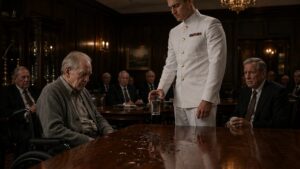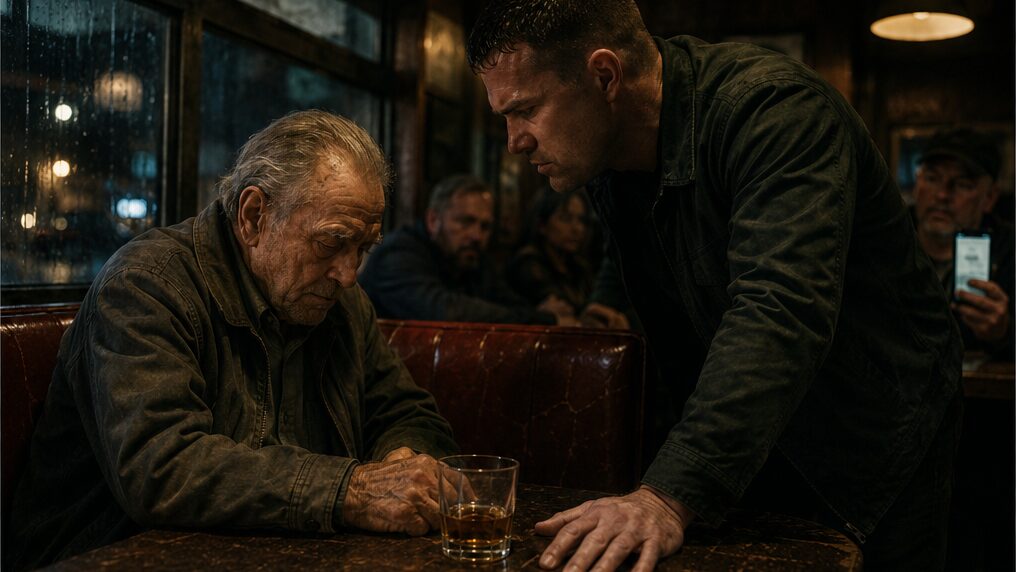
The Old Veteran Never Touched His Drink Until The Young Man Learned Why
Chapter 1: The Man In The Red Cracked Booth
The neon sign above the front window had been missing the same letter for three years.
BAR became BA whenever the wind shook the glass.
Charles Bennett noticed it every time he came, though he never mentioned it to anyone. He noticed small broken things. A veteran got good at that, or else he did not stay alive long enough to grow old. The cracked curb near the door. The bent brass handle. The way the third floorboard dipped under his right shoe. The smoke stain above the jukebox that looked like a thumbprint pressed into the ceiling.
He paused outside the entrance before going in.
Not because he was afraid of the place. He had known worse rooms. He had slept under shell-split trees, on mud, in rain, on the floor of a transport plane while men coughed blood into their sleeves. A dim roadside bar with a sticky door and a tired neon sign did not frighten him.
But the date did.
It had a way of finding him each year, no matter how quiet he kept his life. The morning would open with ordinary light. He would rinse one cup in his kitchen, shave carefully, button the same faded green-gray jacket, and tell himself he was only going out for a drive. By afternoon, his hands would know before his mind admitted it. They would rest too long on the steering wheel. They would fold over one another in his lap. They would search for something that had not been there for more than fifty years.
Charles touched the pocket of his jacket. Nothing inside but a handkerchief and a folded receipt from the pharmacy. He carried no medals, no old photographs, no proof. Proof was for men who needed strangers to understand them quickly. Charles had learned that the things most worth remembering usually could not be shown.
He opened the door.
Warm air rolled out, carrying the smell of fryer grease, old wood, beer, floor cleaner, and rain-soaked coats. It was early evening, but the bar already had the restless pressure of a place expecting a crowd. Two men in work shirts watched a game without enthusiasm. A woman near the end of the counter stirred ice in her glass. The jukebox played low enough that the words were only a murmur.
Melissa Walker looked up from behind the bar.
For one second her face tightened, not with annoyance but recognition. Then she wiped her hands on a towel and gave him the same nod she gave him every year.
“Evening, Mr. Bennett.”
“Melissa.”
His voice came out thinner than he meant it to. He did not correct it.
She glanced toward the far wall, where the red vinyl booth sat under a dim amber light. The vinyl had split along the corner seam, showing a gray-white stuffing underneath. Someone had tried to mend it with a strip of black tape, which had curled at one edge. The tabletop was scratched through its varnish in pale lines: names, circles from glasses, careless knife marks, the rough history of elbows and boredom.
Nobody was sitting there.
Charles let out the smallest breath.
“Same?” Melissa asked.
“Yes, ma’am.”
She almost smiled at the ma’am. Almost. “I’ll bring it over.”
Charles crossed the room slowly. Not because he wanted anyone to see his age. He hated the little negotiations his body now made in public: the careful steps, the pause before lowering himself, the hand on the booth edge to steady his weight. He disliked how people watched the old as if every movement were either a failure or a warning.
He reached the booth and stood beside it for a moment.
The seat seemed lower than it used to be. Everything did. Chairs, cars, mornings, the patience of strangers.
He slid in carefully, back to the cracked vinyl, facing the room. He had chosen that side the first time without thinking. Later, he understood why. Old habits survived long after the wars that made them. Never sit with your back to a door. Never let your hands be trapped. Never let silence mean you stopped listening.
Melissa set the glass in front of him.
It was small, heavy-bottomed, filled with a finger of amber whiskey that caught the booth light and held it like a little flame.
“Need anything else?” she asked.
“No. Thank you.”
Her eyes rested on him a moment too long. “It’s getting busy tonight. There’s a retirement party coming in around seven. Ashley’s been rearranging tables since four.”
“I won’t be trouble.”
“I didn’t say that.”
“No,” Charles said. “You didn’t.”
Melissa looked as if she wanted to add something, then did not. She had a good bartender’s sense of when a man’s quiet was a wall and when it was a wound. She went back to the counter.
Charles placed both hands flat on the table, one on either side of the glass.
The whiskey smelled sharp and sweet. He did not lift it.
Outside, headlights moved across the window. Rain had started again, fine and silver, streaking the glass beneath the broken neon. Men came in laughing too loudly, shaking water from their jackets. A younger couple followed them. Then three more regulars. The bar filled in pieces, each new body taking up air, each voice adding weight.
Charles kept his eyes mostly on the glass.
Not staring. He had promised himself long ago he would not turn memory into worship. He looked at the glass the way a man looked at a chair left empty at a table: with recognition, not performance.
A man at the bar turned and glanced toward him. Then away. Another customer leaned toward the first and said something Charles could not hear. Their eyes moved back to the booth.
He knew what they saw.
Old man. Alone. Whiskey. Same jacket too thin for the weather. Hands with raised veins. A face nobody had taught them to recognize.
There were years when that bothered him. There were years when he wanted to carry a small card in his pocket and lay it down before anyone guessed wrong. Not medals. Not rank. Just three lines that would stop people from making him simple.
I served.
I remember.
This is not what you think.
But he never made the card.
A man ought not have to bring instructions for how to be seen.
Melissa passed the booth twice as the room grew crowded. The second time, she slowed.
“You all right there?”
“Yes.”
“You sure?”
He nodded.
At the bar, Ashley Reed, the owner, moved between customers with tight efficiency. She had inherited the place from her father and ran it with the weary panic of someone always one slow night from losing it. Charles knew her only by sight. She was not unkind, but she measured rooms in tables, minutes, tabs, and spills. Tonight, every seat mattered.
Ashley leaned toward Melissa and spoke low.
Melissa shook her head once.
Ashley looked toward the red booth.
Charles did not pretend not to notice. He had once watched men decide whether another man could be moved while that man still breathed. Compared with that, a bar owner needing a table was no cruelty. It was only the world continuing to ask old bodies to justify the space they occupied.
The front door opened again.
A younger man stepped in out of the rain, broad-shouldered, close-cropped hair dark with water. He wore a dark green jacket zipped halfway over a black shirt. His boots were clean but not soft. His posture belonged to someone used to being told he could handle things and afraid someone might discover he could not.
Brian Carter.
Charles did not know his name yet. He only knew the stance. Many young men carried it. Chest slightly forward. Jaw set before anyone challenged him. Eyes measuring the room for disorder.
Brian spoke with Ashley near the bar. She pointed toward the retirement group arriving at the door, then toward the red booth. Her expression was strained, practical. Brian nodded once, the way a man nodded when he wanted to be useful.
Melissa’s face changed.
“No,” Charles heard her say, not loud enough for the room.
Brian did not look at her. He was already looking at Charles.
The young man began crossing the floor.
The room did not go silent. Rooms rarely gave a man that courtesy. The game still flashed on the television. Glasses still clicked. Someone laughed too hard at nothing. But Charles felt attention shift, small as a draft under a door.
He rested his right hand near the glass.
Brian stopped beside the booth.
“Sir,” he said.
Charles looked up.
The young man’s face was not cruel. That mattered. Cruel men enjoyed taking space. This one looked irritated, pressured, and too sure that irritation was the same thing as authority.
“We need this booth,” Brian said. “There are seats at the bar.”
Charles glanced toward the counter. Every stool was taken except one near the service station, where wait trays passed close enough to brush a shoulder.
“I’m waiting a while,” Charles said.
Brian’s mouth tightened. “You’ve been waiting with one drink for almost an hour.”
Charles did not correct the time. It had been twenty-two minutes.
Melissa moved from behind the bar, but Ashley caught her arm and said something quick. Brian leaned one hand on the back of the booth across from Charles.
“Come on,” he said. “Let’s not make this hard.”
Charles looked back at the glass.
The whiskey held the amber light and did not move.
Chapter 2: The Young Man Leaned Over The Table
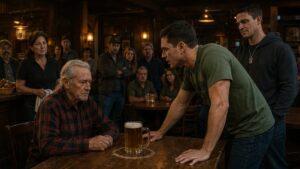
Brian Carter had not meant to raise his voice.
That was what he told himself first.
He had only meant to clear a booth. Ashley was overwhelmed, Melissa was too soft with regulars, and the retirement party by the door had eight people pretending they could squeeze around a four-top. The old man had a drink in front of him and no food, no companion, no tab worth protecting. It was simple.
Except the old man did not move.
Charles Bennett sat with both shoulders slightly rounded, chin lowered, hand resting near the untouched whiskey as if the glass might wander off without him. His face showed no anger. That bothered Brian more than anger would have.
“Sir,” Brian said again, sharper now, “I’m asking politely.”
Charles lifted his eyes.
They were pale blue, clouded a little with age but steady. Brian had expected confusion, maybe stubborn drunkenness, maybe the loose defiance of an old man who wanted to be difficult because he had so few powers left.
He did not expect stillness.
“I heard you,” Charles said.
“Then you understand we need the booth.”
“I understand you said it.”
A couple at the nearby table stopped talking. One of the men at the bar turned on his stool. Brian felt their attention and mistook it for support.
He planted his palm on the tabletop.
The glass trembled once.
Charles’s fingers moved, not to grab it, only to steady the space beside it. His fingertips were square and weathered, nails clean, skin thin over the knuckles. Brian noticed the hand because it did not flinch.
“You can finish that at the bar,” Brian said.
Charles looked at the glass, then back at him. “No.”
The word was soft. It carried no challenge. That made it worse somehow, because Brian could not push against it without becoming the only loud thing in the booth.
Ashley stood behind the counter, arms folded tight. Melissa had come halfway across the floor and stopped near the service station, towel twisted in her hands.
“Mr. Bennett,” she said carefully, “maybe I can find another—”
“I’m all right, Melissa,” Charles said.
Brian caught the name. Bennett. He filed it nowhere.
Behind him, a man lifted his phone.
Justin Miller liked moments before anyone else knew they were moments. He had a habit of recording bar arguments, birthday songs, bad karaoke, near-fights in the parking lot, anything that might make people send him laughing messages the next morning. He did not think of himself as cruel. He thought of himself as observant.
His screen framed the young man leaning over the old man, the whiskey between them, the red booth glowing under tired light.
Brian saw the phone from the corner of his eye and felt a quick hot pressure in his chest. Now the room was not only watching. It was keeping score.
He lowered his voice, but the restraint made it harder.
“Look, you’ve had your time. We have paying customers waiting.”
Charles’s gaze moved briefly to the retirement party by the door. Wet coats. Wrapped gift bag. A woman holding a cake box. People shifting awkwardly, pretending not to stare.
“I paid,” Charles said.
“For one drink.”
“Yes.”
“You haven’t touched it.”
“No.”
Brian gave a short laugh. It was not humor. It was discomfort leaving through the wrong door. “Then what are we doing here?”
Charles did not answer.
Brian leaned closer, one hand still on the table, the other gripping the top of the booth divider. He had been taught to close distance when someone resisted. Not in any official manual worth quoting, but by men who valued command presence, by drills, by corrections, by the way a room changed when a man stepped forward instead of back.
Charles remained seated.
That difference—one man standing, one man old and boxed into cracked red vinyl—should have warned Brian. Instead, it made him feel more responsible for ending the scene quickly.
“Sir, I don’t know what kind of night you’re having,” Brian said, “but you can’t just sit here pretending not to hear people.”
A few customers murmured.
Charles lowered his eyes.
To Brian, it looked like guilt. To Melissa, it looked like pain. To Charles, it was neither. It was discipline. There were words inside him, but some words, once brought out in a public room, became common property. Men with phones could carry them away. Strangers could chew them into opinions. He had not come here to feed his dead to a crowd.
He breathed once through his nose.
His right thumb touched the rim of the glass.
Brian noticed and said, “If you’re too drunk to move, I can help you.”
The room changed then.
Not loudly. Not dramatically. A few faces sharpened. Melissa took a step forward.
Charles looked up again.
He did it slowly, not for effect but because his neck was stiff and because he wanted one more second before deciding what kind of man the young one would be allowed to become in this moment.
“Brian,” Melissa said.
He did not turn. “I’ve got it.”
“No,” she said. “You don’t.”
Charles’s eyes stayed on Brian. They held no accusation, which unsettled Brian more than anger would have.
“I am not drunk,” Charles said.
The phone kept recording.
Brian’s jaw flexed. “Then why order it?”
Charles looked down at the whiskey. The amber surface had gone still again. Above it, the booth light made a small yellow oval on the scratched wood.
When he spoke, his voice was low enough that the nearest tables leaned to hear.
“That one isn’t mine to drink.”
Brian blinked.
The sentence landed strangely. It did not explain enough to end the matter. It explained just enough to make the room aware that it had been standing in the middle of something it did not understand.
Justin’s phone tilted closer.
Brian’s hand remained on the table, but the force went out of his fingers. He glanced at the glass, then at Charles’s face.
“What does that mean?”
Charles withdrew his hand from the rim and folded it over the other. “It means I won’t be long.”
“That’s not—” Brian stopped himself.
A man at the bar muttered, “Let him sit.”
Someone else said, “It’s just a booth.”
Ashley heard that. Her cheeks tightened. In a struggling bar, nothing was just a booth. But even she did not speak.
Brian felt the whole room pressing against his back now, no longer in support but in judgment. He hated the shift. He hated that the old man had changed the temperature with one quiet sentence. He hated that he suddenly looked like the bully in a story he had not known he was entering.
So he did what ashamed men often do before they understand shame. He tried to recover authority.
“Then be not long somewhere else,” he said.
Melissa inhaled sharply.
The words sounded worse once they were outside him.
Charles did not react at first. His face stayed composed, but something behind his eyes moved backward, far away from the bar, from Brian, from the rain on the window. For a second, Brian had the unreasonable sense that the old man was listening to someone who was not there.
Then Charles placed one palm flat on the table and began to slide out of the booth.
It was not graceful. His knee resisted. His shoulder brushed the cracked vinyl. He paused once, not asking for help. The room watched him negotiate his own body while the untouched glass remained behind him.
Brian stepped back.
Not out of respect. Not yet. Only because there was suddenly nowhere proper for him to stand.
Charles reached into his jacket pocket, took out a folded bill, and laid it beside the glass. More than the drink cost. Enough for Melissa, though she would not want it.
He looked at Brian once more.
There were many things he could have said. Young men often believed restraint meant a man had no ammunition. Charles had enough words to wound him cleanly. He could have named units, years, heat, blood, promises, the sound a boy made when he was trying not to call for his mother.
Instead he said, “You keep the seat warm, then.”
Brian stared at him.
Charles turned and walked toward the door.
No one applauded. No one stopped him. Justin’s phone followed him across the room, catching the slow steps, the faded jacket, the old hand brushing the back of a chair for balance.
At the door, Charles paused beneath the broken neon glow.
Melissa called his name, but softly, as if too much volume might break what remained of him.
He did not turn around.
The door opened. Rain and cold air moved in. Then Charles Bennett stepped out, leaving the small glass untouched on the scratched table.
Chapter 3: The Video Made Him Smaller
By morning, Charles was smaller than he had been the night before.
Not in his body. His body had been shrinking by quiet degrees for years: less muscle under the sleeves, less height in the spine, less certainty in the left knee when rain came through town. He had made his peace with much of that. A body was a borrowed tool. If a man was lucky, he got to use it until the handle wore smooth.
No, the video made him smaller in a different way.
It took a room where he had sat in grief and flattened it into a scene people could hold in one hand.
Charles saw it because his neighbor from the next apartment knocked before breakfast with a phone already glowing.
“Mr. Bennett,” the neighbor said, uneasy, “is this you?”
Charles was standing in his kitchen with one clean cup in the dish rack and a slice of toast cooling on a plate. He had not slept. Rain had tapped the windows until after midnight, and each time he closed his eyes he saw Brian’s hand on the table, the glass trembling, the phone raised behind him.
He looked at the screen.
There he was.
Old. Seated. Cornered by the red booth. His jacket looked poorer through the phone than it had felt on his shoulders. His head was bowed in the first frame, and for one disorienting second he understood why strangers might think him defeated before they heard a word.
The caption read: Old guy refuses to leave booth over drink he won’t even touch.
Below it, comments climbed in restless lines.
Some defended him. Some mocked him. Some wanted to know what was wrong with young people now. Some wanted to know what was wrong with old people who thought the world owed them a chair. Some posted little flags, though there had been no flag in the room. Some guessed he was homeless. Others guessed he was drunk. A few called Brian a hero for trying to keep order. A few called Brian names Charles would not have allowed in his mother’s kitchen.
The video reached the sentence.
That one isn’t mine to drink.
The neighbor looked up at him, waiting.
Charles handed the phone back.
“That’s me,” he said.
“People are talking about it.”
“I expect they are.”
“You want me to report it or something?”
“No.”
“But they shouldn’t have—”
Charles lifted one hand, not sharply, just enough.
The neighbor stopped.
“Thank you for telling me,” Charles said.
After the door closed, he stood a long while in the kitchen. The toast hardened on the plate. The cup in the rack dried with one drop clinging to its rim.
He did not feel anger first.
That surprised him.
He felt exposure. A draft through a wall he had thought was solid. The ritual had survived decades because it had remained small. A booth. A glass. A date. A name spoken inwardly, where no one could mispronounce it or use it to make themselves feel noble.
Now strangers had pieces of it.
Not the true piece, but enough to bruise it.
He sat at the kitchen table, but the chair felt wrong. It did not hold memory. It only held weight.
Across town, Brian Carter watched the same video in the bar office with Ashley standing behind him and Melissa in the doorway.
Ashley had her arms folded. Her face looked as if she had spent the morning reading comments and calculating damage.
“Well,” she said, “this is bad.”
Brian did not answer.
On the screen, his own body leaned over the old man. He had not known he looked that large. Not strong. Large. Heavy in the frame. His hand spread on the table like he owned it. His jaw set in a way that now seemed less disciplined than stupid.
The video made Charles smaller, but it made Brian uglier.
He had watched it six times before Ashley came in. Each time, he waited for some angle that would explain him better. It never came. There was no caption long enough to show the retirement party waiting, Ashley’s pressure, the full bar, the practical problem of seating. Even if there had been, he knew by the fourth viewing that none of it changed the sound of his own voice.
If you’re too drunk to move, I can help you.
He rubbed a hand over his face.
Melissa spoke from the doorway. “He wasn’t drunk.”
Ashley turned. “We know that now.”
“We knew it then,” Melissa said.
The room went quiet.
Brian stared at the paused image. Charles was halfway out of the booth, one hand braced on the table. The glass sat untouched beside the folded bill.
“How often does he come in?” Brian asked.
Melissa looked at him. “Once a year.”
Brian turned. “What?”
“Same date. Same booth. Same drink.”
Ashley frowned. “I didn’t know that.”
“You don’t work many Tuesdays before seven,” Melissa said.
Ashley accepted that without answering.
Brian looked back at the screen. “Once a year?”
Melissa nodded.
“Why?”
“I don’t know.”
“You never asked?”
“No,” Melissa said. “Because some people come in carrying something, and if they don’t hand it to you, you don’t grab.”
Brian felt the words hit somewhere below the ribs.
Ashley sighed, business and guilt wrestling across her face. “I need this handled. People are tagging the bar. Some are saying we threw out a veteran.”
Brian looked up quickly. “Is he?”
Melissa’s expression hardened. “Does he need to be for it to matter?”
“No. I just—”
“You just what?”
He had no good ending for that sentence.
On the desk, Ashley’s phone buzzed again. She glanced at it, winced, and turned it face down.
“We need to call him,” she said. “Apologize. Offer a meal. Something.”
Melissa shook her head. “Do not make him a promotion.”
“I’m trying to keep this place from getting buried.”
“And I’m trying to keep you from burying him again.”
Brian stood. The chair scraped hard behind him. “I’ll apologize.”
Melissa looked at him for a long moment. “For what?”
He frowned. “For what happened.”
“That’s not an answer.”
“For asking him to move.”
“No.”
“For assuming he was drunk.”
“Closer.”
“For pushing him in front of everyone,” Brian said, irritated now. “For making it a whole thing. What do you want me to say?”
Melissa’s voice stayed level. “Not to me.”
Brian looked away.
At his apartment, Charles took his jacket from the back of a chair and brushed at a spot near the cuff that was not there. He hung it in the closet, took it out again, then hung it once more.
By noon, Melissa called.
He let it ring four times before answering.
“Mr. Bennett?”
“Yes.”
“It’s Melissa. I’m sorry to bother you.”
“You’re not.”
A pause. Bar noise murmured faintly behind her, though the place was not open yet.
“I wanted to say I’m sorry,” she said. “For last night. I should have stopped it sooner.”
Charles looked toward the window. Rainwater trembled on the fire escape rail.
“You were working,” he said.
“That’s not all I was doing.”
He closed his eyes briefly. He had no wish to become the object of her guilt either.
“Melissa,” he said, “is the booth still there?”
She went silent.
“Yes,” she said at last. “It’s still there.”
“Good.”
“Mr. Bennett, if you want to come back, I’ll make sure—”
“I don’t know yet.”
“Of course.”
He almost ended the call. Instead he asked, “The glass?”
“What?”
“The glass from last night.”
“I washed it,” she said softly. “I’m sorry. I didn’t know.”
“No,” he said. “You did what a bartender does.”
His hand tightened around the phone.
“Thank you for calling.”
After they hung up, Charles remained by the window.
Cars moved below through the wet street. People crossed under umbrellas, heads down, each carrying private weather no stranger could read. He wondered how many of them had been made smaller by a story told badly about them. How many had swallowed the correction because explaining would cost more than silence.
On the kitchen table, the untouched toast still lay on the plate.
Charles picked it up and threw it away.
Then he opened the cupboard, took down a small plain glass, and set it in front of the empty chair across from him.
For a moment he only stood there.
“You see that?” he said quietly.
The apartment answered with the hum of the refrigerator, the ticking heat pipe, the city breathing through wet brick.
Charles pulled out his chair and sat down.
He did not know whether he would return to the bar.
But he knew the date had not finished with him.
Chapter 4: Nobody Asked Why He Came Back
Melissa Walker had learned the habits of men who did not want to be known.
They sat with their backs to walls. They paid in cash. They said thank you without looking directly at her, not out of rudeness but to keep whatever lived behind their eyes from spilling onto the counter. They did not ask for sympathy. Most of them did not even ask for refills. They came into the bar carrying silence the way other people carried umbrellas, and if you were decent, you let them set it down without touching it.
Charles Bennett had always been one of those men.
Once a year, same date. Early evening. Faded jacket. Red booth. One small whiskey. Folded bill. No trouble. No small talk beyond what courtesy required.
Melissa had noticed the pattern by the third year she worked there.
By the fifth, she began setting aside the heavy-bottomed glass before he arrived.
By the seventh, she stopped asking if he wanted anything else.
But she had never asked why.
That truth sat in her now like a stone.
The bar was closed for the afternoon, though it did not feel empty. The building held the previous night’s noise in its wood, in the stale beer smell rising from the floor mats, in the half-cleaned tables and the low hum of the refrigerator under the counter. Rain had cleared, leaving the front windows bright with a pale, indifferent sun.
Melissa stood beside the red booth with a damp rag in her hand.
The glass was gone, washed because that was what she did after closing. Glasses came in dirty and left clean. Tables came in cluttered and left bare. A bartender survived by returning things to order.
But some things were not meant to be cleared so quickly.
She wiped the tabletop slowly. The rag caught in one of the deeper scratches. The mark ran diagonally across the wood, pale against dark varnish. She had seen it a thousand times without caring. Now every mark looked like a clue she had been too busy to read.
Ashley Reed came from the back office carrying a clipboard and the tight expression she wore when numbers were bad.
“I spoke to the insurance guy,” she said. “That was useless. I spoke to the website guy. Also useless. I spoke to my cousin who says we should post a statement.”
Melissa kept wiping.
Ashley waited. “You heard me?”
“I heard you.”
“You have thoughts?”
“Yes.”
“And?”
“Don’t post anything with his name in it.”
Ashley exhaled through her nose. “I know that.”
“Don’t call him a veteran unless he says you can.”
“I didn’t say I would.”
“Don’t offer free food online like we’re buying forgiveness with a burger basket.”
Ashley lowered the clipboard. “I didn’t say that either.”
Melissa looked up then. “You were thinking it.”
Ashley’s mouth opened, then closed.
For years, Melissa had watched Ashley fight to keep the bar alive. She had seen her stretch vendor bills, fix toilets herself, work through migraines, smile at customers who treated her like part of the furniture. Ashley was not heartless. But fear had a way of making people practical until practical became unkind.
Ashley moved to the booth and looked down at the seat.
“This place doesn’t get to survive on feelings,” she said quietly.
“No,” Melissa said. “But it can die from forgetting people are people.”
Ashley’s fingers tightened on the clipboard.
From the back office, Brian Carter appeared and stopped just inside the hallway. He had a broom in one hand, though he had not swept anything in ten minutes. Melissa knew he had been listening. She let him.
Ashley noticed him too. “You should be helping with the cooler.”
“Yes, ma’am,” Brian said, but he did not move.
Melissa turned back to the table. “There might be something in the old reservation books.”
Ashley frowned. “We don’t take reservations.”
“Your father did sometimes. For regulars. For anniversaries. Things like that.”
“That was twenty years ago.”
“Exactly.”
Ashley looked at her, then toward the storage room where boxes of old ledgers sat beneath broken Christmas decorations and spare tap handles.
Brian shifted. “You think Mr. Bennett is in there?”
“I think,” Melissa said, folding the rag, “nobody asked why he came back. So maybe the building remembers better than we do.”
The storage room smelled of cardboard, dust, and lemon cleaner. Ashley pulled the chain on the overhead bulb, and weak yellow light swung over stacked boxes marked TAX, MENUS, RECEIPTS, and MISC in her father’s blocky handwriting. The old reservation books were in a milk crate under a collapsed New Year’s banner.
Melissa carried the crate to the bar.
They opened the books one by one.
Most entries meant nothing now. Birthdays. Dart league. Poker night. A graduation dinner. Names of people who had moved, died, divorced, or stopped coming without announcement. The pages had grease stains at the corners and old coffee rings bleeding through the ink.
Brian stood across from them, silent.
Ashley turned pages quickly at first, then slower when Melissa said, “June twelfth.”
The first book with that date held no Charles Bennett. The next did not either. Then, in a ledger from years before Melissa had worked there, they found it.
June 12. Back booth. One whiskey. C.B.
No phone number. No party count. No note except a small check mark.
Melissa touched the initials.
Ashley leaned closer. “That could be anyone.”
Melissa turned to the next year.
June 12. Back booth. One whiskey. C.B.
The next.
Same.
The handwriting changed halfway through the books, from Ashley’s father’s heavy print to Melissa’s own neater script. She had not realized she was continuing an older habit. She had simply written what Charles asked, year after year, as if the routine had begun with her.
Brian’s face had gone still.
“How many years?” he asked.
Melissa kept turning pages.
They found seventeen in the books. Ashley found three more clipped paper notes in a folder of old shift schedules. Melissa remembered at least seven that had never been written down because by then everyone simply knew.
“More than twenty,” she said.
Ashley sat on a barstool as if her knees had asked for permission.
Brian stared toward the red booth.
“He’s been coming here once a year for over twenty years,” he said.
Melissa closed the last book carefully. “Yes.”
“And nobody knows why.”
“No.”
Brian swallowed. “He said the drink wasn’t his.”
Ashley looked at the reservation books spread across the bar. For the first time all day, the business problem left her face. What replaced it was not yet understanding. It was the embarrassment of having mistaken something sacred for something inconvenient.
Her phone buzzed on the counter.
She glanced at it, ignored it, then turned it face down.
“What do we do?” she asked.
Melissa looked toward the red booth. Sunlight from the front window touched the split vinyl and made the cracked red surface look almost soft.
“We leave room,” she said.
Brian’s jaw tightened.
Melissa saw the movement and turned to him. “Not for your apology. Not for our statement. For him.”
Brian’s eyes flicked to the reservation book. “I wasn’t trying to—”
“I know,” Melissa said.
That stopped him more effectively than blame.
She did know. He had not come in looking to hurt an old man. He had come in looking to be useful, to solve a problem, to prove he could handle pressure. That was what made it worse in some ways. Harm done casually, under the cover of being practical, had a way of looking innocent to the person doing it.
Ashley stood and gathered the books.
“If he comes back,” she said, “I don’t want another scene.”
Brian looked up.
The words entered him wrong. Melissa saw it happen. He heard accusation where Ashley meant fear. He heard his own failure named without being named. His ears went red.
“There won’t be,” he said.
Ashley softened a fraction. “Brian—”
“I said there won’t be.”
He set the broom against the bar with more force than needed and walked toward the storage hallway.
Melissa watched him go.
Ashley sighed. “Now I’ve got him upset too.”
“He should be upset,” Melissa said. “Just not at the wrong person.”
In the hallway, Brian stopped where no one could see him from the bar. The wall was covered with old framed pictures: softball teams, Halloween parties, a newspaper clipping from when Ashley’s father bought the place, a faded photo of the bar before the neon sign lost its letter.
He had passed those pictures a dozen times without caring.
Now he looked at all the faces and wondered how many stories he had walked past because they were not standing in his way.
From the bar, Melissa’s voice carried faintly.
“Put the books somewhere safe.”
Brian closed his eyes.
In his memory, Charles Bennett’s hand steadied the table beside the glass.
Not shaking. Not drunk.
Steadying what Brian had made tremble.
Chapter 5: Brian Carter Wanted One Clean Apology
Brian Carter wanted an apology he could stand inside.
Something with shape. Something that began with “I’m sorry,” moved through “I was wrong,” and ended with the other person nodding so the air could clear. He wanted a task, not a wound. Tasks had edges. You could finish them.
By the third day after the video, he had written six versions on his phone.
Mr. Bennett, I apologize for how I handled the situation.
Deleted.
Sir, I disrespected you and I’d like to make it right.
Deleted.
Charles, I’m sorry.
He stared at that one longest. It was too familiar. He did not have the right to use the man’s first name. He deleted it too.
The bar had reopened the night before and survived, though not peacefully. People came in pretending they had not come because of the video. They ordered beer slowly and looked toward the red booth before looking at the menu. A few asked Melissa if “the old guy” was coming back. One customer made a joke about saving seats for ghosts, and Melissa stared at him until he became interested in his napkin.
Brian worked the door and carried cases and stayed away from the booth.
Justin Miller came in near nine, grinning with the nervous pride of a man whose bad idea had become popular.
“Wild week, huh?” Justin said.
Brian looked at him. “Take it down.”
Justin blinked. “What?”
“The video.”
“It’s already everywhere.”
“Take yours down.”
Justin laughed once, but it died when Brian did not smile. “Man, I didn’t make you say what you said.”
“No,” Brian said. “You just made sure he had to keep hearing it.”
Justin’s face flushed. “People had a right to see.”
“Did he have a right not to be used?”
The question hung between them.
Justin looked away first. “I’ll think about it.”
Brian wanted to press him, but Melissa’s words came back: You don’t grab what someone hasn’t handed to you. He let Justin move past him toward the bar, though every step felt unfinished.
The next afternoon, Brian arrived early and found Melissa unloading clean glasses from a plastic rack. Sunlight made the bottles behind the bar look brighter than they had any right to.
“Do you have his number?” he asked.
Melissa did not look up. “Yes.”
“Can I have it?”
“No.”
“I need to apologize.”
She slid a glass into place. “Need?”
He breathed out. “Want.”
“Better.”
“Melissa.”
She finally turned. “If he wants to hear from you, he’ll say so.”
“How would he say so if I can’t ask?”
“He knows where the bar is.”
“That’s not fair.”
“No,” she said. “It’s respectful.”
Brian leaned both hands on the bar, caught himself, and removed them. He did not want to look like he was looming again, even over furniture.
“I’ve been thinking about it,” he said.
“I’m sure.”
“That came out wrong.”
“A lot does with you.”
He almost snapped back. The impulse rose fast, familiar. Then he saw Charles trying to stand from the booth while the room watched. He swallowed it.
“I know I was wrong,” he said.
Melissa studied him. “What were you wrong about?”
He looked at the red booth. It was empty now, its table clean, its crack taped but not repaired.
“I thought he was being difficult.”
“And?”
“I thought because I had a reason, I had the right.”
Melissa’s expression shifted just slightly.
Brian continued before he could make it sound polished. “I thought if I kept my voice steady, it counted as respectful. But I was using the room against him.”
Melissa picked up another glass. “That’s closer.”
The front door opened before he could answer.
Charles Bennett stepped inside.
For a moment, no one moved.
He wore the same faded jacket, buttoned higher against the afternoon chill. The room was not open yet, chairs still turned on some tables, floor still smelling faintly of mop water. Without evening noise around him, Charles looked both more fragile and harder to misread. His face was tired, but his eyes were clear.
Melissa set the glass down.
“Mr. Bennett,” she said softly.
Charles nodded. “Melissa.”
Brian stood behind the bar, suddenly aware of his hands, his boots, his height, the space he occupied.
Charles looked at him but did not speak.
Ashley came from the office doorway and froze.
“I can come back later,” Charles said.
“No,” Melissa said too quickly. Then, gentler, “No. You’re welcome here.”
Charles’s eyes moved to the red booth.
Brian stepped aside even though he was nowhere near blocking it.
Charles crossed the room with the same careful gait as before. He placed one hand on the booth edge and lowered himself into the cracked red seat. The movement was slow, but this time no one mistook slowness for confusion. The room held itself around him.
Melissa reached for the heavy-bottomed glass, then stopped.
Charles noticed. “Same, please.”
Her hand trembled once before she steadied it. She poured a finger of whiskey and carried it over. She set it down with more care than the drink required.
Charles placed a folded bill beside it.
“Not yet,” Melissa said.
He looked at her.
“Please,” she added. “After.”
After what, no one said.
Brian remained near the bar until he could not bear the distance. He walked toward the booth and stopped several feet away, leaving space between them.
“Mr. Bennett.”
Charles looked up.
Brian had practiced an apology, but all the sentences arranged inside him now sounded like something a man said to escape the room.
“I was wrong,” he said.
Charles waited.
Brian’s throat worked. “I treated you like a problem to move. You weren’t. I assumed things I had no right to assume. I spoke to you in front of people in a way no man should speak to another.”
The old man’s face gave him nothing easy.
“I’m sorry,” Brian said.
Charles looked at the glass.
It sat untouched between them, not close enough for Brian to reach, not far enough for him to ignore.
“Do you want me to say I forgive you?” Charles asked.
Brian’s face went hot. “No, sir.”
“Good.”
The word was not cruel. It was clean.
Brian nodded once, accepting the cut because it was deserved.
Charles rested his right hand near the glass. “A clean apology is a fine thing when the harm is clean.”
Brian looked down.
“This wasn’t?” he asked, though he already knew.
Charles’s thumb moved along a scratch in the table. “You didn’t only speak to me. You let everyone else decide what they were seeing.”
Brian thought of Justin’s phone, Ashley’s worry, comments under the video, strangers turning Charles into argument.
“I know,” he said.
“No,” Charles said quietly. “You know you feel bad. That’s not the same.”
The words landed without force and still found the mark.
Melissa turned away behind the bar, not to give them privacy exactly, but to deny the room the shape of an audience.
Brian stood there, unable to fix himself into usefulness.
“What do I do?” he asked.
Charles looked up then.
For the first time, there was something like sadness in his expression that had nothing to do with weakness.
“You stand differently next time,” he said.
Brian nodded, though he did not yet understand.
Charles did not explain. He turned his gaze back to the glass, and Brian knew the conversation was over because the old man had ended it, not because Brian had earned an ending.
He stepped back.
Charles remained in the booth for twenty minutes. He did not drink. He did not speak. When he left, he placed the folded bill under the rim of the glass and nodded to Melissa on his way out.
Brian watched from the hallway.
Outside, the afternoon light fell across Charles’s shoulders as he opened the door.
No phone recorded him this time.
When the door closed, Brian walked to the booth. The glass still stood there, amber and untouched. The bill was folded beneath it, pinned like a quiet instruction.
Melissa came up beside him.
Brian did not look away from the glass.
“He came back,” he said.
“Yes.”
“Why?”
Melissa did not answer.
Across the room, the door opened again, and for one unreasonable second Brian thought Charles had returned.
But it was only the delivery driver with a crate of lemons.
Brian stepped aside to let him pass, then looked again at the empty red booth.
He understood, with a discomfort deeper than guilt, that forgiveness was not the thing he had been asked to carry.
Chapter 6: The Name Beneath The Silence
Charles Bennett returned before the bar opened because daylight left fewer places for pity to hide.
The street outside was bright and cold, washed clean by a night of rain. Delivery trucks groaned at the curb. A trash bag split near the alley, and a line of dirty napkins fluttered against the brick like surrendered flags. Charles stood under the broken neon sign, looking at his reflection in the dark front window.
Old man. Faded jacket. Shoulders not as square as they had once been.
He raised one hand and touched the glass lightly, not his reflection, just the barrier between inside and out.
Melissa saw him from behind the bar and unlocked the door.
“You don’t have to open early,” he said.
“I was already here.”
That was almost certainly true. It was also not the whole truth.
She held the door and let him pass. The bar smelled different before customers arrived. Less sour. More wooden. More honest. Chairs stood upside down on tables. The television was off. Without voices, the red booth seemed farther from the door than usual, as if it existed in its own weather.
Brian was inside, stacking clean pint glasses on a shelf.
He turned when Charles entered.
The young man did not straighten into command this time. He simply stood still, glass in hand, waiting to be told whether he belonged in the moment.
Charles saw that and felt a small, reluctant approval he did not show.
Ashley came halfway out of the office, saw him, and stopped.
“Mr. Bennett,” she said. “Good morning.”
“Morning.”
“If you need anything—”
“I know where the booth is.”
Ashley closed her mouth and stepped back.
Charles moved to the red booth and sat. His knee complained, but softly. He placed both hands on the table. The scratches were clearer in morning light. Years of use laid bare without the kindness of amber bulbs.
Melissa approached with the heavy-bottomed glass.
Charles looked at it in her hand.
“No whiskey this morning,” she said. “Just the glass.”
He accepted that.
She set it on the table empty.
It looked wrong at first. Too clear. Too innocent. A glass without its amber weight was only a glass, and yet Charles felt the old ache move under his ribs anyway. The object did not need filling to know what it was.
Brian stayed near the bar.
Charles let the silence lengthen until it became his and not theirs.
Then he said, “You can come over.”
Brian looked at Melissa. She gave him nothing. He wiped his hands on a towel and walked to the booth, stopping where he had stood during the apology.
Charles nodded toward the opposite seat.
Brian hesitated. “Are you sure?”
“No.”
Brian almost smiled, then realized Charles was not joking, not entirely. He slid into the booth carefully, as if the cracked vinyl might object.
He looked too large there, too young, too alive.
For a moment, Charles saw another young man across from him. Narrower face. Lighter hair. A grin that appeared too quickly. A boy who had lied about his age by three months because he wanted out of a mill town and into something that sounded like purpose. Charles closed his eyes once and let the image settle back where it belonged.
Brian did not speak.
That helped.
Charles turned the empty glass slowly with two fingers. Its base rasped faintly over the wood.
“There was a boy,” he said.
Brian’s face tightened at the word, but he stayed quiet.
“He was not a boy by law. Nineteen. Old enough for the Army to put a rifle in his hands and young enough to still be surprised when rain came through a roof.”
Melissa, behind the bar, stopped moving. Ashley remained unseen in the office doorway. Charles knew they were listening. He had allowed it by speaking here. That did not make it easy.
“He talked too much,” Charles said. “Some men talk because they like their own voice. He talked because quiet scared him. Asked everyone what they would do when they got home. Asked it like home was a place waiting politely for all of us to return.”
Brian’s eyes dropped to the glass.
Charles’s hand rested beside it.
“He asked me once if I drank whiskey. I told him no. He said when we got back, he’d buy me one anyway, and I could sit there looking sour while he drank both.” A breath that was almost a laugh moved through Charles and vanished. “He had plans for a garage. Not a big one. Two bays. His uncle knew engines. He was going to name it something foolish.”
The bar was very still.
“What was his name?” Brian asked softly.
Charles looked at him.
The question had been asked correctly. Not hungry. Not grabbing. Just opening a door and waiting outside it.
“Andrew Harris,” Charles said.
The name changed the room.
Not because anyone there knew it. They did not. That was the ache of it. A whole life could become a name that made no sound in strangers’ memories unless someone living carried it forward.
Charles looked at the empty glass.
“He was hit after midnight,” he said. “There had been shelling all evening. Then quiet. Quiet was worse sometimes. Made you trust the wrong thing.”
His fingers curled slightly. Not enough for anyone to call it a tremor.
“I was a medic. That was my job. Get to them. Keep them breathing. Lie when lying helped. Tell them they were going home when nobody knew who was going anywhere.”
Brian’s lips pressed together.
Charles heard again the mud sucking at his boots. The wet heat. A voice calling not for God, not for country, but for a mother named in a whisper. He did not describe those things. Some truths did not become more honest when spoken plainly. They only became less bearable for the listener and no lighter for the teller.
“I got to Andrew,” he said. “Not fast enough.”
Melissa covered her mouth with one hand.
Charles kept his eyes on Brian. The young man needed to hear this without drowning in it. That was part of the lesson too.
“He knew,” Charles said. “Some men do. He grabbed my sleeve and told me I still owed him that drink. Imagine that. Boy lying there with half the world leaving him, and he remembered a joke.”
The empty glass blurred. Charles blinked once and the room returned.
“I told him we’d have it when we got home.”
No one moved.
“He said, ‘Then don’t drink mine.’”
Brian lowered his head.
Charles let the silence hold the name.
Andrew Harris.
The bar had never heard it before. Not truly. For more than twenty years, the place had held the ritual without understanding the reason. Charles did not blame it. Buildings kept what people gave them. He had given very little.
“After my wife passed,” Charles said, “I started coming here. First year was an accident. I was driving with nowhere to be and saw the sign. Ordered a whiskey before I remembered I didn’t drink it. Then I remembered him.” He touched the glass. “So I left it there.”
Melissa’s eyes shone, but she did not interrupt.
“Next year, I came back. Same date. Same booth. Same drink. It seemed foolish. Then it seemed less foolish than forgetting.”
Brian looked up. His face had changed, not cleansed, not forgiven, but stripped of something he had mistaken for strength.
“I’m sorry,” he said.
Charles shook his head once. “Don’t spend that word too fast.”
Brian closed his mouth.
Charles leaned back against the cracked vinyl. He was tired now. Speaking had a cost. The room had taken the story gently, but it had taken it all the same.
“You asked what you should do,” Charles said.
Brian nodded.
“You don’t repair disrespect by feeling sorry. You repair it by standing differently next time.”
Brian’s eyes moved to the booth, the empty glass, the place where his hand had pressed too hard against the table days before.
“Yes, sir,” he said.
Charles studied him. “And don’t call me sir because you’re ashamed.”
Brian swallowed. “What should I call you?”
“Mr. Bennett will do.”
For the first time that morning, Melissa made a small sound that might have become a laugh if the room had been less tender.
Charles allowed himself to look toward her.
“You wrote it down?” he asked.
Melissa blinked. “What?”
“The name.”
She turned quickly, grabbed an order pad from behind the bar, and picked up a pen. Her hand hovered.
“Andrew Harris,” Charles said.
She wrote it carefully.
Not on the wall. Not on a sign. Not in a public post. Just on a small piece of paper behind a bar that had finally learned what it had been holding.
Charles looked back at Brian.
The young man sat very still across from him, hands folded loosely on the table where they could do no harm.
For a while, none of them spoke.
Then Charles slid the empty glass a few inches toward the center of the table.
Not to Brian.
Not away from himself.
Just into the space between them, where a memory could be seen without being owned.
Chapter 7: The Booth Was Not For Sale That Night
By Friday evening, the video had begun to die the way most public cruelties died now: not by being answered, but by being replaced.
A dog got loose in a grocery store two towns over. A school board argument turned louder than anyone expected. A delivery truck wedged itself under the low bridge near the interstate, and by noon half the county had seen a picture of it. People moved on with the relief of those who had never been required to stay.
But the bar had not moved on.
The red booth sat under its amber light with a small reserved card Melissa had written by hand and set flat on the table, not propped up for display. She had used plain black ink. No decoration. No explanation.
Reserved.
Ashley had stared at the card for almost a full minute when Melissa placed it there.
“For how long?” Ashley asked.
Melissa wiped the table once more though it was already clean. “Tonight.”
“It’s Friday.”
“I know what day it is.”
“We’ll be full.”
Melissa looked at her. “Then we’ll be full without this booth.”
Ashley’s first answer came from the place in her that counted chairs before people. “That’s four seats.”
“No,” Melissa said. “Tonight it’s one.”
Ashley rubbed her forehead. She looked tired. She had spent the week answering messages she did not want, refusing interview requests from people who called themselves local creators, and explaining to customers that no, they were not putting up a plaque, no, they were not hosting a veteran night because of a viral video, no, they were not interested in turning a man’s private grief into a special.
“I don’t want to make it weird,” Ashley said.
“Then don’t.”
“It already is.”
Melissa softened. “Only if we act like it’s ours.”
Brian stood at the far end of the bar, carrying a crate of clean glasses. He heard them but did not join. Since the morning Charles had spoken Andrew Harris’s name, Brian had moved differently around the booth. Not carefully enough to be theatrical. Just differently. He did not set dirty plates on that table while passing. He did not lean on the divider. He did not let customers toss coats into the seat.
Once, a man asked if that was “the famous old guy’s booth,” and Brian answered, “No.”
The man laughed. “No?”
“It’s a booth,” Brian said. “And it’s reserved.”
The man had looked at him as if waiting for a punch line. Brian gave him none.
Now the Friday crowd thickened early. Rain threatened again but had not yet fallen, leaving the air close and electric. The retirement party from the week before had not returned, but others came in their place: warehouse workers, two couples from the bowling alley, a group from the auto parts store, regulars who had watched the video and wanted to pretend they had not.
Justin Miller came through the door just after seven.
Brian saw him immediately.
Justin’s shoulders had lost some of their easy bounce. He approached the bar, avoiding the booth with more effort than if he had simply looked at it.
“Beer?” Melissa asked.
“Yeah.”
She poured it without comment.
Justin placed cash on the counter. “I took it down.”
Melissa looked at him.
“The video,” he said, quieter. “I took mine down. I know it’s still out there other places, but mine’s gone.”
Brian was close enough to hear. He did not thank him. Gratitude would have made the act sound complete.
Melissa slid the beer over. “All right.”
Justin nodded too much. “I didn’t mean for it to—”
Melissa’s eyes stopped him.
He picked up his beer and moved to a stool near the wall.
At seven twenty, Charles arrived.
The broken neon flickered red across his jacket as he stepped in. The room noticed him in pieces, then all at once. Conversations did not stop, but they thinned. People tried not to turn their heads too quickly. A few failed.
Charles paused just inside the door.
Brian, standing near the host stand Ashley had dragged out for busy nights, felt the old reflex rise in him: step forward, manage the entrance, explain the room. This time, he did not move into Charles’s path.
He only said, “Good evening, Mr. Bennett.”
Charles looked at him. “Brian.”
The use of his first name struck harder than any forgiveness Brian had imagined. Not warmth. Not absolution. Recognition. Enough to make him stand straighter for the right reason.
Melissa came around from behind the bar with the heavy-bottomed glass already in her hand. She did not fill it yet.
Charles saw the reserved card on the table.
His expression changed so little that anyone else might have missed it. Brian did not. The old man’s mouth tightened, not with displeasure exactly, but with the discomfort of being considered too carefully.
“I didn’t ask for that,” Charles said.
Melissa answered from beside him. “No.”
Charles glanced at Ashley, who stood near the service station, hands clasped in front of her instead of folded. Ashley gave a small nod.
“No speeches,” she said. “No signs. No posts. Just the booth.”
Charles held her gaze, then looked back at the table.
The card lay there like a question.
He walked to the booth and picked it up. For a moment Brian thought he would hand it back, and part of him hoped he would. That would make the room simpler. Charles would refuse honor, everyone would respect the refusal, and the hard work would be done.
Instead, Charles folded the card once and placed it beside the napkin holder.
Not displayed. Not rejected.
Adjusted.
Melissa poured the whiskey at the bar, carried it over, and set it down. Charles placed his folded bill beside it. This time she let it stay.
The night went on around him.
At first, the room behaved too well. People lowered their voices when passing. One man removed his cap for no clear reason and then seemed embarrassed by his own gesture. Charles stared at the glass and endured their good intentions with the same discipline he had endured their judgment.
Brian saw the strain.
Respect, he was learning, could become another kind of crowding if a man used it to feel noble.
An hour later, the pressure came from a group near the door. Four men in work jackets, loud from the cold and from the confidence of coming in together, scanned the room for seats.
One pointed at the red booth. “There. That one’s open.”
Brian stepped out from beside the bar. “It’s taken.”
The man looked. Charles sat alone with the untouched drink. “By who?”
Brian did not answer too fast. He had learned the cost of quick authority.
“By him.”
The man gave Charles a glance, then looked back at Brian. “He’s one guy.”
“Yes.”
“That’s a four-top.”
“Not tonight.”
The man laughed, expecting the others to join. Two did. One did not.
Ashley heard from the register and looked over. Her face tightened. The practical part of her saw four customers, four tabs, a Friday night margin. Brian could see the arithmetic pass through her eyes.
Then she looked at Charles.
He was not asking for help. He was not looking up. His right hand rested near the glass, fingers still.
Ashley walked over.
“There’s room at the bar in five minutes,” she told the group. “I can start you a tab standing.”
The man frowned. “You’re saving a booth for one old guy?”
Before Ashley could answer, Brian did.
“We’re not saving it,” he said. “We’re respecting it.”
The words were plain. No drama. No raised voice.
The group quieted because there was no performance to push against.
Charles looked up then.
Brian did not look back at him for approval. That mattered. He kept his attention on the men, not threatening, not puffed up, simply present. His body stood between the booth and the room without making a wall of himself.
The man scoffed, but weaker now. “Whatever.”
He and his friends moved toward the bar.
Ashley exhaled softly and returned to the register.
Melissa busied herself with glasses, though her eyes shone.
Brian stepped away from the booth.
“Brian,” Charles said.
He turned.
Charles looked at the empty seat across from him. For a while, he said nothing. The bar noise filled in around them, softer than before.
Then Charles said, “You can sit, if you can sit quietly.”
Brian felt the room try to watch.
He ignored it.
He slid into the booth across from Charles, careful not to jar the table. The small glass stood between them, amber under the light, untouched.
Brian folded his hands in front of him.
For once, he did not ask what came next.
Chapter 8: The Drink He Still Would Not Touch
The bar emptied slowly after midnight.
People left in clusters, pulling on coats, calling good nights over their shoulders, carrying the ordinary warmth of an evening that had asked less of them than it had asked of the booth in the corner. Chairs scraped. The jukebox clicked off between songs. Rain finally arrived, tapping the front window with a careful, persistent sound.
Charles remained seated.
Brian sat across from him for nearly an hour before either man spoke. At first, silence pressed on him like an order he did not understand. He heard every small noise: Melissa stacking plates, Ashley locking the cash drawer, a bottle settling in the cooler, rain collecting in the gutter outside. His knees wanted to shift. His hands wanted a task. Twice he nearly asked if Charles needed anything, and twice he stopped himself.
To sit quietly, he discovered, was not the absence of action.
It was an action.
Charles watched him learn this without comment.
The whiskey between them had not been touched. Its surface reflected the booth light, the ceiling fan, the old man’s fingers resting near its base. A week earlier Brian had looked at the glass and seen an obstacle. Then evidence. Then mystery. Now he understood it as a door that opened only as far as Charles allowed.
Melissa moved near the booth with a rag and stopped several feet away.
“You want me to leave that?” she asked, nodding toward the glass.
Charles looked at it. “For a little while.”
“All right.”
She returned to the bar.
Ashley had locked the front door but left the inside lights low. She stood near the office, uncertain whether to say good night or pretend she had paperwork. At last she came to the booth.
“Mr. Bennett,” she said.
Charles looked up.
“I wanted to tell you something before I lose my nerve.”
Brian began to stand.
Charles lifted one hand slightly. Brian stayed seated.
Ashley’s mouth tightened with the effort of speaking plainly. “I treated that booth like a number. I didn’t mean harm by it. That doesn’t make it harmless.”
Charles studied her.
She held his gaze. “Melissa found the old books. My father must have known enough to keep the space for you back then. I should have known my own place better.”
The old man’s face softened in a way so slight it might have been only fatigue.
“Your father didn’t know either,” Charles said.
Ashley blinked.
“He asked once,” Charles said. “I said it was for a friend. He said that was enough.”
Ashley looked down at the table. The answer seemed to move through her slowly, changing the shape of what she had inherited.
“I can do that,” she said.
Charles nodded. “Then do that.”
No ceremony. No absolution. Just a task given cleanly.
Ashley pressed her lips together, nodded back, and walked away.
Brian watched her go, then looked at Charles. “She’ll keep it.”
“I know.”
“You trust her?”
“I trust what she just chose.”
That settled between them.
The rain thickened. Outside, the broken neon sign blinked red against the wet glass, BA, then BAR, then BA again. Charles turned his head toward it.
“Sign’s still missing its mind,” he said.
Brian followed his gaze. A small laugh surprised him, quiet and brief.
Charles looked back at him, not displeased.
After a moment, Brian said, “Can I ask one thing?”
“You can ask.”
“You said you were afraid his name would disappear.”
Charles’s eyes moved to the glass.
Brian wished he had shaped the question better. He waited, resisting the urge to repair it.
At last Charles said, “Most names disappear. That’s not tragedy. That’s life. But some names are handed to you in a way that makes forgetting feel like stealing.”
Brian absorbed that.
“Andrew Harris,” he said.
Charles looked at him.
Brian did not repeat it loudly. He did not make a pledge out of it. He simply set the name in the room as carefully as Melissa had set down the glass.
“Yes,” Charles said.
His hand moved toward the whiskey. For one breath, Brian thought the old man might lift it after all.
Charles only touched the rim.
“He should have been older than I am now,” Charles said. “That’s the part people don’t think about. They say young forever like it’s a comfort. It isn’t. He doesn’t get sore knees. He doesn’t forget where he put his keys. He doesn’t get annoyed by medicine bottles or the price of eggs. He doesn’t become hard to recognize in a window.”
Brian lowered his eyes.
Charles continued, voice steady. “I got all that. He got nineteen.”
The words did not ask for pity. They refused it.
Brian thought of the way he had leaned over the table. The way he had seen only an old man occupying space. He had not understood that age itself could be a kind of witness. Every wrinkle on Charles’s face was time Andrew Harris never received.
“I’m sorry,” Brian said, then stopped. The word still felt too small.
Charles seemed to understand the unfinished part better than the spoken one.
“I know.”
The bar lights clicked lower as Melissa shut off the row over the bottles. She did not rush them. Behind the bar, she took the order pad from beneath the register and looked at the line she had written days earlier.
Andrew Harris.
She folded the paper once and tucked it into the back of the old reservation book, not taped to a wall, not framed, not displayed for customers to admire themselves for noticing. Just kept.
Charles saw her do it.
His eyes closed for a moment.
When he opened them, Brian was still sitting quietly.
“You serve now?” Charles asked.
“National Guard,” Brian said. “Part-time. Not deployed.”
“That’s service.”
Brian shifted. “Doesn’t feel like much sitting across from you.”
“Don’t do that.”
Brian looked up.
“Don’t shrink your own duty to flatter mine,” Charles said. “That’s not respect. That’s theater.”
Brian accepted the correction with a nod.
Charles leaned back, tired but present. “You’ll have your own chances to decide what kind of man you are. Most won’t look important when they arrive.”
Brian looked at the glass.
“Like a booth,” he said.
“Like a booth.”
The answer carried no smile, but something in the corner of Charles’s eyes eased.
Near one in the morning, Charles placed both palms on the table and began to rise. Brian moved, then stopped himself before offering help too quickly.
Charles noticed. “You may stand,” he said dryly. “I’m not made of blown glass.”
Brian stood, and this time the movement did not crowd him. It simply made room.
Charles slid out of the booth. His knee stiffened, and his hand gripped the table edge for a second longer than pride preferred. Brian waited until Charles had his balance.
Melissa came over with his folded bill.
“You left too much again,” she said.
“I usually do.”
“I know. I usually let you.”
He took the bill, looked at it, then placed it on the table again, not under the glass this time but beside it.
“For the house,” he said.
Ashley, from near the register, began to object.
Charles looked at her.
She stopped.
“Thank you,” she said instead.
Charles nodded.
Brian reached for the glass. “Do you want me to—”
“No,” Charles said.
Brian withdrew his hand.
Charles looked at the whiskey one final time. “It stays until you close.”
Melissa answered, “It will.”
The old man buttoned his jacket.
At the door, he paused beneath the broken neon light, as he had the night he left humiliated. The same red flicker touched his hair and shoulders. But the room behind him was different now. Not adoring. Not applauding. Simply attentive in the right way.
Brian stood by the booth. Melissa behind the bar. Ashley near the register. None of them spoke.
Charles opened the door to the rain.
Before stepping out, he looked back at Brian.
“Next year,” he said, “if I’m late, don’t give away the seat.”
Brian’s throat tightened. “No, Mr. Bennett.”
Charles gave a small nod and went out.
Rain swallowed the sound of his footsteps.
For a while, nobody moved. Then Melissa turned the lock, Ashley shut off the front sign, and Brian walked to the red booth with a clean rag.
The glass remained on the table, amber and untouched.
He did not lift it right away.
He wiped the table around it, slowly, following the scratches in the wood, careful not to disturb the small circle of space it occupied. When he was finished, he sat for a moment where Charles had allowed him to sit and looked at the empty seat across from him.
“Andrew Harris,” he said quietly.
Not as a performance. Not as a promise big enough to impress anyone.
Just so the name would have another place to live.
Only then did he carry the glass to the bar.
He poured the whiskey out, washed the glass by hand, dried it carefully, and set it on the shelf where Melissa kept the heavy-bottomed ones.
Outside, the rain continued.
Inside, the red booth waited, cracked and ordinary, holding its place in the dark.
The story has ended.