The Young Guard Blocked an Old Veteran Carrying the Bag Nobody Remembered
Chapter 1: The Bag at the Gate
The gate had been moved since Thomas Bennett last came through it.
That was the first thing he noticed, standing on the sun-bright sidewalk outside the National Guard training center with a duffel bag pulling at his right shoulder. The old gate had been green chain-link with a squeal in the hinge. This one was steel, black, squared off, with cameras under the roof of the guard booth and a red arm that came down across the drive like a ruler drawn through the morning.
Beyond it, the base looked both familiar and wrong. The same low buildings sat back from the road. The same flat stretch of parade ground lay beyond the administrative office. But the motor-pool roof had been replaced, the signs were cleaner, and the old gravel lot where men used to smoke after shift had been paved over with neat white lines.
Thomas adjusted his glasses with two fingers and shifted the duffel lower against his leg.
The bag was dark canvas, rubbed almost gray along the seams. One handle had been wrapped with black tape, not cleanly but carefully, the way a man fixed something he planned to keep using even after common sense told him to throw it away. A faded cloth tag hung from the zipper ring. The writing on it had softened into almost nothing.
He took one step toward the guard booth.
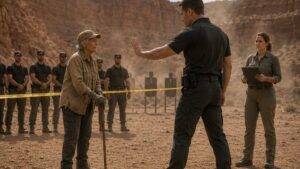
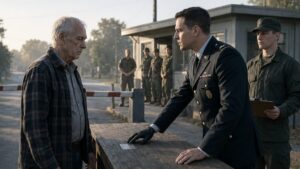
A young soldier in camouflage stepped out before Thomas reached the painted line.
“Sir,” the soldier said, raising his palm. “Stop there.”
Thomas stopped.
The soldier was broad-shouldered, clean-shaven, and young enough that his skin still held the smoothness of somebody who had not yet learned how long a night could become. His name tape read Carter. His boots were polished. His eyes moved from Thomas’s face to the duffel and back again.
“I’m here for the memorial rehearsal,” Thomas said.
The soldier kept his palm out. “Do you have a visitor pass?”
Thomas reached slowly into the breast pocket of his faded green jacket. The soldier’s hand dropped near his belt, not to a weapon, just enough to remind Thomas that movement belonged to younger men now.
Thomas paused, then drew out a folded letter.
The soldier took it between two fingers and opened it. His lips moved slightly over the printed lines. His brow tightened.
“This is old,” he said.
“It came from the office.”
“It’s dated twenty years ago.”
Thomas looked past him at the base. A flag moved against the pale morning sky. He could hear a truck backing somewhere inside, the faint beep carrying across the lot.
“Yes,” he said. “That’s when they first told me to bring it.”
The soldier’s expression changed, not cruelly, but in that quick flat way people used when they had decided the person in front of them would require extra time.
“What’s your name?”
“Thomas Bennett.”
The soldier looked toward the guard booth. A clerk inside was watching through the glass. Two soldiers near the side gate had stopped talking. Thomas felt their attention settle on his shoulders like weather.
“Mr. Bennett,” Carter said, “you’re not on today’s visitor list.”
“I called last week.”
“Who did you speak to?”
“A woman in the office. I didn’t catch her name.”
“You need a confirmed sponsor to enter.”
Thomas nodded once. He had expected some of this. Not the tone, maybe. Not the hand held up like he was traffic. But he had expected the world to have added locks since he last belonged to any part of it.
“I can wait,” he said.
“You can wait over there.” Carter pointed to a concrete bench outside the fence.
Thomas did not move.
“I need to bring this inside.”
Carter’s eyes went to the duffel again. “What’s in the bag?”
“Things that belong here.”
“That’s not an answer.”
“It’s the only one I have for the gate.”
The young soldier’s jaw set. “Sir, if you want to come inside, that bag gets searched.”
Thomas’s hand closed around the taped handle.
The motion was small. It still changed the air.
Carter noticed. So did the soldiers near the side gate. One of them shifted his weight, the way men did when a moment began to have witnesses.
“It isn’t dangerous,” Thomas said.
“Then you won’t mind opening it.”
Thomas looked down at the bag. The canvas had darkened under his palm where sweat had found the old weave. For a moment he was not at the gate. He was in a room with oil in the concrete, rain hammering the tin roof, and a man laughing through a cigarette he was not supposed to have lit. Then he blinked, and the morning came back.
“No,” Thomas said.
Carter stepped closer. Not much. Enough.
“Sir, I’m going to ask you to set the bag down.”
Thomas lifted his eyes.
He had been called sir by lieutenants who meant it and by doctors who did not. He had heard it from store clerks, from bank tellers, from his daughter when she was trying not to sound worried. From this young man it sounded polished but empty, like a brass button.
“I’m not setting it on the ground,” Thomas said.
The soldier’s face reddened lightly. “You don’t get to decide how security works.”
Behind him, one of the watching soldiers murmured something. Another gave a short laugh, not loud enough to be called disrespectful, just enough to be heard. Thomas did not look over. He kept his eyes on Carter because to look at the others would be to admit the size of the circle forming around him.
“I understand security,” Thomas said.
Carter’s hand came up again, straight across Thomas’s path. “Then you understand you’re not entering this facility with an unsearched bag and no valid clearance.”
The red gate arm hummed as a pickup exited. For a second the barrier lifted, revealing the road inside. Thomas saw the motor-pool building beyond the admin lot. The old bay doors were gone, replaced with roll-up aluminum. But the line of the roof remained. He had known that roof in heat, rain, and the blue-black cold before dawn.
The gate arm lowered again.
Something in Thomas’s chest tightened, but his voice did not change.
“I just need to return what was borrowed.”
Carter stared at him.
“What does that mean?”
Thomas did not answer.
The young soldier looked toward the booth. “Call Ms. Reed.”
The clerk inside picked up a phone.
Thomas shifted the duffel again. It was heavier than it should have been. Not because of the books alone. Paper had weight, metal had weight, old canvas had weight. But years had a way of climbing into anything a man carried long enough.
Carter glanced at Thomas’s left hand. It trembled once against the jacket hem. Thomas closed it into a fist until the tremor stopped.
“You okay to stand?” Carter asked.
It might have been concern. It might have been another way of telling him he looked unfit to be there.
“I’m standing,” Thomas said.
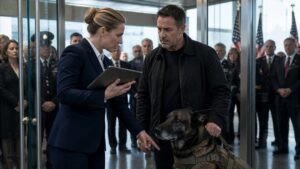
A white utility cart rolled toward the gate from inside the base. The woman driving it wore a navy blazer over a pale blouse, not a uniform. Her hair was pulled back, and she had a badge clipped to her jacket. She parked near the booth and stepped out with a tablet already in her hand.
“Carter,” she said, “what’s the issue?”
“Ma’am, this gentleman says he’s here for the memorial rehearsal. No current pass, not on the list, carrying an unsearched bag he won’t open.”
The woman looked at Thomas. Her expression was professional, quick, and already tired.
“I’m Laura Reed,” she said. “Base administration. Your name?”
“Thomas Bennett.”
She tapped the tablet. “Bennett. Bennett.” Her finger moved. “I don’t have you.”
“I called last week.”
“I’m sure you did, but if you’re not on the access list, we can’t just let you through.”
Thomas held out the folded letter. She took it, read the date, and looked up at him more carefully.
“This is from the old command office.”
“Yes.”
“This office doesn’t exist anymore.”
“I know.”
“Mr. Bennett, we have a rehearsal this morning and a command walkthrough in less than an hour. If you want to make an inquiry, you can leave your contact information.”
He heard the kindness she had placed in the sentence. It was a thin sheet laid over dismissal.
“I didn’t come to make an inquiry,” he said.
The duffel slid an inch against his leg. He caught it.
Laura’s eyes followed the movement. “What’s in the bag?”
Thomas looked through the gate again.
The old motor-pool roof waited beyond the paved lot, smaller than memory but still there.
“Something that should have come home a long time ago,” he said.
Laura Reed folded the letter and handed it back.
“Sir,” she said, “if you don’t have clearance, you don’t come in.”
Chapter 2: What Kimberly Thought He Was Chasing
The night before, Kimberly had found him at the kitchen table with the duffel open between his elbows.
She had used her key because he did not answer the door quickly enough. Thomas heard it turn in the lock, heard the soft push of her shoulder against the frame that always stuck in damp weather, heard the pause that meant she was deciding whether to call out or come looking.
“Dad?”
“In here.”
She appeared in the doorway still wearing her work blouse, her purse strap cutting across one shoulder. She was forty-six, but sometimes when she was tired Thomas saw the seven-year-old who used to stand in that same doorway asking if the storm was close enough to hurt the house.
Her eyes went to the bag.
“I knew it,” she said quietly.
Thomas threaded a strip of black tape around the cracked handle and pressed it flat with his thumb.
“You knew I owned tape?”
“I knew you were going.”
He kept smoothing the tape. “Coffee’s still warm.”
“I don’t want coffee.” She came closer. “Dad.”
He did not look up.
The kitchen was small, clean, and old in the way a room became old when a man changed little because change required decisions he had no interest in making. The calendar by the refrigerator still showed the previous month. A pill organizer sat by the sink. Beside it lay the visitor letter, flattened under a saltshaker so it would not curl at the creases.
Kimberly picked it up.
“You’re using this?” she asked.
“It has the address.”
“It has an address from two decades ago.”
“The base didn’t move.”
“The people did. The rules did. Everything did.”
Thomas tore the tape with his teeth.
Kimberly set the letter down carefully, as if sudden movement might make him stubborn.
“You called them?”
“Yes.”
“And they said you could come?”
“They said there was a memorial event.”
“That isn’t the same thing.”
He pressed the last fold of tape around the handle. His fingers were slower than he wanted them to be. The tape stuck to the side of his thumb. He peeled it off with more force than necessary.
Kimberly saw that too. She always saw the small defeats.
“You have your clinic appointment tomorrow,” she said.
“I moved it.”
“You shouldn’t have.”
“It’s a checkup.”
“It’s your heart.”
“It’s still there.”
“That isn’t funny.”
“No,” he said. “It isn’t.”
The quiet after that had the shape of every conversation they kept having in different rooms. Kimberly thinking he was being reckless. Thomas thinking she was asking him to become less alive so he could remain safe.
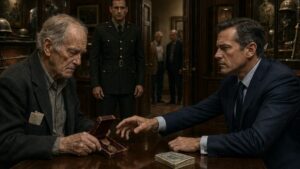
She pulled out the chair opposite him and sat. The duffel lay open between them. Inside, beneath a folded towel, were three worn logbooks wrapped in brown paper, a smaller cloth bundle tied with string, and a faded cap with a patch so old the stitching had softened. Kimberly looked at the contents without touching them.
“I thought you got rid of all that,” she said.
“No.”
“Mom thought you had.”
“Your mother knew I hadn’t.”
Kimberly looked toward the dark window above the sink. Outside, the porch light showed the edge of the steps and the shape of an empty flowerpot.
“What are you trying to prove?”
Thomas placed the tape roll beside the bag.
The question irritated him because it was reasonable. It would have been easier if she accused him of something foolish. But Kimberly had learned, with the weary patience of a daughter who had been motherless for six years, to ask the soft questions that cut cleaner.
“I’m not trying to prove anything.”
“You don’t drive across the county with old papers in a broken bag for nothing.”
“It isn’t broken.”
“The handle is wrapped in tape.”
“Now it isn’t broken.”
She sighed and touched the bridge of her nose.
He almost smiled. Almost. She made the same motion her mother used to make when he said something that was technically true and completely useless.
“Dad, I know you miss that part of your life.”
His hand stopped on the zipper.
“That part?”
“The service. The people. Having a place.”
He looked at her then.
Her face changed immediately, regret passing through it before pride could cover it.
“I didn’t mean it like that.”
“Yes, you did.”
“I meant you don’t have to make them remember you.”
“I’m not asking them to remember me.”
“Then what are you asking?”
Thomas looked down into the duffel.
The brown paper around the logbooks had gone soft at the corners. He had kept them in a closet first, then in the garage, then in a plastic bin after Kimberly complained about mildew, then back in the closet when he decided plastic trapped the wrong kind of damp. Every few years he told himself he would deliver them. Every few years there was a reason not to.
A surgery. His wife’s treatments. A move at the base. A name changed on a building. A letter lost. A phone number disconnected.
Then time had done what time did. It had made delay look like intention.
“I borrowed something,” he said. “A long time ago.”
Kimberly waited.
He picked up the small cloth bundle. It fit in both hands. Beneath the faded rag was a metal piece no bigger than a closed fist, heavy enough to surprise anyone who expected it to be hollow.
“From who?”
Thomas slid the bundle back under the towel.
“From a man who trusted me to bring it back.”
“Is he alive?”
“No.”
The answer came too fast, and Kimberly heard everything inside it.
Her voice lowered. “Was he from the base?”
Thomas zipped the duffel halfway. “Motor pool.”
“Dad.”
He pulled the zipper to the end.
She leaned back, hurt now, not because he had said too much but because he had stopped before saying enough.
“You do this,” she said. “You give me one little piece and then close the door.”
“I’m not trying to shut you out.”
“You are. You just do it politely.”
He ran his fingers over the taped handle.
Kimberly stood, then sat again. “Let me drive you, at least.”
“No.”
“Why not?”
“Because if they turn me away, I don’t want you seeing it.”
Her face softened so quickly he had to look away.
“Dad.”
He stood, slower than he meant to. The chair scraped against the floor. He carried the duffel to the counter and set it beside the pill organizer. It landed with a low, dense thud.
Kimberly rose behind him.
“You think I’m embarrassed by you?”
“No.”
“Then why say that?”
He rested both hands on the counter. Outside the window, his reflection looked older than he felt inside, which was one of aging’s daily insults.
“Because sometimes,” he said, “people decide what an old man is before he opens his mouth.”
Kimberly did not answer.
He regretted the words immediately. Not because they were untrue, but because she had not deserved them.
After a while, she picked up the visitor letter and folded it along its old creases.
“Put this somewhere you won’t lose it,” she said.
He took it from her.
“And call me when you get there.”
“I will.”
“You won’t.”
He put the letter in his jacket pocket.
She touched the duffel handle. Not to stop him. Just to feel the thing that had made him stubborn.
“What was borrowed?” she asked.
Thomas looked at her hand on the canvas.
“A little time,” he said. “A little truth.”
She waited, but he had already given her more than he had planned.
Now, at the gate, with Laura Reed’s refusal hanging in the morning and Nicholas Carter standing between him and the road inside, Thomas felt the old tape under his palm and remembered Kimberly’s question.
What was borrowed?
The answer sat heavy against his leg.
Laura turned toward the guard booth. “Have him wait outside the fence. I’ll check whether anyone in records knows the name.”
Thomas looked at her.
“Records won’t know it,” he said.
Laura stopped.
“Then who will?”
Thomas glanced beyond the gate, toward the low roof in the distance.
“If he’s still alive,” he said, “Paul Miller.”
Chapter 3: The Office That Had No Record of Him
They let him through without letting him belong.
That was how it felt to Thomas as the gate arm lifted and Nicholas Carter walked him across the painted line like a man escorting a problem, not a guest. The duffel remained in Thomas’s hand. That had been the compromise, though no one had called it one. He would carry it. He would not open it at the gate. He would sit in administration until Laura Reed found someone who could confirm he had a reason to be there.
Nicholas stayed half a step behind him.
Thomas could hear the young soldier’s gear shift with each stride. The sound reminded him of men walking with tools on their belts, wrenches tapping hip bones, keys clinking, somebody calling for a socket that had just been in his hand. For one breath he let himself hear those older sounds layered beneath the new ones.
Then a golf cart hummed past, and the spell broke.
Administration sat where the old supply office had been. The outside had new glass doors and a sign with clean lettering. Inside, the air-conditioning was too cold. A framed photograph of the base hung behind the reception desk, taken from above by a drone. Thomas paused before it, searching for the old motor-pool yard.
“You can sit there,” Laura said.
The chair she indicated was low and cushioned, the kind that made old knees negotiate. Thomas chose the wooden bench by the wall instead. He set the duffel upright between his shoes.
Nicholas remained by the door.
“You don’t have to guard me,” Thomas said.
The young man’s face tightened. “I’m posted here until Ms. Reed clears it.”
Thomas nodded. “Then I guess you do.”
Laura stood at a counter with a clerk, both of them looking at a computer screen. Thomas heard his name spoken twice, then spelled. Bennett. Thomas. Possible former employee. Possible former service member. No sponsor listed. No event registration.
The clerk glanced at him as if he were an error message.
Thomas looked down at his hands. There was oil in the lines of them that no soap had ever fully taken out, though nobody else would have seen it now. Age had covered everything with spots and raised veins. Still, he knew where the oil had been. Under the nails. Across the thumb web. In the half-moons of skin that cracked every winter.
Laura came over with the tablet held close to her chest.
“Mr. Bennett, I can’t find a current record under your name.”
“I wouldn’t have a current record.”
“I checked veteran volunteer lists, contractor access, prior base employment, and ceremony invitees.”
“I wasn’t a contractor.”
“Were you stationed here?”
“Attached for training support. Motor-pool maintenance.”
“What years?”
He gave them.
Laura entered something else. Her mouth pressed into a line.
“The system doesn’t go back cleanly that far.”
“No,” Thomas said. “It wouldn’t.”
Nicholas shifted near the door. Thomas did not look at him.
Laura sat across from Thomas, which he appreciated more than he wanted to. At least she did not stand over him.
“Can you tell me exactly why you came today?”
Thomas looked at the duffel.
“I came because you’re putting names on a wall.”
Laura’s expression changed. Not much. Enough.
“The memorial rededication is tomorrow,” she said. “Today is only rehearsal.”
“Then I’m early enough.”
“Early enough for what?”
“To fix one.”
Laura folded her hands around the tablet. Her nails were short, pale, practical.
“If you believe a name was omitted, there’s a process.”
“I wrote once.”
“To this office?”
“To the command office.”
“When?”
Thomas did not answer quickly.
Laura looked toward the folded letter now lying on her desk.
“Twenty years ago?”
“They sent that back.”
“And you didn’t follow up?”
The question was not unkind. That made it worse. It placed twenty years on the table like an object he should have kept better track of.
Thomas rubbed the edge of the duffel tag between his fingers.
“My wife got sick,” he said. “Then better. Then sick again. I had work. Then I didn’t. The base changed numbers. People retired. I told myself next month.”
Laura’s face softened.
He did not want it to.
“Mr. Bennett, I’m sorry, but the program has already been printed. The wall panels have been reviewed by command and the historical office.”
“The name is still missing.”
“Which name?”
Thomas closed his hand around the tag.
“Larry Cooper.”
At the door, Nicholas looked up.
Laura typed.
The clerk typed too.
The office filled with small modern sounds: keys clicking, printer waking, an air vent rattling lightly overhead. Thomas sat still.
Laura looked at her screen for a long moment.
“I have a Lawrence Cooper,” she said. “Civilian support attached to a maintenance unit. No active-duty status shown. No memorial eligibility notation.”
Thomas felt something old move in him, not anger exactly. Anger had heat. This was colder.
“That’s how they buried it,” he said.
Laura looked up. “Buried what?”
“What he did.”
Nicholas shifted again, but this time Thomas sensed attention, not suspicion.
Laura lowered her voice. “Mr. Bennett, I’m not saying you’re wrong. I’m saying I can’t change a memorial wall the day before a ceremony based on a verbal claim.”
“I didn’t ask you to change it based on my mouth.”
Her eyes went to the duffel.
“Is that what’s in the bag?”
Thomas did not touch the zipper.
“Part of it.”
“Then let us review it.”
“No.”
Laura sat back.
Nicholas gave a short breath, almost a laugh, then stopped himself. Thomas heard it anyway.
Laura’s patience thinned. “You understand how difficult that makes this.”
“Yes.”
“You came here to correct a record, but you won’t show the record?”
“Not in an office where people step around it like it’s trash.”
The words came out before he could make them smaller.
Silence fell.
The clerk stared at the screen. Nicholas looked at the floor. Laura’s face went still, not offended exactly, but held in place.
Thomas looked down at the duffel and regretted the sharpness. He had promised himself he would not come angry. Anger made people stop listening. Anger made an old man easy to dismiss.
Laura stood.
“I’m going to be direct,” she said. “We have an official ceremony tomorrow with families, retirees, command staff, and press. If there is a legitimate correction, I want it handled properly. But I cannot let an unverified claim disrupt the event.”
“Larry Cooper disrupted a worse thing than an event,” Thomas said.
Laura waited.
He almost told her then.
He almost said rain, engine, brake line, wrong pin, young men in the back of a transport who had no idea they were seconds from dying. He almost said Larry went under first because Thomas had turned his ankle that week and could not move fast enough. He almost said the sound Larry made was not a scream, not exactly, and that he had heard it in every quiet garage since.
Instead, Thomas looked toward the window.
Outside, beyond the admin parking lot, the motor-pool building sat with its new doors closed.
“Is Paul Miller here?” he asked.
Laura glanced at the clerk.
The clerk said, “There’s a Paul Miller on the volunteer list. Comes in some afternoons. Archive assistance.”
“What time?”
“Usually after lunch.”
Laura looked at Thomas again. “You know him?”
“I knew him.”
“That’s not the same thing.”
“No,” Thomas said. “It isn’t.”
Laura checked her watch. “You can wait until noon. If Mr. Miller confirms there’s something to review, we’ll discuss next steps.”
Nicholas opened the office door. “Ma’am, where should he wait?”
The question sounded ordinary, but Thomas heard the old assumption inside it: Where do we put him?
Laura hesitated.
Thomas stood before she answered. His knees complained. He lifted the duffel before Nicholas could offer or order anything.
“I’ll wait at the motor pool,” Thomas said.
Laura shook her head. “That building is restricted during renovation.”
“Then I’ll wait outside it.”
“Mr. Bennett—”
“I waited twenty years,” he said. “I can wait by a door.”
Laura studied him for a long moment. Then she turned to Nicholas.
“Escort him to the exterior bench near Building Six. He stays outside. The bag stays with him. If he enters the building, you call me.”
Nicholas nodded.
Thomas walked out first this time.
The sun struck his glasses as he stepped back outside. For a second the base blurred into light. He stood still until the shapes returned: sidewalk, curb, training field, young soldiers moving in pairs, the motor-pool roof beyond them.
Nicholas came beside him, no longer behind but not quite with him.
They walked without speaking. Halfway across the lot, two soldiers passed and looked at the duffel. One whispered something Thomas could not hear. The other glanced at Nicholas, then away.
At the old motor-pool building, the bench had been painted blue. Thomas lowered himself onto it and set the duffel between his shoes again.
Nicholas remained standing.
After a moment, the young soldier said, “What happened here?”
Thomas looked at the closed bay doors.
On one of them, fresh paint covered everything. On the concrete below, if a man knew where to look, there was still a darker patch shaped like a memory refusing to dry.
“You wouldn’t have a record of it,” Thomas said.
Nicholas looked at him, but Thomas kept his eyes on the door.
Inside his jacket pocket, the old visitor letter pressed against his chest, thin as a leaf and not nearly enough.
Chapter 4: The Logbook Nobody Wanted to Read
The bench outside Building Six held the heat of the day by the time the sun climbed over the motor-pool roof.
Thomas sat with both hands resting on the duffel handle. Nicholas stood a few yards away near the corner of the building, close enough to watch him, far enough to pretend he was watching the parking lot instead. For nearly an hour, neither of them said much.
Young soldiers crossed the paved lane in twos and threes. Some carried clipboards. Some carried cases. One group in training uniforms moved past in a loose file, their boots scuffing in uneven rhythm. They looked at Thomas the way people looked at furniture left temporarily in a hallway.
The old motor pool had never been a place anybody visited unless they needed something fixed.
Now the bay doors were clean and shut. A sign taped to one of them read RENOVATION ACCESS ONLY. A dumpster sat near the side wall filled with broken drywall, rusted shelving, and pieces of pipe. Someone had painted over the old unit markings, but the new paint did not quite hide the ghost of letters beneath.
Thomas’s gaze kept returning to the left bay.
That had been Larry’s bay.
He did not mean to think it so plainly. He had trained himself around certain sentences. He could think around them, above them, beside them. But sitting there with the bag between his shoes and the door in front of him, the words came without asking permission.
Larry’s bay.
“Do you need water?” Nicholas asked.
Thomas looked over.
The young soldier had one hand on his radio and one on a bottle he must have taken from the guard booth. His tone was different from earlier, less hard at the edges.
“No,” Thomas said.
Nicholas nodded, though he did not move away.
Thomas should have accepted it. His mouth was dry. His shirt clung under the jacket. But taking the bottle felt like beginning some small forgiveness neither of them had earned yet.
A cart came around the side of the building just before noon. The man driving it was thin, white-haired, and bent forward over the wheel as if listening for a sound under the motor. He wore a volunteer badge and a plaid shirt tucked too neatly into faded jeans.
He slowed when he saw Thomas.
For one second, his face was empty.
Then something passed across it that time had not worn away.
“Tommy Bennett,” the man said.
Thomas stood.
The effort cost him more than he wanted Paul Miller to see. He kept one hand on the duffel and straightened his back.
“Paul.”
Paul shut off the cart. For a moment he remained seated, both hands on the steering wheel. His eyes moved over Thomas’s face, then down to the bag, then to the old bay door.
“Well,” Paul said softly. “I’ll be.”
Nicholas stepped forward. “Mr. Miller?”
Paul ignored him, not rudely, but completely.
“You brought it,” Paul said.
Thomas nodded.
Paul looked at the bag again. His lips moved once without sound.
“I thought you would’ve burned all that by now.”
“I thought about it.”
“Yeah.” Paul lowered himself from the cart. His right knee stiffened before it took his weight. “Me too.”
Nicholas looked between them. “Sir, Ms. Reed said you might be able to confirm Mr. Bennett’s connection to the base.”
Paul glanced at him then. “Connection?”
Nicholas held his posture. “Yes, sir.”
Paul gave a humorless little breath. “That man kept half this place running when your parents were still being told not to touch hot stoves.”
Thomas said, “Paul.”
The old volunteer stopped.
The correction was quiet, but it landed.
Paul’s face changed. He understood. Thomas did not want a defense that turned into a performance. Not here. Not with the bay door watching.
Nicholas looked down.
Paul rubbed his mouth. “Sorry.”
Thomas nodded once.
Laura Reed arrived a few minutes later on foot, tablet in hand, the clerk trailing behind her with a folder. She looked from Paul to Thomas, then to the duffel.
“Mr. Miller,” she said, “you know Mr. Bennett?”
“I do.”
“Can you confirm he worked in motor-pool maintenance here?”
Paul’s eyes flicked toward Thomas. “He did.”
“In what capacity?”
Paul looked irritated by the word, but he answered. “Army support. Maintenance. Training vehicles. Recovery work. Whatever broke and needed somebody who knew which end of a wrench was honest.”
Laura typed. “And Larry Cooper?”
Paul stopped moving.
The motor-pool wall seemed to gather the silence and hold it.
After a moment, Paul said, “Where’d you hear that name?”
“Mr. Bennett says the memorial list is missing him.”
Paul looked at Thomas. “You told them?”
“Not all of it.”
“No,” Paul said. “You wouldn’t.”
Laura’s professional patience tightened again. “Mr. Miller, if there is information relevant to the memorial, I need something more specific than—”
“The records were wrong,” Paul said.
The clerk looked up.
Laura said, “In what way?”
Paul’s hand moved toward the bay door, then stopped at his side. “Larry was listed wrong after the accident. Civilian support, temporary attachment, no eligibility. He was more than that.”
“That may be true emotionally,” Laura said carefully, “but memorial criteria require documentation.”
Thomas bent and lifted the duffel.
Nicholas stepped instinctively closer. This time, he stopped himself before speaking.
Thomas carried the bag to the shaded strip by the bay door and set it on an old concrete block. The zipper resisted halfway, caught on a warped tooth. He worked it loose with two fingers. Nobody moved while he opened it.
He lifted out the folded towel first.
Then the brown-paper-wrapped logbooks.
The paper had been tied with twine. Thomas untied the knot slowly. His hands did not shake now. That surprised him. Or maybe it did not. Some work returned to the body when the work mattered.
He laid the first logbook on the concrete block.
Its cover was dark green, corners swollen from damp. The white label had yellowed.
MOTOR POOL SERVICE LOG
BUILDING SIX
APRIL–JUNE
Laura leaned closer.
Thomas opened it to a page marked by an old gas receipt.
The paper smelled faintly of dust, oil, and the cardboard box in his closet. Columns filled the page in several hands. Dates. Vehicle numbers. Repair notes. Initials.
He tapped one line with his finger.
L.C. reported brake pressure irregularity. Removed vehicle from training rotation pending inspection.
Laura read it.
Thomas turned two pages.
L.C. and T.B. replaced master cylinder. Further line inspection recommended.
Paul stood beside him, one hand pressed against his thigh.
Thomas turned another page.
Then another.
The entries became less neat. Rain damage had blurred some ink near the margin. He stopped at a page where the lower half had been folded inward for years.
He unfolded it.
Laura’s tablet lowered.
Nicholas took one step closer despite himself.
The entry was written in block letters, darker than the rest.
UNIT TRANSPORT 14 HELD. DO NOT RELEASE. LINE FAILURE RISK. L.C. REFUSED SIGN-OFF.
Beside it, in another hand: Command override pending morning movement.
Laura’s face changed.
Not enough to solve anything. Enough to feel the floor tilt.
“What happened?” Nicholas asked.
Thomas looked at the line, not at the young soldier.
“They moved it anyway,” he said.
No one spoke.
The wind pushed a dry leaf along the concrete. It scraped past the duffel and caught against Nicholas’s boot.
Thomas closed the logbook halfway.
Paul’s voice came rough. “Larry crawled under before they could roll out. Said if they wouldn’t listen to paper, maybe they’d listen to him blocking the wheels.”
Laura said, “Was anyone injured?”
Thomas’s hand rested flat on the book.
“Larry was.”
The answer was smaller than the fact.
Paul turned away. He looked toward the dumpster like there might be something there worth seeing.
Thomas reached into the duffel again and took out the cloth bundle. The string had been tied by younger fingers, but the knot was the same. He did not open it yet. He only placed it beside the logbook.
“What is that?” Laura asked.
“Part of what failed,” Thomas said.
Nicholas looked at it. “You kept it?”
Thomas’s mouth tightened. “No.”
Paul looked back.
“Larry pulled it,” Thomas said. “Told me to hold it until someone wrote it down right.”
Laura’s voice softened despite herself. “Mr. Bennett, why didn’t you bring this sooner?”
It was not accusation this time.
That made it harder.
Thomas looked at the bay door, at the new paint over old letters, at the concrete where water once ran black with oil and rain.
“Because at first I thought someone else would do right,” he said. “Then I thought I had time.”
The words settled among them.
Nicholas looked at Thomas with something unsettled in his face, something not yet apology and not yet understanding.
Laura closed the folder she had brought.
“I need to take these to records,” she said.
Thomas placed his hand on the logbook.
“No.”
“Mr. Bennett—”
“They don’t leave me.”
“We need to verify them.”
“You can verify them with me sitting beside them.”
“That may not be possible.”
“Then neither is your review.”
The firmness in his voice surprised even Paul. He looked at Thomas with old recognition, the kind that did not belong to rank but to work: a man knowing when a bolt would strip if pushed any farther.
Laura exhaled slowly.
“Fine,” she said. “Records room. You, the bag, and Mr. Miller. Carter, you come too.”
Nicholas straightened. “Yes, ma’am.”
Thomas began wrapping the logbook again. The cloth bundle remained on the concrete for one more moment, small and dull beside the duffel.
Paul stared at it.
“They still don’t have his name up there?” he whispered.
Thomas tied the twine.
“No,” he said. “They still don’t.”
Chapter 5: A Promise Misfiled as Property
The records room had no windows.
It sat behind administration in a hallway that smelled faintly of toner and floor wax. Metal shelves lined three walls. Cardboard boxes with printed labels sat beside plastic bins with barcodes. A scanner blinked green on a desk near the door, waiting with the patience of a machine.
Thomas did not like the room.
It was too clean to hold the past and too crowded to respect it.
Laura brought them in, then shut the door halfway but not fully. The clerk took the chair at the computer. Nicholas stood near the wall with his cap tucked under his arm. Paul lowered himself into the second chair without being invited, his breathing a little uneven from the walk.
Thomas set the duffel on the table.
Not the floor.
Laura noticed but did not comment.
The first hour went into finding what the computer already believed. Lawrence Cooper existed in fragments. A temporary personnel sheet. A maintenance attachment. A hospital transfer note with most of the description blacked out from some old scanning error. A property report mentioning a damaged vehicle and a removed part. No commendation. No casualty classification that fit the memorial criteria. No formal witness statement in the digitized file.
“Civilian support attached,” the clerk said, reading the screen. “That’s the status repeated here.”
Paul made a sound low in his throat.
Thomas stared at the table.
Laura turned to him. “The logbooks help, but they aren’t enough by themselves.”
“They were enough to stop the vehicle,” Thomas said.
“I understand why you feel that way.”
“No,” he said.
The room went still.
He had not raised his voice, but something in it stopped the clerk’s fingers above the keyboard.
Thomas looked at Laura.
“You understand paper,” he said. “That’s not the same.”
Laura held his gaze. To her credit, she did not look away.
Nicholas shifted near the wall.
Thomas regretted it again, the edge in his words. He could feel himself becoming exactly what they expected: an old man with an old grievance, difficult to process, hard to place.
He placed both hands flat on the table.
“I’m sorry,” he said.
Laura’s face softened a little. “I know this is personal.”
“It is,” Thomas said. “But that’s not why it matters.”
He opened the first logbook again. Laura photographed pages with her tablet. The clerk scanned copies. Paul confirmed handwriting where he could. Larry’s initials appeared again and again: L.C. beside vehicle numbers, beside inspection refusals, beside notes written in cramped block letters.
Then Thomas untied the cloth bundle.
No one spoke while he folded back the rag.
Inside was a dark metal part, curved and scarred, heavier than it looked. Corrosion had eaten at one edge. A torn paper tag was looped through it with wire.
The clerk leaned closer.
Nicholas did too.
Thomas touched the tag lightly.
PROPERTY HOLD
TRANSPORT 14
DO NOT DISCARD
L.C. / T.B.
Laura read it twice.
“This was kept outside the evidence file?”
“It was never called evidence,” Thomas said. “They called it property.”
Paul’s jaw tightened. “Misfiled it before the week was out.”
Laura looked at him. “You knew?”
“I knew there was a fight over the report. I didn’t know Tom had this.”
Thomas did not correct him. Tommy belonged to a smaller room, older hands, men with grease on their sleeves. Here, Thomas was easier.
The clerk searched again, this time using the transport number. A few more documents surfaced. Maintenance delay. Training schedule adjustment. Equipment loss. A statement from command noting that “a support worker entered the hazard area without authorization.”
Nicholas read the line over the clerk’s shoulder. His expression changed.
“Without authorization?” he said.
Paul laughed once, bitter and dry. “That’s one way to say he stopped them from rolling over their own mistake.”
Laura’s mouth tightened. “Mr. Miller.”
“No,” Paul said. “Don’t smooth it. That line’s why his name isn’t on the wall.”
Thomas looked at the metal part. He had not touched it bare in years. The last time, Kimberly’s mother had been alive. She had found him in the garage holding it and had not asked him to explain. She had only stood beside him until he put it away.
Laura printed the old statement. The paper slid from the machine with a warm whisper. She read it, then read it again.
“There’s no witness statement from you,” she said to Thomas.
“No.”
“Why?”
The question found the one place he had not meant to expose.
Paul said, “He was in the clinic.”
Thomas looked at him.
Paul looked back. His face had gone pale, but he did not stop. “Turned his ankle three days before. Shouldn’t have been working the line. Larry was covering his bay.”
Thomas’s fingers curled around the table edge.
Nicholas looked at him.
Thomas hated that look. It was not pity yet, but it was near enough.
“I was there,” Thomas said.
Paul’s voice softened. “You were across the yard.”
“I heard him.”
“That’s not the same as being able to stop it.”
Thomas stood.
The chair behind him scraped hard against the floor.
Laura flinched. Nicholas moved half a step forward. Thomas saw it all and wished he had stayed seated.
He took a breath, then another.
“I was supposed to be under that vehicle with him,” he said.
Paul closed his eyes.
The clerk stared at the keyboard.
Laura spoke carefully. “Mr. Bennett, did Mr. Cooper ask you to keep this part?”
Thomas looked at the metal on the table.
After the accident, after the shouting and the rain and the ambulance, after a captain Thomas barely knew told everyone to stay clear, Larry had gripped Thomas’s sleeve with a hand slick from rainwater and black grease. Not dramatic. Not clean. Not like stories made final words sound.
He had said, Don’t let them put it back on the shelf.
Thomas had thought he meant the part.
For years, he had let himself think he meant the part.
“Yes,” Thomas said.
Laura waited.
Thomas touched the paper tag.
“He told me not to let them put it back on the shelf.”
Nicholas looked toward the rows of boxes.
Thomas gave a tired little smile without humor.
“Took me too long to understand he wasn’t only talking about metal.”
Laura sat down slowly.
The door opened wider, and a young officer looked in. “Ms. Reed, they’re asking for you at the rehearsal site.”
Laura checked her watch and stood with visible reluctance.
“I need ten minutes.”
“They said now.”
She looked at Thomas, then at the logbooks, then at the printed sheets.
“We may be able to submit a correction request,” she said.
“Before tomorrow?”
Her silence answered.
Paul leaned forward. “Laura.”
She looked at him sharply. “I can’t alter a memorial program overnight based on documents that haven’t been formally reviewed.”
“The wall is wrong.”
“I did not build the wall.”
“No,” Thomas said. “But you’re asking me to stand beside it.”
Laura absorbed that.
For a moment, the room held the weight of all its shelves.
Then she said, “I can arrange for you to attend tomorrow as a guest. We can begin the review afterward.”
Thomas looked at her.
It was not a cruel offer. It might even have been the best she thought she could do. A chair in the back. A promise of later. A folder opened when the guests had gone home.
A private assurance offered in exchange for public silence.
He began wrapping the metal part again.
Nicholas watched his hands.
“Mr. Bennett,” Nicholas said, his voice quieter, “is that tag yours?”
Thomas paused.
The cloth tag on the duffel had flipped over when he moved the bag. Beneath the faded top letters, almost hidden by fray and grime, another set of initials showed through where the fabric had worn thin.
L.C.
Thomas looked at it.
Then he turned the tag fully so everyone could see.
“Bag was his first,” he said.
Paul covered his mouth with one hand.
Laura’s expression shifted, not toward solution, but toward understanding.
Thomas pulled the string around the cloth bundle and tied it.
“I only carried it longer.”
Outside the records room, distant voices rose from the rehearsal site. Chairs being moved. A microphone tested. A flag line being arranged. The ceremony was continuing to build itself around the missing name.
Laura picked up her tablet.
“I have to go,” she said. “Please don’t leave until I come back.”
Thomas slid the logbooks into the duffel.
“I didn’t come all this way to leave before the thing was done.”
Nicholas stepped aside as Thomas lifted the bag.
Not much. Just enough to clear the doorway without being guided.
As Thomas passed him, Nicholas looked at the faded tag again.
For the first time that morning, the young soldier did not look at the duffel as a threat.
He looked at it as if it had been carrying someone.
Chapter 6: The Name Left Off the Wall
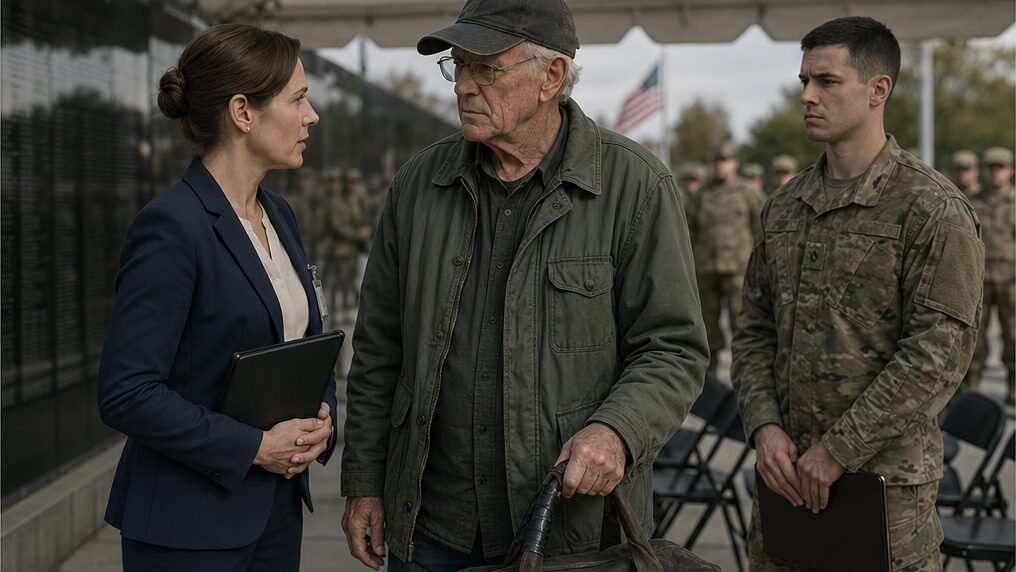
The memorial wall stood under a white canopy at the edge of the parade ground.
It was not a wall in the way Thomas had imagined one. It was a series of dark panels mounted in a low stone frame, new enough that the surface still reflected the sky. Folding chairs faced it in straight rows. A lectern stood to one side. Behind the lectern, flags waited in weighted stands, their fabric gathered and clipped against the breeze.
Men and women moved through the rehearsal with papers in their hands. A microphone squealed, then settled. Someone tested the first lines of a welcome. The words came thin over the speakers and scattered across the grass.
Thomas stood at the back with the duffel in his hand.
Paul stood beside him, one shoulder lower than the other. Nicholas remained a few paces away, no longer guarding exactly, but unable to leave. Laura was near the lectern, speaking with the young officer and a contractor in a hard hat. She held Thomas’s copied pages in a folder against her side.
No one had invited Thomas to the wall.
No one had told him to go away.
There were many ways to be unwelcome without being removed.
Thomas looked at the names engraved into the dark panels. Some he did not know. Some he knew only by echoes. A few struck him with surprising force: surnames from work orders, jokes, shouted greetings across rain, men who had borrowed tools and never returned them.
He walked closer.
Nicholas moved as if to follow, then stopped.
Thomas read down the first panel. Then the second.
The letters were clean. Exact. Permanent-looking in the way new engraving always pretended to be.
Larry Cooper was not there.
Thomas had known he would not be. Still, seeing the absence had a shape. It occupied space like a man standing with his back turned.
Paul came to his side.
“Tom,” he said.
Thomas set the duffel down at the base of the wall.
The sound was soft. Canvas against stone.
Several heads turned.
Laura saw it from the lectern area. Her shoulders tightened.
Thomas did not open the bag. Not yet.
The microphone crackled again. The young officer said, “Let’s run the recognition portion from the top.”
A woman near the front began reading names from the printed program. Her voice was steady, practiced, respectful. Each name fell into the bright air and vanished.
Thomas listened.
He had never resented the named. That was one thing he needed clear inside himself. The men on that wall deserved remembering. The ache in him did not come from what they had been given. It came from what had been withheld.
Laura left the lectern and came toward him.
“Mr. Bennett,” she said under her breath, “this isn’t the time.”
Thomas looked at the wall.
“When is?”
“We are not ignoring this.”
“No,” he said. “You are delaying it.”
“I told you there is a process.”
“I know.”
“Then please respect it.”
Thomas turned to her.
The word respect stood between them, too large for the sentence she had put it in.
Laura heard it after she said it. Her face changed.
Before she could speak again, Nicholas stepped closer.
“Ms. Reed,” he said, “maybe they should pause.”
Laura looked at him, surprised.
The young officer near the lectern noticed the interruption. “Everything all right?”
Laura hesitated.
Thomas bent and unzipped the duffel.
The sound carried farther than it should have.
One by one, nearby conversations thinned. Not all at once. A few people still moved chairs. Someone laughed near the far edge of the canopy, unaware. But around Thomas, attention gathered.
He took out the first logbook and placed it on top of the duffel.
Then the second.
Then the cloth-wrapped metal part.
He did not rush. He did not perform. His movements were the same ones he had used at the kitchen table, in the records room, on a hundred mornings when a machine had needed calm hands more than fast ones.
The young officer approached. “Sir, I’m going to need you to step away from the display.”
Thomas opened the first logbook to the marked page.
“I stepped away once,” he said.
The officer stopped.
Thomas looked at the names on the wall, not at the people. That made speaking easier.
“I was supposed to be under Transport 14 the morning it failed inspection. My ankle was bad. Larry Cooper covered my bay.”
Paul lowered his head.
Laura closed her folder slowly.
Thomas continued, his voice carrying only because everyone had grown quiet enough to let it.
“The brake pressure had been wrong for two days. He wrote it here. Twice. He refused sign-off. They were behind schedule. They moved to override him.”
The young officer looked at Laura. Laura did not interrupt.
Thomas unfolded the cloth from the metal part. It lay dark against the faded rag.
“Larry pulled this before they could put the transport back in rotation. He kept that vehicle from carrying twelve soldiers down a grade with a bad line.”
A chair creaked.
Thomas’s throat tightened. He waited until it obeyed him.
“He was hurt doing it. The report called him unauthorized. The property sheet called this scrap. The file called him civilian support attached.”
He touched the duffel tag.
“But that bag was on his shoulder before it was on mine. Those initials are his. Those notes are his. That refusal is his.”
The rehearsal field had gone still.
Thomas could feel Nicholas somewhere to his right. He did not look.
“I don’t need my name on anything,” Thomas said. “I didn’t come for that. I came because he asked me not to let what happened get put back on the shelf.”
The wind moved across the canopy. One of the flags shifted against its clip.
Laura stepped forward.
“Mr. Bennett,” she said softly, “we can review this.”
“You have reviewed enough to know the wall is wrong.”
The words were plain. Not loud. Not accusing.
That was why they held.
The young officer looked uncomfortable. “Sir, the ceremony is tomorrow. The engraving can’t be changed overnight.”
Thomas nodded.
“I know.”
“Then what are you asking?”
Thomas looked at the blank stretch at the bottom of the second panel, where future names might one day go.
“For you not to read it like it’s complete.”
No one answered.
A contractor near the side removed his hard hat and held it in both hands, unsure why but certain the room of air had changed.
Laura looked down at the folder she carried. The copied pages were inside it. Not all the truth. Enough to begin.
“We can add a correction notice to the program insert,” she said slowly. “Not an engraving. Not yet. But an acknowledgment that the list is under review pending documentation of Lawrence Cooper’s service-related action.”
Paul looked up.
The young officer frowned. “Can we approve that?”
Laura’s voice steadied. “I can approve a review notice. Command can decide whether they want to explain why we refused to read one.”
The officer said nothing.
Thomas closed the logbook.
The victory, if that was what it was, felt nothing like victory. It felt like setting down a box and discovering his arms still ached.
Nicholas moved then.
He walked toward the small table near the lectern where visitor materials had been stacked. He picked up the clipboard Thomas had not been allowed to sign that morning and brought it back.
The gesture made several people turn.
Nicholas stopped in front of Thomas.
His face was pale under the brim of his cap.
“Mr. Bennett,” he said, “I should have let you sign in before I decided you didn’t belong.”
Thomas looked at the clipboard.
Nicholas held it out, not like an order this time.
Like an offering.
Thomas took the pen.
For a second, his hand trembled. He waited, pen tip above the line, until the tremor passed.
Then he wrote his name.
Thomas Bennett.
Below it, in the space marked Purpose of Visit, he paused.
Everyone seemed to be watching the pen.
He wrote only three words.
Returning borrowed property.
Nicholas read them upside down. His jaw tightened.
Thomas capped the pen and handed it back.
Nicholas did not move away.
“I’m sorry,” he said.
The words were low. They did not travel far. They were not meant to.
Thomas looked at him then.
He saw the young man from the gate, stiff with duty and fear of being wrong. He saw the raised hand. He saw the watching soldiers. He saw a boy trying to wear authority before he understood its weight.
Thomas could have made him stand there longer.
He did not.
“Do better at the gate,” Thomas said.
Nicholas swallowed. “Yes, sir.”
Thomas bent to gather the logbooks. Nicholas reached, then stopped, waiting.
After a moment, Thomas handed him the top one.
“Careful,” he said. “Spine’s weak.”
Nicholas took it with both hands.
Chapter 7: What Was Borrowed Was Finally Returned
The next morning, Thomas arrived early enough to hear the base waking.
The same gate stood in the same place, black steel under a pale sky. The red arm rested across the drive. Cameras watched from their corners. The guard booth window reflected the morning so completely that, for a moment, Thomas saw only himself in it: faded green jacket, cap low, glasses catching the light, duffel in his right hand.
The bag felt different.
Not lighter. The logbooks were still inside. The metal part still sat wrapped in cloth. The cracked handle still pressed against the same sore place in his palm.
But something had shifted after the rehearsal. The duffel was no longer a thing he had to defend from everyone. It was something others had finally begun to carry with him, even if only awkwardly, even if only for one day.
The guard booth door opened before he reached the painted line.
Nicholas Carter stepped out.
He was in the same uniform, boots clean, cap straight, posture controlled. But he did not raise his hand.
He walked to the gate panel, pressed a button, and the red arm lifted with a mechanical hum.
Thomas stopped anyway.
Nicholas looked at him through the open space.
“Good morning, Mr. Bennett.”
“Morning.”
Nicholas held a clipboard against his side. Not extended. Not blocking.
“I put you on the access list last night,” he said. “Ms. Reed approved it.”
Thomas glanced toward the booth window. The clerk inside looked down quickly, pretending to work.
Nicholas shifted the clipboard to his other hand. “You still need to sign in. But I can bring it to you.”
Thomas looked at the young man’s face. There was strain in it, the kind that came from a night spent replaying one’s own voice.
“I can walk to the booth,” Thomas said.
Nicholas nodded. “Yes, sir.”
The words were the same as yesterday. They did not sound the same.
Thomas crossed the painted line.
Inside the booth, the visitor log lay open. Nicholas turned it toward him. Under Purpose of Visit, someone had left the previous day’s entry untouched.
Returning borrowed property.
Thomas signed beneath it for the new day. His hand trembled near the end of Bennett. He paused, waited, finished the final two letters.
Nicholas did not look away in embarrassment. He did not pretend not to notice either. He simply waited.
When Thomas capped the pen, he saw a small handwritten note taped beside the visitor log.
Older visitors may need time. Ask before assisting. Listen before deciding.
The handwriting was blocky and careful.
Thomas looked at Nicholas.
The young man’s ears reddened. “It’s just for our shift. I mean, I’m going to ask if they’ll use it longer, but—”
Thomas handed back the pen.
“It’s a start,” he said.
Nicholas accepted that as if it weighed something.
The memorial ceremony had not yet begun when Thomas reached the parade ground. Folding chairs waited in clean rows, beads of dew bright on the metal legs. A few people moved near the canopy, speaking softly in the particular voice people used before public solemnity. The flags had been unclipped. They lifted and settled in the morning air.
Laura Reed stood near the lectern with a folder pressed to her chest.
She saw Thomas and came toward him.
“Mr. Bennett.”
He nodded.
She looked tired. Her hair was pinned back, but a few strands had escaped near her temple. The folder in her arms was thicker than yesterday.
“I owe you an update before everyone arrives,” she said.
Thomas looked past her at the wall.
Larry’s name was still absent from the engraving. He had not expected otherwise, but expectation did not dull the sight.
Laura followed his gaze.
“We couldn’t change the stone,” she said.
“I know.”
“But there will be an insert in the program.” She opened the folder and removed a single cream-colored sheet. “And the speaking notes have been amended.”
Thomas took the sheet.
The print was formal, careful, and temporary. It named Lawrence Cooper as a maintenance support member whose service-related action on Transport 14 was under official review after the recovery of contemporaneous motor-pool records and retained property documentation.
It was not enough.
It was also more than yesterday had allowed.
Thomas read it twice.
Laura waited without filling the silence.
“He hated Lawrence,” Thomas said finally.
Laura blinked. “I’m sorry?”
“Larry. He’d say Lawrence was what his mother called him when she’d found out something expensive was broken.”
For the first time since he met her, Laura smiled without meaning to manage anyone.
“I can ask them to say Larry.”
Thomas looked at the page again. There was an old habit in him, one trained by institutions and grief both, that wanted to accept whatever he had been given before it was taken back.
Then he thought of Larry under the bay light, tapping a wrench against his boot, saying, If they put my whole name on something, Tom, check what I did wrong.
“Ask them,” Thomas said.
Laura nodded. She put the sheet back in the folder.
“I also spoke with records this morning. The logbooks and the part will need to be held for review if you’re willing.”
Thomas’s fingers tightened on the duffel handle.
There it was.
The thing he had known would come and still was not ready for.
Laura saw his hand move. “You can stay during intake. We’ll document each item in front of you. Mr. Miller will be there. Nicholas too, if you want.”
Thomas looked down at the bag.
For years he had believed his duty was not to let it leave his sight. But there was a difference between guarding something and keeping it trapped. Larry had not told him to make a shrine out of old canvas. He had told him not to let it go back on the shelf.
“No,” Thomas said.
Laura’s face tightened, as if bracing for another fight.
Thomas lifted the duffel onto the nearest chair and unzipped it.
“I’ll hand them over now.”
She did not speak.
He took out the logbooks first. One by one. Green covers, swollen corners, pages marked by gas receipts and folded slips. He placed them in Laura’s hands, and she held them with a care that would have irritated him yesterday because yesterday it would have seemed like show.
Today it did not.
Then he lifted the cloth bundle.
The metal part was still wrapped in the rag. He untied it, checked the paper tag, and tied it again. His thumb rested on the wire loop for one second longer than necessary.
Laura extended both hands.
Thomas gave it to her.
The absence in the duffel was immediate.
He looked inside. A towel, a faded cap, a few folded papers, the cloth tag hanging from the zipper ring. That was all.
Paul Miller arrived in his cart just as Thomas closed the bag.
“You didn’t wait for me,” Paul called, climbing out with effort.
Thomas said, “You’re late.”
Paul gave him a look. “I’m old.”
“So am I.”
“That was my point.”
The small exchange loosened something in the morning. Laura looked down at the logbooks, perhaps to hide her expression.
Paul came beside Thomas and looked at the folder in Laura’s arms.
“They doing it?”
“An insert,” Thomas said. “And a review.”
Paul’s mouth worked once.
“Well,” he said. “That’s more than a closed file.”
Thomas nodded.
Families began arriving. Some wore suits. Some wore uniforms that fit differently from the bodies inside them now. Older men paused before the wall and touched names with two fingers. Younger soldiers directed people to chairs. The base filled with the muted rustle of programs, low greetings, and shoes in grass.
Kimberly arrived ten minutes before the ceremony.
Thomas saw her before she saw him. She stood at the edge of the chairs, scanning the crowd with worry already gathered around her eyes. She wore a dark dress and carried a sweater over one arm though the day was warm.
He lifted a hand.
Her face changed when she found him.
She came quickly, then slowed when she saw the wall, the canopy, the bag at his feet, and the people around him.
“You didn’t call,” she said.
“No.”
“I knew you wouldn’t.”
“I was busy.”
Her eyes moved to Laura, to Paul, to Nicholas standing near the gate path, then back to Thomas.
“Are you all right?”
He considered the question.
“No,” he said. “But better.”
That was enough to undo her composure. She looked away, pressed her lips together, and then reached for his hand. He let her take it. Her fingers were warm and tight.
“I shouldn’t have said you were chasing being remembered,” she said.
Thomas looked at the wall.
“You were trying to keep me from getting hurt.”
“I was still wrong.”
He turned the duffel tag between his fingers. The fabric had worn thin enough that Larry’s initials showed more clearly than his own.
“I didn’t tell you enough to be right,” he said.
The ceremony began without fanfare. People stood. The flag moved. The young officer welcomed families and veterans, his voice stiff at first, then steadier. Laura stood near the side with the folder. Nicholas remained at the back, hands clasped in front of him, watching the crowd instead of himself.
When the recognition portion came, the woman with the printed program stepped to the microphone.
Thomas felt Kimberly’s hand tighten around his.
The woman read the names on the wall. Each one entered the morning and was received by silence. Thomas listened carefully. He gave each name the respect he had wanted for Larry. That mattered.
Then the woman paused.
Laura stepped forward and handed her a cream-colored insert.
The woman looked at it, then at Laura, then back toward the crowd.
“We also acknowledge,” she said, “that the historical record remains incomplete. Newly recovered maintenance records have opened an official review into the service-related action of Larry Cooper, whose refusal to release Transport 14 may have prevented further loss during the incident connected to this memorial.”
She paused again.
Thomas did not breathe.
The woman continued, quieter now.
“Until the review is complete, this command recognizes that remembrance sometimes begins with admitting what was missed.”
No applause followed.
Thomas was grateful for that.
Instead, there was stillness. A different kind than yesterday. Not confusion. Not discomfort. A room of air making space.
Paul lowered his head. Kimberly wiped her cheek with the back of her fingers. Nicholas looked down at his boots.
Thomas looked at the wall.
Larry’s name was not there.
But it had been spoken.
After the ceremony, people moved slowly. A few older veterans came to Paul. One asked Thomas whether he had worked Building Six. Another said he remembered Transport 14 but not enough. Thomas answered what he could and let silence handle the rest.
Laura approached near the end.
“The archive intake is ready,” she said.
Thomas nodded.
In the records room, the clerk had set white cloths on the table. Each logbook was photographed, labeled, and placed in a storage sleeve. The metal part was weighed, tagged, and entered. Thomas watched every step. Paul signed as witness. Laura signed as receiving administrator.
Nicholas stood by the door until Thomas looked at him.
“You can come in,” Thomas said.
The young soldier stepped forward.
When the clerk asked for a second witness on the property transfer, Nicholas signed carefully beneath Paul’s name.
The pen looked large in his hand.
When it was done, the duffel lay nearly flat.
Thomas picked it up and was startled by how little it pulled at his shoulder.
He kept the faded cloth tag.
The clerk cut it from the zipper ring only after Thomas asked. The scissors made a soft sound through the worn fabric. Thomas folded the tag once and placed it in his jacket pocket beside the old visitor letter.
No one asked him to surrender that.
By late morning, he was ready to leave.
Kimberly offered to bring the car around. He told her he wanted to walk to the gate. She did not argue. She walked beside him, close but not holding his arm. Paul rode slowly behind in the cart until the sidewalk narrowed, then stopped and lifted two fingers from the wheel.
Laura remained near administration with the folder under one arm.
At the gate, Nicholas stepped out of the booth before Thomas reached it.
The red arm was down.
For a moment, the scene arranged itself exactly as it had the day before: old man, young soldier, guarded entrance, a bag in one hand.
But the bag was soft now, nearly empty.
Nicholas pressed the button.
The arm lifted.
He did not speak until Thomas was beside him.
“Mr. Bennett.”
Thomas stopped.
Nicholas looked toward the parade ground, then back at him.
“I keep thinking about what you said yesterday. Do better at the gate.”
Thomas waited.
“I thought the rule was the job,” Nicholas said. “I didn’t think about how I was making someone stand there while I figured out what to do.”
“That’s part of the job too.”
“Yes, sir.”
The young man swallowed. His eyes were clear, ashamed but steady.
“I’m sorry for the way I put my hand up.”
Thomas looked at that hand now, resting against Nicholas’s side.
A hand could stop a man. It could also open a gate. Most people lived long enough to do both, if they were lucky and honest about it.
“Remember how it felt,” Thomas said. “Not so you can feel bad. So you can notice the next person sooner.”
Nicholas nodded.
Kimberly looked away, giving them what privacy could exist beside a guard booth.
Thomas stepped through the gate.
Outside the fence, the morning seemed larger. Cars moved along the road. A mower ran somewhere beyond the base. Ordinary life, indifferent and merciful, continued.
He turned back once.
Nicholas was still standing by the open gate. He did not salute. Thomas was glad. A salute would have made the moment too easy, too polished, too much like an ending someone else had written.
Instead, Nicholas held the gate open until Thomas had fully passed.
Thomas adjusted the empty duffel on his shoulder.
For years, he had imagined returning the borrowed thing would feel like closing a door. But as he walked toward Kimberly’s car with the faded tag in his pocket, he understood it differently.
Some things were not returned all at once.
Some things were returned by telling the truth.
Some by leaving the proof where it could no longer be ignored.
Some by letting a young man learn without being crushed under the lesson.
At the car, Kimberly opened the passenger door.
Thomas paused before getting in. He looked back at the base one last time. The wall was hidden from here by distance and buildings, but he knew where it stood. He knew what name was missing. He knew it would take forms, review, maybe months of delay and another letter written in careful language.
But Larry Cooper’s name had entered the air there.
That was not everything.
It was not nothing.
Thomas took the cloth tag from his pocket. The initials were faint: L.C. beneath the ghost of T.B., two lives worn into the same piece of fabric.
Kimberly touched it lightly.
“Can I ask now?” she said.
Thomas looked at her.
“What was borrowed?”
He folded the tag into her palm.
“Memory,” he said.
She closed her fingers around it.
Thomas eased himself into the car. The empty duffel settled at his feet, collapsed and ordinary-looking in the floorboard. Kimberly shut the door gently, then walked around to the driver’s side.
As they pulled away, Thomas watched the gate recede in the side mirror.
Nicholas was opening it for an older man in a brown jacket who had just arrived on foot. This time, the young soldier stepped forward without blocking the path. He said something Thomas could not hear and offered the clipboard first.
Thomas leaned back in the seat.
The bag at his feet no longer looked like something he had carried too long.
It looked like something that had finally been set down.
The story has ended.