The Old Veteran Saw the Training-Room Mistake Every Young Soldier Refused to Notice
Chapter 1: The Old Man Stopped Beside the Shifted Mat
The rubber mat had lifted less than half an inch.
William Martin saw it before he saw the soldiers.
It sat near the dumbbell rack, where the black flooring panels met in a seam made shiny by years of boots, sweat, and disinfectant. A corner had curled just enough to catch the toe of a man moving fast. Not much. Not enough for the young soldiers passing it to notice. Not enough for the facility maintenance worker dragging a mop bucket across the far wall to stop and crouch.
But enough.
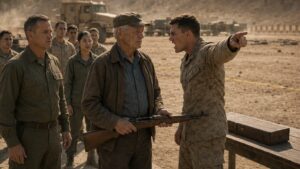
William paused at the edge of the training lane with his left hand hanging close to his thigh. The fluorescent lights hummed overhead. Dumbbells lay in clean pairs along the wall. A row of soldiers in tan shirts and green trousers moved through warmups, their boots hitting the mat in short, confident rhythms.
No one looked down.
That was the first mistake.
The desk clerk had given William a visitor badge in a plastic sleeve and pointed him toward the gym as if sending him to a waiting room. The badge clipped badly to the collar of his dark shirt. Each time he walked, it tapped against his chest with a faint, cheap click.
“Training floor is straight ahead, sir,” the clerk had said. “They’re already started.”
Sir, but not the kind that meant anything.
William did not mind. At seventy-four, he had learned which words carried weight and which were handed out to keep old men moving. He crossed the threshold slowly, not because he was uncertain, but because his right knee needed the first ten steps of every room to decide whether it planned to cooperate. He kept his shoulders square, his chin level, his hands open.
The gym smelled of rubber, metal, and young sweat.
A soldier near the wall glanced at him, then away. Another looked at the visitor badge and smiled like there was a joke William had not heard. At the far end, a tall young man with a thick neck and arms built by repetition clapped twice.
“Reset the line,” the young man called. “We run it clean in five.”
The soldiers moved quickly. They wanted to be seen moving quickly. William had known that hunger once. A room full of men trying to look ready before they understood what readiness cost.
He took three more steps and stopped at the lifted mat.
A soldier nearly brushed past him.
“Careful,” William said.
The soldier slowed just enough to give him a polite frown. “You good, sir?”
William looked at the floor. “This edge is up.”
The soldier glanced down without lowering his head. “Maintenance checks it.”
“Not if it shifted after the check.”
The soldier looked toward the others, then gave a quick shrug. “I’ll tell somebody.”
He did not tell anybody.
William bent carefully, not all the way to the floor, but enough to see the seam. The mat had been taped before. A dull strip ran beneath the top layer, old adhesive gathering dust along one side. Someone had tried to flatten it, maybe yesterday, maybe last week. But the tape had loosened, and the mat had crept toward the dumbbell rack, pushed by repeated pivots from men driving their weight forward.
William’s left sleeve slipped as he lowered his hand. Pale, roped scars showed along the underside of his forearm, old marks crossing old marks, some smooth, some puckered, some nearly lost in the loose skin of age. He tugged the cuff back down without thinking.
Behind him, the tall young man called again. “Lewis, you want the first lane or second?”
“First,” the muscular soldier said.
William heard the answer and lifted his eyes.
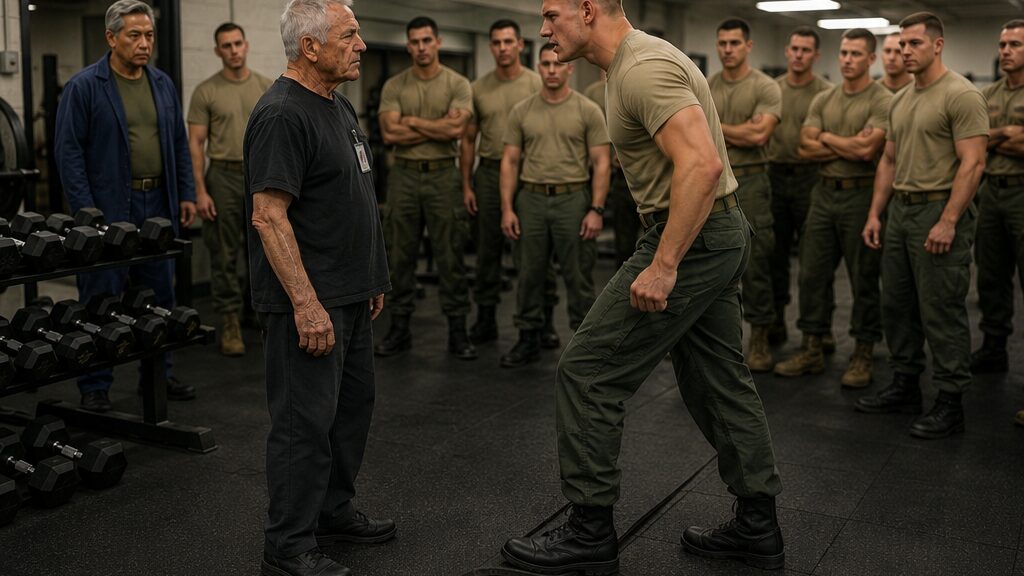
The young man stepped into the center of the gym as if the space belonged to him. Brandon Lewis, according to the name tape across his chest. He moved with the easy confidence of a soldier used to other soldiers making room. His tan shirt stretched at the shoulders. His boots were clean but not new. The kind of clean that came from wanting inspection eyes to notice discipline.
Brandon pointed to two trainees. “You come in slow on the first pass. Then full speed after I call switch. No hesitation.”
William’s eyes returned to the mat.
Full speed.
A hand touched his elbow. Not hard. Not respectful either.
“Sir,” a range safety assistant said, “we need visitors behind the yellow line.”
William looked at the yellow tape on the floor. It ran two feet behind him, faded where boots had crossed it. “I was asked to look at the training space.”
The assistant glanced at the visitor badge. “Yes, sir, but during live movement, we keep non-participants clear.”
“Who set this lane?”
“Excuse me?”
William pointed to the floor, one finger extended, no drama in it. “The mat edge is up. First pivot comes across it.”
The assistant looked at the mat. His face remained polite and empty. “We’ve been running this all week.”
“That can make it worse.”
“Maintenance signed off.”
“Maintenance doesn’t fall on your knee.”
The assistant’s eyes tightened. Not anger yet. Embarrassment. The small discomfort of being corrected by someone whose age made the correction feel inconvenient.
At the center of the room, Brandon noticed the exchange.
“What’s the delay?” he called.
The assistant straightened. “Visitor concern.”
A few soldiers turned. William felt the room do what rooms did when old men became obstacles. Attention gathered, not with curiosity, but with impatience.
Brandon walked over.
Up close, he was larger than he had looked from across the gym. Young muscle, thick wrists, jaw set clean and square. He stopped just beyond the lifted mat, hands on hips, chest forward. His eyes flicked once to William’s badge.
“You with evaluation?” Brandon asked.
“Safety review,” William said.
Brandon’s mouth moved like he almost smiled. “Same difference.”
“Not always.”
One of the watching soldiers gave a short laugh and swallowed it.
William placed the toe of his old black shoe gently against the lifted mat. “This edge needs to be flattened before you run through.”
Brandon looked down. His boot was inches from the wrinkle. “That?”
“Yes.”
“That’s nothing.”
“It’s enough.”
Brandon drew in a slow breath through his nose. “Sir, with respect, this is a close-combat lane. People hit harder things than a mat wrinkle.”
“They do when someone careless teaches them to.”
The words landed too quietly to be an insult, but the room heard them.
Brandon’s face changed. Not much. Just enough for William to know pride had stepped in where judgment should have been standing.
A few soldiers stopped stretching. One of them folded his arms. Another leaned against the dumbbell rack, watching the old man and the young instructor as if the morning had finally become interesting.
William wished they would look at the floor.
Brandon put one boot directly on the mat edge and pressed down. The wrinkle flattened under his weight.
“See?” he said. “Problem solved.”
William looked at the boot, then at the angle of Brandon’s knee. “Not when you move.”
“Sir, you need to step back.”
The range safety assistant shifted uneasily. “Mr. Martin, maybe we can have someone check it after the block.”
William heard his name in the assistant’s mouth and realized nobody in the room had been told why he was there. To them, he was a visitor with a badge, an old man in a dark shirt and black pants, short gray hair, slow step, scarred arm hidden under a sleeve. He could have told them then. He could have said he had spent more years teaching men how not to break each other than Brandon had spent wearing boots.
But that would have made the room about him.
He had come to look at a floor.
So he stayed still.
“After the block is after the fall,” William said.
Brandon’s eyes hardened. “We don’t fall from a wrinkle.”
“You fall from believing that.”
This time the laugh came from more than one soldier.
Brandon turned his head slightly, enough to let the room know he knew they were watching. When he looked back at William, his voice had dropped.
“This is live instruction,” Brandon said. “You’re standing in the lane.”
“I’m standing where the problem is.”
“You’re standing where my trainees need to move.”
“Then move the trainees.”
A silence spread outward from them. It reached the dumbbells, the folded arms, the assistant’s stiff shoulders. Even the maintenance worker at the far wall stopped pushing the mop.
Brandon took one step closer. His boot came down on the lifted mat again, flattening it for a moment. William watched the edge rise again as the pressure shifted off it.
There it was.
The little spring. The little lie.
Brandon did not see it.
The soldiers did not see it.
William’s left forearm ached beneath the sleeve, not from the scars themselves, but from the memory of floors and weight and the awful speed at which a body could become a problem no one meant to cause.
He put his hand over the wrinkle, palm facing down, hovering above it but not touching.
“Don’t step through this at full speed,” he said.
Brandon looked at the hand, then at William’s face.
“Move,” he said.
William did not.
Chapter 2: Brandon Lewis Made the Room Watch
Brandon Lewis had learned early that hesitation looked like weakness even when it was wisdom.
He had not been born arrogant. William could see that much in him. Arrogance had been added later, layer by layer, by rooms where men laughed faster than they listened. Brandon wore it like body armor now: shoulders wide, voice sharp, chin high, every movement meant to show the watching soldiers that he had control of his floor.
William had seen that armor before.
It usually cracked from the inside.
“Sir,” Brandon said, louder now, “I’m not asking again.”
William kept his palm above the mat wrinkle. “Then don’t ask. Look.”
Brandon’s eyes dropped for half a second, not to inspect the floor but to prove he had done it. “I looked.”
“No,” William said. “You glanced.”
A murmur moved through the line of soldiers. Someone near the dumbbell rack shifted his weight and whispered something William did not catch. The range safety assistant opened his mouth, then closed it. The assistant was young enough to want peace and experienced enough to know peace sometimes meant letting the loudest man decide.
Brandon gave the room a short, controlled smile.
“All right,” he said. “Since we’re stopping training for a floor inspection, everybody might as well learn something.”
William’s stomach tightened.
Not fear. Disappointment.
Brandon turned to the soldiers. “Circle in. Quick.”
They obeyed too quickly. Boots scraped over rubber. Men came closer in a loose half-ring, leaving the yellow line behind. Their faces carried different versions of the same expectation: some amused, some uncomfortable, some hungry for a story they could repeat later.
Old guy stopped the lane.
Lewis handled it.
William lowered his hand from the mat and straightened. The movement took one beat longer than it would have twenty years earlier. He saw Brandon notice that. Worse, he saw Brandon decide it mattered.
“Sir,” Brandon said, now performing for the room, “what you’re looking at is a standard training surface. We run takedown entries, balance disruption, and recovery drills here every day. Nobody is asking you to do them. Nobody is asking you to stand in them.”
William said nothing.
Brandon stepped closer. He was near enough now that William could smell mint gum and laundry soap beneath sweat.
“You ever run one of these lanes?” Brandon asked.
The question could have been honest. It was not.
William looked past him at the mat. “Yes.”
A soldier laughed under his breath.
Brandon tilted his head. “Recently?”
William let the silence sit.
The laugh grew a little.
Brandon’s smile sharpened. “That’s what I thought.”
William folded his hands loosely in front of him. The sleeve on his left arm slipped again, exposing the pale ridges along his forearm. A few soldiers saw them. Their eyes flicked down and away. Scars made people curious, but age made them cautious about asking.
Brandon saw the scars and misread them.
“You’ve got some miles on you,” he said, quieter but still loud enough. “No disrespect. But this isn’t a museum lane.”
The room reacted before it meant to. A breath, a grin, one soft sound quickly hidden.
William felt no anger rise. Anger would have been easy. Anger would have made Brandon simple. Instead, William felt the old tired weight of a familiar moment: a young man mistaking restraint for absence.
He glanced at the dumbbell rack. Heavy pairs sat close to the edge of the lane, slightly too close. If a trainee caught the mat, twisted, reached to recover, there would be metal waiting where empty floor should have been. The risk was not dramatic. That was why they ignored it.
Most damage began as something ordinary.
“Move the rack back six inches,” William said.
Brandon blinked. “What?”
“The rack. And tape the mat from the underside, not over the seam.”
“We’re not rearranging the room because you don’t like the flooring.”
“It isn’t about liking it.”
“Then what’s it about?”
William looked at Brandon’s right boot. “Your lead foot.”
Brandon looked down at himself now, irritated. “My foot?”
“You plant too narrow when you drive through. The mat catches your outside edge. Your knee tries to correct what your pride won’t.”
The silence changed.
That had gone too specific to sound like wandering complaint.
Brandon’s face closed. William saw the instinctive defense come in. The soldiers saw it too, and that made Brandon’s pride cornered.
“You think you can read my footwork from standing there?” Brandon asked.
“Yes.”
A few soldiers murmured again, louder this time.
Brandon stepped close enough that his chest nearly touched William’s shoulder. He bent slightly, bringing his face down toward William’s. It was not a grab. Not yet. But it was a crowding motion, the kind men used when they wanted space to become a weapon without admitting it.
“Then read this,” Brandon said. “Step back.”
William met his eyes.
He could have stepped back. Some part of him wished he would. His morning would become simpler. Gregory Ramirez would sign a form. Charles Wilson might nod in a hallway. William would go home with the same scars and the same quiet.
But the mat was still lifted.
And Brandon’s boot was still wrong.
William said, “Your weight is too far forward.”
Brandon’s jaw tightened. “You don’t know me.”
“I know where you’re about to hurt.”
Brandon’s hand came up, not a punch, not even a shove at first. Just a young man’s hand reaching to guide an old man out of the way. But the fingers closed around William’s upper arm with enough pressure to make the scar tissue tighten under his sleeve.
William moved.
It was hardly visible.
His left hand turned inward, catching Brandon’s wrist not with strength but with timing. His right foot slid back half a step, creating an empty space where Brandon expected resistance. William rotated his forearm across Brandon’s grip, placed two fingers just above the tendon, and shifted his own weight down through the heel.
Brandon’s body made the decision before his pride did.
His shoulder dipped. His knee softened. The pressure traveled through the narrow stance William had already named, and Brandon dropped onto one knee beside the lifted mat, one hand shooting out toward the floor to catch himself.
No strike.
No slam.
No sound except a boot scrape and Brandon’s breath leaving him.
The room went still.
William released him at once.
Brandon stayed there, one knee down, eyes wide with shock more than pain. His right hand flexed twice as if trying to understand why it had betrayed him. The soldiers stared. One man near the rack lost his grin completely. The range safety assistant stood frozen with both hands half raised.
William stepped back, giving Brandon space to stand.
“Your knee followed your foot,” he said quietly.
Brandon looked up at him.
For one second, something honest crossed the young man’s face. Not respect. Not yet. But uncertainty.
Then embarrassment rushed in and burned it away.
Brandon rose too fast. He almost shifted onto the same bad angle again, caught himself, and straightened. William saw him feel the knee. Brandon pretended he had not.
“What was that?” Brandon demanded.
“A warning.”
“That was not a warning.”
“It was the smallest one I could give you.”
The words did not land as William intended. To the room, they sounded like victory. A few soldiers looked away because watching Brandon lose face felt dangerous now. Others watched harder.
William regretted the audience. He had not wanted Brandon kneeling in front of them. Kneeling taught nothing when shame filled the space where attention should be.
Brandon stepped forward again.
This time, William raised one open hand.
“Don’t,” he said.
The command in his voice was not loud. It did not need to be. It stopped Brandon for reasons Brandon himself seemed not to understand.
A door opened at the side of the gym.
“Enough.”
The voice came from a man in a blue coverall jacket over a green shirt, gray at the temples, face set in a hard line. Charles Wilson walked in with the controlled pace of someone who had learned never to run toward a problem unless blood was already on the floor.
His eyes moved from Brandon to William to the lifted mat. Then they dropped to William’s left forearm, where the sleeve had ridden high during the movement.
For the first time that morning, someone looked at the scars and understood they were not the lesson.
Charles stopped three steps away.
“William,” he said.
The use of the first name changed the room more than the kneeling had.
Brandon turned his head. “You know him?”
Charles did not answer him.
William pulled his sleeve down.
Charles watched the motion, and something old passed behind his eyes. Not surprise. Not pity. Recognition, held carefully so it would not embarrass either of them.
“Clear the floor,” Charles said.
Gregory Ramirez appeared in the doorway behind him, wearing pressed fatigue trousers and an expression already preparing to contain damage. “What happened?”
No one answered at first.
Brandon’s face had gone red along the neck. The watching soldiers stood too still.
William looked down once more at the mat edge. It had lifted again.
Chapter 3: The Scar Was Not the Lesson
The side office had no windows, only a wall clock, two filing cabinets, and a framed safety poster showing a soldier lifting a crate with perfect knees and an empty smile.
William sat in the chair farthest from the desk because it allowed him to see the door.
Old habit.
Gregory Ramirez stood instead of sitting. He had the polished irritation of a man whose schedule had been touched by something messy. His sleeves were creased. His boots were clean. His tablet was tucked under one arm like a shield.
Charles Wilson shut the office door softly.
For a few seconds, the gym sounds came through the wall: boots moving, lowered voices, a barbell settling into a rack. Then even that quieted, as if the whole room outside were listening through the paint.
Gregory spoke first.
“Mr. Martin, I’m going to be direct.”
William nodded once.
“We appreciate your coming in for the facility review. We do. Charles asked for your eyes on the room, and I respect that. But what happened out there cannot happen during an evaluation day.”
William rested his hands on his knees. “No.”
Gregory looked relieved by the agreement until William added, “It should have happened before one.”
Charles lowered his eyes for a moment.
Gregory’s jaw tightened. “A soldier ended up on one knee in front of his unit.”
“He grabbed my arm.”
“I understand there was contact.”
“No,” William said. “You understand there was embarrassment.”
The office went still.
Gregory set the tablet on the desk. “Perception matters.”
“So does the floor.”
“We will have maintenance inspect the mat.”
“Maintenance already inspected it.”
“Then we’ll reinspect it.”
“And the rack?”
Gregory’s eyes narrowed. “The dumbbell rack is not part of today’s demonstration.”
“It becomes part of it when someone falls into it.”
“Mr. Martin—”
“William,” Charles said quietly.
Gregory paused.
Charles was still standing by the door, arms at his sides, neither defending William nor surrendering the room to Gregory. His gaze remained on the old man, but it carried a warning William recognized: not here, not all at once.
William looked down at his left sleeve. During the confrontation, the fabric had bunched above the forearm. He had pulled it low again, but the cuff no longer sat right. The skin beneath ached with the dull, private echo that sometimes came after being touched there unexpectedly.
Gregory noticed where he was looking.
“Are you injured?” he asked, too quickly.
“No.”
“Do you need the medic?”
“No.”
“Because if there was any injury during contact, I need that documented.”
William almost smiled. Not because it was funny, but because paperwork had a way of arriving faster than understanding.
Charles stepped away from the door and pulled the second chair out from the desk. He did not sit either. “William’s concern is not new.”
Gregory turned to him. “You said he was reviewing general training safety.”
“He is.”
“You did not say he had a personal concern with this drill lane.”
William looked at Charles.
Charles held the look, and William saw the old apology there. It was not enough to change the past. It was not meant to.
“I didn’t know he would find the same pattern,” Charles said.
Gregory frowned. “Same pattern as what?”
William’s hands remained still on his knees.
Charles opened the filing cabinet behind the desk and removed a thin folder, the kind bases kept long after everyone pretended records had been digitized. He set it down but did not open it.
William recognized the faded label before he could read it.
His throat tightened once, then cleared.
Gregory looked from the folder to William. “What is that?”
“Old safety notes,” Charles said. “From a training review years ago.”
“Relevant to today?”
“Possibly.”
Gregory gave a short breath through his nose. “Possibly is not helpful during an active evaluation.”
William said, “Neither is pretending speed makes a bad movement safer.”
Gregory leaned both hands on the desk. “Mr. Martin, I need you to understand something. We have visiting evaluators arriving this afternoon. The demonstration has been scheduled for weeks. The soldiers have rehearsed. The room has been signed off. If we halt everything because of a mat wrinkle and an old file, it creates questions I may not be able to answer.”
William looked at the folder.
“You should want questions you can’t answer,” he said. “Those are the ones that save people.”
Gregory stared at him.
Charles opened the folder at last.
Inside were photocopied diagrams, old forms, and handwritten notes in black ink that had faded brown at the edges. William did not need to lean closer to know the shape of his own writing. Short lines. No decoration. Corrections marked by arrows, foot positions circled, warnings written in margins because margins were where warnings often ended up.
Charles turned one page toward Gregory.
“Modified entry drill,” he said. “High-speed forward drive. Narrow plant. Surface shift. Adjacent equipment too close to lane.”
Gregory read the lines without touching the paper. His face gave away nothing, but his silence lasted longer than before.
William remembered writing those words with his right hand bandaged and his left forearm wrapped from wrist to elbow. He remembered the smell of iodine. He remembered a young soldier trying not to cry because pride had survived where the knee had not. He remembered speaking calmly at the review, because anger made commanders stop listening.
He had thought calm would help.
Maybe it had.
Not enough.
Gregory straightened. “How old is this?”
“Old enough,” Charles said.
“That’s not an answer.”
William said, “The body hasn’t changed.”
Gregory turned on him. “Training has.”
“Yes.”
“That matters.”
“It does.”
“Then you cannot walk in here and assume every modern adjustment is reckless.”
“I didn’t.”
“You dropped one of my instructors in front of his soldiers.”
William’s fingers curled once on his knee, then relaxed. “He was about to run the wrong movement over the wrong floor.”
“He was demonstrating authority.”
“He was demonstrating why authority needs correction.”
Gregory looked away, swallowing whatever answer he wanted to give. He was not stupid. William could see that. He was cornered by responsibilities that rewarded smooth surfaces and punished delays. Men like Gregory often learned to fear disruption more than danger because disruption had a signature line and danger had a chance of never happening.
Charles closed the folder halfway. “We can adjust the lane.”
Gregory shook his head. “We can tape the mat. Move the rack if maintenance approves. But we are not redesigning the drill on evaluation day.”
“The pause has to go back in,” William said.
Gregory looked at him. “What pause?”
William pointed to the diagram without touching it. “Before the drive-through. Half count. Check weight. Check partner. Then move.”
“That slows the drill.”
“It keeps it a drill.”
“The current version tests speed under pressure.”
“It tests whether pride outruns balance.”
Gregory’s mouth flattened. “You have a talent for making simple things sound like moral failures.”
William looked at him steadily. “Most injuries are simple things somebody made moral too late.”
Charles shut his eyes briefly.
A knock came at the door before anyone could answer. The door opened halfway, and Rachel Moore stood there with a medical clipboard against her chest. She was young, but not new. Her eyes took in the room quickly: Gregory standing rigid, Charles beside the folder, William seated with his sleeve pulled down.
“Sorry,” she said. “You asked for anything unusual from the floor.”
Gregory exhaled. “Now?”
Rachel hesitated, then stepped inside. “Brandon Lewis declined treatment.”
“Of course he did,” Gregory muttered.
“But I watched him walk it off,” Rachel said. “His right knee buckled inward when he turned back to the line.”
William looked up.
Rachel noticed. For the first time since he entered the building, a younger person looked at him not as an interruption, but as a source.
She glanced at Gregory, then back to William. “Same direction you warned about.”
The office fell quiet again.
From beyond the wall came the muffled sound of boots starting to move on rubber. Training had resumed.
William’s forearm ached under the sleeve.
This time, he did not look away.
Chapter 4: Nobody Wanted the Old Method
Rachel Moore waited until Gregory Ramirez left the office before she looked at the folder again.
He had not slammed the door. Men like Gregory did not slam doors on evaluation days. They closed them with discipline and then made other people feel the force of the closing. His last instruction had been simple: tape the mat, move the rack if it could be done quickly, and keep the afternoon demonstration on schedule.
No redesign.
No delay.
No “old method,” as he had called it on his way out.
The phrase stayed with Rachel as she followed Charles Wilson and William Martin back toward the gym. The hallway smelled of floor cleaner and old concrete. Through the open training-room doors, she could see soldiers standing in broken lines while the facility maintenance worker knelt near the dumbbell rack with a roll of tape.
Brandon Lewis stood apart from the others, arms folded, face angled toward the far wall. His jaw worked once, then stopped. He had not asked for ice. He had not asked for a wrap. He had not even admitted the knee had hurt.
Rachel knew that kind of refusal too. Her job had taught her that pride could hide swelling longer than skin could.
William stopped at the observation rail.
He did not look at Brandon first. He looked at the floor.
That was what made Rachel slow down beside him.
Most people looked at conflict. William looked at causes.
The maintenance worker pressed a strip of tape over the mat seam and smoothed it with his palm. The wrinkle flattened, but not evenly. The top layer buckled slightly where the adhesive pulled it sideways.
William’s hand rose a fraction, then lowered.
Rachel saw the movement. “That isn’t right?”
William glanced at her. His eyes were pale and steady under gray brows. “It’ll look right from standing height.”
“That’s not what I asked.”
For the first time, the corner of his mouth moved. Not quite a smile. More like surprise held politely.
“No,” he said. “It isn’t right.”
Rachel looked at the tape again. “Because it’s taped on top?”
“Top tape stops the eye. Not the shift.”
Charles, standing on William’s other side, said nothing. His silence felt deliberate, as if he was letting Rachel hear William without making it official.
In the gym, Brandon barked an instruction. “Reset the entry line. Slow walk-through only.”
One of the soldiers glanced toward William. Another whispered something that made the soldier beside him smirk. Brandon caught it.
“Eyes forward,” he snapped.
The smirk vanished.
Rachel tightened her grip on the clipboard. “He’s embarrassed.”
“Yes,” William said.
“You embarrassed him.”
“Yes.”
The answer was so plain it left no room for defense.
Rachel studied him. “Did you mean to?”
“No.”
“But you knew it would happen.”
William’s gaze stayed on the mat. “I hoped he would look down before he made the room look at him.”
That answer settled uneasily in Rachel’s chest. She had expected old men, especially military old men, to defend their pride with stories. William did not offer one. He did not say who he had been. He did not mention the folder, the scars, or whatever history made Charles speak his name so carefully.
He only watched the young soldiers move.
Brandon began the walk-through. Two trainees faced each other in the lane. One advanced. One received. Brandon corrected shoulders, hips, hand placement. He moved well. Rachel had to admit that. Fast, clean, confident. He saw big errors immediately.
But when the lead trainee stepped across the taped seam, William’s fingers pressed lightly against the rail.
“There,” he said.
Rachel followed his eyes. “The foot?”
“The pause.”
“What pause?”
William lifted his hand, palm down, and held it still in the air. “There used to be a half count before the drive. Not for show. For the body to tell you whether the floor, the partner, and the weight were where you thought they were.”
Rachel watched the next trainee step in. The movement was smooth until the body drove forward. There was no breath between placement and force, no moment of checking.
“It’s faster now,” she said.
“Yes.”
“That’s what they want.”
“I know.”
“Is faster always worse?”
William turned to her then, and she felt the quiet correction before he spoke.
“No.”
Rachel nodded once, accepting the rebuke.
He looked back to the floor. “Fast is fine when the truth is already checked. They took out the checking and kept the speed.”
Inside the lane, Brandon demonstrated again. His boot came down just left of the tape. His weight drove forward. The movement looked powerful from the observation rail, the kind of motion evaluators liked because it made training feel decisive.
But Rachel saw the knee now.
Only because William had taught her where to look.
A small inward dip. A correction almost too quick to name. Brandon recovered before anyone else noticed.
Rachel wrote it down.
Charles noticed the note. “You’re documenting?”
“Medical observation.”
“That may make Gregory unhappy.”
“He’s already unhappy.”
William did not look away from Brandon. “Pain?”
Rachel understood the question. “He hides it well.”
“Most do.”
“Did you?”
This time, Charles looked at her sharply.
Rachel wished she could pull the question back. But William did not seem offended. He rubbed his left forearm once through the sleeve, thumb pressing over the hidden ridges beneath the fabric.
“Not well enough,” he said.
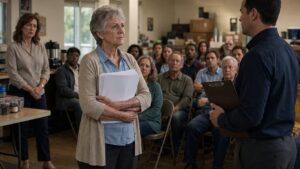
The classroom portion began twenty minutes later. Gregory had decided that if the floor needed “minor adjustment,” the soldiers could review sequence terminology while the mat was taped and the rack shifted. The classroom was really a side of the gym divided by movable panels. Folding chairs faced a monitor. A diagram of the drill appeared on screen, all clean lines and arrows.
Rachel stood near the back with her clipboard.
William sat in the last row, not by choice. Gregory had placed him there with a hand gesture and a thin smile. Charles stood near the wall. Brandon remained at the front, pointing at the diagram with a stylus.
“Entry. Contact. Drive. Recovery,” Brandon said. “No dead space. No pause that lets the opponent reset.”
William’s eyes lowered.
Rachel saw it.
There it was again. Not anger. Weight.
Brandon continued. “The older version had a check step here. We removed it because it broke aggression and created hesitation. Hesitation fails under pressure.”
A few soldiers nodded.
William said nothing.
Rachel waited. She wanted him to interrupt. Part of her feared he would. But he only looked at his hands.
The hands were not large. They were not theatrical. The skin had thinned across the knuckles. A faint tremor moved through the left one when it rested, then disappeared when he folded both hands together.
Brandon glanced toward him, perhaps expecting a challenge. When none came, he pressed on.
“The evaluators want to see decisive movement,” Brandon said. “That means commitment.”
William’s voice came from the back, quiet enough that some soldiers turned because they almost missed it.
“Commitment to what?”
Brandon stopped.
Gregory, positioned by the monitor, stiffened. “Mr. Martin.”
William did not stand. “The question matters.”
Brandon’s eyes narrowed. “Commitment to the technique.”
“Not the partner?”
The room shifted.
Rachel saw Brandon’s answer arrive too fast, then stop behind his teeth.
William spared him. He leaned forward slightly, looking not at Brandon but at the trainees. “A pause is not surrender. It is a promise that you know what you are about to do to the person in front of you.”
No speech followed. No story. Just that.
It was worse, somehow. The room had to sit with it.
Gregory cleared his throat. “Thank you. We’ll continue.”
Brandon turned back to the monitor. “As I was saying.”
But Rachel saw the damage. Not to Brandon’s pride this time. To the certainty in the room.
During the next break, she found William alone near the observation rail. He was looking down at the training floor where the rack had been moved three inches, not six. The taped seam remained.
“You said the old pause was a promise,” Rachel said.
William did not answer at first.
Below, a soldier stepped over the seam without noticing. Another copied him. Habit moving through a room faster than instruction.
Rachel looked at her notes. “Brandon’s right knee dipped inward twice. One trainee favoring left side. Tape holding visually but not flat under pressure. Rack moved, but still within fall path.”
William turned his head. “You saw all that?”
“You pointed to where the room was lying.”
He looked at her then, and she realized she had said it in his language.
A shout came from across the gym. Gregory had reentered, tablet in hand, expression smoothed into official calm.
“Final demonstration remains at fourteen hundred,” he announced. “Full speed. Evaluation team will observe from the west side. No further interruptions.”
The soldiers straightened. Brandon looked toward the training lane, then toward William.
For the first time that day, Rachel saw uncertainty break through his face before pride covered it again.
William’s thumb pressed once against his hidden scar.
Nobody moved to stop the schedule.
Chapter 5: The Demonstration Became the Same Mistake
Brandon Lewis had never hated silence until that afternoon.
Noise was easier. Boots striking rubber, soldiers calling cadence, instructors correcting hand position, weights clanking on the rack. Noise gave a man rhythm. Noise covered the little betrayals of the body.
Silence made him hear his own knee.
It had not hurt badly at first. That was what angered him. Pain he could have dismissed. Pain had a story: strain, bruise, impact, nothing serious. But this was not pain exactly. It was a small untrustworthy looseness on the inside of the joint, appearing only when he turned right and tried to drive forward.
The old man had named it before it happened.
Your lead foot.
Your weight is too far forward.
Your knee tries to correct what your pride won’t.
Brandon stood at the front of the gym while the visiting evaluation team entered through the west doors. Three observers, role-only strangers with clipboards and calm faces. Gregory Ramirez greeted them with the practiced confidence of a man who could make a schedule sound like a promise. Charles Wilson stayed near the side wall. Rachel Moore stood behind the medical table, her clipboard already in hand.
And William Martin stood near the observation rail.
Not sitting. Not interfering. Just watching.
That was worse too.
Brandon rolled his shoulders and checked the trainees. “You know the sequence,” he said. “Slow first, then speed on command. Clean lines. No freelancing.”
One trainee nodded too quickly. He was young, lean, eager, with the restless eyes of someone who wanted to be chosen for the harder version. He had been favoring his left side earlier. Brandon had seen it after Rachel pointedly wrote something on her clipboard while watching him.
He had pretended not to see.
Now he saw too much.
The mat had been taped again. A fresh strip ran across the seam, darker than the floor. From standing height, it looked fixed. But near the dumbbell rack the tape made a shallow ridge of its own, and where the mat had curled, it still held a memory of being lifted.
The rack had been moved.
Not enough.
Brandon looked away.
“Lewis,” Gregory called softly.
Brandon turned.
Gregory’s smile remained in place for the evaluators, but his eyes were hard. “Ready when you are.”
Ready.
The word used to settle him. Now it sounded like a dare.
Brandon stepped onto the lane. He felt every eye that had watched him drop to one knee that morning. Nobody had spoken of it directly, but the room had carried it all day. Soldiers looked at him and then looked away. The story had already grown without words. The old man had folded him. The old man had touched his wrist and made him kneel. The old man had known.
Brandon’s face warmed.
He had worked too long to become a joke in his own room.
“First pair,” he said.
Two trainees entered the lane.
Brandon demonstrated the opening at half speed. He kept his stance slightly wider than usual. The change irritated him. It felt like obeying William even though no one had told him to. His knee held.
The evaluators watched.
“Contact,” Brandon called.
The trainees moved.
“Drive.”
They completed the sequence cleanly.
“Reset.”
The second pair stepped in.
Brandon moved beside them, correcting posture. He heard himself sound normal. Good. Sharp. In command. The soldiers responded. The room regained rhythm. Perhaps that was all the morning had been: a disruption, a strange old man, a brief embarrassment that would pass if Brandon carried the floor through the afternoon.
Then his boot touched the taped seam.
Not hard. Not even during a drive. Just enough for the ridge to press under the outside edge of his sole.
His knee shifted inward.
He stopped it.
No one saw.
Except William.
Brandon knew without looking.
His throat tightened. He lifted his head and found the old man by the rail. William did not nod, did not signal, did not make a face. He simply looked at Brandon’s boot, then at the trainees.
Brandon hated him for that.
Not because William was mocking him.
Because he was not.
“Full speed on this pass,” Gregory said from the side.
Brandon turned. “We’re not there yet.”
Gregory’s smile thinned. “The schedule says we are.”
“The pair needs another slow rep.”
One of the evaluators made a note.
Gregory saw it. “They’ve had all morning.”
Brandon felt the room waiting for him to choose. If he delayed, the soldiers would know. Gregory would know. The evaluators would know. William would know. More than that, Brandon would know he had changed the block because an old man had gotten inside his head.
He looked at the eager trainee. The young man bounced once on his toes.
“Ready,” the trainee said.
Brandon almost told him to slow down.
Almost.
Instead he said, “Full speed. Controlled finish.”
The words came out clean and wrong.
William’s hand closed around the observation rail.
Brandon saw it. For a fraction of a second, the morning returned: the lifted mat, the old man’s palm hovering above it, the quiet warning before pride made everything public.
Don’t step through this at full speed.
Brandon inhaled.
The first trainee entered. Contact. Shift. Drive.
Clean.
The second pair moved in.
The eager trainee took the lead. His first step landed just short of the taped ridge. His partner squared to receive him. Brandon saw the foot angle before the movement continued.
Too narrow.
It was not exactly his own mistake. It was worse. It was his mistake taught into someone else.
“Hold,” Brandon said.
But he said it softly.
Too softly.
The trainee heard drive because that was the word he had been waiting for.
He launched.
Brandon moved before thinking, but he was on the wrong side. The trainee’s boot caught the ridge, slid a fraction, then stuck. Momentum went on without the foot. The knee began to fold inward with the terrible quiet inevitability of a hinge being forced the wrong way.
The room stretched thin.
Rachel’s clipboard dropped against her thigh.
Charles took one step forward.
Gregory’s mouth opened.
Brandon saw William move.
There was no hurry in it, and yet he was already there.
The old man stepped past the yellow line, one hand lifting, not toward the trainee’s chest, not toward the face, but toward the forearm that was reaching out blindly for balance. William’s scarred sleeve had ridden up again. Pale marks flashed under the fluorescent light.
Brandon’s own knee gave a warning pulse as he turned.
The trainee was falling into the same path Brandon had dismissed all morning: across the taped seam, toward the too-close dumbbell rack, body committed to speed before truth had been checked.
Brandon wanted to call out.
This time, no sound came fast enough.
Chapter 6: William Martin Chose Restraint Again
William reached the trainee before the room understood he had crossed it.
He did not grab.
Grabbing made falling men fight you. Grabbing turned fear into resistance. William had learned that before his hair went gray, before his hands began to tremble at rest, before old scars learned to ache when weather shifted.
He placed his right palm against the trainee’s forearm and gave the body a new direction.
Not back.
Back would tear the knee.
Not down.
Down would drive the shoulder into the rack.
Across.
A narrow angle. A half step stolen from the fall. A path the trainee had not chosen but could still survive.
William’s left hand dropped to the young man’s hip, fingers spread, guiding weight away from the trapped boot. The scarred forearm tightened under the light. For a moment he felt the old skin pull, felt the memory beneath it open like a door.
Rubber floor.
Wrong foot.
Too much speed.
A young soldier’s face white with surprise.
Someone saying, He was fine a second ago.
William pushed the memory aside and stayed with the body in front of him.
“Let the foot go,” he said.
The trainee did not understand.
William changed his voice.
“Now.”
The boot released. The trainee stumbled across William’s line instead of collapsing into it. Brandon caught him from the other side, both hands finally where they should have been, not forcing, only receiving. Together they brought the young man down to a seated position on the mat, away from the dumbbell rack.
The gym stopped breathing.
The trainee blinked at his own knee, then at William. “I’m okay.”
Rachel was already moving. “Don’t stand yet.”
“I’m okay,” he repeated, but he obeyed.
William stepped back.
His heart was working too hard. He could feel it in his throat. He lowered his left arm before anyone could see the tremor and turned his wrist inward to hide the scars. The sleeve stayed up anyway, caught above the old ridges.
Brandon crouched beside the trainee, face drained of color. “Did it twist?”
Rachel took the knee gently, checked alignment, asked the trainee to move his foot. Her professional calm filled the space that panic wanted.
“Not torn,” she said after a moment. “But he was close.”
Nobody answered.
Close was a word that sounded small until it stood in a room where everyone had seen the shape of what almost happened.
Gregory came forward slowly. His tablet hung at his side. “Clear the lane,” he said, but the command had lost its polish.
Charles looked at William.
William looked at the mat.
The tape had peeled at the edge. Under it, the original wrinkle had lifted again, patient and plain, as if waiting to be believed.
Brandon saw it too.
For once, he did not look away.
Rachel helped the trainee sit with one leg extended. “He needs ice and no more drill today.”
The trainee started to protest.
Brandon said, “You’re done.”
The firmness in his voice was not pride this time. It was care trying on authority.
William heard it and closed his eyes briefly.
Something in the room had changed, but change was dangerous if people mistook it for a finished lesson.
Gregory turned toward the evaluators. “We’ll pause the demonstration while we reassess the lane.”
William said, “No.”
Every face turned to him.
His voice had not been loud. It did not need to be. He could feel Charles watching him with the dread of a man who knew what it cost William to keep speaking.
Gregory’s brow tightened. “No?”
“Don’t reassess the lane and leave the drill untouched.”
Brandon rose slowly from beside the trainee. His hands hung open at his sides. The flush of humiliation was gone from his neck, replaced by something duller.
William stepped toward the taped seam. His right knee complained. He ignored it.
“The mat is part of it,” he said. “The rack is part of it. But the mistake starts before the foot lands.”
He looked at the soldiers. Not at Gregory. Not at the evaluators. At the young men who had nearly learned the wrong lesson from almost getting away with something.
“You removed the pause.”
No one spoke.
William bent, slower than he wanted to, and placed two fingers on the lifted edge of the mat. His sleeve fell back again. This time he did not pull it down.
The scars showed plainly now. Not one mark, but a map of old damage: pale lines crossing the forearm, a long tightened patch near the wrist, uneven skin where something had healed without caring how it looked.
One of the soldiers stared.
William did not tell him not to.
“Years ago,” William said, “I told a room this same movement was being rushed.”
Charles lowered his head.
The gym stayed silent.
William kept his fingers on the mat edge because it gave his hand something honest to do. “Different floor. Same pride. Same idea that a pause meant weakness. A young soldier drove through before his body knew where the weight had gone.”
He stopped.
The words ahead were not many, but they were heavy. He had carried them so long that speaking them felt less like release than like setting down a box he still expected to pick up again.
“I reached him late,” William said.
No one moved.
“My arm caught between him and the equipment. His knee still went. Not as bad as it could have. Worse than it should have.”
The trainee on the floor had stopped touching his own leg.
Brandon’s face tightened.
William looked at him, not cruelly. “That morning, the instructor said what you said. We run it every day. Nobody falls from that.”
Brandon swallowed.
William straightened. It took effort, and he hated that the room saw it. But hiding effort had never saved anyone.
“I wrote the notes after. Move the equipment. Fix the surface from underneath. Restore the half count. Not because old methods are sacred.” He looked at the line of soldiers. “Because your partner is.”
Rachel’s eyes lowered to her clipboard, but she did not write.
Gregory stood rigid, caught between embarrassment and responsibility. The evaluators said nothing. Their silence no longer felt administrative. It felt like witness.
Brandon looked at the mat, then at William’s arm.
“That thing you did this morning,” Brandon said, voice rough. “To my wrist.”
William waited.
“You knew my knee would drop.”
“Yes.”
“Because of my foot.”
“Yes.”
Brandon nodded once, barely. “You weren’t trying to put me down.”
“No.”
“You were showing me where I was already going.”
William held his gaze. “Yes.”
The room absorbed that slowly.
Brandon turned toward the soldiers. For a moment, William thought pride might return. It would have been understandable. Shame had a way of trying to save itself by blaming the nearest witness.
But Brandon looked at the young trainee seated on the floor, then at the tape peeled up under William’s fingers.
“Reset the drill,” Brandon said.
Gregory started to speak. “Lewis—”
Brandon looked at him. “Not for evaluation. For correction.”
Gregory stopped.
Brandon stepped into the lane, then lowered himself to one knee beside the lifted mat. This time no one had put him there. No wrist had turned. No leverage had made the decision for him.
He placed his boot beside the seam and looked up at William.
“Show me the pause,” he said.
The words carried no performance.
William felt the room waiting again, but the waiting had changed. It no longer leaned toward spectacle. It leaned toward instruction.
His forearm ached. His knee ached. Some old part of him, the part that had spoken too late once, quieted by a fraction.
He stepped beside Brandon and pointed to the foot.
“Not there,” William said. “Half an inch wider.”
Brandon moved it.
“Now wait,” William said.
Brandon held still.
The whole room held with him.
Chapter 7: The Room Learned Without Applause
By evening, the gym looked larger.
Most of the soldiers had gone. The visiting evaluators had left with quiet faces and full clipboards. Gregory Ramirez had signed for a work order, then another, then stood for several minutes beside the training lane without speaking to anyone. The facility maintenance worker had pulled up the bad tape, lifted the loose mat, cleaned the underside, and replaced the section instead of pretending another strip would solve it.
The dumbbell rack now sat farther from the lane.
Six inches, then two more.
William noticed.
He stood near the observation rail while the room settled into the soft clatter of after-hours work. A mop moved in steady passes near the far wall. Somewhere beyond the double doors, a cart squeaked down the corridor. The fluorescent lights still hummed overhead, but without the bodies and shouted commands, the sound felt less like pressure and more like weather.
His sleeve was down again.
He had rolled it carefully after Rachel checked the trainee and cleared him for rest. She had not asked to examine William’s forearm. She had only looked at him once and said, “You should sit for a minute.”
He had not.
Now the ache had found him.
It lived in the old places: knee, wrist, shoulder, the scar tissue beneath the left sleeve. The body always collected the bill after restraint. William had known that for years. He rested one hand on the rail and let the tremor pass through the fingers where no one important needed to see it.
Behind him, Charles Wilson said, “You still hate being right.”
William did not turn. “There are better things to be.”
Charles came to stand beside him. He carried the old folder under one arm. Its edges had softened with age, the label nearly unreadable now. William looked at it once, then away.
“You kept that,” William said.
“Yes.”
“Should’ve thrown it out.”
“No.”
The word was quiet, but it ended the argument before it began.
On the gym floor, Brandon Lewis knelt beside the replaced mat with one trainee across from him. Not the injured one. Another soldier, older by a few years and careful in the way men became after watching someone almost fall. Brandon set his own boot, adjusted it, then stopped.
“Half count,” he said.
The trainee waited.
Brandon tapped the floor lightly with two fingers. “Check the foot. Check the partner. Then move.”
William watched without changing expression.
Brandon looked different kneeling by choice. Smaller, perhaps, but not diminished. The room had stripped something from him that morning and given something back in a shape he had not expected. His voice no longer pushed against the walls. It carried just far enough.
The trainee stepped in slowly.
Brandon lifted one hand. “Pause.”
The trainee froze.
“Feel where the weight is?”
“Yes.”
“Don’t answer fast. Feel it.”
The trainee shifted his hips and nodded again, this time slower.
Brandon glanced toward the observation rail.
William gave the smallest correction with his hand: half an inch outward.
Brandon looked down, saw it, and moved the trainee’s foot.
No defensiveness. No joke for the room. No quick recovery of pride.
Charles noticed too.
“He’s listening,” Charles said.
“For now.”
“That’s all any of us do at first.”
William let that pass. The folder under Charles’s arm made the air between them heavier than the gym. There were years inside it. Not all of them written down.
Charles rested the folder on the rail. “I read your notes again this afternoon.”
“You already knew them.”
“I knew the recommendations.” Charles looked at the replaced mat. “I don’t think I understood the restraint.”
William’s fingers tightened around the rail.
Charles continued carefully. “Back then, I thought you were being professional because command needed you professional.”
“I was.”
“You were also angry.”
“Yes.”
“I should have said that in the room.”
William looked at him then.
Charles’s face had aged into itself. The hair thinner, the lines deeper, but the eyes were the same: observant, burdened, too late more often than he wanted to admit. William had not blamed him for the old accident. Not fully. Blame had many places to go in those days, and none of them brought the young soldier’s easy walk back.
“You said enough,” William told him.
“No,” Charles said. “I said enough to keep the report alive. Not enough to keep you from carrying it alone.”
The maintenance worker’s mop bucket squeaked at the far wall. Brandon’s voice drifted up from the mat.
“Again. Slow is not soft. Slow is where you find the mistake.”
William looked back at him.
The words were not William’s exactly, but they were close enough to hurt.
Charles opened the folder. “Your notes saved soldiers after that.”
William did not answer.
“They did,” Charles said. “Two training centers changed the lane spacing. One put the pause back in for new instruction. Another stopped running the drill beside equipment.”
“And this one forgot.”
“This one got comfortable.”
William touched the rail with his thumb, feeling the worn smoothness where countless hands had rested. “Comfortable is how rooms lie to themselves.”
Charles closed the folder again. “That sounds like one of your notes.”
“It should have been.”
Below, Brandon stood and demonstrated the movement at half speed. He stopped before the drive, waited, then completed it. The motion was less impressive than the version he had taught that morning. Less explosive. Less likely to make a visiting evaluator write a word like aggressive.
It was better.
The injured trainee sat on a bench with ice wrapped around his knee, watching. Rachel stood beside him, arms folded over her clipboard, but her face had softened. She caught William watching and gave a small nod.
Not gratitude exactly.
Acknowledgment.
That was easier to accept.
Gregory Ramirez entered from the side hallway with his tablet in one hand and no official smile left on his face. He paused near the doors, watched Brandon reset the drill, then walked toward the observation rail. His steps were measured, but there was fatigue in them now.
“Mr. Martin,” he said.
William turned slightly.
Gregory glanced at Charles, then at the folder, then back to William. “The lane is closed until the replacement is inspected tomorrow. Rack spacing will be marked. Demonstration notes will be amended.”
William nodded. “Good.”
Gregory seemed to expect more than that. Maybe accusation. Maybe satisfaction. When neither came, he shifted the tablet under his arm.
“I pushed the schedule too hard,” he said.
William said nothing.
Gregory looked down at the gym floor. “I saw a clean room. You saw a dangerous one.”
“I saw one dangerous thing.”
“That’s enough.”
“Yes.”
Gregory’s mouth tightened, not with anger this time. With the discomfort of a man choosing not to excuse himself. “I’ll include your recommendations in the review.”
“They aren’t mine anymore if the room uses them.”
Gregory looked at him then, and something in his posture lowered. Not submission. Not apology as performance. Just the first honest adjustment of the day.
“I understand,” he said.
William hoped he did.
When Gregory left, Charles took the folder from the rail. “Do you want this?”
William looked at the faded label.
For years, part of him had wanted every copy gone. Another part had feared that if the paper disappeared, the warning would too. He had lived long enough to know memory alone was not a system. Men forgot. Rooms got comfortable. Tape went over a seam and everyone called it fixed.
“No,” William said. “Keep it where somebody can find it.”
Charles nodded.
On the floor, Brandon finished the corrected sequence and dismissed the trainee. He stayed kneeling after the other soldier stepped away. For a moment he looked at the mat, one hand resting on his own knee. Then he rose and walked toward William.
Rachel watched him come. So did Charles. William stayed where he was.
Brandon stopped a few feet away. He had washed his face, but the day still marked him: tired eyes, stiff right leg, pride bruised into something more useful.
“Mr. Martin,” he said.
“William is fine.”
Brandon absorbed that. “William.”
It sounded difficult for him, which made it worth more.
“I thought you were trying to make me look bad,” Brandon said.
“I know.”
“I thought if I gave ground, the room would stop trusting me.”
William looked past him to the replaced mat. “Did it?”
Brandon glanced back. The trainee with the ice pack was speaking quietly with Rachel. The other soldiers who remained were stacking equipment, but their eyes kept moving toward the lane, toward the corrected marks, toward the space where the rack had been moved.
“No,” Brandon said.
“Then remember that.”
Brandon nodded.
Silence settled between them, not empty, not easy.
After a moment Brandon said, “When you dropped me this morning, I hated you for about five minutes.”
William’s mouth moved almost into a smile. “Only five?”
“Maybe six.”
Charles looked away, hiding his own smile badly.
Brandon looked down at his boots. “I was already going where you sent me.”
“Yes.”
“I keep thinking about that.”
“Good.”
Brandon lifted his eyes. “Will you show me again? Not in front of everyone. Just the correction. The wrist, the foot, the pause.”
William studied him.
The young man’s shoulders were still strong. His voice still had the habit of command. He would probably get loud again someday. He would probably mistake speed for certainty more than once before life corrected him in ways William could not. But he was asking now, and he was asking without needing the room to admire the question.
William stepped away from the rail.
His knee objected. Brandon saw it and started to move as if to offer help, then stopped himself.
Better.
William walked down to the mat. Brandon followed.
They stood in the lane where the morning had turned.
William pointed to Brandon’s boot. “Set it where you had it.”
Brandon placed his foot too narrow.
“Feel strong?”
“Yes.”
“That’s the trap.”
Brandon looked down.
William touched his own forearm through the sleeve, once, lightly. Then he let the hand fall.
“Strength that can’t pause is just momentum,” he said.
Brandon shifted the boot outward. Half an inch. Then waited.
William nodded.
“Again,” he said.
Brandon repeated the step.
This time, he paused correctly.
No one clapped. No one saluted. No one made the room into a ceremony.
The mop bucket rolled by the far wall. Rachel packed the medical bag. Charles carried the old folder back toward the office where someone might need it someday. Gregory’s voice sounded faintly in the hall, giving maintenance instructions without polish.
William watched Brandon run the sequence once more.
Foot.
Pause.
Check.
Move.
The old method did not look old when done right. It looked like care made visible.
At the door, William stopped and looked back.
Brandon had reset alone in the center of the gym. He placed his boot beside the new mat edge, held the half count, and adjusted before moving through. Slower than before. Cleaner than before.
William pulled his sleeve down over the scars, not to hide them this time, but because the day was done.
Then he stepped into the hallway and let the gym keep the lesson.
The story has ended.