The Young Instructor Laughed At The Old Veteran’s Hands Until The Target Came Back Silent
Chapter 1: The Old Man Stayed Seated While The Rifle Changed Hands
The rifle was already in the young instructor’s hands when William Miller realized the crowd had stopped talking.
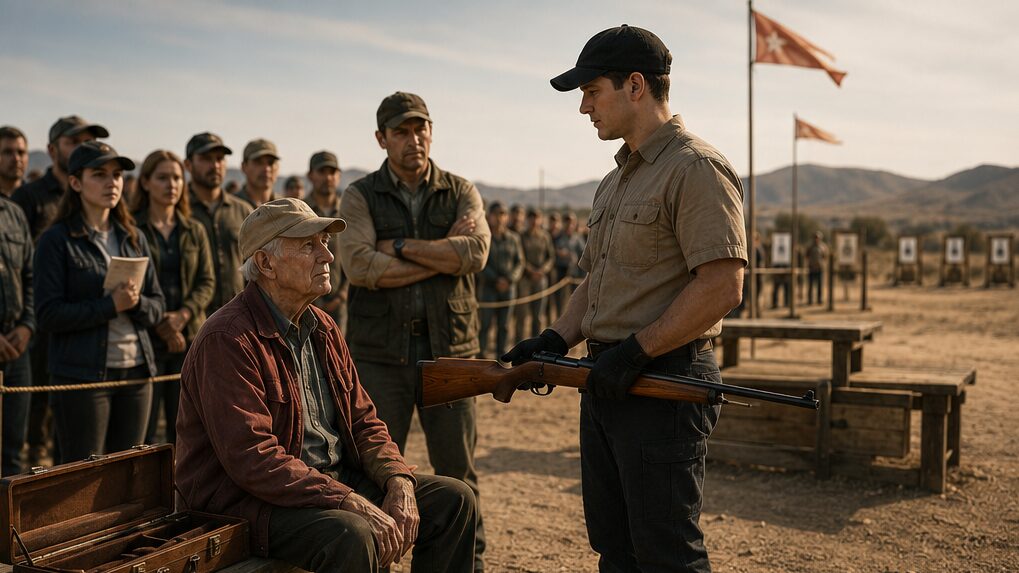
A moment before, the range had been full of ordinary noise: folding chairs scraping gravel, paper targets rattling in the dry wind, donors laughing under the shade canopy, junior shooters adjusting ear protection too early because they wanted to look prepared. Then Justin King lifted the wooden-stock rifle from the bench in front of William, held it across his chest, and the whole firing line seemed to notice the old man sitting on the stool.
William did not reach for the rifle.
He let his hands rest on his knees.
That was the first thing people saw, he supposed. The hands. Knuckles swollen at the joints. Skin thin enough for blue veins to show. A faint tremor in the left thumb when the wind came up cold from the wash beyond the berm. They saw the pale cap pulled low over his forehead, the red jacket faded at the elbows, the gray shirt buttoned carefully to the throat, and the worn rifle case standing against the bench like something carried out of a closet after too many years.
Justin saw all of it too.
“Sir,” Justin said, not unkindly at first, but loudly enough for those nearest the line to hear, “I need to make sure we’re clear on what’s happening here.”
William looked up.
Justin was twenty-nine or thirty, broad through the shoulders, clean-shaved, wearing a dark range cap and a pressed instructor’s shirt that still held the square creases from its packaging. His gloves were black. His sunglasses rested on the brim of his cap. He had the kind of confidence that came from knowing people were watching him work.
Behind him stood Benjamin Allen, the event safety officer. Benjamin said nothing. He was a little older than Justin, heavier in the jaw, quieter in the eyes. He kept his arms folded and watched the rifle, not the crowd.
The rifle was pointed downrange, safe enough, though Justin held it like an object he intended to explain rather than respect.
William noticed that.
He also noticed the flag above the far target line shifting left, then hanging, then snapping again in a small gust. Beyond the berm, dust curled low across the scrub. Lane seven would be tricky today. It had always been tricky when the wind came over the shallow dip and rolled along the firing line sideways.
Justin continued, “This is a charity precision match, yes, but it’s still a controlled range. We have junior shooters here. We have guests. Nobody handles a firearm unless I know they can do it safely.”
A few heads turned under the canopy.
William heard someone whisper, “Is he competing?”
Another voice, softer: “Maybe he’s just here for the memorial round.”
William kept his eyes on Justin’s hands.
“I understand,” William said.
His voice came out quieter than Justin’s, the kind of quiet that made a person lean in or dismiss it completely.
Justin chose the second.
“You brought this?” Justin nodded toward the wooden rifle case by the stool.
“Yes.”
“And you’re registered to shoot?”
“Yes.”
Justin’s mouth tightened as if politeness had become a task. “Sir, I’m not finding you on the main sheet.”
“I have my card.”
“We use electronic check-in now.”
William nodded once. “I was told to bring my card.”
That got a small reaction from the row of volunteers near the registration table. One of them looked down at a tablet and frowned. The announcer’s voice crackled from a speaker near the shade canopy, welcoming everyone to the annual veterans’ charity precision match, but the speaker cut out halfway through “precision,” turning the word into a flat burst of static.
Justin shifted the rifle slightly.
William’s eyes followed the motion.
A good rifle had a way of telling on the person holding it. It told whether the hands were showing off or listening. Justin’s grip was confident, but hurried. His index finger stayed outside the trigger guard, as it should, but it curled and relaxed in rhythm with his speech, too close to habit. Too much energy in the hand. Too much message in the posture.
William did not correct him.
Not yet.
A young girl near the junior shooters’ bench watched the exchange without blinking. She had a ponytail tucked through the back of her cap and a paper score sheet clenched against her chest. William had seen that look before: wanting to learn, afraid to be noticed learning.
Justin turned slightly, presenting the rifle between himself and William like a boundary.
“I’m going to ask you to remain seated until we verify your registration and do a quick safety review.”
The word seated landed harder than the rest.
William had been seated because his hip ached after the long walk from the gravel lot. He had chosen the stool at lane seven because the bench was familiar. The old wooden top had been sanded down since he last saw it, but the right corner still dipped where shooters used to rest their ammunition trays. Someone had painted over the old lane numbers. Seven was now a crisp black stencil instead of the chipped white numeral he remembered.
He stayed seated because standing too soon made people think he was proving something.
He had not come to prove anything.
The wind touched the brim of his cap.
“I can wait,” William said.
Justin glanced toward the audience, then back. “That’s probably best.”
A few people looked away at that. Others kept watching, drawn by the shape of embarrassment. The public kind always made people uncomfortable, but not uncomfortable enough to stop staring.
William lowered his gaze to his own hands.
One breath in.
One breath out.
The tremor in his thumb eased.
He had learned long ago that the first discipline was not the shot. It was the pause before you decided what kind of man you were going to be with a rifle nearby.
A board member under the canopy said something about donors needing the event to stay on schedule. The announcer tapped the microphone and tried again. Flags along the berm flicked, settled, flicked. A row of white targets waited downrange, blank and patient.
Justin leaned closer. “Sir, no offense, but we’ve had situations before where older guests thought they were signed up for demonstration seating, not live-fire competition.”
William looked at him then.
“No offense taken.”
The answer seemed to disappoint Justin. Maybe he wanted protest. Maybe he wanted anger. Something that would make his caution look justified.
Benjamin’s gaze moved from William’s face to the old rifle case and back again.
“Do you have identification with the card?” Benjamin asked.
William reached slowly into the inside pocket of his red jacket.
Justin stiffened, just a little.
William saw it. So did Benjamin.
William stopped with his fingers still inside the pocket. He did not smile. He did not sigh. He waited until Justin’s shoulders lowered by a fraction, then drew out a faded range card sealed in cloudy plastic.
The card looked small in the open air.
Its corners had softened. The print was old. The photograph had yellowed until William’s younger face appeared almost ghostlike beneath the lamination. In one corner, someone had written a lane number in dark ink long ago.
Seven.
Justin took half a step forward, but Benjamin reached first.
“May I?” Benjamin asked.
William handed him the card.
Benjamin read it. His expression did not change much, but something behind his eyes shifted, as if a door had opened in a hallway he had not known was there.
Justin noticed. “What is it?”
Benjamin did not answer right away.
William watched the younger man’s thumb slide over the old number on the card. The sun flashed once on the cracked plastic. A dust gust moved across the firing line and rattled the paper targets downrange.
“I asked for lane seven,” William said.
Justin gave a short laugh, not quite mocking, not quite patient. “Lane assignments are managed by staff.”
Benjamin was still looking at the card.
William folded his hands again.
“I know,” he said. “That’s why I asked.”
Benjamin lifted his eyes from the faded card to the black stencil on the bench beside William.
For the first time that morning, the safety officer looked less like a man supervising a charity match and more like someone who had just heard an old warning in a language he almost understood.
Chapter 2: The Faded Range Card Nobody Wanted To Read
The registration table sat beneath a beige canopy that snapped and puffed in the wind like a tired sail.
William walked there slowly with Benjamin beside him and Justin a few steps ahead, carrying himself as if he had solved the matter by moving it away from the firing line. The old rifle case remained in William’s right hand, its leather handle darkened by years of sweat and oil. Each step made the hinges give a small dry tick.
He did not mind walking slowly.
What he minded was the way people tried not to watch him do it.
At seventy-eight, William had learned that embarrassment often wore a polite face. People offered chairs too quickly. They raised their voices by mistake. They explained simple things twice and complicated things not at all. They called it concern, but sometimes concern had the same weight as dismissal.
A volunteer behind the table smiled with her lips pressed together. “Name?”
“William Miller.”
She typed with both thumbs on a tablet. “I’m sorry, I don’t see a current registration.”
Justin stood behind her shoulder. “That’s what I was saying.”
William placed the faded range card on the table.
The volunteer glanced at it for less than a second. “Oh, we don’t use these anymore.”
“I was told to bring it.”
“By who?”
“Patricia Robinson.”
The name moved through the small space beneath the canopy differently than his own had. One of the board members looked up from a clipboard. Benjamin’s hand, resting near the edge of the table, went still.
The volunteer scrolled again. “I have a Robinson on the donor list.”
“She did not invite me as a donor.”
Justin took the tablet gently from the volunteer, as if patience had to be demonstrated. “Mr. Miller, this event has several categories. Open rifle, junior scholarship, memorial demonstration, veteran guest seating—”
“I know the categories.”
Justin looked up from the screen. “Then you understand why we can’t just let someone walk onto a live-fire lane with an old card.”
William did not answer immediately.
Across the range, a group of junior shooters laughed at something near the water cooler. The girl he had noticed earlier stood apart from them, adjusting the strap of her shooting bag. Her score sheet was folded now, creased down the middle. She looked at lane seven, then away when Justin’s voice rose again.
“This is not about disrespect,” Justin said. “It’s about safety.”
William looked at the range card lying between them.
Safety.
The word had been used properly in his life and improperly. Properly, it was a discipline that humbled everyone equally. Improperly, it became a clean uniform people wore over pride.
“I agree,” William said.
Justin blinked, thrown again by the absence of resistance.
The board member with the clipboard stepped closer. “Patricia asked for a few legacy invitations this year. The old instructor program, mostly ceremonial. We’re trying to honor the history without disrupting the competition.”
“The invitation said I was entered,” William said.
“May I see it?”
William reached into the case’s side pocket and removed an envelope, folded twice. The paper had softened from being carried. Patricia’s handwriting leaned forward across the front, firm despite age.
The board member unfolded the letter. His expression tightened as he read.
William did not need to read it again. He knew the words.
Will, they are calling it a memorial now, but the range has forgotten what it is memorializing. Come if you can. Not for them. For what you and he built before everyone learned to clap for speed and forget why the line stays safe.
Below that, Patricia had written the date and a simple note.
Lane seven is open.
The board member cleared his throat. “This is informal.”
“It is Patricia’s hand,” William said.
“No one is questioning that.”
Justin said, “The issue is whether he is cleared to compete today.”
Benjamin finally spoke. “His card has a qualification stamp.”
Justin turned. “From decades ago.”
“Still worth noting.”
“It’s worth framing,” Justin said, then softened his tone when the volunteer glanced up. “Not relying on.”
William looked at him, not with anger, but with interest. Justin King had a fear under the polish. Not fear of William. Fear of losing control in public. Fear of the event becoming something he could not manage. William had seen young instructors like that. Some grew out of it. Some built their whole authority around it.
The volunteer tapped the tablet. “I can add him manually under legacy participant, but live-fire requires instructor approval.”
Justin’s answer came too quickly. “Then he’ll need a safety review.”
The board member nodded with relief. Procedure had arrived to save everyone from judgment.
William took the letter back, folded it carefully, and returned it to the case pocket.
The scent of the old case rose when he opened it: gun oil, dry leather, a faint trace of cedar from the closet where it had rested for years. Inside, under a plain cloth, lay the wooden-stock rifle. It was not a museum piece, not fancy, not polished for display. Its stock bore small dents where time had handled it honestly. The metal was clean. The chamber flag was in place. Everything was as it should be.
Justin looked inside and gave a small, controlled smile.
“You planning to shoot that today?”
“If allowed.”
“That’s an older platform.”
“Yes.”
“We have loaners with modern optics if you need one.”
“I do not.”
Justin’s smile held. “Most people say that before the wind starts talking.”
William closed the case.
He counted one breath.
Then another.
The second breath brought Patricia into view across the edge of the canopy.
She stood near the memorial table, a small woman in a pale blouse with one hand resting on a framed photograph. Her hair was silver and pinned back. She had not approached him yet. She simply watched, as if she knew the cost of being seen too soon.
For a moment, the range blurred into another year.
A younger man laughing at lane seven. A hand slapping William’s shoulder. A voice saying, You count too slow, Will. The students already fired.
Then a gust pushed dust against William’s shoes, and the present returned.
Justin shut off the tablet and handed it back to the volunteer.
“All right,” he said, turning so the people nearby could hear. “Mr. Miller can remain on the participant list as a legacy entry. But before he touches a rifle on my line, I’ll personally conduct a safety review. For everyone’s comfort.”
The phrase settled under the canopy.
For everyone’s comfort.
William watched Patricia close her eyes for half a second.
Benjamin looked down at the faded card again.
The volunteer seemed grateful the matter had rules now. The board member moved away, already talking about keeping the schedule intact. Under the far canopy, the announcer called the junior shooters to staging.
Justin faced William with the satisfied calm of a man who believed he had been generous.
“Fair enough?” he asked.
William lifted the old range card from the table and slid it back into his jacket.
“Yes,” he said. “Fair enough.”
But as he turned toward lane seven, he saw Benjamin still staring at him, not at the card now, but at his hands.
Not the tremor.
The way the tremor disappeared whenever William touched the rifle case.
Chapter 3: The Young Instructor Raised His Voice For The Crowd
By early afternoon, the firing line had arranged itself into an audience.
No one admitted that was what had happened. The junior shooters stood near their benches, pretending to check equipment. The donors gathered in the shade, pretending to listen to the announcer. The board members stayed close enough to observe and far enough to deny responsibility if the old man embarrassed himself. Even the range medic had drifted nearer with a bottle of water in one hand.
William sat at lane seven.
He had not been told to sit this time. He simply chose the stool because it was there, because his hip asked for it, and because standing before he needed to would waste strength better saved for steadier things.
The wooden-stock rifle lay in its open case on the bench. The chamber flag remained in place. The muzzle faced downrange. The bolt was open. The safety review had not officially begun, but William had already completed most of it in silence.
Justin approached with Benjamin behind him.
Justin carried a clipboard now. The clipboard made the moment look official. His voice did the rest.
“Ladies and gentlemen, we’re going to take a short pause before the next relay,” he called. “We have a legacy participant who’ll be completing a required safety review.”
A few people shifted.
William kept his hands on his knees.
Justin stopped beside the bench and looked at the open case. “Mr. Miller, I’m going to walk you through the basic commands we use on this line.”
William nodded.
“You’ll respond verbally so I know we’re on the same page.”
“Yes.”
Justin’s mouth tightened slightly. “When the line is cold, no handling firearms. When the line is hot, eyes and ears on, muzzle downrange, finger off the trigger until ready to fire. You understand?”
“Yes.”
“Chamber open until instructed.”
“Yes.”
“Any malfunction, keep the rifle pointed downrange and raise your support hand.”
“Yes.”
Justin glanced toward the crowd. “And if you feel dizzy, confused, weak, or uncertain at any point, you’ll step away. No shame in that.”
There was the insult, wrapped in soft cloth.
William heard a tiny sound from the junior benches. Not laughter exactly. More like young people trying not to react.
The girl with the folded score sheet, Laura White, looked down at her shoes.
William’s left thumb trembled once against his knee.
He covered it with his right hand.
“One breath in,” he thought.
One breath out.
Justin picked up the wooden-stock rifle from the open case without asking.
Benjamin’s eyes narrowed.
William did not move.
Justin checked the open chamber, then held the rifle horizontally between himself and William, just above waist level, its plain stock catching the hard sun. He handled it correctly enough for public viewing, but his attention was split between the object and the spectators. That was the danger of performing safety. The eyes went to the audience when they should stay with the rifle.
“This,” Justin said, “is an older rifle. Nothing wrong with that when properly maintained, but older platforms require extra attention. They don’t forgive sloppy handling.”
“No rifle does,” William said.
It was quiet, but close enough that Justin heard.
A brief pause.
Justin gave him a practiced smile. “Exactly. That’s why we review.”
He turned the rifle slightly as if demonstrating its age. A man under the donor canopy murmured something about iron and wood. Another said, “My grandfather had one like that.”
William watched Justin’s right hand. The finger stayed straight, but the glove brushed the trigger guard as he shifted grip. Not inside. Not dangerous yet. But careless in the way a pebble at the top of a hill was not an avalanche yet.
Justin lifted his voice.
“Now, Mr. Miller, before I hand this to you, I need you to show me where your trigger finger rests when you shoulder the rifle.”
A demonstration for the crowd.
William looked at the rifle, then at Justin.
“I would rather show you after you hand it to me.”
That drew a small laugh from somewhere near the water cooler.
Justin smiled wider. “I’m sure you would. But we do things step by step.”
William’s eyes moved to the far targets. The white paper squares shimmered slightly in heat. The wind flag beyond lane seven twitched, dipped, then pulled hard left. He remembered when lane seven had no flag. In those days they had read the dust and the grass. In those days a man’s impatience showed up on paper before it showed up in his voice.
Justin adjusted his grip again.
This time his gloved finger brushed too close and lingered near the guard as he turned to speak to the observers.
William’s voice came low and clear.
“Finger straight until the target asks for it.”
The firing line changed.
Not dramatically. No one gasped. No one stepped back. But the small living sounds around lane seven thinned: the shuffle of shoes, the cough near the canopy, the click of someone adjusting a scope.
Justin looked at him.
“What was that?”
William kept his hands folded. “Finger straight until the target asks for it.”
Justin’s face colored. “I know trigger discipline, sir.”
“I did not say you didn’t.”
“You’re correcting me during your safety review?”
“I am correcting the rifle’s moment.”
The words were strange enough to make the crowd listen harder.
Benjamin looked past Justin toward the faded signboard mounted near the range office. Most of its newer rules were printed in bright vinyl. But along the bottom edge, half-covered by a sponsor banner, an older line of painted text remained, sun-bleached and nearly lost.
Finger straight until the target asks.
Benjamin read it once.
Then again.
Justin followed his gaze and saw the sign.
For the first time since the confrontation began, his confidence slipped without finding something to grab.
William saw it happen. He did not enjoy it. Enjoyment would have spoiled the correction.
A rifle did not care who was embarrassed. A line did not get safer because a man won an argument.
Justin cleared his throat. “That’s an old phrase.”
“Yes.”
“You read it from the sign?”
“No.”
A dry gust moved over the firing line. The sponsor banner fluttered, exposing the old painted words more clearly for a second, then covering half of them again.
Benjamin stepped closer.
“Where did you hear it?” he asked.
William looked down at the rifle in Justin’s hands. The stock had been cared for, but not by someone who knew all its small histories. A shallow dent near the comb. A darker patch under the sling mount. Old wood held memory differently than metal. Metal forgot fingerprints. Wood kept pressure.
“Here,” William said.
Justin gave a small laugh, defensive and thin. “A lot of people have trained here.”
William nodded. “They have.”
Benjamin’s expression had become careful. “When?”
William did not answer.
The range announcer’s voice crackled again from the speaker, calling for the open rifle relay to prepare. No one moved at first. They remained caught by the sight of the old man seated calmly while the young instructor held the rifle between them, no longer quite sure who was teaching whom.
Justin lowered the rifle slightly.
He had not lost control of the line. Not officially. But something had shifted away from him. He felt it, and because he felt it, he reached for the only tool he trusted.
Procedure.
“Fine,” he said. “Then let’s finish the review.”
He set the rifle back into the open case, more carefully than before. The muzzle remained downrange. The bolt stayed open. His movements were correct now, almost too correct, sharpened by the sting of being watched.
William did not touch the rifle yet.
“Mr. Miller,” Justin said, “when instructed, you will lift the rifle, confirm clear, shoulder only on command, and dry-fire only when I say. Understood?”
William looked at Benjamin, not Justin.
“Is the line hot?”
Benjamin blinked. “No.”
“Then I will not shoulder it.”
The silence that followed was longer than the first.
Justin’s jaw worked once. He had walked himself into his own rule, and everyone who had listened heard it.
William did not look at the crowd. He did not need to. Their attention pressed against his back like sunlight.
Benjamin’s voice came softer. “He’s right.”
Justin’s eyes flashed toward him.
Benjamin kept his tone neutral. “Line is cold.”
The announcer, sensing trouble but not understanding it, filled the speaker with a nervous reminder about raffle tickets.
William leaned back slightly on the stool.
His hip ached. His thumb trembled again. He let it. There was no shame in a body telling the truth. Shame lived elsewhere, in men who mistook volume for command and speed for skill.
Justin took a breath through his nose and glanced at the spectators. He had been corrected twice now, but neither correction gave him a clean enemy. William had not mocked him. Had not raised his voice. Had not taken the rifle. That made the embarrassment harder to fight.
“All right,” Justin said. “We’ll wait for hot line.”
“Good,” William said.
A simple word.
Not victory. Not challenge. Just agreement with the rule.
Benjamin stepped beside the bench, close enough that only William could hear him over the returning noise of the range.
“Mr. Miller,” he said, “where did you learn that phrase?”
William looked toward lane seven’s target frame. The wind had turned tricky again, crossing left to right now, low and uneven.
He counted one breath.
Then another.
Then he answered without looking at Benjamin.
“Here.”
Chapter 4: The First Shot Was Not The Proof They Wanted
The line went hot after lunch, and lane seven was the last one called.
William waited for the command with the wooden-stock rifle resting open on the bench in front of him. He had cleaned it the night before beneath the yellow light of his kitchen, not because it needed much, but because old habits settled the hand. Cloth through the bore. Oil where oil belonged. None where it did not. Bolt moving smooth. Chamber checked twice and then a third time because the third check was not doubt; it was respect.
Justin stood three lanes down, speaking into a small radio clipped to his vest. He did not look at William directly, but William felt his attention all the same. It came in glances, in pauses, in the way Justin’s voice sharpened whenever he spoke about procedure.
“Open rifle relay,” the announcer called. “Five rounds for score. Shooters will wait for command.”
A line of competitors moved into place with modern rifles, heavy barrels, adjustable stocks, sleek scopes mounted on clean rails. Their bags and rests looked designed by engineers. Their wind meters hung from lanyards or sat blinking beside ammunition boxes. The wooden rifle in front of William looked smaller among them, plainer, like a chair from an old schoolhouse set inside a new office.
Justin approached lane seven carrying a folded shooting mat.
“We’re putting you here,” he said.
“I asked for here.”
Justin’s mouth twitched. “You may not want it after the first flag change.”
William looked downrange.
Lane seven sat near the slight break in the berm where the wind funneled across the line. Most shooters disliked it. The flags lied there. High flag left, low dust right. Paper still until it wasn’t. A man who trusted one sign would chase his own shots all afternoon.
“I know the lane,” William said.
Justin laid the mat down with more force than needed. “You’ll fire from the bench. No unsupported positions. We’re not risking a fall.”
William nodded.
The limitation was unnecessary, but not insulting enough to be worth carrying. A man only had so much room in his chest. Better to save it for breath.
Benjamin came to the lane with the score card. His eyes flicked over William’s rifle case, the open bolt, the chamber flag, the ammunition box placed to the right and slightly forward. He gave no praise. He only nodded once.
“Shooter ready?” Benjamin asked.
William looked at the flag above the fifty-yard board, then the dust near the hundred-yard marker, then the mirage trembling above the backstop.
“Not yet.”
Justin exhaled through his nose.
William placed his palms flat on the bench and waited.
The other shooters shifted impatiently. One adjusted his scope. Another whispered to someone behind the rope. The junior shooters had gathered again, Laura White among them. She stood with both hands wrapped around the strap of her bag, watching William’s lane instead of the competitors with expensive rifles.
A gust moved across the range.
The high flag snapped left.
The dust low on lane seven drifted right.
Then, briefly, both stopped.
William lifted his right hand.
“Ready.”
The command came down the line.
“Load.”
William removed the chamber flag, touched the open chamber with a glance and then with memory, and placed one round where it belonged. His fingers trembled until they touched the rifle. Then they settled.
He heard it before he felt it: the small quiet inside himself that had nothing to do with confidence. Confidence moved too much. This was older. He had trusted it when young men were watching him for instruction, when nervous hands made mistakes, when a range could turn dangerous because one person wanted to look quick.
He closed the bolt.
Justin stood slightly behind him, arms folded.
“Remember,” Justin said, not loudly now but not softly either, “take your time.”
William placed the rifle into his shoulder.
He did not answer.
The stock fit differently than it used to. His collarbone had less meat over it. His cheek did not settle as low. Age changed the body around a familiar object and asked memory to make adjustments without complaint.
He breathed in.
Out.
In.
Out.
The front sight steadied, then wandered, then steadied again. He did not fight the wandering. A rifle showed what the body was doing. Fighting it only made the body lie harder.
The wind touched his left ear.
Not the flag. Not the dust. The skin.
William held through one more breath.
Then he fired.
The shot cracked across the range and folded itself into the others. Several rifles had fired close together, a ragged little storm moving down the line. William did not lift his head. He opened the bolt, watched the brass clear, and set the rifle safe.
Justin leaned forward, looking through his spotting scope.
He said nothing.
Benjamin marked something on the score card.
The target did not come back yet. The relay continued, and William let the next four shooters take their shots before he loaded again. He did not rush to prove he had control of the rifle. He already knew that. Proof belonged to the people who needed it.
Second shot.
He waited through the false calm and broke the shot just as the dust shifted.
Third.
The wind rose. He held off more than the flag suggested.
Fourth.
A competitor in lane five muttered after his own miss, blaming a switch. William heard the frustration and remembered how quickly pride looked for weather to accuse.
Fifth.
The line went cold.
Bolts opened. Chamber flags inserted. Hands lifted away. Benjamin walked the line with the other safety officers. William waited until Benjamin’s eyes met his before he moved back from the bench.
Justin stepped to the target return control with a look that tried to be casual.
The paper targets came gliding back on their carriers, one by one. The donors under the canopy leaned forward. The junior shooters drifted closer to the rope. Laura stood on her toes.
Lane seven’s target arrived last.
It turned slightly in the wind as it came, the white paper shivering on its frame.
The grouping was not perfect.
William saw that first.
Not perfect. A little vertical spread from the third shot, one edge pulled by a wind change he had felt half a second too late. Good, but not enough to quiet a lifetime. He had never trusted perfection anyway. Perfection made liars of targets and fools of men.
But the five holes sat close enough inside the scoring ring that the first small silence formed around the paper.
Benjamin looked at the group. Then at William. Then back at the group.
Justin removed the target from the carrier and held it flat.
“Clean score,” Benjamin said.
A few people murmured.
Justin’s jaw tightened. “Good first round.”
William nodded.
“Very good for that lane,” Benjamin added.
Justin glanced at him.
“For that lane,” Justin repeated, and forced a short laugh. “Wind probably settled just right.”
William began placing the rifle back into the case.
“It settled once,” he said.
Justin heard the correction under the calm. “Meaning?”
“Not for all five.”
The words were not sharp. That made them harder for Justin to dismiss.
A man near the donor canopy said, “Maybe the old rifle still has some life in it.”
Someone else chuckled, but it died quickly when William looked downrange instead of reacting.
Justin set the target on the table and tapped one hole with his gloved finger. “Still, one string doesn’t tell the whole story. We’ve got competitors who can repeat this all day.”
“I expect so,” William said.
“You’ll need to do it again in qualifying.”
“Yes.”
Laura stepped closer to the rope before she seemed to realize she had moved. Her eyes were on William’s hands.
“They stopped shaking,” she said, too quietly for most people.
But William heard.
So did Patricia Robinson, standing beneath the memorial tent with one hand on the framed photograph. Her face had changed since the morning. Not brighter. Not relieved. Something more painful than that. Recognition, perhaps, with old grief folded through it.
William picked up the target only after Benjamin offered it to him.
The paper felt thin and dry. Five holes, close but not final. Enough to make people wonder. Not enough to finish anything.
He looked at the group once, then handed it back.
“Keep it with the score,” he said.
“You don’t want it?” Benjamin asked.
“No.”
Justin gave him a sidelong look. “Most shooters keep their good targets.”
William closed the case halfway, leaving the chamber open and visible until cold line ended officially.
“Only the ones that teach me something.”
At the memorial tent, Patricia’s mouth moved, barely forming words.
No one around her seemed to hear.
William did.
“He still counts the same way,” she whispered.
Chapter 5: The Worst Lane Became The Quietest Place On The Range
By late afternoon, the wind had become dishonest.
It came over the berm in layers now, warm above the target line and cooler near the ground, lifting dust in small starts and then dropping it as if nothing had happened. Flags snapped, fell slack, and snapped again. Shooters began checking devices more often than breathing. The range turned busy with numbers, adjustments, excuses.
William sat at lane seven with his rifle case closed beside him.
He had qualified.
Barely, according to the board near the announcer’s table. Comfortably, according to anyone who understood what the lane had asked of him. His name had appeared near the bottom of the handwritten sheet as W. Miller, Legacy Entry, the last part underlined by someone who had wanted the category to explain the score before the score could speak for itself.
Justin did not mock the first target anymore. He had found another way to protect himself.
“Demonstration round before finals,” he announced, voice amplified by the speaker and the attention he had gathered around him. “We’ll show the juniors what modern equipment can do when paired with proper technique.”
He stood at lane four beside a sleek rifle mounted on a precision rest. A small crowd formed quickly. Donors liked clean demonstrations. Board members liked anything that looked planned. Junior shooters liked gear they could imagine owning someday.
Laura White stood near the front.
William noticed her before he noticed Justin.
She had set her feet too wide, copying the stance Justin had shown earlier to one of the boys. Her shoulders were stiff. Her jaw locked each time Justin mentioned pressure. She watched his hands with the hunger of someone trying to become steady by imitation alone.
Justin adjusted a scope and spoke to the juniors.
“Speed matters when conditions shift. If you wait too long, you lose the wind call. You need confidence. You need to trust your equipment and commit.”
William looked toward the flags.
The advice was not entirely wrong. That was what made it dangerous. Wrong advice was easy to reject. Half-right advice slid into young minds and built rooms there.
Justin gestured Laura forward. “You. Junior scholarship group, right?”
Laura straightened. “Yes, sir.”
“Come here. Let’s show them how not to overthink.”
William’s hand tightened once on the edge of the stool.
Benjamin stood near the target table, watching the demonstration with the troubled stillness he had worn since the safety review.
Justin placed Laura behind the rifle, careful with the muzzle, correct with the chamber, controlled in the public ways. “Get behind it. Don’t freeze. Find the target, breathe, press. Clean and confident.”
Laura nodded too quickly.
William saw her finger straighten properly along the frame. Good. Then he saw her breathing: shallow, held high in the chest. Justin talked beside her, still performing for the group, telling her not to hesitate while the wind shifted low across lane four.
The old memory did not come as a scene at first.
It came as sound.
A laugh from another year. Brass landing on concrete. The clean clap of a shot released too soon. Then a voice, not Justin’s, younger and familiar.
Will, you count too slow.
William closed his eyes once.
His old range partner had been a better natural shooter than William, faster to read light, quicker to make students laugh. He could take command of a nervous line with a grin. People followed him because he made confidence feel easy.
That was also the trouble.
On the day everything changed, he had been demonstrating under pressure from visiting officers. A young class watched. A new drill. A shifting line. One missed correction that William had spoken too softly because he did not want to embarrass a friend in front of students.
Not a dramatic accident. Not the kind stories exaggerated around coffee. A small unsafe moment, corrected too late. A fall, a struck head against the concrete edge, a life narrowed in a hospital bed and gone before the month ended. No bullet wound. No battlefield glory. Just pride, speed, fatigue, and a rule treated as flexible because the man holding it was trusted.
William had replayed the moment for years.
Not because his correction would certainly have saved him.
Because he had made it quietly when it needed to be heard.
At lane four, Laura’s shoulders lifted again. Justin told her to send it.
William opened his eyes.
“Stop.”
The word did not carry like a shout. It carried because it came from a place in him that had no tremor.
Laura froze.
Justin turned, anger rising before he understood it. “Mr. Miller, this is a controlled demonstration.”
“Her breathing is wrong.”
A few juniors looked at Laura. Her face went red.
William regretted that part immediately.
He stood.
The movement was slow and not graceful. His hip resisted. The stool scraped gravel behind him. Several people watched as if standing itself had become a performance.
William did not look at them.
He looked at Laura. “Step back from the rifle, please.”
She did.
Benjamin moved closer but did not interfere.
Justin’s voice dropped. “You don’t interrupt my line.”
“Then teach the whole rule.”
“I was teaching confidence.”
“Confidence without pause becomes guessing.”
Justin laughed once, hard. “You had one good string and now you’re instructing my juniors?”
William felt the words land. He let them land. Some insults were like spent brass. Hot for a moment, harmless if you did not pick them up too soon.
Laura stared at the ground.
That decided him.
William turned to Benjamin. “Is qualifying complete?”
“For open rifle?” Benjamin said. “One final string remains.”
“Scored properly?”
“Yes.”
“Put me in lane seven.”
Justin stepped toward him. “You’re already qualified.”
“Then score it as exhibition if you like.”
“That’s not how this works.”
William looked at him. “Then let it work properly.”
The range had gone quiet again. Not fully. The wind still moved. Paper still rattled. But people had stopped pretending not to listen.
Justin’s face was tight with the strain of being challenged without being attacked.
“You want another five shots?” he asked.
“No.”
William’s hand rested on the old rifle case.
“One full string. Same as the finals. No favors. Same wind. Same target distance. Same rules.”
Benjamin looked at the target line. “That would be ten.”
“I know.”
Justin folded his arms. “With that rifle?”
“Yes.”
“On lane seven?”
“Yes.”
The board members under the canopy began murmuring. The announcer leaned away from his microphone, unsure whether this was a schedule problem or the best thing the event had offered all day.
Justin looked at William’s left hand, where the thumb had begun to tremble again after standing.
“You sure that’s wise?”
William followed his gaze. For a moment, he saw what Justin saw: age, fatigue, thin skin, a man who should have stayed seated. Then he touched the brass latch of the rifle case.
The tremor stilled.
“No,” William said.
That answer unsettled Justin more than yes would have.
William opened the case.
“I am sure it is necessary.”
Benjamin lifted the score card slowly.
“Lane seven,” he called to the target crew. “One full string. Scored properly.”
Laura looked up then.
William did not smile at her. He only gave the smallest nod, not enough to make her feel chosen in front of everyone, just enough to tell her the shame was not hers to carry.
Justin stepped aside, but not far.
William lifted the wooden-stock rifle from the case, checked the chamber, checked the flag, and set it on the bench with the muzzle downrange.
The old words came back to him, not as grief this time, but as instruction.
Finger straight until the target asks.
The first rule was respect.
The second was safety.
Everything after that was only marksmanship.
Chapter 6: When The Target Came Back, Nobody Spoke First
The sun lowered behind the range office and turned the dust the color of old brass.
William stood at lane seven while everyone else seemed to arrange themselves around the possibility of his failure. Donors moved closer to the rope. Junior shooters clustered in two uneven rows. The board members stopped pretending to discuss schedules. The announcer held the microphone near his chest without speaking into it.
Justin stayed to William’s right, far enough not to interfere, close enough to remind everyone that he still supervised the line.
Benjamin stood behind the scoring table with the card in his hand.
Before William loaded, Benjamin walked to lane seven and placed the card flat on the bench.
“Ten rounds,” he said. “Final standard.”
William nodded.
Benjamin hesitated. “Mr. Miller.”
William looked at him.
“I checked the old course board in the office.”
Justin’s head turned slightly.
Benjamin kept his voice low, but not low enough to hide it from those closest. “The phrase is on the original safety sheet. Same wording. Same punctuation.”
William said nothing.
“There are initials at the bottom,” Benjamin continued. “W.M.”
The range seemed to lean in.
William looked down at the rifle.
Initials were light things. Ink on old paper. A mark that survived because no one had bothered to remove it. They could explain a phrase, maybe a card, maybe the way Benjamin now looked at him. They could not explain the years away. They could not bring back the man whose photograph sat on Patricia’s memorial table.
Justin’s voice cut in, sharper than necessary. “Lots of people write training documents.”
William agreed. “They do.”
Benjamin studied him. “Did you write that one?”
William reached for his ammunition box.
“Part of it.”
The answer did not give the crowd what it wanted. No proud confession. No story. No title for them to pass around. Just two plain words and the first round lifted carefully between old fingers.
Justin looked away.
The command sequence began.
“Shooters, eyes and ears.”
Ear protection settled. The world dulled.
“Line is hot.”
The words entered William’s body the way old music did.
He loaded the first round.
The rifle came to his shoulder.
Immediately, the years vanished and did not vanish. He felt every one of them in his hip, his neck, his breathing. But beneath them lay the old structure, not young strength but disciplined order. Feet. Bench. Shoulder. Cheek. Sight. Breath. Wind.
The high flag said left.
The low dust said wait.
William waited.
One competitor would have worried about the crowd. Another about Justin. A younger William might have worried about proving something to Patricia, to Benjamin, to the photograph on the memorial table, to the ghost of the man who had once laughed at his slow count.
But the target did not care about any of them.
That was its mercy.
That was its judgment.
He breathed in.
Out.
He did not fire at stillness. He fired at the moment before stillness broke.
The first shot cracked.
Bolt open. Brass clear. Chamber visible. Second round.
Justin watched through a spotting scope now. William could feel the rhythm of his attention: surprise at the first hole, doubt after the second, suspicion after the third. By the fourth, Justin had stopped shifting his stance.
William did not look.
Fourth shot.
Fifth.
The wind changed.
He lowered the rifle.
A murmur moved across the crowd.
Justin lifted his head from the scope. “Problem?”
William kept the muzzle downrange, bolt open.
“Waiting.”
“For what?”
“The wind to finish lying.”
Someone behind the rope let out a nervous laugh, then swallowed it.
William waited.
The wind flag continued left, but the dust near the berm curled back toward the right. Heat shimmer lifted off the ground, bending the target edges just enough to invite overcorrection. William watched the empty space beside the target, not the center.
A rifleman learned that a target was more than paper. It was everything between the muzzle and the paper, including the shooter’s wish to hurry.
The dust settled.
Not stopped. Settled.
William loaded the sixth round.
Fired.
Seventh.
He felt the stock differently now. Not as an object from the past, but as a question in his hands. What is this for? Pride? Proof? Memory? Punishment?
Eighth.
Laura stood near the rope, both hands at her sides now, not clenched. She watched his breathing more than the rifle.
Good, William thought.
Ninth.
The old ache in his shoulder deepened. His left hand trembled when he opened the bolt. He did not hide it. He let the tremor exist until the next task required stillness.
Tenth.
For the last shot, the range seemed to hold its breath for him. That was dangerous. Borrowed breath could make a man sentimental.
William closed everything out except the sight, the wind, the pressure beneath his finger, and the line from an old painted board.
Finger straight until the target asks.
The target asked.
He answered.
The shot broke clean.
William opened the bolt, cleared the chamber, inserted the flag, and set the rifle down before anyone could turn the moment into celebration.
“Line is cold,” Benjamin called after completing the check.
Only then did William step back.
His hip throbbed hard enough that he reached for the bench. Laura saw and took half a step forward, but Patricia, standing behind her, gently touched the girl’s shoulder to stop her.
Let him stand, that touch seemed to say.
The target carrier began its return.
It came slowly, too slowly for the crowd and quickly enough for William. The paper moved along the line, trembling in the wind. The announcer forgot the microphone in his hand. The board members stepped out from the canopy. Justin stood at the target table, spotting scope still in one hand, his mouth set flat.
The paper arrived.
Benjamin removed it from the clips.
He looked.
No one spoke.
Justin took one step closer. Then another.
The ten holes were there, though at first the eye did not want to count them because they had gathered so tightly into one torn cluster that the center looked wounded rather than pierced. Not impossible. Not magic. Not a trick. Just ten disciplined shots laid through shifting air by a man who had waited for each one to become honest.
Benjamin turned the paper slightly in the light.
The group stayed tight.
The silence widened.
Justin reached out as if he needed to touch the paper to believe it. His gloved finger hovered near the cluster, then stopped before contact.
He looked through the paper toward the backer, then at the scoring rings, then at William.
The young instructor’s face changed in pieces. First the confidence left. Then the defense. Then something more private cracked open: the realization that he had not merely underestimated an old man. He had performed that underestimation in front of students he was supposed to teach.
Benjamin wrote the score.
His hand moved carefully.
“Clean,” he said.
The word carried farther than the microphone would have.
No cheer came. That was what made the moment hold. People did not know whether to clap, apologize, or stay still. The target did the speaking, and the target had no interest in making anyone comfortable.
From the memorial tent, Patricia pressed two fingers to her mouth.
William looked at the target only once.
He saw the group, the slight pull on the sixth, the clean correction on the seventh, the patience in the ninth. He saw what the crowd saw, but he also saw what it had cost: not pain, not glory, but years of carrying rules like stones because once, one rule had not been spoken loudly enough.
Justin turned toward him.
“Mr. Miller,” he began, voice raised enough that everyone could hear, “I owe you—”
William lifted one hand.
Justin stopped.
The raised hand was not dramatic. It was not command in the old sense. It was simply enough.
William lowered it slowly.
He did not want the apology yet. Not while the crowd was hungry for it. Not while Justin’s shame was still public and raw. An apology given to escape silence was only another kind of performance.
William stepped toward the bench and touched the wooden stock of the rifle.
His fingers trembled again.
This time, nobody laughed.
Chapter 7: The Lesson Was Never About The Shot
Justin’s apology stayed unfinished in the space between them.
William kept his hand raised only long enough for the young instructor to understand that silence was being requested, not punishment. Then he lowered it and turned back toward the bench. The crowd waited for the kind of moment people knew how to hold: the humbled man speaking, the old man answering, the lesson stated cleanly for everyone to carry home.
William gave them none of that.
He opened the rifle case and laid the wooden-stock rifle inside with the same care he had used before anyone believed care mattered. Bolt open. Chamber checked. Flag in place. Muzzle direction honored until the last second. He folded the cloth over the stock and let his palm rest there once, not stroking it, not displaying it, just acknowledging the work was finished.
Behind him, the range remained strangely still.
The announcer had set the microphone on the table. The board members spoke in whispers. Donors who had leaned forward for spectacle now looked down at the gravel, unsure where their eyes belonged. The junior shooters stared at the returned target as if it might change if they looked away.
Benjamin stood beside the scoring table with William’s target in both hands.
“Mr. Miller,” he said quietly, “what do you want done with this?”
William looked at the torn center of the paper.
Ten holes gathered so close they had become one rough opening. People saw mastery there. William saw correction. Patience. The sixth shot almost pulled. The seventh recovered. The ninth waited. The tenth did not ask to be admired.
“Score it,” William said.
Benjamin nodded. “After that?”
William thought of walls lined with old targets, photographs of men in hats, plaques that outlived the voices of the people named on them. Once, he had believed a range remembered because things were mounted there. Later, he learned walls forgot faster than students did.
“Give it to the scholarship table.”
Benjamin looked surprised but did not question him.
Justin removed his gloves slowly. The movement stripped him of some of his polish. Without them, his hands looked young. Capable, but young. He took one step toward William, then stopped as if uncertain whether he had earned the right to close the distance.
William spared him from deciding.
“Mr. King,” he said.
Justin straightened. “Yes, sir.”
Not sir as performance now. Not entirely. Something had softened under it.
“Laura White,” William said. “Is she still here?”
Justin looked toward the junior shooters. Laura stood half-hidden behind two taller boys, her eyes still moving between the target and William’s hands.
“Yes.”
“Ask her to bring her rifle to lane seven. Cleared and flagged.”
Justin hesitated. “Now?”
“If she wants.”
Justin looked as if he might ask why, but Benjamin gave him a small shake of the head.
The message reached Laura through the line in murmurs. She turned red before she moved, then bent to collect her rifle bag. William watched her walk toward him with the stiff care of someone afraid the whole range had become a test.
“It’s not loaded,” she said before anyone asked.
“Good,” William said.
She set the bag on the bench and opened it. Her hands trembled worse than his had.
Justin noticed. William saw him notice. For once, he did not speak first.
William pointed to the stool. “Sit.”
Laura looked at him. “I thought—”
“Sit.”
She sat.
The stool made her look smaller. William had been made small on it earlier, or so they had thought. Now it steadied her height to the bench, took weight from her knees, gave her one less thing to fight.
William stood beside the bench, close enough to guide, far enough not to crowd.
“Show me clear.”
Laura opened the action, checked the chamber, then angled it so he could see.
“Again,” he said.
She checked again.
“Good.”
She swallowed. “I get nervous.”
“I saw.”
Her face dropped.
William softened his voice. “That was not criticism.”
Justin stood behind the rope now, no longer at William’s shoulder. Patricia had come closer, though she remained quiet. Her hand rested against the back of a folding chair, fingers curled around the metal frame.
William touched the edge of the bench. “Nerves mean your body knows something matters. That is not weakness. But your body should not command the rifle. You should.”
Laura nodded, too fast.
“Slowly,” he said.
She nodded again, slower.
He looked at her trigger hand. “Where does the finger rest?”
“Straight,” she said, placing it along the frame.
“Until?”
She glanced toward the old painted sign near the range office. The sponsor banner had slipped loose and now showed most of the faded line beneath.
“Until the target asks for it.”
William nodded. “No. Until you are sure you have earned the right to answer.”
Laura looked confused, then thoughtful.
Justin’s face changed at the edge of William’s sight. He understood that the old phrase had not been a slogan. It had always been a brake on pride.
William guided Laura through the rest without touching her rifle. Feet placed. Shoulder settled. Cheek weld without strain. Breath low, not trapped at the collarbone. He did not mention the crowd. He did not mention the scholarship. He did not mention his own target still lying near the scoring table.
“Three breaths,” he said. “First tells you where fear is. Second tells you where the rifle is. Third tells you whether the shot is ready.”
Laura listened as if the range had narrowed to his voice alone.
A board member near the canopy whispered something about finishing the award presentation. Patricia turned her head, and the whisper stopped.
Benjamin called the line hot only for the controlled junior demonstration. Every movement was checked. Every person behind the rope stayed back. Justin repeated the commands, but quieter now, with space around each word.
Laura loaded one round.
William stood behind her left shoulder.
“Do not chase the center,” he said. “Let the sight move. Learn the pattern. Then press inside it.”
Her breathing shook.
“One,” he said.
She inhaled.
“Two.”
Her shoulders dropped.
“Three.”
The range waited.
The shot cracked.
Laura flinched after it, not before.
William smiled then, just slightly.
“Better,” he said.
The target came back a minute later with one clean hole inside the scoring ring, not centered, not remarkable to the crowd after what they had seen from William. But Laura stared at it as if it had opened a door.
“I thought I missed,” she said.
“You waited long enough not to.”
Justin stepped closer. “That was a good shot.”
Laura looked at him, uncertain whether the praise would turn into instruction.
Justin kept his hands at his sides. “Better than my demonstration.”
The admission cost him. Not everything. Enough.
William saw Laura hear it. He saw Justin hear himself. That was how a range changed, if it changed at all: not from one perfect target, but from one proud voice learning to lower itself before it taught the next person.
Patricia came to William’s side after Laura carried her target to the scholarship table. For a while, neither of them spoke.
The light had thinned. Long shadows reached from the benches toward the berm. Volunteers folded chairs under the canopy. The juniors gathered around Laura’s target now, not laughing, not loud, asking her what William had said. She showed them her hand position instead of answering.
Patricia looked toward lane seven.
“He would have laughed,” she said.
William knew whom she meant.
“Yes.”
“At first,” Patricia added.
“At first.”
She looked at him then, and the years between them seemed to gather in the dry air. “I asked you to come because they kept saying his name at these events. Memorial this, memorial that. But nobody taught the way the two of you taught. Nobody remembered why he listened to you even when he pretended not to.”
William’s throat tightened.
“He didn’t always listen.”
“No,” Patricia said. “But he heard you more than you think.”
William looked at the bench, at the stool, at the dust gathered around its legs.
“I should have spoken louder that day.”
Patricia closed her eyes briefly. When she opened them, they were wet but steady.
“Maybe,” she said. “And maybe he should have listened sooner.”
The words did not release him. Not fully. Nothing spoken once could undo years of carrying a moment like a stone in the pocket. But the stone shifted. Not gone. Smaller.
Benjamin approached with the old range card in one hand and William’s final target in the other.
“I found a display case in the office,” he said. “Original course materials. Your safety sheet should be in it. It wasn’t.”
William waited.
Benjamin held up the faded card. “May we copy this? Not to make a fuss. To restore the file.”
William took the card.
The cloudy plastic caught the last light. His younger face looked out from beneath scratches and age. Lane seven sat marked in dark ink, stubborn after all these years.
For a moment, he wanted to put it back in his jacket and carry it home. He had carried enough things home.
He looked at Laura, who stood near the scholarship table repeating the hand position to another junior shooter.
Then William placed the old card beside her clean target.
“Use that,” he said.
Benjamin glanced down. “For the file?”
“For the lesson.”
Justin came forward last.
He did not raise his voice this time. “Mr. Miller.”
William turned.
“I was wrong.”
The words were plain. No audience shape to them. No polished apology. Just a young man standing in the dust without his gloves on.
William nodded once. “Yes.”
Justin accepted it. That mattered.
“I confused control with safety,” Justin said.
William looked toward Laura. “Most instructors do once.”
Justin almost smiled, then didn’t. “And after?”
“After, they decide what kind of instructor they are.”
The announcement table had begun handing out prizes, but the ceremony sounded distant and small. Someone offered William the top open rifle certificate. He took it, looked at Laura, and handed it to Benjamin.
“Put it toward the junior scholarship.”
Benjamin’s eyebrows lifted. “Are you sure?”
William picked up his rifle case.
“No target shoots better because a man keeps paper.”
Patricia laughed softly, through tears this time.
The range emptied slowly around him. Chairs folded. Brass swept. Targets stacked. The old painted safety phrase remained visible under the loosened sponsor banner, faded but readable in the evening light.
William walked past lane seven with the rifle case in his right hand. His hip hurt. His thumb trembled. His steps were slow enough that anyone watching could see his age clearly.
No one mistook it for weakness now.
Behind him, Laura’s voice carried across the cooling range, careful and earnest as she showed another junior shooter where to place her finger.
“Straight,” she said. “Until the target asks for it.”
William kept walking.
He did not turn around.
The rifle case felt heavy, but not as heavy as when he had arrived.
The story has ended.