The Old Man Beside the Jet Engine Carried the Tool Bag No One Wanted Opened
Chapter 1: The Old Man Sitting Beside the Engine
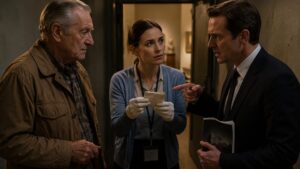
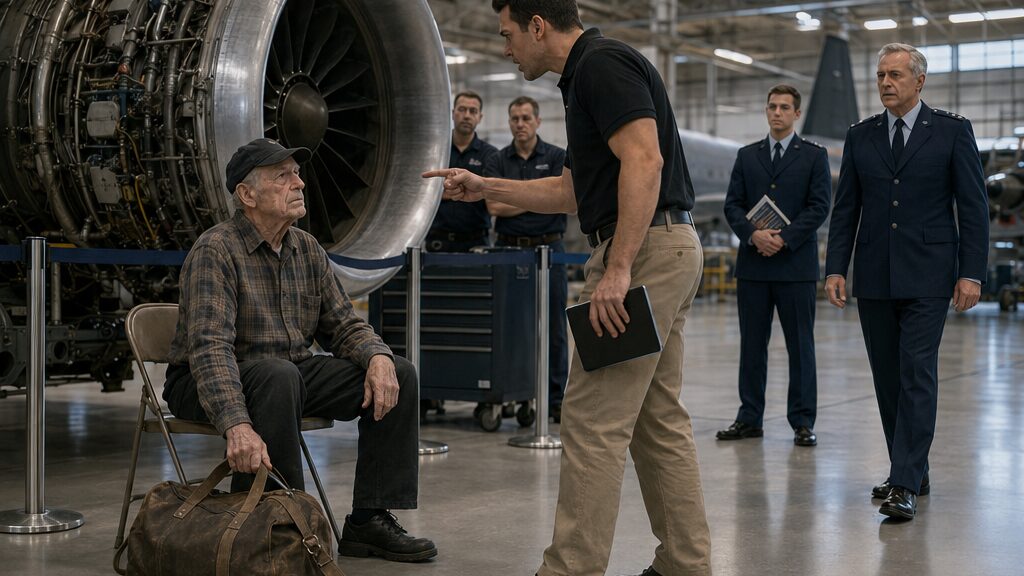
The young man’s finger stopped two inches from Gary Mitchell’s face.
“Sir, I’m not asking again. You cannot sit here.”
Gary did not move at first. His left hand stayed curled around the strap of the old brown duffel bag at his feet. His right hand rested flat on his knee, the knuckles swollen and pale under the hangar lights. Behind him, the exposed jet engine sat inside its roped-off semicircle like a sleeping animal, polished for visitors, tagged for ceremony, clean enough to look almost harmless.
It did not sound harmless.
Even cold, even silent, it held sound in its shape. Gary could feel it in the back of his teeth, the memory of turbines winding up before dawn, of men shouting over ground power, of oil heat, rubber, rain, and a checklist that never waited for grief.
The man standing over him wore a black polo tucked too tightly into pressed khaki pants. A laminated badge swung from his belt clip every time he jabbed his finger.
“You’re inside the restricted line,” the man said. “And that bag can’t be there.”
Gary looked down at the duffel. It had been brown once. Now it was the color of old coffee, soft at the corners, patched near the zipper with thread Brenda had used because Gary’s hands had cramped that winter. One side sagged around the shape of what was inside. The strap was darker where he had carried it for years without carrying it anywhere.
“It’s not in anyone’s way,” Gary said.
The man’s mouth tightened.
A maintenance technician near the rolling tool cabinet glanced over, then looked away. A young airman in service dress stood by the far side of the display, holding a stack of folded programs against his chest. He watched for a moment, uncertain, then lowered his eyes as if reading something very important on the top page.
Gary knew the look. Men learned it early around authority. See nothing until someone tells you what you saw.
“My name is Nicholas Rivera,” the man said. “I’m the compliance supervisor for this event. That means if someone trips over your bag, or if some visitor wanders past the rope because you’re sitting here like this is a bus station, that comes back on me.”
Gary lifted his eyes. “I understand.”
“No, I don’t think you do.” Nicholas shifted closer. His voice stayed controlled, but it carried enough for the nearby crew to hear. “This aircraft is being dedicated in less than three hours. We have families coming through, public affairs, command staff, retired personnel who actually RSVP’d. You can’t just walk in here and park yourself by an engine.”
Gary’s thumb moved once over the duffel strap. The leather edge had cracked. He had meant to replace it twenty years ago.
“I checked in at the gate,” Gary said.
“With a visitor sticker and no escort.”
“The guard said the hangar was open for the ceremony.”
“The hangar is open for authorized visitors at the posted time. Not for someone to come in early and sit next to restricted equipment with an uninspected bag.”
The word uninspected moved through the air differently. The technician by the cabinet stopped pretending to work. The young airman looked up again.
Gary felt their attention settle on the bag.
It was not fear in their faces, not exactly. It was procedure. The kind that made old men into problems and bags into threats and silence into guilt.
Nicholas bent slightly, not enough to be respectful, only enough to make himself heard more sharply.
“What’s in it?”
Gary’s jaw worked once.
“Tools.”
“What kind of tools?”
“Old ones.”
“That’s not an answer.”
“It’s the one I have.”
Nicholas’s face flushed at the edges. He looked younger then, not much older than Brenda’s oldest boy would have been if Brenda had ever had children. Thirty-five maybe. Young enough to think being embarrassed in public was the same thing as being challenged.
“Sir, stand up.”
The words struck harder than the finger had.
Gary kept his eyes on Nicholas, then slowly pressed both palms to his knees. His left hip objected first. Then the old injury behind his right ankle sent its thin wire of pain upward. He had chosen the chair because it was close to the engine and because standing too long made his vision shimmer at the edges. He had not chosen it to make trouble.
The chair scraped faintly as he rose halfway.
“Leave him be for a second,” the technician muttered.
Nicholas turned his head. “Excuse me?”
The technician busied himself with a drawer.
Gary stayed half-standing, one hand still on the chair back. He had been ordered to stand by men whose boots had mud from other countries on them, by men with fear hidden under loud voices, by men who later did not come back at all. Nicholas Rivera did not know what kind of voice he was using. That made it easier to forgive and harder to bear.
A low mechanical hum began somewhere beyond the hangar wall. Ground equipment starting up. A compressor, maybe. Not this aircraft. Not this engine.
Still, Gary’s eyes shifted behind Nicholas to the intake cowling, to the polished curve beneath the left side, to the mount line that was too clean now to show what it had once been.
Nicholas followed his gaze.
“Do not touch the aircraft.”
Gary almost smiled, but it stopped before anyone could see it.
“I wasn’t going to.”
“Then move away from it.”
Gary straightened fully. The hangar tilted for half a breath and settled back. He did not reach for the chair again. He kept one hand on the duffel strap and looked at the engine, not at Nicholas.
“That intake used to sing different before they changed the mount.”
The words were not loud. They did not need to be. In the high, bright space of the hangar, they slipped between the polished aircraft, the folded programs, the quiet technician, the young airman, and the man with the badge.
Nicholas blinked. “What?”
Gary said nothing more.
The young airman’s eyes moved from Gary to the engine. The technician’s hand stilled inside the open drawer.
Nicholas gave a short, disbelieving laugh. “Sir, I don’t know what you read online or what tour group you wandered away from, but you need to step back.”
Gary looked at him then. Not angry. That seemed to bother Nicholas more.
“I said step back,” Nicholas repeated.
Gary bent slowly to lift the duffel. The motion pulled at his back. The bag rose only a few inches before Nicholas reached down.
“I’ll take that.”
Gary’s hand closed harder around the strap.
“No.”
The word came out flat, not loud. But it changed the space more than Nicholas’s raised voice had. The technician turned fully now. The young airman took one step forward without seeming to decide.
Nicholas’s hand hung above the bag.
“You don’t get to refuse a security check.”
“You can check it,” Gary said. “You don’t get to grab it.”
For a moment neither man moved.
Then footsteps crossed the hangar floor from the open bay doors. Firm, measured, familiar in rhythm even before Gary turned. The kind of stride that had learned long ago not to hurry in front of enlisted men unless fire was involved.
A senior officer in dress uniform came past the rope line with a ceremony folder tucked under one arm. His hair had gone silver at the temples. His face carried the practiced calm of a man who had spent years receiving bad news without letting the room see where it landed.
“Nicholas,” the officer said. “What’s happening here?”
Nicholas withdrew his hand at once. “Sir, I’m handling an unauthorized visitor inside the restricted display area.”
The officer’s gaze moved to Gary.
Gary had expected to feel nothing. He had told himself that the names would be different now, the faces younger, the hangar repainted, the aircraft polished into something almost fictional. He had not prepared for a face he almost knew.
The officer looked at him for a long second. Then his eyes lowered to the duffel, to Gary’s cap, to the hand still gripping the cracked strap.
His expression shifted, not into certainty, but into memory searching for a place to land.
Gary looked away first.
The officer took one step closer.
“Mitchell?” he said quietly.
Nicholas turned sharply toward Gary.
The young airman stopped breathing for a moment.
Gary kept his hand on the bag.
“Yes, sir,” he said.
The officer’s voice changed.
“Gary Mitchell?”
Chapter 2: The Name James Harris Remembered Too Late
James Harris remembered the name before he remembered the face.
Mitchell had been written on old maintenance reports he had read as a lieutenant because a retired chief had told him, If you want to understand this aircraft, don’t start with the pilots. Start with the men who kept her flying when nobody had parts.
Gary Mitchell had been a name in margins. A hard slant of pencil on copied forms. A crew chief whose notes were so exact that instructors still used them without always knowing where they came from.
But the man in front of James was smaller than the name had been.
His cap was faded. His shirt hung loose on his shoulders. His right hand trembled slightly where it held the strap of the duffel bag. He stood in the hard light beside the jet engine, not as a guest of honor, not as a speaker, not as someone the base had prepared to receive, but as an old man who had been asked to move.
James felt the failure of that before anyone said it.
“Mr. Mitchell,” he said, careful not to make his voice too loud. “Would you come with me for a minute?”
Gary’s eyes flicked toward Nicholas Rivera. “If I’m in the way, I can wait outside.”
“No,” James said. “You’re not in the way.”
Nicholas cleared his throat. “Sir, his access hasn’t been verified. He has a visitor sticker, but he entered the display area before public opening. And the bag—”
“I heard you,” James said.
The words were mild, but Nicholas stopped.
James turned toward the young airman by the programs. “Airman Johnson, take over at the display rope for a few minutes.”
“Yes, sir.”
Steven Johnson stepped forward, too quickly, nearly dropping the programs. His eyes passed over Gary’s face and then the duffel. He looked embarrassed without knowing exactly what for.
Gary bent to pick up the bag.
James reached instinctively to help, then stopped himself. Some help, he had learned too late in life, could feel like another kind of taking.
Gary lifted it alone. The weight pulled his shoulder down. He hid the strain badly, and because he hid it badly, James looked away.
They walked toward the small glass-walled office at the side of the hangar. Nicholas followed with his tablet tucked tight against his ribs. Gary’s steps were slow but not wandering. He knew where to place his feet around floor cables without looking. He moved around a yellow chock as if it had always been there.
Inside the office, the hangar sounds softened. Through the glass, the aircraft looked staged and distant. Public affairs staff moved around the display with clipboards. A technician wiped a surface already clean. Steven stood at the rope line, glancing once toward the office before fixing his eyes forward.
“Please,” James said, gesturing toward a chair.
Gary remained standing.
James understood. After what had just happened, a chair could feel like a concession or a trap.
Nicholas set his tablet on the desk. “Sir, I need to document this. We were told all early arrivals would have escort credentials. If Mr. Mitchell was expected, I wasn’t informed.”
“I wasn’t expected,” Gary said.
James looked at him.
Gary’s voice stayed even. “I came early because I didn’t want to be in anybody’s program.”
Nicholas gave a small, impatient exhale. “That’s exactly the issue.”
James held up one hand.
“Mr. Mitchell,” he said, “did you serve with the 77th Maintenance Squadron?”
Gary’s mouth tightened, as if the number had touched an old bruise.
“A long time ago.”
“Crew chief?”
“For part of it.”
“On this airframe?”
Gary looked through the glass. The aircraft’s nose pointed toward the hangar doors, proud and clean, a museum version of something that had once leaked, screamed, iced over, and scared men into prayer.
“On one that wore the same bones,” he said.
Nicholas shifted. “Sir, with respect, prior service doesn’t change current access rules.”
“No,” Gary said before James could answer. “It doesn’t.”
James looked at him again.
Gary had not said it to support Nicholas. He had said it because it was true, and because truth mattered even when used by someone who did not understand it.
Nicholas seemed briefly thrown off, then recovered. “Then we should escort him to the visitor area until opening.”
James studied Gary’s bag. “May I ask what you brought?”
Gary’s fingers moved over the strap, not opening it.
“Something that belongs near that engine. Not on display. Not for photographs.”
Nicholas leaned forward. “That’s not specific enough.”
Gary looked at him. “No.”
The office grew still.
James lowered his voice. “Gary, no one is going to take it from you.”
Gary’s eyes remained on Nicholas.
“I know,” Gary said.
It was not trust. It was warning.
James felt Nicholas bristle beside him. The young man had been hired for difficult work: contractor coordination, visitor safety, restricted access compliance, all the invisible fences that kept a ceremonial day from becoming a reportable incident. He was not cruel. James knew that. He was efficient, ambitious, anxious, and too aware that every officer above him would remember the mistake and forget the ten things he prevented.
Still, he had pointed at an old man’s face.
James opened the top drawer of the desk and removed a visitor escort badge. He placed it on the desk, not directly into Gary’s hand.
“This will cover your movement with me or Airman Johnson,” he said. “For today.”
Nicholas’s jaw tightened. “Sir—”
“I’ll assume responsibility.”
Gary did not take the badge.
“I didn’t come for special treatment.”
“You’re not getting it,” James said gently. “You’re getting an escort.”
Gary looked at him then, and James saw the faintest approval in his eyes. Not gratitude. Approval. Like a correction had been made properly.
Gary picked up the badge and clipped it to his shirt pocket. The plastic looked bright and foolish against the faded plaid.
Nicholas folded his arms. “The bag still needs to be screened.”
“Then screen it,” Gary said.
James watched him set the duffel on the security table outside the office. He did it carefully, as if lowering something asleep. Nicholas unzipped the top only halfway, professional now, every motion controlled because James was watching.
Inside lay a pair of old leather gloves, a folded gray cloth, a small notebook bound with a rubber band, and a wrapped shape tied in oil-dark fabric.
Nicholas paused.
Gary’s hand came down on the edge of the bag.
“Not that,” he said.
Nicholas looked up. “If it’s inside the bag, I need to inspect it.”
“You can look,” Gary said. “You don’t untie it.”
“That’s not how inspection works.”
“It is today,” James said.
Nicholas stared at him.
James did not raise his voice. “Document that I authorized visual inspection only of the wrapped item unless there’s a visible safety concern.”
Nicholas swallowed whatever he wanted to say. He angled the bag open with two fingers and shone a small flashlight across the cloth. Nothing metal flashed except the dull edge of an old tool handle barely visible through a gap in the wrap.
“No visible safety concern,” he said, clipped.
Gary closed the zipper himself.
As he did, the old notebook shifted. Something brittle and rectangular slid partly from between its pages: a faded maintenance tag, yellowed at the corners, tied with a broken loop of string.
Nicholas saw it before Gary tucked it back.
There was writing on it, too faint to read from where James stood.
But Nicholas’s eyes sharpened, and for the first time that morning his expression held something other than irritation.
Suspicion had found a new shape.
Chapter 3: The Bag Nicholas Wanted Removed
Nicholas Rivera had learned to distrust anything that looked harmless.
A folded chair left in the wrong place could become a fall report. A coffee urn cord could become a complaint from command staff. A veteran who wandered past a rope line could become a photo on social media with a caption no one in public affairs could control.
Three months earlier, at another event on another part of the base, a contractor had propped open a restricted side door with a trash can because it was “only for a minute.” Nicholas had missed it during walkthrough. A visiting child had slipped through, crossed into a vehicle bay, and nothing terrible had happened except that nothing terrible had happened in front of a colonel.
That had been enough.
Since then, every object had weight. Every exception had teeth.
The old man’s duffel sat on the security table like a test Nicholas had already failed.
Gary Mitchell stood on the opposite side with one hand resting on the top seam. James Harris had stepped away to answer a call from the ceremony coordinator, leaving them under the thin supervision of Airman Johnson, who stood nearby pretending not to listen.
Nicholas tapped his tablet awake.
“I need your full name for the incident log.”
Gary looked at him. “You already heard it.”
“I need to enter it.”
“Gary Mitchell.”
“Middle initial?”
Gary’s eyes lifted.
Nicholas waited.
“None that matters,” Gary said.
Nicholas typed only the first and last name. He could feel the airman watching him now. He hated that. He hated being made to look like the small man in a scene where all he had done was enforce the rules printed in the packet no one else had read.
“Date of birth?”
Gary gave it.
Nicholas’s fingers paused for a fraction of a second. Seventy-eight. Older than his father would have been. He entered it anyway.
“Purpose of visit?”
Gary looked past him toward the aircraft. “Ceremony.”
“You arrived before public access.”
“The gate was open.”
“That is not the same as authorized entry.”
“No,” Gary said. “It isn’t.”
Again, that steady agreement. Not apology. Not submission. Just truth.
Nicholas lowered the tablet. “Mr. Mitchell, I don’t know what you think is happening here, but I have a job to do. That aircraft is part of a formal dedication. There are procedures.”
“I know procedures.”
“Then you should understand why a bag full of tools near a display engine is a problem.”
Gary’s fingers pressed lightly into the canvas.
“They were never display tools.”
Nicholas almost answered, then stopped. The sentence had landed in a place he did not have a category for.
Airman Johnson shifted his feet.
Nicholas pointed—not at Gary’s face this time, but at the duffel. “Open it fully, please.”
Gary unzipped the bag.
The smell came out first. Old oil, dry leather, metal wrapped long enough to take on cloth, and something faintly dusty, like a garage after rain.
Nicholas leaned closer. He saw the gloves first. They were cracked at the palms and blackened in the creases. Beside them lay a folded cloth with faded block lettering too worn to read. The notebook was small, corners softened from use. Its rubber band looked ready to break. The wrapped tool sat underneath everything, tied with an old strip of fabric.
Nicholas reached for the notebook.
Gary’s hand moved.
Not fast. Just there.
Nicholas looked at him.
“You can inspect the bag,” Gary said. “You don’t read the book.”
“If there’s identifying information, I need—”
“It identifies men who are gone.”
The words cut off the sentence cleanly.
Nicholas felt irritation rise because irritation was easier than discomfort. “Mr. Mitchell, I can’t work with riddles.”
Gary’s face did not change. “Then don’t.”
Airman Johnson looked down at the floor.
Nicholas exhaled through his nose and turned the bag slightly without touching the notebook. The wrapped tool bothered him most. Anything hidden bothered him. He could call security. He could have Gary removed and be right on paper. He could already imagine the report: elderly visitor refused full inspection of unknown item inside restricted hangar.
He could also imagine James Harris reading it and asking why Nicholas had turned an old man with an escort badge into an incident before the dedication even began.
A voice crackled over Nicholas’s radio.
“Rivera, public affairs wants the east entrance cleared in twenty. Families are arriving early.”
Nicholas pressed the button. “Copy. I’m handling it.”
Handling it. The phrase felt like a dare.
He glanced at the hangar entrance. Staff were setting up the welcome table. The ceremony coordinator was arguing with someone about flowers near the plaque stand. Two technicians moved a rolling platform away from the aircraft. Everything had to look effortless by the time guests entered. Nobody would see the hours of tape marks, checklists, caution signs, badge checks, and last-minute corrections unless something went wrong.
Things only became visible when they failed.
Nicholas looked back at Gary. “I’ll allow the bag to remain in holding until the ceremony opens. You can retrieve it afterward.”
Gary’s fingers tightened once. “No.”
“You can’t carry it around the display floor.”
“I’m not carrying it around.”
“You said you brought something that belongs near the engine.”
Gary said nothing.
Nicholas closed his eyes briefly. “You hear how that sounds, right?”
Gary looked at the wrapped tool. “I hear how you hear it.”
That was worse than an argument.
Nicholas leaned closer, lowering his voice so the airman would not hear every word. “I am not trying to disrespect you.”
Gary’s gaze moved to him, steady and tired.
Nicholas knew, with a quick sting of shame, that he had failed to make that believable.
“I’m trying to prevent a problem,” he said.
“Sometimes those look the same from the other side.”
The words were quiet. Nicholas had no answer for them.
At the entrance, the ceremony coordinator waved sharply. “Nicholas, I need this table cleared.”
He turned. “One minute.”
When he turned back, Gary had taken the folded gray cloth from the bag. It lay over his palm, thin from age. For a second Nicholas thought the old man might open it, but Gary only smoothed one corner with his thumb.
The gesture changed his face.
Not softened. Not broken. Changed. As if the hangar had emptied around him and filled with something no one else could see.
Nicholas looked away first.
“Wrap it back up,” he said, more quietly. “Please.”
Gary did.
The word please sat between them awkwardly, unused but not meaningless.
Nicholas logged the bag as visually inspected, personal historical tools, no visible hazard. It was not clean procedure. It was not what he would have preferred. But it was defensible if no one decided to make it otherwise.
He placed a temporary security tag through the duffel handle.
Gary stared at it.
“It doesn’t lock,” Nicholas said.
“I can see that.”
“It just shows it’s been checked.”
Gary nodded once.
The radio crackled again. Families at the gate. Public affairs waiting. James Harris still on the phone. The entire morning squeezing toward ceremony time.
Then a woman’s voice cut through the hangar noise.
“Dad?”
Nicholas turned.
A woman stood just inside the entrance, one hand still on the strap of her purse, her visitor badge crooked on her jacket. She looked from Nicholas to the open duffel, then to Gary’s hand resting beside it.
Her face changed before she said another word.
Not surprise.
Recognition of something she had feared finding.
Gary closed the bag slowly.
“Brenda,” he said.
She stepped closer, eyes fixed on the security tag hanging from the old brown handle.
“What are they doing to you?”
Chapter 4: Brenda Mitchell Knew the Silence at Home
Brenda Mitchell saw the security tag on her father’s duffel before she saw the oldness in his face.
It was a small paper loop, white with a printed number, fastened through the cracked handle as if the bag belonged to the hangar now and not to the man whose hand still rested on it. She had seen that hand around coffee mugs, pill bottles, steering wheels, furnace filters, loose screws, and the backs of chairs when he thought no one noticed he needed balance. She had never seen it look possessive until now.
“What are they doing to you?” she asked.
Gary’s eyes shifted toward Nicholas Rivera, then back to her.
“Nothing,” he said.
Brenda hated that word from him. Nothing was what he said when his knee gave out on the porch step. Nothing was what he said when the VA envelope sat unopened by the toaster. Nothing was what he said the night she found him in the garage at two in the morning, sitting on an overturned bucket with the brown duffel at his feet and the light off.
Nicholas straightened. “Ma’am, we’re conducting routine access procedures.”
Brenda looked at him once. He was younger than she expected. Younger than his voice had sounded from across the hangar. Pressed shirt, badge, tablet, jaw set like he was bracing for an argument he had already prepared answers for.
“My father is seventy-eight,” she said. “He’s not a threat.”
Nicholas’s expression tightened. “I didn’t say he was.”
“You tagged his bag.”
“Brenda,” Gary said.
It was quiet, but it stopped her more effectively than Nicholas could have.
She looked at her father. The hangar light made every line in his face visible. He seemed smaller here than he did at home, which made no sense. At home he moved carefully between narrow rooms, between the recliner and the counter and the hallway where he kept one palm against the wall without calling it support. Here, beside the aircraft, with high steel beams above him and the engine’s open mouth behind the glass wall, he should have looked swallowed.
Instead he looked placed.
That frightened her more.
James Harris returned from the office, folding his phone into his palm. “Ms. Mitchell?”
“Brenda,” she said. “I’m his daughter.”
James gave a small nod. “James Harris. Your father is cleared to remain with escort.”
“With escort,” Nicholas added.
Brenda’s eyes moved to the duffel again. “Why does he need an escort?”
Gary reached for the bag. “We’re going to step outside.”
“I just got here.”
“I know.”
His voice had that firmness she remembered from childhood, not loud, never loud, but final enough to make the house adjust around it. She had obeyed it at eight. She resented obeying it at fifty-two.
Still, when Gary lifted the duffel, she moved to help.
“I’ve got it,” he said.
“You don’t have to prove that.”
“I’m not.”
He carried it anyway.
James opened the side door leading into the corridor outside the hangar. The sound changed at once. The wide metallic air dropped behind them, replaced by the buzz of fluorescent lights, distant footsteps, and the soft hydraulic sigh of a door closer. The corridor walls held framed photographs of aircraft crews from different decades. Men in flight suits. Men in grease-dark fatigues. Men smiling because the camera had caught them before they knew which memories would harden.
Gary stopped under one photograph without seeming to notice it. His breath had shortened. Brenda saw it and reached for his elbow.
This time he allowed it.
The duffel hung from his other hand.
“Dad,” she said, once James had stepped discreetly away toward the corner, “why didn’t you tell me you were coming this early?”
“You had work.”
“I took the day off because you asked me to come to the ceremony.”
“I asked you to come when it started.”
“Because you wanted to sneak in first?”
He looked at the floor.
Brenda’s throat tightened. “That man was talking to you like you were lost.”
“He was doing his job.”
“Don’t do that.”
Gary lifted his eyes.
She lowered her voice. “Don’t make it easier for people to treat you badly by explaining it for them.”
For a moment, she thought he might answer sharply. He had that look he got when she came too close to a locked room inside him. But the sharpness faded.
“He’s young,” Gary said.
“That’s not an excuse.”
“No.”
“He embarrassed you.”
Gary’s mouth moved slightly, almost a smile without humor. “I’ve been embarrassed by better men than him.”
“That doesn’t make me feel better.”
“It wasn’t meant to.”
She turned away, blinking once. Through the narrow window in the door, she could see the hangar floor. Nicholas stood near the security table, speaking into his radio. Steven Johnson had taken position near the rope line. Visitors would be coming soon. Everything would be polished, timed, photographed. Her father would be expected to become quiet background again.
Her eyes dropped to the duffel.
“Is this about that bag?”
Gary followed her gaze.
At home, the bag lived in the hall closet behind winter coats no one wore. When Brenda was young, it had smelled like engine oil and cold air. Her mother had once told her not to drag it around because “your father keeps ghosts in there,” then laughed like it was a joke. After her mother died, the bag moved to Gary’s bedroom. Then to the garage. Then back to the closet. It never left the house until medical appointments began requiring Brenda to move things out of the hallway so he would not trip.
She had once asked what was in it.
“Work,” he had said.
“You haven’t worked in twenty years.”
“Some work doesn’t clock out.”
She had not asked again.
Now, in the corridor, the bag seemed less like storage and more like something alive with waiting.
“What’s in it?” she asked.
Gary leaned his shoulder against the wall. Not heavily. Just enough.
“Things I should’ve left here a long time ago.”
“Why today?”
He looked through the window toward the engine. “Because they’re naming her.”
“The aircraft?”
“The display. The mission. The people they remember from it.” His fingers slid over the handle. “And some they don’t.”
Brenda went still.
“You told me you didn’t know anyone connected to this dedication.”
“I said I wasn’t in the program.”
“That’s not the same thing.”
“No.”
The old pattern sat between them. Her asking directly. Him answering accurately and incompletely. She had spent years mistaking his precision for distance. Now she wondered how much of his silence had been a kind of fence around something too damaged to leave exposed.
“Dad,” she said softly, “did something happen with that plane?”
Gary closed his eyes for a second.
“Not that one. One before it. Same line. Same sound when the mount was wrong.”
A door opened farther down the corridor. A staff member hurried past carrying a box of programs, nodded without slowing, and vanished into the hangar. The ceremony was moving toward them, whether Gary was ready or not.
Brenda lowered her voice. “We can leave. Right now. You don’t owe these people anything.”
Gary looked at her then, and the tiredness in his eyes was so old she felt suddenly foolish for thinking the morning’s insult was the worst thing that had happened here.
“I owe someone one last check,” he said.
The phrase made no sense and too much sense at once.
Before she could ask, James Harris came back down the corridor. His expression had shifted from courtesy into concern.
“Mr. Mitchell,” he said, “they’re starting the dedication walkthrough. There’s something you may want to see before the room fills.”
Gary straightened.
Brenda reached for the duffel. “Let me carry it.”
This time, Gary hesitated.
Then he handed it to her.
The weight surprised her. Not because it was heavy, though it was, but because it felt deliberate, as if every object inside had been placed there with care and then left untouched for years.
She held it against her leg while James opened the hangar door.
The sound of the aircraft space rolled back over them.
Across the floor, near the display stand, the ceremony coordinator was polishing the edge of a bronze plaque with a blue cloth. Steven Johnson stood beside her, reading from a printed sheet. Nicholas was watching the entrance, already anxious about arriving families.
Gary’s eyes fixed on the plaque.
He walked toward it without waiting for anyone.
Brenda followed, the old duffel bumping softly against her knee.
When Gary reached the stand, he did not touch the bronze. He leaned in just enough to read.
His face changed so slightly that Brenda might have missed it anywhere else.
But she was watching now.
James stepped beside him. “Is something wrong?”
Gary read the names again.
The ceremony coordinator, still holding the blue cloth, said, “We just finished verifying the inscription last week.”
Gary’s mouth tightened.
“One’s missing,” he said.
Chapter 5: The Missing Name on the Dedication Plaque
The plaque was not large enough for all the dead.
Gary knew that before he read it. Plaques were always too small. They made history fit rectangles, made loss accept font size, made men into first initials and last names because bronze could not hold the sound of someone laughing over bad coffee at four in the morning.
Still, he read every line.
Mission designation. Date. Aircraft series. Rescue operation. Crew honored for courage under hostile conditions. Names arranged by rank, neat and final.
He read them twice before saying it.
“One’s missing.”
The ceremony coordinator’s smile stayed in place for half a second too long. “Sir?”
Gary pointed, not touching the metal. “There were six.”
James Harris came closer.
The coordinator looked at her clipboard. “Our records list five primary aircrew for the aircraft honored in the rescue.”
“Primary aircrew,” Gary said.
Brenda heard the edge in his voice. Not anger yet. Something more dangerous because it had been held longer.
Nicholas Rivera had come over from the security table, drawn by the stillness gathering around the display. Steven Johnson stood on the other side of the plaque with the folded programs in his hands.
James read the inscription. “Gary, who’s missing?”
Gary’s eyes remained on the bronze. “The man who stayed with the damaged bird long enough to get the others transferred.”
The coordinator shifted uneasily. “If there’s a documentation issue, we can make a note for later review, but the dedication starts in forty minutes.”
“Later review,” Gary repeated.
Nicholas stepped in, careful now but still firm. “Colonel Harris, the display area needs to be cleared. Guests are already being processed through the east entrance.”
James did not answer him. “Gary.”
Gary looked at the engine.
It sat beyond the rope, open panels gleaming under the lights. The aircraft on display was not the same one. He knew that. The original had been stripped, cannibalized, logged, forgotten in pieces. This one had been restored to stand in its place, a clean symbol for a dirty day. But the intake shape was the same. The mount line was the same. The memory knew no serial number.
Brenda stood close behind him, still carrying the duffel. She had not asked another question. That was mercy.
Steven Johnson said quietly, “Sir, should I get the archival packet?”
Nicholas looked at him sharply. “Airman—”
James nodded. “Get it.”
Steven moved at once.
Nicholas lowered his voice. “Sir, I don’t think we should alter ceremony content based on an undocumented statement minutes before visitors arrive.”
Gary turned then.
Nicholas did not flinch, but something in his posture tightened.
“You’re right,” Gary said.
The agreement startled him again.
Gary looked back to the plaque. “You don’t change bronze because an old man says a name.”
Brenda’s grip tightened on the duffel handle.
James studied him. “But you brought something.”
Gary took the bag from Brenda. He did not open it. Not yet.
“I brought what I was told to bring back if I ever saw her named.”
“Her?” Steven asked as he returned with a folder.
Gary glanced toward the aircraft. “Aircraft get called all kinds of things by people who only meet them after paint. On the line, she was whatever got us home or didn’t.”
James opened the archival folder on the stand. Copies of mission reports, public summaries, photographs, typed witness statements. The coordinator hovered, anxious about fingerprints, schedule, optics. Nicholas checked his watch, then the entrance, then Gary’s hands.
Families had begun to gather beyond the welcome table. Older men in caps. Women holding folded programs. A child pulling at a sleeve. Public affairs staff trying to keep everyone smiling in one direction.
Gary saw them and felt the old refusal rise in him.
Not here. Not like this. Not with strangers watching his face.
He turned to Steven. “Airman Johnson.”
Steven straightened. “Yes, sir.”
“I need a maintenance ladder.”
Nicholas almost laughed. “Absolutely not.”
Gary kept his eyes on Steven. “Small one. Platform if you’ve got it. I’m not climbing high.”
Nicholas moved between them. “Mr. Mitchell, you are not going near the aircraft with tools.”
“I don’t need tools.”
“You just asked for a maintenance ladder.”
“To see the mount line.”
“The aircraft has been inspected.”
“I didn’t say it hadn’t.”
“Then why?”
Gary looked at him for a long second. “Because memory lies less when the body stands where it stood.”
The words made no procedural sense. Nicholas’s expression said so. But Steven Johnson, who had been silent through most of the morning, looked toward James.
James closed the folder. “Get the platform.”
Nicholas stared at him. “Sir.”
“I’ll take responsibility.”
Again. Those words. Nicholas’s face colored.
Steven returned with a low rolling maintenance platform, its wheels squeaking faintly. A technician came with him, curious but careful not to ask. The platform was positioned outside the rope, angled so Gary could see into the intake area without crossing the boundary.
Brenda moved close. “Dad, you don’t have to do this.”
“I know.”
His hand brushed her sleeve as he passed. Not quite holding. Not quite apology.
He stepped onto the platform with Steven on one side and James on the other, neither touching him unless he needed it. For a moment, the hangar seemed to hold its breath around the slow lift of his body, the careful placement of one shoe, then the other.
Nicholas watched the visitors gather. He could already imagine the wrong person filming. An elderly man on a platform beside a restricted aircraft. A compliance supervisor overruled. A ceremony off schedule. His name in the report again.
“Please make this quick,” he said.
Gary looked down at him. Not unkindly.
Then he turned toward the engine.
From the platform, the angle was close enough. The polished restoration panel did not hide the seam completely. His eyes found it as if no years had passed, as if his hands were still black with oil, as if the ground under him trembled with heat and fear.
He saw rain streaking sideways under floodlights.
He saw a pilot with one glove torn at the thumb.
He saw a maintenance tag pressed into his palm.
If she sings wrong, Mitchell, don’t let them call her ready.
Gary closed his fingers around nothing.
“Mount was changed after,” he said. “But they kept the field bracket pattern.”
James looked up sharply. “Field bracket?”
Gary stepped down carefully before answering. His breath had gone shallow, and he hated that Brenda could see it.
Steven offered a hand. Gary ignored it at first, then took it because pride had already cost him enough in life.
Back on the floor, he reached into the duffel.
Nicholas moved at once. “No tools near the aircraft.”
Gary stopped with his hand inside the bag.
The visitors at the entrance had noticed now. Conversations thinned. The ceremony coordinator’s face tightened. Public affairs staff exchanged looks.
Brenda stepped forward. “He’s not doing anything wrong.”
Nicholas did not look at her. His eyes stayed on Gary’s hand in the bag.
“Mr. Mitchell,” he said, voice raised just enough to carry, “remove your hand from the bag and step away from the display.”
The hangar quieted.
Gary felt the eyes again. Younger eyes. Older eyes. Uniformed eyes. Civilian eyes. He had been watched by men waiting to see if he could fix what fear had broken. He had been watched by officers who needed a yes because no would cost lives. He had been watched by a pilot who knew he was asking too much and asked anyway.
This was only a room.
Only embarrassment.
Only an old man with his hand in a bag.
He withdrew the wrapped tool slowly, still tied in its dark cloth, and held it against his chest.
Nicholas stepped toward him.
James said, “Nicholas.”
But Nicholas had reached the edge of what he could tolerate. “Sir, with all respect, we have guests entering, unsecured personal tools, an unverified historical claim, and an individual repeatedly refusing direction around a restricted aircraft. I can’t allow this.”
Gary looked at the young man’s face and saw, finally, the fear under the authority. It was not fear of Gary. It was fear of being the man blamed after everyone else had decided exceptions were noble.
Gary lowered the wrapped tool.
“You’re trying to keep your line clean,” he said.
Nicholas blinked.
Gary nodded once, as if answering himself. “I understand that.”
For a second Nicholas looked ashamed, then angry at being seen.
Gary turned to Steven. “Airman, may I use that table?”
Steven looked at James.
James nodded.
Gary carried the wrapped tool not to the aircraft, but to a plain utility table beside the display stand. He set it down carefully, then placed the duffel beneath it. His hands moved to the knot in the cloth and stopped.
The plaque stood a few feet away, one name short.
Visitors watched from the entrance.
Nicholas stood between duty and regret, still ready to intervene.
Gary did not untie the cloth.
Not yet.
He looked at James Harris and said, “If I open this, it isn’t for me.”
Before James could answer, Nicholas saw two security staff entering through the side door, summoned earlier by radio protocol and now walking toward the display with purpose.
Nicholas lifted his hand to signal them over.
Gary looked at the wrapped tool, then at the missing place on the plaque.
The decision had reached him before the men did.
Chapter 6: The Tool Wrapped in an Old Flight Cloth
Gary had tied the cloth himself the night the call came.
Not the night of the mission. Not the night the aircraft limped back with metal groaning and men too tired to speak above a whisper. Later. After reports. After signatures. After the kind of quiet that followed official explanations. After a box was sent to a widow and a name became something people lowered their voices around.
The cloth had been cleaner then. Blue-gray, torn from a flight-line rag that had wiped oil from his hands a hundred times. The tool inside had belonged to the job, not to him. That was what he had told himself when he kept it. That it was not theft. That it was evidence of a promise. That someday someone would ask the right question.
No one had.
So he had carried the answer alone.
Now two security staff crossed the hangar floor, Nicholas Rivera’s raised hand guiding them closer, and Gary knew that if they took the wrapped tool from him, it would become property, then evidence, then inconvenience. It would be handled by people who had no reason to know what it weighed.
He put one palm flat on the cloth.
“Mr. Rivera,” he said.
Nicholas’s hand remained half-raised.
Gary’s voice did not carry far, but the quiet in the hangar helped it. “You asked what was in the bag.”
Nicholas said nothing.
“You were right to ask.”
The admission moved through the room in a way accusation would not have. Nicholas lowered his hand slightly. The security staff slowed, uncertain now.
Gary looked at James Harris. “You asked if I wanted to address the room.”
James waited.
“I don’t,” Gary said. “But I’ll answer the question before someone else writes it wrong.”
He untied the cloth.
His fingers were slow. The knot had tightened over years of being ignored. Brenda stood close enough to help, but she did not touch it. She understood now, maybe not the story, but the boundary.
The cloth opened around a compact, worn tool with a darkened handle and a narrow head polished bright along one edge from use. Beside it lay a maintenance tag, yellowed and fragile, its string broken at one end. Gary placed the tag on top of the cloth and smoothed it flat with two fingers.
The handwriting was faded but still there.
Steven Johnson leaned closer, then stopped himself.
James’s face changed when he saw the date.
Nicholas looked from the tag to the plaque. “What is it?”
“A mount alignment gauge,” Gary said. “Modified. Not regulation.”
The word modified made Nicholas stiffen.
Gary noticed. “That’s why it never went in the official kit.”
James lowered his voice. “And the tag?”
Gary’s thumb rested near the writing but not over it. “Last discrepancy note before the rescue flight.”
The hangar had become almost completely silent now. Even the visitors near the entrance seemed held back by the tone of the room.
Gary did not look at them.
“There was an aircraft,” he said. “Not this one. Same family. Same intake trouble after a field repair. We were short on parts, short on sleep, and short on men who still believed weather cared about schedules.”
He stopped.
The words wanted to become too many. He pushed most of them back.
“A rescue crew came in damaged. Another crew was pinned beyond the ridge. Command wanted a turnaround no one liked but everyone understood. The intake mount had shifted. Not enough to fail inspection if a man wanted a yes. Enough to make the engine sing wrong if he knew her.”
Brenda’s hand went to her mouth, then lowered.
Gary looked at the tool. “I made a bracket correction with this. Temporary. Logged it on that tag. The pilot saw me hesitate.”
The hangar lights shone on the tag’s brittle corner.
“He said, ‘If she sings wrong, Mitchell, don’t let them call her ready.’”
James closed his eyes briefly.
Gary swallowed once. “She didn’t sing wrong when she left.”
Nicholas’s voice came carefully. “Then what happened?”
Gary looked at him, and for the first time that day Nicholas did not look defensive. He looked young.
“They got the others out,” Gary said. “Most of them. The aircraft took damage on departure. Pilot stayed with her long enough for the crew to transfer. He didn’t come back with the rest.”
No one spoke.
Gary felt Brenda beside him, felt the years she had spent outside this story because he had not known how to invite her in without handing her the weight. He had thought silence spared her. It had only taught her to stand outside locked doors.
“The reports named the flight crew assigned to the rescue,” James said quietly. “But not the pilot who ferried the damaged aircraft clear.”
Gary nodded.
“His name was on the maintenance tag,” James said.
Gary touched the tag.
“It was all I had with his handwriting and mine on the same piece of paper.”
Nicholas stared at the small tag as if it had become larger than the aircraft.
“Why didn’t you submit it?” he asked.
Gary’s mouth tightened. Not at the question. At the answer.
“Because the correction wasn’t regulation. Because men above me were deciding what version of the mission could survive review. Because I was tired. Because I was twenty-eight and thought keeping my mouth shut was the same as protecting people.”
James looked down.
Gary continued, softer, “Because his widow asked me if he was scared, and I told her he was steady. That was true. It just wasn’t all of it.”
The retired pilot’s widow stood among the visitors near the entrance. Gary had not noticed her arrive. He did not know if she was the same woman; time had made strangers of everyone. But she had one hand pressed against the back of a folding chair, listening.
Brenda saw her father see the woman and understood that he was not sure.
Nicholas followed Gary’s gaze, then looked away quickly.
The security staff had stopped several yards back. One of them lowered his hands to his sides.
James picked up the archival folder from the display stand and set it beside the cloth. “Gary, may I read the name?”
Gary’s fingers closed lightly over the tag.
There it was. The last piece of control. For decades the name had been his to protect, which was another way of saying his to imprison.
He lifted his hand.
James leaned over the tag. He read silently first. His jaw tightened.
Then he said the name quietly enough that it did not become performance.
The widow near the entrance lowered herself into the nearest chair.
Gary did not look away from the tag.
Nicholas spoke, his voice stripped of its earlier edge. “Mr. Mitchell, I didn’t know.”
Gary folded the cloth back from the tool’s handle so the whole thing was visible.
“No,” he said. “You didn’t.”
It could have been punishment. It was not.
Nicholas’s face tightened anyway.
Gary looked at the plaque. “That’s the trouble with clean rooms and finished bronze. They make not knowing look like certainty.”
James turned to the ceremony coordinator. “Can we delay?”
She looked pale. “The program is printed. The plaque is mounted.”
“I didn’t ask if it was convenient.”
Gary shook his head.
James looked back at him. “Gary.”
“No ceremony delay for me.”
“This is not for you.”
“I know.” Gary’s eyes remained on the missing space where the name should have been. “But don’t make that woman sit through a room trying to decide how to react. Don’t turn him into a correction announced between a welcome speech and refreshments.”
The coordinator whispered, “We can prepare an insert. A spoken acknowledgment.”
Gary nodded once. “Spoken is enough today. Bronze can wait until it’s done right.”
James studied him. “And the tool?”
Gary looked at the modified gauge. “Archive it with the tag. Not under my name first.”
Brenda’s eyes filled, but she did not wipe them.
Nicholas stepped back from the table. The movement was small, but everyone saw that he was no longer blocking Gary from the display.
“I should have handled this differently,” he said.
Gary picked up the tag with both hands, careful of the old paper. “Yes.”
Nicholas absorbed it.
Gary placed the tag into James’s open archival folder.
“But you were trying to keep people safe,” Gary said. “Don’t stop doing that. Just leave room for the ones who don’t explain themselves fast enough.”
Nicholas looked down.
The words did more than shame would have. Shame made men defend themselves. This gave him work to do.
James closed the folder carefully, then looked at Gary. “Would you like to say something when we begin?”
The question settled across the hangar. Visitors watched. Brenda held her breath. Steven Johnson stood very still, eyes bright with the effort not to show too much.
Gary looked toward the aircraft, the engine, the mount line, the chair where he had first been told to move.
For a moment, he heard it again.
Not the polished silence of a display. The old sound. Intake, weather, ground power, a pilot’s voice asking him not to let a machine lie.
Then the sound faded.
“No,” Gary said.
James did not press.
Gary folded the empty cloth once, then again, and placed it back inside the duffel. The bag seemed smaller now, but not light.
“I came to finish a check,” he said. “Not start a show.”
Chapter 7: The Chair Left Empty Beside the Jet
The ceremony began seven minutes late.
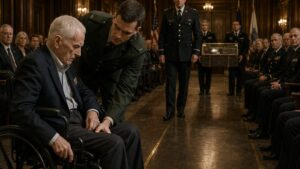
No one announced why. The ceremony coordinator moved with the careful brightness of someone patching a tear before guests could see the fabric. Public affairs staff guided families into rows of folding chairs. Programs were handed out with a small white insert tucked inside each one. Most visitors glanced at the insert, then looked up toward the aircraft, faces shifting as they understood there was one more name than the bronze had promised.
Gary stood at the back.
Brenda stood beside him, close enough that her sleeve brushed his arm whenever people passed. She had not given the duffel back to him until he asked. When he took it, the bag hung differently. The wrapped tool was no longer inside. The maintenance tag was gone too, placed in James Harris’s archival folder with two witnesses, a temporary receipt, and Gary’s name written only where procedure required it.
The duffel still had weight. Gloves. Notebook. Folded cloth. Years.
But it no longer pulled at the same part of him.
James stepped to the small podium near the aircraft nose. Behind him, the jet engine sat under the lights, panels polished, intake dark and round, quiet as if listening.
He welcomed the families, the service members, the technicians, the visitors who had come to honor a mission older than some of the people standing guard around it. He did not say Gary’s name at first. Gary appreciated that. Names could become hooks. Once a room had one, it wanted to hang a whole story from it whether the story wanted hanging or not.
James spoke of crews who flew damaged aircraft, of maintenance teams who worked without enough parts, of rescue decisions made under weather and pressure, of records that sometimes carried less than memory did.
Then he picked up the white insert.
“Today,” he said, “we also acknowledge a crew member whose name was not included on the permanent plaque. That omission will be corrected.”
The hangar remained still.
James read the missing name.
He read it plainly. Not like a performance. Not like a reveal. Like a duty.
Near the second row, the retired pilot’s widow bowed her head. A woman beside her put a hand over hers. Gary watched only long enough to know the name had reached the person it needed to reach. Then he looked at the floor.
Brenda’s hand found his elbow.
He did not move away.
When James finished, there was no applause at first, and that was right. Silence stood where applause would have been too small. Then chairs creaked. A few people shifted. Someone coughed softly. The ceremony moved on, altered but not broken.
Nicholas Rivera stood near the side wall with his hands folded in front of him. He was not in the line of attention anymore. Earlier, he would have looked relieved by that. Now he looked as if invisibility had given him too much room to think.
Gary noticed him only once during the dedication. Nicholas was watching the old chair near the engine, the one Gary had been ordered out of that morning. It had been moved during setup, then stacked with two others near a support column.
After the formal remarks, guests were invited to walk the display. People moved slowly around the aircraft, reading the plaque, reading the insert, touching one another’s shoulders. The widow stood before the bronze for a long time. James Harris spoke with her quietly. Gary stayed back.
Brenda leaned toward him. “Do you want to talk to her?”
Gary shook his head.
“She might want to know.”
“She knows enough for today.”
“You sure?”
“No.”
Brenda looked at him.
Gary’s mouth tightened faintly. “That’s different from being wrong.”
She almost smiled, but it did not quite make it through.
For a while, they watched from the edge of the hangar. Steven Johnson passed by carrying empty program boxes. He slowed when he saw Gary.
“Mr. Mitchell,” he said.
Gary nodded.
Steven hesitated, then held out a folded insert. “I kept one extra. Thought you might want it.”
Gary looked at the paper but did not take it immediately.
The missing name had been printed in plain black type, rushed but careful. Beneath it was a short line: Added to formal correction record pending permanent plaque update.
Gary took the insert.
“Thank you, Airman.”
Steven stood straighter at the title than he had at sir. “Yes, Mr. Mitchell.”
Gary folded the paper once and slid it into the side pocket of the duffel.
Steven glanced toward the aircraft. “I didn’t say anything this morning.”
Gary looked at him.
“When Mr. Rivera was talking to you,” Steven said. “I saw it, and I didn’t say anything.”
The hangar noise thinned around them.
Gary adjusted the duffel strap in his hand. “Did you know what was happening?”
“No.”
“Then remember how it felt not to know.”
Steven’s face changed.
Gary added, “Next time, look longer before you look away.”
Steven nodded slowly. “I will.”
He left without asking for more. Gary appreciated that too.
The crowd began to loosen. Families drifted toward refreshments. The coordinator directed staff to remove a row of chairs for photographs. The engine remained behind its rope, suddenly less like a symbol and more like a thing that had survived being misunderstood.
Nicholas approached when Brenda had stepped away to take a call near the corridor.
He did not bring his tablet.
Gary noticed.
Nicholas stopped a respectful distance away. For the first time that day, he seemed unsure what to do with his hands.
“Mr. Mitchell.”
Gary waited.
“I owe you an apology.”
Gary looked toward the aircraft. “For which part?”
Nicholas swallowed.
It was not a cruel question. It was a precise one.
“For pointing at you,” Nicholas said. “For grabbing at the bag. For deciding what you were before I knew why you were here.”
Gary let the words stand.
Nicholas continued, quieter, “I thought if I controlled everything, nothing could go wrong.”
“Things go wrong anyway.”
“Yes, sir.”
Gary looked back at him. “Don’t call me that because you feel bad.”
Nicholas nodded once. “Mr. Mitchell.”
“That’ll do.”
Nicholas looked toward the plaque. “Colonel Harris told me the archive office will take the tool and tag today. They’ll start the correction packet Monday.”
Gary’s eyes narrowed slightly. “He told you?”
“I asked.”
That mattered more than the apology.
Gary shifted the duffel to his other hand. His fingers had stiffened. Nicholas saw it, then looked away before seeing became staring.
“I also asked them to adjust visitor procedure for early-arriving veterans and families,” Nicholas said. “Not remove security. Just make sure someone knows how to receive people who don’t fit the spreadsheet.”
Gary studied him.
Nicholas’s face reddened, but he did not retreat into defensiveness.
“That sounds useful,” Gary said.
“It should have been obvious.”
“Most things are after.”
A faint breath left Nicholas. Not quite a laugh. Not relief either.
Brenda returned and stopped a few steps away, watching them. Gary saw the protective anger still in her posture, but she did not interrupt.
Nicholas looked at the duffel. “Do you want me to remove the security tag?”
Gary had forgotten it was still there. The white loop hung from the handle, ridiculous now.
He held out the bag.
Nicholas took the tag between his fingers and tore it carefully so the old handle would not pull. The paper came free with a small whisper.
He folded the broken tag once, then looked around for a trash can.
Gary held out his hand.
Nicholas placed it in his palm.
Gary tucked it into his shirt pocket.
Brenda stared at him. “You’re keeping that?”
“For now.”
“Why?”
Gary looked at Nicholas, then at the chair stacked near the column. “Reminder.”
Nicholas did not ask whether the reminder was for Gary or for him.
A staff member came by to move the stacked chairs. Nicholas turned suddenly.
“Leave one,” he said.
The staff member paused. “Here?”
Nicholas looked at Gary, then toward the engine. “Beside the display rope. Not blocking the path.”
The staff member set one folding chair near the same spot where Gary had sat that morning, just outside the restricted line. Nicholas adjusted it himself, angling it not toward the crowd but toward the engine. He stepped back, checked the walkway, then moved it two inches farther from the rope.
It was a small act. Almost nothing.
Gary felt Brenda go still beside him.
Nicholas turned back. “If you want to sit a minute before you go.”
Gary looked at the chair.
In the morning, it had been evidence against him. An old man sitting where busy people thought he should not be. Now it was space made without announcement. No one clapped. No one saw enough to make a story out of it. That was why it worked.
Gary walked to the chair and sat down carefully.
The engine faced him.
For a moment, the hangar emptied in the way memory could empty a room. Not of people, but of noise that did not matter. He heard the old intake again, the almost-song before the mount was corrected, the tremble that had run through the frame and into his hands. He heard the pilot’s voice, younger than Gary was now by half a lifetime.
If she sings wrong, Mitchell, don’t let them call her ready.
Gary looked at the corrected insert in his duffel pocket.
“She’s named right now,” he said under his breath.
Brenda heard him. She sat in the chair beside him only after Nicholas quietly brought another one.
Father and daughter remained there while the crowd thinned. She did not ask him for the whole story. Not yet. He did not offer it. Not yet. But when her hand rested on the duffel between them, Gary placed his hand over hers.
The bag no longer felt like a locked thing.
After the last photographs were taken and the widow had left with James walking beside her, the archive clerk arrived with a padded box. Gary stood as the tool and tag were transferred from the folder. He watched every movement. Not because he mistrusted them, but because some duties deserved witnesses.
The clerk asked if the donor line should read Gary Mitchell.
Gary shook his head. “Recovered from flight-line maintenance materials. Corrected by witness statement.”
James looked at him. “Gary.”
“That’s enough.”
The clerk wrote it down.
Nicholas stood several feet away, saying nothing.
When it was done, Gary closed the duffel. The zipper caught near the patched corner, as it always did. Brenda reached to help, but Gary worked it loose with a small practiced tug.
“Ready?” she asked.
He looked once more at the engine, the plaque, the temporary insert, the chair Nicholas had left in place.
“No,” he said.
Brenda waited.
Gary lifted the bag. “But I’m finished.”
They walked toward the hangar doors together. His steps were slow, and this time Brenda did not pretend not to notice. She matched them. Outside, late afternoon light washed the concrete in pale gold. The air smelled of cut grass, warm metal, and distant fuel.
Behind them, inside the hangar, Steven Johnson stood before the plaque with one of the white inserts in his hand. He read the added name silently, then aloud, just once, careful and clear.
Gary heard it before the door eased shut.
He did not turn around.
The duffel hung lighter at his side.
The story has ended.