A Young Soldier Chained The Old Man Beside The Jet, Then His Commander Saluted
Chapter 1: The Old Man At The Restricted Gate
The guard at the visitor gate looked at Samuel Carter’s paper invitation as if it had been pulled from a drawer after a flood.
It was cream-colored once, before age had browned the fold lines and softened the corners. Samuel held it flat with two fingers while his other hand rested on the black handle of his cane. Behind the guard booth, beyond the double fence and the strip of sunlit concrete, the tail of a large gray aircraft rose above the base buildings like a memory that had refused to lie down.
The guard turned the invitation over.
Samuel waited.
A truck rolled past inside the gate, carrying folding chairs and metal stands toward the tarmac. Somewhere beyond the buildings, a loudspeaker gave a short burst of static, then a clipped voice directed maintenance crews toward the memorial route. The morning smelled of jet fuel, cut grass, and hot pavement.
The guard was young enough that his face had not yet learned to hide impatience.
“Sir, where did you get this?”
Samuel looked at the invitation, then at the gate arm lowered across the lane.
“It was mailed to me.”
“This format is old.”
“Yes.”
“I mean, it doesn’t match the current visitor list.”
Samuel shifted his weight carefully. His right knee complained before the rest of him did. He had dressed without help that morning: loose plaid shirt buttoned to the neck, dark trousers pressed by his own hand, black shoes polished enough to show effort but not shine. The cane was not decorative. He leaned on it only when necessary, and today it seemed the ground had decided to be longer than usual.
“There may be a supplemental list,” he said.
The guard frowned and checked the tablet mounted inside the booth. “Name?”
“Samuel Carter.”
The guard typed. His eyes moved across the screen, then back to the paper. “I have a Samuel Carter listed for general memorial attendance, but not for restricted tarmac inspection.”
Samuel did not answer immediately.
Across the fence, a maintenance crew in reflective vests guided a tow vehicle into position. The aircraft beyond them sat in the pale sun, broad-winged and heavy, painted in the clean gray of a machine prepared for ceremony rather than weather. A temporary platform was being assembled near its nose. Flags stood furled beside the stairs, waiting for wind.
Samuel watched the tow vehicle turn too sharply.
“They should take it wider,” he said.
The guard glanced up. “What?”
“The nose gear doesn’t like that angle. Not with the old strut assembly.”
The guard stared at him, unsure whether to be amused. “Sir, are you with maintenance?”
“No.”
“Were you told to report here?”
“I was told to arrive before noon.”
“For the public ceremony?”
“For the aircraft.”
The guard looked again at Samuel’s clothes, his cane, the worn invitation, the faded rectangular hang tag clipped to his shirt pocket. The tag had gone cloudy under its plastic cover. Only part of an old aircraft number could still be read. Samuel knew how it looked. He had chosen not to replace it.
The guard leaned slightly out of the booth. “Sir, I’m going to need you to step to the side while I check with security.”
“I can wait.”
“There’s a bench over there.”
Samuel followed the man’s gesture to a patch of shade near the outer fence. Three folding chairs sat beside a temporary sign that read VISITOR HOLDING AREA. The words had probably been chosen for efficiency. They still felt like a label placed on a person.
“I would prefer to remain near the gate,” Samuel said. “If someone from historical office is expecting me, they may come here.”
The guard’s jaw tightened. “Sir, I’m not trying to make this difficult.”
“I know.”
“But we have VIP guests arriving and restricted movement all morning. Nobody gets on that route without clearance.”
Samuel’s eyes returned to the aircraft.
“I understand clearance.”
The guard did not seem to hear the shape of the words. He stepped back inside and spoke into a radio. Samuel caught only fragments: elderly male, old paper invitation, unclear access, possible confusion. The words landed around him without striking. He had stood in worse places. He had been called worse things by men who were frightened, tired, or bleeding. This young guard was only following a screen.
Still, something in Samuel lowered.
He had not come to be known. That had been the point. No driver. No escort. No dress uniform pulled from storage. No blue coat with ribbons arranged like a history he no longer wanted strangers reading from his chest. He had come because the aircraft would be opened before the ceremony, because the crew names would be spoken, because thirty-seven years had passed and he had never stood beside that fuselage without hearing the last transmission.
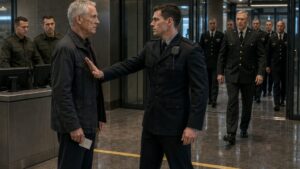
A second uniformed man approached from inside the gate. He was taller, sharper in posture, with a clean face and a security armband. His name tape read LEE.
The first guard handed him the invitation.
Samuel watched the man read it. Not carefully. Quickly, already annoyed.
“You Samuel Carter?” the man asked.
“Yes.”
“I’m Airman Tyler Lee. This is a restricted base event.”
“I was invited.”
Tyler held up the paper. “This doesn’t authorize tarmac access.”
“It may not show it in your system.”
“That’s not how this works.”
Samuel said nothing.
Tyler looked at the faded hang tag clipped to Samuel’s pocket. “What’s that?”
“An old maintenance tag.”
“You were maintenance?”
“No.”
“Then why are you wearing it?”
Samuel touched the cloudy plastic with two fingers, not to display it, only to steady it. “It belonged to the aircraft.”
Tyler’s eyes flicked past him to the vehicle lane. A black official car had arrived behind Samuel, waiting at a distance. The driver watched the delay through the windshield.
“Sir, you’re blocking access.”
Samuel moved one step to the side. His cane tapped once against the painted line.
Tyler’s attention sharpened at the sound. “I need you in the visitor holding area.”
“I will wait here until the historical office confirms.”
“The historical office is inside the restricted perimeter.”
“Yes.”
Tyler exhaled through his nose. “Sir, you don’t get to decide where you wait.”
The words were not loud. That made them worse. A junior airman carrying a box slowed slightly, then kept walking. The first guard looked down at his tablet. The driver of the black car shifted in his seat.
Samuel folded the invitation along its old crease.
“I came early,” he said. “I can wait quietly.”
Tyler stepped closer. “Then wait where you’re told.”
Samuel studied the young man’s face. There was no cruelty there, not exactly. There was pressure. A fear of making a mistake in front of people who mattered. The kind of fear that dressed itself as authority because it had not yet learned anything gentler.
Samuel had once sounded like that. Not the same words. The same certainty.
He turned toward the holding area.
The cane struck the pavement again, light but clear. Tap. Then another step. Tap.
Behind him, the black car was waved through after a quick glance at a laminated placard. No delay. No second question. The gate arm rose smoothly, and the car rolled past Samuel into the base.
He did not look at it.
At the chairs, he remained standing.
Tyler followed him halfway, still holding the invitation. “Stay here until we verify.”
Samuel looked beyond the fence. The tow crew had stopped the aircraft movement. Someone was crouched near the nose gear.
“They turned too tight,” Samuel said.
Tyler looked back toward the tarmac, then at Samuel with renewed irritation. “Sir, I need you to stop commenting on restricted equipment.”
Samuel’s hand tightened around the cane handle. Only once.
“I was not commenting,” he said. “I was remembering.”
Tyler did not answer. He folded the old invitation one more time than its crease required and slipped it into his own clipboard.
“You’ll wait away from the memorial route,” he said. “If you leave this area before verification, security will escort you off base.”
Samuel looked at the young man’s hand covering the invitation, then at the aircraft tail above the fence.
For the first time that morning, the base felt unfamiliar.
Chapter 2: The Chain Beside The Aircraft
Tyler Lee had been told three things before the memorial guests arrived.
Keep the tarmac clear. Do not embarrass the command staff. Do not let anyone near the aircraft without verified access.
The old man with the cane had managed to threaten all three without raising his voice.
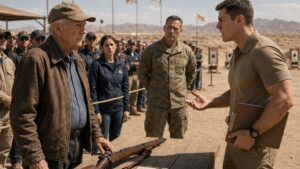
Tyler stood near the visitor holding area, watching Samuel Carter through the corner of his eye while a line of vehicles passed through the gate. Contractors, public affairs staff, family members with special badges, two older men in suits who saluted the flag decal on the booth as if someone had asked them to. Every person had a credential that matched the day’s list. Every person except the old man.
The old man stood instead of sitting. That bothered Tyler more than it should have. There was a chair three feet behind him, but Samuel held himself upright with the cane planted beside his right shoe, facing the fence and the distant aircraft. Not wandering. Not agitated. Waiting as if the base had made an error and would eventually correct itself.
The first guard stepped out of the booth. “Historical office isn’t answering.”
“Try public affairs.”
“I did. They said no unlisted tarmac access.”
Tyler glanced at Samuel’s old tag. “Then he’s not getting in.”
A call came over the radio. Maintenance needed extra hands clearing the temporary barrier along the outer road. A delivery truck had backed up in the wrong lane. For three minutes, Tyler’s attention split between the old man, the gate, and a civilian driver who seemed unable to understand orange cones.
When he looked back, Samuel was gone from the holding area.
Tyler felt the heat rise in his neck before he moved.
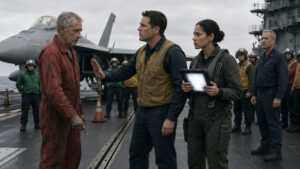
He found him inside the open service lane, past the first barrier but not yet at the aircraft. A maintenance crew had opened the pedestrian gate while moving equipment, and Samuel had walked through as if he belonged on that concrete. He was not hurrying. That made it worse. He moved slowly, cane first, step after step, toward the preserved aircraft sitting under the white morning glare.
“Sir!” Tyler shouted.
Samuel stopped.
Several heads turned: junior airmen, two maintenance workers, a public affairs officer with a folder pressed to her chest. A black staff car idled near the ceremony platform. The aircraft loomed behind Samuel, its shadow falling short of his shoes.
Tyler crossed the concrete fast, boots striking hard. “I told you to remain in the holding area.”
Samuel turned carefully. “The pedestrian gate was open.”
“That was not permission.”
“No.”
“Then why did you enter?”
Samuel looked toward the aircraft. “They moved her too far forward.”
Tyler almost laughed, but there were people watching. “Her?”
“The aircraft.”
“This is not your aircraft.”
A small silence followed. Samuel did not correct him.
Tyler stepped closer. “Sir, I need you to come with me.”
“In a moment.”
“No. Now.”
Samuel’s eyes rested on the aircraft’s nose, where a mechanic knelt beside a panel. “The port-side rescue markings are wrong.”
Tyler looked at him. “What did you say?”
“The markings. They restored her as she was after the repaint. Not as she flew that night.”
A maintenance crew chief straightened from near the platform. “How would he know that?”
Tyler heard the question, and it irritated him because he did not have an answer. The old man had crossed into a restricted zone. The rules were clear. Tyler could feel the morning tightening around him: guests arriving, officers approaching, everyone watching the security airman who had already let an unverified elderly man reach the aircraft.
“Sir,” Tyler said, lowering his voice, “you are in a controlled area without authorization.”
Samuel looked back at him. “Then check the aircraft number again.”
“You don’t give orders here.”
“I did not give one.”
“Hands where I can see them.”
Samuel blinked once. His left hand rested on the cane. His right held nothing. “Airman, I am not a danger to you.”
“That’s not your call.”
The public affairs officer took a half step forward. “Lee, maybe we should—”
“I have it,” Tyler said.
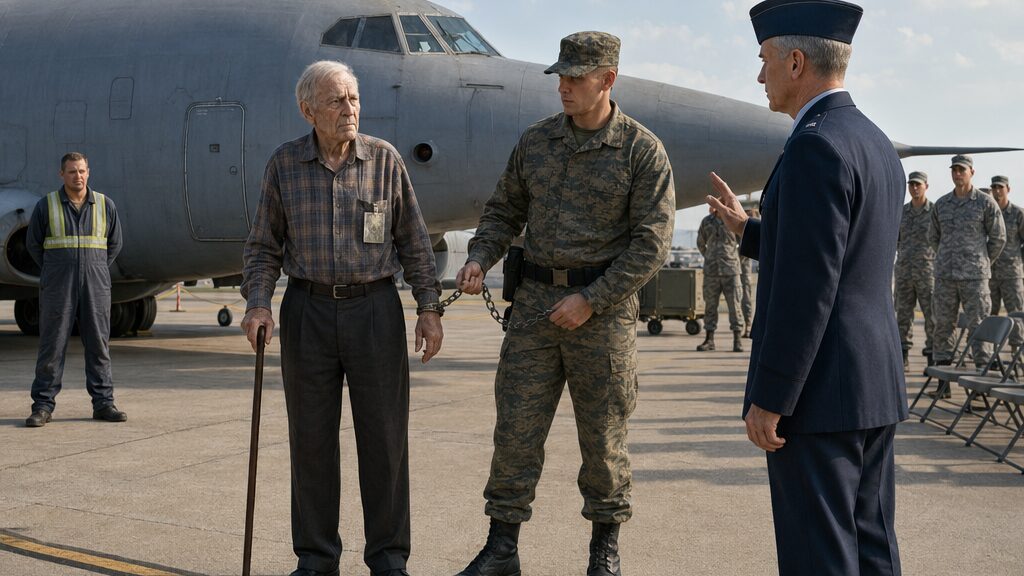
He removed the light restraint chain from his belt. It was standard for temporary control: short, metal, meant to attach wrist to wrist or wrist to a fixed point while waiting for transport. Tyler had used it twice before, both times on drunk civilians during air show week. It had never felt heavy until he saw the old man look at it.
Samuel did not pull away.
That was almost enough to make Tyler stop.
But the maintenance crew chief was watching. The staff car door opened. Someone inside the vehicle paused before stepping out. Tyler imagined the report: unauthorized person reached restricted aircraft during memorial preparation. Security failed to act.
“Right wrist,” Tyler said.
Samuel’s voice was quiet. “Is that necessary?”
“Right wrist.”
For a moment the only sound was the hum of equipment and the distant roll of another vehicle at the gate.
Samuel shifted the cane to his left hand with slow care. He raised his right wrist.
The skin there was thin, marked with age and a pale scar that disappeared under his sleeve. Tyler clipped the restraint around it. The small click carried farther than it should have. A junior airman looked away. The public affairs officer pressed her folder tighter to her chest.
Tyler secured the other end in his own hand, not tight enough to hurt, but visible. A chain between a young man in uniform and an old man in a plaid shirt.
“Step back from the aircraft,” Tyler said.
Samuel obeyed.
Not quickly. Not resentfully. He moved one pace, cane tapping once, chain lifting between them. The sight of it changed the air. Before, he had been an inconvenience. Now he was a spectacle.
Tyler felt his confidence wobble, so he hardened his voice. “You understand you crossed into a restricted area after being directed not to.”
“I understand what you believe happened.”
“What I believe?” Tyler repeated.
Samuel looked at him then, fully, with eyes that were tired but not confused. “Yes.”
A few yards away, the maintenance crew chief had gone still. “Sir,” he said, not to Tyler but to Samuel, “what markings were you talking about?”
Tyler shot him a look. “Not now.”
Samuel’s gaze moved back to the aircraft. “There should be a blackened patch below the left rescue hatch. They painted over it. The hoist jammed there. The crew chief cut his hand trying to free the line.”
The maintenance crew chief frowned. “That detail isn’t on the restoration sheet.”
“No,” Samuel said. “It would not be.”
Tyler tightened his grip on the chain. “Stop.”
Samuel did.
“Stop pretending you know classified or historical details to get sympathy.”
The old man’s mouth closed. His expression did not change much, but something behind it withdrew.
Tyler spoke into his radio. “Security control, this is Lee. I have one elderly male detained near the memorial aircraft. Possible unauthorized entry, possible false credentials. Request supervisor response.”
The word detained landed like a second chain.
Samuel looked down at his wrist. The metal was not cutting him. That almost made it worse. It was careful, procedural, defensible. A small cruelty wearing the uniform of caution.
“Airman Lee,” Samuel said.
Tyler looked at him.
“You may want to ask why they parked the chairs facing east.”
Tyler stared. “What?”
“The afternoon sun will be in the families’ eyes.”
“We’re done talking.”
Samuel lowered his gaze to the concrete. “As you wish.”
Across the tarmac, a senior officer in a dark formal uniform stepped out from near the ceremony platform. He had been speaking with a base aide, one hand holding a program, the other adjusting his service cap. His posture was straight, practiced, commanding without effort.
He turned toward the cluster by the aircraft.
Tyler saw him notice the chain first.
Then the cane.
Then the old man.
The officer stopped walking.
For one strange second, the entire tarmac seemed to hold its breath. The tow vehicle idled. The flags hung still. The chain between Tyler and Samuel caught a hard strip of sun.
The senior officer’s face changed.
Not into anger.
Into recognition.
Chapter 3: The Officer Who Remembered The Voice
Gary Roberts had not seen Samuel Carter in nineteen years, and even then the general had been walking away.
That was how Gary remembered him: back turned, dress blues immaculate, shoulders still squared under the weight of retirement papers he had refused to let anyone call a celebration. No reception. No speech beyond a few lines. No final lap through the building while younger officers pretended not to measure themselves against him. Samuel Carter had signed what needed signing, thanked the people who needed thanking, and disappeared before the cake was cut.
Gary had been a colonel then, young enough to think absence was pride.
Now, standing on the tarmac in a formal uniform that felt too warm under the sun, he looked at the old man in the plaid shirt and felt the past come toward him with a cane.
He did not move at first.
The security airman was holding a restraint chain. One end circled the old man’s wrist. The other rested in the airman’s grip. Several people stood nearby pretending not to stare. The aircraft waited behind them, restored and polished and not quite right.
Gary’s aide said something about the schedule.
Gary did not hear it.
The old man turned slightly, and the light struck the side of his face. Time had taken weight from him. It had hollowed his cheeks, thinned his hair, bent one shoulder lower than the other. But it had not changed the eyes.
Gary stepped off the platform.
Each pace made the scene worse. The chain became clearer. The old man’s right wrist. The cane in his left hand. Airman Lee standing stiff with the posture of a man who believed procedure would protect him from judgment.
Gary stopped ten feet away.
“Airman,” he said.
Tyler snapped straighter. “Sir.”
“What happened here?”
“Unauthorized entry into restricted tarmac area, sir. Subject failed to remain in visitor holding and made claims about the aircraft.”
Subject.
Gary felt the word like grit between his teeth.
The old man did not look at him directly. His gaze stayed on the aircraft’s nose, as if the conversation were happening somewhere beside him.
Gary studied the faded hang tag clipped to the man’s shirt pocket. The plastic had yellowed, but a partial number showed beneath the clouded surface. 713. Gary knew that number. Anyone who had served in that wing long enough knew it, though most knew only the clean version that fit on plaques.
“What claims?” Gary asked.
Tyler hesitated. “He said the restoration markings were wrong.”
Gary turned to the aircraft. “Which markings?”
Tyler’s confidence thinned. “Port-side rescue hatch. Some kind of blackened patch.”
Gary looked at the old man.
The old man looked back at last.
The tarmac noise faded to a narrow thread: the idling tow vehicle, the rattle of a flag clip against a pole, someone’s radio murmuring about guest arrival. Gary heard none of it clearly. He heard instead a voice from decades earlier cutting through static.
Hold west until I call you in. No one crosses that ridge blind.
Gary had been a captain then, frightened and trying not to sound it. The voice had been calm enough to obey.
“Sir,” Gary said, then stopped.
Tyler glanced between them.
The old man gave the smallest shake of his head. Not denial. Warning.
Do not do this here.
Gary understood the request before he understood his own reaction to it. Samuel Carter had come quietly. He had not arrived in uniform. He had not called ahead to demand a receiving line. He had allowed a guard to question him, a young airman to restrain him, rather than break open the day for himself.
That restraint was more familiar than the face.
Gary lowered his hand before it could rise into a salute.
“Mr. Carter,” he said carefully.
Samuel’s expression did not change, but gratitude flickered once and was gone.
Tyler blinked. “You know him, sir?”
Gary kept his eyes on Samuel. “I knew a Samuel Carter.”
The airman swallowed. “Sir, he entered—”
“I heard your report.”
Samuel spoke then, voice low, worn at the edges. “The airman followed what he believed to be his duty.”
Gary turned toward him.
That voice.
Older, softer, scraped by years. But beneath it, the same controlled cadence Gary had heard over radio channels, in briefing rooms, beside field maps with bad weather closing in. The same habit of spending no extra words when lives were already expensive.
Gary almost said the title.
Samuel’s fingers tightened once around the cane.
Gary held it back.
“Mr. Carter,” Gary said, “why didn’t you tell them who to call?”
Samuel looked at the aircraft. “I did not come to be a disruption.”
The answer settled over the group more heavily than any announcement could have.
Tyler shifted his grip on the chain. It gave a small metallic sound. Gary looked down at it.
“Remove that,” he said.
Tyler’s face flushed. “Sir, until identity is verified—”
“Remove it.”
The words were not loud. They did not need to be.
Tyler unclipped the chain from Samuel’s wrist. The old man did not rub the place where metal had touched him. He simply lowered his hand and rested it against the cane, as if nothing significant had happened.
But Gary had seen the mark.
A thin red circle around old skin.
“Mr. Carter,” Gary said, “I’d like to move this conversation out of the sun.”
Samuel’s eyes remained on the aircraft. “The families will be arriving soon.”
“They will.”
“The chairs face east.”
Gary turned slowly toward the seating area. The rows had been placed with military precision and human blindness. By late afternoon, the sun would fall straight into the faces of the older guests.
Gary looked back at Samuel. “We can adjust them.”
“You should.”
Tyler stared at the ground.
The public affairs officer hurried away, already speaking into her phone. The maintenance crew chief lingered near the aircraft, eyes narrowing at the port-side rescue hatch as if he were seeing it for the first time.
Gary stepped closer to Samuel and lowered his voice.
“Do you remember me?”
Samuel studied him. For one painful second, Gary felt young again, waiting for approval he would have denied wanting.
“Roberts,” Samuel said.
Gary’s throat tightened.
“Yes, sir.”
The title slipped out before he could stop it.
Tyler’s head lifted.
Samuel did not rebuke Gary. He only looked tired.
“You were a captain,” Samuel said.
“I was.”
“You kept your aircraft steady in bad weather.”
Gary let out a breath that almost became a laugh. “You remember that?”
“I remember the people who came back.”
Gary heard what was missing. The people who did not.
He glanced toward the aircraft, then at the memorial platform, then at the old man who had come alone to stand beside a machine the base had polished clean of its hardest memories.
“Sir,” Gary said softly, “your name is not on my restricted access list.”
“It would not be.”
“Why?”
Samuel looked down at his folded invitation. Tyler still held it on his clipboard.
“I asked not to be listed that way.”
Gary stared at him. “You asked?”
“I asked to attend as family.”
“Family of whom?”
Samuel’s face turned slightly toward the aircraft. “Of the crew.”
No one spoke.
A gust moved across the tarmac at last, lifting the edge of a folded flag near the platform. The aircraft seemed to breathe with it.
Gary looked at Tyler.
The young airman’s face had changed. Not enough yet. Confusion had opened a crack in his certainty, but pride still held the pieces together.
Gary nodded toward the invitation. “Give that back.”
Tyler handed it to Samuel with both hands, though no one had instructed him to.
Samuel accepted it. His fingers were steady.
Gary took one more step closer. He wanted to salute. Every instinct in his body told him to. The tarmac, the aircraft, the old command voice, the chain mark on the wrist—all of it demanded a gesture large enough to correct the picture.
But Samuel had asked, without saying the words, not yet.
So Gary did not raise his hand.
Instead he turned his head toward Tyler and spoke quietly enough that the airman had to lean in to hear.
“Airman Lee,” Gary said, “do you know whose wrist you chained?”
Chapter 4: The File With The Aircraft Number
Catherine Williams had spent three weeks preparing the memorial exhibit, and until that afternoon, the aircraft had behaved like every other artifact in the base historical office: difficult, dusty, and mostly obedient once the right file box was found.
Then the public affairs officer called from the tarmac and said an elderly visitor had been restrained beside aircraft 713 after identifying a restoration detail that was not in the official packet.
Catherine stopped with one hand on a display label.
“What detail?”
“A blackened patch below the left rescue hatch.”
Catherine looked across the archive room to the long table where the ceremony materials were arranged in neat rows: laminated crew biographies, reproduced photographs, a cleaned-up mission map, and a framed paragraph approved by command staff. The aircraft had been restored for public viewing, its dents smoothed, its mission scars translated into language suitable for families and cameras.
“There’s no blackened patch in the restoration notes,” Catherine said.
“That’s what maintenance said.”
“Who is the visitor?”
“Samuel Carter.”
The name did not strike her at first. It moved through her mind as one more item to check. She had read hundreds of names that month, most of them printed in old reports with carbon-smudged letters and rank abbreviations that changed over time. The dead were easy to organize. The living were harder. They resisted labels by continuing to become other things.
“Is he on the guest list?” Catherine asked.
“General attendance, maybe. Not restricted.”
Catherine frowned. “General attendance?”
“Old paper invitation. Faded tag. Security thinks he wandered through a service gate.”
“And Colonel Roberts?”
A pause. “He’s with him now.”
That made Catherine set down the label.
The archive room occupied the back of a low brick building that had once been administrative storage. Its air-conditioning ran too cold, and the lights buzzed softly above rows of metal shelves. Boxes labeled with aircraft numbers, wing histories, deployment years, and decommissioned unit codes lined the walls. Catherine knew where most things were by memory because the digital inventory was only as reliable as the person who had last cared enough to update it.
She went to the 700-series shelf.
The box for 713 was heavier than it should have been. Inside were restoration records, photocopied flight logs, maintenance summaries, and a sealed brown envelope marked MISSION MATERIALS—REVIEWED FOR PUBLIC DISPLAY. A yellow note on top read: Use approved summaries only. Do not reproduce casualty images.
Catherine had obeyed that note because the memorial was meant to comfort, not reopen wounds.
Now she opened the envelope.
The first photographs were familiar: aircraft 713 on a runway, aircraft 713 with its crew, aircraft 713 in a hangar under fluorescent lights. Then came older images with harder edges. Smoke-stained fuselage. A hatch removed. A rope hoist hanging bent and useless. A dark scorch mark below the left rescue hatch.
Catherine sat down without meaning to.
The mark was exactly where the old man had said it would be.
She drew the photograph closer. In the corner, three men stood with their backs to the camera. One had his sleeve wrapped around his hand. Another leaned into the aircraft’s open hatch. The third stood slightly apart, headset cord trailing from one shoulder, one hand raised toward the crew inside as if holding them in place by will alone.
The caption beneath it was typed crookedly.
Mission recovery inspection, aircraft 713. Command authority on site: Carter, Samuel.
Catherine stared at the last two words.
She moved faster after that.
The approved packet had reduced the mission to a paragraph: severe-weather rescue, hostile terrain, thirty-two civilians evacuated, four crew members lost, later recognized as one of the defining operations in the wing’s history. The language was correct. It was also hollow. It made the mission sound inevitable, as if courage had been a scheduled procedure and grief an administrative result.
She pulled the mission report.
The pages had softened with age. Some sections were redacted. Some were annotated in two different hands. Samuel Carter’s name appeared first as mission commander, later as commanding officer responsible for final authorization. Not a guest. Not a maintenance veteran. Not a confused visitor with an old tag.
Command authority.
Catherine turned another page and found a photograph clipped to a personnel summary. Younger Samuel Carter looked out from the image in flight gear, hair dark, jaw set, eyes already carrying the severity Catherine had seen in certain old portraits. He stood beside aircraft 713 with one hand resting below the left rescue hatch, close to the place where the scorch mark had been painted over.
A second note had been paper-clipped to the back.
Do not center Carter in public exhibit at his request. Include crew names first.
Catherine read the sentence twice.
At his request.
The door opened behind her. The public affairs officer entered with a base commander’s aide and the tight expression of someone trying to turn a mistake into a schedule adjustment.
“Tell me you found something clear,” the officer said.
Catherine did not answer immediately. She laid the younger photograph beside the current ceremony program.
The program looked elegant. Too elegant. On the front was the restored aircraft, cleaned and angled beautifully against a blue sky. Inside were remarks from command, an order of events, a brief mission description, and selected crew representatives.
Selected.
Catherine turned to the memorial page.
Several names had been omitted from the printed version to keep the layout balanced. She had argued against it. Public affairs had said the full list would appear on the permanent plaque later. Later was a word institutions used when they wanted grief to be patient.
“Who approved this program?” Catherine asked.
The public affairs officer stiffened. “We had space limits.”
Catherine slid the old photograph across the table. “This is Samuel Carter.”
The aide leaned in. His face changed first with recognition of the uniform, then with understanding of the rank printed below.
The public affairs officer whispered, “General Carter?”
“Retired,” Catherine said. “Former mission commander. Command authority for the 713 rescue.”
“He was invited as general attendance.”
“He requested not to be centered,” Catherine said. “That is not the same as being treated as unknown.”
No one spoke.
Catherine returned to the box and removed a larger file. It contained the official mission summary, the command review, and a sealed copy of the citation language. Not a medal, not the clean kind of proof that could be pinned to a jacket for a camera. Paper. Decisions. Names. Weather. Coordinates. The record of a man who had carried responsibility before anyone thought to thank him for it.
Outside the small archive window, she could see a strip of tarmac and the gray shape of the aircraft’s tail beyond the building. Somewhere out there, Samuel Carter was waiting while others decided what his own history meant.
“Where is he now?” Catherine asked.
“Colonel Roberts moved him out of the sun,” the aide said. “Near the hangar.”
“Is the chain off?”
The aide looked down.
Catherine closed the folder with controlled care. “That was not an abstract mistake.”
The public affairs officer rubbed both hands over her face. “Command needs confirmation before anything is said publicly.”
Catherine lifted the mission report. “Then take this.”
“Is it enough?”
Catherine turned to the page marked with the old aircraft number, the rescue hatch notation, and Samuel’s signature beneath final command authority. The ink had faded, but the name remained clear.
“It is more than enough.”
She gathered the younger photograph, the mission report, the old note requesting crew names first, and the image of the blackened rescue hatch. As she stacked them, her eyes returned to the current program with its missing names and polished language.
History had not disappeared. It had been made convenient.
Catherine tucked the file against her chest and walked toward the door.
At the threshold, she stopped and looked back at the open box. A small object had slipped between two folders: a duplicate maintenance hang tag, cloudy with age, the same shape as the one the old man wore on his pocket. Its number was more legible.
On the back, in faded marker, someone had written one line.
Return to Carter if found.
Catherine picked it up with both hands, as if it were breakable.
Chapter 5: The Crew He Would Not Leave Behind
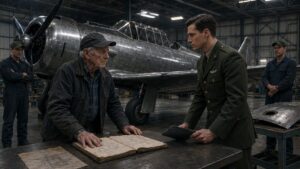
Samuel stood inside the maintenance hangar because Gary Roberts had asked him to, not because the shade made it easier.
The hangar doors were open to the tarmac. From where Samuel waited, aircraft 713 was visible in pieces: the gray curve of its nose, the left wing, the stairs being adjusted near the ceremony platform. Men and women moved around it with efficient care. They carried cables, water bottles, folded programs, wreath stands. None of them had been alive the night the aircraft returned with smoke in its seams and ice on its wings.
Samuel’s cane leaned against the hangar wall beside him. For a few minutes he let himself stand without it, one hand resting on a workbench. The mark around his wrist had darkened to a narrow red band.
He looked at it only once.
Behind him, footsteps stopped at the edge of the hangar.
“You were supposed to call me when you arrived.”
Amy Clark did not raise her voice. She rarely did when she was angry. Her anger came folded, like letters kept too long in a drawer.
Samuel turned. “You found the base.”
“I found your empty house first.”
“I left a note.”
“You wrote, ‘Went to the memorial.’ That is not a note. That is a clue.”
She crossed the concrete toward him, her face drawn with worry she had tried to control during the drive. She had his eyes, people said, though hers had learned to show more. Her hair was pinned back, her jacket thrown over one arm, her visitor badge hanging crooked from a lanyard.
She saw his wrist.
Her steps slowed.
“What happened?”
“Nothing lasting.”
“Dad.”
He picked up the cane before answering. “There was a misunderstanding at the gate.”
Amy came closer and took his hand before he could lower it. She looked at the red mark, then toward the aircraft, then back at him. “A misunderstanding did this?”
“It has been corrected.”
“By whom?”
He gave a tired breath. “Gary Roberts is here.”
Her mouth tightened. “So someone had to recognize you before they treated you properly.”
Samuel did not answer.
That was answer enough.
Amy released his wrist carefully. “You should have let me come with you.”
“I wanted to arrive quietly.”
“You always want to arrive quietly. You want to suffer quietly. You want to remember quietly. You want everyone else to guess what hurts and then feel guilty when we guess wrong.”
The words struck harder because they were not unfair.
Samuel looked out toward 713. A maintenance worker was checking the left rescue hatch now. Someone must have told them. The restored paint gleamed clean where smoke had once clung.
“I did not come to suffer,” he said.
“No. You came alone to stand beside the aircraft that still gives you nightmares.”
He turned back to her.
Amy’s expression softened, but she did not retreat. “You think I don’t know?”
Samuel rested both hands on the cane handle. “There are memories a parent has no right to give a child.”
“And there are silences that become their own inheritance.”
For a moment, neither of them spoke. The hangar held the old smells of oil, rubber, metal, and dust warmed by sun. A chain clinked somewhere outside as a crew adjusted a barrier. Samuel felt the sound move through his wrist.
Amy followed his gaze. “What did they think you were?”
“Lost.”
“Were you?”
He almost smiled. “Not on this base.”
“Then why didn’t you tell them?”
Because saying it would have been easy. Because a title would have opened gates that should have opened to decency. Because the dead had not returned to hear him announce himself. Because some part of him had wanted to know whether the institution remembered the crew without being reminded of the general.
He said only, “I did not come as General Carter.”
Amy looked at him for a long time. “They don’t know how to separate the man from the rank because you never let us see either one clearly.”
Samuel’s hand tightened on the cane.
Outside, a group of older guests began arriving near the platform. Some moved with walkers. Some wore old unit caps. Some held photographs. Family members guided them gently across the concrete. The chairs had been turned, no longer facing the worst of the sun.
Samuel noticed. Gary had listened.
Amy moved beside him and looked out too. “Tell me about them.”
He knew who she meant.
He could have said, You have heard the story. Thirty-two civilians evacuated. Severe weather. Terrain instability. Hostile fire reported. Four crew members lost during final extraction. Words neat enough to survive public ceremonies.
Instead he watched a maintenance worker run one hand along the left rescue hatch.
“The hoist jammed on the last lift,” Samuel said.
Amy did not move.
“We had civilians on the ground. More than the report says. The weather came in faster than forecast. The ridge disappeared. We were overweight, underpowered, and the radio cut in and out so badly I had to make half the decisions from fragments.”
His voice remained level. That was the only way he could continue.
“The crew chief cut his hand freeing the line. The medic gave up his own harness for a child. The pilot held position in crosswind that should have rolled us into the slope. And I kept telling them to stay. One more lift. One more minute. One more life.”
Amy’s eyes filled, but she did not interrupt.
Samuel looked at the aircraft. “They obeyed.”
The word carried everything he did not say.
A horn sounded softly on the tarmac. Guests were being guided toward the seating area. The ceremony would begin soon.
Amy touched his sleeve. “You saved people.”
“I ordered men to remain in a place they did not leave.”
“You were their commander.”
“Yes.”
He looked down at his cane. The handle bore a small dent from where it had fallen once beside his bed during a night he had woken hearing rotor wash that was not there.
“I have spent years being thanked for the wrong part.”
Amy’s voice was quiet. “What is the right part?”
He looked toward the families now taking their seats. Some carried flowers. One old woman held a framed photograph against her chest.
“Their names.”
A base aide approached the hangar carrying a stack of printed programs. He slowed when he saw Samuel and Amy, then came forward with visible caution.
“Mr. Carter,” he said, avoiding any rank. “Colonel Roberts asked me to bring you a copy before the ceremony begins.”
Samuel accepted the program.
The cover showed 713 in restored paint. Clean lines. Good lighting. A beautiful picture of a machine after history had been polished from it.
He opened to the memorial page.
Amy watched his face change before she looked at the paper.
There were names listed under Honored Crew Representatives. A few. Not all.
Samuel read them once. Then again.
The missing names did not shout from the page. They were absent with perfect manners. Removed for space. Removed because the program needed balance. Removed because grief had been asked to fit inside margins.
His thumb stopped near the blank place where the medic’s name should have been.
Amy whispered, “Dad.”
Samuel closed the program.
For the first time that day, the restraint in him shifted into something else. Not rage. Not pride. Something older and steadier.
He reached for his cane.
The aide glanced toward the tarmac. “Sir, Colonel Roberts said he can delay the opening remarks if you need—”
“No,” Samuel said.
Amy looked at him.
Samuel held the folded program in one hand and the cane in the other. The mark from the chain circled his wrist like a question that had finally found its answer.
“No more delay,” he said. “They have waited long enough.”
Chapter 6: When The Commander Finally Saluted
By late afternoon, the tarmac had been arranged to look effortless.
Rows of chairs faced the aircraft now from a kinder angle. Flags lifted in a light wind. The restored fuselage caught the sun in broad sheets of gray and silver, clean enough for photographs, old enough for silence. Families filled the front rows. Active-duty personnel stood along the edges. Maintenance workers lingered near the wing, pretending they were still needed.
Samuel walked from the hangar with Amy at his left and Gary Roberts a few paces ahead.
No one announced him.
That was Gary’s doing, or perhaps Samuel’s. Either way, the lack of announcement made the watching more obvious. People turned because officers turned. Junior airmen straightened because Gary Roberts slowed. Tyler Lee stood near the security barrier, face pale beneath the brim of his cap.
Samuel felt the eyes before he saw them.
He had spent a life being watched for decisions. This was different. These people were watching a man they had almost removed from the place where he belonged. Some knew only that there had been an incident. Some had heard enough to whisper. Some saw the cane, the old shirt, the folded program in his hand, and could not yet assemble the pieces.
Catherine Williams waited near the platform with a folder held against her chest and an expression that had lost its administrative calm. Beside her stood the public affairs officer, who looked as if she had spent the past hour discovering that polished language could become a kind of lie.
Gary stopped at the foot of the platform. “Mr. Carter.”
Samuel looked at him.
“The record is clear.”
Samuel’s gaze shifted briefly to Catherine’s folder.
“She found it?”
“She did.”
Samuel nodded once.
The ceremony had not officially begun, but silence had already gathered. Conversations dropped away in uneven layers. A child in the second row asked a question and was hushed. The flag clips tapped softly against the poles.
Gary stepped onto the platform.
Samuel remained on the concrete.
The public affairs officer moved toward the microphone, but Gary raised one hand, stopping her without sharpness. He looked down at the printed remarks in his own hand, then folded them once and set them aside.
“We were scheduled to begin today with prepared remarks about aircraft 713,” Gary said.
His voice carried across the tarmac, firm but not theatrical.
“Before we do, there is something this base needs to correct.”
Tyler lowered his eyes.
Samuel held the cane steady. Amy stood close enough that her sleeve brushed his.
Gary continued, “Earlier today, a visitor arrived with an old invitation and a faded aircraft tag. His access was questioned. That part was procedural. What followed was not worthy of the uniform.”
No one moved.
Gary looked toward Tyler only once, then away. He did not make the young airman the whole story. Samuel respected him for that.
“This visitor was not recognized by our system,” Gary said. “But our system was not the measure of the man.”
Catherine stepped forward and handed him a photograph.
Gary held it up.
The image showed a younger Samuel Carter beside aircraft 713, one hand near the rescue hatch, headset cord across his chest, smoke-stained metal behind him. The people in the first rows leaned forward. Those farther back watched the image through the large display screen beside the platform, where Catherine had already arranged for it to appear.
A murmur passed through the guests.
Gary’s voice softened, not with weakness but with care.
“This is Samuel Carter, former mission commander and retired Air Force general. Thirty-seven years ago, under conditions most of us know only from reports, he authorized and led the final rescue operation tied to this aircraft. Many people lived because his crew stayed. Some of that crew did not come home.”
The words moved through the crowd and changed it.
People who had been curious became still. Those in uniform adjusted without thinking, shoulders squaring, hands settling along trouser seams. The older guests in the front row looked from the photograph to the man with the cane. One woman pressed a hand to her mouth. The maintenance crew chief stared at the left rescue hatch as if the fresh paint had become transparent.
Tyler did not lift his head.
Samuel looked at the photograph on the screen and felt no triumph. The younger man in the image seemed like someone who had believed endurance was the same as permission to keep living. He wanted to tell him he was wrong. He wanted to tell him nothing that happened later would make the arithmetic come out clean.
Gary descended from the platform.
He came to stand before Samuel.
For one breath, the years between them vanished: captain and commander, weather and static, a voice telling frightened pilots to hold steady.
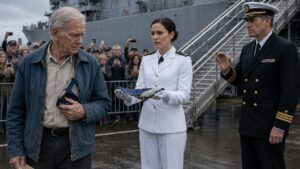
Gary raised his right hand.
This time Samuel did not stop him.
The salute was not dramatic. It was precise, formal, and deeply quiet. That was why it struck the tarmac harder than any speech could have.
Every uniformed person present followed.
A wave of hands rose, not in performance but in recognition. Tyler’s hand came up last. It shook slightly.
Samuel stood with his cane in one hand and the folded program in the other. He did not return the salute immediately. His eyes moved across the crowd, past the officers, past the public affairs staff, past the guests who now knew enough to look ashamed of not knowing sooner.
Then he returned it.
Slowly. Correctly. With an old body that remembered what the body was for.
Gary lowered his hand.
So did the others.
For a moment no one seemed to know what sound belonged after that.
The public affairs officer reached toward the microphone, but Samuel stepped forward first. Not onto the platform. Just to the ground-level microphone used for family speakers who preferred not to climb steps.
Amy moved as if to help him.
He gave her the smallest look.
She stopped.
Samuel reached the microphone on his own. The cane tapped once, then rested.
The public affairs officer placed the microphone lower. Her hands trembled.
“General Carter,” she whispered.
Samuel looked at her, not unkindly. “Mr. Carter will do.”
She stepped back.
He unfolded the printed program. The paper made a dry sound in the quiet.
He looked at the front row, where families sat holding photographs, folded flags, old letters, and hands that had aged around absence. Then he looked at Tyler Lee, still near the barrier, visibly braced for punishment.
Samuel did not give it to him.
“I came today,” he said, “because this aircraft carried people home.”
His voice was not strong in the way a public speaker’s voice was strong. It was worn, but it carried because everyone had chosen to listen.
“It also failed to carry some home. That is why a memorial matters. Not for aircraft. Not for commanders. For names.”
He held up the program.
“This program is missing some.”
The public affairs officer closed her eyes.
Samuel looked down at the paper, then folded it once along the center.
No one interrupted.
“I do not believe the omission was cruel,” he said. “But it was convenient. And convenience has taken too much from them already.”
He rested the folded program against the cane handle.
“I am grateful for the salute. I am grateful for Colonel Roberts. I am grateful someone went back to the files. But I ask you not to let this day become about discovering who I was.”
His eyes moved to the red mark still faint around his wrist.
“A title can open a gate. It should not be required to receive patience at one.”
The words settled without needing to rise.
Tyler’s face changed then—not with the fear of discipline, but with the heavier recognition of having been spared the easy version of shame.
Samuel looked at the aircraft.
“The crew names will be read today,” he said. “All of them. Or I will stand here quietly until there is time.”
A few people in the crowd lowered their heads. Catherine Williams had already opened her folder. Gary Roberts turned to the public affairs officer, who nodded quickly through tears she was trying to hide.
Samuel folded the program closed completely and set it on the microphone stand.
The old paper invitation was still in his shirt pocket. The faded tag still hung beside it. His cane remained planted on the tarmac, not as proof of weakness, but as the instrument by which he had crossed all the distance silence had asked of him.
He looked once more at the aircraft, then at the waiting families.
“Begin with the missing names,” he said.
Chapter 7: The Rule Written After The Salute
The first missing name was read by Catherine Williams from a page that had not been part of the printed program.
She stood beside the microphone with the old mission file open in both hands. Her voice caught on the second name, steadied on the third, and by the fourth the families in the front row had begun to understand what was happening. A woman who had been holding a framed photograph lowered it to her lap and pressed her fingers over her mouth. An older man in a unit cap closed his eyes.
Samuel remained near the platform, not on it.
The ceremony shifted around him. It was still formal. It still followed the shape of military order: names, silence, folded flags, recorded music, remarks kept brief by people who now understood brevity differently. But the center of the event had moved away from the polished aircraft and back toward the people who had once filled it with breath, fear, skill, and obedience.
When the final crew name was spoken, the silence lasted longer than scheduled.
No one rushed it.
Samuel looked at the aircraft’s left rescue hatch. Maintenance had not repainted the blackened patch; there had been no time. But someone had placed a small temporary marker below the hatch, a plain strip of tape where the missing scar had been. It was not elegant. It was honest enough for the day.
After the ceremony, people approached Samuel carefully.
Some called him General Carter. Some stopped themselves and said Mr. Carter instead. A few only shook his hand and could not speak. He accepted each greeting without correcting grief into ceremony. When the old woman with the framed photograph reached him, she held the picture out.
“My brother,” she said.
Samuel looked at the young face in the frame.
“I remember him,” he said.
Her eyes searched his. “Do you?”
“Yes.”
He told her one thing: that her brother had laughed once during a storm because the coffee had spilled upward before it hit the floor. It was a small memory, useless to history, precious to a sister. She wept without making a sound.
Amy stood a few feet away, watching him give away pieces of a past he had kept locked for most of her life. She did not interrupt. She did not rescue him from it. For once, Samuel did not seem to be disappearing into the memory. He was standing inside it with the others.
Near the security barrier, Tyler Lee waited.
He had removed his cap and held it in both hands. The restraint chain was no longer on his belt. It lay on the security table behind him, coiled beside a sign-in clipboard and a stack of temporary badges, looking smaller now than it had looked in the sun.
Gary Roberts approached Samuel after the last family member moved away. Catherine remained with the mission file near the platform, speaking quietly with the public affairs officer. The base commander’s aide stood nearby with a notepad, no longer trying to manage the story before understanding it.
“Sir,” Gary said, then corrected himself. “Mr. Carter. The commander would like to speak with you before you leave.”
Samuel glanced toward the administrative building. “About Tyler Lee?”
“About several things.”
“Bring them here.”
Gary studied him. “Here?”
Samuel looked toward the tarmac. “This is where it happened.”
Gary nodded.
A few minutes later, they gathered near the security table: Gary, Catherine, the public affairs officer, the base commander’s aide, Tyler Lee, and Samuel with Amy at his side. No crowd surrounded them. The ceremony guests had begun moving toward the reception area. The aircraft stood behind them, quiet and immense, the tape mark beneath the rescue hatch catching a sliver of evening light.
Tyler stood at attention.
Samuel looked at him for a moment before speaking.
“Airman Lee.”
“Yes, sir.”
“Look at me.”
Tyler lifted his eyes.
Samuel saw a young man trying to hold himself together inside shame. He saw pride damaged, fear awakened, certainty cracked. He also saw something that could still be taught. That mattered.
“You were wrong today,” Samuel said.
“Yes, sir.”
“Not because I was a general.”
Tyler swallowed. “Yes, sir.”
“Say it back.”
Tyler’s face tightened. For a second, Samuel thought the young man would hide inside repetition. Then Tyler looked toward the chain on the table.
“I was wrong before I knew who you were.”
The words came out rough.
Samuel nodded once. “That is the part worth keeping.”
Tyler’s eyes reddened. “I’m sorry, Mr. Carter.”
“Why?”
“For restraining you.”
“That is what you did. Why are you sorry?”
Tyler looked at the table, then forced himself to answer. “Because I decided you were a problem before I checked. Because you looked old and out of place, and I treated that like evidence.”
The public affairs officer lowered her gaze.
Samuel rested both hands on the cane handle. “Then learn from that. Do not perform shame and call it change.”
Tyler nodded.
Gary glanced toward the chain. “Security procedures will be reviewed.”
Samuel looked at the coiled metal. “Reviewed is a soft word.”
The aide’s pen paused above the notepad.
Samuel continued, “If a person is dangerous, protect the base. If a person is confused, protect the person. If a person has an old document, verify it before you make their age the charge against them.”
No one spoke.
“Write that into your visitor handling instructions,” Samuel said. “Plainly. Especially for elderly veterans, family members, and civilians attending memorial events. A worn paper is not proof of fraud. A cane is not proof of confusion. Silence is not proof of guilt.”
The aide wrote quickly now.
Catherine looked at Samuel with the stillness of someone hearing archive language become living policy.
“And the crew names?” Samuel asked.
Catherine answered before anyone else. “The permanent plaque will include all of them. The exhibit too. Not selected representatives. All names.”
Samuel’s eyes moved to the aircraft. “And the blackened patch?”
“The restoration team will document it,” Catherine said. “If the families agree, we’ll restore that section as it was after the mission.”
Samuel nodded. “Ask the families first.”
“We will.”
The evening wind moved across the tarmac. The chain on the table shifted slightly, one link touching another with a faint sound. Tyler flinched at it.
Samuel heard it too.
He looked at the young airman. “You may have a long career ahead of you.”
Tyler did not answer.
“Do not spend it trying to look certain,” Samuel said. “Spend it learning when certainty has made you careless.”
Tyler’s mouth trembled once. He controlled it. “I will, sir.”
Samuel let the title pass. There were moments when correction helped. There were moments when mercy did more.
Gary stepped forward with a folded paper. “The commander asked if you would accept a formal written apology from the base.”
Samuel looked at the paper but did not take it.
“Send it to the families first,” he said.
Gary understood. “Yes, sir.”
This time Samuel did not correct him.
The sun had lowered behind the hangars by the time the gathering broke apart. The official cars left first. Then the guests. Maintenance crews began collecting chairs, slowly, without the careless noise that usually followed an event. The public affairs officer gathered the unused printed programs and carried them away under one arm as if they weighed more than paper.
Samuel walked toward the base exit road with Amy beside him.
He had refused a vehicle.
The cane tapped against the pavement in a steady rhythm. Tap. Step. Tap. Step. The same sound that had marked his humiliation at the gate now measured his leaving. The difference was not in the cane. It was in the people who heard it.
At the gate, the first guard stood outside the booth.
He held Samuel’s old invitation with both hands. Someone had returned it to him, smoothed but still creased.
“Mr. Carter,” the guard said, “I apologize.”
Samuel accepted the invitation. “Thank you.”
“I should have checked more carefully.”
“Yes.”
The guard looked ashamed, but Samuel did not make him stand in it longer than necessary.
“Next time,” Samuel said, “check while the person is still standing in front of you.”
The guard nodded. “Yes, sir.”
Samuel placed the invitation inside his shirt pocket beside the faded hang tag.
Beyond the gate, Amy’s car waited near the curb. She opened the passenger door, then paused when Samuel did not immediately get in. He had turned back toward the base.
From that distance, aircraft 713 was only a gray shape above the buildings. Its tail caught the last light. The flags had been lowered. The chairs were almost gone. The tarmac looked ordinary again, as if nothing had happened there except a ceremony.
Amy came to stand beside him.
“You okay?”
Samuel considered the question.
His wrist still ached faintly where the chain had been. His knee hurt. His throat felt raw from speaking names he had avoided aloud for too long. Somewhere inside him, the old arithmetic remained impossible. Those who returned. Those who did not. Orders given. Orders obeyed.
But the names had been read.
All of them.
And for the first time in years, the aircraft did not seem to be waiting for him to confess something he had no language to forgive.
“No,” Samuel said.
Amy looked at him.
He touched the faded hang tag through his pocket.
“But I am closer.”
She nodded, accepting the answer as complete.
Behind them, at the security table inside the gate, Tyler Lee picked up the restraint chain and carried it back toward the equipment room. He did not clip it to his belt. He held it in both hands, like something that needed to be understood before it was used again.
Samuel watched until the young man disappeared from view.
Then he turned toward the car.
He wore the same plaid shirt, the same old shoes, the same cloudy tag. No escort followed him. No crowd waited. No one announced his departure.
The cane tapped once against the pavement.
This time, the sound did not make him feel invisible.
The story has ended.