They Told the Old Air Force Mechanic to Step Aside Until His Wrench Heard the Engine
Chapter 1: The Old Man Beside the Open Engine
The first thing George Allen heard was not the young man’s voice.
It was the engine.
Not running. Not alive. Not loud enough for anyone else to care. Just a dead aircraft cooling in the hangar, its panel open like a rib cage, metal ticking softly as heat left the frame. Beneath that, hidden under the whine of lights and the shuffle of boots, there was a small uneven settling sound near the mount.
A half-beat.
A wrong pause.
George stopped with his hand still wrapped around the worn 9/16 socket wrench.
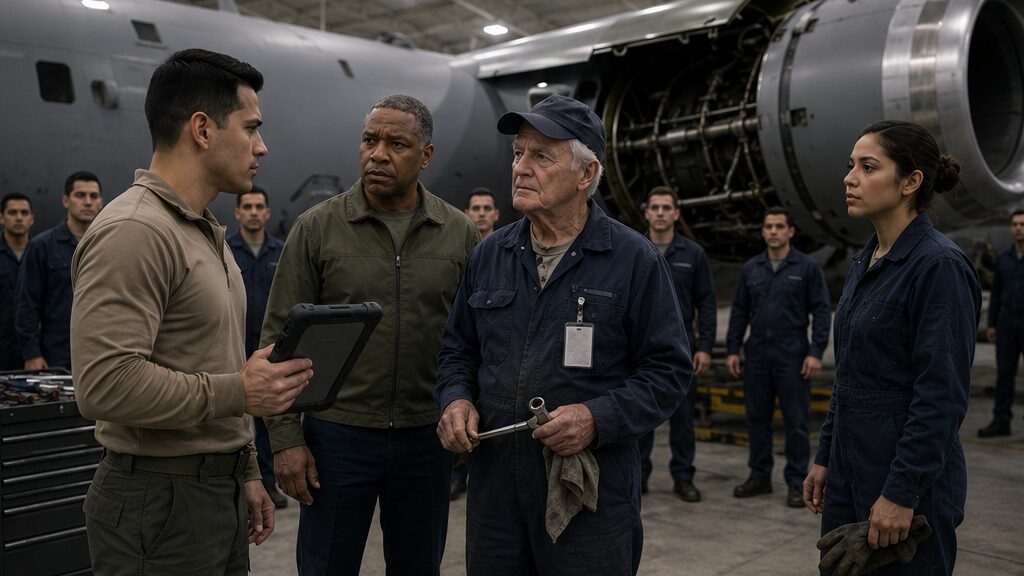
Across from him, Joshua Torres lifted his tablet like it was a shield.
“Sir, I’m telling you, the system cleared that section,” Joshua said. His voice was controlled, but it carried. Too far. Past George’s shoulder. Past Stephen Martin standing near the nose. Past the two crewmen who had stopped pretending they were not watching.
George looked from the tablet to the aircraft. Gray body, open panel, inspection lights shining into the engine bay. The same aircraft had been quiet ten minutes ago when they rolled it into position. Too quiet in the way a man stayed quiet when he had already decided not to complain.
Joshua stepped closer. He was young enough to still look uncomfortable in authority, and proud enough to hide it poorly. “We already ran the diagnostic sequence twice. No fault code. No heat spike. No vibration warning. If we keep chasing ghosts, this aircraft misses the training window.”
George folded his grease cloth once, then again. His hands did not move as quickly as they used to. The joints in his fingers had thickened with age and cold mornings, and the right thumb did not always answer on the first try. He kept the wrench in his palm because setting it down would make him look finished.
“I asked for thirty seconds,” George said.
Joshua’s jaw tightened. “With respect, you’re not assigned to this crew.”
There it was.
Not shouted. Not cruel enough to answer. Just clean and procedural, the way disrespect often came when it had learned to wear a uniform.
A crewman by the tool cart looked down. Another shifted his weight. Melissa Garcia, the junior mechanic nearest the open panel, froze with a pair of gloves in her hand. Stephen Martin did not move.
George felt the room make its decision before anyone said another word. They saw the stoop in his shoulders, the old cap, the faded navy-blue coveralls that had been washed soft at the elbows. They saw the civilian badge clipped to his chest instead of a current patch. They saw a man called in from somewhere outside the regular chain, an old maintenance chief who had already had his time.
They did not see the aircraft.
“Joshua,” Stephen said.
The younger technician kept his eyes on George. “Sir, I’m responsible for the sign-off path. If we delay on an undocumented concern, I need something more than—”
Stephen raised one hand.
The gesture was small, but it cut through the hangar harder than a shout.
Joshua stopped.
For a moment only the lights hummed overhead. Somewhere outside, a cart rolled across concrete, its wheels rattling in a rhythm too even to be the sound George had heard.
Stephen walked toward them, boots slow, face unreadable. He was not young anymore, but he was not old enough to be dismissed. That middle ground had always looked safest from the outside. George knew better. It was where men learned to balance what they knew against what the room would accept.
Stephen glanced at the tablet. “Diagnostics clean?”
“Yes, sir,” Joshua said.
“Visual inspection?”
“Clean.”
“Mount bolts?”
“Within torque range.”
George lifted his eyes at that.
Stephen noticed.
Joshua noticed Stephen noticing.
“The torque values are in range,” Joshua repeated, sharper now. “We checked them by procedure.”
George ran his thumb over the socket wrench’s handle. Decades of use had polished one side smooth. It had outlasted three toolboxes, two bases, one marriage, and most of the men who had first taught him to listen before touching metal. It was not lucky. George did not believe in lucky tools. He believed in tools that had been held long enough to tell a man when his own hand was lying.
“Torque is one answer,” George said. “It isn’t the only answer.”
Joshua looked past him, toward Stephen. “This is exactly what I mean. We can’t keep applying old checks to every clean readout.”
Old checks.
The words landed with less force than George expected. Maybe because he had heard worse. Maybe because age made insults slower to arrive, like mail sent to an address where nobody lived anymore.
He stepped closer to the engine bay. The inspection light painted his hands pale against the darker metal. He did not reach inside. Not yet. He only leaned and listened.
There it was again.
Not a click. Not a crack. A soft irregular give, as if the mount were settling against a pressure it did not want to admit.
George turned the wrench once in his hand.
“Who ran the last vibration complaint?” he asked.
Joshua frowned. “There was no formal complaint.”
“I didn’t ask if there was paperwork.”
“The pilot noted roughness on taxi last week,” Melissa said before she seemed to realize she had spoken.
Joshua glanced at her. She lowered the gloves.
Stephen looked at Melissa. “Where did you see that?”
“Crew note. Not a fault report. It was in the margin on the intake sheet.”
Joshua exhaled through his nose. “And it resolved during run-up. That’s why it didn’t become a formal write-up.”
George nodded once. That was how small problems survived. They learned to disappear when important people looked directly at them.
He wiped the socket with the folded cloth. The movement was careful, almost ceremonial, though George meant nothing by it. He had always cleaned a tool before asking it for the truth. Grease could fool a hand. Dirt could make a man think he felt resistance where there was none.
Joshua watched the cloth, then the wrench. His expression said the same thing his mouth was too disciplined to say: this is wasting time.
Stephen came to stand beside George. Not in front of him. That mattered, though George did not let himself show it.
“What do you want checked?” Stephen asked.
George lifted the wrench slightly toward the open panel. “Lower starboard mount. Rear bolt. Not torque. Seating.”
Joshua’s eyes narrowed. “We checked that mount.”
“You checked value.”
“Because value is the standard.”
George looked at him then. Not hard. Not angry. The kind of look he had once given young airmen who were too tired to know they were dangerous.
“Standards tell you where to start,” he said. “They don’t tell you where to stop listening.”
Nobody answered.
Stephen’s hand hovered for a moment near the tool cart, then he reached out. George thought he meant to take the wrench away, to smooth the whole thing over, to say they would note the concern and move on. Instead Stephen picked up a small inspection mirror and handed it to Melissa.
“Light on the mount,” Stephen said.
Joshua turned his tablet against his hip. “Sir—”
Stephen did not raise his hand this time. He only looked at him.
Joshua stepped back.
George felt the crew’s attention sharpen. That was worse than dismissal in some ways. Dismissal let a man disappear. Attention made every tremor visible.
His right knee gave its old warning ache as he leaned into the engine bay. He ignored it. The smell of warm metal, old fuel, and solvent came up around him. For half a second, the hangar fell away and he was somewhere else, younger, bent under worse light, with a different aircraft and a louder clock running behind him.
He blinked, and the present returned.
Melissa angled the light. The mount sat where it should. Clean. Ordinary. Innocent.
George reached in but did not turn the bolt. He rested the socket lightly over it, enough to feel the seating through the tool. The wrench settled into his palm.
A young man’s tablet could read numbers.
George’s hand read hesitation.
He drew the wrench back.
“Well?” Joshua asked.
George looked at the bolt, then at the faint line where the panel seam met the bracket.
He could have said more. He could have told them about the half-beat, about stress that did not always announce itself on a screen, about the way a mount could pass torque and still fail to settle under shifting load. But too many words from an old man became stories, and stories became fog.
So he said only what he knew.
“That mount is not settling right.”
Chapter 2: The Tablet Said the Aircraft Was Clean
By noon, George’s wrench lay on a metal desk between two stacks of paper that disagreed with him.
The hangar office had glass walls facing the inspection bay, and through them George could see the aircraft still opened under lights. Its gray skin reflected the movement of crew members passing around it with clipboards, carts, cables, and the practiced impatience of people who believed the answer had already been found.
Joshua stood at the end of the desk with the tablet in his hand. Stephen sat, sleeves rolled to the forearm, reading the diagnostic report line by line. Melissa stayed near the door, quiet enough to be mistaken for furniture, though George had noticed she missed very little.
“Engine health monitoring shows no flagged anomaly,” Joshua said. “Mount torque recorded within range. Thermal imaging clean. Vibration sweep within acceptable limits after run-up. No repeatable fault.”
George did not touch the wrench. He watched the overhead light slide along its worn handle.
Stephen turned a page. “Pilot note says roughness on taxi.”
“Informal,” Joshua said.
“Still written down.”
“Because pilots write down everything that feels odd before coffee.”
Stephen looked up.
Joshua’s mouth tightened. “Sir, I’m not dismissing the pilot. I’m saying the note didn’t repeat under controlled conditions.”
George folded his hands to hide the stiffness in them. The office chair was too low, and his hip had begun to ache from sitting. He would not shift. Not with Joshua standing.
Stephen looked at George. “Tell me again what you felt.”
George almost smiled at that. Felt. Not saw. Not proved. The word left him exposed.
“Socket seated differently on the rear bolt,” he said. “Not loose. Not stripped. Different. Like pressure’s coming through the bracket uneven.”
Joshua tapped the tablet. “That’s not a measurable fault.”
“It is measurable,” George said. “Just not by that first.”
Joshua inhaled, held it, let it out. “Mr. Allen, the aircraft doesn’t care how long any of us have been doing this. It cares whether the data supports grounding it.”
The name landed harder than the argument.
Mr. Allen.
Not Chief. Not George. Not even sir this time.
George had retired from needing titles, or so he had told himself. But hearing his name flattened into civilian inconvenience made something old and foolish rise in his chest. He pressed it down.
Stephen noticed. George wished he had not.
“What’s the clearance deadline?” Stephen asked.
“Friday morning,” Joshua said. “Training flight goes wheels up Friday afternoon. If this bird misses that slot, the whole week shifts. The scheduler already asked if we’re going to keep chasing an unverified vibration.”
George turned toward the window. The aircraft sat nose-forward, patient and accused.
“Machines don’t get safer because schedules are crowded,” he said.
Joshua’s face changed, just a little. Not anger exactly. Fear wearing anger’s jacket.
“With respect,” he said, and the words had less respect each time he used them, “you’re not the one who has to answer for this inspection chain.”
“No,” George said. “I’m only the one who heard it.”
The room went still.
Stephen set down the report. “Joshua, get me the intake sheet. The original one. Not the cleaned-up file.”
Joshua hesitated, then left.
Melissa moved as if to follow, but Stephen stopped her. “Garcia. You saw the margin note?”
“Yes, sir.”
“Anything else informal?”
She looked toward George before answering. “There was a line about roughness fading after the aircraft warmed. And one crew chief wrote ‘felt low, right side’ with a question mark. It didn’t make it into the digital summary.”
Stephen rubbed the bridge of his nose.
George knew that gesture. Every maintenance officer had one. A small private surrender to paperwork that had learned to protect itself.
“Why didn’t you say that earlier?” Stephen asked.
Melissa’s eyes flicked to the hallway where Joshua had gone. “Wasn’t my job to interpret it.”
George looked at her. “Sometimes reading is just listening with your eyes.”
She seemed unsure whether she was being corrected or encouraged.
Joshua returned with a thin folder. He placed it on the desk in front of Stephen, then remained standing.
Stephen opened it. There it was: a handwritten note in the margin, small and slanted.
Rough taxi vibration. Low/right? Cleared in run-up.
George leaned forward only enough to see it. His eyes were not what they had been, but he knew the shape of a warning when someone had tried to write it quietly.
“Margin notes are not fault reports,” Joshua said.
“No,” George said. “They’re where faults live before they grow up.”
Joshua gave a short, humorless laugh. “That sounds good. It’s not procedure.”
George reached for the wrench then. He did not pick it up. He touched it with two fingers, aligning it parallel to the edge of the diagnostic printout.
The gesture drew Melissa’s eyes.
“Bring me a grease pencil,” George said.
Joshua stared at him. “For what?”
“For a mark that won’t argue.”
Stephen nodded to Melissa.
She left and returned with a yellow grease pencil. George took it slowly. His thumb protested when he gripped it, but the line he drew on a scrap diagram was steady. One short mark at the rear bolt position. One at the seam. One tiny arrow where his ear had placed the sound.
Joshua looked at the marks. “You can’t ground an aircraft with arrows.”
George capped the pencil. “No. But you can remember where to look.”
Stephen turned the diagram toward himself. “We’ll mark the actual bolt before the next run-up.”
Joshua’s head snapped toward him. “Sir, that adds another inspection cycle.”
“It adds a mark,” Stephen said.
“And delay.”
“It adds a mark,” Stephen repeated.
The younger technician looked away through the glass wall. For the first time, George saw the boy under the uniform. Not a child, no. A trained man with too much riding on being right. George had known men like that. He had been one.
“I’m not trying to make your job harder,” George said.
Joshua did not turn around. “You are making my job harder.”
George accepted that. The truth often did.
Later, in the inspection bay, Melissa held the light while George leaned toward the mount again. Joshua stood close, tablet ready, watching as though George might smuggle a fault into existence.
George cleaned the bolt head with his cloth. He drew a fine yellow line from bolt to bracket. His hand moved slowly, but no one spoke this time.
The mark looked almost foolish when he finished. A small yellow line on a large gray aircraft. A child’s answer to a machine full of systems.
Melissa tilted her head. “That’s it?”
“That’s it,” George said.
Joshua made a note on the tablet, though his mouth still held doubt.
From somewhere beyond the hangar office, a flight scheduler’s voice carried through an open door, clipped and impatient.
“Friday morning is the latest. If maintenance doesn’t clear it by then, we’re pulling another aircraft and everybody gets to explain why.”
George kept his eyes on the yellow mark.
The aircraft said nothing.
That worried him most.
Chapter 3: Carolyn Wanted Him Away From the Hangar
Carolyn Hill saw the wrench before she saw the pain in his hand.
It lay on George’s kitchen table beside his folded cloth, cleaned of hangar grease but still dark in the grooves. He had set it there after dinner, the way another man might set down keys or reading glasses. Outside, Monday night pressed against the window above the sink. The porch light turned the driveway silver.
Carolyn stood with her coat still on. “You brought that home again.”
George looked at the wrench, then back at the coffee he had not touched. “It rides better with me than in the truck.”
“That isn’t an answer.”
“It’s the one I’ve got.”
She sighed and came farther into the kitchen. She had her mother’s way of removing silence from a room without raising her voice. George had loved that once. Now it made him feel inspected.
“You were supposed to consult for half a day,” she said. “You left before breakfast and came home after dark.”
“The aircraft had a question.”
“Aircraft don’t ask questions.”
George wrapped both hands around the mug. The heat eased his knuckles. “They do if people stop telling them what they’re allowed to say.”
Carolyn pulled out the chair across from him and sat. Her eyes moved over his face, then to his right hand. He had been holding it too still.
“Let me see.”
“It’s fine.”
“Dad.”
He hated that tone most of all. Not because it was harsh. Because it was careful.
George lifted his hand. Carolyn reached across the table and turned it palm-up. The skin around the thumb joint was swollen. Not badly. Enough.
“You said the doctor told you to rest this,” she said.
“He told me not to rebuild a transmission.”
“He told you not to overuse it.”
“I used it.”
“That’s exactly the kind of sentence that makes me want to hide your truck keys.”
George drew his hand back gently. “You won’t.”
“No. But I’ll think about it.”
For a moment, the edge between them softened. The old kitchen held the remains of dinner: a bowl rinsed but not washed, a towel folded over the counter, the faint smell of onions and black pepper. Carolyn had brought soup because she thought he was not cooking enough. George had eaten two bowls because arguing would have taken more energy than being loved.
Then her eyes returned to the wrench.
“What happened today?” she asked.
“Nothing happened.”
“That means something happened and you don’t want to say it.”
George leaned back. The chair creaked under him. “Young technician didn’t like me asking for another check.”
Carolyn’s mouth tightened. “Did he say something?”
“Nothing worth carrying home.”
“You carried the wrench.”
He looked down at it. The handle caught the light along the worn patch where his palm had lived for years.
“He had a tablet,” George said.
“That isn’t a crime.”
“No.”
“And you had that.”
“Yes.”
She waited.
George could have told her about Joshua’s voice carrying across the hangar. About Stephen’s raised hand. About Melissa watching the grease pencil line as if it were a secret message. About the way the crew looked at him and saw delay, liability, age.
Instead he said, “They’re under pressure.”
“So are you.”
“Not the same kind.”
“Maybe not. But you’re seventy-four, and every time that base calls, you go like you still owe them your spine.”
George looked toward the window. The porch light showed his truck, old and square, with a dent above the rear wheel. Beyond it, darkness hid the street.
“I don’t owe them my spine.”
“What do you owe them?”
He did not answer quickly enough.
Carolyn’s expression changed. Concern deepened into something older. “Dad.”
George lifted the mug, then set it down untouched. His hand had started to tremble. A small tremor. Not fear. Fatigue. He put the hand under the table.
Carolyn saw anyway.
“That hangar keeps taking from you,” she said softly. “Your sleep. Your hand. Your mood. Every time they need an old memory, they call you. Then when you come home, you sit here like you’re still listening to engines.”
George closed his eyes briefly.
He was listening now. Not to an engine. To a sound from years before, one he had trained himself not to hear until nights like this opened the door.
A low uneven rhythm beneath metal skin. A crew waiting. A schedule pressed tight. A younger version of himself with more rank in his voice than caution in his bones.
“You think I go because I miss it,” he said.
“Don’t you?”
“Yes.” He opened his eyes. “But that isn’t all.”
Carolyn’s face softened, but she did not interrupt.
“There are things a man should have listened to sooner,” George said. “When you get older, people think memory is just what you keep because you can’t move forward. Sometimes it’s what keeps somebody else from making your mistake.”
“What mistake?”
The question sat between them.
George looked at the wrench. He saw not the kitchen table but a maintenance bay under harsher light, a clipboard, a tired pilot, a pressure in the room that everyone pretended was normal because the mission mattered. He had signed the clearance then. Not carelessly. Not foolishly. By the book. That was the part that still woke him.
By the book, and still wrong.
“Not tonight,” he said.
Carolyn’s shoulders fell.
He hated disappointing her. She had already lost her mother. She had spent enough years watching him come home with pieces of himself locked behind his teeth.
“You don’t have to keep proving you matter,” she said.
The words struck cleaner than Joshua’s had.
George stood slowly and took his mug to the sink, though he had not drunk from it. His knees complained. His back tightened. He heard the small betrayal of his own body and hoped she did not.
“I know,” he said.
But he did not know. Not fully. If he mattered only when he could still hear what others missed, then maybe Carolyn was right to fear the day the sound stopped reaching him. If he mattered without the work, without the hangar, without the wrench, he had not learned yet how to live that way.
Carolyn rose and came beside him. “Promise me you won’t let them embarrass you just because they need something.”
George rinsed the mug. Water hit ceramic, steady and clean.
“They can’t embarrass a man unless he helps them.”
“That’s not true.”
He turned off the faucet.
No. It was not.
Carolyn touched his sleeve. “Rest tomorrow.”
“I’ll try.”
“That means no.”
“It means I’ll try.”
She shook her head, but there was no anger left in it. At the door, she paused and looked back at the table.
“Put that thing away before you sleep.”
After she left, George stood in the kitchen until her headlights disappeared from the window. The house settled around him, quiet and familiar. He returned to the table and picked up the wrench.
For once, it felt heavier than it should.
He carried it to the narrow drawer beneath the old telephone stand. Inside lay a small maintenance notebook with a cracked black cover and pages softened by years of being opened and closed but never shared. He set the wrench beside it, then hesitated.
The notebook opened to the place it always wanted to open.
A date. An aircraft number. A note written in his younger hand.
Low right vibration faded after warm-up.
George stared at the line until the kitchen seemed to lose air.
Then he closed the notebook before he could read the rest.
Chapter 4: The Sound Returned During the Run-Up
By Wednesday afternoon, the aircraft had begun to make everybody impatient.
George could feel it before the engine even turned. It was in the way crew members moved around the hangar without looking at him, the way Joshua’s tablet never left his hand, the way Stephen kept checking the wall clock above the inspection bay doors as if time itself had become another officer in the room.
They had rolled the aircraft to the run-up area under a pale sky, its nose pointed toward the open stretch beyond the hangar. Heat shimmered faintly above the concrete. Cables were cleared. Panels were secured. The yellow grease mark George had drawn two days earlier sat small and almost embarrassing on the rear mount bolt, hidden unless a person knew where to bend and look.
George knew where.
He stood behind the marked safety line with his cap pulled low and his cloth folded in his left hand. His right hand was empty. The wrench stayed in his toolbox for the run-up. A man did not bring a tool to a sound. He brought his ears.
The engine started with a rising cough, then a clean, powerful whine that filled the air and pressed against George’s chest. Younger men often heard power first. George heard layers. Air moving. Bearings waking. Metal accepting load. A thousand small agreements happening faster than thought.
At first, the aircraft behaved.
Joshua stood several yards away, headset on, eyes moving between the aircraft and his tablet. He looked focused, not smug. George gave him that. The boy cared. The problem was that he cared in straight lines.
Stephen watched from near the hangar door, arms folded.
Melissa stood closer to George than anyone else did. She had her own notepad out this time, though she held it low, as if not wanting Joshua to see.
The engine climbed.
George turned his head slightly, letting the sound strike his right ear.
There.
Not a bang. Not a grind. Not anything dramatic enough to make men jump back or point.
A low unevenness beneath the main vibration. One small hesitation, then a correction. A body limping before pain reached the face.
George closed his eyes.
The sound moved through him and found an old locked room.
Another apron. Another aircraft. Younger hands. Rain on concrete. Men waiting for a clearance because the schedule had already been cut too close. A vibration that faded after warm-up. His own voice saying it was within tolerance. His own signature at the bottom of a form.
He opened his eyes before the memory could finish.
Joshua gave a thumbs-up to the operator. The engine stabilized, then began to ease down.
“Clean,” Joshua called after the noise dropped enough to speak over. He pulled off one side of the headset. “No repeat fault. Vibration stayed within acceptable range.”
George did not move.
Stephen looked at him. “George?”
“Again,” George said.
Joshua’s expression tightened. “We just did it.”
“Again, from lower idle to climb setting. Slower.”
“That’s not required.”
“No.”
“Then why?”
George looked toward the aircraft. “Because it’s hiding between steps.”
Joshua laughed once under his breath, not loudly enough for Stephen to correct, but loudly enough for George to hear.
Melissa heard it too. Her mouth pressed into a thin line.
Stephen took a long breath. “Run it again. Slower transition.”
Joshua turned toward him. “Sir, we’ve already added extra cycles.”
“Run it again.”
The second run-up took longer to prepare because irritation made even simple things clumsy. The crew checked their positions. The operator signaled. The engine rose again.
This time George did not close his eyes. He watched the open space beneath the aircraft skin, as if the sound might become visible if he gave it enough respect.
The vibration came again, brief and low.
Melissa’s pencil moved.
George stepped toward the safety line, stopped at the mark, and waited until the engine wound down. The moment the crew cleared movement, he walked to the mount panel. His knee hurt enough that he felt it in his jaw.
Joshua followed. “We are not opening another inspection rabbit hole because of a feeling.”
George ignored the words and crouched slowly. Pain ran from hip to ankle. He braced one hand against the frame, hating that he needed to. Melissa angled a light without being asked.
The yellow grease mark had shifted.
Barely.
A hairline break had opened between the mark on the bolt and the mark on the bracket. Small enough that a man who did not want to see it could honestly say he had not.
George stared at it.
The past breathed behind his shoulder.
Melissa lowered herself beside him. “It moved.”
Joshua leaned in. “That could be from heat expansion.”
“Could be,” George said.
“Or from the mark not being clean.”
George glanced at him. “I cleaned it.”
Joshua looked at the mark again. Something uncertain crossed his face, but he buried it quickly. “Even if it shifted, it doesn’t prove a structural issue.”
“No,” George said. “It proves movement.”
Stephen came closer. The others made room for him without being told. He bent, studied the yellow line, then looked at George.
“You want the bolt checked again?”
George opened his toolbox and took out the 9/16 socket wrench. The handle settled into his hand like an old question.
“I want to feel where it seats after the run,” he said.
Joshua straightened. “If you put a tool on that bolt now, we contaminate the inspection trail.”
“He’s not turning it,” Stephen said.
George slid the socket over the bolt head with care. He did not apply force. He let the tool sit, then lifted it, then seated it again. On the third seating, the small wrongness came through the handle. Not looseness. Not failure. A misalignment under pressure, like a door that closed but did not belong in its frame.
He stopped before instinct could make him test further.
Joshua watched his hand. “Why stop?”
“Because if I force it, I’ll change what it’s trying to tell us.”
For the first time, Joshua did not answer immediately.
Melissa looked from the wrench to the mark. “What does it mean?”
George kept his eyes on the bolt. He did not want to say it in front of them. Not yet. Not because he feared being wrong. Because he feared being right for the same reason he had once been wrong.
“It means,” he said, “this aircraft is talking under load and going quiet when people come to check.”
Joshua’s patience snapped. “Aircraft don’t talk.”
George looked up at him from his crouch. “They do. You just don’t like the language.”
The words were sharper than he intended. He saw Joshua flinch behind his anger and wished he had kept quiet.
Stephen helped George stand, though George pretended he was only taking the offered hand because it was already there. His knee stiffened when he straightened.
Stephen saw that too. George disliked how much Stephen saw.
“We’ll document the mark shift,” Stephen said.
Joshua shook his head. “Document it as what? Possible movement? Possible mark error? Possible consultant concern? The safety inspector will ask for proof.”
“Then we give him what we have.”
“What we have is not enough to ground a flight.”
George looked toward the aircraft. Sunlight had struck the gray fuselage, making it look almost smooth from a distance. Clean surfaces had fooled better men than Joshua.
“It’s enough to keep looking,” George said.
Joshua’s voice lowered. “And if there’s nothing there?”
George folded the cloth around the wrench head and wiped once, slowly.
“Then I’ll be an old man who cost you two days.”
Joshua’s face changed. The answer had taken something from his anger.
Stephen looked between them. “One more inspection cycle. Deeper look at that mount, review prior notes, and I want safety looped in.”
Joshua’s shoulders stiffened. “And if that still shows nothing?”
Stephen looked at George.
The question should have gone to the officer, the technician, the paperwork. Instead it came to the old man with a wrench in his hand and a pain in his leg he was trying to hide.
George listened to the aircraft cooling in the sun.
The sound came again in memory, not metal.
Low right vibration faded after warm-up.
He could almost see the page in his notebook. The line below the one he had refused to read.
Stephen’s voice was careful. “George?”
George slid the wrench back into his toolbox.
“If the deeper inspection shows nothing,” Stephen said, “we clear it Friday morning.”
Joshua exhaled as if that settled the matter.
George looked at the yellow mark, no longer whole.
“No,” he said quietly. “If it shows nothing, you clear it without me.”
Stephen’s eyes narrowed. “Meaning?”
“Meaning I won’t put my name beside it.”
The air around them changed.
Joshua stared at him. The crew stopped moving again. Melissa still held the light on the tiny broken mark as if it were the only honest thing on the aircraft.
Stephen’s face hardened, not with anger, but with the weight of command pressure arriving early.
“One more inspection,” he said. “Then it clears unless you can show me proof.”
George nodded.
The aircraft ticked as it cooled, metal shrinking back into silence.
This time, the silence did not comfort him.
Chapter 5: The Bolt That Remembered the Wrong Pressure
The safety inspector arrived Thursday morning with clean boots, a hard case, and the expression of a man who had been called in to measure someone else’s doubt.
He did not look unkind. That made it worse. Unkind men could be resisted. Reasonable men required answers.
George stood beside the inspection bay while the aircraft sat under full light, its panel open wider than before. The marked bolt remained untouched. The yellow line was broken by less than the width of a fingernail, but once George saw it, he could not unsee it.
The safety inspector bent under the panel, checked the mark, then looked at the reports laid out on the work stand.
“Diagnostics clean,” he said.
Joshua stood beside him. “Yes.”
“Torque values logged.”
“Yes.”
“Thermal and vibration sweep acceptable.”
“Yes.”
“Pilot note informal.”
Joshua hesitated. “Yes.”
The inspector turned to Stephen. “And the grounding concern is based on physical feel and observed mark shift?”
Stephen glanced at George. “Based on Mr. Allen’s assessment and a visible shift after run-up.”
The inspector looked at George for the first time with professional politeness. “Can you reproduce the fault?”
George had been waiting for that question.
“No.”
Joshua’s head lowered slightly.
The inspector’s pen paused. “No?”
“Not standing still,” George said. “Not with the load off. Not every time.”
“That makes it difficult.”
“Yes.”
“Can you define the failure mode?”
“Stress seating under transition.”
The inspector wrote that down, then looked at the bolt. “That is broad.”
“It is.”
“What are you asking for?”
“Remove the panel deeper. Check bracket seat and mount face under tension pattern. Look for witness marks where there shouldn’t be any.”
Joshua shifted. “That’s half a day minimum. More if we need additional sign-off.”
The inspector glanced at him. “I understand the cost.”
George looked at the aircraft. “Cost comes either way.”
Nobody spoke for a few seconds.
The inspector closed the folder. “Mr. Allen, I need more than instinct to recommend holding this aircraft past Friday.”
George felt the word instinct settle around him like dust.
He had heard it before. Instinct. Gut feeling. Old-school sense. Words people used when they wanted the benefit of experience without granting it the dignity of method.
“It isn’t instinct,” George said.
The inspector waited.
George reached for his toolbox and opened the top tray. The wrench lay there with the cloth wrapped around it. Beneath a shallow compartment was the old black maintenance notebook he had brought from home before dawn. He had almost left it in the drawer. Then he had pictured the yellow mark broken under the light and slipped it into the toolbox without letting himself think.
Carolyn would have seen through him in one glance.
He lifted the notebook out.
The room seemed to grow smaller.
Stephen recognized it as something personal and looked away. Joshua did not. Melissa, standing near the work stand, watched George’s hands.
George opened the notebook to the marked page. The paper had yellowed at the edges. His younger handwriting looked too confident.
He did not hand it over.
“There was an aircraft years ago,” he said. “Different model. Different base. Similar complaint.”
Joshua’s mouth tightened, but he stayed silent.
George looked down at the line.
Low right vibration faded after warm-up.
He made himself read the next one.
Mount inspected. Torque acceptable. Cleared for operation.
His throat closed.
The safety inspector’s voice softened. “What happened?”
George kept his eyes on the page. “Hard landing three days later. Not a crash. No headline. No one died.” He paused because the truth deserved precision. “But the mount had been shifting under load. It damaged more than it should have. Pilot got hurt. Crew chief blamed himself. I blamed the schedule. Then I blamed the book. Then I ran out of things to blame.”
The hangar noises beyond the bay continued: a cart rolling, a tool dropped somewhere, a distant laugh cut short. The world had a way of continuing through confession.
Joshua looked at the notebook now, not George.
“You signed it off?” he asked.
George nodded.
“Within procedure?”
“Yes.”
Joshua swallowed. “Then it wasn’t your fault.”
George almost smiled. Young men were generous with faults they had not yet lived through.
“Fault is for reports,” he said. “Responsibility is what follows you home.”
The safety inspector removed his glasses and rubbed one lens with a cloth. “Do you believe this is the same issue?”
“No,” George said. “That would be too easy. I believe it is the same kind of lie.”
“The aircraft is lying?”
“No. We are. When we say a thing is clean because the problem has learned to appear only between our checks.”
The inspector looked at Stephen. Stephen’s face had changed. Some old respect was there, but also concern. George did not want concern. He wanted the panel opened.
Joshua stepped closer to the work stand. “Why didn’t you say this Monday?”
George closed the notebook halfway. “Because old men telling old stories are easy to dismiss.”
Joshua flinched, and George regretted the cruelty in the truth.
Melissa moved quietly to the file binder near the inspection station. She had been listening with her whole body, the way good mechanics did before they learned to pretend otherwise.
“There was a maintenance bulletin,” she said.
Joshua turned. “What?”
She flipped through printed references clipped behind the aircraft’s supplemental notes. “Not for this exact tail number. It was in the general archive link. Something about mount face fretting after repeated low-load vibration complaints. I saw it when I was checking older intake notes.”
The inspector stepped toward her. “Show me.”
Melissa pulled a sheet halfway free, then frowned. “It references a bulletin number, but the local record is incomplete.”
Joshua was beside her now. “That archive is outdated. Some of those bulletins were superseded.”
“Maybe,” Melissa said. “But the description matches what Mr. Allen said.”
George looked at her. She did not look triumphant. Only nervous and steady.
The inspector took the page. “This lacks the aircraft-specific attachment.”
“I know,” Melissa said. “But it points to a deeper inspection procedure.”
Joshua scanned the sheet, his eyes moving fast. “This doesn’t prove the fault.”
“No,” Stephen said. “It proves there was a reason to create a procedure.”
The inspector reread the reference. “I can authorize a limited deeper inspection if operations agrees to hold clearance pending findings. But if we open it and find nothing, this becomes a scheduling issue.”
Stephen’s mouth flattened. “It already is.”
George put the notebook back into the toolbox. His hand shook once. He closed the lid before anyone could notice, but Joshua noticed. Of course he did. Doubt made a man watch closely, and so did the beginning of respect.
“You really think the mount face is moving under transition?” Joshua asked.
George looked at the young technician. The question had changed. It was not soft, not apologetic, but it had lost its edge.
“I think that bolt remembers pressure your tablet hasn’t been asked to measure.”
Joshua glanced at the marked bolt. “Bolts don’t remember.”
George wiped the wrench again. “They do in their own way.”
The inspector gave Stephen a short nod. “Limited inspection. No more than necessary. Document everything.”
Stephen turned to Joshua. “Set it up.”
Joshua did not argue this time. He took the tablet, entered the new inspection line, and called for the hangar supervisor. His voice remained clipped, but something in it had shifted from defense to work.
George stepped back to let the crew move in.
His hip brushed the work stand. Pain flashed through his leg, quick and bright. He gripped the edge until it passed.
Melissa saw. She said nothing. Instead she slid a rolling stool closer without looking at him.
George stared at it.
Pride rose first. Then fatigue. Then a small gratitude he did not know where to put.
He sat.
The stool lowered under his weight with a quiet hiss.
Across the bay, Joshua watched him for half a second, then looked away as if granting privacy.
The panel came open wider. Fasteners were removed. Lights shifted. Hands reached into the aircraft, younger hands, steady hands, hands that did not yet ache in the morning.
George listened to the small sounds of work.
For once, no one told him he was slowing them down.
Near the printer, Melissa kept digging through the archive references. After several minutes, she lifted another page.
“Sir,” she said to Stephen. “I found the bulletin index number. The full file is missing, but the title line is still here.”
Stephen walked over.
Melissa read it carefully. “Inspection advisory for intermittent mount seating discrepancy after low-speed taxi vibration.”
Joshua stopped typing.
The safety inspector turned.
George did not move.
The words hung in the bay, still incomplete, still not proof, but no longer only his.
Stephen looked toward George, but George kept his eyes on the aircraft.
He had spent years wishing the past would stop speaking.
Now he needed it to say just enough.
Chapter 6: Thirty Seconds Before They Cleared the Flight
By Friday morning, the aircraft stood on the ready line with its panel closed.
That was the first bad sign.
George saw it as soon as he entered the hangar. The gray fuselage had been wiped clean. The tool carts had been pulled back. The inspection lights were off. Outside the open doors, pale morning sun stretched across the concrete toward a sky clear enough for training.
A pilot waited near the operations desk with a helmet bag at his feet.
The aircraft looked ready.
Too ready.
George stopped just inside the hangar, his toolbox hanging from his left hand. His right hand had stiffened overnight, and he had wrapped the thumb before leaving home. Carolyn had seen the wrap when he passed her in the driveway. She had not asked where he was going. She had only looked at him through her open car window and said, “Come home with both hands still yours.”
He had promised nothing. She knew him well enough not to ask twice.
Joshua stood near the work stand with the tablet. Stephen faced him, jaw tight. The safety inspector had returned, his hard case at his feet. Melissa was by the aircraft, eyes moving between the closed panel and George.
Stephen saw him and came over.
“They found light fretting,” Stephen said quietly. “Minor. No crack. No deformation beyond tolerance.”
George looked at the aircraft. “And?”
“Joshua believes the minor wear explains the mark shift. Inspector says we can clear with monitoring if the mount is retorqued and logged.”
George looked past him. Joshua did not look away.
“Panel closed before I saw it,” George said.
Stephen’s silence answered.
The hangar felt larger than it had all week. More people had gathered than necessary, drawn by schedule, curiosity, or the smell of conflict about to be settled. George recognized the shape of the moment. A room waiting for an old man to accept the official version so everyone could move again.
The flight scheduler’s voice cut across the bay. “Operations needs final clearance in ten.”
Joshua walked toward George. The tablet was tucked under one arm. In his other hand, he held a printed inspection sheet.
“We found fretting,” he said. “You were right that something moved. But it’s minor. We cleaned the mount face, retorqued the assembly, and the inspector approved monitoring. That’s the appropriate fix.”
George listened to each word. Appropriate. Approved. Monitoring. Clean words.
“Did you recreate transition load before closing?”
Joshua’s eyes flicked to Stephen.
George did not need more.
“You didn’t,” he said.
“We followed the limited inspection authorization,” Joshua replied. “The fault you were worried about wasn’t there.”
“The one you looked for wasn’t.”
Joshua’s voice dropped. “Mr. Allen, we cannot keep moving the finish line.”
George felt the eyes of the crew. The young technician’s words were not unreasonable. That was what made them dangerous. George had lived long enough to fear reasonable sentences spoken near aircraft.
The safety inspector approached. “Mr. Allen, I understand your concern. But there is no current evidence of an unsafe condition.”
George nodded.
His hand hurt. His knee hurt. His pride hurt in an older place.
He could step back now. Let them sign. Let the aircraft fly under monitoring. If something happened, the paperwork would show he had objected. If nothing happened, he would become the old man who had scared a crew for no reason.
Either way, he could go home.
He looked at Melissa. She stood near the panel seam, holding a small flashlight. Her face was pale with the effort of not speaking.
“What?” George asked her.
Joshua turned. “Garcia?”
Melissa swallowed. “The grease mark.”
Stephen looked sharply at the aircraft. “What about it?”
“When they cleaned the mount, the mark came off the bolt,” she said. “But there’s still a trace on the bracket edge. I noticed before they closed it.”
Joshua frowned. “Because not all residue wipes evenly.”
Melissa nodded quickly. “Yes. Maybe. But the trace wasn’t aligned with the retorque witness mark.”
George set his toolbox down.
The sound it made on the concrete was small, but final.
Joshua closed his eyes for one second. “We are not reopening the panel over grease residue.”
George opened the toolbox and took out the folded cloth. Beneath it lay the 9/16 socket wrench.
He did not pick it up.
Not yet.
He looked at Stephen. “Thirty seconds.”
Stephen’s face hardened with the strain of two duties pulling at him. “George.”
“Thirty seconds with the panel under tension.”
The safety inspector shook his head. “Panel is secured.”
“Not opened,” George said. “Loaded.”
Joshua stared. “That won’t show anything.”
“It will if the bracket is seating wrong against the face.”
Stephen understood first. George saw it in his eyes before the officer spoke.
“You want simulated panel pressure while checking socket seat.”
George nodded. “Same condition as transition. Not full run. Just enough stress on the assembly.”
The inspector considered. “Non-invasive?”
“Non-invasive.”
“Thirty seconds?”
George finally lifted the wrench.
“Maybe less.”
The flight scheduler stepped in from the office doorway. “We are past the clearance window.”
Stephen turned, and his voice carried. “Then wait outside it.”
The hangar went still.
Joshua looked at Stephen as if the betrayal stung. Then he looked at George, and beneath frustration something else moved: fear, hope, exhaustion. He was a young man trapped between wanting the old man wrong and needing the aircraft safe.
Stephen nodded to the crew. “Set it up. Light pressure only. Document video. Inspector observes.”
They moved fast.
Melissa positioned herself near the seam with the flashlight. The safety inspector crouched where he could see both George’s hand and the panel edge. A crewman applied controlled pressure as instructed. Stephen stood just behind George. Joshua remained in front of him, holding the tablet now lowered at his side.
George stepped close to the aircraft.
The world narrowed to a panel seam, a bolt hidden beneath access clearance, and the worn handle in his palm.
“Pressure,” Stephen said.
The crewman applied it.
Nothing happened.
George could feel Joshua’s breath held somewhere to his left.
He seated the socket.
It did not settle.
Not wrong enough for drama. Not loose enough for anyone to gasp. It stopped half a turn of feel before it should have seated fully against the bolt head, as if the bolt had leaned into a memory of pressure.
George lifted the wrench and seated it again.
Same stop.
The safety inspector leaned closer.
“Release pressure,” George said.
Pressure came off.
George seated the socket a third time.
It settled clean.
Melissa whispered, “There.”
George closed his eyes once, not in victory. In sorrow. Machines told the truth eventually. Men were the ones who delayed hearing it.
“Pressure again,” the inspector said.
The crewman applied it.
George seated the socket.
It stopped short.
Joshua stepped forward despite himself. “Let me feel it.”
George looked at him.
The room seemed to tilt around that request.
Slowly, George held out the wrench.
Joshua took it by the handle, not snatching, not defensive. George guided his hand only with two fingers near the socket.
“Don’t turn,” George said. “Listen through your wrist.”
Joshua’s jaw tightened, but he obeyed. He seated the socket under pressure.
His face changed.
Not much. Enough.
“Release,” George said.
The pressure came off.
Joshua seated it again.
This time the socket dropped clean.
The tablet hung useless at his side.
“What does that indicate?” the safety inspector asked, voice crisp now.
George let Joshua answer if he could.
The younger technician stared at the bolt access point. “The assembly is shifting under panel stress. The mount face isn’t seating the same under load.”
“And risk?” Stephen asked.
Joshua swallowed. “Monitoring isn’t enough.”
The words moved through the hangar more quietly than applause and far heavier.
The safety inspector stood. “Ground it. Open the panel. Full mount inspection. No clearance until resolved.”
The flight scheduler made a sound from the doorway, then thought better of it.
Stephen turned toward the crew. “You heard him. Open it deeper.”
For a second, nobody moved. Not because they doubted. Because they understood what had just happened and did not know where to put their eyes.
Then Melissa grabbed the light. The crewman moved for the cart. The inspector opened his case. Stephen began issuing instructions.
Joshua remained in front of George, holding the wrench.
His face was pale. Young. Older than it had been Monday.
“I thought the fretting explained it,” he said.
“It explained part of it.”
“I should have checked under pressure.”
George looked at the aircraft. “You know now.”
Joshua’s mouth worked once before he got words out. “You tried to tell me.”
George’s hand ached where the wrench was no longer.
“I tried to tell the aircraft first,” he said. “You were standing closest.”
Joshua looked down at the tool in his hand. For a moment George thought he might apologize, and he hoped he would not. Not here. Not with the crew pretending not to watch. An apology would make the moment smaller than the lesson.
Stephen came back from the aircraft, eyes on George. There was relief there, and something like shame.
“You good?” Stephen asked.
George nodded.
It was almost true.
The deeper panel fasteners came out one by one. Metal opened. The inspection light went in. Men leaned close.
A few minutes later, the safety inspector’s voice came from beneath the panel.
“Stephen. Look at this.”
The hangar quieted again, but this time no one looked at George first.
They looked at the aircraft.
That was better. That was how it should be.
Stephen bent under the panel. Joshua followed. Melissa angled the light. The inspector pointed to a darkened contact pattern along the mount face where stress had been traveling wrong, subtle but undeniable now that the assembly sat exposed.
George stayed where he was.
He did not need to crowd the proof.
Stephen straightened slowly. “Full grounding. Notify operations.”
Joshua turned toward George, wrench still in hand.
The young man took two steps and held it out.
Not handle-first yet. Not like a student. Not like the ending George did not want rushed.
Just returning what was not his.
George accepted the wrench. Their hands touched briefly on the worn metal.
Joshua said nothing.
Neither did George.
Outside, the training sky remained clear and bright, indifferent to the flight that would not happen. Inside the hangar, the aircraft sat open at last, no longer pretending to be ready.
Stephen’s voice carried across the bay.
“This aircraft is grounded until that mount is fully cleared.”
George lowered the wrench into his toolbox and let the cloth cover it.
For the first time all week, the silence that followed sounded earned.
Chapter 7: He Handed the Wrench Back Without Apology
By Friday evening, the hangar had lost its crowd.
That was how George preferred it.
The aircraft still sat open beneath the inspection lights, but the urgency had drained from the concrete floor. Tool carts stood where the crew had left them. A panel lay padded on a rolling stand. The deeper mount assembly, exposed at last, showed a narrow dark contact pattern along the face where stress had been traveling wrong. Not dramatic. Not the kind of damage that made men whistle and step back.
Just enough.
Enough to ground the aircraft. Enough to rewrite the inspection note. Enough to make Friday’s training flight disappear from the board without anyone calling it caution anymore.
George stood near the workbench with his toolbox closed beside him. The safety inspector had left an hour earlier. Stephen was in the office, calling operations and using the calm voice officers used when the answer had become expensive. Melissa was at the far table, entering notes from the advisory bulletin into a training file, her shoulders still tight but her eyes brighter than they had been Monday.
Joshua remained by the aircraft.
He had been there for a long time, not touching anything. Just looking into the open structure as if waiting for the machine to explain itself in terms he could forgive.
George did not interrupt him.
A man needed room after being wrong in public. George knew that. The room could punish you if nobody gave you a corner of it to stand in.
He opened his toolbox and took out the wrench. It had been wiped clean, but a faint yellow trace from the grease mark remained near the socket. He rubbed it with the cloth. The mark faded, but did not vanish.
Stephen came out of the office and stopped beside him.
“Confirmed stress damage,” he said.
George nodded.
“Not catastrophic.”
“No.”
“Would’ve gotten worse.”
“Yes.”
Stephen leaned against the bench, tired now that command pressure had somewhere else to go. “Operations isn’t happy.”
“Aircraft doesn’t care.”
That drew the faintest smile from Stephen, gone almost before it arrived.
“They’re adding the pressure-seat check to tomorrow’s maintenance review,” Stephen said. “Not as gospel. As a condition-based check. Melissa’s building the note.”
George looked toward her. She had one hand on the keyboard and one on the printed bulletin, making sure the old reference did not disappear again into a bad archive link.
“She did well,” George said.
“She did.” Stephen paused. “So did you.”
George folded the cloth around the wrench handle. “I stood there a long time before doing it.”
“You did it.”
“Eventually.”
Stephen was quiet for a moment. Then he said, “I should’ve backed you stronger Monday.”
George looked at him. The officer’s face carried the kind of regret that did not want comfort, only acknowledgment.
“You raised your hand,” George said.
“That wasn’t enough.”
“It was enough to give me thirty seconds.”
Stephen looked toward the aircraft. “Sometimes thirty seconds is all a man asks for.”
George closed the toolbox. “Sometimes it’s all he gets.”
They let that sit.
Across the hangar, Joshua finally turned away from the open panel. He walked toward them slowly, carrying the wrench George had used earlier. George looked down and realized his own hand was empty. He had cleaned the spare socket from the tray, not the wrench Joshua had last held during the demonstration.
Age had a way of taking small facts and moving them two inches to the left.
He felt irritation rise in him, not at Joshua, but at himself. He had not noticed the tool was missing.
Joshua stopped in front of him.
For one breath, neither of them spoke.
Then Joshua held out the wrench handle-first.
Not sideways. Not dropped on the bench. Handle-first, the way a mechanic gave a tool back when he understood it belonged to another man’s hand.
George took it.
The weight settled correctly this time.
Joshua’s eyes stayed on the wrench. “I cleaned it.”
“I see that.”
“I didn’t know if you wanted the grease left on.”
“No.”
Joshua nodded once. His mouth worked as if he had brought several sentences and none of them fit through the door.
George waited.
“I was wrong,” Joshua said.
It was not an apology exactly. George respected that. Apologies could become performances if the room was watching. This was a fact placed carefully on the bench.
“You were early,” George said.
Joshua looked up.
“Wrong is where most of us start,” George said. “Staying there is the problem.”
Joshua’s face tightened, then eased. “I thought you were guessing.”
“I know.”
“I thought the old check was habit.”
“It is.”
Joshua frowned.
George held up the wrench slightly. “Good habits are memory with discipline. Bad habits are memory without attention. The trick is knowing which one you’re using.”
Joshua looked back toward the aircraft. “How did you hear it?”
George almost gave the answer he had given younger men decades ago: practice. It was true, but not enough. It made skill sound clean.
He turned the wrench in his hand. “I didn’t hear one sound. I heard one sound missing from where it should’ve been.”
Joshua absorbed that slowly.
Melissa had stopped typing. Stephen had not moved. The hangar was not crowded, but it was listening.
George walked to the open panel, slower now that the day had spent him. Joshua followed. Melissa came with her notepad, not hiding it this time.
George pointed with the wrench, careful not to touch the exposed mount. “When the engine transitions, load doesn’t arrive everywhere at once. Most of the time, that doesn’t matter. The system catches what it needs to catch. But sometimes pressure finds a path through something that looks seated until it’s asked a different question.”
Joshua leaned closer.
“This face here,” George said. “See how the wear pattern is narrow? That’s not normal settling. That’s movement trying to become normal.”
Melissa wrote that down.
George glanced at her notes. “Don’t write it like I said it.”
She looked embarrassed. “Sorry.”
“Write what you can defend.”
She nodded and changed the line.
Joshua watched the mount. “So the tablet wasn’t useless.”
“No.”
“I used it wrong.”
“You used it first,” George said. “Then you stopped.”
Joshua looked at him, and this time the lesson landed without injury.
Stephen stepped closer. “I want this check taught next week.”
George shook his head. “Not by me alone.”
Joshua’s eyes lifted.
“You felt it,” George said to him. “You teach what the tablet shows. I’ll teach what the wrist should ask after.”
Joshua stood very still. Then he nodded.
Not eagerly. Seriously.
“That would help,” he said.
George liked the shape of that answer. Not grand. Not grateful in a way that required him to receive it. Just useful.
His hand began to ache around the wrench. He loosened his grip before anyone saw, but Carolyn would have seen. The thought of her made the day feel suddenly long.
As if summoned by the thought, his phone buzzed in his pocket.
He took it out with effort. A message from Carolyn glowed on the screen.
Are you coming home before the soup becomes history?
George stared at it long enough that Stephen raised an eyebrow.
“Everything all right?”
George put the phone away. “My daughter is threatening soup.”
“Serious.”
“Very.”
Stephen smiled, then looked at the toolbox. “Need a hand carrying that?”
The old answer rose fast.
No.
It came from pride, habit, fear. From the same place that made him hide pain under the table and pretend a stool had arrived by accident. From the place that believed accepting help was the first loose bolt in a structure that would eventually fail.
George looked at the toolbox.
Then at the aircraft.
Then at Joshua, who had once thought him too old to trust and now stood waiting without reaching.
George picked up the toolbox with his left hand. Pain pulled through his wrist and into his thumb. He held it for one stubborn second.
Then he set it back down.
“Joshua,” he said, “carry that to my truck.”
The young technician did not make a face. He did not smile too quickly. He only stepped forward and lifted the toolbox.
“Yes, sir.”
Not Mr. Allen.
George heard the difference. He let it be enough.
They walked through the hangar together, past the aircraft that would not fly that day, past Melissa’s training notes, past Stephen standing with his arms folded and his head lowered in quiet respect. No one clapped. No one called the room to attention. No one made George into a symbol too heavy for a man to carry.
Outside, evening had softened the ready line. The sky was turning pale gold over the concrete. George’s old truck waited near the side lot, its dented fender catching the last light.
Joshua placed the toolbox on the passenger-side floor.
George stood by the open door with the wrench still in his hand.
Joshua looked at it. “Should I add the pressure-seat check under conditional inspection or recurring advisory?”
“Conditional,” George said. “Don’t make people chase ghosts. Teach them when to listen.”
Joshua nodded. “Will you be here Monday?”
George looked toward the hangar.
For a moment, the old pull came back: the lights, the engines, the young hands learning, the machines that asked questions only patient people heard. Then he felt the ache in his thumb, the heaviness in his legs, the phone in his pocket with Carolyn’s message waiting.
“Maybe,” he said. “For part of it.”
Joshua accepted that too.
George climbed into the truck slowly. Before he could reach for the door, Joshua closed it gently from the outside. Not like closing a door on an old man. Like closing a panel after checking the seam.
On the drive home, the wrench lay on the passenger seat, not in the toolbox. George placed it there without thinking, then left it.
Carolyn was waiting in the driveway when he pulled in, arms crossed against the cooling air. She looked first at his face, then at his wrapped hand, then through the window to the wrench on the seat.
“You brought it home again,” she said when he opened the door.
“Yes.”
She looked ready to argue. Then she saw something in him and stopped.
“Did they listen?” she asked.
George took a breath.
The answer was not simple. They had listened late. They had listened after pressure, after proof, after the machine was nearly cleared. But they had listened. Joshua had felt the wrong seating through the wrench. Melissa had written the check into training. Stephen had grounded the aircraft. And George had asked someone to carry his toolbox.
“Yes,” he said. “Eventually.”
Carolyn’s face changed the way the hangar had changed when the socket stopped short under pressure. A small shift, but real.
She came around the truck. “Give me the toolbox.”
“Joshua carried it.”
“Good.”
George waited for the rest. For the warning. For the plea that he stay away from the hangar. For the fear dressed as anger.
Instead Carolyn looked at the wrench on the passenger seat and said, “Bring that inside after dinner. Not before.”
George looked at her.
She shrugged. “Soup first. Old aircraft second.”
He laughed then. Not loudly. Not long. Enough to surprise them both.
Carolyn held out her arm.
For a second, pride rose again, automatic and tired.
Then George took it.
They walked toward the house together, slowly, under the porch light. Behind him, the wrench remained on the passenger seat, catching the last of the evening through the windshield.
For once, Carolyn did not ask him to put it away.
The story has ended.