The Young Officer Pointed At His Worn Green Jacket Before The Airfield Remembered His Name
Chapter 1: The Old Man At The Cone Line
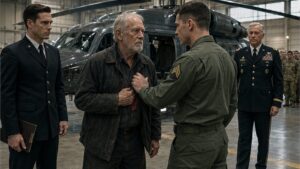
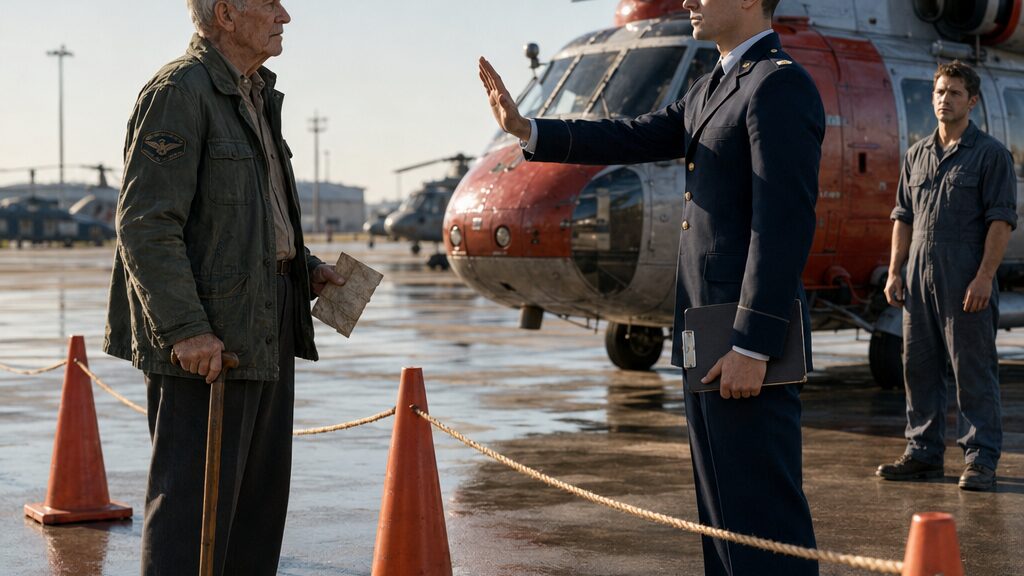
The young officer’s hand came up like a barrier before William Harris had crossed the first orange cone.
“Sir, stop right there.”
William stopped.
He had been walking slowly, not because he was lost, and not because the airfield confused him, but because the concrete beneath his shoes had pulled him backward through forty years of memory. The tarmac still held heat the same way. The wind still carried the bitter smell of fuel and cut grass. Farther out, a line of helicopters stood with their noses angled toward the morning light, their rotors tied down, their dark windows reflecting the pale sky.
One of them sat apart from the others.
Old. Broad-bodied. Faded at the edges.
The helicopter being retired.
William’s eyes found it before he saw the folding chairs, the speakers’ platform, the ropes, the camera tripods, or the neat row of uniforms moving with clipped purpose around it. For a moment, he forgot the ache in his left knee. He forgot the paper invitation folded in his breast pocket. He forgot the young officer watching him as if he were a problem that had wandered in from the parking lot.
Then the officer stepped closer.
He was maybe twenty-nine. Tall. Clean-shaven. Dress uniform pressed so sharply the sleeves looked edged with wire. His nameplate read Martin. His shoes had not yet learned dust. His face held the tight expression of a man determined not to be caught doing anything wrong.
“This area is restricted,” Officer Martin said.
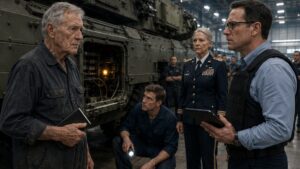
William looked at the cone line between them. It was a temporary boundary, bright plastic and nylon rope. Beyond it, soldiers carried cables across the tarmac, a maintenance crew wiped down the retired helicopter’s side panels, and a junior public affairs officer pointed toward the hangar doors where banners had not yet been unfurled.
“I was asked to come early,” William said.
The officer’s eyes traveled over him.
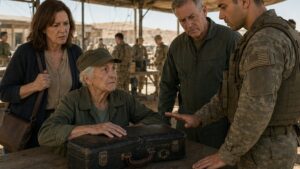
William knew what he saw. A tall old man made smaller by age. A green field jacket worn soft at the elbows. Brown shoes polished but old. No ribbons. No insignia. No escort. No laminated badge swinging from his neck. Only a folded paper invitation and hands that did not tremble unless the morning was cold.
“You were asked to come early by whom?” Tyler Martin asked.
William reached inside his jacket.
The officer’s hand moved toward his belt, not dramatically, but enough for William to notice. William paused, then slowly took out the invitation between two fingers.
“Ceremony office,” he said. “It came by mail.”
Tyler took the paper and opened it. His eyes narrowed at the crease lines, the worn corner, the coffee-colored stain that had bled across part of the printed name. William had folded and unfolded it more times than he cared to count since it arrived three weeks ago.
The officer read silently, but not long enough.
“This doesn’t have the current badge stamp.”
“It came in the envelope that way.”
“All event guests check in at the visitor tent.”
“I understand.”
“Then you need to go there.”
William looked past him at the helicopter. The maintenance crew had rolled a ladder beside it. Someone had polished the number on the tail, though not well enough to hide where the paint had weathered under sun and salt air. Near the rear, just below the stabilizer, a small mission marking had been restored in blue and gold.
His throat tightened before he could stop it.
“I only wanted a minute with the aircraft before the crowd,” he said.
Tyler folded the invitation with less care than William had unfolded it.
“Sir, I can’t allow that.”
There were already people watching. Not many, but enough. Two soldiers near a cart of bottled water had slowed their work. A maintenance crew member leaned out from behind the helicopter’s open side panel. A woman at the registration table glanced up, then back down, pretending not to listen.
William held out his hand for the paper.
Tyler did not return it at once.
“Are you former military?” he asked.
William gave a small nod.
“What branch?”
“Army.”
“This is an active ceremony area, sir. We have aviation personnel, invited families, command staff, and press coming in. It’s not a walk-through display.”
“I know what it is.”
The answer was quiet enough that Tyler seemed to miss the weight inside it. He looked again at William’s jacket.
“That coat part of a costume group?”
One of the soldiers by the water cart looked down.
William’s fingers closed once at his side, then opened. The jacket had been green once, truly green, before rain, engine grease, sun, and years of closet darkness had faded it into something softer. Inside the cuff, hidden unless the sleeve turned just so, was a patch no one had issued in decades.
“No,” William said.
Tyler’s mouth tightened. “Sir, I’m going to ask you not to make this difficult.”
“I’m not making it difficult.”
“You crossed into a restricted zone.”
“I stopped when you asked.”
“You approached an aircraft without authorization.”
“I have an invitation.”
“A paper invitation that doesn’t match our check-in protocol.”
“You can check the name again.”
Tyler exhaled through his nose. Not quite a laugh. Not quite patience. He opened the invitation again and angled it away from the breeze.
“The name is smudged.”
“It still reads well enough.”
“William H—” Tyler squinted. “Harris?”
William said nothing.
Tyler looked up. “There’s no Harris on my printed access sheet for early aircraft viewing.”
“Then the sheet may be incomplete.”
The officer’s chin lifted by a fraction.
On the far side of the tarmac, a group of veterans in caps had begun arriving. A shuttle stopped near the visitor tent. Folding chairs scraped inside the hangar. From somewhere behind the maintenance bay came the cough of a generator starting up.
Everything was moving toward ceremony.
William was standing still.
Tyler handed back the invitation. “I don’t know what you were told, Mr. Harris, but you can’t just show up at an airfield and expect access because you have an old piece of paper.”
William took the invitation and folded it along its existing lines. He slid it into his breast pocket, smoothing it once with his thumb.
“I didn’t just show up,” he said.
Tyler’s eyes flickered, but he had already decided what kind of man stood in front of him. That was clear in the way his shoulders squared, in the way his voice lowered into official firmness.
“Visitor tent is that way.”
William followed his gesture. The tent sat beyond the rope line, far from the helicopter, with a table, a plastic sign, and rows of folding chairs for guests waiting to be processed. It was shaded, orderly, and removed from everything he had come to see.
Behind Tyler, the maintenance crew member who had been watching shifted his gaze to William’s cuff. The breeze had lifted the sleeve just enough to show the faded edge of the old aviation patch. For one second, the younger man’s face changed. Recognition did not arrive, but uncertainty did.
Then Tyler stepped sideways, blocking William’s view of the helicopter.
“Please move along.”
William looked at the officer’s polished shoes, then at the cone line, then at the aircraft that had survived storms, mountains, floodwater, and the weight of men who did not all come home.
He had waited in worse places.
He turned toward the visitor tent.
Tyler pointed after him, sharper now, as if the gesture itself could erase the hesitation in the air.
“That aircraft is not for civilians.”
William did not turn back.
Chapter 2: The Helicopter They Were Retiring
The visitor tent smelled of coffee, vinyl chairs, and damp canvas warming under the sun.
William chose a seat at the far end, where he could see the retired helicopter through a gap between two support poles. The angle was poor. A rope line cut across the view. People moved in and out of frame: uniforms, camera operators, a mechanic carrying a toolbox, an event worker with a clipboard tucked under her arm.
Still, he could see the tail.
That was enough to make his hand go to his sleeve.
The mission marking was smaller than he remembered. Or maybe age had made memory enlarge everything. Blue and gold, a half circle around a winged rescue hook. Below it, a date. The paint was fresh, but the symbol was old. It belonged to a night when rain turned sideways, radios broke into static, and men listened for orders they hoped would never come.
William took his hand away from the cuff.
A volunteer at the table called names and checked them against a printed list. Guests answered too loudly, relieved to be recognized. A retired pilot in a cap complained about parking. A family with two children stood near a display board, the younger child asking why the helicopter looked tired.
Because it is, William thought.
He sat with both hands resting on the head of his cane. He had not needed the cane when he first wore the green jacket. Back then, he could climb into an aircraft before the rotors finished slowing. He could sleep upright in a hangar chair. He could read weather maps at three in the morning and know from the pressure lines who would be asking for help before dawn.
Now, a young officer had decided he was a wandering problem.
It should not have hurt.
A man who had ordered crews into storms had no business being wounded by a pointing finger and a nylon rope. He had known grief. He had watched good officers age overnight after making the right decision and paying for it anyway. He had signed letters to families. He had stood beside folded flags without trusting his voice.
Still, when Tyler Martin called the helicopter not for civilians, something old shifted in William’s chest.
He had not come to be honored. That was the part no one would believe if he said it plainly. The invitation had called him a guest of honor, but he had nearly thrown it away. The words had sat on his kitchen table for two days beside a glass of water and a bottle of pills, looking more like an accusation than a courtesy.
He came because of the aircraft.
He came because machines had memories if people gave them names.
He came because one crew chief had once slapped the side of that helicopter and said, “She’ll bring us home if you don’t ask her to lie.”
William had asked a great deal that night.
Beyond the tent, a mechanic climbed the ladder and wiped at the edge of the cockpit glass. The helicopter’s side door was open. Inside, the dark cabin waited like a room someone had left in a hurry. For a moment, William could almost hear the old rhythm: boots on metal floor, headset crackle, rain against the skin of the aircraft, the pilot’s voice clipped and steady.
Fuel at forty.
Wind from the east.
No visual.
Say again, command?
He closed his eyes.
When he opened them, the airfield was only morning again.
A woman sat two rows away, wearing a navy dress and a white cardigan despite the heat. She held a folded ceremony program in her lap, though the official ones had not yet been handed out. Her hair was silver and pinned neatly back. She had the posture of someone who had spent years holding herself together in public rooms.
She had been watching him.
William looked away first.
He did not want recognition. Recognition came with questions. Questions came with names. Names came with the night he had carried in silence because there was no fair place to put it down.
A shuttle arrived, and more guests entered the tent. The volunteer grew flustered. Someone could not find a seating card. A soldier brought more bottled water. The event moved forward without noticing the old man in the green jacket at the edge of things.
William took out the invitation again.
The paper had softened at the folds. His thumb brushed the stained corner. The coffee mark was his own fault. On the morning the envelope arrived, he had set his mug too close while reading the first line.
Dear Major General Harris,
He had folded the letter before finishing it.
Not because the title embarrassed him. Titles had their uses. They could organize chaos, assign responsibility, and remind a tired person that others were depending on them. But after retirement, a title could also become a costume other people placed on you when they wanted the comfort of a clean story.
He preferred William now.
A maintenance crew member crossed in front of the tent opening. He was young, maybe twenty-two, with grease on his forearm and a rag tucked into his belt. He slowed when he saw William and gave the quick, polite nod young service members sometimes gave to older veterans.
Then his eyes fell to William’s sleeve.
The wind had turned the cuff back again.
William noticed the look and covered the patch with his hand.
The young mechanic stopped for half a second too long. His eyes moved from the cuff to the helicopter’s tail marking, then back to William. His brow tightened as if trying to place a sound heard in another room.
Before he could speak, a voice called from behind him. He turned and hurried away.
William released the cuff.
The woman in the white cardigan had seen it too.
She rose slowly, one hand pressed against the chair in front of her. For a moment William thought she meant to pass him and go to the registration table. Instead, she came closer, stopping at the respectful distance of a person who understood that some silences had fences around them.
“That patch,” she said.
William looked at her then.
Her eyes were pale brown, clear, and searching. She was not looking at him as Tyler had looked at him. She was not measuring his clothes or his usefulness. She was listening backward.
“It’s old,” William said.
“I know.”
The answer struck him more sharply than accusation would have.
Outside, someone tested a microphone in the hangar. The speaker gave a low thump, then a squeal of feedback. People turned their heads. The woman did not.
William folded the invitation and put it away.
She glanced toward the helicopter. “I haven’t seen that marking in years.”
He said nothing.
Her fingers tightened around the program in her hand. “My husband kept a photograph with that insignia in his toolbox. Said nobody used it anymore because nobody wanted to remember that storm correctly.”
William’s mouth went dry.
The wind lifted the tent flap. Sunlight flashed along the helicopter’s side, catching the blue and gold of the restored mission marking.
The woman took one small breath.
“Blackwater Ridge,” she whispered.
Chapter 3: The Officer Who Would Not Check
By late morning, Tyler Martin had checked the guest list twelve times and still did not like the way the day was shaping itself around one old man.
The printed list sat on the registration table under his palm, clipped to a board and already marked with corrections. Three VIP names had been added by hand. Two Gold Star families had arrived early. A retired colonel had shown up with the wrong parking pass and an attitude Tyler could still feel behind his eyes. The public affairs officer wanted clear walkways. The security sergeant wanted no exceptions. Rebecca Hall wanted the ceremony to look effortless, which meant everyone else had to sweat before the cameras started rolling.
And then there was William Harris.
Tyler found the name nowhere.
He checked the early aircraft viewing sheet. Nothing. The VIP escort sheet. Nothing. The family seating list. Nothing. The general guest roster had a Harris, but not William. Carolyn Harris, guest of maintenance section. Different person. Different line.
He should have felt settled by that.
Instead, he kept seeing the old man’s face when he had looked past him at the helicopter. Not angry. Not confused. Not pleading.
Worse than that.
Familiar.
Tyler hated that the word had come to him.
He had been assigned access control because Patrick Green’s office wanted a junior officer who looked sharp, followed procedure, and would not get sentimental around veterans. Tyler knew that was not exactly a compliment. He also knew it was an opportunity. There were colonels coming. Local officials. Press. Families who deserved order. If he let one unauthorized person past the cone line and something happened, no one would remember that he had been kind.
They would remember that he had failed.
He tapped the roster with a pen.
The paper invitation bothered him most. It had looked legitimate in the way old things sometimes did, with formal language and a heavy seal faintly pressed into the page. But it lacked the updated badge stamp. The corner stain covered part of the printed title above the name. The old man had offered it without urgency, which Tyler had first taken for confusion and then for stubbornness.
You can check the name again.
Tyler had checked.
Nothing.
A gust swept across the tarmac, rattling the tent poles and sending a stack of loose seating cards sliding across the table. Tyler caught them before they scattered. The volunteer beside him gave a grateful smile.
“Thank you, sir.”
Sir.
He liked and disliked the word in equal measure.
It still felt new enough to polish his spine when he heard it. He had worked hard to earn it. He came from a house where authority meant being loudest, and he had spent years trying to become a different kind of man: precise, calm, worthy of trust. But some mornings, under inspection, with senior officers nearby and civilians asking questions he could not answer, the old fear returned. Not fear of danger. Fear of being seen as small.
Across the tarmac, William Harris sat in the visitor tent like a misplaced item no one had decided where to store.
The woman in the white cardigan had moved near him. Tyler noticed them speaking and frowned. He did not like side conversations around unclear access issues.
Rebecca Hall approached with a tablet against her chest and a headset tucked behind one ear. Her shoes clicked against the concrete with brisk irritation.
“Lieutenant Martin.”
He straightened. “Ma’am.”
“Why is there still a hold-up near the visitor tent?”
“There’s no hold-up.”
“There are three people asking whether early viewing has begun, and one of my staff said an elderly guest was stopped near the aircraft.”
“He attempted to cross the restricted line without current credentials.”
Rebecca glanced toward the tent. “The man in the green jacket?”
“Yes.”
“Is he press?”
“No.”
“Family?”
“Not on the list.”
“Veteran?”
“Possibly.”
“Possibly?”
“He said former Army.”
Rebecca’s mouth pressed thin. “Everyone here is former something. That’s why we have lists.”
“I understand.”
“Did he have paperwork?”
Tyler hesitated. “An old invitation. Not current.”
“Name?”
“William Harris.”
Rebecca looked down at her tablet, typed quickly, then frowned. “I don’t see him.”
“I checked.”
“Then why is he still sitting where the photographers can see him?”
Tyler blinked. “Ma’am?”
She lowered her voice. “We have command staff arriving in twenty minutes. The hangar floor opens in thirty. We cannot have confused guests drifting toward restricted areas or looking like they’ve been turned away from an event honoring veterans.”
Tyler felt heat rise under his collar. “I handled it respectfully.”
Rebecca’s eyes moved over his face just long enough to make him doubt that.
“I’m sure you did. Handle the rest. Move him to general seating or have the shuttle take him back to parking until check-in opens.”
“He may resist.”
“Then be clear.”
The word landed like an order and an accusation together.
Rebecca walked off before he could answer, already speaking into her headset about chairs, banners, and a missing podium seal.
Tyler picked up the clipboard.
The old invitation lay in his memory like unfinished paperwork. He could ask the security sergeant to call the ceremony office, but the ceremony office was buried in hangar setup. He could radio command admin, but if the answer came back that the man was nobody, Tyler would look like he had lost control over a routine access issue. If the answer came back that the man mattered, the question would become why Tyler had not known sooner.
He looked at the list again.
No William Harris.
That should have been enough.
He crossed the tarmac toward the visitor tent.
The closer he came, the more he noticed what he had ignored earlier. William’s shoes were old but polished. The cane was plain, not decorative. The green jacket was worn but clean, patched carefully at one elbow. The man sat upright, not slumped, both hands steady. The woman beside him had stopped speaking the moment she saw Tyler approach.
William looked up.
Tyler kept his voice low. “Mr. Harris, we need to relocate you.”
The old man’s expression did not change. “Relocate me where?”
“General seating opens soon. Until then, visitors need to remain behind the main line.”
“I am behind the line.”
“You’re drawing attention.”
The woman in the white cardigan turned sharply. “He is sitting in a chair.”
Tyler looked at her. “Ma’am, I’m not speaking to you.”
William’s eyes lowered for a second.
It was not submission. Somehow that made Tyler more uncomfortable.
The old man reached slowly into his jacket and brought out the invitation again. “Lieutenant, you have a job to do. I respect that. But someone at this base sent this to me. I came because I was invited.”
Tyler took the paper. The crease had opened from use. This time he saw the top line more clearly, though the stain still blurred part of it.
Dear Major General—
The rest disappeared beneath brown.
His thumb shifted over the stain.
Could be anything, he told himself. Could be an honorary line. Could be a mistake. Could be an old form. Could be someone’s idea of importance from another era.
The name below remained plain.
William Harris.
No rank visible. No badge. No escort.
Tyler handed it back. “This doesn’t match today’s credentialing system.”
“No,” William said. “I suppose it doesn’t.”
“Then I need you to cooperate.”
The woman stood. “You need to check the patch on his sleeve.”
Tyler barely looked. “Ma’am, I’m not verifying guests by clothing.”
William folded the cuff down before Tyler could see it properly.
“Please don’t,” he said softly to her.
That quiet request irritated Tyler more than protest would have. It suggested a private understanding happening around him, one he had not been granted access to. On his own tarmac. Under his responsibility.
He lifted his hand and pointed toward the farther edge of the visitor area.
“Mr. Harris, you can wait by the shuttle benches. When general entry opens, someone will process you with the rest of the public.”
The woman’s face changed. “The rest of the public?”
William rose before she could say more. It took effort, though he hid most of it. He steadied himself on the cane, then slipped the invitation back into his jacket.
“All right,” he said.
No argument. No explanation. No demand.
That should have made Tyler feel in control.
Instead, the old man’s restraint made the space around them feel suddenly too quiet.
From behind him, Rebecca’s voice cut across the tarmac.
“Lieutenant Martin, move the old man before the cameras arrive.”
Chapter 4: The Photograph Behind The Covered Wall
Rebecca Hall had built the ceremony backward from the photographs.
The speeches could run short, the coffee could go cold, and the wind could bother the microphones, but if the photographs landed cleanly, people would remember the day as successful. A folded flag beside the podium. Veterans framed against the retired helicopter. Families standing beneath the hangar lights. The commander unveiling the memorial wall while the cameras caught the first reaction.
That was the part she kept telling the staff.
“Do not uncover that display until the cue,” she said, pointing toward the far wall of the hangar. “Not halfway. Not for a preview. Not because someone asks. The reveal happens after the commander’s remarks.”
Two soldiers nodded beside the covered wall. The cloth over it was navy blue and weighted along the bottom so it would not flutter in the draft from the open hangar doors. Behind it, mounted on temporary panels, were enlarged photographs, mission summaries, crew names, and a restored squadron emblem that had taken three weeks to get approved because no one in the design office could decide whether the original blue was too faded to reproduce.
Rebecca had seen enough of the display to know it would work.
At the center was a black-and-white photograph taken decades earlier. A much younger officer stood beside the same helicopter when its paint was fresh and its panels still shone. He wore a green field jacket, one hand resting on the aircraft’s open door, his face turned not to the camera but toward someone outside the frame. Behind him, crew members moved in a blur of rain-dark uniforms.
The caption beneath the photograph had been covered separately with a strip of paper until the unveiling.
Rebecca knew the name. Everyone on the ceremony team knew the name. It had been in the program, in the commander’s draft remarks, in the final briefing packet, in the seating plan for the front row.
Major General William Harris.
She had said the name so often in planning meetings it had become part of the event vocabulary, like podium, banner, rope line, media riser. The ceremony was not only for the helicopter. It was for the rescue doctrine born from the Blackwater Ridge evacuation, for the crews who had flown through weather that should have grounded them, and for the commander who had made the decision that changed aviation rescue procedures across the region.
The guest of honor was supposed to arrive with command escort.
That was what the binder said.
Rebecca flipped open the binder again while a junior public affairs officer adjusted the microphone height. The schedule was printed in clean blocks.
1100: Final guest check-in.
1130: VIP arrival.
1145: Guest of honor escort to holding area.
1200: Ceremony begins.
She checked her watch.
The commander had not arrived. The escort had not reported. The guest of honor had not been brought inside.
And outside, an old man in a green jacket was causing confusion.
Rebecca pushed that thought away as soon as it formed. She did not have time for loose associations. Military events were full of green jackets. Old veterans wore them because they could not throw them away. Surplus stores sold them by the rack. A jacket did not make a guest of honor.
Still, when she crossed the hangar floor, her eyes returned to the covered wall.
A corner of the cloth had pulled tight across the central photograph, outlining the raised edge of the frame beneath it. She could not see the man’s face, but she remembered it clearly. Strong jaw. Dark hair. Eyes fixed somewhere past the moment. The kind of photograph that made a person look brave because the viewer already knew history had approved them.
Rebecca had spent years around ceremonies. She knew how memory was shaped. Lighting mattered. Order mattered. Who stood where mattered. If the wrong person stepped into the wrong frame, the whole message blurred.
Her headset crackled.
“Media van at Gate Two. Commander’s vehicle five minutes out. Still no confirmation on the Harris escort.”
Rebecca pressed a finger to her earpiece. “Say again. No confirmation?”
“Negative. Admin says the original escort officer was reassigned this morning. Replacement unclear.”
Rebecca stopped walking.
“Who was supposed to receive him?”
“Checking.”
She turned toward the hangar doors. Beyond them, the tarmac shone white in the noon light. The visitor tent trembled in the wind. Figures moved near it: soldiers, guests, one woman in a white cardigan, and the old man in the green jacket standing with a cane while Lieutenant Martin faced him.
A cold thread moved through Rebecca’s stomach.
No. That would be absurd.
She opened the binder and went to the guest packet. There should have been a photograph clipped behind the biography. There had been one in the earlier version, but the final packet used only the formal service portrait from decades ago, cropped tight in dress uniform. She stared at it. The man in the portrait was younger than the old man outside by half a lifetime. Broad shoulders. Controlled expression. Rows of ribbons. No cane. No faded jacket. No coffee-stained invitation.
People changed.
She hated that her first reaction to the thought was inconvenience.
“Can someone pull the arrival notes for Major General Harris?” she asked into the headset.
Static.
Then, “Working on it.”
The public affairs officer waved from the podium. “Rebecca, do you want the memorial lights warmer?”
She looked back at the covered wall. “No. Leave them.”
“Program stack just arrived,” someone called from the registration table.
Rebecca took one of the fresh programs and flipped it open. There, on the inside page beneath the ceremony title, was the line she had approved herself.
Guest of Honor: Major General William Harris, U.S. Army, Retired.
Below it was a small reproduction of the central photograph. Not large enough for the public to study yet, but clear enough.
Green jacket. Aircraft door. Same posture.
Rebecca looked up again toward the tent.
The old man was farther away now. Lieutenant Martin had moved him toward the shuttle benches at the edge of the visitor area. The woman in the white cardigan walked beside him, stiff with anger. William Harris—if that was who he was—did not appear angry at all.
That frightened Rebecca more.
A man wrongly placed in a story usually protested. He waved papers. He demanded a supervisor. He made the scene bigger.
This man had allowed himself to be moved.
Rebecca started toward the hangar doors, then stopped when two black vehicles rolled up near the command entrance. Staff members straightened. Soldiers adjusted their posture. The base commander had arrived.
Patrick Green stepped out before the driver could come around. He was in dress uniform, silver at the temples, moving with the contained speed of a man who disliked being late. He took one glance at the hangar, another at the aircraft, and then at Rebecca.
“Status?” he asked.
“Ceremony floor ready,” Rebecca said. “Media arriving. Families seated in ten.”
“General Harris?”
The question was quiet.
Rebecca felt every sound in the hangar sharpen around it: the scrape of chair legs, the hum of lights, the distant rotor clink in the wind.
“We’re confirming his escort now,” she said.
Patrick’s eyes narrowed. “Confirming?”
“There was a change at access control.”
He looked past her, out toward the visitor tent.
Rebecca followed his gaze. Lieutenant Martin stood near the shuttle benches, clipboard tucked under his arm. The old man in the green jacket sat alone now, his cane upright between his hands, his face turned toward the retired helicopter as though the ceremony had already begun without him.
Patrick did not move for a full second.
Then he said, “Why is the guest of honor sitting outside?”
Chapter 5: The Widow Who Knew The Patch
Debra Lopez had not planned to speak his name.
She had carried it for too many years already.
Not every day. Not even every month. Life had a way of putting ordinary things over old grief: grocery lists, doctor visits, birthdays, leaky faucets, the soft stubbornness of continuing. But some names did not vanish. They waited in drawers with photographs. They lived inside folded newspaper clippings and the backs of old toolboxes. They returned when a helicopter’s shape crossed the sky.
William Harris was one of those names.
Her husband had spoken it rarely, but never carelessly.
“Hard man,” he had once said, cleaning grease from under his nails at the kitchen table. “Not cruel. Just hard in the way command makes you when the weather is mean and people are waiting on rooftops.”
That had been before Blackwater Ridge.
Afterward, he did not speak of the man for nearly a year.
Debra watched William from the edge of the visitor area now, trying to fit the old face before her to the younger one from the photograph her husband had kept in the garage. The photograph had curled at the corners from humidity. In it, a group of men stood beside a helicopter after some operation she had never fully understood. One of them wore a green jacket with a patch at the cuff. Her husband had tapped that patch once and said, “That was before they changed the insignia. Harris never did like the new one.”
She had not known why the detail mattered until today.
William sat near the shuttle benches after Lieutenant Martin moved him there. The place was technically still part of the event area, but barely. It was where people waited when they had arrived too soon or belonged nowhere in particular. Behind him, a chain-link fence separated the airfield from the parking road. In front of him, the retired helicopter sat under increasing ceremony, polished and arranged, as if old machines could be made innocent by sunlight.
Debra approached slowly.
He knew before she spoke.
She saw it in the way his hand tightened on the cane, not enough for anyone else to notice, but enough for a woman who had spent years reading what men tried not to show.
“General Harris,” she said softly.
He closed his eyes.
Only for a moment.
When he opened them, he looked older than he had when the officer pointed at him. Not weaker. Just closer to something he had been keeping at a distance.
“Please,” he said. “Not here.”
Debra sat beside him without asking. The plastic bench was warm from the sun.
“My husband was on Crew Three,” she said.
William turned his head toward her.
The airfield noise seemed to step away. A generator thumped. Somewhere, a microphone squealed and was silenced. The helicopter waited.
Debra held the folded program in her lap, but her fingers had wrinkled the edge. “Raymond Lopez.”
William bowed his head.
He did not say he remembered. He did not need to.
The silence did that for him.
“He kept your picture,” Debra said. “Not the formal one. The one by the aircraft. Rain on everybody. You looking like you hadn’t slept in a week.”
“None of us had.”
“No.”
She looked at the helicopter’s tail. “He told me you gave the order to go back.”
William’s jaw shifted.
Debra had imagined this conversation before, though never here. In her imagination she had been younger and angrier. She had asked why. She had demanded a clean answer from a man whose voice on a radio had sent her husband into weather that swallowed maps. She had wanted someone to tell her whether sacrifice was noble because people said so afterward, or merely terrible with better lighting.
But age changed the questions.
So did seeing the man himself, sitting alone at the edge of a ceremony meant to honor him, treated as if he had wandered into the wrong place.
William spoke without looking at her. “There were thirty-two people on the north ridge. Flood took the bridge out. Two children had hypothermia. We had one aircraft that could still lift in that wind.”
“Raymond said they were already low on fuel.”
“They were.”
“You ordered them back anyway.”
“I did.”
The answer came cleanly. No decoration. No defense.
Debra felt the old pain rise, but it did not come with the same teeth. She had lived with the shape of that night for decades. She knew the official version. Rescue completed. Aircraft damaged. Crew chief lost during emergency extraction. Command decision later used in revised rescue doctrine.
Doctrine. That was the word institutions used when grief became useful.
“My husband said you sounded calm,” she said.
“I was not calm.”
“He said you were.”
“He needed me to be.”
For the first time, his voice roughened.
Debra turned toward him. “Did you know he blamed you?”
William’s hands remained on the cane.
“Yes.”
“Did you blame yourself?”
The old man looked at the helicopter then, really looked at it, as if every rivet had become a date.
“Yes.”
A breeze moved across the tarmac, lifting the edge of his green jacket. The cuff turned back again, revealing the faded patch. Debra stared at it, and suddenly she saw her husband’s hands holding that old photograph at the kitchen table. His thumb had covered one corner. His voice had been bitter, but not hateful.
“He said you wrote to me,” she said.
“I did.”
“I burned the first letter.”
“I know.”
Her eyes stung before she could stop them.
William reached into his jacket, not for the invitation this time, but only to press the fabric flat over the patch. The gesture was protective. Not of himself. Of a time that had become too easy for others to polish.
“I wrote badly,” he said.
“You wrote like a commander.”
“I was trying not to write like a man who had sent your husband into a storm.”
Debra looked down at the program. The official text praised courage, innovation, service, sacrifice. All good words. All too clean.
“Why didn’t you tell that officer who you are?” she asked.
William let out a faint breath that might have been almost a laugh if it had not carried so much weariness.
“Because if a man needs my rank before he can hear me, then my rank is not the lesson he needs.”
Debra sat with that.
Across the tarmac, Lieutenant Martin spoke with Rebecca Hall near the registration table. Rebecca’s face was pale now, her tablet clutched too tightly. The commander’s vehicle had arrived at the hangar entrance. Something had shifted. The ceremony machine had begun to realize one of its polished pieces was missing.
Debra should have felt satisfaction.
Instead, she felt the old grief opening toward something gentler and more difficult.
“My husband did not hate you at the end,” she said.
William’s head turned.
She had not known she would say it until the words were already there.
“He was angry. He had a right to be. But he told me once that if you had not sent them back, he would have gone anyway. He said that was what crews did when people were waiting.”
William did not answer.
The lines around his mouth deepened. His eyes stayed fixed on the helicopter, but Debra could see that he was not looking at metal anymore.
She reached into her purse and took out a small copy of the old photograph, folded inside a paper sleeve. She had brought it because she had not known what else to bring. Flowers felt wrong for an aircraft. A flag felt too public. The photograph had seemed honest.
She held it out.
William looked at it for a long time before touching it.
In the picture, he was young, rain-soaked, standing beside the helicopter in the same jacket. Debra’s husband stood half behind him, one hand raised as if telling whoever held the camera to hurry up.
William touched the edge of the photo, not the faces.
“I remember that morning,” he said.
“So do I, and I wasn’t there.”
Near the hangar, Patrick Green had begun walking quickly across the concrete with Rebecca beside him. Tyler followed several steps behind, his clipboard held like it had become too heavy.
Debra saw them coming.
So did William.
She leaned closer, lowering her voice. “They’re going to know.”
He folded the photograph back into its sleeve with great care and returned it to her.
“They already knew,” he said. “They just forgot to look.”
Debra watched the commander approach, watched the young officer’s face lose its certainty, watched the ceremony finally turn toward the man it had left outside.
Softly, because the name now felt less like accusation than witness, she said again, “General Harris.”
William looked at her, pain and warning both in his eyes.
“Please,” he said. “Not yet.”
Chapter 6: When The Hangar Remembered First
William heard Patrick Green’s footsteps before he saw his face.
There were ways men learned to move across a flight line. Even after years behind desks, even wrapped in dress uniform and ceremony polish, some carried the old rhythm: fast but not hurried, aware of rotors even when none were turning, eyes measuring distance, weather, people, risk.
Patrick still had it.
He stopped a few feet from the shuttle bench, close enough for respect, far enough not to make a performance of it. His face had changed since William last saw him. Older, broader, more careful. But the eyes were the same as the young pilot who had once stood in a briefing room at two in the morning, absorbing every word as if lives were hidden between them.
For a second, neither man spoke.
Then Patrick Green removed his cap.
“Sir,” he said.
The word traveled farther than he intended.
Tyler Martin stood behind him, color draining from his face. Rebecca Hall’s mouth parted slightly, then closed. Debra lowered her eyes to the program in her lap. Around them, the airfield seemed to notice the silence before the people did.
William looked at Patrick’s cap in his hand.
“Patrick,” he said.
The commander’s throat moved. “We were expecting you at the command entrance.”
“I expected to arrive quietly.”
“That’s not the same as outside.”
“No,” William said. “It isn’t.”
Patrick turned his head just enough to look at Tyler. He did not raise his voice. That made it worse.
“Lieutenant Martin.”
Tyler stepped forward. “Sir.”
“Did Mr. Harris present an invitation?”
“Yes, sir.”
“Did you verify it?”
“I checked the printed access sheet, sir. His name wasn’t—”
“Did you call command admin?”
Tyler swallowed. “No, sir.”
William shifted his cane slightly against the concrete. The small sound interrupted more effectively than a reprimand.
“Commander,” he said, “the lieutenant had a line to hold.”
Patrick looked back at him. “And a person in front of him.”
Tyler’s eyes dropped.
William rose from the bench. It took more effort than he wanted anyone to see. Patrick moved as if to help, then stopped himself when William’s gaze flicked toward him. The kindness was noticed. The restraint was appreciated.
“I came to see the aircraft,” William said.
“The aircraft is waiting for you inside the ceremony line.”
“That aircraft spent most of her life waiting for someone else.”
Patrick’s expression softened, but he did not press.
The ceremony was minutes from beginning. Guests had gathered inside the hangar. From where William stood, he could see rows of chairs, the podium, the folded flag, the covered memorial wall. The wall drew his eye with a force he disliked. He knew what waited beneath the cloth. He had approved the photograph only after Patrick wrote him twice and called once.
People should see the crew, William had said.
They will, Patrick had answered. But they should see the man who carried the order too.
Now that same photograph sat hidden while the living man had been placed outside.
Patrick gestured toward the hangar. “Will you come in?”
William looked at Debra.
She gave a small nod.
Not permission. Not forgiveness exactly. Something steadier than both.
He walked.
The distance from the shuttle bench to the hangar was not long, but the tarmac made it feel ceremonial before anyone announced anything. Conversations thinned as they passed. Soldiers straightened without knowing why. The maintenance crew member who had noticed William’s patch earlier stepped back from the aircraft and stared openly now. Tyler followed several paces behind, carrying the clipboard against his side, his confidence folding inward with each step.
At the rope line near the VIP entrance, Tyler moved ahead by habit.
Then he stopped.
William stopped too.
For a moment they stood on opposite sides of another temporary boundary.
Tyler looked at the rope, then at William. His hand trembled slightly as he unhooked the clasp and lowered the line.
“Sir,” he said, barely audible.
William passed through without comment.
Inside the hangar, the air changed. Cooler. Shadowed. Full of polished shoes, perfume, coffee, and the metallic echo of chairs scraping concrete. The retired helicopter sat just beyond the open door, half in sunlight, half in hangar shade. Its old body bore the ceremony’s attention with the patience of a machine that had carried worse burdens.
Rebecca hurried ahead toward the podium, whispering urgently into her headset. Patrick guided William not to the front row yet, but to the side of the memorial wall.
The navy cloth waited.
People turned.
A murmur moved through the hangar as they saw the commander walking with the old man in the green jacket. Some guests seemed confused. Others looked irritated by a delay they did not understand. A few veterans leaned forward, sensing a disturbance in protocol.
William felt Tyler behind him like a question no one had answered.
Patrick stepped to the microphone.
The feedback that followed was brief, but sharp enough to make the room wince. He adjusted the stand himself.
“Ladies and gentlemen,” Patrick said, “before we begin the scheduled remarks, there is something we need to correct.”
Rebecca stood beside the memorial wall, face carefully composed except for her eyes.
William’s hand tightened around the cane.
He had not wanted this.
He had wanted one minute alone with the aircraft, one private look at the cabin, one chance to place his hand where Raymond Lopez had once slapped the door and laughed at bad weather. He had wanted to leave before the words guest of honor became a shape people stared at.
But the room was staring now.
Patrick continued. “Today’s ceremony honors an aircraft, its crews, and a rescue legacy that shaped this unit. It also honors the commander whose decisions, doctrine, and burdens are part of that history.”
He turned toward William.
William did not move.
Patrick nodded to Rebecca.
She pulled the cord.
The navy cloth fell.
For a moment, the hangar did not understand what it was seeing.
Then the central photograph appeared fully under the memorial lights: a younger William Harris beside the same helicopter, rain darkening the shoulders of the same green jacket, the faded patch visible near his cuff. His face was leaner then, his hair dark, his posture rigid with exhaustion. Around him stood crew members, including Raymond Lopez half turned toward the aircraft door.
Below the photograph, the caption read:
Major General William Harris, Commander, Blackwater Ridge Rescue Operation.
A silence opened so completely that William heard the cloth settle against the floor.
Then chairs creaked. Someone drew in a breath. A veteran in the second row stood without seeming to realize he had done it. The maintenance crew member near the helicopter looked from the photograph to William’s sleeve and back again, his mouth slightly open.
Tyler Martin stared at the wall as if the photograph had struck him.
Patrick’s voice remained steady. “Major General Harris did not ask for ceremony. Most people who carry the heaviest parts of history rarely do. But this airfield owes him more than a program line. It owes him attention.”
William wanted to look away.
Instead, he looked at the photograph until the young man in it became a stranger again. That was easier.
Patrick stepped from the podium and came to him. He did not salute. Not yet. In this room, at this moment, a salute might have turned William into a symbol too quickly, and Patrick knew him better than that.
“Sir,” Patrick said quietly, “the floor is yours if you want it.”
William looked at the chairs. At the families. At Debra, sitting very still with her photograph held in both hands. At Tyler, whose face had gone pale with the slow understanding that he had not merely misread a credential. He had mistaken humility for emptiness.
William walked to the microphone.
Each step echoed.
He stood behind the podium, the green jacket out of place against the formal backdrop, the old invitation still folded in his pocket.
“I came early,” he said, “because I wanted to see the aircraft before anyone asked me what it meant.”
No one moved.
He looked toward the helicopter. “Machines do not become sacred because commanders stand beside them. They become sacred because crews trust them when there is no time left to be afraid.”
Debra lowered her head.
William paused. He would not tell the whole story. Not here. Not in a room hungry for clean meanings.
“There were people who came home because of this aircraft,” he said. “And there were people who did not. Any honor given today belongs first to them.”
He stepped back from the microphone before the silence could become applause.
Patrick’s eyes glistened, but he kept his composure. The room did not clap at first. It remained still, held by the weight of what had not been said. Then a few people rose. Others followed. The sound came slowly, not thunderous, not theatrical. Respectful. Uneasy. Human.
William did not look at Tyler until the applause faded.
The young officer had moved closer, his clipboard gone now, his cap held in one hand. His shoulders were no longer squared against the world.
“Sir,” Tyler began, voice rough. “General, I—”
William lifted one hand.
Tyler stopped before he could finish the title.
Chapter 7: The Seat He Chose Instead
Tyler’s unfinished apology hung in the hangar like a loose wire.
William kept his hand raised until the young officer’s mouth closed. The room waited with the hunger that always followed a public mistake. People wanted the next shape: forgiveness, reprimand, ceremony, punishment. Something they could understand and retell neatly.
William looked at Tyler’s face and saw no villain there. Only a young man stripped suddenly of the story he had told himself.
“Not that word,” William said.
Tyler swallowed. “Sir?”
“You were about to apologize to the general.”
The silence changed. It became sharper, less comfortable.
William rested both hands on the sides of the podium. The old wood beneath his palms felt smoother than it looked.
“The general was not standing at your cone line this morning,” he said. “An old man was. An invited guest was. A person was.”
Tyler’s eyes reddened, but he did not look away.
William turned slightly, not to make the lesson larger, but because the room needed to hear the quiet parts. “Rank has its place. Procedures have their place. Security has its place. But if a man must prove he was once important before he is treated with patience, then something has gone wrong long before the paperwork fails.”
No one clapped.
Good, William thought.
Applause would have let them escape too soon.
Patrick stood beside the memorial wall, cap tucked under his arm. Rebecca Hall’s headset hung loose around her neck now, forgotten. The ceremony program in her hands had bent where she gripped it.
William stepped away from the podium. The movement seemed to release the room. Chairs shifted. A few guests wiped their eyes. The maintenance crew near the helicopter stood stiffly, as if unsure whether they were part of the honored group or merely background to it.
William knew exactly where he wanted to sit.
Patrick moved toward the front row, where a card bearing William’s name had been placed in the center seat. It was flanked by command staff and local officials. A bottle of water waited beneath it. The view from there was perfect: podium, memorial wall, aircraft, cameras.
William walked past it.
A small confusion rippled through the first row.
Patrick followed with his eyes but did not stop him.
Debra Lopez sat three rows back near the aisle, not in the family section exactly, not among the VIPs either. Her program lay folded in her lap. Beside her were two empty chairs and, beyond them, a row of maintenance crew members who had been pulled from work long enough to attend the ceremony in clean uniforms that still carried the smell of oil.
William stopped at the empty seat beside Debra.
“Is this taken?” he asked.
Debra looked up at him. Her face held years he had not earned the right to disturb, and a steadiness he was grateful for.
“No,” she said. “It is now.”
He sat carefully, cane angled against his knee. The green jacket creased at his shoulders. In the central photograph, the younger version of him wore the same jacket without knowing how much life would ask of it.
Patrick returned to the microphone after a moment. He did not comment on William’s choice of seat. That, too, was kindness.
The ceremony resumed, though it was no longer the ceremony Rebecca had designed.
The words on the page were still spoken. The aircraft’s service record was read. The names of crews and missions moved through the hangar. But the tone had changed. The room listened differently now. When Patrick spoke of Blackwater Ridge, he did not polish it. He named the rescued. He named the lost. He named the decision without pretending decisions became easy because history later approved them.
Debra’s hand tightened once around her program.
William noticed but did not touch her. Some grief did not want comfort. It wanted witness.
When Raymond Lopez’s name was read, Debra closed her eyes. William lowered his head.
There were no rotors turning, yet in the silence after the name, he heard them anyway. Rain against metal. A voice calling fuel numbers. Raymond’s laugh over a bad headset connection. The weight of the order before he gave it. The worse weight after it worked.
After the final name, Patrick asked the maintenance crew to stand.
They did so awkwardly at first, surprised to be pulled into the center of the room. Their boots scraped concrete. One of them, the young mechanic who had noticed William’s patch, looked almost embarrassed.
Patrick said, “Aircraft do not carry memory by themselves. People maintain it.”
That was when William felt the first easing inside his chest. Not release. Nothing so simple. But the ceremony had turned toward the right people.
When the formal portion ended, there was applause, but it came softer than before, less like celebration than acknowledgment. Guests rose and began forming small lines near the memorial wall and the helicopter. Some approached William, then thought better of it when they saw he was speaking with Debra. Others nodded from a distance, which suited him.
Rebecca came first.
She stood at the end of the row, headset in one hand, tablet in the other. Without those objects in motion, she looked tired.
“Major General Harris,” she began, then stopped. Her eyes flicked to him with a question.
“William is fine.”
“William,” she said, with effort. “I’m sorry.”
He waited.
She glanced toward the hangar doors, where the rope lines still separated guests by category. “We built a ceremony about remembering and almost missed the person in front of us.”
“That is easier to do than people admit.”
She nodded once, accepting the mercy but not hiding inside it. “We’ll review the access process.”
William’s mouth softened. “Review how people are spoken to while they wait. The process will follow.”
Rebecca looked down at the bent program in her hand. “Yes, sir.”
She left quietly.
Tyler waited longer.
He stood near the memorial wall, cap in both hands, watching people pass the photograph. Twice he seemed ready to approach; twice he stopped. William let him struggle. Not out of cruelty. A real apology needed to cross distance under its own power.
At last Tyler came down the aisle.
Debra shifted as if to rise, but William touched two fingers lightly to the bench between them. She stayed.
Tyler stopped in front of him. The young officer’s uniform remained immaculate, but he looked younger now, almost painfully so.
“Mr. Harris,” he said.
William looked up.
Tyler took a breath. “I’m sorry for how I treated you when I thought you were just an old man with the wrong paperwork.”
William did not answer immediately.
Around them, the ceremony continued in fragments: low voices, footsteps, the click of a camera, a child asking whether the helicopter could still fly.
“That is the apology,” William said.
Tyler’s eyes dropped. “I should have checked.”
“Yes.”
“I should have listened.”
“Yes.”
“I thought if I held the line, I was doing the job.”
“Sometimes you are,” William said. “But a line is not there to save you from seeing who stands on the other side.”
Tyler absorbed that like an order he would have to keep for years.
“I’ll do better,” he said.
William believed him, though not because the words were polished. They were not. They came with shame still attached.
“Then start before anyone important is watching,” William said.
Tyler nodded.
A few minutes later, when guests were allowed closer to the retired helicopter, Tyler walked to the temporary rope line at the edge of the tarmac. An elderly veteran with a walker waited there while a soldier tried to explain the narrow approved path. Tyler listened, then unhooked the rope himself and widened the opening.
“Take your time, sir,” he said.
William watched from beside Debra.
The green jacket felt heavy in the afternoon warmth, but he did not take it off. Not yet. He rose when Debra did, and together they walked slowly toward the aircraft.
At the open side door, William stopped. The cabin smelled faintly of metal, dust, and old hydraulic fluid. The interior had been cleaned for display, but no one had managed to remove the work from it. Scratches marked the floor. Faded warning labels clung near the frame. A handhold near the door had been worn smooth by decades of gloves.
Debra reached into her purse and took out the photograph again.
“Raymond would have complained about all this attention,” she said.
William looked at the crew chief’s younger face in the picture. “He complained about most things.”
Debra gave a small laugh that broke before it finished.
William placed his hand on the side of the helicopter, just below the restored mission marking. The metal was warm from the sun.
“I came to tell them I remembered,” he said.
Debra stood beside him, close enough that their shoulders nearly touched. “Then tell them.”
William closed his eyes.
He did not speak loudly. He did not need the room, or the cameras, or the title printed in the program.
“Raymond,” he said. “Crew Three. North ridge. All of you.”
The wind moved across the tarmac and lifted the edge of his sleeve. The faded patch showed for a moment, blue and gold against worn green cloth, matching the mark on the helicopter and the photograph on the wall.
This time, William did not cover it.
Behind him, Tyler held the rope open for another old veteran.
The story has ended.