They Mocked The Old Veteran’s Rifle Until The Desert Target Came Back Silent
Chapter 1: The Old Man At The Desert Firing Line
The first thing Anthony Clark noticed was the old rifle case.
Not the man carrying it. Not the slow steps crossing the dusty road between the parked military trucks and the long line of firing mats. Not the faded brown jacket hanging loose on narrow shoulders in the morning heat.
The case.
It was wooden, scarred along the corners, its brass latch polished smooth by years of fingers. It looked as if it belonged in a closet beside moth-eaten uniforms and forgotten letters, not on a military range where carbon-fiber rests, digital wind meters, and polished modern rifles waited under the canvas shade.
John Martin carried it with both hands.
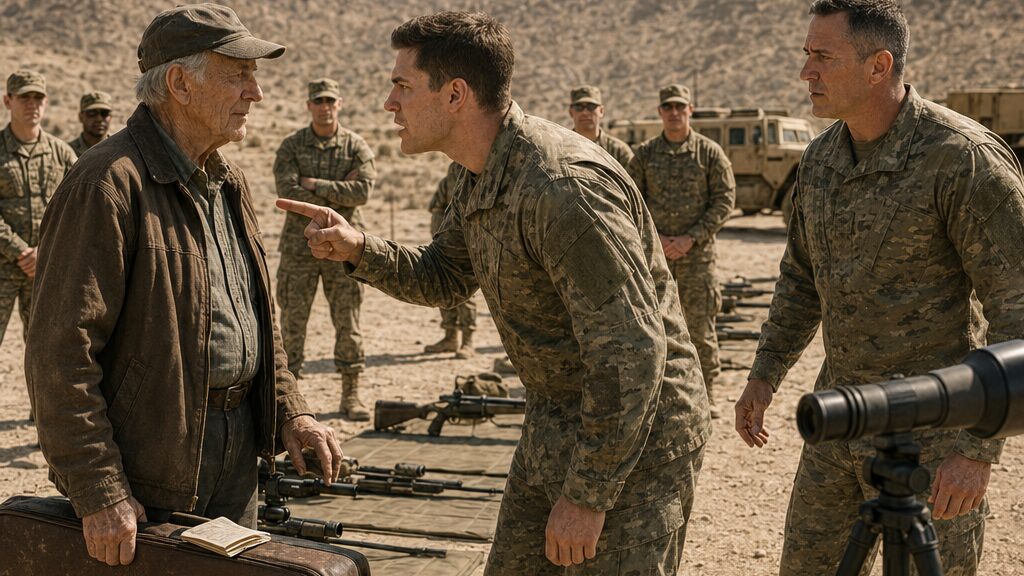
The desert wind moved low over the ground, lifting thin ribbons of dust. Downrange, paper targets hung at intervals against the pale distance. A spotting scope stood on a tripod near the center lane. Rifle mats lay in straight rows, dark and flat against the sand. Beyond them, soldiers in uniform checked gear, spoke in short bursts, and pretended not to stare at the old man.
John had learned long ago that young men stared differently from old men.
Young men stared to measure.
Old men stared to remember.
He stopped at the edge of the firing line and let his eyes travel across the range. The berm. The target frames. The left-to-right wind. The red safety flags. The faded sign bolted near the office trailer: DESERT MARKSMANSHIP CHARITY QUALIFICATION DAY.
Below it, a temporary banner flapped against its ropes.
DEDICATION CEREMONY AT 1700 HOURS.
John read it once and looked away before the ache in his chest could become anything visible.
A folded range card sat tucked into the inside pocket of his jacket. He felt it there when he shifted the rifle case to his left hand. The paper had softened at the creases. He had unfolded it only once that morning, in his motel room before sunrise, then put it away again.
He had not come to be noticed.
He had not come to shoot.
He had come because Margaret Lopez had written him a letter in careful blue ink and asked if he would stand present when her husband’s name went on the wall.
The range had changed since John last saw it. The old wooden benches were gone. The lanes were cleaner. The towers had new glass. The soldiers were younger than his grandchildren would have been, if life had given him any. But the desert still breathed the same. Dry. Patient. Unimpressed.
“Sir?”
John turned.
Anthony Clark came toward him from the center lane with the easy walk of a man who knew people were watching. He wore his uniform neatly, sleeves rolled with precision, sunglasses tucked into the front of his shirt. His voice carried before he arrived.
“This is a controlled line.”
John nodded once. “I can see that.”
Anthony’s eyes dropped to the rifle case, then to John’s hands. They were thin hands, knuckled and veined, steady around the handle but old enough to invite judgment. Anthony’s mouth tightened into something close to a smile.
“Are you here for the ceremony?”
“Yes.”
“That’s later. The spectator area is behind the rope.”
John looked toward the rope. Folding chairs had been arranged beneath a shade canopy near the office trailer. Volunteers moved coolers and clipboards. A few civilians stood there already, separated from the firing line as if age itself required a boundary.
“I was told to check in here,” John said.
“By who?”
“Mrs. Lopez.”
Anthony’s smile cooled. “Mrs. Lopez is helping with the dedication. She doesn’t run the firing line.”
“No,” John said. “I suppose she doesn’t.”
The answer seemed to irritate Anthony more than argument would have. He glanced toward the watching soldiers, then back at the old case.
“What’s in there?”
John rested the case gently on the ground, muzzle direction already in his mind though the rifle remained locked inside. “A rifle.”
A couple of men near the spotting scope laughed under their breath.
Anthony heard it and stood a little straighter. “This isn’t a display table. Personal weapons need to be cleared through range control before they come anywhere near my line.”
“I understand.”
“Do you?”
John looked at him then. Not hard. Not cold. Just directly enough that Anthony had to decide whether to keep leaning forward.
The younger man chose to lean.
“Because we get veterans out here sometimes,” Anthony said. “And I respect that. But today we’ve got active shooters qualifying, junior competitors watching, donors coming through, and a safety schedule that doesn’t bend because somebody wants to relive something.”
The words reached the men behind him. One of them looked away. Another pretended to adjust his ear protection.
John heard the insult settle in the dust between them.
Relive something.
There were things John did relive. The sound of a man laughing over black coffee at 0400. The weight of a range card passed back and forth between two younger hands. A voice saying, If the boys remember the rule, maybe they’ll remember us too.
But he had not come to relive those things in front of Anthony Clark.
He only bent slowly, set the rifle case flat beside his boot, and placed his old cap on top of it so the wind would not take it.
Anthony watched the movement as if it confirmed everything.
“You all right getting down there, sir?”
John straightened. His back objected. He let it. Pain was not an order.
“I’m all right standing here.”
“Good. Then stand behind the rope.”
The words came sharper this time.
Several heads turned. A young woman near the end lane, a cadet by the look of her posture, paused with a clipboard in both hands. John saw embarrassment cross her face, though it was not hers to carry.
Anthony stepped closer and lowered his voice just enough to make it more personal.
“Look, I don’t know what Mrs. Lopez told you, but I’m not letting an elderly civilian with an antique rifle wander onto a hot range. You can watch from the chairs.”
John’s thumb brushed the edge of the folded range card through his jacket.
For a moment, he considered taking it out. Not to boast. Not to win. Just to shorten the morning.
Instead, he left it where it was.
“A range is only hot when the line is declared hot,” John said quietly. “Your flags are up, bolts are open, and no one has called prep.”
Anthony’s expression shifted.
It was a small thing, almost invisible. The quick narrowing of the eyes when a man realizes the person in front of him has seen more than he expected.
Then pride covered it.
“You know some words. That doesn’t put you on my line.”
“No,” John said. “It doesn’t.”
Anthony looked toward the others again, and the need to remain in command hardened his face.
“Move the case.”
John did not move.
The desert wind made a dry whisper along the mats.
Anthony pointed toward the rope.
“Sir, I’m ordering you off the firing line.”
Chapter 2: The Young Champion Takes The Loudest Lane
John had been ordered off firing lines before.
Usually by men who knew exactly why they were doing it.
He lifted the rifle case without hurry. The old latch gave a soft click against the wood as it shifted in his hand. He stepped back from the edge of the mats and crossed toward the shade canopy, passing beneath the eyes of men who now had permission to look at him openly.
Anthony stayed where he was, speaking again before John had gone ten paces.
“Let’s keep personal items in the spectator area. If it hasn’t been inspected, it doesn’t touch my lanes.”
The words were not only for John. They were for the soldiers, the junior shooters, the donors arriving in clean boots, the range medic near the water table, and anyone else who might wonder who controlled the morning.
John reached the rope and set the case beside a folding chair in the shade.
A woman near the sign-in table turned when she saw him.
For a second, Margaret Lopez did not move. Then her hand went to her mouth, not dramatically, not for display, but as if she had seen a ghost walking in ordinary clothes.
“John,” she said.
He removed his cap. “Margaret.”
She crossed to him and took both of his hands. Hers were warm, smaller than he remembered, and stronger than they looked.
“You came.”
“You asked.”
Her eyes moved to the rifle case. “He would have liked that.”
John looked toward the firing line, where Anthony was now demonstrating prone position for a cluster of junior shooters. “He would have said it needed oil.”
Margaret smiled, and the smile almost held.
“He said many things needed oil.”
John lowered himself into the folding chair. The movement was slow enough to be noticed, and he knew it. Age had a way of turning every ordinary act into evidence for the prosecution.
Margaret sat beside him. “I didn’t know they would put you over here.”
“I’m all right.”
“I told the office you were coming.”
“I believe you.”
She watched Anthony lift his rifle from its case at the center lane. His equipment drew eyes immediately: clean, expensive, mounted with a scope large enough to make the older men murmur. He moved with practiced smoothness, calling out instructions in a voice that filled the range.
“That’s Anthony Clark,” Margaret said. “He won the regional service match last month.”
“I heard.”
“He’s good.”
John nodded. “He wants people to know it.”
On the line, Anthony dropped to the mat and settled behind the rifle. The junior shooters leaned in behind the safety mark. The young cadet with the clipboard stood to one side, attentive but guarded, her dark hair tucked beneath her cap.
“That’s Stephanie Harris,” Margaret said, following John’s glance. “She’s been helping with the youth program. Quiet girl. Watches everything.”
“That can be useful.”
“It can also make people overlook you.”
John said nothing.
Anthony’s voice cut across the range.
“Watch the sequence. Position first. Rifle follows the body, not the other way around. Speed matters, but only after control. You hesitate too much, you lose the shot.”
He looked toward the spectator canopy on the last sentence, not long enough for anyone to accuse him of cruelty, long enough for those who had seen the confrontation to understand.
John kept his hands folded loosely in his lap.
A donor near the water table whispered to another man, “That the old fellow he moved off?”
The other man shrugged. “Probably for the best. These events bring out all kinds.”
Margaret’s fingers tightened around the dedication program in her lap.
John looked downrange.
Wind had begun to work from the right. Not strong yet. Enough to touch paper. Enough to matter later if men believed expensive glass could do their thinking for them.
Anthony fired his demonstration string after the command. Five shots, crisp and quick. The target stayed downrange, but the spotting scope showed enough for the men nearby to nod. His group was good. Not perfect, but good enough to earn the small sounds people make when they want to approve of confidence.
Anthony rose and opened the bolt with a flourish that came half a second after safety required and half a second before anyone would object.
John saw it.
So did Stephanie.
Her eyes flicked from Anthony’s rifle to the red flag and back. Her lips parted, then closed.
Anthony turned to the juniors. “That’s what controlled speed looks like.”
One boy asked, “Do we get to try the center lane?”
“When you earn it,” Anthony said. “This lane isn’t for guessing.”
The boy flushed.
Margaret leaned closer to John. “Are you angry?”
“No.”
“You look angry.”
“I’m watching.”
“That used to worry my husband.”
“It saved him time.”
Margaret’s smile faded into memory. “He talked about this place near the end. Not the awards. Not the commanders. This range. He said everything important could be taught here if the teacher cared more about the student than the sound of his own voice.”
John’s eyes stayed on Anthony.
At the firing line, a junior shooter copied Anthony’s setup. The boy’s hands shook from excitement. His rifle remained pointed downrange, but his finger drifted too close to the trigger before the line had been called ready. Stephanie saw it first. Anthony was turned away, talking to the donor with the expensive watch.
John stood.
Margaret’s breath caught. “John?”
He did not cross the rope. He did not raise his voice. He only took two slow steps to the boundary and spoke in a tone that carried because it was calm.
“Finger straight until the command.”
The boy froze.
Stephanie moved immediately. “Finger straight,” she repeated, firmer now. She stepped in, corrected the boy’s hand, and checked the open bolt.
Anthony turned.
The range went still in pieces, as if each person noticed the silence at a different moment.
John remained behind the rope.
The boy swallowed. “Sorry.”
“No harm,” John said. “That’s why we say it before harm.”
Anthony’s face darkened.
“I had it,” he said.
John met his eyes. “Then we both saw it.”
A few soldiers looked down at their boots. Stephanie kept her hand lightly on the junior shooter’s shoulder, her face pale but steady.
Anthony walked toward the rope, each step controlled.
“You don’t instruct my line from the spectator area,” he said.
John picked up his cap from the chair and held it in both hands.
“No,” he said. “I suppose I don’t.”
Anthony’s jaw worked. Behind him, the target frames rattled softly in the wind.
“Then let’s make that clear,” Anthony said. “If you want to correct shooters on this range, sir, you can qualify like everyone else.”
Margaret stood. “Anthony—”
He did not look at her.
John felt the folded range card against his chest.
Anthony pointed to the farthest mat, the one nearest the open stretch where the wind crossed hardest.
“Or you can sit down.”
Chapter 3: The Commander Recognizes The Folded Card
By late morning, the heat had sharpened every edge of the range.
The metal legs of the spotting scope shimmered. Dust clung to boots and rifle cases. The shade canopy no longer felt like shade, only a thinner kind of sunlight. Downrange, target papers stirred with faint, nervous movements each time the wind curled across the open ground.
John stood behind the rope with his rifle case at his feet while Anthony waited for an answer.
The challenge had drawn people closer without anyone admitting they had moved. The junior shooters clustered near the water table. Uniformed observers formed a loose half circle behind the firing mats. Stephanie held her clipboard against her chest. Margaret stood very still beside John’s chair.
Anthony’s voice stayed public.
“Standard qualification distance. Five rounds. Farthest lane. Since you seem eager to advise.”
John looked toward the far mat.
It was a poor lane by design. The ground there dipped slightly before the mat, enough to disturb a prone position if a shooter did not settle properly. The wind came unevenly around the parked vehicles and cut across that side in shifting bands. Nothing unsafe. Nothing unfair enough to protest.
Just enough to reveal the person who had assigned it.
John bent for the rifle case.
Margaret touched his arm. “You don’t have to.”
“I know.”
“He would hate this.”
John looked at her then, and the years between them thinned. “No. He would hate why it happened.”
She let go.
John carried the case to the far mat. The walk took longer than it once would have. He heard someone murmur, “Careful,” as if his bones might scatter on the gravel. Another voice, lower, said, “This is ridiculous.”
Anthony heard enough to feed on.
“Range medic, stay awake,” he called, drawing a small laugh from two men near the trucks.
John stopped at the mat and set the case down with the muzzle end facing safely downrange. He knelt beside it, not yet opening the latch. His knee protested against the mat. His right hand paused near the brass catch.
For a moment, he was aware of how it must look: an old man bent over an old box while a young champion stood above him with the sun at his back.
Anthony folded his arms.
“Need help with that?”
John opened the case.
Inside lay the rifle, plain and cared for. Its wood stock carried small dents from years of use, darkened where hands had held it. No shining attachments. No showpiece engraving. No attempt to impress a modern eye. Beside it sat a cloth, a chamber flag, and the folded range card.
John removed the rifle with the same care he would have used lifting a sleeping child. He checked it visibly. Clear. Safe. Muzzle downrange. Bolt open.
The laughter weakened.
Not because he looked dangerous. He did not.
Because he looked exact.
Anthony stepped closer. “That thing is older than half the instructors here.”
“Older than some mistakes too,” John said.
A few men heard it and smiled before deciding not to.
Anthony’s cheeks colored. “You want to make jokes?”
“No.”
John laid the rifle on the mat and took the folded range card from the case. He smoothed it once with his thumb and placed it beside the ammunition box, where the wind tried to lift one corner.
Anthony glanced at it.
“What’s that?”
“Range card.”
“We have digital boards.”
“I saw them.”
“Then you won’t need it.”
John looked downrange, then at the flags, then at the shimmer above the sand. “Maybe not.”
A vehicle door shut hard behind them.
The sound turned heads before the voice did.
“Hold the line.”
Senior Range Commander Gary Moore walked from the command truck with his cap low and his sleeves buttoned. He did not hurry. Men like Gary had learned that authority moved best at a pace others could read. His face was composed, but his eyes took in everything: Anthony’s stance, the gathered crowd, Margaret near the rope, John on the far mat, the rifle, the card.
Anthony straightened. “Commander.”
Gary stopped beside the firing line. “Why is the qualification paused?”
Anthony answered quickly. “Civilian interference, sir. He corrected one of my juniors from outside the line. I offered him a chance to qualify if he wants to instruct.”
John kept his eyes on the open bolt.
Gary looked at him.
For the first time that morning, John saw recognition arrive in another man’s face and be restrained before it became speech.
Not surprise. Not confusion.
Recognition.
Gary took two steps closer. “Your name, sir?”
John picked up the range card before the wind could move it. “John Martin.”
The air changed.
Only slightly. Only for Gary. His eyes dropped to the card in John’s hand. He looked at the faded numbers in the upper corner, the old grid marks, the initials written in pencil near the bottom.
J.M.
And beside them, in another hand, smaller and neater:
L.L.
Gary’s throat moved.
Anthony missed none of it, though he understood none of it.
“Commander?”
Gary did not answer him at once.
“Mr. Martin,” Gary said carefully, “were you invited for the dedication?”
“Yes.”
“By Mrs. Lopez?”
“Yes.”
Margaret stepped forward. “I should have met him at the gate. This is my fault.”
John looked back. “No.”
Gary’s gaze remained on the range card.
Anthony’s confidence began to show its first crack. “Sir, with respect, I don’t know what the situation is here, but we have active lanes and a safety schedule. I can’t have—”
Gary turned his head.
Anthony stopped.
The silence held longer than a command.
Then Gary said, “Safety is exactly the situation.”
John folded the card once, not all the way, and set it back beside the rifle.
Gary saw the gesture. His expression tightened with something John wished he had not seen. Grief had many uniforms. Some wore rank.
“Do you wish to fire, Mr. Martin?” Gary asked.
John looked at Anthony.
The young man’s jaw was set, but uncertainty had entered his shoulders. He still wanted the crowd. He still wanted the old man small. But Gary’s tone had taken something from him and given nothing back.
“I didn’t come for that,” John said.
“No,” Gary replied softly. “I don’t imagine you did.”
Anthony forced a laugh. “Well, since we’re here, five rounds won’t hurt anything. If the rifle passes inspection.”
John’s eyes moved to him.
A lesser man might have used that moment to explain. A bitter man might have opened the past like a weapon. An old fool might have mistaken public attention for justice.
John only raised the rifle enough for Gary to inspect it.
Gary checked it properly, without theater. “Clear. Serviceable.”
Anthony stared at the rifle. “With that?”
John settled the buttstock gently near the mat, still not in position. “A rifle does not care how young you are.”
That time, no one laughed.
The target carrier at the far lane rattled as the scoreboard clerk clipped a fresh paper target into place. Its white surface flashed in the sun before sliding downrange, farther and farther until it became a small pale square against the berm.
Gary stepped back.
“Line remains cold until Mr. Martin is settled,” he said.
John lowered himself slowly onto the mat.
The movement took effort. He did not hide it. His left hand found the ground first, then his knee, then his hip shifted until his body aligned behind the rifle as if age were merely another condition to account for. The desert pressed heat through the mat into his bones.
He heard Anthony exhale through his nose.
He heard a junior shooter whisper, “Can he even see it?”
He heard Stephanie answer, barely audible, “Watch his hands.”
John placed the range card to his left and touched one finger to the corner to keep it from moving. He checked the chamber again. Checked the muzzle. Checked the flag. Checked the wind.
Then he drew one slow breath and let it leave him.
“The target will tell you,” he said.
Chapter 4: Five Shots Before The Wind Changed
The range waited for John Martin to become what Anthony Clark had already decided he was.
An old man in the wrong place.
John felt the weight of that waiting behind him. It had a sound, though no one spoke. Boots shifting on hard-packed sand. A cough held halfway. The faint scratch of Stephanie’s pencil against her clipboard, then the sudden stop when she realized she was writing nothing.
The rifle rested in front of him, plain and familiar.
John did not hurry to load.
He looked downrange first, past the black ring of the target, past the wavering heat, toward the flags that leaned and relaxed at uneven intervals. The closest flag moved left. The far one twitched right, then settled. Dust lifted along the tires of a parked vehicle and broke apart before it crossed the lane.
Anthony stood behind the line with his arms folded.
“You planning to wait out the weather?” he asked.
John kept his cheek away from the stock. “No.”
“Then what are you waiting for?”
“The wind to finish lying.”
A few of the younger shooters looked at one another.
Anthony gave a short laugh. “We’ve got wind meters for that.”
John glanced at the digital stand near the center lane. “I saw them.”
The commander did not smile. Gary Moore stood with his hands behind his back, eyes on the flags, then on John, then briefly on Anthony. Margaret watched from behind the rope with the dedication program held flat against her chest.
John placed one round carefully into the rifle.
The small metal sound of the chamber closing seemed louder than it should have.
“Shooter ready?” Gary called.
John adjusted his left elbow one inch.
“Ready.”
“Line is hot. Fire when ready.”
John settled into the rifle.
The world narrowed, but not quickly. He had never trusted the men who rushed into focus as if focus were a door they could kick open. He let the range come to him in pieces. The rough weave of the mat beneath his sleeve. The dry pull of the air at the back of his throat. The stock touching the same pocket of his shoulder it had known for years. The target floating small and white at the end of heat and distance.
His hands did not become young.
They remained old hands. Thin. Lined. Marked by time, weather, and small pains that arrived without invitation.
But when he breathed out, they remembered.
Half breath.
Hold.
Pressure, not pull.
The rifle spoke once.
The sound moved flat across the desert and returned from the berm a fraction later.
John opened the bolt, caught the rhythm of his own breathing, and did not look up.
Behind him, no one reacted. At that distance, without the target back, doubt had room to live.
Anthony leaned toward the spotting scope but did not step behind it. Pride kept him from appearing too curious.
John loaded the second round.
The wind shifted while his thumb touched brass. He felt it on his left cheek more than saw it in the flags. A little push. Then a softening.
He waited.
Anthony exhaled loudly enough to be heard. “Most people take the shot before lunch.”
John did not answer.
He had heard worse from better men and better from frightened boys.
When the wind thinned, he fired again.
The second report rolled out, calm as the first.
Stephanie finally moved to the spotting scope. She bent, looked, then froze.
John knew not to look at her. A shooter who looked for approval after every shot was no longer alone with the target. He loaded the third round.
Anthony noticed Stephanie’s stillness.
“What?” he said.
She stepped back from the scope. “Nothing.”
“What do you mean, nothing?”
She glanced at Gary.
Gary gave the smallest shake of his head.
Anthony’s mouth tightened.
John saw none of it directly. He saw the target, the shimmer, the wind’s small argument with the paper. The third shot needed less correction than the second. The fourth would need more if the far flag kept lifting.
He loaded. Breathed. Waited.
A memory came uninvited.
A younger man beside him in this same desert, belly down in dust, pencil tucked behind one ear, muttering, You always wait like the wind owes you money.
John had answered, The wind owes nobody. That’s why you listen.
The memory left before it could hurt him too much.
Third shot.
Open bolt.
Fourth round.
This time the wind did not lie. It announced itself plainly across the range, pushing dust low from right to left. John adjusted without touching the scope, only shifting the relationship between sight, breath, and patience.
Anthony stepped closer to Gary.
“Commander, are we logging this officially?”
Gary’s eyes stayed downrange. “Yes.”
“He’s shooting an old rifle from the worst lane.”
Gary looked at him. “You assigned the lane.”
Anthony said nothing.
John fired the fourth shot.
The silence after it was different. Not quiet yet. Not respect. Something more uncomfortable. The beginning of a room realizing it may have laughed too soon.
John placed the fifth round in his palm.
It sat there warm from the box and sun, small and final.
For the first time, he looked at Anthony.
The younger man held his stare, but there was less force in it now. Confusion had entered him, and confusion was often harder on pride than failure.
John almost felt sorry for him.
Almost.
Then he remembered the junior boy’s finger near the trigger. The careless flourish after Anthony’s demonstration. The way Anthony had said relive something in front of Margaret.
John closed the chamber.
The fifth shot mattered less for the group than for the lesson. Anyone could get lucky once. Some could get lucky twice and build a personality around it. Five shots asked for something luck did not like giving.
John breathed in.
Held half.
Let the old pain in his shoulder become part of the position instead of a reason to leave it.
Then he fired.
The rifle settled back into silence.
John opened the bolt, checked clear, and placed the safety flag where everyone could see it before moving his hand from the rifle.
“Cease fire,” Gary called. “Line is cold.”
Only then did John sit back from the stock.
Getting up took more effort than going down. His elbow trembled once. He heard Anthony’s breath catch, as if the tremor restored the old accusation. John accepted the tremor. He had no interest in pretending time had not touched him.
Stephanie went to retrieve the target with the scoreboard clerk.
No one talked while the carrier hummed back.
The white paper grew larger as it came in, swinging slightly on its clips. From a distance, it looked almost untouched.
Anthony saw that first.
A smile began to return. Not fully, but enough to reveal what he hoped.
Then the target stopped at the line.
The scoreboard clerk reached for it, paused, and lowered his hand.
Stephanie stared.
Gary stepped forward.
At the center of the black, five shots had made one torn opening, no wider than a man’s thumb. Not a perfect miracle. Not a circus trick. Something better. Human. Disciplined. Undeniable.
The desert range went silent in a way John had not heard since men stopped firing to listen for a command that mattered.
Anthony walked to the target.
He looked once.
Then again.
He reached out as if touching the paper might change it, but stopped before his finger reached the hole.
John stood beside his rifle case, cap in hand.
Nobody clapped.
That was good.
Clapping would have made it smaller.
Gary turned from the target to Anthony. His face held no triumph, only weight.
“Specialist Clark,” he said, quiet enough that everyone leaned in to hear, “look at the card again.”
Chapter 5: The Name Written Under The Safety Rule
The range office smelled of dust, old coffee, and paper that had spent too many summers near a swamp cooler.
John stood just inside the door while Gary placed the folded range card on the desk between them. Anthony remained near the file cabinet, arms no longer folded, eyes moving between the card and the target now lying flat beside it.
Margaret had come in last. She did not sit.
Through the office window, the firing line waited in subdued motion. The junior shooters had been moved to water and shade. Men who had been loud earlier now spoke in lower tones. Stephanie stood near the target stand outside, looking toward the office as if she expected the walls to explain what had happened.
John wished the walls would do it.
He had never liked being the subject of a room.
Gary unfolded the card carefully.
The paper had yellowed at the edges. Grid lines crossed the face in faded pencil. Wind notes, distance marks, and old range corrections filled the margins in two hands. John’s writing was cramped and hard. The other hand was smaller, clean, exact.
Gary touched the lower corner without pressing too hard.
“J.M.,” he said. “And L.L.”
Margaret closed her eyes.
Anthony looked at her, then back to Gary. “L.L.?”
“Lopez,” Gary said. “Lieutenant Lopez.”
The name entered the office and changed the air.
John looked at the target instead of Margaret. The torn center seemed too sharp under the fluorescent light. Proof had a way of looking rude after it had done its job.
Gary opened a drawer and removed a binder with a cracked black spine. He set it beside the card and turned several pages protected in cloudy plastic sleeves.
“Original desert range safety doctrine,” Gary said. “Before the new tower. Before the digital system. Before most of us knew this place existed.”
Anthony’s face had gone still.
Gary turned the binder so Anthony could read the page.
At the top was a typed rule, simple and severe.
Finger straight until command. Muzzle downrange until cleared. Speed never outranks safety.
Below it were signatures.
John Martin.
Lieutenant Lopez.
Anthony did not speak for several seconds.
When he did, the words came rougher than before. “I didn’t know.”
John picked up his cap from the corner of the desk. “Most people don’t.”
Gary looked at him. “They should.”
“No,” John said. “They should know the rule. Names matter less.”
Margaret turned then. “Not today.”
John met her eyes and saw that he had hurt her, though he had tried not to. Her husband’s name was why they were here. Her grief had been patient through the morning’s insult, through the target’s return, through the silence afterward. But patience was not absence.
Gary closed the binder halfway. “Mrs. Lopez asked that today’s dedication include the men who built the standard. She listed both names.”
John’s jaw tightened.
“I told her one name was enough.”
Margaret’s voice stayed calm. “And I ignored you.”
Anthony looked from one to the other. “You trained here?”
John let the question sit.
Gary answered when John would not. “He trained instructors here. Before the range became what it is. Before half the current qualification procedures were adopted.”
Anthony’s eyes dropped to the target. “With that rifle?”
John looked at the old case leaning against the wall. “With many rifles. That one stayed.”
“Why bring it?”
Margaret answered softly. “Because my husband helped him bed the stock after a sandstorm cracked it.”
John remembered the night. Two younger men under a bare bulb in a maintenance shed, laughing because the wind had ruined everything except their stubbornness. Lopez with glue on his thumb, saying, If this thing outlives us, you better not let some fool sell it for parts.
John had promised.
He had kept worse promises and easier ones. This was one of the few that still warmed him.
Anthony swallowed.
Outside, a vehicle started and then shut off again. No one in the office moved toward the sound.
Gary tapped the binder page. “Specialist Clark, read the last line.”
Anthony bent slightly.
His voice was lower than it had been all morning.
“Speed never outranks safety.”
Gary waited.
Anthony’s shoulders shifted. “Sir, I saw the junior’s hand late.”
John said nothing.
Gary’s eyes hardened. “Did you?”
Anthony looked at him. “I saw it after Mr. Martin spoke.”
The admission cost him. John could see that. Anthony had built himself around being watched. Now the same eyes that fed him had become a weight.
Gary closed the binder.
“You challenged the man who helped write the rule you nearly missed.”
Anthony looked at John.
For the first time, he did not seem to know where to put his hands.
“Mr. Martin,” he said, “I was out of line.”
John heard the apology. He also heard what it was not yet. It was not understanding. It was not humility. It was a man stepping back from a hot surface.
“That happens,” John said.
Anthony frowned, almost relieved by the mildness.
Then John added, “The danger is when a man gets comfortable staying there.”
The office went quiet again.
Margaret looked down, and this time the corner of her mouth moved.
Gary placed the range card beside the binder. “The dedication ceremony is still at seventeen hundred. I’d like this card displayed with the doctrine page.”
“No,” John said.
Margaret turned sharply. “John.”
He touched the folded crease with one finger. “Not yet.”
Gary studied him. “Why?”
John looked through the window at the range. Stephanie was correcting the junior boy’s stance, gentle and precise. Anthony’s earlier confidence still hung over the day like dust that had not settled.
“Because paper behind glass won’t teach what went wrong out there.”
Anthony’s face tightened.
Gary understood before the others did. “You want the qualification to continue.”
“I want the lesson to continue.”
Margaret looked at him for a long moment. “He would have liked that.”
John picked up the range card and folded it along the old lines.
Anthony watched the movement.
“What lesson?” he asked.
John put the card back into his jacket pocket.
“The one you almost missed twice.”
Chapter 6: Anthony Fires Faster Than He Thinks
By afternoon, the desert had burned the softness out of the day.
The qualification lane reopened under a white sun. Shadows shrank beneath trucks and boots. The junior shooters returned quieter than before, each of them aware that something had happened among the adults but not all of them old enough to name it.
Anthony Clark took the center lane again.
This time, no one cheered his return. No one joked about the old rifle case. The target with John’s five-shot group had been removed from sight, but its absence did not erase it. If anything, the empty space where it had hung seemed to hold the shape of it.
John sat beneath the shade canopy with Margaret, his rifle case closed beside his chair. The folded range card was back inside his jacket pocket, heavy as a stone.
Margaret handed him a paper cup of water.
“You could have let it end in the office,” she said.
John took the cup. “It wouldn’t have ended.”
“No?”
“He apologized to a name. Not to the rule.”
She watched Anthony kneel beside his rifle. “You’re hard on him.”
“I’m trying not to be.”
That was the truth, and not all of it.
John could feel the old pride in himself, the small dark satisfaction that had risen when the target came back and Anthony’s face changed. He did not like that part of himself. Pride was not always loud. Sometimes it sat quietly in an old man and called itself justice.
He had spent a lifetime teaching young shooters that the smallest uncontrolled pressure could move a shot. The same was true inside a person.
Anthony was pressure now.
He moved too quickly. Not recklessly enough for Gary to stop him outright, not carelessly enough for the crowd to gasp, but quickly in all the wrong places. Magazine checked twice, shoulder set hard, cheek down before breath settled. His motions were clean to untrained eyes. To John, they were a man trying to outrun embarrassment.
Gary stood at the command position.
“Shooters on the line, prepare for timed qualification.”
Anthony’s jaw flexed.
Stephanie stood behind the junior shooters, clipboard in hand. She looked once toward John, then away as if embarrassed to be caught needing permission to watch.
John gave no sign.
The command sequence began.
Anthony loaded. Others loaded. The targets waited downrange, white and indifferent.
“Ready on the left.”
A pause.
“Ready on the right.”
The wind moved.
John felt it touch the side of his face and drift past. A dirty, uneven wind, broken by vehicles and the low berm. Anthony glanced at the digital meter, then back through his scope.
Too fast, John thought.
“Fire.”
The lane erupted in controlled reports.
Anthony’s first shot broke early, before his breathing had reached bottom. His second corrected too much. His third tried to recover what the first two had disturbed. By the fourth, his body knew the target was no longer the only thing being measured.
John watched the back of his head more than the rifle.
A shooter told on himself before the paper did.
Anthony finished first.
He opened the bolt and sat back, breathing through his nose. It was a good performance if judged by speed. Even the group would likely be respectable. Good enough for ordinary praise. Not good enough to quiet what had already been awakened.
The other shooters completed their strings. Gary called the line cold. Targets returned.
Anthony’s target came in.
The group sat inside the scoring ring, but loose. One shot had drifted wide enough to make the story visible.
Nobody mocked him.
That seemed to make it worse.
Anthony stared at the paper with the expression of a man who would rather be insulted than quietly understood.
Gary approached. “Safe score. Not your best.”
“No, sir.”
“Why?”
Anthony’s answer came too quickly. “Wind changed.”
John closed his eyes briefly.
Margaret saw. “What?”
“That answer is easier than the true one.”
Gary heard Anthony out without expression. “Did it?”
“Yes, sir.”
Gary looked toward John.
John wished he had not.
Anthony followed the glance. His face hardened again, but not as securely as before.
“Mr. Martin has an opinion?” Anthony asked.
John rose slowly.
His knees had stiffened from sitting. He gave them time, because rushing to hide age was still rushing. Margaret took his cup. He walked to the edge of the rope but did not cross it.
“You fired faster than you thought,” John said.
Anthony laughed once. “That doesn’t make sense.”
“Yes, it does.”
“My time was within standard.”
“I didn’t say faster than the clock.”
The junior shooters leaned in without moving their feet. Stephanie’s pencil hovered over her clipboard.
Anthony looked irritated, but beneath it something else showed. He wanted to know. That was the first useful crack.
John pointed, not at Anthony’s target, but at Anthony himself.
“You fired faster than your breath. Faster than your sight settled. Faster than your mistake could teach you. After the first shot, you were chasing the group instead of building it.”
Anthony looked down at the target.
John added, “The wind moved. You moved more.”
No one spoke.
The words were not cruel. That made them harder to reject.
Anthony’s mouth tightened. “Easy to say after watching.”
“Most things are.”
Gary’s face shifted as if he nearly smiled.
Anthony pulled the target from the carrier clip. “So what, I slow down and magically shoot like you?”
“No.”
“Then what’s the lesson?”
John looked at the junior boy from the morning. Then at Stephanie. Then at the rifle on Anthony’s mat.
“The lesson is not to let pride touch the trigger.”
Anthony stared at him.
For a moment, anger rose again, hot and familiar. John could see it looking for a place to go. But the morning had taken away its easiest roads. Anthony could not mock the old hands now. He could not dismiss the rifle. He could not pretend Gary had not opened the binder.
So the anger folded inward.
“I’m the one they watch,” Anthony said, quieter.
John heard the truth beneath it.
Anthony looked toward the juniors and the donors, toward the soldiers who had seen him confident and then uncertain. “You make one mistake out here, they remember.”
John walked a few steps closer to the rope.
“Yes,” he said. “So give them something better to remember after it.”
Anthony did not answer.
Stephanie stepped forward before her courage could leave.
“Mr. Martin?”
John turned.
She held the clipboard tight against her chest. “What is he doing wrong?”
Chapter 7: The Lesson Was Never The Shot
For a few seconds after Stephanie asked the question, no one moved.
What is he doing wrong?
The words sat in the hot air between the firing line and the shade canopy, plain and dangerous in the way honest questions could be dangerous. They were not an accusation. They were worse for Anthony than that. They were a request to learn in front of everyone.
Anthony looked at Stephanie first.
She did not look away.
John saw her hands tighten around the clipboard, but her chin stayed level. Courage, he had learned, was not the absence of shaking. It was deciding where the shaking would stop.
Gary stood near the command position, silent. Margaret sat under the canopy with the dedication program folded in her lap. The junior shooters watched Stephanie as if she had stepped into a place none of them had known existed.
Anthony gave a short breath through his nose. “I know what I did wrong.”
Stephanie’s eyes stayed on John.
John did not answer immediately. He looked at Anthony’s rifle lying open and safe on the mat. He looked at the loose group on the target. Then he looked at Anthony, who had been loud all morning and was now discovering the unpleasant weight of quiet.
“You want my answer?” John asked.
Stephanie nodded.
Anthony said nothing.
John stepped over the rope only after Gary gave a small nod. He moved slowly to the center lane. Each step gave the watchers time to see that his body was old and that old did not mean careless. He stopped beside Anthony’s mat but did not touch the rifle.
“First,” John said, “he was safe enough.”
Anthony’s eyes flicked up, surprised.
“Safe enough is not the standard,” John added.
The younger man’s face changed again.
John pointed downrange. “He knew where the muzzle was. He opened the bolt when ordered. He followed the range commands. But before the first shot, he let the room get louder than the target.”
Stephanie wrote that down.
John almost told her not to. Some lessons died when turned into phrases too quickly. But she was listening with more than the pencil, so he let her continue.
Anthony looked at the target. “I rushed.”
“No,” John said. “Rushing is sometimes necessary. You performed.”
The word landed hard.
Anthony’s jaw moved, but he did not argue.
John knelt beside the mat with the care of a man lowering himself into a memory. The heat came through the canvas. The smell of dust and oil rose from the rifle. He placed one hand flat on the mat, not near the weapon.
“When a shooter performs, he asks the crowd whether the shot was good before the trigger breaks. When a shooter works, he lets the target answer after.”
A junior shooter whispered, “The target will tell you.”
John looked toward him.
The boy flushed.
John gave one small nod. “Yes.”
Anthony’s voice came lower. “And you want me to shoot again?”
“No.”
That answer surprised nearly everyone.
John reached into his jacket and removed the folded range card. He unfolded it halfway, enough for the old crease to show, enough for the penciled initials to catch sunlight.
“I want you to remember why this place exists.”
Anthony stared at the paper as if it had become more difficult to face than the target.
Margaret rose from the canopy and came closer. She stopped behind the rope, hands clasped.
John kept his eyes on Anthony.
“I came today because Margaret asked me to stand present while her husband’s name went on that wall. He was better than me at many things. Faster with numbers. Kinder with frightened students. Less stubborn when a man offered help.”
Margaret looked down, smiling through the ache.
John swallowed once, then continued.
“He used to say a range teaches the truth twice. First, it teaches where the bullet went. Second, it teaches why the person sent it there.”
The wind moved across the line, lifting one corner of the target Anthony had fired.
Anthony glanced toward the juniors. Some part of him still cared who watched. But now that care had changed shape. It was no longer hunger. It was shame trying to decide whether it could become responsibility.
“I thought he came to show us up,” Anthony said.
John folded the card along the old line. “No. You hoped I did.”
Anthony looked at him sharply.
John’s voice remained even. “If I came to show you up, then you were only guilty of losing. Easier to carry. But if I came for something that mattered, then you mocked a thing you did not understand.”
Anthony’s face tightened, then fell.
For the first time that day, he looked young.
Not strong young. Not loud young. Just young.
John felt the old pride in himself stir again, wanting to press the advantage, wanting to make the lesson complete by making the man smaller. He held that impulse the way he held a bad shot—recognized, corrected, not obeyed.
He looked at the rifle.
“Pick it up,” he said.
Anthony blinked. “Sir?”
“Pick up your rifle.”
Anthony glanced at Gary.
Gary said nothing.
Anthony lowered himself to the mat and took the rifle properly, keeping it safe, bolt open. John watched every motion.
“Not yet,” John said.
Anthony froze.
“Before you touch that rifle like it owes you redemption, say the rule.”
Anthony’s face flushed. “Mr. Martin—”
“Say it.”
The line went still.
Anthony looked at the juniors, then at Stephanie, then at Margaret. He could refuse. John saw that possibility move through him. Refusal would save the last scrap of his old pride and cost him the chance to become more than it.
Anthony looked down at the mat.
“Finger straight until command,” he said. “Muzzle downrange until cleared.”
John waited.
Anthony’s throat worked.
“Speed never outranks safety.”
John held the range card out.
Anthony did not take it at first.
“You don’t get this because you lost,” John said. “You get it because you’re still on the line.”
Anthony took the card carefully, as if old paper could bruise.
John shifted back, giving him room.
“Now,” John said, “breathe before you prove anything.”
Anthony settled behind the rifle.
This time, he did not look at the crowd.
Chapter 8: The Target Came Back Quiet
The sun had begun to lower when the dedication wall finally took the light.
It stood beside the range office, a plain stone panel set beneath the flag and protected from the worst of the wind by a low awning. Earlier in the day, most people had passed it without slowing. Now they gathered before it in a half circle: soldiers with dusty boots, junior shooters holding empty chamber flags, donors who had stopped checking their phones, the range medic, the scoreboard clerk, Stephanie with her clipboard lowered at her side, and Anthony Clark standing near the front with his cap in both hands.
John remained near the back.
He preferred it there.
Margaret stood beside the covered plaque. Gary waited a step behind her, a folded paper in his hand. The old range card lay on a small table beside the binder page from the office, both placed under a temporary sheet of glass until the permanent case could be mounted.
John had objected once more.
Margaret had looked at him once.
That had ended the objection.
Anthony’s second string had not been perfect. That mattered more than if it had been. His group tightened. His timing slowed. One shot still drifted, but he called the error before the target returned, naming his own breath instead of blaming the wind.
The junior shooters had heard him.
So had John.
That was enough for the afternoon.
Gary stepped forward when the range settled.
“We came here today to dedicate this wall to Lieutenant Lopez,” he said.
His voice carried without force. The desert seemed to accept it. Even the wind had softened, moving now in long warm breaths over the parked vehicles and empty mats.
“Many of you knew him by reputation. Some knew him personally. Some of you only know the rules he left behind. That is not a small thing.”
Margaret looked at the covered plaque but did not touch it yet.
Gary continued, “A range is a place of skill, but skill without discipline is only noise. Lieutenant Lopez believed that. So did the man who stood beside him when these standards were written.”
A few heads turned toward John.
He looked at the ground.
Gary did not call him forward.
For that, John was grateful.
Margaret lifted the cloth from the plaque.
The name appeared in dark letters.
LIEUTENANT LOPEZ
FOR THE RULES THAT BROUGHT THEM HOME SAFELY
Below it, smaller:
Finger straight until command. Muzzle downrange until cleared. Speed never outranks safety.
John read the words once and felt the years fold inward.
He remembered Lopez younger than any of the men on the line today. Laughing with dust on his teeth. Cursing a broken staple gun. Holding the same range card under a dim light and saying the rule needed fewer words because frightened people remembered short sentences.
He remembered the last letter, too. Not the whole thing. Only one line.
Don’t let them turn safety into a slogan, John. Make them mean it.
Margaret touched the edge of the plaque.
Then she turned toward John.
He shook his head slightly.
She ignored that, too.
“John Martin came today because I asked him,” she said. “He did not come to be honored. That is why he should be.”
John closed his eyes for a moment.
When he opened them, Anthony had turned halfway toward him. There was no challenge in his face now. No performance. Only the discomfort of a man who knew an apology given privately would not repair a disrespect made publicly.
Anthony stepped forward before Gary could speak.
“Mr. Martin,” he said.
John lifted his eyes.
Anthony faced him fully.
“I treated you like you were in the way.” His voice was tight, but steady enough. “I judged your age, your rifle, and your silence before I understood why you were here. I also missed a safety correction I should have caught.”
He looked back at the junior shooters.
“They saw that. So they should hear this too.”
The range held quiet.
“I was wrong.”
John watched him.
Anthony seemed to expect either forgiveness or punishment. Perhaps both. Young men often thought consequences came dressed as one of those two things.
John gave him neither.
He walked forward, slow under the sunset, until he stood near the table with the card beneath the glass. He looked at Anthony, then at the juniors.
“You were wrong,” John said.
Anthony accepted it with a small nod.
John looked at the young shooters. “So was I, a long time ago. More than once. Difference is, I had someone beside me who corrected me before my pride became habit.”
Margaret’s hand covered her mouth.
John turned to Stephanie.
She stood so still he might not have noticed her if he had not been watching all day.
“You asked the useful question,” he said.
Stephanie looked startled. “Sir?”
“What is he doing wrong?” John said. “That question protects more people than pretending you already know.”
He reached into his jacket and found nothing there, then remembered the card was under glass now. The absence felt strange. Light, and not entirely comfortable.
He looked at Gary. “The first lesson on this wall should not be mine.”
Gary understood. “Whose should it be?”
John looked at Margaret.
Her eyes shone, but she smiled.
Then he looked back at Stephanie. “Hers.”
Stephanie’s lips parted. “I’m not the best shooter here.”
“No,” John said. “That helps.”
A few soft laughs moved through the group, not mocking, not loud.
John nodded toward the final lane, where the mats lay empty in the gold light. “Best shooters are sometimes busy proving it. Good students are busy learning.”
Anthony stepped aside.
Not dramatically. Not as a show. He simply moved and left the path open.
Stephanie walked to the lane with the careful focus of someone afraid of ruining a moment and determined not to. John did not follow her onto the mat. He stayed behind the line and let Anthony stand nearer, close enough to assist, far enough not to own her shot.
“Command sequence,” John said.
Anthony looked at him, then at Stephanie.
His voice came clear.
“Finger straight until command. Muzzle downrange until cleared. Speed never outranks safety.”
Stephanie repeated it.
So did the junior boy from the morning.
Then, one by one, the others joined, not loudly, not like a chant, but like men and women checking the same knot.
John listened.
The desert took the words and carried them low across the range.
Stephanie fired one careful shot. It was not perfect. It did not need to be. When the target came back, the hole sat inside the ring, clean and honest.
No one cheered.
Margaret looked at the target and whispered, “He would have liked that.”
John put on his old cap.
Anthony approached with the rifle case. He held it respectfully, both hands under the worn wood.
“I can carry it to your truck,” he said.
John took the case from him.
“No,” he said. “But you can walk with me.”
They crossed the dusty road together as the range settled behind them. Military vehicles caught the last light. The spotting scope stood folded near the center lane. The mats lay empty, waiting for the next morning and the next student and the next chance for someone to remember before harm.
At the truck, John paused and looked back.
The wall was small from there. The people around it were smaller. But the card beneath the glass caught a flash of sunset, and for a moment the old paper looked less like something preserved than something still working.
Anthony stood beside him, quiet.
John opened the truck door and set the rifle case inside.
“Mr. Martin,” Anthony said, “will you come back?”
John rested one hand on the door.
The answer that rose first was no. He was tired. His shoulder hurt. The day had asked more of him than he had meant to give.
Then he looked toward Stephanie, still standing near the lane while Margaret showed her the plaque.
John breathed in.
Let half go.
“We’ll see,” he said.
He climbed into the truck slowly, with no attempt to hide the effort. Anthony did not offer help this time. He only stood there, respectful enough to let the old man manage what was his.
John started the engine.
As he drove toward the gate, the range disappeared behind him in dust and gold light. He did not look for applause in the mirror.
There was none.
Only Anthony standing straighter than before, Stephanie holding her first target carefully by the edges, Margaret beside the wall, and the desert wind moving across a quiet firing line where the target had already told the truth.
The story has ended.