The Young Soldier Mocked His Old Rifle Until The Desert Target Came Back Silent
Chapter 1: The Old Man At The Desert Firing Line
The first thing Andrew Wilson noticed was the rifle case.
It looked older than some of the buildings surrounding the desert range.
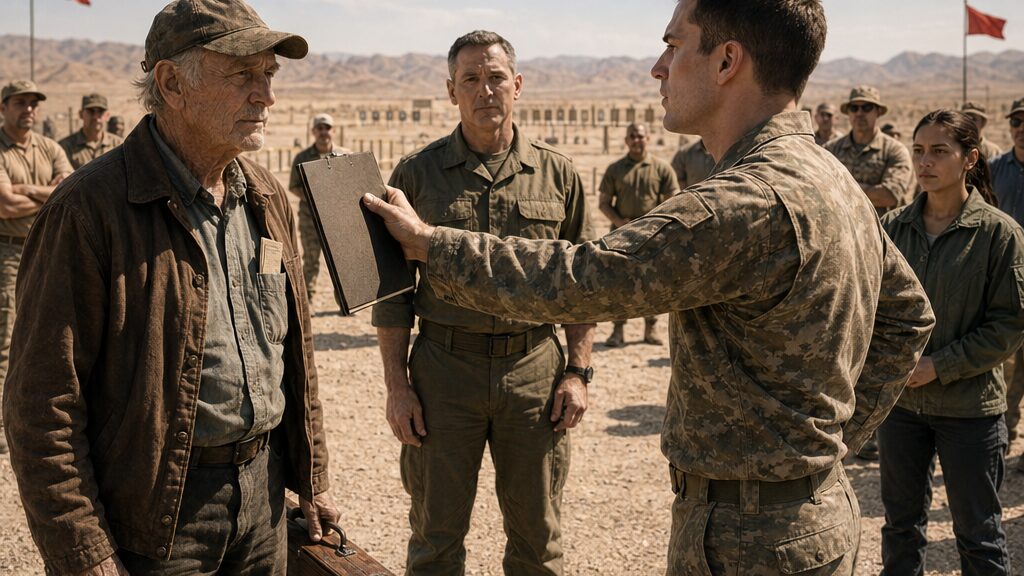
The wooden case rested against a folding chair near the registration tent while its owner stood quietly beside it. The elderly man wore a faded brown jacket despite the growing heat. His gray hair disappeared beneath an old cap. A folded card peeked from his shirt pocket.
Andrew frowned.
The charity qualification event had drawn soldiers, veterans, trainees, and spectators from across the region. Every lane on the range had safety officers. Medical volunteers moved between tents. Banners explained that the event’s proceeds would support injured trainees rebuilding their careers.
Everything had to run smoothly.
The old man looked out of place.
Andrew walked over with a clipboard tucked under one arm.
“Sir.”
The elderly man turned.
His eyes were pale and calm.
“Morning,” he said.
“You here with family?”
“No.”
Andrew glanced at the rifle case.
“The event is for registered participants.”
“I registered.”
Andrew checked the list.
“Name?”
“John Harris.”
The name meant nothing to him.
He found it on the roster.
Veteran category.
Age seventy-eight.
Andrew looked up again.
John waited patiently.
“You planning to shoot?”
“That’s generally why people register.”
A few nearby soldiers laughed.
Andrew felt heat rise in his face.
He wasn’t being mocked exactly. The old man had spoken without any edge at all. Somehow that made it worse.
Andrew opened the rifle case.
Inside lay an old wooden-stock rifle.
Not antique.
Not decorative.
Just old.
Carefully maintained.
The wood showed years of handling.
The metal carried the dull shine of something cleaned more often than displayed.
Andrew inspected it.
“Interesting choice.”
“It works.”
“We have modern equipment available.”
John nodded.
“I noticed.”
More laughter.
Andrew shut the case.
The old man remained perfectly polite.
That calmness irritated him.
Most people defended themselves when challenged.
John simply stood there.
Andrew noticed the folded card again.
“What is that?”
John touched the corner protruding from his pocket.
“An old range card.”
“You carry it around?”
“Sometimes.”
“Sentimental?”
A small pause.
“Something like that.”
Andrew shook his head.
The range was already busy.
Competitors checked optics.
Spotters adjusted equipment.
Wind flags fluttered along the firing lanes.
Everything about the morning felt professional and modern.
Then there was this elderly man carrying a decades-old rifle and a faded card.
Andrew imagined spectators watching.
Questions would come.
If something went wrong, responsibility would fall on him.
“You shot recently?”
“Enough.”
“How recently?”
John smiled faintly.
“Recently enough.”
The answer only annoyed Andrew more.
Nearby, a young cadet named Ashley Young watched from beside a supply table.
She had arrived early to help volunteers.
Now she observed the exchange with growing curiosity.
John noticed her watching.
He gave her a polite nod.
She returned it.
Andrew continued.
“The qualification relay isn’t easy.”
“I know.”
“Long distances.”
“I know.”
“Wind can be difficult.”
“I know.”
Andrew exhaled sharply.
Mary Scott approached carrying a medical kit.
She recognized John immediately.
“Good to see you again.”
John’s expression softened.
“Morning, Mary.”
“You made the drive?”
“I said I would.”
Mary smiled.
“You look well.”
“Depends who you ask.”
She followed his gaze toward Andrew.
Her smile faded slightly.
“Everything alright?”
“Just discussing procedures,” Andrew said.
Mary knew that tone.
She had heard it before from younger men convinced caution and respect were the same thing.
John saved her from replying.
“He’s doing his job.”
Andrew appreciated that.
For about three seconds.
Then John added, “Though he seems determined to do all of it at once.”
Ashley covered a laugh.
Andrew pretended not to hear it.
As the morning briefing began, competitors gathered near the firing line.
John lifted his rifle case.
His movements were slower than those around him.
Not weak.
Measured.
Each step seemed deliberate.
The folded range card remained tucked into his pocket.
Andrew watched him join the crowd.
An uncomfortable thought appeared.
The old man never once argued.
Never bragged.
Never claimed experience.
People who lacked ability often compensated with stories.
John had offered none.
The thought vanished as quickly as it came.
The briefing ended.
Competitors moved toward assigned lanes.
Andrew reviewed assignments.
Then he saw John listed among active shooters.
He stared at the paper.
A decision formed immediately.
He crossed the distance between them.
“Mr. Harris.”
John looked up.
“I’m moving you off the qualification relay.”
Several heads turned.
The range became noticeably quieter.
John waited.
“Why?”
“I think it’s best if you observe today.”
The silence stretched.
Ashley looked from one man to the other.
Mary’s expression hardened.
John simply rested one hand on the rifle case.
“I registered.”
“I know.”
“I passed equipment inspection.”
“You did.”
“So why can’t I shoot?”
Andrew folded his arms.
“You can watch.”
A murmur moved through the crowd.
John lowered his eyes briefly.
Not in defeat.
Almost as if considering something.
Then he nodded.
“Thank you for explaining.”
Andrew blinked.
“That’s it?”
John looked toward the firing line.
“No point arguing.”
His fingers touched the folded card in his pocket.
“The target will tell the truth eventually.”
Andrew frowned.
“What does that mean?”
John lifted the rifle case.
“Nothing important.”
He stepped aside.
The firing line filled with competitors.
The event moved forward.
Yet more than one person kept glancing toward the elderly man standing quietly behind the barriers.
And for reasons Andrew couldn’t explain, that felt less like a victory than it should have.
Chapter 2: The Young Soldier Takes The Loudest Lane
By late morning, the desert heat shimmered above the sand.
Andrew Wilson stood at the center lane.
The best lane.
The most visible lane.
Exactly where he wanted to be.
Spectators lined the observation area while competitors prepared for qualification stages. Charity volunteers collected donations and distributed information about the injured trainees whose rehabilitation programs depended on the event’s success.
Andrew understood performance.
Events like this required examples.
Confidence inspired people.
Results inspired donations.
And Andrew produced results.
The first relay proved it.
His shots landed cleanly.
His timing impressed observers.
A few younger soldiers openly admired him.
Andrew accepted their praise as naturally as breathing.
Meanwhile John Harris remained behind the firing line.
Watching.
Waiting.
Saying little.
Ashley noticed him studying wind flags.
Not casually.
Carefully.
As if he were reading something invisible.
She approached.
“Still planning to shoot?”
“If they’ll let me.”
“You don’t seem angry.”
John smiled faintly.
“Being angry rarely improves accuracy.”
Ashley glanced toward Andrew.
The young soldier was explaining shooting fundamentals to several trainees.
His voice carried easily.
“Losing confidence is what ruins performance. You commit, trust yourself, and move.”
The trainees nodded.
John listened quietly.
Then he looked at Ashley.
“What comes before confidence?”
She thought.
“Practice?”
“Before that.”
She frowned.
“I don’t know.”
“Safety.”
Ashley blinked.
John continued.
“Confidence without discipline becomes carelessness.”
His gaze shifted toward the firing line.
“Discipline survives bad days.”
The words lingered with her.
Andrew finished another impressive relay.
Applause followed.
A few spectators took photographs.
Mary watched from a medical station.
She noticed the contrast immediately.
Andrew gathered attention.
John avoided it.
Yet somehow people kept drifting toward the old man anyway.
A volunteer announced updated donation totals.
The fundraiser was exceeding expectations.
Several injured former trainees had recorded messages displayed near the registration tent.
Their stories reminded everyone why they were there.
For a moment the competition felt secondary.
Then Andrew delivered another strong performance.
Attention swung back.
The crowd responded.
Confidence became momentum.
Momentum became certainty.
By midday many spectators believed Andrew was the best shooter present.
Andrew believed it too.
During a break he walked past John.
“You still enjoying the view?”
John nodded.
“Nice day.”
Andrew laughed.
“You’re taking this surprisingly well.”
“Taking what?”
“The fact you aren’t shooting.”
John looked genuinely puzzled.
“I haven’t accepted that.”
Andrew frowned.
“Then why aren’t you arguing?”
John studied the distant targets.
“Because arguments don’t move bullet holes.”
Ashley overheard the exchange.
She tried not to smile.
Andrew noticed.
His irritation deepened.
The old man had a way of making simple statements sound like lessons.
Joseph Davis arrived shortly afterward.
The senior range commander stepped from a utility vehicle and surveyed the activity.
Years of command showed in his posture.
He didn’t need to raise his voice.
People noticed him anyway.
Andrew immediately straightened.
Joseph exchanged greetings with staff and volunteers.
Then his eyes settled on the observation area.
Specifically on the old wooden rifle case beside John Harris.
Joseph stopped walking.
A strange expression crossed his face.
Recognition.
Not certainty.
But recognition.
He moved closer.
John was adjusting a sling.
The rifle rested across his knees.
For several seconds Joseph simply looked at it.
Then at John.
Then back at the rifle.
“Where did you get that?”
John looked up.
A faint smile appeared.
“Kept it.”
Joseph stared.
“From here?”
“Long time ago.”
The commander fell silent.
Andrew approached.
“Sir?”
Joseph didn’t answer immediately.
His attention remained fixed on the rifle.
The desert wind shifted.
A range flag snapped sharply in the distance.
Finally Joseph spoke.
“Interesting.”
Only one word.
Yet something in his tone made Andrew uneasy.
The commander looked at John again.
Longer this time.
As if trying to place a memory.
John offered no help.
He simply rested a hand over the old rifle stock.
Calm.
Patient.
Waiting.
And for the first time that day, Andrew felt a small crack form in his certainty.
Chapter 3: The Commander Saw Something In His Hands
Joseph Davis had spent most of his career around shooters.
Good ones.
Average ones.
Exceptional ones.
A person’s habits usually revealed themselves before the first shot.
The way they carried a rifle.
The way they checked a chamber.
The way they breathed while waiting.
He watched John Harris from across the range office window.
Something about those habits disturbed old memories.
Not bad memories.
Important ones.
Joseph entered the office archives.
Dusty photographs covered one wall.
Former instructors.
Competition teams.
Historic range events.
He searched without knowing exactly what he was searching for.
A younger officer followed him.
“Need something, sir?”
“Maybe.”
Joseph scanned a faded photograph.
Then another.
And another.
A face almost emerged from memory before slipping away again.
Outside, the event continued.
Andrew reviewed scores.
His name remained near the top.
He felt better after Joseph’s arrival.
Authority restored order.
Soon enough the commander would confirm the obvious.
The elderly man wasn’t qualified for this environment.
The issue would disappear.
Instead Joseph returned carrying a thoughtful expression.
“Andrew.”
“Sir.”
“Why isn’t Mr. Harris shooting?”
Andrew explained.
Safety concerns.
Age.
Practical judgment.
Event efficiency.
The explanation sounded reasonable when spoken aloud.
Joseph listened carefully.
Then asked one question.
“Has he violated any safety rule?”
“No.”
“Equipment issue?”
“No.”
“Registration problem?”
“No.”
Joseph nodded slowly.
“Then I’m missing something.”
Andrew hesitated.
Around them, several spectators listened openly.
The conversation was no longer private.
“I just don’t think it’s wise.”
Joseph looked toward John.
The old man sat quietly cleaning dust from the rifle’s stock.
No audience.
No performance.
Just maintenance.
The commander noticed something else.
Every movement followed exact procedure.
Not habit alone.
Discipline.
The kind drilled into someone over decades.
Joseph made his decision.
“Put him on a lane.”
Andrew stared.
“Sir?”
“Put him on a lane.”
The crowd immediately reacted.
Whispers spread across the range.
Ashley felt excitement surge through her.
Mary simply smiled.
John looked up.
No celebration crossed his face.
Only acknowledgment.
As though this outcome had always been possible.
Andrew struggled to hide his frustration.
“Which lane?”
Joseph considered.
“The far lane.”
The most difficult wind conditions.
The longest visibility challenge.
Andrew almost smiled.
If John insisted on shooting, the lane would settle matters.
An hour later spectators gathered along the observation barriers.
The charity event suddenly had a new attraction.
Not because people expected greatness.
Because they expected proof.
One way or another.
John carried the old rifle onto the firing line.
The wooden stock contrasted sharply with modern equipment surrounding him.
The folded range card remained tucked into his pocket.
Ashley noticed it again.
The same card she had seen all morning.
John performed every safety check with deliberate care.
Chamber.
Action.
Position.
Breath.
Nothing hurried.
Nothing forgotten.
Joseph watched closely.
A memory surfaced.
Not a face.
A stance.
The way John settled behind the rifle.
The way his shoulders aligned.
The way he seemed to disappear into stillness.
The commander felt a chill despite the desert heat.
Andrew watched too.
Initially with confidence.
Then with uncertainty.
Because the old man did not look confused.
He did not look overwhelmed.
He looked comfortable.
John moved into a kneeling position.
Exactly as he had done countless times before.
The desert wind crossed the range.
Dust drifted low across the ground.
Everything seemed louder for a moment.
Then strangely quiet.
The crowd stopped talking.
John lowered his head slightly.
One slow breath.
Then another.
Ashley found herself matching the rhythm unconsciously.
Steady.
Measured.
Patient.
Joseph suddenly remembered where he had seen that posture.
Not here today.
Years ago.
Long ago.
Before he held command.
Before many of the younger soldiers had even been born.
His eyes widened.
Not certainty yet.
But close.
Very close.
Andrew felt it too.
The mood had changed.
The laughter from earlier was gone.
The certainty was gone.
Only waiting remained.
John settled behind the rifle.
His hand brushed the folded range card once.
Almost like a ritual.
Then he focused entirely on the distant target.
The range officer signaled.
The first target moved into position far downrange.
Heat waves danced above the desert floor.
No one spoke.
No one laughed.
No one looked away.
And as the target settled into place, an uneasy question spread silently through the crowd.
Who exactly was John Harris?
Chapter 4: The Target Came Back Without An Excuse
John did not hear the crowd anymore.
He heard wind.
He heard fabric snapping along the range flags.
He heard his own breathing settle into the narrow quiet place where age, memory, and noise no longer mattered.
The old rifle rested into his shoulder as if returning to a mark worn into him long ago. His knees pressed into the dry grit. Heat trembled between him and the distant target. Through it, the paper looked less like a challenge than a question.
He answered carefully.
One breath in.
Half out.
Stillness.
The first shot cracked across the range.
No one moved.
John worked the action with steady hands.
He did not look pleased.
He did not look worried.
He simply repeated the process.
Chamber.
Sight.
Breath.
Pressure.
The second shot followed.
Then the third.
Then the fourth.
Then the fifth.
Each sound faded into the desert and left behind a silence that seemed heavier than before.
When he finished, John opened the action and made the rifle safe before doing anything else.
Joseph Davis watched that first.
Not the target.
Not the score.
The safety check.
Only after John stepped back from the line did the commander turn toward the target bay.
Andrew stood with his arms crossed.
“Clean shooting,” he said, too quickly. “But we’ll see the paper.”
John nodded.
“That’s why it’s there.”
The target was brought back slowly.
Too slowly for the crowd.
People leaned forward.
Ashley stood so still Mary almost touched her shoulder to remind her to breathe.
The paper arrived clipped to the carrier.
At first nobody reacted.
Not because the grouping was hard to see.
Because it was too easy to see.
Five marks sat so close together near the center that the paper seemed almost misprinted. A small cluster. Tight. Plain. Unarguable.
The range officer bent closer.
Another staff member checked it.
Joseph came forward.
Andrew stepped in beside him.
For a few seconds all four men looked at the target without speaking.
Then the score was read aloud.
The silence that followed was not empty.
It was full of everything people had said earlier and now could not take back.
John stood several feet away, the old rifle lowered safely at his side.
The folded card in his shirt pocket shifted slightly in the breeze.
Andrew stared at the target.
“Run it again.”
Joseph looked at him.
Andrew’s jaw tightened.
“I mean, verify the lane. Maybe there was a placement issue.”
“The lane was correct,” the range officer said.
“Then check the target board.”
“It was checked.”
Andrew looked toward John.
The old man offered nothing.
No smile.
No victory.
That restraint made the result worse.
If John had bragged, Andrew could have answered with pride.
If John had mocked him, Andrew could have defended himself.
But John only stood there like a man waiting for the range to finish its work.
Joseph lifted the paper carefully.
“This grouping is tighter than the current top score.”
A murmur moved through the spectators.
Andrew’s face changed.
Not defeat exactly.
Something more private.
The expression of a man realizing the room had seen him misjudge someone.
Ashley looked at John with wide eyes.
Mary looked at Andrew.
John looked only at the target.
For a moment the desert range seemed to fold backward through time. The same heat. The same dust. The same hard lesson printed on paper instead of spoken aloud.
Joseph lowered his voice.
“Mr. Harris.”
John turned.
The commander held the target in one hand.
His eyes moved to the folded card in John’s pocket.
Then to the rifle.
Then to John’s hands.
“Were you instructor Harris?”
The question traveled farther than Joseph intended.
Those close enough heard it.
Andrew heard it.
Ashley heard it.
John’s fingers rested lightly against the old rifle case.
He seemed older suddenly, not weaker, just farther away.
“Once,” he said.
Joseph did not speak again.
The crowd waited for more.
John gave them none.
He looked down at the target paper, then at Andrew.
“Good equipment helps,” he said quietly. “But it can’t breathe for you.”
Andrew swallowed.
The words were not cruel.
That made them land harder.
Chapter 5: The Record Nobody Remembered On The Wall
The old range office smelled of dust, hot paper, and machine oil.
John had not wanted to go inside.
Joseph had asked quietly, away from the crowd, and John had seen in the commander’s face that refusal would create more curiosity than agreement.
So he followed.
Mary came with them.
Andrew did too, though he stayed near the door like a man unsure whether he had been invited or sentenced.
Ashley lingered just outside the office window.
On one wall, newer plaques listed recent event champions. Their polished surfaces caught the light. Beside them hung framed photographs of training classes, commanders, charity relays, and range crews.
John looked at the wall only once.
Then he looked away.
Joseph opened a storage cabinet and removed a flat archive box.
“During renovations,” he said, “some of the old boards came down.”
John said nothing.
Joseph placed the box on the desk.
Inside were faded score sheets, photographs, and nameplates from another era.
Andrew shifted.
The room felt too small for his earlier confidence.
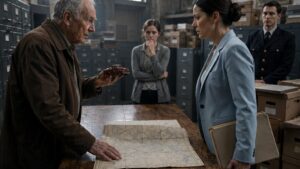
Joseph searched carefully until he found a long, yellowed board wrapped in paper. He unfolded it and laid it across the desk.
Names appeared in neat columns.
Dates.
Distances.
Scores.
Near the bottom was a line written in black ink that had faded toward brown.
John Harris.
Andrew leaned closer despite himself.
The numbers beside the name were not loud.
They did not announce greatness.
They simply sat there, precise and permanent.
Joseph touched the edge of the board.
“I knew I’d seen that stance.”
John’s hand moved to his pocket.
He took out the folded range card.
The paper was worn soft at the creases. When he opened it, the same distance markings appeared. The same old notation. The same careful hand.
Ashley, watching through the window, saw Andrew’s face change again.
John placed the card beside the archived board.
For a moment the two pieces of paper completed each other.
Mary spoke gently.
“You kept it all these years.”
John looked at the card.
“I meant to throw it away a few times.”
“Why didn’t you?”
He rubbed one thumb along the fold.
“Because it reminded me what mattered before pride got involved.”
No one answered.
Outside, a relay began. Shots cracked faintly across the range.
John did not flinch.
Joseph lowered his voice.
“You trained here.”
“For a long time.”
“People should know that.”
John looked at him then.
“No.”
Andrew’s eyes lifted.
John folded the card again, slowly.
“I didn’t come here to be put back on a wall.”
Joseph studied him.
“Then why did you come?”
John glanced toward the charity banner visible through the dusty window.
“Because trainees get hurt. Sometimes by accident. Sometimes by weather. Sometimes by bad luck.”
He paused.
“And sometimes because someone teaches confidence before discipline.”
Andrew looked down.
John’s voice remained calm.
“I had a student once. Talented. Fast. Everyone praised him for it. I praised him too much. Corrected him too little. He didn’t hurt anyone else, but he ended his own career by ignoring a simple rule he thought he had outgrown.”
Mary’s expression softened.
Joseph closed the archive box halfway, as if protecting the memory inside.
John continued.
“I learned that silence can be cowardice if it lets arrogance grow.”
The words settled between them.
Andrew took them in without raising his eyes.
John picked up his range card.
“I came today for the charity. And maybe to see if these hands still remembered the difference between pride and service.”
Joseph nodded once.
“Then shoot the final relay.”
Andrew looked up sharply.
“Sir—”
Joseph turned to him.
“Sign him in.”
Andrew’s mouth tightened.
The order was clear.
Still, something stubborn remained in him.
He took the registration sheet from the desk and wrote John’s name with stiff, controlled movements.
Each letter looked forced.
John watched without satisfaction.
When Andrew finished, he held out the pen.
John accepted it.
Their hands almost touched.
For the first time, Andrew noticed the old man’s fingers closely.
Scarred.
Steady.
Human.
Not a symbol.
Not a joke.
John signed.
Andrew took the sheet back.
“Final relay starts in twenty minutes.”
His voice held protest, but less certainty.
John folded the range card and returned it to his pocket.
“Then we shouldn’t waste daylight.”
Outside, Ashley stepped away from the window before anyone could notice her listening.
But John saw her reflection in the glass.
He did not call her out.
He only gave the smallest nod.
As if the lesson had already begun.
Chapter 6: Slow Breath Against Fast Confidence
The late afternoon wind came unevenly across the long-distance firing line.
It moved in soft waves at first, then hard gusts that snapped flags sideways and pushed dust against the boots of the competitors.
The final relay had drawn nearly everyone back to the barriers.
Andrew stood two lanes from John.
His modern rifle rested ready.
His score had carried him into the final group, and until the old man’s target came back, Andrew had expected to win cleanly.
Now every movement felt observed.
John knelt at the far lane again.
Ashley stood behind the safety line with the trainees, assigned to observe and record timing. She kept her eyes on John’s hands.
Not because they were famous now.
Because they were careful.
The signal came.
The relay began.
Andrew fired first.
Quick.
Controlled.
Good.
The target marker confirmed a strong hit.
Spectators murmured approval.
Andrew chambered again.
He felt steadier.
This was his place.
His training.
His range.
John had not fired yet.
He watched the wind flags.
Ashley glanced at the timer.
Seconds passed.
Andrew fired again.
Another solid mark.
Still John waited.
A trainee near Ashley whispered, “What’s he doing?”
Ashley almost answered with John’s own words.
Breathing.
But she stayed quiet.
John adjusted his position by a fraction.
The old rifle seemed motionless.
The wind shifted.
He fired.
The shot came so cleanly it startled Ashley.
Not loud.
Not dramatic.
Just inevitable.
The marker confirmed center.
Andrew saw it from the corner of his eye.
His next breath shortened.
He fired again before the wind fully settled.
The shot landed good, not perfect.
His jaw tightened.
John fired his second only after another long pause.
Again, the mark came back clean.
The relay continued.
Fast confidence against slow patience.
Andrew’s early lead narrowed.
Then vanished.
John never looked at him.
That was worst of all.
Andrew wanted a rivalry.
John gave him discipline.
With three minutes left, the wind began to twist across the range.
A harsh gust rolled dust over the firing line.
One competitor paused.
Another rushed and missed wide.
Ashley, recording scores, saw a dropped cartridge near a trainee’s boot behind the line. The trainee bent quickly, distracted, while another shifted equipment too close to the marked safety boundary.
It happened fast.
Small.
Almost nothing.
But Ashley, eager not to interrupt the final relay, moved to help without thinking. She stepped forward with her clipboard in one hand, eyes on the fallen cartridge, not on the active lanes.
John saw her.
He lifted his hand away from the trigger immediately.
“Stop.”
His voice was not loud.
It cut through everything.
The safety officer turned.
Ashley froze.
The trainee froze.
Andrew, already settling into his next shot, jerked his head toward them.
For one stunned second, the entire relay held its breath.
John kept his rifle pointed safely downrange, action open.
“Behind the line,” he said.
Ashley stepped back at once, face flushed.
The safety officer corrected the boundary and cleared the distraction.
No one scolded her.
They didn’t need to.
She looked at John, ashamed.
He gave one small shake of his head.
Not anger.
Instruction.
Andrew stared.
The timer continued.
John had lost precious seconds.
His score lead was now at risk.
Andrew looked downrange.
This was his chance.
He could finish.
He could win.
He fired quickly.
A decent mark.
Then another.
The crowd stirred.
John reset his position without hurry.
Mary watched from the side, one hand pressed around the strap of her medical kit.
Joseph’s face remained unreadable, but his eyes never left John.
Ashley could barely look up.
The relay entered its final minute.
Andrew had completed his shots.
His score was strong.
Very strong.
John still had one shot remaining.
The wind flags shifted again.
Wrong direction.
Then back.
Then uncertain.
The timer voice called the remaining seconds.
John settled into kneeling position.
His body looked tired now.
For the first time all day, the age in him showed plainly.
His shoulder lowered a fraction.
His breathing took longer to steady.
Andrew saw it.
So did Ashley.
John touched the folded range card through his shirt pocket.
Not for luck.
For memory.
Then he let his hand return to the rifle.
The range became silent enough for Ashley to hear the wind drag sand across the concrete.
John had one shot left.
Almost no time.
And still he waited for the breath to become true.
Chapter 7: The Lesson Was Never About The Rifle
John fired with two seconds left.
The sound cracked cleanly across the range, then disappeared into the desert wind.
For a moment nothing followed.
No applause.
No score.
No movement except the slow drift of dust across the firing line.
John opened the action and made the rifle safe before he looked anywhere else. His shoulder ached. His knees felt the hard ground more than they had in the morning. The old rifle rested in his hands, familiar and heavy.
The target marker lifted.
Joseph Davis read the result first.
His expression did not change much, but his eyes softened.
Then the score was announced.
John Harris had won the final relay.
Not by much.
Not by a miracle.
By one quiet shot taken only after the line was safe and the breath was steady.
The spectators began to clap, but the sound rose uncertainly, as if the range itself had taught them to be careful with noise.
John stood slowly.
Mary stepped forward as though ready to help, then stopped when she saw he did not need a hand. He gave her a small nod anyway.
Andrew remained at his lane, staring downrange.
His score would have won on most days.
It had not won this one.
But the part that stayed with him was not the score.
It was the moment John had stopped.
The old man had given away time, advantage, and perhaps the win itself because a junior cadet had drifted toward danger.
Andrew looked toward Ashley.
She stood behind the safety line, face still flushed, clipboard held tightly against her chest.
John packed the old rifle before anyone approached him.
He wiped the stock once with a cloth and placed it inside the wooden case. Only then did he turn toward the ceremony area, where a small table had been set beneath the charity banner.
The prize was modest.
A commemorative relay slot.
A certificate.
A donation made in the winner’s name to support injured trainees.
Joseph called John’s name.
The crowd clapped again, louder this time.
John walked forward without hurry.
The sunset had begun to color the range gold. Long shadows stretched behind the target stands. The same desert that had seemed harsh in the morning now looked almost gentle.
Joseph handed him the certificate.
John accepted it, looked at it briefly, then turned.
“Ashley Young.”
Ashley froze.
Several trainees glanced at her.
John held out the certificate.
“Come here.”
She walked forward slowly.
“I didn’t win that.”
“No,” John said. “You learned something more useful.”
Her eyes dropped.
“I stepped past the line.”
“You stopped when corrected.”
He placed the certificate in her hands.
“That matters.”
Ashley looked at Joseph, unsure whether this was allowed.
Joseph gave a small nod.
John turned back to the table.
“The donation can stay in the relay winner’s name,” he said. “But the training slot goes to her.”
A murmur passed through the crowd.
Not surprise this time.
Recognition.
Ashley held the certificate as if it weighed more than paper.
Andrew stepped forward before the ceremony could continue.
He removed his cap.
The movement quieted those nearby.
He faced John, not the crowd.
“I was wrong.”
John waited.
Andrew’s throat worked once.
“I judged you by your age, your rifle, and the way you dressed. I made it public. I should not have done that.”
The apology did not sound practiced.
It sounded difficult.
That made John listen.
Andrew looked down at the old rifle case.
“And I treated confidence like it was the same thing as competence.”
John said nothing for a few seconds.
Then he extended his hand.
Andrew took it.
The handshake was brief.
Firm.
Enough.
“If you want instruction,” John said, “start with the safety manual.”
A faint, embarrassed smile crossed Andrew’s face.
“Yes, sir.”
“Then learn to breathe.”
Andrew nodded.
Ashley watched them with the certificate held against her jacket.
Mary watched John.
She saw the exhaustion in his shoulders now that the day was nearly done, and the relief he tried not to show.
Joseph stepped closer.
“The old board should go back up.”
John looked toward the office.
“Maybe.”
“Your name belongs there.”
John touched the folded card in his shirt pocket.
Then he took it out.
The old paper looked fragile in the sunset.
He unfolded it one last time and studied the marks, the dates, the careful notes made by a younger hand that had believed discipline could protect every student from pride.
It could not.
But it could still protect some.
John folded the card again and held it out to Ashley.
She stared at it.
“I can’t take that.”
“You can borrow it for a while.”
“For how long?”
John smiled faintly.
“Until you teach it to someone else.”
Ashley accepted the card with both hands.
The crowd had gone quiet again, but this silence felt different from the one after the target came back.
That first silence had carried shame.
This one carried attention.
John lifted the wooden rifle case.
Andrew moved as if to carry it for him, then stopped.
John noticed.
“Good choice,” he said.
Andrew lowered his hand, understanding.
Some burdens were not there to be taken.
Some were there to be respected.
The sun dropped lower behind the desert berms.
Range staff began gathering equipment. Spectators drifted toward parked vehicles. The charity banner moved gently in the wind.
John walked away from the ceremony area with the rifle case in one hand.
Behind him, Ashley stood beneath the fading light, holding the old range card.
Andrew stood beside her, no longer speaking loudly.
Joseph watched from near the office door.
Mary waited near the path, close enough to walk with John, far enough not to hurry him.
John reached the edge of the range and paused once.
He looked back at the firing line.
The lanes were empty now.
The targets had been taken down.
Only the desert remained, wide and quiet.
His hand no longer moved toward his shirt pocket.
The card was gone.
The weight of it was gone too.
John adjusted his grip on the rifle case and walked on, lighter than he had been that morning.
The story has ended.