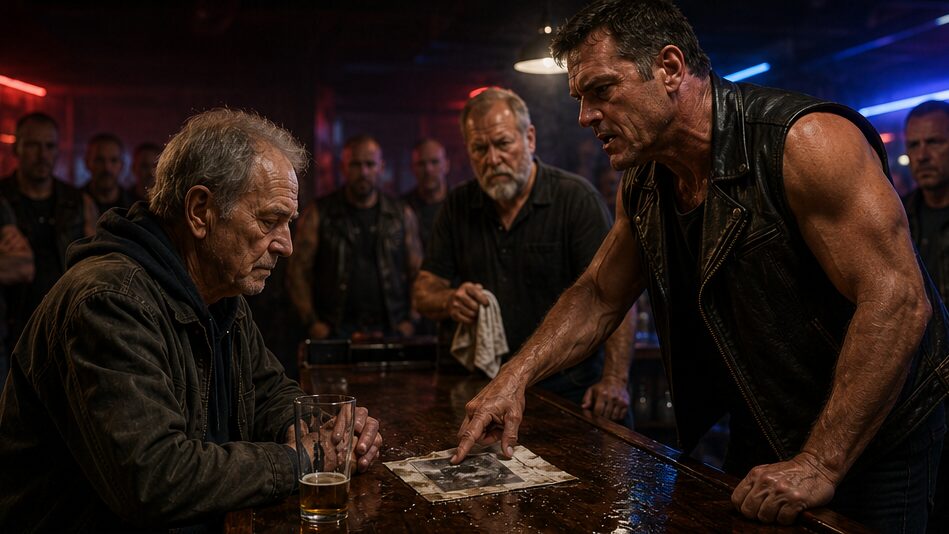
They Put a Repair Bill Beside His Beer and Called the Old Man Guilty
Chapter 1: A Wet Invoice Under Neon Lights
The paper hit the bar before Donald Carter saw the hand that threw it.
It skidded across the wet wood, caught the bottom of his beer glass, and stopped with one corner soaking in the pale ring of spilled lager. Red neon from the beer sign trembled across the plastic sleeve around it. Blue light from the jukebox cut over the top line in sharp flashes.
REPAIR ESTIMATE: $9,860.00
Donald kept his hand around the glass but did not lift it.
The Crossbar had gone too quiet.
A moment before, there had been pool balls cracking in the back, a burst of laughter from the high tables, the dry cough of an old speaker trying to push out a country song through too much smoke and dust. Now the only sound was the cooler behind the bar humming under the bottles.
Scott Green stood on the other side of Donald’s shoulder, close enough that his black leather vest brushed the back of the barstool. He was not a young man, exactly, but he had the strength and impatience of someone who still believed volume counted as proof. His arms were bare under the vest. His jaw was tight. He smelled of cold air and motor oil.
“You see that number?” Scott asked.
Donald looked at the invoice again. He had not brought his reading glasses. He could still see the number.
“I see it.”
Scott leaned closer. “Good. Because that’s what your yard did to my garage.”
A few men near the back shifted. One of them gave a short laugh, not because anything was funny, but because someone bigger had made a smaller man the center of attention. Donald knew that sound. Men used it when they wanted permission not to think.
Larry Adams, behind the bar, reached for a towel but did not wipe the counter yet. His eyes moved from the invoice to Donald, then away.
Donald had been sitting in the same corner seat for twenty minutes, the one near the end where the neon did not reach his face too clearly. He had come in for one beer, not because he liked drinking alone, but because Friday evenings made his house sound too large. Since his wife had died, the little noises had changed. The refrigerator kicked on too sharply. The hallway clock clicked as if it had somewhere to be. The porch boards settled at night like someone stepping back from the door.
At The Crossbar, at least, the noise belonged to other people.
Scott tapped the invoice with two fingers. “Contractor came out. Measured the runoff. Checked the crack. It’s coming from your side.”
“My side,” Donald said.
“Your old drain line. Your yard. Your problem.”
Donald looked past the invoice toward the printed photograph stapled behind it. It showed the back wall of Scott’s garage, a gray block wall with a crack running down from the corner near the old gate. The picture had been taken close. Too close. The kind of picture that wanted the viewer to see damage, not cause.
Scott pulled another paper from under his arm and slapped it on top of the first one. “And before you start saying you don’t know anything about it, Anthony Baker wrote it plain. Water undermining. Soil shift. Old line. That’s you.”
The name Anthony Baker meant contractor paint on a truck, a white hard hat left on a dashboard, a man who bought the cheapest coffee in town and complained loudly if it was cold. Donald had seen him three times that week near Scott’s place, measuring, digging, laughing into his phone.
Donald took one finger and moved the top sheet away from the beer spill. The page stuck to the counter for a second, then came loose with a faint wet sound.
Scott smiled at the room, not at Donald. “Careful. That’s the closest you’ve come to paying it.”
Another laugh came from the back. This one was louder.
Donald let it pass.
He had spent thirty-four years opening drains that men swore were someone else’s fault. Restaurant owners blamed city mains when grease packed their own traps. Apartment managers blamed storms when roof gutters had not been cleaned since the last election. Homeowners blamed roots because roots could not answer back.
He had learned early that the first story told loud enough often became the truth.
Scott bent down until his voice was close to Donald’s ear. “You got until Monday. After that, I put your name on the insurance claim. HOA gets a copy. Then it’s not just me asking nice. Then it’s paperwork, late fees, maybe a lien if they decide you ignored damage crossing from your property.”
Donald’s hand tightened around the glass. Not enough for anyone to see, but enough for the cold to press into his palm.
A lien.
People threw that word around like a bottle cap, light and careless. To Donald it had weight. It meant envelopes. Certified mail. A clerk’s bored voice. It meant his daughter Sarah sitting at his kitchen table with worry around her mouth, trying not to say, Dad, maybe it’s easier if you just pay.
Scott said, “You hearing me?”
Donald nodded once.
“Then say something.”
Donald lifted the invoice by the dry edge. Beer had smeared one corner, making the ink bleed around the contractor’s logo. The photograph underneath showed the wall, the gate, the crack. There was a measuring tape in the frame, yellow against gravel. The zero end disappeared out of view.
Scott straightened and crossed his arms, pleased with the silence.
Donald’s sleeve had slipped toward the wet spot. He pushed it up with slow fingers to keep the cuff clear of the beer. The skin of his forearm, loose and pale under the neon, caught the light. Then the black cross-like mark showed.
It sat just below the elbow, old ink blurred at the edges, dark enough to hold shape. Not a church cross. Not exactly. Four thick points, uneven from age and sun.
The room changed before anyone spoke.
One of the men near the pool table stopped leaning on his cue. Another looked at Larry. Larry’s towel froze in his hand. Scott’s smile thinned, not gone, but checked, as if he had stepped into a room he thought was empty and heard someone breathing.
Donald did not look around to measure the effect. He had not rolled up his sleeve for them.
He set the invoice flat, placed two fingers on the photograph, and drew it closer.
“The crack is running the wrong way,” he said.
Scott blinked. “What?”
Donald tapped the photo once, lightly. “The crack. It’s not pulling from my side.”
For a second, the only thing moving in the bar was the neon reflection sliding over the wet counter.
Scott laughed too hard. “Now you’re an engineer?”
“No.”
“You just some old guy with a beer trying to talk his way out of nine grand.”
Donald looked up then. Slowly. Not angry. Not afraid.
“I’m an old guy who knows water doesn’t climb uphill because a contractor writes it down.”
The bar held that sentence.
Scott’s face darkened. He snatched the invoice off the counter, then seemed to think better of taking it away and shoved it back toward Donald. “You want to play smart? Fine. Saturday morning. You come look at it. You come stand by that wall and tell me I’m lying.”
“I didn’t say you were lying.”
“You’re saying you’re not paying.”
“I’m saying I’m not signing wet paper in a bar.”
A couple of men looked down at their drinks. Larry wiped the counter once, carefully avoiding the invoice.
Scott leaned in again, but this time he did not come as close. “Monday,” he said. “That’s all you get. After that, everyone knows whose yard did it.”
He turned and walked toward the back, boots heavy on the old floorboards. The room took a breath only after the door to the rear patio swung shut behind him.
Donald folded the damp invoice once, then again, careful not to tear the corner with the photograph. He placed it inside his jacket.
Larry came over with the towel. His voice was low.
“You all right, Donald?”
Donald looked at the wet ring where the paper had been.
“No,” he said. “But I know where the crack starts.”
Chapter 2: The Crack That Ran the Wrong Way
By morning, the invoice had dried with a beer stain shaped like a brown thumbprint over the contractor’s address.
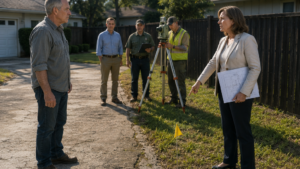
Donald set it on the passenger seat of his old pickup and drove only half a block before the engine had warmed. Scott’s property sat behind his, not quite neighborly and not quite separate. Their back lots met along a narrow gravel alley that ran behind The Crossbar, two garages, and a chain-link fence with more repairs than original wire.
The houses in that part of town were all old enough to remember different rules. Drain lines had been laid before permits were kept on computers. Survey pins hid under grass and rust. Men poured concrete over problems and trusted the next owner to forget what was underneath.
Donald parked beside his own garage and took his time getting out. His right knee had been stiff since the rain three days ago. He disliked letting anyone see him pause before stepping down, so he pretended to check the invoice on the seat until the ache loosened.
Scott was already outside.
He stood by the back corner of his garage in the same leather vest, though daylight made it look less dangerous and more like something worn too long. The rear gate sagged toward the alley, one hinge pulled low. The cinder-block wall beside it had a crack starting near the lower corner and climbing diagonally toward the back window.
Two neighbors watched from their side yards. One held a coffee cup. The other had a phone in hand, lowered but ready.
Scott pointed as Donald approached. “There. That’s what your water did.”
Donald stopped several feet away and looked first at the ground, not the wall.
Gravel had been raked recently. Too recently. Fresh lines ran in arcs where someone had dragged a rake to smooth over disturbed soil. Near the garage corner, a round metal drain cap sat unevenly in the gravel, one side higher than the other. Mud had dried along its rim in a crescent.
Donald remembered that cap sitting flush.
He had not looked at it in years. He had not needed to. Still, some details remained in a man’s mind because his hands had once put them right.
Scott waved the invoice. “You going to stare at rocks all day?”
“Maybe.”
“That wall is what costs money.”
“Walls talk from the bottom up,” Donald said.
Scott gave the watching neighbors a look. “Hear that? Now the wall talks.”
Donald walked closer but did not touch anything. The crack was wider near the lower corner, hairline above. The pattern bothered him. If runoff had been pushing from Donald’s yard, the soil pressure would have shown differently. The gate frame had shifted inward toward Scott’s garage, not outward from Donald’s side.
He bent a little, slow enough that his back did not catch, and examined the bottom course of block. There was dark staining there, but not old staining. It was clean-edged and recent, like water that had found a new path, not one that had been seeping for years.
Scott stepped beside him. “Anthony said your drain line washed out the base.”
“Which line?”
“The old one.”
“There were six old ones through here.”
Scott’s mouth tightened. “Don’t start that.”
“I’m asking which one.”
“The one from your yard.”
Donald looked toward his own fence. His property sloped gently, yes, but not toward this corner. It dropped south toward the alley bend, where the city catch basin sat under a rusted grate. Every heavy storm carried leaves there. He knew because for years he had cleared them with a rake before breakfast so water would not back toward the garages.
Scott came closer. “You always got an answer, don’t you?”
“No.”
“Then answer this. Why did my garage crack right after that last rain?”
Donald straightened. He felt the pull in his lower back and waited before speaking. “Rain shows a problem. It doesn’t always make it.”
“Convenient.”
“So is blaming the nearest old man.”
The neighbor with the coffee cup looked away.
Scott’s face flushed. “I didn’t say old.”
“You didn’t have to.”
The words came sharper than Donald intended. He did not regret them, but he felt their effect. Scott’s shoulders lifted. The phone in the other neighbor’s hand rose a little higher.
Donald looked back at the wall. He would not give them a shouting match. The wall mattered more.
He took the folded invoice from his jacket and opened it against his palm. The photograph on the estimate showed the same crack, but the gravel under it looked different. In the photo, the drain cap was not visible. Either the angle hid it, or the picture had been taken before the gravel was raked away.
Donald stepped three paces left. Then two right. He held the page up, aligning the printed image with the real wall.
There.
A small black scrape marked the lower part of the gate frame in the photograph. In real life, the scrape was longer now, rubbed bright at the center. Something metal had struck or dragged against it more than once.
Scott saw him looking. “What now?”
“When was the gate hit?”
“It wasn’t hit.”
Donald pointed to the scrape without touching it. “That paint didn’t peel itself.”
“It’s old.”
“No.”
Scott folded his arms. “You calling me a liar again?”
“I’m saying black paint doesn’t rust overnight.”
Scott looked at the scrape, then away too quickly. “Anthony moved some equipment back here. That doesn’t have anything to do with water.”
“Maybe not.”
“Exactly. Maybe not. So don’t change the subject.”
Donald stepped toward the drain cap. It was old city stock, heavy iron with two small pry holes. Someone had lifted it recently. Fine gravel had fallen into one pry hole and not the other. The mud crescent showed the cap had been turned and set back slightly off its seat.
He crouched with effort and hovered his hand above it. He did not move it. Not yet.
“Who opened this?”
Scott scoffed. “Nobody.”
Donald looked up.
Scott held his stare for a second, then said, “Anthony checked the line. That’s his job.”
“He checked it or opened it?”
“What difference does it make?”
Donald stood, breathing through the knee pain. “Sometimes all the difference.”
Behind them, a truck engine rumbled from the street. It turned into the alley with a crunch of gravel. A white pickup rolled into view, ladder rack on top, orange cones in the bed, and a magnetic sign on the door that read Baker Property Repair.
Anthony Baker stepped out with a clipboard and a tape measure already in his hand.
He smiled when he saw Donald, but the smile did not reach the corners of his eyes.
“Morning,” Anthony said. “I hear we’re still pretending gravity is negotiable.”
Scott laughed once, relieved to have another man’s confidence beside him.
Donald folded the invoice again and slipped it into his jacket. Anthony walked straight to the wall, hooked the metal end of the tape against the garage corner, and pulled the yellow blade across the gravel toward Donald’s fence.
Donald watched the tape pass within inches of a rust-dark nub half-buried near the alley edge.
The old survey pin.
Anthony stepped over it as if it were a weed and kept walking.
Donald’s fear, which had been loose and cold all morning, narrowed into something clean.
Anthony planted his boot beside the wrong marker and called out, “See? Straight from Carter’s side.”
Donald looked at the skipped pin, then at the crooked drain cap.
Now he knew the mistake had legs.
Chapter 3: The Measuring Tape Starts in the Wrong Place
Anthony Baker pulled the measuring tape tight enough to make it sing.
The yellow blade trembled over the gravel between Scott’s garage and Donald’s fence, bright in the morning sun, official-looking in the way small things did when held by confident men. Anthony planted one boot beside a newer fence stake and wrote something on his clipboard.
“There it is,” he said. “Slope and distance. Same as yesterday.”
Donald stood near the old survey pin, which showed only as a rusted half-moon in the gravel. He did not point to it yet. He wanted to see whether Anthony would acknowledge it without being asked.
He did not.
Scott stood with his arms crossed, watching Donald instead of the tape. “You hear him?”
“I hear him.”
“Then stop acting like there’s some mystery.”
Anthony chuckled. “There usually is a mystery when a homeowner doesn’t want to pay.”
Donald looked at him. “I know that one.”
Anthony’s smile paused.
The back of The Crossbar faced the alley, its rear door propped open with a crate. Larry’s delivery man had left kegs near the threshold, and the sour smell of old beer mixed with damp gravel. A few club regulars had drifted outside, drawn by the raised voices and the promise of somebody else’s problem. They leaned near the rear lot, not close enough to be involved, close enough to hear.
Donald wished they would go back inside. Then he wished he did not wish that. Being watched was not new. Being watched while someone decided whether your memory still counted was different.
Anthony snapped the tape back a few inches and held it again. “Mr. Carter, this is simple. Your property sits higher. Water runs down. Scott’s garage sits lower. Damage appears after heavy rain. We document it. Insurance handles it. You reimburse the deductible and uncovered repairs. Nobody needs to make it emotional.”
“Nine thousand eight hundred sixty dollars isn’t emotional?”
“It’s construction.”
“It’s my winter tax money.”
Scott threw up a hand. “Here we go.”
Donald kept his eyes on Anthony. “And my medication. And the furnace work I’ve been putting off.”
Anthony shifted his clipboard against his chest. For the first time, he seemed annoyed by the presence of the watchers. “That’s not my business.”
“No,” Donald said. “Just your number.”
Scott stepped closer. “You think I like this? You think I wanted my garage wall cracked? You think I wanted my gate sinking?”
Donald looked at the gate. The black scrape caught daylight. It was not only a scrape now that he had seen it twice. It was a pattern: high at one end, lower at the other, as if a metal trailer edge had rubbed while backing in at an angle.
“I think you wanted an answer fast,” Donald said.
“I got one.”
“You got one you liked.”
Anthony made a small sound through his nose. “I’ve been doing this fifteen years.”
Donald nodded. “I worked drainage for thirty-four.”
The regulars by the rear door quieted.
Anthony’s smile came back, thinner. “City work?”
“Yes.”
“Then you know better than to eyeball runoff.”
“I do.”
“Good.” Anthony slapped the clipboard lightly. “Because I measured it.”
“You started from the wrong place.”
Scott laughed, but Anthony did not.
The contractor looked down at his boot, then at the fence stake where the tape began. “This is the property line marker.”
“No.”
Anthony pointed. “It lines up with the fence.”
“The fence was replaced twelve years ago.”
Scott frowned. “What’s that got to do with anything?”
Donald bent slowly, picked up a small piece of gravel, and tossed it aside from the old rusted nub. The survey pin showed more clearly now, set low and stubborn in the dirt.
“This is the old marker.”
Anthony glanced at it. “That’s scrap.”
“It’s iron.”
“There’s scrap all over this alley.”
Donald rubbed the pin with the side of his shoe. Rust flaked away from the rounded top. “The city used that line when they capped the east drain after the flood in ’98.”
Scott turned to Anthony. “Does that matter?”
“No,” Anthony said too quickly. “Even if that was a marker, we go off current structures. Fence, wall, grade.”
“Current structures move,” Donald said. “That’s why markers exist.”
Anthony’s jaw worked once. “Mr. Carter, with respect, things have changed since you were out here with a shovel.”
Donald almost smiled at that. He had not carried only a shovel. He had carried keys to pump stations, maps folded soft from rain, and the names of streets nobody remembered flooding because men like him cleaned them before they did.
But he said only, “Water hasn’t changed.”
Scott stepped into the space between them. “Enough. Anthony, show him the line.”
Anthony hooked the tape again, this time with more force, and dragged it toward Donald’s fence. The blade scraped over gravel and jumped across the old pin without touching it.
Donald saw the move then. Not a mistake. A habit made deliberate.
“You skipped it again,” he said.
Anthony did not look down. “Because it’s irrelevant.”
“Then measuring from it won’t hurt you.”
The watchers shifted. The coffee-cup neighbor had come closer. Larry stood in the rear doorway now with a towel over one shoulder, his face unreadable.
Anthony stared at Donald, then gave a short laugh. “This is exactly why I told Scott to handle this through insurance. You get homeowners involved, everyone becomes an expert.”
“I’m not everyone.”
“No. You’re a retired man who doesn’t want a bill.”
Donald felt the words land. They were meant to make him smaller, to fold him into a category where his house, his hands, his records, and the years under his boots counted less than Anthony’s clipboard.
He looked at the tape measure.
“Move the hook.”
Anthony’s face hardened. “I’m not redoing my estimate in an alley because you found a rusty nail.”
Donald turned to Scott. “Ask him to move it.”
Scott hesitated.
That hesitation told Donald something. Not enough, but something. Scott wanted the bill paid. He wanted the answer. But for the first time, he did not look entirely sure he wanted the measuring tape moved.
Anthony snapped the tape back. It recoiled into its case with a sharp metallic chatter that made one of the regulars flinch.
“We’re done,” Anthony said.
Scott frowned. “Wait, I thought—”
“We’re done with the sidewalk show.” Anthony clipped the tape to his belt and pulled a form from the clipboard. “Here. Acknowledgment of notice. It doesn’t say you agree to pay today. It says you received the estimate and were informed of potential liability.”
He held the paper toward Donald with a pen on top.
Donald did not take it.
Anthony extended it farther. “Refusing to sign doesn’t make it disappear.”
“No.”
“Then sign.”
Donald looked at the form. At the bottom, under the signature line, small print described the signer as the “potentially responsible adjacent property owner.” The words were neat. Polite. Dangerous.
“I received your estimate at the bar,” Donald said. “Wet.”
Scott’s mouth twisted. “For God’s sake.”
Anthony lowered his voice. “Mr. Carter, you’re making this harder than it needs to be.”
“Usually means someone wants it easy for himself.”
The contractor’s eyes flashed.
Scott stepped in again, embarrassed now, anger mixing with uncertainty. “Donald, just sign that you got it.”
“No.”
“Why not?”
“Because the first lie in paper is still paper.”
Anthony let the form drop against his clipboard. “Fine. Scott, get him in front of the HOA Monday. Bring the insurance adjuster. Bring copies. If he wants to act confused in public, let him.”
Donald felt heat rise under his collar, but his voice stayed even. “I’m not confused.”
Anthony looked him over, from the worn cap to the careful way he stood with weight off his bad knee. “Then stop pretending you remember every pipe under this alley.”
Donald glanced at the old survey pin, the crooked drain cap, and the black scrape on the gate.
“I don’t have to remember every pipe,” he said. “Just the one somebody opened.”
For a moment, Anthony said nothing.
Then he turned away and spoke to Scott, low enough that the neighbors might miss it, but not Donald.
“Get the old man’s signature before he starts remembering things wrong.”
Donald watched the contractor walk back to his truck.
The words stayed in the alley after the engine started, hanging there with the dust.
Chapter 4: The Checkbook Opens Before the Truth
Sarah Johnson arrived before sunset with a paper grocery bag in one arm and worry already set in her face.
Donald saw it through the kitchen window before she reached the back steps. She had the same way of walking her mother used to have when carrying bad news: shoulders straight, mouth calm, eyes working ahead of her. He turned the kettle off before it whistled. He did not want the house announcing nervousness before she came inside.
She knocked once, then opened the door. “Dad?”
“In here.”
She set the grocery bag on the counter and began taking things out without asking. Soup. Bread. Bananas. A small bottle of the heartburn medicine he always forgot to buy. She placed each item carefully, as if order itself could hold the evening together.
“I saw Scott at the gas station,” she said.
Donald sat at the kitchen table. The invoice lay in front of him, flattened under the sugar bowl. The beer stain had dried darker along one edge, and the corner with the photo curled upward like it wanted to escape.
Sarah looked at it. Her hand tightened around the bread.
“He told you,” Donald said.
“He told half the gas station.”
Donald nodded once.
Sarah pulled out the chair across from him but did not sit right away. “He said there’s an insurance claim now.”
“He says there will be Monday.”
“And an HOA meeting?”
“Community room. Monday morning.”
She sat then, slowly. “Dad.”
Donald disliked that tone most of all. It was soft, careful, already halfway to deciding for him.
He pushed the invoice toward her. “Read it.”
“I did. He had a copy.”
“Read this one.”
Sarah took it. Her eyes moved over the page, then stopped at the number. “Nine thousand eight hundred sixty dollars.”
“That’s what his contractor says.”
“That’s a lot of money.”
“Yes.”
She turned the page and looked at the photo. “This is his garage?”
“Back corner.”
“And they’re saying water came from your yard?”
“They’re saying it loud.”
Sarah pressed her fingers against her forehead. “Could it have? I’m not accusing you. I’m asking because if there’s even a chance—”
“No.”
“You haven’t had anyone inspect your side in years.”
“I inspected it this morning.”
“You know what I mean.”
Donald did know. She meant someone with a truck logo and a current license. Someone who would not need to push up from a chair with one hand. Someone whose confidence did not look like stubbornness because his hair was not white.
The kettle ticked on the stove as it cooled.
Sarah reached into her purse and removed her reading glasses. “There may be a way to offer partial payment without admitting full liability.”
Donald looked at her.
She heard herself then and lowered her eyes. “I’m not saying it’s fair.”
“No.”
“I’m saying it might stop the bigger trouble.”
“The bigger trouble is signing a lie.”
“The bigger trouble might be a lien, Dad. Or legal fees. Or insurance people deciding you ignored something. You live alone. They know that.”
There it was. Not spoken cruelly. That made it worse.
Donald looked toward the hallway, where one of his wife’s old framed prints still hung slightly crooked. A blue lake. Two yellow boats. She had bought it at a church sale because the boats were “waiting patiently,” she said. He had never straightened the frame after she died. Some things, if fixed, admitted too much.
Sarah took a breath. “How much do you have in checking?”
“Enough.”
“For what?”
“For my business.”
Her face tightened. “I’m trying to help.”
“I know.”
“Then let me.”
Donald pushed back from the table. His knee complained, but he stood anyway and crossed to the small cabinet by the phone. From the drawer he took his checkbook, the one with the plastic cover cracked along the spine. He placed it beside the invoice.
Sarah looked at it with visible relief, which wounded him more than anger would have.
Donald opened it. The last written check was for property taxes. Before that, furnace service. Before that, medication by mail because the local pharmacy had stopped carrying one of his prescriptions. The numbers were ordinary, but ordinary could bleed a man dry when there was not much coming in behind them.
Sarah’s eyes softened. “Dad.”
He turned the register toward her. “That bill clears too much.”
“We could talk about helping—”
“No.”
“You don’t even know what I was going to say.”
“I know what help sounds like when it starts by taking the pen from my hand.”
Sarah leaned back.
The house settled around them. In the quiet, Donald heard a motorcycle pass two streets over, then fade. He remembered Scott in the bar, leaning over him with all those eyes behind him. He remembered the paper wet with beer, the number bright under neon. He remembered Anthony’s boot beside the wrong marker.
He closed the checkbook.
“I’m not refusing because I’m proud,” he said.
Sarah’s mouth trembled slightly. She looked away before he could see whether it was anger or grief.
“Then tell me why.”
He tapped the photograph. “This wall isn’t being pushed from my side. The gate was struck. The drain cap was opened. Anthony measured from a fence stake and ignored the old survey pin.”
Sarah stared at the photo, wanting to believe him but afraid belief would cost them. “Can you prove that?”
“Not yet.”
“That’s the problem.”
“It’s a problem,” Donald said. “Not the truth.”
She rubbed her thumb over the corner of the invoice. “What if you’re wrong?”
The question had been waiting under everything.
Donald could not dismiss it. Not if he wanted her to trust him. Not if he wanted to trust himself.
He looked at his hands. The skin had thinned. Small brown spots had risen across the backs of them. A faint tremor came sometimes in the morning before coffee. He had forgotten a doctor’s appointment last winter. He had put the salt in the refrigerator once and found it there with a shame that made him stand a long time holding the cold carton of milk.
But he remembered water.
He remembered grades, caps, iron pins, the sound of a blocked line breathing when pressure found air. He remembered the east drain behind Scott’s garage because he had been the man in mud up to his ankles when they capped it after the flood in ’98. He remembered the foreman saying, “Mark it clean, Carter. Some fool will fight over this one day.”
Maybe this was that day.
“I could be wrong,” Donald said. “That’s why I’m not writing a check. A check pretends I’m sure.”
Sarah looked at him for a long moment. Then she picked up the checkbook and closed it with care.
“What do you need?”
The question entered him quietly.
Not permission. Not rescue. A question.
Donald swallowed. “The metal file box from the spare room closet.”
“The gray one?”
“Yes.”
Sarah stood and went down the hall. Donald listened to her open the closet, move old coats, slide the box out from the bottom shelf. When she came back, she carried it with both hands, surprised by its weight.
The gray metal had scratched corners and a strip of masking tape across the lid. His wife’s handwriting, faded but still neat, read: STREET DRAINS / TAX / HOUSE PAPERS.
Sarah set it on the table.
Donald rested one hand on the lid but did not open it immediately.
“What’s in there?” she asked.
“Maybe nothing useful.”
“And maybe?”
He pressed the latch. It resisted, then snapped open with a hard metallic click that seemed too loud for the kitchen.
“Maybe the part they hoped I’d forgotten.”
Chapter 5: The Black Cross and the Old Folder
The first thing inside the metal box was not a map.
It was a photograph.
Donald had forgotten it was there until he lifted the stack of tax receipts and saw the faded edge tucked under a rubber-banded bundle of envelopes. He pulled it free carefully. The paper had yellowed, and the corners had curled, but the image remained clear enough: four men standing ankle-deep in brown floodwater behind The Crossbar, all younger than seemed possible now. One of them was Larry Adams with a full black beard and a grin. One was Donald, sleeves rolled above both elbows, the black cross-like tattoo sharp on his forearm, a shovel in one hand and mud on his cheek.
Sarah leaned over his shoulder. “Is that you?”
Donald nodded.
“I’ve never seen this.”
“No reason to.”
She touched the air above the tattoo in the photo, not quite touching the paper. “Is that why everyone got quiet last night?”
“Some of them remembered when this whole block would’ve gone under if the back drains failed.”
“That tattoo means that?”
“No.” Donald placed the photo aside. “The work did.”
He did not tell her the full story because the night did not need it. The mark had started as a foolish thing among younger men who thought they could make brotherhood permanent with ink. The meaning came later, after storms, after broken knuckles, after long nights clearing drains while business owners slept dry behind sandbags. The men at The Crossbar remembered the mark because they remembered who had been there when water rose.
Memory was useful only if it had paper beside it.
Donald sorted through the box. Sarah helped, though she worked too quickly at first, pulling folders with the anxious energy of someone cleaning a wound. He slowed her without scolding.
“Dates first,” he said.
She nodded and began stacking by year.
There were property tax records, old insurance letters, hand-drawn sketches, city notices, receipts for gravel, gutter cleaning, fence repair. Beneath those lay a cracked black folder tied with string. Donald recognized it by touch before he read the label.
EAST ALLEY DRAINAGE — 1998 CAP / 2004 INSPECTION
His breath left him in a small sound.
Sarah heard it. “That’s it?”
“It’s one it.”
He untied the string. Inside were carbon copies from a time when ink pressed through paper. The top sheet held a diagram of the alley behind The Crossbar, Scott’s garage, and Donald’s lot, though Scott had not owned the property then. The east drain was drawn as a dotted line and marked CAPPED AT GARAGE SIDE AFTER FLOOD DAMAGE. A small X showed the old survey pin.
Donald ran his finger over the line.
There it was. Not memory. Not pride. Ink.
Sarah sat down beside him.
“Does this prove it?”
“It proves they capped that line.” He turned another page. “It doesn’t prove who opened it.”
A folder did not win a fight. It only kept the truth from being buried too deep.
They worked until the kitchen light grew harsh and the windows turned black. Sarah made tea neither of them drank. Donald found a 2004 inspection note saying the cap had been seated flush and covered with gravel after minor settling. He found a receipt for replacement gravel from the old yard supply. He found a small Polaroid of the alley taken after the work, the drain cap visible and level behind the garage corner.
Sarah held the Polaroid near the invoice photo. “The cap isn’t in Scott’s picture.”
“Angle’s too tight.”
“Or cropped.”
“Maybe.”
She looked at him. “You don’t sound surprised.”
“I’m trying not to sound ahead of the facts.”
That was something he had taught himself over years. Never outrun the pipe. Water told the story in order, even if men didn’t.
Near midnight, Sarah went home after making him promise to call before going back to the alley. Donald promised because he meant to call, not because he meant to wait.
The house quieted again.
He carried the folder and invoice to the spare room, where an old drafting board leaned against the wall under a sheet. He had not used the room for much since his wife’s sewing machine was moved out. The closet still smelled faintly of cedar and dust. On the worktable he laid the documents in rows: invoice, photo, old diagram, inspection note, Polaroid, tax map.
The beer stain had stiffened the invoice paper. When he smoothed it down, it crackled under his palm.
He put on his reading glasses and looked at Anthony’s line items.
Exterior block repair. Gate reset. Soil remediation. Drainage correction. Labor. Disposal. Emergency stabilization.
Words could be clean even when the work under them was dirty.
Donald took a pencil and circled the photo’s lower corner, where the black scrape marked Scott’s gate. He did not know yet why it mattered. He only knew it did not belong to water.
He looked at the old Polaroid. The gate then had been straight, unmarked, set farther from the cap. The alley gravel sloped gently toward the city basin. There was no shine of disturbed metal, no fresh scrape, no drag mark.
He went to the garage for a magnifying glass he had used once to repair a watch he failed to repair. His workbench smelled of oil, cardboard, and cold concrete. Above it hung tools he still kept in order though he used them less often now. He took the magnifier from a drawer, then paused.
On the pegboard, beside the pipe wrench, hung an old orange-handled probe rod.
He had carried one like it in city trucks. Thin steel, rounded tip, useful for feeling what lay under mud without tearing everything open. This one was shorter, bought after retirement for garden work. Still useful.
He took it down.
Back in the spare room, he examined the invoice photo under magnification. The black scrape on the gate was clearer now. At its edge, a small crescent of brighter metal showed. Not rusted. Fresh.
Then he saw something else.
Near the scrape, low behind the gate frame, a thin dark line crossed the gravel. It was not a shadow from the gate. It had a sharper edge. A track, perhaps, from a trailer jack or equipment foot dragged backward.
Donald sat back and removed his glasses.
Anthony had moved equipment back there. Scott had said so quickly, as if it did not matter. The scrape had grown longer between the invoice photo and Saturday morning. The drain cap had been turned. The measuring tape started from the wrong marker.
Pieces, not proof.
He looked at the black cross tattoo on his forearm. In the yellow room light, the ink was faded, the edges broken with age. Men in the bar remembered a younger version of him. Sarah saw a father she feared might be outmatched. Scott saw a checkbook with white hair. Anthony saw an old man who could be hurried past the right marker.
Donald rolled his sleeve down.
The mark did not need to show. The papers did.
He returned to the file box and searched deeper. At the bottom, under brittle envelopes, he found a folded city work sketch with rain stains along one edge. Not official, but his own handwriting. Measurements. Notes. The east alley line angled from behind The Crossbar toward the old garage corner, then stopped before Scott’s wall. Next to it he had written: CAP SEALED. DO NOT OPEN WITHOUT BASIN CLEAR.
He remembered writing that after the flood, when muddy water had backed into Larry’s storage room. The cap had kept the old line from pulling runoff the wrong direction.
If Anthony opened it to inspect, then failed to seat it, water could have found the soft base near Scott’s garage after the rain.
Donald put the sketch beside the invoice.
The house felt less empty now, not because anyone was there, but because the past had begun answering.
He was reaching for the Polaroid again when the magnifier slipped, knocking the invoice half off the table. It landed faceup on the floor. The printed photo caught the lamplight at an angle.
Donald bent to pick it up, then stopped.
From the floor, the photo showed a thin reflection near the bottom edge of the gate. Not on the wall. On the metal.
He lowered himself slowly to one knee and brought the magnifier down.
There, faint but visible, was a second black scrape, shorter, crossing the first at a different angle.
Not one impact. Two.
The first scrape in the invoice photo was fresh. The longer scrape he had seen that morning came after the photo was taken.
Something had hit that gate once before the estimate and again afterward.
Donald stayed on one knee longer than he meant to, feeling the ache build, looking at the small black mark that did not belong to rain.
When he finally stood, he took a clean envelope from the desk and slid the invoice inside, careful as if it were fragile.
Then he wrote across the envelope in pencil:
GATE SCRAPE BEFORE FINAL DAMAGE.
He underlined before.
Chapter 6: When Silence Became a Public Verdict
By Monday morning, the beer stain on the invoice had become part of the evidence against him.
Donald saw the HOA chair notice it when Scott placed the copied packet on the community room table. Her eyes moved over the wrinkled paper, the brown stain, the softened corner. She did not say anything, but her mouth made the small tight shape people used when deciding whether an old man had kept something properly.
The room smelled of carpet cleaner and burnt coffee. A folding table had been set at the front, with the HOA chair in the middle, the insurance adjuster to her left, Scott to her right. Anthony stood near the wall with his clipboard held against his chest. Donald sat alone on the other side of the table.
Sarah had offered to come. He had told her no, then called her back ten minutes later and said she could wait in the parking lot if she wanted. He had not looked outside to see whether her car was there.
The HOA chair tapped the papers into a neat stack. “Mr. Carter, we’re here to clarify responsibility and next steps. No one is making a final legal determination today.”
Scott leaned forward. “But we are establishing notice.”
She gave him a look. “We’re clarifying.”
The insurance adjuster adjusted his glasses. He had a calm face trained by years of hearing people argue over damage. “Mr. Green’s claim states water intrusion and soil undermining from the adjacent property contributed to structural cracking and gate settlement.”
Donald heard the sentence land in the room as if it had weight because it had syllables.
“Contributed,” Donald said.
The adjuster looked at him. “That’s the wording in the preliminary note.”
“Different from caused.”
“Sometimes, yes.”
Scott made a frustrated sound. “Come on. You saw the photos.”
“I saw photos,” the adjuster said.
Anthony stepped forward. “And my estimate. The grade runs from Carter’s lot. The old drain line is the only logical source.”
Donald looked at him. “Only if you start measuring from the fence.”
Anthony’s jaw tightened. “We went over this.”
“No,” Donald said. “You stepped over it.”
The HOA chair lifted a hand. “Mr. Carter, you’ll have a chance to provide your response.”
“I’m providing it.”
She paused, then folded her hands. “Do you have a licensed report?”
Donald touched the folder on his lap. “I have city records.”
“Current?”
“Old enough to know where the pipe is.”
Anthony gave a quiet laugh.
The sound moved through Donald’s chest like cold water. Not because it was loud, but because it was small. Dismissive. The laugh of a man who knew paperwork favored whoever printed it most recently.
The HOA chair turned to Anthony. “Please let him finish.”
Donald opened the folder and placed the 1998 cap diagram on the table. The paper was worn soft at the creases. The chair leaned forward. The adjuster did too.
Scott did not. He stared at Donald as though the paper itself were an insult.
Donald pointed to the old survey pin mark. “This is the original alley line. The east drain was capped on the garage side after the flood. If the cap stayed sealed, runoff from my yard wouldn’t cross into that corner.”
Anthony said, “That’s nearly thirty years old.”
“Pipes don’t move because birthdays pass.”
“No, but yards change. Structures change. Grading changes.”
“You opened the cap.”
Anthony’s face stilled.
Scott turned sharply. “What?”
Donald looked from one man to the other. “Saturday you said he checked the line. The cap was disturbed.”
Anthony recovered quickly. “I inspected it. That’s routine.”
“Did you reseat it?”
“Of course.”
Donald let the answer sit. Too fast again.
The adjuster made a note. “Is there documentation of that inspection?”
Anthony tapped his clipboard. “My field notes.”
“May I see them?”
Anthony hesitated only a fraction, but Donald caught it. So did the adjuster.
“They’re not formal,” Anthony said. “They’re job notes.”
Scott’s confidence flickered. “But you wrote down what you saw.”
“Yes.”
“Then show him.”
Anthony pulled a page from the clipboard and handed it over. The adjuster read silently. The HOA chair watched his face for guidance.
Donald looked at the stamped copy of the invoice now lying in the center of the table. The HOA chair had marked it RECEIVED in blue ink. The stamp crossed the top corner of the repair estimate, making it look official, settled, almost clean despite the copied beer stain.
The invoice was becoming what Scott wanted it to become.
Not a demand. A record.
The HOA chair took the page from the adjuster and scanned it. “Mr. Carter, regardless of disputed cause, if there is ongoing runoff from your property, the association may require mitigation.”
“What ongoing runoff?”
“The alleged runoff.”
“Alleged by him,” Donald said, looking at Anthony.
Anthony’s shoulders lifted. “By the damage.”
The adjuster set the notes down. “There’s enough here to keep the claim open. Responsibility isn’t final, but Mr. Carter, you should be aware that if the carrier pursues subrogation or if the association determines noncompliance with drainage maintenance, costs can increase.”
“How much?”
The question came out before Donald could stop it.
The adjuster’s face softened, but only professionally. “That depends. Deductibles, uncovered repairs, administrative fees. If the HOA issues a violation and it remains unresolved, late fees may apply. If unpaid amounts are assessed—”
“A lien,” Scott said.
The HOA chair gave him another look, but she did not deny it.
Donald felt the room move farther away.
The stamped invoice sat between them. The contractor’s notes were newer than his maps. The adjuster was not accusing him, but he was keeping the door open for others to do it later with interest added. The HOA chair was not cruel, but she wanted tidy process more than old memory.
Donald had known this could happen. Knowing did not stop the body from reacting. His mouth went dry. His bad knee pulsed under the table. For one wild second he imagined opening the checkbook, writing whatever number would make them all stop looking at him.
Then he saw the photograph clipped to Anthony’s notes.
It was not the same as the invoice photo. It showed the equipment trailer parked behind Scott’s garage, angled near the gate. The image had probably been taken to document the work area. The trailer’s rear corner was visible.
A black scrape marked the lower metal edge of the trailer.
Donald leaned forward.
Anthony noticed and reached for the page. “That’s just a site photo.”
Donald placed one finger on the table, not touching the paper. “May I see that?”
Anthony pulled it back. “It’s my file.”
The adjuster held out a hand. “Let me look.”
Anthony had no easy way to refuse. He handed it over.
The adjuster studied the photo, then slid it toward Donald.
Donald did not grab it. He pulled the invoice from his folder, the original, beer stain and all. He placed it beside Anthony’s site photo. The room watched him now, impatient but curious.
He aligned the gate scrape in the invoice photo with the scrape on the trailer.
Same height.
Same black paint.
Same angled bite.
The HOA chair leaned closer despite herself.
Scott said, “What are you doing?”
Donald looked at the trailer photo again. The black scrape pattern was not proof by itself. Not enough. But it opened the next door.
“This trailer was back there before the final estimate,” Donald said.
Anthony’s voice sharpened. “So?”
“So the scrape on Scott’s gate may not be from settling.”
Scott stood halfway from his chair. “My garage wall is cracked. Don’t turn this into some scratch.”
Donald looked at him. “A scratch tells direction too.”
The HOA chair exhaled. “Mr. Carter, we are not equipped to determine all of this today.”
“No,” Donald said. “But you’re equipped to stamp his bill.”
Her face colored.
The room went silent.
Donald knew he had pushed too hard. The truth did not excuse every word. His wife would have touched his wrist under the table, warning him back from pride. But she was not there, and the stamp was.
The HOA chair gathered the papers. “The claim will remain pending. Mr. Carter, you have until close of business tomorrow to submit any additional documentation. Until then, the association will note your refusal to sign acknowledgment of responsibility.”
“I refused responsibility,” Donald said. “Not notice.”
Scott sat back with a bitter smile. “Same difference when the bill comes.”
Donald slid the original invoice into his folder. The room had not believed him. Not fully. Not enough. But he had seen the trailer photo, and Anthony had tried to pull it away.
That mattered.
Outside, Sarah’s car was parked under the sycamore by the lot entrance. She stepped out when she saw him, but Donald lifted one hand before she could hurry over.
Not yet.
He needed the alley.
He needed the pipe.
And he needed the mark on that trailer before somebody wiped it clean.
Chapter 7: The Pipe Beneath the Gravel Alley
Donald did not ask Sarah to drive him to the alley.
She followed anyway.
He saw her car in his mirror two turns after leaving the community room, keeping one car length back, close enough to worry and far enough to pretend she was not. He did not wave her off. He was tired of making love look like distance.
The afternoon had turned bright and hard. Sun flashed on windshields, on the wet leaves packed along curbs from last week’s rain, on the chrome of motorcycles parked behind The Crossbar. The rear alley lay in a strip of shadow between the buildings, gravel pale where tires had crushed it, dark where water had settled and dried.
Donald parked beside his garage and sat for a moment with both hands on the wheel.
The folder rested on the passenger seat. Inside it were papers old enough to smell faintly of dust and machine oil, the beer-stained invoice in its envelope, the Polaroid, the sketch marked DO NOT OPEN WITHOUT BASIN CLEAR, and the copied photograph of Anthony’s equipment trailer, which the insurance adjuster had let him keep only after Donald asked for a copy in front of the HOA chair.
Sarah’s car stopped behind him. She got out but did not come to his door.
Good, Donald thought. Then, a second later, he thought, Thank you.
He took the orange-handled probe rod from the truck bed. It felt lighter than the city rods he remembered, but balanced enough in his palm. The old work returned to his fingers before confidence returned to the rest of him. Grip low. Angle shallow. Listen through the hand.
Larry Adams came out the rear door of The Crossbar carrying a trash bag. He stopped when he saw Donald, then looked at Sarah, then at the rod.
“You digging up my alley?” Larry asked.
“Not if the pipe tells the truth easy.”
Larry glanced toward Scott’s garage. “Scott ain’t home.”
“His wall is.”
Sarah came closer. “Dad.”
“I know.”
She looked at the probe rod. “You said you’d call before going back.”
“I did call.”
“You let it ring once.”
“I knew you’d follow.”
She stared at him, then shook her head once, not quite angry enough to spend it. “What do you need me to do?”
Donald looked at the ground. That question, again. He had not known how hungry he was for it.
“Stand by the gate and tell me if the scrape lines with that trailer photo.”
Larry dropped the trash bag by the door. “What trailer photo?”
Donald opened the folder on the hood of his truck and took out the copy. Larry wiped his hands on his jeans before accepting it. The paper looked almost official in his broad fingers.
“That’s Anthony’s trailer,” Larry said.
“You remember when it was back here?”
Larry squinted. “Last Thursday. Maybe Friday morning too. He backed in crooked because Scott had his truck too close to the garage.”
Donald nodded. “Did the trailer touch the gate?”
Larry did not answer right away.
Sarah watched him. “Did it?”
“Couldn’t say.” Larry’s eyes moved to the gate. “He cussed like it did.”
Donald did not smile. “That helps.”
Larry looked uncomfortable. “I should’ve said something.”
“You didn’t know it mattered.”
“Maybe.”
Donald left the word alone.
He walked to the old survey pin and set the tip of the probe rod just beside it. The ground there was firm. He pressed. The rod went down only an inch before it struck compacted gravel. He moved six inches toward Scott’s garage. Pressed again. Firm. Another six inches. Firm.
The work slowed him. His knee ached. His shoulder tightened from bending. Sarah took one step toward him each time he leaned too far, then stopped herself. He appreciated both movements.
Near the crooked drain cap, the probe sank deeper.
Donald paused.
He pressed again at a new angle. The rod slid into softer earth, then struck metal with a dull, hollow tick.
Not stone. Not root.
Pipe.
He closed his eyes.
For a second he was not old. He was in floodwater behind The Crossbar with rain down his neck, Larry shouting over the pump, mud pulling at his boots. He remembered the line’s location not as a number but as a feeling in the muscles of his younger back. Three paces off the pin, angled toward the old garage corner, capped before the wall.
He opened his eyes and marked the spot with his heel.
Sarah’s voice was low. “You found it?”
“I found something.”
Larry came down the steps. “Need a shovel?”
“No shovel yet.”
Donald moved toward the cap. The iron lid sat crooked, just as it had Saturday morning, one edge lifted enough to gather grit beneath it. He used the rod to clear gravel from the rim. The cap wobbled when he touched it.
Sarah saw it too. “That shouldn’t move like that?”
“No.”
Donald slid the probe into one pry hole and lifted carefully. The cap rose with less resistance than it should have. Someone had opened it recently and not seated it right. A sour smell of wet soil came up from beneath.
Larry muttered, “That’s not good.”
Under the cap, the pipe throat was half-packed with gravel and leaves, but not old leaves. Fresh green-brown pieces, the kind washed loose in the last rain. The edge of the old seal was chipped away on one side. A scrape cut across the iron lip where a tool had slipped.
Donald crouched lower, ignoring the burn in his knee. He pointed into the dark. “See that?”
Sarah bent beside him. “The broken edge?”
“It was sealed. Someone knocked it open.”
Larry looked toward Scott’s garage. “Anthony said he checked it.”
“Checked,” Donald said, “is doing a lot of work today.”
A truck door slammed at the far end of the alley.
They all looked up.
Scott Green walked toward them from the street, face tight, phone in hand. Behind him, Anthony Baker came at a quicker pace, jaw set, clipboard under one arm. Scott must have called him. Or Anthony had been waiting for the call.
“What are you doing?” Scott shouted.
Donald stood slowly with the cap at his feet.
Anthony’s eyes went first to the open pipe, then to Donald’s probe rod, then to Larry. “You can’t just open drainage structures.”
Donald held his gaze. “You did.”
“I inspected it.”
“You broke the seal.”
Anthony laughed, but the sound came thin. “You don’t know that.”
Donald lifted the copied trailer photo from the hood and handed it to Sarah. She held it beside the gate. The black scrape on the trailer photo lined up with the mark on the lower gate frame. Same height. Same angle.
Sarah did not speak. She did not need to.
Scott looked from the photo to the gate. “That doesn’t mean he caused the crack.”
“No,” Donald said. “It means your gate wasn’t sagging because of my yard.”
Anthony stepped closer to the open cap. “The wall cracked from water.”
“Water from the line you opened.”
“I opened a cap to inspect. That’s standard.”
“Not this cap,” Donald said. “Not without clearing the basin. It pulls water where it shouldn’t when the old line breathes.”
Anthony’s eyes flicked to the folder on the hood. He saw the old sketch. Saw Donald watching him see it.
Scott’s voice dropped. “Anthony?”
The contractor’s mouth hardened. “Old drawings don’t prove current cause.”
Donald took the 1998 sketch and laid it on the hood beside the invoice photo. He placed the Polaroid next to it. Then the copied trailer photo. He did not arrange them dramatically. He put them in order.
“Old cap seated flush,” he said, touching the Polaroid. “Your estimate photo, first gate scrape before the wall shifted more.” He touched the invoice. “Your trailer photo, same scrape height.” He touched the copy. “Today, cap loose, seal chipped, fresh wash through the old line.”
Scott stared at the papers.
Anthony said, “That’s speculation.”
Donald nodded. “Some.”
The admission surprised him. It surprised the others more.
He went on. “Enough to stop you calling it settled.”
The alley quieted except for a motorcycle passing on the street beyond the bar. Larry looked at the open cap, then at Scott.
“I can tell the adjuster the cap wasn’t sitting like that before Anthony worked here,” Larry said.
Anthony turned on him. “You can tell him whatever you want. Doesn’t make you qualified.”
Larry’s face darkened. “No. But I own the building this alley drains past. And I remember Donald sealing that line when your truck still had training wheels.”
Scott rubbed a hand over his mouth. For the first time since Friday night, he looked less angry than trapped.
Donald felt no pleasure in that. A trapped man reached for whatever exit was closest.
“I want the claim amended,” Donald said. “Today.”
Scott looked up. “You want?”
“I want my name off responsibility until a proper drainage inspection is done from the old marker and the cap condition is documented.”
Anthony snapped, “That’s not how this works.”
Donald looked at him. “It is when the first estimate starts from the wrong place.”
Sarah moved beside Donald, not in front of him. “I heard him ask for a correction.”
Donald glanced at her. She kept looking at Scott.
Scott’s fingers tightened around his phone. “If I amend it and it turns out he’s wrong, I’m stuck.”
“If you don’t amend it and I’m right,” Donald said, “you tried to make me pay with a bill you didn’t understand.”
That landed harder than Donald expected.
Scott looked toward the garage wall. The crack was still there. The gate still sagged. His property was still damaged. The need for repair had not vanished because blame had shifted. Donald saw the fear under his pride then: money, embarrassment, the shame of having pushed too hard in front of too many people.
“You said Monday,” Donald said. “It’s Monday.”
Anthony shoved his clipboard under his arm. “I’m done standing in an alley being accused by—”
“By a man who kept the records,” Donald said.
Anthony stopped.
Larry picked up the iron cap and turned it over. On the underside, a fresh scrape shone silver against old rust.
Sarah took a picture of it.
Anthony saw the phone and said nothing.
Donald looked at Larry. “Can you keep the bar open after closing?”
Larry’s brows drew together. “Why?”
Donald gathered the papers back into the folder, the invoice last. The beer-stained corner caught on the envelope, and he freed it carefully.
“Because the bill needs to be returned where it began.”
Chapter 8: The Bill Comes Back Across the Bar
The Crossbar stayed open after the jukebox went quiet.
At ten-thirty, Larry locked the front door but left the red neon beer sign glowing over the counter. The blue light from the old machine in the corner blinked on and off, washing the bottles in slow pulses. Chairs were turned upside down on tables. The floor smelled of mop water, smoke caught in wood, and the faint sour trace of spilled lager that no towel ever fully removed.
Donald sat in the same stool as Friday night.
This time, he did not have a beer.
The folder lay closed in front of him, both hands resting on top of it. His sleeve covered the tattoo. The old mark had done what it needed to do. The papers would have to do the rest.
Larry stood behind the bar, arms folded. Sarah sat two stools away, close enough to stay, far enough not to speak for him.
Scott came in through the rear door first. He had changed out of the leather vest into a work jacket, which made him look less like the man who had thrown a bill and more like a tired homeowner with a cracked garage wall. Anthony followed him, carrying nothing but his phone. Without the clipboard, his hands looked unsure.
No club regulars had been invited, but two were still near the pool table, pretending to finish a game they had stopped playing twenty minutes earlier. Larry had not asked them to leave. He had not asked them to watch either.
Donald opened the folder.
Scott looked at the counter. “This doesn’t need to be a show.”
“No,” Donald said. “It needed not to be one Friday.”
Scott’s mouth closed.
Donald removed the beer-stained invoice and placed it on the bar. Same spot. Same counter. The paper did not slide this time. He had flattened it under books overnight until it lay obediently, though the stain remained.
Then he placed the old sketch beside it. The Polaroid. The photo of Anthony’s trailer. Sarah’s picture of the fresh scrape under the cap. A copy of the HOA stamped page. Last, a handwritten timeline, one page, plain and numbered.
Anthony made a dismissive sound. “Handwritten notes aren’t engineering reports.”
Donald looked at him. “No. They’re a way to keep everyone from interrupting.”
Larry’s face twitched. Not a smile. Almost.
Donald turned the timeline toward Scott.
“One. East alley line capped after flood. Two. Cap documented flush in 2004. Three. Anthony works behind your garage Thursday. Four. Trailer scrape appears on gate before final estimate. Five. Cap found loose after Anthony’s inspection. Six. Estimate measures from fence stake, not old survey pin. Seven. Claim names my yard before checking the opened cap.”
Scott read without touching the page.
Anthony said, “You can’t prove the cap caused the wall crack.”
Donald nodded. “Not alone.”
“Then this is pointless.”
“No. I can prove your estimate shouldn’t have blamed me.”
That was the difference he had been working toward. Not the whole world solved. Not every crack explained down to the first drop of rain. Enough truth to stop a false bill from becoming his debt.
Sarah opened her purse and took out a folded paper. She handed it to Donald without a word. He placed it beside the timeline.
“The insurance adjuster sent that at six,” Donald said. “After Sarah sent the cap photo and Larry confirmed the timeline.”
Scott picked it up.
His eyes moved over the page. Anthony leaned closer, but Scott turned slightly away from him as he read.
The adjuster had not declared final responsibility. Donald had not expected that. The letter stated that Donald Carter should not be listed as the responsible adjacent property owner pending further inspection of the opened cap, gate impact marks, and disputed measurement point. It requested an amended claim statement from Scott.
Scott read it twice.
Anthony’s jaw tightened. “That just means pending.”
Donald said, “Pending is not guilty.”
The words sat between them.
Scott set the paper down. He looked older under the neon. Not old like Donald, but older than Friday. Pride drained badly from a man. It left the face uneven.
“I was trying to get my garage fixed,” Scott said.
Donald waited.
“I saw the crack after the rain. Anthony said it lined up. The HOA said file fast before anything got worse.” Scott looked at the invoice. “I didn’t think—”
“No,” Donald said quietly. “You didn’t.”
Scott’s eyes lifted, anger starting again from habit, then fading before it reached his mouth.
Anthony stepped forward. “You still don’t know the final cause.”
Donald turned to him. “Then write that.”
“What?”
“Write that your estimate should not have assigned responsibility to my property based on the measurement you used.”
Anthony laughed once. “I’m not writing that.”
Larry moved from behind the bar and laid one large hand on the counter. “Then don’t bring estimates into my place again and call them facts.”
Anthony looked at him, then at the two regulars by the pool table, then at Sarah. Nobody spoke for Donald. Nobody had to.
Scott took a pen from inside his jacket. “I’ll amend the claim.”
Anthony turned sharply. “Scott.”
Scott did not look at him. “It’s my claim.”
Donald slid a clean sheet across the bar. He had written the statement before arriving, leaving blanks for date and signature.
Scott read it.
I, Scott Green, withdraw the statement that Donald Carter’s property caused the damage to my garage wall and gate. Responsibility is disputed pending proper inspection of the opened drainage cap, original survey marker, and contractor activity near the gate.
Scott’s hand hovered over the paper. “This makes me look like I lied.”
“It says you were wrong to state it as fact.”
“I didn’t know.”
Donald looked at the beer stain on the invoice. “You knew you didn’t know.”
Scott flinched, almost invisibly.
That was enough.
He signed.
The pen moved loudly in the quiet bar. Scott added the date. Then he pushed the paper back toward Donald.
Donald did not touch it yet. He looked at Anthony.
“The invoice,” he said.
Anthony’s face hardened. “What about it?”
“Correct it.”
“I’m not voiding my work.”
“I didn’t ask you to void the wall. I asked you to correct the blame.”
Anthony stared at him for a long moment, then took the invoice with stiff fingers. He crossed out the line that read ADJACENT PROPERTY RUNOFF — CARTER SIDE and wrote CAUSE DISPUTED / FURTHER DRAINAGE INSPECTION REQUIRED.
He initialed it so sharply the pen nearly tore the paper.
Donald accepted the invoice back.
The beer stain crossed the contractor logo, the new correction cutting through the old accusation. It was still ugly. Still expensive. Still not finished. But it was no longer a weapon pointed at his house.
Sarah released a breath she had been holding.
Scott put both hands on the bar. “Donald.”
Donald waited.
Scott looked at the floor first, then forced himself to look up. “I shouldn’t have put it on you like that. Not in here.”
Donald studied him. The apology was incomplete. It did not fix the crack, the fear, the gas station talk, the way Sarah had opened his checkbook with trembling hope that surrender might be cheaper. But it cost Scott something to say it in the same room where he had tried to make Donald small.
“No,” Donald said. “You shouldn’t have.”
Scott nodded once.
Larry reached under the bar. “Drink on the house, Donald.”
Donald folded Scott’s signed statement and the corrected invoice together. He slid them into his old repair folder, smoothing the edges with two fingers. Then he stood, slower than he wished but steadier than he had feared.
“No, thank you.”
Sarah stood too. “Dad, I can drive you home.”
“I know.”
This time, he did not refuse. He only picked up the folder himself.
At the door, one of the regulars near the pool table shifted aside. Donald felt the man’s eyes move to his sleeve, as if waiting for another glimpse of old ink. Donald buttoned his cuff.
The tattoo had never been the proof.
Outside, the night air was cool. The alley behind the bar lay dark beyond the side lot, hiding the cracked wall, the opened cap, the scrape marks, and the gravel that had held the truth until someone patient enough pressed down in the right place.
Sarah walked beside him to the car.
“Are you all right?” she asked.
Donald held the folder against his ribs.
He thought of the checkbook closed on the kitchen table, the file box open under the light, his wife’s old handwriting on the lid. He thought of the stamped invoice, then the corrected one. He thought of all the ways a man could be mistaken for finished just because he took his time standing up.
“No,” he said.
Sarah looked at him.
Donald opened the passenger door and got in carefully, keeping the folder on his lap.
“But I’m not paying it.”
Sarah smiled then, small and tired and bright enough.
As they pulled away, The Crossbar’s neon faded in the side mirror. Donald looked down at the folded papers resting under his hands. He did not feel victorious. Victory was too loud a word for keeping what should never have been taken.
He felt the quiet return to him differently.
Not as silence.
As room to breathe.
The story has ended.