The Officer Almost Turned Her Away Until He Read the Folded Paper in Her Hand
Chapter 1: The Woman at the Records Door
The young serviceman at the glass door looked at the folded paper in Virginia Carter’s hands as if it were something she had picked up from the sidewalk by mistake.
“Ma’am,” he said, not unkindly, but with the tired patience people saved for the elderly and lost, “today is by appointment only.”
Virginia kept both hands on the paper.
It was folded into quarters, yellowed along the edges, soft at the creases from years of being opened and closed and opened again. She had carried it in a worn black purse through two bus rides, one long walk across a parking lot too wide for her knees, and a security checkpoint where a guard had asked her if she was there for the memorial tour.
She had said no then.
She said no now.
“I’m not here for a tour.”
The serviceman glanced past her shoulder. A small line had formed behind her: a man in a veteran cap, a middle-aged woman clutching a folder, two visitors wearing laminated badges. Beyond the glass doors, the lobby of the Military Records and Memorial Office gleamed with polished stone and quiet flags. A bronze plaque beside the entrance read: SERVICE RECORD REVIEW DAY — SCHEDULED APPOINTMENTS ONLY.
Virginia had read the sign three times before approaching the door.
She had come anyway.
“I understand,” the young man said. His nameplate read Mitchell. His face was clean, alert, and far too young to have learned how long a person could carry a promise. “But you’ll need to call and request a records appointment. The number is on the website.”
“I called.”
“Then they should have given you a date.”
“They gave me October.”
He blinked. “October is usually the earliest available.”
Virginia looked down at the paper. The morning wind pressed her coat against her legs. She had dressed carefully: dark skirt, low shoes, gray cardigan buttoned beneath her old navy coat. Nothing about her announced urgency except the way her thumbs held the document flat, guarding it from the breeze.
“I may not have October,” she said.
The serviceman’s expression changed by less than an inch. Not enough to become sympathy. Enough to become discomfort.
“I’m sorry, ma’am,” he said. “But I can’t let unscheduled visitors into the records review area. There are privacy rules. Chain-of-custody rules. We have families here today who waited months.”
Virginia nodded once.
She could appreciate rules. She had lived by them when they kept morphine counted, stretchers moving, evacuation tags legible, and wounded men from being shipped to the wrong place if anyone still had enough light to read. Rules could save lives.
They could also become doors.
“I don’t need the review area,” she said. “I only need someone to read it.”
Ryan Mitchell lowered his eyes to the folded sheet. He did not reach for it.
“What is it?”
“A transfer request.”
“For whom?”
Virginia’s fingers tightened at the crease.
“For a soldier whose name is wrong.”
The man behind her sighed. Not loudly. Not cruelly. Just with the impatience of a person who had an appointment time and did not want an old woman’s confusion to cost him his turn.
Ryan heard it. His shoulders stiffened.
“Ma’am, if there’s a correction request, there’s a form.”
“I filled out the form.”
“Then it will be processed.”
“It was returned.”
“Then there was probably missing documentation.”
Virginia raised the folded paper an inch. “This is the documentation.”
For a moment, he only looked at her hands.
The wind moved again, lifting one edge of the document. Virginia pressed it down with her thumb before the crease could open. A part of her had imagined this moment for weeks, then for months, then, if she were honest, for years. She had not imagined the glass door. She had not imagined being made to stand outside like someone asking for directions.
She had imagined a desk, perhaps. A chair. A person older than this young man. Someone who might recognize the typewritten lines, the faded carbon marks, the initials scrawled in the lower right corner by a doctor who had been too exhausted to remove his gloves.
But the first person to see her was Ryan Mitchell, and he was doing what he had been told to do.
That made it harder to resent him.
“Ma’am,” he said, voice lower now, “I’m going to ask you to step to the side so these visitors can check in. Then I can give you the public records office number.”
Virginia did not move.
The line behind her shifted. Inside the building, through the glass, a receptionist looked up from her desk. A uniformed officer crossed the lobby with a tablet in hand, speaking to another staff member. His hair was close-cropped, his posture direct. People turned slightly as he passed, not from fear, but from habit. He belonged to the building in a way Virginia did not.
Ryan followed her gaze and seemed to regret that he had.
“Ma’am,” he said carefully, “please don’t make this difficult.”
Virginia almost smiled at that.
She had once held a boy’s jaw together while he tried to apologize for bleeding on her sleeves. She had once walked a corridor lined with men calling for water while the generator failed and the night outside kept flashing white. She had once written three names on tape because the tags had run out and someone needed to know who was still breathing.
Difficult had a weight. This was only a door.
“I’m not making it difficult,” she said. “I’m trying not to let it stay wrong.”
Ryan looked back through the glass.
The officer had noticed them now.
Virginia saw the moment. The officer’s conversation slowed. His eyes moved from Ryan to the small line, then to her. He did not look angry. He looked like a man who measured disruptions by how quickly they could be contained.
He came toward the door.
The receptionist stood slightly, as though ready to explain. Ryan straightened before the officer reached them. The glass door opened with a soft hydraulic sigh, letting out a breath of cool air from the lobby.
The officer stepped outside.
“Mitchell,” he said.
“Sir,” Ryan answered. “This visitor doesn’t have an appointment. She says she has a correction request.”
The officer turned to Virginia.
Up close, he was younger than she had expected, perhaps in his fifties, with a lined face that had learned command but not yet surrender. His uniform was neat enough that Virginia noticed one thread at the cuff because everything else was exact.
“Ma’am,” he said, “I’m Alexander Wilson. I oversee today’s review schedule. What seems to be the problem?”
Virginia looked at him for a long moment.
There it was again, that careful word. Problem.
She had been a problem to the phone system, a problem to the returned envelope, a problem to the appointment calendar, and now a problem at the door.
The folded paper rested between them.
“I only need someone to read it,” she said.
Alexander Wilson glanced at the document, then at the line waiting behind her, then at Ryan. His face settled into the expression of a man preparing to be courteous and brief.
“And what exactly am I reading?” he asked.
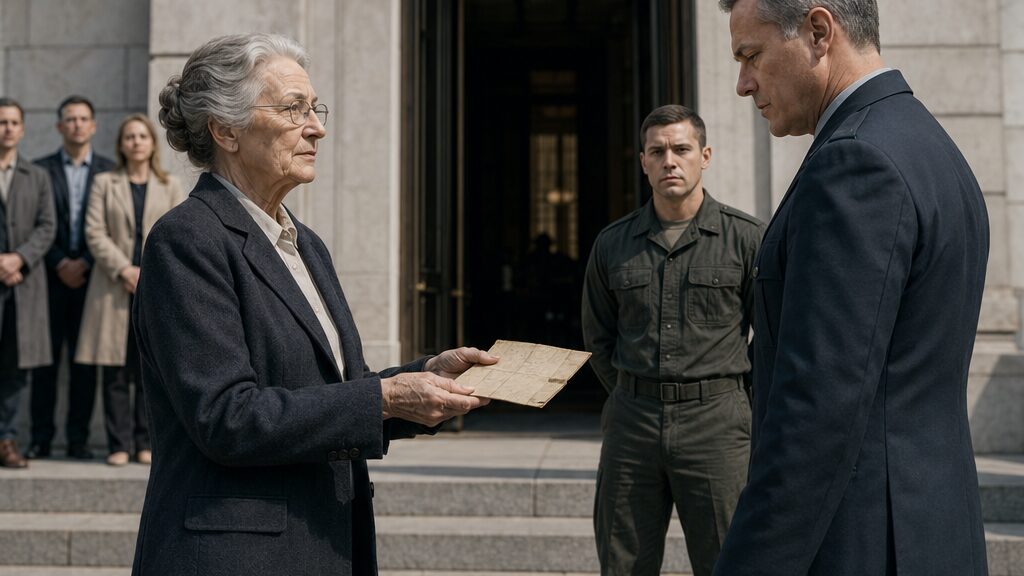
Virginia held out the paper.
Chapter 2: When the Officer Read Her Name
Alexander Wilson did not take the document immediately.
That hesitation lasted only a second, but he felt it. He saw the woman’s hand remain steady in the air, palm slightly lifted, paper resting across her fingers like something both fragile and official. He had spent the morning signing off on controlled access, visitor routing, archive supervision, identity checks, and family briefings. He had already handled two emotional disputes before ten o’clock. Records Review Day always brought grief to the lobby in pressed shirts and polished shoes.
But this woman was not crying.
That made him study her more closely.
She stood thin and straight in the wind, her gray hair pinned back with no ornament, her eyes pale but clear. She wore no veteran cap, no service pin, no lanyard. Nothing that asked to be interpreted. She looked like someone’s grandmother who had boarded the wrong bus and refused to admit it.
That thought embarrassed him as soon as it formed.
Still, procedure was procedure.
“Ma’am,” Alexander said, keeping his voice even, “I can look at it briefly, but I can’t accept original documents outside the intake process.”
“I’m not giving it to you,” she said. “I’m showing it to you.”
Ryan Mitchell shifted beside him. The line behind the woman had grown quiet, listening with the shameless attention of people pretending not to.
Alexander extended his hand.
The woman unfolded the paper herself.
Carefully. Slowly. Not from drama, but from age and respect for the fibers. One crease opened. Then another. The sheet had been folded for so long it resisted becoming flat. The upper corner trembled in the wind until she pressed it down against a small leather-bound notebook she had pulled from her purse.
Alexander expected a photocopy. Perhaps a letter from a veterans’ office. Perhaps a printed claim denial. Instead he saw old typewritten text, the ink uneven from a machine whose ribbon had already been tired. The paper was thin, almost translucent where fingers had handled it for decades.
At the top, in faded block letters, was a field medical transfer request.
His eyes moved with professional speed.
Unit designation. Evacuation station. Casualty count. Names. Initials. Date. Routing mark. A handwritten note in the margin.
Then his gaze stopped.
CARTER, VIRGINIA — ANC — DUTY NURSE, FIELD TRANSFER AUTHORIZATION.
He read it once.
Then again.
Not Mrs. Carter. Not Virginia Carter, next of kin. Not civilian witness.
Carter, Virginia. Army Nurse Corps.
Alexander felt the air around the doorway change before anyone else moved. He became suddenly aware of his own posture, of the way he had angled his shoulders to conclude the encounter quickly. He became aware of Ryan watching him, waiting for the cue that would decide whether this woman remained a delay or became someone else entirely.
Alexander lowered his voice.
“Mrs. Carter,” he said, then stopped. “Ms. Carter?”
“Virginia is fine.”
“No,” he said, quieter still. “It isn’t.”
Her eyes lifted to his.
He looked back down at the paper, not because he needed to confirm what he had seen, but because he needed a second to correct himself in front of her.
“Sergeant Carter?” Ryan asked before he could stop himself.
Virginia turned toward the young serviceman.
“I was a nurse,” she said. “We did not always get called what we were.”
Ryan’s face colored.
Alexander folded his hands behind his back, then brought them forward again because the gesture felt too formal, too distancing. He had seen veterans arrive in full jackets, medals pinned, stories ready. He had also seen those who wanted no attention. But there was a particular discipline in this woman’s silence that he should have recognized sooner.
“Ms. Carter,” he said, “were you Army Nurse Corps?”
“Yes.”
“Active service?”
“Yes.”
The word carried no demand. It did not ask him to admire her. It merely corrected the room.
The man behind her removed his cap.
Alexander noticed that too.
He heard the lobby behind him, the low hum of conversation, the receptionist still standing halfway from her chair, the soft beep of a badge reader. All of it seemed improperly loud.
“May I ask why this wasn’t submitted through Veterans Records?” he asked.
“It was.”
“And?”
“It came back.”
“Why?”
“They said I was not listed as attached to the unit on the transfer sheet.”
Alexander looked again. The unit code in the upper line was faded, but legible enough. “Were you?”
“No.”
He glanced up.
Virginia’s mouth tightened, not in defensiveness but in preparation. “That’s the point.”
Ryan looked between them, lost.
Alexander felt the shape of a longer problem gathering behind the small piece of paper. A mismatch. An old field transfer. A woman who had been told she did not belong on a record she had physically carried for most of her life.
He stepped aside from the doorway.
“Ms. Carter, would you come inside?”
She did not move at first.
It was not defiance. It was the stillness of someone who had learned not to trust a door just because it opened.
Alexander turned to Ryan. “Make space in the waiting room.”
“Yes, sir.”
“And get Michelle Lewis from records intake.”
Ryan nodded and disappeared inside.
Alexander faced the line. “Thank you for your patience. Scheduled appointments will continue through the main desk.”
No one complained now.
Virginia began to fold the document again.
“Please,” Alexander said, almost too quickly. “You don’t have to put it away.”
She paused.
Something in her face changed, though he could not have named it. Not relief. Relief was too simple. Perhaps it was the exhaustion of having expected another refusal and needing a moment to set that expectation down.
“I keep it folded,” she said.
“May I ask why?”
“So it lasts.”
Alexander had no answer for that.
He held the door open for her.
Inside, the lobby smelled faintly of floor polish and paper. Flags stood along one wall. Beyond them, a display case held photographs of service members from different decades. Virginia’s eyes did not move toward the case. They stayed on the path ahead, on the place where Ryan had hurried to clear a chair.
Alexander walked half a step behind her, deliberately not guiding her by the elbow. He had seen staff do that to older visitors without asking, as if age itself were permission to take hold. Today, the impulse came and went, and he let it go.
At the waiting area, Ryan had moved a stack of forms off a chair.
“Ma’am,” he said, then corrected himself. “Ms. Carter.”
Virginia sat carefully, keeping the paper on her lap.
Alexander remained standing.
“Before we proceed,” he said, “I need to understand what correction you’re requesting.”
Virginia smoothed one crease with her thumb.
“There is a name on your memorial record,” she said. “It is attached to the wrong man.”
Alexander kept his face still. “Wrong how?”
“He was moved under another unit during evacuation. The transfer was never completed properly. His name followed the paperwork that survived, not the body that did.”
Ryan looked down.
Alexander heard the words with the part of himself trained to locate administrative errors. Misassigned identity. Wartime chaos. Incomplete field records. Possible correction request.
Then Virginia added, “I was there when he told me his name.”
Alexander looked at her hands.
The paper did not tremble.
“He asked me not to let them lose it,” she said.
Alexander felt the morning, the schedule, the line, the bright official lobby all recede around that sentence.
“What was the name?” he asked.
Virginia did not answer immediately.
She looked toward the wall where the memorial directory screen glowed blue and white, cycling through names in clean digital columns.
“The name on your record,” she said, “is not the one he gave me.”
Chapter 3: The Name That Did Not Belong
The waiting room chair was lower than Virginia expected, and for one foolish second she worried she would not rise from it with dignity.
She sat anyway.
The folded paper rested on her lap, open now but held along its creases, as if the document itself remembered being smaller. Around her, the waiting room resumed its muted rhythm. A receptionist called a surname. A printer clicked behind a counter. Shoes crossed polished stone. The building was full of people searching for names, and still Virginia felt she had brought in the only one that weighed anything.
Alexander Wilson stood near her right shoulder, not hovering but unwilling to leave. Ryan Mitchell stayed by the doorway, quieter than before. He had stopped looking at her as if she might wander. Now he looked at her as if he might miss something important if he blinked.
A woman in a records badge approached with a tablet tucked under one arm and reading glasses pushed up on her head.
“Michelle Lewis,” she said. “Records intake.”
Virginia nodded.
Michelle’s eyes went first to the document, then to Virginia’s face. She did not reach for the paper without asking.
“May I see it?”
Virginia liked her for that.
“You may look,” she said.
Michelle leaned in instead of taking it. Her expression changed in small professional stages: curiosity, recognition of age, caution, then concentration. The old format slowed her down. She read the heading under her breath, then the transfer line, then the handwritten note in the margin.
“This is original?” Michelle asked.
“Yes.”
“Do you have a preservation sleeve for it?”
“At home.”
Michelle looked pained. “We’ll get one.”
Alexander said, “She submitted a correction request. It was returned.”
Michelle’s mouth tightened, already understanding the likely reason before he finished. “Name mismatch?”
“Unit attachment mismatch,” Alexander said.
Virginia kept her eyes on the paper.
Michelle straightened. “Ms. Carter, do I have permission to search the active memorial record while you’re here?”
“That’s why I came.”
Michelle sat across from her and opened the tablet. Her fingers moved quickly. The screen reflected pale light in her glasses.
“What name did you submit for correction?”
Virginia inhaled. The name had lived so long in her mouth without being spoken that saying it here felt almost like exposing him to weather.
“George Brown.”
Michelle typed.
The tablet offered no reaction. Only a list. Official systems never knew when they were disappointing someone.
“There are multiple George Browns,” Michelle said. “Do you have middle initial, rank, branch?”
Virginia looked down at the document. “He told me George Brown. The tag they gave him said G. Brown. The transfer sheet listed G. Brown under the wrong unit.”
“Which unit did the current record attach him to?”
Virginia recited it from memory.
Michelle glanced up, surprised. “You remember the unit code?”
“I remember what they wrote over his name.”
Alexander’s eyes moved to her, but he did not interrupt.
Michelle searched again. Her fingers slowed. “I have a George Brown listed under that unit, deceased in transfer. Memorial record entry approved in 1973, digitized in 2008. No next-of-kin update after 1981.”
“That is not him,” Virginia said.
Michelle’s voice stayed gentle. “The record says it is.”
“I know what the record says.”
The words came sharper than she intended.
Ryan lowered his eyes. Alexander remained still.
Virginia pressed her lips together and made herself breathe. Anger had no place to go at her age. It only made people call you confused faster.
Michelle did not bristle. She turned the tablet slightly so Virginia could see without giving up control of the screen. “This entry lists the service member as assigned to the receiving convoy. The evacuation record says he was transferred from Station Six.”
“He was moved from Station Four,” Virginia said.
Michelle scrolled. “The system doesn’t show Station Four in connection with him.”
“No,” Virginia said. “Because Station Four lost power.”
The waiting room noise seemed to thin.
Michelle looked at Alexander.
Virginia could feel their attention settle differently now. Not just on her claim, but on the possibility that she was not recalling a document. She was recalling a room.
“There were too many of them,” Virginia said. “The generator kept failing. We wrote what we could. Some tags were tied to stretchers. Some were pinned. Some were in pockets. Some were lost before the trucks left.”
Her thumb moved once over the document’s lower crease.
“I wrote his name twice,” she said. “Once on tape. Once here.”
Michelle looked again at the paper. “The handwriting in the margin?”
Virginia nodded.
Michelle bent closer. The margin held a cramped note, faint but still there: G. Brown — Station 4 transfer, verbal ID confirmed. V.C.
“V.C.,” Michelle said softly.
Virginia said nothing.
Alexander’s face had gone very still.
Michelle turned back to the tablet and began a deeper search. “Ms. Carter, the issue is that the digital record doesn’t list you as Army Nurse Corps attached to Station Four. It shows a Virginia Carter as civilian volunteer support entered later into a supplemental index.”
Virginia stared at her.
The words did not surprise her. Not exactly. Some part of her had known. She had felt it in every returned envelope, every polite letter, every line that said insufficient supporting evidence.
Still, hearing it aloud in this clean room made something old and tired move under her ribs.
“Civilian volunteer,” she repeated.
Michelle looked apologetic. “That may be why your prior request failed. If the system doesn’t recognize you as attached medical personnel, your note may have been treated as secondary witness material.”
“I was not secondary.”
“I understand.”
“No,” Virginia said.
Her voice was quiet, but it stopped Michelle’s hand above the screen.
Virginia looked at the tablet, then at the open paper in her lap. “You may understand what the screen says. You do not understand what it is to stand in a room where everyone is asking who still has a pulse, and then be told years later that you were not attached enough to write down a name.”
Ryan’s face tightened as if the words had struck him personally.
Michelle folded her hands around the tablet. “You’re right,” she said. “I don’t.”
That simple admission settled the air more than an apology would have.
Alexander pulled out the chair beside Michelle and sat. Until then, he had remained standing, a figure of authority overseeing a complaint. Sitting changed him. He was no longer above her line of sight.
“What do we need?” he asked Michelle.
“For a formal correction? Original document review. Cross-reference with archive holdings. Any surviving evacuation logs. Personnel verification for Ms. Carter. Chain-of-custody scan. Probably supervisor approval.”
“Can it be done today?”
Michelle gave him a look that suggested the honest answer was no, the bureaucratic answer was also no, and the human answer was trying to become maybe.
“We can start today,” she said.
Virginia began folding the document.
Michelle raised a hand slightly. “May we place it in a sleeve first?”
Virginia paused.
The paper lay open across her knees, showing everything it had survived: creases, fading ink, a corner darkened by something that might once have been water or might not have been. For years she had kept it folded because folded things could be protected. Open things could be taken, judged, dismissed.
But Michelle was already standing, asking a clerk for archival sleeves. Alexander had not looked away. Ryan stood at the doorway as though guarding not the entrance but the moment itself.
Virginia let the document remain open.
Michelle returned with a clear sleeve and slid a stiff backing beneath the paper with the care of someone lifting a sleeping child.
“There,” she said. “No more bare handling.”
Virginia watched the document settle under the thin protective sheet. It looked less like something she had carried and more like something the building had finally agreed existed.
Michelle read the personnel line once more.
Then she frowned.
“What is it?” Alexander asked.
Michelle tapped the tablet.
“The archive file linked to this correction request doesn’t just misidentify the soldier,” she said. “It misidentifies Ms. Carter.”
Virginia looked up.
Michelle’s voice lowered.
“In the old index, Virginia Carter is listed as civilian volunteer support, no service authority, no medical authorization.”
Ryan turned toward Alexander.
Alexander’s jaw tightened.
Virginia felt the room change again, but this time she did not feel recognized.
She felt erased in a second, official way.
Michelle looked from the tablet to the paper sealed beneath the protective sleeve.
“The file says you weren’t Army Nurse Corps,” she said. “It says you were never officially there.”
Chapter 4: The File Marked Incomplete
Michelle Lewis had spent twelve years inside rooms where the dead arrived as numbers, scanned pages, unit codes, and names typed with varying degrees of care.
She believed in records because she knew what happened without them. Families filled the gaps with stories. Institutions filled them with assumptions. History, if left unattended, became whatever had been easiest to file.
Still, she had never liked the archive room at midday.
The overhead lights hummed too loudly. The metal shelves seemed to hold their breath. Boxes lined the walls in gray ranks, each labeled by decade, conflict, branch, and condition. Some had neat printed barcodes. Others carried old handwritten markings from before anyone thought paper might one day need translating into a machine.
Virginia Carter sat at the narrow review table beneath a reading lamp, her hands folded in her lap now that the document had been placed inside an archival sleeve. Michelle had set the paper on a clean mat in front of her. Alexander Wilson stood across from them with his jacket buttoned and his tablet unused in his hand. Ryan Mitchell had been told to manage the lobby, but he appeared every few minutes in the doorway under the pretense of asking whether they needed anything.
Michelle did not send him away.
She opened the first file box.
The folder inside was thinner than it should have been.
That was the first bad sign.
“Station Four,” Michelle said, reading the label. “Supplemental evacuation reports. Partial recovery. Several entries marked incomplete.”
Virginia did not react to the word.
Alexander did. His jaw shifted once.
Michelle placed cotton weights at the corners of a photocopied log. “Most of these are duplicates from later summaries. Originals may have been damaged or incorporated into unit records.”
“Lost,” Virginia said.
Michelle glanced at her. “Possibly.”
Virginia looked at the page. “Lost is shorter.”
Michelle accepted the correction silently.
The first hour gave them fragments. A convoy schedule with two times crossed out. A casualty movement list that began with twenty-six names and ended with eleven. A receiving unit stamp too blurred to read. A line noting generator failure at Station Four at 0210 hours. Michelle wrote each connection on a yellow legal pad because the database view flattened too much of what mattered.
Virginia answered only when asked.
Not because she lacked memory. Michelle understood that quickly. Virginia’s memory was exact in places that official documents had blurred. She remembered which tables had been pushed together. She remembered that the light above the south wall had flickered before it died completely. She remembered a supply sergeant using a flashlight between his teeth while tying tags to stretcher rails. She remembered the sound of rain on canvas and the diesel smell from trucks waiting with their engines running.
But she did not offer any of it freely.
Every question seemed to require her to decide whether opening another door in herself was worth what might be found behind it.
Michelle respected that.
“Here,” Alexander said suddenly.
He had moved to the second box, where a folder had been misfiled under receiving convoy addenda. He placed a page beside Michelle’s notes.
The paper listed transferred personnel by initial and surname when full identification had not been confirmed. Near the bottom, in a rushed hand, was: G. Brown — verbal ID — Station 4 overflow — nurse confirm.
Michelle leaned closer. “Nurse confirm.”
Alexander looked to Virginia.
Virginia’s face remained calm, but her fingers had closed around the edge of her chair.
“Is that your confirmation?” Michelle asked.
Virginia nodded once.
“Did you write this page?”
“No,” Virginia said. “A clerk wrote it. I gave him the names.”
Michelle compared the sheet to the document in the sleeve. “The field transfer request says V.C. confirmed verbal ID. This convoy addendum says nurse confirm. But the later index reassigns G. Brown to the receiving convoy’s unit.”
“Because he was loaded with them,” Virginia said.
Alexander studied the page. “So the body followed the convoy record.”
Virginia’s eyes moved to him. “The body followed whoever had room.”
For a while, none of them spoke.
Michelle made another note, though she already knew it would not be enough by itself. The correction board would want a chain: personnel authority, original record, corroborating archive file, reason for discrepancy. They had pieces of the chain, but every link was rusted.
She opened Virginia’s personnel index next.
That file was worse.
There was a typed entry for Carter, Virginia, attached to auxiliary support for Station Six. Beside her name, a later digital note labeled her status as civilian volunteer support. There was no active Army Nurse Corps service authority tied to Station Four. No transfer order. No temporary assignment.
Michelle frowned. “This may be the source of the denial.”
Virginia’s mouth tightened. “I was sent where they needed hands.”
“Do you remember who ordered the reassignment?”
Virginia looked toward the shelves as if the name might be stored there. “A doctor. Maybe a major. He had a burn across one wrist. Everyone was shouting. He pointed at me and another nurse and said Station Four was drowning.”
“Was it written?”
Virginia gave a small, dry breath. “Everything was supposed to be written.”
Alexander set down his tablet. “But not everything was.”
“No.”
Michelle turned a page. There was a carbon copy of a personnel movement roster, edges damaged, half the names faint. Under temporary medical support, she saw only a partial line: Carter, V.—ANC—detached…
The rest was gone.
Michelle felt a quick professional thrill, then suppressed it. A damaged line was not proof, but it was a crack in the wall.
She slid the roster under the lamp. “Ms. Carter.”
Virginia leaned forward.
Michelle pointed carefully, not touching the ink. “This appears to list you as Army Nurse Corps. Detached. The destination is missing.”
Virginia stared at the broken line.
For the first time since entering the archive room, her face lost its practiced composure. Not dramatically. Her eyes did not fill. Her hands did not fly to her mouth. She simply looked older, as if the years had moved forward all at once because a piece of paper had admitted what people had not.
“I was there,” she said.
“I believe you,” Michelle replied.
Alexander looked at Michelle.
The words mattered in an archive room. They were not a ruling, not a correction, not enough for a board. But they were the first thing anyone inside that building had given Virginia without requiring another form.
Michelle returned to the file. “There’s still a problem. The memorial record identifies George Brown through the receiving convoy entry. If we challenge that, we need to show that the convoy entry absorbed a Station Four casualty incorrectly.”
Virginia touched the sleeve lightly. “That is what that says.”
“It helps,” Michelle said. “But the file will ask why your note was authoritative.”
Virginia withdrew her hand.
Alexander’s expression shifted. He saw it too now, Michelle thought. The insult underneath the procedure. Not loud, not intentional, but cleanly built: the system had first erased Virginia’s authority, then used that erasure to reject the correction only she could make.
Michelle opened the final folder in the box.
Inside was a set of casualty routing slips, many nearly blank. She sorted them by date, then by initials. Rain had blurred several stamps. One slip had no full name at all, only initials, unit code, and a receiving mark.
G.B.
Station Four overflow.
Transferred under temporary convoy designation.
Michelle held her breath.
“There,” Alexander said.
Virginia did not lean in. She seemed afraid to move the air.
Michelle placed the routing slip beside the protected document. The handwriting was different. The date matched. The transfer route matched. The initials matched. The receiving designation matched the wrong memorial entry.
“It doesn’t give the full name,” Michelle said.
“No,” Virginia said. “He did.”
Alexander asked, “You heard him clearly?”
Virginia’s eyes stayed on the slip. “He made me repeat it.”
The room became very still.
Michelle looked again at the slip and then at the personnel list. Together, the documents did not give a clean answer. They gave a human one, broken across pages, depending on whether anyone was willing to see what the broken pieces meant.
Alexander walked to the end of the table and rested both hands against the edge.
“Michelle,” he said, “what would happen if this stayed as it is?”
Michelle knew the answer. “The existing memorial entry remains unchanged. Prior correction denial stands. Ms. Carter remains indexed as civilian volunteer support in this case file unless personnel review is opened separately.”
Alexander looked at Virginia.
“That means,” Virginia said, “he stays under the wrong name.”
“Wrong unit,” Michelle corrected softly.
Virginia’s gaze sharpened.
Michelle lowered her voice. “I’m sorry.”
Virginia looked back at the paper.
“Wrong man,” she said.
Alexander absorbed that. He did not argue this time.
Michelle turned the damaged personnel roster again, seeking any clearer mark, any note, any attached order. A small slip fell from between two pages and landed near Alexander’s hand.
He picked it up before she could stop him, then froze, remembering the handling rules. Carefully, he set it flat.
It was a partial casualty note, clipped at the corner. Most of the text was administrative shorthand. At the bottom were three initials.
G.B.
Beside them, in pencil, a next-of-kin surname: Brown.
And beneath that, barely legible, a handwritten line: carried by Wilson truck after Station 4 overflow.
Michelle saw Alexander’s face change.
Not the public change from the doorway. This was private and involuntary, like a door opening inside him before he could brace it shut.
“Wilson truck,” he said.
Virginia looked up.
Michelle glanced between them. “That may refer to a driver, vehicle, or convoy designation.”
Alexander did not answer at once.
He touched nothing now. His hand hovered above the slip, then pulled back.
“My grandfather,” he said quietly, “drove medical transport before he was wounded.”
Michelle waited.
Alexander’s eyes stayed on the penciled line.
“His last name was Wilson,” he said.
Chapter 5: The Story She Never Wanted to Tell
Virginia had learned long ago that memory did not arrive in order.
It came as hands first.
Not faces. Not names. Hands.
A young man’s fingers gripping the edge of a stretcher. A doctor’s cracked knuckles under dried soap. Her own hands, red at the wrists, trying to press gauze where the body refused to close. The hand of a soldier who did not know her name but knew enough to hold on.
In the quiet office where Alexander Wilson had brought her after the archive room, Virginia sat beneath a framed photograph of service members she did not know and listened to a wall clock mark off seconds with unnecessary confidence.
Her protected document lay on the desk between them.
Michelle Lewis had gone to request supervised access to a deeper personnel index. Ryan Mitchell had been sent to keep the hallway clear. For the first time since the doorway, Virginia and Alexander were alone.
He did not sit behind the desk. He had tried, then changed his mind, taking the chair across from her instead.
“My grandfather rarely spoke about transport duty,” Alexander said.
Virginia looked at the document, not at him.
“Many didn’t.”
“He said once that he carried more men than he could count.”
“That sounds right.”
Alexander folded his hands. “His records say he was wounded the same night as the Station Four evacuation.”
Virginia’s breath moved shallowly in her chest.
“I’m not asking you to solve my family history,” he said. “I need you to understand that. This review cannot become personal.”
“No,” Virginia said. “It shouldn’t.”
“But I do need to ask what you remember.”
She looked at him then.
There were careful men, and there were men trying to be careful because they had just discovered carelessness in themselves. Alexander Wilson was the second kind now. It made him more human, but not easier to answer.
“How much?” she asked.
“As much as you can give.”
Virginia almost laughed.
People always thought memory was a locked drawer. Open it, take what you need, close it again. They did not know it was water under a door. Once it came through, it found every low place.
She rested one hand on her purse strap.
“I was assigned to Station Six,” she said. “That part is true. Station Four was not supposed to receive as many as it did. Roads changed. Weather changed. Orders changed faster than paper. Someone came for two of us because they needed nurses who could still stand.”
She paused.
Alexander did not fill the silence.
“When I got there, they had already started marking men for transfer. Some could wait. Some couldn’t. Some were only names by then.”
She looked toward the window. Outside, a flag moved in a steady wind, its reflection faint in the glass.
“The lights failed twice. The second time, a supply clerk knocked over a tray in the dark. Everyone yelled at him, but he was just trying to find more tags. We had tape, so I wrote on tape when there were no tags left. Initials if that was all we had. Full names if they could tell us.”
“George Brown could tell you?”
“Yes.”
Her voice remained level, but her throat had tightened around the name.
“He was young. They were all young, but he looked younger because his face was clean. No beard. No dirt yet in the lines because he did not have lines. He kept apologizing.”
“For what?”
“Taking time.”
Alexander lowered his eyes.
Virginia looked down at her hands.
“He was awake when they brought him in. Not for long, but enough. He grabbed my sleeve and said, ‘Don’t let them mix me up.’ I told him we wouldn’t. That was what you said. You did not say maybe. You did not say we were short on tags. You did not say the truck was leaving and half the paperwork was wet.”
She closed her fingers.
“You said, ‘We won’t.’”
Alexander’s voice was very soft. “And he gave you his name.”
“He said George Brown. He made me say it back. I did. Then he said it again, as if the second time would hold better.”
“Did he mention family?”
Virginia’s gaze went distant.
“A sister. Maybe. Or a mother. I remember the word home more than I remember the details. He was trying not to sleep. They always tried not to sleep when they thought sleep was a kind of agreement.”
The clock ticked.
“I wrote G. Brown on the first tape. Then I wrote George Brown on another strip and put it under the blanket near his shoulder because his sleeve was torn. When the trucks came, they changed the order. A driver said he had space for two more. Someone shouted Station Four overflow. Someone else shouted that the receiving unit would correct it at intake.”
She looked at Alexander.
“They did not correct it.”
He said nothing.
“He was not the only one,” Virginia continued. “That is the part that kept me quiet. You begin with one name, but behind it are others. You think, if I pull this thread, what happens to the whole cloth? Who did I miss? Who did I fail? Who did I promise less because they could no longer ask?”
Alexander’s face tightened.
“You came now,” he said.
“Yes.”
“Why?”
Virginia touched the edge of the protective sleeve. “Because I saw his name on the memorial record.”
“Recently?”
“Three months ago. A neighbor helped me use the public database. I had avoided it.”
“Why?”
She looked at him with something almost stern.
“Because old women are allowed to know their cowardice by its proper name.”
Alexander drew back slightly, not offended, but struck.
Virginia softened. “I do not mean fear of telling the truth. I mean fear of finding out the truth no longer wants you.”
The words seemed to empty the small office.
She had not planned to say that. She had planned only to make someone read the document. She had thought if she kept to paper, paper would keep her safe.
But George Brown had not asked her to preserve paper.
He had asked not to be mixed up.
“When I saw the record,” she said, “the unit was wrong. The transfer line was wrong. The note attached to him belonged to another route. And my correction was returned because the system said I had no authority.”
Alexander looked toward the document. “But you did.”
Virginia’s mouth pressed into a thin line. “Authority is a strange word for a room where everyone is doing whatever keeps someone alive until the next hand can take them.”
“What did you want the correction to say?”
“His name. His transfer. That he came from Station Four. That the record was not clean because the night was not clean.”
“And your service?”
She looked away.
“That is not why I came.”
“But it is part of why they dismissed your request.”
“Then fix it only as much as it needs fixing.”
Alexander sat back. “Ms. Carter, if the file identifies you incorrectly, correcting that may matter too.”
Virginia shook her head. “Do not make him disappear again by turning this into a ceremony for me.”
“I’m not suggesting that.”
“People do. They find an old nurse and suddenly they want a photograph. A handshake. A paragraph about courage. Then the man whose name started it becomes a line under my story.”
Alexander did not answer quickly.
That restraint helped.
“I understand,” he said at last. “Or I’m trying to.”
Virginia believed him enough not to look away.
The door opened after a light knock. Michelle entered with a folder held against her chest. Her expression was controlled, but her eyes moved first to Virginia, then Alexander.
“I found the deeper index,” she said. “There’s no full transfer order. But there is a personnel correction note from years later acknowledging possible misclassification for temporary medical staff at Station Four. It was never attached to Ms. Carter’s file.”
Alexander stood. “Can it support review?”
“It can support reopening the review.”
Virginia heard the difference.
Reopening was not correcting. Searching was not finding. Believing was not changing the record.
Still, it was no longer a closed door.
Michelle placed the folder on the desk. “There’s another issue.”
Alexander waited.
“The casualty note from the archive room—the one marked Wilson truck. I cross-checked transport logs. The driver attached to that convoy survived. He later submitted a statement about carrying unidentified Station Four overflow casualties.”
Alexander’s face lost a little color.
Michelle glanced at Virginia. “His statement mentions a nurse who insisted one of the men was named George Brown.”
Virginia closed her eyes.
Not to cry. Not yet.
To see the room again without being swallowed by it.
Alexander’s voice came carefully. “What was the driver’s name?”
Michelle hesitated only a second.
“George Brown’s transfer record was countersigned by a transport driver listed as Wilson,” she said. “The surviving driver’s full name appears in the transport file.”
Alexander looked at Virginia.
“My grandfather?” he asked.
Michelle gave a small nod. “It appears so.”
Virginia opened her eyes.
Alexander’s composure held, but only because he made it hold. He looked suddenly less like an officer and more like a grandson who had found a handprint on a wall he thought he knew.
“Ms. Carter,” he said, voice barely above the clock, “was the soldier’s name George Brown?”
Virginia looked at the protected paper, at the crease that had nearly worn through, at the initials V.C. still visible where her younger hand had tried to make a promise last.
“Yes,” she said.
Alexander swallowed.
“George Brown,” he repeated.
Virginia heard something underneath the name now. Not doubt. Recognition turning personal before he could stop it.
He looked at Michelle, then back at Virginia.
“Was his name George Brown?” he asked again, but differently this time.
Virginia’s hands stilled.
Alexander said, “George Brown was my grandfather’s closest friend.”
Chapter 6: A Salute She Did Not Ask For
Ryan Mitchell knew the hallway had changed before anyone told him why.
People walked differently when a room became important. Clerks lowered their voices as they passed. The receptionist stopped sending routine questions toward the archive wing. Even the visitors waiting by the memorial displays seemed to sense that something had moved beneath the ordinary business of the day.
Ryan stood near the corridor entrance with a clipboard he did not need, pretending to check appointments while watching the closed office door.
He had been wrong about her.
That fact kept returning with the sharpness of a pebble in his shoe.
At the door, he had seen an elderly woman without an appointment. A delay. A possible confusion. A task to manage. He had not seen Virginia Carter, Army Nurse Corps. He had not seen the steady hands that had written a name in a room where records were breaking faster than people could make them.
He had not seen anything except age and inconvenience.
The office door opened.
Michelle Lewis stepped out first, carrying a folder. Alexander Wilson followed, his expression set in the controlled way officers wore when something private had to remain private in public. Virginia came last.
She moved slowly, one hand on the back of a chair before she entered the hallway. Ryan stepped forward automatically.
“Ma’am—”
He stopped himself too late.
Virginia looked at him.
The word hung between them, not insulting, not wrong by itself, but smaller than what he knew now.
“Ms. Carter,” he corrected.
Alexander noticed. So did Michelle.
Virginia only nodded.
Ryan wanted to say more. Apologize, perhaps. But apology felt too easy, a way to relieve himself instead of serve her. So he moved the chair aside, clearing the path without touching her arm.
“Thank you,” she said.
The words were ordinary. They made him feel worse.
Behind them, the archive supervisor appeared with another staff member, both speaking in low tones. A records clerk at the desk whispered something to the receptionist. Within minutes, the fact of Virginia’s service had traveled ahead of her like weather.
By the time she reached the corridor outside the review room, three staff members had stood.
Virginia saw it happen.
Ryan saw her see it.
A man who had earlier complained in line removed his cap again. The receptionist straightened so quickly her chair rolled back. The archive supervisor held the folder against his chest with both hands, his face arranged in solemn respect.
Then the security guard near the entrance, who had first checked Virginia’s purse, lifted his hand in a salute.
It was not showy. It was not loud. But it was visible.
Other eyes turned.
Ryan felt his own body respond before thought. His shoulders squared. His hand began to rise.
Virginia stopped walking.
The hallway stopped with her.
Her gaze moved from the guard’s salute to Ryan’s half-raised hand, then to Alexander. Not angrily. Not with embarrassment. With a weariness so precise that Ryan lowered his hand before completing the gesture.
The security guard lowered his too, uncertain.
Virginia stood in the center of the corridor, the protected document held by Michelle a few steps behind her.
“I know you mean respect,” she said.
No one answered.
Her voice was soft enough that people leaned in to hear and ashamed enough to wish they did not have to.
“But please don’t turn me into a moment.”
Ryan felt the words land harder than any reprimand could have.
Alexander stepped closer, not in front of her, not speaking for her. Just near enough that the staff understood the hallway belonged to her words now.
Virginia looked toward the memorial display at the far wall. Names glowed on the digital screen in clean rows, bright and untroubled.
“I came because a man’s name is wrong,” she said. “Not because I need anyone to discover mine.”
The receptionist looked down.
The man with the cap held it against his chest.
Virginia turned to Ryan then. “Do you understand the difference?”
He answered too quickly, then stopped. A fast yes would be another way of escaping the weight of the question.
“I’m trying to,” he said.
She held his gaze a moment.
That seemed to satisfy her more than certainty would have.
Michelle came forward, carrying the archival sleeve. “Ms. Carter, we need your permission to make a preservation scan of the document. The original remains with you unless you choose otherwise.”
Virginia’s eyes moved to the sleeve.
The paper inside looked strangely distant now, flattened and protected. Ryan remembered how he had stared at it outside as if it were an inconvenience. He wanted to touch it only to prove to himself he could handle it correctly.
Michelle held it toward him. “Mitchell, would you escort this to scanning with me? Two-person handling.”
Ryan stepped forward.
Then he looked at Virginia. “May I?”
The question surprised even him.
Virginia’s expression softened by almost nothing, but enough.
“Yes.”
Michelle placed the sleeve in his hands.
Ryan received it with both palms, careful not to bend the backing board. The paper weighed almost nothing. That was the first thing he noticed. The second was that his hands knew enough to be afraid of their own carelessness.
He walked beside Michelle down the corridor to the scanning station. The staff parted without ceremony this time, not because someone had saluted, but because everyone finally understood the object being carried was not a prop.
At the scanning room, Michelle guided him through the process. Lights. Glass. Calibration. No pressure on the original. No exposed handling. Ryan followed each instruction with a concentration that made his neck tense.
Through the open door, he could see Virginia seated near Alexander in the review room. She looked tired now. Not weak. Tired the way stone might be tired after holding a building for too long.
“People mean well,” Michelle said quietly as the scanner warmed.
Ryan knew she was speaking of the salute.
“I almost did it too,” he said.
“I saw.”
“I thought it was respect.”
“It can be.”
“But not always.”
Michelle looked at him. “Sometimes respect is asking before deciding what someone’s service means.”
The scanner light moved beneath the glass.
Ryan watched the document appear slowly on the screen, line by line. CARTER, VIRGINIA. ANC. G. Brown. V.C.
He thought about how little he had known when he told her to step aside.
When the scan finished, Michelle saved the image, logged the chain-of-custody note, and handed the sleeve back to him.
“Return it to her,” she said.
“Me?”
“She allowed you to carry it.”
Ryan understood that this was not a reward.
It was a chance to do one thing correctly.
He walked back more slowly than necessary. Virginia looked up as he approached. Alexander moved his chair slightly aside, giving Ryan a clear path.
Ryan stopped in front of her and held out the document with both hands.
“Ms. Carter,” he said, “thank you for trusting me with it.”
She took the sleeve, her fingers brushing the edge but not his hands. “Trust is too large a word for one hallway.”
“Yes, ma’am,” he said, then caught himself. “Yes, Ms. Carter.”
This time, she almost smiled.
Ryan stayed there instead of retreating.
“What do you want us to do now?” he asked.
The question changed the room.
Alexander looked at him, not sharply, but with recognition. Michelle paused near the table. Virginia lowered her eyes to the sleeve, then lifted them again.
For the first time all day, no one had asked what form she had filled out, what appointment she lacked, what proof she carried, or what category she belonged in.
Someone had asked what she wanted done.
Virginia rested the document across her knees.
“I want the record corrected,” she said.
Alexander leaned forward. “We can open the review.”
She shook her head once. “Not open. Not honor. Not thank. Correct.”
The words were not hard, but they were immovable.
Ryan nodded as if receiving an order he finally understood.
Virginia looked toward the memorial screen, where the names continued to move in their silent rotation.
“Put his name,” she
Chapter 7: The Record That Changed the Room
By the next morning, Alexander Wilson had read his grandfather’s transport statement nine times.
He had not meant to.
He had opened the file first as an officer, then as a records authority, then as a man trying to find the edge between duty and blood. Each time, the old statement remained the same: brief, uneven, written by a younger version of a man Alexander had only known with white hair and a quiet chair near the kitchen window.
Station Four overflow. Two added after loading. Nurse insisted one verbal ID: George Brown. Paper wet. Could not confirm at receiving.
His grandfather had signed it in a hand Alexander recognized from birthday cards and tool labels in a garage that still smelled of oil after the man died.
The records review chamber was colder than the rest of the building. It had been designed for preservation and impartiality: long table, sealed evidence sleeves, overhead camera, two monitors, recording equipment, chairs placed at careful distances. There was no flag large enough to soften it. No photograph. No ceremony.
Virginia Carter sat at the table with her purse in her lap.
Michelle Lewis arranged the documents in order: the original field transfer request in its protective sleeve, the damaged personnel roster showing Carter, V.—ANC—detached, the casualty routing slip marked G.B., the receiving convoy record, the later memorial entry, and the transport statement signed by Wilson.
Ryan Mitchell stood near the door, assigned as witness, though Alexander suspected he would have volunteered if not ordered.
The archive supervisor sat with a tablet, already looking doubtful in the official way of a person whose caution was professional rather than cruel.
Alexander understood him. Yesterday, he might have been him.
“This is enough to reopen the case,” the archive supervisor said. “But a formal correction requires more than correlation.”
Virginia looked at the papers. “Correlation.”
Michelle’s eyes flicked toward Alexander.
The archive supervisor adjusted his glasses. “Ms. Carter, I don’t mean to diminish your statement.”
“Then don’t,” Virginia said quietly.
The room stilled.
She had not raised her voice. She had not leaned forward. Yet the words landed with the authority everyone had failed to see on the sidewalk.
The archive supervisor inclined his head. “Understood.”
Alexander let the silence stay for one breath longer. Then he placed his grandfather’s statement beside the other documents.
“We have an original field transfer request identifying Carter, Virginia, Army Nurse Corps, as duty nurse with transfer authorization,” he said. “We have a partial personnel roster confirming Carter, V., ANC, detached. We have a casualty routing slip for G.B. from Station Four overflow, transferred under temporary convoy designation. We have a receiving convoy record that appears to have absorbed that casualty into its unit. We have a transport statement confirming a nurse insisted the verbal identification was George Brown.”
The archive supervisor said, “We do not have a full middle initial.”
“No,” Alexander said.
“We do not have a surviving complete transfer order.”
“No.”
“We do not have an intact intake confirmation at the receiving station.”
“No.”
The archive supervisor folded his hands. “Then the safest administrative action is to add a note of disputed identification and refer the case for extended historical review.”
Virginia did not move, but Alexander saw the effect.
It was the shape of another delay. Not refusal. Something worse, perhaps: respect spoken in careful language while nothing changed.
Michelle looked down.
Ryan’s jaw worked once.
Alexander stared at the neat row of documents. Yesterday, he might have accepted the recommendation as prudent. He might have thanked Virginia for bringing the issue forward. He might have promised further review. He might even have believed he had done right by her.
The thought made his neck feel hot beneath his collar.
“Safe for whom?” he asked.
The archive supervisor looked up. “Sir?”
“Safe for whom?” Alexander repeated.
The man hesitated. “For the integrity of the record.”
Alexander touched nothing, but he looked at the field transfer request in its sleeve. “The record already lacks integrity.”
Virginia’s eyes lifted to him.
He continued before the room could become sentimental. “A disputed note preserves our uncertainty. It does not address how that uncertainty was created. Ms. Carter’s authority was misindexed. Her correction was rejected because of that misindexing. The casualty followed an administrative shortcut created under emergency conditions. We are not protecting the record by preserving the shortcut.”
The archive supervisor was silent.
Alexander turned to Virginia. “Ms. Carter, I need to ask plainly. Are you requesting that George Brown’s memorial entry be corrected to reflect Station Four transfer and verbal identification confirmed by Army Nurse Corps duty nurse Virginia Carter?”
Virginia’s hands rested on her purse. She looked at the document that had once lived folded in darkness.
“No,” she said.
Alexander stopped.
Michelle looked up sharply.
Virginia drew a breath. “Not like that.”
The archive supervisor’s expression tightened, as if the uncertainty had vindicated him.
Alexander waited.
Virginia pointed to the transfer request. Her finger did not touch the sleeve. “Do not make my name the center of his line.”
“Then how should it read?” Alexander asked.
She looked at him for a long moment, and he understood that the question mattered more than the answer. Not because of wording. Because someone had finally asked.
“George Brown,” she said. “Station Four medical overflow. Transferred under emergency convoy designation. Verbal identity confirmed before transfer.”
Michelle began writing.
Alexander asked, “And your role?”
“In the supporting file,” Virginia said. “Where someone who needs to know can know. Not on the memorial line.”
The archive supervisor leaned forward. “Ms. Carter, without naming your authority on the memorial entry, the correction may appear less supported.”
Virginia’s eyes did not leave Alexander. “Then support it properly.”
Ryan lowered his gaze, almost hiding a smile.
Alexander felt something in him settle.
There it was. Not a plea. Not a performance. Not a grateful old woman accepting whatever the institution gave her. A veteran insisting the work be done right.
He turned to the archive supervisor. “Open two actions. First, formal correction to George Brown’s memorial record with supporting documentation attached. Second, personnel index correction for Virginia Carter, Army Nurse Corps, temporary medical detachment to Station Four.”
The supervisor’s mouth tightened. “Sir, personnel correction may require separate approval.”
“Then request it.”
“It could take weeks.”
“Begin today.”
The room did not brighten. No one applauded. No music rose. The overhead lights kept humming, and the documents remained old, fragile, incomplete.
But something had changed.
Michelle slid a form toward Alexander. “You’ll need to sign the review authorization.”
He took the pen.
For a moment, his eyes fell again on his grandfather’s statement. Wilson. The name sat there with its own burden. His grandfather had driven men through rain and confusion, then lived long enough to become a quiet old man who never told his grandson that one of the names had stayed wrong.
Alexander signed.
Not for his grandfather. Not only.
For Virginia, who had carried a folded paper because no system had carried her truth.
For George Brown, whose name had traveled under the wrong line because the living were too overwhelmed to keep every promise clean.
For every person at the door who had been told to come back with a better form.
Michelle took the authorization and logged it into the system. The monitors reflected the new case status in impersonal blue: FORMAL CORRECTION REVIEW — ACTIVE.
“Ms. Carter,” Alexander said, “the correction can be entered with provisional approval today and finalized after historical certification. The public entry can be amended to show pending correction before you leave, if you consent.”
Virginia looked at the screen. “Pending is not corrected.”
“No,” he said. “But it stops presenting the old entry as complete.”
She considered that.
“All right.”
Michelle’s fingers moved across the keyboard. The memorial record appeared on the main monitor: George Brown, unit designation, transfer status, death entry, archival notes. Clean lines. Wrong lines.
Michelle did not rush.
Alexander watched Virginia as the old entry changed. Not fully. Not finally. But enough that the screen no longer pretended there had never been a question.
An annotation appeared beneath the name:
Correction pending: Station Four medical overflow transfer under emergency convoy designation. Supporting field documentation under review.
Virginia read it twice.
Then she looked away.
Alexander had expected relief. Perhaps gratitude. Instead, she looked tired in a way that made him ashamed of every hour the paper had spent folded in her purse.
“Ms. Carter,” he said, “how would you like the final correction announced?”
The question came from habit, from policy, from the part of him still searching for the proper respectful shape. A notice. A letter. A small gathering. A formal acknowledgment.
Virginia looked at him with a sadness almost gentle.
“Announced?”
“If you wish,” he said. “There are ways to recognize—”
“No,” she said.
The word was not harsh, but it ended the sentence.
She looked at George Brown’s name on the screen.
“You may notify whoever needs notifying,” she said. “You may correct whatever needs correcting. But I have no use for a room full of people discovering my pain after breakfast.”
Alexander lowered his eyes.
Michelle stopped typing.
Virginia picked up her purse, then paused. Her gaze moved from the digital record to the old paper in its sleeve.
“When it is final,” she said, “read it right. That will be enough.”
Alexander nodded.
This time, he did not salute.
He did not thank her for her service.
He did not ask for a photograph.
He stood, opened the chamber door himself, and waited until Virginia chose to walk through it.
Chapter 8: Someone Finally Read It Right
One week later, Virginia Carter returned to the records office with the folded paper no longer folded.
That was what she noticed first.
Not the weather, though the morning was clearer than before. Not the parking lot, though the walk from the bus stop still pulled at her knees. Not the glass doors, though she saw her reflection in them and found the same old woman in the dark coat looking back.
The paper had changed.
It rested inside a protective sleeve in her purse, flat against a backing board Michelle Lewis had insisted she keep. A preservation copy had been made. A certified scan had been stored. A digital reference number now belonged to it, though Virginia did not remember the number and did not want to.
For more than half her life, she had kept the paper folded small enough to hide.
Now it would not fit in the old pocket where she had always carried it.
Ryan Mitchell saw her before she reached the door.
He did not wait for her to lift a hand. He did not look around to see if anyone else noticed. He opened the glass door and stood aside.
“Good morning, Ms. Carter.”
Virginia paused on the threshold.
The first time she came, he had guarded the entrance from her. Now he guarded the space for her.
“Good morning,” she said.
Inside, the lobby looked mostly the same. Polished floor. Quiet flags. Visitors waiting with folders. Reception desk. Memorial screen glowing on the wall.
But beside the check-in counter stood a new sign in a simple frame:
WALK-IN RECORD CONCERNS FROM VETERANS AND SERVICE WITNESSES WILL BE REVIEWED BY INTAKE STAFF BEFORE REFERRAL.
It was not dramatic. No one had decorated it. No ribbon hung across it. Most people passing through the lobby barely glanced at it.
Virginia stopped anyway.
Ryan followed her gaze.
“Colonel Wilson had it posted yesterday,” he said. “There’s a written procedure behind the desk too.”
Virginia read the sign again.
Service witnesses.
Not visitors. Not problems. Not unscheduled cases.
Witnesses.
She felt something inside her loosen, though not enough to become joy. Joy was too bright a word for what she carried. This was quieter. A knot letting go of one strand.
Alexander Wilson came from the records corridor carrying a folder. He did not hurry, but his eyes had already found her.
“Ms. Carter,” he said. “Thank you for coming back.”
She gave a small nod. “You said there was something to read.”
“Yes.”
He did not ask if she wanted help walking. He simply matched his pace to hers.
At the records desk, Michelle waited with two folders and a clear document case. The receptionist stood nearby, not stiffly this time, only attentive. Ryan remained a few steps back until Michelle motioned him closer.
Virginia noticed all of it: the space given, the voices lowered without becoming ceremonial, the absence of staring. Respect, she thought, could be as simple as people not turning your grief into a room’s entertainment.
Michelle placed the first folder on the counter.
“The memorial entry has been corrected,” she said.
Virginia’s hand moved once against her purse strap.
Michelle turned the folder so Virginia could read.
George Brown.
Station Four medical overflow.
Transferred under emergency convoy designation.
Verbal identity confirmed before transfer.
Supporting documentation: field medical transfer request, casualty routing slip, transport statement, personnel correction addendum.
Virginia read the lines slowly.
The words were dry. Official. Almost plain enough to disappoint someone who thought closure should announce itself with warmth.
But Virginia knew better. Plain words were what records used when they meant to last.
She read them again.
George Brown had not returned. No corrected line could change the rain, the generator, the strip of tape beneath a blanket, the hand gripping her sleeve. No office could give his family back the exact truth of his final hour. No system could make her young again or let her keep every name she had lost.
But the record no longer lied.
That mattered.
She touched the counter with two fingers.
Michelle waited.
Alexander waited.
Ryan waited.
No one filled the silence for her.
“Thank you,” Virginia said.
Michelle’s face softened. “There’s more.”
Virginia looked up.
Michelle opened the second folder. “Your personnel index was amended. It now reflects Army Nurse Corps service and temporary detachment to Station Four during emergency overflow operations. The correction is attached to the George Brown file, but not displayed on his public memorial line.”
Virginia looked at Alexander.
“As you requested,” he said.
She lowered her eyes to the page.
Carter, Virginia — Army Nurse Corps.
Temporary medical detachment: Station Four.
Authority confirmed through field transfer documentation and personnel correction addendum.
For a moment, she was back in the archive room hearing Michelle say civilian volunteer. She had told herself it did not matter. She had believed it almost enough to stand upright.
Seeing the correction now, she realized how much of her restraint had been made from old hurt.
She had not come for her own name.
Still, her name had been wrong too.
Virginia swallowed once.
Michelle placed the clear document case on the counter. Inside was the original transfer request, still protected, along with a certified copy and a printed record of the correction.
“We archived the scan,” Michelle said. “The original remains yours unless you choose to donate it later. No pressure. No deadline.”
Virginia looked at the document.
Flat, protected, visible.
“I don’t know where to keep it now,” she said.
It came out almost like a confession.
Ryan spoke quietly. “Some things are hard to put back where they were.”
Virginia turned to him.
There was no cleverness in his face. Only the careful humility of someone who had learned one lesson and did not intend to pretend it was the whole course.
“No,” she said. “They are.”
Alexander opened the folder he had carried. “Ms. Carter, there’s also a letter for you. It summarizes the corrective actions. I wrote it plainly.”
She took it but did not open it.
“Plain is best,” she said.
He nodded. “I also wanted to tell you that from now on, no walk-in veteran or service witness with original documentation will be turned away at the door without intake review.”
Virginia glanced again at the sign.
“That will slow your schedule.”
“It will correct our behavior.”
She looked back at him then.
That was the first thing he had said that sounded like the kind of respect she could accept.
Not praise. Not sorrow. Not the polished language of gratitude.
Behavior.
“Yes,” she said. “It might.”
A visitor near the waiting area stood uncertainly with a folder against his chest. He was older, though not as old as Virginia, and he wore a faded jacket with no markings. He looked from the sign to the receptionist and back again, as if unsure whether it applied to him.
Ryan noticed.
So did Virginia.
The receptionist began to speak, but Ryan stepped forward first. Not sharply. Not to command. Simply to meet the man before the man had to plead.
“Sir,” Ryan said, “do you have a records concern?”
The man looked embarrassed. “I don’t have an appointment.”
“That’s all right,” Ryan said. “We’ll have intake look at what you brought.”
Virginia watched him open the side gate instead of pointing toward the phone number. He did not touch the man’s elbow. He did not hurry him. He did not make him explain in the doorway.
Alexander watched too.
Michelle closed Virginia’s folder.
The corrected record rested between them, quiet and official and insufficient in all the ways truth was always insufficient after loss. Yet Virginia felt lighter standing there than she had when she arrived.
Not free.
Free was too much to ask from paper.
But no longer alone with it.
She placed the letter in her purse, careful not to bend it. Michelle handed her the document case, and Virginia accepted it with both hands. The old transfer request would never fold small again. She would have to carry it differently.
That seemed right.
At the door, Alexander walked with her but did not step ahead. The lobby moved around them in its ordinary way. Names continued cycling on the memorial screen. Somewhere behind the desk, a printer started. A phone rang once and was answered in a low voice.
Virginia stopped just before the exit and looked back at the corrected entry displayed on a side monitor for final review.
George Brown.
She whispered the name, not for the room, not for Alexander, not even for herself.
For the young man who had made her repeat it.
Then she turned toward the doors.
Ryan was there, holding one open. The older man with the folder sat now at intake, speaking with the receptionist while Michelle listened from beside the desk.
Virginia stepped into the morning light.
Behind her, Ryan’s voice carried gently to the next person approaching the entrance.
“What do you need us to read?”
Virginia did not look back.
She held the document case flat against her chest and walked slowly toward the parking lot, the paper no longer folded, the name no longer misplaced, the promise no longer entirely hers to carry.
The story has ended.