The Night His Daughter Saw the Pawn Receipt for the Watch He Never Removed
Chapter 1: The Receipt Glowed Between Them in the Dark
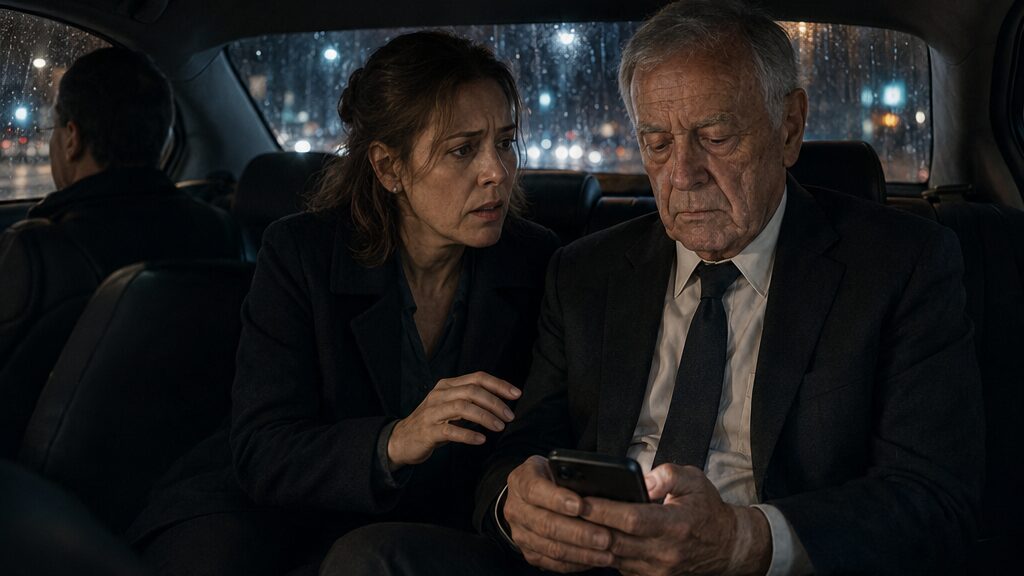
The phone lit up in Charles Lewis’s hand, and Rebecca saw the word PAWN before he turned the screen toward his coat.
For three seconds, the back seat of the car seemed to shrink around them. Rain slid sideways across the window. Red brake lights smeared over the glass. The rideshare driver kept his eyes forward, one hand loose on the wheel, pretending not to notice the silence that had gone hard behind him.
Rebecca leaned closer. “Dad.”
Charles folded both hands over the phone. His left wrist showed beneath the cuff of his dark suit jacket, pale and bare where his watch had always sat. Rebecca noticed the skin before she understood it. A thin strip of lighter flesh circled the bone, as clean as a bandage mark.
Her breath caught. “Where is it?”
Charles looked down at his wrist, then out at the city lights.
“Dad, where is your watch?”
He did not answer right away. He had been quiet all evening, but this was different. At dinner he had been old-man quiet, the kind that came with tired knees, too much restaurant noise, and menus printed too small. This quiet had weight. It had been chosen.
Rebecca reached for the phone. “Let me see.”
Charles moved it an inch away, not sharply, not enough to make a scene. Just enough.
That made her angrier than if he had snapped. “You’re hiding a pawn receipt from me?”
The driver’s eyes flicked to the mirror.
Charles said, “Keep your voice down.”
That was all. Not I can explain. Not You misunderstood. Not It’s none of your business. Just those four words, calm enough to make her feel like a child.
Rebecca sat back, stunned by the heat rushing up her throat. “You sold something.”
His face remained turned toward the window. City light cut across his cheek, silver, then black, then silver again. He had trimmed his beard that morning. He had worn his dark suit because Tyler’s school had held its winter program, and Charles still believed a man dressed properly when a child was standing on a stage.
“You sold your watch,” she said.
His thumb rested on the side of the phone. The screen had gone dark again, but she could still see the shape of the notification in her mind. Pawn ticket. Finalized. Pickup terms. Some amount she had not caught.
“Why would you do that?” Her voice lowered but shook harder. “That watch hasn’t left your wrist since I was born.”
Charles blinked once.
“Was somebody calling you? Did someone tell you it was worth something? Did they pressure you?” She leaned forward again. “Tell me the name of the shop.”
“No.”
“No?”
“No.”
The driver took a turn too fast. Rebecca’s shoulder bumped the door, but Charles barely shifted. He kept the same careful posture, knees together, back not quite touching the seat, as if the car were a place he had been assigned to endure.
Rebecca stared at the empty place on his wrist. “You promised Mom you’d never sell that watch.”
Charles’s jaw tightened, almost too little to see.
That was the first thing that frightened her. Not the receipt. Not the watch. That tiny tightening, as if she had touched a bruise he had spent years keeping covered.
“I didn’t say her name to hurt you,” Rebecca said, though she had.
“No,” Charles said quietly. “You said it because you knew it would work.”
The words landed without force, and that made them worse.
Rebecca looked away. Outside, storefronts passed in quick strips of neon: pharmacy, laundromat, cash advance, closed bakery, a clinic sign glowing blue at the corner. They had driven this route hundreds of times, but tonight every lit window seemed to be watching them.
She pressed her fingers to her temple. “I’m not trying to control you.”
Charles gave a faint breath that might have been a laugh if it had held any humor.
“I’m not,” she insisted. “I’m worried. You don’t tell me things anymore. You move money around, you refuse help, you say everything is fine, and then I find out from a notification that you pawned the one thing—” Her voice broke, and she hated that it did. “The one thing you would never even take off at Thanksgiving.”
Charles looked down again at the bare wrist. His fingers moved once, a small habit reaching for a crown that was not there. Rebecca saw it. The driver saw it too, she was sure, and shame burned through her because she had made that private little motion public.
“I knew what I was doing,” Charles said.
“That doesn’t make it better.”
“No.”
“Then make it make sense.”
He turned the phone in his hand, screen down. “It made sense when I did it.”
“For what? Rent? Your prescriptions? Some bill you didn’t tell me about?”
He stayed silent.
Rebecca thought of the unopened envelopes on his kitchen table, the careful way he tore grocery coupons, the old leather wallet he would not replace even though the stitching had split. She thought of the way he still polished his shoes before appointments, as if poverty could be kept away by discipline. She had told herself those habits were just him. Army habits. Widower habits. Pride habits.
Now she wondered how much she had missed.
“Dad,” she said, softer, “are you in trouble?”
“No.”
“Then why?”
The car slowed at a red light. Rain ticked against the roof. Across the intersection, a man in a hooded jacket stood under a bus shelter, holding a bouquet wrapped in plastic.
Charles looked at the bouquet for a long moment. Then he said, “There are different kinds of trouble.”
Rebecca swallowed. The anger had nowhere to stand now. It kept slipping into fear.
“Did you sell it today?”
“Yes.”
“After Tyler’s program?”
Charles’s eyes closed briefly.
“Dad.”
“He was good on that stage,” Charles said.
The change in subject was so gentle she almost followed it. Tyler had been good. Nervous, pale under the auditorium lights, one leg braced under his slacks, but proud. He had played two songs on the trumpet and bowed too quickly because he hated people seeing the limp.
Rebecca’s voice narrowed. “What does Tyler have to do with your watch?”
Charles did not answer.
She took out her own phone, hands trembling now, and opened the family banking app. Nothing looked changed. Then she opened her email. Searched “clinic.” Nothing new. Searched “brace.” A stack of messages appeared, the latest one unread, marked payment received.
Her stomach dropped before she opened it.
The amount was not huge in the way disasters were huge. It was worse. It was the kind of number that could break a month quietly. The balance left after insurance, after appeals, after Rebecca had told herself she would figure it out by Friday.
Paid in full.
She looked at Charles.
His gaze was still outside, his reflection faint in the window, an old man in a suit riding through rain with nothing on his wrist.
“You paid Tyler’s brace bill?” she whispered.
Charles did not look at her. “The money is already where it needed to go.”
Chapter 2: The Counter Where Time Became Cash
Earlier that evening, Charles Lewis stood under the buzzing fluorescent lights of Hill’s Pawn & Jewelry and kept his left hand closed around his watch.
The shop smelled of metal polish, old cardboard, and rain tracked in from the sidewalk. Behind the glass counters lay wedding bands, pocketknives, tablets, guitars, hunting binoculars, and watches arranged in rows that made time look plentiful and cheap. A television mounted in the corner played a game with the sound off. Every few seconds, the blue-white glare slid over the glass and touched Charles’s face.
Barbara Hill looked over her readers at him. “You selling or borrowing against it?”
Charles did not answer immediately. He looked past her to the small sign taped to the register: ALL SALES FINAL AFTER HOLD PERIOD. Then to the tray she had placed on the counter.
“Borrowing,” he said.
Barbara nodded as if she had expected that answer. “Let me see what we’ve got.”
He unfastened the strap slowly.
The movement had once been impossible to do one-handed. Carol had teased him about that before his second deployment, sitting on the edge of their bed with the watch in her lap and a sewing needle clenched between her teeth. The strap had been stiff then, dark brown leather, new enough to creak. Now it was nearly black from years of skin, weather, sweat, and oil. The buckle had been replaced once. The glass had a small scratch near the four. The second hand still moved with a stubborn sweep.
Charles laid it on the velvet tray face up.
Barbara picked it up before he could ask her not to.
Her hands were not careless exactly. They were practiced. Efficient. That almost made it worse. She turned the watch, tilted it under a desk lamp, pressed the crown, listened to it, then flipped it over with the faintest click against her ring.
Charles’s fingers curled at his side.
“Manual wind?” she asked.
“Yes.”
“Military style, but not issued, I don’t think. Older. Scratched crystal. Strap’s got no resale value.”
“The strap stays with it.”
She glanced at him. “That’s usually how watches work.”
The clerk at the far counter gave a small laugh and then turned it into a cough.
Charles kept his eyes on the watch. “Please don’t set it on the glass face down.”
Barbara paused. “I’m not damaging it.”
“I didn’t say you were.”
“No, but you looked like I dropped it in a sink.”
Charles met her eyes. He could feel the old part of himself rising, the part that corrected tone, posture, movement. He pushed it down. This was not a barracks. This was a pawn shop. He needed her more than she needed him.
Barbara softened by half an inch. “Mr. Lewis, people bring in things every day that mean something. I understand sentimental value. But I can only price what I can sell.”
Charles looked at the watch back. Under the scratches, the engraving was worn but still readable if the light caught it right.
C.L. — C.L.
1968
Keep time. Come home.
Barbara squinted at it. “Initials?”
“Yes.”
“Yours?”
“One set.”
She waited. He did not give her more.
Her mouth tightened, not unkindly. She took the watch to a small scale, though Charles knew the weight would tell her almost nothing. Then she checked a catalog, typed something into a computer, opened a drawer of loupe lenses, and gave the case another look.
“It’s not gold,” she said.
“I know what it is.”
“I can do eighty-five on loan. One hundred if you sell outright.”
The number sat between them.
Charles had known it would be bad. He had not expected it to feel insulting. Not because the watch was worth thousands. It wasn’t. Carol had bought it from a jeweler who let young wives pay things off by the week. Charles knew that story because she had confessed it after he came home, laughing as if thrift and love were both small conspiracies.
One hundred dollars.
For every morning he had wound it after shaving. For every night he had set it beside Carol’s medicine cup while she slept. For the day Rebecca was born, when he had timed the contractions with the second hand because the hospital clock was broken. For the funeral, when he had kept it on because he did not know what else to do with his hands.
“One hundred,” Barbara repeated. “If you sell.”
Charles took out his phone and opened the clinic payment page.
He had memorized the balance, but the number still seemed to shift when he looked at it. There was the amount due for Tyler’s new brace, the unpaid part after insurance, the part Rebecca had not mentioned. He had seen the notice by accident when Tyler left his backpack open at Charles’s apartment and the printed invoice slid from a folder. The boy had snatched it away too fast, then smiled too wide.
Mom’s handling it, Grandpa.
Charles had nodded because he had seen lies told bravely before.
He had checked his own account that afternoon. Then the jar in the cupboard. Then the envelope under the socks. Groceries, utilities, rent. Pride did not add numbers. Neither did memory.
Barbara watched him over the monitor. “You don’t have to decide right now.”
“Yes, I do.”
“You sure no one in the family wants it?”
The question was practical. It struck like a slap.
Charles looked up. “That is not why I’m here.”
“I just mean sometimes folks come in, then a daughter or son shows up mad because they didn’t know.”
“They don’t need to know.”
Barbara leaned back. “That usually means they do.”
Charles slid the watch closer to her. Not all the way. Just enough to show decision.
Barbara looked at him for a long second. “I can write it as a pawn loan. You’ll have a short window to redeem. Fees are printed here. I’m required to say them plainly.”
“Say them.”
She did. He listened, eyes on the watch, while the clerk printed the ticket. Every word was business: annual percentage, storage, forfeiture, identification, signature. A language built to make loss sound orderly.
When she pushed the ticket toward him, he did not sign.
Barbara tapped the line. “Right there.”
Charles touched the watch instead, two fingers on the worn crystal.
“Sir?”
He looked up. “It kept time when nothing else did.”
Barbara’s expression shifted. The clerk stopped moving behind her.
Charles did not know why he had said it. He regretted it at once. It was too much and not enough. A door opened an inch, then held.
Barbara lowered her voice. “Then maybe don’t do this.”
The phone in Charles’s other hand lit with the clinic page. Balance due. Payment options. Deadline. Tyler’s name in black letters.
Charles signed.
Barbara counted the cash in twenties and tens. Not fast, not slow. Charles placed the bills in his wallet without looking at them. She printed the receipt, stapled it to the pawn ticket, and folded both with a clean crease.
“Keep this,” she said. “You’ll need it if you come back.”
“If,” the clerk said under his breath, not cruelly, maybe just used to the way these things went.
Charles heard him.
Barbara did too. “Go check the guitars,” she told the clerk.
The young man moved away.
Charles took the folded ticket. His wrist felt exposed to the cold air. He reached to adjust the watch that was no longer there, caught himself, and lowered his hand.
Barbara noticed. Of course she did. People who priced loss for a living noticed hands.
She placed the watch into a small padded box. For a moment the lid remained open, and Charles saw the face one last time, the hands pointing to 6:42.
Carol used to say the watch ran two minutes slow because he did, and he used to tell her a man who came home was never late.
Barbara closed the box.
The sound was soft, barely more than cardboard meeting cardboard.
It still felt final.
Charles turned toward the door before his face could betray him. The bell above the entrance rang when he stepped into the rain. Behind him, Barbara slid the padded box beneath the counter, away from the display case, but not far enough to be safe from what came next.
Chapter 3: Rebecca Mistook Silence for Decline
Rebecca did not speak to Charles in the elevator.
Tyler’s apartment building had a mirror on the back wall, clouded at the corners, and in it she could see the two of them standing side by side like strangers after a courthouse hearing. Charles held his folded coat over one arm. His phone was in his pocket now. His left hand hung loose at his side, the bare wrist visible each time the elevator light flickered.
She wanted to apologize.
She wanted to demand the pawn ticket.
She wanted to ask if there were other things gone already: the cuff links Carol had bought him, the wooden box of old letters, the framed photograph from his Army years that stayed on the small table beside his bed. The questions crowded her mouth and came out as nothing.
Charles watched the numbers change above the door.
At the fourth floor, a neighbor stepped in carrying a laundry basket. “Evening.”
“Evening,” Charles said.
The neighbor glanced at Charles’s suit. “Big occasion?”
“My grandson played trumpet,” Charles said.
A small answer. A safe one.
Rebecca looked away.
When they reached the sixth floor, Tyler opened the apartment door before they knocked. He stood with one hand on the frame and the other on the top of his brace, a habit he had developed after the injury. He always touched it when he was nervous, as if checking that the metal and straps had not made decisions without him.
“Why do you both look weird?” he asked.
Rebecca forced a smile too late. “We don’t.”
“You do. Grandpa looks like he’s about to inspect a kitchen, and you look like the kitchen failed.”
Charles’s mouth moved at one corner. “Your intonation was better tonight.”
Tyler brightened despite himself. “You noticed?”
“I endured three beginners before you. I noticed.”
“Grandpa.”
“That was praise.”
Tyler laughed, and for a second the apartment warmed. Sheet music lay across the coffee table. A trumpet case leaned against the couch. On the kitchen counter, a stack of envelopes sat under a chipped blue mug Rebecca used as a paperweight.
Charles saw the envelopes. Rebecca saw him see them.
She crossed the room too quickly and moved the mug.
Tyler frowned. “Mom?”
“Nothing. Just cleaning.”
“At ten at night?”
“Go put your trumpet away.”
“It is away.”
“Then put it more away.”
He rolled his eyes, but he smiled when Charles hung his suit coat neatly over the back of a chair. “Can I show you the video? My friend sent it. The sound is bad because his mom kept yelling ‘that’s my son’ even though he wasn’t playing.”
“In a minute,” Charles said.
Rebecca turned. “Dad’s tired.”
“I’m not tired.”
“You should sit.”
“I can stand.”
Her patience snapped because it had never really been patience. It had been fear wearing a thin coat. “Why do you do that?”
Tyler looked between them. “Do what?”
Rebecca lowered her voice. “Act like accepting a chair is surrender.”
Charles’s face closed.
Tyler’s hand tightened on the brace.
Rebecca saw it and hated herself, but the words kept coming because stopping meant feeling what she had done in the car. “You scared me tonight. You think if you say nothing, that makes it noble, but it doesn’t. It makes everyone around you guess. It makes me wonder if you forgot to pay something, or trusted someone you shouldn’t, or—”
“Rebecca,” Charles said.
“No. I need to know what’s happening. If you need money, say that. If someone took advantage of you, say that. If you’re confused about bills or contracts, then we handle it. But you don’t get to vanish behind silence and call it dignity.”
Tyler went very still.
Charles looked at his grandson, not Rebecca. “You don’t need to hear this.”
“I kind of already am,” Tyler said.
Rebecca pressed her hand over her eyes. “Ty, please go to your room.”
“I’m not five.”
“No, but you are tired.”
“I’m also not deaf.”
Charles took one step toward him. “Your mother and I are having grown-up trouble.”
Tyler looked at the empty wrist.
Rebecca wished she could cover it.
“Where’s your watch?” Tyler asked.
No one moved.
The refrigerator hummed. Rain tapped the window air conditioner. Somewhere below them, a car alarm chirped twice and stopped.
Charles said, “Being looked after.”
Tyler’s eyes narrowed. “That sounds like something adults say when the truth is worse.”
Rebecca turned toward the counter and picked up the top envelope, though she already knew what it was. Clinic billing. Final notice. The paper felt thin and accusatory in her hand.
“I was going to pay this,” she said.
Charles looked at her.
“I was,” she insisted.
“I know.”
“No, you don’t. I had a plan.”
“Did you?”
The question was quiet enough to be mistaken for kindness. It wasn’t unkind, but it did not let her hide.
Rebecca’s throat tightened. “I was going to call them Monday. Ask for an extension. Maybe split it. I didn’t want Tyler worrying.”
Tyler’s face changed. “Worrying about what?”
Rebecca closed her eyes.
Charles pulled a chair out slowly and sat, not because she had told him to, but because the room needed someone to stop standing like a witness.
“Your brace balance,” he said.
Tyler’s cheeks reddened. “I told you Mom was handling it.”
“She was trying.”
“I didn’t ask you to pay it.”
“No,” Charles said. “You didn’t.”
Rebecca stared at him. “You knew?”
“I saw the paper.”
“You went through his backpack?”
“It fell out.”
“And you didn’t tell me?”
“You were already carrying enough.”
That broke something in her, not cleanly. She laughed once, a small ugly sound. “So you sold Mom’s watch instead?”
Charles’s eyes lifted. “It was my watch.”
“You know what I mean.”
“Yes,” he said. “I do.”
Tyler looked from one to the other, panic beginning to gather under his attempt at control. “Wait. The payment cleared?”
Rebecca turned to him. “What?”
He limped to the coffee table, grabbed his phone, and opened an email. His thumb shook as he scrolled.
“I got this during the ride home. I thought Mom—” He stopped, reading. “It says paid in full.”
Rebecca did not move.
Tyler looked up at her. “You paid it?”
She shook her head once.
His face turned toward Charles.
Charles sat with both hands folded, the left wrist naked beneath the cuff, the old circle of lighter skin catching the kitchen light.
“Grandpa,” Tyler said, barely above a whisper.
Charles looked at him with a firmness that left no room for pity. “You needed the brace.”
Tyler’s mouth trembled. He looked angry, ashamed, grateful, all at once. “Not more than you needed your watch.”
Charles leaned back, and for the first time that night he looked old in a way Rebecca could not blame on lighting or posture. Not weak. Worn.
“That’s not for you to decide,” he said.
Rebecca stood in the middle of the apartment with the final notice in her hand, and the truth of the night settled over her piece by piece. The dinner suit. The quiet. The notification. The bare wrist. The way he had watched Tyler bow onstage as if memorizing him.
She had thought Charles was slipping away from her into stubbornness or secrecy.
Instead, he had gone ahead of her into the trouble she had been hiding and left something of himself there as payment.
Tyler’s phone chimed softly. He glanced down, then held the screen toward Rebecca.
A second message from the clinic confirmed the payment again.
“Mom,” he said, confused and small despite his height, “why does it say thank you for your payment when you didn’t pay it?”
Rebecca had no answer.
Charles did.
“Because,” he said, “some bills don’t need the right name on them to be paid.”
Chapter 4: The Name Scratched Beneath the Watch Back
Stephen Miller came into Hill’s Pawn & Jewelry for a battery he did not need.
The old wall clock over Barbara’s counter had been losing seven minutes a week since spring, and she had refused to replace it because she said customers trusted a pawn shop less when everything looked too new. Stephen had repaired it once, tightened a hand, cleaned a bit of dust from the mechanism, and listened while Barbara told him she had no intention of paying him for something she had not asked him to fix.
He still came by on Thursday mornings.
The bell over the door gave its thin ring. Barbara was behind the main counter with a cardboard coffee cup, pricing a tray of watches under a white lamp. The clerk was sweeping near the guitar wall, pushing the same strip of paper back and forth without picking it up.
“You’re early,” Barbara said.
“I’m predictable.”
“That’s different.”
Stephen wiped rain from his jacket sleeve and leaned against the glass. He was forty-two, with a careful beard, close-cut hair, and a stiffness in his right shoulder that showed most when the weather turned. He had learned not to rub it in public. People noticed pain too quickly and understood it too slowly.
Barbara slid a small plastic bin toward him. “Batteries are there.”
He looked at the bin, then at the tray under her lamp. “New batch?”
“Mostly yesterday. Couple of watches. One bracelet. Two rings I don’t like the story on.”
“You ask for stories now?”
“I ask less than I used to.”
The watch caught his eye because it did not belong with the others.
Most watches in Barbara’s morning tray wanted attention. Shiny bezels, big faces, fake luxury weight, names printed larger than the hour marks. This one sat quiet. Stainless case, worn dark strap, a scratched crystal with a narrow scar near the four. It looked like something that had been used rather than displayed. The kind of object a man reached for before he knew he was awake.
Stephen picked it up without thinking.
Barbara’s hand moved. “Careful with that.”
He glanced at her. “You just told me yesterday sentimental value is not a pricing category.”
“I said I can’t price it. I didn’t say I can’t notice it.”
That made him look closer.
The watch was heavier than he expected, not expensive-heavy, but honest. He turned the crown gently. The mechanism resisted, then gave. The second hand moved with a faint, stubborn sweep.
“Manual,” he said.
“Customer said that too.”
“Older service style.”
“Not issued. At least not according to what I found.”
“No,” Stephen said. “Private purchase. Men bought these because they wanted something sturdier than what they were handed.”
Barbara watched him now. “You know watches or you know men?”
“Some of both.”
He turned it over. At first he saw scratches, the dull rubbed back of a thing that had touched skin for decades. Then the lamp caught the engraving.
C.L. — C.L.
1968
Keep time. Come home.
Stephen stopped breathing for a beat.
Barbara saw the pause. “What?”
He angled the watch closer to the light.
The first C.L. had been cut deeper than the second, as if the engraver pressed hard at the start and eased up by the time love made his hand nervous. The year sat centered below, practical and plain. The last line had worn faintest, but it remained there, not ornamental. An instruction. A plea.
“Who brought this in?” Stephen asked.
Barbara took a sip of coffee. “Older gentleman. Charles Lewis.”
Stephen repeated the name under his breath.
“You know him?”
“No.” He turned the watch once more. “Maybe.”
“That means no.”
“It means I know what this isn’t.”
Barbara folded her arms. “And what isn’t it?”
“Scrap.”
“I didn’t price it as scrap.”
“How much?”
“That’s not your business.”
“Barbara.”
Her mouth tightened. She looked toward the clerk, who suddenly became interested in dust under a display case. “One hundred sale. Eighty-five loan. He took the loan.”
Stephen set the watch down very carefully.
Barbara looked defensive before he said anything. “It’s not gold. It’s not a collector model. The strap is worn out. The crystal needs replacing. The movement probably needs service. I gave him the number I could give him.”
“I’m not accusing you of stealing it.”
“You’re doing something close.”
“I’m saying somebody brought you a watch with a message on it, and you treated it like a watch.”
“That is what I sell here.”
Stephen touched the engraving again with the tip of his finger, not pressing, just following the old cuts. “This is a deployment year.”
Barbara’s face changed a little. Not enough to be guilt, but enough to be attention.
Stephen had seen years carved into things. Zippo lighters. Bible covers. Knife handles. Pocket watches. Sometimes men marked the date they left. Sometimes the date they returned. Sometimes the date someone didn’t.
“Did he say anything?” he asked.
“He said it kept time when nothing else did.”
The clerk stopped sweeping again.
Stephen looked toward the door as if the old man might still be outside in the rain.
Barbara put the coffee cup down. “He needed money. That much was clear.”
“People usually do when they come here.”
“Don’t start.”
“I’m not.”
“You are. You come in with that veteran tone like everybody else is supposed to know a whole life from three scratched initials.”
Stephen accepted the hit because part of it was fair.
He was tired of strangers performing gratitude with big voices. He was also tired of rooms where nobody noticed the quiet things until they were already gone.
“I’m not asking you to give it away,” he said. “I’m asking you not to move it yet.”
Barbara looked at the watch. “There’s already interest.”
“From who?”
“A buyer online. I posted a preview picture of the tray last night. He likes military-style pieces. Said he’d come by.”
“You posted it?”
“Not the engraving.”
“But the watch.”
“It’s inventory, Stephen.”
He heard the weariness under the word. Rent, insurance, payroll, theft loss, taxes. Barbara did not run a museum of sorrow. She ran a narrow shop on a street where people came in with rings after divorces and tools after layoffs and game consoles when a light bill was due. If she let every item become sacred, the place would drown in other people’s grief.
Still, the watch sat between them, ticking softly.
Stephen said, “Hold it twenty-four hours.”
“For what?”
“So I can find him.”
Barbara’s brows lifted. “And say what? ‘Sir, I studied your watch and decided your private pain requires my involvement’?”
“No.”
“What then?”
“I don’t know yet.”
“That’s not a plan.”
“It’s a pause.”
Barbara laughed once, dryly. “A pause doesn’t cover my margins.”
“I’ll pay a deposit.”
“No.”
“Why not?”
“Because then it becomes your watch.”
Stephen looked at her, surprised.
Barbara took off her readers and rubbed the bridge of her nose. “He didn’t want anyone in his family knowing. I asked. He shut that down. If you come charging in with money, you might do exactly what he was trying to avoid.”
Stephen looked back at the engraving. He had been about to argue, but Barbara had reached the thing he had not named. Respect could become trespass if it arrived too loudly.
“What was he like?” Stephen asked.
“Polite. Stubborn. Sad, but not in a way he wanted noticed.”
“That narrows it down to half the old men in this city.”
“He had suit cuffs too old for the suit. Good shoes. Worn soles. He corrected me for setting it face down.”
Stephen smiled faintly despite himself.
Barbara’s eyes softened. “Then he signed like he was accepting orders he hated but understood.”
The watch ticked.
Stephen turned it over again and noticed the case back had a narrow repair notch near the edge, hand-cut, not factory. Someone had opened this watch with a tool that slipped once. Not a professional job. A kitchen-table repair maybe. A man trying to keep time going one more year because repair costs were money and money had always been needed somewhere else.
He reached into his wallet and took out a plain business card. Not the one with his full shop number. The smaller one he used for watch club meetings and veteran repair swaps.
“Put this with it,” he said.
Barbara did not take it. “No.”
“Please.”
“You’re making this complicated.”
“It already is.”
The door bell rang before she could answer.
A man in a wool coat stepped in, shaking rain from an umbrella. His eyes went straight to the tray.
Barbara quietly slid the watch closer to herself.
The man smiled. “Morning. I messaged about the field watch.”
Stephen’s hand tightened on the business card.
Barbara looked from the man to Stephen, then down at the watch with the scratched back and the year 1968. For the first time since Stephen had known her, she seemed uncertain which side of the counter she was standing on.
Stephen set the card down anyway.
“Hold it,” he said softly. “Just long enough to know what you’re selling.”
Chapter 5: The Bill He Paid Without Saying Her Name
Charles woke before dawn and reached for the watch that was not there.
His fingers found only the cool sheet beside him. For a moment, not fully awake, he believed he had left it by the sink after washing his hands. Then he remembered the padded box, Barbara Hill’s lamp, the printed ticket folded in his wallet, and the bare circle on his wrist.
He lay still until the room became itself.
Rebecca’s apartment had different sounds than his own. Pipes knocked in the wall when someone upstairs showered. The refrigerator clicked too loudly. A delivery truck groaned in the alley before sunrise. On the couch, where he had slept after Tyler refused to let him walk home in the rain, Charles folded the blanket with more care than it deserved.
His suit jacket hung over the chair. His shoes stood side by side beneath it. His wallet rested on the kitchen table, and inside it the pawn ticket felt heavier than money ever had.
He dressed quietly and found Rebecca already awake in the kitchen.
She was sitting with the clinic receipt open on her phone and the paper invoice beside it. Her hair was tied back badly, the way it got when she had been awake too long. A mug of coffee cooled near her elbow untouched.
“You weren’t supposed to see that,” she said.
Charles buttoned his cuff over the watch mark. “I know.”
“You keep saying that like it makes this better.”
“No.”
She looked up. Her eyes were red, but she did not seem to want him to notice. “Tyler thinks this is his fault.”
“He’s wrong.”
“I told him that.”
“Good.”
“He doesn’t believe me.”
Charles pulled out the chair across from her. This time he sat before she asked. Some gestures mattered.
Rebecca watched him sit, and her face tightened as if the small concession hurt.
“I called the clinic,” she said. “They confirmed the payment. They wouldn’t tell me the card, obviously, but they said it was made online around seven.”
Charles looked at the window. Morning had not yet lifted the darkness from the glass.
“You left after the program at six-ten,” she said. “You told us you needed air.”
“I did.”
“You walked four blocks in the rain to pawn Mom’s watch?”
“My watch.”
Her mouth pressed flat. “Your watch.”
He nodded.
“Dad, I didn’t mean—”
“Yes, you did.” His voice was not sharp. “Not cruelly. But you meant it.”
Rebecca looked down.
Charles had no wish to punish her. He had heard her say Carol’s name in the car and felt the old wound answer because it always answered. But Rebecca was not wrong to think of the watch as her mother’s too. Carol had chosen it. Carol had saved for it. Carol had held it in both hands like an oath and told him a man needed something reliable when the world had no intention of being so.
He drew his wallet from his pocket and took out the pawn ticket.
Rebecca stared at it.
He laid it between them but kept two fingers on it. “You may read it. You may not take it.”
She gave a brittle laugh. “You still think I’m a teenager stealing your keys?”
“I think you are my daughter when frightened. That has always been more dangerous than when you are angry.”
She did not smile. She read the ticket. Her eyes stopped on the amount. He watched her fight not to react and lose.
“One hundred dollars?”
“Eighty-five as a loan. I used part of what I had.”
“For a watch you wore for fifty years.”
“Fifty-eight.”
Rebecca closed her eyes.
Charles took the ticket back and refolded it along the existing crease.
“You should have told me,” she said.
“And you should have told me about the bill.”
She looked up quickly. “That is different.”
“Yes. You were protecting someone.”
Her face changed.
Charles let the silence do its work. He had learned, in long years of marriage and command and fatherhood, that not every truth needed to be pushed. Some only needed to be placed where the other person could not walk around it.
Rebecca’s hands folded around her mug. “I didn’t want you worrying.”
“Neither did I.”
“You don’t have extra money.”
“No.”
“You need your prescriptions.”
“They’re filled.”
“For now.”
“For now is where most people live.”
She shook her head, frustrated and hurt. “You make everything sound simple when it isn’t.”
“I make it sound manageable because panic has never paid a bill.”
That silenced her.
From down the hall came the faint sound of Tyler moving in his room. A drawer opened, closed. The brace straps made their soft, familiar rasp.
Rebecca lowered her voice. “He thinks needing the brace cost you Mom’s watch.”
Charles looked at the hallway. “Then I’ll tell him different.”
“How?”
“By telling him the truth.”
“You haven’t told me the truth.”
He looked at his bare wrist. The skin seemed indecent in the kitchen light. He had not realized how often he used the watch to keep his hands steady. During conversations, grief, waiting rooms, arguments. Thumb to crown. Finger over crystal. Time made touchable.
“Your mother bought it before I left,” he said.
Rebecca went still.
“She did not tell me until later that she paid for it five dollars at a time. I thought her father had helped. He hadn’t. She was working afternoons at the grocery and saving her tips from Saturdays.” He looked toward the window. “She gave it to me in a shoebox because she said wrapping paper would make her cry.”
Rebecca’s lips parted, but she said nothing.
“She had the back engraved. C.L. for me. C.L. for her. Same initials before she ever took my name, she said, so I wouldn’t get confused overseas.”
A sound escaped Rebecca, small and involuntary.
Charles kept his voice even. “The year. The line. ‘Keep time. Come home.’ She said it like a joke because she didn’t want me leaving with her crying in the doorway.”
“Why didn’t you ever tell me?”
“I suppose I thought you knew enough.”
“I knew she gave it to you. I didn’t know the rest.”
“There is always more rest.”
Tyler appeared in the hallway then, one hand on the wall, his brace visible under loose sweatpants. His hair stood up in the back. He looked younger than he had onstage.
“Did Grandma really write that?” he asked.
Charles turned. “Yes.”
Tyler looked at the empty wrist and then at the chair across from Charles. “Can I sit?”
“It’s your home.”
Tyler came in slowly and sat beside his mother. He did not look at her. That was mercy or accusation. Charles could not tell.
“I didn’t know the bill was still there,” Tyler said.
Rebecca touched his arm. “You weren’t supposed to worry about it.”
“I heard that part already.”
Charles studied the boy. Pride and shame made poor companions, but they often traveled together. Tyler’s shoulders had taken on a curve Charles recognized from men who believed they had become heavy to others.
“You didn’t cause this,” Charles said.
Tyler’s eyes shone, angry. “You sold something because of me.”
“I sold something for you.”
“That’s the same thing.”
“No. It is not.”
Tyler looked away.
Charles leaned forward, both hands flat on the table. “Listen carefully. There are things a man keeps because they remind him who he has been. There are things he gives up because they remind him who he still is. The watch was not more important than your leg.”
Tyler swallowed hard.
Rebecca whispered, “Dad.”
Charles looked at her, and something in his expression made her stop. He was not giving a speech. He was setting a boundary around his own choice.
“I did not sell it because I was confused,” he said. “I did not sell it because I forgot what it meant. I knew exactly what it meant. That is why it was worth using.”
The apartment seemed to breathe around them.
Rebecca picked up the clinic receipt and folded it once, then again. “How long do you have to get it back?”
Charles hesitated.
Her eyes sharpened. “Dad.”
“Less than the standard term.”
“Why?”
“I took the short option.”
“Why would you do that?”
“Lower fee.”
She stared at him. “How long?”
He took the pawn ticket from his wallet again and placed it on the table. Tyler leaned forward. Rebecca read the date twice.
“That’s not enough time,” she said.
“It is the time I agreed to.”
“We can go today.”
“No.”
“Why not?”
“Because going today is your guilt driving. Guilt is a poor driver.”
“I don’t care what you call it.”
“I do.”
Rebecca stood, chair scraping. “You can be proud later. Right now we need to get it back.”
Charles rose too, slowly, because his knees did not let him do otherwise. Still, when he stood, the room gave him space.
“You will not storm into that shop and make my business into your apology,” he said.
Rebecca stopped.
Tyler looked down at his hands.
Charles softened his voice, but not the decision. “If we go back, we go because I choose to go. Not because you cannot bear what I chose yesterday.”
Rebecca’s face crumpled then, but she turned away before it fully happened.
“I’m sorry,” she said to the sink, the window, the rain still clinging to the morning.
Charles slipped the pawn ticket back into his wallet.
“So am I,” he said.
“For selling it?”
“For not teaching you sooner that silence is sometimes a mistake.”
She turned back.
He touched the bare wrist once, lightly, and this time he let them see it.
“The ticket expires sooner than you think,” he said. “So if we are going to be foolish, we should be organized about it.”
Chapter 6: The Shop Would Not Sell Back a Story
Rebecca reached the pawn shop door before Charles and pulled it open like she meant to tear the bell loose.
Charles stopped on the sidewalk.
She looked back, one foot already inside. “What?”
He stood beneath the faded sign of Hill’s Pawn & Jewelry, his coat buttoned, his bare left wrist tucked under his right hand. Morning traffic hissed through damp pavement behind him. The shop windows reflected the two of them unevenly: Rebecca forward and sharp, Charles still as a post.
“We are not entering like that,” he said.
“Like what?”
“Like you intend to rescue me from a burning building.”
Her jaw tightened. “I intend to buy back your watch.”
“That is not the same thing.”
“It should be.”
“It is not.”
Inside, Barbara Hill looked up from behind the counter. Rebecca saw the recognition pass across her face. Not guilt exactly. Not surprise. Something guarded.
Rebecca lowered her voice. “I can be calm.”
Charles gave her a look.
“I can,” she said.
“Then begin before the bell rings again.”
She let the door close. The bell gave a final little shake.
Rebecca inhaled through her nose, counted to three, and tried to remember that fear had already done enough damage speaking in her voice. “Okay.”
Charles opened the door himself.
The shop smelled the same as it had in Rebecca’s imagination all night: metal, dust, cheap carpet, old electricity. She had not been here when he sold the watch, but she had pictured it so many times that stepping inside felt like entering a scene she had failed to stop.
Barbara stood behind the main counter. A tray of rings lay to her left, a laptop to her right. Her eyes moved from Rebecca to Charles, then to his left wrist.
“Mr. Lewis,” she said.
Charles nodded. “Ms. Hill.”
Rebecca hated the politeness. It made the watch’s absence feel like a business appointment.
Barbara looked at her. “You must be his daughter.”
“I’m Rebecca.”
“I figured someone might come.”
Charles said, “You mentioned that possibility.”
Barbara’s mouth tightened faintly. “I did.”
Rebecca placed both hands on the counter. “We want to redeem the watch.”
Charles turned his head slightly toward her.
She corrected herself. “He wants to redeem it. I’m here to help with the cost.”
Barbara did not move toward the register. “The watch is on hold.”
Rebecca blinked. “On hold?”
“Yes.”
“It was pawned. There’s a ticket.” She looked at Charles. “Show her.”
Charles reached into his wallet and set the folded ticket on the glass.
Barbara did not touch it. “I know the ticket.”
“Then what does on hold mean?” Rebecca asked.
“It means there’s been interest in the piece and I pulled it from the tray until I sorted out the status.”
“The status is it belongs to him.”
“The status,” Barbara said carefully, “is that it is collateral under a loan agreement with a redemption window and fees.”
Rebecca felt heat rise in her face. “Don’t legal-word this. He came back.”
“He came back within his window. That matters. But there’s another complication.”
Charles said, “What complication?”
Barbara looked at him rather than Rebecca, which somehow made Rebecca feel both excluded and ashamed. “A buyer saw the preview photo. He came in yesterday. There’s also a gentleman who asked me to hold it before making any decisions.”
Rebecca’s voice sharpened. “You showed it to people?”
“I posted a tray photo. Not the engraving.”
“The engraving?” Rebecca turned to Charles. “She saw the engraving?”
Charles kept his eyes on Barbara. “Who asked you to hold it?”
Barbara hesitated.
Rebecca laughed once, disbelieving. “You’re protecting a buyer?”
“No,” Barbara said. “I’m trying not to make a bad situation worse.”
“You made it worse when you took a veteran’s watch for eighty-five dollars.”
Charles’s hand came down on the counter.
Not hard. Just once.
The sound cut the air clean.
Rebecca stopped.
The clerk froze near the back wall.
Charles looked at his daughter. “You will not use that word like a weapon for me.”
Her face burned.
Barbara looked away, but not before Rebecca saw something like relief in her expression.
Charles picked up the pawn ticket, smoothed the crease with his thumb, and placed it down again. “Ms. Hill gave me terms. I accepted them. No one stole from me.”
“She underpaid you.”
“She priced a watch. I brought her a story and did not tell it.”
Rebecca’s eyes stung. “Dad—”
“No.”
The word was quiet, but it had rank in it.
Charles turned back to Barbara. “Is the watch here?”
“Yes.”
“May I see it?”
Barbara reached under the counter but paused. “There’s something you should know first.”
Rebecca braced for another fee, another rule, another sentence designed to make loss sound orderly.
Barbara opened a drawer and took out a small padded box. She did not open it yet. “A man named Stephen Miller noticed the inscription. He asked me to hold it for twenty-four hours before selling or moving it.”
Charles’s expression did not change, but Rebecca saw his right hand close around his left wrist.
“He recognized something?” Charles asked.
“He thought he did.”
“What?”
“The year. The mark near the back. Maybe the style. He didn’t say it all plainly.” Barbara set the box on the counter. “He’s a younger veteran. Repairs watches sometimes. Collects them, I think, though he’d hate that word.”
Rebecca said, “So he wants to buy it.”
“He wanted me not to sell it too fast.”
“That’s convenient.”
Barbara looked at her then. “No. Convenient would have been taking the higher offer and telling you the window closed.”
Rebecca had no answer.
The bell rang behind them.
A man stepped in from the wet sidewalk, removing a dark cap as he crossed the threshold. He was younger than Charles, older than Rebecca, with careful eyes and a stiffness in one shoulder. His gaze went first to Barbara, then to the box, then to Charles.
He stopped before reaching the counter.
“Mr. Lewis?” he asked.
Charles turned.
The man held his cap with both hands. “Stephen Miller.”
Charles gave a small nod. “You asked about my watch.”
“Yes, sir.”
Rebecca heard herself inhale at the “sir.” It was not exaggerated. Not performative. Just natural, given without announcing itself.
Stephen took a step closer. “I owe you an apology before anything else. I looked at the back.”
Charles’s face tightened.
Barbara said, “I showed him after he noticed the piece.”
Stephen did not look away from Charles. “That doesn’t make it mine to know.”
“No,” Charles said. “It doesn’t.”
Stephen accepted that. “You’re right.”
The shop settled into a silence different from the one in the car. This one had witnesses, glass counters, price tags, a clerk pretending to rearrange guitar picks, Barbara standing with one hand near the padded box.
Rebecca wanted someone to open it. She wanted the watch visible so the room would understand what it was doing to him. But Charles made no move.
Stephen looked at the pawn ticket on the glass. “The date on the back,” he said. “Nineteen sixty-eight.”
Charles’s eyes sharpened.
Stephen’s voice stayed low. “Does it mean what I think it means?”
Charles did not answer right away.
His hand lifted toward the box, stopped, and lowered again.
Rebecca watched him, suddenly afraid of the question, afraid of the answer, afraid that every attempt to fix this had dragged her father’s private life farther into fluorescent light.
Charles looked at Stephen Miller as if measuring whether the man had earned the next word.
Then he said, “That depends what you think it means.”
Chapter 7: He Named the Price Without Naming the Pain
Charles looked at the padded box before he looked at Stephen Miller again.
The watch was inside it. He knew that without seeing it. He could feel its shape in the room the way a man could sense an empty chair at a table where someone used to sit. Barbara’s hand rested near the lid, not touching it, and Rebecca stood beside him with both arms folded tight across herself, trying and failing to appear calm.
Stephen waited.
That counted for something.
Charles had known men who could not wait. Young officers with polished boots and empty patience. Strangers at airports who wanted to thank him loudly before they knew whether gratitude was welcome. Clerks who filled silence because silence made them feel accused. Stephen Miller stood on the other side of the glass counter with his cap in his hands and let Charles decide whether the next second belonged to him.
Charles said, “Nineteen sixty-eight was the year I left.”
Stephen nodded once. “Vietnam?”
“Yes.”
Rebecca’s breath shifted beside him.
Charles did not look at her. He had not meant to say that word in this shop. He had spent a lifetime refusing to lay certain memories on counters where people could turn them over and decide what they were worth. But the date had already spoken. The inscription had already opened the door.
Stephen said, “The repair notch on the case back. That wasn’t factory.”
“No.”
“You opened it yourself?”
“Once.”
Barbara’s eyes moved to Charles’s hands.
“The second hand stopped after I came home,” Charles said. “Couldn’t afford a jeweler. Thought I could manage it.”
“Did you?”
“Not well.” A faint dry line crossed his mouth. “But well enough.”
Stephen smiled, not broadly. “Sometimes that’s the best repair.”
Charles looked at him then. The stiffness in Stephen’s shoulder, the way he held himself, the careful distance from anything that might look like pity. A man who had learned something and had not mistaken it for wisdom.
“You served?” Charles asked.
Stephen’s face closed by a small degree. “Yes, sir.”
“Don’t call me sir unless you mean to charge me extra.”
Stephen’s smile returned, brief and real. “Yes.”
Rebecca looked between them, as if watching a language she half understood.
Barbara opened the padded box.
The watch lay inside with the strap curved like it remembered his wrist. Under the fluorescent light, the crystal scratch looked sharper than it did at home. The hands had stopped. Charles noticed that first, and for one foolish instant he felt betrayed, as if the watch had chosen the shop over him.
Barbara said, “I didn’t wind it.”
“I know.”
Charles reached toward it, then stopped with his hand above the box.
He had imagined taking it back. Many times in the last two days, against his own instructions, he had imagined the weight returning to his wrist. Buckle through the worn hole. Thumb against the crown. Time restored to its proper place.
But the room was too full now. Rebecca’s guilt. Barbara’s caution. Stephen’s respect. Tyler’s unpaid shame changed into paid confusion. Carol’s line on the back, small and stubborn beneath scratches.
If he snatched the watch up like a rescued thing, he would be lying about what had happened. He had not lost it by accident. He had spent it.
“How much to redeem it?” Charles asked.
Barbara took out the ticket. “Original amount, fee, storage. I can waive part of the storage.”
“No,” Charles said.
Rebecca turned. “Dad.”
He did not look at her. “No.”
Barbara hesitated. “Mr. Lewis, I’m allowed to adjust—”
“I signed terms.”
Stephen set his cap on the counter. “Let me cover the difference.”
“No.”
“I don’t mean as charity.”
“No,” Charles repeated.
Stephen’s jaw tightened, then eased. “Then as purchase.”
Rebecca frowned. “Purchase?”
Stephen pointed to the watch, careful not to touch it. “If Mr. Lewis is willing, I buy the watch for a fair price. He receives more than the loan covered, and I return the piece to him under a private agreement.”
“That is charity wearing a hat,” Charles said.
Stephen accepted the correction with a small nod. “Fair.”
Rebecca’s frustration broke through. “Then what can anybody do? You won’t let Barbara waive the fee. You won’t let Stephen pay. You wouldn’t let me come in here yesterday. What exactly are we allowed to do, Dad?”
The clerk in the back stopped pretending not to listen.
Charles turned to Rebecca. He saw Carol in the set of her chin, but the fear was his own doing. He had raised a daughter to be strong and then punished her for trying to use that strength on his behalf.
“You are allowed to stand with me,” he said. “Not in front of me.”
Rebecca’s eyes filled.
He turned back to Barbara. “I can pay the loan and the fee in full in two weeks.”
Barbara looked at the ticket. “Your window is shorter than that.”
“I know.”
Stephen leaned in slightly. “A hold agreement?”
Barbara’s brow creased. “That would mean rewriting the ticket as an extension and deposit. I don’t usually—”
“Can you?” Charles asked.
She looked at him for a long moment. “Yes. If there’s a partial payment today.”
Rebecca reached for her purse.
Charles put his hand over hers before she opened it.
“Half from me,” he said. “Half from Rebecca, as a loan to me. Written down.”
Rebecca stared at him. “Written down?”
“Yes.”
“You want an IOU from your daughter?”
“I want a record so nobody in this room gets to call it rescue.”
Her mouth trembled. “I wasn’t going to.”
“Not today.”
The words landed gently, but she understood them. Someday, guilt might rot into resentment if left unnamed. Someday, help given in panic might ask to be repaid in obedience. Charles had seen families split over less than a watch.
Stephen said, “I can pay for the service.”
Charles looked at him.
“The watch needs cleaning,” Stephen said. “Not restoration. Just enough care to keep it running. Let me do that as work, not rescue. Barbara can note it. No ownership changes.”
Barbara folded her arms. “This is becoming the most paperwork anyone has ever generated over a hundred-dollar loan.”
Charles looked at the watch. “It has outlived worse paperwork.”
Stephen laughed under his breath.
Barbara took a form from beneath the counter. “Fine. Partial redemption hold. Two weeks. No display. No sale. No online listing. Watch remains secured here until balance is paid. Repair assessment only with owner permission.” She looked at Charles. “That permission is yours.”
Charles nodded.
Rebecca opened her purse slowly this time. She counted out cash and set it on the counter without pushing it forward. Charles took his wallet out and added his part. The bills lay beside the watch, not enough to buy memory, enough to keep strangers from taking it away.
Barbara wrote carefully. Her pen scratched across the paper.
Stephen watched the watch, not hungrily, but like a man keeping vigil.
When Barbara slid the new receipt toward Charles, he read every line. Twice.
Rebecca did not rush him.
At the signature line, Charles paused. The date sat above his name. The current year, printed neatly by Barbara’s register, looked strange beside 1968 in his mind. All those years between. All the mornings wound forward one click at a time.
He signed.
Barbara placed the new receipt in his hand.
“You may hold it,” she said.
Charles looked at her.
“I mean the watch,” Barbara said. “Before I put it back.”
He knew she was offering an apology in the only language the counter allowed.
He reached into the box and lifted the watch.
It was lighter than he remembered. That troubled him until he understood that his wrist had been carrying not weight, but habit. The strap bent across his palm. The crystal was cool. He turned it over and rubbed his thumb across the engraving.
C.L. — C.L.
1968
Keep time. Come home.
Rebecca made a small sound beside him.
Charles did not look at her. If he did, he might put the watch on, and that was not yet the right ending.
Stephen said, “She had steady hands.”
Charles’s thumb stopped.
“The engraving,” Stephen added. “Whoever chose the words had steady hands.”
“No,” Charles said. His voice came out rougher than he wanted. “She cried on the box.”
No one answered.
For once, the silence in the pawn shop held correctly.
Charles placed the watch back in the padding and closed the lid himself.
“Tyler should hear the story before the watch goes anywhere,” he said.
Rebecca wiped under one eye and nodded.
Stephen picked up his cap. “Then I’ll keep it running until he does.”
Charles looked at him for a long moment, then held out his hand.
Stephen shook it, firmly, without squeezing too hard.
Barbara took the box and placed it in the safe beneath the counter, not under the tray, not near the display, not with the other inventory. Charles watched until the safe door closed.
Outside, the rain had stopped.
Rebecca walked beside him to the door, not ahead of him. When the bell rang above them, Charles did not feel rescued.
He felt measured, and still standing.
Chapter 8: The Watch Went Home on Someone Else’s Wrist
One week later, Tyler held the watch like it might break if he breathed wrong.
They sat at Rebecca’s kitchen table with the afternoon light spread thin across the scratched wood. The trumpet case had been moved to the couch. The clinic papers were gone from beneath the blue mug. In their place lay the new receipt from Barbara Hill, a small envelope of cash Rebecca had insisted on labeling properly, and the watch, wound and ticking again.
Stephen had cleaned the case but not polished it. That was the first thing Charles noticed when Barbara handed it back. The scratches remained. The notch on the back remained. The strap had been conditioned but not replaced. Stephen had understood without being told: some wear was damage, and some was witness.
Now Tyler turned the watch over in his hands and read the engraving for the third time.
“C.L. and C.L.,” he said.
“Charles Lewis and Carol Lewis,” Rebecca said softly.
Charles sat across from them, his hands folded on the table. The mark on his wrist had begun to lose its sharpness. In another month, maybe less, the pale circle would fade. He had expected that to bother him. Instead, he found himself watching it with curiosity, as if the skin were deciding what it no longer needed to prove.
Tyler looked up. “Grandma wrote ‘Keep time. Come home’?”
“She had it written,” Charles said. “She claimed she would have engraved it herself if the jeweler had trusted her with tools.”
Rebecca smiled through wet eyes. “That sounds like Mom.”
“It was your grandmother’s habit to believe skill could be substituted by determination.”
“Did it work?”
“Frequently enough to encourage her.”
Tyler smiled, but his eyes stayed on the watch. “And you wore it over there?”
“Yes.”
“The whole time?”
“When it worked.”
“When it stopped?”
“I carried it.”
Tyler looked at him then, and Charles saw the question he was trying not to ask. Not about combat. Not about history from textbooks or movies. Something smaller and more dangerous.
“Were you scared?” Tyler asked.
Rebecca went still.
Charles looked toward the window. A delivery truck moved slowly past the building. Somewhere downstairs, the neighbor’s dog barked twice.
“Yes,” Charles said.
Tyler nodded, as if the answer had confirmed something important.
Charles reached for the watch, and Tyler gave it to him at once. He held it face up in his palm. The second hand moved steadily now, repaired but not renewed. He wound the crown three turns and stopped before it tightened.
“Your grandmother told me time was not something a man owned,” Charles said. “She said it was something he was responsible for spending.”
Rebecca looked down.
“I thought she meant coming home on leave. Writing letters. Not missing anniversaries if I could help it.” He rubbed his thumb along the strap. “Later, after she was gone, I thought keeping the watch on meant keeping my promise to her.”
“Did it?” Tyler asked.
“For a while.”
“And then?”
Charles slid the watch toward him. “Then you needed a brace.”
Tyler’s face twisted. “Grandpa.”
“No.” Charles kept his hand on the table, not touching the boy, not softening the words. “Listen. If that watch could only sit on my wrist while you worried about walking, then I had made it smaller than she meant it to be.”
Tyler looked down at the brace under the table.
Rebecca said, “He still thinks he cost you something.”
“He did,” Charles said.
Both of them looked at him.
He nodded toward the watch. “So did your mother when she was born. So did Carol when she loved me. So did every person I ever cared about. Love costs something. That is not an accusation.”
Tyler blinked hard.
Charles pushed the watch closer. “The mistake is pretending nothing was paid.”
Rebecca covered her mouth.
Tyler touched the strap. “I want you to keep it.”
“I know.”
“You just got it back.”
“Yes.”
“So wear it.”
Charles leaned back. “For fifty-eight years I thought the promise was to keep it with me. I was wrong.”
Tyler shook his head. “I can’t take that.”
“I didn’t say you were taking it.”
“You’re putting it in front of me.”
“I am telling you where it goes next.”
The boy looked almost frightened. “What if I lose it?”
“Then you will learn to be careful.”
“What if I break it?”
“Then you will learn repair costs money.”
Despite herself, Rebecca laughed through tears.
Charles allowed the corner of his mouth to move.
Tyler ran one finger over the engraving. “What if I don’t deserve it?”
That was the real question. Charles had been waiting for it since the clinic email, maybe longer.
He reached across the table and tapped the watch once. “Objects like this do not go to people who deserve them. They go to people who must learn what carrying means.”
Tyler stared at him.
“You do not have to wear it every day,” Charles said. “You do not have to become me. You do not have to make your pain useful to earn a place in this family. But someday, when you think needing help makes you less of a man, I want you to look at that back and remember your grandmother bought it five dollars at a time. I want you to remember your mother hid a bill because she was scared. I want you to remember I sold it because I was scared too, though I would have called it practical if anyone asked.”
Rebecca whispered, “Dad.”
He looked at her then. “And I want you both to stop protecting each other with silence so sharp it cuts the people you meant to spare.”
No one moved for a while.
Then Tyler picked up the watch and held it out. “Will you put it on me?”
Charles stood slowly and went around the table.
Tyler held out his left wrist. The brace was on his other leg, straps visible, metal hinge catching light. His wrist looked young, narrow, unmarked by years or watches or promises made before departures.
Charles fastened the strap carefully. It was too loose on the last worn hole.
“We’ll have it adjusted,” Rebecca said.
“No,” Tyler said quickly. “Not yet.”
Charles understood. For a little while, the looseness mattered. It showed that the watch had come from someone else, that he had not grown into it yet.
The second hand moved.
Tyler lifted his wrist to his ear and listened.
“It’s loud,” he said.
“It is not,” Rebecca said.
“It is if you’re paying attention,” Charles said.
That evening, Rebecca called a car to take Charles home. She offered to drive him herself, but he said she had dishes to ignore and a son pretending not to cry in his room. She accepted the correction.
In the back seat, the city lights blurred against the window as they had the week before. Charles sat with his hands folded. His left wrist was bare, but this time he did not hide it under his cuff.
His phone lit up in his coat pocket.
He took it out and read the message from Barbara Hill.
Final payment received. Item released to owner per agreement. Thank you.
Below it was a second message, sent a minute later.
Stephen says it should keep good time if wound properly.
Charles looked at the words until the screen dimmed.
The driver changed lanes. Rain from an earlier shower flashed beneath the streetlights. In the window, Charles saw his reflection: an old man in a dark coat, shoulders slightly bent, one wrist empty.
For the first time since the pawn shop, the emptiness did not feel like loss.
It felt like room.
He turned his hand palm up and rested it on his knee, letting the city pass over the pale fading circle where the watch had been. Somewhere behind him, in Rebecca’s apartment, Tyler was probably holding his wrist close to his ear, listening to time arrive one small click at a time.
Charles closed his eyes.
He had kept time.
He had come home.
The story has ended.