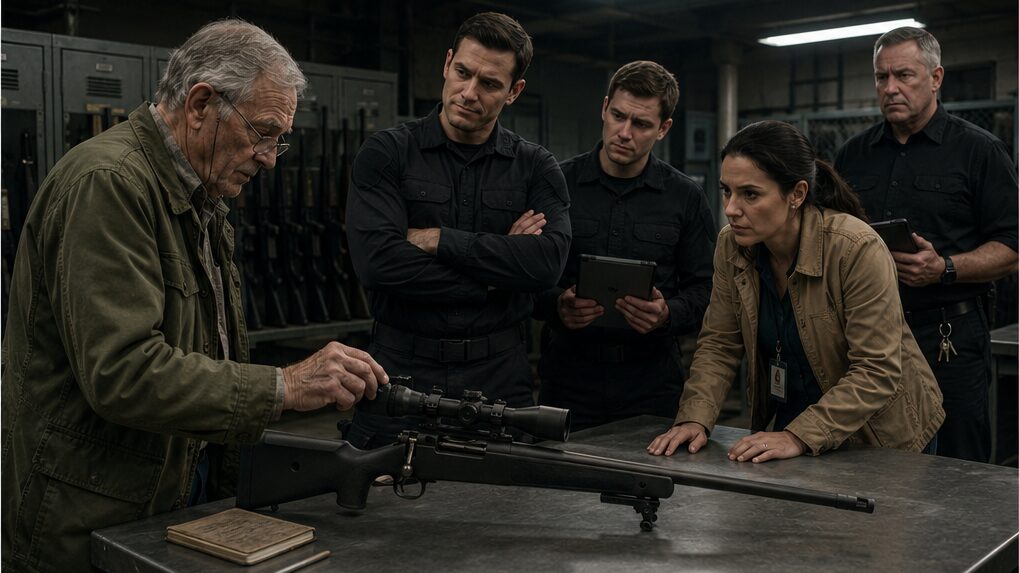
They Laughed When the Old Veteran Checked the Rifle No One Else Questioned
Chapter 1: The Old Man at the Rifle Table
The rifle made a sound Samuel Carter did not like.
It was not loud. It was not dramatic. It was only the faint dry tick of metal settling against metal when he eased the scoped rifle onto the armory table. To anyone else in the room, it would have disappeared beneath the buzz of the fluorescent lights, the scrape of boots on concrete, the distant clatter of cases being opened down the row.
Samuel heard it anyway.
He kept his left hand on the stock and let the sound finish in his mind before he moved again.
Across the table, Ryan Clark leaned one shoulder against a locker cage and folded his arms. He was young in the way men became young when they knew other people were watching them. Clean uniform. Tight jaw. Fresh confidence. Jerry Miller stood beside him with a tablet in one hand and an expression he tried to hide behind the screen.
Samuel did not look at either one of them.
The rifle lay long and black under the armory lights, the scope mounted high enough to clear gloved hands, the rail screws dark and even, the barrel clean. Someone had wiped it down recently. Too recently, perhaps. Oil shone in the low places where oil did not need to shine.
Samuel took his reading glasses from the cord at his chest and set them on his nose.
Ryan’s mouth twitched.
“Need more light, Mr. Carter?”
Samuel turned the rifle slightly. “I have enough.”
Jerry looked down at his tablet, then over at Ryan. The look was quick, but not quick enough.
Samuel had spent much of his life in rooms where young men tried not to laugh before they understood the thing in front of them. He had learned not to punish that too early. Sometimes embarrassment taught. Sometimes it only hardened.
He ran one finger along the scope rail, not touching the glass, not touching the turrets. Old habit. Let the eyes work first. Then the finger. Then the memory. The rifle was not a stranger. None of them were, not really. Every weapon told a history if a man had the patience to read the places hands forgot to lie.
Behind him, the armory hummed with early morning urgency. Cases lined the floor. Spare magazines sat in trays. A row of tactical rifles waited in padded racks, all tagged for the county live-fire certification scheduled after lunch. The department had spent weeks preparing for it. Samuel had heard the phrase repeated three times before he finished his first cup of coffee: outside evaluators, public safety funding, sheriff wants no delays.
That was why they had called him in, though no one said it plainly. Frank Moore, the armory supervisor, had asked for “an extra set of eyes” on older inventory, the kind of phrase people used when they wanted help but not responsibility. Samuel volunteered twice a month, usually to sort parts, check serials, and remind younger hands that a clean weapon was not always a safe one.
Today the table held the rifle from the special response unit. That made the air tighter.
Samuel lifted the rifle and brought the scope level with his eye. His right shoulder complained before the rifle settled. He ignored the complaint. Age spoke often. It did not always deserve an answer.
Through the optic, the far wall swam into focus: pegboard, hooks, a faded paper target taped crooked beside a clock. He did not aim long. He was not checking his ability. He was checking alignment, shadow, the way the reticle sat when the rifle rested naturally instead of being forced.
There it was again.
Not movement exactly. A memory of movement.
He lowered the rifle and laid it carefully back on the table.
Ryan pushed off the locker. “We’re not qualifying with it in here.”
Jerry let out a small breath that might have been a laugh.
Samuel removed his glasses, wiped one lens with a folded cloth, and put them back on. “That’s good.”
Ryan glanced at Jerry as if inviting him to enjoy the answer. “Good?”
“Means nobody’s standing behind it.”
The smile slipped from Jerry’s face for half a second. Ryan kept his.
“Frank said you used to work on these,” Ryan said.
“Not this model.”
“That’s what I figured.”
Samuel looked up then. Not sharply. He only gave Ryan the weight of his attention.
The younger man shifted, but only a little. “I mean, optics have changed.”
“Yes,” Samuel said.
“Mounts too.”
“Yes.”
“And we’ve got digital logs now. Torque specs. Inspection history. Everything’s tracked.”
Samuel nodded once and returned to the rifle. “That helps when the history is true.”
The room quieted near the table.
Ryan’s arms unfolded. “Something wrong with the log?”
“I don’t know yet.”
Jerry tapped his tablet screen. “This rifle passed inspection last week. Clean bore, stable zero, no visible damage. Frank signed off.”
Samuel did not answer right away. He leaned closer to the scope mount. Near the front ring, half hidden by the angle of the rail, a thin pale crescent sat just outside the edge of the screw head. Not a scratch. Not exactly. More like the ghost of a previous position, a witness mark left by pressure, oil, dust, and time. Beside it was a newer mark, darker, neater, almost matching.
Almost was a word that had followed men into bad places.
Samuel took the small notebook from the inside pocket of his field jacket. The cover was dark from years of handling, its corners softened, a pencil tucked into the spiral. He opened to a clean line and wrote the rifle number first. Then the time. Then: front ring witness mark offset.
Ryan watched the pencil move.
“You keep a diary for rifles?” he asked.
Jerry smiled again, but the smile was weaker now.
Samuel kept writing. “Only the ones that talk.”
“That supposed to mean something?”
“It means I’m listening.”
The armory door opened at the far end. Frank Moore entered with a ring of keys clipped to his belt and a paper cup of coffee in one hand. He was broad in the shoulders, gray at the temples, and already moving like a man behind schedule.
“Morning,” Frank said. His eyes landed on the open notebook. “How’s it looking?”
Samuel closed his pencil between two fingers but did not shut the notebook.
Ryan answered first. “Mr. Carter’s listening to the rifle.”
Frank gave a short laugh, the kind meant to smooth things over. “He does that.”
Samuel touched the front ring with the pencil tip. “Who took this mount off?”
Frank blinked once. “What?”
“This scope mount. Front ring’s not where it started.”
Jerry looked from Samuel to the rifle. Ryan stepped closer despite himself.
Frank set the coffee on a nearby shelf. “That rifle’s been checked.”
“I asked who took the mount off.”
“Nobody, far as I know.”
Samuel looked down again. The pale crescent sat in the light, stubborn and small. He had seen smaller things cause larger silence.
Frank’s voice tightened. “We’ve got certification today. If something’s loose, we torque it and move on.”
Samuel placed his palm flat beside the rifle, not touching it. “Don’t torque a question until you know what it’s asking.”
Ryan made a sound under his breath.
Samuel heard that too.
He turned the notebook slightly, shielding the page from casual eyes, and wrote one more line beneath the first. His hand was slower than it used to be, the knuckle of his index finger swollen from old work and colder mornings. The pencil tip pressed dark into the paper.
Do not clear this rifle.
Then he closed the notebook before anyone could read why.
Chapter 2: The Certification No One Wanted Delayed
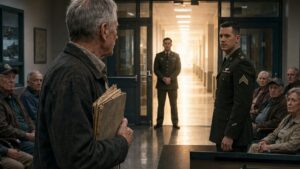
Catherine Roberts found the old man standing alone in the armory corridor with the closed notebook in his hand.
At first, she noticed the jacket before the man. Faded green canvas. Worn cuffs. A small repair near the elbow sewn by someone practical rather than careful. He stood beneath a strip of fluorescent light that made the lines in his face look deeper, but he did not seem uncertain. He seemed like someone waiting for the room to catch up.
Inside the training office, voices were already too loud for the hour.
Catherine carried a slim folder against her side and paused at the doorway. The county sheriff sat at the head of the small conference table, one hand wrapped around a paper cup. Frank Moore stood near the wall with a tablet and a set of armory keys. Ryan Clark leaned against the filing cabinet, restless, while Jerry Miller sat with his elbows on his knees.
The whiteboard behind them read LIVE-FIRE CERTIFICATION in block letters. Under it were time slots, evaluator initials, and the names of recruits who would rotate through the range. Everything on the board looked planned. That was usually when Catherine started looking for what was missing.
Frank saw her first. “Catherine. Good. We’ve got a small snag, but nothing that should affect the schedule.”
The sheriff looked up. “Tell me it’s not equipment.”
“It’s equipment being over-discussed,” Ryan said.
Catherine did not smile. “Which weapon?”
Frank glanced toward the corridor. “Unit rifle seven.”
The sheriff’s hand tightened around the cup. “That rifle is on the demonstration lane.”
“I know,” Frank said. “It passed last week.”
Catherine opened her folder. “Then why is there a snag?”
No one answered immediately.
In the silence, Samuel stepped into the doorway.
He did not announce himself. He did not look like a man trying to take a room. He stood with his notebook at his side, glasses hanging from the cord against his shirt.
Ryan exhaled. “Mr. Carter saw a mark.”
Catherine turned toward Samuel. “What kind of mark?”
“Witness mark near the front ring,” Samuel said.
“Movement?”
“Maybe.”
Frank cut in. “Not movement. A mark. There are marks on every duty rifle in this building.”
Samuel’s eyes stayed on Catherine. “Not two histories in the same place.”
That stopped her pencil over the folder.
The sheriff frowned. “What does that mean?”
“It means,” Ryan said before Samuel could answer, “that a rifle with a clean inspection and stable zero is being held up because an old witness mark looks funny.”
Samuel did not react to the word old. Catherine did.
She had heard that tone in hospitals with patients who moved slowly, in county meetings with retired volunteers, in family disputes where the eldest person in the room had become furniture to everyone else. It was not always cruelty. Sometimes it was impatience wearing a clean shirt.
“Mr. Carter,” she said, “did you fire the rifle?”
“No.”
“Did you check torque?”
“No.”
Ryan lifted a hand as if that settled the matter.
Catherine looked at him until the hand lowered. “Why not?”
Samuel opened the notebook. “Because if the mount moved once, tightening it now may hide why.”
Frank’s jaw worked. “Nobody’s hiding anything.”
Samuel gave him a brief look. “I didn’t say anyone was.”
Catherine stepped closer and held out her hand. “May I?”
For a moment, Samuel’s thumb rested on the notebook cover. Not possessive. Protective. Then he handed it to her.
The pages surprised her. She expected old man shorthand, maybe scattered notes, maybe sentimental marks from years of habit. Instead she found neat columns. Rifle number. Date. Weather if range-fired. Cleaning residue. Screw condition. Sound on settling. Smell of oil. Point-of-impact changes. Witness marks. Human notes too, but brief: shooter flinched left; sling tension inconsistent; bolt felt dry on second cycle.
Not a diary.
A second memory system.
Catherine turned back one page and saw older entries in the same careful pencil. Some were months apart. Some had been written after inventory days. The newest line sat at the bottom of the page, darker than the rest because the pencil had been pressed harder.
front ring witness mark offset
Below that, partly hidden where the page had bent under his thumb, another line began: do not—
Samuel reached for the notebook gently. She let him take it before the room could read over her shoulder.
The sheriff watched her face. “Catherine?”
“I want to see the rifle.”
Frank closed his eyes for half a second. “We’re already behind.”
“We’re not behind until someone tells the evaluators the truth,” she said. “Right now we don’t know what the truth is.”
Ryan straightened. “With respect, this is getting out of proportion. The last shooter threw one round during qualification. That’s all this is.”
Catherine looked at him. “What round?”
Jerry answered before Ryan could. “Third string. Lane two. Went high and right.”
“Shooter?”
“A recruit,” Ryan said. “Nerves. First time on that platform under a timer.”
Samuel’s eyes lowered to the floor as if he were placing that detail somewhere.
Catherine saw it. “Mr. Carter?”
He took his time. “Was the rifle warm?”
Ryan let out a laugh. “It was being fired. So yes.”
“How many rounds before the high-right impact?”
Jerry checked the tablet. His thumb moved once, then stopped. “Eight.”
Samuel nodded faintly, not with satisfaction but with recognition.
Ryan saw the nod and did not like it. “That doesn’t prove anything.”
“No,” Samuel said. “It doesn’t.”
That answer bothered Catherine more than an argument would have. A man trying to win would have pushed. Samuel only stood there, letting the unanswered part remain unanswered.
Frank moved toward the door. “I’ll bring rifle seven in. We inspect it together. Then we clear it and get back on schedule.”
“Not in the office,” Catherine said. “On the armory table.”
Frank’s expression sharpened. “Why?”
“Because that’s where the concern started.”
The sheriff rubbed his forehead. “I need a recommendation before noon. We have evaluators coming, county board observers, and three departments using this certification window. If we cancel on a maybe, it becomes a budget question.”
There it was, Catherine thought. The weight beneath the room.
Budget. Reputation. Paperwork. The invisible hands that pushed people to make clean decisions out of dirty uncertainty.
Samuel seemed smaller beside the filing cabinet, not because he had shrunk, but because the room had placed him there. Old volunteer. Extra eyes. Courtesy mistake. The words did not have to be spoken twice to do their work.
Catherine closed her folder. “Then we start with the rifle.”
Frank’s keys jingled as he turned. “Fine.”
The group moved into the corridor. Ryan and Jerry walked ahead, their boots quick on concrete. Frank followed with stiff shoulders. The sheriff stayed behind to make a call.
Catherine fell into step beside Samuel.
“Your notebook,” she said quietly. “You organize by things most inspection forms don’t ask for.”
“Forms help.”
“That’s not what I said.”
“No,” Samuel said. “It isn’t.”
They walked past the armory cages, past racks of labeled equipment, past a cart stacked with hearing protection. The building smelled of oil, dust, and burnt coffee. At the main table, rifle seven waited under the lights where Samuel had left it.
Ryan picked it up before anyone else could. “Same rifle. Same mount. Same inspection tag.”
Samuel’s gaze went to the front ring.
Frank placed the official log tablet on the table. “There. Clean.”
Catherine watched Samuel lean in without touching anything.
The room seemed to hold its breath.
Frank tapped the tablet. “Passed inspection.”
Samuel looked at the scope mount, then at Frank.
“Who changed the front ring?”
Chapter 3: Two Marks Where One Should Be
Samuel Carter had not meant to make the room go still.
Stillness was not the same as attention. In a still room, people often waited for the oldest man to finish so they could return to what they had already decided. Samuel knew the difference. Attention had weight. Stillness had impatience.
Rifle seven lay across the metal table between them.
Ryan stood closest, his hands on his belt, jaw angled as if Samuel’s question itself had become an insult. Jerry had moved near the end of the table with the tablet tucked under one arm. Catherine Roberts stood across from Samuel, her folder closed, her eyes on the front scope ring. Frank Moore remained near the log tablet, one hand resting on its black case.
“Who changed the front ring?” Samuel asked again.
Frank’s voice came out flatter this time. “Nobody changed it.”
Samuel nodded once, not agreeing. Only acknowledging that the answer had been given.
He turned the rifle a fraction so the light fell lengthwise across the mount. “May I?”
Frank’s hand tightened on the tablet. “It’s an inspected weapon.”
“That wasn’t my question.”
Catherine looked at Frank. “Let him show us.”
Ryan gave a short laugh. “Show us what? A scratch?”
Samuel put on his reading glasses.
The laugh bothered him less than the fact that Ryan had already named the thing before seeing it. That was how mistakes survived. A man called a mark a scratch, a shift a scratch, a warning a scratch, and soon the word did all the seeing for him.
Samuel touched the rifle with only two fingers and moved it under the light. He took the pencil from the spiral of his notebook and pointed with the eraser end, not the lead. “Here.”
No one moved.
He waited.
Jerry leaned first. His eyes narrowed. “Where?”
Samuel angled the pencil. “Front ring. Left edge of the base. See the pale crescent?”
Jerry bent closer. “Maybe.”
Ryan stepped in beside him. “That’s finish wear.”
“Yes,” Samuel said.
Ryan looked up, almost triumphant. “Then what are we doing?”
Samuel moved the pencil a quarter inch. “And this is finish wear too.”
Catherine leaned over the table. “Two marks.”
“Two positions,” Samuel said.
Frank’s face did not change, but his eyes moved.
Samuel saw that. He wished he had not.
Ryan folded his arms again. “Rings get bumped. Rifles get handled.”
“Bumped rings don’t leave new thread-lock on old dust.”
Jerry looked at Ryan, then back at the rifle.
Samuel pointed to the screw head. “See the edge? Dark residue on the right shoulder. Red under the black. New over old.”
Catherine’s voice stayed quiet. “The inspection log says no optic removal.”
Frank spoke too quickly. “Because there was no optic removal.”
Samuel withdrew the pencil and wrote in his notebook before anyone else could continue. The pencil made a soft, patient sound against the page.
Ryan stared at him. “Are you writing this down before you even know?”
Samuel finished the line. “I’m writing it down so I know what I knew before everyone started talking.”
Jerry’s mouth opened slightly, then closed.
That was the first honest thing in the room.
Samuel turned the notebook so only he could see it. Rifle seven. Front ring offset. Red residue under black. Two witness positions. Prior high-right impact after heat.
Ryan stepped closer. “Mr. Carter, with respect, we have a schedule. We have an inspection system. We don’t clear rifles by pencil.”
Samuel closed the notebook halfway. “No. You clear them by truth.”
“That sounds good,” Ryan said, voice tightening, “but it doesn’t mean anything unless you can prove the rifle’s unsafe.”
“Unsafe isn’t always generous enough to prove itself on the first request.”
Frank exhaled. “Listen. We’re not canceling certification because a retired volunteer sees poetry in tool marks.”
Catherine’s eyes flicked to him.
Samuel felt the words land, but not where Frank intended. Retired. Volunteer. Poetry. Three ways of making an old man smaller without raising your voice.
He placed the pencil back into the spiral and removed his glasses. His vision softened at the edges without them, but the men in the room did not need sharpness to be understood.
“I don’t need you to cancel anything,” Samuel said.
“Good,” Frank replied.
“I need you not to clear that rifle.”
Ryan shook his head. “Same thing today.”
“No,” Samuel said. “It isn’t.”
Frank tapped the tablet. “Official inspection says bore clean, mount secure, optic level, zero confirmed.”
“Who confirmed zero?”
Jerry checked the tablet. “Range staff. Last Thursday.”
“How many rounds?”
“Three.”
“Cold barrel?”
Jerry hesitated. “Looks like it.”
Ryan cut in. “Standard confirmation.”
Samuel looked at the rifle. “Three cold rounds tell you where a rifle starts. Not where it goes.”
Ryan’s face hardened. “This rifle held zero.”
“Until it didn’t.”
“You don’t know that.”
“I know what it’s trying to do.”
The room went quiet again. This time the quiet had a different edge.
Catherine stepped around the table and lowered herself enough to see the mark from Samuel’s angle. She did not touch the rifle. “Explain it.”
Frank gave a small, disbelieving sound. “Catherine—”
She did not look away from the mount. “Explain it.”
Samuel drew a breath through his nose. He could feel every year in his hands that morning. The old stiffness. The slight tremor that came when he held a pencil too long. The ache between shoulder and neck from lifting the rifle earlier. A younger man would have trusted strength to carry authority. Samuel had run out of that kind of authority long ago.
So he used the kind he still had.
“Front ring was seated here,” he said, pointing to the pale crescent. “Then it was loosened or replaced. When it went back on, it seated here.” He moved the pencil to the darker line. “Close enough to pass if you’re checking fast. Not close enough if recoil and heat make the base walk back toward its old bite.”
Jerry frowned. “You’re saying it drifts?”
“I’m saying it wants to.”
Ryan almost smiled. “Wants to.”
Samuel looked at him. “Metal remembers pressure better than people remember paperwork.”
The smile did not come.
Frank’s face had gone red at the edges. “That’s not a technical finding.”
“No,” Samuel said. “It’s an old way of saying the technical finding.”
Catherine’s eyes remained on the mount. “What happens if he’s right?”
Samuel did not answer quickly. He did not dramatize it. He did not look at the recruits moving in the distant corridor, laughing about lunch, unaware that a single rifle on a table had begun to change the shape of their day.
“If it moves under heat,” he said, “your point of impact walks. Maybe a little. Maybe enough. Depends who’s holding it, how fast they shoot, how far the target is, and whether anyone blames the shooter before they blame the rifle.”
Ryan’s expression shifted then, not into belief, but into irritation sharpened by doubt.
Jerry glanced at the tablet again. “The recruit last week went high and right.”
Samuel put his glasses back on and looked at the mount. “That’s where I’d expect the first lie to show.”
Frank’s hand came down on the table, not hard enough to rattle the rifle but hard enough to end the sentence. “Enough.”
Samuel did not flinch.
Frank lowered his voice. “You are guessing.”
Samuel looked at him. “Yes.”
Ryan let out a breath. “There it is.”
Samuel turned to him. “A good inspection starts as a guess honest enough to test.”
Catherine straightened. Her face revealed little, but her posture had changed. She was no longer waiting for Samuel to finish. She was holding space for the next answer.
Ryan saw that and stepped in. “Fine. Test it. We’ll take it to the indoor range, cold barrel, bench rest, three rounds. When it groups, we clear it.”
Samuel shook his head. “Three rounds won’t tell you.”
“Convenient.”
“Five after heat. Handling reset. Then five more.”
Frank laughed without humor. “We do not have time for a science project.”
“It isn’t science,” Samuel said. “It’s respect for the thing you’re asking to behave.”
Ryan picked up the rifle. “I’ll shoot it myself.”
Samuel’s eyes went to the way Ryan’s hand closed around the stock—confident, quick, already proving something.
“That won’t make it true or false,” Samuel said.
Ryan leaned slightly over the table. “No, but it’ll make it done.”
For the first time that morning, Samuel felt the old anger move in him. Not hot. Not wild. More like a door opening in a room he had locked years ago. He thought of another table, another young man, another piece of equipment someone had called fine because admitting doubt would delay the morning. He thought of the sound afterward, and the silence after that.
His hand closed around the notebook until the spiral pressed into his palm.
Then he let go.
Catherine saw the movement. “Mr. Carter?”
Samuel looked at Ryan. “If you test it wrong and it passes, that won’t clear the rifle. It will only clear your conscience for a few hours.”
Ryan stared back, the color rising in his neck.
No one laughed now.
Frank said, “Indoor range. Three rounds. Then we move.”
Catherine looked from Frank to Samuel. “We start there,” she said. “But we don’t clear anything until I say so.”
Ryan lifted the rifle from the table.
Samuel watched the front ring as it left the light. For a moment the pale crescent disappeared. The darker mark stayed visible, thin as a held breath.
Ryan headed for the range door with Jerry following.
At the threshold, Ryan turned back. “You coming, Mr. Carter?”
Samuel picked up his notebook.
“Yes,” he said.
Ryan’s smile returned, smaller and harder. “Good. I’d hate for you to miss being wrong.”
Chapter 4: The First Test That Proved Nothing
Ryan Clark liked the indoor range because it told the truth fast.
Steel door. Concrete lane. Bench rest. Target carrier humming downrange. No speeches. No old sayings. No room for a man to turn a scratch into a story.
He set rifle seven on the bench and checked the chamber out of habit, though Jerry had already done it twice on the way in. The rifle felt solid in his hands. Familiar weight. Clean stock. Smooth action. The optic sat straight enough to satisfy the eye, and Ryan trusted his eye more than he trusted Samuel Carter’s pencil.
Behind the glass, Catherine Roberts stood with Frank Moore near the observation booth door. Samuel stood a little apart from them, notebook in hand, his shoulders slightly rounded beneath that old green jacket. He looked smaller in the range light than he had in the armory, but not less certain. That irritated Ryan more than if the old man had argued.
Jerry placed the tablet on the counter. “Target at fifty?”
“One hundred,” Ryan said.
Frank looked through the glass. “Three rounds. Standard confirmation. Then we move.”
Catherine said nothing.
Ryan seated himself behind the rifle. The bench was stable, the rest properly adjusted. He rolled his shoulder once, settled his cheek, and let the reticle rest at center mass on the paper target downrange. He took one breath, let half of it out, and pressed the trigger.
The rifle cracked.
The sound snapped cleanly through the lane and came back off the walls. Ryan cycled the bolt, found the sight picture again, and fired twice more with the rhythm of a man demonstrating competence without appearing to perform.
Three shots. Tight group.
He lifted his head. “Bring it in.”
Jerry pressed the return switch. The target hummed back through the dim lane, the paper trembling slightly on its clips. When it stopped, Ryan stepped over and pulled it free.
The three holes sat close enough to cover with a quarter.
He held it up against the booth window.
Frank’s expression loosened first. Jerry gave a small nod. Catherine looked at the target, then at Samuel.
Samuel did not look at the target for long.
He was looking at the rifle.
Ryan opened the door to the booth with the paper still in his hand. “There you go.”
Samuel’s pencil moved across the notebook.
Ryan’s jaw tightened. “You’re writing down a pass?”
Samuel finished the line before answering. “I’m writing down the first three shots.”
Frank took the target from Ryan. “That’s a pass.”
“For a cold rifle,” Samuel said.
Ryan laughed once. “That was the test.”
“That was a beginning.”
Frank turned toward Catherine. “This is exactly what I was worried about. We can keep moving the line until nothing satisfies him.”
Ryan felt a small surge of relief. There it was. Someone had said it clearly. Not disrespect. Not impatience. Just practicality.
He looked at Samuel. “You said it would drift.”
“I said it may drift after heat and recoil.”
“You said high and right.”
“After enough pressure.”
Ryan gestured to the target. “It didn’t.”
Samuel nodded. “No.”
The answer stole the force from Ryan’s next words. He had expected the old man to dodge, to claim the test was invalid in some slippery way. Instead Samuel let the three holes be what they were. That should have made Ryan feel better. It did not.
Catherine stepped into the range lane and stood beside the bench. “What would satisfy you, Mr. Carter?”
“Five more rounds,” Samuel said. “Fired at controlled pace. Then let it sit. Handle it. Reset the position. Five again.”
Frank made a sound under his breath. “That proves nothing we need today.”
“It proves whether the mount returns to the same place after being warmed and moved.”
Ryan placed both hands on his hips. “We’re not running a long-form diagnostic because of one mark.”
Samuel glanced toward the target, then back to the rifle. “You don’t need long. You need honest.”
Ryan felt the word land harder than it should have.
He turned away and loaded five more rounds into the magazine. “Fine. Five more.”
Frank stepped toward him. “Ryan.”
“It’ll take two minutes,” Ryan said. “Then we’re done.”
Catherine’s eyes moved between them, measuring something Ryan could not name.
He sat again and brought the rifle into his shoulder. This time he was aware of Samuel behind the glass, the old man’s gaze not on Ryan’s form, not on the target, but on the front ring of the scope mount. It was absurd. No one watched a mount while a man fired. You watched breathing, trigger control, impact.
Ryan fired the first round. Then the second. Then the third, fourth, fifth.
The barrel warmth rose faintly into the air.
He retrieved the target. The group had opened a little, but nothing that would stop certification. Still acceptable. Still inside reason. He slapped the paper lightly against the counter.
“Good enough.”
Jerry studied it. “A little wider.”
Ryan shot him a look. “Five-shot group. Different pace.”
Jerry said nothing.
Samuel wrote again.
Ryan had an urge to take the notebook from him and read every line just to prove there was nothing mystical inside it. He hated that he wanted to. He hated more that Jerry was watching Samuel now with the cautious look of a man who had begun to doubt the right person.
Frank folded his arms. “Catherine, we need a call.”
Catherine looked at the second target. “Mr. Carter asked for a reset.”
Frank’s voice lowered. “We don’t need one.”
Samuel closed the notebook halfway. “Then don’t call it cleared.”
Ryan turned back to him. “You understand what happens if we delay this? This isn’t a club shoot. This is certification. There are recruits, evaluators, outside departments.”
Samuel looked at him without heat. “Yes.”
“And if we pull a rifle every time someone doesn’t like the sound it makes?”
“You should pull every rifle that tells you something changed.”
Ryan shook his head. “Rifles don’t tell you things.”
Samuel’s eyes went to the bench, and for a moment Ryan saw tiredness there. Not weakness. Tiredness, as if the old man had already had this argument somewhere far away and had not won it in time.
“No,” Samuel said softly. “They leave what they can.”
Jerry’s gaze dropped to the mount.
Ryan saw it and felt his patience break. He reached for the rifle. “Cold reset, then. I’ll move it, set it back, shoot three more, and when it groups, we clear.”
Samuel stepped forward. “Not three.”
Frank’s voice snapped from the booth doorway. “Enough.”
Everyone turned.
Frank’s face was tight now, color high in his cheeks. “This is not a debate club. That rifle passed inspection, passed cold confirmation, passed a five-round group. We are not burning range time chasing a theory.”
Catherine’s eyes narrowed slightly. “Frank.”
“No,” Frank said. “We have a schedule and a certified armory process. I respect Mr. Carter’s service, but this isn’t how we run equipment clearance.”
Ryan expected Samuel to answer. He almost wanted him to. Instead the old man reached for the rifle and touched the stock once, near the rear sling point, as if steadying a restless animal.
Then he withdrew his hand.
“Five more,” Samuel said. “After it cools.”
Frank’s mouth tightened. “Absolutely not.”
Chapter 5: The Shortcut Hidden in the Armory Log
By evening, the records room beside the armory had become warmer than the hallway and twice as airless.
Catherine Roberts sat at a narrow desk under a humming light with the armory log open on one screen and the inspection reports on another. A stack of printed inventory sheets lay at her elbow. Frank Moore stood behind her for the first ten minutes, then beside the door for the next twenty, then finally took a chair only after it became clear she was not leaving because he looked tired.
Samuel Carter stood near a cabinet of old binders.
He had not asked for a chair. Catherine had offered one anyway. He thanked her and remained standing, one hand resting lightly on the edge of the cabinet, the other holding his notebook against his side.
Ryan had gone to brief the training staff that certification might be “adjusted,” a word Catherine had not approved but had no energy to correct. Jerry had stayed for a while, quiet near the doorway, then left when Frank told him to check lane assignments for the morning.
Now the room held the three people most invested in what the log did not say.
Frank rubbed both hands over his face. “You’re not going to find anything because there’s nothing to find.”
Catherine clicked into the prior month’s maintenance entries. “Then this should be quick.”
“It was quick three hours ago.”
She ignored that and opened the parts history for rifle seven. Barrel inspection. Bore cleaning. Stock replacement two years ago. Optic level check. Torque confirmation. Zero confirmation. All neat. All timestamped.
Too neat, maybe.
“Who enters part swaps?” she asked.
“Armory staff,” Frank said.
“Which means you.”
“Or whoever completes the work under my login.”
Catherine turned slightly. “Is that common?”
“In small departments? Yes.”
Samuel did not move.
Catherine opened the decommissioned weapons list. A separate table loaded slowly. Asset numbers. Stripped parts. Disposal notes. She scanned down until one entry stopped her.
“Rifle twelve was decommissioned six weeks ago.”
Frank looked at the screen. “Cracked stock. Barrel wear. It was old.”
“Optic mount?”
“Reusable parts are pulled when appropriate.”
“Was the mount pulled?”
Frank’s answer came too late. “I don’t remember.”
Samuel lowered his eyes to his notebook.
Catherine noticed. “Mr. Carter?”
He opened to the page from that morning and turned it so she could see. Under the newest notes, he had drawn a small rectangle representing the mount base, with two tiny arcs at the front ring.
Beside it, in pencil, he had written: black over red; older bite left side; front ring likely reused.
She looked from the page to Frank.
Frank stood. “That does not mean rifle twelve’s mount went onto rifle seven.”
“No,” Samuel said. “It means the mount on seven has a history the log doesn’t.”
Frank pointed toward the notebook. “That’s not an official record.”
Samuel closed it gently. “It’s not pretending to be.”
Catherine returned to the screen. “Show me the parts pull from rifle twelve.”
Frank took the mouse before she could ask twice. He navigated through folders with the quickness of a man who knew where things should be. A PDF opened. Removed: optic, sling hardware, rear sight assembly, magazine well plate. The mount was not listed.
“There,” Frank said. “No mount.”
Catherine leaned closer. “Optic removed, but no mount?”
“It may have stayed attached to the optic.”
“Then the mount should be listed with the optic transfer.”
“It’s a small part.”
Samuel looked up. “Not to the rifle.”
Frank turned on him. “You keep saying things like that as if they settle policy.”
“They settle consequences.”
The words were quiet enough that Catherine almost wished they had not been said. Frank heard them anyway.
His shoulders dropped a fraction. For the first time all day, Catherine saw something besides irritation in him. Fatigue, yes. But beneath that, fear.
She softened her voice without softening the question. “Frank, did rifle seven’s mount fail inspection before?”
“No.”
“Did anyone report movement?”
“No.”
“Did anyone replace the front ring?”
He looked toward the screen. “Not officially.”
The answer changed the air.
Catherine sat back. “What does that mean?”
Frank did not answer.
Samuel moved away from the cabinet and came to the desk. He placed his notebook beside the keyboard, not open, not offered as proof. Just present.
Frank looked at it as if it were heavier than the binders in the cabinet.
Catherine said, “Frank.”
He sat down again. The chair creaked.
“We had an evaluator visit two weeks ago,” Frank said. “Informal. Walk-through. He didn’t like the condition of some of the unit equipment. Said if we couldn’t show readiness, certain lanes might not qualify for the grant cycle.”
Catherine waited.
“Rifle seven’s mount had a stripped screw starting. Not failed. Starting.” He lifted one hand before she could speak. “I caught it before certification prep. The replacement order was delayed. Rifle twelve was already being stripped. There was a ring that fit.”
Samuel closed his eyes briefly.
Catherine kept her voice flat. “You installed a used front ring from a decommissioned rifle onto rifle seven.”
Frank looked down. “Temporary. Until the replacement came in.”
“Did you log it?”
“I meant to.”
“Did you test after installation?”
“Cold zero. Three rounds.”
Samuel’s hand settled on the notebook cover. Catherine could hear the pencil inside the spiral shift faintly.
Frank saw Samuel’s hand. “Don’t look at me like that.”
Samuel opened his eyes. “I’m not.”
“You think I don’t know what should’ve been done?”
“I think you know exactly.”
That was worse than accusation.
Frank stood again, but this time the motion had no force. “You have any idea what this place runs on? We patch, we stretch, we wait for approvals from people who have never cleaned a rifle in their lives. Every year they ask for readiness with less money and more cameras. I made a temporary fix.”
Catherine said, “And left it undocumented.”
Frank swallowed. “Yes.”
The room was quiet except for the computer fan.
Catherine turned back to the logs. “Was anyone else aware?”
“No.”
“Sheriff?”
“No.”
“Ryan?”
“No.”
Samuel looked at Frank then, not harshly. “A shortcut you carry alone gets heavier when someone else has to fire it.”
Frank looked away.
Catherine copied the decommissioned rifle record, the inspection report, and the zero confirmation into a case folder. None of it yet proved drift under heat. It proved a gap. It proved a decision. It proved enough to make everyone uncomfortable and not enough to stop the world by itself.
Her phone buzzed on the desk.
The sheriff’s name lit the screen.
She answered. “Roberts.”
His voice was clipped. “I’ve got evaluators asking whether tomorrow’s schedule is firm.”
“We have a parts-log issue on rifle seven.”
“Does it make the rifle unsafe?”
Catherine looked at Samuel.
He did not nod. He did not help her make the uncertainty smaller.
“We don’t have final proof yet,” she said.
“Then get it by morning. Unless you can document a safety failure, certification proceeds. Pull rifle seven if you need to, but don’t shut down the schedule without proof.”
The line went dead.
Frank sat very still.
Catherine set the phone down. “Morning, then.”
Samuel opened his notebook and looked at the page he had written in the armory.
Frank’s voice was low. “You already knew.”
Samuel shook his head. “No. I only knew the rifle was asking why.”
Chapter 6: The Rifle Told Two Histories
The outdoor range was cold enough at sunrise to make Samuel Carter’s fingers slow.
He flexed them once inside his gloves before removing the right glove and laying it beside the open notebook on the wooden bench. The pencil felt thinner in the chill. His knuckles had stiffened overnight, and his shoulder still carried yesterday’s ache from lifting rifle seven under the armory lights.
Across the firing line, paper targets hung at one hundred yards, pale squares against the berm. The range grass glittered with frost where the morning sun had not yet reached. Behind Samuel, the county sheriff stood with Catherine Roberts near the range house steps. Frank Moore kept to the side, arms crossed, face drawn. Ryan Clark had brought the rifle out in a hard case and had said almost nothing since opening it.
Jerry Miller stood near the spotting scope.
No one laughed.
That was not respect yet, Samuel thought. Sometimes silence was only people waiting for proof.
Ryan set rifle seven on the bench. “Same ammunition lot as yesterday.”
Catherine checked the box and nodded. “Same shooter?”
Ryan glanced at Samuel. “I’ll shoot unless Mr. Carter objects.”
Samuel looked at the rifle, then at Ryan’s hands. “You shoot.”
Something like surprise crossed Ryan’s face.
Samuel wrote the time in his notebook. Air cold. Rifle cold. Same ammunition. Shooter Ryan. He kept the lines small and clean.
Ryan sat behind the rifle and settled in. His movements were controlled, but Samuel saw tension in the jaw, the extra pressure in the shoulder, the pride trying not to show itself as worry. Ryan was not careless. That had become clearer yesterday. He was fast to dismiss, but not careless. There was a difference worth preserving.
“Five rounds,” Catherine said. “Controlled pace.”
Ryan fired.
The first group formed well. Not perfect, but clean. Samuel watched through the spotting scope after Jerry stepped aside. He marked the impacts in the notebook with small dots, numbering them as they appeared.
One. Two. Three. Four. Five.
Still acceptable.
Frank let out a breath. “There.”
Samuel did not look at him. “Heat it.”
Ryan turned. “How?”
“Same way training will. Fire the next five from supported position, then move the rifle off the rest, carry it to the side table, set it down, bring it back. Don’t baby it. Don’t abuse it.”
The sheriff frowned. “Is that standard?”
Samuel answered without turning. “It’s ordinary.”
Catherine nodded to Ryan.
The next five rounds opened the group. Not enough for a dramatic failure. Enough that Samuel felt the old unease settle into place with the steadiness of a hand on his shoulder.
Jerry, watching through the scope now, said, “Slight high.”
Ryan looked back. “Wind?”
“There’s no wind,” Jerry said.
The words came out before he seemed ready for them.
Frank shifted near the range house.
Samuel wrote: rounds 6–10 climbing. Then he drew a short arrow, high and right.
Ryan lifted the rifle, cleared it, carried it to the side table, and placed it down. He waited while Catherine checked the time. Two minutes. Three. The barrel ticked softly as it cooled, small sounds lost to anyone not waiting for them.
Samuel stood beside the table and looked at the front ring.
The darker witness mark still sat where it had been. The pale crescent waited beside it like an old bruise under skin.
“Back to the bench,” Catherine said.
Ryan carried the rifle carefully this time. Too carefully.
“Normal handling,” Samuel said.
Ryan paused, then adjusted his grip and carried it the way he would carry it on a training lane. Not careless. Not ceremonial.
He sat behind the bench again.
Samuel’s mouth had gone dry.
For one moment, the range was not the county range. It was another morning, another line, another piece of equipment declared ready because the schedule had already made the decision. He remembered a younger voice saying it was probably fine. He remembered his own hesitation, the half second in which not wanting to be difficult had weighed against the small wrongness in front of him.
The memory passed. It never left, but it passed.
Ryan fired the first round of the final string.
Jerry stiffened behind the spotting scope.
“High right,” he said.
Ryan stayed down on the rifle. “Call it after the group.”
He fired again.
“High right,” Jerry said, quieter.
Third round. Fourth. Fifth.
The group was not wild. It was worse than wild. Wild could be blamed on the shooter. This was orderly. A clean, disciplined migration away from where the rifle had begun.
Samuel wrote each mark before anyone spoke.
Catherine walked to the spotting scope and looked through it herself. She stayed there longer than necessary.
The sheriff came down from the steps. “Let me see.”
Jerry moved aside.
Frank did not move at all.
Ryan remained seated behind the rifle after clearing it. He stared downrange, one hand still near the stock, the other resting open on the bench. The confidence had not vanished from him all at once. It had nowhere to go that quickly. Instead it sat broken in pieces around him: the tight group from yesterday, the cold shots from morning, the way he had said wind when there was no wind.
Samuel removed his glasses and rubbed the bridge of his nose.
Catherine turned from the scope. “That is a shift.”
The sheriff looked at Frank. “Why?”
Frank’s mouth opened. No answer came.
Samuel placed the notebook on the bench beside the rifle and turned it so Catherine could see the page. The dots on paper matched the target downrange: first group centered, second climbing, third walking high and right after heat and handling.
Not magic. Not poetry. Just attention kept long enough to become evidence.
Catherine looked at the notebook, then at the rifle. “Mr. Carter, can you show the mount?”
Samuel leaned over the rifle. His back protested. He ignored it. With the pencil tip, he pointed to the front ring, where the darker mark now sat just shy of the pale crescent. The difference was tiny. It was everything.
“There,” he said.
Jerry stepped in carefully and looked. “It moved.”
Ryan rose from the bench.
Samuel expected anger. Denial. A last defense.
Ryan only looked at the mark, then at the target, then at Samuel’s notebook. His face had gone still in a way Samuel recognized from men who had just understood how close they had come to trusting the wrong thing.
“How much would that be at distance?” Ryan asked.
Samuel answered plainly. “Enough to blame a good shooter. Enough to miss what you thought you knew. Enough that I wouldn’t let a recruit learn on it.”
The sheriff’s expression hardened. “This rifle is pulled.”
Catherine nodded. “And certification lane assignments change until all similar mounts are checked.”
Frank finally spoke. “It was temporary.”
No one answered.
He looked at Catherine, then at the sheriff. “The replacement order was delayed. I used a ring off a decommissioned rifle. It was supposed to get us through inspection. I cold-zeroed it. It held.”
The sheriff’s face went red. “You installed an undocumented part on a certification rifle?”
Frank looked down. “Yes.”
Ryan turned away from the bench, his jaw working. Jerry stared at the ground.
Samuel closed his notebook halfway. He felt no triumph. Only the familiar heaviness of a preventable thing revealed before it became irreversible.
Frank looked at him then, and there was resentment in the look, but also something close to pleading. “It was temporary.”
Samuel rested his hand beside the rifle, not on it.
“How temporary,” he asked, “is safety supposed to be?”
Chapter 7: No One Applauded in the Range House
No one spoke on the walk back to the range house.
Catherine Roberts carried Samuel’s notebook page in a clear sleeve against her folder, though Samuel had not given it to her as evidence at first. He had torn it out with care, folded it along the spiral edge, then handed it over as if it were only a grocery list.
“For the correction,” he had said.
Not for blame. Not for display. Not for the satisfaction of being right.
Inside the range house, the air smelled of burnt powder, coffee left too long on the warmer, and wet boots. The county sheriff stood at the end of the table with both hands planted on the wood. Frank Moore sat on one side, no longer red-faced, only gray around the mouth. Ryan Clark stood near the window, looking out toward the firing line where rifle seven remained locked open on the bench under Jerry Miller’s watch.
Catherine set her folder down.
“We’re pulling rifle seven from certification,” she said. “We’re checking every rifle with similar mounts before any live-fire lane opens. I’ll document the part-swap issue, the failed heat-and-handling test, and the missing maintenance entry.”
The sheriff looked at Frank. “You understand what this means?”
Frank nodded once. His eyes stayed on the table.
“You altered a certification weapon and didn’t log it.”
“It was a front ring,” Frank said, but the defense had no life in it now. “It wasn’t supposed to stay.”
“How long?”
Frank swallowed. “Until the replacement came in.”
“When was that supposed to be?”
“Last Friday.”
Catherine watched the sheriff’s face change.
Frank continued before anyone asked. “It got pushed. Procurement said next week. Then maybe the week after. Evaluators were coming. I thought if it held cold zero, we could get through today and fix it before the next cycle.”
Ryan turned from the window. “You knew?”
Frank looked at him. “I knew I changed the part. I didn’t know it would drift.”
Ryan’s voice stayed low. “You let us qualify with it.”
“I thought it was stable.”
“You thought.”
The word could have become cruel. Catherine saw it start to sharpen in Ryan’s mouth, the need to move guilt out of himself and onto someone else. Then Samuel shifted in his chair.
It was the smallest movement, but Ryan noticed.
Samuel had accepted a chair only after Catherine set one beside the wall and left it there without insisting. He sat with his hands folded over his cane, the notebook now thinner in his coat pocket. He looked tired from the morning, and the cold had stiffened one side of his neck. Still, when he spoke, the room came to him.
“Don’t make him carry what isn’t his,” Samuel said.
Ryan blinked. “Sir?”
“You trusted the process you were given.” Samuel looked at Frank. “He bent the process. That’s his. But if the room teaches you anything today, don’t make the lesson smaller by turning it into one man you can hate.”
Frank’s eyes lifted.
Catherine felt the sentence settle over the table.
The sheriff leaned back slowly. “Mr. Carter, are you saying we excuse it?”
“No.”
“Then what are you saying?”
Samuel looked at the clear sleeve in Catherine’s folder, where his pencil marks showed the groups walking high and right. “Correct it clean. Name what happened. Fix what let it happen. Then teach the next person what to see before they trust a sign-off.”
Frank pressed both palms flat on the table. “I should have logged it.”
“Yes,” Samuel said.
“I should have pulled it when the replacement didn’t arrive.”
“Yes.”
Frank’s mouth tightened. “You don’t have to make it easy.”
“I’m not.”
That quiet answer seemed to take more from Frank than anger would have.
Catherine opened her folder. “The immediate corrective action is simple. Rifle seven is removed. All rifles using comparable mounts are checked before certification resumes. The undocumented swap goes in the incident report. Frank is relieved from clearance authority until the sheriff and department attorney decide next steps.”
The sheriff nodded, jaw tight. “Done.”
Frank shut his eyes.
For a moment Catherine saw him not as the man who had argued all morning, but as a supervisor who had spent too many years making bad budgets look workable. That did not soften the record. It only made the record human.
Ryan stepped away from the window. “What about the recruit from last week?”
Catherine looked at him. “What about him?”
“He threw that round high and right. We said nerves.”
No one answered immediately.
Ryan’s throat worked. “I said nerves.”
Samuel looked down at his hands. “Then unsay it.”
Ryan’s face changed as if the instruction had struck deeper than blame. He nodded once, almost to himself.
“I’ll correct the note,” Catherine said. “No shooter performance mark tied to that round until equipment review is complete.”
Ryan’s shoulders dropped.
Outside, Jerry opened the range house door and stepped in, bringing cold air with him. “Rifle’s secured. I tagged it out.”
Catherine nodded. “Thank you.”
Jerry looked at Samuel before he looked at anyone else. “I checked the witness mark before I locked the case.”
Ryan turned toward him.
Jerry’s expression held both embarrassment and a kind of relief. “I could see it once I knew where to look.”
Samuel said, “That’s usually how seeing works.”
It was not a joke exactly, but Jerry’s mouth moved as if he almost smiled.
The sheriff rubbed a hand across his jaw. “We’re going to lose half a day.”
“Better than losing the right half,” Samuel said.
The room stayed quiet.
No one clapped. No one thanked him in a way that asked the moment to become ceremony. Catherine was grateful for that. Praise could sometimes become another kind of dismissal, turning a person into a symbol so no one had to sit with what he had actually done.
She slid the clear sleeve fully into the folder.
“Mr. Carter,” she said, “I have one more request.”
Samuel looked up.
“Not for the report.”
His eyes narrowed slightly, cautious.
Catherine held his gaze. “I want you to teach the unit how you inspected that rifle.”
Ryan looked down. Jerry went still. Frank’s face tightened, but not with protest now.
Samuel’s hand moved once toward the pocket where the notebook rested. He did not answer quickly.
“I’m not an instructor anymore,” he said.
Ryan’s voice came from near the window, quieter than it had been all day. “Maybe not officially.”
Samuel turned to him.
Ryan did not look away this time. “But I’d like to know how you saw it before we did.”
Samuel’s face gave almost nothing. Only his fingers changed, loosening slightly on the cane.
Catherine waited. She had learned by then not to fill Samuel Carter’s silences. They were not empty. They were where he weighed the cost of words.
At last he said, “One hour. No speeches.”
The sheriff nodded. “You’ll have it.”
Samuel stood slowly. Ryan moved as if to help, then stopped himself. Samuel saw the aborted motion and did not punish him for it.
At the door, Frank spoke.
“Mr. Carter.”
Samuel turned.
Frank’s voice was rough. “I’m sorry.”
Samuel studied him for a moment. “Write it down right this time.”
Frank nodded, and this time he did not look away.
Chapter 8: The Lesson Written in Pencil
One week later, Samuel Carter returned to the armory and found ten chairs arranged in two straight rows facing the rifle table.
He stopped in the doorway.
Catherine Roberts, standing near the whiteboard with a marker in one hand, followed his gaze to the chairs. “Too much?”
Samuel looked at the table. Rifle seven lay there with its bolt removed, tagged out, the scope mount separated and set on a clean cloth beside it. No ceremony. No display. Just the thing itself, no longer pretending.
“The chairs are fine,” he said.
Ryan Clark stood near the back row with Jerry Miller. Both were in uniform. Both were quiet. Several recruits sat forward with notebooks open, department-issued pens ready. That made Samuel uneasy in a way the mockery had not. Mockery was simple. Expectation was heavier.
He walked to the front with his own notebook in his coat pocket.
Catherine had written on the board: INSPECTION HABITS. Under it, in smaller letters, she had added: before the checklist, during the checklist, after the checklist.
Samuel looked at the words and shook his head faintly.
Catherine capped the marker. “You can erase it.”
“I’ll survive it.”
A few recruits smiled. Ryan did not. He watched Samuel with the serious expression of a man trying to make up for something without making a performance of it.
Samuel set his notebook on the table beside the disassembled mount. Then he took off his glasses, cleaned them with the folded cloth, and put them on.
“I don’t have much to teach you,” he said.
Several pens paused.
Catherine leaned against the side wall and said nothing.
Samuel touched the old front ring with one finger. “That’s the first thing. Anyone who starts by telling you they have all the answers is already skipping inspection.”
The pens moved again.
He walked them through the rifle slowly. Not as a lecture, but as a set of habits. Look before touching. Ask what changed. Trust records, but do not worship them. Learn what a proper mark looks like so an improper one has a place to stand out. Know the difference between clean and hidden. Between tight and seated. Between a shooter problem and a rifle problem. Between confidence and certainty.
He did not tell war stories. He did not describe danger to make the room grateful. Once, when a recruit asked whether he had learned all this “overseas,” Samuel only looked at the mount and said, “I learned it from consequences.”
The recruit wrote that down.
Samuel wished he had said it differently, but the room had already taken it.
He opened his notebook to a blank page and held it up.
“This is not official,” he said. “It does not replace your logs. It does not outrank policy. It does not make your memory better than someone else’s procedure.”
He laid it flat beside the rifle.
“It keeps you honest about when you noticed something. Before the argument. Before the pressure. Before the room starts telling you what would be convenient.”
Ryan’s eyes lowered.
Samuel saw, on the bench near Ryan’s elbow, a small field notebook with a black cover. It was new enough that the spine had not softened. A pencil rested in its first page.
Samuel looked away before Ryan could see him looking.
Jerry raised a hand. “What made you check the front ring first?”
Samuel picked up the old mount and turned it so the room could see the worn edge. “I didn’t check it first.”
Jerry frowned slightly.
“I heard the rifle settle wrong when I put it down. Then the sight picture didn’t sit the way the rifle wanted to sit. Then I looked for where metal had been asked to change its mind.”
No one wrote for a second.
Samuel set the mount down. “That sounds stranger than it is. You all know something like it. A door at home that closes different when the weather turns. A patrol car that starts with a sound it didn’t have last week. A person who says they’re fine and isn’t. Inspection is partly knowing what normal feels like before abnormal arrives dressed correctly.”
Catherine’s face softened at the edge.
For the next forty minutes, Samuel had them handle three mounts: one proper, one loose, one tightened after movement. He made them look before touching. He made them describe what they saw without naming it too early. Scratch. Wear. Shift. Residue. He corrected words gently, but he corrected them.
When a recruit tried to call one mark meaningless, Samuel asked, “Meaningless to what?”
The recruit hesitated. “To function?”
“Maybe. To history?”
“No.”
“Then don’t throw away history before you know whether function needs it.”
Near the end, Ryan stepped forward.
“May I?” he asked.
Samuel gestured toward the table.
Ryan picked up the flawed ring, examined the edge, then set it beside the rifle rail. He did not rush. He did not pretend to understand more than he did. After a moment, he opened his small field notebook and wrote something down.
Samuel kept his face still.
Ryan looked up. “Is this the kind of thing you mean?”
He turned the notebook slightly, not offering it to the whole room. Only to Samuel.
On the page, in careful block letters, Ryan had written: front ring shows old seat mark left of current position; ask what changed before clearing.
Samuel read it twice.
“Close,” he said.
Ryan waited.
Samuel picked up the pencil from Ryan’s notebook, added one word beneath the line, and handed it back.
Why.
Ryan looked at it for a long moment.
Then he nodded.
The hour ended without announcement. Chairs scraped. Recruits returned mounts to cloth. Catherine collected the training sign-in sheet but did not hurry anyone out. Jerry stayed behind to compare two marks again under the light.
Samuel closed his notebook and slipped it into his coat pocket.
At the table, rifle seven remained open and incomplete. It looked less dangerous that way. Less proud. More honest.
Ryan stood beside it, his new notebook still in hand.
“I owe you an apology,” he said.
Samuel reached for his cane. “You gave one by listening.”
“I still owe it.”
Samuel looked at him then.
Ryan’s ears had gone slightly red, but he did not turn away. “I thought you were slowing us down because you were used to old ways. I didn’t understand you were trying to keep us from trusting a bad shortcut.”
Samuel considered the young man, the stiff shoulders, the effort not to make the apology too polished.
“Old ways can be wrong too,” Samuel said.
Ryan nodded. “Yes, sir.”
“Don’t say sir because I’m old.”
Ryan paused. “Yes, Mr. Carter.”
That almost made Samuel smile.
Catherine approached with the folder tucked under her arm. “The revised inspection procedure goes out today. Your witness-mark check is included as a required visual step.”
Samuel’s fingers tightened on the cane. “Don’t call it mine.”
“What should I call it?”
He looked at the rifle, at the mount, at the chairs now pushed slightly out of line. “Call it looking.”
Catherine nodded as if that had always been the correct title.
Samuel moved toward the door. His shoulder ached. His hand was stiff. The morning had taken more from him than he intended to show. At the threshold, he glanced back once.
Ryan had set the flawed ring down. He reached for rifle seven, then stopped before touching it. He bent closer, angled the rail under the light, and checked the witness mark first.
Only then did he place his hand on the rifle.
Samuel stepped into the corridor, where the fluorescent lights hummed above the concrete floor, and kept walking.
The story has ended.