They Questioned The Old Man’s Service Until His Faded Field Jacket Made The Room Go Silent
Chapter 1: The Jacket Beside The Empty Chair
The security sergeant stopped Samuel Carter at the scanner because of the jacket.
Not because of a weapon. Not because of anything hidden in the pockets. The old olive-green field jacket had already gone through the belt twice, folded neatly in the gray plastic tray beside Samuel’s keys, his wallet, and the thin envelope stamped with the review board’s seal.
The problem was that Samuel would not let the jacket go.
“Sir,” the security sergeant said, keeping his voice level, “you can leave personal outerwear at the desk. They’ll bring it in after the hearing if it’s needed.”
Samuel stood with one hand resting on the edge of the tray. He was tall enough that people still expected strength from him, but age had taken some of the straightness from his back and patience from his knees. His shirt collar sat clean against his neck. His shoes had been polished, but not recently enough to hide the fine cracks across the leather.
“I’ll keep it with me,” Samuel said.
The sergeant glanced toward the waiting line behind him. Two young officers in pressed uniforms shifted their folders from one arm to the other. A woman in civilian clothes checked her phone and sighed softly. Somewhere beyond the checkpoint, a printer coughed paper into a tray, one sheet at a time.
“It’s just a jacket, sir.”
Samuel looked at the folded bundle in the tray.
The fabric had faded in different ways, as if it had remembered weather in layers. The shoulders were paler than the sleeves. The cuff edges were frayed. A small U.S. flag patch still clung to the right arm, its threads dulled from years of sun, smoke, and storage. Above the breast pocket, the name tape had lost enough color that CARTER looked less printed than whispered.
“Yes,” Samuel said. “It is.”
The sergeant did not know what to do with that answer. He looked over Samuel’s face, saw an old man in a button-up shirt, saw the envelope in his hand, saw no uniform, no visible insignia worth adjusting himself for.
“This is a formal review building,” the sergeant said. “They like the room clear.”
Samuel lifted the jacket from the tray with both hands. Not quickly. Not defiantly. He gathered the sleeves in, smoothed the fold once with his thumb, and held it against his chest.
“Then I’ll keep it clear.”
The sergeant’s mouth tightened, but the line behind Samuel had begun to move around him at another station. Delay had become more inconvenient than permission. He waved Samuel forward with the kind of small motion people use when they believe they are being generous.
“Fine. Just don’t place it on the table unless they ask.”
Samuel nodded once.
He did not tell the sergeant that he had already decided where the jacket would sit.
The waiting area was too bright. Fluorescent lights reflected off framed photographs of service members, unit flags, and official portraits arranged along the wall. A television in the corner played muted news, captions sliding beneath a weather map no one watched. Chairs lined the room in stiff rows, each one bolted to a metal rail.
Samuel chose the last chair in the second row. There was an empty seat beside him. He placed the jacket there instead of on his lap.
Across the room, a waiting-room veteran with a cane glanced at it, then at Samuel. His eyes rested briefly on the faded patch. He did not speak. He only gave a small nod, almost too small for anyone else to notice.
Samuel returned it.
The envelope in Samuel’s hand had softened at the corners from being opened and closed too many times. Inside were copies of records, each one more incomplete than the last. Dates. Transfer lines. A location redacted decades ago and never properly restored. His full name typed correctly in some places, shortened in others, missing from one appendix entirely. A request number. A denial. A reconsideration notice.
And now, this.
“Mr. Carter?”
The records clerk stood at the side door with a clipboard. She was young, her uniform neat, her expression already occupied with the next name after his. “Samuel Carter?”
Samuel rose. His right knee gave its familiar hesitation, not pain exactly, but the memory of pain. He picked up the jacket before he picked up the envelope.
The clerk looked at the empty seat where it had been.
“You can leave that here if you want.”
“No.”
The word came out quieter than he intended. The clerk blinked.
Samuel softened his face. “Thank you. I’ll carry it.”
She led him through a corridor that narrowed the farther they walked. Behind closed doors, voices rose and fell in official tones. The building smelled of floor polish, paper, coffee gone bitter in a machine. Samuel kept his fingers pressed around the jacket’s folded collar.
At the hearing room door, the clerk paused.
“They may ask direct questions,” she said, not unkindly. “Just answer what’s asked. The board has limited time.”
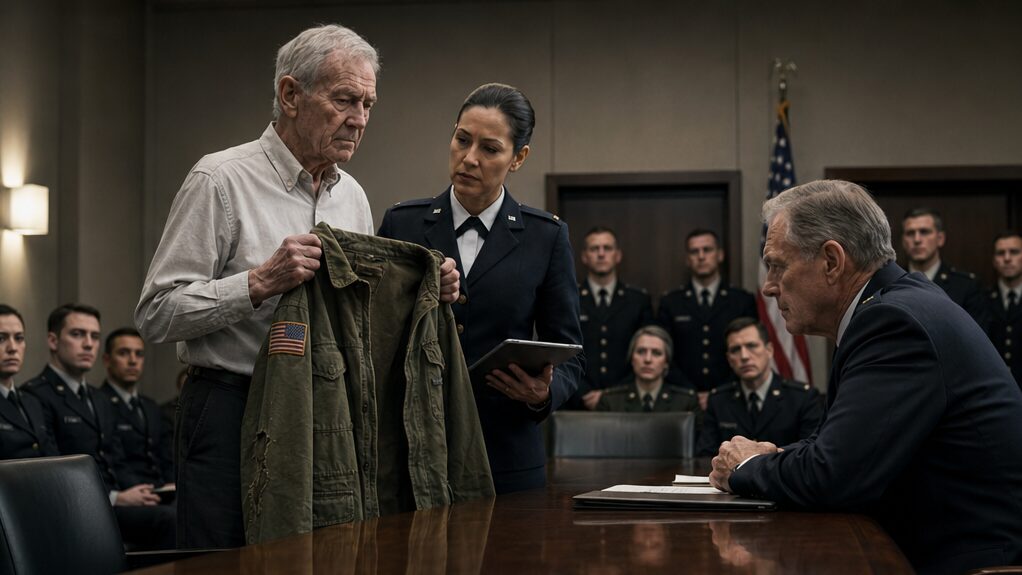
Samuel looked through the narrow glass panel. A long conference table waited inside. Three board members sat at the far side. Two younger officers occupied seats along the wall. At the head of the table, an older man with gray hair reviewed a folder under a lamp. Beside him stood a female officer with a tablet tucked beneath one arm.
Samuel had stood in worse rooms. Louder rooms. Rooms where the air had carried heat and dust and the metal taste of fear.
This room was colder.
The clerk opened the door.
Every face turned toward him with the same brief assessment: age, plain shirt, envelope, jacket.
“Mr. Carter,” said the older man at the head of the table. “I’m Alexander Wilson. I’ll chair today’s review. Please take the seat facing the board.”
Samuel crossed the room slowly enough to hear the whisper of the jacket fabric against his sleeve. He placed the envelope on the table. Then he set the jacket over the back of the empty chair beside him, not crumpled, not displayed, simply present.
One of the younger officers looked at it, then down at his notes.
Alexander Wilson watched Samuel for a moment longer than the others. His expression gave nothing away.
The woman standing near the board stepped forward. Her uniform was exact, from the line of her shoulders to the shine on her shoes. “I’m Catherine Garcia. I’ll be reviewing the documentation history with you.”
Samuel sat.
The chair seemed too low once he was in it. Catherine remained standing. From that angle, she had to look down to meet his eyes.
“Do you understand why you’ve been asked to appear in person today?” she asked.
Samuel placed both hands on the table, fingers loose. “Because the file doesn’t agree with me.”
A board member glanced up.
Catherine tapped her tablet. “Because your requested correction relies on an event record that is incomplete, partially restricted, and inconsistent with the personnel list currently available to this office.”
“Yes,” Samuel said. “That too.”
No one smiled.
Catherine looked at the jacket on the chair. “For the record, are you appearing today with representation?”
“No.”
“Family?”
“My daughter drove me. She’s outside.”
“But not present?”
“No.”
“Any reason?”
Samuel thought of Elizabeth in the parking lot, her hands tight on the steering wheel, saying, Dad, you don’t have to let them do this to you again.
He said, “This part is mine.”
Catherine’s eyes moved from his face to the envelope, then back again. “Mr. Carter, the board has reviewed your submitted materials. Before we begin, I need to be clear. There is no clean proof in this file that places you with the unit action named in your request.”
Samuel heard the sentence settle across the table. Clean proof. As if proof lived cleanly. As if the things worth remembering had ever arrived unstained.
Alexander Wilson opened the folder in front of him.
Catherine stepped closer to Samuel’s side of the table. “So I’ll ask you plainly. Why does your file contain no clean proof of the claim?”
Samuel did not look at the envelope.
He looked instead at the jacket beside the empty chair, where one worn sleeve hung down as if someone absent had just stepped out of it.
Chapter 2: The File That Did Not Remember Him
Catherine Garcia had read Samuel Carter’s file three times before he entered the room, and each reading left her with the same problem.
The claim was too specific to dismiss easily and too poorly supported to approve.
The file did not look like fraud. Fraud usually had a shine to it: too many confident phrases, too much certainty, dates copied from public summaries, heroic language pressed into the margins. Samuel’s file was the opposite. It was spare. Almost stubbornly spare. He had submitted forms with exact dates, then refused to embellish the open fields that asked for explanation. He had written only what he claimed to know.
Unit reassignment: temporary.
Operation designation: listed incorrectly.
Names omitted: four.
Request: correction.
That was not enough.
Catherine stood beside the table and let the silence do what procedure often did better than anger. It invited the claimant to fill it.
Samuel Carter did not fill it. He sat with his hands on the table and waited.
She had seen older veterans arrive with boxes of photographs, laminated certificates, folded flags, framed commendations, letters from former officers, sometimes even faded newspaper clippings. She had also seen men come with memory only, convinced that sincerity could rebuild archives. Some were right about what they had lived through. Some were not. The difficulty was that the system did not run on the weight in a man’s voice.
“Mr. Carter,” she said, “your DD documentation confirms service during the period in question. That is not disputed.”
Samuel nodded once.
“What is disputed is your attachment to the action listed in your petition and the personnel correction connected to that action.”
“Yes.”
Catherine waited for more. There was none.
She turned slightly toward the board. Alexander Wilson watched from the head of the table with his chin resting against one hand. The other board members kept their pens ready. Along the wall, the younger officers sat too straight, the way observers did when they wanted not to be noticed.
Catherine looked back down at her tablet. “You identified the date as October seventeenth.”
“Yes.”
“The existing record places your assigned unit at a different staging area on that date.”
“The existing record is incomplete.”
“You understand that stating that does not make it so.”
“I do.”
His tone did not rise. That steadiness should have helped him. Instead, it made him harder to read.
Catherine moved to the folder lying beside Alexander. “You also submitted four names you believe should be attached to the action summary. The records office found two near matches, one probable misspelling, and one name with no clear personnel match in the recovered files.”
Samuel’s fingers shifted on the table.
It was the first movement Catherine had seen from him that was not purely controlled.
“Which name?” he asked.
Catherine checked the page, though she already knew. “The fourth.”
Samuel’s jaw tightened. He looked down, not as if embarrassed, but as if he were holding something in place.
Alexander noticed too. Catherine saw his eyes narrow slightly.
“Mr. Carter,” Catherine said, “this is why the board needs more than recollection. If the requested correction is approved, it becomes part of the official record. That affects historical summaries, unit documentation, and in some cases survivor and family notifications.”
“I know what records do,” Samuel said.
The sentence was not rude. That made it worse. It carried no challenge, only weariness.
Catherine kept her voice even. “Then you understand our responsibility.”
“I do.”
“Help me understand yours.”
For the first time, Samuel looked directly at her.
There was no accusation in his eyes. Catherine had expected one, perhaps even preferred one. Anger would have given the room shape. Instead, he looked at her as if she had asked him to open a door that had been sealed for a reason and then wanted to know why the hinges were rusted.
“My responsibility,” he said, “is not to let the wrong paper be the last paper.”
One of the board members paused his pen.
Catherine looked down at the file again. “That is not a documentation standard.”
“No.”
“Then what is it?”
Samuel’s gaze drifted toward the jacket on the empty chair.
Catherine followed it. She had noticed the jacket when he came in, of course. Everyone had. It looked old enough to belong in a museum storage drawer, though not valuable enough for display. It was clean, but not restored. The U.S. flag patch had faded. The name tape was barely readable. One sleeve had a repair near the elbow.
She had almost asked him to remove it from the chair. She was glad now that she hadn’t. Not because she understood its relevance, but because asking would have created another delay.
“Mr. Carter,” she said, “the jacket is not listed among your submitted materials.”
“No.”
“Is it connected to your petition?”
Samuel did not answer immediately.
Alexander leaned forward. “Mr. Carter?”
Samuel placed one palm flat against the table. The skin over his knuckles was thin and spotted, the veins raised. Catherine thought suddenly of how old hands could make any room impatient. They made movement slower. They made documents harder to sign. They made silence look like confusion to people who valued speed.
“Yes,” Samuel said at last. “It’s connected.”
Catherine set the tablet down. “In what way?”
He looked at her again. “It was there.”
A faint shift moved thro
Chapter 4: Recognition Was Not The Same As Repair
Catherine Garcia found the restricted cross-reference file in a records office that smelled of toner, old carpet, and overheated plastic.
The administrative aide had guided her there after Alexander Wilson suspended the hearing for review. No one called it a recess. Recess sounded like relief. What had happened in the room had not relieved anyone. It had only changed the shape of the problem.
On the records office counter, Samuel Carter’s folder lay beside the jacket photographs Catherine had taken under Alexander’s direction. She had photographed the outside first, then the name tape, then the flag patch, then the lining. When she reached the stitched initials, she had paused.
“Closer,” Alexander had said from behind her.
She had adjusted the lens and watched the letters sharpen on the screen.
Four sets of initials. Uneven spacing. Thread pulled too tightly in one place, loose in another. Nothing official. Nothing that should have mattered as much as it suddenly did.
Now the file on the records computer displayed a training reference from years earlier. Catherine read the summary twice.
Recovered garment. Improvised internal identifier markings. Possible casualty association. Personnel attachment unresolved.
The document did not name Samuel Carter. It did not name the four men. It did not even name the operation in full. It pointed to an older restricted archive, then to a storage note, then to a blank field where a follow-up report should have been.
Catherine felt the first clean certainty of the day slip away.
Alexander stood beside her, one hand braced on the counter. He had removed his reading glasses and was looking not at the monitor but at the printed photograph of the jacket lining.
“This confirms relevance,” Catherine said. “Not the correction.”
“No,” Alexander replied. “It confirms we should have looked more carefully before this morning.”
She accepted the rebuke because he had not raised his voice.
Through the glass panel in the door, Catherine could see Samuel seated on a bench in the hallway. The jacket was back in his possession, folded across his lap. He was not looking toward the records office. He sat with his shoulders slightly forward, one hand resting on the fabric as if keeping it from sliding away.
Elizabeth Carter had joined him. Catherine knew because the woman had signed in at the desk with the tight, guarded expression of someone accustomed to waiting outside rooms that took too much from her father.
Elizabeth sat close enough to Samuel to help him, not close enough to crowd him. She said something. Samuel shook his head once. She looked away.
Catherine returned her attention to the screen. “We can recommend continuation of the review.”
Alexander looked at her.
She corrected herself. “We can recommend that the board consider the jacket as contextual support and request sworn testimony.”
“From Mr. Carter.”
“Yes.”
“And from anyone else?”
“If any surviving witness can be located.”
Alexander’s expression answered before he did. They both knew the odds.
The administrative aide printed the training reference and slid it across the counter. Catherine picked it up carefully, then stopped. She had handled Samuel’s documents all morning with ordinary efficiency. Now even this copy felt heavier.
“He submitted the names,” she said. “We treated them like weak supporting details.”
“We treated them like unverified details,” Alexander said.
Catherine looked at him.
“There is a difference,” he added. “But it may not feel like one to him.”
In the hallway, Samuel rose when they approached. Elizabeth stood with him, one hand hovering near his elbow until he gave the smallest shake of his head. She let her hand fall.
“Mr. Carter,” Alexander said, “we found a restricted cross-reference that appears to correspond to the jacket markings.”
Samuel held the jacket a little tighter. “Appears.”
Alexander nodded. “Appears. It does not complete the record.”
Elizabeth’s face hardened. “So after all that, you still can’t just fix it?”
Catherine understood her anger before she was ready for it. The question should have sounded unfair. It didn’t.
Alexander answered gently. “Not properly. Not yet.”
Samuel looked between them. “What do you need?”
Catherine opened the folder. “The board would need your testimony entered into the record. Specifics. Names as you remember them. The circumstances of the stitching. How the jacket came to contain those initials. Why the official personnel list differs from your petition.”
Elizabeth turned to her father. “Dad.”
Samuel did not look at her. “And if I give that?”
Catherine held the folder against her side. “Then the board can consider a broader correction. But there may still be limits. Some of the original materials remain restricted or missing. We can’t promise the outcome.”
He nodded as if he had expected nothing else.
Elizabeth stepped closer to him. “You don’t owe them every piece of this.”
Samuel’s thumb moved over the folded collar. “I owe somebody.”
Catherine heard the words and felt the corridor shift around them. Not dramatically. No one else in the hallway stopped. A clerk carried papers past them. A phone rang in the records office. But Catherine suddenly understood that Samuel had not come for recognition alone.
Alexander said, “We can continue tomorrow morning. That will give you time.”
Samuel looked down at the jacket. “Time doesn’t help some things.”
“No,” Alexander said. “But it may help the board do this correctly.”
Elizabeth looked at Catherine, and the distrust in her face was plain. “Correctly would have been listening before making him stand there like he was begging.”
Catherine did not defend herself.
Only that morning, she would have. She would have explained procedure, evidentiary standards, board responsibility, the difference between disbelief and review. All of it would have been true. None of it would have answered what Elizabeth had actually said.
“You’re right,” Catherine said.
Elizabeth blinked. Samuel looked at her then.
Catherine kept her shoulders squared, but she lowered her voice. “I handled the file before I understood what the jacket was carrying. I can’t change that. I can change how we continue.”
Samuel watched her without softening. That, too, she accepted.
Alexander turned to him. “Mr. Carter, before we recess, I need to know one thing. If the board can only verify your attachment first, do you want us to proceed with that portion?”
It was a practical question. Catherine recognized it as the cleanest path: correct Samuel’s record, leave the unresolved names for later review, reduce the burden on everyone.
Samuel understood it just as quickly.
He looked toward the printed cross-reference in Catherine’s hand, then toward the jacket folded against his chest. When he spoke, his voice had no anger in it, and because of that, it cut more deeply.
“If it only fixes my name,” he said, “the record will still be wrong.”
Chapter 5: The Names Sewn Where No One Looked
Elizabeth Carter unlocked her father’s front door before he could reach for his keys.
He let her. That frightened her more than if he had insisted.
Inside, the house was exactly as she had left it that morning: hallway light on, kitchen chair pushed halfway beneath the table, the mail stacked beside the toaster, a glass turned upside down on a dish towel near the sink. Ordinary things. Safe things. Things that should have been enough to hold a day together.
Samuel stepped in slowly, the jacket folded over his arm.
“Sit,” Elizabeth said.
He gave her the look he had given her since childhood whenever she mistook concern for command.
“Please,” she added.
That worked. It usually did.
He sat at the kitchen table. The same table where Elizabeth had done homework while he read the newspaper, where he had taught her how to balance a checkbook, where he had fixed a loose button on her winter coat because he did not believe in throwing away things that could still serve.
He placed the jacket on the table, not on the back of the chair.
Elizabeth shut the door and leaned against it for a moment. She was angry at the board, angry at Catherine Garcia, angry at the polite way Alexander Wilson had said they could not fix what they now knew mattered. Most of all, she was angry at the jacket, though she knew better than to admit it.
It had been in her life longer than many relatives. Folded in closets. Hung behind bedroom doors. Packed into boxes and unpacked again when Samuel moved after her mother died. She had seen him check its pockets before storms, before hospital appointments, before long silences. As a child, she had thought all fathers had some object they treated like a locked room.
Now the locked room was on the kitchen table.
“Dad,” she said, “you almost fell getting out of that chair.”
“I did not almost fall.”
“You grabbed the table.”
“I used the table.”
She laughed once, without humor. “That’s the difference?”
“To me.”
Elizabeth crossed the kitchen and filled the kettle because her hands needed work. “They already embarrassed you once. Tomorrow they’ll ask for more. Details, dates, names. They’ll make you say things you haven’t said in years, and then they’ll still hide behind the word ‘limitations.’”
Samuel looked at the jacket. “Maybe.”
“Maybe?” She turned from the counter. “That’s all?”
“What would you like me to say?”
“I’d like you to say you’re done.”
He was quiet.
The kettle clicked as it began to heat.
Elizabeth regretted the sharpness of her voice, but not the meaning. She had watched her father give pieces of himself to systems that returned letters stamped incomplete. She had driven him to records offices, mailed certified copies, sat beside him while hold music played from a speakerphone. Each time, he had said it was the last attempt. Each time, another form arrived.
“You don’t need their permission to know what you did,” she said.
Samuel’s eyes lifted. “No.”
“Then why keep letting them put you through this?”
He touched the jacket’s collar but did not unfold it. “Because knowing isn’t the same as leaving it right.”
Elizabeth turned off the kettle before it boiled. The kitchen filled with the faint sound of cooling metal.
“Is this about you,” she asked, “or about them?”
He understood who she meant.
The names.
Until that day, they had been shadows around the edges of family life. Not secrets exactly. Samuel had never lied when asked about the service. He simply answered with less than people wanted and more than they expected. Elizabeth knew there had been men. She knew there had been an operation. She knew a date in October could turn him inward for days.
She did not know why four sets of initials had been sewn inside the jacket.
Samuel placed both hands on the table. “Bring me the small scissors from the drawer.”
“No.”
“Elizabeth.”
“You are not cutting that jacket open.”
“I’m not cutting it. The lining catches.”
She hesitated, then opened the drawer. The scissors were where they had always been, beside rubber bands, twist ties, and a flashlight with weak batteries. She handed them to him handle-first.
He unfolded the jacket.
In the kitchen light, it looked older than it had in the review room. Less symbolic. More tired. A garment that had been rained on, slept in, mended badly, and kept too long because throwing it away would have been a second loss.
Samuel turned the lining outward. The initials were smaller than Elizabeth expected.
She sat down across from him.
“That’s it?” she whispered.
Samuel’s thumb stopped beside the thread. “That’s what stayed.”
Elizabeth felt ashamed as soon as she heard her own question in the room. She had expected something larger because grief, from the outside, always seemed as if it should leave larger evidence.
Samuel pointed to the first set of initials. “He kept a deck of cards wrapped in wax paper. Said damp cards were worse than bad coffee.” His finger moved to the next. “This one talked too much when he was scared. Everyone knew it. Nobody told him to stop.” A third. “He could fix a radio if you gave him a wire, a blade, and five minutes.”
His finger rested near the fourth, but he did not touch it.
Elizabeth waited.
The house made small evening sounds around them. Pipes. Refrigerator. A car passing outside. The kind of sounds that had no idea what they were interrupting.
“The fourth?” she asked.
Samuel drew his hand back.
“The fourth was entered wrong from the start,” he said. “Wrong middle initial on one list. Wrong last letter on another. By the time the file closed, he belonged to no one on paper.”
Elizabeth looked at the thread until her eyes blurred. “Why didn’t you tell me?”
“I did.”
“No,” she said softly. “You told me there were men you remembered. You didn’t tell me you were the only place one of them was written right.”
Samuel closed his eyes for a moment.
When he opened them, he seemed older than he had before.
“We were told not to talk,” he said. “At first, that made sense. Then the years passed, and it made less sense, but it had become habit. After your mother died, I started the request. Then stopped. Then started again.”
“Because of him?”
“Because of all of them.”
Elizabeth reached toward the jacket, then paused. For the first time, she understood why Alexander had asked permission.
“May I?” she said.
Samuel looked at her hand. Something in his face loosened, barely.
“Yes.”
She touched the lining beside the initials. The fabric was thin and rough beneath her fingertips. Not sacred. Not magical. Just cloth. But someone had pushed a needle through it in a place where paper had failed.
“I thought you were doing this because you didn’t want to be forgotten,” she said.
Samuel smiled faintly, and it hurt her to see it. “I’ll be forgotten soon enough.”
“Dad.”
“That’s not sadness. That’s math.” He folded the edge back carefully. “But if a name is wrong in the record, it keeps being wrong. People copy wrong things. They build other wrong things on top of them. After a while, the mistake looks official.”
Elizabeth looked at the fourth set of initials.
“Do you remember his full name?”
Samuel’s hand closed gently over the lining.
“Yes.”
“Then tell them tomorrow.”
His eyes lifted to hers.
The words surprised her as much as they seemed to surprise him. An hour earlier, she had wanted him to walk away. She still wanted to protect him from the room, from Catherine’s questions, from Alexander’s careful limits, from the way official language could sand down pain until it no longer looked like pain.
But touching the thread had changed the size of the matter.
Samuel did not need the board to tell him who he was. The men in the lining needed someone to stop letting the board remain wrong.
Elizabeth stood and took two mugs from the cabinet. “I’ll drive you in the morning.”
“You don’t have to come inside.”
“I know.”
She poured the tea too strong and set a mug near him. He did not drink. He kept his hand over the jacket lining as if feeling for a pulse.
After a while, he said, “There’s something I should have corrected long before now.”
Elizabeth looked at him.
Samuel’s voice stayed steady, but his eyes did not. “One name in this jacket was never entered correctly anywhere.”
Chapter 6: The Procedure That Almost Erased Them Again
Alexander Wilson arrived before the board room lights had fully warmed.
The building had a different sound in the early morning. No waiting-room television. No steady foot traffic. No phones ringing from three desks at once. Only the ventilation system pushing cool air through the ceiling grates and the occasional click of a door somewhere down the corridor.
He preferred it that way.
On the table before him lay two files.
One was Samuel Carter’s official packet, now thicker by several pages: the cross-reference printout, photographs of the jacket, Catherine Garcia’s notes, a procedural recommendation for continued review, and a flagged request for restricted archive retrieval.
The other was not a file at all, but a thin set of copies Alexander had pulled from an old training archive after hours. He had not taken the originals. He knew better. He had printed what the system allowed and written a reference number in the margin.
Recovered garment.
Internal identifiers.
Personnel unresolved.
He had read those words years ago in a leadership course, back when he still believed incomplete records were rare accidents rather than quiet companions to complicated service. The case had been presented cleanly, as training cases always were. A lesson in field improvisation. A lesson in documentation under degraded conditions. A lesson in why proper reporting mattered.
No one had mentioned the man who carried the garment home.
Now Alexander could not stop seeing Samuel standing beside the table, his hand near the lining, answering with almost unbearable plainness.
I sewed two.
Catherine entered with two cups of coffee and a folder under her arm. She set one cup near Alexander without comment.
“Restricted archive request is moving,” she said. “Not fast.”
“It never does.”
“The records office confirmed three of the four submitted names have probable links to the staging area. Still not enough for full correction.”
“And the fourth?”
Catherine opened the folder. “Still no clean match. There are variants, but none align fully with Mr. Carter’s spelling.”
Alexander looked toward the empty chair where Samuel had sat the day before. “Maybe the spelling is the point.”
Catherine nodded. She looked tired, though her uniform was as precise as ever. He suspected she had spent part of the night thinking of the same hallway conversation he had.
“You understand,” she said, “the board will accept a narrow amendment.”
“Yes.”
“They’ll add Carter’s temporary attachment if we frame the jacket as contextual support and his testimony as credible personal recollection aligned with the restricted reference.”
“And the other names?”
“Deferred pending further verification.”
Alexander let the phrase sit between them.
Deferred pending further verification. Another way of saying not today. Another way of asking an old man to be grateful for the portion of truth the room found manageable.
The other board members arrived in sequence, carrying folders, coffee, and the practiced caution of people who knew a difficult decision had entered the room before them. No one spoke lightly. That was something, at least.
When Samuel arrived, Elizabeth walked beside him as far as the door.
Alexander noticed the change immediately. Samuel still wore the same plain shirt, the same polished old shoes, the same contained expression. But the jacket was no longer folded tightly against him. He carried it over his forearm with the lining inward, like something ready to be opened if necessary.
Catherine met him at the door.
“Mr. Carter,” she said.
Not sir, not claimant, not a hurried name off a list. Mr. Carter. Clear. Steady.
Samuel nodded.
Elizabeth looked past Catherine into the room, then at her father. “I’ll be right outside.”
“I know,” Samuel said.
Catherine held the door without rushing him.
That small thing would not appear in any record, Alexander thought. It mattered anyway.
When the hearing resumed, Alexander stated the procedural findings first. He kept his voice formal because informality could become its own kind of disrespect. Samuel deserved clarity, not sentiment.
“The board has located a restricted cross-reference consistent with the jacket markings presented yesterday. This does not independently verify every requested correction, but it does establish relevance to the disputed record.”
Samuel listened without expression.
Alexander continued. “Based on available materials, the board is prepared to consider a narrow amendment recognizing your temporary attachment to the unit action under review.”
Catherine’s eyes moved briefly to Samuel.
Alexander saw the old man understand the offer at once.
A narrow amendment would repair him. It would place Samuel Carter where he had always said he belonged. It would let the board close the most defensible part of the matter. It would allow everyone in the room to feel they had done something decent.
One board member adjusted his pen. “The remaining submitted names would require additional review. We can attach them as pending references but not enter them into the corrected action summary at this time.”
Samuel looked down at the folder before him. Catherine had prepared a statement for him overnight, a clean one-page summary designed to support the narrow amendment without forcing him through every detail. It was careful. Respectful. Limited.
Alexander had approved it as a procedural option.
Now, watching Samuel look at it, he felt the weakness of that approval.
“Mr. Carter,” Catherine said, “you are not required to provide expanded testimony today. If you choose to proceed with the narrow amendment, the board can preserve your petition for later review of the other names.”
Samuel touched the edge of the prepared statement.
His fingers rested there for several seconds.
The room waited.
Alexander saw the tremor in Samuel’s right hand. He also saw the old man still it by pressing his palm flat.
“Major Garcia,” Samuel said.
“Yes.”
“Did you write this?”
“I drafted it from the verified portions of the file.”
“It’s clean.”
Catherine’s face changed slightly. “I tried to make it accurate.”
Samuel looked at her, not unkindly. “Clean isn’t always accurate.”
No one moved.
Alexander felt the sentence find its place in the room.
Samuel pushed the prepared statement away.
The paper slid a few inches across the polished table and stopped beside the old jacket.
Catherine did not reach for it.
Alexander understood then that recognition had only opened the door. What happened next would decide whether the board walked through it or stood politely at the threshold.
Samuel lifted his eyes to the board.
“I’d like to speak without that,” he said.
Chapter 7: He Would Not Let The Jacket Speak Alone
Samuel Carter had not planned to begin with the river.
He had planned, if planning was the right word, to begin with the date. October seventeenth. Then the staging area. Then the reassignment that never appeared where it should have. He had practiced the clean version in his kitchen while Elizabeth pretended not to listen from the sink.
But when the prepared statement slid away from his hand and stopped beside the jacket, the room waited with its polished table and careful faces, and Samuel understood that the clean version would fail them again.
So he began with the sound of rain.
“It had rained for two days,” he said.
Catherine Garcia’s pen hovered above her paper. She did not interrupt.
Samuel looked at the jacket, not at the board. “Not hard the whole time. Just enough to turn everything soft. You’d step where ground looked solid and sink past your ankle. Trucks got stuck. Radios acted up. Paper didn’t last unless you kept it inside plastic, and even then, sometimes the ink bled.”
One of the board members shifted, but Alexander Wilson did not. He sat very still, both hands folded in front of him.
Samuel placed his palm on the jacket lining. The fabric was cool beneath his skin.
“We were attached temporary. That’s why your list doesn’t show it clean. Temporary meant you went where they needed bodies and came back if there was still a place to come back to. Nobody built a monument for temporary.”
Catherine wrote that down, then stopped and crossed something out. When she began again, her hand moved more slowly.
Samuel saw it. He kept going.
“There were six of us at first in the element I’m talking about. Two were separated before the crossing. Four stayed with me until the evacuation broke apart.”
His voice wanted to thin. He breathed through his nose once and steadied it.
“I wrote their names after. Not all at once.”
Catherine looked up. “You wrote them where, Mr. Carter?”
Samuel turned back the lining. “Here.”
The room leaned toward the jacket without moving much. That was how attention looked when people finally understood it should be careful.
“The first set was done before daylight,” Samuel said. “He was breathing when I started. He was not when I finished. I used black thread from a repair kit. My hands were shaking, so the letters came out crooked.”
He did not name the man yet. If he named him too soon, he would lose the order.
“The second was later. We had a pencil, but everything was wet. I didn’t trust paper. One of them said, ‘Put it somewhere that comes home.’ So I did.”
Catherine’s mouth tightened. Not with disbelief. With the effort of not showing too much.
“The third, another man sewed. I held the cloth. He had better fingers for it, even with mud on them. He laughed because the needle kept slipping. Said if he lived, he’d never mend another thing as long as he breathed.”
Samuel’s hand moved to the fourth set of initials.
He stopped there.
For years, the fourth had been the place where memory changed shape. The others came with voices, habits, small annoyances, the ordinary evidence of having lived beside a man. The fourth came with a mistake. A letter entered wrong. A sound misheard. A name that paperwork had bent until it no longer pointed home.
Alexander’s voice was quiet. “Take your time.”
Samuel almost smiled. Time had been the one thing none of them had that day.
He lifted his eyes to the board. “The fourth name in your file is wrong.”
Catherine turned a page in the packet. “The submitted spelling?”
“No. Mine is right. Yours is wrong.”
No one challenged him.
He looked at the records clerk seated near the side station. The clerk had been typing, but now her fingers rested above the keys.
Samuel gave the name.
He gave it slowly. First name. Middle initial. Last name. Then he spelled it. Once. Twice. The second time, the records clerk repeated each letter back to him, and Samuel corrected the fourth letter before she finished.
“That’s where the mistake always starts,” he said.
The clerk swallowed. “Corrected.”
Samuel nodded.
The word sat in the room with more force than anyone expected.
Catherine set her pen down. “Mr. Carter, for the record, how do you know that is the correct spelling?”
Samuel touched the lining again. “Because he made us say it right.”
A faint, broken breath moved through the room. Not laughter. The memory of it.
“He said people had been getting it wrong since grade school. Told us if we ever had to write it down, we’d better not get lazy. He said a man could forgive bad coffee and late mail, but not someone trimming letters off his name because they were in a hurry.”
Catherine looked down at the file before her, then at the clean government spelling that had failed him.
Samuel continued. “When I sewed his initials, I used the right ones. Later, when I saw the first list, it was wrong. I reported it once. I was told the file was restricted and the correction would be handled through proper channels.”
He looked at Alexander.
“It wasn’t.”
Alexander did not look away.
Samuel’s hand closed gently over the jacket. “I let that stand too long.”
“No,” Catherine said.
The word left her before rank or procedure could catch it. Every face turned toward her.
She drew herself back, but did not retreat from the meaning. “For the record, Mr. Carter, the failure to amend an official file is not yours.”
Samuel watched her.
Catherine’s cheeks colored slightly, but her voice remained steady. “Please continue.”
He understood then that she was no longer trying to manage him into a useful statement. She was guarding the space around what he had to say.
So Samuel gave them what he had carried.
Not all of it. Some things belonged to the dead and the dark and the part of him that still woke before dawn certain he had heard rain on metal. But he gave enough. He gave the temporary attachment. The wrong staging note. The names as they had been spoken. The reason the jacket became the place they wrote what paper could not hold. He gave the moment when the order to stay silent, once necessary, hardened over the years into neglect.
He did not ask them to feel anything. He did not tell them he deserved honor. He did not raise his voice.
When his throat tightened, he paused. Catherine waited each time. The board waited. Even the young officers along the wall seemed to understand that their stillness was now part of the record, though no machine would capture it.
At last, Samuel turned the lining outward so the initials faced the board.
“I came here to correct my file,” he said. “That is what I wrote on the form because the form had room for that. But if you put my name where it belongs and leave theirs outside the line again, then you’ll make me the only man who came home twice.”
No one wrote for several seconds.
Alexander removed his glasses.
Samuel’s palm rested on the jacket beside the initials. His hand looked old there. Spotted, veined, unsteady at the edges. But it did not move away.
Catherine stood.
Not quickly. Not with ceremony. She gathered the prepared statement Samuel had pushed aside and placed it face down. Then she turned to the records clerk.
“Enter Mr. Carter’s testimony as expanded record support,” she said. “Attach the spelling correction exactly as stated. Flag all four names for board action in the same incident summary, not as separate deferred references.”
One board member straightened. “Major Garcia, that exceeds the preliminary recommendation.”
“Yes,” Catherine said. “The preliminary recommendation was too narrow.”
Alexander looked at her, then at Samuel.
Catherine kept her eyes on the board. “We recognized the jacket yesterday. Today we need to recognize what it was carrying.”
The words were not loud, but they changed the room.
Samuel lowered his eyes.
He had thought speaking would empty him. It did not. It left him tired in a deeper way, but not hollow. The names had left his mouth and remained alive in the air.
Alexander placed both hands on the table.
“Before anyone leaves this room,” Catherine said, “I’m asking that the hearing record be amended.”
Chapter 8: The Way They Handled The Jacket Afterward
Catherine Garcia had never noticed how loudly paper moved in a silent room.
The amended hearing record came from the printer in warm sheets, each page sliding into the tray with a soft mechanical sigh. The records clerk carried them to the table and placed them before Alexander Wilson first, then before the board members, then before Catherine.
No one reached for Samuel Carter’s jacket.
That, Catherine thought, was the first sign they had learned something.
The jacket lay open beside the official file, its lining turned just enough for the initials to show. Not displayed. Not hidden. Samuel had left his hand near it during the board’s deliberation, but he had not touched it since Catherine asked for the amendment. His fingers rested on the table now, still except for a faint tremor he no longer bothered to hide.
Alexander read the final page twice.
Catherine did the same.
The correction did not make the past whole. It did not restore years, remove grief, or turn a restricted cross-reference into a perfect archive. It did what a record could do when people stopped asking it to protect them from responsibility.
It placed Samuel Carter with the temporary attachment.
It tied the four names to the incident summary.
It corrected the misspelled name.
It noted the jacket markings as material context supported by sworn testimony and restricted archival reference.
Plain language. Dry language. But no longer empty.
Alexander signed first. The pen made a small sound against the paper. Then the next board member. Then the next.
Catherine signed where procedure required her to certify the review record. Her signature looked the same as it always did. It did not feel the same.
Alexander turned the packet toward Samuel.
“Mr. Carter,” he said, “the board has approved the amended record.”
Samuel looked at the page but did not reach for it.
Catherine understood that too. A signature could be another kind of burden. Proof, once received, still had to be carried.
Alexander continued, his voice formal but not distant. “Your temporary attachment will be entered into the corrected action summary. The four names you provided will be attached to the incident record with the spelling correction entered as stated in your testimony. Additional archival retrieval will continue, but the correction will not wait on that retrieval.”
Elizabeth stood near the back wall. She had been allowed into the room after Samuel’s testimony, though she had not spoken. Catherine had expected her to cry when the decision came. She did not. She pressed one hand over her mouth and looked at her father as if seeing both the old man in the chair and someone much younger standing behind him.
Samuel nodded once.
“Thank you,” he said.
The words were so quiet Catherine almost wished he had not had to spend them.
One of the younger officers along the wall began to rise too fast, moved by some instinct toward a larger gesture. Alexander’s eyes shifted in his direction, and the officer stopped. Not rebuked. Guided.
Not every feeling needed to become performance.
Catherine closed the file in front of her. Then she looked at the jacket.
“Mr. Carter,” she said.
Samuel turned to her.
She stepped around the table, stopping far enough away that he would not feel crowded. “May I fold it?”
For a moment, no one moved.
Samuel looked from her face to the jacket. Catherine kept her hands at her sides. She would not reach first. She would not assume that permission yesterday meant permission today.
Finally, Samuel said, “Yes.”
Catherine approached the jacket the way Alexander had approached it the day before, with the caution of someone entering a room already occupied. She touched the lining only where Samuel had touched it. She did not press the initials flat. She did not smooth away the uneven thread. She folded the left side inward, then the right, watching Samuel’s eyes for correction.
“The sleeves go across,” he said.
She paused.
“Left first?” she asked.
He looked at her then, really looked, and something almost like warmth passed through his tired face.
“Left first.”
She folded it left sleeve across the chest, right sleeve after, collar tucked inward. The same pattern he had used for years. When she finished, she lifted the jacket with both hands and held it out to him.
Not by the collar. Not pinched between fingers. Both hands beneath it, supporting the weight.
“Mr. Carter,” she said, “I’m sorry for how I addressed your file before I understood what you were asking us to hear.”
Samuel took the jacket from her.
“You were doing your job,” he said.
“I was doing part of it.”
He did not absolve her. He did not need to. The answer was enough.
Elizabeth stepped forward when Samuel rose. This time, when her hand came near his elbow, he let it stay there. Catherine saw Elizabeth notice that permission and hold herself very still around it.
Alexander stood.
Then the board members stood.
The young officers followed, more carefully this time. Chairs moved softly against the floor. No one clapped. No one called for attention. No one made the room into a stage.
Samuel looked uncomfortable for a breath, then seemed to understand the difference.
They were not standing because they had discovered a hero.
They were standing because a man who had carried names alone was leaving the room, and they finally knew better than to remain seated as if nothing had changed.
Alexander came around the table. He stopped before Samuel, straightened, and gave a restrained salute. It was small, controlled, and held only long enough to be understood.
Samuel did not salute back. His hands were full of the jacket.
Instead, he nodded.
Alexander lowered his hand.
In the hallway, the building had resumed its ordinary life. Phones rang. Shoes crossed tile. A clerk laughed somewhere behind a half-closed door and then caught herself, as if laughter might be improper near the review room.
Elizabeth walked beside Samuel toward the exit.
Catherine followed a few steps behind with the amended packet in a sealed envelope. At the security checkpoint, the same security sergeant from the day before looked up. His eyes moved to Samuel, then to the jacket.
This time he did not call it outerwear.
He opened the gate without asking Samuel to place anything in a tray.
“Mr. Carter,” Catherine said before Samuel stepped through.
He turned.
She held out the envelope. “A certified copy. The rest will be mailed, but this one is yours today.”
Elizabeth accepted it because Samuel’s hands were still around the jacket.
Catherine lowered her voice. “The records office will contact next of kin where the correction allows. For the fourth name, we’ll start with the spelling you gave us.”
Samuel looked toward the envelope, then back at her.
“Say it right,” he said.
Catherine nodded. “We will.”
Outside, afternoon light spread across the building steps. Samuel paused at the top, blinking as if the day had become brighter while he was inside. Elizabeth stood beside him, holding the envelope carefully against her chest.
“Ready?” she asked.
Samuel looked down at the folded field jacket in his arms.
For nearly four decades, it had been proof no one had asked to see, a record no office had known how to read, a weight he had accepted because setting it down felt too much like leaving men behind.
Now it was still old. Still faded. Still frayed at the cuffs.
But when Catherine watched Samuel walk down the steps with Elizabeth beside him, the jacket no longer looked like something the room had allowed him to carry.
It looked like something the room had finally learned how to return.
The story has ended.