The Dog Tags He Wouldn’t Let Her Wear Became the Lesson She Never Forgot
Chapter 1: The Old Man Beside the Polished Floor
The dog tags struck the gym lights before Donald Carter heard the young woman laugh.
They flashed once against the green of her training shirt, two small pieces of metal bouncing near her collarbone as she turned toward the seated trainees. One tag caught the light cleanly. The other did not. It hung darker, rubbed at the edges, its face dulled by years that did not belong to her.
Donald stopped beside the polished floor with a stack of attendance folders under one arm.
No one noticed him stop.
That was usually how these mornings began. A gate guard nodded him through because his name was on the list. A training assistant gave him a visitor badge and forgot to make eye contact. The trainees glanced once at his brown jacket, his careful steps, his thinning gray hair, and quietly placed him in the harmless category reserved for old volunteers, retired relatives, men who came to talk about discipline while younger bodies did the work.
Donald did not mind being misread. Most days, being underestimated gave him room to breathe.
The training hall smelled of floor wax, rubber mats, and coffee cooling in paper cups. Rows of folding chairs faced a taped-off demonstration area. Along the far wall, medicine balls and training pads sat in tidy stacks. The flags near the entrance did not move. Everything in the room looked prepared for instruction, except for the way the trainees watched one another more than they watched the front.
Captain Stephen Martin stood near the whiteboard, sleeves rolled with neat impatience. He saw Donald and lifted two fingers in greeting, then turned back to the group.
“All right,” Stephen said. “We keep this simple. Situational judgment, chain of responsibility, and what you carry into the room before you ever open your mouth.”
A few trainees shifted. One yawned behind a fist.
Donald stepped to the side, where a gray metal chair had been placed for him near the edge of the floor. Not at the front. Not hidden. Beside the action, like a tool someone might use if needed.
That suited him.
He set the folders on his lap and looked down at the first roster. Names, checkboxes, unit numbers. Young lives reduced to lines for the morning. He knew better than to stare at faces too long. Young soldiers could feel an old man measuring them, even when he was only trying to remember who had looked tired, who had looked scared, who had looked too proud to ask for help.
Then the tags flashed again.
The young woman wearing them stood near the front row, not seated like the others. Her posture was strong in the way young people learned before they learned exhaustion. Chin lifted, shoulders square, dark hair tied back tight enough to pull the skin near her temples. She had the confidence of someone who had already decided the room needed to know she belonged in it.
“Davis,” Stephen said, glancing at his clipboard. “You volunteered for the scenario?”
“Yes, sir,” she said.
Laura Davis.
Donald found the name on his roster and marked nothing beside it.
Stephen gave instructions. A trainee would play an exhausted team member refusing an order. Another would play the senior in the room. Laura would intervene. The exercise was not about force, Stephen said. It was about judgment under public pressure.
Donald listened with half his attention. The rest stayed with the darker tag resting against Laura’s shirt.
It was not unusual for trainees to wear family tokens. A ring on a chain. A patch inside a cap. A photograph tucked into a notebook. The young carried memory outward because they had not yet learned how heavy it became when carried inside.
But dog tags were different.
Donald watched Laura touch them while Stephen spoke. Not nervously. Possessively. Her fingers closed over both tags as if the gesture itself answered any question before it could be asked.
The first scenario began badly. The trainee playing the exhausted team member raised his voice too fast. The one giving the order smirked before he spoke. Laura stepped between them with crisp confidence and said the right words in the wrong tone.
“You don’t get to fall apart just because you’re tired,” she said.
Stephen made a note.
Donald’s hand tightened slightly on the folder.
Laura continued, voice carrying. “People depend on you. If you can’t handle pressure, say so before everyone else has to carry your weakness.”
A couple of trainees looked down. One smiled as if he approved. Another stared at the floor.
Donald waited for Stephen to stop her.
Stephen watched a moment longer, perhaps wanting to see where she would take it.
Laura turned toward the trainee playing the exhausted soldier. “You think anyone cares how you feel when the job needs doing?”
The gym went quiet in the way rooms go quiet when cruelty has dressed itself as discipline.
Donald rose before he decided to.
His knees objected first. Then his back. He steadied the folders against his side and stepped onto the edge of the polished floor. His old black shoes made almost no sound.
“Miss Davis,” he said.
Laura turned. Her eyes moved over him quickly, from gray hair to visitor badge to the folders under his arm.
“Yes?”
“The words are correct enough,” Donald said. “The use of them is not.”
A few trainees lifted their heads.
Stephen looked from Donald to Laura. “Mr. Carter is assisting with today’s ethics portion.”
Laura’s mouth tightened. Not quite a smile. “I understand, sir.”
Donald heard what sat beneath it. I understand why he is here. I do not understand why he is speaking.
He kept his voice even. “Pressure does not excuse stripping a person down in front of others. If someone is failing, you correct the failure. You do not make their pain the lesson.”
Laura’s fingers rose to the tags again.
“With respect,” she said, “this is training. People are going to be uncomfortable.”
“Yes,” Donald said. “They are.”
“Then maybe they should learn now.”
“They should,” Donald said. “But not from contempt.”
The word landed harder than he intended.
Laura’s face changed. Not much. Just enough. Her pride, already standing guard, stepped forward.
“I wasn’t showing contempt,” she said. “I was showing standards.”
Donald nodded once, accepting the correction without accepting the meaning.
Stephen moved half a step forward. “Let’s pause there.”
But Laura did not pause. The trainees were watching now, and Donald could feel the room choosing sides before anyone had the courage to admit there were sides to choose.
“I know what standards cost,” Laura said.
Her hand closed fully over the tags.
Donald’s eyes dropped despite himself.
The worn one slipped between her fingers. Dark edge. Shallow bend near the lower corner. A thin crescent-shaped scar across the metal, almost hidden by the chain.
Air left the room.
No one else seemed to notice.
Donald did not move. He looked at that mark until the gym floor blurred around it, until the waxed boards became a different shine under a harder light, until a voice he had not heard in years seemed to come from somewhere behind his right shoulder.
Not like that, Carter. Don’t let them make it mean that.
“Mr. Carter?” Stephen said.
Donald blinked.
Laura was staring at him now. Her confidence had sharpened into irritation.
“You were saying?” she asked.
Donald looked back at her face. Young. Defensive. Brave, maybe, but not yet careful. She did not know what she was holding. That much was suddenly clear.
He could have said the name then.
He could have taken the room in one sentence and changed every eye in it.
Instead he lowered his gaze and folded the roster closed.
“Nothing more for now,” he said.
A small breath of amusement moved somewhere among the trainees. Not loud enough to be challenged. Loud enough to be felt.
Laura heard it too. It gave her courage she did not need.
“Sir,” she said to Stephen, though her eyes stayed on Donald, “with permission, I’d like to finish the scenario.”
Stephen hesitated.
Donald stepped back from the floor.
Laura’s hand remained at her collar. “Because I think the point stands. Some things can’t be understood from the sidelines.”
Donald returned to the chair. The folders lay stiff against his knees. His thumb found the corner of the top page and held it there.
Stephen cleared his throat. “Davis, reset your tone and continue.”
Laura nodded, but she did not reset her tone. Not fully. She turned back to the group with her shoulders even higher than before.
Donald watched the worn tag settle against her shirt.
For the next ten minutes, the room moved around him. Trainees spoke. Stephen corrected. Shoes squeaked on the floor. A clipboard snapped shut. Donald heard all of it from a distance.
He had seen thousands of tags. New tags, old tags, tags pressed into palms, tags sealed in envelopes, tags hung from rearview mirrors by people who did not know better until someone told them. Metal survived what flesh could not. That was part of the cruelty of it.
When the scenario ended, Stephen dismissed the trainees for water and told them to remain in the hall.
Chairs scraped. Voices rose carefully, then more boldly. Laura stayed near the front, speaking with two other trainees. She laughed once, but it came out forced.
Donald stood again.
He did not want to cross the floor.
He crossed it anyway.
Laura saw him coming and turned before he reached her. “Is there another correction?”
The two trainees beside her went quiet.
Donald kept his hands at his sides. “The tags you’re wearing.”
Her face closed.
“What about them?”
“May I ask whose they are?”
Laura’s eyes narrowed. “Family.”
“That was not my question.”
“It’s the answer I’m giving.”
One of the trainees shifted backward.
Donald looked at the tags, then at her. “They should be carried with care.”
Laura gave a short, disbelieving breath.
“With respect, you don’t know how I carry anything.”
“No,” Donald said. “I do not. That is why I asked.”
Stephen had begun walking toward them from across the gym, but he was too far away to stop what had already gathered.
Laura lifted the tags from her shirt and let them fall back against her chest.
“My mother served,” she said. “My family served. These mean something to me.”
Donald’s throat tightened around the word mother.
“I believe they do,” he said.
Her voice rose, not much, but enough for the nearest row to hear. “Then maybe don’t stand there like I’m wearing jewelry.”
The room thinned into silence again.
Donald looked at the polished floor and saw both of them reflected there: the young woman upright with bright anger, the old man slightly bent, holding nothing, asking too late.
Laura touched the darker tag with two fingers.
“What could an old man like you possibly know about them?”
Chapter 2: The Name He Would Not Say Out Loud
The question stayed in the air long enough for the trainees to understand they had heard something they were not supposed to enjoy.
Donald could feel their attention tightening around him. Some waited for him to snap back. Some waited for Stephen Martin to rescue the room. A few watched Laura with the uneasy loyalty of people who wanted her confidence to remain admirable, not cruel.
Donald looked at her hand on the tags.
Then he looked at Laura.
“More than I wish I did,” he said.
The words were quiet. They did not carry to the whole room. That was all right. They were not meant for the whole room yet.
Stephen arrived at Donald’s left side. “Mr. Carter, we can handle this after the session.”
Donald kept his eyes on Laura. “May I see them?”
Laura’s fingers tightened at once. “No.”
“That is your right.”
“Then why ask?”
“Because one of them has a mark I recognize.”
Her expression flickered. Not fear. Offense searching for steadier ground.
“These are my family’s.”
“I heard you.”
“You don’t get to inspect them.”
“No,” Donald said. “I do not.”
He took half a step back.
That should have ended it. A younger Donald might have let it end there, out of pride if not discipline. But the dark tag had turned slightly when Laura moved, and the crescent mark near the corner showed again. There was another mark too, a tiny flattening along the edge where metal had met stone or concrete or something worse. He had held that tag once under a buzzing light while a chaplain stood beside him and said nothing because there was nothing useful to say.
Laura saw his face before he could repair it.
“What?” she demanded.
Donald did not answer.
Her anger faltered under curiosity. She pulled the chain over her head with a quick motion, as if proving she was not afraid. The tags slid free from her collar and landed in her palm.
“Fine,” she said. “Look.”
Stephen lowered his voice. “Davis.”
“No, sir,” she said, still facing Donald. “If he recognizes something, let him say it.”
The room had gone almost completely still.
Donald looked at Stephen. The captain’s jaw was set, his eyes warning and uncertain. He wanted order. Donald did not blame him. Order was easier than truth, and often kinder in the short term.
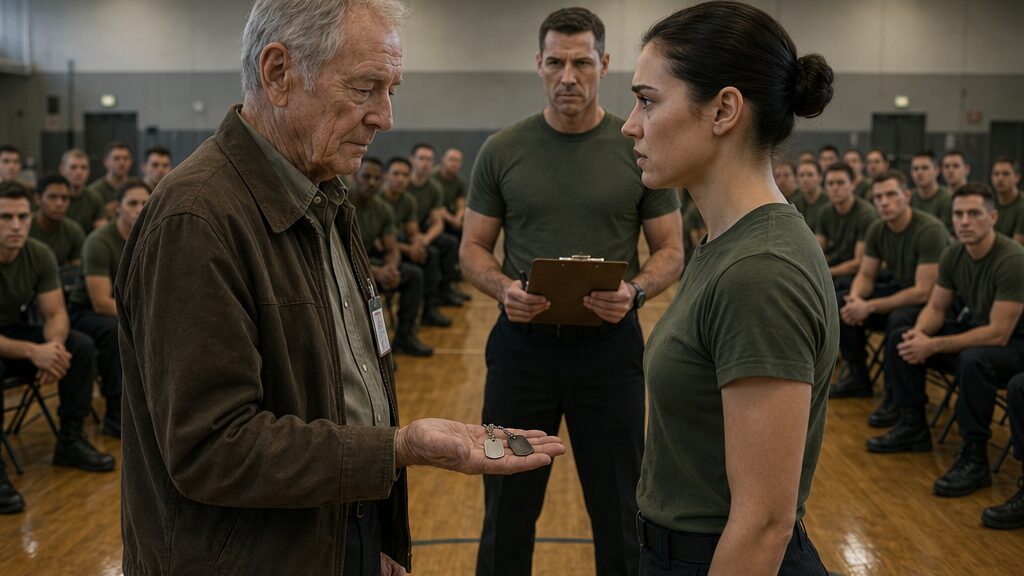
Donald extended his hand.
Laura hesitated before placing the tags in it.
They were warmer than he expected.
The bright tag lay on top first, newer and cleaner, its letters sharp enough that Donald did not need to read them to know it had been remade. The chain was newer too. Not issued. Bought. The second tag slid beneath it, darker and thinner from wear. Donald separated them with his thumb.
The old tag showed itself.
The name came up through the years before his eyes finished finding it.
TORRES
ELIZABETH
Donald’s fingers stopped.
The gym disappeared at the edges.
He was not in the training hall for a moment. He was in heat and dust and a corridor too narrow for the number of people trying to move through it. He heard someone laughing from exhaustion, heard Elizabeth Torres say his name like she was scolding him for worrying too much. He saw her hand press something into his palm.
Not now, he had told her.
Yes now, Carter, she had said.
The old tag sat in his hand again, but he was old now, and Elizabeth was not.
“Mr. Carter?” Stephen said.
Donald drew in a careful breath.
Laura’s eyes had changed. She was still guarded, but the certainty had drained from them. “How do you know that mark?”
Donald rubbed his thumb near the crescent but did not cover the name. “It was made before you were born.”
“That’s not an answer.”
“No,” he said. “It is not.”
The trainees leaned toward the silence. Donald could feel their hunger for the missing piece. It shamed him, though none of them meant harm. People wanted stories to explain objects. They wanted grief to become a lesson clean enough to repeat.
Elizabeth deserved better than being turned into a weapon in a gym.
Donald placed the bright tag against the old one and held both in his open palm.
“Who told you to wear these?” he asked.
Laura swallowed. “My grandmother gave them to me.”
“Both?”
“Yes.”
“Did she tell you whose old tag this was?”
“My mother’s.” The answer came quickly, but not cleanly. “Elizabeth Torres. She was my mother.”
The word struck Donald harder this time.
Mother.
He looked at Laura’s face again and tried to find Elizabeth there. The line of the chin, perhaps. The set of the mouth when refusing to be moved. But Laura’s anger was younger than Elizabeth’s had been. Less tested. Less merciful.
Donald closed his fingers around the tags, not tightly. Just enough to stop them from shaking.
Laura noticed.
“Give them back,” she said.
Donald did not move at once.
Stephen stepped closer. “Mr. Carter.”
Donald opened his hand again. The tags lay visible. He would not make anyone think he meant to keep them.
“Your mother served with courage,” he said.
Laura’s face tightened with vindication. “I know that.”
“No,” Donald said, and the softness of the word made it heavier than a shout. “You know the clean part.”
A trainee in the second row drew a breath.
Stephen’s voice sharpened. “That’s enough.”
Donald knew he should stop. He had already gone further than he intended. The morning had split open around an old promise, and every choice now risked doing harm.
He looked at Laura. “Did anyone tell you why this tag was not returned on the chain?”
Her lips parted.
The polished floor held the reflection of his hand, the tags, Laura’s boots, Stephen’s stiff posture. Everything doubled there, less clear but impossible to hide.
Laura reached for the tags. “You don’t know what my family told me.”
Donald let her take them.
The chain slipped from his palm, but the old tag caught briefly against his finger. For one small second, he felt its edge as he had felt it years ago, pressed into his skin with Elizabeth’s voice attached to it.
Promise me they don’t make it pretty.
He released it.
Laura pulled the tags back to her chest but did not put the chain over her head. She held them instead, both hands closed around the metal.
Donald stepped back.
The room did not know what to do with him now. That was visible in every face. The old helper had not defended himself. He had not claimed rank, sacrifice, or authority. He had only touched a name and made the room feel the weight of something outside the morning’s lesson.
Stephen turned to the trainees. “Break. Ten minutes. No phones.”
No one moved for a second.
“Now,” Stephen said.
Chairs scraped all at once. The trainees rose in clusters, murmuring with restraint that would not last beyond the hallway. Some glanced at Laura. Some glanced at Donald. One young man looked ashamed without knowing exactly why.
Laura stayed where she was.
Donald wished she would leave with the others. He wished he could sit down. He wished the old tag had not caught the light.
“Tell me,” Laura said.
Stephen cut in. “Davis, not here.”
Laura ignored him. “Tell me what you think you know.”
Donald shook his head. “Not in front of a room.”
“You started this in front of a room.”
“No,” he said. “You did.”
The words hurt her. He saw that they did, and regretted the sharpness before it had fully left his mouth.
Laura’s grip tightened around the tags. “You think I’m disrespecting her.”
“I think,” Donald said slowly, “you are carrying something you were given in pieces.”
Her eyes shone, but anger kept the tears back.
“My grandmother said my mother wanted me to have them.”
“She may have.”
“Then who are you to say I shouldn’t wear them?”
Donald looked toward the far wall, where the flags hung still. Years had made him careful with flags, with names, with anything people used to stand taller than their conduct allowed.
“I am not saying what you want me to be saying.”
“You said they weren’t meant to be worn.”
Stephen looked sharply at Donald.
Donald felt the captain’s warning, the institutional fear blooming behind it. This could become a complaint, a family issue, a command issue, a story told wrong by lunchtime. He understood all of that.
But the tags were still in Laura’s hand.
And Elizabeth’s name was still in the room.
Donald faced her fully. “I said you should ask why the older one was never meant to be worn.”
Laura stared at him.
He could have explained then that sometimes the dead left instructions too complicated for the living, that grief polished rough truth into something easier to display, that love could become pride if no one taught it humility. But those were speeches. Donald had survived many things by not making speeches when silence would carry more truth.
Laura’s voice dropped. “Ask who?”
Donald picked up the folder from the chair where he had left it. His hands were steadier now, which meant he had gone numb enough to function.
“Ask the person who gave it to you,” he said.
“My grandmother?”
“Yes.”
“She’ll ask why.”
“Then tell her an old man recognized the damage near the corner.”
Laura looked down at the tag as if seeing it for the first time.
Stephen exhaled through his nose. “Mr. Carter, step into my office.”
Donald nodded. He had expected that.
Laura did not move aside when he passed. For a moment they stood close enough that he could hear the chain settle against her fingers.
“You knew her,” Laura said.
Donald stopped.
He did not look back. If he looked back, he might say Elizabeth’s name in the wrong tone, and the whole room would take it from him.
“Yes,” he said.
Laura’s breath caught behind him.
Donald walked toward Stephen’s office, each step small and controlled across the polished floor.
Behind him, Laura said nothing.
That silence, at least, felt like the beginning of something better than pride.
Chapter 3: A Complaint Filed Before Lunch
Stephen Martin closed the office door with more care than anger.
That worried Donald more than a slam would have.
The office had one narrow window looking into the hallway, a metal desk, two chairs, and a framed training schedule already marked with changes. A coffee mug sat untouched near the keyboard. On the wall, a poster about leadership standards had begun to curl at one corner.
Donald remained standing until Stephen gestured at the chair.
“Please,” Stephen said.
Donald sat.
His knees were grateful. The rest of him was not.
Through the wall came the muffled return of trainees to the gym. Shoes on polished wood. Low voices. The building had resumed its routine quickly, as institutions did after small earthquakes. They checked for visible cracks, then continued.
Stephen stood behind his desk and rubbed both hands over his face. He was younger than he tried to appear, maybe late thirties, with the tired polish of a man promoted into responsibility before he had learned which mistakes were worth making.
“I invited you here because I trust your judgment,” Stephen said.
Donald waited.
“And because the program needs someone who can talk about restraint without making it sound weak.”
Donald looked at the visitor badge clipped to his worn brown jacket. The plastic case had turned cloudy at the edges.
Stephen lowered his hands. “But I need to know what just happened.”
Donald folded his fingers loosely. “A trainee wore dog tags she does not fully understand.”
“That’s not enough.”
“No.”
“Then give me enough.”
Donald looked toward the window. A trainee passed, glanced in, then quickly looked away.
“The older tag belonged to Elizabeth Torres,” Donald said.
“You knew her.”
“Yes.”
“How?”
Donald’s jaw worked once before he answered. “We served together.”
Stephen waited for more. Donald gave him no more.
The captain leaned against the desk. “Davis says Elizabeth Torres was her mother.”
“She was.”
“You knew that before today?”
“No.”
Stephen studied him, and Donald saw the calculation begin. Not cruel calculation. Administrative calculation. What must be reported. What could be contained. Which sentence might become a problem if repeated by the wrong person.
“Is there an issue with Davis having the tags?”
Donald looked down at his hands. The left one had a faint tremor when he was tired. He pressed the thumb against the knuckle until it stopped.
“There is an issue with how she uses them.”
“She’s proud of her mother.”
“She should be.”
“But?”
Donald raised his eyes. “Pride is not the same as permission.”
Stephen’s mouth tightened. “That sounds like something I can’t put in a report.”
“I am not asking you to.”
“I may have to.”
There it was. The room shifted from concern to containment.
Donald nodded once. “Do what your position requires.”
“My position requires keeping a training environment from turning into gossip about a dead service member’s family.” Stephen’s voice softened immediately after, as if he regretted how the words had arranged themselves. “I’m not dismissing what you saw. I’m trying to prevent damage.”
“Damage to whom?”
Stephen did not answer quickly enough.
Donald looked away.
Outside, someone laughed in the hallway and then went quiet, probably after seeing Stephen through the office window. The laugh left a faint echo Donald disliked.
Stephen sat at last. “Davis filed a verbal complaint with the training assistant before she came back in.”
Donald absorbed that without moving.
“She said you singled out a family item, implied she had no right to wear it, and embarrassed her in front of peers.”
“That is close enough to what happened,” Donald said.
Stephen blinked. “You’re not going to defend yourself?”
“I questioned the tags in public. She responded in public. I handled them because she allowed it. I said less than I knew.”
“That last part matters.”
“Not to a complaint form.”
Stephen leaned back, frustrated. “You understand the position this puts me in.”
“Yes.”
“I have trainees in that room who already think this morning is about whether an old civilian volunteer got offended by a young woman’s confidence.”
Donald almost smiled. Not because it was funny, but because the wrong story had put on its boots quickly.
“Then they learned something about wrong assumptions,” he said.
Stephen did not smile. “They may learn the wrong thing.”
“They often do at first.”
The captain looked at him for a long moment. “Are you able to continue today?”
Donald heard the question beneath the question. Can you behave as though none of this happened? Can you avoid becoming the center of my problem? Can you be useful and quiet at the same time?
“I can continue,” Donald said.
“That’s not what I asked.”
“It is what you need answered.”
Stephen looked ashamed for half a second. Then the office phone rang.
He glanced at the screen and did not pick up. The ringing stopped. Almost immediately, a notification appeared on his computer. He read it, and his shoulders lowered in a way that meant the morning had worsened.
“The training assistant says two trainees are already texting about it,” he said.
“You told them no phones.”
“I did.”
Donald said nothing.
Stephen stood again. “I need this to disappear before lunch.”
The sentence came out plainly, without ceremony.
Donald had heard versions of it before. Make it disappear. Keep it quiet. Don’t reopen. Don’t write it down that way. Let families have peace. Let units move on. Let the story become cleaner than the truth.
He thought of a paper envelope in the bottom drawer of his small desk at home. Cream-colored once, yellowed now. Elizabeth’s name written on it in his own younger hand. Inside it, a note he had never delivered properly because every door he approached had already been crowded with grief.
Stephen came around the desk and sat in the chair opposite him, closer now, less captain than man.
“Donald,” he said, using his first name for the first time that morning, “I’m asking you plainly. Is there something about those tags that puts Davis at risk? Is there something stolen, misused, mishandled?”
“No.”
“Is the family story false?”
Donald closed his eyes briefly.
The family story.
There was always a family story. Sometimes it was accurate in the outline and wrong in the weight. Sometimes it protected the living by sanding down the dead. Sometimes it began as mercy and hardened into myth.
“It is incomplete,” Donald said.
Stephen exhaled. “That’s not something I can act on.”
“I know.”
“Then help me. Should I remove you from the afternoon session?”
Donald opened his eyes.
The question landed where public disrespect had not. Laura’s words had stung, but they belonged to youth, pride, pain. Stephen’s question belonged to an institution that should have known better and often did not. Remove the old man. Smooth the floor. Continue training.
Donald looked through the office window into the hallway. The polished gym floor was visible through the open double doors beyond. From this distance, it reflected only movement, not faces.
“If you remove me,” Donald said, “what will you tell them?”
“That we adjusted the schedule.”
“And what will Laura learn?”
Stephen’s expression tightened.
Donald rose slowly from the chair. “I will not accuse her. I will not tell that room what is not theirs to hear. But I will not pretend the tag is meaningless so the morning feels easier.”
Stephen stood too. “That may not be your call.”
“No,” Donald said. “It may not be.”
They faced each other across the small office, both tired in different ways.
Then Stephen’s phone buzzed on the desk. He picked it up, read the message, and went very still.
“What is it?” Donald asked.
Stephen looked at him.
“Laura Davis says the tag belonged to her mother,” he said. “And she wants to know why you said her mother never meant for it to be worn.”
Chapter 4: The Family Story With One Missing Piece
Donald did not open the envelope until the kettle had boiled dry.
The sharp metallic click from the kitchen pulled him out of the chair, and he crossed the small apartment with a speed his knees disliked. Steam no longer rose from the spout. The kettle sat hot and empty on the burner, trembling faintly as if it too had been holding something too long.
He turned off the flame and stood there with one hand braced against the counter.
Outside his window, evening settled over the base housing road in flat gray layers. Cars passed with headlights on. Somewhere below, a delivery driver knocked on the wrong door and apologized. Ordinary sounds. Survivable sounds.
On Donald’s table lay the cream-colored envelope.
It had waited in three apartments, two storage boxes, and one desk drawer with a handle that stuck in damp weather. He had written the name on it years ago in block letters because cursive had felt too intimate.
TORRES, ELIZABETH
Below that, smaller:
For family, when ready.
The problem had always been those last two words.
Donald carried the envelope back to the table and sat. His apartment had few decorations: a framed landscape print he had not chosen, a lamp with a leaning shade, a bookshelf with manuals, histories, and old paperbacks softened by use. On the hook beside the door hung the brown jacket he had worn that morning. The visitor badge was still clipped to it.
He had forgotten to return it.
He stared at the badge until the word VISITOR blurred.
At last, he slid a finger beneath the envelope flap. The glue had long since given up. Inside were two folded sheets and a smaller paper sleeve. He did not open the sleeve. He knew what it contained: a rubbed impression taken from Elizabeth’s tag after the chain had been separated, because he had once believed records could carry what people could not.
The first sheet was his own account, written too carefully. Dates. Location. Names. The kind of language used when pain had to pass through official channels.
The second sheet was not official.
It was Elizabeth’s note, written in a hand that leaned right when she was tired.
Donald unfolded it halfway, then stopped.
He did not need to read the whole thing. He had heard it enough in memory.
Carter,
If this reaches my girl one day, don’t let them turn me into a statue. Tell her I was scared. Tell her I was sharp-tongued. Tell her I served beside people better than me and worse than me, and I owed both kinds decency. If she wears anything with my name, make sure she knows it is not armor for pride.
He folded the note again.
For years, he had told himself the family had not been ready. Elizabeth’s mother had been pale and shaking when he first came to the house with what the Army had not already delivered. Laura had been a toddler then, asleep in the next room, one small sock missing. There had been a casserole on the counter, untouched. A chaplain had done most of the speaking. Donald had held the envelope in his coat pocket until his fingers cramped around it.
Not today, Elizabeth’s mother had whispered when he mentioned a note.
He had obeyed.
Then months became years. He called once and hung up before anyone answered. He mailed a holiday card and received no reply. He told himself grief had its own chain of command.
Now Laura Davis wore Elizabeth’s tag in a training hall and used pain she did not understand as a blade against another trainee.
Donald reached for the phone.
The number Stephen Martin had sent was written on a sticky note beside the envelope. Laura’s grandmother had agreed to receive a call after Stephen explained only that an old service connection had surfaced. Donald disliked that phrase. It made Elizabeth sound like paperwork discovered in a box.
He dialed before he could delay again.
The phone rang four times.
“Hello?”
The voice was older than he remembered, but the shape of it remained: guarded, careful, carrying fatigue in the throat.
Donald closed his eyes. “Ma’am, this is Donald Carter.”
Silence.
Then a breath. “I know that name.”
“Yes, ma’am.”
Another silence followed, longer this time. He could hear a television low in the background, then the sound lowered.
“Is this about Laura?” she asked.
“Yes.”
“What happened?”
Donald looked at the envelope. “She wore Elizabeth’s tags today during training.”
“She wears them on hard days.”
“She said you gave them to her.”
“I did.”
Donald pressed his palm flat on the table. “Did you give her both?”
“Yes.”
“Did you tell her why the older one was separate?”
The woman did not answer.
Donald waited. He had learned long ago that silence had different temperatures. This one was not empty. It was crowded.
“She knows her mother served,” Laura’s grandmother said at last. “She knows Elizabeth was brave. She knows enough.”
Donald felt the sentence settle between them.
“Does she know Elizabeth left a note?”
A small sound came through the line, almost anger, almost grief. “Don’t.”
“I should have brought it again.”
“No.” The word came sharp. “You came once. I remember. I remember your hands shaking around that envelope like you thought I could survive one more thing if you held it gently enough.”
Donald bowed his head.
“I was wrong not to return,” he said.
“I was wrong to send you away.”
Neither of them spoke after that.
Outside, a car door closed. Somewhere in the building, water ran through old pipes.
“She was two,” Laura’s grandmother said. “Laura. She was two years old and kept asking why everyone whispered. What was I supposed to tell her? That her mother wanted her to inherit fear too?”
“No,” Donald said. “Not fear.”
“Then what?”
He looked at Elizabeth’s folded note. “Responsibility.”
The woman gave a tired laugh without humor. “That’s a heavy gift for a child.”
“Yes.”
“So I waited. Then she got older, and waiting became easier than telling. She started asking questions. I gave her the clean answers first. Then the clean answers became the only ones she wanted.”
Donald understood that too well.
“She loves her mother,” Laura’s grandmother said.
“I saw that.”
“She can be hard when she is ashamed.”
“I saw that too.”
A faint shift came through the line, the sound of someone sitting down.
“What did she do?” the grandmother asked.
Donald did not want to answer. But protection had already done its damage.
“She used her mother’s service to make another trainee feel small.”
The line went still.
“She wouldn’t think of it that way,” the grandmother said softly.
“No.”
“But that’s what happened?”
“Yes.”
The old woman breathed in, unsteady. “Elizabeth hated that.”
“I know.”
“She could cut a person down with one sentence when she was young. Then she’d hate herself for it. She wrote me once that the Army taught her the difference between being strong and making sure everyone knew you were strong.”
Donald’s eyes burned. He had forgotten that line, or perhaps he had never heard it in those words. Elizabeth had lived it, anyway.
“Laura doesn’t know that part,” the grandmother said.
“No.”
“She knows the photograph. The folded flag. The words people say when they don’t know what else to say.”
Donald looked at the paper sleeve and did not touch it.
“She should hear the note from family,” he said.
“I don’t know if I can read it.”
“You do not have to read all of it.”
“Do you still have it?”
“Yes.”
The woman was quiet long enough that Donald wondered whether the call had failed.
Then she said, “I told her the tag was something to hold her head up with.”
Donald closed his eyes.
“That was not wrong,” he said.
“It wasn’t all of it.”
“No.”
“And you saw the missing piece today.”
“Yes.”
Her voice grew smaller. “Did she embarrass you?”
Donald looked at the visitor badge across the room.
“She tried,” he said.
That answer seemed to hurt the woman more than a harsher one would have.
“I’m sorry,” she whispered.
Donald shook his head though she could not see it. “Do not spend that on me.”
“Elizabeth trusted you?”
The question found the old wound exactly.
“I think,” Donald said, “she trusted me to do one thing I did not finish.”
The grandmother took a long breath. “Then finish it carefully.”
After the call ended, Donald remained at the table with the phone still in his hand.
The apartment had darkened around him. The envelope lay open beneath the lamp, no longer a sealed burden, no longer safe in its silence.
He unfolded Elizabeth’s note fully this time.
The paper crackled softly.
He read every line.
Then he placed it back in the envelope, not as evidence, not as a weapon, but as something still alive enough to wound if handled carelessly.
Before he went to bed, he removed the visitor badge from his jacket and set it beside the envelope.
In the dim room, both looked like things waiting to be returned.
Chapter 5: The Tag Was Never a Trophy
Laura Davis was already inside the training hall when Donald arrived the next morning.
She stood alone near the center of the polished floor, the dog tags looped around her fist instead of her neck. The overhead lights made the floor shine around her boots. No trainees filled the chairs yet. No clipboard snapped. No voices softened the space. Without the group watching, the hall felt larger and less forgiving.
Donald stopped at the doorway.
Laura turned before he spoke.
Her eyes were swollen in a way sleep did not fix. Her hair was tied back as tightly as before, but the rest of her looked less assembled. One sleeve had been rolled unevenly. Her jaw held itself with effort.
“Captain Martin said you’d come early,” she said.
Donald stepped inside. “He said the same of you.”
“I asked him.”
He nodded and walked no farther than the first row of chairs.
Laura looked at that distance and gave a small, bitter smile. “Afraid I’ll make another scene?”
“No.”
“Then why stand over there?”
“Because you are holding something that already made one.”
Her smile vanished.
For a moment, neither moved. The gym hummed faintly with ventilation. Somewhere behind the far wall, a cart rattled and stopped.
Laura lifted her hand. The chain dangled between her fingers. The old tag rested against her knuckle.
“My grandmother cried last night,” she said.
Donald did not answer.
“She doesn’t cry where people can hear. She goes into the bathroom and runs the water. She thinks I don’t know.”
Donald looked down.
“She told me you called,” Laura said. “She told me there was a note.”
“Yes.”
“You had it all this time?”
“Yes.”
“And you just kept it?”
The accusation deserved to land.
Donald let it.
“I did.”
Laura’s eyes hardened. “Then don’t stand there like you’re the only one who knows how to respect the dead.”
“I am not.”
“You knew my mother and kept part of her from me.”
“Yes.”
The plain answer unsettled her. She seemed ready for defense, not admission.
Donald stepped slowly to the edge of the taped-off area. “I brought the note.”
Her hand tightened around the tags. “Where is it?”
“In my jacket pocket.”
“Give it to me.”
“Not yet.”
Anger flared. “You don’t get to decide that.”
“No,” Donald said. “Your grandmother does. And you do. But I get to decide whether I hand grief across a room like proof.”
Laura’s face worked around a reply that did not come.
He saw then how young she was beneath the posture. Not childish. Not weak. Young in the way of someone who had built herself from stories and had just discovered one wall did not hold.
“She said my mother wanted me to have them,” Laura said.
“She may have.”
“You keep saying that.”
“Because I do not know what Elizabeth would say after all these years.”
Laura flinched at the first name. “Don’t.”
Donald stopped.
“You don’t get to say her name like you had more right to her than I did.”
The words struck sharply, and this time Donald felt something old and unkind rise in him. He wanted to say, I was there. He wanted to say, I held what was left of promises while you were too young to remember her voice. He wanted to end the argument with the cruel efficiency of truth.
Instead he looked at the floor.
In the reflection, his shoulders appeared narrower.
“You are right,” he said.
Laura’s anger faltered again.
Donald lifted his gaze. “A child has a right no comrade can outrank.”
She looked away quickly.
The tags slipped in her fist and clicked against one another.
“I wore them because people look at me differently when they see them,” she said. “Not everyone. But some. They stop asking why I’m here like I need to justify it.”
Donald waited.
“My mother served. My father wasn’t in the picture. My grandmother worked two jobs. People hear that and make a face like I’m a sad story. But when they see the tags, they think sacrifice. They think legacy.” Her mouth tightened. “I liked that better.”
“That is understandable.”
“I don’t need you to make it sound nice.”
“I was not.”
Laura looked at him then. “Yesterday, when that trainee acted like he couldn’t handle pressure, I saw weakness.”
Donald nodded slightly.
“I hate weakness,” she said.
“In yourself?”
The question was soft.
It still made her eyes fill.
She looked down at the tags in her hand. “My grandmother told me my mother never complained.”
Donald almost smiled with sadness. “That was not true.”
Laura stared at him.
“Elizabeth complained about bad coffee, bad boots, slow mail, men who talked too long, officers who used five words when one would do, and anyone who treated fear like a personal failure.”
Laura’s lips parted. The image did not fit the clean photograph.
“She was brave,” Donald said. “She was also afraid sometimes. Tired. Impatient. Funny when she should have been quiet. Quiet when someone needed her to be.”
Laura’s grip loosened.
“She wrote,” Donald continued, “that if you ever carried her name, you should not use it to stand above someone else.”
Laura’s face changed as if the sentence had physically reached her.
“She wrote that?”
“Not exactly in those words.”
“Then what words?”
Donald touched the envelope inside his jacket but did not remove it. “She said not to let anyone make her into a statue. She said service was not armor for pride.”
Laura looked at the floor.
For a long moment, she did not speak. Then she stepped forward, bent, and placed the dog tags on the polished wood between them.
The sound was small.
In the empty gym, it was enough.
“I don’t know what to do with them now,” she said.
Donald looked at the tags lying there. Yesterday, against her shirt, they had flashed like a claim. On the floor, they looked almost helpless.
“Neither did I,” he said.
Laura wiped at her cheek with the heel of her hand, angry at the tear more than the feeling behind it.
“Did she give them to you?”
“The old one, for a time.”
“Why?”
Donald’s throat tightened. This was the edge of what he could give without turning the morning into a story Laura would bleed from.
“She wanted someone to make sure the meaning did not get cleaned until it disappeared.”
Laura looked up. “And you failed?”
Donald took that in.
“Yes,” he said.
She seemed startled by how easily he accepted it.
He stepped closer and lowered himself carefully into a crouch. His knees protested. He picked up the tags by the chain and laid them across his palm as he had the day before.
“This newer tag,” he said, touching the bright one, “is what your family remade so her name would not be lost.”
Laura nodded.
“This older one is what she carried through fear, duty, mistakes, and mercy. It should not be treated as a pass to be cruel.”
Laura’s voice broke. “I wasn’t trying to be cruel.”
“I believe you.”
“That doesn’t make it better.”
“No.”
The ventilation hummed overhead. Morning light pressed pale rectangles through the high windows.
Donald stood with effort and offered the tags back. Laura did not take them at first.
“What did she ask you to tell me?” she said.
Donald held her gaze. “Enough that you would know she was human. Enough that you would not use her name to hide from your own conduct.”
“And the rest?”
“The rest belongs in a quieter room.”
“With my grandmother?”
“If you choose.”
Laura stared at the tags.
Donald saw the choice forming and frightening her. Wearing them had been simple. Knowing them would not be.
He opened his other hand slightly, palm empty.
“You can hear the rest privately,” he said. “You can ask your grandmother to sit with you. You can read the note when you are ready. Or you can keep wearing the tags without knowing them.”
Laura’s eyes lifted to his.
“That’s not much of a choice,” she said.
“No,” Donald answered. “Most real ones are not.”
Chapter 6: The Room Waited for Him to Strike Back
By afternoon, every trainee in the hall knew enough to be wrong.
Donald felt it the moment he entered.
The rows were neater than yesterday, the bodies straighter, the voices lower. No one laughed. No one openly stared at Laura Davis, which meant nearly everyone was aware of where she stood. She had taken a place near the front but not at the center. Her collar was bare.
Stephen Martin stood beside the whiteboard with a marker in one hand and a controlled expression on his face. He had offered Donald an outline ten minutes earlier in the hallway: a brief correction on respect, no names, no personal history, then return to the training schedule. The captain had looked relieved when Donald agreed.
Relief was dangerous. It made people think the difficult part had passed.
Donald walked to the edge of the polished floor. The same gray metal chair waited for him, but he did not sit.
The room noticed.
Stephen cleared his throat. “Yesterday’s ethics scenario raised an issue we need to address before continuing.”
A few trainees looked down.
Donald watched Laura. She stood still, both hands at her sides. No chain at her neck. No visible shield. Her face was pale but composed.
Stephen continued. “This program expects directness. It also expects discipline. Those are not competing standards. Mr. Carter will speak briefly.”
Briefly.
Donald almost smiled.
He stepped onto the floor.
The shine beneath him caught his reflection: old shoes, dark trousers, worn jacket. He looked like someone’s grandfather who had wandered into the wrong part of the building. He knew that. He had known it yesterday too.
He faced the trainees.
“I was asked to talk about what we carry into a room,” he said.
No one moved.
“Some of what we carry is visible. Uniform. Name tape. Rank when rank applies. Objects from home. Family history. The way others have treated us before we arrive.”
His voice did not fill the hall like Stephen’s. The trainees had to listen. That was better.
“Some of what we carry is not visible. Fear. Grief. Shame. Pride. A need to prove we belong before anyone asks.”
Laura’s eyes lowered briefly.
Donald did not look at her long enough to turn the room toward her.
“Yesterday, I corrected a trainee’s tone during a scenario. I was right to care about the tone. I was wrong to let the correction become tangled with something personal in front of others.”
Stephen shifted slightly. He had not expected that.
The trainees had not either.
Donald let them sit with it.
“The mistake many people make,” he said, “is thinking dignity means never being corrected. It does not. Dignity means correction is not made into entertainment.”
A young man in the second row swallowed and looked at the floor.
Donald’s hands hung open at his sides. “Another mistake is thinking service, especially someone else’s service, makes us larger than the person in front of us. It does not. If anything, it should make us more careful.”
The hall remained silent.
Near the front, Laura moved.
Donald did not turn, but he saw the motion in the floor’s reflection. She reached into her pocket and took out a small square of dark cloth. Inside it, something metal shifted with a muted sound. Not the bright public click from yesterday. A softer, covered weight.
She stepped forward.
Stephen’s body tightened, but he did not stop her.
Laura stood a few feet from Donald, facing the room. For a second, her mouth opened and no sound came.
Then she looked at the trainees she had spoken over the day before.
“I wore something yesterday that mattered to my family,” she said. “I used it like it made me harder to question.”
No one breathed loudly.
Laura’s fingers closed around the cloth.
“That was wrong.”
Donald looked at the far wall.
He would not rescue her from the silence. He would not make it easier by praising her in front of everyone. This was hers to carry, and carrying did not always feel good.
Laura continued, voice steadier but low. “I also spoke to someone in this room like pressure made contempt acceptable. It doesn’t.”
The trainee from yesterday sat in the second row. He stared at her, surprised and wary.
Laura turned slightly toward him. “I’m sorry.”
He gave a small nod, awkward and unprepared.
No applause came. No one dared start it. Donald was grateful.
Stephen lowered the marker to the tray beneath the board.
Laura looked at Donald. “May I ask something?”
Donald nodded.
She faced him fully, still holding the cloth-wrapped tags.
“How do you remember someone without using them?”
The question entered the room quietly and changed its shape.
Donald felt it pass through the trainees, through Stephen, through the polished floor beneath all of them. Yesterday, they had waited for humiliation. Today, perhaps some still did. They expected an old man to claim victory, to deliver the sentence that would make Laura small enough to balance the scales.
Donald had no use for balanced cruelty.
He looked at the cloth in her hand.
“You begin,” he said, “by letting the person be more than what you needed them to be.”
Laura’s chin trembled once.
Donald turned to the room. “That applies to the living too.”
The words were not dramatic. They did not strike like a command. They settled like weight placed carefully on a table.
Stephen watched him with an expression Donald could not read.
Donald continued. “When you inherit a name, a uniform, a story, or a loss, you do not inherit permission to stand above others. You inherit work. The work is to become more honest, not more impressive.”
He paused.
“And when you correct someone, remember this: the goal is not to leave them with no place to stand. The goal is to help them stand better.”
The trainee in the second row looked up.
Laura’s fingers loosened around the cloth.
Donald stepped back, yielding the center of the floor.
Stephen did not immediately resume control. For once, his pause did not feel like hesitation. It felt like respect for the silence the room needed.
Finally, he said, “Pair off for the revised scenario. Same exercise. Different standard.”
Chairs scraped, but quietly this time.
The trainees moved into pairs. No one rushed. The gym filled with subdued voices and the squeak of shoes. Stephen crossed to Donald while the room rearranged itself.
“I was going to ask you to make it simpler,” Stephen said.
“I did.”
Stephen glanced at Laura, who had moved to the side of the floor and was tucking the cloth-wrapped tags into her pocket.
“No names,” Stephen said.
“No.”
“No spectacle.”
“No.”
The captain looked ashamed again, but this time he did not hide from it. “I should have backed you sooner.”
Donald watched two trainees begin the scenario again. The one playing exhaustion lowered his head. The other paused before speaking, searching for firmness without contempt.
“We all learn late,” Donald said.
Stephen gave a small, humorless breath. “Some of us learn in public.”
Donald looked across the hall.
Laura stood alone for a moment near the first row. Her hand rested over her pocket, not displaying the tags, only knowing where they were. Then she stepped toward the trainee she had apologized to and asked if he wanted to run the scenario again.
He hesitated, then nodded.
Donald sat at last in the gray metal chair.
The polished floor reflected all of them imperfectly: the young learning to correct without cutting, the captain watching order become something deeper than quiet, the old man at the edge who had not struck back when the room expected him to.
Laura glanced once toward Donald before beginning.
Her question still hung between them.
How do you remember someone without using them?
Donald placed one hand over the envelope in his jacket pocket and knew the answer was not finished yet.
Chapter 7: What He Chose to Leave Unsaid
By evening, the polished floor no longer reflected a crowd.
It held only the overhead lights, the empty rows of folding chairs, and the faint scuff marks left by boots learning where not to stand. The training hall had the tired smell of a room after use: wax warmed by movement, paper cups in the trash, dust loosened from mats and settled again.
Donald Carter stayed seated until the last trainee left.
Stephen Martin stood by the double doors with a clipboard tucked under one arm, speaking quietly to the training assistant. His voice was low enough that Donald could not hear the words, only the shape of responsibility settling in them. Once, Stephen glanced toward him. He did not interrupt.
Laura Davis waited near the far wall.
She had not put the tags back around her neck. All afternoon, Donald had watched her touch her pocket whenever a scenario grew tense, not as a performance, not for others to see, but as if reminding herself that weight did not need an audience.
That was something.
Not everything. But something.
When the training assistant left, Stephen lingered at the doors.
“Mr. Carter,” he said.
Donald looked up.
Stephen’s expression had lost some of its official polish. “I’m going to revise the section on family service items. Not ban them,” he added quickly, as if still expecting resistance from somewhere. “Context. Guidance. Maybe a private check-in before trainees wear something tied to another person’s record.”
Donald nodded. “That would be wise.”
Stephen looked toward Laura. “Should I stay?”
Donald followed his gaze. Laura stood still, hands clasped before her, not looking at either of them.
“No,” Donald said. “Not unless she asks you to.”
Stephen accepted that. He walked to the door, stopped, and turned back.
“I thought order meant keeping the room quiet,” he said.
Donald put one hand on the chair arm and rose carefully. “Quiet is only useful when it makes room for truth.”
Stephen took that in without replying. Then he left.
The doors closed behind him with a soft metal click.
Laura and Donald remained in the hall.
For a moment, the space between them felt as wide as it had the first morning, when she had stood in front of the trainees with her chin lifted and the tags flashing at her chest. Now her collar was plain. Her boots had lost some of their certainty. She looked younger in the empty room, but not smaller.
Donald reached into the inside pocket of his jacket.
Laura saw the movement and went very still.
He took out the cream-colored envelope.
The paper looked fragile under the gym lights. Its corners had softened. The name across the front had faded where his thumb had passed over it too many times.
He held it in both hands, not offering it yet.
“Your grandmother knows I brought this,” he said. “She said you may read it when you choose, but she wants to be with you for the rest.”
Laura’s eyes dropped to the envelope. “The rest?”
Donald nodded.
“What aren’t you giving me?”
He heard anger under the question, but it was not yesterday’s anger. This one had fear inside it.
“Details that belong first to family,” he said.
“She was my mother.”
“Yes.”
“Then why does everyone keep deciding what I can survive?”
Donald looked down at the envelope.
The answer that came to him first was not good enough: because they loved you, because you were little, because grief makes cowards of decent people. All true. None sufficient.
“Because sometimes,” he said, “people mistake protection for mercy.”
Laura’s mouth tightened.
“Did you?”
“Yes.”
She blinked at the answer.
Donald lifted the envelope slightly. “I cannot repair that by handing you everything at once.”
“You mean you won’t.”
“I mean I have learned the difference too late.”
The quiet after that did not feel empty. It felt like someone standing at the edge of a doorway, deciding whether to enter.
Laura stepped closer.
Donald gave her the envelope.
She took it with both hands.
For a second, neither let go. The paper held between them, old promise passing into young fingers. Donald felt the slight tremor in her grip and knew she could feel his.
Then he released it.
Laura stared at the front.
“Her name looks different in handwriting,” she said.
Donald swallowed. “Names often do.”
She ran one thumb beneath the faded letters but did not open the flap. “I used to say her name like it proved something.”
“What did it prove?”
“That I came from someone strong.” She gave a small, uneven breath. “That I wasn’t just another recruit trying to be seen.”
Donald looked at the floor. Their reflections stood there, blurred but close.
“You did come from someone strong,” he said.
Laura’s fingers tightened around the envelope. “But not only strong.”
“No.”
“She was scared?”
“Yes.”
“Angry?”
“At times.”
“Wrong sometimes?”
Donald looked back at her. “Yes.”
Laura absorbed that with visible effort. Her eyes shone, but she did not look away.
“And still worth honoring,” Donald said.
The words seemed to steady her more than comfort would have.
She reached into her pocket and drew out the dark cloth. The tags were wrapped inside, the chain tucked carefully so it would not spill loose. She opened the cloth just enough to look at them.
“I don’t think I can wear them tomorrow,” she said.
“You do not need to decide tomorrow tonight.”
“I don’t want to hide them because I’m ashamed.”
“Then do not hide them.”
“I don’t want to show them because I’m proud in the old way.”
“Then learn another way.”
Laura gave a faint, sad laugh. “You say things like they’re simple.”
“No,” Donald said. “I say them because they are not.”
She folded the cloth again and put it back in her pocket.
The gesture was small, but Donald felt Elizabeth in it—not the photograph version, not the clean version, but the woman who had once wrapped a cracked mug in a towel because someone had said it was useless and she disliked waste.
Laura held the envelope to her chest, then lowered it quickly, as if remembering the difference between holding and displaying.
“I’m sorry,” she said.
Donald did not answer at once.
She looked at him, anxious now. “For what I said. For asking what an old man like you could know. For making them laugh.”
“They chose whether to laugh.”
“I gave them the chance.”
He nodded once. That mattered.
Laura drew a breath. “Were you angry?”
“Yes.”
The honesty surprised them both.
Donald looked toward the chairs, the rows now empty. “I wanted to say everything in the cruelest order. I wanted the room to feel ashamed.”
“Why didn’t you?”
“Because your mother asked better of me before you ever did.”
Laura looked down.
Donald let that settle, then added, “And because if I used her name to punish you, I would be doing the thing I asked you not to do.”
The envelope bent slightly under Laura’s fingers. She eased her grip when she noticed.
“My grandmother is outside,” she said. “In the parking lot.”
Donald nodded.
“She wanted to come in.”
“Why didn’t she?”
“She said this part was mine.”
The words pleased him and hurt him.
Laura looked toward the doors. “Will you talk to her?”
“If she wants.”
“She does.”
Donald picked up the stack of folders from the chair. He had no reason to take them; they belonged to the program. Habit made him straighten them anyway before setting them back down.
At the door, Laura stopped.
“Mr. Carter?”
He turned.
“How do I read it?”
The envelope rested in her hands.
Donald understood she did not mean the words.
“Slowly,” he said. “And not alone if you can help it.”
Laura nodded. Then, after a pause, she opened the envelope just enough to look inside. She did not remove the note. Her breath caught at the first glimpse of the paper.
Donald looked away, giving her that privacy.
When he faced her again, she had taken out the dog tags and laid the cloth over her palm. The older tag rested on top.
She read the name silently.
Not as proof. Not as armor. Not as a story clean enough to repeat.
As a daughter beginning again.
Donald walked through the double doors first.
The evening air outside had cooled. The base walkway stretched beneath low lights, the concrete pale against the darkening grass. Cars sat in quiet rows beyond the curb. Near one of them, an older woman stood with both hands clasped around the strap of her purse.
Donald saw Laura move toward her grandmother, the envelope held carefully at her side and the tags tucked back into her pocket.
No one called after him.
No one thanked him loudly.
No one stood straighter because he passed.
Donald continued down the walkway with his old shoes making soft, uneven sounds on the concrete. Behind him, through the glass doors of the training hall, Laura remained under the lights with her grandmother beside her, head bowed over the note, reading the name properly at last.
Donald did not stop to watch the whole thing.
Some promises were not meant to be witnessed after they were finally set down.
He walked on quietly, feeling the absence of the envelope in his jacket pocket like a weight and a mercy both.
The story has ended.