They Made the Old Veteran Wipe Coffee From the Mess Hall Counter Before Learning Why She Came Back
Chapter 1: The Spill at the Serving Counter
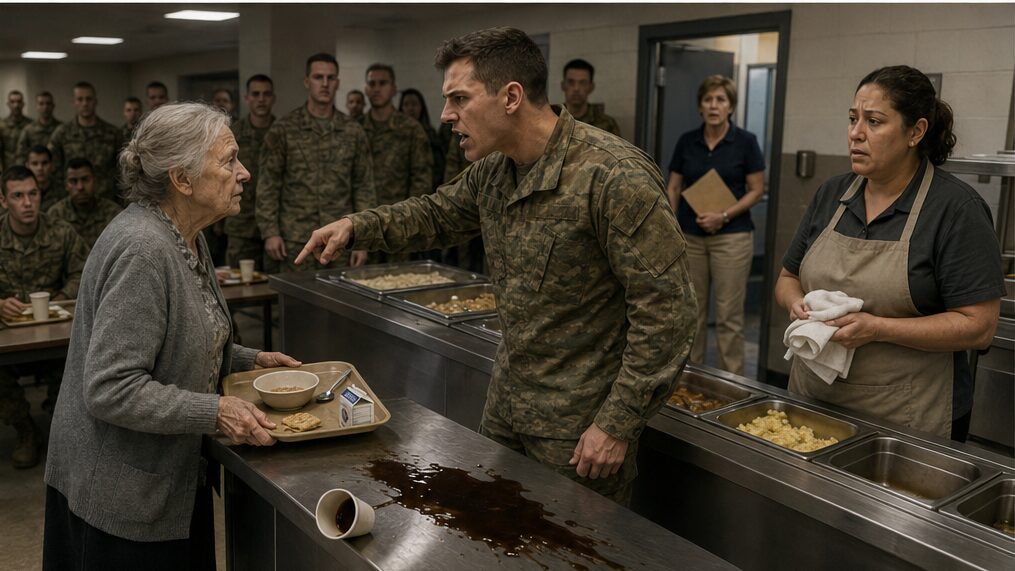
The coffee hit the metal counter before Mary Lewis could move her tray.
It spread fast, black and thin, racing along the shallow groove beside the steam table and pooling near the edge where the serving line bent toward the cash register. A disposable cup rolled once, tapped against the base of a napkin holder, and settled there with its brown rim dented inward.
For one second, no one said anything.
Then the young soldier in front of her turned.
“You need to watch what you’re doing, ma’am.”
His voice cut through the dining hall hard enough to stop a fork halfway to someone’s mouth.
Mary held her tray with both hands. It was a tan plastic tray, the kind that had been used in mess halls long before someone decided to call them dining facilities. On it sat a paper bowl of stew, two wrapped crackers, a spoon, and a small carton of milk she had chosen out of habit instead of appetite.
She looked at the coffee spreading near her sleeve.
It had not been her cup.
The soldier stepped closer anyway. He was tall, broad in the shoulders, still young enough that his uniform looked sharper than his face. His name tape read ADAMS. His jaw tightened as his eyes moved from the spill to Mary’s sweater, her hands, the tray, the slow way she stood there as if the whole room had tilted and she was deciding where to place her feet.
Behind the counter, Brenda Garcia froze with a stack of clean towels pressed against her apron. She had been reaching for the cup before it fell. She had seen the elbow that caught it. Maybe everyone had, or maybe no one wanted to have seen it.
The line behind Mary stopped. Soldiers in camouflage shifted their boots. Someone at a table stopped laughing. The old hum of refrigerators and voices kept going, but lower now, like the building itself had learned to be careful.
Kevin Adams pointed at the counter.
“You can’t just stand there. There’s a line.”
Mary’s fingers tightened once on the tray. Not enough for anyone to notice unless they were looking for it. She had learned a long time ago that the body always spoke first. Fear, anger, shame, pride—all of it tried to get out through the hands.
She lowered the tray to the clean strip of counter beside the spill.
The young soldier looked annoyed by the care she took.
“Here,” Brenda said too softly.
She held out one of the towels but did not step around the counter. Her eyes kept darting toward the dining supervisor, who had appeared near the kitchen doors with a clipboard tucked against his chest.
Mary took the towel.
The cloth was white, thick, and stiff from too many wash cycles. It smelled faintly of bleach and fryer oil. For a moment, it lay in her palm like something remembered.
Kevin exhaled through his nose.
“Ma’am, please clean it up before it gets on the floor.”
The word please did not soften the order. It made it worse. It gave the shape of manners to something that was not manners at all.
Mary looked at him.
He did not look away.
Around them, the dining hall watched. Young faces. Tired faces. A few embarrassed faces that lowered themselves quickly toward trays. A woman in uniform near the drink station held her empty cup without filling it. A kitchen trainee peeked through the pass window. No one moved.
Mary unfolded the towel.
She placed it flat at the edge of the spill and drew it back slowly, not toward the floor where the liquid would drip over the lip, but toward the narrow drain groove behind the steam table. The motion was practiced. Quiet. Economical.
Kevin frowned.
“Not that way.”
Mary kept wiping.
The coffee darkened the cloth in a wide stain. She turned the towel over once, folded the wet edge inward, and pressed it along the groove to stop the liquid from traveling behind the warmer. Her wrist bent at a small angle that had once saved hours of cleanup when food lines were moving too fast and soldiers were too hungry to complain.
“Ma’am,” Kevin said, louder now, “I said—”
“If you push it forward,” Mary said, “it runs beneath the rubber mat.”
Her voice was not sharp. That was why it carried.
Kevin’s mouth closed.
Mary continued, still looking at the counter, not at him. “Then someone steps on the mat, and the coffee comes back up through the holes. It looks clean until it isn’t.”
Brenda stared at the towel in Mary’s hand.
The dining supervisor’s clipboard lowered an inch.
Mary wiped the last streak toward the drain. She took a dry corner of the cloth and passed it once along the counter edge, where a single drop trembled before falling. She caught it before it did.
No one thanked her.
That, too, was familiar.
Kevin’s face had changed, though not enough to call it regret. Confusion first. Irritation second, because confusion in front of others felt like being challenged. He glanced toward the soldiers behind Mary as if he could still recover the shape of authority he had had a minute earlier.
Mary folded the towel. Wet side in. Corners matched.
She set it beside the dented cup.
Then she picked up her tray.
The stew had sloshed to one side of the bowl. The milk carton leaned against the crackers. A small strip of paper from the tray liner had curled up where coffee had touched it.
Kevin noticed the line still stalled behind her.
“Next time,” he said, lower, “ask for help if you’re having trouble.”
Mary looked at him again.
In the clean brightness of the serving line, under fluorescent tubes that hummed the way they always had, she looked smaller than the soldiers around her. Gray hair, plain sweater, sensible shoes, no jewelry except a thin watch with a scratched face. Nothing on her announced anything. Nothing demanded room.
That was what made the silence after his words feel so heavy.
“I wasn’t having trouble,” she said.
Her answer was quiet enough that some at the far tables probably missed it, but Kevin heard. Brenda heard. The supervisor heard. The soldiers closest to the line heard and chose not to move.
Kevin’s eyes dropped to her tray, then to the wet cloth, then to her hands. There were faint marks on those hands that age had softened but not erased: a small burn scar near the base of her thumb, a crooked knuckle, a pale line across one finger where the skin had healed decades ago.
He did not know what to do with any of that.
“Ma’am,” he began.
The side door opened.
A woman in a navy polo stepped in from the hallway, one hand still on the handle. She was breathing as if she had hurried from another building. Her gaze moved over the stopped line, the soldiers, the counter, Kevin’s posture, Brenda’s face, then landed on Mary.
The woman’s expression shifted so quickly that the whole room seemed to feel it. Not surprise exactly. Recognition. Alarm. The look of someone arriving too late.
“Mrs. Lewis?” Sarah Campbell said.
Mary turned her head.
The tray stayed steady in her hands.
Sarah took one step into the dining hall and stopped. She looked at the towel beside the cup, then at Kevin Adams, whose shoulders had stiffened under attention he no longer controlled.
“I’m sorry,” Sarah said, and the words were not meant for the room. “They told me you had already checked in at the gate.”
Mary gave her a small nod.
“I did.”
Sarah’s gaze moved again to the coffee stain on the folded cloth. When she looked back at Mary, something in her face had gone pale.
Kevin cleared his throat. “Ma’am, is she with your office?”
Sarah did not answer him at first.
Mary adjusted the tray in her hands, as if the stew, crackers, spoon, and milk were the only things that required attention.
“May I sit down now?” she asked.
It was not a challenge. That was the worst of it.
Sarah opened her mouth, closed it, then looked past Mary toward the far corner of the dining hall, where plastic sheeting hung over a taped-off section and several old tables had been stacked against the wall for renovation.
The room seemed to wait with her.
“Yes,” Sarah said softly. “Of course.”
Mary took one step away from the counter. Then another.
No one in the line complained.
Kevin watched her go, but the young soldier’s face no longer held the simple certainty it had worn when the cup first fell. He looked at the clean strip of metal where the coffee had been, as if the counter itself had kept something from him.
Behind him, Brenda picked up the folded towel.
The stain had spread through the cloth in the shape of an uneven hand.
Chapter 2: The Woman They Asked to Wait
The hallway outside the dining hall smelled of floor wax and old steam.
Mary stood beside a bulletin board covered with curling notices while Sarah Campbell spoke in a low voice to the dining supervisor. The tray was still in Mary’s hands. No one had asked if it was heavy.
She could have set it down on the narrow ledge beneath the unit photographs. She did not. A tray should not be abandoned in a hallway. Not with food still on it. Not while people were still deciding whether you belonged.
Through the half-open dining hall door came the muffled noise of lunch trying to begin again. Utensils. Boots. A chair scraping too loudly, then stopping. Someone laughed once and cut it short.
Sarah kept glancing at Mary while the supervisor talked.
“I understand she was expected,” he said. “But nobody sent anything to food service. We’ve got inspection prep, renovation prep, a shortened line, and soldiers rotating through all afternoon. If outreach guests are coming through, we need names in advance.”
“I sent names to administration,” Sarah said.
“Not to my office.”
“She checked in at the gate.”
“That doesn’t mean she can stand in the line during a rush and create a spill.”
Mary looked down at the milk carton.
It was starting to sweat.
Sarah’s voice tightened. “She didn’t create it.”
The supervisor paused. “I’m saying the situation created a disruption.”
That was a word Mary knew. Disruption. It had a clean sound. It turned people into weather.
Kevin stood a few feet away near the wall, his cap tucked under one arm. He had been told to wait there by a unit sergeant who had appeared after the dining hall became too quiet. Kevin’s eyes stayed fixed on the floor, but the line of his jaw said he was listening.
Brenda came out of the dining hall carrying the stained towel in a plastic tub. When she saw Mary still holding the tray, her face tightened.
“Ma’am, I can take that for you.”
Mary looked at the tray, then at Brenda.
“I’m not finished with it.”
Brenda swallowed. “Yes, ma’am.”
The ma’am sounded different from Kevin’s. Less like a handle. More like an apology that had not learned to speak yet.
Sarah stepped away from the supervisor and came to Mary.
“Mrs. Lewis, I am so sorry. There was a mix-up. I was supposed to meet you at the front entrance.”
“I found the cafeteria.”
“Yes, but I should have been there.”
Mary gave a small, tired smile. “I used to find it in the dark.”
Sarah blinked.
Mary looked past her, down the hallway toward a set of glass doors where sunlight hit the polished floor. The base had changed since she had last been allowed through without an escort. New security desk. New signs. New laminate flooring. But the hallway held its old proportions. The ceiling was still low. The pipes still clicked when hot water moved. Somewhere beyond the wall, a vent rattled in the same off-beat rhythm it had kept for years.
Sarah lowered her voice. “Would you like to file a complaint?”
The question sat between them like another tray.
Mary shifted her grip. Her wrists had begun to ache, but she kept them level.
“No.”
“Mrs. Lewis—”
“I came for lunch.”
Sarah looked toward the dining hall. “We can bring you something fresh. Somewhere quieter.”
Mary shook her head. “This is fresh enough.”
“It got cold.”
“That happens.”
Kevin’s eyes lifted for the first time. He looked at her tray and then away.
The unit sergeant spoke to him in a low tone near the corner. Mary heard only fragments.
“…standard of conduct… older guest… not how we handle…”
Kevin’s answer came stiffly. “I was maintaining the line.”
The sergeant’s silence was long enough to answer him.
Mary remembered young soldiers answering that way. Not cruel. Cornered. Afraid that being wrong once meant being seen as wrong entirely. They wrapped themselves in rules because rules did not shake.
The dining supervisor returned, smoothing his expression into something official.
“Mrs. Lewis, we’d like you to wait in the side office while we sort this out.”
Mary looked at the office door behind him. It had a narrow window, a desk visible through it, a chair with one bent armrest, and boxes of disposable gloves stacked near a file cabinet.
“I don’t need sorting.”
His mouth tightened. “It’s just for privacy.”
“The counter wasn’t private.”
Sarah drew in a breath.
Mary had not raised her voice. That was what made the sentence land. Not hard. Not loud. Simply placed.
Brenda looked down at the plastic tub in her arms. The stained towel lay inside, dark in the center, white at the edges.
The supervisor glanced toward Kevin, then toward the dining hall door, where two soldiers had slowed to listen before pretending they had not.
“We’re trying to be respectful,” he said.
Mary looked at him for a moment.
Then she turned to Sarah. “Was I expected here today?”
Sarah nodded. “Yes. By my office.”
“Was I cleared through the gate?”
“Yes.”
“Then I’d like to finish my lunch.”
Sarah seemed relieved by the plainness of it. “Of course. We can find a table.”
Mary looked toward the dining hall. Through the doorway she could see the serving counter again, now dry and bright, the line moving around the place where she had stood. She could also see the far corner, sealed with clear plastic and yellow caution tape. Beyond it, where the light struck through the high windows, there had once been four tables pushed together.
Her fingers tightened on the tray.
Sarah noticed.
“What is it?”
Mary did not answer immediately.
In the old days, the back corner had been loud before dawn and quiet after midnight. Soldiers sat there when they did not want anyone asking whether they were scared. They came in hungry after field exercises, angry after bad calls home, laughing too hard before leaving for places no one in the kitchen was supposed to ask about. Mary had carried trays there when someone was too tired to stand. She had wiped coffee there, soup, gravy, blood once from a split knuckle someone tried to hide under a napkin.
She had made a promise there without ceremony, because promises made in dining halls did not need witnesses to become real.
“Is the back corner table still there?” she asked.
The hallway seemed to hold its breath.
Sarah followed Mary’s gaze through the doorway, toward the taped-off section.
The supervisor looked uncomfortable. “That area’s closed.”
“I didn’t ask if it was open,” Mary said.
Sarah’s face changed. Just a little. Enough.
“The tables were moved yesterday,” Sarah said carefully. “Renovation starts tomorrow. That whole section is sealed.”
Mary looked down at her tray.
The stew had gone still in its paper bowl.
“I see,” she said.
But Sarah Campbell’s hand had gone pale around the folder she was carrying, and Brenda Garcia, standing with the stained towel in the tub, understood suddenly that the old woman had not come for free lunch at all.
Chapter 3: The Table That Was No Longer There
By early afternoon, the dining hall had emptied into a tired quiet.
The lunch rush was over. Chairs sat crooked at tables. A kitchen trainee pushed a mop near the drink station, careful to avoid the serving line where everyone now knew something had happened. The steam tables had been shut down, their metal lids reflecting strips of fluorescent light. Behind the counter, Brenda stacked clean trays with unusual care.
Mary stood at the yellow tape across the back corner.
The plastic sheeting moved faintly in the air from the vents. Beyond it, the floor showed pale rectangles where tables had stood for years. Dust marked the edges. A strip of old tile, darker than the rest, ran along the wall where chair legs had rubbed and rubbed until the building kept the memory.
“There’s nothing safe past this point,” the dining supervisor said.
He stood with his clipboard again, as if paper could settle things. Sarah Campbell was beside him, her navy polo tucked neatly into khaki pants, her expression caught between duty and regret.
Mary looked through the plastic.
“I only need a chair.”
“The chairs are stacked.”
“One tray, then.”
The supervisor sighed through his nose. “Mrs. Lewis, with respect, that section is closed because contractors are coming in. If you trip, if something falls, if equipment is damaged—”
“I know what closed means.”
His lips pressed together.
Mary did not blame him for the rules. Rules had their uses. They kept meat cold, floors dry, knives pointed away from hands, fuel stored far from flame. Rules could save lives if people remembered they were made for people.
But rules could also become a wall no one had to feel responsible for building.
Sarah stepped closer. “Maybe we can set you up at another table. One near the windows?”
Mary looked at the nearest tables. Clean, newer, gray-topped, placed in straight rows. They were fine tables. They had done nothing wrong.
“No,” she said. “Thank you.”
The supervisor shifted. “Mrs. Lewis, I don’t know what you were told by outreach, but this facility is under transition. If there was some kind of memorial visit planned, it should have gone through—”
“It wasn’t planned.”
“Then I’m not sure what we’re trying to accomplish.”
Mary turned toward him.
He was not unkind, she decided. Just busy in the way people became busy when they had learned to value a clean report more than a difficult person standing in front of them.
“I came to sit where I used to sit after second service,” she said.
The supervisor blinked. “You worked here?”
“A long time ago.”
Sarah’s eyes sharpened. “In this dining hall?”
Mary nodded.
Brenda had stopped stacking trays. From behind the counter, she was listening with both hands resting on the top tray.
The supervisor glanced down at his clipboard as though Mary’s history might appear between inventory numbers. “Civilian employee?”
“Army first,” Mary said. “Kitchen after that. Field kitchens before this building had half its equipment.”
For a moment, no one spoke.
It was not the kind of service that made anyone straighten dramatically. No one knew what to do with it. Not infantry, not command, not a story that fit cleanly into a display case. Food service sat somewhere ordinary in people’s minds until the hour they were cold, frightened, exhausted, or far from home.
Mary knew that. She had known it then, too.
Sarah’s voice softened. “You were stationed here?”
“Assigned through here. Returned later. Left again. Came back when they needed hands.” Mary looked at the empty floor behind the plastic. “The building kept changing. The corner didn’t.”
Brenda came around the counter without realizing she had moved. “Which table was yours?”
Mary pointed through the plastic toward a pale rectangle nearest the wall.
“That one.”
The supervisor followed her finger. “They were all identical.”
“No.”
He looked at her.
Mary gave him no argument. She simply held her tray level and kept looking at the empty place.
The table had been the last one to fill when the room was crowded. Too far from the doors, too close to the draft, one leg uneven no matter how often someone tried to fix it. Young soldiers complained until they needed privacy, and then they found it useful. Mary had seen letters opened there with shaking hands. She had seen birthday cupcakes cut into six pieces because there were only six people who knew. She had once watched a soldier stare at a bowl of oatmeal for twenty minutes before admitting he had forgotten how to swallow around fear.
Names faded. Faces did not.
Not really.
“You remember where people sat?” Sarah asked.
Mary’s gaze stayed on the floor marks. “Sometimes that’s all you get.”
The supervisor rubbed his thumb along the edge of the clipboard. “Mrs. Lewis, I respect your service. I do. But I can’t open a construction area because you remember a table.”
Mary looked at him then.
“I didn’t ask you to respect my service.”
He seemed startled.
“I asked whether the table was still there.”
Behind them, Kevin Adams had entered from the side hallway with the unit sergeant. He stopped near the drink station when he heard Mary’s voice. His uniform was still sharp. His face was not. The confidence from the morning had been worn down by questions he had not expected to answer.
Mary saw him but did not turn toward him.
The unit sergeant murmured something to Kevin, but Kevin did not move. His eyes had gone to the tray in Mary’s hands.
The supervisor said, more carefully, “The table was removed yesterday.”
Mary nodded once.
A small thing in her face closed. Not dramatically. No tears, no shaking breath. Just a door pulled inward.
“Then I’m late,” she said.
Brenda looked at the tray Mary still carried. “Ma’am, I can warm that stew.”
Mary shook her head. “It was never about the stew.”
The words fell softly, but they reached Kevin where he stood.
He looked from Mary to the taped-off corner, then to Brenda, then to the place on the serving counter where the cup had spilled that morning. His brow tightened as if pieces had begun arranging themselves against his will.
Sarah turned toward him and saw him there.
“Kevin,” she said.
He straightened automatically. “Ma’am.”
Mary finally looked back at him.
There was no accusation in her face. That made it harder for him to hold her gaze.
Sarah took a breath. “Mrs. Lewis was assigned to field kitchens before she worked this hall.”
Kevin’s eyes flicked toward Mary’s hands.
The small burn scar near her thumb. The careful grip on the tray. The way she had folded the cloth. The way she had known where the coffee would run.
“Oh,” he said.
It was a small word. Too small for the morning. Too small for the counter, the pointing, the watching room. Too small for an old woman made to clean a mess she had not made.
Mary turned back to the plastic sheeting.
“I used to bring trays here,” she said, not to Kevin, not to Sarah, not even to Brenda. “When they were too tired to stand in line.”
The supervisor lowered his clipboard.
Brenda’s hands pressed flat against her apron.
Kevin stared at the taped-off floor where the table had been, and for the first time all day, he looked less like a man defending a rule and more like a young soldier who had mistaken a whole life for a
Chapter 4: What the Wiping Cloth Remembered
Brenda Garcia found the towel after the lunch trays were washed.
It had been dropped into the gray plastic tub with the other stained cloths, but she knew which one it was before she touched it. The coffee had bled through in a dark oval, wide at the center and feathered at the edges. Most stains looked careless. This one looked held.
She stood in the prep area while steam lifted from the dish machine and kitchen trainees clattered sheet pans into the rack behind her. The dining hall beyond the swinging doors was nearly empty, but Brenda could still see Mary Lewis standing at the yellow tape, tray in hand, looking at the place where a table had been.
Brenda should have stepped in that morning.
She had told herself she could not leave the counter because the line was moving. She had told herself Kevin Adams was in uniform and she was only food service. She had told herself older guests sometimes did get confused, and perhaps correcting him in front of others would only make things worse. All the things she told herself had sounded reasonable until Mary folded the cloth.
Now reason sat in Brenda’s stomach like cold dough.
She rinsed the towel under the prep sink. Coffee ran brown down the drain. She scrubbed once, then stopped. The motion felt wrong. Too rough. As if she were trying to erase something before she had understood it.
The swinging door opened.
Mary came in carrying her tray.
Brenda straightened. “Ma’am, you don’t need to bring that back here.”
Mary glanced at the dish window. “This is where trays go.”
“Yes, but you’re a guest.”
“I was a guest this morning. It didn’t improve the tray.”
The corner of Brenda’s mouth moved before she could stop it. Not quite a smile, but close enough to hurt.
Mary set the tray on the stainless-steel landing beside the dish machine. The stew bowl was empty now, the crackers untouched, the milk carton folded flat the way Brenda’s own grandmother used to fold them before throwing them away. Nothing wasted, even when little had been wanted.
“You ate?” Brenda asked.
“Enough.”
“I could have warmed it.”
“It was fine.”
“It wasn’t.”
Mary looked at her then, and Brenda lowered her eyes first.
The kitchen seemed too loud suddenly. Water beating metal. Vents humming. Rubber soles squeaking on damp tile. It was easier to be ashamed in a quiet room; in a working kitchen, shame had to keep moving.
Brenda took the tray and slid the bowl into the trash, the spoon into the silverware bin, the tray into the rack.
Mary reached for the towel beside the sink.
Brenda put a hand out. “I can do that.”
“I know.”
Mary took the towel anyway, rinsed the last trace of coffee from the cloth, wrung it without twisting too hard, snapped it once to square the corners, then folded it in thirds over the rail by the sink.
Brenda watched her hands.
Not delicate hands. Not weak ones. Old, yes. The skin thin at the knuckles, the veins raised, the nails cut short. But the motions were exact. A person who had spent years making work easier for the next person. A person who knew that a wrung cloth left bunched would sour, that a tray stacked wet would stick, that a careless spill became someone else’s fall.
“You worked kitchens,” Brenda said.
Mary smoothed the towel over the rail. “So did you.”
Brenda’s throat tightened. “Not like that.”
Mary did not ask what she meant.
A trainee passed behind them with a rack of cups, slowed when he noticed Mary, then hurried on. The story had already moved through the building in half-formed pieces. Old woman. Coffee. Adams. Outreach. Veteran. Nobody knew where to set their eyes.
Brenda dried her hands on her apron. “I’m sorry.”
Mary reached for the edge of the tray rack, then let her hand rest there.
“For what?”
Brenda almost said for the spill, though she knew that was too small. She almost said for him, but that sounded like she was placing her courage after the fact. She looked at the folded towel instead.
“For standing there.”
Mary’s face did not change.
Brenda forced herself to continue. “I saw. Not everything, but enough. I had the towel in my hand, and I waited for someone with more right to speak.”
Mary looked through the pass window into the dining hall. “A lot of people wait for that.”
“It doesn’t make it right.”
“No.”
The word was soft. It did not rescue Brenda.
For a while, neither woman spoke. A kitchen trainee turned off the dish machine, and the room dropped into a quieter hum. Mary seemed smaller without the tray in her hands, but also less burdened. She stood with one hand on the counter, looking at the kitchen as if it were made of layers only she could see.
“When I was younger,” Mary said, “we had a field line set up in rain for three days. Mud up past the ankles. Burners wouldn’t hold. Coffee tasted like the bottom of a tire.”
Brenda stayed still.
“Men came through anyway,” Mary said. “Women too, later. Hungry enough not to complain, tired enough that if you gave them one sharp word, it stayed with them longer than the food.”
She reached out and touched the folded towel with two fingers.
“You learn not to spend anger where someone has to eat.”
Brenda swallowed.
Mary pulled her hand back. “Doesn’t mean you never get angry.”
“Did you?”
“This morning?”
Brenda nodded.
Mary looked at the clean trays stacked near the wall. “Yes.”
The answer surprised Brenda more than a speech would have.
Mary’s voice remained even. “I wanted to tell him exactly whose elbow knocked that cup over. I wanted to ask the room why they were watching an old woman wipe coffee and calling it order. I wanted to set the tray down and walk out.”
“Why didn’t you?”
Mary took a breath, slow through the nose.
“Because there were young soldiers watching,” she said. “And some of them were learning from him. Some of them were learning from me.”
Brenda looked down.
That was worse than forgiveness. Forgiveness might have let her put the morning away. This made the morning responsible for something.
The swinging door opened again, and Sarah Campbell stepped halfway inside. She carried her folder against her chest.
“Mrs. Lewis,” Sarah said, “may I speak with you?”
Mary nodded.
Sarah glanced at Brenda, then at the folded towel on the rail. She seemed to understand she had interrupted something and was sorry for that, too.
“The base administrator wants to address what happened,” Sarah said carefully. “He believes we should make this right in a clear way.”
Mary looked at her. “Clear for whom?”
Sarah hesitated.
Brenda felt the answer before Sarah said anything.
“He suggested a formal apology,” Sarah said. “In the dining hall. Possibly a photo for the veterans outreach page, if you’re comfortable.”
Mary’s hand stayed on the counter.
In the prep room, even the trainees seemed to understand not to move too loudly.
Sarah added quickly, “You don’t have to agree. I told him that. But he thinks it would show respect.”
Mary looked at the towel she had folded. Its damp edge had darkened the rail beneath it.
“I didn’t come here to be shown,” she said.
Sarah’s face fell a little. “I understand.”
“No,” Mary said, without cruelty. “You don’t yet.”
Brenda lowered her eyes again, but this time not from shame alone. She was listening.
Mary turned toward the swinging door, beyond which the dining hall waited with its sealed corner and empty tables.
“I came because tomorrow they start tearing out a room where people left pieces of themselves,” she said. “I came because some promises don’t need a ceremony, but they do need keeping.”
Sarah’s folder slipped slightly in her hands.
“What promise?” she asked.
Mary’s gaze remained on the door.
The towel hung folded behind her, clean enough now, but not white.
“That,” Mary said, “is not for a camera.”
Chapter 5: The Apology They Wanted to Stage
Sarah Campbell had spent nine years arranging ceremonies that were supposed to feel personal inside rooms built for procedure.
She knew where to place chairs so older knees had room. She knew which microphones squealed, which administrators spoke too long, which flags leaned in their stands, and which guests wanted their service mentioned only after their families had sat down. She knew how good intentions became stiff when they passed through too many offices.
Still, the next morning, sitting across from the base administrator with a folder on her lap, she felt something in the plan go wrong before the plan had been fully spoken.
“We need to be visible about this,” the administrator said.
The dining supervisor stood near the window with his clipboard held against his side. Kevin Adams sat two chairs down from Sarah, hands clasped, uniform pressed so sharply it seemed to accuse him. A unit sergeant stood behind him. No one looked rested.
Sarah kept her voice level. “Mrs. Lewis asked that nothing be made public.”
“She may feel differently after an apology.”
“She was clear.”
The administrator folded his hands. “I’m not talking about exploiting her. I’m talking about accountability. A veteran was treated poorly in our dining facility. We correct that where it happened.”
Kevin’s jaw flexed.
Sarah looked at him. He had said little since arriving. When asked for his account, he had recited it in order: lunch rush, fallen cup, spill hazard, line delay, instruction given. The words sounded like sandbags stacked against a flood. Then the unit sergeant asked whether he had seen who knocked over the cup.
Kevin had gone quiet.
“I didn’t see clearly,” he had said.
Sarah suspected that was not true. Or not fully true. But she had also seen his face when Mary mentioned carrying trays to tired soldiers. He looked like someone who had begun to remember details too late.
The administrator turned to him. “Adams, are you prepared to apologize?”
Kevin straightened. “Yes, sir.”
“In front of the dining hall?”
A pause.
“Yes, sir.”
Sarah watched his hands. One thumb rubbed at the side of the other, back and forth, hard enough to redden the skin.
The dining supervisor cleared his throat. “We could do it before final lunch service. Keep it brief. Mrs. Lewis comes in, Adams apologizes, we thank her for her service, maybe a photograph near the entrance. It sends the right message.”
Sarah heard Mary’s voice in the prep room.
I didn’t come here to be shown.
“She doesn’t want a photograph,” Sarah said.
“We won’t require one,” the administrator replied. “But we should offer. Sometimes guests say no at first because they don’t want to be trouble.”
The words were not malicious. That was what made them difficult. Everyone in the room thought they were repairing something. Sarah had thought that way too, until she saw Mary standing with the tray like a person holding on to the last ordinary part of a visit everyone else was trying to turn official.
The unit sergeant finally spoke. “Sir, permission to speak plainly?”
The administrator nodded.
“Adams needs to apologize. But if we put him in front of the room with her, it may look like we’re making her stand there for our benefit.”
Kevin looked up.
Sarah saw it then: not resistance, but relief so brief he tried to hide it.
The administrator leaned back. “Then what do you suggest?”
No one answered.
The office window looked out toward the dining hall entrance. Workers had begun placing renovation signs near the doors. FINAL SERVICE BEFORE TEMPORARY CLOSURE. USE SOUTH FACILITY BEGINNING TOMORROW. The words made the building feel already half gone.
Sarah opened her folder. Inside was Mary’s visitor form, printed from the outreach office. Mary Lewis. Army veteran. Former field-kitchen support. Invited under facility heritage contact list. There were no medals listed. No public bio. No request for recognition. In the notes field, written by hand after a phone call weeks ago, Sarah had recorded only one sentence.
Wishes to visit old dining hall before renovation.
Sarah closed the folder.
“I think we should ask her what making it right means,” she said.
The dining supervisor shifted. “We did ask. She said she came for lunch.”
“Then maybe that’s the answer.”
The administrator looked unconvinced, but before he could speak, Kevin did.
“Sir,” he said, voice tight, “I don’t need the room.”
Everyone turned.
Kevin swallowed. “I mean, I’ll do whatever you order. But if the apology is for Mrs. Lewis, I should say it to Mrs. Lewis.”
The unit sergeant watched him closely.
The administrator studied Kevin for a moment. “And if she refuses to hear it?”
Kevin’s eyes dropped.
“Then I still owe it.”
It was the first thing he had said that did not sound prepared.
Sarah let the silence sit. Sometimes silence did the work that language only disturbed.
When Mary arrived an hour later, she came through the dining hall entrance alone. Not the front office. Not the side hall where Sarah had offered to meet her. The same entrance everyone used.
She wore the same gray sweater beneath a light coat. Her hair was pinned back. Her shoes were polished but old. She carried no purse large enough for ceremony, no folder, no sign of having dressed for attention. When she saw Sarah waiting near the entrance, she gave a nod that was neither warm nor cold.
“Mrs. Lewis,” Sarah said.
“Ms. Campbell.”
“Mary, if you prefer.”
Mary’s eyes softened by a fraction. “Sarah, then.”
Kevin stood several feet behind Sarah, near a display case filled with old unit photographs. His posture was straight, but he looked younger than he had the day before. Without the anger in his face, he seemed unsure where to put himself.
Mary saw him.
He stepped forward. “Mrs. Lewis.”
Sarah prepared to intervene if Mary turned away.
Mary did not.
Kevin removed his cap, though they were indoors and it was not needed. Perhaps his hands needed something to do. He held it against his side.
“I was wrong yesterday,” he said.
The dining hall behind them had begun to fill for the final lunch. A few soldiers glanced over, sensed the tension, and looked away. This was not the staged apology the administrator wanted. There was no cleared space, no gathered audience, no camera.
Mary waited.
Kevin’s voice roughened. “I blamed you because it was easier than admitting I didn’t know what happened. I spoke to you like the room mattered more than you did.”
Mary’s face remained still, but Sarah saw her hand move once against the seam of her coat.
“I’m sorry,” Kevin said.
The words were plain. They had no decoration to hide in.
Mary looked past him toward the serving line, where trays waited in their stack.
“What were you afraid of?” she asked.
Kevin blinked.
The question did not accuse him. It placed him under a different kind of inspection.
He glanced at the display case. Reflections of soldiers moved in the glass behind old photographs.
“I made a mistake last week,” he said. “During a readiness check. Nothing dangerous, but it got noticed. I was told to tighten up. So I tightened everything. The line. The room. People.”
Mary nodded slightly. “People don’t tighten well.”
Kevin looked down.
“No, ma’am.”
She studied him for another moment.
“I won’t carry your excuse for you,” she said.
His face flushed. “I’m not asking you to.”
“But I won’t make a display of your shame either.”
Sarah looked away then, because something in Kevin’s face had opened and he deserved not to have everyone see it.
Mary turned toward the trays.
“I came for the final lunch,” she said. “Not an apology.”
Kevin stepped aside.
The dining supervisor appeared near the entrance, saw no camera, no gathering, no public correction, and looked uncertain. The administrator stood farther back, expression controlled.
Sarah felt the whole institution trying to decide whether a thing could be repaired if it could not be photographed.
Mary reached for a tray.
Then she paused and looked back at Sarah.
“No announcements,” she said.
Sarah nodded. “No announcements.”
“No thank-you speech.”
“No speech.”
“No picture by the doors.”
“No picture.”
Mary lifted the tray from the stack. The plastic made a soft scrape against the one beneath it.
Only then did she look at Kevin again.
“You can stand where you like,” she said. “But don’t stand over anyone.”
Kevin’s throat moved.
“Yes, ma’am.”
Mary stepped into the serving line.
This time, the tray was empty at first, but Sarah saw that it was not light. It carried the day before. It carried the corner table. It carried a promise no one had yet been allowed to name.
And as Mary moved forward, the soldiers in line made room without anyone telling them to.
Chapter 6: The Last Lunch Before Renovation
The final lunch service began with too many people pretending not to notice Mary Lewis.
That was almost worse than the staring.
Soldiers lowered their voices as she entered the line. A kitchen trainee offered her two bowls before she had chosen one. The dining supervisor kept appearing at the edge of things, then disappearing whenever Mary looked in his direction. Even the administrator stood near the far wall with the strained expression of a man trying to respect a boundary he did not understand.
Mary took a tray from the stack.
It was warmer than the one from yesterday, fresh from the machine, still faintly damp at one corner. She ran her thumb along the rim to make sure it was dry before setting it flat. Old habit. A wet tray slid. A sliding tray made noise. Noise made people turn around.
Brenda Garcia stood behind the serving counter.
“Beef stew again?” she asked.
Mary looked at the options. Chicken, rice, green beans, rolls under a heat lamp. Nothing special. Nothing ceremonial. Good.
“Stew,” Mary said.
Brenda ladled carefully, then added a little extra broth without mentioning it. Beside the bowls, near the napkin holder, lay a clean white cloth folded in thirds.
Mary noticed.
Brenda did not touch it. She only said, “In case the counter acts up.”
Mary’s eyes rose to hers.
The smallest smile passed between them.
Kevin Adams stood near the drink station, assigned there or stationed there by conscience. Mary was not sure which. His uniform was as neat as before, but he no longer used it like armor. When their eyes met, he nodded once and looked down, not out of dismissal. Out of difficulty.
He had not forgiven himself. That was not Mary’s work to rush.
The dining hall had gathered a strange kind of quiet around her. No one announced her. No one thanked her for her service. Yet her path through the serving line seemed to create a narrow corridor of care. A soldier stepped back before his elbow could crowd her tray. Another moved his cup from the counter edge without being asked. Someone at a nearby table stopped another laugh from becoming too loud.
It was respect, perhaps.
It was also discomfort.
Mary knew the difference. Respect left room for a person to breathe. Discomfort only lowered the volume.
She carried her tray toward the back of the room.
The yellow tape remained across the corner. The plastic sheeting had been pulled back halfway for contractors to carry out the last of the stacked chairs. The table was still gone. The pale rectangle on the tile remained, clearer now in the lunch light, an absence shaped by years of ordinary use.
Sarah Campbell met her near the taped line.
“I asked facilities if one chair could be placed nearby,” Sarah said. “Outside the sealed area.”
Mary looked.
A single chair had been set just short of the tape. Not inside the corner. Not where the table had been. Close enough for memory, far enough for rules.
It was a compromise. Mary had never liked compromises that pretended to be gifts. But this one had the plainness of someone trying.
“Thank you,” she said.
Sarah let out a breath.
Mary sat slowly, placing the tray across her knees because there was no table. The plastic tray flexed under the bowl, and she steadied it with both hands.
“You don’t have to eat there,” Sarah said quietly.
“I know.”
Across the room, the lunch line resumed its motion.
Mary looked at the empty floor beyond the tape and let the dining hall settle over her. The clink of spoons, the low talk, the hiss of the drink machine, the soft thud of trays landing on tabletops. Some sounds had changed. The old coffee urn was gone. The milk cooler no longer rattled the way it used to. But young hunger sounded the same. So did tired laughter.
She took one spoonful of stew.
It was hotter today.
In the old years, she had eaten after everyone else when she could. Second service, third coffee, the half hour between rushes when the floor needed mopping and the quiet ones came back for bread. She had sat in that corner with her own tray and watched faces pass through.
One soldier had always taken milk though he hated it, because he said his mother would know if he didn’t. Another folded napkins into tiny squares until the day he shipped out. A young woman with a stubborn chin used to sit with her boots stretched under the table, writing letters she never mailed. Names moved in and out of memory. Habits stayed.
Mary had promised one of them she would remember the table.
Not because the table was sacred. Because nothing else about that morning had been allowed to be.
“You all right?” Sarah asked.
Mary nodded.
Sarah did not ask again.
That was better than most kindness.
Kevin remained by the drink station. From where Mary sat, she could see him pick up fallen straw wrappers, straighten the cups, wipe a small ring of condensation near the dispenser. Each motion looked deliberate. Not performative. Practiced badly, maybe, but practiced.
A group of older veteran guests entered with a staff escort near the front. They had been invited for the final lunch too, though Mary had not known. One used a cane. Another wore a cap with a service patch. The dining hall stiffened slightly, as if more history had walked in than the room knew where to seat.
The administrator moved toward them with professional warmth.
Mary looked back at her stew.
She had not wanted a gathering. But she could not begrudge others their last look at a place that had held them. People returned to buildings for reasons a sign-in sheet could not explain.
The line grew crowded again.
Brenda worked quickly behind the counter. A trainee placed cups too close to the edge. Kevin noticed and moved one back. The trainee gave him a look, half annoyance, half question.
Kevin said something Mary could not hear.
The trainee shrugged and shifted the cups.
Mary took another spoonful.
Then the cane of one older veteran guest caught against a chair leg near the drink station. He steadied himself, but his elbow struck a full cup someone had left on the counter.
The cup tipped.
Dark coffee spilled across the same stretch of metal.
The sound was small.
The reaction was not.
The line stopped.
Brenda’s hand froze above the ladle. Sarah turned from the taped corner. The dining supervisor looked up sharply. A soldier near the spill drew breath as if about to speak.
Kevin was closest.
For one bare second, Mary saw yesterday return to the room.
The coffee spread, black and thin, racing toward the counter edge. The older guest with the cane stood rigid, embarrassed before anyone had blamed him. His hand tightened on the handle until his knuckles showed pale.
Kevin looked at the spill.
Then at the old man.
Then, across the room, at Mary.
Mary held his gaze over the tray on her knees.
No one moved.
The clean white cloth lay folded beside the napkin holder, waiting.
Chapter 7: Before Anyone Could Point
Kevin Adams reached for the cloth before he knew whether anyone was watching.
The movement came from somewhere beneath thought. One moment the cup was tipping and the old man with the cane was standing there with his face closing in on itself, and the next Kevin’s hand was on the folded white cloth beside the napkin holder.
He heard the room pause behind him.
That was the danger. The pause. The space where someone could decide what a person was before the person had a chance to breathe.
Yesterday, Kevin had filled that space with his voice.
Now he stepped into it with his hands.
“I’ve got it,” he said.
The older guest’s eyes flicked toward him, cautious and embarrassed.
“It was my cane,” the man said quickly. “I caught the chair leg. I didn’t mean—”
“It happens,” Kevin said.
The words were plain, and for an instant he almost added sir too sharply, almost made it sound like correction wearing manners. He stopped himself. He lowered his voice.
“Please take your time.”
The old man looked as if he did not quite trust the kindness. Kevin could not blame him.
Coffee ran toward the counter edge. Kevin unfolded the cloth and placed it flat against the spill the way Mary had done. Not forward. Not into the mat. Back toward the groove. He heard her voice from yesterday, low and steady.
If you push it forward, it runs beneath the rubber mat.
His first pass was clumsy. The cloth bunched under his fingers, and hot coffee soaked through faster than he expected. He adjusted, folded the wet part inward, and pressed along the groove. The counter gave off the metallic smell of heat and old cleaner. A dark line slid toward the drain.
No one spoke.
Kevin knew silence in formation. He knew silence before an inspection. He knew the silence after someone had made a mistake and everyone waited to see where blame would land. This was different. This was the silence he had created yesterday, returned to him with all its weight.
He wiped the last streak, then the counter edge.
A single drop clung there.
He caught it with the corner of the cloth.
When he straightened, his eyes found Mary across the room.
She sat near the taped-off corner, tray balanced over her knees, spoon resting in the stew bowl. She had not moved to help him. She had not nodded approval. She had not rescued him from the meaning of what he was doing.
That restraint cut deeper than anger.
The older guest with the cane shifted awkwardly. “Thank you.”
Kevin turned to him. “You’re welcome.”
The man stared at him another second, then moved on with his tray, slower now, but not chased by shame. A soldier behind him waited without complaint. Brenda Garcia took the cloth from Kevin’s hand, but he did not let go immediately.
“I’ll rinse it,” he said.
Brenda’s eyes moved to his face.
“All right.”
He stepped around the counter and into the prep area with the cloth held away from his uniform. Yesterday he would have worried about the stain. Today he was ashamed of how long it had taken him to understand what stains were for.
At the sink, he ran water over the cloth. Coffee streamed brown and thin into the drain. His hands worked too fast at first, scrubbing as if speed could correct a thing already done. Then he slowed.
Fold the wet side inward.
Corners matched.
Leave it ready for the next person.
He laid the cloth over the rail. Not as neatly as Mary had, but not carelessly.
When he returned to the dining hall, the room had begun moving again. Quietly. Carefully. Not because someone had ordered it, but because a lesson had passed through the counter and left everyone responsible for what came next.
Kevin stood near the drink station, unsure whether he had earned the right to approach Mary.
Sarah Campbell saw him looking and did not interfere. The administrator near the wall checked his phone, perhaps because there was nothing official to do with a moment no one had staged. The dining supervisor pretended to study a renovation sign, though his eyes kept returning to the clean counter.
Kevin crossed the room.
Each step felt longer than it should have. The soldiers closest to Mary glanced up and then away. No one made room for him because of rank. They made room because they understood the room belonged, for this moment, to someone else.
Mary looked up when his shadow reached the edge of the taped corner.
Her tray still rested across her knees. She had eaten only half the stew. A roll sat untouched beside the bowl. The milk carton stood folded at one end, creased flat.
Kevin stopped at a respectful distance.
“Mrs. Lewis.”
“Yes.”
He looked toward the pale rectangle beyond the tape where the old table had stood. Without the table, the absence seemed more visible than furniture would have been.
“I’m sorry,” he said.
Mary’s expression did not change.
“I said it yesterday,” he continued, “but I don’t think I understood what I was apologizing for.”
Mary rested one hand lightly on the tray rim.
Kevin swallowed. “I thought I was keeping order. I wasn’t. I was protecting myself from looking like I didn’t have control.”
Her eyes stayed on him, steady enough that he had to keep going.
“When you wiped that counter,” he said, “you gave me a chance not to be worse in front of everyone. I didn’t know that then.”
“No,” Mary said. “You didn’t.”
He accepted it. The answer landed cleaner than comfort would have.
“I saw you watching just now,” he said.
“I was eating.”
The smallest heat rose in his face. “Yes, ma’am.”
A faint crease appeared near the corner of her mouth. Not a smile exactly. Maybe the memory of one.
Kevin looked again toward the taped corner.
“May I ask why that table mattered?”
For a moment he thought she would refuse. She had refused cameras, speeches, easy repair. He would have deserved that too.
Mary looked past him, into the sealed space.
“Because a young soldier once asked me to remember it,” she said.
Kevin waited.
Mary’s fingers moved along the tray rim, tracing a worn groove.
“She was leaving before dawn. Didn’t want breakfast. Took coffee because her hands needed something warm.” Mary’s voice remained even, but Kevin saw the way Brenda, behind the counter, had gone still. “She sat there after second service. Everyone else had gone loud to keep from thinking. She stayed quiet.”
Kevin did not ask whether the soldier came back.
Mary spared him the need.
“Not everyone you feed comes back,” she said. “And not everyone who comes back tells you what they carried. But she asked me that morning if anyone would remember she had sat there. I told her I would.”
The dining hall noise thinned around the words.
Mary looked down at the tray across her knees.
“I was young enough then to think remembering meant keeping a face. Later I learned it meant keeping the shape of care. A tray carried when someone is too tired to stand. Coffee poured without asking questions. A cloth handed before blame.”
Kevin’s throat tightened.
“She was your friend?” he asked.
Mary shook her head. “She was hungry and afraid. That was enough.”
He looked at his boots.
The sentence opened something in him he did not know how to hold. Yesterday he had seen an old woman in a gray sweater delaying a line. Today he saw every person who had ever stood in front of him while he decided whether efficiency mattered more than mercy.
“I’m sorry,” he said again, softer.
Mary looked at him. “Don’t keep saying it so you don’t have to do anything else.”
The words struck him still.
He nodded once.
Across the room, another soldier laughed too loudly at a table and then quieted. Life kept trying to resume. That was what made change difficult. There was always a next tray, next spill, next order, next chance to forget.
Kevin looked at the tray on Mary’s knees. “May I carry that for you?”
Mary’s hand tightened on the rim.
He saw it and stepped back half a pace.
“I don’t mean because you can’t,” he said quickly. “I know you can.”
Mary held his gaze.
“Then why?”
He looked at the taped corner, then at the chair Sarah had placed outside it, then at the tray that had become, in his eyes, heavier than anything he had carried that day.
“Because you came to sit where you served,” he said. “And yesterday I made you carry what I spilled.”
Mary said nothing.
Kevin forced himself not to fill the silence. Not to explain. Not to make his offer into another kind of pressure.
The tray remained across her knees.
On the counter behind him, Brenda lifted the rinsed cloth from the rail and folded it again, slower this time, as if the whole room might learn from corners meeting.
Mary looked down at the tray.
Then she looked toward the empty place behind the plastic.
When she spoke, her voice was quiet enough that Kevin had to lean inward, not over her, only nearer.
“You may carry it to the line,” she said. “I’ll carry it from there.”
It was not absolution.
It was not rejection.
Kevin nodded.
“Yes, ma’am.”
He reached for the tray only after she had lifted her hands away.
Chapter 8: The Tray Left Clean
Mary let Kevin carry the tray as far as the serving line, and no farther.
He understood the boundary without being told twice. At the counter, he stopped, held the tray steady until she placed both hands beneath it, then released it carefully. The tray returned to her with its small weight of stew bowl, spoon, folded milk carton, and untouched roll.
“Thank you,” she said.
Kevin stepped back.
The words were ordinary. Mary meant them that way. Ordinary thanks for ordinary help. Nothing polished for display. Nothing grand enough for anyone to hide behind.
The dining hall had settled into late-afternoon light. Lunch was nearly over. The final service before renovation had thinned to scattered trays and low voices. Contractors waited outside the far doors with equipment carts. The yellow tape near the back corner fluttered whenever the ventilation shifted, and the plastic sheeting gave soft, restless clicks.
Sarah Campbell approached slowly, as if asking permission with each step.
“Mary,” she said, “the administrator would still like to thank you privately before you leave.”
Mary looked toward the wall where he stood with the dining supervisor. The administrator had removed himself from the center of the room, which Mary appreciated. He seemed uncertain whether distance was respect or neglect.
“I don’t mind meeting him,” Mary said. “But I don’t need thanking.”
Sarah nodded. “I think he needs to learn the difference.”
That earned her a look from Mary, almost amused.
Brenda came from behind the counter carrying a clean cloth folded in thirds. She set it beside the tray return, not in front of Mary, not as a symbol, simply where a cloth belonged.
“I saved the corner of the old table,” Brenda said suddenly.
Mary turned.
Brenda looked embarrassed and pointed toward a small square of wood resting on the service shelf. “One of the contractors cut a damaged edge off yesterday. It was going to the trash. I thought maybe outreach could keep it, or maybe not. I didn’t know if that was strange.”
Mary looked at the piece of wood.
It was not beautiful. The finish had worn thin. The edge was nicked. One corner bore a dark ring that might have been coffee, years old and impossible to prove. It looked exactly like something that belonged in a trash bin.
Mary touched it with two fingers.
For a moment the dining hall fell away.
Not into a vision. Mary did not believe memory worked like that. The past did not return whole just because a hand found wood. But the body remembered surfaces. The table edge beneath tired wrists. The tap of a spoon against a bowl. A young soldier’s paper cup trembling around black coffee she did not drink.
Will anyone remember I sat here?
Mary had been young then. Younger than she thought now, older than she should have been. She had said yes because the soldier needed yes. Later, when word came through channels no one in the kitchen was supposed to hear, Mary had wiped that table until her arms ached. Not to erase. To keep it ready.
She drew her hand back from the wood.
“You keep it here,” she said.
Brenda blinked. “Here?”
“Not in a case. Not with a plaque. Somewhere staff can see it when they forget what rooms are for.”
The dining supervisor heard. To his credit, he did not object immediately.
Sarah looked toward him.
He cleared his throat. “We could place it in the renovated dining area. Maybe near the staff entrance.”
Mary nodded once.
“Near the towels,” she said.
Brenda pressed her lips together.
Kevin stood several feet away, listening without pushing himself into the moment. His posture had changed since morning. Still straight, but no longer pointed at anyone.
The administrator finally crossed the room.
“Mrs. Lewis,” he said, “I want to offer my apology for what happened in this facility.”
Mary looked at him. “Thank you.”
He paused, perhaps expecting more.
Mary let the silence do its work.
“We will be reviewing procedures,” he added.
“Procedures are useful,” Mary said.
“Yes.”
“They won’t help much if people wait for a procedure before they see someone.”
The administrator took that in. His face did not soften dramatically. Men in his position rarely changed where others could watch. But something in his eyes shifted from prepared response to listening.
“No, ma’am,” he said. “They won’t.”
Mary was tired then. It came suddenly, as it often did now. Not weakness. A body collecting its debts. She placed her tray on the return counter and began to separate the items: bowl to trash, spoon to bin, folded carton to waste, tray flat on the rack.
Brenda moved as if to help, then stopped herself.
Mary noticed and was grateful.
She took the clean cloth from beside the return and wiped the tray’s corner where broth had left a thin shine. Once. Twice. Then she folded the cloth and laid it beside the tray.
Clean enough for the next person.
When she turned, Sarah was waiting by the exit.
Kevin stood near the drink station again, but not stiffly now. One of the older veteran guests had paused there, struggling to balance a tray with one hand while reaching for a cup. Kevin stepped in quietly.
“May I hold that while you pour?”
The older guest glanced at him, measured the offer, then handed over the tray.
“Just for a second.”
“Yes, sir.”
No one had told Kevin to do it. No one had announced him. The administrator was looking elsewhere. The dining supervisor was speaking to a contractor. The watching soldiers were gathering their things.
Mary saw.
That was enough.
She walked toward the exit with Sarah beside her.
At the door, Sarah said, “I wish yesterday had been different.”
Mary looked back at the dining hall one last time. The taped corner. The service counter. The folded cloth. Kevin holding a tray for someone whose hands needed steadiness more than correction.
“So do I,” Mary said.
She stepped into the hallway.
The smell of floor wax and old steam followed her for a few paces, then thinned as the outside doors opened ahead. Sunlight fell across the polished floor in long pale rectangles. Mary moved through them slowly, not because she could not move faster, but because there was no longer a line behind her demanding she hurry.
At the glass doors, she paused.
Behind her, in the dining hall, a cup tipped lightly against the counter. Not enough to spill much. Just a small splash near the drink station.
Mary did not turn all the way around.
She only glanced back.
Kevin had already taken the cloth. He wiped the small spill before the older guest could apologize, before anyone could look, before shame had time to gather.
Then he folded the cloth and set it back where the next person could reach it.
Mary pushed open the door and walked out carrying nothing in her hands.
The story has ended.