They Mocked the Old Man’s Trembling Hands Until the Digital Target Proved What They Remembered
Chapter 1: The Man in Denim at Lane Twelve
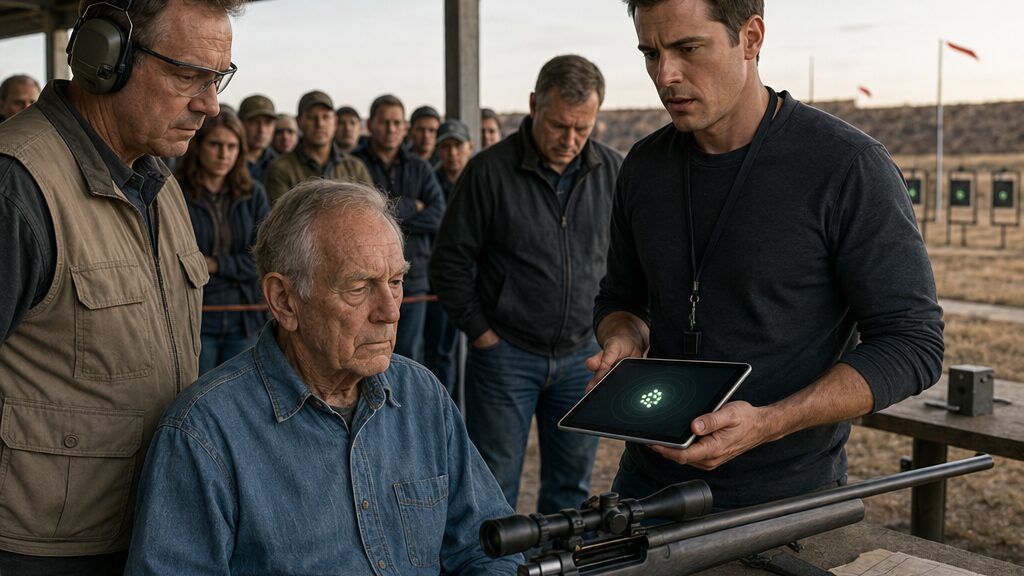
The tablet clipped to Timothy King’s chest displayed two words beside Frank Baker’s name.
SHOOTER NOT CLEARED.
Frank was already seated at Lane Twelve with the bolt removed from his rifle and the empty chamber angled toward the range officer.
He read the message upside down when Timothy stopped beside the bench. The younger man made no effort to turn the screen away.
Around them, the outdoor range gathered itself for the morning relay. Metal target frames stood two hundred yards beyond the covered firing line. Red wind flags stirred at uneven angles above the grass. Volunteers moved ammunition crates, competitors unfolded shooting mats, and parents crowded behind the yellow spectator rope with coffee cups and folding chairs.
Frank wore a faded blue denim shirt, dark work pants, and a brown belt polished smooth by years of use. His rifle sat on a plain front rest inside an unmarked black case. Nothing on him carried a brand large enough to be seen from ten feet away.
His right hand trembled lightly where it rested against his knee.
Timothy noticed.
“Mr. Baker,” he said, “I’m going to need you to leave the rifle untouched for a moment.”
“It is untouched.”
“I can see that.”
Frank looked toward the western berm. The electronic board above the target-control shed reported a six-mile-per-hour wind from the right. The nearest flag showed roughly the same. The farther flag, near the rise beyond the two-hundred-yard line, hung almost still.
The grass beneath it leaned left.
Timothy tapped the tablet. He was thirty-two, broad-shouldered, clean-shaven, and dressed in a fitted range shirt with the event logo over the heart. A lanyard held a timer and a whistle at his chest. He carried himself like a man who knew several people were watching and intended to justify their attention.
“Registration didn’t attach a current competency record,” he said.
“My safety certification is in the envelope under the score sheet.”
Timothy lifted the envelope, glanced at the date, then looked again at Frank’s hand.
“This says you renewed six months ago.”
“That is what the date means.”
A competitor at the next lane smothered a laugh.
Timothy’s mouth tightened. “Certification and practical readiness aren’t always the same thing.”
Frank did not answer. He folded the edge of his denim cuff over his wrist until the frayed seam disappeared.
Beyond Timothy, the range director stood near the registration shelter speaking to a sponsor representative. David Thompson was thicker around the waist than Frank remembered and grayer at the temples, but the way he planted his feet had not changed. Left foot slightly forward. Shoulders square even when talking casually.
David looked toward Lane Twelve.
For half a second, recognition crossed his face.
Then he turned back to the sponsor representative.
Frank slid a small folded card from his shirt pocket. Pencil marks covered both sides—dates, temperatures, wind directions, brief notes compressed into a shorthand only two people had ever read without asking questions. He opened it beneath the score sheet and studied the far grass again.
Timothy leaned closer. “What is that?”
“Wind notes.”
“We provide live sensor data.”
“I saw it.”
“The system updates every three seconds.”
Frank placed the card beneath the score sheet before Timothy could read it. “Then it should catch up soon.”
Timothy followed his gaze toward the flags. “The board is reading correctly.”
Frank said nothing.
A registration volunteer approached with two boxes of match ammunition. She set one on the empty bench at Lane Eleven, then reached across Frank’s rifle case to place the second beside his front rest.
Frank lifted one finger.
“Ma’am.”
She paused.
“The line hasn’t been declared hot.”
“These are just the issued rounds.”
“Then they can wait behind the ready line.”
The volunteer looked toward Timothy.
Timothy exhaled through his nose. “The ammunition is boxed.”
“The rule does not say boxed ammunition is exempt.”
The range safety officer, who had been checking chamber flags three lanes down, looked over. “He’s right. Ammunition stays behind the ready line until the command.”
The volunteer flushed and carried both boxes back.
Frank lowered his hand.
Timothy stared at him with the patient expression of a man whose authority had been challenged by a technicality.
“We are trying to keep this event on schedule,” he said.
“So is the rule.”
“This is not a basic class.”
“No.”
“We have experienced shooters here.”
Frank looked at the empty target line. “Experienced shooters still wait for the command.”
The competitor at Lane Eleven stopped smiling.
The safety officer continued down the row, checking actions and chamber flags. Timothy remained beside Frank’s bench, the tablet glowing between them.
Behind the spectator rope, a teenage girl in a gray shooting jacket watched the exchange. Her dark hair was tied at the base of her neck, and she held a score card against her chest with both hands. When Frank glanced her way, she quickly looked down.
Timothy noticed that too.
“This event includes junior participants,” he said. “We have to be especially careful about what they see.”
Frank’s eyes returned to him. “Agreed.”
The answer seemed to irritate Timothy more than an argument would have.
He scrolled through Frank’s registration page. “No club affiliation.”
“Not anymore.”
“No recent match history.”
“I didn’t list one.”
“No equipment classification.”
“The rifle meets the rules.”
Timothy glanced at the rifle. It was modern enough to be ordinary, maintained well enough to reveal nothing. A modest scope. No polished stock. No oversized muzzle device. No electronic level clipped to the rail.
“Have you fired past one hundred yards in the last year?”
“Yes.”
“Bench or prone?”
“Both.”
“With this rifle?”
“Yes.”
“What kind of groups?”
Frank folded his hands loosely. The tremor showed again at his right thumb.
“The target kept them.”
Timothy’s expression hardened. “That kind of answer does not help me assess whether you are safe to participate.”
“My certification does.”
“I am the lead evaluator today.”
“And the range officer controls safety.”
The whistle at Timothy’s chest shifted as he straightened.
A voice came over the loudspeaker, asking first-relay shooters to remain behind the red line. Competitors began moving into position. Frank saw David glance over once more, then pretend to review a clipboard.
It told Frank more than a greeting would have.
David knew who he was.
David also knew why Frank might have come.
Yet he was leaving Timothy to handle him as an anonymous old man with a trembling hand.
That was useful information.
Frank had not driven seventy miles to be welcomed. He had come to watch. To see how the range treated people who could offer it nothing obvious. To see whether Kathleen’s name belonged anywhere near the program asking for their money.
He had promised himself he would not interfere.
Not yet.
Timothy tapped the tablet again. The red warning beside Frank’s name remained.
“I can clear you provisionally,” Timothy said, “after a supervised competency string.”
Several nearby shooters turned their heads.
Frank looked at him. “Is that required for everyone without a listed match result?”
“It is required when I believe additional assessment is appropriate.”
“Because of my hand?”
Timothy hesitated just long enough to answer the question.
“Because of the total presentation.”
The phrase traveled farther than he intended. The teenage girl behind the rope looked up again. One of the veteran spectators frowned. The competitor at Lane Eleven began adjusting a scope turret he had already adjusted twice.
Frank felt the old instinct rise—the urge to correct posture, language, sequence, cause. He had spent much of his life teaching men younger than Timothy that a careless assumption could travel faster than a bullet and do damage long before anyone noticed.
But he had also spent the last two years learning how easy it was to call silence restraint.
He looked toward David.
The range director met his eyes this time.
Then looked away.
Frank reached beneath the score sheet and touched the folded wind card. Kathleen’s pencil marks lay inside the oldest crease, hidden from view.
Not yet, he thought.
The loudspeaker crackled.
Timothy walked to the control station at the center of the firing line. His voice came through every speaker under the metal roof.
“Attention, shooters. Due to an incomplete practical record, Lane Twelve will begin with a safety verification before the scored relay.”
The conversations behind the line thinned into silence.
Frank remained seated beside his open rifle case while faces turned toward the old man in denim.
Chapter 2: The Wind Reading No Screen Displayed
Emily Lopez’s first sighting shot landed four inches left of where Timothy told her it would.
The electronic target plotted the impact as a bright blue dot on the monitor above Lane Seven. Emily lifted her cheek from the stock and stared at it.
Timothy stepped behind her with the tablet in one hand.
“Good elevation,” he said. “Add one minute right.”
Emily looked toward the range board. “The wind feels like it’s coming from the left now.”
“The sensor has it from the right at six.”
“The tape by the target is moving the other way.”
Timothy glanced downrange without shifting his stance. “That’s a local swirl. Use the board.”
Frank sat three lanes away, waiting for his delayed competency string. The red flag behind the firing line showed a weak right wind. Halfway to the targets, the grass rippled left. Near the western berm, heat rose from the bare earth and bent the mirage in a slow diagonal.
The wind had switched.
Not completely. Not cleanly. It moved in layers, as it often had on this range after the sun cleared the cottonwoods.
Frank’s hand went to the folded card beneath his score sheet.
He wrote a short pencil mark: 10:42—west lift, lower field left.
The note joined one from twenty-three years earlier.
Kathleen had once called the western berm a liar because it showed shooters one condition at the bench and gave their bullets another halfway downrange. Frank had told students to watch the grass below the flag, not only the flag itself. The flag told them what happened where it stood. The grass told them where the wind was going.
Emily adjusted one minute right.
Frank opened his mouth.
Timothy spoke first. “Send the next shot when ready.”
Frank closed it again.
Emily settled behind the rifle. Her breathing was too high in her chest. The heel of the stock sat a little low against her shoulder, but not enough to cause what was coming.
The shot broke.
The monitor painted another blue dot, farther left than the first.
Emily’s shoulders sank.
Timothy frowned at the tablet and refreshed the sensor display. “Hold center. The system may be correcting between samples.”
Frank looked from the board to the grass. The screen still showed wind from the right.
The frayed strip of survey tape attached to the two-hundred-yard frame snapped left.
Emily saw it.
“So I should come back left?” she asked.
“No. Trust the data.”
She hesitated.
Timothy lowered his voice, though everyone nearby could still hear. “Second-guessing the call will cost you more than the wind.”
Frank felt the sentence land where it should not.
Emily placed her cheek against the stock again.
He could have stood. He could have asked the range officer to review the conditions. He could have said that a shooter who reported contradictory information deserved an answer, not a command.
Instead, he remained seated.
This was not his line.
Not his student.
Not his program.
Those had been the rules he gave himself before arriving.
Emily fired three more rounds. The group tightened, but it remained displaced left. When the scoring string ended, the monitor showed a total nine points below the threshold pace for the advanced clinic.
She cleared the rifle exactly as instructed. Magazine out. Bolt open. Chamber flag inserted.
Her hands stayed steady until she stepped behind the red line. Then the score card shook against her leg.
Timothy crouched near the tablet with a technician, tapping through wind logs. The event announcer filled the delay by thanking the sponsor for supporting youth development and modern training technology.
Frank looked at the pencil mark he had made.
He pressed the card flat with his thumb.
The tremor blurred the edge of the paper.
During the cease-fire, Emily came to Lane Twelve carrying an empty water bottle. She stopped several feet away, careful not to cross into Frank’s bench space.
“You saw it switch,” she said.
It was not a question.
Frank folded the card.
“I saw several things.”
“Was I wrong?”
“You were right about what touched your face.”
“But the board said—”
“The board reported what its sensor measured.”
“Then why did the shots move left?”
Frank looked downrange. Target technicians drove along the service road in a small utility vehicle. The nearest wind flag drooped. Farther out, the survey tape still leaned left.
“One instrument gives one piece of the range,” he said. “Your cheek gave you another. The tape gave you a third.”
“Which one do you trust?”
“You don’t begin by trusting. You begin by asking why they disagree.”
She frowned. “Mr. King said second-guessing costs points.”
“Sometimes.”
“What costs more?”
“Refusing to notice.”
Emily looked back toward her monitor. “I needed that score.”
“I know.”
“How?”
“The clinic threshold is printed on your card.”
She glanced down, almost embarrassed. “I thought maybe you knew about the program.”
“I read what was in front of me.”
Timothy’s shadow crossed the concrete before his voice reached them.
“Emily.”
She straightened.
Timothy approached with the tablet against his chest. “You need to be with the junior group during cease-fire.”
“I was getting water.”
“The coolers are by the classroom.”
Her empty bottle remained in her hand.
Timothy looked at Frank. “Are you giving instruction?”
“No,” Frank said.
Emily turned toward him. The surprise on her face made the answer feel uglier than Frank expected.
Timothy pointed toward the classroom. “Go ahead.”
She left without speaking.
When she was beyond hearing, Timothy stepped closer.
“She is a registered junior competitor. Only authorized staff may coach her.”
“She asked why the wind indicators disagreed.”
“And you should have sent her to me.”
“You had already answered her.”
Timothy’s jaw flexed. “We run a standardized program. That means students receive consistent information, not conflicting opinions from spectators.”
“I’m registered in the relay.”
“You have not been cleared.”
Frank looked at the tablet. “The board still shows wind from the right.”
Timothy glanced at it.
For the first time, uncertainty crossed his face.
Then he tapped the refresh icon. The display updated to a weak left wind.
“There,” he said. “The system caught the shift.”
“After her string.”
“It updates continuously.”
“It updated late.”
“You don’t know that.”
Frank unfolded his card and showed only the newest pencil mark.
10:42—west lift, lower field left.
Timothy read it.
“You wrote that after the fact.”
Frank folded the card again.
Timothy let out a short breath. “This is exactly why we use logged sensors instead of personal memory.”
“It isn’t memory.”
“It is a handwritten note.”
“Yes.”
“Without a time stamp.”
Frank pointed toward the analog clock mounted above the firing line. “That is where the time came from.”
Timothy looked past him toward the spectators. A few were watching.
His voice became more formal.
“I need you to stop engaging with junior participants. You are not staff, and until your competency verification is complete, you are not cleared to offer range instruction.”
Frank thought of Emily’s face when he denied coaching her.
He thought of the second shot moving farther left.
Silence had once felt disciplined. Clean. It prevented arguments from becoming performances.
Now it felt like watching a student make a mistake after seeing the cause.
“I understand the rule,” Frank said.
“Good.”
“I do not agree with how you used it.”
Timothy’s eyes narrowed. “That is not your decision.”
The loudspeaker called shooters back to the line.
Timothy turned away, but stopped after two steps.
“Your verification will take place after equipment check,” he said. “Until then, remain at your assigned bench and do not coach anyone.”
Frank watched him return to the control station.
Beyond the yellow rope, Emily stood with the other juniors, her score card folded once down the middle.
She did not look at Frank again.
Chapter 3: A Safety Lesson Nobody Wanted
The bolt closed with a hard metallic click while the target technician’s vehicle was still visible beyond the side berm.
Frank saw the motion at Lane Nine before anyone else reacted.
A nervous adult competitor had seated a magazine during equipment check and pushed the bolt forward, eyes fixed on his scope. The muzzle remained downrange, but the white utility vehicle was moving along the service road near the target frames.
Frank stood.
“Stop.”
He did not shout. He did not need to.
The command cut through the voices under the roof. The competitor froze with one hand on the rifle.
Frank raised an open palm.
“Do not touch the trigger. Keep the muzzle where it is.”
Timothy turned from the control station. “What happened?”
“Closed action at Nine,” Frank said. “Personnel downrange.”
The range safety officer moved quickly between the benches. “Lane Nine, hands off. Step back.”
The competitor obeyed, face drained of color.
Timothy looked toward the service road. The white vehicle passed behind a target frame and disappeared below the berm.
“The chamber may be empty,” he said.
“Then we verify it as though it is not,” Frank replied.
Timothy’s eyes flicked toward the spectators.
The safety officer reached Lane Nine, removed the magazine, opened the bolt, and checked the chamber.
“Empty,” he announced.
A few shoulders loosened.
Frank did not.
The safety officer inserted a chamber flag and faced the competitor. “No ammunition on the bench during equipment check. You heard the briefing.”
“I thought we were going hot.”
“We were not.”
The competitor looked at Timothy. “The tablet at my station changed to ready.”
Timothy checked his own screen. “The lane status should still be locked.”
“It showed green.”
The range officer’s expression sharpened. “Then we have two problems.”
Timothy swiped through several menus. “The central command was cold. Lane Nine may have cached the prior status.”
Frank lowered his hand only after the rifle was open and flagged.
The tremor returned as soon as his arm rested by his side.
Timothy saw it.
So did several people behind the rope.
The competitor at Lane Nine swallowed. “I’m sorry.”
Frank looked at him. The man was perhaps forty, dressed in expensive technical clothing, with the frightened expression of someone who understood the size of his mistake.
“Remember the command, not the color,” Frank said. “Screens can disagree. The line command cannot.”
The range officer nodded once. “That’s correct.”
Timothy turned toward Frank. “I have control of the firing line.”
“Then control it.”
The words came out quieter than anger and carried farther.
David Thompson arrived from the registration area with the sponsor representative several steps behind him.
“What happened?” David asked.
“Lane interface issue,” Timothy said. “No round was chambered.”
“The bolt was closed while personnel were downrange,” the safety officer added.
David’s gaze moved to Frank.
This time he did not look away quickly enough.
“Mr. Baker identified it,” the safety officer continued. “Before anyone else.”
The sponsor representative folded her arms. “Was someone in danger?”
“No loaded chamber,” Timothy said. “The procedures worked.”
Frank watched David absorb the answer. Years earlier, when David had been a young private with more speed than patience, Frank had made him repeat one rule until he could say it without irritation: a safe outcome did not turn an unsafe act into a safe one.
David remembered. Frank saw that he remembered.
But the range director only said, “Pause the event and reset every lane.”
Timothy’s mouth tightened. “We are already behind.”
“Reset every lane.”
The loudspeaker announced an extended cold line.
Competitors stepped away from their benches. Conversations rose immediately, low and sharp. The sponsor representative followed David toward the control station. Timothy remained near Frank.
“You disrupted the entire relay,” he said.
“The closed bolt disrupted it.”
“You could have alerted me without issuing a command.”
“There was no time to discuss titles.”
“I am responsible for this line.”
“Then you should be grateful someone was watching it.”
Timothy looked at Frank’s trembling hand. “Watching is not the same as operating safely.”
Frank’s eyes settled on him.
Timothy seemed to hear his own sentence only after it was spoken, but pride prevented him from taking it back.
“The public verification remains necessary,” he said. “Especially now.”
“Because I stopped an error?”
“Because you are inserting yourself into range command. You have spoken to a junior shooter without authorization, challenged the sensor system, and issued a cease action outside the chain.”
“The range officer confirmed the action.”
“That does not make you staff.”
“No.”
“Then stop behaving as if this is your classroom.”
The last word struck something Frank had kept carefully closed.
For a moment he saw another firing line, decades earlier. Young soldiers lying prone in damp grass. David among them, elbows too wide, jaw clenched against correction. Kathleen at a folding table behind the line, recording scores and reminding each shooter to explain the wind before touching a dial.
Frank pushed the memory down.
This was not his classroom.
That had been the point of coming as a stranger.
Emily stood near the ready area, watching. Her score card was still folded. When Frank glanced at her, she looked toward the target road instead.
The safety officer began checking each lane interface manually. At Lane Twelve, he examined Frank’s rifle and front rest.
“Bolt removed,” he said. “No ammunition present. Bench is compliant.”
Timothy said nothing.
Frank sat. As his left elbow found the bench, the shaking in his right hand softened. He placed his forearm against the support, allowing bone and surface to carry what muscle no longer could. The hand did not become perfectly still. It did not need to. Structure reduced the movement to something controlled.
Emily noticed.
She approached only as far as the yellow line.
“Mr. Baker?”
Timothy was speaking with the technician. Frank looked toward him before answering.
“Yes?”
Emily held up her score card. “Can you show me what you meant without coaching me?”
It was an awkward question, carefully shaped around the rule.
Frank almost smiled.
He removed the folded wind card from beneath his score sheet and turned it over. The back appeared blank except for old crease lines.
With his pencil, he drew a bench, a rifle, and three small boxes.
“Before anything comes to the bench,” he said, “what must be true?”
“The line is hot.”
He marked the first box.
“Before the bolt closes?”
“Target area clear. Muzzle downrange. Command given.”
He marked the second.
“And before the shot?”
Emily looked toward the flags.
“You know what the wind is doing.”
“No.”
She frowned.
“You know what you think it is doing,” Frank said. “Then you keep watching.”
He marked the third box but left it empty.
Timothy’s voice came from behind them.
“I gave you a direct instruction.”
Emily stepped back.
Frank placed the pencil down.
“She asked about sequence.”
“She is not assigned to you.”
“No.”
Timothy looked at the drawing. “And now she has an unofficial procedure in her hand.”
“The procedure is yours.”
“That is not the issue.”
Frank folded the card, hiding the diagram inside.
“What is the issue?”
Timothy glanced toward the sponsor representative, then toward the competitors waiting under the shelter.
“The issue is that a range cannot function if every experienced person decides their judgment outranks the system.”
Frank followed his gaze. “Does the system include the screen that turned green?”
“That fault is being reviewed.”
“And the sensor that changed after the shots?”
“Also being reviewed.”
Timothy lowered his voice. “You think because you caught two inconsistencies, everything here is careless.”
“I have not said what I think.”
“That may be the problem.”
David approached before Frank could answer.
“Timothy, give us a minute.”
Timothy hesitated, then walked toward the control shed.
David stood beside the bench, looking at the rifle without touching it.
“You could have called me,” he said.
“I did.”
“I mean before today.”
Frank studied him. “You received the fund notice.”
David’s eyes moved toward the crowd. “Not here.”
“You chose here when you ignored me.”
“I did not ignore you.”
“You recognized me.”
David rubbed a thumb along the edge of his clipboard. “I didn’t know how you wanted this handled.”
“As an ordinary registration.”
“And now?”
Frank looked toward Timothy, who was conferring with the technician while still watching Lane Twelve.
David lowered his voice. “Don’t make today about the old days.”
Frank felt the words settle between them.
“The old days taught you to wait for the line command.”
David flinched.
“That isn’t what I meant.”
“I know.”
“We have sponsors here. Parents. A full junior program depending on this event.”
“Then today is exactly when your standards matter.”
David stared at him for several seconds. “What are you going to do?”
Frank looked at the red warning still displayed beside his name.
He had arrived intending to watch without being known. Timothy had turned observation into spectacle. David had turned recognition into silence. Frank himself had watched Emily lose points rather than risk becoming involved.
There was enough responsibility to go around.
He pulled the competency card toward him.
Timothy had written the conditions in block letters: supervised demonstration, five rounds, electronic scoring, evaluator discretion.
Frank crossed out the final phrase.
Timothy returned immediately. “You cannot alter the form.”
“I corrected it.”
“To what?”
Frank wrote beneath his name with the same pencil he used on the wind card.
Cold bore. Five rounds. Same conditions as everyone.
He signed the bottom and handed the card to Timothy.
“If the test is for safety,” Frank said, “the range officer will supervise it. If it is for skill, the target will score it. You do not need discretion for either.”
The safety officer read the card over Timothy’s shoulder.
“That is acceptable under match rules,” he said.
Timothy looked from the signature to Frank’s hand. The tremor had returned around the pencil.
Then he looked toward the spectators gathering behind Lane Twelve.
“Fine,” he said. “First string after lunch.”
Frank placed the pencil beside the folded wind card.
For the first time that morning, he was no longer waiting to see what kind of range this had become.
He had decided to make it show him.
Chapter 4: The Target Made the First Judgment
Timothy stood beside Lane Twelve with the scoring tablet held against his chest.
“Do you want the rifle removed before your hands get any worse?”
He said it loudly enough for the first three rows behind the spectator rope to hear.
The conversations under the metal roof faded. Frank remained seated. His right hand trembled against the denim covering his thigh, the movement small but visible.
“No,” he said.
Timothy looked toward the range safety officer. “The shooter has declined assistance.”
“I heard him,” the officer said.
Frank opened the rifle case and took out the bolt. He held it by the body rather than the handle and presented it for inspection. The safety officer checked the firing pin, then watched Frank insert it into the rifle with the muzzle fixed downrange.
Each action was slow.
Timothy mistook the pace for difficulty. Frank could tell from the way the younger man shifted closer, ready to intervene.
Frank checked the chamber, opened the action again, and placed five issued cartridges in a straight line beside the rifle.
“Before we begin,” Timothy said, “the official wind reading is seven miles per hour from three o’clock. The firing solution is already loaded into the lane display.”
Frank looked at the electronic board. Seven from the right.
At the two-hundred-yard line, the closest flag agreed. The grass beneath the western berm did not. A low band of it bent left, then flattened. Mirage above the pale dirt drifted at an angle too shallow for the board’s reading.
Frank placed his folded wind card beside the ammunition.
Timothy noticed. “You are expected to use the published conditions.”
“I am expected to fire five rounds safely.”
“And accurately, if you intend to enter the scored relay.”
Frank touched the pencil to the card and added a short line beneath the morning’s note.
Timothy leaned enough to see the motion but not the words. “What correction are you using?”
“I haven’t decided.”
A competitor behind Lane Eleven gave a quiet laugh. Frank heard someone whisper that the old man did not know his own scope.
He settled the rifle into the front rest.
The tremor continued while his hand remained unsupported. When Frank placed the heel of his palm against the stock and brought his elbow onto the bench, the movement narrowed. Bone carried the weight. His shoulder settled behind the butt. His cheek found the same worn place along the comb it had found hundreds of times.
The world inside the scope became small and clean.
Target Twelve waited at the center of the reticle.
He checked parallax. Focus. Level.
Then he lifted his head.
“Range officer,” he said, “confirm the line is hot.”
The officer looked left and right, verified the target road was empty, and checked the indicator lights.
“The line is hot. You may load and fire on command.”
Frank inserted the first cartridge and closed the bolt.
Timothy raised the tablet so those behind him could see the lane timer. “Five rounds. Eight minutes. Electronic scoring. Begin.”
Frank did not immediately look through the scope.
He watched the survey tape near the target frame. It pointed left for three seconds, loosened, then turned toward the right.
A switching wind.
The board still displayed seven from three o’clock.
He dialed less correction than Timothy’s solution called for.
Timothy saw the movement. “You are undercorrecting.”
Frank did not answer.
He placed his finger along the stock, outside the trigger guard, and settled again. Breath entered. Left. Entered halfway. Stopped without strain.
The first shot broke.
The rifle moved straight back into his shoulder. Frank opened the bolt, caught the case, and laid it beside the remaining cartridges.
A blue impact appeared on the monitor.
Near the center, slightly low and right.
The spectators murmured.
Timothy checked the tablet. “Good first shot.”
Frank loaded the second.
The wind at the bench touched his right cheek, but the far grass remained uncertain. He waited until the survey tape lifted, then fired.
The second blue mark appeared close to the first.
Timothy’s expression did not change, but he lowered the tablet and raised it again as if the angle had distorted the display.
Frank fired the third after another deliberate pause.
Three marks formed a cluster small enough that the electronic outlines nearly overlapped.
Someone behind the rope whispered, “That can’t be right.”
The competitor at Lane Eleven stopped pretending not to watch.
Frank opened the bolt and rested his hand.
The timer showed four minutes remaining. Two shots left.
Timothy looked downrange, then at the board. “Conditions are stable. Continue.”
Frank studied the mirage.
It had begun to flatten.
The western flag still leaned, but the survey tape had gone slack. A pale shimmer over the berm rose vertically for a moment.
Frank did not load.
Thirty seconds passed.
Timothy looked at the timer. “You have a valid condition now.”
Frank kept his eye on the grass.
The tablet still showed seven from the right.
“Mr. Baker.”
Frank remained still.
The nearest spectators began shifting, impatient with a pause they could not understand. The event announcer whispered to the sponsor representative. Emily stood near the end of the rope, watching not the tablet but the distant tape.
The fourth cartridge remained on the bench.
Then the far flag snapped hard to the left.
The survey tape followed.
A second later, the electronic board changed from seven miles per hour right to four miles per hour left.
The sound beneath the roof disappeared.
Frank adjusted the scope.
Timothy stared at his tablet. The firing solution refreshed too late, its numbers changing while Frank was already behind the rifle.
He loaded.
The fourth shot broke.
The monitor placed it inside the existing group.
Timothy refreshed the lane display.
The same result appeared.
Frank waited again. Not as long this time. The new condition held across the grass, flag, and mirage.
He fired the fifth round.
The rifle settled.
Frank opened the bolt, removed it completely, and placed it on the bench. Only then did he look at the monitor.
Five blue marks formed a tight, irregular cluster a fraction right of center.
The tablet emitted a soft tone.
Timothy looked down.
His eyes moved once across the screen, then returned to the top as though he had read the wrong lane.
He tapped Lane Twelve.
The result remained.
He checked the target number printed beside Frank’s bench.
Then he looked from the tablet to Frank.
“Measurement error,” he said.
The range safety officer stepped closer. “What does it show?”
Timothy did not answer at first.
The officer read over his shoulder.
“Zero point four six minute.”
A veteran spectator removed his cap without seeming to realize he had done it.
No one cheered. The quiet was heavier than cheering would have been.
Timothy refreshed the page a second time. “That is inconsistent with the shot dispersion shown during the string.”
“It looked consistent to me,” the safety officer said.
“The target could be registering edge overlap incorrectly.”
Frank lifted his cheek from the stock and straightened slowly. The tremor returned when his hand left the support.
Timothy noticed it again, but now he did not speak.
Frank gathered the five empty cases into a row.
“Can you repeat that group?” Timothy asked.
“That was not the agreement.”
“If the system misread—”
“Then another string proves nothing about this one.”
Timothy looked toward David, perhaps expecting the range director to intervene.
David stood near the control station with his arms at his sides. His face held no surprise. Only something closer to embarrassment.
The sponsor representative approached the firing line. “Is that the best group today?”
Timothy’s jaw tightened. “It has not been verified.”
“What was the previous best?”
“Zero point six eight.”
She looked at Frank. “And his is zero point four six?”
“According to a system that may have a calibration issue.”
Frank folded the wind card along its old crease.
The pride he might once have felt did not come. Emily’s folded score card remained visible at the edge of his vision. The target had answered the smallest question in the room.
It had not answered the important one.
Timothy turned to the target technician. “Run a diagnostic on Twelve.”
The technician began entering commands at the control station. “Diagnostics were clean before the relay.”
“Run them again.”
The range safety officer looked at Frank. “Do you want the score entered provisionally?”
“No.”
Timothy gave him a sharp glance.
Frank slipped the pencil into his shirt pocket. “I want the paper inspected.”
“The electronic face is backed by a witness sheet,” the technician said. “We can retrieve it at cease-fire.”
“Do that.”
Timothy lowered the tablet. “You are demanding a manual confirmation after relying on the electronic result?”
“I have not relied on it.”
“What do you call this?”
Frank looked at the screen. “A number.”
The crowd shifted behind the rope. Some faces had softened toward him. Others had turned toward Timothy with the appetite people brought to a public reversal.
Frank wanted no part of either.
He pointed toward the western board.
“And verify the wind sensor.”
Timothy’s face changed. “The wind sensor is separate from the target calibration.”
“It gave Emily the wrong condition this morning.”
“It updated during a switch.”
“After her string.”
“That is your opinion.”
Frank opened the wind card and placed it beside the tablet. His pencil marks showed the first leftward shift, the later lull, and the hard reversal before his fourth shot.
“Then compare the logs.”
Timothy looked at the card but did not touch it.
David finally stepped closer.
“Do it,” he said.
Timothy turned. “We are already an hour behind.”
“Retrieve the witness sheet and check the sensor history.”
The younger man stared at him. “You knew he could shoot.”
David’s eyes went to Frank, then away. “That is not what we are verifying.”
It was enough.
Timothy understood that there was history beneath the exchange, something no one had told him. His grip tightened around the tablet.
Frank closed the rifle case.
“Verify all of it,” he said. “Including the wind sensor.”
Chapter 5: The Score That Solved Too Little
The paper target came out of the carrier with five holes packed into a cluster no wider than the technician’s thumb.
He laid it on the table inside the target-control shed.
Timothy placed his tablet beside it.
The electronic image and the physical holes matched.
One shot had cut the edge of another, which explained why the digital display appeared almost too tight. The technician used a transparent scoring gauge, measured twice, then wrote the result on the witness sheet.
“Zero point four seven by manual measurement,” he said. “Difference is rounding.”
The range safety officer looked at Timothy. “Target system is good.”
Timothy’s face remained controlled, but a muscle moved along his jaw.
Frank stood at the end of the table with his folded wind card in one hand. Emily waited near the doorway, close enough to hear but not close enough to be accused of interrupting.
The sponsor representative had gone outside to answer a call. Most spectators remained behind the rope, where rumors traveled between them faster than official information.
Timothy tapped the physical target. “A confirmed group does not establish that every earlier call was wrong.”
“No one said every call was wrong,” Frank replied.
“You implied the entire system was unreliable.”
“I asked for one sensor to be checked.”
The target technician turned toward a laptop connected to the range network. “I pulled the western unit history.”
Timothy glanced at him. “And?”
“There are two communication-lag warnings.”
The room became still.
“When?” David asked.
“One at ten eighteen. One at ten thirty-nine.”
Emily looked at the folded score card in her hand.
Her string had begun at ten forty-one.
Timothy stepped closer to the laptop. “Warnings do not mean the reading was inaccurate. They mean data packets were delayed.”
“How delayed?” Frank asked.
The technician opened another screen. “First event, eleven seconds. Second event…” He paused. “One minute, forty-six.”
Emily’s fingers tightened around the card.
The technician continued, “The display held the last valid reading until the connection restored.”
“The right wind,” she said.
Everyone looked at her.
She swallowed but did not lower her eyes. “That was the reading it held when I fired.”
Timothy pressed two fingers to the bridge of his nose. “The central system did not flag a full sensor failure.”
“It flagged a delay,” David said.
“A delay that resolved.”
“After her shots,” Frank said.
Timothy turned on him. “You want this to be simple. It is not.”
Frank felt anger rise, but it no longer belonged to the insult at Lane Twelve. That had become small. What mattered was the girl in the doorway and the way she had begun folding her score card smaller, as if reducing its size could reduce what it meant.
“No,” Frank said. “It is not simple.”
Timothy looked almost surprised by the agreement.
The technician pulled up the notification history. “Both warnings were sent to the lead evaluator account.”
David’s face hardened. “You received them?”
Timothy looked at the screen.
“That system produces alerts all day,” he said. “Battery warnings, packet loss, target wake errors. Most clear themselves.”
“You saw these?” David asked.
“I saw the first. I don’t remember the second.”
The technician pointed. “Both marked acknowledged.”
Timothy’s head snapped toward him. “Acknowledged means the dashboard cleared them when I opened the event panel.”
“It means your account recorded them.”
“I was running eight lanes, a sponsor demonstration, and a junior relay with half the volunteer staff we requested.”
His voice had sharpened, but there was strain beneath it now, not merely pride.
David folded his arms. “Why didn’t you pause?”
“Because we had already paused twice. The sponsor representative told me this morning that another delay would be included in the program review.”
“That is not a safety standard.”
“It is a reality.”
Timothy looked around the room, as though daring anyone to deny it.
“This junior program nearly lost its grant last year. One parent complaint about inconsistent instruction, one equipment malfunction, one incident that looks unmanaged, and they pull the funding. Then there is no advanced clinic for Emily or anyone else.”
Emily’s expression changed. Not forgiveness. Understanding.
Timothy pointed at the physical target. “He gets to arrive for one day, shoot a remarkable group, and make every decision look obvious after the fact. I have to keep this place open every week.”
Frank laid the folded wind card on the table.
“You kept the event moving.”
“Yes.”
“You did not keep it honest.”
Timothy’s face reddened.
Frank could have pressed harder. The room was ready for it. The target lay between them like permission. One sentence could have reduced Timothy from authority to spectacle.
Instead, Frank turned to Emily.
“Your group was consistent.”
She blinked. “It was off center.”
“Consistent and off center are not the same as poor.”
She unfolded the score card. The holes plotted on its small diagram formed a respectable cluster displaced left.
“The condition was wrong,” Frank said. “Your shooting was not.”
Her lips parted, but no answer came.
It was a small correction. Too late to restore the points, but not too late to stop the score from becoming a verdict on her ability.
Timothy looked at her card.
“I should have reviewed the first impact before giving the same call,” he said.
The admission was quiet enough that everyone had to listen.
Emily did not thank him.
David picked up the wind card and compared its marks to the manual range log kept on a clipboard near the door. The handwritten times fell within a minute of the technician’s restored sensor data.
“How did you know the western unit would lag?” he asked Frank.
“I did not know the unit would lag.”
“You wrote the changes before they displayed.”
“I watched the range.”
David studied the older marks on the card. His thumb stopped near a faded notation along one fold.
He recognized the handwriting.
Frank took the card from him before he could say anything.
The sponsor representative returned to the shed. “I need to know whether we are resuming.”
Timothy straightened. “We can disable the western sensor and use the central reading.”
“No,” Frank said.
Timothy stared at him. “You do not run this event.”
“Not the event.”
The words changed David’s posture.
Frank saw him decide, too late, that the truth could no longer remain private.
The sponsor representative looked between them. “What does that mean?”
David placed both palms on the table.
“It means Mr. Baker is not here only as a competitor.”
Timothy’s expression hardened with suspicion. “Then why is he here?”
David looked at Frank, offering him the chance to answer.
Frank said nothing.
It was the same habit again—letting another person carry words he did not want to speak.
David’s eyes lowered.
Then he faced Timothy.
“The funding decision you have been performing for all day belongs to him.”
Chapter 6: The Promise Hidden Behind the Qualification
Timothy removed his instructor badge and placed it on the office desk before anyone asked him to resign.
The plastic rectangle landed beside a stack of junior applications.
David closed the door behind them. The suspended relay had emptied the range classroom, leaving only Frank, Timothy, David, and the sound of distant voices from the firing line.
“You don’t need to do that,” David said.
Timothy kept his hand beside the badge. “Apparently I conducted a funding review without being told one was happening.”
“You conducted an event.”
“For a man deciding whether we deserve to exist.”
Frank stood near the window, looking through the glass toward Lane Twelve. His rifle remained cased on the bench. The target had been removed from the monitor, but people still gathered near the lane, speaking in low groups.
Timothy turned to him. “Was any part of today ordinary?”
“My registration was.”
“Your name was not.”
“It is the only one I use.”
David pulled a chair away from the desk. “Sit down, both of you.”
Frank remained standing. Timothy did the same.
David let the chair go.
“The Baker memorial fund has supported our junior clinic for six years,” he said. “The agreement comes up for renewal this month.”
Timothy looked at Frank. “Baker memorial.”
“My wife,” Frank said.
The room changed around Kathleen’s absence. Frank felt it happen every time he used the past tense without saying it.
David continued carefully. “Frank and Kathleen built the fund after they stopped coaching full-time.”
“Why wasn’t I told he was coming?”
“Because I asked to register like anyone else,” Frank said.
Timothy gave a bitter laugh. “Anyone else would not have authority over next year’s budget.”
“I did not exercise that authority.”
“You watched.”
“Yes.”
“You let me speak to you like—”
“Like an old man you had already judged.”
Timothy looked away first.
Frank removed the wind card from his pocket. Its edges had softened over years of unfolding. He opened the oldest crease.
Kathleen’s handwriting appeared there in small block letters:
Make them explain what they see.
Timothy read it from across the desk.
“She wrote that?” David asked.
Frank nodded.
Kathleen had written it after a junior shooter repeated three perfect wind calls without understanding any of them. The boy had memorized corrections from an instructor and believed accuracy meant obedience. Kathleen had taken his score sheet, turned it over, and made him describe the grass, mirage, flags, and pressure against his face.
The next group had been worse.
His next year had been better.
Frank folded the card halfway.
“She did not want the money going to a program that taught children to depend on whoever held the tablet,” he said.
Timothy’s eyes moved toward the badge. “So you came looking for failure.”
Frank’s first instinct was to deny it.
The denial reached his throat and stopped there.
He had driven to the range with the renewal papers in his truck. He had told himself he would evaluate standards. He had not admitted how much easier it would be to find the program unworthy, close the fund, and return home without ever standing beside another young shooter who reminded him of Kathleen.
“I came prepared to find it,” he said.
David stared at him.
Timothy’s expression shifted. Some of the defensiveness left it, replaced by something more cautious.
Frank looked at the card in his hands.
“I have not coached since she died. Not once.”
David lowered himself into the chair.
Frank continued before silence could protect him again.
“I said the program needed to prove it could continue without us. That sounded responsible. It was also convenient.”
“You thought we would fail,” David said.
“I thought if you failed, I would not have to return.”
The admission sat harder than the confirmed target had.
Timothy picked up his badge, turned it over, then placed it down again.
“You still had the right to stop the relay when the sensor alert came,” Frank said. “Pressure does not change that.”
“I know.”
“But I had the right to speak when Emily described a condition I also saw.”
Timothy looked toward the classroom door. “You weren’t staff.”
“No.”
“You had no authority.”
“No.”
“You could have asked for a pause.”
“Yes.”
“And you didn’t.”
Frank met his eyes. “No.”
David rubbed both hands over his face. “I recognized you at registration.”
“I noticed.”
“I thought you wanted privacy.”
“You could have asked.”
“I was afraid that if people knew I trained under you, anything you said would look arranged. The sponsor already thinks we are too informal.”
“So you let him use me as a demonstration.”
David’s mouth tightened. “I told myself Timothy would handle it correctly.”
Timothy looked at him. “You could have told me he was an experienced instructor without mentioning the fund.”
“Yes.”
“But you didn’t.”
“No.”
For a moment, none of them occupied the clean side of the argument.
Timothy pushed the badge toward David. “Take it.”
Frank reached across the desk and stopped it with two fingers.
Timothy’s eyes narrowed. “You don’t get to decide whether I resign.”
“No. But leaving now would make this easier for you.”
“You think staying is punishment?”
“I think resignation would let everyone blame one arrogant instructor and keep the same habits.”
David looked at Frank. “What are you proposing?”
“Nothing yet.”
“The relay is suspended. The sponsor wants an answer.”
“Then tell her the equipment failed and the event stopped while you determine how instruction will continue.”
Timothy gave a humorless smile. “That will sound excellent in the review.”
“It will sound true.”
“And if they pull the grant?”
Frank looked toward the junior applications stacked beside the badge. Emily’s name was visible on the top page.
“Then we decide whether a program survives by hiding mistakes or correcting them.”
A knock sounded at the door.
David opened it.
Emily stood in the hall with her folded score card. She looked first at Timothy’s badge, then at Frank.
“The range officer said the final junior relay might still happen,” she said.
David stepped aside. “We are discussing it.”
Emily entered but did not sit.
Her gaze stayed on Frank.
He expected a question about the score, the wind, or the fund. Instead, she held out the card he had drawn on earlier. The three boxes remained on the back. The final one was still empty.
“You knew the board was late,” she said.
“I believed it was.”
“You saw my first shot.”
“Yes.”
“You heard me say the wind touched the other side of my face.”
“Yes.”
Timothy started to speak, but Emily did not look at him.
Frank felt the card’s old crease beneath his thumb.
“I should have asked for the string to stop,” he said.
“Why didn’t you?”
“Because I told myself it was not my place.”
“But you used to teach here.”
“Not anymore.”
“That isn’t what I asked.”
The question left him no room to retreat into titles.
Emily’s voice remained level.
“Would you have spoken sooner if I had been your student?”
Chapter 7: The Shot Frank Refused to Take
Emily did not chamber a round.
The rifle lay open on the bench at Lane Seven, bolt drawn back, chamber flag removed but resting within reach. The faulty western sensor had been disabled. Its display remained dark while the central board showed only temperature and pressure.
“I’m not firing until I can explain the wind call,” she said.
The range safety officer stood behind her. Timothy waited several feet to the right with his tablet facedown on an empty chair. David had reopened only the junior relay, limiting the line to Emily and two shooters whose earlier strings had not been affected.
The sun had dropped toward the western berm, stretching shadows across the grass. Heat still lifted from the target road, but the mirage no longer ran in the simple bands it had at noon.
Frank stood beside the yellow line.
Emily turned toward him. “Tell me what correction to use.”
“No.”
Her expression tightened. “I have one string left.”
“I know.”
“If I miss the threshold again, I’m out.”
“I know that too.”
“Then why won’t you help?”
Frank removed a clean index card from the registration table. He folded it once and placed it beside her score sheet.
“Because you asked for a correction.”
“That is helping.”
“It is answering.”
She looked down at the blank card.
Frank’s completed wind card remained in his shirt pocket. Kathleen’s writing pressed against the denim above his heart, though he could not feel the letters.
“What do you see?” he asked.
Emily exhaled. “The near flag is moving right.”
“What else?”
“The grass halfway down is mostly flat.”
“Mostly?”
“It rises in patches.”
“Good. What else?”
She leaned to look through the spotting scope without touching the rifle.
“The survey tape is moving left, but not steadily.”
Frank waited.
Emily glanced at the dark sensor, then at Timothy’s tablet.
“The instruments don’t agree because one of them is off.”
“The disabled one is off,” Frank said. “What about everything else?”
She looked again. “The wind changes across the range.”
“That is an observation. Not yet a call.”
Emily picked up the pencil and wrote near, middle, far on the card.
Her hand moved quickly at first, then slowed.
Timothy watched from the chair. He had said little since the meeting in the office. His badge was clipped back to his shirt, but the lanyard hung loose, and the whistle remained in his pocket.
Emily drew an arrow beside near, another beside far.
“The near wind pushes right,” she said. “The far wind pushes left.”
“Which one affects the bullet longer?”
“The near wind starts earlier.”
“Does that make it more important?”
“Usually.”
“Usually is not an explanation.”
Emily pressed the pencil hard enough to darken the paper.
Frank heard Kathleen’s voice as clearly as if she stood behind him: Do not rescue them from the work.
He had spent two years refusing to teach because teaching made absence visible. Now every pause threatened to feel like abandonment.
Emily looked toward him.
“You know the answer.”
“I have an answer.”
“Is it right?”
“We would find out.”
“That is easy for you to say.”
“No,” Frank said. “It is simply true.”
Timothy shifted near the chair. “The mirage has changed.”
Everyone looked at him.
He did not reach for the tablet.
“Above the target berm,” he said. “It was leaning left. Now it’s nearly vertical.”
Emily studied the scope. “So the far wind is dropping.”
Timothy nodded once, then stopped himself before adding anything more.
Frank saw the effort it cost him.
Emily wrote far—weakening.
She looked at the grass again. A low ripple moved rightward from the benches toward the center field, then broke apart.
“The near wind is increasing.”
“What does that suggest?” Frank asked.
“Less left correction than I would have used five minutes ago.”
“Put a number to it.”
She did.
Frank did not confirm it.
Emily stared at him. “You’re not going to say whether you agree?”
“Explain why you chose it.”
She did, using the near flag, grass, mirage, and target tape in sequence. Her voice steadied as she spoke.
When she finished, Timothy looked at Frank.
Frank looked back at Emily.
“Now it is your call.”
She placed the card beside the rifle and loaded the first cartridge.
The safety officer confirmed the line hot.
Emily settled behind the stock. The shot broke cleanly.
The electronic target paused, then displayed the impact near the outer edge of the scoring ring.
Emily lifted her head sharply.
“I was wrong.”
“You were close,” Timothy said.
“Close does not qualify.”
Frank looked downrange. The far tape had begun to lift again.
“What changed?” he asked.
Emily’s frustration sharpened. “The shot went right.”
“That is the result. What changed?”
She forced herself back to the spotting scope.
The near flag still pushed right. The mirage had begun leaning left again, faint but visible.
“The far wind came back.”
“How much?”
“I don’t know.”
“Then watch.”
The timer continued.
Two minutes passed before Emily loaded the second round.
She adjusted less than Frank expected, fired, and placed the shot inside the ring, left of center.
The third landed nearer the middle.
Her breathing changed. Not calmer, exactly. More deliberate.
On the fourth shot, the target tape snapped hard left while the near flag barely moved. Emily lifted her finger from the trigger and waited.
Behind her, one parent whispered about the time.
Emily did not rush.
When the far condition weakened, she fired. The impact appeared inside the required zone.
One round remained.
Her score was close enough that the final shot would decide the clinic threshold.
Emily stared at the card. Four arrows, two notes, several crossed-out corrections. Nothing about it resembled certainty.
“Make the call for me,” she said quietly.
Frank’s right hand rested against the yellow line barrier. The denim cuff trembled over his wrist.
He could have given her the correction. He knew what he would dial. The answer sat in him, built from grass, light, mirage, and the remembered shape of that berm.
But if he spoke the number, the final shot would belong partly to him.
“No,” he said.
Emily shut her eyes.
Timothy stepped forward, then stopped beside the facedown tablet.
“I see the mirage running left at about half value,” he said. “That is all I see.”
He did not tell her what to do with it.
Emily opened her eyes and looked through the scope.
“The grass is moving right harder than before,” she said.
Frank waited.
“The near push lasts longer. The far push is weaker but closer to the target.”
She looked at her previous impacts.
“My last correction was too far left.”
No one answered.
She erased the number on the card and wrote another.
The disabled western display still showed the frozen reading from before it had gone dark. Her new correction contradicted it.
Emily reached for the final cartridge.
“Why that number?” Frank asked.
She explained.
This time, she did not look to either man for approval.
She loaded the rifle, settled her shoulder, and placed her finger inside the trigger guard.
The range seemed to narrow around the sound of her breathing.
Frank’s hand continued trembling against the barrier.
Emily began the final press.
Chapter 8: What the Old Hands Chose to Leave
The target did not register immediately.
For two seconds the monitor at Lane Seven showed only the four previous impacts. Emily remained behind the rifle, bolt open, eyes fixed on the blank space where the fifth mark should appear.
Then the screen chimed.
A blue dot appeared just inside the required ring.
Emily did not move.
The score total updated beneath it.
She had cleared the advanced-clinic threshold by one point.
The sound behind the line was not applause. It was a collective breath released by people who had been holding it without knowing.
Emily lifted her cheek from the stock. She removed the magazine, opened the bolt fully, and inserted the chamber flag before looking at anyone.
Timothy checked the target number on the monitor, then looked at Frank.
Earlier, the same movement had carried disbelief. Now it carried recognition of a different kind. Not recognition of who Frank had been, but of what he had refused to do.
He had refused to take the shot from her.
Emily stepped behind the line with the blank card in her hand. It was no longer blank. Pencil marks covered the front in uneven rows.
“I changed the correction because the near wind lasted longer,” she said to Frank.
“Yes.”
“The far mirage mattered, but not as much.”
“On that shot.”
She nodded. “On that shot.”
Timothy picked up his tablet, entered the score, and turned the screen toward her.
“Qualified,” he said.
Emily read it, then looked at him. “Will the first score stay on my record?”
“Yes.”
Her face tightened.
“So will the equipment note,” Timothy continued. “And my correction.”
He opened the official event log. Before her name, he entered an addendum stating that delayed sensor data had affected the original string and that the shooter’s grouping remained technically consistent.
Then he added another entry.
Frank watched his fingers move.
At 11:57, participant Frank Baker identified and stopped an improper closed-action condition while personnel remained downrange. At 13:14, his manual wind observation prompted review of a delayed sensor feed.
Timothy saved the record.
It was not an apology. It was harder to erase than one.
The sponsor representative approached from the classroom with David beside her.
“We would like to make an announcement before everyone leaves,” she said. “Mr. Baker’s background, the confirmed group, his connection to the program—people should understand what happened here.”
Frank picked up his rifle case.
“No.”
She blinked. “It would reassure the parents.”
“Tell them the equipment fault was found, the procedures are being reviewed, and the scores were corrected.”
“Your service history would give context.”
“My service did not make the sensor late.”
“It would show that the range values experience.”
Frank looked toward Timothy, then David. “That will be shown by what happens after today.”
The representative hesitated, searching for a version of the moment that could be placed behind a microphone.
Frank gave her none.
In the range office, the renewal papers waited inside a yellow folder. David placed them on the desk but did not push them forward.
“What are the conditions?” he asked.
Timothy stood near the wall, his badge clipped squarely to his shirt again. Emily remained in the doorway, carrying her rifle case and the marked wind card.
Frank opened the folder.
The agreement would fund equipment maintenance, ammunition subsidies, and six places in the advanced junior clinic. Kathleen’s name appeared at the top of every page.
For two years, Frank had treated the fund as the last thing they still managed together. Keeping it untouched had felt like keeping faith.
But money preserved without judgment was only delay.
“Monthly sessions without electronic wind calls,” he said. “Students observe first and record what they see before a screen gives them a number.”
David nodded.
“All equipment warnings go into the event log. Not only failures. Delays, freezes, anything acknowledged by staff.”
Timothy shifted. “That will create pages of noise.”
“Then teach people how to distinguish noise from risk.”
Timothy met his eyes. After a moment, he nodded.
“Senior and younger instructors share the sessions,” Frank continued. “No ceremonial titles. No guest demonstrations. They work the line together.”
David glanced at Timothy. “Who chooses the senior instructors?”
“I will help with the first group.”
The words surprised Frank as he said them.
Kathleen’s absence opened inside him, sharp and familiar. A classroom full of juniors would not make it smaller. Returning would not finish the work they had planned.
It would only require him to stand where she no longer could.
David heard the commitment. “How often?”
“One afternoon a week through the first clinic cycle.”
Emily looked down at her card to hide her reaction.
Timothy stepped away from the wall. “I documented the sensor alerts and my decision not to pause. I also drafted a dual-observation policy during the final relay.”
He placed the tablet on the desk and opened the file.
The policy required one instructor to monitor system data and another to observe physical conditions, with either authorized to call a review. Junior shooters would be asked to describe what they saw before receiving corrections.
Frank read the first page.
“You wrote this before her final shot?”
“Yes.”
“Why?”
Timothy looked toward Emily. “Because I kept thinking control meant giving the answer faster.”
Frank turned to the second page.
The draft was imperfect. Too many fields. Too much language designed to protect the institution. But beneath it was a structure that could be taught.
He placed the tablet beside Emily’s handwritten card.
Neither looked complete without the other.
Frank signed the renewal on the line above Kathleen’s printed name. Then he added the conditions in his own hand.
The following Monday, Lane Twelve held no audience.
Frank sat at the same bench in the same blue denim shirt. His modest scoped rifle remained cased beneath the table. Today belonged to the juniors’ observation session, not to his score.
Emily stood beside a younger beginner who kept glancing at the digital board.
“What does it say?” the child asked.
Emily did not look at the screen.
“What do you see?” she replied.
The child studied the nearest flag. “It is moving right.”
“What else?”
“The grass in the middle is moving less.”
Timothy stood several feet behind them with the tablet at his side. His thumb hovered above the display, but he did not wake it.
Frank removed a fresh card from his pocket.
He had written only the date at the top.
He handed it to Emily.
She turned it over, perhaps expecting the old diagrams or Kathleen’s faded note. The rest of the card was empty.
“Where are your corrections?” she asked.
“Those were for another day.”
She understood. She folded the card once and gave it to the beginner with a pencil.
Frank kept his old wind card in his pocket. He did not frame it, donate it, or place it beneath glass. Kathleen’s handwriting remained where it had always belonged—close enough to guide him, not displayed so others would mistake memory for instruction.
At the far end of the range, the survey tape lifted.
Emily pointed toward it.
The beginner began to explain the wind.
Timothy listened to the full answer before checking the screen.
Frank rested his trembling hand on the bench and listened too.
The story has ended.