The Young Soldier Dumped His Tray at the Old Cafeteria Woman’s Feet, Then Saw the Scar Under Her Glove
Chapter 1: The Tray Fell Before the Room Went Quiet
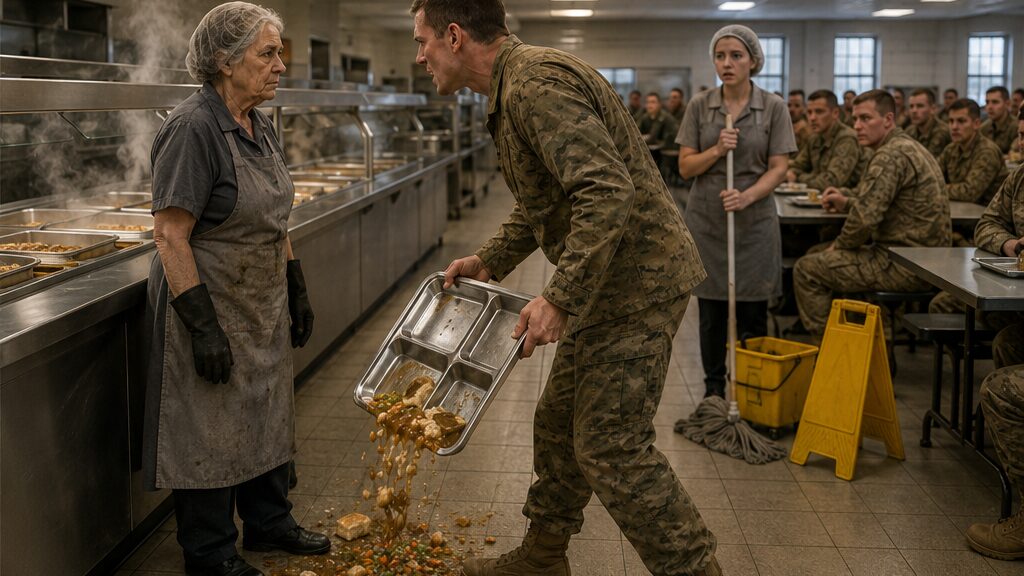
The meatloaf hit the floor first, sliding between Karen Wilson’s black shoes in a brown smear of gravy before the cup bounced once and rolled under the serving counter.
For one second, the mess hall kept moving.
Trays scraped. Plastic forks clicked against plates. Steam pushed from the hot line in white bursts. Somewhere near the drink station, a soldier laughed too loudly at something that had nothing to do with her.
Then the rest of the tray came down.
Green beans scattered across the tile. A roll split open against the leg of the sneeze guard. The metal tray clattered flat at Karen’s feet, loud enough to cut through every conversation in the room.
The young soldier standing in front of her did not bend to pick it up.
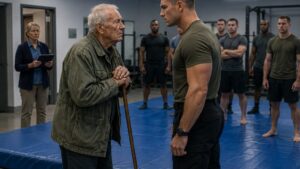
He kept one hand loose at his side and the other curled near his belt, as if the mess on the floor were something she had placed there for him. His face was flushed from the lunch rush heat and from being watched. The name tape on his uniform read ANDERSON. Karen had seen him come through twice that week with a line of younger soldiers behind him, his chin lifted, his voice always a little sharper when they were close enough to hear.
“Maybe if you people moved faster,” he said, “my squad wouldn’t be standing here waiting on cold food.”
The room had gone quiet enough that Karen heard the gravy drip from the edge of the counter.
She looked down at the tray, then at his boots, then at the full row of soldiers holding their lunches halfway to their mouths. Nobody moved. Nobody wanted to be first.
Her right hand was still around the serving spoon. Her left hand, covered in a black heat glove despite the warmth of the room, rested lightly against her apron. She had worn gloves every day since starting in that kitchen. One for the hot pans. One for the hand she did not like people staring at.
“Step back, please,” she said.
Her voice did not carry anger. That seemed to irritate him more.
“Step back?” Mark Anderson repeated, with a short laugh meant for the men behind him. “That’s what you’ve got? You dropped half my lunch, and that’s what you’ve got?”
Karen had not dropped it. The tray had been in his hands when he snapped it downward, not hard enough to look like he threw it, but hard enough that the room understood. He had wanted the sound. He had wanted the splash. He had wanted the old woman in the stained apron to look small in front of the tables.
Ashley Baker appeared at the far end of the serving line with a mop already in her hands, her brown hair coming loose from its net. She stopped when she saw Mark still standing over Karen.
“I can get it,” Ashley said.
Karen raised her gloved hand.
Not sharply. Not dramatically. Just palm out, a small stop sign between the young woman and the soldier.
Ashley froze.
The yellow wet-floor sign bumped against her leg and clicked open halfway.
Mark saw the gesture and followed it to Karen’s hand. His eyes narrowed, as if he had found a new place to put his anger.
“What’s with those gloves anyway?” he said.
The question moved through the room faster than the tray had. Karen felt it in the silence. She had heard versions of it before, from staff, from inspectors, from young soldiers trying to make kitchen jokes. She had learned which ones to ignore. She had learned that curiosity often sounded harmless until it found a bruise.
Catherine Hill, the food-service supervisor, came out from behind the register area with a clipboard pressed to her chest. She was walking quickly but carefully, already calculating who had seen what and how much it might cost.
“What happened here?” Catherine asked.
No one answered.
Steam hissed behind Karen from the pans of vegetables. The smell of gravy and disinfectant mixed on the floor.
Mark’s jaw moved. He looked toward the nearest table. Two of his squad members glanced down at their trays. One stared at the old woman’s shoes.
“She mishandled my tray,” Mark said. “Then told me to step back.”
Karen did not look at him when he said it. She looked at Ashley, who was gripping the mop so tightly her knuckles had gone pale.
Catherine’s gaze dropped to the spilled food, then rose to Karen’s gloves.
“Karen,” she said, in the voice she used when inspectors came early, “we need to clean this up and keep the line moving.”
Mark took a half step closer.
“That’s it?” he said. “She just gets to stand there?”
Something in Karen’s chest tightened, old and familiar. Not fear. Fear had a quicker pulse. This was the heavy thing that came when a room decided what you were before you had spoken. Old. Slow. Hired help. In the way.
Her wrist ached under the glove.
She could have told him to pick up the tray. She could have asked the soldiers who had watched his hand tilt downward whether they had seen enough. She could have said his rank did not give him permission to make another person kneel.
Instead she set the serving spoon down.
The small metal sound made several heads turn.
“Private space is still space,” Karen said. “Even in a mess hall.”
Mark’s face hardened because he did not understand the sentence and did not like that he didn’t.
“You trying to teach me something?” he asked.
“No.”
“Then take off the gloves,” he said. “Let’s see if you’re even fit to handle food.”
Catherine inhaled through her nose. “That’s enough.”
But it was too late. The words had landed. They were on the floor with the gravy and the broken roll.
Karen felt Ashley take one step forward.
Again, Karen lifted the gloved hand. This time she looked directly at the young woman.
Stay.
Ashley’s mouth pressed shut.
Karen pinched the black glove at the cuff. The material stuck slightly where heat and age had stiffened it. Her fingers worked slowly, not because she wanted drama, but because the glove never came off easily when her hand had been close to steam all morning.
The room leaned without moving.
Mark’s expression held its anger for another second. Then the glove loosened.
Karen pulled it free.
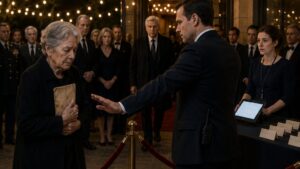
Her left wrist came into the open, narrow and deeply lined, with shiny old burn tissue running from the base of her thumb toward the inside of her forearm. Beneath the uneven skin, partly blurred by scar and time, a dark mark remained: the faded shape of a field kitchen insignia and three letters no one could read clearly from where they sat.
A soldier near the front table lowered his fork.
Mark looked at the scar first, then the tattoo, then Karen’s face.
For the first time since the tray fell, he had nothing ready to say.
Karen folded the glove once and held it against her apron. Her bare hand looked smaller without it. Older, too. More fragile than she liked. The scar pulled when she flexed her fingers, but she did not hide it.
“You wanted to see,” she said quietly.
Mark swallowed.
Ashley’s eyes filled, though she blinked the tears back fast. Catherine’s clipboard dipped an inch.
The line behind Mark had stopped completely. Lunch trays were cooling in soldiers’ hands. The room was not respectful yet. It was stunned. There was a difference. Karen knew it well.
She bent slightly, not all the way, and picked up the empty metal tray from the floor. The movement made her wrist tighten, but she kept her face still. She set the tray on the counter between herself and Mark.
“Your squad still needs to eat,” she said. “Move along or step aside.”
Mark stared at the tray like it had changed into something else.
One of his soldiers murmured, “Anderson.”
That broke whatever hold the moment had on him. Mark stepped back, but the movement was stiff, angry in a new way now, because shame had entered it. He turned toward the tables, leaving the food on the floor.
Ashley hurried forward with the mop.
Karen put the glove into the pocket of her apron instead of back on her hand.
Catherine leaned close, her voice low and tight. “We’ll talk after service.”
Karen nodded once and reached for a fresh tray.
The mess hall slowly remembered how to make noise. Forks moved. Men coughed. Someone at the back asked for more coffee too loudly, as if sound could repair what had happened.
Karen served the next soldier potatoes with her bare left hand visible beside the pan.
He did not look at her wrist. He looked at the tray.
“Thank you, ma’am,” he said.
She gave him the same portion she had given everyone else.
After lunch, when the last pan had been pulled and the floor still smelled faintly of gravy despite Ashley’s scrubbing, Catherine called Karen into the small office behind the kitchen. The wet-floor sign stood folded beside the desk, yellow and accusing.
Catherine closed the door.
“The incident report,” she said, already uncapping a pen, “will say you lost control of the tray during service.”
Karen looked at the blank form on the desk.
Outside, the steam valves knocked once in the cooling pipes.
Catherine did not look up. “It will be cleaner that way.”
Chapter 2: The Glove Stayed in Her Pocket
Catherine placed the blank statement form beside the folded wet-floor sign as if both belonged to the same spill.
Karen stood on the other side of the desk, her apron damp at the waist, her left glove still tucked into the front pocket. She could feel the edge of it pressing against her hip. The bare wrist beneath her rolled sleeve had begun to throb now that the rush was over and there was no line of hungry soldiers to distract her from it.
Catherine wrote the date across the top of the form.
“Sit down,” she said.
Karen did not.
The office was too small for three file cabinets, a desk, two chairs, and the smell of old fryer oil that lived in the walls. A laminated inspection checklist hung crooked near the door. Three boxes were marked in red. Karen knew Catherine had been looking at those boxes all week.
Catherine tapped the form with her pen.
“Karen, I’m not asking you to confess to a crime. I’m asking you to help me keep this from becoming something bigger than it needs to be.”
“It was already bigger than it needed to be.”
Catherine’s eyes lifted.
For a moment her face softened, not with kindness exactly, but with exhaustion. Then the supervisor returned. “We have inspection in two days. The contract review is tied to that inspection. If command gets a complaint from a squad leader saying food was mishandled and staff escalated in front of soldiers, they won’t ask for nuance.”
Karen looked at the first line of the form.
Employee statement regarding dining incident.
Dining incident. That was one way to say a young man had dropped a tray at an old woman’s feet because he wanted the room to see her bend.
“I won’t sign a lie,” Karen said.
“I didn’t say lie. I said clean.”
“That’s often the same rag.”
Catherine’s pen stopped moving.
Before she could answer, a knock came hard and quick at the door. Ashley pushed it open without waiting. She still had the mop handle in one hand, though there was no reason for her to be carrying it anymore.
“I saw him do it,” Ashley said.
Catherine turned slowly. “This is a private conversation.”
“He dropped it.” Ashley’s voice shook, but she did not stop. “He tipped the tray down. Mrs. Wilson didn’t touch it.”
Karen closed her eyes for half a breath.
Mrs. Wilson. Ashley only used that when she was scared.
Catherine stood. “Ashley, go finish the dish station.”
“No.”
The word surprised all three of them.
Ashley looked at Karen, then at the glove in her apron pocket. “He said things he shouldn’t have said. Everybody heard him. And when she took off her glove—”
“That has nothing to do with the report,” Karen said.
Ashley stared at her. “It looked like an Army mark.”
The office went very still.
Catherine’s expression changed first. Not shock. Calculation. Her eyes moved to Karen’s exposed wrist. “You served?”
Karen pulled her sleeve down.
“Long time ago.”
“How long?”
“Long enough that it isn’t part of your lunch service problem.”
Ashley’s grip tightened around the mop. “Why didn’t you say something?”
Karen looked at the young woman’s face and saw outrage there, clean and bright, the kind that had not yet learned how institutions grind it down into caution. She envied it for one second. Then she feared for it.
“Because a uniform you wore once doesn’t excuse the work you do today,” Karen said.
“That’s not what this is.”
“It’s exactly what this is if I let it become that.”
Catherine placed the pen carefully on the desk. “Karen, if you have prior service, that may be relevant to how command receives this. It could smooth things over.”
Karen almost laughed. Smooth things over. As if the old scar had been waiting forty years to become paperwork lubricant.
“No,” she said.
Catherine frowned. “No?”
“My service isn’t a broom.”
Ashley’s eyes flicked downward to the actual broom and mop bucket visible through the open door.
Catherine moved around the desk and shut the door, more gently this time. “Listen to me. I am trying to keep everyone employed. You, Ashley, the dish crew, the breakfast prep team. If this turns into an accusation against a soldier preparing for deployment, command will protect its own first. They always do.”
Karen did not disagree. She knew the shape of that truth.
Catherine continued, lower now. “If the report says tray mishandled, food spill, no injury, corrective training completed, then it dies here. You get a reminder about grip protocol. Anderson gets told to watch his temper. We pass inspection.”
“And if it says what happened?”
“Then it leaves this office.”
Ashley said, “Good.”
Catherine looked at her. “You’re nineteen. You think truth travels clean because nobody has made you carry it through a chain of command yet.”
Ashley flushed. “I know what I saw.”
“And do you know what happens when your name is on a statement contradicting a squad leader? Do you know who gets called unreliable first? The new girl on probation who forgot to log freezer temps twice last month.”
“That was one time,” Ashley said, but the force had drained from her voice.
Karen turned to Catherine. “Leave her out.”
Ashley jerked her head toward Karen. “Don’t do that.”
“I said leave her out.”
Catherine watched them both. Something like relief passed across her face because Karen had given her a usable door. “Then sign that you were responsible for clearing the spill and that the tray was unstable.”
“That isn’t what you wrote.”
“I can adjust the wording.”
“You can adjust it until it looks like my hands failed.”
Catherine’s gaze dropped again to Karen’s wrist before she stopped herself.
Karen felt the old heat rise under her skin.
Ashley saw the look. Her voice softened. “Mrs. Wilson, what happened to your hand?”
The room was full of ways to answer. Hot oil. Steam burn. Bad day. Army kitchen. Fire. Friend. Door that wouldn’t open. Smoke so thick it had weight.
Karen chose the smallest answer.
“Work.”
Ashley waited.
Karen gave her nothing else.
Catherine exhaled. “Fine. We won’t finish this now. But I need something by close of business tomorrow.”
She slid the form across the desk.
Karen did not pick it up.
Catherine’s patience thinned. “If you don’t sign, Karen, I still have to file an initial report.”
“Then file what you know.”
“What I know is that an incident happened during your service window.”
“What you know,” Ashley said, “is that he dropped the tray.”
Catherine looked at the young woman with a warning that did not need words.
Karen reached back and opened the office door.
“Ashley,” she said, “go rinse the mop.”
Ashley did not move.
“Please.”
That did it. Not the order. The please.
Ashley backed out, eyes shining with anger she had nowhere to put. She left the mop leaning against the wall, the wet strings dripping into a dark spot on the tile.
When she was gone, Catherine lowered her voice.
“You keep protecting her, you’ll make this worse for both of you.”
Karen looked at the wet mark spreading under the mop head. “She told the truth.”
“She challenged a supervisor in my office.”
“She’s young.”
“So is Anderson.”
Karen’s jaw tightened.
Catherine caught it. “I’m not defending what he did. I’m saying young people make loud mistakes. Older people usually understand how to keep those mistakes from becoming permanent.”
“That sounds like something people say right before they bury the wrong thing.”
Catherine rubbed her forehead. For a second she looked less like a supervisor and more like a woman with too many bills stacked behind her eyes.
“I have twelve employees who need this contract renewed,” she said. “I have an inspector who already thinks we run sloppy because our equipment is old. I have command officers who complain if eggs are cold and contractors who complain if we replace a broken warmer. So yes, I am trying to bury this. Not because I think you deserved it. Because I cannot let one tray cost twelve families their checks.”
Karen heard the truth in it. That was the trouble. Wrong things often carried a piece of truth on their backs.
“I won’t accuse him,” Karen said. “But I won’t accuse myself.”
Catherine picked up the pen again. “Then you may not get to control who writes the first version.”
Karen reached into her apron pocket and touched the glove. The material was still warm from her body.
“First versions have a way of sticking,” she said.
Catherine’s desk phone rang before she could reply.
She answered with her office voice. “Dining services, Hill speaking.”
Karen saw the change in her posture. The straightening. The stillness. The quick glance toward the form.
“Yes,” Catherine said. “I understand. He already filed?”
Karen’s hand closed around the glove in her pocket.
Catherine listened, her face going flat.
“No, I have not completed our staff statement yet,” she said. “Yes. I’ll prepare one.”
She hung up slowly.
Karen did not ask.
Catherine looked at the blank form as if it had just filled itself in.
“That was the liaison desk,” she said. “Mark Anderson filed a complaint first.”
Chapter 3: The Complaint Made Her the Problem
Karen found her name circled in blue ink before she had taken the lid off the oatmeal.
The disciplinary notice lay on a clipboard at the end of the serving line, half-hidden beneath the breakfast temperature log. Someone had placed it where the kitchen staff would see it but the soldiers would not. Her name sat in the middle of the page, neat and official.
Karen Wilson — pending review.
Below that, in boxed language clean enough to pretend it had no teeth, the complaint stated that she had failed to maintain proper control of a meal tray, created a slip hazard, and responded in a manner that escalated tension with active-duty personnel.
She read it once.
Then she moved the notice aside and opened the oatmeal.
The steam came up thick and sweet, fogging her glasses. She wiped them with the corner of her apron. Her left hand was bare. The glove stayed folded beside the coffee filters, where she had set it before dawn and then failed to put it on.
Ashley saw the paper ten minutes later.
“What is that?” she whispered.
“Notice.”
Ashley snatched it up. Her lips moved as she read. “Escalated tension? He dumped food at your feet.”
“Lower your voice.”
“There’s nobody here yet.”
“There are always ears in a military kitchen.”
Ashley looked toward the swinging doors as if someone might be standing just beyond them. No one came through. Only the hum of the refrigerators answered.
Ashley put the clipboard down too hard. “You can’t let this stand.”
Karen stirred the oatmeal. “I haven’t let anything do anything yet.”
“That’s what you do. You make it sound like waiting is a decision.”
Karen looked at her then.
Ashley’s face changed, but she did not apologize.
Before Karen could answer, the first breakfast soldiers entered in loose clusters, quieter than the lunch crowd. Some glanced at Karen’s hands. Word had traveled. Not the truth, maybe, but enough of a shape to make people curious.
Karen put on the right glove for the hot pans and left the left one off.
It was not bravery. She simply had not been able to make herself cover the scar after seeing her name circled as if the hand itself had confessed.
Mark Anderson came in at 0615 with three members of his squad. He did not join Karen’s line at first. He went to the cereal station, took a bowl, then set it down untouched. His eyes found the clipboard. Catherine had removed the notice from view by then, but people always sensed paper before they saw it.
He looked at Karen once.
She served eggs to the soldier in front of her.
“Toast?” she asked.
“Yes, ma’am.”
Her bare left wrist rested near the edge of the pan. She saw the soldier notice the scar and then make himself look away.
Mark stepped into the line.
Ashley, working the drink station, went stiff.
Karen kept serving.
When Mark reached her, his tray was empty except for a carton of milk. He looked less angry in the morning light and more tired. There were shadows under his eyes. Still, his voice came out hard enough for the men behind him to hear.
“Hot eggs today?”
Karen lifted the spoon. “Yes.”
“That was the problem yesterday.”
“No,” Ashley said from the drink station.
Karen did not turn. “Ashley.”
Mark’s face tightened. “You got something to add?”
Ashley opened her mouth, but Catherine appeared through the kitchen doors with a stack of clean lids in her arms.
“Breakfast line moving,” Catherine said. “All of it.”
Karen placed eggs on Mark’s tray. Not less than others. Not more.
“Toast?” she asked.
Mark looked at the eggs, then at her wrist. His gaze caught on the faded mark beneath the scar tissue.
“What is that?” he asked quietly.
The soldiers behind him leaned in by pretending not to.
Karen set the spoon back into the pan. “Old skin.”
“That’s not what I asked.”
“No,” she said. “It isn’t.”
Something flickered across his face. Shame, maybe. Or irritation at being denied another answer.
Catherine stepped closer. “Anderson, take your tray.”
For a second Karen thought he might say something else. Then he moved on.
The line resumed, but tension stayed in it. Every tray felt watched. Every spoonful landed too loudly.
At 0830, after the breakfast rush thinned, John Perez came through the side entrance with a folder under one arm and the careful walk of a man entering another person’s problem.
He was older than Mark, younger than Karen, with close-cropped hair and the kind of quiet authority that made young soldiers stand straighter without being told. Catherine met him before he reached the serving line.
“John,” she said. “I was going to bring the preliminary statement over.”
“I thought I’d save you the walk.”
His eyes moved from Catherine to Karen, then to the exposed wrist near the pan of cooling oatmeal.
He stopped.
Karen saw recognition begin, not complete, in his face.
“Ms. Wilson,” he said.
“Morning.”
His gaze returned to the wrist, then away. “Do you have a minute?”
Catherine answered before Karen could. “She’s on shift.”
“I can wait.”
Karen wiped the counter with a damp cloth. “No need.”
They moved to the short corridor between the kitchen and dry storage. Ashley watched from the dish area until Catherine gave her a look and she turned back to the sink.
John held the folder closed in both hands.
“I read Anderson’s complaint,” he said.
“I figured someone would.”
“He says you mishandled the tray and then exposed an injury in a way that unsettled personnel.”
Karen almost smiled at that. Exposed an injury. Unsettled personnel. There was no end to what paper could do to a room.
John shifted his weight. “He also says you refused to explain a visible marking that may violate food-service safety standards if it indicates an untreated wound.”
Karen looked down the corridor toward the dry-storage shelves.
“It’s treated,” she said. “About forty years overtreated.”
John studied her.
Then he lowered his voice. “Did you serve in field kitchens overseas?”
Karen’s hand tightened around the damp cloth.
The question did not sound like curiosity. It sounded like he already had a locked door in his mind and was trying an old key.
“Why would you ask that?”
He opened the folder just enough to show the top page. It was not Mark’s complaint. It was an old support roster copy, printed from some digital archive, the names faint and uneven. Her own younger name sat near the bottom of a column. Wilson, Karen. Food Service Specialist.
She had not seen it in decades.
For a moment, the corridor smelled wrong. Not like breakfast cooling in industrial pans, but like scorched flour and diesel smoke. Her fingers remembered heat before her mind allowed memory.
She looked away.
“Where did you get that?”
“Base support office keeps historical rosters for veteran outreach. Your employee file flagged prior service years ago, but there was no detail attached. I never had reason to look closer until today.”
“You still don’t.”
John closed the folder, but he did not put it away. “Karen, if there’s service history relevant to that mark, it may help clarify that Anderson’s complaint is misleading.”
“No.”
He blinked. “No?”
“No making a case out of an old hand.”
“That isn’t what I’m trying to do.”
“It’s what happens. First they look at the hand. Then the file. Then the story grows legs and runs somewhere I didn’t send it.”
John held his silence. Karen appreciated that more than she wanted to.
After a moment he said, “I’m not looking for a ceremony.”
“Good. I’m not looking to be held up in front of a room.”
“What are you looking for?”
The question landed harder than it should have.
Karen looked through the narrow window in the swinging door. Ashley was rinsing trays too fast, angry water splashing her apron. Catherine was at the desk near the register, writing something on a form. Soldiers crossed the far side of the mess hall with breakfast plates and coffee cups, all of them passing through a room that had fed thousands and remembered almost none of them.
“I’m looking to finish my shift,” Karen said.
John nodded slowly. “That may not be enough now.”
“It has been enough for a long time.”
“Maybe that’s part of the problem.”
Karen’s eyes went back to him.
He did not retreat, but he softened his voice. “I’m sorry. That came out wrong.”
“No,” Karen said. “It came out honest.”
The swinging door opened behind them. Catherine stepped into the corridor holding two sheets of paper.
“John, I have the preliminary language,” she said.
Karen saw the top line.
Staff response to soldier complaint.
Ashley’s name was not on the page.
That should have relieved her. Instead, it made the air feel thinner.
Catherine handed John the first sheet, then looked at Karen. “I left out the part about Ashley contradicting Anderson. For now.”
“For now,” Karen repeated.
Catherine’s mouth tightened. “I’m trying to protect her from being pulled into this.”
Ashley appeared in the doorway, wet gloves dripping, eyes moving from one adult to another. “Pulled into what?”
No one answered fast enough.
John folded the roster back into his folder.
Catherine turned toward Ashley with the expression of someone about to make bad news sound procedural. “You need to come to the office after breakfast.”
Ashley looked at Karen.
Karen already knew.
Catherine held up the second sheet. “We need your revised statement.”
Chapter 4: The Statement Changed Before She Signed It
Ashley saw her own words rewritten before Catherine pushed the paper across the desk.
The first sentence still sounded like her.
I observed a tray fall during lunch service.
After that, it became someone else’s voice.
The tray appeared unstable near the serving line. Staff response may have contributed to confusion. Soldier Anderson responded verbally after the incident.
Ashley read the paragraph twice, waiting for the part where Mark had tipped his hands and let the food hit the floor. It never came. The paper did not say he had stepped close to Karen. It did not say he had asked about her gloves. It did not say Karen had lifted one hand to stop Ashley from walking into the middle of it.
It did not say what everyone had seen.
“This isn’t my statement,” Ashley said.
Catherine stood on the other side of the office desk with both hands folded over her clipboard. The inspection checklist hung behind her shoulder. The same three red boxes seemed to stare at Ashley from the wall.
“It is a revised statement,” Catherine said. “Cleaner wording. Less emotional.”
“Truth isn’t emotional.”
“That depends on who is reading it.”
Ashley looked down again. There was a line waiting for her signature. Her name had been typed beneath it already, as if the paper believed she would catch up with what had been decided.
“I’m not signing this.”
Catherine’s mouth tightened. “Ashley, you are still within your probation period.”
The words landed quietly and did exactly what they were meant to do.
Through the office wall, Ashley could hear pans being stacked, the clangs sharp and uneven. Lunch prep had begun early because inspection was the next morning. Everyone was moving faster than usual. Everyone was afraid of being the person who forgot a label, missed a temperature, left a cart in the wrong place.
Catherine lowered her voice. “I’m not threatening you. I’m reminding you where you stand.”
“That sounds like a threat with nicer shoes.”
“Ashley.”
“No. You wrote out the part that matters.”
“The part that matters is whether this facility keeps operating.” Catherine leaned forward. “You want to help Karen? Then don’t make her the center of a command review two days before inspection.”
Ashley almost answered, but the office door opened.
Karen stood there with a crate of clean aprons balanced against one hip. Her left glove was back on now, but not pulled tight. The cuff sat crooked, leaving a narrow edge of scarred skin visible when she shifted the crate.
Her eyes moved from Ashley’s face to the statement on the desk.
Catherine straightened. “This is a personnel conversation.”
“Then you should have closed the door all the way.”
Ashley pushed the paper toward Karen. “She changed what I said.”
Karen set the crate down just inside the office. She picked up the statement and read it without moving anything except her eyes. The room seemed to wait for her anger. Ashley waited for it too. She wanted it. She wanted Karen to finally say that enough was enough.
Karen placed the paper back on the desk.
“Don’t sign what you don’t mean,” she said.
Ashley’s shoulders loosened.
Then Karen turned to Catherine. “Put my name on it.”
Ashley stared. “What?”
Catherine did not speak.
Karen slid the statement closer to herself. “Say I was responsible for clearing the hazard. Say I should have moved the line faster. Say I declined to identify the soldier’s intent.”
“You can’t do that,” Ashley said.
“I can do a great many foolish things. I’ve had practice.”
“This isn’t funny.”
“No,” Karen said. “It isn’t.”
Catherine watched Karen carefully. “If your name goes on it, the review may still recommend corrective action.”
“Better mine than hers.”
Ashley stepped away from the chair so fast it scraped the floor. “Stop protecting me like I’m a child.”
Karen looked at her then, and Ashley saw the fatigue under the older woman’s composure. Not weakness. Not surrender. Something heavier.
“I’m not protecting you because you’re a child,” Karen said. “I’m protecting you because you told the truth before you knew what it might cost.”
Ashley’s throat tightened.
“That’s not a reason to punish you,” Karen added.
Catherine reached for the form, but Ashley grabbed it first.
“No,” Ashley said. “I need air.”
She left the office before either woman could stop her.
The storage room was dim and cooler than the kitchen, lined with shelves of paper cups, flour bags, plastic wrap, and cans stacked in military-straight rows. Ashley went there because no one came looking unless something was missing. She pressed the statement against her chest, then lowered it and saw that her hand had wrinkled the corner.
On the middle shelf near the extra aprons sat Karen’s spare pair of black gloves.
Ashley had seen them there before. Everyone had. Karen kept them folded, always cuffs facing inward, as if even the gloves needed privacy. One had slipped halfway open, probably tugged loose when Karen grabbed the aprons.
Ashley should have left it alone.
Instead, she touched the cuff.
The material was stiff near the edge, hardened in a crescent shape that did not match normal kitchen wear. It looked almost melted. She turned it slightly and saw darkened stitching, old and glossy, as if heat had once sealed the fibers together.
A sound came behind her.
Ashley turned.
Karen stood in the storage doorway.
For a long second, neither of them moved.
Ashley put the glove down carefully. “I’m sorry.”
Karen’s face did not change. “Were you looking for something?”
“The truth.”
“That’s not usually kept between aprons and plastic wrap.”
“It might be with you.”
Karen came in and picked up the glove. She folded the damaged cuff under with her thumb, but Ashley had already seen the way her fingers handled it, tender and practiced.
“It’s old,” Karen said.
“What happened?”
“Heat.”
Ashley waited.
Karen looked at the glove in her palm. “There was a field kitchen. Canvas roof. Bad wiring from a generator we had no business still using. Too many hungry people waiting, not enough equipment, and a line outside that didn’t stop just because smoke started showing.”
Ashley barely breathed.
“You were Army,” she said.
Karen’s eyes lifted, and the storage room seemed smaller.
“I cooked,” Karen said. “I counted cans. I stretched coffee. I made powdered eggs taste less like punishment when I could. That is all most days were.”
“But not that day.”
Karen closed her hand around the glove.
“No,” she said. “Not that day.”
The kitchen doors banged somewhere outside. Catherine’s voice called for both of them.
Karen tucked the glove under a stack of aprons, hiding the damaged cuff again.
Ashley lowered her voice. “Did you save people?”
Karen’s mouth tightened at one corner, not a smile, not quite pain. “People always ask that part first.”
“What should I ask?”
Karen looked toward the hallway.
“Who didn’t make it out.”
Ashley felt the words go cold in her chest.
Catherine appeared in the doorway before she could ask anything else. Her expression moved from Ashley to Karen to the disturbed gloves on the shelf.
“What’s going on?”
“Inventory,” Karen said.
Catherine did not believe her. She didn’t need to.
“The base liaison called,” Catherine said. “Anderson’s complaint has been forwarded for temporary review. Pending inspection, he’s been assigned corrective support in the mess hall.”
Ashley blinked. “He’s coming here?”
“Before breakfast in two days,” Catherine said. “Cleanup duty. Floors, tray return, whatever the liaison decides.”
Karen said nothing.
Catherine looked at her with something close to warning. “This could go easier if everyone stays professional.”
Ashley still held the wrinkled statement.
Karen reached over and gently took it from her.
“I’ll handle it,” Karen said.
Ashley stepped back as if the words had burned her. “That’s what you keep saying.”
Karen did not answer.
Catherine nodded once, as though Karen had finally become practical, and left to return to the office.
Ashley watched Karen smooth the statement against the shelf.
“You’re letting them make you the problem.”
Karen slid the paper into her apron pocket beside the glove.
“No,” she said. “I’m keeping you from becoming one.”
Two mornings later, when the dining room lights clicked on before sunrise and the floor still smelled of fresh bleach, Mark Anderson came through the side door in uniform with his sleeves rolled tight and anger already sitting in his jaw.
The liaison behind him held out a mop.
Mark looked past it to Karen.
“This is a joke,” he said.
Chapter 5: The Floor He Had to Clean
Mark Anderson had expected a weapons checklist, not a mop.
The senior enlisted liaison stood in the side hall with the handle angled toward him like he had all morning to wait. Behind him, the mess hall stretched empty and bright, chairs still upside down on tables, floor shining with a wetness that smelled like lemon cleaner and old meals.
Mark stared at the mop head.
“I have squad movement prep at 0900,” he said.
John Perez did not blink. “Then you’ll want to start.”
“This is beneath my assignment.”
“It’s above your last choice.”
Mark’s hand curled once before he took the mop. The wood felt rough, lighter than he expected, stupidly ordinary. His squad would be in for breakfast in less than an hour. If they saw him pushing a mop bucket through the same room where he had lost his temper, he would never hear the end of it.
That thought angered him more than the duty.
Karen Wilson stood near the serving line, unloading breakfast trays from a rolling rack. She did not look at him. She wore both gloves this morning, black against the silver pans, and moved with the same measured pace that had irritated him from the first week he started bringing his squad through her line.
Measured. Not slow. He could see the difference now, and he did not like that he could.
John pointed to the far corner near the drink station. “Start there. Work toward tray return.”
Mark pushed the bucket harder than necessary. Water slapped the sides.
He had slept badly for two nights. Every time he closed his eyes, he saw the tray hit the floor again, but the memory had changed. At first, it had been her fault in his mind: the old worker, the delay, the lukewarm food, the eyes of his squad on his back. Then the room kept returning in sharper pieces. His own wrists dipping. The sudden satisfaction when the tray clattered. The old woman’s hand rising, not afraid, not pleading, stopping the younger worker from stepping into his anger.
And then the scar.
He shoved the mop across the tile.
The bucket wheels squeaked.
Karen carried a pan to the hot well. The steam rose around her forearms. She did not flinch when vapor touched the glove cuffs.
Mark remembered her bare wrist in the breakfast line, the warped skin and the dark mark beneath. An old Army mark, the young cafeteria worker had said. He had pretended not to hear.
“You missed a spot,” Karen said.
He looked up sharply.
She was not looking at him. She had spoken toward the floor, where a pale streak of cleaner curved near the table leg.
His face heated. “I know how to mop.”
“I didn’t say you didn’t.”
The calmness made him want to argue. He bent to fix the streak instead.
By 0545, his shoulders had begun to ache. He hated that, too. He could carry gear until his back burned. He could run with a pack. But the mop demanded a different kind of patience: overlapping strokes, corners, rinsing before the water went gray. If he rushed, the floor showed it.
Near the dish station, Ashley Baker came in carrying a crate of clean cups. When she saw him, she stopped so abruptly one cup tipped over and rattled against the others.
Mark straightened.
She walked past him without speaking.
That bothered him more than if she had said something.
At 0600, John returned with a folder and stood near the coffee urns, speaking low to Catherine Hill. Mark caught only pieces while rinsing the mop.
“Review wants supporting context.”
“Inspection first.”
“Catherine, this isn’t only an inspection issue.”
“It becomes one if you let it.”
Mark wrung the mop too hard. Water splashed onto his boot.
Catherine’s eyes flicked toward him, then away.
John lowered his voice further, but the empty room carried it.
“I found a roster. Field food-service unit. Same years as the warehouse fire record.”
Mark stopped.
Catherine said something he could not hear.
John answered, “No, I don’t have the incident report yet. But the scar matches the kind of burn described in the archived medical notation.”
The mop handle felt suddenly awkward in Mark’s hands.
Field food-service. Warehouse fire. Medical notation.
He looked at Karen.
She had paused at the serving line with a pan in both hands. Her shoulders remained square, but Mark knew she had heard. Everyone in the room had heard. The refrigerator hum seemed to grow louder around the words John should not have let loose.
Karen set the pan down.
“Coffee filters are in dry storage,” she said to Ashley.
Ashley looked confused. “We have some here.”
“Check anyway.”
Ashley understood a second later. She left.
Karen turned to John. “That is not yours to open in the dining room.”
John’s face tightened with regret. “You’re right.”
Mark looked down at the gray mop water.
For the first time, he imagined the old woman in a uniform not because someone told him to respect her, but because the details forced themselves into shape: heat, smoke, food lines, soldiers waiting. Her hands doing the same kind of work in some worse place.
Catherine cleared her throat. “We all need to be careful with assumptions.”
Karen looked at her. “That would have been useful two days ago.”
Catherine had no answer.
Breakfast began before the silence could become anything else. Chairs came down. Soldiers flowed in, loud and hungry and smelling faintly of soap, canvas, and cold morning air. Mark kept mopping near tray return, head down, hoping his squad would choose the far door.
They didn’t.
One of them saw him first and slowed. Another grinned, uncertain whether laughter was safe. The third looked from Mark to Karen and seemed to decide nothing good would come from speaking.
“Corrective duty,” Mark said before anyone asked.
The grin vanished.
His squad moved into line.
Karen served them without comment.
That should have made it easier. It didn’t.
Near the end of breakfast, Catherine came to Mark while he was rinsing the mop head in the utility sink.
“You’re handling this better than I expected,” she said.
He looked at her in the mirror above the sink, though it was too spotted to show either of them clearly. “Was that supposed to help?”
“It was an observation.”
“I’m here because I was ordered.”
“Yes. And orders end. Records don’t.”
He turned off the water.
Catherine held a folded form against her clipboard. “Your complaint is still active. If the review asks whether staff mishandling contributed to the spill, you should answer carefully.”
Mark faced her. “Carefully.”
“I mean accurately.”
He could tell she meant usefully.
Through the open utility door, he saw Karen guiding a kitchen worker around a hot pan. Her movements were firm, economical. She watched the space around people, not just the food. She had done it with Ashley, too, raising her hand before the younger woman could step into trouble.
Catherine followed his gaze.
“Karen has worked here twelve years,” she said. “She is reliable, but she is stubborn. If she refuses to explain something, it leaves everyone else guessing. Guessing can become a liability.”
“You want me to say she was careless.”
“I want you not to make yourself the only person responsible for a bad moment.”
There it was. The open door.
Mark wanted it.
He thought of his squad watching him mop. He thought of the complaint already written in his name. He thought of the movement prep at 0900, the way his leadership would look at him if this became an official conduct issue two weeks before deployment training. One bad moment could follow a soldier longer than it should. He knew that. Everyone knew that.
Then he saw Ashley come out of dry storage carrying coffee filters she had not needed. She looked at Karen first, then at him, and her face was full of a disappointment he had no right to care about.
“I’ll answer review when they ask me,” Mark said.
Catherine’s mouth tightened. “That is not an answer.”
“No, ma’am.”
“It needs to be.”
She left him with the mop bucket.
The breakfast rush thinned. Mark wheeled the bucket toward the serving line to clear a splash of coffee. At the same moment, a kitchen worker lifted a pan too quickly from the steam well. The pan tilted, hot water rolling toward the edge.
Karen moved before anyone else.
She reached with her left hand, glove half-loose from earlier work, and caught the pan handle before it slipped. Steam burst up, white and sudden. The glove twisted. For one bare second, her wrist was exposed directly above the heat.
Mark saw the scar pull tight and pale.
Karen’s jaw clenched, but she did not cry out. She steadied the pan, guided it back onto the rack, and only then released it.
The glove had slipped to the floor between them.
Mark looked from the glove to her uncovered hand.
The faded mark beneath the burn was clearer this close, dark lines broken by scar tissue, three old letters and the curve of an insignia he almost recognized.
Karen bent to pick up the glove, but her fingers did not close right away.
For the first time, Mark stepped forward without anger.
“I’ll get it,” he said.
Karen looked at him, and the room between them held all the things he had not yet admitted.
Chapter 6: The Fire She Never Reported Right
Karen unlocked the old metal recipe box after the last dish cart had been rolled into the wash room and the mess hall lights had been dimmed to half.
The box was wedged behind the staff lockers, hidden beneath a folded apron no one used because one tie had torn off years ago. Its blue paint had chipped at the corners. A strip of masking tape on the lid read SPARE LABELS in Catherine’s handwriting from some forgotten inventory day.
It did not hold labels.
Karen carried it to the serving counter and set it where the hot pans usually sat. The room was empty except for the cooling tick of metal, the distant churn of the dish machine, and the soft knock of pipes settling in the walls. In the dimness, the long tables looked less like a place for feeding soldiers and more like rows of witnesses that had finally stopped pretending not to see.
Her left hand shook when she opened the lid.
Inside lay a folded photograph, two ration cards, a yellowed recipe sheet for powdered eggs, and a heat-warped card curled at one corner. No medal. No commendation. Nothing polished enough to make a stranger lower their voice.
Karen lifted the warped card.
The initials in the corner were still visible.
D.T.
Her thumb found them before her eyes did.
The air changed.
Not fully. The mess hall remained around her: clean tile, stainless steel, fluorescent hum. But beneath it came the old smell, smoke wrapped in grease, flour burning, diesel from the generator outside the canvas wall. She heard men shouting for water. Heard someone coughing hard enough to tear. Heard trays hitting ground, not in insult, but because hands were needed elsewhere.
She had been thirty-one, maybe thirty-two. Old enough to know better than to break ration control. Young enough to believe rules were meant to survive contact with hunger.
The field kitchen had been set behind a supply structure that was never supposed to store what it stored. Everyone knew the generator was bad. Everyone knew the wiring sparked when rain got into the junction. Everyone knew, and everyone had eaten anyway, because knowing did not fill stomachs.
That afternoon, the line had stretched past the canvas flap. Soldiers came in dirty, hollow-eyed, too tired to complain unless food ran out. Karen had watched the count and known the numbers were wrong.
No more hot trays until resupply, the rule said.
She had opened the extra crates anyway.
Her friend had seen her do it. A woman with a quick laugh, faster hands, and initials D.T. written on every card because she said loose paper vanished faster than socks.
“You’ll get written up,” her friend had said.
“Then I’ll write back,” Karen had answered.
It was the kind of joke that belonged to ordinary time. Ten minutes later, ordinary time ended.
A spark. A crack behind the wall. Heat running along canvas faster than thought. Men shouting that the rear flap was blocked. Karen remembered grabbing a pan with no mitt. Remembered a handle burning into her palm. Remembered using her arm against a support pole that had gone hot enough to skin her through the sleeve. Remembered the tattoo on her wrist blistering under heat, the unit mark she and three others had gotten on a dare during a weekend pass.
She remembered pulling two soldiers under the serving frame because smoke rose above it. Remembered shoving ration boxes out of the way to clear a path. Remembered her friend going back for the clipboard with the count sheets because command would ask, command always asked.
The roof came down before Karen could reach her.
Afterward, the report said equipment failure and material loss.
Karen had signed a supply discrepancy statement with her right hand because her left was bandaged too thick to hold a pen. She had written that she opened extra crates without authorization. She had not written that the extra crates kept men inside the kitchen long enough to be pulled through the side gap instead of crowding the burning entrance. She had not written that her friend went back because the paperwork mattered more than it should have.
She had not reported it right because the right report would still not bring anyone back.
The dish machine shut off in the back.
Karen returned to the present with the warped ration card in her hand and found Ashley standing near the tray return.
The younger woman looked as if she had been there long enough to understand she should leave, but not long enough to make herself do it.
“I didn’t mean to spy,” Ashley said.
“You did, a little.”
Ashley winced.
Karen set the card down. “It’s all right.”
Ashley came closer slowly, eyes on the contents of the box. “That’s from when you served?”
“Yes.”
“Is that the fire?”
Karen did not answer at once. She folded the recipe sheet along its oldest crease. “Part of it.”
Ashley stopped on the other side of the counter. “Catherine says if I don’t sign the revised statement, review might question whether I’m reliable.”
“She shouldn’t have said that.”
“She did.”
Karen looked toward the office door. Closed now. Dark under the frame.
Ashley’s voice lowered. “She also said you were willing to take responsibility.”
“I was.”
“Were?”
Karen touched the cuff of her left glove. She had put it back on after Mark picked it up for her, but it had felt wrong ever since, like a door shut from the wrong side.
“I thought I was keeping you safe,” she said.
“You were keeping everyone comfortable.”
The words struck clean because they were not cruel.
Karen removed the left glove and placed it on the counter. Then she removed the right and set it beside the first.
Without them, her hands looked bare in a way hands should not. The scar shone under the fluorescent lights. The old tattoo sat broken beneath it, still there, still unreadable to anyone who did not already know the shape.
Ashley stared at the gloves, not the scar.
“I’m scared,” she said.
“So am I.”
That surprised her. “You?”
Karen almost smiled. “Age doesn’t cure that. It just teaches you to stand still while it passes through.”
Ashley looked at the box. “What happens if you tell them?”
“Maybe nothing. Maybe they ask questions I have avoided for a long time. Maybe someone decides an old discrepancy matters again because it is useful now. Maybe Catherine loses patience. Maybe Mark saves himself.”
“Or maybe he tells the truth.”
Karen thought of him reaching for the glove on the floor. Not enough to forgive. Enough to notice.
“Maybe,” she said.
Footsteps sounded from the side hall.
John Perez entered with his cap tucked under one arm and a folder in his hand. He stopped when he saw the gloves on the counter and the open recipe box.
“I can come back,” he said.
“No,” Karen said. “You brought paper.”
He glanced at Ashley, then at Karen. “Review meeting is set for 0700 tomorrow. Catherine, Anderson, you, and me. Ashley may be called afterward depending on what is entered.”
Ashley’s face drained.
Karen picked up the warped ration card. “No.”
John waited.
“She won’t be dragged in after they’ve already softened everything,” Karen said.
Ashley looked at her. “Mrs. Wilson—”
Karen raised one bare hand.
Ashley stopped.
The old gesture had changed. It no longer told Ashley to stay out. It asked her to hold for one more second.
Karen slid the ration card back into the box. “I’ll come.”
John nodded. “Do you want representation from the veteran support office?”
“No.”
“Karen—”
“No ceremony. No file parade. No one standing up to tell a room what I did before they decide whether I’m worth hearing now.”
John’s face tightened with the rebuke.
Karen softened her voice. “I need the record corrected. I need Ashley left alone. I need Mark Anderson to say what his hands did.”
“And if he doesn’t?”
Karen looked at the gloves on the counter.
For decades, she had believed silence kept the dead from being used by the living. She still believed part of that. But now silence had begun reaching forward, putting weight on a young woman who had only told the truth.
That was not dignity.
That was hiding.
“I’ll say enough,” Karen said.
Ashley’s eyes filled again, but this time she did not turn away.
John placed a review notice on the counter. The paper rested beside the gloves, white against black.
Karen closed the recipe box and slid it under her arm.
At 0658 the next morning, Catherine Hill looked up from the review room table as Karen entered.
Mark Anderson sat beside the far wall, uniform pressed, jaw tight. John stood near the window with his folder. The false statement lay centered on the table, waiting for a signature.
Karen walked to the empty chair without either glove on.
Chapter 7: The Old Scar Stayed Uncovered
Karen laid the unsigned statement on the review room table with her bare left hand.
No one reached for it.
The paper sat beneath her scarred wrist, its typed lines clean, its empty signature space waiting like a trap with good manners. Catherine Hill’s pen rested beside it. Mark Anderson sat across from Karen, his uniform pressed so sharply the sleeves seemed uncomfortable. John Perez stood at the window with his folder closed against his chest.
Karen could feel all three of them looking at her hand.
She let them.
Catherine broke first. “Karen, before we begin, I want to make clear this is not disciplinary unless the review determines—”
“It already became disciplinary,” Karen said.
Catherine stopped.
Karen did not raise her voice. She only slid the statement an inch toward the center of the table. “The minute my name was circled before anyone asked what my hands had done.”
Mark’s eyes dropped.
John moved from the window to the table. “We’re here to enter the corrected account.”
Catherine’s jaw tightened at the word corrected. “We’re here to clarify conflicting accounts.”
“Then clarify them,” Karen said.
The room went still again, but not like the mess hall had gone still. This was smaller, harder. No audience to absorb the shame. No clatter to hide behind. Just four people, one page, and the bare skin Karen had hidden longer than Mark had been alive.
Catherine opened a folder. “Initial complaint states that food-service staff mishandled a tray, creating a hazard. Staff response contributed to elevated tension during lunch service. Witness statement remains pending.”
“Ashley Baker’s statement,” Karen said.
Catherine’s eyes flicked up. “Yes.”
“It remains pending because you rewrote it.”
Catherine flushed. “I simplified language for procedural clarity.”
“You removed the part where she saw him drop it.”
Mark’s head lifted.
Karen looked at him then. Not to accuse. To leave no space for him to pretend the sentence belonged to someone else.
Catherine set her pen down. “Karen, intent is difficult to establish.”
“No,” Mark said.
The word came out rough.
Catherine turned to him. “Anderson?”
Mark looked at the statement, then at Karen’s wrist. His face held the strain of a man standing in front of a door he had built himself.
“No,” he said again, quieter. “It isn’t difficult.”
John did not move.
Mark swallowed. “I dropped the tray.”
Catherine’s fingers tightened around the folder. “You mean you lost grip during the exchange.”
“No, ma’am.” He looked down at his own hands, open on his knees. “I tipped it. I wanted it to fall.”
The air seemed to leave Catherine all at once.
Karen kept her hand on the paper.
Mark went on before anyone could rescue him with softer words. “I was angry. My squad was waiting. I thought she was moving slow on purpose. I thought she didn’t care that we had a schedule.” His mouth worked once before sound came. “I thought making a scene would make me look like I was handling it.”
John’s expression changed by a fraction, not approval, not forgiveness. Recognition of a hard thing said plainly.
Catherine glanced toward the closed door. “That changes the nature of the complaint.”
“It should,” Karen said.
Mark’s face tightened, but he did not look away this time. “I also said she exposed an injury to unsettle personnel. That was wrong.”
Karen felt the scar pull as her fingers relaxed.
“I took the glove off because you asked,” she said.
“I know.”
“No,” Karen said. “You know that now.”
The words found him. He nodded once.
Catherine reached for a fresh form, movements too precise. “Then we’ll amend the soldier complaint and remove staff mishandling pending—”
“No pending,” Karen said.
Catherine looked at her.
Karen touched the unsigned statement. “I don’t need a softened version. I don’t need a praise note. I don’t need anyone searching old files so they can decide whether I deserved common courtesy.” Her bare thumb rested on the edge of the paper. “I need this record to say a soldier dropped a tray at a worker’s feet, a worker did not cause the spill, and a witness was not pressured to change what she saw.”
Catherine’s face went pale in a way that was not theatrical. It was the color of a woman seeing the thing she had tried to contain become larger because she had squeezed it too hard.
“I was trying to protect the facility,” she said.
“I know.”
“My staff.”
“I know.”
“The contract review is tomorrow.”
“I know that too.”
Catherine looked almost angry that Karen would not make it easier by hating her.
Karen folded her hands together on the table, scarred left over lined right. “Protection that needs a false statement is not protection. It’s just another spill someone else has to clean.”
For a moment, Catherine said nothing. Then she pulled the rewritten witness statement from her folder, tore it once across the middle, and placed the pieces beside the blank form.
“I’ll ask Ashley for her original account,” she said.
“No,” Karen said.
Catherine stopped again.
Karen’s voice softened. “You’ll let her give it. You won’t ask her like her job depends on your preferred wording.”
Catherine’s eyes shone, but she blinked it back quickly. “All right.”
John opened his folder at last. “I’ll enter that the soldier complaint was amended by the complainant and that staff witness intimidation concerns have been addressed.”
Catherine flinched slightly at the formal phrase, but she did not argue.
Mark sat forward. “What happens to me?”
Nobody answered at first.
Karen could have asked for punishment. She could have let John write the harshest language and let Mark carry it into every room where his authority mattered. Part of her wanted to. Not the best part. Not the oldest part. Just the tired part that had bent too many times and wanted, once, to see someone else bend.
Then she thought of him reaching for the glove on the floor.
Not redemption. A beginning.
“That is not mine to decide,” Karen said.
Mark’s face fell in a way she had not expected.
“But,” she added, “what happens next is partly yours.”
He looked up.
“You can accept whatever correction they give you and still learn nothing,” she said. “Or you can start by cleaning up what you actually spilled.”
His throat moved. “I’m sorry.”
Catherine reached for the pen, maybe to record it.
Karen shook her head once.
Mark understood. This was not for the form.
He turned fully toward her. “I’m sorry I dropped the tray at your feet. I’m sorry I lied about it. I’m sorry I talked to you like your work didn’t matter because I was embarrassed in front of my men.”
Karen held his gaze.
That apology did not fix the floor. It did not touch the old fire. It did not return Ashley’s two days of fear or Catherine’s choices or the years Karen had kept one hand hidden as if grief were a stain.
But it named the right thing.
“That’s a start,” she said.
The review ended without ceremony. John gathered the corrected forms. Catherine stayed behind to call Ashley in properly. Mark stepped into the hallway and waited, not because anyone ordered him to, but because leaving first would have been easier.
Karen stopped beside him.
He looked at her hand and then, carefully, at her face.
“I heard something about a fire,” he said.
Karen’s fingers curled once.
He seemed to regret the words immediately. “I don’t need to know. I mean, you don’t owe me that.”
“No,” she said. “I don’t.”
He nodded.
She let the silence sit until it no longer felt like a wall.
“There was a kitchen,” she said. “A bad generator. Too many hungry soldiers. Not enough exits.” She looked toward the mess hall doors. “I opened extra food I wasn’t authorized to open. It kept some people close enough to pull out. It kept one person close enough not to.”
Mark’s face changed.
Karen did not give him more. More would have turned memory into an offering, and she was not ready to feed that to anyone.
“Don’t make people earn respect by surviving something you recognize,” she said.
He looked down. “Yes, ma’am.”
The lunch rush began at 1130.
By then Ashley had given her original statement with Catherine seated across from her, silent except for questions that matched the form. When Ashley came out, she found Karen at the serving line without gloves, both hands washed, sleeves rolled neatly, the scar uncovered beside the pan of potatoes.
Ashley did not hug her. She looked like she wanted to, and Karen looked like she would endure it badly.
So Ashley only said, “You okay?”
Karen picked up the serving spoon. “Ask me after lunch.”
Ashley smiled a little. “Yes, ma’am.”
Mark came through the line near noon with a clean tray in both hands. His squad was behind him, quieter than usual. No one joked about the mop. No one looked at Karen’s wrist for long.
When Mark reached her, he kept the tray level.
“Potatoes, please,” he said.
Karen served him the same portion as everyone else.
“Thank you,” he said.
She nodded.
At the drink station, a younger soldier bumped a cup with his elbow. It tipped, rolled toward the edge, and dropped.
Mark stepped out of line fast enough to catch it against his boot before it could spill across the floor. He picked it up, set it in the bin for dirty cups, and reached for a clean one.
No one applauded. Half the room did not even notice.
Karen did.
Mark carried his tray to the table, then came back after eating and wiped the small splash left near the drink station without being asked. The yellow wet-floor sign stood open beside him, bright and ordinary.
Behind the counter, Karen flexed her bare left hand once. The scar pulled. It always would.
Ashley slid a fresh stack of trays into place. Catherine checked temperatures by the hot well and, for once, did not rush anyone past the numbers. John passed through the far door, saw the corrected report clipped under Catherine’s arm, and kept walking.
Karen reached for the black gloves folded beneath the counter.
She picked them up, felt the stiffened cuff, then placed them on the shelf beside the clean aprons instead of putting them on.
The line moved forward.
“Next,” Karen said.
The story has ended.