They Laughed When The Old Veteran Pointed At The Soldier’s Watch, Until The Second Pulse Returned
Chapter 1: The Old Man Saw The Second Pulse
“Take it off.”
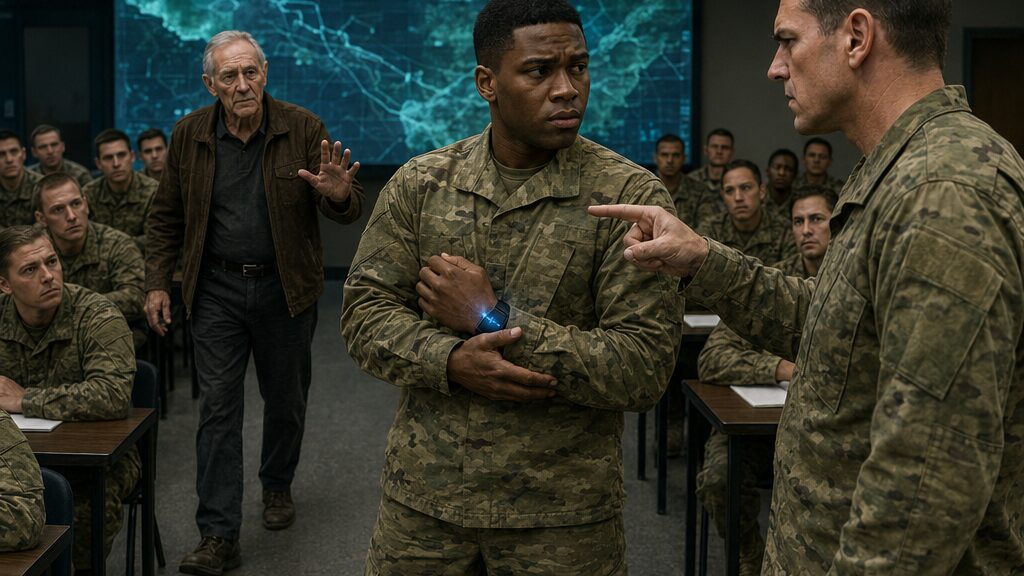
The instructor’s finger stopped less than an inch from Jason King’s wrist, close enough that half the room leaned forward without meaning to. The young soldier stood beside the front row with his shoulders squared too hard, his jaw locked, and his left hand clamped over the dark device strapped above his pulse.
Behind him, the tactical screen glowed with a frozen map of the training range. Blue grid lines crossed over pale terrain. Rows of trainees sat silent at their desks, boots tucked under chairs, notebooks open, eyes moving between Jason’s face and the instructor’s hand.
Steven Hall did not raise his voice. He did not need to.
“Private King,” he said, “you were told before the exercise: no outside devices during simulation blocks.”
“It isn’t an outside device, sir.”
Steven’s finger shifted from the wrist to Jason’s face. “You want to correct me in front of the room?”
Jason swallowed. The muscles in his neck tightened. “No, sir.”
At the back of the classroom, Samuel Brown watched the wrist device pulse once.
He had been placed there like extra furniture, a visiting observer in a brown jacket, invited because someone in administration had decided old systems needed an old pair of eyes before inspection week. No one had said it that plainly. They had called him a legacy-systems consultant, then a veteran volunteer, then simply “Mr. Brown” when the morning grew busy and the younger staff stopped remembering why he was there.
Samuel had accepted all three names without correction.
He leaned slightly on the edge of the rear desk, not because he needed help standing yet, but because his left knee preferred warning over surprise. Seventy-four years had taught him the difference between weakness and notice. A body gave notice. A room did too.
The room was giving notice now.
Jason’s watch pulsed blue again.
Not a notification. Not a message flash. Not the soft rolling shimmer of a fitness monitor. The light climbed in a narrow waveform, broke, fell flat, then waited.
Samuel’s fingers tightened against the desk.
Steven stepped closer to Jason. “You had access to live map data. You had a transmitter on your wrist. You were caught glancing at it during a timed decision block.”
“It monitors my hand, sir.”
A sound moved through the trainees. Not laughter exactly. Worse. A low, shared disbelief that tried to hide itself as breath.
Steven heard it and let it stay.
“Your hand,” he repeated.
Jason’s eyes dropped for half a second. “Yes, sir.”
“What does your hand have to do with tactical decision-making?”
Jason did not answer quickly enough. His thumb pressed the edge of the watchband. Samuel saw the tiny tremor before the boy stilled it. The tremor was not fear alone. It had rhythm. Suppressed, practiced, familiar to anyone who had watched soldiers learn to hide the part of the body that betrayed them.
Steven reached out. “Remove it.”
Samuel looked at the tactical screen.
For a fraction of a second, the upper-right corner of the map blinked.
Then the watch pulsed blue.
Samuel straightened.
The movement was small, but the chair nearest him scraped as a trainee turned. Steven looked back with the expression of a man already irritated by one problem and unwilling to accept another.
“Mr. Brown,” Steven said, “we’re handling a discipline issue.”
Samuel raised one hand, palm out.
He meant wait.
Several trainees stared at the hand first, then at his face. He saw what they saw: age spots, old veins, a knuckle that had never bent right after winter training in a place nobody in that room needed to know about. A hand more suited, in their judgment, to holding a coffee cup in the back row than interrupting an instructor.
“Just a second,” Samuel said.
Steven’s mouth tightened. “This is current training, not old radio school.”
A sharper silence fell.
Someone in the second row looked down at his notebook. Someone else’s eyebrows lifted and disappeared beneath the brim of a patrol cap. Jason’s face changed less than the others, but Samuel saw the heat rise along his cheekbones. Shame could spread from one person to another if a room allowed it.
Samuel walked down the aisle.
His right foot dragged only slightly. He hated that it did, and hated more that he noticed who noticed. Steven did. A trainee near the front did. Jason did too, but Jason’s gaze softened instead of judging, which made Samuel wish he had moved faster.
“Sir,” Steven said, the politeness clipped thin, “please return to your seat.”
Samuel stopped beside Jason, not between him and Steven. Never step between authority and the person being corrected unless you intended to take the fight. Samuel had no fight in him. Not that kind.
He looked at Jason. “May I see it?”
Jason hesitated.
Steven answered for him. “No.”
Samuel kept his eyes on Jason. “Not to clear you. Not yet. Just to see.”
The word yet changed the room.
Jason slowly uncovered the device. Its black face looked ordinary until the blue line came alive again, rising in a clean narrow spike and dropping into a flat pause.
Samuel took Jason’s wrist gently, two fingers under the strap, one thumb resting beside the casing. He did not press the screen. He did not swipe. He waited.
A few trainees shifted. Steven folded his arms.
“Mr. Brown,” Steven said, louder now, “you are interfering with an official correction.”
Samuel did not look up. “I know.”
“That device may contain unauthorized data.”
“It may.”
“You have no chain-of-custody authority.”
“No.”
Steven gave a short laugh, not amused enough to be honest. “Then what exactly are you doing?”
Samuel watched the blue screen go dark.
“One more,” he said.
Jason turned his head. “One more what?”
Samuel lifted his hand again, the same small palm-out gesture.
“Wait for the second pulse.”
The words landed strangely. Not dramatic. Not loud. Just old and certain enough to bother people.
On the tactical screen behind Steven, the map held still.
The classroom seemed to lean around its own silence. The air conditioner hummed. A projector fan rattled softly above them. Somewhere in the hallway, boots passed and faded.
The watch pulsed.
A thin blue line rose, broke into two small teeth, then fell.
Samuel felt his stomach tighten.
He had seen that break before. Not on a wrist. Not on glass this clean. Not in a classroom full of young faces and polished procedures. But patterns aged better than machines. Men forgot. Equipment changed. A bad rhythm could survive anything if no one cared enough to ask why it repeated.
“That isn’t a message feed,” Samuel said.
Steven stepped nearer. “You cannot determine that by looking at a consumer screen.”
“No,” Samuel said. “Not determine.”
“Then stop.”
Samuel let go of Jason’s wrist. Carefully. He did not want the boy to feel seized by two authorities at once.
“It repeats too cleanly,” Samuel said. “And it comes after the map flickers.”
Steven looked toward the tactical display, then back at Samuel. “The map did not flicker.”
“It did.”
A trainee in the third row shifted, then stopped when Steven’s eyes cut toward him.
Jason looked at the map. “I saw something,” he said quietly.
Steven turned on him. “You saw your own violation getting worse.”
Jason’s mouth closed.
Samuel had spent half his life teaching young soldiers when not to speak. He had not expected to spend the end of it wishing one would.
Steven held out his hand. “Device.”
Jason unbuckled the watch slowly. The strap resisted for a moment, caught against his sleeve. Samuel saw the tremor again. Jason forced his hand still, but the effort cost him.
Steven took the device with two fingers, as if it were contaminated.
“It will be logged as unauthorized equipment,” he said. “You will report to the duty clerk after this block. Written statement. Full explanation.”
“Sir—”
“Now.”
The room watched Jason take the first step toward the door.
Samuel should have said more. The sentence rose in him whole and hard: Stop the simulation system and pull the last three map refreshes. But certainty was not the same as proof. He had once learned that too late, and the lesson had rooted so deep that even now, with the blue rhythm still beating behind his eyes, his tongue held.
Steven turned toward the class.
“This,” he said, lifting the watch for every row to see, “is what happens when one person decides the rules are for everyone else.”
Samuel looked past the watch to the tactical screen.
The upper-right corner blinked once.
No one else seemed to see it.
Steven dropped the watch into a clear evidence pouch, sealed it, and wrote Jason’s name across the white label in black marker.
Chapter 2: A Watch That Was Not Cheating
Jason saw the incident report before he saw the chair they expected him to sit in.
The form glowed on the duty clerk’s monitor, half-filled already, his last name typed in the subject line beside the words UNAUTHORIZED DEVICE USE. The evidence pouch with his watch lay on the desk beneath the screen. His own name looked different there, flattened into a problem that had already been solved by people who did not ask him why his hand sometimes shook.
“Sit,” the duty clerk said, not unkindly.
Jason remained standing.
Behind him, Samuel Brown moved slower through the doorway, one hand near the wall but not touching it. He had followed without invitation. Jason had expected someone to stop him, but no one had. Maybe because old civilians could drift through administrative spaces unnoticed if they looked harmless enough.
Steven Hall stood beside the desk with his arms folded. “Statement first. Then medical verification if he insists on that explanation.”
Jason’s throat tightened. “I’m not insisting. It’s what the device does.”
“The device was present during a controlled simulation,” Steven said. “That is what it did.”
Jason looked at the pouch. The watch face had gone black.
It was strange how quickly an object could look guilty once someone put it in plastic.
The duty clerk turned the keyboard toward Jason. “Write what happened.”
Jason sat. His fingers hovered over the keys. The tremor started in his left hand first, a small jump in the tendons beneath the skin. He lowered the hand into his lap, pressing his palm against his thigh until the muscle obeyed.
Samuel saw it. Jason knew he saw it because the old man looked away.
That small mercy made Jason angrier than if he had stared.
“I wore it because my hand locks after stress loads,” Jason said. “It tracks the tremor pattern and warns me before it gets bad.”
Steven exhaled through his nose. “You were cleared for training.”
“I am cleared.”
“Then you did not need it.”
Jason’s fingers curled. “Cleared does not mean cured, sir.”
The words came out too sharp. The duty clerk stopped typing. Steven’s face changed by almost nothing, but the room cooled.
Samuel spoke before Steven could.
“Who authorized the monitor?”
Jason turned. “Medical observer said it was permitted during non-field blocks if it didn’t transmit. It’s in my packet.”
Steven’s eyes narrowed. “That packet was not presented before simulation.”
“I told the assistant instructor last week.”
“Not me.”
Jason had no answer for that. He had told someone. Someone had nodded. Someone had said, Keep it discreet and don’t make it a thing. In training, not making it a thing often meant carrying the weight quietly until someone punished you for being quiet.
Samuel stepped to the desk. “May I ask the clerk to preserve the device history before it powers down?”
Steven looked at him. “Again?”
“If it was transmitting, the history helps you. If it was not, it helps him.”
“That is not your determination.”
“No. It is the device’s.”
The duty clerk glanced at Steven, waiting.
Jason stared at Samuel. The old man’s voice had no force in it, but it did not bend either. It reminded Jason of a range flag in steady wind: not loud, impossible to ignore once seen.
Steven looked at the sealed pouch. Inspection week had everyone cautious. Jason knew that much. A mishandled evidence item could become its own report.
“Fine,” Steven said. “Technician only. No one else touches it.”
They moved to the equipment room two doors down, where metal shelves held training tablets, range batteries, cable spools, old monitors labeled with tape, and the kind of dust that gathered only on things still too useful to throw away. A civilian technician sat at a workstation with a tablet in one hand and a half-eaten protein bar in the other.
Kimberly Lee looked up as four people entered with the energy of a problem looking for a place to happen.
“What broke?” she asked.
Steven placed the pouch on her table. “Unauthorized wrist device. Pull local history. Confirm whether it transmitted during the simulation block.”
Kimberly’s eyes moved to Jason, then to Samuel, then back to the pouch. “Was it connected to the classroom network?”
“That is what we’re determining.”
She put the protein bar down, pulled on gloves, and opened the pouch. Jason felt an absurd urge to apologize to the watch.
Kimberly connected the device with a short cable. Its face woke under the fluorescent lights. For one second it showed the time. Then the blue waveform appeared in the corner history window, small but alive, a jagged rise followed by a flat pause.
Samuel moved closer.
Steven noticed. “Hands off.”
Samuel stopped immediately. “Of course.”
Kimberly tapped through screens. “No outgoing message traffic. No paired phone active. No Wi-Fi handshake during the block. Bluetooth was locked to medical mode.”
Jason let out air he had not meant to hold.
Steven did not soften. “Could it receive?”
Kimberly scrolled. “Passive sensor logs only, from what I’m seeing.”
“From what you’re seeing?”
“It’s not Army-issued. I need more than ten seconds.”
Jason looked at Samuel. The old man’s eyes were on the screen, not triumphant, not relieved. Worried.
“Open the signal capture,” Samuel said.
Steven’s head turned. “Mr. Brown.”
Kimberly paused with her finger above the tablet. “There is a signal capture.”
Steven leaned in. “Why?”
“Because it monitors tremor onset through motion and environmental interference,” Jason said. “That’s what it does. If my hand starts misfiring, it flags the pattern.”
Steven looked at the device as if it had found a better lawyer.
Kimberly opened the saved capture. The blue waveform expanded on her monitor. It looked larger now, less like a glow and more like a sentence in a language no one wanted to admit was being spoken.
Samuel lifted his right hand and tapped once on the edge of the workstation.
Everyone looked at him.
He waited.
Then he tapped again.
The interval between the taps sat in Jason’s bones before he understood why. It matched the flat pause on the screen.
Kimberly’s eyes narrowed. She dragged the cursor across the waveform. “That’s… consistent.”
Steven moved closer. “Consistent with what?”
“Not tremor.” Kimberly zoomed in. “The device tagged it as environmental interference, not body movement. There’s no source ID.”
“So it could be anything,” Steven said.
Samuel nodded once. “Yes.”
Jason’s brief hope slipped.
Steven seized the word. “Then we are exactly where we started. An unauthorized device in a controlled room captured an unidentified signal. That does not clear him.”
“It does not prove cheating either,” Samuel said.
“No, but the policy violation stands.”
Jason looked down at his hands. He had defended himself. The device had defended him. Neither had been enough.
Kimberly saved the screen capture to a base drive and printed a timestamped copy. The printer near her feet clicked and hummed. When the page slid out, the blue waveform looked dull in grayscale, its strange life reduced to black peaks on white paper.
Samuel picked up the page only after Kimberly slid it toward him.
“No source tag,” she said. “No network label. No paired device. If this came from somewhere in the room, the classroom logs would show something around the same time.”
Steven’s expression sharpened. “If.”
Kimberly held his stare for a second, then turned to a second terminal. “I can check the tactical display refresh logs.”
“Not necessary for the discipline packet,” Steven said.
Jason looked up.
Samuel did not move. That was what made the moment tighten. He became very still, the way older people did when they refused to spend strength on anything except the next necessary thing.
Kimberly’s hand hovered over the keyboard.
Steven said, “Ms. Lee.”
Kimberly pulled her hand back.
Samuel folded the printed waveform once, carefully, aligning the edges with his thumb. “Private King,” he said, “did the watch alert before the instructor called on you?”
Jason searched the morning. The frozen map. The timed answer. Steven’s voice. His own glance down.
“Yes,” he said. “Before.”
“Before the map changed?”
Jason frowned. “I don’t know.”
Steven took the evidence pouch back. “Enough. King, finish your statement. Mr. Brown, I appreciate your concern, but concern is not procedure.”
Samuel looked at the folded paper in his hand. “No,” he said. “It is what procedure is supposed to protect.”
Steven’s face hardened, but before he could answer, Kimberly’s second monitor flickered.
It was quick. A diagnostic window behind her main screen refreshed and flashed a string of timestamps. Kimberly turned toward it, annoyed at first, then leaned in.
Samuel saw her eyes move once across the numbers.
Then she pulled the printed waveform back from him, unfolded it, and held it beside the screen.
Jason saw the color drain from her face.
“What?” he asked.
Kimberly did not answer him. She looked at Steven instead.
“The classroom display log,” she said quietly, “has the same rhythm.”
Chapter 3: The Map Blinked Before The Alarm
The tactical map blinked while Jason’s watch sat locked in Steven Hall’s evidence pouch.
Samuel saw it from the doorway of the simulation room, before anyone had finished arguing about permissions. A small flicker in the upper-right grid. Not a full reset. Not enough to alarm a technician watching ten other systems. Just a blue-white hesitation, a held breath in the map before the terrain returned to normal.
Then the diagnostic monitor beside Kimberly Lee gave a soft tone.
Samuel did not look at Steven.
He looked at the clock.
Two beats.
Three.
The monitor pulsed again.
Kimberly whispered, “Same interval.”
Steven stood in the center of the room as if refusing to let the equipment arrange itself into an accusation around him. The simulation room was smaller than the classroom, crowded with consoles, cable trunks, spare tablets, and the main tactical display mounted across the far wall. Without trainees in the seats, the place felt less like instruction and more like the inside of a machine.
Jason had not been allowed in. Steven had made that clear. Samuel had watched the young soldier stop at the hallway line as if an invisible door had closed in his face.
Now only Steven, Kimberly, Samuel, and the duty clerk stood before the blinking map.
“Display refresh artifacts,” Steven said.
Kimberly did not answer right away. Her hands moved over the keyboard, pulling the logs into columns. “Refresh artifacts do not normally match external sensor captures down to the second.”
“Normally.”
She glanced back. “I said what I said.”
Steven’s jaw worked once. “We are three days from inspection. I am not suspending a training block because an old monitor blinked and a nonstandard wristband noticed.”
Samuel heard the word old and felt how neatly it had been aimed. Not just at the monitor.
He stepped closer to the tactical display. “May I ask when this map package was loaded?”
Steven gave a thin smile. “Now you’re a software auditor too?”
“No.”
“Then stay in your lane.”
Samuel nodded slowly. The phrase had followed him through too many years in too many uniforms, though it wore different mouths. Stay in your lane. Not your call. Not enough proof. We’ll review it later. Every version sounded reasonable until something went wrong.
He looked at the map. “I was asking because the flicker comes before the pulse, not after.”
Kimberly turned from her console. “What?”
“The watch didn’t cause it. The room did something first.”
Steven shook his head. “You cannot know that.”
Samuel pointed, not at the screen itself, but at the corner of the map. “If the display hesitates, then the pulse follows, the watch is not pushing data. It is hearing what the system leaks.”
Kimberly’s focus sharpened. She pulled up a timecode comparison, placing Jason’s watch capture beside the classroom display log and the simulation room’s current refresh data. Three lines. Three separate sources. The peaks did not match perfectly, but the spacing did.
Samuel felt the old part of his mind wake fully, the part he did not summon often because it brought other things with it: cold field tables, wet gloves, voices clipped by static, young faces waiting for older men to be certain.
“Kill the room audio,” he said.
Steven stared at him. “Excuse me?”
“Thirty seconds. No talking. No chair movement. No keyboard.”
Kimberly looked from Steven to Samuel. “For what?”
Samuel’s pride wanted to answer with certainty. His caution stopped him. “To listen.”
Steven laughed once. This time, the sound had less room to travel. “To listen.”
Samuel did not defend the word.
Kimberly reached over and muted the workstation alerts. The duty clerk stopped shifting papers. Steven did not agree, but he also did not speak, which was close enough.
Silence settled unevenly.
The simulation room was not truly quiet. Rooms like this never were. The projector fan ran overhead with a dry bearing whine. The main display gave off a faint electrical hum. Somewhere behind the wall, ventilation moved in a steady hush. Samuel closed his eyes, not because he needed darkness, but because people trusted closed eyes less and sound more when they watched an old man trying to prove something.
There.
A tiny dip in the fan’s pitch.
Samuel opened his eyes.
The map blinked.
Two seconds later, Kimberly’s monitor marked the pulse.
She sat back. “That’s not random.”
The duty clerk looked uncomfortable. Steven’s expression remained firm, but the certainty had thinned at the edges.
Samuel turned to Kimberly. “Does the map package touch the range beacon emulator?”
“Not during classroom mode,” she said automatically. Then she stopped. “It shouldn’t.”
“Shouldn’t is not no.”
Steven stepped between them and the display. “Enough. This is exactly how bad conclusions happen. A sound, a blink, and suddenly we have a ghost in the system.”
“No ghost,” Samuel said.
“Then what?”
Samuel looked at the waveform on Kimberly’s screen. The second peak had a small notch in its shoulder. He remembered that shape too well for comfort, but memory was a dangerous witness. It could tell the truth and still make a man careless.
“I don’t know yet,” he said.
Steven spread his hands. “There it is.”
Samuel accepted the hit because it was fair. He did not know. Not enough.
Kimberly enlarged the waveform. “It resembles an old emergency ping.”
Steven turned on her. “Resembles?”
“I’m saying the structure is familiar.”
“To whom?”
Kimberly hesitated.
Samuel answered quietly. “To anyone who had to work when systems did not explain themselves.”
Steven’s face flushed. “That is a nice line, Mr. Brown, but I am responsible for soldiers in this program. I cannot let every familiar-looking squiggle become a reason to ignore policy.”
“Private King did not make the map blink.”
“That does not clear him of wearing an unauthorized device.”
The words stopped Samuel because they were true in the narrow way rules were often true. Jason had worn it. He had not made certain every approving voice was attached to a signed form. He had trusted a nod in a system that punished missing paper more quickly than missing judgment.
Kimberly printed the side-by-side logs. The duty clerk took them reluctantly. Steven reached for the evidence pouch at his belt and placed Jason’s watch on the console, still sealed.
“There will be a formal review,” he said. “Until then, the device remains evidence, Private King remains under report, and classroom instruction continues.”
Samuel looked toward the hallway. Through the narrow window in the door, Jason stood outside pretending not to watch.
“He should hear this,” Samuel said.
“He will hear what command decides he needs to hear.”
Samuel almost said it then. Pull the old emergency protocol files. Check the range beacon emulator. Do not run the outdoor exercise until you know why the second pulse is there.
The sentence formed cleanly.
Then another memory rose beneath it: a younger Samuel standing over another console, saying, “It may be nothing,” because his captain had wanted certainty and Samuel had not had the courage to give warning without it.
He heard Steven in the present, but the old room answered first.
Not enough proof.
Samuel’s mouth closed.
The door opened behind them.
Amanda Torres entered without hurry, but everyone straightened. She wore her dress uniform as if the fabric had been measured against her posture. Decorations sat above her left breast, quiet and exact. Her eyes went first to the tactical display, then to the watch sealed on the console, then to Samuel.
“Why,” she asked, “is a discipline incident now attached to a system log?”
Steven spoke before anyone else. “Ma’am, we have an unauthorized device, an unverified environmental signal, and a great deal of speculation.”
Amanda looked at Kimberly. “Do we have matching timestamps?”
Kimberly glanced at Steven, then answered. “Yes, ma’am. Close enough to require review.”
Amanda turned to Samuel. “And you saw it first?”
Samuel felt every year in his knee, his hand, his throat. “I saw enough to ask them to wait.”
“Enough to stop training?”
There it was. The question he hated. The space between notice and proof.
Samuel looked at Jason through the door window. The young soldier’s hand was closed around nothing, steady only because he was forcing it to be.
“I don’t know yet,” Samuel said.
Amanda held his gaze for a moment longer than comfort allowed.
“Then we review before inspection,” she said. “Tomorrow if necessary. Today if possible.”
Steven’s shoulders tightened. “Ma’am, with respect, the inspection team—”
“Will prefer a delayed answer over a clean mistake.”
She picked up the printed logs and folded them once.
“Classroom review. Sixteen hundred. Bring the device, the system data, and the incident packet.”
Steven nodded, but his eyes did not leave Samuel.
Samuel looked back at the tactical map.
The corner blinked again, almost too faint to catch.
This time, Amanda saw it.
Chapter 4: The Report That Made Him Silent
The report number was written in Samuel Brown’s own hand.
He knew it before the records clerk slid the thin file across the counter, before the faded cover sheet cleared the shadow of the desk lamp. The slant of the seven, the narrow loop in the six, the hard pressure mark where the pen had dug through the paper—none of it should have survived thirty years and three filing systems, but there it was.
Samuel kept his hand flat on the folder.
The clerk waited. “Is that the one?”
Samuel did not open it.
Behind him, through the glass wall of the records office, soldiers moved along the hallway in clean lines, carrying tablets and coffee, laughing too softly for the hour. Tuesday morning had the forced brightness of a place trying to look ready for inspection. Every bulletin board had been straightened. Every cable had been tied. Every problem was supposed to have a label by now.
Samuel’s problem had a number.
“Yes,” he said. “That’s the one.”
The clerk turned back to the computer. “You can review it here. No copying unless command approves.”
Samuel nodded and carried the file to the small table near the wall.
The first page crackled when he opened it. The paper smelled faintly of dust and toner and old cabinets. It was not the original report; originals disappeared into archives, then into scans, then into whatever place the Army sent things it did not want to lose but did not expect anyone to need. This was a copy of a copy, but his handwriting remained on the margin of the third page.
Signal delay observed before second repeat.
Samuel sat down too quickly, and his knee complained.
He did not touch the words at first. He looked past them to the date, to the training range name, to the list of equipment checked and cleared by people who had all been younger then. He found his own name typed lower on the page: communications section support. Not investigator. Not decision-maker. Not the man in charge.
That had been the comfort he used for years.
Not my call.
He turned the page.
The past did not return as a full scene. It returned in fragments that still knew where to hurt. A wet sleeve cuff. A handset slick in his glove. Someone asking if the delay mattered. Samuel saying, “It might be nothing,” because the officer beside him wanted a firm answer and Samuel had still been waiting for the second repeat.
He had gotten it.
By then, the training convoy had already moved.
Samuel closed his eyes, then opened them before memory could make its own room.
A chair scraped beside him.
Amanda Torres sat without asking permission. She placed her cap on the table, brim toward the folder, as if setting rank aside without fully removing it.
“The clerk said you pulled an old mishap file,” she said.
Samuel looked at the report. “It was not a mishap file at the time.”
“What was it?”
“A discrepancy report.”
Amanda’s gaze moved over the cover sheet. She did not reach for it. “And after?”
“After, it became easier for everyone to call it a mishap.”
The hallway beyond the glass filled briefly with boots and voices, then emptied again. Amanda waited through the interruption. Samuel respected that. He also disliked it. Patient officers made silence feel like a choice instead of a refuge.
She said, “The review yesterday did not give me enough to clear Private King.”
“I know.”
“It gave me enough to delay final discipline.”
Samuel nodded.
“And enough to worry about the system.”
He looked at her then. She had seen the map blink. That mattered. It also did not matter enough.
Amanda tapped the edge of the folder once. “Why this report?”
Samuel opened to the page with the margin note and turned the file toward her. “Because the shape is similar.”
“The watch signal?”
“The pause before the second repeat.”
Amanda read the note. Her expression did not change, but her body did. A small stillness came into her shoulders.
“You wrote this?”
“Yes.”
“What happened after?”
Samuel looked at the typed lines below his handwriting. The official language had always offended him by how gently it carried hard things. Navigation error. Incorrect position relay. Delayed correction. Training injuries. Equipment review recommended.
He remembered the names, but he did not say them. The report did not give them back as people, only as outcomes.
“I reported uncertainty,” he said.
“That is not an answer.”
“It is the answer I gave then.”
Amanda looked up.
Samuel wanted to resent the question forming in her face. Instead, he found himself tired before she asked it.
“Why did you stop teaching after that year?” she said.
The room noise thinned.
Samuel folded his hands, hiding the bent knuckle beneath the other palm. “Because I became very good at explaining what had already happened.”
Amanda let that sit.
“That is not what I asked.”
“No.”
“Are you withholding something now because of that file?”
Samuel almost said no. The habit came to him fully dressed, ready for service. No, ma’am. Only giving what I can prove. No, ma’am. Not relevant to current review. No, ma’am. Old history.
He had worn obedience so long it could still stand up by itself.
“I do not know what the current pulse means,” he said.
“But you know what you fear it means.”
Samuel looked through the glass at a young soldier passing with a tablet tucked under one arm. The soldier looked down at the screen as he walked, trusting the glowing map in his hand to tell him where to go.
“Yes,” Samuel said.
Amanda waited.
He did not continue.
Her mouth tightened, not in anger yet. In calculation. “Mr. Brown, I can delay discipline. I can question logs. I can have Ms. Lee run comparisons all day. What I cannot do is stop a scheduled field exercise tomorrow because a visiting consultant has a feeling tied to a thirty-year-old file.”
“It is not a feeling.”
“Then give me the rest.”
The rest sat in his throat.
He could have told her about the captain who wanted certainty. About the second repeat that came too late. About how the signal delay had looked insignificant because every official display said the route was clear. About how Samuel had learned to distrust both panic and calm. About how he had spent decades teaching people to wait one more beat, then failed in the one room where one more beat had mattered.
Instead, he heard himself say, “The records may contain enough.”
Amanda’s eyes cooled by a degree. It was not dismissal. It was worse: a door being held open for him, then slowly closing because he would not step through.
“Records do not speak for themselves,” she said.
“No.”
“People do.”
Samuel looked down.
Amanda stood. She placed the cap back under her arm. “Sixteen hundred review remains. Bring that file. Bring what you are willing to say.”
She left without raising her voice.
Samuel stayed at the table until the clerk reminded him the file could not leave the room without approval. He signed the checkout log for command transfer, his name smaller than usual on the line. The clerk put the file into a red-edged folder and stamped a routing sheet across the front.
When Samuel stepped outside, the bench against the hallway wall was empty. He sat because his knee wanted it and because he did not trust himself to walk yet.
Across the corridor, Jason King stood near a vending machine, holding a paper cup he had not drunk from. He looked as if he had come there for chance and regretted finding it.
“Sir,” Jason said.
Samuel almost corrected him again, almost said he was not sir, not anymore. But Jason’s voice was too careful to interrupt.
“They told me the review is still happening,” Jason said.
“Yes.”
“They also told me not to attend unless called.”
Samuel nodded.
Jason’s left hand flexed around the paper cup. Without the watch, the tremor had nowhere to hide. “Did they find something?”
“Something.”
“Enough?”
Samuel looked at the young man’s hand and saw him forcing it still in front of an old man he barely knew. Pride and fear lived close together in soldiers. Sometimes the Army trained them so close they became difficult to separate.
“Not enough yet,” Samuel said.
Jason’s face fell only slightly, but slightly was plenty.
“I didn’t cheat,” he said.
“I know.”
Jason looked up sharply. “You know?”
Samuel should have said, I believe you. That would have been safer. Cleaner. More accurate.
Instead, he said, “I know.”
The words committed him before proof did.
Jason swallowed. “Then why does it feel like everybody’s waiting for me to admit I did?”
Because institutions liked confession better than uncertainty. Because rules could move faster than truth. Because a young soldier with a device was easier to correct than a system nobody wanted to open before inspection.
Samuel said none of that.
“Write down who approved the monitor,” he said. “Every conversation. Every date you can remember. Even if it was just a nod.”
“I already put it in the statement.”
“Put it again. Cleaner.”
Jason nodded, then looked toward the red-edged folder under Samuel’s arm. “Is that about the watch?”
Samuel tightened his grip on the folder.
“Partly.”
“What’s the other part?”
The hallway seemed to hold still.
Samuel looked at the cup in Jason’s trembling hand, then at the folder, then at the far end of the corridor where Amanda had disappeared.
“My mistake,” Samuel said.
Before Jason could answer, a door opened down the hall. Steven Hall stepped out of the administrative office with a signed form in his hand. He did not see Samuel at first. He spoke to the duty clerk walking beside him.
“Submit the recommendation,” Steven said. “Remove King from tomorrow’s exercise rotation pending final review.”
Jason heard it. So did Samuel.
Steven stopped when he saw them.
The paper in his hand did not look heavy, but Jason’s shoulders sank as if it had landed there.
Chapter 5: When The Training Room Chose Sides
Amanda Torres placed Jason King’s watch beside Steven Hall’s report and watched the room decide which object it wanted to believe.
The watch sat sealed in clear plastic, dark-faced now, ordinary and almost small on the long classroom table. The report was clean, aligned, and clipped in the upper left corner. One object had a smudge on the inside of the evidence pouch where someone’s thumb had pressed too hard. The other had Steven’s signature, a routing number, and all the calm power of format.
Amanda knew which one the Army preferred.
She stood at the front of the same classroom where the accusation had begun. The trainees were gone, but the chairs remained in rows, facing the tactical display. Samuel Brown sat to her left with the red-edged file on his lap. Jason was not seated at the table; he had been allowed to stand along the side wall as a witness if called. Amanda had not liked that arrangement, but she had permitted it because the review was not yet a trial, not yet a clearance, not yet anything solid enough to name.
Steven stood opposite Samuel. His uniform looked sharper than it had the day before. That told Amanda something. Men under pressure often polished the part of themselves they could still control.
Kimberly Lee sat near the console, fingers folded tightly around a pen.
Amanda opened the report first.
“Private King wore a non-issued wrist device during a controlled simulation block. That fact is not disputed.”
Jason’s eyes stayed forward.
Steven nodded once. “Correct, ma’am.”
“The device captured an unidentified signal during the same block.”
“Yes, ma’am, but no source has been verified.”
“The tactical display logs show a matching interval.”
“A matching interval is not a source.”
Amanda looked at Kimberly. “Ms. Lee?”
Kimberly’s pen stopped moving. “The interval match is real. The watch capture, the classroom display refresh anomaly, and yesterday’s simulation room anomaly are close enough to be related.”
Steven turned slightly. “Close enough is doing a lot of work.”
Kimberly’s face tightened. “So is unauthorized if the medical exception was mishandled before it reached your desk.”
Amanda marked that. Not the words—the courage it took Kimberly to say them in this room.
Steven heard it too. “That exception was not in the exercise binder.”
Jason shifted against the wall.
Amanda raised her hand before he spoke. Not yet.
She turned to Samuel. “Mr. Brown. You brought an old file.”
Samuel opened the red-edged folder and removed the copied report. He did not spread it dramatically. He placed it on the table as if it might bruise.
“This report describes a delayed correction pattern during a training movement,” he said. “The shape of the repeat signal resembles what the watch captured.”
Steven leaned back. “Resembles again.”
Samuel accepted the word. “Yes.”
Amanda watched him. His restraint had weight, but it also had gaps. She had seen enough older veterans bury pain under careful phrasing to know when a man was protecting something besides facts.
“Does it identify the current source?” she asked.
“No.”
“Does it establish that tomorrow’s field exercise is unsafe?”
Samuel’s hand moved over the file, then stopped. “No.”
Steven exhaled quietly.
Jason’s jaw set.
Amanda disliked the answer. She respected it anyway.
“Then we have two questions,” she said. “One, whether Private King violated policy. Two, whether our system is producing a signal we do not understand. They overlap, but they are not the same question.”
Steven nodded. “Agreed.”
Amanda looked at him. “Do you agree they overlap?”
He hesitated a fraction too long. “They may.”
That was the first crack.
Kimberly’s console gave a soft alert. Everyone turned. She glanced at the screen, then quickly muted it.
Amanda said, “Open it.”
Kimberly did not move.
“Ms. Lee.”
Kimberly set down the pen. “It’s an automated diagnostic flag.”
“For what?”
“Legacy noise.”
The phrase changed the room more than Amanda expected. Samuel looked up first. Steven looked away first.
Amanda walked to the console. “Show me.”
Kimberly opened a log window. Three entries highlighted amber. Two from Monday’s classroom block. One from the simulation room. A fourth line sat lower, not amber, not red, but marked as acknowledged.
Amanda read the date. “This predates Private King’s device.”
Kimberly’s mouth pressed thin.
Steven said, “Legacy noise is common in older integrated systems.”
Amanda did not turn around. “You knew about this?”
“I knew there were nuisance flags.”
“Did you review them?”
“They were reviewed at staff level.”
Kimberly’s eyes flicked down.
Amanda saw it.
“Ms. Lee,” she said, quieter.
Kimberly looked at Steven, then at Samuel, then at the sealed watch on the table. When she spoke, her voice was careful enough to reveal how long she had been measuring every word.
“I flagged two anomalies last month. Same diagnostic family. Not the same visible waveform because we did not have a passive capture like the watch gave us. I noted the possibility of interference between the classroom map package and the range beacon emulator.”
Steven’s hand closed around the edge of his folder. “You noted a possibility. I told you to monitor it.”
“You told me not to complicate inspection prep with legacy noise unless it produced a hard fault.”
“That is not the same thing.”
Kimberly looked at Amanda. “That is the phrase you used.”
Silence moved through the classroom.
Amanda felt irritation rise, but she held it down. Anger made rooms feel clean too early. She needed the dirt visible.
Steven’s face had gone still. “Ma’am, we receive nuisance flags weekly. If we suspended training for every noncritical diagnostic—”
“No one asked you to suspend training last month,” Amanda said. “I am asking why a related flag was not in yesterday’s packet.”
Steven looked at the report. “Because yesterday was a discipline issue.”
Samuel’s voice came from the table. “It became a system issue when the map blinked before the watch.”
Steven turned on him. “And yet you still cannot say what it means.”
Samuel’s eyes did not rise quickly. When they did, Amanda saw pain there, and frustration sharpened by self-blame.
“No,” Samuel said. “I cannot say enough yet.”
Steven gestured toward him, not cruelly, but with the relief of a man pointing to a weakness he needed everyone else to see. “That is the problem. We are building doubt around one soldier’s violation based on an old report, a technician’s maybe, and Mr. Brown’s memory of a pattern.”
Jason spoke from the wall.
“It wasn’t maybe to me.”
Every head turned.
His voice had come out rough, but he did not take it back. “Sir.”
Amanda studied him. “Go ahead.”
Jason stepped away from the wall. His left hand shook once before he tucked it against his side. “The watch alerts before my hand locks. That’s why I wear it. It catches the little things before I can feel them. Monday, it alerted before I looked down. I looked because it warned me, not because I was checking something.”
Steven said, “You should have disclosed it fully.”
“I tried.”
“You failed.”
Jason’s face tightened. “Yes, sir.”
The answer took some force out of Steven. Amanda noticed that too.
Jason looked at the watch. “But if the room caused the alert, then I got reported for reacting to something the system did first.”
Samuel closed his eyes briefly.
Amanda let the sentence stand. It was the clearest thing anyone had said.
She returned to the table. “Private King is not cleared today.”
Jason’s shoulders stiffened.
Amanda continued before disappointment could settle into defeat. “But the final disciplinary recommendation is suspended pending technical review. He remains off tomorrow’s active rotation until I determine whether the device exception was properly handled.”
Steven nodded, controlled. He had gotten enough to hold position.
Jason had not gotten enough to breathe.
Amanda turned to Steven. “You will amend the packet to include the system anomalies.”
“Yes, ma’am.”
“Not as an attachment no one reads. In the summary.”
His jaw tightened. “Yes, ma’am.”
She faced Kimberly. “You will pull every legacy-noise flag connected to the classroom map package, simulation room, and range beacon emulator for the past ninety days.”
Kimberly nodded. “Yes, ma’am.”
Amanda looked at Samuel last. “And you will decide before tomorrow morning whether the old report is background or warning.”
Samuel’s hand rested on the file. “Yes, ma’am.”
The review should have ended there.
Then Kimberly’s printer began to click.
No one had sent anything to it.
A single page emerged, paused, then slid into the tray.
Kimberly stood and picked it up. Her eyes moved down the printout, then stopped near the bottom.
“What is it?” Amanda asked.
Kimberly turned the page around.
At the top was tomorrow’s outdoor exercise packet, auto-generated for final review. Near the coordinate block, in a diagnostic margin that should not have printed at all, sat the same amber flag.
Legacy noise detected: range beacon emulator.
Timestamp pending second repeat.
Chapter 6: The Field Test No One Trusted
Jason King found his name crossed off the roster in black marker.
Not removed cleanly. Not reprinted. Crossed off. A hard line ran through KING, J. so thick the paper had buckled beneath the ink. He stood outside the mobile command tent on Wednesday morning with the roster clipped to a board in front of him, watching other trainees check their assignments and look away when they reached his empty slot.
Observer only had been written beside his name in smaller letters.
That was worse in some ways. Removed meant gone. Observer meant present enough to be reminded.
A trainee behind him shifted. “You blocking the board?”
Jason stepped aside.
The outdoor range spread beyond the tent in pale morning light: gravel lanes, orange markers, low scrub, distance flags, and the squared-off shapes of training vehicles waiting near the staging line. Inside the mobile command tent, screens glowed on folding tables. Cables ran under mats. A range beacon mast stood fifty yards away, its small light blinking green at steady intervals.
Jason looked for his watch by habit and found only bare skin.
His hand trembled once.
He closed it.
“Private King.”
Samuel Brown stood near the tent entrance, brown jacket zipped against the wind, cap low over his forehead. The old man looked smaller outdoors. The range was built for distance and movement; Samuel moved as if each step had to be negotiated in advance. But his eyes were on the beacon mast, not the ground.
Jason straightened. “Sir.”
Samuel gave him a look.
“Mr. Brown,” Jason corrected.
“Better.”
Jason nodded toward the roster. “They made me observer.”
“I saw.”
“I guess that’s better than being removed.”
Samuel looked at the black line through Jason’s name. “Is it?”
Jason almost smiled, but there was no room for it. “No.”
Inside the tent, Steven Hall’s voice carried through the open flap.
“Grid package loads at zero nine. Field team steps at zero nine fifteen. We do not stop for noncritical diagnostics unless command directs.”
Jason saw Samuel hear the last part.
Amanda Torres stood at the central table, reading from a command tablet. Kimberly Lee sat beside the equipment rack with two laptops open and a cable looped around one wrist like a restraint. Steven moved between the map display and the tent opening, checking watches, rosters, faces.
Everyone looked busy enough to pretend they were not waiting for the pulse.
Jason followed Samuel into the tent but stayed near the side, where observers belonged. His eyes found the sealed pouch on Amanda’s table. His watch was inside, connected now to Kimberly’s laptop by a short cable that disappeared through a small opening in the plastic. The face glowed dimly.
It looked like a patient under guard.
Kimberly noticed Jason looking. “Passive read only,” she said. “No network connection.”
Steven heard her. “State that for the log.”
Kimberly pressed a key. “Private King’s device is in passive sensor mode, physically isolated, connected only to local diagnostic capture.”
Amanda looked up from the command tablet. “Thank you.”
Samuel stood near the rear of the tent, one hand resting on the back of a folding chair. Jason recognized the posture now. It was not casual. It was how Samuel made himself still enough to notice what moved.
The command display loaded the range map.
For a few minutes, nothing happened.
That was almost worse.
Steven began issuing instructions. The field team checked radios. The beacon mast blinked green. Kimberly watched three windows at once, eyes moving left to right, left to right. Amanda stood behind her, not interfering. Jason tried to read the command tablet from across the tent and failed.
Samuel lifted his head slightly.
Jason saw it and held his breath.
The range beacon’s green light did not change. The display did not blink. No alarm sounded.
Then Samuel looked down at the floor mat where a cable crossed beneath the table.
“What is it?” Jason whispered.
Samuel did not answer.
He moved closer to Kimberly’s station, slow enough that Steven saw him.
“Mr. Brown,” Steven said, “please do not crowd the technician.”
Samuel stopped, but his gaze remained on the screen. “What grid does the command tablet show for the west marker?”
Amanda checked. “Marker reads C-seven.”
Kimberly looked at her main display. “Range map shows C-seven.”
Samuel turned toward the tent opening. Beyond it, the west marker flag snapped in the wind.
“The beacon mast is calling it C-six.”
Kimberly’s fingers froze above the keyboard.
Steven turned sharply. “How would you know that?”
Samuel pointed toward a small repeater display mounted beside the tent flap. It was meant for quick status checks, the kind no one watched when larger screens were available. Its small green text showed a status line that refreshed every few seconds.
WEST MARKER: C6 SYNC PENDING
Jason stared at it. He had walked past the display twice without reading it.
Kimberly rolled her chair to the side console and pulled up the beacon emulator feed. “That should have synced on load.”
Steven stepped beside her. “Is it a display lag?”
“Maybe.”
Samuel’s eyes stayed on the small repeater. “Wait.”
Steven’s shoulders tightened.
The command tablet flickered.
Jason felt the tent change before anyone spoke.
On Kimberly’s laptop, the blue waveform rose from the watch capture. It broke into the same narrow teeth, fell, and flattened.
Two seconds later, the repeater display changed.
WEST MARKER: C7 SYNC COMPLETE
Kimberly whispered, “It corrected.”
Steven seized on that. “Then the system corrected itself.”
Samuel shook his head. “After the second pulse.”
“The correct coordinate is now displayed.”
“Now.”
Amanda looked at Kimberly. “Could the field team have received the wrong coordinate before correction?”
Kimberly checked a log. “If the packet pushed during the pending state, yes. But the main display showed correct.”
“The field radios?”
Kimberly opened another window. Her face changed. “Initial packet queued C-six.”
Steven leaned over her shoulder. “Queued is not sent.”
“Not yet.”
The words made the tent seem smaller.
Outside, the field team leader raised one arm, ready to move the group into position. A radio crackled. “Command, field team ready for step-off.”
Steven took the handset. “Stand by.”
Amanda looked at him.
He looked back, and for a second Jason saw the man beneath the instructor: tired, cornered, holding a program together with procedures that had always worked until they didn’t. Steven was not enjoying this. That made what he did next feel worse, not better.
He keyed the handset. “Command to field team. Continue prep. Await final step.”
Amanda’s eyes narrowed. “I did not authorize step.”
“I did not give it.”
“You are close.”
Steven lowered the radio. “Ma’am, stopping this exercise now triggers inspection notification. We have a corrected display and an unsent queue. We can monitor.”
Kimberly said, “The packet auto-sends on step command.”
“Then we do not send until we verify.”
Samuel looked at the beacon mast, then at the tablet, then at the small repeater no one had watched. “The correction is late.”
Steven turned on him. “Everything you say is almost. Almost wrong. Almost late. Almost like something old. I need an actual fault.”
Samuel’s hand tightened on the chair back. Jason saw the skin pale across his knuckles.
Amanda said, “Mr. Brown?”
Samuel did not answer right away.
Jason wanted him to. The whole tent seemed to wait for the old man to become certain enough for everyone else to borrow from him. But Samuel’s face had changed in a way Jason had not seen before. Not confusion. Memory.
The radio crackled again. “Command, field team holding. Confirm step at zero nine fifteen?”
Steven looked at the clock. “We have three minutes.”
Kimberly’s laptop pinged softly.
Everyone turned.
The watch trace had gone flat again, waiting.
Jason looked at Samuel. “It’s going to do it again, isn’t it?”
Samuel’s eyes came back from wherever they had gone.
“Yes,” he said.
Steven gave a hard breath. “You cannot know that.”
Samuel looked at the command lane marked by orange cones outside the tent, where only authorized personnel were supposed to stand during active range movement. Then he looked at Amanda, but not as if asking permission. More as if giving her one last chance to stop him from needing to act.
She said nothing.
The radio sounded a third time. “Command, ready for step.”
Steven raised the handset.
Samuel moved before he could speak.
He stepped out of the tent and into the command lane, slower than any young soldier would have done it, but with a steadiness that made everyone watching understand he knew exactly where he was standing.
Then he raised one hand, palm out, toward the field team and the tent behind him.
The same hand. The same warning.
Only this time, Jason saw no hesitation in it.
Chapter 7: Before The Wrong Grid Became Real
“Mr. Brown, step back.”
Steven Hall’s voice carried across the command lane, sharp enough that two soldiers at the staging line turned their heads. Samuel Brown did not move. His hand stayed raised, palm out, between the waiting field team and the mobile command tent behind him.
The radio in Steven’s hand crackled. “Command, confirm step?”
No one answered.
Samuel could feel the range watching. The field team stood in partial formation beyond the orange cones, packs tight against their shoulders, faces turned toward the old man blocking the lane. Behind Samuel, the tent flap snapped in the wind. He heard chairs scrape, cables shift, Kimberly Lee’s keyboard stutter, Jason King’s breath catch somewhere just inside the opening.
His knee had begun to hurt.
That was useful. Pain kept the present clear.
Steven came to the edge of the tent. “You do not have authority to stop movement.”
“No,” Samuel said.
“Then move.”
Samuel looked at the small repeater display mounted near the tent entrance. WEST MARKER: C7 SYNC COMPLETE. Clean. Reassuring. Late.
“It will blink again,” Samuel said.
Steven stared at him. “You are gambling with a live training window.”
“I am asking you not to.”
Amanda Torres stepped out of the tent but did not cross into the lane. Her eyes moved once from Samuel’s raised hand to the field team, then to Steven’s radio.
“Hold field team,” she said.
Steven’s jaw tightened. “Ma’am, with respect—”
“Hold them.”
Steven keyed the handset. “Command to field team. Hold position.”
The answer came back clipped. “Holding.”
Samuel lowered his hand only halfway. His shoulder ached from keeping it up, but lowering it completely felt too much like surrender.
Amanda addressed him evenly. “Mr. Brown, you have their attention. Use it.”
That was the order he had wanted and feared.
Samuel turned toward the tent. Kimberly’s laptop showed the watch trace, flat and waiting. Beside it, the command tablet still carried the correct grid. The main range map agreed. The little repeater agreed. All the screens looked innocent now.
That was why men trusted them.
“Ms. Lee,” Samuel said, “show the queued packet, not the displayed packet.”
Kimberly’s fingers moved. A hidden window opened under two status panels. Steven stepped closer despite himself.
Amanda read aloud, “West marker queued C-six.”
Kimberly said, “It hasn’t pushed.”
“Because step command hasn’t gone,” Samuel said.
Steven snapped, “And once it refreshes, it will correct.”
Samuel looked at him. “After the second pulse.”
“You keep saying that like it explains something.”
“It does.”
“Then explain it.”
Samuel’s mouth went dry.
The range faded for a moment, replaced by another room, another officer, another display that had been almost correct. He heard his own younger voice saying, It may be nothing. He had waited to be certain then. He had waited until the repeat came. He had waited until the field had already moved.
A gust struck the tent and rattled the poles.
Jason stood just inside the flap, bare wrist pressed against his side. The young soldier was watching Samuel as if the old man’s next words might decide whether truth had a place in uniform.
Samuel inhaled once.
“Old emergency protocols used repeating correction pulses,” he said. “First pulse marked a mismatch. Second confirmed whether the correction propagated. If the system updated late, the display could show clean while the outgoing packet still held the old grid.”
Kimberly turned sharply to the laptop. “That’s why the queue and display disagree.”
Steven’s eyes narrowed. “Why would an old protocol be active in this system?”
“I don’t know.”
Steven opened his hands as if the answer had freed him. “Again.”
Samuel did not flinch. “But I know what it does when it fails.”
The words came out rougher than he intended.
Amanda heard the change. “From the report?”
Samuel nodded.
Steven lowered the radio a fraction. “A thirty-year-old report is not the same system.”
“No. Same mistake.”
The watch trace rose.
It happened without sound. A blue line climbed on Kimberly’s laptop, broke into the two small teeth Samuel had seen in the classroom, then dropped. Kimberly whispered, “First pulse.”
Samuel turned to the command display. “Do not watch the big map.”
Steven frowned.
“Watch the queue.”
Kimberly opened the packet log larger. The field team’s pending step command sat in yellow. Under the west marker line, C-six remained.
The tent went still.
“Ten seconds,” Samuel said.
No one asked how he knew.
He did not know in the clean way Steven wanted. He knew by interval, by old failure, by the shape of waiting. He knew by the second beat his younger self had once heard too late.
The range beacon’s green light blinked.
The command tablet flickered.
Kimberly’s laptop marked the second pulse.
At the same instant, the main display stayed on C-seven, the repeater stayed on C-seven, but the queued packet flashed red before correcting.
For less than one second, everyone saw it.
WEST MARKER: C6 PENDING SEND
Then it became C7.
Kimberly’s hand flew to the keyboard. “Captured.”
Amanda’s voice cut through the tent. “Exercise hold remains. No step command.”
Steven did not move.
The radio in his hand crackled again. “Command, still holding. Request reason.”
Amanda took the handset from him. “Command to field team. Technical hold. Maintain position.”
Samuel finally lowered his hand.
His shoulder burned. His knee throbbed. But the worst pain was not in his body. It was in the space just behind his ribs where the past had been waiting for him to stop pretending it was only background.
Steven looked at the corrected queue, then at Samuel. “Why didn’t you say all of that yesterday?”
The question was quiet enough to hurt.
Samuel could have defended himself. He could have said Steven had mocked him in front of the room. He could have said Amanda had needed data. He could have said old reports did not speak cleanly to new systems.
All of it would have been partly true.
“I was waiting for enough proof,” Samuel said.
Steven’s expression shifted, but not into victory. “You had enough to warn.”
“Yes.”
Amanda looked at him for a long moment. “And now?”
Samuel turned toward the field team, still waiting in the lane because an old man had raised his hand. “Now I am warning.”
Kimberly leaned close to the laptop. “The old protocol isn’t active as a visible module. It’s embedded in the range beacon emulator. The classroom map package must be calling it during sync.”
Steven said, “That package was cleared.”
“Cleared for display,” Kimberly said. “Not field packet generation.”
Amanda asked, “Could this misdirect the team?”
Kimberly looked at the captured packet. “If step command hits during the pending window, yes. They receive C-six while command sees C-seven.”
Jason spoke from the tent opening. “That’s why my watch alerted before I looked down.”
No one corrected him.
Samuel looked at Steven. “Private King reacted to the room.”
Steven’s face tightened. For a second he seemed about to resist again, to retreat into policy because policy still gave him one defensible place to stand.
Then he looked at the packet log.
The red flash had been captured. Not imagined. Not old fear. Not a veteran’s nostalgia. Captured.
Steven turned away and walked to the folding table where his report folder lay under a clipboard. He opened it, removed a page from the back, and held it without looking at Amanda.
“What is that?” she asked.
Steven’s voice was low. “Earlier draft.”
Amanda did not reach for it yet.
He continued, “I wrote that the system anomaly appeared related to the device capture. I removed it before submission because it was unverified and I did not want the packet to confuse the discipline issue.”
Kimberly looked down.
Jason’s face went still.
Samuel felt no satisfaction. The admission did not clean the room. It made the harm visible.
Amanda took the page. Her eyes moved over it once. “You understood the connection enough to write it.”
“I understood there might be a connection.”
“And chose not to include it.”
Steven looked at Jason, then away. “Yes, ma’am.”
The radio stayed silent now. The field team waited under a hold no one wanted but everyone finally understood.
Samuel reached for the nearest chair. Jason moved quickly, then stopped himself, as if unsure whether help would insult him. Samuel saw the hesitation and almost waved him off out of habit.
Instead, he let his hand rest on the chair back and said, “Thank you, Private.”
Jason stepped in and steadied the chair.
Samuel sat carefully.
Amanda ordered the exercise suspended pending system correction. Kimberly began preserving logs. Steven stood with the earlier draft in Amanda’s hand between them like a thing that had become heavier after being hidden.
Samuel looked at the watch trace on the screen.
Flat again.
Waiting.
Chapter 8: The Lesson Left On The Watch
Jason King’s watch was returned without ceremony.
No formation. No apology in front of a crowded room. No grand speech, no sudden applause, no decorated officer turning a small object into a performance. On Friday morning, it rested on the front table in the training classroom, sealed pouch opened, black strap laid flat beside a corrected incident report and three printed pages from Kimberly Lee’s system logs.
Samuel Brown stood in the back row, where he had stood on Monday.
The room looked the same and did not feel the same. The tactical display still filled the front wall. The desks still faced forward. The trainees still sat in rows, though their eyes did not move with the easy cruelty of spectators now. They watched Jason differently. They watched Samuel differently too, and that made him uncomfortable in a way dismissal never had.
Respect, he had learned, could be its own weight.
Amanda Torres stood near the table. Steven Hall stood beside her, report folder in hand. Kimberly sat at the console, one laptop open but dimmed, no longer trying to disappear behind the equipment.
Jason waited at the side of the room.
Amanda began with facts.
“Private King’s medical monitor exception has been verified,” she said. “Its documentation was incomplete at the classroom level. That failure has been corrected.”
Jason did not move.
“The device did not transmit unauthorized data during Monday’s simulation block. It passively captured an environmental signal produced by a training-system fault.”
A few trainees looked toward the tactical display.
Amanda continued, “Private King is restored to active rotation pending standard medical monitoring conditions.”
The words should have looked like victory on Jason’s face. Instead, he lowered his eyes briefly, as if relief had to pass through exhaustion before he could use it.
Steven stepped forward.
Samuel watched the man’s hands. They held the folder too tightly, but they did not shake.
“I corrected the incident summary,” Steven said. “The original report separated the device violation from the system anomaly. That was incomplete.”
The room remained silent.
Steven looked at Jason. “Private King, you should have ensured your exception was present in the exercise binder.”
Jason straightened. “Yes, sir.”
Steven’s jaw moved once. “And I should not have treated an incomplete binder as a complete truth.”
Jason’s face changed, not softening exactly, but receiving the words.
“Yes, sir,” he said again, quieter.
Steven turned to the room. “Procedure matters. So does listening when procedure finds something it cannot explain.”
He stopped there. It was not polished. It was not enough to erase Monday. That was why Samuel believed it more than he would have believed something smoother.
Amanda looked toward the back row. “Mr. Brown.”
Samuel did not move at first.
Every head turned.
He hated that part. The turning. The waiting. The expectation that age, once proven useful, should become a lesson on command. He had spent years avoiding rooms that wanted his past more than his person.
Amanda’s expression did not order him forward. It asked.
That made refusal harder.
Samuel walked down the aisle. His knee made him slower than he wanted. No one laughed. That also made him uncomfortable.
At the front table, the watch lay beside the corrected report. The screen was dark.
Steven stepped back to give him room.
Samuel looked at the trainees. Many were young enough to believe mistakes belonged mostly to other people. Some were old enough in service to know better. Jason stood among them now, not fully restored to what he had been before Monday, but perhaps restored to something sturdier.
Samuel picked up the watch.
“It noticed before we did,” he said.
No one wrote that down. Good.
He turned the watch in his fingers. “Not because it was smarter. Because it was allowed to notice small things without being embarrassed.”
A few eyes shifted toward Jason’s left hand.
Samuel set the watch down again. “That is what we almost punished.”
The room held still.
He felt Steven’s gaze on him, felt Amanda’s, felt Kimberly waiting at the console with the logs that had given proof to what he had not said soon enough.
Samuel rested one hand on the table.
“When I was younger, I thought being careful meant waiting until no one could argue with me.” He looked at the dark watch face. “Sometimes that is discipline. Sometimes it is fear wearing a clean uniform.”
Jason looked up.
Samuel did not look away from the room. “The first pulse tells you something is wrong. The second tells you whether it repeats. But if people are already moving, waiting too long can become its own mistake.”
The words cost him less than he had feared and more than he had expected.
Kimberly brought the classroom display online. The corrected training package appeared without the old hidden call to the range beacon emulator. She highlighted the captured fault, then the patch note that removed the legacy pathway from active field packets.
“This protocol is now flagged for review anytime the map package touches beacon emulation,” she said. Her voice was steadier than it had been on Tuesday. “The logs will stay visible during inspection.”
Amanda nodded. “And after inspection.”
Kimberly looked surprised, then relieved. “Yes, ma’am.”
Steven picked up the corrected report and placed it beside Jason’s watch. “Private King, retrieve your device.”
Jason walked to the table.
This time, no one pointed at his wrist.
He picked up the watch slowly and strapped it on. His left hand trembled once as he worked the buckle. The room saw it. Jason saw them seeing it.
He kept buckling anyway.
Samuel felt something ease in his chest.
Jason looked at him. “Thank you.”
Samuel shook his head slightly. “Use it properly.”
“Yes, sir.”
Samuel almost corrected him. Then he let it pass.
Amanda dismissed the room to reset for the afternoon block. Chairs moved. Voices returned carefully, not quite casual yet. The trainees filed out, some glancing at Jason, some at the watch, some at Samuel with expressions they did not know how to wear.
Steven remained near the front table.
After a moment, he said, “Mr. Brown.”
Samuel turned.
Steven held out the earlier draft page—the one he had admitted removing. “This goes in the review archive.”
Samuel looked at it but did not take it. “That is yours to file.”
Steven nodded once. “It is.”
There was no apology in those two words. There was responsibility, which was harder to perform and easier to trust.
Amanda approached Samuel as Steven walked to the clerk waiting near the door.
“You could have let me read the old report and say it for you,” she said.
“I almost did.”
“I know.”
Samuel looked toward Jason, who stood by the front row adjusting the watch settings while Kimberly showed him the passive mode indicator. “He needed more than my file.”
“So did you.”
Samuel gave a small, tired smile. “Commanders always get one extra sentence.”
Amanda’s expression softened only at the edges. “Old instructors too.”
The tactical screen dimmed as Kimberly reset the system. For a moment, the room reflected faintly in the black glass: desks, uniforms, an elderly man in a brown jacket, a young soldier with a watch on his wrist.
Jason touched the device once, then looked toward the screen.
Before the display went fully dark, he said, not loudly, “Wait for the second pulse.”
No one laughed.
The story has ended.