They Untied the Old Veteran’s Bundle in Public, but the Medal Was Never His to Keep
Chapter 1: The Officer Reached for the Cord
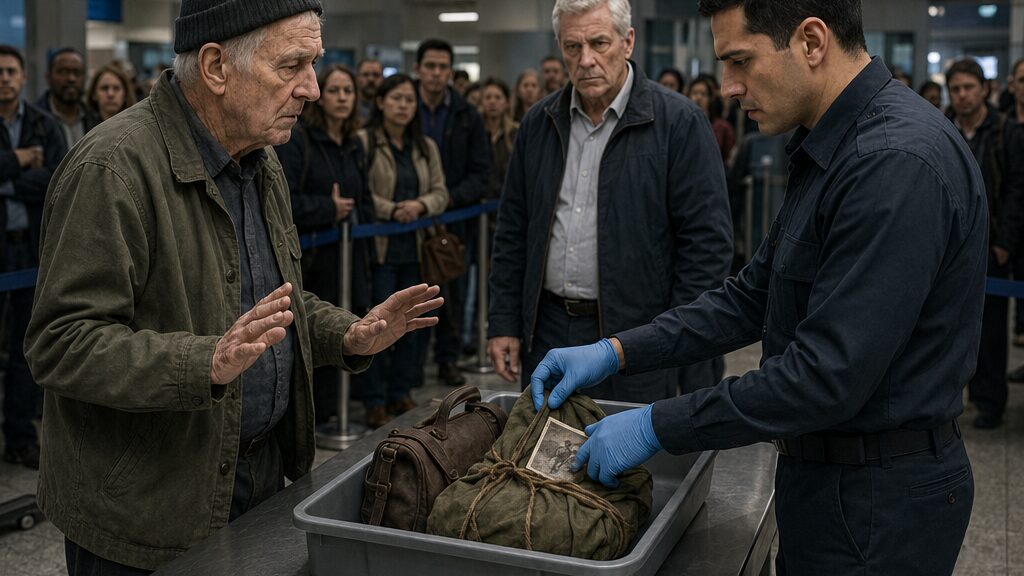
The scissors closed around the rough cord.
“Please don’t cut that,” Frank Campbell said.
The officer’s blue-gloved hand stopped, though the steel blades remained open against the faded fibers. Behind Frank, the security line shifted with the restless scrape of shoes and wheeled bags. Someone sighed loudly enough to be heard. A child asked why the old man was taking so long.
Frank kept his hands open beside the gray inspection bin.
The bundle lay between them, folded from olive cloth gone pale along its creases. The cord crossed it four times and disappeared beneath a knot darkened by years of handling. It had survived three apartments, a flooded basement, and every move Frank had made since leaving the Army.
The young officer looked from the bundle to Frank.
“You told me you packed this bag yourself.”
“I did.”
“But you can’t tell me what this is.”
“I can tell you.” Frank swallowed. “I’d rather not do it here.”
The officer’s badge read RAMIREZ. His face was younger than Frank had first noticed, but strain had pulled tight lines around his mouth. He glanced at the line, then toward the supervisor standing two lanes away.
“We’re already in secondary screening, sir.”
“There’s a room behind that wall.”
“That’s for cases requiring private screening.”
“This does.”
A business traveler near the rope barrier checked his watch and shook his head.
Kevin Ramirez heard it. His jaw tightened.
“The scan showed dense metal components and layered material,” he said, louder now. “I need to inspect the contents.”
Frank looked at the scissors again. His right hand trembled once. He brought it against his thigh until it stopped.
“You can inspect it,” he said. “Let me untie it.”
Kevin did not move the blades away. “Step back from the table.”
Frank stepped back.
The humiliation was not in being searched. He understood searches. Rules existed because people had learned how to hide danger inside ordinary things. The humiliation was in the way the officer had raised his voice, as though age had made Frank deaf or resistance had made him stupid.
Kevin lifted one corner of the cloth. The bundle gave no sound.
“What kind of metal is inside?”
“Nothing dangerous.”
“That isn’t what I asked.”
Frank watched a mother in line turn her child’s face toward another lane. The business traveler leaned sideways, trying to see into the bin.
Frank could have said veteran. He could have named the branch, the years, the field hospital. He could have watched the word move through the line and change how people stood around him.
Instead he said, “Old things.”
Kevin’s eyes hardened. “Old things still show up on a scan.”
He set the scissors down but did not surrender the bundle. With both gloved hands, he tested the knot. The cord had been made to release under pressure from one direction, but only if the person knew where to press.
Frank did.
“Let me,” he said again.
Kevin pulled at the wrong loop. The knot tightened.
The old cloth drew inward, and something hard shifted inside with a muted click.
Kevin looked toward the scanner display. A second officer enlarged the image. Irregular white shapes appeared inside the dark outline: a circular disk, a narrow metal bar, two smaller fragments overlapping near the edge.
“Multiple metal objects,” Kevin said. “Unidentified.”
Frank felt the time on the departure board moving without him. His flight began boarding in thirty-eight minutes. The memorial started the next morning. He had chosen the first flight because delay had become too easy a habit.
“It’s a medal,” he said.
The line behind him quieted in small, uneven degrees.
Kevin’s expression changed, but only slightly. “What else?”
“A photograph. A letter. Cloth.”
“What kind of medal?”
Frank looked down at his empty hands. “Service.”
“You served?”
“That shouldn’t matter to this.”
Kevin’s cheeks colored. “I didn’t say it did.”
“No,” Frank said. “You didn’t.”
The supervisor approached and stood at Kevin’s shoulder.
“Problem?”
“Passenger won’t clearly identify the contents.”
“I identified them.”
Kevin turned. “You said ‘old things.’”
Frank saw the warning in the supervisor’s eyes—not concern for him, but concern that a delay was becoming visible. Every stalled traveler was a mark against somebody.
The supervisor asked, “Are you refusing inspection, sir?”
“No.”
“Then Officer Ramirez will proceed.”
“In private.”
The supervisor looked toward the line, then at Frank’s worn brown bag, his knit cap, the sleeves of his olive jacket polished thin at the cuffs.
“No indication private screening is required.”
Frank almost laughed. Not because anything was funny, but because the sentence placed the decision inside a rule instead of inside a person.
Kevin picked up the scissors again.
Frank leaned forward before he could stop himself. Two officers shifted instantly. His palms rose.
“I said I would open it.”
Kevin froze.
For one second, everyone seemed to see only the old man who had moved toward a security officer.
Frank stepped back.
“Please,” he said. “The cord has to stay with it.”
Kevin’s grip loosened. “Why?”
Frank could not answer without beginning the whole journey too soon.
The supervisor exhaled. “Let him untie it. Keep his hands visible.”
Kevin slid the bin forward.
Frank touched the cord. The fibers were dry and rough beneath his thumb. His fingers remembered the motion even when the rest of him resisted it: hold the crossing loop, press beneath the second turn, pull toward the body.
The knot opened halfway.
A corner of a black-and-white photograph slipped from the cloth and fell face down into the tray. Beneath it, a dull bronze edge caught the fluorescent light.
Someone behind the barrier whispered, “It’s a medal.”
Frank’s stomach tightened.
He had spent years keeping that bronze disk away from curious hands. Now it lay exposed beneath airport lights, close enough for strangers to build whatever story they wanted around it.
Kevin’s manner shifted from accusation to caution. He reached toward the photograph.
“Don’t,” Frank said.
The sharpness in his own voice surprised him.
Kevin stopped.
An older man in a dark airport-volunteer jacket had moved out of the nearby assistance lane. He was broad-shouldered, with silver hair and a visitor badge clipped neatly to his lapel. He did not look at the medal.
He looked at the knot.
“That isn’t a storage knot,” the man said.
The supervisor turned. “Sir, please remain outside the screening area.”
The man obeyed the boundary but not the dismissal.
“It’s a medic’s quick-release wrap,” he said. “Field cloth, too. You press under the crossing loop so it can be opened one-handed.”
Frank’s fingers remained on the loosened cord.
The man’s gaze settled on him rather than on the officers.
“Who tied this for you?”
Chapter 2: A Photograph Face Down in the Tray
Kevin turned the photograph over before Frank answered.
Two young men stood in front of a canvas medical tent, both thin beneath rolled sleeves, both squinting into hard sunlight. One was Frank at twenty-four, his left arm in a sling. The other man had a wide, crooked smile and one hand resting on Frank’s good shoulder.
Kevin held the photograph by its edges.
“Which one is you?”
Frank pointed to the man with the sling.
“And the other?”
“Eric Jackson.”
The older volunteer remained outside the marked boundary. “I’m Andrew Scott,” he said quietly. “I work with traveling military families. Not security.”
Frank nodded without looking up.
Kevin examined the photograph, then the objects still nested inside the cloth. “Who does the bundle belong to?”
Frank could feel the answer in his throat, where it had remained for years in different forms.
“A man who never came home.”
Kevin’s gaze moved to the medal. “Eric Jackson?”
Frank said nothing.
The supervisor stepped closer. “Sir, we need direct answers.”
“They are direct.”
“No,” Kevin said, and his frustration returned. “They’re incomplete.”
He lifted a narrow metal identification strip from the fold. The stamped letters were worn but readable.
CAMPBELL, FRANK.
Kevin set it beside the photograph.
“This has your name.”
“It was mine.”
“And the medal?”
Frank looked at the circular bronze shape beneath its faded ribbon. Only one side was visible.
“That goes with the bundle.”
“That isn’t an answer either.”
The cord lay across the edge of the tray. One strand had been nicked by the scissors. It had not broken, but pale fibers had opened like a small wound.
Andrew noticed Frank staring at it.
“Could you finish the inspection behind the divider?” he asked the supervisor. “You have the authority.”
The supervisor’s expression cooled. “You don’t work this checkpoint.”
“No. I work with people after checkpoints have reminded them they’re cargo.”
A few passengers heard. The business traveler looked away.
Kevin lowered his voice. “Mr. Scott, please don’t interfere.”
Andrew’s face tightened, not with anger but recognition of his own mistake. “You’re right.” He turned to Frank. “Do you want me to stay?”
Frank had spent enough of his life allowing other men to answer on his behalf.
“Yes,” he said. “But don’t explain me.”
Andrew nodded once.
The supervisor looked at the growing line, then pulled a folding privacy divider around the secondary table. It was no room, only three fabric panels that blocked the crowd’s view. Still, the noise outside changed. Frank could no longer see the people watching.
The remaining inspection became quieter and somehow more exact.
Kevin swabbed the cloth, the metal strip, and the medal. He opened the worn brown bag’s seams and checked the lining. He did not tug at the letter tucked beneath the photograph.
A boarding announcement sounded overhead.
“Final boarding for Flight 218.”
Frank checked the gate number on his pass.
Kevin heard the announcement. His hands paused.
“That yours?”
“Yes.”
The supervisor looked at the test strip processing in the machine. “We can’t release anything until the result clears and the report is completed.”
Frank nodded.
“You may miss it,” Kevin said.
“I know.”
Something in Kevin’s face suggested he wanted Frank to protest. A complaint would have returned them to familiar positions: officer and difficult passenger, rule and resistance.
Frank only watched the test strip.
It cleared.
Kevin repacked the objects under Frank’s direction. Photograph first. Letter beneath it. Metal strip along the fold. Medal last.
When Kevin turned the medal, its reverse caught the light. Frank shifted his hand over it before the engraved edge could be read.
Kevin noticed.
He said nothing.
Frank wrapped the olive cloth and retied the damaged cord. His fingers lacked their earlier precision. The knot sat crooked.
“You want help?” Andrew asked.
“No.”
Frank tightened it until the fabric compressed.
The supervisor completed the report. “You’re cleared.”
Kevin placed the bundle into Frank’s bare hands. The gesture was careful now, almost formal, but Frank did not mistake care for repair.
Kevin said, “I’m sorry about the delay.”
Frank looked at the gloved hands, then at his bundle.
“You had a private option,” he said.
Kevin’s eyes lowered. “Yes.”
Frank put the bundle inside the bag.
He did not thank him.
By the time he reached the gate, the door had closed. The aircraft remained visible through the window, connected to the jet bridge, close enough to make the refusal feel personal.
The airline desk agent typed while Frank stood before her, breathing through the ache in his knees.
“The security delay is documented,” she said. “I can rebook you without a fee.”
“What gets me to Dayton before nine tomorrow morning?”
She searched again.
Andrew had followed at a distance. He remained several chairs away, giving Frank the chance to send him off.
The agent frowned at the screen. “There’s a connection tonight, but the second leg is full. The next confirmed seat arrives at eleven forty-five tomorrow.”
“The memorial starts at ten.”
“I’m sorry.”
“What about standby?”
“You could try. I can put you on the first flight, but there’s no guarantee on the connection.”
Frank rested the brown bag against his leg.
For seventeen years, he had found respectable reasons not to arrive. Work. His wife’s illness. His own surgery. A letter lost beneath unopened bills. Then no reason at all except that each year of silence made the next harder to cross.
The agent waited.
“If I don’t make the connection?”
“There’s an overnight shuttle from the regional airport. It’s a long ride, and you’d have to arrange it yourself.”
Frank looked through the glass as the jet bridge pulled away from his missed flight.
The agent softened her voice. “I can also ship your bag to your destination.”
“No.”
“The next confirmed seat is the safest option.”
Safest.
He had treated that word like a virtue for too long.
“Put me on standby.”
She printed two boarding passes and slid them toward him.
As Frank picked them up, the departure board changed. The next possible route would arrive after Eric Jackson’s memorial had already begun.
Chapter 3: The Call Frank Had Avoided for Years
“I thought you had decided not to come again.”
Laura Jackson’s voice reached Frank before he managed a greeting.
He stood in a narrow chapel alcove between the airport concourse and a row of vending machines. The room held four padded chairs, a wooden table, and no religious symbol except the silence people brought inside.
“I’m at the airport,” he said.
“That wasn’t what I said.”
“My first flight left without me.”
“Of course it did.”
There was no surprise in her answer. That hurt more than anger would have.
Frank placed the brown bag on the chair beside him. The bundle pressed against its worn leather side.
“There was a delay at security.”
“How long?”
“Long enough.”
Laura was silent.
He could hear voices on her end, chairs being moved, something metallic dropped and picked up. The memorial hall. People preparing the room her father’s photograph would occupy.
“I may still get there,” Frank said.
“May?”
“I’m on standby.”
“The service is at ten.”
“I know.”
“You’ve known for four months.”
Frank closed his eyes.
The cord had loosened during the walk from the gate. He pulled the bundle from the bag and laid it across his knees. His fingers tried to restore the medic’s knot, but the damaged strand slipped. The tremor in his right hand tightened the wrong loop.
“Mail the things,” Laura said.
“No.”
“They’ve waited fifty-two years. A few more days won’t insult them.”
“They’re not things.”
“Then stop carrying them around like punishment.”
Frank’s hand stopped.
The concourse announcement outside the alcove was muffled by the door. A woman laughed as she passed. Somewhere a cart beeped while backing up.
“I want to give them to you,” he said.
“You wanted to give them to me when I was thirty-four. Then you stopped answering.”
“That isn’t why—”
“You wrote every Christmas for fourteen years. You remembered my children’s birthdays. You told me what my father cooked when he was homesick and what songs he ruined because he never knew the words. Then I asked one question you didn’t like.”
Frank looked at the crooked knot.
“I didn’t know how to answer.”
“You knew how not to.”
The words landed without force. Laura had carried them too long to need emphasis.
Frank placed the phone on speaker and used both hands on the cord.
The crossing loop had gone flat. Eric would have fixed it in seconds, probably while telling Frank he was tying it like a man trying to strangle his own lunch.
Frank could nearly hear the laugh that followed.
Laura said, “What exactly is in the bundle?”
“You know about the photograph.”
“I know you have one.”
“And some field cloth. His identification strip.”
A pause.
“The medal?”
Frank’s thumb pressed too hard against the cord.
“Yes.”
“I don’t want it.”
“It should be with you.”
“No. It should be wherever it belongs.”
“It belongs with your father’s things.”
“You told me years ago it was yours.”
Frank’s shoulders went still.
He had forgotten that letter. Or had chosen to forget it so completely that the choice now resembled age.
Laura continued. “You said they put your name on it because you were the one who came back. I was nineteen when I read that. I thought you were being modest.”
Frank retied the bundle with an ordinary square knot. It looked wrong. Too rigid. No release hidden inside it.
“It wasn’t modesty.”
“What was it?”
He watched his open hand rest on the olive cloth.
“Not over the phone.”
“That answer is why we’re here.”
Frank drew a breath. “There’s a letter.”
“From you?”
“From him.”
The movement on Laura’s end stopped.
“What letter?”
“Your father’s last one.”
“You said there wasn’t one.”
“I said I never received one for you.”
“That is not the same sentence.”
“No.”
“Have you read it?”
“It’s sealed.”
“For me?”
Frank looked toward the fold where the envelope lay protected beneath cloth.
“I believe so.”
“You believe so?”
“I never opened it.”
Laura’s breath changed. Not a sob. Something smaller and more controlled.
“You had a letter from my father all this time.”
“I had the bundle. I didn’t know what was in every fold when I first brought it home.”
“But you knew later.”
“Yes.”
“How much later?”
Frank did not answer quickly enough.
Laura said, “Years?”
“Yes.”
“And you still stopped writing.”
The cord cut into his fingers.
He had imagined this call many times. In some versions, Laura heard his voice and softened. In others, she refused to speak. He had never imagined the exact cruelty of being allowed to continue.
“The memorial will go on without you,” she said. “Mail the photograph and the letter. Keep the medal.”
“I’m coming.”
“Why now?”
“Because I should have before.”
“That isn’t an answer. That’s a sentence people use when they don’t want to name what they did.”
Frank stared at the bundle on his knees. At security, he had protected it from scissors, gloves, and strangers. Here, alone, it seemed less like something he had preserved than something he had kept closed.
“I thought bringing it would be enough,” he said.
“For what?”
He had no honest answer that did not make him smaller.
“For me to stand there,” he said at last.
Laura was quiet for several seconds.
Then she asked, “Did my father tell you to leave him there?”
Chapter 4: The Name Engraved Beneath the Ribbon
Andrew noticed the engraving when the medal slipped against the metal table.
“Frank,” he said, “that’s your name.”
They stood in a storage room behind the airport veterans’ lounge, a narrow place crowded with folded wheelchairs, bottled water, and boxes of donated paperbacks. Andrew had found it after Frank ended the call with Laura without answering her question.
The medal lay on the olive cloth beneath a fluorescent tube. Its ribbon had faded unevenly, but the letters along the lower rim remained clear.
FRANK CAMPBELL.
Andrew looked at him. “You said the bundle belonged to Eric.”
“It does.”
“The cloth may. The photograph may. This doesn’t.”
Frank reached for the medal.
Andrew did not stop him, but neither did he look away.
Frank turned the engraved side downward. “They put my name on it.”
“That is generally how medals work.”
“You don’t know what happened.”
“No.” Andrew leaned against a carton marked HYGIENE KITS. “Because you answer every question with half a sentence and expect people to respect the half you keep.”
Frank folded the ribbon over the bronze disk.
The words stung because they resembled Laura’s without sounding like them. He had imagined Andrew as an ally when the older man recognized the knot. Now Andrew’s attention felt less comfortable than Kevin’s suspicion. Kevin had wanted to know whether the bundle was dangerous. Andrew wanted to know why Frank kept arranging the truth so that no one could touch it.
Frank wrapped the medal in one corner of the cloth.
Andrew said, “Did Eric earn it?”
“Yes.”
“Officially?”
“No.”
“Then what does that mean?”
Frank’s fingers pressed into the fabric. “He found the route.”
Andrew waited.
“There was a wash behind the clinic,” Frank said. “Dry most of the year. The road was blocked, and the eastern path was exposed. Eric had walked the wash two days before. He knew where it narrowed and where a litter could pass.”
“And you led people through it?”
Frank’s gaze remained on the bundle. “I took them through.”
“How many?”
“That isn’t the point.”
“It might be part of it.”
“Eleven wounded. Three civilians helping us move them.”
Andrew’s expression softened, and Frank disliked him for it.
“Don’t,” Frank said.
“Don’t what?”
“Turn me into what they did.”
Andrew straightened. “What did they do?”
“They wrote one man into the report because one man came out where the officer could see him.”
The storage-room door opened. An airline desk agent leaned inside.
“Mr. Campbell? We may have one standby seat on the connection. I need you at the service desk now.”
Frank gathered the cloth, but Andrew reached for the cord.
“You’ve got it crossed wrong.”
“I can manage.”
“The damaged strand will pull through.”
Before Frank could object, Andrew folded the cloth firmly and rebuilt the medic’s knot. His hands moved with practiced familiarity but not a medic’s speed.
“My son used to tie equipment this way,” Andrew said. “I learned after he came home. He said ordinary knots made him feel trapped.”
Frank watched the final loop settle into place.
Andrew offered the bundle back.
Frank took it, then immediately pulled the release. The knot opened in Andrew’s hands.
“I didn’t ask you to close it,” Frank said.
Andrew stared at the loose cord. “Fair enough.”
At the service desk, the agent spoke rapidly while checking the monitor.
“One seat opened, but there’s a complication. A mother and her child are also listed. The child has a medical appointment tomorrow. Their booking was separated after a cancellation.”
Frank saw them ten feet away. The mother held a paper cup under the boy’s mouth while he swallowed a pill. A small mask hung under his chin. Their bags were piled around their shoes.
The agent lowered her voice. “You were listed first because of the documented security delay. The seat is yours if you take it.”
Andrew said nothing.
Frank looked at the departure screen. This flight connected to the last regional departure of the night. If he boarded, he could reach the memorial before ten. If he gave it up, the mother and child might still travel together only if another passenger failed to appear.
The boy leaned against his mother’s arm.
Frank pushed the boarding pass back.
“Put them together.”
The agent hesitated. “Mr. Campbell, there may not be another seat.”
“I heard you.”
The mother looked over, realizing what was being discussed. “Sir, please. We can manage.”
Frank picked up his bag. “So can I.”
Her face tightened with gratitude he did not want to receive. He turned before she could offer it.
Andrew followed him toward the lounge.
“That was decent,” he said.
“It was a seat.”
“It was also your last clean way to arrive on time.”
Frank stopped beside an empty row of chairs. “Do you think that makes the rest clean?”
“No.”
The answer came without comfort.
Frank sat and placed the bundle between his feet. Andrew remained standing.
“The route was Eric’s,” Frank said. “The decision to use it was Eric’s. The order to move was Eric’s.”
“But you got them out.”
“I followed the path he gave me.”
“And the report?”
“Compressed it.”
“Did you correct anyone?”
“I was in a hospital when the citation was written.”
“That wasn’t my question.”
Frank rubbed the nicked strand of cord between thumb and forefinger.
Months after the hospital, an officer had visited him with typed pages and a polished box. Frank had read Eric’s name once in the narrative, buried beneath phrases about supporting personnel. He had told himself he would send a correction when his hand stopped shaking. Then when he returned to work. Then after Eric’s family had been notified properly.
The ceremony came first.
He had stood because they told him to stand.
“I wrote a statement,” Frank said.
“What happened to it?”
“I never sent it.”
Andrew sat across from him. “Why?”
“At first, because I didn’t know whether correcting the account would hurt Eric’s family. Later…” Frank looked toward the gate where the mother and child were boarding. “Later it would have looked like I was protecting myself from praise I had already accepted.”
Andrew reached toward the medal but stopped before touching it.
“So you began saying it belonged to Eric.”
“It does.”
“No.” Andrew’s voice stayed level. “The plan may have been his. The medal may tell the story badly. But your name is on it, and you carried people out. Calling it his lets you hide inside guilt and call that honesty.”
Frank’s hand closed around the bronze disk.
Andrew stood.
A shuttle schedule was posted near the lounge entrance. The overnight route left from the regional terminal in forty-five minutes. It would take nearly nine hours with transfers, but it could put Frank within thirty miles of the memorial by morning.
Andrew copied the number onto the back of Frank’s unused boarding pass.
“You can still go,” he said.
Frank put the medal inside the cloth.
Andrew caught his wrist lightly, then released it.
“Then stop telling everyone it belongs to a dead man.”
Chapter 5: The Letter Inside the Field Cloth
The second envelope appeared when the shuttle struck a pothole and the loosened bundle slid from Frank’s lap.
He caught it against the seat before it reached the floor. The olive cloth opened along one fold, and a small yellowed envelope slipped from a hidden pocket in the fabric.
Frank stared at the handwriting.
CAMPBELL.
Not Laura. Not Jackson.
His own name.
The overnight shuttle carried six passengers through dark highway towns, its interior lit by dim blue strips above the windows. The driver had warned them that the transfer terminal would close its waiting room at midnight. Frank had planned to keep the bundle tied until morning.
Now the cord was looped around his wrist, and the unknown letter rested in his palm.
He turned it over.
The seal was intact.
Eric’s handwriting had always leaned forward, as though the words were walking into wind. Frank recognized the heavy downstroke of the C and the way Eric refused to close the top of an A.
The photograph and Laura’s letter had been stored beneath the main fold. This envelope had been stitched into the cloth pocket, hidden flat against a faded brown stain.
Frank tried to remember whether he had ever examined that seam. He had washed the cloth once, by hand, decades ago. He had dried it across two chairs in his apartment and sat watching until dawn, afraid the fabric might shrink around whatever remained inside.
He had protected it without knowing it.
At the roadside transfer terminal, the driver unlocked a small room containing molded chairs, a vending machine, and a wall clock that ran three minutes slow. The other passengers settled with coats folded beneath their heads.
Frank sat beneath the brightest light.
The envelope yielded with a dry crack.
Inside was a single page.
Frank—
If this reaches you, then you are probably angry with me, which means you are alive enough to be inconvenient.
Frank stopped reading.
The old humor did not soften the words. It made the room tilt.
He placed the page on the cloth and walked to the vending machine, though he did not want anything. In the dark glass, he saw his own reflection layered over rows of chips and candy: knit cap, hollow cheeks, shoulders still held as if someone might inspect his posture.
He returned to the chair.
Eric’s letter continued without ceremony.
The road will be the first thing they block. Use the wash if you have to move people. You know where it narrows. Do not waste time arguing with me if I tell you to go.
Frank gripped the page.
The wash had been Eric’s idea, but the letter proved something more difficult: Eric had considered the possibility before the final attack. He had not improvised the order out of panic. He had prepared Frank to obey it.
The next paragraph was shorter.
Laura will hear a hundred clean versions of whatever happens here. Do not add another. Tell her I complained, cheated at cards, burned coffee, and was afraid when fear made sense. Look after her if she lets you. Do not turn me into a shrine.
Frank lowered the letter.
A passenger across the room shifted beneath his coat. The clock clicked forward.
For years Frank had imagined that preserving Eric’s objects honored him. He had kept the photograph free of moisture, polished the identification strip with a cloth, protected the medal from tarnish, and carried the bundle through every move.
A shrine did not require stone. Sometimes it was only an unopened letter and a man who called silence loyalty.
Frank read the final lines.
You do not owe me your life because I asked you to save someone else’s. If you come home, live where people can reach you.
—Eric
Frank folded the page along its old crease.
The memory he had kept at a distance returned without asking permission: Eric kneeling beside a litter, one sleeve dark to the elbow, pointing toward the wash. Frank’s left arm hung useless. Smoke had flattened the daylight. Two patients could not be moved without equipment they no longer had.
“Take the walking wounded and go,” Eric had said.
Frank had refused once.
Eric had grabbed the front of his shirt.
“That is an order only because you’re too stubborn to hear it as sense.”
Frank had gone.
The official report later described him as identifying an alternate evacuation route under fire. It mentioned that another medic remained at the clinic. It did not say Eric had mapped the route, prepared for the blockage, and forced Frank to use it.
But Eric’s letter did not ask Frank to spend his life correcting one report.
It asked him to remain reachable.
Frank took out his phone.
Laura’s number sat at the top of his recent calls. Beneath it were years of absent calls that the screen could not show.
He had written to her when she entered college. When she married. When her first child was born. He had answered questions about Eric’s food, music, temper, and handwriting. Then she had asked whether her father knew he would be left behind.
Frank had drafted six replies.
None had been sent.
He had told himself that a wrong answer would damage her. The truth was less honorable. He feared that the right answer would change how she saw him, and he had preferred being remembered as the kind veteran who kept her father alive in stories.
The terminal loudspeaker announced that the next shuttle would board in twenty minutes.
Frank called.
Laura answered after five rings.
“Where are you?”
“A transfer station outside Columbus.”
“You took the overnight shuttle?”
“Yes.”
“You should have waited for the morning flight.”
“I’ve waited enough.”
She did not respond.
Frank looked at Eric’s letter.
“I found something inside the cloth,” he said. “A letter addressed to me.”
“From my father?”
“Yes.”
“Did you read it?”
“I did.”
“You opened it tonight?”
“Yes.”
Another pause.
“What did he say?”
Frank could have read the lines that absolved him. You do not owe me your life. He could have offered them first, like evidence.
Instead he said, “He asked me to look after you if you let me.”
Laura’s breathing remained steady.
“You didn’t.”
“No.”
“You wrote for years.”
“And then I stopped when you asked me to tell the part that frightened me.”
“What part?”
Frank folded the letter and placed it over the photograph.
“The worst thing I did happened years after your father died.”
Chapter 6: Laura Would Not Take the Medal
Laura left the medal in Frank’s open palm.
They stood beside a folding table at the rear of the community memorial hall. Volunteers were arranging photographs on easels and testing a microphone at the front. Through an open doorway came the muted clatter of coffee urns and serving trays.
Frank had arrived eighteen minutes before the service.
He had not slept.
Laura looked older than the last photograph he had received, though not in the ways he had expected. Her hair was shorter. Her face carried the same narrow concentration Eric wore while cleaning a wound. She had hugged Andrew when he introduced himself outside, thanked the shuttle driver, and given Frank only enough space to enter.
He placed the tied bundle on the table between them and opened it.
Photograph. Identification strip. Two letters. Medal.
When he offered the medal, she did not close her fingers.
“I told you I don’t want that.”
“It should be here.”
“Here is not the same as mine.”
Frank lowered his hand, but he did not put the medal away.
Laura picked up the photograph. Her thumb moved once over Eric’s crooked smile.
“You were both younger than my son is now.”
“Yes.”
“Did he know this picture existed?”
“He complained they caught his bad side.”
“Which side was that?”
“He said both.”
The corner of Laura’s mouth moved and vanished.
Frank touched the cord. He had tied the bundle loosely during the final shuttle ride. The square knot from the airport was gone, but he had not restored Eric’s quick-release wrap.
Laura set the photograph down.
“You said the worst thing happened later.”
“Yes.”
“How much later?”
“Fourteen years after I came home.”
Her eyes narrowed. “When you stopped writing.”
Frank nodded.
Laura opened her handbag and removed a clear plastic sleeve. Inside was an old letter, folded into quarters. Frank recognized his own handwriting before she placed it on the table.
The last letter he had sent her.
“You wrote that you would answer anything I asked,” she said.
“I remember.”
“No, you remember saying it. I’m not sure you remember what I asked.”
She removed a second sheet from behind his letter. It was covered in her younger handwriting.
Frank did remember.
Did he know you were leaving? Was he alone when you made the decision? Did he ask you to stay?
Laura tapped the final line.
“I waited seven months. Then I wrote again. Then Christmas came, and for the first time since I was six, there was no card from you.”
Frank held the medal flat in his palm. Its weight had never changed. Only the stories around it had.
“I thought answering would make me ask you to forgive something you hadn’t accused me of.”
“That is a very careful sentence.”
“It is.”
“And careful sentences kept you comfortable.”
“No.” Frank looked at her. “They kept me hidden.”
The memorial coordinator passed behind them carrying a folder.
“Mr. Campbell, we’ll introduce you after the family remembrance. We have the citation excerpt Laura sent years ago.”
Laura’s head turned. “I forgot that was still in the program.”
The coordinator smiled uncertainly. “It’s a strong account. The evacuation through the riverbed?”
“Wash,” Frank said.
“Of course. We’ll say wash.”
When the coordinator left, Laura looked at the medal again.
“You could have corrected the citation any time.”
“Yes.”
“Why didn’t you?”
“At first I was injured. Then I was embarrassed. Then people had already repeated it so often that correcting them felt like asking for a different kind of praise.”
“And later?”
“Later I used your father to punish myself.”
Laura’s expression hardened. “Do not make him responsible for that.”
“I’m not.”
“You keep saying the medal belongs to him. You keep carrying his things. You disappear and call it guilt. Every version puts him between you and your choices.”
Frank closed his fingers around the medal.
At the airport, Kevin’s gloves had exposed the objects in front of strangers. Here, Laura exposed the arrangement Frank had built around them.
“He was not alone when the decision was made,” Frank said.
Laura went still.
Frank continued before silence could rescue him.
“I was with him. Two patients could not be moved. The road was blocked, and he had already planned the wash route. He told me to take everyone who could travel.”
“Did he know he would die?”
“He knew he might.”
“Did he tell you to leave?”
“Yes.”
The word remained between them, plain and insufficient.
Laura looked down at her old letter.
“And after?”
“I obeyed him in the field.” Frank opened his hand again. “I disobeyed him for the rest of my life.”
She glanced at Eric’s letter. “What did he tell you?”
“To live where people could reach me.”
Laura pressed both palms against the table.
“You don’t get to arrive after seventeen years and turn one honest morning into a repaired life.”
“I know.”
“Do you?”
“I’m beginning to.”
Voices gathered in the hall. Former unit members took seats near the front. A large photograph of Eric had been placed beside a simple arrangement of white flowers. He was older in that picture than in the one from the field, but still wearing the same crooked smile.
Laura lifted Eric’s letter.
“Is this mine?”
“The envelope addressed to you is. The other was written to me.”
“Will you read yours during the service?”
“Only if you want me to.”
“I don’t know what I want you to do.”
Frank placed the medal on the cloth instead of offering it again.
“I can tell them the prepared account is incomplete.”
“And then what? They decide you’re humble? They decide my father was the real hero? They choose one man again because two are harder to remember?”
Frank looked toward the chairs filling at the front.
“No,” he said. “I tell them what happened. I don’t tell them what to think of us.”
Laura studied him.
The memorial coordinator approached the microphone. A soft burst of feedback crossed the room. Conversations quieted.
Laura gathered the photograph and both letters but left the medal where it lay.
“You’ll have one chance,” she said. “Not to make yourself innocent. Not to make him perfect.”
Frank lifted the bundle and followed her toward the front row.
The coordinator welcomed the attendees, spoke briefly about Eric’s years of service, and then opened the folder containing the prepared citation.
“Our final remembrance comes from Frank Campbell, whose extraordinary leadership identified an alternate evacuation route and saved fourteen lives when—”
Frank rose before she could finish.
Chapter 7: Frank Corrected the Story Without Defending Himself
“Please stop,” Frank said.
The memorial coordinator looked up from the citation. Her finger remained beneath the line describing Frank’s extraordinary leadership.
The room had gone quiet enough for Frank to hear the faint rattle of the medal inside the folded field cloth.
He walked toward the front carrying the bundle with both hands. Laura sat in the first row, the photograph and letters resting in her lap. She did not encourage him. She did not look away.
The coordinator moved aside from the microphone.
Frank placed the olive cloth on the lectern.
“My name is Frank Campbell,” he said. “The account you were about to hear has my name in it. That does not make all of it mine.”
A chair creaked near the back. One of the former unit members leaned forward.
Frank found the loose end of the rough cord.
At the airport, blue-gloved hands had pulled at the wrong loop while strangers watched. Here, no one touched the bundle but him. He pressed beneath the crossing strand and drew the cord toward his body.
The knot released.
He unfolded the cloth slowly. The medal appeared first, followed by Eric’s identification strip and the empty space where the photograph and letters had rested.
“The citation says I identified the evacuation route,” Frank continued. “Eric Jackson identified it. He walked the wash two days earlier. He measured where the litter teams could pass. He warned us the road would be the first route blocked.”
The memorial coordinator lowered the folder.
Frank lifted the medal by its faded ribbon.
“My name is engraved here because I led the wounded through that wash.”
He did not say only. The word would have been another kind of lie.
“There were eleven wounded men and three civilians. I brought them out. That part happened. But Eric planned the route, gave the order, and stayed behind with two patients we could not move.”
A former unit member rose halfway from his chair.
“That’s right,” he said. His voice was rough with age. “Jackson gave the order. I heard him.”
Several heads turned toward the man.
Frank looked at him. “Thank you.”
The confirmation loosened something in the room, but Frank did not let it loosen him.
“That does not finish the story,” he said.
The former unit member sat.
Frank placed the medal on the unfolded cloth.
“The report was written while I was in a hospital. I read it later. I knew it had made one man’s action out of two men’s decisions. I drafted a correction.”
He rested both hands on the lectern.
“I did not send it.”
No one moved.
“I told myself Eric’s family had already suffered enough. I told myself correcting the report would look ungrateful. Later I told myself it was too late.”
He glanced at Laura.
“Those explanations sounded honorable when I kept them to myself.”
Laura’s face remained controlled, but one hand tightened around her father’s letter.
Frank took Eric’s page from the inner pocket of his jacket.
“He wrote to me before the final mission. I found this last night inside the field cloth. I will read one part, because Laura gave me permission.”
Laura gave the smallest nod.
Frank unfolded the page.
“Do not waste time arguing with me if I tell you to go,” he read. “Look after Laura if she lets you. Do not turn me into a shrine.”
His voice nearly failed on the next line, but he waited until it returned.
“You do not owe me your life because I asked you to save someone else’s. If you come home, live where people can reach you.”
Frank folded the letter.
“I followed his order that day. I did not follow the rest.”
The room no longer felt like an audience. It felt more difficult than that. It felt like people listening without being told what conclusion to reach.
Frank looked at Laura directly.
“For fourteen years, I wrote to you.”
“Yes,” she said from her chair.
“When you asked whether your father knew I was leaving, I stopped.”
Laura stood.
The movement drew every eye toward her, but her attention stayed on Frank.
“Why?”
The question sounded different in the hall. It was no longer protected by paper, telephone distance, or years.
Frank could have said trauma. He could have said shame, guilt, nightmares, or the difficulty of describing a battlefield to a daughter. All of those things were true.
None was the deepest truth.
“Because you trusted me,” he said. “And I was afraid the answer would change that.”
Laura’s face tightened.
“I thought you blamed me for surviving. I thought you might decide I had taken his plan, his place, and the praise that followed.”
“Did you?”
“I took the praise by failing to correct it.”
“That isn’t what I asked.”
Frank looked down at the medal.
“No,” he said. “I did not take his place. He ordered me to leave. I obeyed because there were people I could still move.”
“Then why disappear?”
Frank’s hands opened on either side of the cloth.
“Because being guilty was easier than being known accurately.”
The words left him with nothing noble to hide behind.
He continued, “If I stayed guilty, I could tell myself I was honoring him. If I answered you, I would have to admit that I wanted you to keep thinking well of me.”
Laura lowered her eyes.
Frank did not ask whether she understood. Understanding was not forgiveness, and forgiveness was not something he had earned by traveling through one difficult night.
“I am sorry I left you with questions your father trusted me to answer,” he said. “I am sorry I made my silence look like respect.”
The memorial coordinator stepped farther away from the microphone.
No one applauded.
Frank was grateful.
He lifted the photograph from Laura’s lap only after she released it. He placed it on the cloth beside the medal, Eric’s smiling face turned toward the room.
“The citation saved my name,” Frank said. “The photograph saved his face. Neither one tells enough.”
The former unit member stood again, slower this time.
“Campbell,” he said, “you carried me through part of that wash.”
Frank recognized him then—not by his aged face, but by the slight inward turn of his left foot.
“You walked the last mile,” Frank said.
“Because you made me.”
A few people smiled, but the sound died gently.
The man looked toward Laura. “Your father came up with the route. Frank got us through it. Both are true.”
Frank nodded. “Both are true.”
He did not use the testimony to clean himself. Eric’s plan and Frank’s action could share a sentence. So could Frank’s service and his failure afterward.
Laura walked to the lectern.
She picked up the photograph and Eric’s letter. Then she lifted the identification strip, turning it once in her hand.
The medal remained on the cloth.
“What do you want me to do with this?” Frank asked.
“I don’t know yet.”
“It can stay with you.”
“No.” Her voice was quiet. “Not until I know what keeping it would mean.”
Frank accepted that.
Laura folded her father’s letter and held it against the photograph.
“The display should name the people who came through the wash,” she said. “Not only the men who gave orders.”
Frank looked at the former unit members, then at the rows of Eric’s family and friends.
“Yes.”
“And it should say the route was my father’s.”
“Yes.”
“And that you led them out.”
Frank hesitated.
Laura’s expression sharpened. “Do not make me correct your version too.”
He lowered his head once. “Yes.”
She took the letters and photograph back to her seat.
The medal stayed between them on the unfolded field cloth, bearing Frank’s name beneath a story that no longer belonged to one man.
Chapter 8: The Cord Came Back Empty
The package contained only the rough cord and a folded note.
Frank stood at his kitchen counter with the opened envelope beneath his hands. Two weeks had passed since the memorial. Laura had not called, and Frank had not used her silence as an invitation to fill it.
He lifted the cord.
The nick from Kevin’s scissors remained visible, a pale fray interrupting the darkened fibers. Laura had wound it into a small circle without tying it.
Her note held four lines.
The display is finished. The medal is there with both names and the names of the fourteen people who came through the wash.
I kept the photograph and the letters.
You kept this closed long enough.
—Laura
Frank read it twice.
There was no promise of another visit. No forgiveness shaped into a comforting sentence. But she had not returned the medal, and she had chosen a history large enough to include Eric’s plan, Frank’s action, and the lives neither man had saved alone.
Frank slipped the cord into his jacket pocket.
That afternoon, he returned to the airport.
He had been asked to meet with the checkpoint supervisor regarding the complaint Andrew helped him file. Frank had delayed submitting it until he could write the central sentence without anger: The issue was not that my property was inspected. The issue was that privacy was available, requested, and denied for convenience.
The security line was shorter than before.
Frank stood outside the screening boundary while a different elderly traveler entered secondary inspection carrying a small black case. Kevin Ramirez waited beside the gray bin in blue gloves.
The traveler held the case against his chest.
“It contains my wife’s ashes,” he said.
Kevin did not reach for it.
He stopped with his hands several inches away.
“We will need to inspect the container,” he said. “Would you prefer that we do so behind the privacy divider?”
The traveler nodded.
Kevin turned to the waiting passengers. “This lane will pause briefly. Please use the open lane to your left.”
No raised voice. No public demand for details. No attempt to make speed look like authority.
Kevin pulled the divider into place and waited for the traveler to set the case down himself.
Frank remained where he was until the inspection ended.
The traveler emerged carrying the case with both hands. Kevin followed, noticed Frank, and went still.
For a moment, the younger man looked as he had when the medal first appeared in the tray: uncertain what story the object required him to believe.
Then he removed his gloves and approached.
“Mr. Campbell.”
“Officer Ramirez.”
Kevin glanced toward the supervisor’s office. “I heard you were coming.”
Frank nodded toward the divider. “You asked him.”
“Yes.”
“Before touching the case.”
“Yes.”
Kevin rubbed one bare thumb against the other. “The supervisor approved a revised privacy guideline. Personal memorial items, medical equipment, religious objects—anything a passenger identifies as sensitive. We ask before opening when the situation allows.”
“When the situation allows?”
Kevin accepted the challenge in the words.
“When there isn’t an immediate threat,” he corrected.
Frank looked through the glass panels toward the inspection table. The gray bins were the same. The fluorescent lights were the same. Rules had not become gentle merely because one officer had changed how he stood beside them.
Kevin said, “I wrote a statement about what happened.”
“I read it.”
“I included that you requested private screening.”
“You did.”
“And that I denied it.”
“Yes.”
Kevin’s jaw shifted. “The complaint office asked whether you wanted disciplinary action.”
“I told them that was their decision.”
“They also asked whether you would withdraw the complaint if the procedure changed.”
Frank drew the cord from his pocket and let it rest across his palm.
Kevin recognized it.
“Did you bring that for the meeting?”
“No.”
The frayed strand lifted slightly in the conditioned air.
Kevin looked at it, then at Frank. “I’m sorry I cut it.”
“You didn’t cut through.”
“I would have.”
“Yes.”
Kevin lowered his gaze.
Frank could have made the young man remain there beneath the weight of it. Part of him wanted Kevin to understand the exact cost of each choice: the missed flight, the public exposure, the way strangers had stared at the photograph before Laura touched it.
But Frank had spent too many years making punishment stand in for truth.
“The cord was not the worst part,” he said.
“I know.”
“Do you?”
Kevin looked toward the private divider.
“I thought treating everyone the same meant refusing exceptions. Three months before you came through, something prohibited passed my lane. I was warned that one more mistake could cost me the job. When you asked for privacy, I heard delay. When you didn’t answer cleanly, I heard concealment.”
“That explains it.”
“It doesn’t excuse it.”
“No.”
Kevin breathed out.
“Do you want the complaint withdrawn?”
Frank looped the cord once around his fingers, then freed them.
“The complaint was never about getting you punished.”
Kevin waited.
“It was about the next person asking once and being heard.”
Through the checkpoint, a mother lifted a stroller onto the belt. An officer moved forward to help only after she nodded permission.
Kevin said, “Then leave it open until they finish the review.”
Frank put the cord back into his pocket. “That was my plan.”
They shook hands without ceremony.
Kevin’s grip was careful, but not fragile. Frank appreciated that more than caution performed as reverence.
Before leaving the airport, Frank stopped at the veterans’ lounge. Andrew was helping a traveler print a boarding pass. He saw Frank but did not abandon the traveler to greet him. When he finished, he crossed the room.
“How did it go?”
“He asked before touching the case.”
Andrew smiled. “That sounds like something.”
“It is something.”
Andrew nodded toward Frank’s pocket, where one end of the cord showed. “Laura send that?”
“Yes.”
“Anything else?”
“A note.”
Frank did not offer it, and Andrew did not ask.
At home that evening, Frank opened the memorial website Laura had listed at the bottom of her note.
The display photograph showed the olive cloth spread beneath the objects. Eric’s picture stood at the center. The medal rested below it, accompanied by a card bearing two names: Eric Jackson and Frank Campbell.
Beneath them were fourteen smaller names.
No hero was printed larger than the others.
Frank studied the photograph until his eyes blurred.
Then he closed the page.
His worn brown travel bag stood beside the kitchen chair, empty except for the knit cap he had removed at the memorial. Frank took the cord and threaded it once around the handle.
His hands began the old quick-release knot.
He stopped before tightening it.
Instead, he made a single loose turn and tucked the end beneath itself. The cord would stay in place. It would also open with one hand.
Frank lifted the bag by its handle.
The knot held without closing anything inside.
The story has ended.