They Laughed at the Old Mechanic’s Warning Until the Memorial Engine Began to Shake
Chapter 1: The Warning Everyone Heard and Nobody Respected
“We are not delaying a Marine memorial because an old mechanic dislikes the sound of cooling metal.”
Captain Tyler Young said it loudly enough for everyone in the restoration bay to hear.
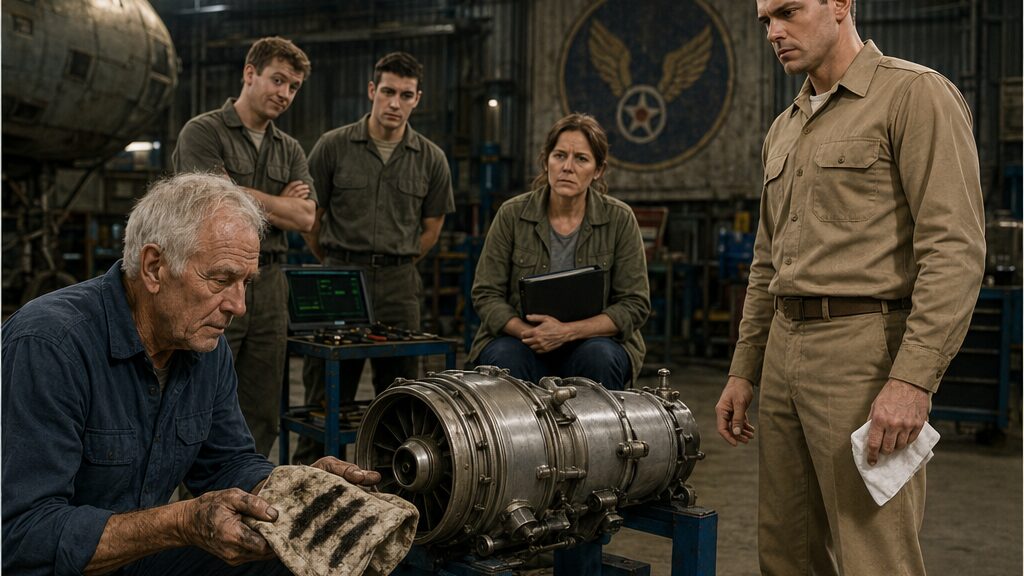
Edward Miller remained crouched beside the turbine starter assembly, one knee stiff against the concrete, two fingers resting lightly on the silver housing. Above him, Tyler’s tan uniform looked untouched by the grease, dust, and metal filings that had settled into every corner of Miller Aircraft Restoration.
One of the junior maintainers glanced toward the other. The second man lowered his eyes, but not before Edward saw the beginning of a smile.
Edward withdrew his fingers.
The cooling tick came again.
Too quick. Then a pause. Then a softer answer from deeper inside the housing.
On the far side of the blue engine stand, Elizabeth sat with the contract binder open across her lap. She had gone still when Tyler raised his voice. Behind her, the faded squadron emblem on the corrugated wall seemed almost colorless beneath forty years of shop dust.
Tyler held out a clean disposable cloth. “You said there was active oil migration.”
“There is.”
“Then show me.”
Edward pushed himself upright using the stand. His left knee took a moment to straighten. He ignored the impatience in Tyler’s face and picked up the stained shop rag from his back pocket.
He wiped the starter housing at three points.
First beneath the forward seal.
Then along the lower cooling rib.
Then near the rear mounting flange.
Each touch was brief. He folded the rag inward after every pass, keeping the marks separate.
Tyler watched as though waiting through a performance he had already judged.
Edward opened the folds across his palm. Three narrow oil smears darkened the cloth. The first was barely more than a crescent. The second had a feathered edge. The third ended in a distinct bead.
“They’re aligned,” Edward said.
“They’re residue.”
“They’re moving against the expected airflow.”
The civilian diagnostic technician leaned closer without stepping away from his cart. Two tablets showed green bars from the morning’s pressure and leak checks.
“Static pressure held,” the technician said. “No decay outside tolerance.”
Edward nodded once. “I saw the readings.”
Tyler took the rag between two fingers, studied the marks, and handed it back. “This assembly was cleaned before installation. There’s always residual oil after a rebuild.”
“Not in pulses.”
“You have measured pulse pressure?”
“No.”
“Recorded leakage?”
“No.”
“Borescope evidence?”
“Not yet.”
Tyler turned slightly, including the others in his patience. “Then what we have is a visual impression.”
Edward felt Elizabeth watching him. She wanted him to explain more. He knew that. She had been asking him to explain more for most of her life.
Instead, he crouched again and placed his fingers on the housing.
The younger maintainer who had almost smiled shifted his weight.
Edward waited.
The starter had not run since the previous afternoon, but the shop had warmed rapidly after sunrise. Aluminum and steel released heat differently. Most men heard random contractions. Edward heard spacing.
Seven seconds.
A tick sounded near the forward rib.
Four seconds.
A faint metallic answer came from the rear.
Edward looked at the junior maintainer. “The next one will come from under the lower flange. Six seconds.”
Tyler exhaled through his nose.
Five.
Six.
A sharp click sounded exactly where Edward had indicated.
The maintainer stopped smiling.
Edward stood again. “Something inside that housing is shifting the load as the metals change temperature.”
The diagnostic technician checked the screen as though the sound might have appeared there after all.
Tyler’s expression hardened. “Cooling contraction is not a failure mode.”
“No. But the interval can tell you where pressure settled before shutdown.”
“Captain,” Elizabeth said carefully, “my father rebuilt starter systems for—”
Edward looked at her.
She stopped.
He did not want his service record placed on the floor between them like a tool Tyler was required to admire. He had seen too many men become untouchable in their own stories. Past authority could not identify a present defect.
Tyler noticed the interruption. “Mr. Miller’s prior experience is not in dispute.”
His tone made clear that everything else was.
“The memorial committee expects certification by Thursday,” he continued. “The aircraft must be transferred to the base hangar that afternoon. We have four days, including today, to complete staged testing, correct any documented defects, and sign the release.”
Patrick Allen stood near the open bay door with both hands around the head of his cane. He had flown the trainer’s type before either junior maintainer had been born. He had also spent six months persuading donors, veterans’ families, and the base commander that one final memorial flight was worth the cost.
“Can the inspection be done without losing the morning?” Patrick asked.
Edward looked at him. “Yes.”
Tyler’s chin lifted slightly.
“If the assembly comes off the stand.”
Elizabeth closed her eyes for a moment.
Removing the starter would cost most of a day. Opening the seal housing could cost another. If replacement hardware was required, the schedule would collapse.
Tyler stepped beside the blue stand. “On what documented basis?”
“The residue direction. The cooling interval. A change in how the rear flange carries the return.”
“You haven’t run it under instrumentation.”
“That is why I’m telling you not to test it.”
“And the instrumentation is how we determine whether your concern is valid.”
Edward wiped his fingertips on the rag. “Sometimes the first test destroys the evidence you needed before it.”
Silence gathered around the stand.
Tyler looked at the others, then back at Edward. “That is an old shop habit dressed up as a safety finding.”
The sentence landed without force in his voice, which made it worse.
One junior maintainer stared at the floor. The other pretended to inspect a cable connection. The diagnostic technician touched the edge of his tablet but said nothing.
Elizabeth rose from the chair. “Captain—”
Edward lifted one hand.
She remained standing, the contract binder pressed against her side.
Tyler straightened. “From this point forward, all objections will be submitted in writing with an identified failure mode, supporting measurement, and recommended corrective action. Until then, you are not to alter or disassemble the assembly.”
“This is my shop.”
“This is government equipment under a military certification process.”
“It is a retired aircraft in a civilian shop.”
“And your company signed the contract that placed the restoration under my inspection authority.”
Patrick shifted near the door. “Tyler, nobody is questioning your authority.”
Edward looked at him. Patrick stopped speaking.
That was exactly what everyone was questioning. Not whether Tyler possessed authority, but whether authority had left room for doubt.
Edward folded the rag so the three marks faced inward. “Run it if you have to.”
Elizabeth’s face changed.
Tyler waited.
Edward placed the rag on the edge of the blue stand. “Don’t take it past twenty percent.”
The diagnostic technician glanced toward his displays.
“Why twenty?” Tyler asked.
“Because if I’m right, that is where the load will stop settling and start moving.”
“And if you’re wrong?”
Edward looked at the housing. The cooling metal gave another uneven pair of ticks.
“Then you lose ten minutes.”
Tyler’s mouth tightened. “And if we disassemble on your recommendation and find nothing, we lose the memorial window.”
Edward could feel the old answer pressing behind his teeth: Better a missed flight than an empty seat at someone’s table.
He did not say it.
That sentence belonged to another aircraft, another shop, another officer standing over him while men waited for him to withdraw a concern he could not yet prove.
His silence now looked like stubbornness. He knew it did. Still, he could not force the memory into words under Tyler’s gaze.
Elizabeth stepped closer. “Dad, write down exactly what you think is happening.”
“I have.”
“No. You’ve named what you noticed. You haven’t explained it.”
Tyler seized the distinction. “Until he does, the scheduled procedure stands.”
Edward took the rag from the blue stand and slipped it into his pocket.
Tyler walked to the inspection table. The test authorization form waited beneath a clear plastic cover. He entered the starter’s serial number, confirmed that pressure and temperature checks had passed, and signed beside the line marked AUTHORIZING OFFICER.
Then he changed the planned ceiling from fifteen percent to twenty.
The pen made a small scratching sound across the paper.
Edward heard it more clearly than the cooling metal.
Chapter 2: The Test Stopped One Second Too Late
At twelve percent, Edward heard the first knock.
It came through the insulated wall of the test bay as two close impacts: one dull, one sharp. Neither was loud enough to trigger an alarm. On the diagnostic display, the vibration trace trembled and flattened before the technician could point to it.
Tyler stood inside the marked control area with a headset over one ear.
“Stable at twelve,” the technician announced.
Edward watched from behind the yellow boundary line Tyler had ordered him not to cross.
The starter assembly sat secured to the blue stand beneath the extraction hood. Cables ran from its casing to the monitoring cart. The bay doors were open, but the air still carried the hot, dry smell of electrical load and atomized oil.
Elizabeth stood beside Edward with her arms folded tightly. Patrick had been moved behind the safety glass.
The speed increased.
Fourteen percent.
The starter’s whine climbed cleanly. The pressure reading remained green. Temperature spread held within limits.
Tyler looked toward Edward through the clear face shield of his headset.
Edward kept his eyes on the lower flange.
A pale haze appeared and vanished beneath the rear mount.
“Did you see that?” Elizabeth whispered.
“Yes.”
“Is that the oil?”
“Not yet.”
At sixteen percent, the vibration trace rose again. This time it formed a narrow tooth before dropping below the software’s highlighted threshold.
The diagnostic technician touched the screen. “Transient only.”
Edward heard the second double knock.
He stepped closer to the line.
Tyler saw him and raised one flat hand: stay back.
Seventeen percent.
The housing began to sing beneath the mechanical whine, a thin resonance Edward felt more than heard. It traveled through the stand, into the floor, and up the bones of his legs.
He had felt that note before.
Not the same machine. Not the same bracket. But the same false smoothness around it, as if one part were carrying strain for another and pretending everything was aligned.
“Shut it down,” Edward said.
The headset concealed Tyler’s response.
Eighteen percent.
“Captain,” the technician said, “phase variance on channel four.”
“Magnitude?”
“Below trip value.”
“Continue.”
Edward’s hand closed around the rag in his pocket.
Elizabeth turned to him. “He can’t hear you.”
“He heard the data.”
Nineteen percent.
The oil haze returned beneath the lower cooling rib. This time it did not disperse evenly. It pushed outward in a small pulse, disappeared, then formed again closer to the rear flange.
The three wipe points.
Forward. Lower. Rear.
Edward crossed the yellow line.
A warning buzzer sounded from the boundary sensor. Tyler spun toward him.
Edward raised both arms and slashed one hand across the other—the manual signal for immediate shutdown.
For one second, Tyler did nothing.
Then the vibration trace jumped.
The blue stand shifted hard enough for one wheel to strike its chock.
Tyler hit the cutoff.
Power fell through eighteen percent, then fifteen. The whine descended, but the assembly gave one final metallic snap that sounded like a tool breaking inside a drawer.
The extraction fans continued running.
No one moved.
Edward reached the stand first.
Tyler caught his arm. “Outside the boundary.”
“Take your hand off me.”
The words were quiet. Tyler released him.
Edward crouched near the rear flange without touching the housing. A fresh line of oil had appeared beneath the cooling rib. It was no wider than a thread.
“You disrupted an authorized test,” Tyler said.
Edward pulled the rag from his pocket and wiped beneath the line, then folded the cloth over itself to trap the residue.
“I signaled a shutdown.”
“You entered a controlled area.”
“At nineteen percent.”
“The system had not reached a shutdown limit.”
“The stand moved.”
“After you crossed the boundary and triggered the alarm.”
Edward looked up. “The alarm did not move four hundred pounds of mounted equipment.”
The junior maintainers exchanged a glance, but this time neither looked amused.
The diagnostic technician replayed the trace. “There was a spike just before cutoff.”
“How high?” Tyler asked.
“Still below automatic threshold. Barely.”
Tyler removed his headset. Sweat darkened the hair above his temples. “Then the safeties functioned as designed.”
Edward unfolded the rag.
Fine silver dust shone within the fresh oil.
Elizabeth saw it first. “That wasn’t there this morning.”
“No.”
Tyler crouched across from Edward. “Source?”
Edward pointed to the narrow gap beside the coupling guard. “There.”
One junior maintainer brought a light. The beam revealed a faint metallic crescent near the coupling’s forward face.
The diagnostic technician leaned over them. “Could be contact wear.”
“It is contact wear,” Tyler said.
Edward rubbed the residue between finger and thumb through the cloth. The particles were too coarse to come from the seal face, too bright to be old contamination.
Tyler looked at him. “You predicted movement. We have wear at a replaceable coupling. That is a contained, correctable defect.”
“Maybe.”
The single word sharpened Tyler’s expression.
“You stopped the test because of that coupling.”
“I stopped the test because the load moved.”
“And the worn coupling explains the movement.”
“It explains where the metal came off.”
Tyler stood. “Which is more evidence than we had before the test.”
Edward remained crouched, listening as the starter cooled.
Tick.
Pause.
Tick-tick.
Closer together now.
The junior maintainer holding the light looked at Edward. “Is that the interval you meant?”
“Yes.”
Tyler heard him. “The assembly has just been run. Of course the cooling pattern changed.”
Edward touched neither the machine nor the stand. “Remove the coupling.”
Tyler gave a short, disbelieving breath. “You are no longer directing the inspection.”
“Then direct it.”
The words stopped him.
Elizabeth moved between the inspection table and the stand. “Captain, the contract requires damaged components discovered during testing to be removed and examined.”
Tyler looked at her, then at the silver trace.
“Document the condition,” he told the technician. “Photographs before removal.”
The team worked for nearly an hour. Edward was instructed to remain outside the marked area, though the line had lost some of its authority after the stand jumped.
He watched the maintainers disconnect the guard, mark the coupling orientation, and loosen the fasteners in sequence. Tyler checked each step himself. His movements were precise. He did not rush. Whatever else drove him, he was not careless with tools.
When the coupling came free, one edge showed a polished band and shallow scoring.
The younger maintainer looked relieved. “There it is.”
Tyler held the part beneath the inspection lamp. “Localized wear on the forward face. Likely seating error or dimensional variance.”
Patrick emerged from behind the safety glass. “Can it be replaced?”
“If the supplier has one,” Tyler said. “Yes.”
Elizabeth’s shoulders lowered slightly.
The simple answer moved through the room like permission to breathe.
Edward took the coupling when Tyler finally offered it. He rotated the part in his hands. The wear band was real. It was fresh. It could have produced the silver trace.
But its direction was wrong.
He ran one thumbnail along the scoring, then looked toward the rear mount.
“What?” Elizabeth asked.
Edward held the coupling so she could see. “If this part forced the housing rearward, the scoring should climb with rotation.”
Tyler stepped closer. “It does.”
“No. It falls against it.”
Tyler turned the piece beneath the lamp.
The technician brought up the rotation diagram on his tablet. After a moment, his finger stopped above the screen.
Tyler’s jaw shifted. “Reverse contact during coast-down.”
“Possible,” Edward said.
“You just said it contradicted your explanation.”
“It contradicts the load direction I expected.”
The relief left Elizabeth’s face.
Tyler placed the coupling on a clean inspection pad. “So the part is worn, but your theory of internal movement is wrong.”
“I said the load moved. I was wrong about where it started.”
One of the maintainers looked surprised by the admission.
Tyler did not. He looked almost steadier.
“This is why documented testing matters,” he said. “Observation suggested a fault. The test identified a worn component. Inspection has now shown that the proposed failure path does not match.”
Edward folded the rag around the silver dust and put it in a small evidence bag.
“What are you doing?” Tyler asked.
“Keeping the sequence.”
“We have photographs.”
“Photographs don’t preserve particle size.”
Tyler’s patience thinned. “The coupling goes to dimensional inspection. If it is out of tolerance, we replace it and repeat the test.”
Edward looked through the stand toward the rear mounting bracket. “And if it measures correctly?”
“Then we examine the next probable cause.”
“The rear mount.”
“Based on what?”
“The wear direction.”
“Which you just acknowledged may have occurred during coast-down.”
Edward said nothing.
Tyler watched that silence become useful to him.
By late afternoon, the coupling had been measured twice. Its diameter was within tolerance, but the polished band proved uneven seating. A replacement could arrive by Tuesday noon from the local parts supplier.
Tyler entered the finding into the certification record as a probable coupling defect discovered during staged testing.
Before he closed the report, he added a second note: unauthorized boundary entry by civilian shop personnel.
Elizabeth read it over his shoulder. “Was that necessary?”
“It happened.”
“So did his shutdown signal.”
“That is also documented.”
Edward stood at the workbench, the evidence bag beneath his palm.
Tyler looked toward him. “We’ll install the replacement tomorrow. Until then, no one touches the assembly.”
Edward studied the worn coupling once more.
The metal had answered one question. Something had shifted under load.
But the scoring ran the wrong way, and the rag held fresh silver from a part that might have been damaged by a force originating somewhere else.
He looked at the blue stand.
For the first time since hearing the cooling ticks, he wondered whether memory had guided him to the right danger by the wrong path.
Chapter 3: The Photograph Behind the Squadron Emblem
The contract suspension notice arrived before Elizabeth unlocked the front office.
She found the envelope pushed halfway beneath the glass door, stamped with the base procurement office seal. The wording inside was restrained and devastating: further payment would be withheld pending review of the test interruption, the discovered defect, and the workshop’s compliance with certification controls.
By seven-thirty, she had read it four times.
Edward stood at the office sink washing yesterday’s silver residue from beneath his fingernails. He had already changed into his faded dark-blue work shirt. His movements suggested an ordinary morning.
Elizabeth placed the notice beside him.
“They froze the next payment.”
He dried his hands. “I expected they might.”
“The supplier invoice is due Friday.”
“I know.”
“The insurance renewal is due next week.”
“I know that too.”
She waited for him to look at her.
He folded the paper towel once, then again, and placed it beside the sink.
“The coupling will be here by noon,” he said.
“That is not an answer.”
“It is the next step.”
“No. It is the next mechanical step. I am talking about the shop.”
Through the office window, the starter assembly sat on the blue stand beneath the bay lights. Without its coupling guard, it looked partially opened and strangely vulnerable.
Elizabeth lowered her voice. “Tyler says the new coupling may resolve the defect. If it does, we need to accept that and move forward.”
Edward picked up his coffee but did not drink.
“You saw the wear direction,” he said.
“I saw a damaged part.”
“You saw the wrong damage.”
“I saw a part that could be replaced before Thursday.”
He looked at her then. The disappointment in his face made her angrier.
“You don’t get to do that,” she said.
“Do what?”
“Stand there as if I’ve chosen money over safety. I have spent six years keeping this place open while you refuse estimates, undercharge veterans, and tell customers a handshake is enough documentation.”
“No one asked you to—”
“I asked myself because you would have worked until the bank changed the locks.”
The office seemed to contract around them.
Edward turned toward the window. “If the coupling fixed it, I’d say so.”
“But you won’t say what would convince you.”
“The oil direction must stop.”
“Tyler says the coupling was seated unevenly.”
“The rearward mark came first.”
“You never recorded that before the test.”
“I preserved it on the rag.”
“And where is the report explaining why it matters?”
He said nothing.
Elizabeth pressed both hands against the edge of the desk. “I cannot keep defending conclusions you refuse to explain.”
“I didn’t ask you to defend me.”
“You let me sit in that bay while he spoke to you like you were lost. You stopped me when I tried to tell them who you were. Then you gave them six words and expected everyone to understand.”
“Who I was would not make me right.”
“No. But telling them what you know might give them a chance to decide whether you are.”
The front door opened behind her. Patrick entered carrying a cardboard tray with three coffees and the careful expression of a man who had heard enough through the glass to wish he had waited outside.
“I can come back,” he said.
“No,” Elizabeth replied. “You can tell me whether the memorial committee intends to move the aircraft.”
Patrick set down the tray. “They’re discussing options.”
“That means yes.”
“It means they’re frightened of losing the date.”
“So are we.”
Edward took his jacket from the chair. “I’m going to the bay.”
Elizabeth moved in front of the door. “Do you believe the replacement coupling will make the starter safe?”
“No.”
“Why?”
“The wear is a result.”
“Of what?”
“I don’t know yet.”
She stared at him. “Then Tyler is right about one thing. You are asking everyone to stop on a feeling.”
Edward’s face closed.
Patrick stepped between them without fully entering the space. “There may be another way to frame this.”
Elizabeth turned on him. “Did you know about the sound?”
Patrick’s eyes moved to Edward.
That was answer enough.
“What sound?” she asked.
Edward opened the office door. “Not now.”
“Then when?”
He left without replying.
By midmorning, Elizabeth had revised the cash-flow sheet twice and found no arrangement that carried the shop through another month without the suspended payment. Selling one of the stored restoration projects might buy time, but the only buyer who had expressed interest wanted the building too.
She went to the storage loft looking for the original property documents.
The loft stretched over the rear half of the workshop, crowded with labeled bins, retired instruments, manuals, warped propeller blades, and toolboxes Edward had not opened in years. Dust softened the edges of everything.
The deed box was supposed to be on the shelving behind the old squadron emblem.
From below, the emblem appeared fixed to the wall. From the loft, she saw that it hung from two hooks, its plywood backing bowed with age. She lifted it aside.
A narrow metal toolbox sat in the gap behind it.
There was no label.
Inside lay a folded olive-drab rag, stiff with age, a stack of service documents tied with cotton cord, and a photograph split diagonally across one corner.
Elizabeth lifted the photograph.
Four men stood beside a damaged training aircraft on a sun-bleached flight line. One was unmistakably Edward, younger than she had ever known him, his sleeves rolled above his elbows. Patrick stood near the cockpit ladder.
The face of the third man had been scratched away with something sharp.
Behind them, the aircraft’s engine access panel hung open. A dark streak ran along the lower housing.
Patrick’s cane sounded on the loft stairs.
When he reached the top, he stopped at the sight of the open box.
“You should have asked him,” he said.
“I have asked him. For years.”
Patrick took the photograph carefully. His thumb rested against the unbroken corner.
“That aircraft was lost during a training deployment,” he said.
“Were people killed?”
“Yes.”
“How many?”
He did not answer.
Elizabeth looked at the scratched-out face. “Who is that?”
“The maintenance officer.”
“Did my father work on the aircraft?”
Patrick handed the photograph back. “Everyone in that picture did.”
“What happened?”
“There was an investigation.”
“That is not what I asked.”
Patrick looked toward the loft opening. Below them, Edward moved around the blue stand, taking measurements he had been forbidden to use as a basis for disassembly.
“The official finding named a failed mount and secondary damage,” Patrick said.
“And the unofficial finding?”
“Elizabeth.”
“Did my father warn someone?”
Patrick’s silence carried more weight than a confession.
She lifted the old rag. Three brown-black marks remained visible along one folded edge, arranged in a line.
The same three points.
A footstep sounded behind Patrick.
Edward stood at the top of the stairs.
He did not look angry at first. He looked exposed.
Elizabeth held the photograph against her chest. “Why did you keep this behind the emblem?”
“Put it back.”
“Patrick says you worked on the aircraft.”
“Put it back.”
“Did you hear the same knocking?”
Edward crossed the loft and took the old rag from her hand. His care with it was almost tenderness.
“You had no right to open this.”
“I was looking for the deed because the contract payment has been frozen and you refuse to discuss selling anything.”
“So you turned my past into evidence for a hearing?”
“I’m trying to understand why you would risk this shop, that memorial, and your own reputation without telling anyone what you know.”
His mouth tightened. “You think knowing this will make Tyler listen?”
“I think it might make me understand you.”
“That is not the same thing.”
“No. It is more important.”
For a moment, something moved behind his restraint. Then he placed the old rag inside the toolbox and closed the lid.
“You found an accident photograph,” he said. “That doesn’t prove anything about the starter downstairs.”
He lifted the box and carried it toward the stairs.
The photograph slipped from Elizabeth’s hand and fell facedown.
She bent to retrieve it.
On the back, beside a faded date from 1978, were Edward’s initials in dark pencil.
Beneath them, in handwriting pressed so hard the words had dented the paper, was a single sentence.
I heard it first.
Chapter 4: The Part That Proved Almost Nothing
Tyler’s phone vibrated while he was tightening the replacement coupling.
He ignored it until the torque wrench clicked, then stepped away from the blue stand and read the message beneath the bay lights.
FORMAL REVIEW INITIATED: COMMAND JUDGMENT AND CERTIFICATION DELAY.
A second line advised him that any further schedule deviation would require written justification to the maintenance command.
He locked the screen before anyone could see.
The replacement coupling had arrived thirty minutes late in a foam-lined box from the local parts supplier. Its measured dimensions matched the technical order. Its mating surfaces were clean. Tyler had personally verified the alignment marks before installation.
This was not guesswork. It was a documented repair of a documented defect.
Edward stood behind the workbench, excluded from the certification team but not from his own building. He watched without offering advice.
Tyler preferred the silence until he realized it felt less like surrender than judgment.
“Ready for hand rotation,” the civilian technician said.
Tyler nodded.
One junior maintainer turned the shaft slowly through the approved range. The assembly moved without resistance.
The dull double knock was gone.
They completed another rotation.
Nothing.
The technician checked the dial indicator. “Runout within limit.”
The younger maintainer smiled. “Looks like the coupling.”
Tyler allowed himself one full breath.
For two days, the workshop had revolved around Edward’s warning. A stained rag, three oil marks, a cooling tick, a vibration spike that never crossed the automated threshold. All of it had gained weight because Edward spoke with the restraint of someone accustomed to being believed.
But a worn coupling had been found. It had been replaced. The mechanical symptom had disappeared.
Tyler looked toward Edward. “Anything you want documented before we close the guard?”
Edward walked to the stand.
He did not touch the assembly. He studied the lower housing, then the replacement coupling, then the rear mount.
“Rotate it again,” he said.
Tyler’s relief thinned. “We have already completed the specified check.”
“Once more.”
“On what basis?”
Edward looked at the junior maintainer holding the rotation bar. “Slowly this time. Stop at each quarter turn.”
The maintainer glanced at Tyler.
Tyler considered refusing. Then he thought of the review notice, the suspended contract, and how any later defect would make refusal look worse than delay.
“Proceed,” he said.
The shaft moved.
Edward took a disposable cloth from the bench.
Tyler noticed the choice. “No old rag today?”
“You said you wanted documentation.”
Edward wiped beneath the forward seal, then the lower rib, then the rear flange. The cloth came away clean.
The shaft reached half rotation.
Edward repeated the wipes.
A faint mark appeared at the lower rib.
“Assembly lubricant,” Tyler said.
Edward folded the cloth, preserving the mark. “Keep turning.”
At three-quarter rotation, a second smear appeared near the rear flange.
The technician leaned closer. “There wasn’t anything at the forward point.”
“No,” Edward said.
Tyler looked at the housing. “Because we corrected the coupling.”
Edward performed the wipe again after the shaft completed one full turn.
This time the rear mark came first.
Then the lower.
The forward point remained dry.
Three days earlier, the marks had moved forward to rear. Now they appeared in reverse order.
Tyler felt his relief collapse into irritation.
“You changed the contact pattern when you replaced the coupling,” Edward said.
“That is what a repair does.”
“It should remove the movement, not send it backward.”
“We have no powered load. We have no active pressure. What you’re seeing could be residue displaced during installation.”
Edward held the cloth beneath the light. “Then it should follow gravity.”
Tyler looked at the technician. “Your assessment?”
The man hesitated. “With hand rotation only, I can’t assign cause.”
“Exactly.”
“But the sequence is unusual.”
Edward placed the cloth beside the first rag evidence bag.
Tyler heard his phone vibrate again in his pocket.
He had once grounded a service aircraft after a flight-control sensor produced two contradictory values during startup. The fault vanished during retesting. He had insisted on replacing the sensor anyway, delaying a deployment movement by fourteen hours.
The removed sensor later passed every bench test.
The delay had become a line in his evaluation. Excessive caution under operational pressure. Inability to distinguish anomalous data from mission-relevant failure.
He had learned what the institution rewarded: not recklessness, but decisions that could be defended in clean language.
A worn coupling was clean language.
A reversed smear on a cloth was not.
“The hand rotation confirms the replacement corrected the audible contact,” Tyler said. “We proceed with the staged run.”
Edward’s eyes lifted. “Not to fifty percent.”
“That is the next authorized stage.”
“You haven’t found the load source.”
“We found and corrected a worn component.”
“You found where the force left a mark.”
Tyler stepped closer. “And you have not identified where this other force supposedly originates.”
“No.”
The answer came without defense.
Tyler had expected resistance. Edward’s uncertainty made him angrier because it offered nothing solid to defeat.
“Then what do you want?” Tyler asked. “Every bracket removed? Every mount replaced? The entire aircraft disassembled until no unexplained stain remains?”
“I want the rear load path checked under heat.”
“Based on a reversed sequence you produced using a cloth after maintenance.”
“Based on the wear running against rotation.”
“Which can occur during coast-down.”
“Can.”
“And the replacement coupling eliminated the knock.”
“It did.”
Tyler opened his hands. “Then the evidence supports correction.”
“It supports a change.”
The junior maintainers had stopped working. Elizabeth stood in the office doorway, the suspension notice folded in one hand. Patrick sat near the wall emblem, his cane across his knees.
Tyler became aware of the room watching two men argue over the meaning of almost nothing.
He lowered his voice. “Mr. Miller, there is a difference between caution and refusing every answer that does not match your expectation.”
Edward looked at the replacement coupling. “My expectation was wrong.”
The admission unsettled the room again.
“I thought the movement began inside the seal housing,” Edward continued. “The scoring says it didn’t. The new oil direction says the load is still traveling.”
“Or the oil is residual.”
“Then heat it without spinning and watch.”
“That procedure is not in the test plan.”
“Add it.”
“On what technical authority?”
Edward’s face changed by barely anything. “The kind you already decided does not count.”
Elizabeth stepped forward. “Dad.”
He folded the disposable cloth and put it beside the evidence bag.
Tyler reached for the inspection clipboard. “The fifty-percent run will occur tomorrow morning under the approved staged procedure.”
“No,” Edward said.
“You are not on the certification team.”
“It is still my facility.”
“And your contract requires reasonable access for testing.”
“I said the assembly should not run.”
Tyler pulled a prepared memorandum from beneath the clipboard. He had written it before the coupling arrived, hoping he would not need it.
The words looked harsher in the shop than they had in his temporary office.
“Effective immediately,” he said, “you are removed from all certification activity involving this assembly. You may observe from designated areas, but you may not handle components, direct personnel, alter test equipment, or enter the controlled bay.”
Elizabeth stared at him. “You prepared that before the replacement was installed.”
“I prepared for continued interference.”
Edward read the page without taking it.
Tyler signed at the bottom.
For a moment, neither man moved.
Then Edward picked up the folded cloth and walked away from the blue stand.
Tyler watched him cross beneath the faded squadron emblem and disappear into the rear of the workshop.
His phone vibrated a third time.
The memorial committee representative had confirmed the fifty-percent test window for eight the next morning.
Tyler entered the schedule into the certification log.
When he reached the line for responsible shop representative, Edward’s name had already been struck through.
Chapter 5: What Edward Did Not Say in 1978
At twelve minutes past midnight, Edward put a wrench on the first rear-mount bolt.
The workshop was locked. The main lights were off. A single task lamp cast the starter assembly and its blue stand into a hard white circle.
He had removed the safety wire and marked the bolt position with a grease pencil. One turn would tell him whether the bracket had settled under load. Two might expose fretting beneath the washer.
One turn would also violate the certification lock Tyler had placed on the assembly.
Edward tightened his grip.
“You loosen that, we lose the contract whether you’re right or not.”
Elizabeth stood at the edge of the light wearing yesterday’s clothes beneath an unbuttoned coat. In one hand she held the damaged photograph. In the other was the old folded rag from the toolbox.
Edward set the wrench down.
“You took that again.”
“I brought it back.”
“Put it away.”
“No.”
The word sounded unfamiliar in the empty shop.
She approached the stand but did not enter the space between him and the engine.
“Tyler scheduled the fifty-percent run for eight,” she said.
“I saw the board.”
“And you were going to dismantle the mount before he arrived.”
“I was going to inspect it.”
“Without authorization.”
“With my own tools in my own building.”
“On an assembly under a certification seal.”
Edward looked at the thin wire he had already cut. “The seal was wrong before I touched it.”
“That is not how this will be written.”
He knew she was right.
If he loosened the bracket and found damage, Tyler could claim the evidence had been altered. If he found nothing, Edward would have destroyed the shop’s position for no reason. Either result would move the argument away from the machine and onto his conduct.
Elizabeth placed the photograph on the workbench.
“I will not defend you tomorrow unless you tell me what happened.”
His head lifted. “You don’t have to defend me.”
“That is the problem. You keep deciding what I have to know, what I’m allowed to carry, and whether I get to stand beside you.”
“This has nothing to do with you.”
“The shop is half mine.”
“The accident wasn’t.”
“But this is.”
She held up the old rag. The three dark marks had faded into the cloth, but their order remained visible.
Edward took one step toward her, then stopped.
“Where did you get that?” he asked, though he knew.
“From the box. Patrick put it back after you left.”
“Patrick should have stayed out of it.”
“He did. For forty-eight years.”
The number settled between them.
Edward turned away from the blue stand. Beyond the open side door of the bay, the memorial aircraft rested in shadow, its unfinished fuselage reflecting a narrow strip of light.
“It was a training deployment,” he said. “Summer of 1978.”
Elizabeth said nothing.
“The starter had been running hot. Not past limit. Just hotter on one side during ground cycles. We changed a seal and a coupling. The readings improved.”
His eyes remained on the aircraft.
“The morning before the loss, I heard two knocks during coast-down. Then the housing cooled out of sequence. I wiped three points. The oil moved rearward.”
“The same as this one?”
“Close.”
“Not the same?”
“No.”
The honesty seemed to cost him more than certainty would have.
“I told the maintenance officer the rear mount was carrying load it shouldn’t. He asked for measurements. I had temperature differences, but not enough to exceed the manual. No crack. No loose hardware. No failed test.”
Edward touched the edge of the blue stand.
“He had a schedule. We had pilots waiting. He said I was reading ghosts into an old machine.”
Elizabeth looked at the scratched face in the photograph.
“He threatened you?”
“He said if I could not separate caution from fear, I could spend the rest of the deployment counting inventory.”
“What did you do?”
Edward’s fingers tightened against the stand.
“I signed the release.”
The shop’s refrigeration unit cycled on in the rear office. Its low hum filled the silence.
“The mount shifted under heat,” he continued. “Not enough to fail on the ground. In flight, the starter system came apart after disengagement. Fragments damaged adjacent lines. The crew tried to return.”
Elizabeth lowered the rag.
“How many?”
“Two.”
Patrick had been in the photograph. He had not been one of them. Edward had known the answer before asking, but he had needed to hear whether his father would say it.
“Was the maintenance officer blamed?”
“The investigation found an offset in the mount assembly and secondary coupling wear. The officer was reassigned. The report said the defect was difficult to detect under available inspection methods.”
“And you?”
“My signature was on the release.”
“You warned him.”
“I stopped warning him.”
The sentence came without anger or self-pity. That made it harder to answer.
Elizabeth looked at the old rag again. “You kept this because it proved you were right.”
“No.”
Edward took it from her and unfolded the stiff cloth beneath the task light.
“I kept it because I folded it before the flight. I had the sequence in my pocket. I could have opened it again. I could have put it on his clipboard and refused.”
“But you were young. He outranked you.”
“And the aircraft did not care.”
She watched him trace the old marks without touching them.
“Afterward,” he said, “everyone told me the final decision belonged to the officer. They meant to help. Maybe they did help for a while. But I knew where my part began.”
“In the silence.”
“Yes.”
Elizabeth sat on the edge of the workbench. “So when Tyler spoke over you—”
“I heard the same room.”
“And you shut down.”
“I warned him.”
“You gave him fragments.”
Edward folded the old rag along its original creases. “Fragments were all I could say without standing back there again.”
She looked toward the cut certification wire. “And tonight you were going to make the same mistake differently.”
His face hardened.
“You were,” she said. “You were going to act alone so you would not have to explain yourself. Then Tyler could dismiss everything you found, and you could tell yourself at least you tried.”
Edward looked at the wrench on the floor.
The truth of it did not arrive as revelation. It arrived as fatigue.
He lowered himself onto the small rolling stool beside the stand. For the first time, Elizabeth saw how much effort he had spent appearing steady.
“I’m not certain,” he said.
“About the bracket?”
“About all of it. The sound is close. The residue is close. The load direction is wrong, then right, then wrong again. Memory makes patterns too neat if you let it.”
“Then why stop the test?”
“Because close is enough to require an answer.”
She waited.
He looked at her. “Not enough to make me right. Enough to make silence a choice.”
Elizabeth took the wrench and placed it back in the drawer.
“What can you do that does not destroy the evidence?”
“Write the refusal.”
“You already objected.”
“Not the way I should have.”
He went to the office and returned with a blank certification statement. At the workbench, he wrote slowly, describing the oil migration, the cooling interval, the vibration phase change, the coupling wear direction, and the reversal after replacement.
No reference to instinct.
No demand that anyone trust his years.
At the end, he wrote:
I cannot certify this assembly for powered testing above twenty percent until the rear mounting load path is examined under simulated operating heat.
He signed his civilian name.
Then he paused.
Beneath it, he added the service title he had not used on any shop document since retirement:
Former Marine Aviation Crew Chief.
Elizabeth watched him set down the pen.
“That won’t make Tyler accept it,” she said.
“It isn’t there to make him accept it.”
“Then why?”
Edward folded the old rag and placed it beside the page.
“Because this time I want the record to show exactly who refused and why.”
Chapter 6: The Clipboard Under the Folded Rag
The replacement authorization form no longer contained Edward’s name.
Tyler placed it on the inspection table at seven-forty Wednesday morning, twenty minutes before the scheduled fifty-percent run. The shop representative signature line had been replaced by an alternate certification clause allowing the test to proceed under military authority.
The base safety inspector stood beside him.
“If you sign here,” the inspector said, “you accept personal responsibility for the deviation from the civilian contractor’s objection.”
Tyler looked toward the controlled bay.
The starter assembly waited on the blue stand. The replacement coupling guard had been installed. Sensors ran from the housing to the diagnostic cart. Two junior maintainers completed cable checks under the technician’s supervision.
Edward entered carrying a single sheet of paper.
Elizabeth followed him. Patrick came last.
Tyler saw the cut certification wire immediately. “Who broke the seal?”
“I did,” Edward said.
The inspector’s expression sharpened.
“I removed the safety wire,” Edward continued. “No bolt was turned. No component was moved.”
“You altered a controlled assembly,” Tyler said.
“I stopped before I did.”
“That distinction does not erase the violation.”
“No.”
Edward placed his written refusal on the table.
Tyler read the first paragraph. His eyes moved more slowly through the rest.
“You added a proposed heat inspection,” he said.
“I added what I should have explained Monday.”
“The procedure is not approved.”
“It does not require rotation.”
“It requires thermal loading outside the current test plan.”
“Less risk than fifty percent.”
The memorial committee representative entered through the bay door with a phone pressed to one ear. He listened for several seconds, then covered the microphone.
“If this run does not happen this morning, the committee will begin transfer to another contractor.”
Elizabeth’s hand tightened around the back of a chair.
Patrick looked at the aircraft in the adjoining bay.
Tyler turned to the safety inspector. “The identified coupling was replaced. Hand rotation is clean. Pressure checks remain within tolerance. The existing evidence does not establish a rear-mount defect.”
Edward stepped beside the diagnostic cart. “Show the phase trace from Monday.”
Tyler’s voice cooled. “You are not directing this test.”
“I’m asking you to look where the load went.”
The diagnostic technician hesitated, then opened the saved recording. Three colored traces appeared across the tablet.
Edward pointed without touching the screen. “Channel four. At eighteen percent.”
The technician expanded the segment.
A narrow rise appeared in the vibration curve.
Tyler said, “Below threshold.”
“Move the phase overlay.”
The technician added a second graph. The curve shifted slightly just before the spike.
“How much?” Edward asked.
“Seven degrees,” the technician said.
“Then after shutdown?”
The technician advanced the recording.
“Twelve.”
The safety inspector leaned toward the display. “Why wasn’t that flagged?”
“Magnitude remained below the alert threshold,” the technician said. “The software classified it as a transient.”
Edward took the folded stained rag from his pocket and opened it beside the tablet.
“Forward mark first before the test,” he said. “Lower mark second. Rear mark last. After the coupling replacement, rear first, then lower.”
Tyler looked from the cloth to the screen.
Edward continued. “The phase shifted as the oil direction changed. The coupling was carrying force from somewhere else. Replace it, and the force took another path.”
“You cannot derive component location from seven degrees of phase movement,” Tyler said.
“No. But you can stop calling the residue random.”
The technician enlarged the trace again. “The phase change begins before the magnitude spike.”
Tyler knew what that meant. The system had not merely vibrated harder. The direction or timing of the force had changed before the visible event.
Still, the data did not identify the source.
“Could a mounting shift produce this?” the inspector asked.
The technician considered. “Possibly. So could coupling seating, sensor placement, thermal distortion, or structural transfer.”
The memorial representative lowered his phone. “The committee needs an answer, not another list.”
Edward returned to the inspection table.
Tyler’s alternate authorization waited beneath a clear plastic cover.
“You have evidence of an anomaly,” Tyler said. “Not evidence of imminent failure.”
“That is true.”
The lack of triumph in Edward’s voice made the admission more difficult to dismiss.
“And you propose delaying the memorial based on uncertainty.”
“I propose not turning uncertainty into speed.”
Tyler’s hand moved toward the pen.
Edward placed the folded rag over the signature line.
The inspector looked at him sharply. “Mr. Miller.”
Edward did not move.
Tyler stared at the stained cloth on the clean form.
“You think this is authority?” Tyler asked.
“No.”
“Then remove it.”
“I will when you answer one question.”
“You no longer set conditions.”
Edward’s gaze stayed on him. “Did you see the oil pulse before the twenty-percent run?”
Tyler did not reply.
The junior maintainers had gone silent.
“Did you see it?” Edward asked again.
“Yes.”
“Did you understand it?”
“No.”
“Did you proceed anyway?”
Tyler felt the entire bay waiting.
He could say the readings were normal. He could say the pulse had no documented significance. He could say the test remained within approved limits and that Edward’s later interruption created additional risk.
Every statement would be defensible.
None would answer the question.
“Yes,” Tyler said.
The memorial representative shifted uncomfortably. The inspector’s eyes remained on Tyler.
Edward tapped the edge of the rag. “I am not asking you to trust my age. I am asking you to look where the load went.”
Tyler’s phone vibrated.
He imagined the formal review already waiting. Another delay. Another explanation of why he had stopped a test over data that might prove harmless. Another judgment that he lacked decisiveness.
Then he looked at Edward’s written refusal.
Not certainty. Not rank. Not a story about old experience.
A list of observations, limitations, and one specific unsafe unknown.
Tyler lifted the plastic cover and removed the alternate authorization.
The memorial representative stepped forward. “Captain, before you do anything, understand that transfer arrangements will begin immediately.”
Tyler took the pen.
Instead of signing, he drew a line through the authorization clause.
The sound of the pen scratching across paper carried through the bay.
“What are you doing?” the representative asked.
“Correcting the record.”
Tyler turned the form over and began writing. He documented Edward’s warning before the twenty-percent run. He documented the visible oil pulse. He documented his decision to proceed and the resulting vibration event.
The words came more easily after the first sentence.
When he finished, he signed his name and handed the page to the safety inspector.
“I am reporting my prior override,” he said. “I am suspending powered testing pending a joint load-path inspection.”
The inspector read the statement once. “You understand this will be included in your command review.”
“Yes.”
The memorial representative walked away, already speaking into his phone.
Elizabeth sat down as if her knees had weakened.
Tyler lifted the rag from the crossed-out authorization and gave it back to Edward.
“This does not prove your bracket theory,” he said.
“I know.”
“And we may lose the aircraft before we find anything.”
“I know that too.”
Tyler looked toward the blue stand, then at the diagnostic technician.
“Build the phase overlay for every recorded rotation,” he said. “Cold, warm, powered, and coast-down.”
He turned to Edward.
“You said you could test the rear load path without spinning the assembly.”
Edward folded the rag once more.
“Yes.”
“Then show us.”
Chapter 7: The Load Path No Instrument Saw Alone
The first combined test produced nothing.
No oil mist appeared at the forward seal, the lower rib, or the rear flange. The vibration sensors held steady. Even the irregular cooling tick failed to return.
For twenty minutes, Edward watched clean cloth come away clean.
Tyler stood beside the diagnostic cart, one hand braced against its frame. “We followed your procedure.”
“We followed part of it.”
“We applied the specified static load.”
“The housing is too cold.”
The workshop doors had remained open while the memorial committee prepared to transfer the aircraft. Morning air moved across the bay floor and around the blue stand, carrying away the heat from the external warming bands almost as quickly as they supplied it.
Tyler checked the thermal display. “The assembly is within the temperature range recorded before Monday’s test.”
“Surface temperature is.”
The diagnostic technician looked at Edward. “You think the bracket hasn’t expanded?”
“I think the housing warmed before the mount.”
Tyler exhaled. “Then the temperature sensors should show a gradient.”
“They show the points where you placed them.”
The answer might once have sounded like dismissal. This time Edward walked to the assembly and pointed.
“One on the housing. One near the coupling guard. One on the stand. Nothing behind the bracket.”
“There is no approved sensor mount there,” Tyler said.
“Then don’t mount it.”
Edward selected a thin contact probe from the technician’s case and slid it carefully through the access gap until it touched the rear bracket.
The reading settled eleven degrees below the housing temperature.
The technician leaned toward the screen. “That is more separation than I expected.”
Tyler said nothing.
Edward removed the probe. “Monday, the starter heated from inside. The housing expanded first. The bracket followed late. We warmed everything from outside and erased the difference.”
One of the junior maintainers looked at the warming bands. “How do we heat the housing without spinning it?”
Edward pointed toward the circulation ports. “Controlled heated air. Low pressure. No rotation.”
The safety inspector, who had remained through the revised procedure, crossed his arms. “Maximum housing temperature?”
Edward gave a number below the operating limit, then added, “Stop if the rear bracket closes the gap faster than expected.”
“How do we measure that?”
Tyler answered before Edward could.
“Displacement gauge across the rear mount. Phase sensors remain active. Three-point residue check at fixed intervals.”
Edward looked at him.
Tyler had already begun entering the sequence into the test record.
They spent the next hour building the setup. The diagnostic technician routed heated air through the housing while the maintainers attached gauges to accessible points around the rear mount. Edward marked the three wipe locations with removable tape.
When everything was ready, he held out a clean rag to Tyler.
Tyler looked at it. “You want me to do the wipes.”
“You need to feel the pressure.”
“Through cloth?”
“Through your fingers before the cloth touches.”
Tyler took the rag.
The heated air began to flow.
At first, the assembly remained ordinary metal on a blue stand. Numbers rose slowly across the tablet. The housing expanded by fractions too small to see. The rear bracket followed.
Tyler placed two fingers near the forward seal, waited, then wiped.
Clean.
At the lower rib, clean.
At the rear flange, clean.
“Again in two minutes,” Edward said.
The second sequence showed nothing.
By the fourth, the junior maintainers had begun to shift their weight. The memorial representative stood near the bay door speaking quietly into a phone. Every empty wipe strengthened the argument for transfer.
Tyler opened the rag after the fifth sequence.
Still clean.
He looked at Edward. “Housing temperature is approaching Monday’s recorded level.”
Edward touched the stand with the back of his hand. The concrete beneath his boots remained cold. Heat had reached the housing, but not the support beneath it.
The old accident rose in his memory with dangerous clarity: bright flight line, hot casing, shaded mount, a mark that appeared only after the sun crossed the hangar roof.
He had spent decades treating memory as a warning. Now he had to treat it as evidence capable of being wrong.
“Stop the airflow,” he said.
The memorial representative gave a bitter laugh. “So that is it?”
“No.”
Edward looked at the temperature spread. “We heated it too evenly.”
Tyler frowned. “You just said the bracket was colder.”
“It is. But the stand is carrying heat away symmetrically. In operation, torque loads one side while the temperature rises.”
“We agreed on no rotation.”
“We don’t need rotation.”
Edward asked the maintainers for a calibrated lever fixture. Tyler understood first.
“Static torque,” he said.
“Below movement threshold.”
The inspector stepped forward. “No improvised loading.”
Tyler turned the tablet so the inspector could see. “We can calculate the force and remain below the bracket’s service load. No shaft movement. No powered operation.”
The inspector read the proposed value. “Document every increment.”
The fixture was attached to the coupling shaft. One maintainer applied controlled force while the other watched the displacement gauge. Heated air resumed through the housing.
Edward stood beside Tyler.
“First point,” he said.
Tyler pressed two fingers to the housing.
For several seconds, nothing changed.
Then he looked up.
“I felt that.”
“What?”
“A pulse.”
He wiped the forward seal. The rag came away clean.
At the lower rib, a faint gray crescent appeared.
At the rear flange, a small bead of oil darkened the weave.
The diagnostic technician pointed at the tablet. “Phase shift. Four degrees.”
“Hold the load,” Edward said.
Heat rose another three degrees.
Tyler performed the sequence again.
Rear flange first.
Lower rib second.
Then, at the forward point, a thin mark appeared.
Three marks.
The same pattern Edward’s stained rag had preserved, now forming under measured heat and synchronized static load.
The phase trace moved at the same moment.
Tyler stared at the clean rag in his hand as though it had changed weight.
“The software still calls it transient,” the technician said.
“Because the amplitude is low,” Tyler replied.
Edward nodded. “But now we know when it changes.”
They released the load and allowed the assembly to cool. The oil sequence faded. When they applied heat without torque, it did not return. When they applied torque without the temperature difference, the phase remained steady.
Neither method alone reproduced the fault.
Together, they did.
The rear bracket came off after the inspector approved disassembly.
At first glance, it appeared serviceable. No crack crossed the surface. Bolt holes remained round. The mounting face looked clean.
Tyler placed it on the inspection table. “Dimensional check.”
The technician swept a precision indicator across the machined face.
The needle moved.
Barely.
He repeated the pass from the opposite side.
“Offset,” he said. “Less than a millimeter.”
One junior maintainer leaned closer. “That small?”
Edward turned the bracket beneath the light. Along one edge, a faint polished line showed where heat expansion had forced uneven contact.
“That is enough,” he said. “Cold, it seats. Hot, it tips. Torque sends the load through the coupling.”
Tyler compared the bracket number with the restoration record. “Replacement component installed during the earlier mounting correction.”
“Under my authorization,” he added quietly.
Edward looked at him. “The paperwork matched.”
“The part did not.”
“The part matched its drawing. The machining didn’t.”
Tyler seemed to hear the difference, though it offered little comfort.
The memorial representative approached the table. “Can it be corrected?”
“Not safely in this shop,” the technician said. “The face requires precision remachining or replacement.”
“How soon?”
The local supplier had no bracket in stock. The nearest verified replacement could not arrive before the following week.
The memorial flight was scheduled for the next afternoon.
Patrick entered from the adjoining hangar after receiving the news. He stood over the offset bracket for a long moment.
“So that is the thing,” he said.
“One of them,” Edward replied. “The worn coupling still needs replacement inspection. The mount hardware should be checked for transferred strain.”
“But you found the source.”
“We found the chain.”
Patrick looked through the open bay toward the grounded aircraft. Families were already traveling for the ceremony. The names of the deceased squadron members had been painted beneath the canopy. For months, he had promised them the trainer would fly once more.
He turned back to Edward.
“A temporary shim could level that face.”
Tyler’s head rose.
Patrick continued carefully. “Not as a permanent repair. One ceremonial flight. Reduced profile, no aggressive maneuvering.”
The technician looked down at the bracket.
The safety inspector said nothing.
A shim, properly fitted, might restore alignment long enough to pass a ground run. It might even survive one flight. The temptation lay in the word might.
Patrick placed both hands on his cane. “Can it be done?”
No one looked at the diagnostic tablet.
No one looked at Tyler’s rank.
They all looked at Edward.
Chapter 8: The Flight They Chose Not to Make
Patrick offered Edward sole authority to approve the temporary repair.
The written proposal lay on the workbench Thursday afternoon beside the offset bracket. It called for a precision-fitted shim, reduced operating limits, enhanced monitoring, and immediate removal of the starter assembly after the memorial flight.
On paper, every risk had been narrowed.
None had been removed.
“The shim could hold,” Patrick said.
Edward read the proposal again. “Yes.”
Elizabeth stood near the office doorway. Tyler and the safety inspector waited beside the blue stand. Beyond the open hangar doors, the memorial aircraft faced an empty flight line.
Patrick searched Edward’s face. “That is not the same as saying no.”
“No.”
“Then tell me what would make it acceptable.”
Edward placed the paper down. “A complete load test after installation. Reinspection of the coupling. Verification that the mount hardware has not stretched. Enough cycles to prove the force stays where it belongs.”
“How long?”
“Longer than we have.”
Patrick’s hands tightened around his cane. “Some of those families have waited forty years to see this aircraft in the air.”
“I know.”
“You knew some of the men whose names are on it.”
“Yes.”
“Then you know this is not spectacle.”
Edward looked through the hangar doors. Folding chairs had been arranged near the flight line before the test suspension. Now they faced a grounded aircraft surrounded by maintenance stands.
“I know exactly what it is,” he said.
Patrick lowered his voice. “The temporary repair is technically possible.”
“So was the release I signed in 1978.”
The words stopped the room.
Edward did not use the old accident to end the argument. He lifted the shim proposal and pointed to the probability language: expected, anticipated, likely.
“These are honest words,” he said. “They also tell us what we do not know.”
Patrick looked away.
Edward continued, “If I approve this because people are waiting, another mechanic will have to stand here tomorrow and decide whether my name on this page is worth more than what the metal tells him.”
The safety inspector watched without interrupting.
“Memory is not honored,” Edward said, “by asking someone else to accept an avoidable risk.”
Patrick’s shoulders lowered. The fight did not leave him all at once. It left in pieces: first the argument, then the deadline, then the image he had carried of the aircraft crossing the field above the waiting families.
Tyler stepped to the workbench.
“The temporary authorization will not be submitted,” he said.
Patrick turned toward him. “Captain, Edward was given final technical authority.”
“And he used it. I support the refusal.”
There was no hesitation in Tyler’s voice. No glance toward the inspector to measure how the decision would look.
The memorial representative, standing near the hangar entrance, checked his phone. “Then the flight is canceled.”
“Postponed,” Patrick said automatically.
Edward looked at the disassembled starter. “Until it is safe.”
The representative shook his head. “The event begins in three hours. We need something to tell the families.”
Patrick stared at the painted names beneath the aircraft canopy.
Then he walked toward the flight line.
The ceremony took place with the aircraft on the ground.
The hangar doors remained fully open so the families could see the empty sky beyond it. Instead of an engine start, the names of the deceased squadron members were read beside the silent trainer. Patrick spoke briefly about machines, memory, and the obligations passed from one generation to the next.
He did not mention the canceled flight as a failure.
Edward stood at the rear of the hangar with Elizabeth. He wore his dark work shirt, not a uniform. No one called him forward. No one announced what he had prevented.
When the final name was read, Patrick placed one hand against the aircraft’s fuselage.
The silence afterward carried farther than an engine would have.
The shop lost the performance payment the next morning.
The suspended portion of the restoration contract was reduced after the safety review, but not restored in full. The numbers in Elizabeth’s office did not become easier because Edward had been right.
They sold one stored project and renegotiated the supplier debt. Elizabeth arranged a smaller line of credit secured against equipment rather than the building. Edward objected to the interest rate, then stopped objecting long enough to listen when she explained the alternatives.
“You do not have to carry the shop alone,” she told him.
“Neither do you.”
It was the closest either came to an apology that day.
Tyler’s command review remained open. His report documented the override, the ignored physical evidence, and the procedural gap that allowed low-amplitude phase changes to be dismissed without correlating thermal behavior.
He did not ask Edward to soften the account.
Several weeks later, a verified replacement bracket arrived.
The machined face was checked before installation. Tyler performed the measurement himself, watched by the same two junior maintainers who had stood in the bay on Monday morning.
The new coupling passed inspection. The mount hardware was replaced. Heat and static torque were applied before any powered run.
At the three marked points, the rag remained clean.
The phase trace held steady.
Only then did the inspector authorize staged testing.
The starter reached twenty percent without a knock.
At fifty, the blue stand remained still.
At full test power, the vibration stayed within range and returned along the same path during coast-down. The cooling ticks came in an even sequence from front to rear.
Edward listened through the final one.
“Good?” Tyler asked.
Edward waited another five seconds.
“Good.”
The certification was signed jointly.
No memorial committee attended. No cameras recorded the test. The aircraft would fly at a later date under a routine authorization, without the pressure of making one afternoon carry the weight of every man remembered.
In the weeks that followed, Elizabeth converted a corner of the office into a documentation station. Edward resisted the microphone she bought for recording inspection notes. He disliked hearing his own voice played back.
She kept it anyway.
Together, they wrote the three-point routine into the shop procedure: wipe, listen, feel. It included photographs, sensor-placement guidance, temperature comparisons, and a warning that physical patterns required correlation rather than automatic acceptance.
Edward removed the old accident photograph from behind the squadron emblem.
He did not throw it away.
He placed it inside the service file with a written account of what he had heard, what he had failed to say, and where memory might have distorted the details. The old rag went into the same file, sealed and labeled.
The emblem remained on the wall.
Elizabeth cleaned away the loose dust but did not repaint it. Its faded colors belonged to the years it had survived.
One afternoon, Tyler returned with the two junior maintainers for a training session. He wore work coveralls instead of his tan uniform.
On the bench, his diagnostic tablet rested beside Edward’s folded shop rag.
Neither object covered the other.
Edward handed the younger maintainer a clean cloth and showed him the three points on the housing. The man wiped too quickly.
“You missed the pressure change,” Edward said.
“I didn’t feel anything.”
“You were already reaching for the next point.”
The maintainer tried again.
Tyler stood on the opposite side of the blue stand, level with Edward rather than above him. He placed two fingers against the cooling rib and waited.
A soft metallic tick sounded from inside the housing.
The other maintainer looked at the tablet.
Edward shook his head. “Listen first. Then see what the instrument says.”
They waited through the next interval.
This time, Tyler heard it.
He glanced at Edward, not for approval, but to confirm they had noticed the same thing.
After the session, Elizabeth brought a folder from the office. It contained a schedule for future training, a plan to reduce Edward’s physical workload, and a list of inspections that would require two qualified people instead of one.
Edward read the page.
“You made decisions without me.”
“I made proposals.”
He looked at the line assigning Tyler as a military liaison for the revised procedure.
“You agreed to this?” Edward asked him.
Tyler nodded. “Provided you stop calling the tablet unnecessary.”
“I never called it unnecessary.”
“You called it deaf.”
“It was.”
One of the maintainers looked down, hiding a smile.
Edward signed the training schedule.
Elizabeth t