The Night They Put an Old Veteran on Camera and Mistook His Silence for Shame
Chapter 1: The Phone Above the Old Man’s Head
“Tell them what unit that patch belongs to.”
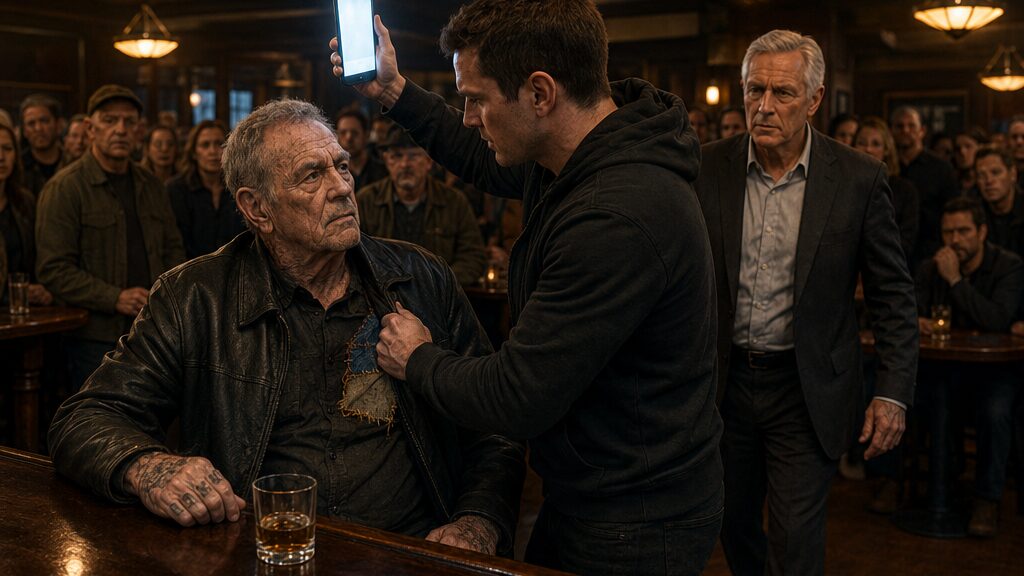
The phone was already pointed at Samuel Miller when Nicholas King asked the question.
Its white screen hovered above Samuel’s unfinished drink, bright enough to bleach the color from Nicholas’s knuckles and throw a hard rectangle across the amber whiskey. On the screen, comments climbed too quickly to read. Small hearts floated upward beside Samuel’s reflected face.
Samuel looked at the phone once, then at Nicholas.
The Lantern Room had been loud a moment earlier. Glasses knocking against the dark bar. A country song muttering beneath conversation. Chairs scraping as men and women leaned across tables to bid on donated fishing gear and restaurant certificates. Now the sound seemed to have pulled back from the stool where Samuel sat.
Nicholas smiled toward the camera.
“We’re live from the memorial fundraiser,” he said. “And apparently we’ve got a mystery guest.”
A few people laughed. Not many.
Samuel rested both hands on the bar. His right thumb lay across the faded tattoo near his wrist. The hand had begun to shake, as it sometimes did when he held it still too long. He pressed harder against the wood until the tremor moved into his forearm and disappeared beneath the sleeve of his leather jacket.
The jacket was older than Nicholas. Black once, now gray at the elbows and seams. On the left chest sat a crooked patch made from dark fabric, its edges hand-stitched with three colors of thread. It did not match any official insignia hanging in the Lantern Room’s display cases.
Nicholas angled the phone toward it.
“People are asking what it is.”
Samuel said nothing.
He had come to the Lantern Room every year on this date for nineteen years. He took the same stool near the corner, ordered one whiskey, and left most of it behind. Lisa knew not to ask whether he wanted another. Jeffrey sometimes sat two stools away, close enough to be company and far enough to leave him alone.
Tonight there had been a new sign taped to the door.
MEMBERS AND VERIFIED GUESTS ONLY.
Samuel had nearly turned around. Instead, he had touched the envelope inside his jacket and entered.
Nicholas tapped at a tablet beside the register. He wore a black hooded sweatshirt with the Lantern Room’s lantern emblem over the chest and a wireless microphone clipped near the drawstring. He had spent the evening moving through the crowd with easy confidence, announcing donation totals and introducing veterans who were willing to tell their stories on camera.
“Name again?” Nicholas asked.
“You heard it.”
“For the system.”
“Samuel Miller.”
Nicholas typed. The tablet made a small rejecting sound.
“No Samuel Miller.”
“My card’s in my wallet.”
“We don’t use the old cards anymore.”
Samuel drew out a cracked leather wallet. The membership card inside had softened at the corners from years of being carried. Lisa Campbell had signed it herself, though the signature had nearly worn away.
Nicholas held the phone over it.
“This expired eleven years ago.”
“I paid longer than that.”
“Maybe. But you’re not in the digital list.”
Lisa stood at the far end of the bar, one hand frozen around a bottle. Her eyes met Samuel’s, then shifted toward the people filling the room. Donors. Regulars. Veterans wearing caps stitched with campaigns and ship names. A local outreach coordinator near the raffle table.
She opened her mouth, but Nicholas spoke first.
“We had a man in here three months ago claiming he served,” he told the livestream. “Raised money using our name. Some of you remember what that cost us.”
The laughter was gone now.
A man at a nearby table said, “He’s got a point.”
Samuel slid the card back into his wallet.
Nicholas looked at the patch again. “And this thing doesn’t help.”
Samuel’s fingers curled slightly against the bar.
“It isn’t for you.”
“That’s not an answer.”
“It’s the one you’re getting.”
A few comments on the phone caught Nicholas’s attention. His smile widened, but there was strain beneath it.
“All right. The viewers want a vote.”
He turned the screen briefly toward the room. Two options sat beneath the video.
REAL VETERAN.
FAKE PATCH.
Samuel could not see the totals, but Nicholas’s expression told him enough.
Jeffrey Hall stood near the rear wall in a charcoal suit, watching over the rim of a water glass. His silver hair and formal clothes had always made him look as though he had arrived for a funeral no one else knew about. He took one step away from the wall.
Samuel gave the smallest shake of his head.
Jeffrey stopped.
That was Samuel’s mistake, though he would not understand it until later. He believed asking Jeffrey to stay back was the same as handling the matter himself.
Nicholas leaned closer.
“What branch?”
Samuel watched a bead of condensation travel down his glass.
“What years?”
The bead touched the bar and broke.
“What unit?”
Samuel’s jaw tightened.
Nicholas glanced at the phone. “See, this is what people do when the questions get specific.”
Samuel turned his head then.
Nicholas’s face was younger than his voice made it sound. Thirty-four, perhaps. Fit. Closely shaved. The hard certainty in him did not come from ignorance alone. It came from a man who believed he had been given a duty and was afraid of failing at it.
That did not make his hand any less insulting when he reached for Samuel’s jacket.
Nicholas pinched the edge of the patch and pulled it toward the phone.
The room tilted.
Samuel’s left hand moved halfway from the bar before he stopped it. Years earlier, the motion would have ended with Nicholas on the floor. The knowledge remained in Samuel’s shoulders and hips even if speed had left his knees.
He closed his hand around the bar’s brass rail instead.
“Take your hand off the jacket,” he said.
Nicholas kept smiling at the phone. “I’m just showing them.”
“Leave the patch where it is.”
The smile faltered.
Samuel’s voice had not risen, but the air between them changed. The young bartender stepped backward. Lisa set the bottle down without looking.
Nicholas could have released the fabric then.
Instead, he looked at the viewers’ comments and pulled harder.
One stitch gave way with a sound too small for anyone else to hear.
Samuel heard it.
His fear came faster than anger.
He rose an inch from the stool, and Nicholas’s free hand caught the front of the jacket near the collar as if to steady him—or hold him in place. The phone remained high.
“Easy,” Nicholas said. “Nobody’s hurting you.”
Samuel stared at the hand gripping his coat.
Around them, the Lantern Room watched.
A man near the raffle table lowered his eyes. One of the regulars folded his arms. Lisa took a step forward, then stopped when someone called her name from the register. For three long seconds, temporary power belonged entirely to the man holding the phone.
Samuel could have broken the spell by striking him.
Instead, he made himself sit fully again.
His right hand shook against the brass rail. The tremor traveled into the glass, sending a small ring through the whiskey.
Nicholas lifted the patch closer to the camera.
The loosened bottom edge folded outward.
On the faded inner lining, written in ink almost erased by time, were three sets of initials. Beneath one of them, part of a surname showed.
ALLEN.
Jeffrey’s water glass struck a table behind them.
Nicholas turned at the sound.
Jeffrey was already moving. He crossed the floor without hurrying, but people cleared space before him. He stopped beside Samuel, close enough that his sleeve brushed the old jacket.
His eyes went to the exposed writing.
Something in his face emptied.
“Where did you get that name?” he asked.
Samuel folded the patch down with two fingers.
Nicholas shifted the phone toward Jeffrey. “You know him?”
Jeffrey looked first at Nicholas’s hand on the jacket, then at the glowing screen above Samuel’s head.
“Nicholas,” he said, “lower the phone. Now.”
Chapter 2: The Clip Leaves the Room First
Lisa locked the office door and turned to Samuel.
“That video has already passed eight thousand views.”
The office behind the Lantern Room’s kitchen was narrow enough that Jeffrey’s shoulder nearly touched a filing cabinet. A desk crowded with invoices separated Lisa from Samuel. Nicholas remained outside with the guests, though the murmur beyond the door had changed into the uneven noise of people pretending not to discuss what they had witnessed.
Samuel stood rather than take the chair Lisa offered.
His patch hung partly loose. He had folded it inward so the names could not be seen. One strand of blue thread trailed against the zipper.
Lisa held her phone facedown on the desk, but it buzzed every few seconds.
“We ended the livestream,” she said. “Nicholas took down the original.”
Jeffrey gave her a tired look. “Someone recorded it.”
“Yes.”
“And clipped it.”
“Yes.”
Samuel touched the envelope inside his jacket. It remained unbent.
Lisa sat behind the desk. “People are posting screenshots. They’re calling you a stolen-valor case. They’re also calling Nicholas a bully. Donors are tagging us. One wants his contribution returned unless we explain what happened.”
“Tell them it happened,” Samuel said.
“That isn’t an explanation.”
“It’s enough of one.”
Lisa drew a breath through her nose. She had managed the Lantern Room for fifteen years and had learned to make every problem sound administrative until it became survivable. “Samuel, your membership isn’t current.”
“I know that now.”
“We mailed notices.”
“I don’t read much mail.”
“That isn’t Nicholas’s fault.”
Jeffrey moved closer to the desk. “His membership status has nothing to do with Nicholas putting a hand on him.”
“I didn’t say it did.”
“You’re putting the two things in the same sentence.”
“Because tomorrow everyone else will.”
Samuel watched them arrange his humiliation into categories. Membership. Conduct. Public response. Liability. Each word placed a clean edge around something that had not felt clean.
Lisa softened her voice. “We had a man use this room’s name to collect nearly twelve thousand dollars from veterans and their families. He lied about serving. Nicholas was the one who traced the accounts. He helped us recover some of it.”
“That gives him a reason to ask,” Samuel said.
Jeffrey turned toward him.
“It doesn’t give him the rest.”
Lisa’s eyes dropped to the torn patch. “What is it?”
Samuel said nothing.
Her expression tightened with frustration. “You see the position that puts us in.”
“No,” Jeffrey said. “It puts him in a position. You’re deciding whether it inconveniences us.”
Lisa pushed back from the desk. “I have six employees whose hours depend on this fundraiser. The roof leaks over the meeting hall. Half our donors already think we’re careless because of the last scandal. I can’t issue a statement saying, ‘Trust us, the man won’t answer questions, but Jeffrey knows him.’”
Jeffrey’s face reddened.
Samuel looked at him. “Don’t.”
“I can confirm you served.”
“Don’t.”
“I don’t need to say anything else.”
“You don’t know anything else.”
The words landed harder than Samuel intended.
Jeffrey glanced toward the floor. The two men had sat in the same grief group every Thursday for nearly three years. Jeffrey knew Samuel had been Army. He knew he had worked recovery vehicles and avoided Memorial Day ceremonies. He knew certain dates made Samuel stop answering the phone.
He did not know what lay beneath the patch.
“I know enough to say you belong in this room,” Jeffrey said.
Samuel looked through the office window at the dark bar beyond. His stool stood empty. The whiskey remained where he had left it.
“That wasn’t in question until tonight.”
A new vibration rattled Lisa’s phone. She turned it over despite herself.
The frozen thumbnail showed Nicholas’s hand clamped around Samuel’s collar and the phone raised above them. Samuel’s face appeared turned away, mouth closed, eyes lowered. The image made him look cornered.
Beneath it, a caption read:
FAKE VET EXPOSED AT MEMORIAL FUNDRAISER?
Lisa locked the screen.
“I need you to leave until the board meets,” she said.
Jeffrey stared at her. “You’re removing him?”
“I’m separating everyone involved.”
“Nicholas is still outside hosting.”
“He knows the accounts and the equipment. I can’t empty the room in the middle of a fundraiser.”
Samuel had heard enough.
He opened the office door.
Jeffrey followed him into the hallway. “Samuel.”
Samuel continued past the kitchen, where the young bartender had stopped stacking glasses. When Samuel entered the main room, conversations thinned again. No one looked directly at his patch.
Nicholas stood near the raffle table, phone lowered to his chest. For the first time that evening, he did not appear sure where to put his eyes.
Samuel walked past him.
“Mr. Miller,” Nicholas said.
Samuel stopped but did not turn.
“I shouldn’t have grabbed you.”
The apology was quiet enough that the room could pretend not to hear it.
Samuel looked over his shoulder. “No.”
Nicholas swallowed. “No?”
“You shouldn’t have decided the camera made you right.”
He left before Nicholas could answer.
Outside, cold air struck the place on Samuel’s chest where the patch had torn loose. Jeffrey caught up near the parking lot.
“I waited too long,” Jeffrey said.
Samuel unlocked his truck.
“I saw Nicholas questioning you. I told myself he was doing his job. Then I saw him touch the jacket, and I still waited because you told me not to interfere.”
Samuel opened the driver’s door.
“That was my choice.”
“It was my choice too.”
For a moment neither man moved.
Jeffrey said, “Let me make one statement. Just that I know you served.”
“No.”
“They’ll keep saying it.”
“Let them.”
“You don’t mean that.”
Samuel climbed into the truck. “You want me to explain so you can feel better about not stepping in.”
Jeffrey stepped back as if struck.
Samuel closed the door before regret could change his face.
The cab smelled of cold vinyl and machine oil that had outlived his years at the municipal garage. He put both hands on the steering wheel. Beyond the windshield, people entered and left the Lantern Room beneath the warm yellow sign.
His phone, buried in the center console, buzzed twice.
He did not look at it.
Instead, he reached inside his jacket for the envelope he had meant to leave with Lisa. It had been there against his ribs through the whole confrontation, as if the paper had heard every accusation.
The envelope was yellowed and sealed with tape that had gone brittle at the edges.
On the front, in Samuel’s handwriting from thirty-eight years earlier, were two words.
Sarah Allen.
Chapter 3: A Record That Proves Too Little
Nicholas watched the clip without sound and noticed that Samuel never looked at the camera.
Not once.
The Lantern Room’s board office smelled of burnt coffee and old paper. Saturday light pushed through the blinds in pale stripes. Nicholas sat at the end of the conference table with his laptop open, moving through the video frame by frame.
There was his own hand on the jacket.
Paused, it looked less like an attempt to display the patch and more like a fist holding an old man in place.
Jeffrey stood behind him.
“You edited this version.”
Nicholas did not turn. “I cut the dead time.”
“You cut yourself being told to stop.”
“The livestream ended after that.”
“Not immediately.”
Nicholas pressed the space bar. The silent figures moved. Samuel’s mouth formed the words Nicholas now remembered exactly.
Take your hand off the jacket.
Leave the patch where it is.
Nicholas stopped the clip again.
“I apologized for touching him.”
“You apologized where no one could hear.”
“I didn’t know the camera was still catching the room.”
Jeffrey leaned over the table. “You always know where the camera is.”
Lisa entered carrying a file folder and set it between them. Her face looked older than it had the night before.
“The outreach office found him.”
Nicholas straightened.
Lisa opened the file. “Samuel Miller. Army. Vehicle recovery and maintenance. Honorable separation.”
The relief Nicholas felt came with shame attached. He had wanted confirmation, yet the confirmation made his judgment worse.
“So we correct it,” Jeffrey said.
Lisa did not close the folder. “There’s more.”
Inside was a photocopied service photograph. Five young men stood beside a recovery vehicle, faces narrowed against bright sun. Samuel was easy to identify despite the decades between then and now. He stood at the edge of the group in the same leather jacket, newer and blacker, before the crooked patch had been sewn onto it.
Nicholas touched the corner of the photograph.
“He wore that jacket there?”
“Apparently.”
“Then the patch was added later.”
“Yes,” Lisa said.
Nicholas looked through the remaining pages. “What does this mean?”
“It means he served,” Jeffrey said. “Which is the accusation you broadcast.”
“I said his story didn’t check out.”
“You made sure thousands of people heard what you meant.”
Nicholas shut the folder, then opened it again. “The patch still isn’t official. His membership still wasn’t current. We just had someone steal from this place by using a uniform and a convincing story.”
“Samuel wasn’t collecting money.”
“He came to a members-only fundraiser.”
“He has come here longer than you have.”
“Then why didn’t anyone put him in the system?”
No one answered.
Nicholas turned the phone faceup beside the laptop. The clip had been copied onto accounts he did not control. One version had passed seventy thousand views. Comments called him brave, cruel, vigilant, abusive. Strangers had found the Lantern Room’s address.
A message from a donor asked whether the bar planned to protect “real veterans” or surrender to public pressure.
Nicholas read it twice.
“My brother trusted a man who said he ran a housing charity for veterans,” he said.
Jeffrey’s expression did not change, but Lisa sat down.
Nicholas kept his eyes on the phone. “The man had photographs. Unit shirts. Stories with enough detail to sound true. My brother gave him money, then convinced other people to give. When it came out, everybody acted like my brother was stupid.”
“I remember,” Lisa said.
“He stopped coming to places like this after that. Said everyone looked at him and saw the fool who got taken.”
Nicholas pushed the phone away.
“He died owing money to three people who had trusted him. So when someone won’t answer a basic question, I don’t assume silence is noble.”
Jeffrey rested both hands on the table. “Your brother’s pain didn’t put your hand on Samuel.”
“I know.”
“Do you?”
Nicholas looked again at the paused image.
“I know how it looks.”
“That isn’t the same thing.”
Lisa pulled another sheet from the folder. “The outreach office found a partial personnel summary. Samuel requested reassignment immediately after an evacuation incident. Two fatalities. Several injuries. After that, he declined every reunion invitation the office could trace.”
Nicholas read the date.
“Why would he wear fabric connected to a unit he spent the rest of his life avoiding?”
Jeffrey took the paper from him. “We don’t know that he did.”
“The initials were under the patch.”
“We saw one name.”
“All right. One name.”
Lisa folded her arms. “The board needs a statement from Samuel before Tuesday. If he refuses, they may treat him as an unverified guest and bar him until the issue is resolved.”
Jeffrey’s voice went flat. “You confirmed his service.”
“That resolves the false-veteran allegation. It doesn’t resolve the membership issue, the patch, the donor complaints, or what we tell the public.”
Nicholas stared at the photograph of young Samuel.
The jacket had been open. The left chest bare.
Whatever the patch meant, it had come afterward.
Across town, Samuel sat at his kitchen table with the curtains closed.
The sealed envelope for Sarah Allen lay beside his coffee cup. He had not opened it. He had not opened it in thirty-eight years.
His phone rang for the fourth time.
He let it stop.
A minute later, someone knocked.
Samuel waited.
“Samuel,” Jeffrey called through the door. “I know you’re home.”
Samuel carried his coffee into the living room but did not answer.
“I have the service summary,” Jeffrey said. “The board found it.”
Samuel’s grip tightened around the cup.
“They know you served. That part is over.”
No part of it was over.
“They also found the reassignment request.”
The coffee cup became suddenly slick in Samuel’s hand.
Jeffrey continued through the door. “There’s an incident date attached. I don’t know what happened. I’m not asking you to tell me through a door.”
Samuel stood motionless.
Jeffrey read the date aloud.
The cup slipped.
It struck the floor, shattered, and sent black coffee across the baseboard.
On the table behind Samuel, the envelope addressed to Sarah Allen remained sealed.
Chapter 4: Why Nicholas Needed a Fraud to Find
The donor’s message arrived before Nicholas had finished brushing his teeth.
KEEP THE CLIP UP UNTIL TUESDAY. I’LL DOUBLE MY PLEDGE IF THE LANTERN ROOM DOESN’T FOLD.
Nicholas read it twice in the blue light of his phone.
The amount already promised would cover nearly half the repair to the meeting-hall roof. Doubled, it could also replace the failing ice machine and keep the young bartender’s hours from being cut. Nicholas knew those numbers because he had built the fundraiser page, scheduled the posts, and watched every contribution rise in real time.
He set the phone faceup on the bathroom counter.
Another notification appeared.
A stranger had stitched the confrontation into a video about fake veterans. Samuel’s silent face filled one side of the screen. On the other, a commentator pointed at the crooked patch and said that honest men did not hide behind age.
Nicholas closed the app.
The phone rang almost immediately. Lisa.
“Come to the outreach office,” she said. “Now.”
The local veterans’ outreach office occupied two rooms above a pharmacy. By the time Nicholas arrived, Lisa was seated across from the outreach coordinator with a printed transcript spread between them. Jeffrey stood near the window, arms folded.
Lisa did not invite Nicholas to sit.
“Did you edit the clip before you posted the recap?”
“I cut it for length.”
“You cut Jeffrey telling you to lower the phone.”
“The broadcast was over by then.”
“No,” Lisa said. “It wasn’t.”
She tapped a line on the transcript. The time stamp showed twelve more seconds after Jeffrey’s command. Twelve seconds in which Nicholas had lowered the phone, released Samuel’s jacket, and stopped smiling.
Nicholas looked toward Jeffrey. “The original livestream was chaotic. I made something people could understand.”
“You made yourself easier to understand,” Jeffrey said.
Nicholas pulled out a chair. “We had people asking whether we let anyone walk in wearing whatever they wanted. We needed to show that we were taking verification seriously.”
“And Samuel’s answer?” Lisa asked.
“He didn’t give one.”
“He told you to take your hand off him.”
“That wasn’t an answer about the patch.”
The outreach coordinator turned a pen between both hands but said nothing.
Nicholas felt the room closing around one moment while ignoring everything that had led to it. The stolen fundraiser. The angry donors. The checks the Lantern Room had covered from its own thin account. Men who had trusted the wrong person because he knew how to say the right things.
“My brother answered questions,” Nicholas said. “He answered every question that man asked him.”
Jeffrey’s arms loosened.
Nicholas looked at the transcript rather than at them. “The charity organizer told him there was housing money available. Said he needed a processing fee first. Then another fee. My brother got other people involved because he believed it.”
“We know,” Lisa said.
“No, you know the part people repeat.”
Nicholas’s phone buzzed in his pocket. He ignored it.
“When the organizer disappeared, people didn’t blame the man who lied. Not at first. They blamed my brother for being foolish enough to believe him. He stopped coming to the Lantern Room because he thought every conversation paused when he walked in.”
Jeffrey said, “That still doesn’t make Samuel your fraud.”
“I didn’t know what Samuel was.”
“So you decided in public.”
Nicholas’s jaw tightened. “I decided not to let another person use silence as protection.”
The words remained in the room longer than he expected.
Lisa’s expression shifted—not toward sympathy, exactly, but recognition. “You thought exposing someone would undo what happened to your brother.”
Nicholas stood. “Don’t make this about grief so you can dismiss the actual risk.”
“I’m making it about why you stopped checking the difference between risk and certainty.”
The outreach coordinator slid a sheet across the table. “We recommend a full correction now. Confirm that Mr. Miller served. Remove any language implying stolen valor. State that the membership question remains administrative.”
Nicholas looked at the paper. “And the fundraiser?”
Lisa answered before anyone else. “May take a hit.”
“The donor offered to double his pledge if we keep the clip.”
Jeffrey’s face hardened. “Then he’s paying us to keep humiliating Samuel.”
“He’s paying us not to hide a controversy.”
“You trimmed the controversy.”
Nicholas put both hands on the table. “I was trying to protect this place.”
Lisa met his eyes. “That explains the edit. It doesn’t make it honest.”
For the first time since Friday, Nicholas saw the route by which his good reason had become a bad act. It had not happened all at once. It had happened in small permissions: keep the camera running, ask one more question, let the comments vote, touch the patch so viewers could see, remove the part that weakened the message.
His phone buzzed again.
He turned it faceup.
The donor had sent a second message.
STAND YOUR GROUND. PEOPLE RESPECT COURAGE.
Nicholas stared until the screen dimmed.
Then an old voicemail notification appeared beneath it, carried forward from a backup folder he had opened the night before. His brother’s name was not stored anymore, only the number.
Nicholas pressed play.
Static came first. Then his brother’s voice, tired and embarrassed.
I know you told me not to trust him. You don’t have to say it again.
Nicholas stopped the message and turned the phone facedown.
Lisa gathered the transcript. “The board meets Tuesday evening. Because the clip is still circulating and because donors are contacting us, the disciplinary portion will be open to members.”
“Public?” Nicholas asked.
“Limited attendance. But yes.”
Jeffrey said, “Samuel won’t come.”
“Then the board will decide without him.”
Nicholas looked up. “Decide what?”
“Your volunteer status. His access. Our filming policy. The statement.”
“His access? You already confirmed he served.”
“His membership is expired, and he has declined to respond.”
Nicholas heard the unfairness in the sentence and hated that part of him still found it useful.
“If he won’t answer,” he said, “the board can’t pretend there’s no issue.”
Jeffrey stepped closer. “There is an issue. You put your hand on him and turned him into content.”
“And if the patch means something else?”
“Then ask privately.”
“I tried.”
“No. You performed.”
Nicholas took his phone from the table. He did not play the voicemail again.
At the Lantern Room later that afternoon, Lisa found him in the storeroom beside stacked raffle signs. She handed him a formal notice.
“Deliver it.”
“Why me?”
“Because you helped create the situation requiring it.”
The notice stated that Samuel Miller was requested to attend Tuesday’s board meeting. Failure to appear would result in suspension of access until membership and conduct questions were resolved.
Nicholas read the final line.
“This sounds like a threat.”
“It is a consequence.”
“For him?”
“For everyone.”
Samuel did not answer when Nicholas called. The voicemail began after four rings.
Nicholas almost spoke informally. Almost said that the board had confirmed his service and that the clip looked worse each time Nicholas watched it.
Instead, he read the notice exactly as written.
When the call ended, the phone remained in his hand.
He opened his email, attached the formal document, and pressed send.
Across town, Samuel’s computer chimed in the darkened apartment.
On the screen, beneath the Lantern Room’s emblem, the subject line appeared:
ATTENDANCE REQUIRED TO AVOID PERMANENT EXCLUSION.
Chapter 5: Three Threads Beneath the Crooked Patch
Sarah Allen placed the unopened letter on Samuel’s kitchen table.
“Why didn’t you deliver this?”
Samuel stood beside the sink with his leather jacket still on. He had not invited her inside, but Jeffrey had brought her to the door and then left when she asked him to. She was forty-three, perhaps forty-four, with dark hair pulled away from a face Samuel recognized only in fragments.
Her father’s eyebrows.
Her mother’s way of holding anger absolutely still.
The envelope lay between them, yellowed at the edges, SARAH ALLEN written across it in Samuel’s younger hand.
“You were a baby when it was written,” he said.
“I gathered that.”
“It was for later.”
“I’m later.”
Samuel looked toward the window. The curtains remained closed.
Sarah slid the envelope closer to him. “Jeffrey found my name after he saw it in your truck Friday night. He called the outreach office. They found me.”
“He shouldn’t have.”
“He said you’d tell me that.”
Samuel touched the jacket zipper but did not remove the coat.
Sarah studied the loose patch. One corner had been temporarily secured with a safety pin. The three thread colors—blue, brown, and pale green—ran unevenly around its edge.
“I saw the video,” she said.
Samuel’s shoulders stiffened.
“I saw the long version too. Not the edited one.”
“That makes one of us.”
“You haven’t watched it?”
“No.”
“He put his hand on you.”
Samuel pulled out a chair and sat. His knees had begun to ache from standing, though he would not give Sarah the satisfaction of seeing him retreat.
“He took it off.”
“After someone ordered him to.”
Samuel nodded once.
Sarah remained standing. “You could have told him what the patch was.”
“It wasn’t his.”
“That answer has caused you some trouble.”
“It was still the answer.”
She looked at the envelope again. “Was this mine?”
“Yes.”
“What is it?”
“A letter.”
“From whom?”
Samuel did not reply.
Sarah’s fingers tightened against the table. “My father?”
“Yes.”
The word barely crossed the distance between them.
She pulled out the other chair, but before sitting, she placed both palms on its back as though she needed the wood to remain upright.
“My mother said there was no letter.”
“She didn’t know.”
“Did you?”
Samuel’s gaze moved to the sealed edge.
“I knew.”
“For thirty-eight years?”
He said nothing.
The kitchen clock clicked once for every second Sarah waited.
She sat slowly. “I thought you disappeared because you didn’t care.”
Samuel’s right hand trembled on his knee. He covered it with the left.
“I went to your mother’s house twice.”
“I don’t remember that.”
“You wouldn’t.”
“Then what happened?”
“She asked me whether your father suffered.”
Sarah’s mouth tightened. “And?”
“I left.”
She looked at him as if the answer had confirmed something ugly. “So you did disappear.”
Samuel rose too quickly. The chair legs scraped the floor.
“I didn’t come here to be judged in my own kitchen.”
“No. You prefer people to do it without enough information.”
The sentence struck near Friday night, near Nicholas’s raised phone, and Samuel’s expression changed.
Sarah saw it.
“I’m not saying he was right,” she said. “I’m saying you make silence do work it cannot do.”
Samuel turned away. On the counter sat the chipped replacement cup Jeffrey had brought after cleaning the spilled coffee from the floor. Samuel had not used it.
Behind him, Sarah said, “Show me the patch.”
“No.”
“You carried my father’s name under it.”
“You saw a video.”
“Jeffrey saw the name.”
“He saw part of it.”
“Then show me the rest.”
Samuel faced her. “You don’t have a claim on all of it.”
“Maybe not. But I have a claim on something.”
She picked up the envelope.
Samuel moved before he decided to, one hand closing over hers. Not hard, but fast enough that she startled.
He released her at once.
The room went quiet.
“I’m sorry,” he said.
Sarah left the envelope where it was.
Samuel unzipped his jacket. The sound was rough and metallic. He slipped the coat from his shoulders and laid it on the table with the lining upward.
For years, he had opened it only in private.
He removed the safety pin and lifted the patch from the torn corner.
Three faded pieces of fabric formed its base. One was dark blue, nearly black. One had once been brown. The third was pale green with a line of tiny white stitches running through it.
Sarah leaned closer.
“My mother did that.”
Samuel did not ask how she knew.
“She repaired everything with white thread,” Sarah said. “Even when the fabric was dark. She said matching thread was how stores made you buy too much.”
A sound escaped her that was almost laughter and not close to joy.
She touched the air above the green fabric but did not touch the jacket.
Samuel pointed to the initials written beneath it.
J.A.
The others were faded enough to resist easy reading.
“Three jackets?” Sarah asked.
“Three pieces.”
“Why?”
Samuel lowered the patch.
The mission returned first as weight, not image. A recovery vehicle sunk to its axle. The heat trapped inside his helmet. A radio voice repeating the extraction limit. Six men who could still be moved. Two who could not be moved without losing everyone before the road closed.
He sat opposite Sarah.
“Your father was part of the recovery crew.”
“I know that much.”
“The vehicle ahead of us was hit and blocked the route. We reached eight men. The order was to load those with the best chance and clear the road before the second section collapsed.”
Sarah did not blink.
“Your father was conscious,” Samuel continued. “So was the other man we left.”
“You left him alive.”
“Yes.”
The word did not become easier after thirty-eight years.
“Did you have a choice?”
Samuel looked at the three colors.
“There is always a choice. Sometimes every choice has a body attached.”
Sarah’s face changed, but she did not look away. “How many did you get out?”
“Six.”
Her eyes filled. “You saved six men.”
“No.”
“You just said—”
“I followed the load order. I drove. Other people kept them alive.”
“You brought six out.”
“I left two.”
The clock continued clicking.
Sarah lifted the edge of the patch herself, carefully, and read her father’s initials.
“What did he say?”
Samuel’s mouth went dry.
“He asked me to cut the lining from his jacket.”
“Why?”
“He said his daughter would never remember the uniform.”
Sarah pressed her lips together.
“He told me to carry them home,” Samuel said. “All of them. The ones in the vehicle and the ones who weren’t coming.”
“And you thought this did that?” She indicated the patch.
“At first.”
“What changed?”
“I requested reassignment. Stopped answering letters. Missed reunions. Kept the fabric.”
Sarah sat back. “You carried cloth home.”
Samuel looked at the sealed envelope.
“Yes.”
“But not yourself.”
He had no answer.
They left the apartment because the walls had become too close. At the diner, Samuel ordered coffee and did not drink it. Sarah placed the envelope between the sugar jar and the napkin holder.
“Open it,” she said.
“It isn’t mine.”
“It was yours long enough.”
Samuel pushed it toward her.
Sarah did not break the seal. “Tell me why my mother never received it.”
“Your father addressed it to you.”
“So you waited until I was old enough.”
“That was the plan.”
“How old?”
“Eighteen.”
“And after eighteen?”
Samuel watched a server refill cups at the counter.
“I told myself your mother had rebuilt a life. Then that you had. Then that the letter would only reopen something.”
Sarah gave him a hard, wounded look. “You decided for us.”
“Yes.”
The admission quieted them both.
She touched the pale green thread along the patch. “My father asked you to carry them home. Maybe he meant remember them.”
Samuel’s eyes remained on the table.
“Maybe he didn’t mean spend the rest of your life standing outside every room they might have entered.”
“You weren’t there.”
“No. I was the baby he wanted you to bring a letter to.”
He flinched.
Sarah’s anger softened, but it did not disappear. “I’m not calling you a hero. I don’t know enough, and you clearly hate the word.”
“Good.”
“But you don’t get to turn his last request into a sentence he never gave you.”
Samuel’s fingers closed around the edge of the table.
Sarah pushed the envelope back toward him, leaving it unopened.
“You don’t get to decide that my father wanted you punished.”
Chapter 6: The Board Offers Samuel an Easy Enemy
“His presence may not be worth the liability.”
Samuel heard the board secretary through the closed meeting-hall door.
He had arrived fifteen minutes early and stopped in the corridor when he saw his leather jacket draped across an empty chair inside. Jeffrey had taken it from him near the entrance, saying the room was warm. Now the board sat around the long table discussing Samuel while his coat occupied the only chair that seemed prepared to receive him.
Lisa answered the secretary. “Removing him after we confirmed his service would look retaliatory.”
“I’m not talking about appearance. I’m talking about disruption.”
Samuel opened the door.
Conversation stopped.
Jeffrey stood first. Nicholas remained seated at the far end of the table, his phone beside a yellow legal pad. Lisa had arranged folders in front of each board member. A printed statement lay on top.
Samuel walked to the empty chair, lifted his jacket, and put it on.
“You can continue,” he said. “The liability is here.”
No one did.
Jeffrey pulled out another chair. Samuel sat without thanking him.
Lisa cleared her throat. “We were reviewing options.”
“For me?”
“For everyone involved.”
Samuel picked up the prepared statement.
It acknowledged that “an unfortunate verbal exchange” had occurred during the fundraiser. It described Nicholas’s conduct as inconsistent with Lantern Room values. It confirmed that Samuel had served in the United States Army. It did not say that Nicholas accused him publicly of lying. It did not mention the hand on his jacket. It did not correct the implication attached to the patch.
The statement ended by promising improved procedures.
Samuel returned it to the table.
“Who wrote this?”
“I did,” Lisa said.
“It protects the room.”
“That is part of my job.”
“Does it protect Nicholas?”
Her hesitation answered him.
Jeffrey sat beside Samuel. “The board is prepared to remove Nicholas from his volunteer position and prohibit him from events for one year.”
Nicholas looked at the table.
“And me?” Samuel asked.
“Your membership can be restored immediately,” Lisa said. “No fees.”
“Generous.”
“Samuel—”
“Why did you ask me to leave Friday?”
Lisa’s fingers aligned the edge of her folder. “The situation was escalating.”
“Nicholas stayed.”
“He was running the fundraiser.”
“Why did I leave?”
The financial fear came into her face before the words did.
“Donors were watching,” she said. “I thought if I separated you, we could finish the event and sort it out privately.”
“You removed the easier person.”
“Yes.”
The answer surprised the board.
Lisa looked directly at Samuel. “I protected the fundraiser before I protected you.”
Samuel nodded once. The truth did not repair anything, but it stopped the room from pretending.
Jeffrey leaned forward. “I knew this week was difficult for you. I knew the mission date was close.”
Samuel turned toward him.
“I treated that knowledge as a reason not to interfere,” Jeffrey said. “When you signaled me to stay back, I was relieved. It meant I could call my hesitation respect.”
Samuel remembered Jeffrey against the rear wall, water glass in hand.
“You did step in.”
“Late.”
“Yes.”
Jeffrey accepted the word.
Nicholas pushed his legal pad aside. “Can I speak to him privately?”
Samuel looked at Lisa. “Is this private?”
She understood. “Not if you don’t want it to be.”
Nicholas’s phone remained faceup. No recording indicator showed, but Samuel noticed Jeffrey glance at it.
Nicholas turned it facedown.
“I’m sorry I grabbed your jacket,” he said. “I’m sorry I kept the camera on you after you made it clear you didn’t want that.”
Samuel waited.
Nicholas’s eyes moved to the repaired corner of the patch. Samuel had resewn it that morning with black thread, deliberately different from the original three colors.
“But I still think the question was legitimate,” Nicholas continued. “You weren’t in the membership system. The patch wasn’t official. You wouldn’t answer. I handled it wrong, but I didn’t invent the uncertainty.”
The secretary murmured, “That seems fair.”
Samuel looked at Nicholas. “You were entitled to ask privately.”
“I did ask.”
“You asked while broadcasting.”
“I asked before I touched you.”
“You invited strangers to vote on whether I was real.”
Nicholas’s mouth tightened. “You gave me nothing usable.”
Samuel let the sentence settle.
“Usable for what?”
“To establish who you were.”
“I knew who I was.”
“That doesn’t help the person responsible for verifying entry.”
“No. It doesn’t.”
Nicholas seemed surprised by the concession.
Samuel continued. “You had a door. An office. Lisa. Jeffrey. A phone you could have used to call the outreach center. You had every tool except patience.”
Nicholas looked down.
Samuel touched the repaired patch. “You were allowed to question the card. You were not allowed to turn my body and clothes into evidence for entertainment.”
“It wasn’t entertainment.”
“Then why was there a poll?”
No one answered for Nicholas.
Lisa slid the prepared statement away. “We can revise it.”
Samuel looked around the table. “The statement says his tone was wrong.”
“We can make it stronger.”
“His tone wasn’t the thing.”
“What do you want it to say?” the secretary asked.
Samuel could have told them to publish Nicholas’s full name beside every accusation. He could have accepted the one-year ban and watched the board make Nicholas into a single bad man whose removal proved the Lantern Room was good.
Sarah’s words had followed him since the diner.
You don’t get to decide that my father wanted you punished.
Punishment was simpler than repair. That was why institutions offered it first.
“What happens to the edited clip?” Samuel asked.
“Nicholas removes it,” Lisa said.
“It has been copied.”
“We can’t control every copy.”
“What happens to the full recording?”
Lisa glanced at Nicholas. “We haven’t decided.”
Samuel leaned back. “Then you haven’t decided anything.”
Jeffrey said quietly, “What would be enough?”
Samuel looked at the phone facedown beside Nicholas’s hand.
He thought of the letter Sarah had still not opened. The three pieces of fabric. Six men loaded, two left behind. A promise he had reduced to stitching because cloth asked nothing from him.
He could remain silent. The board would ban Nicholas, restore Samuel’s membership, and issue a polished statement. Samuel could return once a year, drink half a whiskey, and leave everyone to fill the empty spaces themselves.
That had been his method for thirty-eight years.
It had not carried anyone home.
Samuel reached across the table.
Nicholas pulled his hand back as Samuel took the phone.
The room went still.
Samuel placed it screenup between them.
“Tomorrow,” he said, “you will start the same broadcast.”
Nicholas stared at him.
“Then you will hand this to me.”
Chapter 7: Samuel Opens the Jacket Himself
Nicholas began with the words the board had written for him.
“On Friday evening, during the Lantern Room memorial fundraiser, I made an error in judgment—”
“Stop.”
Samuel’s voice was quiet, but Nicholas stopped.
The phone stood upright on a small tripod at the end of the bar. Its screen showed the broadcast count rising. Behind it sat no crowd like Friday’s, only the board, Sarah, two regular patrons, and the outreach coordinator. Lisa had locked the front door and drawn the blinds.
Nicholas looked at Samuel. “What?”
“You don’t believe that sentence.”
“I do.”
“You memorized it.”
Nicholas glanced toward Lisa. She did not help him.
Samuel sat on his old stool in the leather jacket. The repaired corner of the patch lay flat against his chest. His whiskey had been replaced with water, though he had not touched that either.
“Start again,” Samuel said. “Use words you can answer for.”
Nicholas looked into the phone.
“Friday night, I questioned Samuel Miller’s membership while I was livestreaming. I accused him of pretending to be a veteran. I put my hand on his jacket after he told me not to.”
His jaw tightened.
“I edited the clip afterward. I removed the part where Jeffrey told me to lower the phone and where I released Samuel. That edit made my actions look more justified than they were.”
The comments began moving.
Nicholas read one, then forced his eyes away.
“I was wrong to broadcast the accusation before verifying it privately. Samuel served in the United States Army.”
Samuel raised one hand.
“That’s enough.”
Nicholas hesitated. “You said I should hand you the phone.”
“Yes.”
He lifted it from the tripod.
For one second, the image shook as Nicholas crossed the space between them. On Friday, he had held the phone above Samuel’s head. Now he extended it at chest height with both hands.
Samuel took it.
The phone felt lighter than he expected.
He turned the camera toward himself. His own face appeared on the screen—deep lines, gray hair cut too short over one ear, eyes that looked less certain than he wanted them to.
Hundreds of strangers were waiting.
Samuel set the phone against his water glass so the camera would remain steady.
“My name is Samuel Miller,” he said. “I was in the Army. That is true. It is also the least important part of what happened Friday.”
The comment stream accelerated.
He could see fragments.
SHOW THE RECORDS.
HE ALREADY ADMITTED IT.
WHY THE FAKE PATCH?
Samuel looked past the screen at Sarah. The unopened letter rested in her lap. She had brought it with her but had not asked him again to open it.
He placed two fingers beneath the lower edge of the patch.
Nicholas shifted where he stood.
Samuel noticed.
“This was the part he touched,” Samuel said. “After I asked him not to.”
He lifted the patch himself.
The three pieces of fabric beneath it came into view. Dark blue. Brown. Pale green crossed by tiny white stitches. The initials appeared along the lining, faded and incomplete.
No one moved closer.
“The patch does not belong to a unit,” Samuel said. “It does not prove service. It was never meant to.”
He held it open long enough for the camera to see, then lowered it.
“Those pieces came from three jackets connected to a recovery mission. I will not give the location. I will not give every name. Some of that belongs to families who did not agree to be part of this.”
One comment flashed across the screen.
CONVENIENT.
Samuel saw it. He continued.
“There were eight men waiting for transport. We had capacity and time for six.”
The room contracted around the sentence.
“The road was failing. The order was to load those most likely to survive and clear the route. I followed that order.”
His fingers trembled against the patch.
“I drove six men out. Two were left behind.”
Sarah lowered her eyes.
Samuel had rehearsed no speech. The words came in the same order he had avoided them for thirty-eight years.
“One of the men we left was conscious. His name was Jack Allen. He asked me to take part of his jacket lining. His daughter was an infant. He said she would not remember the uniform.”
Sarah looked at the phone.
“This green piece belonged to my father,” she said. “That is all I am confirming.”
The firmness in her voice closed the door on every other question.
Samuel nodded to her.
“The other pieces are not mine to explain,” he said. “I stitched them onto this jacket because I was told to carry those men home.”
He looked down at the crooked seams.
“For a long time, I thought carrying meant keeping something. Cloth. Names. A letter.”
Sarah’s hand tightened around the envelope.
“I stopped going to reunions. I stopped answering families. I told myself silence was respect. Sometimes it was. Sometimes it was a place to hide.”
The phone’s comment stream slowed, then surged again.
A message remained visible long enough for Samuel to read.
THIS OLD MAN IS WORKING EVERYBODY FOR SYMPATHY.
Lisa stepped toward the phone. “We can turn the comments off.”
“No.”
“Samuel—”
“Leave them.”
She stopped.
He looked into the camera again.
“Some people watching will believe me because a record was found. Some will believe me because Sarah identified the fabric. Some will never believe me. That is not why I agreed to this.”
He turned slightly toward Nicholas.
“The worst thing Nicholas did was not suspect me.”
Nicholas’s face lifted.
“A business has the right to know who enters. A fundraiser has the right to protect donors. He could have asked. He could have checked. I could have answered more than I did.”
Nicholas looked surprised by the admission.
Samuel continued.
“The worst thing was deciding that because I would not perform my pain for him, I must not have any. He treated my silence as evidence. Then he used my body and clothing to make the accusation more convincing.”
The phone remained steady against the glass.
“No one owes strangers the worst thing that ever happened to them. No one needs a heroic story before you take your hand off their coat.”
The room was silent.
Not the silence of Friday, when people had waited to see who would win. This silence held no demand.
Samuel turned the phone toward Nicholas.
Nicholas did not step away.
“I thought exposing people protected others,” he said. “My brother was deceived by a man who used veteran status to take money. Afterward, people treated my brother like he was stupid for trusting him.”
He swallowed.
“I saw Samuel refusing to answer, and I decided I had found the same kind of man. I wanted to find one.”
Samuel watched him.
Nicholas looked into the camera. “That reason is mine. It is not Samuel’s excuse to give me.”
He placed both hands on the bar.
“I was wrong.”
The sentence sounded smaller than the harm. It also sounded true.
Jeffrey stood beside Samuel but said nothing. His presence no longer felt like rescue. It felt like witness.
Lisa unfolded the board’s revised statement. Samuel shook his head before she could read.
“No more statements tonight.”
“The board still has to determine Nicholas’s status,” she said.
“I have.”
The board secretary shifted. “That is not solely your decision.”
“No. But you asked what repair would look like.”
Samuel gave the phone back to Nicholas.
“You will remove the edited clip from every account you control. You will leave this full correction available without advertisements or fundraising links.”
Nicholas nodded.
“You will not run public verification again.”
Another nod.
“For six months, you will conduct membership intake privately. No camera. No public questions. You will ask permission before recording anyone, even if they have already signed a general release.”
Lisa said, “That would require supervision.”
“You have a board.”
The secretary looked unconvinced. “And if he refuses?”
Nicholas answered before Samuel could.
“I won’t.”
Samuel studied him.
“I am not asking for him to be expelled,” Samuel said. “Removing one man lets the room pretend the rest of you were not here.”
Lisa lowered the statement.
One of the regular patrons looked at the floor.
Nicholas’s phone continued broadcasting. The comments filled with demands, praise, suspicion, and argument. Samuel no longer tried to read them.
He zipped the jacket over the patch.
Sarah stood. Jeffrey moved as if to follow, but Samuel gave him a slight shake of the head.
This time, Jeffrey understood without using it as permission to remain passive. He opened the door for Samuel and stayed beside it.
Samuel walked through the quiet room.
Behind him, a chair scraped. Someone drew breath as though about to speak.
Samuel kept moving before gratitude could become spectacle and before apology could become applause.
The door closed behind him while Nicholas’s phone continued recording the room it would now have to change.
Chapter 8: The Jacket on the Back of His Chair
Samuel’s old stool was empty.
Every other place at the Lantern Room bar was occupied by the weekday lunch crowd, yet the corner stool waited beneath the warm pendant light with nothing on it but a folded paper napkin.
Samuel stopped just inside the door.
The room did not fall silent.
A pair of regulars continued arguing about a baseball trade. The young bartender carried bowls of soup to a table. Someone laughed near the meeting-hall entrance. No one raised a phone.
Lisa saw him first.
She came from behind the register but stopped several feet away.
“We kept it open,” she said.
“I can see that.”
“I didn’t know whether you’d come.”
“Neither did I.”
A printed notice beside the door read:
NO FILMING OR PHOTOGRAPHY WITHOUT DIRECT CONSENT.
Beneath it, in smaller letters, was a private-verification procedure. No public challenges. No livestreamed intake. Questions moved to the office when necessary.
Samuel removed his leather jacket.
The patch had been repaired but not straightened. Sarah had told him the crooked edge was part of its history now. He draped the jacket over the back of the stool and sat.
The young bartender approached.
“Whiskey?”
“Coffee.”
The bartender nodded without reacting to the change.
Across the room, Nicholas sat at a small table with an older applicant and a clipboard. His phone lay facedown beside a stack of membership forms. He spoke quietly, waited for answers, and turned the papers so the applicant could read before signing.
Lisa followed Samuel’s gaze.
“Thirty-seven interviews,” she said. “Three people needed records checked. No one was filmed.”
“How many complained?”
“Seven.”
“That sounds low.”
“It was twelve, but five came back.”
She poured Samuel’s coffee herself.
“We received requests to license the correction video,” she said. “A news page offered enough to cover the roof.”
“And?”
“I said no.”
Samuel looked at her.
“I wanted to say yes,” Lisa admitted. “For about an hour.”
“Only an hour?”
“Maybe three.”
He added sugar to the coffee.
Lisa rested both hands on the bar. “The roof still leaks.”
“It leaked before me.”
“Yes.”
She returned to the register.
Jeffrey arrived ten minutes later in a gray sweater instead of a suit. He took the stool two places from Samuel, leaving one empty between them as he always had.
“You came,” Jeffrey said.
“That seems to be the rumor.”
Jeffrey ordered water. Neither man spoke about the broadcast.
The restraint felt different now. It did not conceal a question. It allowed one to remain unasked.
A bowl slipped from the bartender’s tray near Samuel. It struck the bar without breaking, but soup splashed across the wood and ran toward the jacket.
Nicholas reached the stool first.
His hand stopped several inches from the leather.
“May I move it?”
The room did not stop, but Samuel did.
He looked at Nicholas’s open hand, then at the phone still facedown across the room.
“Yes.”
Nicholas lifted the jacket by the shoulders and placed it over the neighboring stool, careful not to touch the patch. The young bartender wiped the spill and apologized.
Nicholas remained standing.
“Thank you,” Samuel said.
Nicholas nodded and started back toward the intake table.
“Sit down,” Samuel said.
Nicholas took the empty stool between Samuel and Jeffrey.
For a moment, none of them spoke.
Nicholas had lost some of the certainty that once made him seem taller. He did not look diminished. He looked as though he had discovered that responsibility was heavier than accusation.
“The full video is still online,” he said. “The edited one keeps reappearing on other accounts.”
“I know.”
“I’ve filed removal requests.”
“You can’t collect every copy.”
“No.”
Samuel drank his coffee.
Nicholas rubbed one thumb along the edge of the bar. “Do you forgive me?”
Jeffrey turned slightly, but Samuel kept his attention on the cup.
“That is a large question for a Wednesday afternoon.”
“I don’t need you to make it easy.”
“Good.”
Nicholas waited.
Samuel looked toward the table where the older applicant was reading the form without being rushed.
“I believe you are doing what I asked.”
“I am.”
“That is not the same as forgiveness.”
“No.”
“It may be how you reach it.”
Nicholas accepted that without asking when.
Sarah entered carrying the envelope.
She had opened it.
The brittle tape had been cut cleanly along one edge. She sat beside Samuel after Nicholas returned to the intake table.
“I read it,” she said.
Samuel’s hand tightened around the coffee cup.
“You don’t have to tell me.”
“I know.”
She placed the envelope on the bar. “He wrote mostly about ordinary things. Your truck making a noise. Someone burning dinner. He complained that you cheated at cards.”
“I did not.”
“He seemed confident.”
Samuel looked at the letter but did not reach for it.
Sarah smiled faintly. “He asked me not to grow up thinking his last day was the only important one.”
Samuel closed his eyes for a moment.
“I spent a long time doing exactly that,” she said.
“So did I.”
The Lantern Room kept a memorial ledger in a wooden case near the end of the bar. Names, dates, and short messages filled its pages. Samuel had never written in it.
He carried the opened letter to the case.
Sarah followed but did not direct him. He lifted the ledger, placed the envelope beneath it, and closed the glass lid. The letter was not displayed. Only stored somewhere it could be found by those who had a reason to look.
He returned to his stool.
His jacket remained on the neighboring chair, safe from the spill. Nicholas’s phone remained facedown.
One of the regulars leaned across Jeffrey and asked Samuel whether the city garage had ever managed to fix the old snowplow that pulled left every winter.
Samuel looked at him.
“No,” he said. “They replaced half the steering and blamed the road.”
The regular laughed. Jeffrey shook his head.
Samuel wrapped both hands around the warm coffee.
The conversation moved on to engines, bad repairs, and roads that never received enough salt. No one asked him to explain the patch. No one called him a hero. No one told him he had finally come home.
For that afternoon, being allowed to remain an ordinary man was enough.
The story has ended.