The Day They Sent a Steamroller to Destroy His Son’s Treehouse and Uncovered the HOA Fraud Behind It
Chapter 1: The Morning the Hydrangeas Became Violations
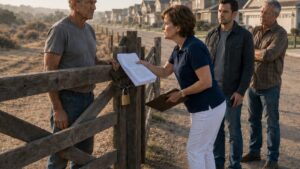
The violation notice was attached to Brian Hall’s freshly painted front door with bright red tape.
For a second he thought someone had made a mistake.
Then he saw the HOA seal.
He pulled the paper free and read the first line.
NOTICE OF NONCOMPLIANCE.
His eyes moved lower.
Hydrangea beds in violation of approved landscaping standards.
Exterior paint color inconsistent with approved neighborhood palette.
Further corrective action required.
Brian stared at the door behind the notice. He had painted it three weeks earlier. The color difference was barely noticeable unless someone stood inches away.
The hydrangeas were even more ridiculous.
They had been there for years.
Across the street, sprinklers clicked rhythmically across a green lawn.
Everything looked normal.
Yet suddenly his home had become a problem.
“Dad?”
Brian turned.
The treehouse stood behind the house beneath a sprawling oak. Sunlight filtered through the leaves.
A small face peered over the railing.
“Dad, what’s wrong?”
“Nothing.”
The answer came automatically.
The same answer he gave whenever he wanted to protect someone from worry.
He folded the notice.
“Just paperwork.”
The child disappeared back into the treehouse.
Brian remained still.
The structure had taken nearly six months to build.
Every board had been measured twice.
Every nail placed by hand.
The project had started during the hardest period of his life, after a family loss that had left the house painfully quiet.
The treehouse had given him something to build when everything else felt broken.
Now someone wanted to classify it as a violation.
A luxury SUV rolled slowly past the house.
Brian recognized it instantly.
Ashley Brown.
The vehicle paused for a moment.
Ashley sat behind the wheel wearing oversized sunglasses.
She looked toward the hydrangeas.
Then toward the treehouse.
Then she drove away.
The knot in Brian’s stomach tightened.
By noon he was standing in the HOA office.
The receptionist accepted his paperwork without enthusiasm.
“I’d like clarification.”
She barely glanced up.
“You can submit an appeal.”
“I am submitting one.”
She slid another form across the counter.
“Review may take up to thirty days.”
“The notice gives me fourteen.”
She shrugged.
Brian left with a growing sense that the process had been designed long before he walked through the door.
Outside, he found Rachel Baker loading groceries into her car.
She noticed the folded notice in his hand.
“They got you too?”
Brian frowned.
“What do you mean?”
Rachel hesitated.
Then looked around before speaking.
“A couple years ago they fined me over a fence color.”
“A fence color?”
“Three times.”
Brian laughed once.
Not because it was funny.
Because it sounded absurd.
Rachel wasn’t laughing.
“Who pushed it?”
Ashley.”
The answer arrived immediately.
Rachel lowered her voice.
“Most people just pay whatever they ask.”
“You think Ashley is behind this?”
“I know she is.”
Brian studied her face.
There was no exaggeration there.
Only caution.
The kind that came from experience.
“Why?”
Rachel shook her head.
“I don’t know.”
Then she added quietly:
“But when Ashley decides she doesn’t like something, it usually disappears.”
That evening Brian walked through his backyard.
The hydrangeas lined the fence in soft clusters of blue and purple.
They had belonged to someone he loved.
Years earlier they had planted them together.
The flowers returned every spring.
Reliable.
Familiar.
A reminder that not everything vanished forever.
He crouched beside one of the bushes.
The leaves rustled in a light breeze.
For the first time he found himself wondering whether they would still be here next month.
A hammer rested on a shelf inside the treehouse.
Small handprints decorated one wall.
There were old drawings tucked into corners.
A stack of comic books.
A faded blanket.
Memories occupied every inch of the place.
A violation notice could not see any of that.
To Ashley it was probably lumber and measurements.
To Brian it was something else entirely.
His phone buzzed.
An email.
He opened it.
The HOA had updated his case file.
His appeal had been acknowledged.
Attached beneath it was another document.
A permit application.
Heavy equipment authorization.
Brian frowned.
The date made no sense.
The authorization had been submitted before his appeal had even been reviewed.
Someone was already preparing for enforcement.
Someone expected him to lose.
For the first time, irritation gave way to something colder.
Concern.
He looked toward the street.
The neighborhood seemed peaceful.
Yet somewhere behind the paperwork, somebody was already planning what came next.
Chapter 2: Rules That Grow Sharper Every Day
“Appeal denied.”
Brian blinked.
“What?”
The HOA manager pushed a sheet of paper across the table.
The hearing had lasted less than five minutes.
No discussion.
No review.
No inspection.
Just denial.
Across the room, Ashley sat with a leather folder resting neatly on her lap.
She looked perfectly composed.
“As outlined in community standards,” she said, “the violations are clear.”
Brian looked at her.
“You inspected the property yourself?”
“I reviewed documentation.”
“Photos.”
“Evidence.”
“The flowers have been there for years.”
“The standards have evolved.”
Brian almost laughed.
Instead he gripped the edge of the table.
The board members avoided eye contact.
Only Ryan Martinez seemed uncomfortable.
The rest looked eager to move on.
The meeting ended before Brian could say much else.
Outside, Ryan caught up with him.
“Brian.”
Brian stopped.
Ryan adjusted his glasses.
“I know you’re upset.”
“Upset isn’t the word.”
Ryan sighed.
“I don’t control final decisions.”
“But you sit on the board.”
Ryan looked away.
That silence told Brian enough.
Someone else was calling the shots.
Back at home another notice waited in the mailbox.
The deadline had shortened.
Corrective action would begin if compliance was not achieved.
The speed surprised him.
Every response seemed prepared in advance.
As though somebody had been waiting for an excuse.
That afternoon two people arrived with measuring equipment.
They spent twenty minutes photographing the treehouse.
Taking notes.
Recording dimensions.
One of them circled the oak tree while speaking into a tablet.
Brian stepped outside.
“What exactly are you measuring?”
“Structural compliance.”
“For a treehouse?”
The worker offered an apologetic smile.
“We’re just following instructions.”
When they left, Brian watched them drive away.
Something about the process felt wrong.
The treehouse had suddenly become the primary focus.
Not the flowers.
Not the paint.
The treehouse.
That evening Rachel knocked on his door.
She held a folder.
“I found something.”
Inside were copies of neighborhood notices from previous years.
Different addresses.
Different violations.
Different homeowners.
Yet one detail repeated.
The same contractor appeared repeatedly after enforcement actions.
Tree removal.
Landscape correction.
Property modification.
The company name surfaced again and again.
Brian studied the pages.
“How many people got these?”
“More than you’d think.”
“Did anyone challenge it?”
“Most couldn’t afford to.”
Rachel sat across from him.
“The strange part isn’t the notices.”
“What is?”
“The costs.”
She pointed at several invoices.
The numbers were surprisingly high.
Far above what similar work should cost.
Brian felt a spark of curiosity.
Not proof.
Not yet.
But enough to keep digging.
The next morning he visited the HOA office again.
While waiting in the lobby, he overheard part of a conversation behind a partially open door.
Ryan’s voice.
Another board member.
Stacks of documents covered the table.
“…same contractor again?”
Ryan asked.
“We approved them last quarter.”
“They submitted the lowest bid.”
“Did they?”
The question hung briefly in the air.
Then the door closed.
Brian never heard the answer.
But Ryan’s tone stayed with him.
Doubt.
Later that day he searched public records available online.
The contractor’s name appeared repeatedly.
Large contracts.
Neighborhood projects.
Tree removals.
Landscape enforcement.
The numbers kept growing.
By evening a truck pulled into the neighborhood carrying survey markers.
Workers began placing small orange flags near several properties.
One appeared beside Brian’s oak tree.
His stomach tightened.
The treehouse sat above it like a lookout tower.
Suddenly vulnerable.
He removed the flag himself.
An hour later another appeared.
That night he barely slept.
The next morning an official scheduling notice arrived.
Removal crew assigned.
Date confirmed.
Equipment reserved.
Brian read the paperwork twice.
Then a third time.
Near the bottom of the page sat the contractor’s name.
The same one Rachel had shown him.
The same one Ryan seemed concerned about.
The same one appearing across years of HOA enforcement records.
This wasn’t coincidence anymore.
Brian opened his laptop.
He began searching deeper.
Because for the first time he wasn’t asking whether Ashley had influence.
He was asking why one company kept benefiting from that influence.
Chapter 3: Following the Trail Behind the Contracts
A chainsaw started somewhere down the street.
Brian looked up from his coffee.
Across the neighborhood, workers surrounded another property.
Orange notices were attached to the homeowner’s mailbox.
Fresh survey flags marked the lawn.
The scene felt disturbingly familiar.
Too familiar.
Brian crossed the street.
The homeowner stood nearby arguing with a supervisor.
“What exactly did I violate?”
The supervisor pointed toward paperwork.
Brian couldn’t hear the response.
But he recognized the contractor logo on the truck.
The same company.
Again.
When he returned home, he opened a spreadsheet.
Addresses.
Dates.
Violations.
Contract amounts.
Patterns slowly emerged.
The company seemed to appear wherever enforcement became aggressive.
The more Brian searched, the more impossible it became to ignore.
By noon he was sitting inside the county records office.
Rows of computers filled the room.
A clerk helped him access archived filings.
Hours passed.
Most documents revealed nothing unusual.
Then one invoice caught his attention.
The cost of removing several shrubs exceeded what an entire landscaping project should have cost.
Another contract showed similar numbers.
Then another.
Brian copied everything.
When he finally stepped outside, sunlight was fading.
His phone buzzed.
Rachel.
“Can you stop by?”
Twenty minutes later he sat at her kitchen table.
Rachel looked nervous.
“I wasn’t going to tell anyone this.”
“What is it?”
She slid a notebook toward him.
“I started keeping notes years ago.”
Inside were dates.
Meetings.
Observations.
Small details.
Nothing dramatic.
But together they painted a pattern.
Ashley pushing for enforcement.
Properties selected.
Contractors hired.
Costs increasing.
Rachel tapped one page.
“I saw Ashley having dinner with one of their executives.”
Brian looked up.
“When?”
“About a year ago.”
“You’re sure?”
“I remember because it felt strange.”
The information wasn’t proof.
But it connected another thread.
Rachel leaned back.
“I stayed quiet because I didn’t want problems.”
Brian understood.
Most people did.
Conflict carried costs.
Ashley knew that.
She depended on it.
Later that evening Brian climbed into the treehouse.
The sun was setting beyond the rooftops.
He sat on the wooden floor and looked around.
The place felt smaller than he remembered.
Maybe because time had passed.
Maybe because the threat hanging over it made every detail sharper.
He pulled out his phone.
Photographed the walls.
The drawings.
The old blanket.
The railing.
Everything.
As if preparing evidence for something he still hoped would never happen.
A knock sounded below.
Rachel.
She looked up.
“You should see this.”
She handed him her phone.
An email screenshot.
Another homeowner had received an enforcement notice.
The contractor appeared again.
Different violation.
Same result.
Brian stared at it.
The pattern was no longer isolated.
It was spreading.
For the first time he stopped thinking about his own yard.
What if this wasn’t personal?
What if he was simply the latest target?
The realization answered one question.
And opened a larger one.
Back inside his house, he returned to the records.
Near midnight he found something unexpected.
A business filing.
Nothing explosive.
Just a registration document.
Yet attached to it was a reference to an investment entity.
A partial ownership trail.
Several names had been redacted.
Most information remained hidden.
But one detail stood out.
The address linked to the filing matched a property owned by Ashley Brown.
Brian leaned closer.
His pulse quickened.
Not proof.
Not yet.
But close enough to matter.
Then another email arrived.
Official demolition schedule.
The date had been finalized.
The treehouse would be removed within days.
Brian looked from the notice to the ownership filing.
One represented time running out.
The other represented a possible answer.
Outside, the treehouse stood silent beneath the oak.
Inside his office, Brian printed every document he had gathered.
A thick stack formed beside the printer.
The first pieces of something larger.
Something Ashley clearly never expected anyone to investigate.
And buried inside those records was one question that suddenly mattered more than any HOA rule.
Who was really making money from all this?
Chapter 4: What the Records Were Never Supposed to Show
The address matched Ashley Brown’s property.
Brian checked it again.
Then a third time.
The filing sat on his computer screen well past midnight. He leaned closer, searching for a mistake that would explain it away.
There wasn’t one.
The investment entity connected to the contractor listed a mailing address belonging to Ashley.
Not proof of wrongdoing.
Not enough.
But no longer coincidence.
The next morning Brian drove to the county clerk’s office before it opened.
When the doors unlocked, he was first in line.
The clerk accepted the filing number and disappeared into a back room.
Several minutes later she returned carrying a thick folder.
“Some pages are restricted.”
“Can I see the rest?”
She nodded.
Brian sat at a table and began reading.
Corporate amendments.
Financial disclosures.
Ownership transfers.
Most of it was technical language.
But hidden among the paperwork was another connection.
The investment entity had received distributions from the contractor company.
Regular distributions.
Profits.
Brian copied every page he was legally allowed to access.
When he reached the ownership section, however, several names had been blacked out.
The missing information sat exactly where he needed answers.
He left frustrated but not empty-handed.
Outside, his phone buzzed.
Ryan.
Brian almost ignored it.
Then answered.
“Hello?”
Ryan lowered his voice immediately.
“You didn’t hear this from me.”
Brian stopped walking.
“What?”
“There was a special board meeting last month.”
“What about it?”
“Ashley pushed through emergency enforcement funding.”
Brian frowned.
“For what reason?”
“Property compliance.”
“That’s vague.”
“I know.”
Ryan hesitated.
“I voted for it.”
The admission surprised Brian.
Ryan sounded ashamed.
“I thought it was routine.”
“Now?”
“I don’t know anymore.”
Brian looked across the parking lot.
“Why are you telling me this?”
“Because something feels wrong.”
That was the closest Ryan had come to openly questioning Ashley.
It wasn’t enough.
But it mattered.
After the call ended, Brian returned home and spread documents across his dining room table.
Invoices.
Contracts.
Meeting notes.
Property records.
The pattern was becoming clearer.
The contractor benefited from aggressive enforcement.
Ashley pushed aggressive enforcement.
Money flowed into an investment entity connected to Ashley.
The pieces almost fit.
Almost.
The missing ownership records remained the problem.
That afternoon Rachel arrived carrying coffee and a worried expression.
“You look terrible.”
“I’ve been chasing paperwork for three days.”
She set the cups down.
“Did you find anything?”
Brian showed her the documents.
Rachel studied them carefully.
Her eyes widened.
“That’s her address.”
“I know.”
They sat in silence.
Finally Rachel asked the question neither wanted to say aloud.
“What if she’s actually making money from all this?”
Brian leaned back.
A week earlier the idea would have sounded absurd.
Now it felt likely.
His phone rang again.
Unknown number.
He answered.
A man’s voice spoke.
“You’ve been requesting records.”
Brian stiffened.
“Who is this?”
The caller ignored the question.
“Some things aren’t worth pursuing.”
Then the line went dead.
Brian stared at the phone.
Rachel looked alarmed.
“Who was that?”
“I don’t know.”
For several seconds neither spoke.
The call wasn’t a threat exactly.
Yet it felt like one.
That evening Brian made a mistake.
Frustrated by the delays and the growing pressure, he drove to Ashley’s house.
Her property sat at the end of a landscaped cul-de-sac.
Perfect hedges.
Perfect lawn.
Perfect exterior.
He parked across the street.
Ashley emerged from her front door carrying a folder.
For a moment he considered confronting her.
Demanding answers.
Demanding explanations.
The urge felt powerful.
Months of irritation and helplessness compressed into a single moment.
Then he stopped himself.
Confronting her now would accomplish nothing.
She would deny everything.
Worse, she would know exactly how much he had discovered.
Brian drove away.
The restraint frustrated him.
But deep down he knew facts mattered more than anger.
When he reached home, a delivery envelope waited on his porch.
No return address.
Inside was a photocopy.
One page.
Nothing else.
Brian examined it carefully.
A payment summary.
Partially obscured.
Incomplete.
Yet one line remained visible.
A transfer between the contractor and the investment entity.
The amount was substantial.
Far larger than expected.
Rachel arrived minutes later.
Together they stared at the document.
“It proves money moved,” she said.
“It proves something moved.”
“Who sent it?”
Brian shook his head.
“I don’t know.”
The page answered one question.
Money existed.
But another problem appeared immediately.
The document referenced attachments.
Attachments that weren’t included.
The proof remained incomplete.
As night settled over the neighborhood, Brian carried a folder of records into the treehouse.
The wooden floor creaked beneath him.
He sat against the wall and spread the papers around him.
The place felt different now.
Less like a refuge.
More like a reason.
Every document on the floor existed because someone wanted this structure removed.
Someone wanted the oak tree cut down.
Someone wanted memories reduced to debris.
The realization sharpened everything.
Then his phone vibrated.
A new email.
Official notice.
Equipment deployment schedule updated.
Brian opened the attachment.
His blood ran cold.
The demolition operation had been moved forward.
Not next week.
Tomorrow.
He climbed down from the treehouse and hurried toward the front yard.
Across the street, headlights turned into the neighborhood.
A flatbed truck rolled slowly past.
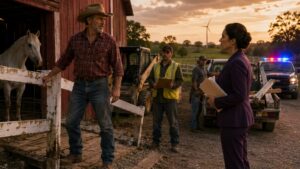
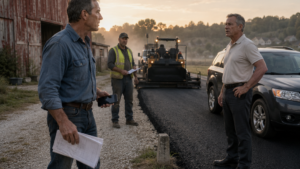
Behind it sat a small steamroller.
Chapter 5: The Day the Machines Entered the Yard
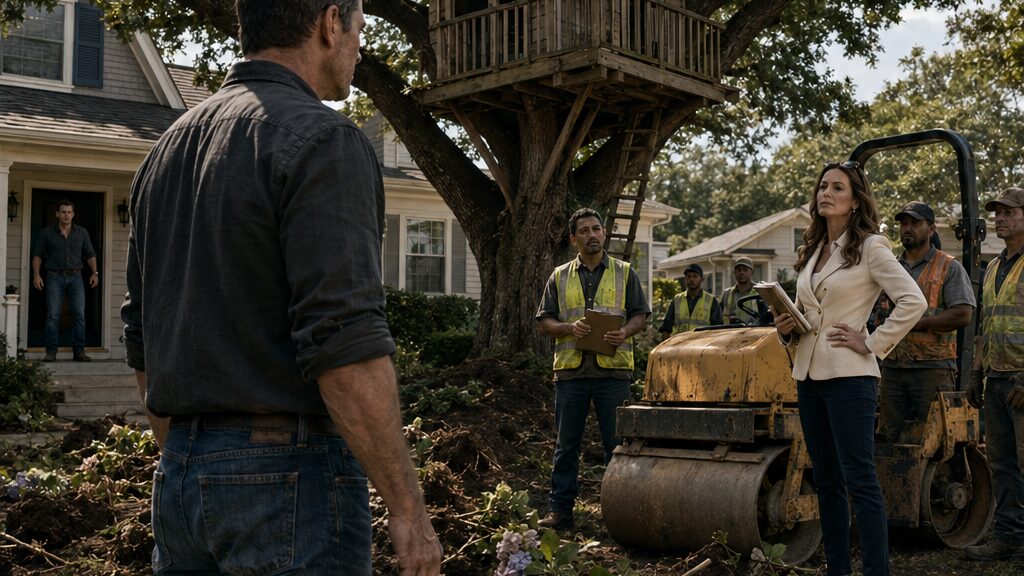
The first hydrangea came out of the ground at eight o’clock in the morning.
Brian heard the roots tear before he reached the front door.
By the time he stepped outside, workers were already moving across the flower beds.
Blue petals scattered across the lawn.
A machine idled near the curb.
The sound filled the street.
Several neighbors stood watching from a distance.
No one looked comfortable.
Brian strode forward.
“What are you doing?”
A worker glanced at a clipboard.
“Property compliance order.”
“You’re early.”
“We follow the schedule we’re given.”
Brian looked toward the road.
More equipment arrived.
Trucks.
Trailers.
Workers.
Far more than necessary for a few landscaping corrections.
Then another vehicle pulled up.
Ashley Brown stepped out.
She wore a tailored jacket and carried a folder beneath one arm.
Her expression remained calm.
Professional.
As if she were attending a routine meeting.
Not destroying someone’s property.
“The deadline hasn’t passed,” Brian said.
Ashley barely looked at him.
“The HOA has authority to proceed.”
“You moved the date.”
“The board approved an acceleration.”
Brian laughed once.
Short and humorless.
“Of course they did.”
Workers continued pulling hydrangeas from the soil.
Years of growth disappeared within minutes.
Brian watched one bush collapse onto a tarp.
For an instant he saw a memory instead of flowers.
Hands in the dirt.
Laughter.
A promise that something beautiful would keep growing.
The image vanished beneath boots and machinery.
Ashley noticed his expression.
“These plants were never approved.”
Brian turned toward her.
“They were here before you ever joined the board.”
“Standards change.”
“Funny how they always change in your favor.”
A flicker crossed her face.
Only for a second.
Then it disappeared.
Nearby, Jeffrey Sanchez stepped out of a truck.
He carried a clipboard and spoke quietly with several workers.
Unlike Ashley, he looked uncomfortable.
His eyes moved repeatedly between the paperwork and the property.
Eventually he approached Brian.
“I’m Jeffrey.”
“The foreman.”
Jeffrey nodded.
“I don’t make policy.”
“No. You just carry it out.”
The words came harsher than Brian intended.
Jeffrey accepted them anyway.
“I understand you’re upset.”
Brian looked toward the treehouse.
Still standing.
Still untouched.
For now.
Jeffrey followed his gaze.
“That’s the structure under review?”
“It’s a treehouse.”
Jeffrey remained silent.
Not arguing.
Not agreeing.
Just looking.
A few moments later he returned to his crew.
The interaction lingered with Brian.
Jeffrey didn’t seem eager to be there.
That mattered.
By midmorning the front flower beds were gone.
Only torn soil remained.
Several neighbors had gathered nearby.
Whispers spread through the crowd.
Questions.
Concerns.
Nobody stepped forward.
Yet fewer people seemed willing to support Ashley than before.
Rachel arrived carrying a camera.
“Document everything,” she whispered.
Brian nodded.
The folder of evidence sat inside his truck.
Part of him wanted to pull it out immediately.
Throw every document in Ashley’s face.
Expose everything.
End this.
Instead he forced himself to wait.
The evidence still wasn’t complete.
Acting too early could destroy his only chance.
The choice felt agonizing.
Especially as another hydrangea disappeared.
Around noon workers began setting markers near the oak tree.
Brian walked over immediately.
“What are those for?”
Jeffrey answered.
“Removal boundaries.”
Brian stared at him.
“The tree?”
“The structure.”
The distinction didn’t help.
Nearby, Ashley opened her folder and reviewed documents.
Calm.
Patient.
Confident.
Like someone who believed victory was inevitable.
The sight reignited Brian’s anger.
But beneath the anger sat something else.
Fear.
Not fear for himself.
Fear of failing.
Fear that after all the records and investigations and sleepless nights, the treehouse might still disappear.
A worker climbed onto the steamroller.
The engine started.
The deep mechanical rumble echoed through the neighborhood.
Children watching from nearby porches went silent.
The machine began moving.
Slowly.
Deliberately.
Toward the backyard access point.
Brian felt something inside him tighten.
Jeffrey stepped into its path briefly.
The driver stopped.
They exchanged words.
Jeffrey pointed toward paperwork.
Toward measurements.
Toward safety concerns.
For a moment Brian thought the delay might matter.
Then Ashley approached.
She said something sharp.
Jeffrey’s jaw tightened.
After a tense pause, he stepped aside.
The machine resumed moving.
The small act told Brian more than any document.
Jeffrey had doubts.
Ashley did not care.
The steamroller continued forward.
Closer.
Closer.
The oak tree rose above it.
The treehouse sat among the branches.
Waiting.
Brian looked from the machine to his truck.
Then to the folder hidden inside.
Then back to the treehouse.
The choice arrived all at once.
No more waiting.
No more hoping paperwork would save him.
The machine kept moving.
Ashley smiled slightly.
As though the outcome had already been decided.
Brian turned and ran.
Not toward the treehouse.
Toward his pickup.
Chapter 6: The Crash That Stopped Everything
The steamroller’s engine roared as it rolled toward the oak tree.
Brian yanked open his truck door and threw himself inside.
His hands shook.
Not from fear.
From certainty.
The moment he had spent weeks trying to avoid had arrived.
Across the yard, workers moved around the base of the tree.
The machine continued advancing.
Ashley stood with her folder tucked against her side, speaking into her phone as if the destruction unfolding behind her were ordinary business.
Brian started the engine.
The pickup growled to life.
Several heads turned.
Jeffrey looked up immediately.
Confusion crossed his face.
Then concern.
Brian grabbed the thick dossier from the passenger seat.
The folder had grown heavier every day.
Invoices.
Ownership filings.
Board records.
Copies of transfers.
Meeting notes.
Months of pressure compressed into paper.
He dropped it onto the seat beside him.
The steamroller kept moving.
A worker signaled.
The driver adjusted position.
The machine lined itself up with the access route leading toward the treehouse.
That was enough.
Brian slammed the truck into gear.
The pickup surged forward.
People shouted.
Workers jumped out of the way.
Ashley spun around.
Her expression changed for the first time all morning.
The truck crossed the lawn.
Brian wasn’t aiming at the steamroller.
He was aiming at the tow vehicle supporting the operation.
The largest piece of equipment coordinating the machinery movement.
The vehicle that made the demolition possible.
The collision came with a deafening metallic crash.
The impact rocked both vehicles.
The tow truck lurched sideways.
Equipment shifted.
Workers scattered.
The steamroller stopped.
Silence followed for half a second.
Then chaos erupted.
Voices.
Engines shutting down.
Someone yelling for everyone to back away.
Brian stepped out of the pickup.
His pulse thundered in his ears.
But the treehouse still stood.
That was all that mattered.
Ashley stormed toward him.
“Have you lost your mind?”
Brian lifted the dossier.
“No.”
He threw it onto the hood of the disabled tow truck.
Paper spilled across the metal surface.
Invoices fluttered in the air.
Records.
Contracts.
Ownership summaries.
Copies of payment distributions.
People began looking.
Really looking.
Jeffrey reached the hood first.
“What is this?”
Brian pointed at the documents.
“You’ve been working for a company she profits from.”
Ashley froze.
Jeffrey picked up several pages.
At first his expression showed skepticism.
Then confusion.
Then something darker.
Several workers gathered beside him.
One flipped through the documents.
Another pointed at highlighted sections.
The crowd grew.
Ashley recovered quickly.
“Don’t listen to him.”
Her voice carried the authority she had relied upon for years.
“Those records mean nothing.”
Brian pulled another page from the folder.
The photocopy from the anonymous envelope.
Then the investment filings.
Then the payment summaries.
Not one document proved everything.
Together they formed a picture.
A picture Ashley suddenly looked desperate to avoid.
Jeffrey read silently.
His face tightened.
“This company made payments to this entity.”
Brian nodded.
“Keep reading.”
Jeffrey did.
The address appeared.
Ashley Brown’s property.
One worker looked up sharply.
“Wait.”
Another grabbed the page.
“That’s her address.”
Ashley stepped forward.
“Those are incomplete records.”
“They’re your records,” Brian said.
For the first time she looked uncertain.
Not defeated.
Not yet.
But uncertain.
The workers noticed.
That was enough.
Jeffrey turned another page.
Then another.
The realization arrived slowly.
Not dramatic.
Not theatrical.
Worse.
Because it felt real.
“We were told these enforcement projects were community approved.”
Ashley folded her arms.
“They are.”
Jeffrey looked directly at her.
“Did you own part of this company?”
Silence.
Several workers exchanged glances.
The answer should have been easy.
Instead Ashley hesitated.
Only briefly.
But everyone saw it.
“I had an investment interest.”
The words landed heavily.
Jeffrey stared at her.
“You sent us here and never mentioned that?”
“It wasn’t relevant.”
The reaction was immediate.
“It wasn’t relevant?” one worker repeated.
Ashley pointed toward Brian.
“He’s manipulating this situation.”
“No,” Brian said quietly.
“You manipulated all of us.”
The neighborhood had become crowded.
More residents gathered along sidewalks.
Rachel stood near the front of the crowd holding her camera.
Ryan arrived moments later.
He pushed through the spectators and looked at the documents.
His face went pale.
“Ashley…”
She ignored him.
Ryan picked up a board authorization form.
Then another.
Recognition spread across his expression.
The same documents he had approved without question.
The same documents he had trusted.
Jeffrey closed the folder.
His decision was visible before he spoke.
“We’re done.”
Ashley blinked.
“What?”
“We’re not touching that treehouse.”
“You have a contract.”
Jeffrey shook his head.
“You tricked us into signing it.”
Several workers nodded immediately.
Others stepped away from the equipment.
The power dynamic shifted all at once.
Not because Brian had won.
Because Ashley had lost belief.
The belief people had placed in her authority.
A distant siren echoed through the neighborhood.
Heads turned.
Then another siren.
Closer.
Ryan looked toward the street.
Ashley followed his gaze.
For the first time all day, genuine fear crossed her face.
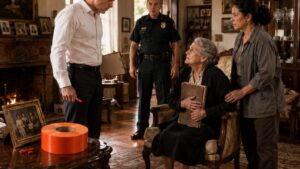
Police vehicles turned into the neighborhood entrance.
Nobody spoke.
The treehouse stood untouched above them.
The oak branches swayed gently overhead.
And as the flashing lights approached, Ashley finally understood that control was no longer hers.
Chapter 7: The Structure That Could Not Be Flattened
Every seat in the community hall was filled.
People lined the walls.
Others stood in the doorway.
Several neighbors who had never attended an HOA meeting before had shown up early just to get a place inside.
Brian sat near the back.
He had no interest in being at the front.
For weeks he had wanted answers.
Now that answers were finally arriving, he felt unexpectedly tired.
The events in his yard had spread through the neighborhood faster than anyone expected.
The police investigation had expanded beyond the original incident.
Financial records had been subpoenaed.
Contract payments reviewed.
Board approvals examined.
The story had become larger than a dispute over flowers or a treehouse.
Much larger.
At the front of the room, Ryan Martinez adjusted the microphone.
The normally composed board member looked exhausted.
The crowd quieted.
Ryan cleared his throat.
“I owe everyone an apology.”
Nobody interrupted.
Nobody applauded.
They simply listened.
“For years, I approved recommendations without asking enough questions.”
His voice remained steady.
“I trusted reports that should have been verified.”
Several board members stared at the table.
Others looked away entirely.
Ryan continued.
“We now know contractor relationships were not properly disclosed.”
Murmurs spread through the room.
Some residents shook their heads.
Others exchanged knowing looks.
The official confirmation mattered.
Not because people were surprised.
Because they had spent years wondering whether anyone would ever admit it.
Ryan looked toward Brian.
Only briefly.
Then back toward the audience.
“The board failed this community.”
The room remained silent.
Yet something important shifted.
Not victory.
Accountability.
Brian had spent much of his life believing facts eventually spoke for themselves.
The past few weeks had taught him otherwise.
Facts needed voices.
People needed courage.
Silence protected problems far more often than it solved them.
After the meeting ended, residents gathered in small groups throughout the hall.
Stories emerged from every corner.
Old fines.
Questionable enforcement notices.
Projects that suddenly became expensive after HOA involvement.
Some stories turned out to be misunderstandings.
Others did not.
For the first time, people compared experiences openly.
Rachel found Brian near the exit.
“You hear that woman over there?”
Brian glanced toward a small group.
“The fence issue?”
Rachel nodded.
“Five years ago.”
Another resident approached.
Then another.
Not to congratulate him.
To talk.
To share.
To ask questions.
The conversations felt strangely ordinary.
And somehow that meant more.
The entire conflict had started because one person assumed nobody would push back.
Now people were talking to one another again.
The community felt less afraid.
Outside the hall, Rachel handed Brian a folder.
“What’s this?”
“Final investigation summary.”
Brian laughed softly.
“I was hoping I was done reading documents.”
“You should read this one.”
He opened it.
Several pages summarized the findings.
Undisclosed financial interests.
Improper approvals.
Contract relationships.
Misuse of HOA resources.
The language was formal.
Dry.
Almost boring.
Yet every sentence represented something he had fought to uncover.
Near the end sat a paragraph explaining that multiple enforcement actions were under review.
Including his own.
Brian closed the folder.
Weeks earlier he would have celebrated.
Now he mostly felt relief.
The weight he had carried was finally beginning to lift.
A few days later he stood in his backyard.
The damaged flower beds had been cleared.
Fresh soil waited inside newly prepared borders.
Several neighbors had volunteered to help replant.
Not because they were ordered to.
Because they wanted to.
Rachel knelt beside one section.
“Where do these go?”
Brian pointed.
“There.”
Together they planted new hydrangeas.
The work was simple.
Hands in soil.
Roots settling into place.
A beginning rather than an ending.
The child climbed down from the treehouse carrying an old drawing.
“Dad.”
Brian looked up.
The paper showed a rough sketch of the treehouse.
The oak tree towered above it.
A family stood underneath.
The drawing had been made years earlier.
Corners bent.
Colors faded.
Yet somehow it survived.
“Found it upstairs.”
Brian smiled.
“Keep it.”
The child nodded and climbed back into the treehouse.
The structure looked exactly as it always had.
Wooden walls.
Small windows.
Uneven boards in places.
Nothing impressive from the outside.
Yet Brian understood now why he had fought so hard for it.
The treehouse was never really about lumber.
Or nails.
Or property.
It represented a promise.
The promise that some things deserved protection even when protecting them became difficult.
His phone vibrated.
A message from Rachel.
Ashley’s house had sold.
The text contained no celebration.
No mockery.
Just information.
Brian stared at the message for a moment.
Then locked the screen.
The urge to feel satisfied surprised him.
The urge to feel angry lingered too.
Weeks earlier he might have embraced both.
Now neither seemed important.
Ashley had made her choices.
The consequences belonged to her.
Carrying bitterness any longer would only keep her part of his life.
Brian slipped the phone into his pocket.
The oak branches rustled overhead.
The treehouse stood among them.
Untouched.
Unflattened.
A symbol of resistance perhaps.
But also something quieter.
A symbol of memory.
Of family.
Of promises kept.
As evening settled over the neighborhood, lights appeared in nearby windows.
Children rode bicycles along the street.
Neighbors waved to one another.
The ordinary life that had nearly been buried beneath paperwork and intimidation slowly returned.
Brian sat beneath the oak tree and looked up at the structure he had built with his own hands.
For the first time in months, there was nothing left to prove.
Nothing left to investigate.
Nothing left to stop.
Only a treehouse.
Only a family memory.
Only a promise that had survived.
The story has ended.