They Laughed When the Old Veteran Warned Them About the Knife in the Snow
Chapter 1: They Laughed Before the Blade Ever Failed
“We are not canceling a course because an old man heard a noise in a knife.”
Benjamin Young said it loudly enough for everyone at the trailhead to hear.
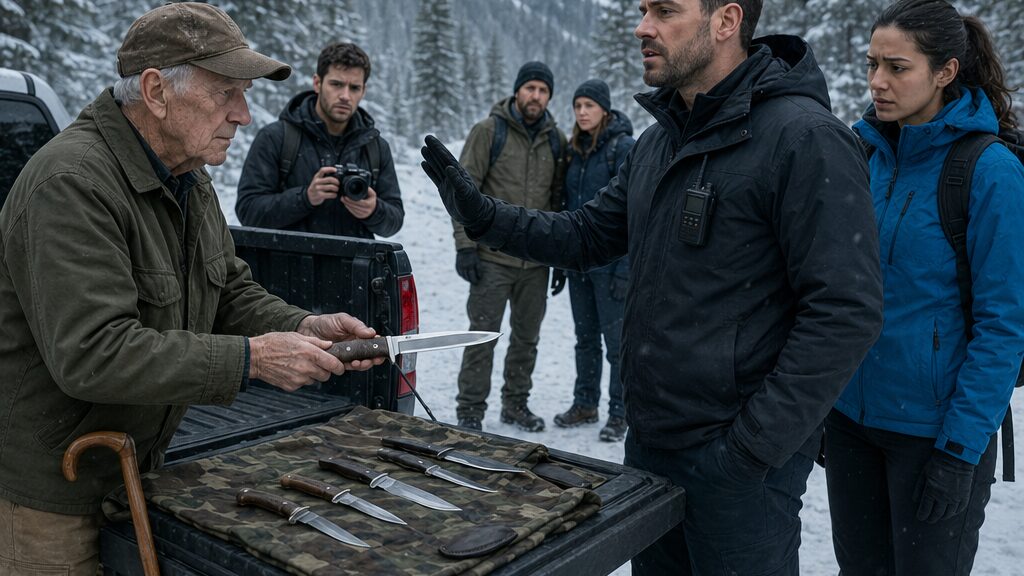
The two participants near the truck looked at one another. One smiled. The other tried not to. Joshua’s camera remained pointed at the lowered tailgate, its red light steady.
Larry Harris kept his eyes on the knife.
It lay across a folded camouflage cloth on the black ribbed bed of the pickup, bright enough to throw the pale morning back into his face. The polished blade was wide through the belly, the wooden handle shaped to look traditional without being plain. A sponsor’s emblem had been burned into the leather sheath.
Around it sat five other fixed blades, all darker, newer, more aggressively designed. Benjamin had arranged them like evidence of competence.
Larry pressed his thumb against the brass-colored guard.
Then he paused.
The wind moved dry snow across the parking lot in thin, whispering sheets. Somewhere under the tailgate, a metal buckle tapped against a pack frame.
Larry applied a little pressure in the opposite direction.
Click.
It was so faint that one of the participants leaned closer without meaning to.
Benjamin folded his arms. His new shell jacket made a crisp sound at the elbows. “There. Everybody heard it. The mountain has spoken.”
A few people laughed.
Larry lifted the knife horizontally, keeping the edge turned away from the group. His right hand was not as steady as it had once been. Cold made the old nerve damage worse. He compensated by bringing his left hand under the handle and using the heel of his palm instead of his fingertips.
He wiped a bead of melted snow from the wood. Then he set the spine against the folded camouflage cloth, braced it safely, and pressed again.
Click.
Kimberly Rivera’s smile faded first.
“The handle is moving independently of the blade,” Larry said.
Benjamin gave a short breath through his nose. “It is a field knife. It flexes.”
“Not there.”
“Modern bonding compounds have some movement.”
Larry looked at him then. Benjamin was thirty-six now, broad through the shoulders, beard trimmed close, a radio clipped neatly to his chest strap. He looked nothing like the nineteen-year-old soldier who had once taken apart a stove pump three times because Larry had asked what sound it made before it failed.
“It may hold all day,” Larry said. “That is not the same as sound.”
The sentence left a space behind it. Larry heard the camera motor adjust focus.
Benjamin glanced toward Joshua, then back to the participants. “Larry comes from a time when people distrusted anything they did not make themselves.”
This laugh was easier for them.
Larry lowered the knife onto the cloth.
He had promised Joshua he would not teach. He had promised himself something similar, though less honestly. He was here as a guest. A grandfather. Someone who could ride up, watch the morning session, perhaps sit near the fire at the lower camp, and let younger people carry the heavy things.
His wooden cane rested against the bumper. His olive field jacket was older than Kimberly. His brown cap had a dark stain above the brim where rain had soaked it decades earlier. Beside Benjamin’s team, dressed in bright technical layers with avalanche transceivers and carbon poles, Larry looked like a man who had taken the wrong turn on his way to a hardware store.
Joshua lowered the camera a fraction. “Ben, maybe just swap it.”
Benjamin’s expression tightened so quickly that Larry might have imagined it.
“We have six knives, Josh. We have backup gear. We have a weather window, a sponsor schedule, and eight miles to cover before the upper exercise.” He picked up the polished blade and turned it once in his gloved hand. “No chips. No visible separation. Balanced fine.”
“You cannot see a hidden tang,” Larry said.
Benjamin looked directly at him. “You also cannot diagnose every piece of equipment by listening to it like a pocket watch.”
The sponsor representative was on speakerphone inside the cab, asking someone whether the opening footage had been captured. Benjamin’s eyes flicked toward the sound.
Larry understood the glance. Money had its own weather.
Benjamin handed the knife to Kimberly. “You will carry the Heritage model for the shelter segment. Good camera contrast against the snow.”
Kimberly accepted it with an uncertain smile. “Sure.”
As she slid it into the sheath on her belt, her hand crept higher on the handle. Her index finger curled near the guard, almost touching the place where the blade would pivot if the hidden connection failed.
Larry reached out with his cane and touched the leather sheath, gently enough that she could step away if she chose.
“May I?”
She looked at Benjamin before looking at Larry.
Benjamin was speaking into his radio now, assigning positions.
Kimberly nodded.
Larry set the cane under his arm and showed her without taking the knife. “When you split wood, keep your support hand behind the line of the spine. Do not wrap forward because the handle feels secure. And do not drive it with your palm near the edge.”
“I know how to baton a knife.”
“I expect you do.”
That made her listen.
He placed two fingers on the back of her glove and moved them half an inch. “Here. If the handle rolls, your hand stays out of the path.”
She repeated the grip once.
“Better,” Larry said.
No praise beyond that. No lecture.
Kimberly glanced at the bright handle hanging at her side. “You really think it is going to break?”
“I think it has already begun.”
Benjamin clapped his hands once. “Packs on. We move in two minutes.”
The others turned toward the line of equipment. Snowshoes were strapped tighter. Radios were tested. Joshua checked his lens, avoiding Larry’s eyes.
Larry picked up his cane.
He had noticed Benjamin had not introduced him properly. Not that Larry wanted a speech. But Benjamin had called Margaret the wilderness medic, Kimberly the retail field specialist, Joshua the documentary lead. Larry had been presented only as Joshua’s grandfather, joining for part of the lower route.
Benjamin had once spent six weeks under Larry’s instruction in Alaska. He had once stood waist-deep in a river because Larry told him not to trust ice that had gone silent.
Now he did not want the group to know.
Perhaps that was fair. A man could build his own authority without carrying his old instructor beside him like a certificate.
Still, the omission had weight.
Margaret Nelson came around the rear of the truck, tightening the straps on her medical pack. She was near sixty, with gray at her temples and no wasted movement.
“You heard it?” Larry asked quietly.
“I heard something.”
“That is not an answer.”
“It is the only one I have without taking the handle apart.”
Benjamin called her name.
Margaret met Larry’s eyes for a moment. “There are backups.”
Then she joined the group.
Larry rested his hand on the cold edge of the tailgate. The knives had been rolled away, leaving a damp outline on the camouflage cloth.
Touch. Listen. Pause.
The habit had once annoyed every young soldier he taught. They wanted steps, not silence. They wanted certainty printed on waterproof cards.
Larry pressed his palm against the truck bed. The steel carried a vibration from the idling engine. Beneath it was something else—the faint movement of meltwater under frozen ground.
Joshua opened the passenger door for him.
“I can manage a door,” Larry said.
“I know.”
Joshua held it anyway.
Larry climbed in slowly, hating the effort more because Joshua pretended not to notice it. The others began moving toward the trail entrance, bright jackets crossing between dark pines.
Benjamin shut the driver’s door.
At that exact moment, a sharp little sound came from beneath the snow beside the drainage ditch.
Click.
Not metal this time.
Ice.
Larry looked through the side window at the shallow white channel running away from the parking lot. The crust above it appeared solid. Underneath, water was moving.
He watched a thin crack travel three feet beneath the surface and vanish under the first line of trees.
Chapter 2: The Snow Made Three Different Sounds
Larry’s cane punched through the snow crust so suddenly that his shoulder dropped and his bad knee twisted beneath him.
Joshua caught his elbow.
Ahead of them, Benjamin’s boot print sat clean and shallow on the same white surface.
Larry pulled the cane free. Its rubber tip came up wet.
“Grandpa?”
“I am standing.”
“That was not what I asked.”
Larry tested his weight before taking the next step. Pain moved around the outside of his knee, bright but contained. “Then ask what you mean.”
Joshua released him, though slowly. The camera hung from a strap across his chest now, lens capped while they climbed through the lower forest.
“What did that mean?” he asked.
Larry looked down at the hole. Dark water gleamed four inches below the crust.
“It means his weight held and mine did not.”
Joshua frowned. “You weigh less than Benjamin.”
“That is why it matters.”
The group had stretched into a line among the spruce. Benjamin led with one participant behind him. Margaret walked near Kimberly. The other two participants followed. Larry and Joshua had been placed at the rear, officially because Joshua was filming transition footage, unofficially because no one wanted the old man slowing the route.
Larry tapped the snow beside the hole.
The first strike made a dry, hollow note.
Two feet farther uphill, the second strike came back dull.
Near the base of a spruce, the cane produced almost no sound at all.
Joshua watched him. “Three kinds?”
“Three conditions.”
“And which one is bad?”
“All of them together.”
Joshua looked toward the group. “Can you say that in a way that does not sound like a riddle?”
Larry continued walking.
Above them, wind combed snow from the higher branches. Fine crystals settled on his cap and melted against the warmer cloth.
“The hollow crust means air beneath. The dull patch means saturated snow. The silence near the tree means a deep well. Warm water is running under a frozen top while cold wind is loading new snow above it.”
“You got all that from your cane?”
“No. I got part of it from my cane.”
“What is the other part?”
Larry pointed to the spruce trunks. On their uphill sides, fresh snow had built into narrow white fins. Downhill, bark remained dark.
“Wind changed after sunrise.”
Joshua’s eyes followed the trees. “The forecast said steady west.”
“The mountain did not read it.”
Joshua exhaled. “Please do not say that to Benjamin.”
Larry stopped.
The group moved another twenty yards before anyone noticed.
Joshua’s face tightened. “I mean, not like that.”
“How should I say it?”
“You know how.”
“No. Tell me.”
Joshua lowered his voice. “He is already defensive. The sponsor is watching. You embarrassed him at the truck.”
“I embarrassed him.”
“That is not what I meant.”
“It is what you said.”
Joshua glanced up the trail, where Benjamin had turned and raised one hand impatiently.
“I invited you because I thought this could be good,” Joshua said. “For both of you.”
“For both of whom?”
“You and me.”
The answer came too late to sound prepared, which made it more painful.
Larry resumed walking. “Then listen when I speak.”
“I am listening.”
“You are managing.”
Joshua did not reply.
At the next bend, Benjamin waited beside a narrow snow bridge crossing the drainage. It looked like a smooth white hump between two banks. A strip of blue marking tape fluttered from a branch above it.
“Single file,” Benjamin said. “Poles wide. Stay on the center line.”
Larry approached until he could hear the water.
Not the rush of an open stream. A muted, uneven sucking sound underneath the crust.
He put the tip of his cane on the center of the bridge, pressed once, and drew it back.
“Go six yards upstream,” he said.
Benjamin checked his watch. “Why?”
“There is standing water under this.”
“It is a marked crossing.”
“It was marked before the thaw.”
“The temperature is twenty-four degrees.”
“In the air.”
Benjamin crouched and pushed a gloved hand against the bridge. It held. “Solid.”
Larry listened again. “The surface is.”
Margaret came forward. “What are you hearing?”
“Water trapped against the downstream edge. The center has separated from the base.”
She crouched beside Benjamin and used a trekking pole to probe. The basket stopped against hard crust.
“No penetration,” she said.
“Remove the basket.”
Benjamin stood. “We are not dismantling equipment every twenty minutes.”
Margaret hesitated, then unscrewed the basket from the pole. She pushed the narrow tip through the same place.
It broke the crust at once.
Brown water rose into the hole.
Kimberly whispered, “Okay.”
Larry pointed upstream. “There will be a narrow section near the exposed roots. Less insulation. More likely to have frozen to the base.”
Benjamin stared at the water for a moment, then stood. “Fine. We move around it.”
He did not say Larry had been right. Larry had not asked him to.
The group climbed upstream, stepping around spruce roots and buried rocks. Six yards away, the drainage narrowed as Larry had predicted. Benjamin tested it carefully before sending anyone across.
The participants moved over one by one.
Kimberly paused beside Larry afterward. “That knife still has not clicked again.”
“Good.”
“You say that like you do not believe it.”
“I say it because good news does not need punishment.”
She gave him a puzzled look, then hurried after Margaret.
For several minutes the trail rose steadily. Larry’s knee warmed into a deep ache. He adjusted his pace rather than stopping. Joshua stayed near him without offering an arm again.
Margaret dropped back.
“You were right about the water,” she said.
“The water was there whether I was right or not.”
“You know what I mean.”
Larry waited.
She glanced toward Benjamin. “The weather station at the trailhead showed no thaw conditions.”
“It measured air six feet above plowed ground.”
“I understand the limitation.”
“Then say what you came to say.”
Margaret’s mouth tightened. “I cannot recommend changing the entire route based on one drainage and a knife we have not disassembled.”
“It is not one drainage.”
“What else?”
Larry looked at the snow gathered on the uphill side of the trees. He looked at the shallow prints near the center of the trail and the deeper fractures near its edge. Kimberly had begun flexing her right hand every few minutes.
He could have explained the pattern.
Instead he heard Benjamin’s laugh again. Old man. Noise in a knife.
“You have eyes,” Larry said.
Margaret’s expression closed.
“Yes,” she said. “I do.”
She returned to the front.
Larry hated himself a little for the satisfaction he felt when she walked away.
By noon, Benjamin called a brief stop beneath a stand of fir. He altered the route by less than fifty yards, avoiding the drainage while keeping the same upper destination.
“Localized melt,” he told the group. “We are adjusting, not retreating.”
Larry drank from his canteen. The metal cap trembled once against the rim before he steadied it.
Joshua sat on a log beside him.
“You could have explained it better to Margaret.”
“She did not ask for instruction. She asked for permission to ignore what she saw.”
“That is not fair.”
“No.”
Joshua looked over. “No, it is not fair to her?”
“No. It is not fair of me.”
The admission seemed to surprise them both.
Benjamin called for packs on.
Joshua remained seated for one extra second. “There is something I should tell you.”
Larry tightened the cap on his canteen.
“When I sent Benjamin the participant list, I included your service background. I thought it might help.”
“Help what?”
“Help him understand why I wanted you here.”
Larry waited.
Joshua rubbed his glove across his mouth. “He called me. He asked me not to mention that you trained military survival instructors. He said it would confuse the authority structure.”
Through the trees, Benjamin stood with the route map open in his hands, explaining the next section to people who did not know he had once learned to read snow from Larry.
Larry rose using his cane.
“Authority,” he said, “usually gets confused before anyone admits it.”
Chapter 3: The First Failure Looked Too Small
The knife handle turned in Kimberly’s hand while the blade remained buried in the wood.
She made a startled sound and pulled harder.
“Stop,” Larry said.
The word cut through the shelter site before anyone else understood what had happened.
Kimberly froze beside a half-split length of fir. The bright blade was wedged near the center of the log. She had been striking its spine with a wooden baton, trying to drive it through frozen grain. Now the polished handle sat several degrees out of line with the blade.
Her left hand had begun to move forward.
Larry crossed the space faster than his knee wanted him to. The pain came sharp enough to blur the edge of his vision, but he reached her before she touched the guard.
“Let go.”
She obeyed.
The handle shifted back a fraction by itself.
Click.
This time everyone heard it.
Benjamin came from the far side of the half-built lean-to. “What happened?”
Larry took Kimberly by the wrist and moved her hand behind the spine line. “Keep it there.”
“I did,” she said. Her voice shook. “I remembered.”
“I know.”
He steadied the log with his boot and examined the knife without pulling it free. A thin dark line had opened between the handle and the guard. At its center, a sliver of bright internal metal showed where none should have been visible.
Margaret crouched beside him. “Separation?”
“More than bonding compound now.”
Benjamin removed one glove and gripped the handle. “It is twisted because she struck off-center.”
Kimberly’s face changed. “I hit the spine.”
“I am not blaming you. I am explaining the failure.”
Larry looked at him. “You cannot explain away movement that was present before use.”
Benjamin pulled the knife straight back. The blade came free with a crack of frozen wood. The handle rotated slightly around the tang as he held it.
One of the participants muttered, “That is not supposed to do that.”
“No,” Larry said.
The words he did not say sat on his tongue.
I told you.
He swallowed them.
Benjamin turned the knife over, jaw set. “The manufacturer will want this documented.”
Joshua raised the camera automatically.
“Not now,” Kimberly said.
Joshua lowered it.
Benjamin looked at the unfinished shelter. Two ridge poles lay on the snow. Cordage hung loose between trees. The planned filming sequence had already fallen nearly an hour behind because they had changed the drainage crossing and moved the site twice to find firmer ground.
“Get the backup blade,” he told one of the participants. “We keep moving.”
Margaret pointed to the gap at the guard. “We need to record that it showed signs before use.”
“We will.”
“You told them there were no signs.”
“I said there was no visible separation at the trailhead. There was not.”
Larry heard the distinction. It was technically true and morally smaller than the truth.
Kimberly flexed her hand.
Larry noticed.
“Any pain?”
“No.”
“Numbness?”
She hesitated only a fraction. “No.”
“Take off the glove.”
“I am fine.”
Margaret reached for her hand. “Let me check.”
Kimberly pulled it back with a quick smile. “Seriously. The handle startled me. That is all.”
Benjamin was already assigning new tasks. “We have forty minutes to finish the shelter demonstration. Then we move.”
Larry looked uphill.
The trees thinned above the temporary site. Beyond them, the ridge was hidden by cloud. Fine snow had begun moving sideways between the trunks, not falling so much as being carried.
The upper camp lay another three miles ahead and nearly twelve hundred feet higher.
He touched the exposed metal at the knife’s guard.
Then he listened.
Not to the blade now. To the wind. To the intermittent settling sounds under the snow. To the shortness in Kimberly’s breath as she pretended to laugh with the others.
Pause.
The knife had not created the danger. It had taken time from them. It had forced new hands onto tasks. It had shown how readily Benjamin separated one failure from the next.
Joshua approached while the camera remained off. “You were right.”
Larry wiped his thumb on the camouflage cloth. “About one thing.”
“It is a pretty important thing.”
“Not the most important.”
Joshua followed his gaze toward the ridge. “You think we should turn around.”
“I think the lower site should become the camp.”
“Tell Benjamin.”
“He heard me at the truck.”
“That was about the knife.”
“That is the problem.”
Before Joshua could answer, Kimberly returned with a darker backup knife. She held it uncertainly.
Larry gestured for her to show him her grip.
She placed her support hand behind the spine.
“Again,” he said.
She reset, slower this time.
“Good.”
Her eyes dropped to the broken knife on the cloth. “If I had held it the other way…”
Larry did not finish the thought for her.
She looked at him. “Thank you.”
He nodded once.
That was enough recognition to satisfy him for perhaps three seconds.
Then Benjamin called the group together beside the incomplete shelter.
“We have a decision,” he said. “The lower exercise has run long. We can stay here, complete the overnight sequence, and lose the ridge navigation segment. Or we can pack now, reach the upper camp before dark, and keep the course on schedule.”
Margaret glanced toward the sky. “We are behind because of equipment failure and the crossing.”
“We adjusted successfully.”
“The wind has shifted.”
“It was expected to shift.”
“Not this early.”
Benjamin’s face remained calm, but Larry knew the signs. The clipped words. The squared shoulders. The way Benjamin looked at the map rather than the terrain when he needed the map to be right.
One participant asked, “What does the forecast say?”
Benjamin checked the device mounted on his forearm. “Snow tapering after four. Winds twenty to twenty-five on the ridge. Manageable.”
Larry said, “That forecast is older than the wind.”
Silence gathered.
Benjamin looked at him. “Do you have a current satellite update?”
“No.”
“An anemometer reading?”
“No.”
“A station report?”
“No.”
“I do.”
“You have numbers from somewhere else.”
“And you have impressions.”
Larry planted his cane in the snow. “We have lost time. The drainage is opening under the trail. New snow is loading from a different direction. One participant is wet at the cuff and hiding hand symptoms.”
Kimberly’s head snapped toward him.
Margaret turned. “Kimberly?”
“I am not hiding anything.”
Benjamin’s voice hardened. “Larry, do not diagnose participants in front of the group.”
“Then check her privately.”
“I already asked,” Margaret said. “She denied symptoms.”
Larry looked at Margaret. “And you accepted that?”
A flush rose along Margaret’s cheeks.
Benjamin folded the map. “Enough.”
The word held more than command. It held the sponsor call, the payroll he had mentioned at the truck, and whatever old resentment made him unwilling to let Larry be right twice in one day.
Larry softened his voice. “Use the lower site.”
“We are going to the upper camp.”
“Then leave the shelter kit cached and travel light.”
“We need it for the sponsored segment.”
“Benjamin.”
The younger man’s expression changed at the sound of his name. For one instant he looked like the soldier who had once waited for correction.
Then the moment closed.
“You are not in charge of this course,” Benjamin said.
Larry felt the sentence land in front of everyone.
No one laughed this time.
That almost made it worse.
Benjamin lifted his voice. “Anyone who is not comfortable continuing can return to the trailhead. Joshua has the lower route. Larry can accompany you.”
The offer sounded considerate. It was shaped like dismissal.
The group looked toward Larry, not Benjamin.
Larry saw the question in their faces: Was the old man leaving because he knew something, or because he could no longer keep up?
He looked at the broken polished knife lying on the camouflage cloth. The gap at its guard was obvious now. Proof had arrived, and somehow it had changed less than he had expected.
Benjamin began rolling the route map.
Larry closed his hand around the head of his cane.
“Pack the lower camera,” Benjamin told Joshua. “You can take him back before the light drops.”
Take him back.
Larry lifted his eyes toward the upper trail, where wind-blown snow was already erasing the first footprints.
Chapter 4: Larry Turned Back, Then Heard Her Lie
Larry took three steps toward the lower trail before the first gust erased the group’s prints behind him.
Joshua followed with the camera bag over one shoulder. He did not speak. Behind them, straps tightened, buckles snapped, and Benjamin’s voice sent the others uphill in a line.
Larry kept walking.
The return trail curved beneath dark firs, descending toward the drainage they had crossed that morning. His cane found each patch of hard snow before his boot did. Touch. Listen. Pause. The motions should have settled him.
They did not.
Benjamin had given him exactly what wounded pride wanted: a clean way out.
Anyone uncomfortable could return with Larry.
Not anyone concerned. Not anyone who believed the conditions were changing. Anyone unable to continue.
Joshua glanced back. “They are moving.”
“I can hear them.”
“We could still—”
Larry stopped so abruptly that Joshua nearly walked into him.
“Still what?”
“Go with them.”
“Benjamin decided.”
“You let him.”
Larry turned downhill again.
The words followed him farther than Joshua did.
For several moments, only the cane and their boots broke the quiet. The lower forest muffled the wind, but overhead the treetops moved in different directions. The higher branches bowed east while powder streamed south between the trunks.
A crossing wind.
Larry counted the seconds between gusts. The intervals were shortening.
Ahead, the trail split around a dense stand of young spruce. Through the branches, he caught a final glimpse of the upper group. Kimberly had fallen several paces behind Margaret. She tugged at the zipper on her jacket pocket, missed the pull, and tried again.
The metal tab slipped from her glove.
She bent to retrieve it, straightened, then dropped it a second time.
Larry stopped watching only when Joshua noticed.
“What?”
“Nothing.”
“That was not nothing.”
Larry moved toward the lower fork.
Behind the spruce, Margaret called, “Kimberly, hold up.”
Their voices carried strangely through the trees.
Larry could not see them now, but he heard the soft thump of packs being set down.
“I am fine,” Kimberly said.
“Give me your hand.”
“It is the glove. The zipper is tiny.”
“Any tingling?”
“No.”
“Numbness?”
A pause.
“No.”
Larry tightened his grip on the cane.
Margaret’s voice dropped, but the wind delivered part of Kimberly’s answer anyway.
“If I get pulled from the exercise, the store will hear about it. I need the field certification for the promotion.”
“This is not about your promotion.”
“It is easy for you to say.”
“No, it is not.”
Larry heard fabric rustle, then Benjamin calling from farther uphill. “We need to move.”
Margaret answered, “One minute.”
Kimberly’s voice hardened. “My fingers are fine.”
Larry waited for Margaret to contradict her.
Instead Margaret said, “Keep the chemical warmers ready. Tell me immediately if it changes.”
Packs lifted again.
The group disappeared into the upper forest.
Joshua stared after them. “You heard that.”
“Yes.”
“She lied.”
“Yes.”
“And Margaret let her keep going.”
Larry looked toward the ridge. “Margaret made a decision with incomplete information.”
“You saw her dropping the zipper.”
“So did you.”
Joshua’s mouth opened, then closed.
The return trail dropped before them. One hundred yards down, it would turn behind a rock outcrop. After that, they would no longer hear the upper group.
Larry planted his cane and took another step.
The choice felt like relief for less than a second.
Joshua said, “I kept filming at the truck because I thought the argument was good.”
Larry did not turn.
“The sponsor wanted conflict,” Joshua continued. “Not fake conflict. Just something human. Ben being challenged, the old knife, different generations. I thought people would watch.”
“You were right.”
“That is not an excuse.”
“No.”
“I should have stopped when he called you an old man.”
“You cannot stop a man from describing what he sees.”
“He knew what he was doing.”
“So did you.”
Joshua took the blow without defending himself.
Larry hated that. Anger was easier when the other person pushed back.
“I invited you because I wanted you there,” Joshua said. “But I also knew the footage might be good. Both things are true.”
Larry turned then. Snow had caught in Joshua’s dark hair where his hood had slipped back. He looked younger without the camera raised, and more tired.
“When did you last come to my house without a tool box?” Larry asked.
Joshua looked confused. “What?”
“Never mind.”
“No, say it.”
Larry began walking again. “We should reach the drainage before the light drops.”
Joshua remained behind for two breaths, then followed.
At the next low branch, Larry ducked and felt his knee fail to lock fully. He caught himself with the cane before Joshua could reach him. Pain spread upward through his thigh.
“Sit down,” Joshua said.
“I do not need to sit.”
“You nearly fell.”
“I corrected.”
“That is what you call it?”
Larry pressed his thumb into the muscle above his knee until the tremor stopped. “You were worried Benjamin would be embarrassed. Margaret was worried she lacked a reading. Kimberly was worried about a promotion. Benjamin was worried about the schedule.”
“And you?”
Larry looked uphill.
“I was worried about being laughed at twice.”
The admission hung between them.
Joshua did not soften it with reassurance.
That was better.
Larry turned slowly, studying the trail the group had taken. The delayed shelter had cost nearly an hour. Kimberly’s wet cuff would conduct heat away from her hand. The wind had shifted earlier than forecast. The drainage under the lower trail was opening, which meant warmer water was moving beneath a surface that still looked frozen. Higher up, that water would undermine snow bridges and soften the base beneath new wind load.
Each problem alone was manageable.
Together they were a system.
He had seen systems fail while every individual part still appeared acceptable.
Touch. Listen. Pause.
He touched the snow with the cane.
He listened to the treetops.
He paused long enough to hear what his pride had been saying all afternoon.
Let Benjamin discover it himself.
The thought shamed him.
Larry turned uphill.
Joshua stepped in front of him. “What are you doing?”
“Going back.”
“You just said your knee—”
“My knee is not the question.”
“It becomes the question if you cannot walk.”
“Then do not waste time arguing.”
Joshua caught the strap of Larry’s pack before he could pass. “Tell me what changed.”
“Nothing changed.”
“That makes no sense.”
“I stopped pretending the pieces were separate.”
Larry pointed through the trees. “The shelter delay put them behind. The new wind is loading the upper side. Water is moving under the snow. Kimberly is losing sensation and hiding it. Margaret knows something is wrong but wants confirmation. Benjamin thinks each problem has been handled.”
Joshua’s grip loosened.
“And the route?” he asked.
“The upper trail crosses the same drainage twice.”
“Can we catch them?”
“If they stop.”
“And if they do not?”
Larry looked at the disappearing tracks.
“Then we follow.”
A sharp report cracked through the forest.
It was deeper than a branch breaking and shorter than thunder. Snow shook loose from the fir boughs around them.
Joshua pulled the radio from his shoulder strap. “Benjamin, this is Joshua. Radio check.”
Static answered.
He tried again.
Nothing.
Far uphill, another sound followed the first—not a crack this time, but a low rushing collapse.
Joshua raised the radio to his mouth.
“Benjamin, respond.”
The channel remained empty.
Chapter 5: The Warning He Once Ignored Himself
Larry removed his right glove and pressed his bare fingertips into the snow.
Cold bit immediately, clean and sharp.
Joshua stood above him on the steep trail, radio in one hand, watching as if Larry had placed his skin against a hot stove.
“What are you doing?”
Larry pushed deeper until his fingertips reached the layer beneath the new powder. The surface was dry. Below it, the grains had rounded and softened around a thin crust. He slid his hand sideways and felt a narrow hollow.
“Listening with my fingers.”
“You have about thirty seconds before that becomes a medical problem.”
“Fewer than that.”
Larry withdrew his hand, dried it against the inside of his jacket, and pulled the glove back on. Sensation returned as needles.
The upper group’s tracks climbed through the trees. In places they were already half-filled. The wind had strengthened enough to push Larry sideways whenever the trail opened.
Joshua moved close behind him. “What did you find?”
“New snow over a weak wet layer.”
“Does that mean avalanche?”
“It means the snow has choices.”
“That is not helpful.”
“It means we do not cross open slopes without checking.”
Larry planted his cane and climbed.
The bad knee had moved beyond pain into unreliability. Every few steps, it failed to straighten. He adjusted by shortening his stride and using the cane higher on the slope. The method cost time.
Joshua tried the radio again. “Benjamin, this is Joshua. We heard a collapse. Give your status.”
Static.
A burst of broken sound came through, too distorted to identify.
“They might be out of range,” Joshua said.
“They should not be.”
“You think the radio broke?”
“I think something changed.”
The tracks led around a granite shoulder where the forest thinned. Larry stopped before leaving the shelter of the trees.
A strip of snow crossed the opening ahead. Wind had smoothed it so completely that the group’s footprints vanished halfway across.
Larry touched the edge with his cane.
The crust gave a faint settling sigh.
He withdrew.
“We go below,” he said.
Joshua looked down the steep bank. “That is not a trail.”
“It has trees.”
“It also has holes between them.”
“Then find the holes before you step in them.”
Larry began traversing through the lower timber.
Joshua followed, using a trekking pole to test the snow. He watched Larry’s sequence, copying it without comment: touch, listen, pause.
The detour cost them twenty minutes. By the time they regained the track, dusk had begun collecting between the trunks.
Larry’s breath came harder. He could feel sweat cooling beneath his shirt, exactly where he had warned others not to let it gather.
Joshua noticed. “We stop for two minutes.”
“We stop for one.”
Larry leaned against a spruce while Joshua tightened the strap above his knee brace. The pressure steadied the joint, though it would stiffen later.
“You should not have come back,” Joshua said.
“Correct.”
Joshua looked up.
Larry added, “Neither should I have left.”
The wind moved through the spruce with a faint ticking sound as ice-coated twigs touched one another.
Larry closed his eyes.
For a moment the forest was gone.
He heard canvas snapping in another cold wind. A stove pump sputtering. A young soldier saying his glove felt wet but his hand was fine. A report on a clipboard with three separate concerns, none large enough to stop an exercise.
He opened his eyes.
Joshua had seen something change in his face. “What is it?”
“Nothing useful right now.”
“You said the pieces matter together.”
“They do.”
“Then do not give me one piece and hide the rest.”
Larry pushed away from the tree.
They climbed another hundred yards before finding the pack.
It lay on its side beside the trail, one shoulder strap buried. A radio antenna, snapped near the base, protruded from the snow several feet away.
Joshua dropped beside it. “Whose?”
“No name outside.”
He opened the top flap.
Inside were spare gloves, a rolled shell, food, and a camera battery case. No medical pouch.
“Participant pack,” Larry said.
“Why leave it?”
“To move faster. Or because the person carrying it could not continue.”
Joshua lifted the broken antenna. “This could be why they are not answering.”
“It is not Benjamin’s radio.”
“How do you know?”
“His antenna is reinforced at the base.”
Joshua looked uphill. “You remember his radio?”
“I remember what I see.”
The defensiveness in Larry’s voice sounded old even to him.
Joshua stood. “And what are you not telling me?”
Larry began to answer, then heard the ticking ice again.
Not the same place. Not the same year.
But the same rhythm.
Small failures. A wet glove. A delayed schedule. A leader who believed stopping would expose weakness. An instructor who saw enough to worry and not enough to surrender authority.
Larry lowered himself onto the abandoned pack.
Joshua waited.
“There was an exercise,” Larry said. “Winter movement. Long time ago.”
Joshua said nothing.
“One soldier reported numb fingers before first light. We changed his gloves. A stove failed at breakfast. We replaced it. The weather report came late. We adjusted the route by a mile.”
“You handled each problem.”
“Yes.”
The word tasted bitter.
Larry looked at his gloved hands. “I had spent weeks defending the exercise. Too expensive, too difficult, too many people saying the conditions were unnecessary. If I canceled, I thought they would say I had lost my nerve.”
“What happened?”
“The soldier’s glove liner was damp. He did not tell the medic how long his fingers had been numb because he wanted to finish. The route change put us behind. We crossed exposed ground after the wind rose.”
Larry stopped.
Joshua crouched in front of him.
“Did someone die?”
“No.”
Relief passed over Joshua’s face and vanished when Larry continued.
“He kept the hand. Lost enough function that the Army lost him.”
The ticking branches filled the pause.
“You blamed yourself,” Joshua said.
“I signed the continuation order.”
“Did you know what would happen?”
“I knew enough to stop.”
“That is not the same thing.”
“It was to his hand.”
Joshua looked away.
Larry appreciated him for not arguing.
“The Army did not remove me,” Larry said. “I stopped teaching afterward.”
Joshua’s head turned back. “I thought they retired you.”
“They would have let me continue.”
“You never told us.”
“No.”
“Why?”
Larry flexed his right hand inside the glove. “Because people hear a confession and rush to turn it into forgiveness. I did not need anyone telling me it was not my fault.”
“Maybe we needed to know why you disappeared.”
Larry looked at him.
The sentence had no accusation in its tone. That made it harder.
“I thought silence was restraint,” Larry said. “Sometimes it is only silence.”
He tried to rise.
His knee folded.
Joshua caught him under the arm and held on.
Larry’s first instinct was to pull away. He felt it travel through his shoulder before he stopped himself.
“Keep your hand there,” he said.
Joshua adjusted his grip without comment.
Together they stood.
They moved more slowly after that. Larry allowed Joshua to take part of his weight on steep sections. The help did not diminish the things Larry could see. It only changed how he reached them.
The abandoned pack remained with them, strapped across Joshua’s chest beneath the camera bag. The broken antenna went into an outer pocket.
A hundred yards farther uphill, the tracks split.
One set continued toward the planned route. Several others cut sharply left, then circled back. Deep boot holes marked a place where people had clustered.
Larry crouched.
At the center was a narrow depression leading toward the drainage. The snow there had collapsed into a dark seam.
“The bridge went,” he said.
Joshua raised the radio. “Benjamin, respond.”
Static hissed.
Then a voice surfaced beneath it, broken by interference.
“—shua—”
Joshua turned the volume higher. “Benjamin, I hear you. Repeat.”
The channel snapped and faded.
Larry took the radio.
“Benjamin, this is Larry. Give condition, people, position.”
For several seconds, only wind answered.
Then Benjamin’s voice came through, stripped of confidence by distance and static.
“We have one person down, and the trail behind us is gone.”
Chapter 6: Experience Was Not the Same as Certainty
“Give me an answer,” Benjamin said.
Larry looked across the collapsed drainage at the group huddled beneath the trees.
“I cannot promise you one.”
Benjamin flinched as if certainty had been the one thing he expected Larry to bring.
Between them, what had been a snow bridge was now a broken channel ten feet across. Brown water moved beneath slabs of ice and compacted snow. The collapse had taken the marked trail with it, leaving the upper group stranded on a narrow bench between the drainage and an exposed slope.
Larry and Joshua had reached them by descending to a fallen log and crossing one at a time. The effort had left Larry’s knee swollen against the brace.
Kimberly sat on a folded pad with Margaret beside her. Her right hand was inside Margaret’s jacket, warming against the medic’s body. Her face had lost color around the mouth.
The other participants stood close together, packs at their feet. Benjamin remained upright because leadership, to him, still required standing.
Larry pointed west through the trees. “There was a maintenance cut above this drainage. It should contour toward an equipment shed near the old service road.”
“Should?”
“I have not used it in twenty-two years.”
Benjamin looked toward the darkening forest. “Is it on the current map?”
“No.”
“Then how do you know it still exists?”
“I do not.”
One of the participants shifted uneasily.
Benjamin lowered his voice. “You came all this way to tell me you are guessing?”
“I came to tell you the planned route is no longer a route.”
Benjamin’s jaw tightened. “The county dispatcher said rescue may reach the lower side within three hours.”
“They cannot cross this channel with a patient once it rises.”
“It may stabilize.”
“It may.”
“And the maintenance cut may be gone.”
“Yes.”
The answer stopped Benjamin more effectively than an argument.
Larry removed the folded camouflage cloth from Joshua’s pack. They had wrapped the damaged polished knife in it before leaving the shelter site. He spread the cloth over a flat section of snow.
“Map,” he said.
Benjamin hesitated, then pulled it from his jacket.
He set the laminated sheet on the camouflage pattern. The gesture was small, but everyone saw it. At the truck, the cloth had displayed Benjamin’s equipment. Now it held his uncertainty.
Larry anchored the corners with the broken knife sheath, a radio, his glove, and Margaret’s medical pouch.
He touched the drainage line.
“This is where the bridge failed. The water runs southeast. The service road used to follow the west contour above it.”
Benjamin knelt. “The slope between us and there is exposed.”
“For about two hundred yards.”
“Wind-loaded?”
“Likely.”
“How likely?”
Larry looked at him. “Enough that we cross one at a time.”
Benjamin rubbed snow from the map. “You are asking me to move an injured participant across a slope you cannot assess completely toward a route you cannot confirm exists.”
“I am telling you the risks I know. Staying has risks too.”
“What happens if the maintenance cut is blocked?”
“We find shelter in the timber and wait.”
“What happens if the slope releases?”
“We do not outrun it.”
Silence moved through the group.
Larry did not soften the answer. False confidence had already brought them far enough.
Margaret called from beside Kimberly. “I need everyone to hear this.”
She removed Kimberly’s hand from inside her jacket. The fingers were pale and stiff, though not waxy.
“Early cold injury,” Margaret said. “Sensation is returning unevenly. She can move them, but she should not grip poles or carry weight with this hand.”
Benjamin stared at Kimberly. “You said you were fine.”
“I thought I was.”
Larry looked at Margaret.
She met his eyes and did not look away. “I noticed her fumbling at the shelter site. I asked once. She denied symptoms, and I accepted it because stopping the route would have meant stopping the course.”
Benjamin’s face changed. “You are the medic.”
“Yes.”
“You should have told me.”
“I should have insisted.”
The honesty left nowhere for him to put his anger.
Kimberly spoke quietly. “I lied because I needed the certification.”
Benjamin turned toward her, then stopped himself.
Larry saw the pattern settle over him at last. Not one incompetent participant. Not one defective knife. Not one cautious medic. Not one unlucky bridge.
Linked failures.
Larry picked up the damaged knife. He held the sheath in one hand and pressed the handle gently with the other.
Click.
No one smiled.
He set it down.
“Touch,” he said. “Listen. Pause. Not because old methods are better. Because speed makes separate problems look harmless.”
Benjamin stared at the knife. “You think I rushed this for the sponsor.”
“I think you had reasons.”
“My company has six employees. The sponsor renewal covers payroll through spring.”
No one spoke.
Benjamin continued, his voice low. “We have been late twice. One more canceled course and they move to another operator. I have loans against the trucks. Margaret knows.”
Margaret nodded once.
Benjamin looked at Larry. “Every time you questioned me, everyone looked at you like the real instructor had arrived.”
“I did not ask them to.”
“You did not have to.”
The accusation carried years inside it.
Benjamin put one hand on the map. “When I trained under you, you could walk into a briefing, say three words, and every officer in the room changed the plan. I have spent fifteen years trying to be the man whose judgment carries that weight.”
“And today you thought listening to me would prove you never became him.”
Benjamin’s eyes sharpened.
Larry continued before pride could close the moment.
“I have done what you did.”
Benjamin shook his head. “You never let anyone move with this many uncertainties.”
“I did.”
Larry glanced toward Joshua. The confession felt different the second time. No easier, but less hidden.
“I kept a winter exercise moving because canceling would have made me look afraid. We had a wet glove, a failed stove, a late weather report, and a delayed route. I handled every problem separately. A soldier lost the use of part of his hand.”
Margaret went still.
Benjamin looked down at the map.
“The difference between us,” Larry said, “is not that I never made your mistake. It is that I remember its cost.”
Wind pressed against the trees. Powder swept over the camouflage cloth, catching along the knife’s exposed guard.
Benjamin’s voice was quieter when he asked, “Would you take the maintenance cut?”
“Yes.”
“Would you take it if Kimberly were your soldier?”
Larry looked at her pale hand.
“I would take it because she is not.”
Benjamin waited.
“She is a person who needs us to stop protecting our authority.”
The route map crackled beneath Benjamin’s glove.
From the radio came the county dispatcher’s broken transmission. Rescue had reached the lower drainage but found the bridge unusable. A technical team was being requested. Estimated arrival was uncertain.
The light had begun to flatten. In less than an hour, the exposed slope would become difficult to read.
Larry pointed to the western contour. “We have a narrow window. I will check the first section from the trees. Joshua can probe ahead where I direct. Margaret stays with Kimberly. Someone else carries her pack. We spread weight and cross one at a time.”
Benjamin looked at Larry’s knee. “Can you make it?”
“I can direct it.”
“That is not what I asked.”
“No.”
The answer surprised the group.
Larry rested both hands on his cane. “I may need help.”
Joshua stepped closer without being asked.
Benjamin looked from Larry to the exposed slope, then to the sponsor camera still mounted on Joshua’s chest.
The red light was on.
Benjamin reached over and pressed the power button.
The light went dark.
He unclipped the radio from his own shoulder and held it out to Larry.
For one moment neither man moved.
Then Larry accepted it.
Benjamin turned to the group.
“We move when he says.”
Chapter 7: The Old Route Demanded New Trust
Larry’s knee buckled before the first person stepped onto the exposed slope.
The cane skidded sideways. Joshua caught him beneath one arm while Benjamin grabbed the back of his jacket. For a moment all three men leaned together against the wind, their boots cutting separate trenches in the snow.
“I have you,” Joshua said.
Larry straightened. “Let go slowly.”
Neither man moved.
“Slowly,” Larry repeated.
Benjamin released the jacket first. Joshua kept one hand under Larry’s elbow until the leg held.
Across the open ground, the darkness had turned the slope into a blank surface. A narrow band of trees marked the far side, perhaps two hundred yards away. Beyond those trees, if Larry’s memory was correct, the old maintenance cut would run toward the service road and equipment shed.
If his memory was wrong, they would reach timber with nowhere useful to go.
Snow streamed across the slope in low ribbons. Each gust erased the shallow probe marks Joshua had made along the edge.
Benjamin stood close enough to be heard. “Can you check it from here?”
“Part of it.”
Larry planted the cane, lowered himself carefully, and studied the snow where the forest gave way to open ground. The surface layer had formed a soft slab over the wetter crust beneath. He pressed with the cane, then angled the tip sideways.
A thin fracture traveled less than a foot and stopped.
Not safe.
Not immediate failure either.
He listened to the slope. Wind. Branches. The faint granular hiss of moving snow. No deep settling.
“First crossing stays near the lower edge,” Larry said. “One person. No bunching. No sudden steps.”
“Who?” Benjamin asked.
Larry looked at the group.
Kimberly rose from the pad before anyone answered. Her injured hand was tucked inside her jacket. Margaret had secured the arm across her chest so she would not use it unconsciously.
“I will go.”
Benjamin shook his head. “You are the patient.”
“I can walk.”
“You cannot use a pole.”
“I only need one hand for the line.”
Margaret stood beside her. “Her balance is good. Her core temperature is stable.”
Larry studied Kimberly’s face. Fear was there, but not confusion. She understood the risk.
“You do not have to prove anything,” he said.
“I know.”
That answer mattered.
Kimberly looked toward the far trees. “You showed me where to put my hand before the knife failed. Show me where to put my feet.”
Larry pointed with the cane.
“Touch the surface before committing your weight. Listen after every third step. Pause if the sound changes or the snow settles.”
“Touch. Listen. Pause.”
“Stay below the faint ridge in the snow. Do not cross above it.”
Benjamin fixed a light cord around her waist. It was not strong enough to arrest a large slide, but it could help if she broke through the crust near the edge. Two participants anchored the other end from the trees.
Kimberly stepped out.
Her first boot sank to the ankle.
She stopped.
No one spoke.
She pressed down, shifted her weight, and brought the second foot beside the first. Three steps later she paused and looked back.
Larry raised one finger.
Listen.
She waited.
The slope remained quiet.
She continued.
Halfway across, the wind struck hard enough to turn her sideways. She crouched, keeping her injured hand against her body. Snow raced past her boots.
“Do not fight it,” Larry called. “Stay low.”
Kimberly waited for the gust to weaken, then moved again.
When she reached the far trees, she wrapped her good arm around a trunk and lifted it once above her head.
The group released a breath together.
Larry saw something change in Benjamin’s face. Not relief alone. Kimberly had carried Larry’s method across the slope without making him the hero of it. The lesson had survived outside his body.
They sent the others one at a time.
Margaret crossed next so she could receive Kimberly. Then the two participants. Joshua made the fifth crossing, probing the route again where drifting snow had covered Kimberly’s steps.
Benjamin remained with Larry.
“You should go before me,” Larry said.
“I will go last.”
“That is not always leadership.”
“Tonight it is.”
Larry did not argue.
When his turn came, he stepped onto the slope with the cane uphill and Benjamin several yards behind. The first twenty feet held.
Then his knee began to shake.
He paused.
“You need my arm,” Benjamin called.
“Not yet.”
The slope gave a soft whump beneath Larry’s boots.
Everyone on the far side went still.
A line opened in the surface snow three feet above him. It ran several yards and stopped against a buried shrub.
“Do not move,” Larry said.
The instruction was for everyone, including himself.
He waited until the snow finished settling.
Then he moved diagonally downward, one short step at a time. Benjamin followed only after Larry reached the next patch of firmer crust.
Near the far edge, Larry’s knee folded again.
This time he could not recover with the cane.
Benjamin reached him before he fell fully, taking his weight across both shoulders. Larry resisted by instinct, trying to push away.
“Stop,” Benjamin said.
The command held no mockery.
Larry looked across at Joshua, who stood among the trees with one arm extended.
There were things a man could do alone and things he could ruin by insisting.
Larry allowed Benjamin to carry part of his weight for the final yards.
Joshua took the other side when they reached the trees.
No one commented.
The maintenance cut appeared thirty yards farther west as a shallow depression running between old growth. Young trees had reclaimed much of it, but the grade was too even to be natural.
Larry felt the first real relief of the night.
“It is here,” Joshua said.
“Part of it is.”
They followed the cut until their headlamps struck the fallen tree.
A mature spruce lay across the route, root ball torn from the frozen earth. Its branches filled the corridor from ground to shoulder height. Snow had packed between them into a wall.
Benjamin pulled the damaged polished knife from the camouflage cloth.
Larry looked at him.
Benjamin looked at the loose handle, then wrapped it again and returned it to Joshua’s pack.
One of the participants removed a compact folding saw.
“Modern enough?” Benjamin asked.
“If the hinge is sound.”
The participant opened it.
Larry held out his hand. “Let me hear.”
There was no laughter.
The saw locked with a clean metallic snap.
Larry tested the hinge, listened, and handed it back. He directed cuts near the thinner branches while Benjamin and Joshua pulled them away. The saw worked faster than any knife would have. Larry stood out of the way, marking which limbs carried tension and warning them before each one sprang free.
The opening grew.
On the other side, the cut descended toward a dark structure barely visible through the trees.
“The shed,” Larry said.
Joshua smiled for the first time since the trailhead.
The opening beneath the trunk was low. Everyone crawled through except Larry.
He tried to lower himself and found that his knee would not bend far enough. Pain locked the joint halfway.
“I can go around,” he said.
Benjamin swept his headlamp toward the slope above and the drainage below. “There is no around.”
“I will find one.”
Joshua moved in front of him. “No.”
Larry gripped the cane.
Joshua crouched. “Put your arm over my shoulder. Benjamin takes the other side. We lift you across the trunk.”
“I am not cargo.”
“No,” Joshua said. “You are the reason we found the road.”
“That does not make me cargo either.”
Benjamin stood beside him. “Larry.”
The use of his name, without rank or challenge, stopped him.
“We need you inside that shed,” Benjamin said. “Let us do the part you cannot.”
Larry looked at the fallen tree. Then at his cane. Then at Kimberly beyond the opening, repeating the warming movement Margaret had shown her.
Mastery, he thought, was not the ability to perform every task.
Sometimes it was the refusal to let pride choose the wrong task.
He put one arm over Joshua’s shoulder and the other over Benjamin’s.
They lifted together.
The movement hurt badly enough that Larry lost his breath. He did not hide it. They carried him over the trunk and set him down carefully on the far side.
The equipment shed had one intact door, a rusted stove, and an emergency radio mounted beneath a cracked plastic cover. The battery indicator flickered when Benjamin turned it on.
Margaret established contact with the county dispatcher. The service road below was passable to a tracked rescue vehicle. Help would reach them within the hour.
Inside, Kimberly sat wrapped in an insulated blanket. The others shared water and dry layers. No one spoke loudly. The broken knife remained wrapped in the camouflage cloth near the door.
Joshua sat beside Larry on an overturned crate.
For several minutes he said nothing.
Then he asked, “Why did you come this weekend?”
Larry looked at him.
Joshua’s voice softened. “Really.”
Chapter 8: No One Put the Knife Back on Display
Benjamin placed the polished knife on the pickup tailgate where the laughter had begun.
Morning light showed the damage clearly. The guard had separated from the wooden handle, exposing a narrow section of the hidden tang. Melted snow gathered in the gap.
No one reached for it.
The group had returned to the trailhead in a tracked rescue vehicle shortly after sunrise. Kimberly’s fingers had regained color and sensation, though Margaret insisted she receive further examination. The others stood nearby in borrowed blankets and open jackets, tired enough that silence no longer felt uncomfortable.
Larry rested one hand on his cane.
He had not answered Joshua in the shed.
There had been too many ears and too little strength left for a truth he had spent months avoiding.
Benjamin touched the knife handle, then withdrew his hand.
“The sponsor wants a statement,” he said. “They also want the footage.”
Joshua stood opposite him with the camera bag at his feet. “There is no emergency footage after the drainage.”
“I know.”
“I turned it off.”
“You turned it off after I did.”
Benjamin looked toward Larry. “There is enough from the truck. The warning. The knife. The group laughing. Then we could explain what happened.”
Larry watched wind push loose snow along the black grooves of the tailgate.
“What would the explanation say?” he asked.
“That you identified the defect before anyone else. That your experience helped us find a safe route. That we ignored you.”
“And the title?”
Benjamin hesitated.
Joshua gave a humorless breath. “Probably something about an old veteran saving a group of experts.”
No one denied it.
Larry picked up the knife by its sheath. The loose handle shifted with a soft click.
“That would sell,” he said.
Benjamin looked down. “Yes.”
“It would also be incomplete.”
“I would not hide my part.”
“That is not the incomplete part.”
Larry set the knife down again. “The story would make one old man right and a room of younger people foolish. That is easier than explaining why each of you made a reasonable choice until the choices became unreasonable together.”
Benjamin folded his arms against the cold. “People may need to see what happened.”
“Then show it in your safety training.”
“The sponsor will not pay for an internal lesson.”
“Perhaps they should not own it.”
The sentence landed without force, but Benjamin’s face tightened. The company still had employees. Trucks still had loans. A moral lesson did not meet payroll.
Larry understood that.
He also understood being tempted to turn failure into a performance before it had been learned from.
Benjamin leaned against the tailgate. “I could offer you a paid role. Public workshops. Equipment reviews. We could build the campaign around experience across generations.”
Larry almost smiled.
“I do not want a campaign.”
“It would not have to be false.”
“Truth can still be used badly.”
Benjamin looked toward the trail entrance, where the county rescue team was packing equipment. “Then what do you want?”
The question was different from asking what Larry recommended.
Larry considered it.
“Review every course plan for linked minor failures,” he said. “Not just emergencies. Equipment delay, participant behavior, weather deviation, medical uncertainty, route change. Any three together trigger a stop and reassessment.”
Margaret stepped closer. “Not an automatic cancellation.”
“No. A stop.”
She nodded slowly. “Documented and signed by operations and medical.”
“And no one person can wave it away,” Larry said.
Benjamin rubbed his thumb along the edge of the tailgate. “You would help write it?”
“One version.”
“And teach it?”
“One room. No cameras.”
Benjamin glanced at Joshua.
Joshua raised both hands. “I heard him.”
There was no apology. No ceremony. Benjamin simply nodded.
“All right.”
Margaret took a waterproof notebook from her pack. On a clean page, she wrote three words at the top:
MINOR LINKED FAILURES.
Beneath them she drew three empty boxes.
Kimberly approached the tailgate, her right hand wrapped loosely. She looked at the knife but did not touch it.
“I should have told Margaret sooner,” she said.
“Yes,” Larry replied.
She waited, perhaps expecting comfort.
Larry added, “You also listened when it mattered.”
Her shoulders lowered.
Joshua unfolded the camouflage cloth and placed it beside the knife. He wrapped the blade and sheath together, covering the polished handle completely.
He did not return it to the row of equipment.
The empty place it left on the tailgate seemed larger than the knife had been.
Later, when the others had gone to speak with rescuers and the parking lot had quieted, Joshua found Larry beside the drainage ditch. Overnight, the crust had collapsed. Brown water moved openly between shelves of ice.
“You never answered me,” Joshua said.
Larry watched the current carry a small piece of bark beneath the road.
“I came because you invited me.”
“That is the answer you give when you do not want to answer.”
Larry rested both hands on the cane.
“You have been coming to the house every few weeks,” he said. “You fix the gutter. Replace a light. Bring groceries I did not request.”
“I thought you needed help.”
“Sometimes I did.”
Joshua waited.
“You stopped coming without a reason to work.”
The words were harder than Larry expected.
He looked toward the truck rather than at his grandson.
“I did not want every visit between us to become maintenance. Mine or the house’s.”
Joshua’s face changed.
Larry continued before he could be interrupted. “Your grandmother used to make ordinary time happen. Coffee. A drive. Sitting on the porch without solving anything. After she died, I let people believe I preferred being alone.”
“Did you?”
“Sometimes.”
“And the rest?”
Larry pressed the cane into the snow. “The rest of the time I did not know how to ask someone to stay when there was nothing useful for either of us to do.”
Joshua looked down at the open drainage.
“I thought bringing you here would give us something to do.”
“It did.”
“I also thought I would have to watch you every minute.”
“You nearly did.”
Joshua laughed once, then covered his mouth with his glove.
Larry looked at him. “My porch rail is loose.”
“I noticed.”
“Do not come today.”
“All right.”
“Come next Saturday.”
“With tools?”
Larry considered.
“Bring them. Leave them in the truck until after coffee.”
Joshua nodded.
When they crossed the icy edge of the parking lot, Larry accepted his arm without waiting for the knee to fail.
Three weeks later, Benjamin’s workshop smelled of canvas, machine oil, and wet wool. Six folding chairs faced a scarred workbench. No sponsor banners hung on the walls. Joshua had kept the camera at home.
Margaret placed the revised safety checklist beside each chair. The three boxes near the top were labeled Equipment, Environment, and Human Condition. Any three linked warnings required a full stop.
Larry stood at the end of the bench in his olive jacket. His cane leaned within reach.
Kimberly arrived early and began checking the training tools. She lifted each one, tested its moving parts, and waited before setting it down.
Touch. Listen. Pause.
Benjamin entered carrying a compact saw. He opened it halfway, then stopped.
A faint click came from the hinge.
Everyone in the room heard it.
Benjamin examined the lock, closed the saw, and placed it in a red removal bin beneath the bench.
He did not look around to see whether anyone had noticed.
He did not wait for anyone to laugh.
The story has ended.