When the Airport Officer Broke the Medal, the Old Veteran Refused to Shame Him
Chapter 1: The Star Broke Before Anyone Heard His Warning
“Step behind the line, sir.”
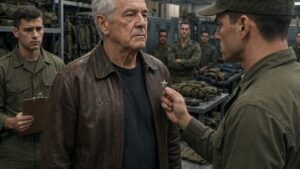
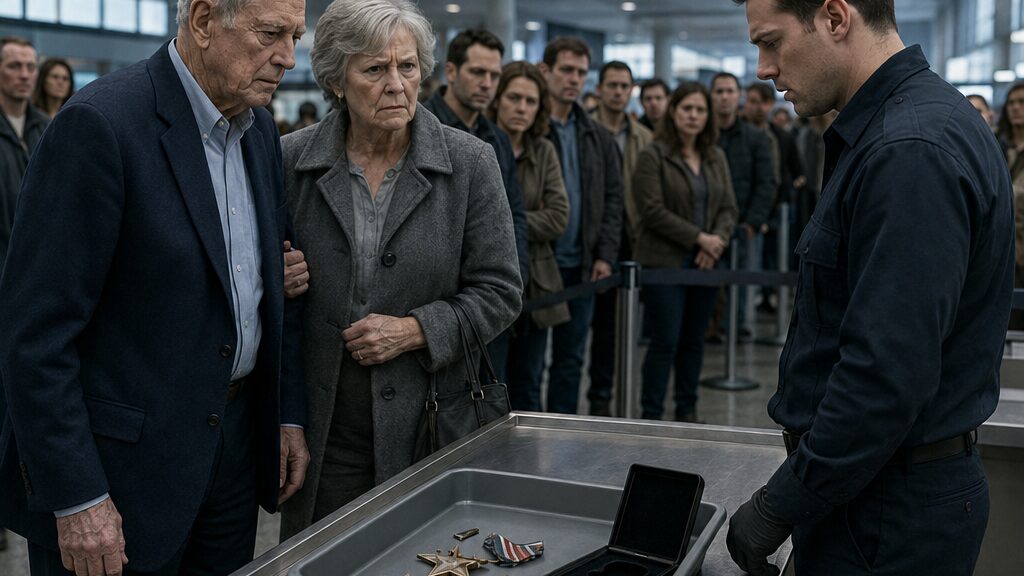
The young officer held the bronze star above a gray inspection tray, pinched by its striped ribbon as though it were something found beneath a seat.
Charles Davis did not move.
The open presentation case rested on the steel table between them. Its dark velvet lining had been cut to the exact shape of the medal, and the empty recess seemed deeper than it had inside Charles’s carry-on. Beneath the fluorescent lights, every worn edge showed.
“Sir,” the officer repeated, louder this time. “You need to step back.”
Charles heard the impatience before he saw it. The line behind Shirley had stopped moving. Plastic bins knocked together. A man in a business jacket glanced at the departure board, then at Charles, as if the old man’s slowness had become a personal offense.
Shirley reached for Charles’s sleeve.
“Come back a little,” she said.
Charles obeyed by half a step.
The officer’s nameplate read WRIGHT. He looked no older than twenty-nine. His uniform was pressed, his hair cut close, his movements sharp enough to suggest that each one had been practiced. A few minutes earlier Charles had watched him kneel beside a frightened boy and explain, in a low patient voice, that the scanner would not swallow his shoes.
That patience was gone now.
“What exactly is this?” Andrew Wright asked.
“A service decoration.”
“Yours?”
Charles’s eyes remained on the medal. “It needs to stay in the case.”
Andrew turned it over. On the back, beneath a hinge blackened with age, a set of engraved letters caught the light.
M.L.
“You can put it back,” Charles said.
Andrew pressed the clasp with his thumbnail. It did not move.
A supervisor farther down the checkpoint called for another bag inspection. Andrew looked toward her, then toward the line that had begun to bend around the stanchions.
“Is there a hidden compartment in the backing?”
“No.”
“Then it should open.”
“It does.”
Andrew gave him a quick, tight look. “That’s what I’m trying to determine.”
Charles leaned forward. Not enough to cross the painted line, only enough to make his voice carry.
“Let me show you.”
“Sir, do not reach into the inspection area.”
“I’m not reaching.”
“Then step back.”
Shirley’s fingers tightened around his sleeve. Charles felt the small tremor in her hand. He had known that tremor for years. It appeared when she was angry enough to say something she might later regret.
Charles stepped back fully.
Andrew held the medal closer to his face. The bronze star was not large. It had weight, though—not much, but enough to pull the ribbon straight. One point bore a dull mark that could only be seen at an angle. Charles had spent thirty-eight years avoiding that angle.
Andrew gripped the rear fixture between two fingers and began to twist.
“The pin lifts,” Charles said. “It does not turn.”
Andrew kept twisting.
Charles could have raised his voice. He could have told him about tool discipline, about old hinges, about metal fatigue, about the difference between resistance and obstruction. He had taught younger men those things in rooms louder than this one.
Instead, he watched Andrew’s knuckles whiten.
“The pin lifts,” Charles said again.
Something gave with a soft metallic snap.
For one impossible second, the medal remained suspended in separate pieces between Andrew’s hands.
Then the star struck the tray.
One point broke away and skittered toward Charles’s wallet. Another fragment landed against the presentation case with a sound too light for the damage it carried. The ribbon slid down last, folding over itself beside the empty velvet recess.
No one behind them complained about the delay.
Andrew stared at his hands.
Shirley inhaled sharply. “You broke it.”
“I—” Andrew lowered both hands. “The fixture separated.”
“You broke it,” she said again.
The supervisor began walking toward them.
Charles crossed the line.
Andrew’s posture changed at once. “Sir, stay back.”
Charles did not look at him. He reached into the tray and lifted one triangular fragment. Its edge was bright where the old bronze had split. On the back, half the engraved M remained, the cut running through the letter.
“Do not touch the other pieces,” Charles said.
Andrew glanced at the supervisor, now only a few yards away. “I need you to step back while we document—”
Charles opened his palm.
The fragment lay against his weathered skin.
Andrew saw the engraving.
“Those are not my initials,” Charles said.
The officer’s eyes moved from the broken piece to Charles’s face.
Behind them, a bin conveyor continued humming. A child asked his mother why everyone had stopped. The mother whispered something Charles could not hear.
The supervisor arrived with a clipped stride. Her badge identified her as Deborah Clark.
“What happened?”
“The backing failed during inspection,” Andrew said.
Shirley gave a short, disbelieving laugh.
Deborah looked at the tray, then at Charles standing inside the inspection boundary. “Sir, I need you to move to the secondary area.”
“My husband warned him,” Shirley said. “Twice.”
“I understand you’re upset.”
“No, you don’t.”
Charles placed the engraved fragment beside the empty case. He did it carefully, fitting nothing together. The edges were too raw. The shape too altered.
Deborah signaled another officer. “Close this lane temporarily.”
The passengers were directed away. Some looked at Charles with sympathy; others avoided his eyes. The man in the business jacket hurried toward the next line without looking back.
Andrew began gathering the remaining pieces.
Charles caught his wrist.
He did not squeeze. He only stopped the hand.
“Not like that,” Charles said.
Andrew went still.
For the first time, the young officer’s face lost its practiced certainty. Beneath it was something unguarded and frightened—not fear of Charles, but fear of what had already happened and could no longer be corrected by following the next procedure properly.
Charles released him.
“Use the case,” he said.
Andrew lifted each piece by the edges. His movements were slower now. He placed the broken points into the velvet hollow, but they no longer matched its shape. The ribbon hung outside the case, caught beneath the lid.
Shirley fixed it before the lid could close.
Deborah directed them to a glass-walled office beyond the checkpoint. Charles saw the departure board as they passed.
BOARDING.
Their flight number glowed beside the word.
He stopped for less than a second.
Shirley saw it too. “We’ll deal with that later.”
Andrew carried the presentation case with both hands.
“No,” Charles said.
Andrew looked at him.
“I’ll take it.”
The officer surrendered the case.
Charles felt its changed balance immediately. The medal had always rested solidly in the center. Now the fragments shifted with every step, whispering against one another inside the velvet recess.
At the office door, Shirley touched his arm.
Through the lid’s clear inner panel, she had seen the engraved letters.
“Charles,” she said quietly, “did you ever tell Laura you were bringing this?”
Chapter 2: The Missed Flight Was Not the Real Deadline
“What would you estimate as the replacement value?”
Deborah Clark sat behind a narrow desk with a claim form open before her. The presentation case lay beside it under a square of white evidence paper. Someone had arranged the fragments for a photograph, separating them so cleanly that they looked less like part of a medal than items from a hardware drawer.
Charles stared at the blank line marked VALUE.
Shirley stood at the window, watching passengers move freely beyond the glass. Their flight had changed from BOARDING to GATE CLOSED ten minutes earlier.
“You cannot replace it,” she said.
Deborah kept her tone measured. “For the claim, we need an approximate monetary figure. That doesn’t mean we’re dismissing sentimental significance.”
“That sentence dismissed it while you were saying it.”
“Shirley,” Charles said.
She turned on him. “No. Don’t quiet me for their convenience.”
Andrew stood near the door. He had removed his gloves. A red mark crossed his thumb where the medal’s clasp had pressed into it.
Deborah slid the form toward Charles. “Decorations of similar type can sometimes be sourced through authorized dealers or military records.”
“It isn’t mine,” Charles said.
Andrew looked up.
Deborah’s pen stopped. “The item does not belong to you?”
“It was entrusted to me.”
“By whom?”
Charles did not answer.
The silence lengthened until Deborah seemed to classify it as resistance.
“We need enough information to process the incident.”
“You need enough information to put a number in a box,” Shirley said.
Deborah closed the folder halfway. “Mrs. Davis, I am attempting to help.”
Charles rested two fingers on the case. Through the thin lid he could feel nothing, but he knew exactly where the empty recess lay.
“The metal can be replaced,” he said. “That isn’t what I failed to replace.”
Shirley’s expression changed.
Deborah opened the folder again, though more slowly. “I’m not sure what you mean.”
Charles withdrew his hand. “Write that the value is undetermined.”
An airport claims employee arrived with a camera. Charles watched her photograph the case from above, then the ribbon, then the broken points against the gray tray they had brought in from the checkpoint. The empty velvet shape was visible in every image.
The claims employee asked him to rotate the engraved fragment.
Charles did not move.
Andrew stepped forward. “I can do it.”
“No,” Charles and Shirley said together.
Andrew stopped.
Charles turned the fragment himself.
The camera flashed over the initials M.L.
No one asked about them.
By ten o’clock, the paperwork had grown thicker while the answer remained the same: the airport could investigate, the airline was not responsible, the object might be repairable, and the next confirmed flight was the following morning.
Shirley refused to accept that.
At the airline desk, she placed both boarding passes on the counter and explained what had happened in a voice that attracted attention without becoming loud. The gate agent listened, glanced at Charles holding the case, and began typing.
“There are two standby seats on the four-forty departure,” the agent said. “I can’t guarantee them, but I can move you to the top of the list given the delay.”
“What time does that land?” Charles asked.
The agent checked. “Seven fifty-five.”
Shirley looked at him.
The gathering began at seven.
Laura had chosen the time because it was the hour her father used to call home from base whenever duty allowed. Charles knew that without needing to look at the invitation folded in Shirley’s handbag.
“We’ll take the standby,” Shirley said.
The agent printed two slips. “Be at the gate by three-forty-five.”
It was a solution, and for several seconds they both treated it like one.
Then Shirley led him to a row of seats beneath a television playing silent weather reports. Travelers charged phones, ate breakfast from paper cartons, and slept with their heads against luggage.
Charles placed the case on his knees.
“You told her we’d be there for the beginning?” Shirley asked.
“Yes.”
“Did you tell her why?”
“She knows I’m bringing something.”
“She knows you’re bringing the medal.”
Charles watched a baggage cart pass beyond the windows.
Shirley sat beside him. “Does she know you’ve had it all this time?”
“She knows it was kept safe.”
“That wasn’t my question.”
He opened the case.
The fragments had shifted again. A thin bronze point lay across the center of the velvet recess like a hand across an empty chair.
Shirley lowered her voice. “You postponed in April. You postponed last fall. Before that, you said the drive was too long.”
“It was.”
“And this time you said flying would make it easier.”
Charles fitted the engraved piece beside the ribbon, not because it belonged there but because he needed his hands to do something exact.
“I did not break it,” he said.
Shirley stared at him. “I know.”
The words sounded more severe than an accusation.
His phone began vibrating in his coat pocket.
Neither of them moved at first.
The screen showed LAURA LEWIS.
Charles let it ring three times before answering.
“Hello, Laura.”
Airport noise filled the space between them.
“Are you at the gate?” she asked.
Her voice was older than the one Charles remembered most clearly, but when she was disappointed, the years fell away.
“We missed the flight.”
Silence.
“There was an incident at security,” he continued. “We’re on standby for another.”
“What kind of incident?”
Charles looked at the broken star.
“Something was damaged.”
“The medal?”
Shirley turned toward him.
Charles closed his eyes once. “Yes.”
On the other end, Laura exhaled slowly.
“Can it be repaired?”
“We’re finding out.”
“The gathering starts at seven.”
“I know.”
“People are coming because you said you would finally bring it.”
Charles’s thumb traced the seam of the case.
“We may arrive afterward.”
Another silence followed, but this one was not empty. It carried every previous delay, every polite excuse, every date changed and then abandoned.
When Laura spoke again, her voice was controlled.
“You promised me this time would be different.”
The call ended before Charles found an answer.
Chapter 3: The Name Behind the Broken Bronze
“I need two tickets home.”
Charles kept his voice low at the airport hotel desk, though Shirley was still upstairs and the lobby was nearly empty.
The clerk looked from the computer to the small presentation case under Charles’s arm. “Return tickets through the airline?”
“Anything leaving today.”
“You’d have to contact the carrier directly.”
Charles nodded as if the answer relieved him. “Could you print the schedule?”
While the clerk searched, Charles imagined carrying the broken medal back through the checkpoint, placing it once more in a gray tray, returning home with the promise still intact because it had never been completed.
“Charles.”
Shirley stood near the elevators holding her handbag and the unopened envelope Laura had mailed three months earlier.
The clerk stopped typing.
Charles took the printed schedule anyway.
Upstairs, Shirley placed the envelope on the small table beside the case.
“You were going to leave without telling me.”
“I was checking options.”
“You asked for two tickets home.”
“The gathering will be over before we arrive.”
“Laura will still be there.”
Charles set the schedule down. “The medal is broken.”
“Laura is not waiting for a piece of bronze.”
He looked at the envelope.
Laura’s handwriting had changed over the years. The letters were careful now, the lines straight. Charles had carried the envelope from his desk to his nightstand, then to the top drawer, then into his luggage without opening it.
Shirley pushed it toward him.
“Read it.”
“Not now.”
“When?”
He did not answer.
Shirley’s anger sharpened. “After another thirty-eight years?”
Charles picked up the presentation case instead. “There’s a repair shop near the airport. Deborah gave us the address.”
“You don’t get to turn this into an errand.”
“It needs to be stabilized before we travel.”
“And after that?”
“After that, we decide.”
“No. You decide. You’ve been deciding for both of us every time you say nothing.”
The repair shop occupied a narrow storefront between a watchmaker and a luggage service. Inside, magnifying lamps bent over scarred worktables. The specialist wore thin cotton gloves and did not touch the medal until Charles gave permission.
That alone made Charles’s chest tighten.
The specialist examined each fragment beneath a circular lens. He said very little. When he needed to turn a piece, he asked.
Finally, he aligned the broken points around the empty velvet recess.
“It can be stabilized,” he said. “The star won’t look untouched.”
“I don’t need it untouched,” Charles replied.
“The seam will remain visible, especially here.” The specialist indicated the longest break. “The old alloy has fatigue.”
Shirley leaned closer. “Old fatigue?”
The specialist adjusted the lamp.
Beneath the fresh bright fracture ran a darker line, thin as a strand of hair, crossing one point toward the center.
“This was already cracked,” he said. “Not separated, but stressed. It may have held for years if left alone. Twisting the backing finished it.”
Charles looked at the dark line.
Shirley looked at him.
“You knew,” she said.
The specialist removed his glasses. “I can give you a few minutes.”
When he stepped into the back room, the ticking of a dozen wall clocks became impossible to ignore.
Charles lowered himself onto a wooden chair.
“It happened the first night,” he said.
Shirley remained standing. “What first night?”
“The night I received it.”
“You told me the medal came from Mark’s effects.”
“It did.”
“Then why was it cracked?”
Charles watched the second hand of the nearest clock cross twelve.
“Because it was on him.”
Shirley’s anger loosened, but did not disappear. “During the fire?”
He nodded.
The words had waited so long that speaking even those two felt less like confession than damage.
The medal had belonged to Mark Lewis. Not to Charles. Not to a unit display or a museum or an office drawer. It had been awarded after an earlier deployment and worn inside Mark’s jacket on the maintenance line despite regulations discouraging it. Mark had said some men carried photographs. He carried proof that his daughter would one day believe he had done at least one thing properly.
Laura had been eight.
After the fire, the medal had been returned with Mark’s personal effects. His widow had not wanted it then. Too much in the box smelled of smoke. Too much had been handled by strangers wearing solemn expressions.
Charles had said he would keep it until Laura was old enough.
Then he had kept it longer.
“The medal is Mark’s,” Shirley said.
“Yes.”
“And Laura has never held it?”
“No.”
The word sounded worse inside the clock shop.
Shirley sat across from him. “You could have repaired the crack years ago.”
“I did not want anyone taking it apart.”
“You carried it onto an airplane.”
“I kept it with me.”
“You refused to mail it because you said it might be lost.”
“Yes.”
“But you brought it through security knowing the backing was weak.”
Charles looked toward the back room where the specialist had disappeared.
“I thought if I held the case myself—”
“You thought you could control every part except the one that mattered.”
He let that stand.
Shirley slid Laura’s envelope from her handbag and placed it beside the broken star.
“Open it.”
Charles lifted the flap carefully. Inside was a single sheet and a photograph.
The photograph showed a table in Laura’s home. At its center sat an empty wooden display stand. Beside it were a pair of worn maintenance gloves and a small card bearing Mark Lewis’s name.
The letter contained no accusation.
That made it harder to read.
Laura wrote that she did not want a ceremony. She wanted Charles to come, bring the medal, and tell her children something true about their grandfather that was not printed in an official record.
At the bottom she had written: I have spent most of my life wondering why the person who knew him best could not bear to know me.
Charles folded the letter once, then again along the existing crease.
The specialist returned.
“I can secure the fragments by tomorrow morning,” he said. “But before I begin, I need to know whether you want the old fracture concealed.”
Charles looked at the thin dark line.
“No,” he said. “Leave it where it can be seen.”
Shirley waited until the specialist carried the pieces away.
Then she asked the question Charles had known was coming from the moment the star struck the tray.
“Did you bring it through security knowing it might break?”
Chapter 4: The Promise He Kept Postponing for Thirty-Eight Years
“The first crack happened the night Mark died.”
Charles said it before Shirley could repeat her question.
They were back in the hotel room. The curtains had been left open, and aircraft moved beyond the glass in slow white arcs, rising above the parking structures and disappearing into cloud. On the table between the beds, Laura’s letter lay beside the printed flight schedule Charles had tried to obtain.
Shirley removed her coat but did not sit.
“You told me the medal was returned with his effects.”
“It was.”
“You did not tell me it had been damaged in the fire.”
Charles pressed his palms together. A pale line marked one finger where the case handle had rested all morning.
“I did not tell you much about the fire.”
“No,” she said. “You did not.”
The bedside clock changed from 1:18 to 1:19. Their standby flight would begin boarding in less than three hours. The medal would remain at the repair shop until morning.
They could not leave without it.
That fact should have felt like a practical obstacle. Instead it felt like relief, and Charles despised himself for recognizing it.
Shirley pulled the desk chair opposite him. “Start before the fire.”
Charles looked toward the window.
“Charles.”
He had spent most of his adult life believing that words became less dangerous if held long enough. Mark used to say the opposite. A warning kept inside your mouth, he said, was only a prediction you had chosen not to prevent.
Charles had remembered those words at the checkpoint.
Too late.
“We were maintaining a ground power unit beside a transport aircraft,” he said. “Overnight shift. Mark was crew chief.”
“And you?”
“Ground systems. Electrical and hydraulic support.”
“I know what you did. I’m asking what happened.”
Charles nodded once.
Earlier that week, he had signed off on a pressure regulator after replacing a damaged seal. The readings had held during the first test. During a later inspection, another technician found a fluctuation Charles had missed.
“It wasn’t enough to cause the fire,” Charles said. “The investigation established that.”
Shirley’s face did not soften. “But?”
“But I had cleared the unit.”
His supervisor removed him from the line pending review. It was standard procedure, temporary and impersonal. Charles had accepted it without argument, but the removal had felt public. Men he had trained avoided discussing it in front of him. Others became overly kind, which was worse.
Mark found him in the tool room before the night shift.
“You made a bad call,” Mark had said.
Charles had expected consolation. Mark never offered it.
“You don’t get to turn one bad call into your entire name.”
The damaged unit still needed monitoring. Mark reassigned Charles’s position to himself and placed Charles on inventory duty away from the aircraft.
“He switched with you?” Shirley asked.
“Yes.”
“Because you had been removed?”
“Because he thought I would try to prove something.”
Charles could still see Mark fastening his jacket in the tool-room doorway. The bronze star had been pinned inside the lining, hidden from regulations and everyone else.
Mark tapped the pocket. “Laura has a school presentation tomorrow. Wants something that proves her father isn’t just a man who smells like fuel.”
Charles had told him medals proved only that someone had filled out the paperwork.
Mark smiled. “Then maybe she’ll be impressed by the paperwork.”
The fire began twenty-three minutes after midnight.
A ruptured fuel line sprayed beneath the transport’s wing. Vapor reached a hot electrical component before the emergency shutoff completed. By the time the alarm sounded, flame had already traveled along the ground toward the power unit.
Charles heard the blast from the storage bay.
He ran toward it despite the order removing him from the line.
In memory, the scene had no continuous motion. It arrived in separate images: orange light under the wing; a hose coiling like a living thing; men shouting numbers; Mark at the manual cutoff because the remote system had failed.
“That was my station,” Charles said.
Shirley leaned forward. “Would you have been there if he hadn’t switched?”
“Yes.”
“Would you have done what he did?”
Charles looked at her.
“I don’t know.”
It was the first honest answer he had ever given to that question.
Mark stayed long enough to close the fuel supply and pull another airman clear. The fire did not reach the main tank. Six men on the far side of the aircraft escaped before the emergency crews contained it.
Mark did not.
“They found the medal inside his jacket,” Charles said. “The heat warped the clasp. One point had cracked.”
Shirley lowered her eyes.
“They gave his effects to his wife. She opened the box once. Then she asked me to take it away. She said Laura should have it when she was old enough to understand.”
“And you agreed.”
“Yes.”
“When was she old enough?”
Charles did not answer.
At eighteen, perhaps. At twenty-one. At twenty-eight, when Laura married. At thirty-two, when her mother died and the last obvious guardian of Mark’s memory was gone.
Each year Charles found a reason that sounded responsible.
The medal needed cleaning. Laura was moving. Charles’s back made travel difficult. The timing was wrong. Mailing it would be careless. A visit deserved planning.
The medal remained in the same case.
Shirley looked toward Laura’s letter. “You thought keeping it safe was the same as keeping your promise.”
“I kept it from being lost.”
“You kept yourself from having to hand it over.”
Charles stood. The movement was too quick, and the room shifted slightly before settling.
“You think I don’t know that?”
“I think you know many things you never allow to become words.”
His phone chimed.
A message from Laura contained a photograph.
The same display table from her letter stood against a wall in her home. Mark’s worn maintenance gloves had been placed beside a framed photograph of him kneeling beside a young Laura. At the center sat the empty wooden stand.
People’s coats were visible at the edge of the image.
The gathering had begun without them.
Beneath the photograph, Laura had written: We left the place open.
Charles sat down again.
Shirley moved beside him, but she did not touch the phone.
“She thinks you stopped visiting because you were ashamed of Mark,” she said.
“I was ashamed.”
“Of him?”
Charles shook his head.
The distinction should have mattered. After thirty-eight years, he was no longer certain it did.
The standby seats expired while they sat there. Shirley turned off the airline notifications without comment. She ordered coffee neither of them drank and called the repair shop to confirm the medal would be ready in the morning.
At four thirty, the hotel room phone rang.
Deborah Clark informed them that the airport had prepared an incident resolution package. It included reimbursement for the missed flight, a hotel voucher, repair expenses, and seats on the first departure after the medal was collected.
“We can review it this evening,” Deborah said. “It should allow everyone to move forward.”
Charles looked at the empty place where the medal case had been.
“Everyone,” he repeated.
After the call, Shirley opened her handbag and took out Charles’s old phone. He kept it charged though he rarely used it. The voicemail archive held messages transferred from two earlier devices.
“What are you doing?” he asked.
“Finding the one you pretend you deleted.”
She navigated by date and placed the phone on the table.
Laura’s recorded voice filled the room.
She sounded younger. The message was eleven years old.
“Mr. Davis, it’s Laura. I found your Christmas card. Thank you. I just… I don’t know why you send cards when you won’t answer when I call. Mom said you were the last person Dad spoke to before the fire. I’m not asking you to make it better. I want to know why you disappeared after the funeral.”
The message ended.
Charles had listened to it many times, always stopping before the final silence.
Now Shirley let that silence continue.
On the screen, an option waited beneath the recording.
DELETE.
Charles reached for the phone, then withdrew his hand.
He had told himself that withholding the story spared Laura the burden of his guilt. He had told himself Mark deserved to be remembered for what he saved, not for the mistake that put him there.
But Mark’s mistake had not placed him at the cutoff.
Charles’s had.
And Mark had chosen to take his place knowing exactly what Charles would do if left near the line: rush back, ignore orders, and attempt to prove that one failed inspection had not made him useless.
The medal’s old fracture had remained visible only when held beneath the right light.
So had the truth.
Chapter 5: The Report Said Decorative Property and Nothing More
Decorative personal property.
The phrase appeared twice in the airport’s report.
Charles read it a third time at the administrative office table while Deborah Clark waited across from him. The document rested beside a color photograph of the gray tray. In the image, the bronze fragments had been numbered with small evidence markers. The striped ribbon curled near the edge. The open case showed its empty velvet recess.
Everything had been made clear except what had happened.
“The wording is for classification,” Deborah said. “It doesn’t define the item’s importance to you.”
“It defines what your office is willing to admit,” Shirley replied.
Deborah folded her hands. Her face showed the fatigue of someone who had spent the day preventing one delay from multiplying into ten. “The package covers the specialist repair, replacement travel, lodging, meals, and an additional property allowance.”
“And in return?” Shirley asked.
“There is a standard acknowledgment that the matter has been resolved.”
Charles turned the page.
The signature line sat beneath a paragraph stating that the object had separated during a routine inspection because of preexisting material weakness.
There was no mention of his warning.
Andrew stood near the wall, no longer in his checkpoint jacket. His sleeves were rolled to the forearms. He looked as though someone had told him to remain available but not to speak.
Charles tapped the sentence.
“This says the medal separated.”
“The prior fracture is relevant,” Deborah said.
“So is the hand that twisted it.”
Andrew looked down.
Deborah’s voice tightened. “Officer Wright was conducting an inspection under active security protocols. Last month, an altered mechanical component passed through his lane because an item was not examined thoroughly. He is currently under performance review.”
Shirley glanced at Andrew. “So he decided no old man would make him look careless twice.”
“That is not what I said.”
“It is what happened.”
Charles studied Andrew’s face. At the checkpoint, certainty had sharpened every movement. Now the young man seemed to be waiting for someone else to choose the version of him that would survive the day.
Deborah pushed the settlement toward Charles. “This does not prevent you from expressing dissatisfaction. It simply closes the property claim.”
The hotel, the flights, the repair—all of it could be settled with one signature.
They could collect the medal in the morning, leave on the next plane, and reach Laura by afternoon. Charles would not have to describe Mark to strangers. He would not have to explain why the initials on the medal were not his. He could keep one part of the truth private a little longer.
The pen lay beside his hand.
Andrew moved away from the wall.
“Sir,” he said.
Deborah turned. “Officer Wright.”
“He warned me.”
The room became still.
Andrew looked at Charles rather than his supervisor. “He said the pin lifted. He said it didn’t turn.”
Deborah’s jaw tightened. “Your original statement is attached to the internal file.”
“It isn’t in this summary.”
“The summary is not intended to reproduce every spoken detail.”
“It reproduces the old fracture.”
“That is physical evidence.”
“So is the break after I twisted it.”
Deborah stood. “We will discuss this separately.”
Andrew’s face reddened, but he did not retreat. “You asked me to sign the revised account.”
“I asked you to confirm the sequence.”
“The sequence leaves out the warning.”
Charles looked again at the tray photograph. Someone had drawn a thin arrow toward the old fracture and typed PREEXISTING STRESS beneath it.
No arrow pointed to Andrew’s hands.
Deborah gathered the papers. “We are not completing this meeting tonight.”
“Why?” Shirley asked. “Because he finally said what happened?”
“Because the matter now requires formal review.”
She named a time the next morning and explained that an internal representative would attend. The first available flight afterward would be in the afternoon.
Another delay.
Shirley’s mouth tightened. “We’ve already missed what we came for.”
Charles watched Deborah place the report into a folder. The phrase decorative personal property disappeared beneath the cover.
“That wording,” he said. “Who chose it?”
Deborah hesitated. “I did.”
“Why?”
“Because official records require neutral descriptions.”
“It is not neutral.”
“It avoids assumptions about military status and value.”
“It avoids the person.”
Deborah held his gaze. For the first time that day, she did not answer immediately.
Andrew followed Charles and Shirley into the corridor after the meeting. Deborah called his name, but he asked for one minute.
“I’ll submit my original statement,” he said.
“You should,” Shirley replied.
Andrew looked at Charles. “I’m sorry.”
Charles adjusted the hotel key sleeve in his pocket.
The apology landed somewhere he could not yet reach.
“I should have listened,” Andrew continued. “I knew you said it. I thought you were slowing me down because you didn’t understand what I was checking.”
Charles nodded once.
Andrew seemed unsettled by the lack of either forgiveness or anger.
“When it broke,” he said, “you told the supervisor it didn’t matter.”
“I said the claim did not matter.”
“I thought you meant what I did.”
Charles looked past him through the administrative-office glass. Deborah was at the table crossing out a line on the report.
“Were you trying to protect me?” Andrew asked.
“No.”
The answer came quickly enough to surprise them both.
Charles continued more quietly. “I was trying not to explain myself.”
Andrew waited.
Charles saw the young man at the checkpoint again, twisting harder because stopping might have looked uncertain. Fear disguised as decisiveness.
He had known that disguise once.
Perhaps he still wore another version of it.
“Tomorrow,” Charles said, “tell them exactly what you did. Do not make it smaller. Do not make yourself larger either.”
Andrew nodded.
Shirley and Charles walked toward the elevators.
Behind them, Deborah called Andrew back into the office.
Shirley pressed the elevator button. “You still haven’t signed.”
“No.”
“Are you going to ask that he be dismissed?”
Charles watched the floor numbers descend.
“I don’t know what I’m going to ask.”
The doors opened.
Before they stepped inside, Andrew spoke from the office doorway.
“Mr. Davis.”
Charles turned.
The young officer’s voice carried down the corridor.
“If telling the truth costs me the job, I’ll tell it anyway.”
Chapter 6: The Old Veteran Finally Corrected the Record
Charles placed the unsigned settlement beside the broken star.
The repair specialist had returned the medal that morning in a temporary padded box. The points had been joined, but a narrow seam crossed the bronze from the old dark fracture into the bright new break. The engraved fragment rested separately inside the open presentation case. It could be secured later, the specialist had explained, but Charles had asked that it remain loose for the review.
The small room held no audience.
Deborah sat at one end of the table with the internal review representative. Andrew occupied the chair nearest the door. Shirley sat beside Charles, her handbag closed in her lap.
A gray plastic tray had been placed on a side table to demonstrate the inspection sequence.
Charles looked at it only once.
The representative activated a recorder. “Mr. Davis, we understand you would like to make a statement before discussing resolution.”
“Yes.”
Shirley shifted as if preparing to help him begin.
Charles laid one hand over hers.
Then he removed it.
He needed to do this without being carried.
“Officer Wright broke the medal,” he said. “The existing fracture did not twist the backing. He did.”
Andrew’s shoulders tightened, but he nodded.
“Mr. Davis,” Deborah began, “the report acknowledges physical contact during inspection.”
“No. It says the item separated.”
The representative turned toward Deborah. “Is that the current wording?”
Deborah opened the folder.
Charles continued. “I warned him. He heard me. He believed my age and hesitation made my instruction less reliable than his judgment.”
Andrew looked at the table. “That’s accurate.”
“The line was crowded,” Charles said. “He was under review because he had failed to inspect something thoroughly before. Those facts explain the pressure. They do not remove his choice.”
Andrew raised his head.
Charles moved the engraved fragment from the case and placed it between them.
“Those initials belong to Mark Lewis.”
No one interrupted.
“He was an Air Force crew chief. He died thirty-eight years ago during an aircraft fire after closing a manual fuel cutoff and pulling another man clear.”
Deborah’s expression changed, but Charles did not allow the medal’s history to become an escape from the present.
“It would still have been wrong to ignore me if this had come from a flea market,” he said. “The object’s story is not what made my warning valid.”
The representative made a note.
Charles felt Shirley’s eyes on him.
“The medal was already cracked because Mark wore it inside his jacket that night. I knew the weakness existed. I carried it because I was taking it to his daughter.”
“Why now?” Deborah asked, then seemed to regret the question.
Charles looked at the empty velvet recess.
“Because I had delayed long enough.”
He told them about the faulty regulator. Not every technical detail, only enough to make the sequence clear. He described being removed from duty, Mark taking his position, and the fire beginning before Charles could return to the line.
Andrew listened without moving.
“Mark made a choice,” Charles said. “For years I told myself that speaking about my mistake would make his sacrifice smaller. That was convenient. Silence let me appear dignified while his daughter wondered why I disappeared.”
Shirley’s fingers tightened around the clasp of her handbag.
Charles reached inside it with her permission and removed a folded sheet protected in a clear sleeve.
Mark’s final note had been found in his locker after the fire. Charles had carried it since the funeral.
He unfolded it.
The writing was hurried, intended for Charles after the maintenance review.
Davis—one bad inspection is not your whole life. Don’t turn it into mine either. If anything happens on this line, make sure Laura knows I was more than the uniform. And don’t disappear because you’re ashamed.
Charles had never shown the final sentence to Laura.
The room blurred briefly. He waited until it cleared.
“I kept the medal safe,” he said. “I did not keep the promise.”
The representative stopped writing.
Andrew looked at the note, then at Charles. “Why tell us this?”
“Because your report does what I did. It uses careful words to avoid the part that assigns responsibility.”
Deborah lowered her eyes to the folder.
Charles slid the settlement away.
“I will not sign a statement that says the medal separated because it was old. And I will not accept a condition that prevents me from describing what happened.”
“There is no intention to suppress—” Deborah began.
“The acknowledgment includes a confidentiality clause.”
The representative turned sharply. “The property form includes confidentiality?”
Deborah opened to the final page. “It is standard language for disputed claims.”
“Remove it,” the representative said.
Deborah’s mouth thinned. “Understood.”
“And restore Officer Wright’s initial statement to the summary.”
For several seconds she did not move.
Then Deborah drew the report toward her, uncapped her pen, and crossed out the sentence describing the warning as unverified. She wrote beside it in compact block letters:
TRAVELER ADVISED OFFICER THAT FIXTURE LIFTED AND SHOULD NOT BE TURNED. OFFICER CONTINUED MANUAL MANIPULATION.
She signed the
Chapter 7: The Daughter Who Had Waited Longer Than the Medal
Laura opened the door, looked at the presentation case in Charles’s hands, and did not step aside.
For a moment, no one spoke.
Behind her, the remains of the gathering were still visible. Paper cups stood in uneven groups along a sideboard. A casserole dish had been covered with foil. On the far wall, Mark Lewis smiled from a framed photograph taken before Charles had known him well enough to understand the impatience behind that smile.
The empty wooden display stand remained on the table.
Charles held the case against his coat. The repaired star rested inside, but not in the velvet recess. The specialist had wrapped it in soft paper so the new seam would not scrape against the lining.
Shirley stood one step behind him.
Laura looked from Charles to her, then back to the case.
“You made the flight,” she said.
“Yes.”
“You said there was more.”
“There is.”
She moved aside.
The house smelled faintly of coffee and extinguished candles. Coats remained draped over dining chairs, though the guests were gone. Two children’s drawings had been taped beneath Mark’s photograph. One showed an airplane with impossible wings. The other showed a man holding a wrench taller than himself.
Laura gestured toward the table. “You can put it there.”
Charles approached the display stand but stopped before setting down the case.
He placed it instead on the lower end of the table, away from the photograph and gloves.
Laura noticed.
“You carried it all this way.”
“I did.”
“And now you don’t want it where we prepared a place?”
“I don’t know yet where it belongs.”
Her face tightened. “That has been the problem for thirty-eight years.”
Shirley drew out a chair. “Laura—”
Charles lifted one hand.
Shirley stopped.
The restraint cost her. He saw it in the way she pressed her lips together, but she sat without speaking.
Charles opened the presentation case.
The empty velvet recess faced upward. Beside it, he unfolded the paper and revealed the bronze star. The repair seam crossed one point and continued toward the center, a pale line against the older metal. The engraving on the back had been preserved. M.L. remained divided by the fracture but legible.
Laura did not reach for it.
“What did they do?” she asked.
“A security officer turned the backing after I told him not to.”
“And you let him?”
Charles felt Shirley look at him.
“I obeyed the instruction to step back.”
Laura gave a humorless breath. “You always did know how to follow the part of an order that let you avoid the rest.”
The words struck accurately enough that he did not defend himself.
“The officer was wrong,” Charles said. “I was also wrong before I reached the airport.”
Laura folded her arms.
Charles removed the clear sleeve containing Mark’s note.
The paper inside had softened at the folds. One corner bore an oil stain that had remained through every careful attempt to preserve it. Charles placed it on the table between them.
Laura’s eyes went to her father’s handwriting.
“What is that?”
“A note he left in his locker.”
“For whom?”
“For me.”
She looked at Charles then, not at the note. “You had a note from my father?”
“Yes.”
“How long?”
He could have said since the investigation. Since the funeral. Since her mother placed the medal in his hands and asked him to keep it safe.
Instead, he said, “Thirty-eight years.”
Laura’s arms dropped.
Shirley lowered her eyes.
Charles slid the note across the table.
Laura did not pick it up at first. When she finally did, she held the sleeve by its edges, the way the repair specialist had handled the medal. Her gaze moved slowly across the lines.
Charles watched her reach the final sentence.
And don’t disappear because you’re ashamed.
Laura read it twice.
“You knew,” she said.
The words were quiet.
“Yes.”
“He told you not to disappear.”
“Yes.”
“And you did it anyway.”
Charles nodded.
She set the note down with care that made her anger harder to bear.
“Why?”
He looked at Mark’s photograph.
“Because he took my position.”
Laura waited.
Charles told her about the regulator, the missed fluctuation, and the temporary removal from the line. He explained how Mark had seen what Charles was likely to do—return early, overreach, prove that he was still useful—and reassigned himself to the manual cutoff station.
“I did not cause the fuel line to rupture,” Charles said. “The investigation was clear about that.”
“But if he had not switched with you—”
“I would have been there.”
Laura’s face changed, though not toward forgiveness.
“And you let me believe he was simply assigned there.”
“He was crew chief. He had authority to make the change.”
“That is not what I asked.”
“No.”
Charles rested both hands on his knees.
“He chose to take the position because he thought I was about to make one mistake into the rest of my life. Then he died there. I spent years telling myself that if I stayed away, I would not make your father’s death about my guilt.”
Laura looked at the note again.
“But staying away made it about you anyway,” she said.
“Yes.”
The answer came without resistance.
That seemed to unsettle her more than an excuse might have.
She walked to the window and stood with her back to them. In the glass, Charles could see the reflection of the empty display stand.
“When Mom died,” Laura said, “I found your address in her book. She had crossed it out, then written it again. Do you know what that told me?”
Charles remained silent.
“It told me she could not decide whether you belonged to us.”
He lowered his head.
“I called anyway. You sent a Christmas card.”
“I remember.”
“You always remembered dates. Never people.”
Shirley flinched.
Charles accepted that too.
Laura returned to the table and touched the paper around the medal, not the medal itself.
“Why now?” she asked. “Why come only after it was damaged?”
“We were already coming.”
“You postponed twice.”
“Yes.”
“So why did a stranger breaking it finally make you tell the truth?”
Charles considered the seam.
“Because I watched an official report turn a warning into nothing. It said the medal separated because it was old. It used careful language to remove the choice that broke it.”
Laura’s eyes narrowed slightly.
“I recognized that kind of language,” he continued. “I had been using it for years.”
The room remained quiet.
Charles did not ask her to understand.
He did not say Mark had forgiven him, though he believed the note meant something close to that. Mark’s forgiveness could not be inherited by his daughter, and it could not erase Charles’s absence.
“I am sorry,” he said. “Not for carrying the medal too long. For convincing myself that carrying it was the same as caring for what he asked.”
Laura looked at him for a long time.
Then she sat.
“Tell me the rest,” she said.
He did.
He told her about the alarm, Mark at the cutoff, and the airman he pulled clear. He told her how Mark used to sing only the wrong words to every song on the radio. He told her about the medal inside Mark’s jacket and the school presentation Mark expected to hear about the next morning.
Laura interrupted only once.
“Did he know he might not come back?”
“No,” Charles said. “He knew only that men were still near the aircraft.”
She allowed him to finish.
When the account ended, the light outside had faded. Shirley had not spoken for nearly an hour.
Laura lifted the repaired star and turned it over in her hand.
The seam caught the lamplight.
She placed it beside the case rather than inside the velvet recess.
“I don’t forgive you tonight,” she said.
“I did not come to ask you to.”
“I don’t know whether I believe that yet.”
Charles nodded.
Laura closed the presentation case while it was still empty.
The latch clicked.
Then she pushed it back toward him.
“Come tomorrow morning,” she said. “Without the medal.”
Chapter 8: The Empty Place No Longer Meant Something Was Missing
Charles arrived without the medal.
He carried no case, no folder, and no prepared explanation. Shirley walked beside him with both hands visible and empty.
Laura opened the door before they knocked.
Her eyes went first to Charles’s hands.
“You listened,” she said.
“This time.”
She considered the answer, then led them to the kitchen.
The bronze star was not on the display stand. It lay inside a shallow wooden box beside Mark’s maintenance gloves, the note, two photographs, and a red plastic comb with several missing teeth.
Charles recognized the comb immediately.
“He kept that?” he asked.
“Mom did.”
Mark had used it to scrape frost from the inside edge of a truck window during one winter exercise. He had carried it afterward because, he claimed, any tool that survived misuse had earned a second occupation.
Laura watched Charles looking at it.
“You said my children should know he was more than the uniform.”
“That is what he wanted.”
“No. He wanted you to make sure I knew.”
Charles accepted the correction.
Laura poured coffee into three mismatched mugs. She left one place at the table empty.
“My children are at school,” she said. “They were disappointed they missed you.”
“I can come another time.”
“That depends.”
“On what?”
She sat across from him.
“Tell me something about him that has nothing to do with the fire.”
Charles had prepared himself for more questions about the regulator, the cutoff, and the investigation. The request left him unsteady.
He looked at the maintenance gloves.
“Mark could not make coffee.”
Laura blinked. “He drank it constantly.”
“He made something brown and hot. Coffee was not involved.”
A small movement touched the corner of her mouth.
Charles continued.
During overnight shifts, Mark filled the industrial pot without measuring. Some nights the brew was nearly transparent. Other nights it stripped the taste from a man’s tongue. He refused all criticism and blamed altitude, humidity, electrical interference, or sabotage by competing branches of service.
“Once,” Charles said, “he accused the moon.”
Laura laughed before she could stop herself.
The sound was brief and startled. It did not heal anything. It changed the room anyway.
Shirley lowered her face toward her mug, granting the moment privacy.
Charles told Laura about Mark using safety wire to repair the arm of a vending machine because it kept stealing coins from younger airmen. He told her how Mark labeled every wrench but never returned one to the correct drawer. He told her about the song lyrics and the red comb.
Laura opened the wooden box.
“He was ordinary,” she said.
“Most days.”
“And brave?”
“On one night when people needed him.”
She traced the repaired seam with one fingertip.
“I spent years with one official photograph and a folded flag,” she said. “They made him look as if he had never laughed at anything.”
Charles looked at the empty display stand in the next room.
“What do you want to do with the medal?”
Laura closed the wooden box.
“Keep it here. With the gloves and the note.”
“Not in the case?”
“The case makes it look finished.”
The words settled between them.
Charles understood then why she had asked him to return empty-handed. The medal had become the only form in which he allowed Mark to exist: preserved, formal, silent, and safely contained. Laura did not need Charles to surrender an object and declare the promise completed. She needed him to remain after the delivery.
“The velvet will stay empty,” she said.
“Yes.”
“Does that bother you?”
Charles thought of the recess under airport lights, photographed as evidence of loss. He thought of the broken points arranged around it, each fragment proving that something once whole had been mishandled.
“No,” he said. “Not now.”
Laura reached across the table and moved the fourth mug from the empty place.
Not removed. Repositioned beside Charles.
“My children get home at three,” she said. “You can stay if you want.”
Charles looked at Shirley.
She did not answer for him.
“Yes,” he said. “I’ll stay.”
Weeks later, on the return journey, Charles placed the empty presentation case into a gray security tray.
He had delayed the flight home twice, but not for the reasons that once governed him. Laura’s son wanted help building a model transport aircraft. Her daughter had asked Charles to attend a school presentation about family history. Shirley had changed their tickets without complaint.
The repaired medal remained in Laura’s wooden box.
At the checkpoint, the open case drew the attention of an officer inspecting carry-on bags.
“What was kept in here?” the officer asked.
“A medal.”
“Where is it now?”
“With the person it belongs to.”
The officer nodded and reached toward the velvet lining.
Charles felt his shoulders harden.
The fluorescent light, the tray, and the uniform folded over one another. For an instant he saw Andrew Wright gripping the bronze star between his fingers.
Then the officer stopped before touching the case.
“May I lift the lining?” she asked. “I need to check beneath it.”
Charles looked at her open hand.
“Yes,” he said. “It releases from the top edge. I can show you.”
“Please do.”
He stepped forward rather than back.
With one finger, Charles lifted the velvet insert. The officer checked beneath it without bending or twisting anything. She thanked him and returned the case to the tray.
A