Edward Cared For Patricia Until The End, Then The Will Erased His Name
Chapter 1: The Name Missing Under The Chandelier
“The residence at 418 Willowmere Drive shall pass in full to Brandon Allen.”
Michelle Moore said it cleanly, without hesitation, as if the sentence had no weight beyond ink and paper.
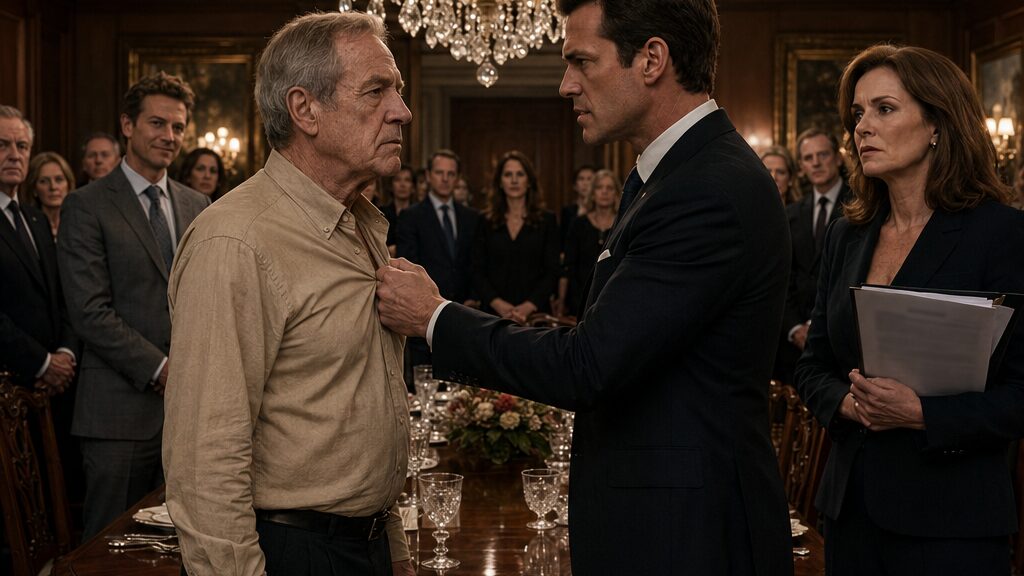
Edward Walker stood beneath Patricia’s chandelier with his hands folded in front of his belt, his beige shirt buttoned wrong at the cuff because he had dressed without looking in the mirror. The chandelier had been Patricia’s favorite thing in the dining room, not because it was grand, but because every crystal piece was slightly mismatched. She used to say the whole thing should have looked foolish, yet somehow held together.
Now it hung above a polished table full of people who were not looking at him.
No one gasped. No one turned in surprise. A woman near the sideboard kept both hands wrapped around a wineglass. Two cousins leaned together near the doorway. Joshua Brown, in a gray suit too bright for a house still full of sympathy flowers, lowered his eyes to hide a smile.
Edward waited for Michelle to continue.
She did.
“The primary checking account, investment account, and all personal property not otherwise designated shall also pass to Brandon Allen, who is named as personal representative of the estate.”
The paper in Michelle’s hand made a soft turning sound.
Edward heard Patricia’s clock ticking in the hall. It had never kept good time after she dropped it during a spring cleaning five years before, but she would not let him replace it.
A place for both of us, Eddie. I don’t want anybody fighting when I’m gone.
That was what she had said at this same table, three months before the hospital bed came into the living room.
Edward looked from Michelle’s hand to Brandon.
Brandon stood at the far end of the table in a dark suit, shoulders squared, chin lifted, looking not at Edward but past him, as though Edward were one more chair to be moved out after the meeting. He was Patricia’s son. Edward had told himself that all week. Grief sat differently on a son. Anger did too.
Michelle continued reading through clauses Edward did not understand. Executor authority. Debts and taxes. Distribution. Formal phrases that sounded like they had been built to keep human voices out.
Edward waited for his name.
It did not come.
When Michelle lowered the page, the room exhaled all at once.
Edward did not.
He touched the center of his chest through his shirt, not enough for anyone to notice. Under the fabric, Patricia’s locket rested against his skin, warm from his body. She had pressed it into his palm the night before the last ambulance ride.
Don’t let Brandon throw everything away.
At the time, he had thought she meant the house. The dining room. The flower beds she still asked about when she could no longer walk to the window.
Now he wondered if she had known more than he had let himself see.
“Is there,” Edward said, and his voice came out dry. He cleared his throat. “Is there another page?”
Michelle looked up.
For the first time since the reading began, several faces turned toward him.
“There are supporting documents,” Michelle said. “But the dispositive provisions are complete.”
“Dispositive,” Joshua repeated under his breath, amused by the shape of the word.
Edward kept his eyes on Michelle. “My name isn’t there.”
“No,” Michelle said carefully. “It is not.”
Brandon’s jaw moved once, as if he had been holding back the need to speak. “Mom made her choice.”
Edward looked at him then.
Brandon’s face had Patricia’s sharp cheekbones but none of her softness. In the last months, he had come more often. Every Tuesday at first, then twice a week, then whenever Edward had gone to the pharmacy or the grocery store. Edward had been grateful in the beginning. Patricia brightened when she saw her son, even on days when names came slowly. Edward had told himself not to stand between them.
“She told me I would have a place here,” Edward said.
A small silence followed. Not respectful. Waiting.
Brandon gave a short laugh. “She told everybody something, Edward. She was sick.”
The words struck harder than if he had shouted.
Michelle shifted in her chair. “This is not the moment for—”
“No,” Brandon said, stepping around the end of the table. “This is exactly the moment. Because he’s going to stand here and act like he doesn’t know what this is.”
Edward did not move.
Brandon came close enough that Edward could smell his cologne, sharp and expensive, cutting through the waxy scent of lilies on the side table.
“This is my mother’s house,” Brandon said.
Edward felt every eye on them now. The room had tightened around him: dark wood, crystal light, silver-framed photographs, the table Patricia had polished every Thanksgiving even when no one came.
“I know whose house it was,” Edward said.
“Was,” Brandon repeated. “That’s the part you need to hear.”
Joshua laughed then, not loudly, but enough. Enough that a woman near the sideboard lowered her glass. Enough that Edward felt heat rise along his neck.
Brandon lifted his hand and pressed two fingers against Edward’s chest, just below the collar.
Edward looked down at the hand.
The room went very still.
“You don’t get to wear grief like a claim,” Brandon said.
His fingers caught the fabric and tightened. The beige shirt pulled against Edward’s throat. Under it, the locket shifted, the chain biting gently at the back of his neck.
Edward’s right hand rose halfway, then stopped. He had held Patricia’s wrist during tremors. He had changed sheets without waking her. He had learned which pills could be crushed and which could not. He knew how to stay steady when a body depended on him.
He would not let this room see him grab back.
“Brandon,” Michelle said, sharper now.
But Brandon did not release him.
“You came into her life late,” Brandon said, low enough to feel private and public at the same time. “Don’t stand here like you built it.”
Edward looked past Brandon, just once, toward Patricia’s empty chair. No one had sat in it. The blue cushion still held the faint dip she used to complain about. He had meant to fix it. There had always been another appointment, another prescription, another night of listening to her breathe.
He looked down at Brandon’s fist.
Then he raised his eyes.
“When did she sign it?”
Brandon’s hand loosened a fraction. “What?”
“The revision.” Edward looked at Michelle. “What date?”
Michelle glanced at the page as if the answer were harmless. “Edward, a copy can be provided through proper—”
“Read the date.”
Brandon dropped his hand, but stayed close. “It doesn’t matter.”
Edward’s chest still felt the shape of Brandon’s grip.
“It matters to me.”
Joshua made a soft sound, almost a scoff. “You’re really doing this here?”
Edward turned toward him. Joshua’s smile faded before Edward said a word.
Michelle drew a slow breath. She lifted the signature page from the stack. The paper trembled slightly—not much, but enough that Edward noticed.
“The document was executed on March fourteenth.”
The clock ticked in the hall.
March fourteenth.
Edward saw Patricia in the recliner that week, wrapped in the yellow blanket because she was cold even when the heat was too high. He saw her trying to drink from a straw and missing it. He saw her looking at the television and asking him why the same weather report had been on for three days, though the television was off.
Six weeks before she died.
Brandon stepped back. “There. You heard it.”
Edward did not answer him. He looked at Michelle’s paper, at the bottom where Patricia’s name had been written by a hand he used to know better than his own.
“Read the date again.”
Chapter 2: The Date Nobody Wanted Edward To Read
“Mom changed her mind,” Brandon said in the hallway, blocking Edward before he could reach the attorney’s table. “That was her right.”
The dining room door remained half open behind them. Voices leaked through in murmurs, the family pretending not to listen while listening to every word. Michelle’s paralegal gathered folders in careful, nervous stacks near the wall.
Edward stood with one hand at his chest, two fingers resting where the locket chain had twisted under his collar. His shirt was wrinkled from Brandon’s grip. He had not smoothed it.
“She changed her mind six weeks before she died,” Edward said.
Brandon’s eyes hardened. “Don’t start that.”
“I’m asking when.”
“You asked. She answered. The paper answered. Michelle answered.”
“No,” Edward said. “The paper gave me a date. That isn’t the same thing.”
Brandon leaned in, but he did not touch him again. Not with Michelle watching from the end of the hallway.
“You want to make my mother sound incompetent now?” Brandon asked. “That’s where you’re going with this?”
Edward felt the trap in the question. If he said yes, he dishonored Patricia. If he said no, he accepted the document. Brandon had found the narrowest place and shoved him toward it.
“She had good hours,” Edward said. “And bad ones.”
“She knew what she wanted.”
“Then there should be no trouble telling me who was there.”
Brandon’s mouth pressed flat.
Michelle stepped between them without seeming to. She moved toward her temporary table near the front sitting room, where she had arranged documents in clean rows beside a leather case. She was younger than Edward had expected for someone entrusted with Patricia’s final papers, maybe early forties, with a calm face that looked practiced rather than natural.
“Mr. Walker,” she said, “I understand this is painful. But the will was signed with the formalities required. There were witnesses. The signatures are verified.”
Edward followed her to the table. “Who called you?”
Michelle hesitated for the first time.
“Patricia retained my office,” she said.
“That isn’t what I asked.”
From the dining room, a chair scraped. Joshua appeared in the doorway, holding his phone loosely in one hand.
Brandon noticed him and straightened. “Michelle doesn’t owe you a cross-examination.”
Edward looked at the folders on the table. The signature page lay on top of one stack. He could see the date now. March 14. Patricia Walker. A line beneath it. Two witness signatures. A notary stamp.
The stamp made it look finished.
Patricia’s actual handwriting did not.
Edward bent closer, then stopped himself before touching it.
“She wrote her P with a loop,” he said quietly.
Michelle glanced down.
“She stopped doing that near the end,” Edward continued. “Her hand hurt. Sometimes she printed instead of signing.”
Brandon gave a humorless laugh. “So now you’re a handwriting expert?”
“No,” Edward said. “I was the one who opened her pill bottles.”
The hallway quieted.
For a second, Brandon’s face changed—not with guilt, not exactly, but with something rawer. Then it vanished.
Michelle picked up the signature page and placed it behind another sheet, as if shielding it from both men.
“The appointment was scheduled by Brandon,” she said.
Brandon turned his head sharply. “Michelle.”
She looked at him. “That is not confidential. It is reflected in the correspondence.”
Edward’s fingers tightened at his side.
Scheduled by Brandon.
A small answer. A larger question.
“Was he there when she signed?” Edward asked.
Michelle’s eyes moved toward Brandon and back. “He was present at the residence.”
“The residence?” Edward said.
Brandon exhaled through his nose. “Mom wasn’t traveling well. You know that.”
Edward stared at him. “Traveling?”
“She was tired.”
“She was in a hospital bed in our living room by then.”
Brandon’s voice sharpened. “Your living room?”
The word did what Brandon intended. It opened the door to every old argument they had never quite had. Edward had moved into Patricia’s house after they married because she would not leave it. Brandon had never said no. He had never said yes either. He had just begun referring to it as “Mom’s place” every time Edward was near.
Michelle lifted a hand. “Please. This cannot become a family argument.”
“It already was,” Edward said. “Before today. I just didn’t know the paperwork had joined in.”
Joshua stepped fully into the hall. “You know what this looks like, right? Standing here, counting money before she’s even buried a month.”
Edward turned slowly.
Joshua looked pleased with himself until Edward met his eyes.
“I washed her hair the morning she forgot her own birthday,” Edward said. “Don’t talk to me about a month.”
No one spoke.
Then Brandon said, quieter, “You always do that.”
Edward looked back at him.
“You make care into ownership,” Brandon said. “Like every hard thing you did means she owed you the house.”
Edward absorbed that. There was enough truth in it to hurt. Not the ownership part. Never that. But he had counted the hard things, privately, shamefully, on the worst nights. He had remembered who came and who did not. He had let bitterness sit beside devotion and told himself it was only exhaustion.
“I don’t want to own what wasn’t mine,” Edward said. “I want to know why she was made to sign away the place she promised I could stay.”
“She wasn’t made to do anything.”
“Then give me the notes.”
Michelle’s jaw tightened. “I cannot release my file based on an emotional objection in a hallway. You may make a written request. You may retain counsel. You may file appropriate proceedings if you believe there are grounds.”
Legal doors. Legal locks.
Edward looked at her table again. There was a neatness to it that made him angry in a way Brandon’s grip had not. Folders, tabs, signatures, dates. Patricia reduced to pages no one had to sit up with at three in the morning.
“What notes exist?” he asked.
Michelle began placing documents into her leather case. “Draft correspondence, scheduling confirmations, execution notes.”
“Medical notes?”
“I am not a medical provider.”
“Did you ask one?”
Her hand stopped on the latch.
Brandon said, “Enough.”
Edward did not look at him. “Did you ask one?”
Michelle closed the case. “Patricia represented that she understood the document.”
Edward almost laughed. Not because it was funny, but because he heard Patricia in the last weeks saying yes to soup, yes to blankets, yes to people she wanted to stop worrying over her. Yes had become easier than explanation.
“She represented,” he said.
Michelle’s face softened, but only slightly. “Mr. Walker, I am telling you what the file supports. Not what you want it to mean.”
“And I’m telling you what the date means.”
Brandon came closer again. “The date means she finally stopped letting you guilt her.”
Edward’s hand went to the locket before he could stop it.
Brandon saw.
His gaze dropped to Edward’s chest, and something bitter crossed his face. “You shouldn’t even have that.”
Edward’s fingers closed over the small shape beneath his shirt. “She gave it to me.”
“She gave everyone things at the end.”
“No,” Edward said. “She held my hand until I took it.”
Michelle looked away.
For a moment, the hallway was not a hallway. It was Patricia’s bedroom, dimmed against afternoon sun, her breathing thin, her palm dry against his. Then Joshua shifted near the door, and Edward returned to the polished floor, the family listening, the paper locked in Michelle’s case.
“Make the request,” Michelle said. “In writing.”
Edward nodded once. He had spent years avoiding written things because they made love feel small. Consent forms. Insurance letters. Prescription instructions. Funeral invoices. Now paper was the only language this room respected.
He reached toward the table, not touching the file, only pointing at the page visible through the gap before Michelle fully closed the case.
“March fourteenth,” he said. “At the residence.”
“Yes,” Michelle said.
Brandon looked relieved, as though repetition made it safer.
Edward stepped back. “I was at the pharmacy that afternoon.”
Brandon’s relief flickered.
Edward remembered the receipt because he had argued with the clerk over a refill that insurance rejected. He remembered coming home to find Patricia sleeping too deeply, Brandon sitting beside her bed with the television on mute.
“You were gone,” Brandon said. “That’s not my fault.”
“No,” Edward said. “It was useful.”
Brandon’s face went red.
Michelle snapped the case shut. “I think this conversation should end now.”
Edward turned toward the dining room, toward the chandelier, the guests, the chair Patricia had left empty.
Then Michelle, perhaps meaning only to fill the silence, perhaps meaning to regain control, said, “The home visit was arranged because Patricia’s condition made travel difficult. That is all the accommodation indicates.”
Edward stopped.
He looked back at her.
“Home visit?”
Michelle’s expression changed before she could hide it.
Brandon said her name once, warning and low.
Edward looked from one to the other.
“The document was signed here?”
No one answered quickly enough.
Chapter 3: The Calendar Brandon Thought Was Empty
Edward’s key still opened Patricia’s front door, but the desk in her study had a black lockbox sitting on it that had not been there when she was alive.
He stood in the doorway with the key still in his hand, listening to the quiet house. Someone had opened the curtains too wide. Morning light fell harshly across the rug Patricia used to say hid every stain except loneliness. On the mantel, the sympathy cards had been gathered into a single stack. The hospital bed was gone from the living room, leaving four pale dents in the carpet where its wheels had stood.
The lockbox sat squarely in the center of her desk.
Not hidden. Placed.
Edward walked toward it but did not touch it. It was matte black, with a combination dial and a small silver label holder that held no label. Patricia’s old stationery box had been moved to the floor to make room for it.
He felt the first foolish impulse to call out her name.
Instead, he closed the front door behind him.
The house had been theirs in practice long before anyone argued over law. He knew which floorboard complained outside the pantry. He knew the drawer where Patricia hid rubber bands. He knew the upstairs window that stuck when the weather turned damp. Yet that morning, every familiar thing seemed to ask who had permission to remember it.
He went first to the kitchen.
If Patricia had written anything down, it would be there. Not in the study, where papers looked important and vanished under other papers. The kitchen was where life happened. Appointments on the calendar. Pills beside the sink. Grocery lists on yellow pads. Brandon’s birthday circled in red even in years when he only sent flowers.
The wall calendar still hung beside the pantry door, turned to March.
Edward stood before it for a long moment before touching it.
Patricia had chosen a calendar with watercolor birds, one for each month. March showed a blue jay on a fencepost. Her handwriting filled the squares early in the month, then thinned into uneven marks. Some entries were his: refill, nurse, blood pressure, call clinic. Some were hers, or what remained of hers: soup, Eddie barber, ask B.
Ask B.
Edward traced the square with his eyes.
Tuesday, March 3: B 2:00.
Tuesday, March 10: B 2:00.
Friday, March 13: B call M.
Saturday, March 14: B/M home.
The ink was different on the last entry. Darker. Pressed harder.
Edward took the calendar down carefully, as if it might bruise.
For six months, he found Brandon’s initial again and again. At first once every few weeks. Then Tuesdays. Then Tuesdays and Fridays. Sometimes Patricia had written “Brandon.” Sometimes just B. Sometimes the time had been crossed out and moved later, to hours when Edward now remembered being sent on errands Brandon suggested.
Mom needs those protein shakes.
You should get out of the house for an hour.
I’ll sit with her. You look exhausted.
Edward sat at the kitchen table with the calendar open in front of him. The locket lay beside it, removed at last from under his shirt. He had unclasped it with fingers that did not want to obey. The little gold oval rested on the wood, catching morning light.
He had never opened it after Patricia gave it to him. He had assumed there would be a picture inside. He had not wanted to discover which one. Young Patricia? Brandon as a boy? The first husband whose name Edward had learned to step around like a sleeping dog?
He left it closed.
His own failure sat across from him more plainly than any ghost. Patricia had said, We should put things in order. He had said, Rest first. Patricia had said, Brandon worries. He had said, Let him come. Patricia had said, I don’t want anybody fighting. He had kissed her forehead and promised there would be no fighting because promises cost nothing when you do not write them down.
The back door opened.
Edward turned so quickly the chair scraped.
Joshua Brown stepped into the kitchen carrying a slim folder and wearing the same gray suit from the reading, though today he had skipped the tie. He paused when he saw Edward, then gave a smile that never reached his eyes.
“Didn’t know you’d be here.”
“I live here,” Edward said.
Joshua glanced around the kitchen as though checking the accuracy of that statement. “For now.”
Edward did not rise. “What do you want?”
“Brandon asked me to look at the property.”
“The property.”
Joshua set the folder on the counter. “Edward, don’t make every word a wound.”
“You walked into my kitchen.”
“I walked into my aunt’s house with permission from the personal representative.”
The title sounded rehearsed. Personal representative. A phrase that let Joshua avoid saying Brandon.
Edward looked at the folder. A real estate company logo sat in the corner. Beneath it, a printed photograph of the house showed the porch in late spring, before Patricia’s flowers had gone untended.
“You’re listing it,” Edward said.
“Preparing options.”
“Before probate?”
Joshua shrugged. “Buyers don’t wait around because families are sentimental. There’s interest. Strong interest. Cash, possibly. Brandon doesn’t want the place sitting empty.”
“It isn’t empty.”
Joshua’s gaze moved to the calendar on the table, then to the locket. His expression sharpened with curiosity.
Edward closed the calendar halfway.
Joshua noticed.
“You looking for something?”
“Memory,” Edward said.
“That won’t hold up.”
Edward almost smiled. “You all keep telling me what won’t hold up.”
“Because somebody needs to.” Joshua leaned against the counter, now more comfortable. “Look, I get that this is hard. But you have to understand how this looks from Brandon’s side. His mother marries late, gets sick, and suddenly the husband says he was promised the house.”
“Suddenly,” Edward repeated.
Joshua lifted both hands. “I’m saying what people are going to say.”
“People meaning you?”
“People meaning anyone with common sense.”
Edward looked at him until Joshua shifted.
The folder on the counter slid slightly when Joshua tapped it. “There’s a way to handle this cleanly. Brandon doesn’t want a fight. He wants closure.”
“Closure usually means everyone else stops talking.”
Joshua’s smile thinned. “You know, Brandon spent years feeling like a guest in his own mother’s life.”
The words landed differently than Edward expected. Not because Joshua said them kindly. He did not. But because they resembled something Edward had refused to look at directly.
“He was her son,” Edward said.
“And you became the one answering the phone. You became the one doctors talked to. You became the one living here. Maybe she wanted to fix that before she died.”
Edward looked at the locket on the table.
Maybe. That was the cruelty of it. There was always a maybe large enough to hide in.
“Then why wait until she couldn’t remember whether it was morning?” he asked.
Joshua looked away first.
Outside, a car door closed. For a second Edward thought Brandon had come too, and his hand moved toward the calendar.
Joshua saw the movement and reached for the folder. “You should take what Brandon offers, if he offers anything. The longer you drag this out, the more expensive it gets for everyone.”
“For everyone?”
“For the estate.” Joshua stepped back toward the door. “And for you, if you decide to make accusations you can’t prove.”
He left the folder’s photograph facing up on the counter. The house looked too bright in it, too clean, as if no one had ever waited inside for the sound of labored breathing to change.
When Joshua was gone, Edward remained still until the back door clicked shut.
Then he opened the calendar again.
March 14. B/M home.
The M could have been Michelle. It could have been medicine. It could have been something else.
He turned back one page, then another. February. January. December. Brandon’s visits grew denser the closer Patricia moved toward dying. But on the week of March 14, another name appeared in a narrow space at the bottom of the square, almost hidden beneath the printed number.
Susan.
Not “nurse.” Not “hospice.”
Susan.
Edward stared at it until the letters seemed to darken.
He remembered her then: the hospice nurse with careful hands and tired eyes, the one who spoke to Patricia as if Patricia were still entirely present even on days when she was not. Susan had been there that week. Maybe that day.
Edward lifted the locket, closed his fingers around it, and looked toward the study where the black lockbox sat on Patricia’s desk.
For the first time since Michelle read the will, he knew a question with a name attached to it.
Chapter 4: The Lawyer Remembered The Wrong Necklace
“The signatures are verified,” Michelle Moore said before Edward had fully sat down.
She had placed the sentence between them like a closed door.
Her office was small, not grand like Patricia’s dining room, but it had the same polished control. Glass-topped desk. Framed credentials. White blinds angled against the afternoon sun. A tray of pens lined up beside a square box of tissues. Edward noticed the tissues because they were the only soft thing in the room, and even they looked arranged.
He kept his hands on his knees.
Michelle sat across from him with a file already open but turned slightly away, where he could not read it. She had agreed to meet only after he sent a written request, and even then the reply had been narrow: she could discuss procedure, not privileged communications, not legal strategy, not medical conclusions.
Edward had written the questions on a yellow pad because his hand shook less when it had something to do.
“Verified by whom?” he asked.
“The witnesses and notary confirmed execution.”
“Execution,” Edward repeated.
Michelle’s mouth tightened. “Signing.”
“Then say signing.”
She looked at him for a moment, then lowered her eyes to the file. “The will was signed in accordance with state requirements.”
“Was it signed at your office?”
“No.”
“At the house.”
“Yes.”
“In the living room?”
“I believe so.”
Edward sat very still. “You believe so?”
Michelle turned one page. “My notes reflect a home visit because Patricia’s condition made travel difficult.”
“Her condition.”
“That does not mean incapacity.”
“I didn’t say it did.”
“No,” Michelle said. “But that is where you are trying to go.”
He heard irritation under her calm. Fear too, maybe. Or only professionalism hardening around a weak place.
Edward looked at the pad in his lap. He had written March 14 at the top and underlined it twice. Beneath it: Who present? Where? What did Patricia say? Did she read? Did anyone answer for her?
He had almost crossed out the last question on the drive over. It sounded accusatory. It sounded like the thing Brandon had accused him of doing: turning Patricia’s last weeks into proof.
He did not cross it out now.
“Did Patricia read the document herself?”
Michelle folded her hands on the desk. “I reviewed the nature of the document with her.”
“That isn’t the same.”
“She indicated she understood.”
Edward lifted his eyes. “How?”
Michelle paused.
It was not long. Half a breath, maybe. But Edward had spent months measuring breath.
“She nodded,” Michelle said. “She responded appropriately.”
“What did she say?”
“Mr. Walker—”
“What words did my wife say that made you believe she understood she was removing me from the house?”
Michelle looked past him toward the blinds. Cars moved somewhere below, their sound faint through the closed window.
“She said she wanted Brandon taken care of.”
Edward nodded once. That sounded like Patricia. It sounded so much like Patricia that it hurt.
“She always wanted Brandon taken care of,” he said. “That was never the question.”
Michelle’s face changed, not enough for anyone else to call it sympathy, but enough that Edward saw the person under the attorney.
“She also asked,” Michelle said slowly, “whether he would still have a place.”
Edward’s fingers tightened around the yellow pad.
“Who?”
Michelle looked down at her notes again, as if she regretted having spoken. “That is unclear.”
“It wasn’t unclear to you when you wrote it.”
“My note says, ‘Asked whether he would still have a place.’ It does not specify.”
“Was she looking at Brandon?”
“I don’t remember.”
“Was she looking at me?”
“You were not present.”
The words fell between them.
Edward had known it. He had known, from the pharmacy receipt and Brandon’s face and the calendar square, that he had not been there. Still, hearing Michelle say it made the absence become an event. Not a gap in memory. A decision made around him.
“I was told she was sleeping when I came back,” he said.
Michelle did not answer.
Edward looked at the file. “Did she ask for me?”
“I can’t say.”
“Because you don’t remember?”
“Because my note does not say that.”
“You only trust what the note says?”
“In my profession, yes.”
He leaned back. A little laugh moved through him without sound. “That must be a comfort.”
Michelle’s eyes sharpened. “It is not a comfort. It is a boundary.”
Edward looked at her then, really looked. She was defensive, yes. But not careless. The file beside her had colored tabs. Her pen rested exactly parallel to the paper. A woman who believed order could keep harm from entering the room.
“Did Brandon answer questions for her?” he asked.
Michelle’s hand moved to the edge of the file.
“No one signed for Patricia.”
“That isn’t what I asked.”
A long silence.
“He clarified some things,” Michelle said.
Edward felt his chest go cold. “Clarified.”
“To keep her calm.”
The phrase sounded almost gentle. That made it worse.
“What needed clarifying?”
“She became distressed when I described the property distribution.”
“Distressed how?”
Michelle’s jaw tightened again. “She touched her necklace and asked about a place. I just told you that.”
Edward’s hand went to his own collar before he remembered the locket was in his pocket now, wrapped in a handkerchief. He had stopped wearing it openly after Brandon looked at it like stolen property.
“Patricia wasn’t wearing a necklace that day,” he said.
Michelle blinked.
Edward reached into his jacket and took out the photograph he had found tucked in the March calendar. It had been taken by a hospice aide on the morning of March 14 because Patricia had smiled for the first time that week when sunlight fell across the blanket. Edward had printed it at the drugstore before coming.
He placed it on Michelle’s desk.
Patricia sat in the recliner under the yellow blanket. Her throat was bare. Her hands rested on top of the blanket, swollen but relaxed. There was no necklace. No chain. No pendant.
Michelle stared at the photograph.
“It may have been a gesture,” she said, but the certainty had thinned.
“She touched something that wasn’t there?”
“I remember her hand moving here.” Michelle touched the base of her own throat. “Maybe I assumed.”
“Maybe you remembered someone else’s necklace.”
Michelle looked up.
Edward reached into his pocket and unfolded the handkerchief. The locket lay inside, dull gold against white cloth.
“She gave this to me the night before the ambulance,” he said. “She said, ‘Don’t let Brandon throw everything away.’ I thought she meant the house. Maybe she meant this. Maybe she meant him. Maybe she meant both. I don’t know. That’s the problem, Ms. Moore. I don’t know, and everyone keeps telling me the paper knows for her.”
Michelle did not touch the locket. But her eyes stayed on it.
“She was concerned about Brandon,” she said quietly.
“Concerned for him?”
“I don’t know.”
“Concerned because of him?”
Michelle closed the file.
Edward waited.
“She said one thing that did not make sense to me at the time,” Michelle said. “I wrote it because it felt unusual.”
Edward’s throat tightened. “What?”
Michelle opened the file again and turned to a page with handwritten notes. She did not angle it toward him. She read from it instead, carefully, as if each word belonged to a ledge.
“Do not upset Brandon.”
Edward felt the room shrink.
Michelle added quickly, “That is not evidence of coercion. Families say complicated things at the end. Illness changes context. She may simply have been worried about his grief.”
“Or she knew he was listening.”
Michelle’s eyes flicked down.
“He was in the room,” Edward said.
“For part of the conversation.”
“For the part where she signed away my place?”
Michelle’s face hardened again, but not fully. “I am telling you more than I should.”
“You’re telling me less than you remember.”
“That may be true.” The admission came so quietly Edward almost missed it. Then she straightened. “But suspicion is not proof. Even if you contest this, the document may hold. You need to understand that. A court may not give you what you believe Patricia promised.”
Edward looked at the locket between them.
For the first time, the locket felt less like comfort and more like a question Patricia had pressed into his hand because she no longer had time to ask it herself.
“Can Brandon make me leave?” he asked.
Michelle hesitated. “As personal representative, he can begin the process of controlling estate property. If he believes you have no legal right to remain, he may seek removal.”
“Removal,” Edward said.
“I’m sorry.”
He believed her that time. Not because apology fixed anything, but because she looked away after saying it.
Edward folded the handkerchief over the locket and put it back in his pocket. He picked up his yellow pad but left the photograph on the edge of her desk.
Michelle noticed. “You forgot this.”
“No,” he said. “I want you to remember which necklace she wasn’t wearing.”
He reached the door before she spoke again.
“Mr. Walker.”
He turned.
Michelle held the note page halfway out of the file, not offering it, not hiding it either.
“She was not afraid in the way people use that word,” Michelle said. “But she was trying very hard not to upset him.”
Edward nodded once.
In the hallway outside her office, he stopped beside the elevator and pressed his fingers flat against his pocket, feeling the locket through the cloth.
He had come looking for proof Brandon had done something wrong. He left with something worse: Patricia might have known the room was wrong and signed anyway.
Chapter 5: The Settlement Offer Beside The Locked Cabinet
Brandon placed the check on Patricia’s dining table and slid it toward Edward with two fingers.
“You can keep the locket,” he said. “Sign this, take the money, and let the house go.”
Edward did not look at the amount.
The table had been cleared of sympathy flowers, but the faint circular marks from their vases remained on the polished wood. Behind Brandon, the locked study door stood open. Inside, the black lockbox still sat on Patricia’s desk, and beside it now was a taller locked cabinet Edward had not noticed before because a chair had been pushed in front of it.
Joshua leaned in the study doorway with a realtor’s folder tucked under his arm. He had the nervous energy of a man pretending not to be in a hurry.
Edward sat in the chair Patricia used to call the uncomfortable one because it made guests leave sooner. He had chosen it on purpose.
“What am I signing?” he asked.
Brandon’s mouth tightened. “A release.”
“From what?”
“Claims against the estate.”
“I haven’t filed a claim.”
“You’ve made it clear you intend to.”
Edward looked at the check then. It was enough money to make a practical man pause and not enough to make an honest wrong feel right. The memo line was blank.
“Is this from the estate?”
“From me,” Brandon said.
Joshua shifted in the doorway.
Edward noticed.
“From you,” Edward repeated. “Before the house is sold.”
Brandon picked up the paper beside the check. “You get a clean break. I don’t challenge anything you took from the house. You stop contacting Michelle. You stop bothering hospice staff. You move out by the end of the month.”
“The end of the month.”
“That is generous.”
Edward looked toward the study. Patricia’s desk lamp was unplugged. Someone had done that. Patricia never unplugged lamps. She believed a room should be ready for someone returning late.
“What’s in the cabinet?” he asked.
Brandon followed his gaze. “Mom’s papers.”
“Then open it.”
“No.”
The answer was too quick.
Joshua pushed off the doorframe. “This is exactly why we need an agreement. We can’t have you digging through every drawer and making a story out of every grocery list.”
Edward looked at him. “Why are you here?”
“Because there’s a buyer waiting for clarity.”
“There it is.”
Joshua’s face colored. “It’s a good offer. Cash. No inspection games. But not if this turns into some family circus.”
Brandon snapped, “Joshua.”
“No, he should hear it,” Joshua said. “You think houses sit around for grief? They don’t. Taxes keep coming. Insurance. Maintenance. Lawn. Utilities. Brandon’s carrying that while you sit here like the place owes you.”
Edward looked at Brandon.
For the first time, Brandon did not look triumphant. He looked tired. Behind the pressed suit and hard eyes was a man who had not slept well and would rather be angry than admit why.
“Is that true?” Edward asked.
Brandon folded his arms. “What?”
“You’re carrying bills?”
“It’s my responsibility now.”
“That isn’t what I asked.”
Brandon turned toward the window. Outside, Patricia’s garden had gone half-wild. The hydrangeas needed cutting back. She would have scolded him for noticing while everything else was burning.
“There are debts,” Brandon said.
“Yours or hers?”
Brandon’s shoulders stiffened.
Joshua stepped in. “Careful.”
Edward kept his voice low. “I’m not accusing. I’m asking.”
Brandon faced him again. “You don’t get to ask about my finances.”
“But you get to ask me to leave my home.”
“My mother’s home.”
Edward felt the old wound open, the one Brandon always knew how to find. He had no blood claim. No childhood bedroom here. No height marks on a pantry door. He had arrived when Patricia was already gray at the temples and stubborn about buying cheap coffee. Late. That was the word Brandon had always put under everything.
“Your mother asked me to come here,” Edward said.
“She was lonely.”
“So was I.”
Brandon’s face flickered.
Edward regretted the admission immediately. Not because it was untrue, but because it gave Brandon something soft to strike.
Instead, Brandon looked down at the check.
“You know what she told me?” he said. “She told me she was afraid you’d be left with nothing and everyone would blame me.”
Edward blinked.
“She also told me she was afraid I’d be left with nothing and you’d say it was what she wanted.” Brandon’s voice grew rougher. “Do you understand what that was like? Every time I came here, you were the one holding the medicine chart. You were the one the nurse talked to. You were the one who knew if she ate. I was her son, and half the time I felt like I needed your permission to sit with her.”
Edward had no ready answer.
Because some of that, too, had been true.
He had not meant to guard Patricia like property. But exhaustion had made him efficient, and efficiency had made him territorial. He knew the medication schedule, so he corrected Brandon. He knew which cup Patricia liked, so he replaced the one Brandon chose. He knew how to lift her from the chair, so he stepped in before Brandon could learn.
He had called it care.
Maybe Brandon had felt it as exile.
“That didn’t give you the right to change her papers alone,” Edward said.
“I didn’t change anything. She did.”
“Then open the cabinet.”
Brandon’s face closed again.
Joshua crossed the room and placed his folder on the table beside the check. Inside was a glossy listing sheet already drafted. Patricia’s house photographed from the best angle. Three bedrooms. Mature landscaping. Desirable established neighborhood. Estate sale opportunity.
Edward read the words once.
Estate sale opportunity.
His hand moved before he intended it to. He took the listing sheet and turned it face down.
Joshua’s jaw tightened. “That’s not final.”
“But ready.”
“Because adults prepare.”
Edward looked at Brandon. “Did Patricia know you were preparing to sell?”
“She knew I couldn’t keep it.”
“Did she know you were preparing before she died?”
Brandon did not answer.
Edward stood slowly. The chair legs made a hard sound against the floor.
Joshua’s eyes went to the locket chain visible at Edward’s collar. “Look, nobody’s trying to take some sentimental trinket.”
Brandon said, “Don’t.”
But Joshua kept going. “If that’s what this is really about, fine. Keep it. Take the check. You don’t need to make this into some grand moral trial.”
Edward reached into his collar and drew the locket out. It swung once against his shirt.
“This was never yours to offer,” he said.
Brandon stared at the locket.
“She gave everyone things at the end,” Brandon said, but the words had lost their force.
“No,” Edward said. “She gave this when you weren’t in the room.”
Something in Brandon’s expression shifted hard and fast. He stepped close, not as close as the day under the chandelier, but near enough that Edward felt the old pressure in his chest.
“You think that proves she chose you?”
“No.”
“Then what?”
Edward unclasped the locket and set it on the table beside the check.
“It proves she trusted me with something you keep trying to price.”
For a moment no one moved.
Then Brandon reached toward the locket.
Edward’s hand came down over it first.
Not grabbing Brandon. Not pushing. Just covering the small gold oval with his palm.
“I won’t sign.”
Joshua swore under his breath.
Brandon’s face went pale with anger. “Then you leave me no choice.”
He took a key ring from his pocket, one Edward recognized as Patricia’s spare set, though there were new keys on it now. He placed a folded notice beside the check.
Edward did look at that.
A demand to vacate.
Not filed yet. Not stamped. But typed, dated, ready.
“You changed the locks,” Edward said.
“This morning,” Brandon replied. “The back door too.”
Edward felt the house tilt around him.
“You had no right.”
“I have the document that says I do.”
The sentence might have ended him a week earlier. Today it only clarified the room.
Edward picked up the locket and clasped it back around his neck with unsteady fingers. He left the check on the table. He left the release. He left the demand to vacate.
At the front door, Joshua called after him, “You’re making this harder than it has to be.”
Edward stopped with his hand on the knob.
“No,” he said without turning. “I made it too easy for too long.”
Outside, he stood on Patricia’s porch with no working key and nowhere to put the grief that rose in him. His phone buzzed as he reached the walkway. Unknown number.
He almost ignored it.
Then he answered.
A woman’s voice, low and careful, said, “Mr. Walker? This is Susan Mitchell. I heard you were asking about March fourteenth.”
Edward closed his eyes.
Susan drew a breath that trembled through the line.
“I kept a note I probably should have filed.”
Chapter 6: The Hospice Note That Changed The Room
“You’re tearing this family apart over money,” Brandon said, loud enough for the mediator in the next room to glance through the glass.
Edward sat across from him at a rectangular table that did not belong to anyone. That helped. No chandelier. No family photographs. No chair Patricia had loved. Just beige walls, a pitcher of water, paper cups, and a clock above the door ticking with official indifference.
Michelle sat to Brandon’s left with her file closed in front of her. Susan Mitchell sat two seats away from Edward, hands folded around a manila envelope as if it might try to escape. She had aged since Edward last saw her beside Patricia’s bed, or maybe he had only been too tired then to notice how worn her face already was.
Joshua stood near the wall, arms crossed, not invited to speak but determined to be seen.
Edward did not answer Brandon right away.
He poured water into a paper cup. The water missed the rim slightly and darkened the table. He wiped it with his sleeve before anyone could offer a napkin.
“I’m not doing this over money,” he said. “I’m doing this because she didn’t sign that alone.”
Brandon laughed once. “You don’t know that.”
Edward looked at Susan.
Her eyes dropped to the envelope.
The mediator entered quietly, reminded everyone that the meeting was voluntary, confidential, and intended to explore resolution before litigation. The words passed over Edward without catching. He heard only the sound the envelope made when Susan finally laid it flat on the table.
Michelle noticed the envelope too.
“What is that?” she asked.
Susan looked at Edward first, then at Michelle. “A copy of my visit note from March fourteenth. And one from March twelfth.”
Brandon sat forward. “You copied patient records?”
Susan’s face flushed. “I copied my own notes after I realized the chart entry was incomplete.”
“Convenient,” Joshua muttered.
The mediator looked at him. “Only parties and counsel should speak.”
Joshua’s mouth closed, but his expression did not.
Susan opened the envelope with slow fingers and removed two pages. They were not dramatic. No bold red warnings. No shocking declaration. Just lined clinical forms, printed headings, handwritten observations, medication notes, times.
Edward felt, absurdly, disappointed by their plainness.
Then Susan pushed one page toward Michelle and one toward the mediator.
“I want to be clear,” Susan said. “This does not say Mrs. Walker was incompetent. That isn’t my determination. I’m not a doctor. I’m not here to say what a court would say.”
Brandon leaned back, seizing on it. “Exactly.”
Susan looked at him. “I’m here to say what I saw.”
The room changed.
Michelle opened her file then, but not with the same confidence as before.
Susan read from the March twelfth note first. Patricia had been oriented to person, intermittently confused as to date, fatigued, emotionally labile. She had asked twice whether “the boys had eaten,” though no boys were present. She had refused soup, then later asked why dinner had not been served.
Edward remembered that day. He had warmed the soup three times.
Susan turned to the second page.
“March fourteenth,” she said. Her voice thinned, then steadied. “Patient drowsy on arrival. Son present. Spouse absent, reportedly at pharmacy. Patient recognized son after prompting. Patient asked whether Edward was ‘still downstairs,’ though spouse was not home.”
Brandon’s eyes hardened. “She was confused. You just said that.”
“I did,” Susan said.
“Then anything she said is unreliable.”
Michelle looked at him sharply. It was the first time Edward saw Brandon realize he had used the wrong weapon.
Susan continued. “Patient became tearful during discussion of house. Repeated, ‘Eddie stays. Brandon gets what is left. Don’t make them fight.’”
Edward’s hand closed around the edge of his chair.
The room blurred for one second. Not from tears exactly. From the sudden cruelty of hearing Patricia’s voice flattened into a note and still recognizing her.
Brandon shook his head. “No.”
Susan did not argue. She turned the page slightly and read the next line.
“Patient later referred to son as ‘Allen’ and asked why he had not come home from work.”
Brandon went still.
Edward did not understand at first. Then he saw Michelle’s face.
Allen had been Brandon’s father.
The first husband. Dead twenty years.
Susan looked at Brandon, and her voice softened. “She mistook you for him for several minutes. You corrected her twice.”
“That happens,” Brandon said. “She mixed names. Everyone knows that.”
“Yes,” Susan said. “It happens.”
“Then why are we here?”
“Because less than an hour later, according to Ms. Moore’s signing note, she was asked to understand a new estate plan.”
Michelle’s eyes dropped to her file.
Brandon turned on her. “Say something.”
Michelle opened her mouth, but no sentence came.
Edward watched her, remembering her office, the tissue box, the blinds, the photograph of Patricia without a necklace. Michelle had wanted the note to hold. She had needed her own note to hold. Now another note sat beside it, not destroying the will, not rescuing anyone completely, but making the clean story impossible.
“The document may still be legally valid,” Michelle said finally.
Brandon exhaled with visible relief.
Edward felt the old floor drop beneath him again.
Michelle continued, “But I can no longer represent that the circumstances were as straightforward as I initially understood.”
Brandon’s relief vanished.
Joshua stepped away from the wall. “What does that mean?”
The mediator answered before Michelle could. “It means there may be factual issues regarding capacity, undue influence, or both. It does not decide anything today.”
“Great,” Joshua said. “So we’re all stuck because of one nurse’s note.”
Susan flinched.
Edward looked at Joshua. “Sit down or leave.”
Joshua stared at him, startled more by the calm than the words.
Brandon rubbed both hands over his face. When he lowered them, he looked younger and angrier.
“You think I wanted this?” he said to Edward.
“I think you wanted control.”
“I wanted my mother not to look through me in my own house.”
Edward said nothing.
Brandon’s voice broke at the edge, and he hated it. Everyone could see that he hated it. “You were always there. Always. You knew the pills. You knew the doctors. You knew what she meant when she pointed at things. I would come in, and she’d ask you what I was trying to say.”
Edward remembered correcting Patricia gently. He remembered telling Brandon, She’s tired, not meaning harm. He remembered taking the cup from Brandon’s hand because he had filled it too high.
“I should have made room,” Edward said.
The admission surprised Brandon into silence.
Edward looked down at Susan’s note. “But that doesn’t make this right.”
“No,” Susan said quietly. “It doesn’t.”
The mediator asked whether anyone wanted a break. No one answered.
Michelle drew the revised will from her file. The signature page lay on top, March 14 clear in black type beneath Patricia’s uneven name. Susan’s note lay beside it. Two papers. One official, one human. Neither enough alone. Together, they made the room breathe differently.
Edward reached into his collar and touched the locket. He did not take it out.
“I’m not asking to take what Patricia wanted Brandon to have,” he said.
Brandon looked at him with open suspicion.
“I’m asking for what she said more than once. That I stay in the house. That you get what’s left after that. She wanted both things.”
“You don’t know that.”
Edward looked at Susan’s note.
“I know she said it when someone wrote it down.”
Brandon stood abruptly, chair scraping.
The mediator lifted a hand. “Mr. Allen—”
“I need air.”
He crossed to the door, but stopped before leaving. His hand gripped the frame. Edward noticed the knuckles, white and strained, and remembered the same hand bunched in his shirt under the chandelier.
Brandon did not look back when he spoke.
“That note doesn’t open every drawer in her house.”
Edward felt the words land.
Not because they were strong. Because they were afraid.
He looked toward Michelle. “There’s a locked cabinet in Patricia’s study.”
Michelle’s brow furrowed.
Joshua said, “Here we go.”
Edward ignored him. “Brandon placed a lockbox on her desk after she died. But the cabinet was hers. It was there before. Patricia kept older papers in it.”
Brandon turned from the doorway. “You don’t know what’s in there.”
“No,” Edward said. “I don’t.”
The room held still around that admission.
Edward pushed Susan’s note gently toward the center of the table, beside the revised will, where everyone could see both dates.
“Before anyone signs another paper,” he said, “unlock Patricia’s cabinet.”
Chapter 7: The Truth The Paper Could Not Hold
Brandon unlocked Patricia’s cabinet but kept his body in front of it as if the door itself might accuse him.
The key turned with a small metallic click in the quiet study. Edward stood near Patricia’s desk, close enough to see the tremor in Brandon’s hand, far enough not to crowd him. Michelle waited beside the window with her file pressed against her chest. Susan had not come to the house; she had said her note was enough. Joshua waited in the hallway, pretending to check his phone, though he had not looked away once.
“Whatever is in here,” Brandon said, “doesn’t change the will.”
Edward looked at the cabinet door. “Maybe not.”
Brandon glanced back at him, suspicious of the answer.
The study smelled faintly of dust and the lavender sachets Patricia tucked into drawers. Edward had not been inside since Brandon changed the locks. The black lockbox still sat on the desk, clean and new and wrong. But the cabinet was old walnut, scratched near the handle where Patricia’s ring had struck it over the years. Edward had repaired one hinge with a screw that did not match. She had noticed within ten minutes and told him it gave the cabinet character.
Brandon opened the door.
Inside were hanging folders, a tin of old buttons, three checkbook boxes, and a stack of envelopes tied with pale ribbon. Nothing leapt out. No miracle. No page glowing with certainty. Just the ordinary clutter of a woman who had kept too much because throwing things away felt rude.
Joshua stepped closer from the hallway. “This is ridiculous.”
Michelle gave him one look, and he stopped at the threshold.
Brandon reached in first, as though choosing what the room was allowed to see. He took out a folder marked HOUSE in Patricia’s handwriting and placed it on the desk. Then another marked INSURANCE. Then one marked BRANDON – SCHOOL / OLD, which he held a second too long before setting it down.
Edward did not touch any of them.
At the back of the cabinet, nearly flat against the wood, was a blue folder with no label. Brandon saw it. Edward saw him see it.
“Take it out,” Edward said.
Brandon’s jaw shifted. “It’s probably nothing.”
“Then take it out.”
The room seemed to wait with him.
Brandon pulled the folder free and dropped it on the desk harder than necessary. A folded sheet slipped halfway out.
Michelle stepped forward. “Careful.”
That word, from her, changed Brandon’s face. He looked at the blue folder as if it had become legal without his permission.
Michelle opened it with gloved caution that made Edward’s stomach tighten. Inside were photocopies, handwritten notes, an older estate-planning worksheet, and a draft summary dated nearly two years before Patricia died.
Edward recognized the first page before reading a word. Patricia had used the good pen. The one that made her handwriting taller.
Michelle scanned silently. Her lips pressed together.
“What?” Brandon demanded.
She did not answer him at once. She turned to the second page, then the third.
Edward watched her eyes move. He had learned to read bad news on professional faces. Doctors, pharmacists, funeral directors, attorneys. The first sign was always the pause before kindness.
“This appears to be an earlier planning worksheet,” Michelle said.
Joshua exhaled. “An old worksheet.”
Michelle looked at him. “Yes. Old. Not controlling by itself.”
Brandon’s shoulders lowered slightly.
Then Michelle added, “But it is specific.”
She turned the page toward Edward and Brandon.
In Patricia’s handwriting, beneath a printed question about real property distribution, she had written: Edward stays in house for life if he wants. Brandon receives house after. No sale while Edward living there unless Edward agrees.
Edward read it once.
Then again.
The room did not blur this time. The words sharpened everything around them—the scratched cabinet, the unplugged lamp, the dust on the window ledge, Brandon breathing through his nose like a man trying not to make a sound.
Patricia had not written love. She had written structure. Protection. A place.
Brandon leaned over the page. “That’s not signed.”
Michelle said, “No. It is not a will.”
“It doesn’t count.”
“No,” Michelle said carefully. “Not the way the revised will counts.”
Edward expected the words to crush him. They did not. Maybe because he had stopped looking for one piece of paper to save him from all the others.
Michelle turned another page. “There is also a note.”
Brandon reached for it, but Michelle lifted it first.
“Read it,” Edward said.
Michelle hesitated.
“Please.”
She read quietly.
“If I get confused later, remember I was not trying to choose one over the other. Brandon is my son. Edward is my home. I want Brandon to have what remains, but Edward must not be pushed out to prove Brandon mattered.”
Brandon stepped back as if the words had touched him.
Joshua looked down at the floor.
Edward held the edge of the desk. He could hear Patricia saying it, not dramatically, not perfectly, maybe while sorting papers and worrying herself into a headache. Brandon is my son. Edward is my home.
It was not a victory. It was worse and better than victory. It was Patricia, trying to be fair and failing to understand how easily fear could turn fairness into a weapon.
Brandon stared at the note. “She never showed me that.”
Edward looked at him. “Would you have listened?”
Brandon’s mouth opened, then closed.
For a moment, he looked so much like the boy in the old photographs that Edward’s anger lost its clean edge. A boy at Patricia’s hip. A boy in a baseball uniform. A boy who had lost his father, then watched his mother build a life with another man and never knew where to stand inside it.
Edward touched the locket under his shirt.
“I should have made room for you,” he said.
Brandon’s eyes lifted, guarded.
“When she got sick. I knew how everything worked, and I acted like that meant I knew everything she needed. I didn’t ask you enough. I corrected you when you tried. I thought I was helping.”
Brandon swallowed.
Edward continued, because stopping would be easier and he was done choosing easy silence. “But you used that hurt to shut me out of the last decision she needed help making.”
Brandon’s face hardened, then cracked in the same breath. “She was my mother.”
“Yes.”
“You had her every day.”
“Yes.”
“And after she died, all I had was this house.”
Edward looked around the study. “No. You had what she wanted to leave you. But you tried to make that mean I had to disappear.”
Michelle placed the older worksheet, the note, Susan’s hospice note, and the revised will side by side on the desk. The documents did not agree neatly. They did not form one perfect answer. But together they made one thing impossible: pretending Patricia had meant for Edward to be erased.
By the end of the afternoon, the resolution was not signed with relief. It was drafted in stiff paragraphs at the dining table where Edward’s name had first gone missing.
Edward would remain in the house for life, responsible for utilities and ordinary upkeep. Brandon would remain beneficiary of the house after Edward’s death and receive the estate accounts after agreed expenses, with a portion set aside to settle the dispute. The pending sale would be withdrawn. The written acknowledgment would state that Patricia had expressed a prior intention for Edward to remain in the home.
Not fraud. Not confession. Not forgiveness.
But truth, finally given a place to stand.
Joshua left before the final page was printed.
Michelle packed her files more slowly than usual. At the door, she paused beside Edward.
“I am sorry I did not ask better questions that day,” she said.
Edward nodded. “So am I.”
Brandon was the last to leave the study. He stood near Patricia’s desk, looking at the locket now resting outside Edward’s shirt.
“I hated that thing,” he said.
Edward looked down at it. “I know.”
“I thought she gave it to you because she chose you.”
“No,” Edward said. “She gave it to me because she trusted me to remember her kindly.”
Brandon’s hand went to his pocket. For one terrible second Edward thought he was reaching for another key, another document, another way to close the room.
Instead, Brandon held out his palm.
The locket chain had twisted at Edward’s collar sometime during the signing. Brandon touched it, carefully this time, and lifted the clasp free where it had caught in the fabric. He did not take it. He only untangled it and let the locket fall back against Edward’s chest.
His hand lowered.
“I don’t know how to do this,” Brandon said.
Edward looked at him for a long moment. “Neither do I.”
That was as close as they came.
After Brandon’s car pulled away, Edward stayed in the house until evening. He plugged Patricia’s desk lamp back in. He returned the blue folder to the cabinet, not hidden, not displayed. He put the lockbox on the floor beside the desk, where it looked smaller.
Then he walked to the front porch.
The hydrangeas still needed cutting back. The welcome mat was crooked. The porch light switch stuck halfway, as it always had, and he had to press it twice before the bulb came on.
Warm light spread over the steps, the railing, the path Brandon had walked down without looking back.
Edward stood in the doorway with Patricia’s locket against his heart and the house behind him—not won, not restored, not untouched, but no longer pretending the paper had told the whole story.
The story has ended.