The HOA Sent a Crew to Tear Down the Fence That Kept His Daughter Safe
Chapter 1: The Crew Was Already Pulling Out the Fence
The engine was already running when Dennis Scott opened the back door.
At first, the sound did not belong to his yard. It came through the kitchen like something from the road beyond the houses, a low mechanical growl under the clink of the glass he had just set in the sink. Then came the crack of wood shifting against metal.
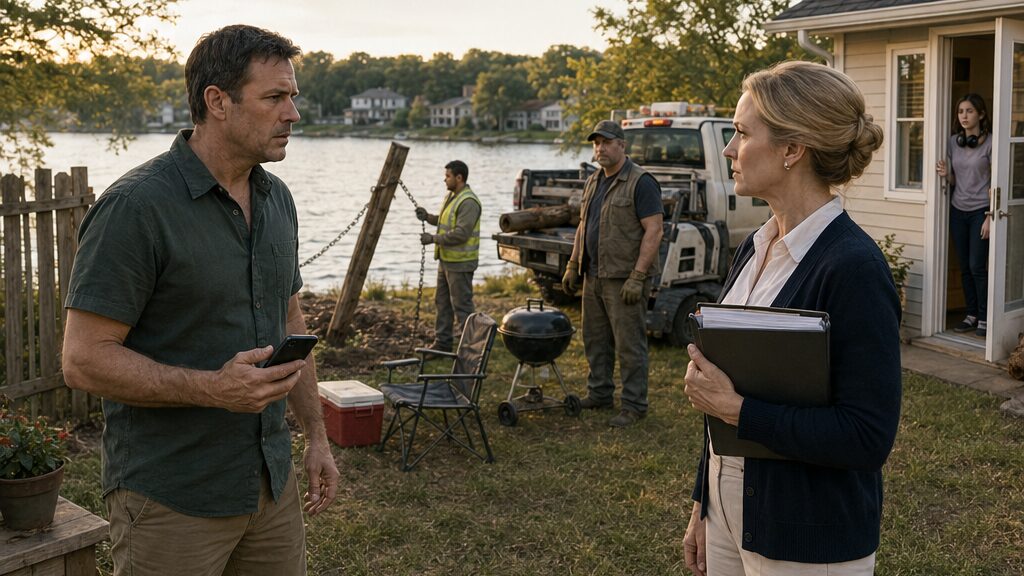
Dennis stepped onto the back porch and saw the first fence post lift out of the ground.
A worker in a yellow vest had a chain wrapped around it. Another man stood beside a small utility machine near the lake edge, one hand raised, guiding the pull. The post came up crooked, dark earth clinging to the bottom, and swung for one loose second over the grass before the worker grabbed it.
Dennis did not move.
The red cooler was still beside the grill from the weekend. Two folding chairs sat open in the sun. Beyond them, the lake looked polished and harmless, bright under the late afternoon light, houses lined cleanly across the water. His yard had the unnatural calm of a place where something wrong was happening in daylight and everyone expected him to accept it because a machine was already there.
“Hey,” he called.
The man beside the machine glanced over but did not stop.
Dennis came down the steps fast enough that one of the folding chairs scraped against his knee. “Stop. Stop the machine.”
A polished blonde woman turned from near the fence line. She wore a white blouse, light trousers, and a dark cardigan despite the heat. A clipboard rested against one arm, thick with papers clipped neatly under metal. Stephanie Clark looked at him as if he had arrived late to an appointment she had already completed without him.
“Mr. Scott,” she said. “We left notice.”
Dennis looked from her to the missing post. The fence had not been decorative. It was low, dark-stained, and plain, running along the uneven part of the shoreline where the yard dropped faster than it appeared from the patio. Kevin Adams had built it to be removable if the HOA approved a permanent version. Dennis had paid extra for that, because he had believed being reasonable would matter.
“You are on my property,” Dennis said.
“We are enforcing the Lakeview Exterior Standards.” Stephanie lifted a page from the clipboard and held it out. “The unapproved lakefront obstruction is scheduled for removal today.”
“Scheduled by who?”
“The board authorized compliance action after your violation period expired.”
The worker with the chain started toward the next post.
Dennis stepped into his path.
The worker stopped. He was younger than Dennis but larger, with sawdust on his gloves and an expression that said he did not want to be part of whatever this was. The man by the machine lowered his hand. The engine kept growling.
A second man approached from the truck parked along the side access. “Sir,” he said, “you need to stay clear of the work area.”
Dennis turned his phone camera on and held it chest-high. “Tell me your name.”
The man looked toward Stephanie.
She answered for him. “Anthony Moore is the crew supervisor. This is an HOA-authorized removal.”
Anthony’s jaw shifted. “We’re just here to take down what we were told to take down.”
“Then you can wait while she shows me the order.”
Stephanie’s smile did not reach her eyes. She slid the notice toward Dennis again. “This is the order.”
Dennis did not take it. “That is a violation notice.”
“It includes removal authorization.”
“From a court?”
“This is not a court matter, Mr. Scott.”
“It is when you send a crew onto my yard and start pulling out safety work.”
Stephanie’s eyes flicked toward the fence, then back to him. “Safety work is not exempt from approval requirements.”
Dennis pointed toward the lake edge, where the grass dipped past the remaining posts. From the porch, it looked like a gentle slope. From where he stood, the drop showed itself—muddy, undercut, too close to the level stretch of lawn where the chairs were.
“That fence is there because the bank is giving way.”
“The board reviewed your submission.”
“No, the board reviewed pictures and ignored what I wrote under them.”
“You submitted a request for a temporary shoreline rail and barrier,” Stephanie said, reading now, not needing to look at the page long. “You did not receive approval. You installed anyway. That creates a visual obstruction from the common lake view and neighboring sight lines.”
Dennis almost laughed. It came out as one hard breath.
Behind Stephanie, the worker laid the removed post in the back of the truck. The sound of wood on metal cut sharper than the engine.
“How long ago did you leave this notice?” Dennis asked.
“This morning.”
“What time?”
Stephanie’s mouth tightened. “I don’t have the exact delivery time.”
Dennis turned the camera toward the half-removed fence, the truck, the workers, Stephanie’s clipboard. “You left a notice this morning and sent a crew the same day?”
“The prior violation notice was issued last week.”
“The prior notice gave me ten days to respond.”
“You responded by refusing removal.”
“I responded by asking for the appeal form.”
Stephanie shuffled one page to the back. “The board considered your email.”
“The board considered it without me?”
“Mr. Scott, you built first and asked later.”
Dennis’s hand tightened around the phone. That was the part that would sound true to anyone who had not stood in this yard three weeks ago, hearing Katherine’s breath break apart while he tried to keep his voice calm and his feet slow.
He swallowed it down.
“Anthony,” Dennis said, keeping his eyes on the supervisor, “do not touch another post until I have a copy of whatever gives you permission to continue.”
Anthony shifted his weight. The machine idled behind him. “I’m contracted by the association. I can pause for a minute, but I can’t just leave.”
Stephanie stepped closer, lowering the clipboard enough that Dennis could see the colored tabs inside the folder. “Interfering with enforcement will add daily fines.”
“How much?”
“Two hundred dollars per day until the obstruction is removed.”
“You’re fining me for stopping you from taking down a safety fence.”
“We are fining continued noncompliance.”
“The fence keeps someone away from that edge.”
Stephanie’s face changed slightly, not softening, just bracing. “If there is a documented medical or accessibility issue, you were required to file the accommodation packet. You did not.”
Dennis looked toward the back door.
The curtains were still. Katherine was supposed to be upstairs with her headphones on, sorting the colored cards her therapist had given her for transitions. He had not wanted her name in an HOA folder passed around by people who measured neighborly worth in lawn height and dock stains.
He turned back. “I filed enough for you to ask a question before bringing a crew.”
“You filed enough for the board to determine the structure was unauthorized.”
The worker with the chain took one step toward the next post.
Dennis stepped in front of it again.
Anthony raised his palm. “Hold up.”
Stephanie’s voice sharpened. “Mr. Moore, please proceed.”
Anthony did not move.
Dennis held the phone between them. “Say that again.”
Stephanie looked at the phone, then at him. For the first time, irritation cracked through the polished surface. “This is not going to help your appeal.”
“My appeal?” Dennis said. “You’re removing the thing I’m appealing before the hearing.”
“The board is not obligated to leave unapproved structures in place during review.”
“Then the review is a performance.”
Something moved behind the glass of the back door.
Dennis saw it before he heard anything. A narrow shape in the shadow, one hand on the frame, dark hair falling forward as Katherine leaned into view.
She opened the door just enough for the late sun to touch her face.
Her eyes went first to the truck. Then to the post lying in the bed. Then to the open gap in the fence line where the lake shone too bright through the missing space.
She stopped there, one bare foot on the threshold, both hands pressed flat against the doorframe.
Dennis lowered the phone.
Katherine did not look at him. She stared at the gap as if the yard had lost a wall only she could see.
Chapter 2: The Notice Said View Standards, Not Safety
By morning, the holes were full of muddy water.
Dennis stood beside them with a coffee he had forgotten to drink, watching the little brown pools tremble in the breeze. The crew had removed three posts before Anthony agreed to stop until Stephanie “clarified the scope.” That was the phrase he used. Clarified the scope. As if the gap near the lake was a scheduling detail.
The remaining fence leaned slightly where the removed section had braced it. Yellow caution tape Dennis had tied there overnight sagged between a porch chair and a splintered stump of wood.
Katherine had not come outside.
On the kitchen table, the HOA packet lay beside Dennis’s laptop. Stephanie’s notice used clean language. It did not say fence. It said lakefront visual obstruction. It did not say safety. It said nonconforming exterior modification. It did not say removed while appeal pending. It said enforcement action authorized under Article 7, Section 4.
Dennis read the same paragraph three times, then opened the folder where he kept his own copies.
Three weeks earlier, he had sent photos of the shoreline after rain. He had attached Kevin Adams’s estimate, a sketch of the temporary barrier, and a note explaining that the repair was urgent because the bank had softened near the family-use area. He had written family-use area instead of Katherine. He had written safety concern instead of what happened.
At the time, it had felt respectful.
Now it looked like a gap they could walk through.
His phone buzzed against the table. Kevin Adams.
“You saw the pictures?” Dennis asked when he answered.
“I saw them,” Kevin said. “I also saw the video you sent. They pulled the post clean out?”
“Three of them.”
A pause. “That rail wasn’t pretty, but it wasn’t junk. We set those anchors shallow on purpose so they could be replaced with permanent footings once approved. It was temporary, but it was safe.”
“Can you put that in writing?”
“I already did.”
“They’re acting like you built a private dock.”
Kevin let out a humorless breath. “That’s because anything near water makes boards nervous. If they admit it’s safety, they have to ask why it wasn’t handled before.”
Dennis looked through the window. The red cooler still sat by the grill. He had meant to bring it in. It looked ridiculous there now, bright and cheerful beside the muddy holes.
“Would it have passed code as temporary safety work?” Dennis asked.
“For what you asked me to do? Yes. But Dennis, you know what they’re going to say.”
“That I didn’t wait.”
“That you didn’t wait with every form in the exact right order.”
Dennis closed his eyes.
From upstairs came the faint thud of a drawer shutting. Katherine was moving around, but she had skipped breakfast. When he knocked earlier, she had said, “I’m fine,” in the tone that meant he was not supposed to ask twice.
“I need the email you sent with the estimate,” Dennis said. “The original timestamp.”
“I’ll forward it again.”
“And the note where you said the shoreline drop needed a barrier.”
“I’ll send it, but they already had that.”
Dennis opened his email and searched Stephanie Clark. The application receipt appeared under a subject line he had nearly forgotten: Exterior Modification Request Received. The date was right. The attachment list showed photos, estimate, sketch.
His shoulders loosened by half an inch.
Then he clicked the second email, the one Stephanie had sent after the removal paused.
Mr. Scott,
Your emergency appeal has been scheduled for Thursday at 6:00 p.m. at the Lakeview Clubhouse. Please note that ongoing enforcement is not stayed by appeal unless a complete accommodation packet has been submitted and accepted for review.
Attached: Reasonable Accommodation Exterior Modification Packet.
Dennis stared at the attachment.
The email continued.
Your prior request did not identify a qualifying medical or accessibility necessity. It was therefore reviewed under standard exterior modification rules.
He read that sentence again slowly.
He had written safety concern. He had written family-use area. He had written temporary barrier. He had not written Katherine’s name. He had not attached the occupational therapist’s letter. He had not attached anything that made his private fear legible to strangers.
His thumb hovered over the therapist’s folder in his files.
The letter was there. So were the notes from the day Katherine had bolted toward the lake after the smoke alarm battery chirped and the grill flared and three neighbors laughed too loudly from a dock across the cove. Dennis had caught her before the drop. Not dramatically. Not like a movie. Just his hand around the back of her hoodie, her whole body shaking, her breath gone thin and high while the lake lapped below as if nothing had happened.
He had not told the HOA that.
He had not wanted them to say her name in a meeting.
The back door opened behind him.
Katherine stood in the doorway to the kitchen, hair pulled into a loose knot, headphones around her neck. Her eyes flicked to the papers.
“Are they coming back?” she asked.
“Not today.”
“That’s not what I asked.”
Dennis folded the HOA notice halfway, then stopped because hiding it was worse. “They scheduled a hearing.”
“For the fence?”
“For the violation.”
Her mouth tightened. “They call it that?”
“They call everything something.”
Katherine came to the table and touched one finger to the printed phrase lakefront visual obstruction. “It didn’t obstruct anything.”
“I know.”
“It helped.”
“I know.”
She looked at the laptop screen and saw the accommodation packet. The room changed around that small recognition.
“You’re not sending them my stuff,” she said.
“I haven’t decided.”
“You said the fence was because the ground was bad.”
“It is because the ground is bad.”
“That’s not all.”
Dennis had no answer that did not sound like betrayal.
Katherine stepped back. “I don’t want Stephanie Clark reading about me.”
“She may not have to.”
“You always say that before something happens anyway.”
The words landed harder because she did not raise her voice.
Dennis reached for the coffee and found it cold. “I’m trying to keep this about the yard.”
“But it’s not about the yard,” she said.
Before he could respond, his phone buzzed again. Kevin’s forwarded email appeared, then another message from the HOA.
Stephanie had attached the hearing notice in formal PDF this time. At the bottom, in bold, was a line Dennis had not seen in the first email.
Removal activity may continue prior to hearing unless stayed by written board action.
He called Stephanie. It went to voicemail.
He emailed back: I am requesting written stay of removal pending Thursday hearing. The structure is safety-related. Contractor documentation attached.
Her answer came twelve minutes later.
Request noted. At this time, no stay has been granted.
Katherine read it over his shoulder. She did not say anything.
Dennis looked through the window at the open holes filling with muddy water, and for the first time since the crew arrived, he understood exactly how his silence had been used. He had kept Katherine’s name out of their paperwork, and they had taken the absence of her name as proof that no person stood behind the fence.
Chapter 3: The Lake Edge Was Closer Than Anyone Admitted
The tape measure slipped from Dennis’s hand and snapped back against the mud.
He stared at the number again, then dragged the metal tab to the old fence mark and stretched the tape toward the lake edge a second time. The ground fell away at eight feet, not eleven. After the rain, the bank had undercut itself in a crescent, hidden beneath the grass until he pressed his boot near it and felt the surface give.
Eight feet from the place where the red cooler sat.
Eight feet from the lawn where Katherine used to sort smooth stones by color when the world was quiet enough.
Dennis crouched, took a photo, then another with the tape visible. He added the missing fence holes, the remaining posts, the soft bank, the muddy line where the water had chewed in under the grass. He kept his breathing steady because anger made his hands shake, and shaking made blurry evidence.
Across the yard, a neighbor stood near the side hedge, pretending to adjust a hose.
Dennis straightened. “You can come say it.”
The neighbor looked embarrassed to be noticed. “I didn’t want to interrupt.”
“You were watching yesterday too.”
“A lot of people were watching yesterday.”
Dennis nodded once. He had seen one phone raised across the lawn when Anthony’s crew pulled the first post.
The neighbor’s gaze went to the holes. “They shouldn’t have come in like that.”
“No.”
“But you know how the board is about the lake view.”
Dennis took another picture. “The lake view won’t matter if the bank drops.”
The neighbor hesitated. “There were meetings about that years ago.”
Dennis looked up.
“Not your fence,” the neighbor added quickly. “The shoreline. Drainage. Erosion. I only remember because people were upset about assessments. Nobody wanted to pay for a study.”
“What meetings?”
“Old board. Maybe 2019? Janet would know. She was treasurer then too.”
Dennis slid the tape measure closed. “Was Stephanie on the board?”
“No. Compliance came later.”
“Did they inspect my lot?”
The neighbor glanced toward the houses across the water as if someone might hear from there. “I don’t know. I just remember maps.”
“Maps of what?”
“Lots with shoreline issues.”
The neighbor picked up the hose, finished with courage. “You didn’t hear it from me.”
By noon, Dennis had printed the current HOA shoreline map from the resident portal. It showed his property line clean and square, the lawn meeting the water in a smooth curve that might have been drawn by someone who had never stood in the mud. He put that beside a photo from the first summer after he bought the house.
The difference was obvious enough that he leaned closer, suspicious of his own hope.
In the old photo, Katherine was younger, sitting cross-legged near the grill with a paper plate in her lap, headphones large over her ears. Behind her, the fence that came with the property sat farther from the lake edge, more decorative than useful. Past it, there was a strip of grass. A real strip. Wide enough for a person to stand on.
Now there was barely enough earth to hold the remaining posts.
Dennis drove to the HOA office with the photo, the tape measurements, Kevin’s contractor note, and the printed map in a folder. The office occupied one end of the clubhouse, with a glass door that looked out toward the same lake everyone kept calling an amenity.
The receptionist said Stephanie was not available.
“I’ll wait.”
“She has appointments.”
“I don’t need an appointment. I need to submit evidence for the hearing.”
The receptionist accepted the folder with two fingers, as though it might leak mud onto her desk. “I can place it in the file.”
“I need a stamped copy showing it was received.”
She looked annoyed but found the stamp.
Dennis watched the red date land on the corner of his cover sheet. It felt like a small, unsatisfying victory.
As he turned to leave, Janet Ramirez came in carrying a slim binder against her chest. She stopped when she saw him.
“Dennis.”
“Janet.”
Her eyes moved to the stamped copy in his hand. “You’re submitting more?”
“Measurements. Photos. Contractor note. Old picture.”
“That’s good,” she said, too quickly.
“Is it?”
“It’s better than coming in angry.”
“I wasn’t angry when they sent a crew into my yard. I was clear.”
She lowered her voice. “I saw part of the video.”
“Then you saw the problem.”
“I saw Stephanie doing what the board authorized.”
Dennis let the words sit between them. “And did the board authorize it before or after my appeal window?”
Janet’s expression tightened.
He should have stopped. He needed Janet if what the neighbor said was true. Instead he pushed because he was tired of careful people speaking as if procedure washed their hands.
“You knew about the shoreline,” he said.
“I know about budgets.”
“That’s not what I asked.”
Janet looked toward the receptionist, then back at him. “You need to be careful how you frame this.”
“Meaning?”
“If you make your lot sound unsafe, the board may classify the yard as nonconforming until a full review. That could restrict any work. Not just the fence.”
Dennis almost laughed again. “So if I prove the fence is necessary, they can punish me for needing it.”
“That’s not what I said.”
“That is exactly what you said, just dressed better.”
Janet’s face colored, but she did not walk away. “There are insurance implications.”
“What insurance implications?”
She pressed the binder tighter. “I shouldn’t have said that.”
“But you did.”
“Dennis, listen to me. If this becomes a community shoreline issue, people will panic about assessments. Some of them bought those lake lots because they were told the association had maintenance under control. If you force the board into a broad admission—”
“I’m not forcing them into anything. I’m trying to keep my daughter safe in her own yard.”
Janet went still.
Dennis knew then he had said too much and not enough. Her expression softened, but beneath it was calculation. Not cruel. Afraid.
“Is this for Katherine?” she asked.
He did not answer.
The office door behind the reception desk opened. Stephanie appeared with her clipboard already in hand, as if she had been waiting for the right moment to enter and make the room official again.
“Mr. Scott,” she said. “All hearing materials should be submitted through the office.”
“They were.”
“I also need to remind you that further unauthorized modification or temporary replacement prior to the hearing will be treated as a separate violation.”
“The yard is open.”
“The removal crew paused at your request.”
“They removed the part that mattered.”
Stephanie’s eyes did not move toward Janet, but Dennis felt the board treasurer become very quiet beside him.
“Thursday will be your opportunity to present,” Stephanie said.
Dennis lifted the stamped copy. “I’ll present measurements. And I’ll ask for every shoreline record the board has.”
Janet inhaled softly.
Stephanie’s face remained composed. “The board file contains the relevant exterior standards.”
“I didn’t say exterior standards.”
No one spoke for a moment.
Janet shifted the binder from one arm to the other. The movement exposed a tabbed label on the top sheet tucked inside: Insurance — Lakefront Review.
Dennis saw it before she covered it.
Stephanie saw him see it.
“That is not part of your violation matter,” Stephanie said.
Dennis looked from the covered binder to the lake beyond the clubhouse glass. The water flashed bright, clean, harmless.
“What does the insurance file say about the shoreline?” he asked.
Janet’s hand closed over the binder.
Stephanie stepped between them, clipboard raised like a door being shut.
Chapter 4: The Board Called the Fence an Admission
Dennis walked into the clubhouse and saw his half-removed fence projected twenty feet wide on the wall.
The photo had been taken from across the lawn, low enough to make the leaning posts look careless and the yellow caution tape look like proof of neglect. Someone had cropped out the muddy holes. Someone had cropped out the drop toward the lake.
At the front table, Stephanie Clark stood beside the projector with her clipboard open. Three board members sat behind folding tables arranged in a shallow curve. Janet Ramirez sat at the far end, hands folded over a binder, her eyes fixed on the tabletop.
Katherine stopped beside Dennis.
“You didn’t say there would be pictures,” she whispered.
“I didn’t know.”
A few neighbors turned. Dennis felt their attention move over him, then Katherine, then the screen. He wanted to step in front of her, but she had already seen the image. Hiding her now would only make it worse.
Stephanie tapped the clicker. A second photo appeared: the same fence from the lake side, the removed posts lying in the truck bed.
“This hearing concerns unauthorized exterior modification, violation of Lakeview Exterior Standards, Article 7, Section 4,” Stephanie said. “Specifically, an unapproved barrier constructed along a protected open shoreline view corridor.”
Dennis raised his hand. “Before you continue, I want the board to note those photos were taken after your crew started removing it.”
Stephanie looked at the board chair. The chair nodded politely, as if that solved nothing.
“Noted,” Stephanie said. “The owner installed without approval.”
Dennis kept his folder closed on his lap. He had brought the contractor note, measurements, photos, old family picture, and the accommodation packet he still had not finished. The therapist’s letter sat inside the folder, face down, like something alive.
Stephanie advanced the slide again. A clean diagram appeared. His lot, flattened into lines. The lake drawn smooth. The fence marked in red.
“The association is not unsympathetic to homeowner concerns,” she continued. “However, Mr. Scott’s installation creates an obstruction visible from neighboring lots and common lake access. It also creates liability concerns by implying the association has permitted a safety barrier in an area not designated as hazardous.”
Dennis looked up.
There it was.
Not just ugly. Not just unauthorized. An admission.
He stood. “You’re saying the fence is a problem because it makes the yard look unsafe?”
Stephanie turned toward him. “I’m saying unauthorized structures near the shoreline can create legal and insurance complications.”
“The ground is unsafe.”
“That has not been established through proper association review.”
Dennis opened his folder and pulled out the tape-measure photos. “I submitted measurements yesterday. The bank has moved. The edge is closer than your map shows.”
Stephanie did not take the photos. “Those materials were received. They do not retroactively approve construction.”
Kevin Adams sat two rows behind Dennis, cap in his hands. Dennis had not expected him to come, but Kevin had walked in five minutes before the meeting and taken a seat without making a show of it.
The board chair leaned toward the microphone. “Mr. Scott, you’ll have time to present. Ms. Clark, continue.”
Stephanie’s next slide was the old family photo Dennis had submitted. Katherine, younger, sitting near the grill with the lake behind her. Dennis stiffened. He had included it to prove the shoreline had changed, not to put his daughter’s childhood on a clubhouse wall.
Katherine went very still beside him.
“This homeowner-submitted image,” Stephanie said, “shows that the lot historically maintained an open, unobstructed visual relationship to the lake, consistent with community standards.”
Dennis’s hand tightened around the folder. He heard the small catch in Katherine’s breath.
“That picture shows more grass between the yard and the water,” he said.
“It shows a prior condition,” Stephanie replied.
“It shows the bank wasn’t where it is now.”
“It does not establish that your specific unapproved fence was necessary.”
Kevin stood from the second row. “I can speak to that.”
Stephanie’s eyes flicked to him. “Please identify yourself for the record.”
“Kevin Adams. Licensed contractor. I installed the temporary barrier.”
The room shifted. Several neighbors turned again, interested now that someone outside the dispute had stood.
Kevin held up a folded paper. “It was not a permanent structure. It was a temporary safety rail and boundary marker. Removable anchors. No concrete footings. No alteration to drainage. It was placed where the ground transitions toward the slope.”
Stephanie wrote something on her clipboard. “Were you aware HOA approval had not been granted?”
Kevin paused. “I was aware the request was pending.”
“That is not what I asked.”
Dennis felt the room lean toward that difference.
Kevin glanced at Dennis, apologetic without saying it. “Yes. I knew final approval had not come through.”
Stephanie’s voice remained level. “And you proceeded anyway?”
“At the owner’s request, because the condition appeared immediate.”
“Appeared,” Stephanie repeated.
Dennis knew the trap. If Kevin sounded too certain, Stephanie would say he was not an engineer. If he sounded careful, she would say the danger was unproven.
Kevin did not rise to it. “I build things people lean on. I don’t need a board vote to see when a drop should have a boundary.”
A murmur moved through the room.
The board chair tapped the microphone. “Let’s keep comments directed to the board.”
Dennis stood with his photos. “The board has my measurements. The contractor confirms the barrier was temporary and safety-related. I’m asking that removal be stopped until the accommodation packet is reviewed.”
Stephanie looked at him over the clipboard. “Then submit a complete packet.”
Katherine’s chair scraped softly.
Dennis looked down.
She was staring at the screen, where her younger self still sat under the frozen summer light. Her face was pale with anger, not fear.
“Take that down,” she said.
Stephanie blinked. “Excuse me?”
“That picture. Take it down.”
“Katherine,” Dennis said quietly.
“No.” She stood. “He didn’t give you that so you could use me as decoration for your view rule.”
The room went silent.
Dennis reached for her hand, but she stepped back, not away from him exactly, away from being managed. She looked at the board, then at Stephanie, and something in her expression closed.
“I’m going outside.”
“Katherine.”
She did not wait.
The clubhouse door opened, letting in the lake glare, then shut behind her.
Dennis remained standing, the therapist’s letter inside his folder suddenly heavier than every photo he had brought. He could stop the meeting and follow her. He could also stay and keep fighting the people still looking at the screen.
He sat down slowly, hating the choice.
The board chair cleared his throat. “Mr. Scott, without a complete accommodation request, we can only review the exterior modification under existing standards.”
“I understand,” Dennis said, though he did not.
Stephanie clicked off the photo at last. The wall went blank.
After the meeting adjourned without a stay, Dennis stepped into the aisle. Janet Ramirez approached him without looking directly at Stephanie.
“I can’t talk long,” she said.
“I don’t need sympathy.”
“I’m not offering sympathy.” Janet slipped a folded note into his hand, small enough to hide under his folder. Her voice dropped. “Ask for the 2019 lake inspection minutes. Not the summary. The minutes.”
Dennis looked at the paper.
Janet was already moving past him.
On the note, in tight blue handwriting, she had written: Ask for page four. Don’t let them give you the packet without it.
Chapter 5: The Minutes Were Missing One Page
“The association copy doesn’t have page four,” the county clerk said.
Dennis looked up from the counter. “What do you mean it doesn’t have page four?”
The clerk slid the scanned packet toward him, one finger resting at the bottom of the screen. Page three ended mid-discussion. Page five began with a vote about dock lighting. Between them was a gap so clean it felt intentional even before Dennis allowed himself to think the word.
“I mean,” the clerk said, “the copy filed by the association goes from three to five.”
“Could that happen by accident?”
The clerk gave him the cautious look of someone who dealt with angry residents, contractors, and amateur legal theories every week. “Anything can happen by accident.”
“But you have another copy.”
“We have the county inspector’s supporting notes attached to the permit review archive. That’s not the same as board minutes.”
“I’ll take whatever you can print.”
She studied him for a moment, then turned back to the computer. “You understand this is public record, not legal advice.”
“I understand.”
The printer behind her woke with a shudder. Dennis stood with both hands flat on the counter while page after page slid into the tray.
He had not slept much after the meeting. Katherine had spoken to him only once, to say she was going to bed. In the morning, her door was closed, and the therapist’s letter was still in his folder, unsigned for release.
The clerk handed him the stack.
Dennis read the first page standing at the counter. 2019 Lake Edge Review. Lots 12 through 19. Drainage softening after severe seasonal rain. Recommended monitoring. Recommended owner notification.
He turned to the next page, then the next.
There, in the inspector’s supporting notes, a sentence had been underlined by whoever scanned it years ago.
Unfenced or visually open water-edge lawns may pose increased child access risk where bank undercutting is present.
Dennis did not move.
The clerk’s voice softened. “Sir?”
He read it again.
Child access risk.
Not his phrase. Not Kevin’s. Not something he had invented after the fact to win a fight. The words had existed before Katherine’s near-incident, before the temporary fence, before Stephanie’s clipboard, before the crew pulled the first post out of the mud.
“Can I get this certified?” he asked.
The clerk nodded. “There’s a fee.”
“I’ll pay it.”
In the parking lot, Dennis sat in his truck with the certified copy on the passenger seat and the windows up though the air inside grew warm. He lined the new pages beside his photos: the missing fence, the tape measure, the old family picture, the HOA map.
For the first time, the pieces did not feel like a defense. They felt like an indictment.
His phone buzzed.
At first he thought it would be Katherine. It was Stephanie.
Final Notice of Continued Enforcement.
Dennis opened it with his thumb.
Mr. Scott,
Because no complete accommodation packet has been accepted for review and because the board has not approved a stay of enforcement, the remaining unapproved rail and posts are scheduled for removal tomorrow at 9:00 a.m.
Any attempt to reinstall, replace, obstruct, or interfere with removal may result in additional penalties, including referral to association counsel.
Attached: Final Compliance Directive.
Dennis sat very still.
Tomorrow.
He forwarded the message to Kevin, then to himself, then saved screenshots. His hands moved automatically now. Evidence, copies, time stamps. The habits he should have had before the first post came out.
Kevin called within a minute.
“They’re coming back?” Kevin asked.
“Tomorrow morning.”
“After the hearing?”
“After the hearing where they told me to submit the complete packet.”
“Dennis.”
“I found the 2019 notes.”
“What notes?”
“County inspection. Child access risk at unfenced water edge. Bank undercutting.”
Kevin was quiet for a beat. “They knew.”
“They knew this kind of barrier was recommended.”
“Does it mention your lot?”
“Lots twelve through nineteen. I’m sixteen.”
Kevin exhaled. “Then bring that to the board before morning.”
“I’m going to.”
“And the accommodation packet?”
Dennis looked at the glove compartment, where the therapist’s letter sat inside the folder.
“I’m working on it.”
Kevin did not let him hide inside the pause. “That means no.”
“It means I’m not sending my daughter’s therapy notes to people who projected her picture on a wall.”
“I get that. I do. But they’re using what’s missing.”
Dennis closed his eyes.
Kevin’s voice lowered. “You asked me to build the fence because of the slope. But that wasn’t the whole reason. Everybody in that room knows it now, or they think they do. The difference is whether they get to fill in the blanks themselves.”
Dennis ended the call without being angry at Kevin. That made it worse.
At home, the yard looked too open under the afternoon light. The remaining section of fence still stood, but it had lost authority. It looked temporary now. Vulnerable. As if it knew men were coming back in the morning to finish undoing it.
Katherine sat on the porch steps with her headphones around her neck. The red cooler was beside her. She had taken it from near the grill and set it close enough to touch with her foot.
Dennis held up the county packet. “I found something.”
“Is it good?”
“It helps.”
“Does it stop them?”
“Not by itself.”
She looked toward the remaining rail. “Are they coming back?”
He could have softened it. He almost did.
“Tomorrow at nine.”
Katherine nodded once, too calmly.
Dennis sat on the step below her. He handed her the printed page with the underlined sentence. She read slowly, lips barely moving.
“Child access risk,” she said.
“That’s from 2019.”
“So they knew the lake edge was dangerous before we even put it up.”
“They knew it could be.”
She looked at him. “But you still don’t want to tell them about me.”
Dennis felt the answer rise, the old one, the protective one. I don’t want them talking about you. I don’t want them reducing you to a packet. I don’t want your private life passed around a clubhouse table.
Instead he said, “I don’t want to use you.”
Katherine’s face changed. “Use me?”
“That’s what it feels like.”
“No.” Her voice sharpened. “It feels like you’re ashamed to say why it matters.”
The words struck so cleanly that Dennis had no defense ready.
“I am not ashamed of you.”
“You’re ashamed of what they’ll think.”
He looked out at the lake. Across the water, the houses reflected in bright broken lines. Somewhere, someone started a mower. Ordinary sounds, ordinary evening, while his daughter waited to see whether he would name the truth or keep protecting her into silence.
Katherine folded the page and pressed it back into his hand.
“If they’re coming tomorrow,” she said, “then you need to decide before they get here whether the fence is for erosion or for me.”
Chapter 6: He Finally Said What the Fence Was For
Dennis carried the removed fence post through the clubhouse doors at eight twelve in the morning.
No one spoke when he entered. The post was six feet long, dark-stained, one end still clumped with dried mud. He held it under one arm like lumber, not evidence, and walked past the folding chairs, past Stephanie’s table, past the board members whispering over paper cups of coffee.
He laid it across the front table.
The sound was not loud. It did not need to be.
Stephanie looked at the mud on the table, then at him. “Mr. Scott, this is not appropriate.”
“Neither was taking it out of my yard before the appeal.”
The board chair leaned back. Janet Ramirez sat beside him with the binder open, her face pale but set. Kevin stood along the side wall. Katherine sat in the front row, headphones around her neck, hands clasped so tightly her knuckles had gone white.
Dennis looked at her before he looked at anyone else.
She nodded once.
He set his folder beside the fence post. “I’m submitting a complete accommodation request.”
Stephanie’s pen stopped.
Dennis slid the first packet forward. “Contractor statement. Current measurements. Photos of the removed section. Certified county inspection notes from 2019. Pediatric occupational therapist letter. And Katherine’s signed consent for the limited disclosure.”
The words limited disclosure steadied him. Not exposure. Not surrender. Consent.
Stephanie recovered first. “The board has not had time to review new materials.”
“You had time to send a crew back this morning.”
“The crew was scheduled under existing enforcement.”
“Then unschedule them.”
“They are already on standby.”
Katherine’s eyes flicked toward the windows.
Dennis had known they might be. He had driven past Anthony’s truck at the clubhouse side lot.
The board chair reached for the packet. “Ms. Clark, let’s review what Mr. Scott has provided.”
Stephanie did not hand it over immediately. “I need to state for the record that emotional testimony does not cure procedural defects.”
Dennis looked at her. “No. But old safety records might.”
Janet closed her eyes briefly.
The board chair opened the packet. “What old records?”
Dennis turned to the certified copy and placed it on top. “2019 Lake Edge Review. Lots twelve through nineteen. My lot is sixteen. The county inspector’s supporting notes mention bank undercutting and child access risk at unfenced water-edge lawns.”
The chair read. The board member beside him leaned in.
Stephanie’s posture changed by a fraction. “Those notes were not part of the approved exterior standards.”
“They were part of what the association knew.”
“That is not the same thing.”
“It is when you tell me my fence creates the appearance of danger. The danger was in your files before my fence existed.”
Janet opened her binder. Her hands shook slightly as she removed a page protected in plastic.
Stephanie saw it. “Janet.”
The warning was quiet, but everyone at the front table heard it.
Janet did not stop. “The board discussed the inspection in 2019.”
The chair turned toward her. “You said the minutes summary covered that.”
“The summary did. The full minutes included a recommendation to notify affected homeowners and price shoreline safety options.”
Stephanie’s face tightened. “There was no vote to adopt those recommendations.”
“No,” Janet said. “Because the preliminary estimate would have required a special assessment.”
The room behind Dennis stirred.
Dennis kept his eyes on Janet. He had expected embarrassment. What he saw was something more complicated: shame hardened by years of practical excuses.
Janet looked down at the page. “We were coming out of a bad budget year. Dock repairs had already upset people. The appraisal window was coming. Several lakefront owners were worried the word erosion would affect sales. We tabled it. Then we summarized it as monitoring.”
“You buried it,” Dennis said.
Janet flinched but did not deny it.
Stephanie spoke before the silence grew. “A tabled recommendation from a prior board does not authorize an individual owner to construct an unapproved barrier.”
Katherine stood.
Dennis turned. “You don’t have to.”
“I know.”
She walked to the front slowly, stopping beside him but not behind him. She looked at the fence post on the table, then at Stephanie.
“That post was near the part of the yard I don’t go past,” she said.
The room went still in a different way.
Katherine’s voice was low, but steady enough. “I don’t like when people talk about me like a problem. So my dad didn’t tell you everything. I asked him not to tell people things too. But the fence wasn’t decoration.”
Dennis felt the words move through him and lodge somewhere behind his ribs.
Katherine touched the headphones around her neck. “Sometimes loud things make it hard for me to know where I am for a minute. Not always. Not every day. But it happens. The day before he called Kevin, the grill flared and a smoke alarm inside started chirping and people across the lake were yelling from a dock. I went toward the water. I didn’t mean to. I just needed everything to stop.”
Dennis stared at the table.
He had never heard her describe it in front of anyone. He had barely let himself replay it without changing the ending to the part where he caught her.
“My dad grabbed my hoodie before the drop,” she said. “After that, the yard felt like a trap because there was no line. The fence gave me a line. I could sit outside again.”
No one moved.
Stephanie’s pen was still in her hand. She did not write.
Katherine looked at the board chair. “I don’t care what color you make it. I don’t care if it’s shorter. I care that I can see where not to go.”
Dennis wanted to say something, but anything he said would take the moment from her.
The board chair removed his glasses and set them on the table. “Thank you, Katherine.”
She nodded once and returned to her seat.
Stephanie cleared her throat. “The association must be careful not to set a precedent where owners bypass approval and later claim necessity.”
Dennis picked up the removed post with both hands and turned it so the mud-darkened end faced the board. “You already set a precedent. You sent men to remove a safety barrier after receiving contractor notes, measurements, and an appeal request. You did that because the form did not say enough for you. I accept my part in that. I should have filed the accommodation packet. I should have trusted my daughter enough to ask what she wanted said instead of deciding silence protected her.”
He looked at Katherine. She did not smile, but her hands had unclenched.
Then he turned back to Stephanie. “But once I told you it was safety-related, you chose to keep pulling.”
Anthony appeared in the clubhouse doorway, cap in hand. He must have been waiting outside with the crew. His eyes went to the fence post on the table.
The chair noticed him. “Mr. Moore?”
Anthony shifted. “Sorry. We were told to wait for confirmation before heading over.”
“Then keep waiting,” the chair said.
Stephanie looked sharply at him. “A pause does not equal approval.”
“No,” the chair said. “But we are pausing.”
He gathered the pages in front of him. The other board members leaned close. Janet slid her plastic-covered page into the center of the table. For several minutes, they spoke in low voices while Dennis stood beside the fence post and listened to the murmur of people deciding whether a thing already removed had mattered.
At last, the chair lifted the microphone.
“Pending review by association counsel and an emergency vote, all removal activity on Mr. Scott’s lot is paused. Existing fines are suspended. The board will review the accommodation packet, county inspection records, and prior shoreline notes.”
A sound moved through the room, not applause, not relief. More like air returning.
Dennis did not move.
“And the fence?” he asked.
The chair glanced at Stephanie. “No further removal.”
“Restoration?”
“Pending counsel.”
Stephanie closed the folder in front of her. “I will not sign an approval today without legal review.”
Katherine’s shoulders dropped.
Dennis felt the old anger come back, but this time it did not scatter him. It narrowed him.
He picked up the removed fence post and looked at Anthony in the doorway. “Tell your crew not to touch my yard.”
Anthony nodded. “I’ll tell them.”
Dennis turned back to the table. Stephanie’s clipboard was closed, but her hand rested on top of it like she was holding a door shut against everything that had just entered.
“Then I’ll be back when counsel is done,” Dennis said.
Stephanie met his eyes. “So will I.”
Chapter 7: The New Fence Did Not Hide the Lake
Kevin Adams returned two weeks later with approved materials, and Anthony Moore’s crew unloaded the same dark-stained posts they had once carried away.
Dennis stood on the back steps and watched the men lift them from the truck in pairs. The posts had been scraped, cleaned, and marked with blue tape where Kevin planned to cut them lower. Beside them lay a new rail, slimmer than the first one, and a roll of dark mesh that would disappear against the water from a distance but still give Katherine the line she needed.
The yard did not feel victorious. It felt used.
The holes had been filled temporarily after the hearing, but the grass around them still showed scars: brown circles where the posts had come out, tire marks near the side access, a flattened strip where the crew had walked with tools. The red cooler sat beside the grill again, empty now, because Katherine had carried it back there that morning without saying why.
Anthony saw Dennis watching and walked over with his cap in his hand.
“We’ll follow Kevin’s layout,” he said. “No machinery past the flagged line. Hand tools near the bank.”
Dennis nodded. “I want photos before and after.”
“Already planned.”
Anthony looked toward the lake, then at the remaining rail. “For what it’s worth, I’m sorry about the first day.”
Dennis studied him. The apology was plain, uncomfortable, and not big enough to cover what had happened. That made it easier to accept.
“You were told it was authorized,” Dennis said.
“I was also standing close enough to hear you say it was safety.”
Neither man added anything after that.
Kevin came up the slope carrying the revised plan rolled in one hand. “They approved the lower height and the mesh panel. Same boundary line, safer footings, no concrete in the setback. If they ever try to call it ornamental again, they’ll have to argue with their own stamp.”
He handed Dennis the page.
The approval stamp sat in the lower right corner. Lakeview Homeowners Association. Conditional Accommodation Approval. Temporary Safety Barrier and Shoreline Access Rail.
Dennis ran his thumb over the ink. It was only paper. After everything, it should have felt heavier.
“Stephanie signed?” he asked.
Kevin pointed to the bottom line.
Stephanie Clark’s name was there, tight and controlled, dated that morning.
Dennis looked toward the side path before he heard her. Stephanie came through the gate carrying a slim folder instead of her usual full clipboard. She wore the same kind of polished clothes, white blouse and dark cardigan, but she walked more slowly than she had on the day the crew arrived. Behind her, Janet Ramirez followed with a binder held against her chest.
Katherine, who had been sitting on the porch steps with her headphones around her neck, straightened.
Dennis went down to the lawn.
Stephanie stopped several feet away and held out the folder. “Final signed approval. Revised conditions. Fine withdrawal. Written notice that the prior removal activity will not continue.”
Dennis took the folder and opened it.
The violation had been withdrawn. The daily fines were suspended and removed. The HOA would reimburse the removal and restoration labor. The association would initiate a review of lakefront safety recommendations for affected lots twelve through nineteen.
He paused on that line.
“For all of them?” he asked.
Janet answered. “All of them.”
Stephanie’s face remained composed. “The board voted to review the 2019 recommendations under current conditions.”
“Because of Katherine?”
“No,” Janet said quietly. “Because we should have done it then.”
Stephanie looked at Janet, but she did not correct her.
Dennis closed the folder. “And the insurance file?”
Janet held up the binder. “It’s being added to the board archive. Owners will get notice of the review. Not all of it is simple. Some of it will cost money.”
“That’s why it disappeared?”
Janet’s eyes lowered. “It didn’t disappear. It was summarized until it became useless.”
Stephanie’s mouth tightened, but again she said nothing.
Across the lawn, Kevin knelt at the first marked post hole and showed Anthony where the footing would sit. No engine ran. No chain scraped wood. The sounds were smaller now: a shovel pressing into soil, a tape measure clicking open, a worker calling out a measurement.
Katherine came down from the porch.
She did not stand behind Dennis. She stood beside him, looking at the flags Kevin had placed along the new line.
“Will it look like before?” she asked.
Kevin glanced up. “Lower. Cleaner. But it’ll mark the edge.”
“Can I see?”
Dennis looked at Stephanie without meaning to.
Stephanie noticed.
Something moved across her face, gone before it became expression. “The approved plan allows resident review during installation, as long as the crew can work safely.”
Katherine walked toward Kevin. He showed her the blue tape marks, then pointed toward the mesh. She listened with her head slightly tilted, hands tucked into her sleeves. After a moment, she crouched and touched one of the cleaned posts.
Dennis watched her trace the old scrape where the chain had bitten into the wood during removal.
Stephanie watched too.
“I need to say something,” she said.
Dennis kept his eyes on Katherine. “You don’t need to say it for me.”
“I’m not.”
That made him look at her.
Stephanie held the slim folder against her side. Without the clipboard between them, she looked less official and more tired. “I believed I was protecting the association from selective enforcement. I believed if I paused one unauthorized structure without the complete packet, every owner would use urgency to bypass review.”
“Some might.”
“Yes,” she said. “Some might.”
It was not an apology. Not exactly. It was the closest she could come without turning herself into a villain in her own mind.
Dennis let the silence stretch until it became uncomfortable enough to be honest.
“You saw the fence coming out,” he said. “You saw the gap.”
Stephanie looked toward the shoreline. “I did.”
“And you kept going.”
Her jaw tightened. “Yes.”
That was the first answer from her that did not hide behind policy.
Dennis looked down at the approval folder. He thought of the first day, the post swinging above the grass, Katherine frozen in the doorway, his own voice trying to stay calm while every private thing he had hidden became leverage against him. He thought of pursuing damages, of forcing the board into a larger admission, of making the video public and letting strangers say what they always said when they were given a villain and a wound.
Then Katherine laughed softly.
Not loudly. Not with relief big enough to fill the yard. Just a small, surprised sound as Kevin showed her how the mesh vanished when she stood at the porch angle but darkened enough up close to mark the drop.
Dennis looked at her, and the decision changed shape.
“I won’t sign anything that says the first removal was acceptable,” he told Stephanie.
“It doesn’t.”
“I won’t agree to confidentiality.”
Stephanie shook her head. “There is no confidentiality clause.”
“I want the policy review notice sent before the next board meeting.”
Janet answered. “It will be.”
“And if another homeowner asks for a safety accommodation, they get the packet before the crew.”
Stephanie looked at him for a long moment. “That language is in the revised compliance procedure.”
Dennis opened the folder again and found it. Temporary stay available upon safety claim pending emergency review. Accommodation packet to be provided before enforcement escalation.
He read the line twice.
It was not enough to erase the truck, the holes, the meeting, or Katherine’s face when her picture appeared on the screen. But it was something that had not existed before.
By late afternoon, the new fence stood along the edge.
It did not hide the lake. From the porch, the water still opened wide beyond the yard, silver under the lowering sun. But up close, the barrier created a clear dark line before the drop. The rail was smooth under Dennis’s hand. The mesh held firm when Kevin pressed it. The old post holes were filled and tamped down, their circles still visible beneath scattered seed.
Katherine carried two cans of soda to the red cooler and put them inside though there was no ice. Then she sat in one of the folding chairs near the grill, facing the lake.
Dennis remained standing for several minutes before he realized he did not need to place himself between her and the water.
Kevin packed his tools. Anthony’s crew loaded the scraps, leaving the approved posts in the ground this time. Janet left first, quiet and stiff-backed, carrying the binder that had finally become heavier than a budget problem. Stephanie stayed until the last measurement was checked, then handed Dennis the final signed inspection sheet.
“No further action required,” she said.
Dennis took it. “There is further action required. Just not against my yard.”
Stephanie accepted that with a small nod. “The board review notice goes out tomorrow.”
Katherine looked over from the chair. “Can I keep the old post?”
Dennis followed her gaze.
One removed post had been set aside near the porch, the chain scrape still visible.
Kevin shrugged. “It’s yours.”
Dennis carried it to the side of the house and leaned it near the shed. He did not know why Katherine wanted it kept, but he understood keeping evidence after the danger passed. Some things needed to stay visible so no one could later smooth the story into procedure.
Inside, after the crew had gone and the lake had darkened beyond the windows, Dennis placed the final approval in a folder. He did not throw away the violation notice. He slid it in beside the approval, then added the county inspection page, Katherine’s limited disclosure consent, Kevin’s contractor note, and the photo of the muddy holes.
Katherine stood in the kitchen doorway. “You’re keeping all of it?”
“Yes.”
“Because you don’t trust them?”
Dennis closed the folder. “Because I trust paper more when it remembers both versions.”
She came to the table and rested one hand on the folder, not opening it.
“I wasn’t ashamed,” he said.
“I know.”
“I was scared people would turn you into the reason.”
She looked toward the backyard, where the new fence line was barely visible in the dusk. “I was the reason.”
Dennis swallowed.
Katherine’s voice softened. “That doesn’t make me the problem.”
He nodded once, because the answer was too large for words and too late to pretend he had always known how to say it.
Outside, the grill stood quiet beside the red cooler, and beyond it the restored fence drew a dark, necessary line between the lawn and the lake. Dennis did not stand guard at the door. He stayed at the table, one hand on the folder that held the violation and the approval together, listening as Katherine opened the back door on her own and stepped safely into the yard.
The story has ended.