The Old Veteran Brought A Letter To The Hospital, But The Family Tried To Close The Door
Chapter 1: The Letter Reached The Hospital Door Too Late
Samuel Clark stepped down from the dark van with his left hand closed around a letter older than the young clerk waiting under the hospital lights.
His prosthetic leg hit the curb too hard.
The jolt climbed through his hip, sharp and familiar, but he did not reach for the van door. He held the envelope against his coat instead, thumb pressed over the softened seal, as if a careless movement might wake the dead inside it.
The hospital entrance breathed open and shut in front of him. Automatic glass doors sighed. Fluorescent light spilled over the drop-off lane. A wheelchair sat abandoned near the wall with one brake loose, squeaking whenever the night air moved. Somewhere beyond the doors, a machine beeped in a rhythm Samuel knew too well.
He had spent sixty years avoiding that sound.
Now he followed it.
At the reception desk, the clerk looked up from a screen. “Name?”
“Donald Williams.”
“Patient or visitor?”
“Patient.”
The clerk typed. “And you are?”
Samuel opened his mouth, but the word he needed had no place on hospital forms. Not brother. Not uncle. Not friend. Not family.
He slid the envelope a fraction higher in his hand. The old paper had gone the color of weak tea.
“I’m here to give him something.”
The clerk’s expression shifted in the small way people used when preparing to refuse an old man politely. “Visiting hours are almost over.”
“I know.”
“Are you on the approved visitor list?”
“No.”
“Then I can’t—”
“He’s seventy-three,” Samuel said. “On oxygen. Admitted this afternoon. Pulmonary floor.”
The clerk stopped typing.
Samuel heard how it sounded. Too much knowledge. Not enough explanation. He had practiced the explanation for miles, past gas stations, county roads, and the last motel he could afford. At the desk, with the hospital smell in his nose and the letter warming under his palm, the words shrank back into the place where he kept all the other things he had never said.
The clerk lifted the phone. “Let me call up.”
Samuel stood very still while she spoke. His right knee ached from taking too much weight. The socket strap bit into the skin above what was left of his left leg. At his age, pain was no longer a warning. It was a weather report.
The clerk hung up. “His daughter is coming down.”
Samuel nodded.
The daughter came faster than he expected.
Rebecca Williams was in her forties, maybe, though exhaustion had taken the softness from her face. She wore jeans, a gray sweater, and a hospital wristband twisted tight around one finger. A folded discharge packet stuck from her purse. Her eyes went first to his face, then to his coat, then to the envelope.
“Who are you?”
Samuel straightened. “My name is Samuel Clark.”
“That doesn’t answer me.”
“No, ma’am.”
The word ma’am hardened her mouth. “Are you with the hospital?”
“No.”
“Church?”
“No.”
“Insurance?”
“No.”
Her gaze dropped again to the envelope. “Then why are you asking for my father?”
Samuel looked past her shoulder, toward the elevators. He had imagined a porch when this day finally came. A little house. A screen door. Maybe a woman with Scott’s eyes. He had imagined himself saying the name gently, with time enough for shock.
He had not imagined hospital glass, a clerk pretending not to listen, and a daughter standing like a lock in front of him.
“I came about his brother.”
Rebecca’s face changed before she could stop it.
Not softening. Not recognition.
Alarm.
“My father doesn’t have a brother.”
“He did.”
Her fingers tightened around the purse strap. “Whatever this is, you need to leave.”
Samuel brought the envelope up slowly, not offering it yet. “Scott Williams asked me to bring this to Donald.”
The clerk looked away.
Rebecca stared at the letter as if it had moved on its own.
“Don’t say that name to me.”
Samuel swallowed. The letter’s edge pressed into the crease of his thumb. He had heard men cry out for mothers, wives, water, morphine, God. Scott Williams, twenty-one years old and bleeding under a sky turned white with smoke, had said only one name clearly after the first minute.
Donny.
Samuel did not say it now.
“He asked me,” Samuel said. “I told him I would.”
Rebecca stepped closer, lowering her voice. “My father is sick. Very sick. I don’t know what story you think you have, but you’re not walking into his room with it.”
“It isn’t a story.”
“No? Then what is it?”
Samuel looked at the envelope.
A promise, he thought.
But that sounded too clean. Promises were made in kitchens and churches. This had been made with dirt in his teeth and Scott’s hand clamped around his sleeve.
“It belongs to him,” Samuel said.
“To my father?”
“Yes.”
“After all this time?”
“Yes.”
“How much do you want?”
Samuel lifted his eyes.
Rebecca’s cheeks flushed, but she did not take it back. “People hear someone’s in the hospital and suddenly they show up. Old bills. Old grudges. Old lies. I’ve seen it.”
“He didn’t ask me to sell it.”
“Who?”
“Scott.”
Her breath caught on the name again, anger covering something thinner beneath it.
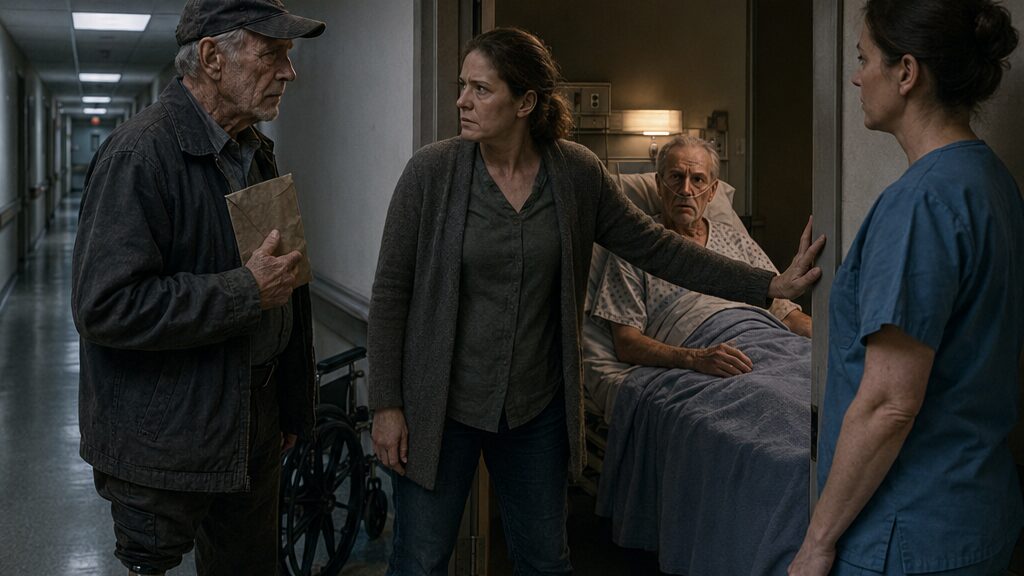
Behind Rebecca, the elevator opened. A nurse in blue scrubs stepped out pushing an empty wheelchair. Her badge read Elizabeth Hill. She glanced between them, reading the air before anyone spoke.
“Everything all right?”
“No,” Rebecca said. “This man is leaving.”
Elizabeth looked at Samuel, not unkindly. “Sir?”
Samuel kept the letter against his chest. “I only need two minutes.”
“With my father?” Rebecca said. “Absolutely not.”
“I’ve been trying to find him for a long time.”
“That’s supposed to make me feel better?”
“No.”
The answer stopped her for half a second.
Samuel wished he had lied. Lying made people easier to handle. He had learned that from men who came home and told their families they were fine. He had never been good at it. Silence had always seemed cleaner.
Rebecca pointed toward the sliding doors. “You found the wrong family.”
“No,” Samuel said.
“You don’t know that.”
“I do.”
“How?”
He could have told her about the returned envelopes, the courthouse records, the neighbor who remembered the Williams boys, the hospital intake note that had finally matched the birth date. He could have told her about walking into county offices with a cane before he gave up the cane and let the prosthetic take over. He could have told her about every dead end that had kept Scott’s letter in a metal box through marriages, funerals, moves, and surgeries.
Instead, he said, “Because Scott told me.”
Rebecca’s eyes sharpened. “My father hasn’t spoken to anyone about Scott in years.”
Samuel heard the present tense in it. Not denial. Not confusion.
A wound.
Elizabeth touched Rebecca’s arm. “Maybe we can step into the family room.”
“No.” Rebecca turned toward the hallway. “He doesn’t get a room. He doesn’t get my father. He doesn’t get to open something we buried a long time ago.”
“I never opened it,” Samuel said.
Rebecca paused.
The letter seemed heavier then. She looked at the seal, at the old flap still closed, at Samuel’s hand shaking despite his effort to keep it still.
“You expect me to believe you carried a sealed envelope for—what? Fifty years?”
“Sixty.”
The number landed badly. Too large to sound sane.
Rebecca gave a short, bitter laugh without humor. “That’s enough.”
She turned and walked toward the elevators.
Samuel followed.
His first steps were uneven. The clerk called after him, but he did not stop. Elizabeth moved beside him, ready to steady him, though he gave her no permission. The elevator had already closed. Rebecca stabbed the button again and faced him.
“You are not coming up.”
“Then take it to him.”
“No.”
“Tell him Scott sent it.”
“No.”
The elevator opened. Rebecca stepped inside and blocked the entrance with her body. “You don’t know what that name does to him.”
Samuel looked through the narrow space beside her shoulder. “I know what it did to Scott.”
For the first time, Rebecca looked afraid.
Then the elevator doors began to close, and she held them with one hand, furious at herself for listening.
“What does that mean?”
Samuel drew the envelope out fully. The paper trembled in the bright elevator light. On the front, the handwriting had faded but not vanished: Donald Williams. The D leaned too far forward. Scott had written it with his left hand because his right hand would no longer obey him.
Rebecca saw the name.
Her face went pale.
From somewhere upstairs, through halls Samuel could not see, a faint alarm tone sounded and stopped.
Elizabeth said, “Rebecca.”
The daughter looked from the letter to Samuel’s face. “My father is dying.”
“I know.”
“Then why would you bring this now?”
Samuel held her eyes.
“Because I just found him.”
The elevator doors tried to close again. Rebecca let them come halfway, then stopped them with her palm. She looked as if she hated him for making the choice hers.
“Go home,” she said.
Samuel stepped forward once, enough that the toe of his prosthetic crossed the elevator threshold. He lowered the letter, not to hand it to her, but to lay it flat across the metal strip between them.
“He asked me to bring it to Donald. I told him I would.”
Rebecca stared down at it.
For one breath, Samuel thought she might bend.
Then her hand shot out and pressed the door-close button.
Elizabeth caught the envelope before the doors could crush it, pushing it back into Samuel’s hands.
The elevator sealed shut on Rebecca’s face.
Samuel stood in the lobby with Scott Williams’s letter still undelivered, the old paper warm from his palm, while the doors reflected a bent old man who had finally found the right hospital and still could not get through.
Chapter 2: The Name Nobody Wanted Spoken Aloud
The security guard asked Samuel how he knew a patient who claimed not to know him.
Samuel sat beneath a vending machine that hummed too loudly, the sealed letter lying across both knees like a thing waiting for judgment. The guard stood with his thumbs hooked in his belt, not cruel, not friendly, just tired of late-night trouble.
“I didn’t say he knew me,” Samuel answered.
“That’s not what I asked.”
“No.”
The guard waited.
Samuel looked toward the elevator bank. The numbers above the doors changed slowly. Three. Four. Five. Somewhere up there, Donald Williams breathed through a plastic tube while the name Scott moved through the walls like smoke.
The guard shifted. “Sir, the daughter says you approached the family with claims about a deceased relative.”
“That’s right.”
“She says you refused to explain your relationship.”
Samuel touched the envelope’s corner. “It isn’t my relationship that matters.”
The guard sighed, the way younger men sighed when older men made simple things difficult. “That kind of answer is why I’m standing here.”
Elizabeth Hill stood a few feet away, chart tablet under one arm. She had stayed after Rebecca went upstairs. Samuel had noticed that. She could have returned to her floor, to machines and medication times and the clean authority of tasks. Instead she remained near the vending alcove, close enough to hear but not yet choosing a side.
“Mr. Clark,” she said, “Rebecca is under a lot of strain.”
Samuel nodded. “I saw.”
“Her father has had three admissions in two months.”
“I didn’t come to add to that.”
“But you did.”
The words were gentle. That made them worse.
Samuel folded his hands over the letter.
The security guard said, “I can ask you to leave the property.”
“You can.”
“You understand that?”
“Yes.”
“And if you come back after being told not to, it becomes trespassing.”
Samuel looked up at him. “Will you tell him I came?”
The guard frowned. “Who?”
“Donald.”
“I’m not getting involved in family business.”
“It isn’t family business.”
Elizabeth’s gaze flicked to the envelope.
The guard stepped closer. “Then what is it?”
Samuel’s throat closed. There had been a time when he could give orders through engine noise and shelling. Now one clean hospital question could pin him like wire.
“It’s old,” he said finally.
The guard waited for more.
Samuel gave him nothing.
Rebecca came down ten minutes later.
She did not come alone. Elizabeth straightened when she saw her. Rebecca’s face had lost some color, but not its force. She walked straight to Samuel and stopped too close.
“My father is upset.”
Samuel started to rise.
“Don’t.” She pointed at him. “Don’t stand up like this is respectful. Don’t make this into something noble.”
He settled back slowly.
“He heard the name,” she said. “He heard you say Scott.”
“I’m sorry.”
“No, you’re not. If you were sorry, you would leave.”
Samuel looked at the letter, then at her. “Did he ask about it?”
Rebecca’s jaw tightened.
That was answer enough.
The guard noticed it too. Elizabeth did not move, but her expression changed.
Rebecca took a breath through her nose. “What do you want?”
“I want him to have what’s his.”
“What do you want?” she repeated, sharper. “Money? A signature? Some kind of veteran charity story? Because we don’t have money. We have bills. We have oxygen deliveries and pharmacy calls and a house with rails in every room. So if this is about cashing in on some old Army thing—”
“He didn’t ask me to sell it.”
Rebecca blinked.
Samuel lifted the envelope in one hand. His fingers had grown crooked with age. The seal remained unbroken.
“He asked me to bring it.”
“To my father.”
“Yes.”
“From a man who died before I was born.”
“Yes.”
“And you held onto it for sixty years out of the goodness of your heart.”
Samuel did not answer.
That angered her more than denial would have.
“You don’t get to stand here and act wounded because I’m asking questions,” she said. “My father spent his life refusing to say his brother’s name. You walk in here at ten o’clock at night with an envelope and expect me to hand you his last few hours?”
Samuel’s hand closed too tightly. The letter bent a little at one corner. He eased his grip at once, ashamed.
Elizabeth saw it.
Rebecca saw it too, but she mistook the shame.
“There,” she said. “That’s the act, isn’t it? The shaking hands. The old coat. The silence.”
Samuel looked at her then, really looked.
She was afraid. Not of him. Not entirely. She was afraid that whatever he carried could undo the careful work of keeping Donald breathing, fed, medicated, calm. She had built a wall around her father because illness had taken everything else piece by piece. Samuel had arrived with a dead man’s name and asked her to open a gate.
He understood her better than he wanted to.
“My wife used to say,” he said, “that silence makes honest men look guilty.”
Rebecca did not soften. “Was she right?”
“Usually.”
“Then talk.”
Samuel looked down the hall. A cleaning cart rattled near the elevators. A nurse laughed softly at a desk, then lowered her voice when she saw the guard. Life went on around old grief. That had always offended him.
“I was with Scott at the end,” he said.
The vending machine hummed.
Rebecca’s lips parted. She had expected a dodge, maybe a story about units and dates. Not that.
Elizabeth’s tablet lowered a little.
Samuel continued because stopping now would be worse. “He gave me this. He said Donald’s name. He made me say it back. Then he made me promise.”
Rebecca’s eyes filled fast, and she hated that too. “Promise what?”
Samuel’s thumb moved over the seal.
“To find Donny.”
The nickname left his mouth before he could catch it.
Rebecca went still.
Elizabeth looked up sharply.
The guard said nothing.
Rebecca’s voice dropped. “What did you call him?”
Samuel closed his eyes once. Too much. He had given too much, and not enough.
“Donald,” he said.
“No.” Rebecca stepped closer. “You said Donny.”
Samuel held the envelope flat against his coat.
“My grandmother called him that,” Rebecca said. “Nobody else. Not even me.”
Samuel’s silence returned, but it no longer protected him.
“How did you know that?” she asked.
He could not say: because a dying man had whispered it through teeth full of dust. He could not say: because Scott’s hand had locked around my sleeve so tightly that I carried the bruise longer than I carried some addresses. He could not say: because every time I tried to forget, that childish name came back first.
“He told me,” Samuel said.
Rebecca backed away as if the answer had reached for her.
Then the alarm came.
Not loud at first. A tone, then footsteps overhead, then a voice through a speaker asking for respiratory support on the fifth floor. Rebecca turned before the announcement finished.
Elizabeth was already moving. “Rebecca.”
“My father?”
“I don’t know yet.”
Rebecca ran for the elevator. The guard followed, speaking into his radio. Elizabeth stopped just long enough to look at Samuel.
“Stay here.”
It was not an order harsh enough to resist.
Samuel stayed.
He sat under the vending machine with the letter on his lap while the elevator numbers climbed. His body wanted to stand. His promise wanted to follow. His shame held him in the chair.
Minutes passed. He counted them by the ache in his leg.
When Rebecca returned, she came alone.
Her face had changed. Fear had burned the anger down to something rawer. She stopped several feet away this time.
“He heard you,” she said.
Samuel rose despite the pain.
Rebecca’s eyes flashed. “I said don’t.”
He stood anyway, because some things still required it.
“He heard Scott’s name,” she said. “He tried to sit up. He couldn’t breathe.”
“I’m sorry.”
“You keep saying that.”
“It keeps being true.”
She looked at the letter. For a moment Samuel thought she might ask for it. Instead she wrapped both arms around herself.
“If you ever cared about him,” she said, “you’ll leave.”
Samuel looked past her to the elevator doors, closed again, holding Donald Williams somewhere above him. Then he looked down at the sealed envelope Scott had trusted to his living hand.
For the first time since finding the hospital address, Samuel wondered whether keeping a promise could become another way of hurting the man it was meant to save.
Chapter 3: The Address That Changed Every Year
Samuel woke in the van because the motel money had become gasoline.
His neck had folded wrong against the window. His right foot had gone numb inside his shoe. The left side, the missing side, burned with a bright false pain that made him grip the steering wheel until the dashboard blurred.
For a few seconds he did not know where he was.
Then the hospital rose beyond the windshield, pale and square in the morning light, and the letter lay inside the open glove compartment in its plastic sleeve.
He had put it there at three in the morning because sleeping with it in his coat made him dream of mud.
Samuel reached for it before he reached for his pill bottle.
The sleeve held more than the envelope. Behind it were folded sheets marked by years of handling: returned mail, courthouse printouts, a torn page from an old phone directory, two obituary clippings that had turned out to be wrong, and a note written by a neighbor in a shaky hand: Williams boys moved after the mother passed. Try county records.
He had tried county records.
He had tried church basements, veterans’ groups, phone calls that ended when people heard his age and assumed confusion, and doors where strangers told him no Donald Williams had ever lived there. Once, twenty years ago, he had found a Donald Williams in Ohio and driven six hours with the letter under his seat. The man had opened the door with a baby on one hip and no brother named Scott.
Samuel had apologized until the man became uncomfortable.
After that, he stopped searching for eleven months.
Not a year, he always told himself.
Eleven months.
As if the missing month changed anything.
He swallowed two pills dry, then checked the envelope seal again. Still closed. Still Scott’s. Still not his to make easier.
Inside the hospital, the day staff had replaced the night staff. The reception desk clerk was different, older, and less easy to unsettle. She looked at Samuel’s coat, his unshaven face, the plastic sleeve under his arm.
“Can I help you?”
“I need to speak with patient advocacy.”
“About a patient?”
“Yes.”
“Are you family?”
“No.”
The answer landed with all the weight it had carried last night.
She gave him a form.
Samuel stared at the blank lines. Relationship to patient. Reason for request. Contact information. The boxes seemed built for people whose lives had stayed inside categories.
He wrote his name slowly. Under relationship, he wrote: Friend of Scott Williams.
Then he crossed out friend.
The clerk noticed but did not comment.
He wrote instead: Messenger.
The patient advocacy office was a narrow room near the elevators with two chairs, a printer, and a fake plant losing dust from its leaves. Elizabeth Hill found him there before the advocate did.
“You didn’t leave,” she said.
“I went to the parking lot.”
“That isn’t leaving.”
“No.”
She looked tired. Daylight showed the fine lines around her eyes. “Rebecca is angry.”
“I know.”
“Donald is stable this morning.”
Samuel gripped the plastic sleeve. “May I see him?”
“No.”
The answer came quickly, but not coldly.
He nodded once.
Elizabeth sat in the other chair. “Mr. Clark, I’m not asking as staff for a moment. I’m asking as the person who watched you almost get removed from the lobby last night. Why now?”
“Because I found him now.”
“How?”
He hesitated.
She waited better than most people.
Samuel opened the plastic sleeve and removed a folded sheet from a county office. “His family changed addresses. Then the name dropped from the property record. His mother died. His father remarried. Donald used another address for a while. Then nothing.”
Elizabeth scanned the paper without touching it. “This is old.”
“Most of it is.”
“And you kept looking?”
“Not every day.”
That answer seemed to matter to her more than if he had claimed devotion without pause.
The records clerk arrived with a file folder before Elizabeth could ask more. She was brisk, careful, and unhappy to be involved.
“I can’t release medical information,” she said.
“I’m not asking for his medical information,” Samuel said.
“You’re asking about visitor restrictions.”
“Yes.”
She opened the folder only enough to consult the top sheet. “The patient has a note in a prior intake record. No military visitors. No veteran association contacts. No service-related outreach.”
Samuel’s hand tightened on the armrest.
Elizabeth looked at him. “Did you know that?”
“No.”
The clerk closed the folder. “It’s old, but it’s there. The daughter reaffirmed limited visitation this morning.”
“Did Donald sign it?” Samuel asked.
The clerk hesitated.
“I’m not asking what’s wrong with him. I’m asking if he signed away the right to hear his own mail.”
Elizabeth’s eyes moved to him sharply.
The clerk said, “Mr. Williams signed the original preference years ago.”
Samuel nodded.
There it was.
Donald had not been lost only by accident. He had put distance between himself and every road that might carry Scott’s name back to him.
Samuel stood. Pain shot through the socket, white and sudden. He caught the chair before it fell.
Elizabeth rose. “Are you all right?”
“Yes.”
“You’re bleeding through your sock.”
He looked down.
A thin dark line had marked the top edge of his left shoe. The prosthetic strap had rubbed raw during the night in the van. He had felt it, then ignored it, then folded it into the ordinary ledger of an old body.
“I have tape,” he said.
“That is not the answer I was hoping for.”
“It’s the one I have.”
The records clerk took half a step toward the door, relieved to escape. “I’ll note that patient advocacy was consulted.”
Samuel picked up the plastic sleeve. “Thank you.”
She looked at him as if she had not done anything worth thanks, which was true enough.
In the restroom near the lobby, Samuel locked himself in the accessible stall and took off the prosthetic. The skin above the liner had split where the strap dug in. Not badly. Badly was a word for when a man could not continue.
He cleaned it with paper towels and water, then used the medical tape he kept in his coat. The letter rested on the changing table while he worked. Its old handwriting faced the ceiling.
Donald Williams.
Samuel leaned his forehead against the stall wall.
“You found him,” he whispered, though he did not know whether he meant himself or Scott.
When he came out, Elizabeth was waiting by the sinks with a small packet of gauze.
“Hospital property,” she said. “Don’t make me regret it.”
He took it. “Thank you.”
She lowered her voice. “Rebecca doesn’t know I’m telling you this.”
Samuel stilled.
“Donald asked about you.”
His fingers closed around the gauze packet.
Elizabeth looked toward the restroom door, then back. “Not by name. He said, ‘Does the stranger still have the envelope?’”
Samuel could not move for a moment.
The hospital noise went thin around him: wheels, intercom, distant coughing, the soft slap of nurses’ shoes. The letter seemed to pull against his coat from the inside, no longer only a burden but a summons.
Elizabeth’s expression held warning and pity together.
“I don’t know if he wants it,” she said. “Or if he’s afraid of it.”
Samuel looked toward the elevators.
For sixty years he had believed the hard part was finding the right man.
Now the right man was upstairs, alive, asking about the envelope, and Samuel understood he had only found the door.
Chapter 4: The Man On Oxygen Remembered Too Much
Donald Williams looked at Samuel’s prosthetic leg before he looked at the letter.
Elizabeth had arranged the meeting for seven minutes. She said it twice in the hallway, once to Rebecca and once to Samuel, as if time could behave better when named. Rebecca stood inside the hospital room with one hand on her father’s bedrail and the other pressed to the call button cord. Donald sat propped against pillows, oxygen tubing looped behind his ears, his cheeks hollowed by the effort of staying upright.
His eyes moved from Samuel’s face to the stiff line of his left pant leg.
“Did he die before or after that happened to you?”
Rebecca stiffened. “Dad.”
Donald did not look at her. His voice was dry and thin, but the question had teeth.
Samuel stood just inside the doorway. He had promised Elizabeth he would sit if his leg started to hurt. It had started hurting before he entered the room. He remained standing anyway.
“After,” he said.
Donald blinked slowly. “So you remember.”
“Yes.”
The machines beside the bed kept marking time in soft green lines. Samuel heard his own breath under them, too loud, too old.
Rebecca’s gaze snapped between them. “You don’t have to do this.”
Donald lifted two fingers, not enough to wave her away, only enough to ask for quiet. The movement cost him.
Samuel saw that, and the letter in his coat became heavier.
“You knew Scott?” Donald asked.
“Yes.”
“In the Army.”
“Yes.”
Donald’s mouth twitched like the answer had confirmed something he resented. “He always wanted out of the house.”
Samuel said nothing.
Donald turned his head slightly toward the window. The afternoon light made the oxygen tube shine across his cheek. “He was good at leaving.”
Rebecca’s hand tightened around the bedrail. “Dad, stop.”
“No.” Donald’s eyes stayed on Samuel. “He left after the fight. Wrote once. Maybe twice. Then nothing. My mother kept waiting for mail that didn’t come.”
Samuel wanted to say it had come too late. He wanted to say Scott had written with shaking fingers while other men shouted for help. He wanted to say the envelope had blood on it once, before rain and time and careful hands faded every mark but the name.
Instead, he touched the sealed edge through his coat.
Donald noticed. “That it?”
Samuel drew the letter out.
The room seemed to narrow around the old paper.
Rebecca made a small sound. “You don’t have to take it, Dad.”
Donald stared. The name on the envelope faced him.
His own name, written by a hand he had spent a lifetime pretending not to remember.
Samuel stepped closer, but Rebecca moved between him and the bed.
“Set it there,” she said.
He placed the envelope on the bedside tray beside a plastic water cup and a packet of tissues. He did not push it toward Donald. He only let it rest where Donald could see it.
Donald looked at it for a long time.
Then he said, “Open it.”
Samuel’s hand moved and stopped.
Rebecca looked at him. “He said open it.”
“It isn’t mine.”
“It has my father’s name on it.”
“Then he opens it.”
Donald gave a bitter breath that was almost a laugh. It turned into a cough. Rebecca reached for him at once, adjusting the oxygen tubing, raising the bed a little. Elizabeth stepped in from the hall, checked the monitor, then looked at Samuel with warning.
Samuel took one step back.
Donald recovered slowly. His hand lay on the blanket, blue veins raised under thin skin. He did not reach for the letter.
“What did he say when he gave it to you?”
The room went too still.
Samuel’s thumb found the seam in his coat pocket where he had rubbed the fabric bare over the years.
“He said your name.”
“That’s all?”
Samuel looked at Donald, at the anger still alive inside the failing body. Scott’s face flashed across him not as it had been in photographs but as Samuel had last seen it: young, frightened, trying to hold on to one task while everything else went dark.
“He said Donny,” Samuel said.
Donald shut his eyes.
Rebecca looked at her father, and for the first time since Samuel had met her, she seemed unsure whom she was protecting him from.
Donald opened his eyes again. They were wet but hard. “He lost the right to call me that.”
Samuel took the blow without moving.
“What happened between you?” Rebecca whispered.
Donald’s jaw worked. “Nothing that belongs in a hospital room.”
Samuel looked at the letter on the tray. “Maybe it belongs exactly here.”
Rebecca’s head turned toward him. The anger returned because it was easier than fear. “You don’t get to decide that.”
“No,” Samuel said. “I don’t.”
The answer should have ended the argument. Instead it deepened it.
Donald’s eyes narrowed. “You’re careful.”
Samuel did not answer.
“Too careful,” Donald said. “Men who bring good news don’t stand like that.”
Samuel almost told him then. Almost told him that Scott had not been thinking of good news or bad news. That dying men did not arrange their words for the comfort of the living. That Scott’s last request had been broken into pieces, and Samuel had spent sixty years trying to keep them in order.
But Scott had written the letter for Donald. Not for Samuel. Not for a nurse. Not for a daughter standing guard.
So Samuel stayed silent.
Donald saw the silence and took it for judgment. “He wrote to apologize, didn’t he?”
Samuel’s face must have changed.
Donald gave a rough little nod. “Of course he did. He was always good at being sorry after.”
Rebecca’s eyes filled. “Dad.”
Donald turned his head toward her. “In the drawer.”
“What?”
“My wallet. There’s an old photograph.”
Rebecca hesitated, then opened the small drawer beside the bed. Under a comb, a prescription list, and a pair of reading glasses, she found a cracked leather wallet. Donald moved his fingers until she understood and slid a photograph free.
It was small and creased almost in half. Two boys stood in front of a house with peeling porch rails. One tall, one small. The older boy had an arm hooked around the younger one’s neck in a rough embrace. The younger one was trying not to smile.
Rebecca stared at it. “I’ve never seen this.”
“Because I didn’t show you.”
She looked wounded, but she said nothing.
Donald looked at Samuel. “That was before he became too big for us.”
Samuel stepped close enough to see the photograph but not enough to touch it. Scott was sixteen there, maybe. No uniform, no fear, no letter. Just a boy with sun in his eyes.
“He talked about that porch,” Samuel said.
Donald’s breath hitched.
Rebecca looked up.
Samuel had not meant to say it. The words had slipped out before shame could stop them.
Donald’s fingers curled weakly against the blanket. “What did he say?”
Samuel looked at the letter.
“Not yet.”
Donald’s expression hardened again, but behind it was a crack now.
Elizabeth entered fully this time. “Mr. Williams needs rest.”
Rebecca put the photograph back in the wallet with care she had not used before.
“The transport company called,” Elizabeth said to Rebecca. “They can’t take him tonight.”
Rebecca closed the drawer. “What do you mean they can’t?”
“They’re short drivers. Earliest is tomorrow morning.”
“He can’t stay here another night. Insurance already said—”
“I know.”
Donald closed his eyes, exhausted by the voices.
Rebecca rubbed her forehead. “I can’t get him into my car. Not with the oxygen tank and the chair. Last time he almost fell.”
Samuel looked toward the window. From that angle he could see the drop-off lane below and, beyond the glass doors, the dark van with its dented side panel and wide passenger opening.
His hip throbbed. The tape under his prosthetic had already loosened. The smart thing was to keep quiet.
Silence had always felt honorable.
Today it felt like cowardice wearing a clean shirt.
“I can get him there,” Samuel said.
Rebecca stared at him.
“No,” she said immediately.
“The van has room.”
“I said no.”
Elizabeth looked from Samuel to Rebecca. “It may be safer than trying to transfer him into a sedan.”
Rebecca’s face tightened. “You’re suggesting I put my father in a stranger’s van?”
Samuel met her eyes. “I’m suggesting you don’t let him fall.”
Donald opened his eyes. The anger had thinned into something tired and watchful.
Rebecca stepped to the window and looked down.
The van sat in the hospital lane like a relic dragged out of another life. Its paint was dull. One rear door was a different shade from the rest. The passenger seat had been removed to make space for a wheelchair and oxygen equipment Samuel had not used in years but never taken out.
Rebecca looked at the van, then at Samuel’s leg, then at the letter lying unopened beside her father’s water cup.
For the first time, she had no quick answer.
Chapter 5: The Old Van Became A Battlefield Again
Donald nearly slipped before his foot reached the curb, and Samuel caught him with the same arm that had once held Scott Williams against the dirt.
The movement tore fire through Samuel’s shoulder. Donald’s weight was not much, but sickness made a body unpredictable. One moment the old man was leaning carefully out of the van, oxygen tube trembling against his cheek; the next his knees folded and his hand clawed at the door frame.
Rebecca gasped. “Dad!”
“I’ve got him,” Samuel said.
He did not know if that was true until Donald’s chest struck his arm and stayed there.
The hospital entrance stood ten feet away. Ten feet of concrete, glass, and bright automatic doors. A nurse waited inside with a wheelchair. Elizabeth stood beside the van, one hand ready, the other holding the portable oxygen tank. Rebecca hovered so close she almost blocked everyone’s movement.
“Don’t pull him,” Samuel said.
“I’m not.”
“You are.”
Rebecca froze, angry and afraid.
Samuel adjusted his grip. “Donald. Look at me.”
Donald’s eyes found his. Pale, furious, embarrassed.
“Breathe first,” Samuel said.
Donald pulled air through the cannula in a thin whistle.
“Now your right foot.”
“I know where my foot is.”
“Then put it there.”
Donald obeyed, cursing under his breath. Samuel almost smiled. Not because it was funny, but because anger was life still making noise.
The letter was tucked inside the blanket over Donald’s lap. Rebecca had put it there herself after refusing to hand it directly to him. She had said it was only so it would not get lost. No one answered her.
Samuel could see one corner of the envelope beneath the wool. Scott’s faded handwriting rode over Donald’s knees as they crossed the hospital threshold in pieces.
The first step took half a minute.
The second took longer.
By the third, Samuel felt the prosthetic strap slide against the torn skin beneath his pant leg. Wet warmth spread under the liner. He locked his jaw and kept Donald upright.
“You’re bleeding,” Rebecca said.
“No.”
“I can see it.”
“No,” Samuel said again, because stopping was not available.
Elizabeth’s voice stayed low. “Samuel, we can wait.”
He looked at the wheelchair. Too far and too close. “Bring it nearer.”
The nurse inside did. The front wheel caught briefly on the door track, then bumped free.
The sound cracked open a place in Samuel’s mind.
A stretcher wheel stuck in mud. Men shouting. A hand on his sleeve. Scott’s face gray under dust. Samuel being lifted when he did not want to be lifted. Scott still on the ground, trying to push something into his hand.
Find Donny.
Not Donald. Not my brother.
Donny.
Samuel blinked, and the hospital came back in pieces: glass door, oxygen tank, Rebecca’s white knuckles, Donald’s breath failing against his chest.
“Samuel,” Elizabeth said.
He had stopped moving.
Donald was staring at him. “You went somewhere.”
“No.”
“Yes, you did.”
Samuel forced his foot forward. The prosthetic struck the floor inside the entrance. The automatic doors sighed shut behind them, trapping warm hospital air around the four of them.
The wheelchair waited.
“On three,” Elizabeth said.
Samuel shook his head. “On his breath.”
Donald looked annoyed. “I’m not a child.”
“No,” Samuel said. “Children rush.”
Something flickered in Donald’s face. Maybe offense. Maybe memory.
They waited for the next inhale. Samuel shifted, Elizabeth steadied the tank, Rebecca supported Donald’s elbow. On the exhale, Samuel guided him down.
Donald landed in the chair with a sound that was not pain exactly, but surrender.
Rebecca bent over him at once. “Are you all right? Dad?”
Donald waved weakly. “Stop fussing.”
She laughed once, badly, and wiped her face with the back of her hand.
Samuel stepped away before anyone could see how close his own knees were to folding.
He made it three steps.
Then the floor tilted.
He caught the wall with his right hand. The letter was no longer in his coat, and for one terrible second he thought he had dropped it somewhere outside in the dark. Then he saw it still under Donald’s blanket. Safe. Not his. Still safe.
“Sit down,” Elizabeth said.
“I’m fine.”
“You are not fine.”
Rebecca looked down at his leg. The blood had reached the top of his shoe again, darker now. Her expression changed in a way Samuel could not bear to watch.
“Why didn’t you say something?”
He kept one hand on the wall. “You had enough to carry.”
The words came out plain. Too plain.
Rebecca looked as if she might answer sharply, but Donald spoke first.
“Was he afraid?”
The hallway seemed to empty around them, though people still moved through it. A doctor passed with a chart. The reception desk phone rang. Somewhere a child cried and was hushed.
Samuel did not pretend not to understand.
Donald sat slumped in the wheelchair, oxygen tube bright beneath his nose, Scott’s letter hidden against his knees.
“Was Scott afraid?” Donald asked.
Rebecca whispered, “Dad, not here.”
Donald did not look at her. “I asked him.”
Samuel’s hand tightened against the wall.
This was the question he had known would come, and the one he had avoided in every version of the meeting he had imagined. He could say no. People liked that. It gave the dead a clean shape. It made last moments easier to frame.
Scott had been afraid.
So had Samuel.
So had every man who ever said he was not.
“He knew what was happening,” Samuel said.
Donald’s mouth trembled with anger. “That isn’t an answer.”
“No.”
“Then answer.”
Samuel looked at the letter. “That part belongs in the room.”
Donald studied him for a long moment. Then he gave the smallest nod, not agreement but delay.
Elizabeth pushed the wheelchair toward the elevator. Rebecca took the oxygen tank from her, then seemed surprised by her own willingness to help. Samuel followed behind, slower now, every step measured. When the elevator doors opened, Rebecca glanced back.
“You should let someone look at your leg.”
“I will.”
“When?”
“After.”
She knew what after meant.
In the hospital room, Donald was transferred back to the bed. He was sweating by then, lips pale, eyes closed as Elizabeth adjusted the pillows. The letter slid from the blanket and landed near his hip. Rebecca reached for it quickly, almost protectively.
Samuel stood by the door.
He had meant to leave once Donald was safe. That was the sensible ending to the help he had offered. The letter was near its owner now. Rebecca could decide. Donald could refuse. Samuel could go back to the van, tape his leg properly, and wait for a phone call that might never come.
But Donald opened his eyes.
“Don’t stand over there like a man waiting to be dismissed,” he said.
Samuel looked at him.
Donald’s voice thinned. “I didn’t ask you to come. But you came.”
Rebecca held the letter against her chest. “Dad, you need to rest.”
“I’ve been resting from this for sixty years.”
She flinched.
Donald turned his head toward her. “Bring it here.”
Rebecca did not move.
The room tightened.
“Dad,” she said, “you almost couldn’t breathe downstairs.”
“I know.”
“This could upset you.”
His eyes softened, but only a little. “You think I’m not upset already?”
She looked down at the envelope.
Samuel could see the war inside her: daughter against gatekeeper, love against control, fear against the simple fact that the letter had his name on it.
Elizabeth stood near the monitors, silent.
Donald lifted his hand. It shook in the air.
“Rebecca.”
The name was not loud, but it carried the weight of fatherhood through every tube and machine in the room.
She took one step toward the bed. Then stopped.
Donald’s eyes moved to Samuel.
“Tell her,” he said.
Samuel’s throat tightened. “It’s yours.”
Donald held his gaze. “Not that.”
Samuel knew what he meant.
Tell her I get to choose.
But that was Donald’s right to say, not his.
Samuel looked at Rebecca. “He asked me to deliver it. Not to protect it from him.”
Rebecca closed her eyes.
When she opened them, she laid the envelope on the blanket beside Donald’s hand, but not in it. Not yet.
Donald touched the corner with one finger.
His breathing changed.
Samuel reached for the chair beside the door and sat before his body could betray him further. He bent forward, hands braced on his knees, and felt the room move in a slow circle.
Rebecca saw. Her anger had nowhere left to stand.
“Elizabeth,” she said quietly.
Elizabeth came to Samuel’s side, but before she could speak, Donald’s thin voice cut through the monitor sounds.
“Bring me the letter.”
Chapter 6: The Letter Was Not Written For The Dead
Rebecca placed the letter on Donald’s blanket but kept her hand over it.
Her palm covered most of Scott’s handwriting. Only the tail of the W in Williams showed beneath her fingers. Donald looked at her hand as if it were another locked door.
“Move it,” he said.
“I will.”
“When?”
“When you promise me you’ll stop if you can’t breathe.”
Donald’s laugh came out like paper tearing. “That’s not a promise anybody gets to keep.”
Rebecca’s face tightened.
Samuel sat by the wall with gauze taped under his trouser leg and his prosthetic loosened just enough to stop the bleeding from worsening. Elizabeth had cleaned the wound without asking permission the second time. He had been too tired to refuse. Now the socket leaned against his chair, and he felt smaller without it, one old man reduced to what he could not hide.
The letter was ten feet away.
For sixty years it had been close enough to touch. Now he had to sit still and let it belong to someone else.
Donald lifted his hand again. Rebecca moved hers at last.
The envelope lay exposed.
No one spoke.
Donald reached for it, missed once, and tried again. His fingers pinched the corner, then slid along the old paper with such care that Samuel had to look away.
“He wrote this?” Donald asked.
Samuel nodded.
Donald turned the envelope slightly. His eyes narrowed. The oxygen tube trembled when he drew breath.
“That’s his D.”
Rebecca leaned in. “You can tell?”
Donald did not answer at first. His thumb moved over the first letter of his own name.
“When we were kids,” he said, “he wrote my name on everything he said was mine. Baseball glove. Lunch sack. A jar where we kept pennies.” His voice thinned. “The D always leaned like it was trying to run ahead.”
Rebecca looked at the envelope as if seeing handwriting for the first time.
Samuel closed his eyes. Scott had laughed about that once. Not in the final hour. Earlier. In a place with bad coffee and men pretending letters from home did not matter.
Donny said I write like I’m escaping the page.
Donald’s hand reached the sealed flap.
Rebecca whispered, “Dad.”
He stopped.
Not because she had asked.
Because breaking the seal meant ending sixty years of not knowing.
Samuel knew that pause. He had lived inside it every time he took the envelope out and considered whether a dead man’s words might forgive the living if no one ever read them.
Donald pressed his thumb under the flap.
The old glue resisted, then gave with a soft tear.
Samuel flinched.
Rebecca noticed. “You never opened it.”
“No.”
“Not once?”
“No.”
“Why?”
Samuel looked at the torn seal. “Because he didn’t give it to me.”
Donald unfolded the page with both hands. The paper crackled. It had been protected, but time had still entered it.
He tried to read silently at first.
His eyes moved over the first line.
Then stopped.
His mouth pulled inward. He looked younger for one terrible second, not less old, but closer to the boy in the photograph.
Rebecca touched his shoulder. “Do you want me to read it?”
Donald shook his head.
He read another line. His breathing grew rougher. Elizabeth glanced at the monitor but did not interrupt.
Donald whispered, “He remembered.”
Rebecca bent closer. “What?”
Donald’s fingers tightened on the page. “The creek.”
Samuel looked down.
There it was. Not the battlefield. Not the apology yet. A creek behind a house with peeling porch rails. Two boys promising that when they were grown, they would buy the place back and fix the steps before their mother got too old to climb them.
Donald swallowed hard. “He said he didn’t forget the porch.”
Rebecca looked at Samuel.
He did not explain. The letter was doing what he had not allowed himself to do.
Donald read farther.
His face changed slowly, unevenly. Anger did not leave all at once. It lost ground line by line.
“He says he was wrong,” Donald said.
Rebecca’s eyes filled.
Donald coughed, and the page shook. Samuel half rose before remembering he could not stand quickly without the prosthetic. Elizabeth moved first, adjusting the oxygen flow, steadying Donald’s shoulders, watching his color.
“Pause,” she said.
Donald shook his head.
“Mr. Williams.”
“No.”
Rebecca took the page gently, but Donald gripped it.
“I said no.”
“You can’t get through it like this.”
“I need to.”
Samuel’s hands curled against his knees. He could have stopped it. He could have said the rest. He knew the shape of it from Scott’s mouth if not from the page.
But Donald had waited longer than Samuel had suffered. That mattered.
Donald forced himself through another paragraph. His lips moved over words he did not voice. Then he reached one line and made a sound that emptied the room.
Rebecca bent over him. “Dad?”
Donald’s eyes were fixed on the page.
“He thought I hated him,” he whispered.
Samuel stared at the floor.
Rebecca looked at him. “Did he?”
Samuel’s mouth opened.
The room waited.
Donald looked up from the letter, and Samuel saw that he was not asking about Scott anymore. He was asking about the boy who had stayed behind, the brother who had turned hurt into silence and silence into a whole life.
Samuel shook his head once. “He was afraid you did.”
Donald’s eyes closed.
Rebecca’s voice broke. “Why would he think that?”
Donald answered before Samuel could. “Because I told him not to come back.”
The words hung there, small and devastating.
Rebecca stepped back. “You never told me that.”
Donald tried to fold the page but could not. His strength was leaving too quickly now. “I was sixteen. Angry. He had enlisted. Mama cried for three days. I told him if he left, he could stay gone.”
Samuel saw it then: not only Scott’s guilt, but Donald’s. Two boys throwing words across a porch, never knowing one of them would have no road home.
Donald tried to continue reading. The page slipped from his fingers.
Rebecca caught it.
“No,” he said, panicked. “No, give it—”
“I have it.” She held the paper where he could see. “I have it.”
His breath came too fast. The monitor sharpened its rhythm. Elizabeth worked calmly, but her eyes told Rebecca what her voice did not: slow him down now.
Rebecca looked at the page. “Do you want me to finish it?”
Donald shook his head once, then stopped, too weak to insist.
Samuel felt the old pull of silence again. It offered him safety. It told him the written words were enough, that he could let the daughter read and spare himself the one part that had never been sealed in paper.
Then Donald turned his head toward him.
“There’s more,” Donald said.
Samuel’s body went cold.
Rebecca looked from her father to Samuel. “More?”
Donald’s voice faded. “He keeps stopping before the end.”
Rebecca looked at the page. “There’s another paragraph.”
“No.” Donald’s eyes stayed on Samuel. “Not there.”
Samuel gripped the sides of the chair.
Scott had been too weak to write the last part. The pencil had fallen. His hand had opened and closed against Samuel’s sleeve. The letter had already been folded, not sealed yet, waiting. But breath was leaving him faster than words could be made permanent.
Samuel had carried the written letter.
He had also carried the unwritten one.
Rebecca lowered the page. “Mr. Clark?”
Samuel looked at her, then at Donald.
Donald’s anger was gone now. Not healed. Gone the way a house goes quiet after everyone stops pretending not to hear the storm.
“Say it,” Donald whispered.
Samuel could hear his own heartbeat in the room. He wanted his leg back on, wanted his coat, wanted the van, wanted any door he could walk through before the past caught him without armor.
Donald reached toward him, not for the letter, but for the truth that had never fit inside it.
“Say the part Scott told you,” he said, “but never wrote.”
Chapter 7: He Walked Out Carrying Nothing
Samuel stood at Donald’s bedside with nothing in his hands.
The letter lay open on the blanket between Donald and Rebecca, its torn envelope tucked beneath the page so it would not slide away. For sixty years Samuel had known its weight by touch: coat pocket, glove compartment, metal box, shirtfront, palm. Now his fingers curled around air.
Donald watched him from the pillows. The oxygen tube trembled with each breath. Rebecca stood on the other side of the bed, one hand near the letter, no longer covering it.
“Say it,” Donald whispered.
Elizabeth remained by the monitor, quiet enough to become part of the room.
Samuel looked at the page. Scott’s written words had done what they could. They had crossed the years, crossed Donald’s anger, crossed Rebecca’s fear. But the last part had never been ink. It had been breath, broken and fading, forced into Samuel’s ear while men shouted for a stretcher.
He had hated Scott for leaving it unwritten.
Then he had hated himself for hating a dying man.
Samuel put one hand on the chair back to steady himself. The prosthetic was strapped on again, but loosely, the pain held back only by gauze and stubbornness.
“He knew you were angry,” Samuel said.
Donald’s eyes did not move.
“He said you had a right to be.”
Rebecca looked down at her father.
Samuel swallowed. The room blurred at its edges, not from tears yet, but from the effort of holding the past still long enough to speak it cleanly.
“He said he should’ve written after the fight. Not once. Not twice. Every week until you answered or told him to stop.”
Donald’s mouth tightened.
“He said leaving was easier than apologizing while he still had time.”
The monitor kept its small green rhythm.
Rebecca’s voice was low. “And the part he didn’t write?”
Samuel closed his eyes for one second. In the dark behind them, Scott was twenty-one again, dust in his lashes, blood under Samuel’s hand, terrified not of dying but of being remembered wrong.
“He said, ‘Don’t let Donny think I forgot the porch.’”
Donald’s face broke, but only briefly. He turned his head toward the window, jaw locked, breath shaking through the tube.
Samuel forced himself to continue.
“He said, ‘Tell him I was coming home to fix it.’”
Rebecca covered her mouth.
Donald’s hand moved toward the letter. Rebecca guided it there without speaking. His fingers rested on the page, not gripping now, only touching.
Samuel’s voice roughened. “Then he said, ‘Tell him I was scared he hated me more than I was scared of dying.’”
Donald made a small sound that was not quite a sob. He shut his eyes hard, as if refusing a second wound.
Samuel looked at the floor.
“That’s what he told me,” he said. “That’s what wasn’t in the letter.”
For a while, no one asked anything of him.
Hospital sounds continued beyond the closed door: wheels over tile, an intercom, distant coughing, the ordinary industry of keeping people alive. Inside the room, Donald lay under the weight of a brother’s apology that had arrived too late to answer back.
Rebecca wiped her face, then looked at Samuel. “Why did you keep trying?”
He had expected Donald’s questions. He had not prepared for hers.
She stood with the letter in reach now, not as a guard but as someone afraid to touch a fragile thing too quickly.
“After all those doors,” she said. “After wrong addresses, wrong people, all this time. Why?”
Samuel’s first answer was the old one.
I promised.
But the room had earned more than that.
He looked at Donald. “Because for a long time, it was easier than admitting I failed.”
Donald opened his eyes.
Samuel’s hand tightened on the chair. “I stopped once.”
Rebecca’s brow folded.
“Not at first. Years after. I had a box full of returned mail and names that led nowhere. My wife was sick then. Bills on the table. The van needed repairs. I told myself Scott would understand.”
His mouth twisted.
“Maybe he would have.”
Donald watched him with a stillness that hurt more than accusation.
“I put the letter in a drawer,” Samuel said. “Eleven months. I didn’t call. Didn’t write. Didn’t look. I told myself a dead man couldn’t be disappointed.”
Rebecca whispered, “What changed?”
“My wife found it.”
He saw her hands again, thin from illness, resting on the envelope without opening it. Saw her look at him across their kitchen table with sadness sharpened by love.
“She asked if it was mine. I said no. She said, ‘Then why are you punishing him for trusting you?’”
Rebecca looked at the letter.
Samuel gave a tired breath. “She died before I found the right county. I kept going after that because stopping had already shown me what kind of man I became when I quit.”
Donald’s fingers moved over Scott’s page. “You think this frees you?”
Samuel answered honestly. “I don’t know.”
Donald turned his head back toward him. His eyes were wet now, but fierce enough to make Samuel stand straighter.
“It doesn’t make us boys again.”
“No.”
“It doesn’t give my mother her son back.”
“No.”
“It doesn’t give Scott the apology I should’ve written.”
Samuel’s throat tightened. “No.”
Donald closed his eyes. A tear slid into the hollow beside his nose, caught against the oxygen tubing.
“Then it’s the right kind of truth,” he said.
Rebecca bent over him then, not to fix the tube or adjust the blanket, but to press her forehead near his shoulder. Donald lifted one weak hand and set it against her hair.
Samuel looked away.
He had delivered messages before. Orders. Casualty notices relayed through channels. Mechanical instructions. Bad news softened by procedure. He had never known what to do after a promise finished breathing.
Donald’s voice came again, softer. “Samuel.”
He looked back.
Donald’s hand left Rebecca’s hair and reached toward him.
Samuel stepped closer.
For a moment he thought Donald wanted the letter moved, or the blanket, or water. Instead Donald’s fingers hovered above Samuel’s sleeve, too weak to grasp.
Samuel placed his hand over Donald’s.
The skin was paper-warm.
Donald looked at him with a grief too old for politeness. “I need you to go now.”
Rebecca lifted her head. “Dad—”
“No.” Donald’s eyes stayed on Samuel. “Not because I want you gone.”
Samuel understood before the words came.
Donald swallowed. “Because if you stay, I’ll ask you everything. And then I’ll make you watch me try not to forgive him all at once.”
Samuel’s chest tightened.
Donald’s mouth trembled. “Let me be ugly about it where a man who kept his word doesn’t have to see.”
Rebecca began to cry silently.
Samuel bowed his head, not like a soldier, not like a guest, only like an old man receiving the last instruction he had any right to obey.
“All right,” he said.
Donald’s hand pressed weakly against his. “Thank you for finding the door.”
Samuel could not answer.
He released Donald’s hand and, after a moment’s hesitation, set his palm on Donald’s shoulder.
The gesture was small. It held no cure, no victory, no claim. Once, outside the van, he had used that hand to keep Donald from falling. Now he used it to leave without taking anything back.
Donald closed his eyes beneath it.
Rebecca picked up the envelope and slid the page carefully inside, though the seal could never be remade. She held it against her chest the way Samuel had done in the lobby.
“I’m sorry,” she said.
Samuel looked at her. “You were protecting your father.”
“I hid it from him.”
“Yes.”
Her face tightened.
Samuel did not soften the truth. He had spent too many years letting silence pretend to be mercy.
Then he said, “You brought it back.”
Rebecca nodded once, accepting neither forgiveness nor punishment yet.
Elizabeth opened the door for him.
Samuel stepped into the corridor. His leg hurt badly now. The gauze had shifted, and every movement dragged fire along the torn skin. He walked anyway, one hand brushing the wall only when the hallway turned.
Behind him, through the closing door, he heard Donald say Scott’s name.
Not loudly.
Not kindly, exactly.
But aloud.
Samuel stopped just long enough for the sound to reach him. Then he continued.
At the elevator, his hand went automatically to his coat pocket.
Empty.
He checked again before he could stop himself.
Still empty.
A strange panic rose in him, sharp as loss. For six decades, emptiness there had meant danger, failure, forgetting. He stood under the elevator light with his fingers pressed into the bare lining until the panic shifted into something heavier and quieter.
The letter was not missing.
It was home.
The elevator opened. Samuel stepped inside alone.
In the lobby, the morning clerk was setting out fresh forms. The vending machine hummed in its corner. The security guard from the night before looked up, recognized him, and seemed about to speak, but Samuel passed with a small nod that asked for nothing.
The sliding doors opened before he reached them.
Outside, the van waited under the pale hospital overhang. Its side panel was still dented. The passenger space was still empty. A wheelchair track marked dust near the rear door.
Samuel paused at the threshold.
For a moment he felt the weight of Scott Williams’s letter exactly where it had always been.
Then the glass doors sighed behind him, and the feeling lifted.
Samuel Clark walked past the hospital doors into the morning with his coat pocket empty, his hand open at his side, carrying n