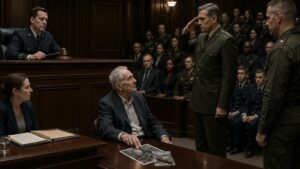
The Old Veteran Signed the Tan Envelope After They Called Her a Liar in Public
Chapter 1: The Tan Envelope Under Her Bandaged Hand
“She’s had enough time to lie.”
Karen Green said it loudly enough for the folding chairs to stop creaking.
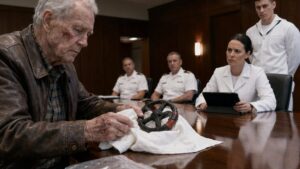
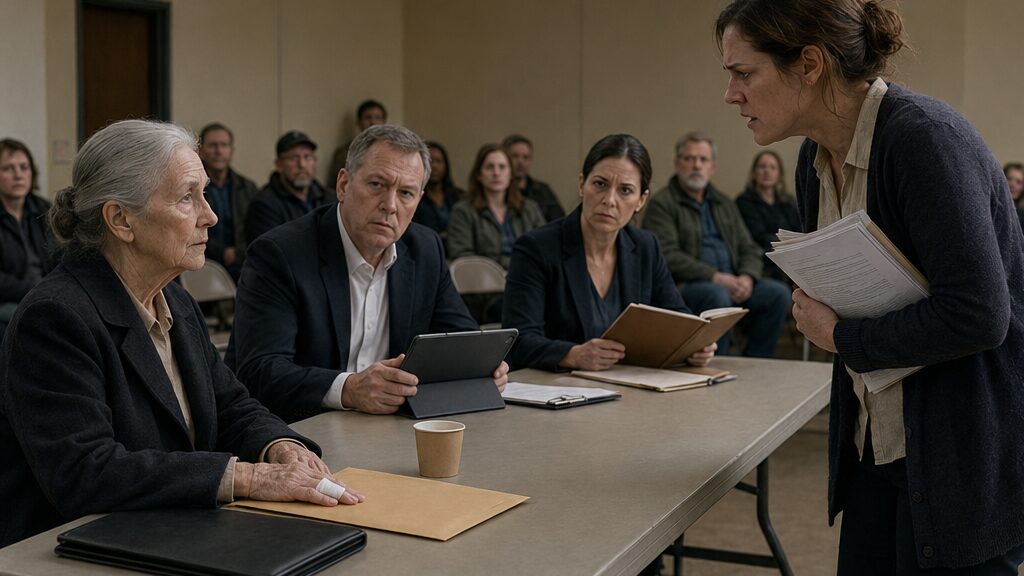
Sharon Walker kept her bandaged finger flat against the tan envelope and did not look up right away. The bandage had loosened at the knuckle during the bus ride, a white strip gone gray at the edge from newsprint and handrail grime. Beneath it, the paper cut throbbed with a stupid little heartbeat. She pressed it down anyway, holding the envelope in place as if the room itself had tilted.
Across the folding table, Karen stood with both hands full of papers. Some were county copies, some funeral invoices, some printed emails with the corners bent from being carried too long. Her face was pale in the harsh light, and the anger in it looked thin, stretched over something more fragile.
Edward Adams, the county review-board chair, shifted behind his tablet. “Ms. Green,” he said, “we need to keep this orderly.”
“She has been keeping it disorderly,” Karen said. “For weeks. My father died, and she shows up with an envelope with my name on it, then refuses to hand it over. What am I supposed to call that?”
A murmur passed through the hearing room.
Sharon had counted nine people when she entered: two waiting veterans, one spouse, a county clerk, the security officer near the side door, Patricia Lewis in her dark blazer, Edward with his tablet, Karen at the end of the table, and a seated older veteran witness who had been studying the floor since Sharon sat down. Nine people, plus the dead man whose name sat in ink on the envelope under her hand.
James Green.
The room smelled of paper cups, old coffee, and damp coats. The county had set up the veterans assistance reviews in the basement meeting room because the upstairs offices were being rewired. Every sound landed too clearly: the click of Edward’s stylus, the clerk’s keyboard, Karen’s breath when she tried not to cry.
Patricia Lewis leaned forward. She was younger than Sharon by decades, careful in the way case officers became when every form could become a complaint. “Mrs. Walker, we are not asking you to disclose private contents at this moment. We are asking you to clarify the status of the envelope for the record.”
Sharon looked at her then. “I understand.”
Karen laughed once, sharp and wet. “Do you? Because every time someone asks you a straight question, you say you understand, and then nothing happens.”
Sharon’s thumb moved along the envelope’s seam. It was sealed, still sealed, the glue ridge firm beneath the paper. James had pressed it closed with both hands because his left hand had been shaking that day. He had asked for a ruler afterward, not to measure anything, but to smooth the flap until no corner lifted.
“Mrs. Walker,” Edward said, “let’s make this simple.”
Simple had been a dangerous word in records rooms. Simple meant someone had already decided which facts did not matter.
Edward turned his tablet slightly, as though the screen could persuade her. “The envelope is addressed to Karen Green. Karen Green is the surviving adult child of James Green. You are listed in the hardship-benefit file as a caretaker contact, not next of kin. If you release the item voluntarily, we can note compliance and proceed with the benefits review.”
Karen’s eyes flashed. “Benefits review? I can’t even get the review finished because she has my father’s final papers.”
Sharon said, “The envelope is not part of the hardship claim.”
“You don’t know that,” Karen said.
“I know what he told me.”
The room quieted again, but this time the quiet had a different weight. Edward’s stylus stopped moving.
Karen looked at the envelope. Her anger flickered, then hardened. “My father told you? He told you, but not me.”
Sharon’s bandaged finger pulsed when James’s name passed Karen’s mouth. She kept her face still. She had learned a long time ago that a person in pain could mistake any movement for an attack.
Patricia glanced at the brown folder lying open before her. “For clarity, the outside of the envelope reads: ‘For Karen Green.’ Beneath that, there are initials, S.W., with the word ‘holder.’ Is that your handwriting, Mrs. Walker?”
“No.”
“James Green’s?”
“Yes.”
Karen stepped closer to the table. “Then it’s mine.”
Sharon did not lift her hand.
Edward watched that hand. “Mrs. Walker, do you understand the form I’ve placed in front of you?”
The question was quiet, but it struck harder than Karen’s accusation. Sharon saw the clerk look up. Saw the security officer’s chin shift. Saw Patricia’s eyes move from Edward to Sharon and back.
There it was, dressed as procedure: old woman, bandaged hand, slow answer, maybe confused, maybe clinging to something she had no right to understand.
Sharon looked at the form. Release of Disputed Personal Effects Pending County Review. Three signature lines. One box for voluntary transfer. One box for refusal. One box for inability to determine.
“I understand forms,” Sharon said.
Edward’s mouth tightened. “No one suggested otherwise.”
The seated older veteran witness made a small sound in his throat, not quite a cough.
Sharon picked up the pen. Her fingers were stiff, and the bandage pulled when she bent them. She signed only the attendance line at the top of the review sheet, the line that said she had appeared. Then she set the pen down beside the envelope.
Karen stared. “That’s it?”
“That is the line that is true,” Sharon said.
“The true line?” Karen’s voice rose. “You sit there like you’re made of stone, and everybody treats you like some poor old lady, but you know exactly what you’re doing.”
Sharon finally looked directly at her.
Karen’s cheeks were bright now. Her papers trembled, though she gripped them hard enough to crease them. “He was my father.”
“Yes,” Sharon said.
“Then why did he give you the last thing with my name on it?”
That question moved through Sharon more slowly than the others. It passed through the room, through the envelope, through the morning when James had refused more morphine until she promised she was listening. It found the place in Sharon where old instructions stayed filed even after the paper was gone.
She could have said: because he was afraid.
She could have said: because he did not trust himself to be forgiven.
She could have said: because he loved you badly and late, and he knew it.
Instead she placed her palm fully over the tan envelope, bandaged finger flat, old veins raised under thin skin.
“I will not open James Green’s words in front of strangers,” she said.
Karen blinked.
Edward leaned back. “Mrs. Walker, refusing to cooperate will not help your standing.”
“My standing is not the matter.”
“It is exactly the matter,” Edward said. “You are holding disputed property.”
“I am holding a sealed request.”
“You have not proven that.”
“No.”
The admission landed badly. Sharon knew it by the way Karen inhaled and Patricia closed the brown folder halfway, as if protecting the county from the shape the moment was taking.
Karen pointed at the envelope. “You hear that? She admits she can’t prove it.”
“I said I have not proven it here,” Sharon said.
Edward tapped his tablet. “Then you will need to do so quickly. The county cannot leave family property in limbo based on a private statement.”
“It is not family property until it is received the way he asked.”
Karen’s face changed. For one second, the anger broke open and showed the wound beneath it.
“The way he asked,” she repeated. “He didn’t ask me anything. He didn’t call. He didn’t come when my mother was sick. He didn’t help when I was filling out funeral forms for a man I barely knew. But he asked you.”
Sharon’s hand trembled then. Not much. Enough that the envelope whispered against the plastic table.
Patricia saw it.
So did Karen.
Edward did not seem to. He was already scrolling. “Mrs. Walker, here is what we’ll do. You have forty-eight hours to produce documentation showing legal standing to retain or condition delivery of the envelope. A witnessed instruction, notarized statement, chain-of-custody note, anything relevant. If you cannot, the board may order transfer into county custody pending release to next of kin.”
Karen looked relieved and furious at the same time.
Sharon nodded once.
Patricia’s voice softened by a small degree. “Mrs. Walker, do you have such documentation?”
Sharon thought of the black portfolio in her lap. The brown folder inside it. The intake card. The incomplete sheet James had insisted was enough because breath had become expensive and pride more expensive still.
“I have what he left me,” she said.
Edward’s eyes narrowed. “That may not be the same thing.”
“No,” Sharon said. “It may not.”
Karen gathered her papers with shaking hands. One slipped free and slid across the table, stopping near Sharon’s wrist. A funeral-home balance notice. Red letters. Past due.
Sharon did not look at it for long. Long enough.
Karen snatched it back as if Sharon had stolen that too.
The clerk announced the next case number, but no one moved right away. Patricia wrote something on a county notice, tore off the top copy, and handed it to Sharon.
Forty-eight hours. Document review required. Failure to comply may result in transfer.
Sharon folded the notice once and placed it in her black portfolio beside the brown folder. The tan envelope went in last, untouched, still sealed.
As she stood, the security officer opened the door for her, not unkindly, but with the alertness people used around old women they thought might fall apart in public.
Sharon stepped into the hallway carrying James Green’s final words, and behind her, Karen said to no one softly enough that she may have meant it only for herself, “She doesn’t even care.”
Sharon kept walking because if she turned back, she might answer too much.
Chapter 2: The Rumor Outside the Veterans Office
The whisper reached Sharon before the elevator did.
“That’s the one who stole from a dead man.”
It came from the row of plastic chairs outside the veterans office, where three people waited with folders on their knees and paper cups balanced between their shoes. The words were not shouted. They did not need to be. A whisper could travel farther when everyone wanted to pretend they had not heard it.
Sharon stood at the elevator button with her black portfolio held against her ribs. The tan envelope inside seemed warmer than the rest of the papers, though that was foolish. Paper had no warmth of its own. Only what the living placed on it.
The elevator doors opened with a tired scrape.
She stepped in, turned around, and saw Patricia Lewis watching from the office doorway. Patricia’s face held apology without permission to offer it. The doors closed before either woman spoke.
Downstairs, the county lobby had already forgotten her. A child tugged at a vending machine handle. A clerk restocked pamphlets. Someone laughed near the tax window. Sharon moved through all of it with the practiced economy of a person who knew how to take up little space.
Outside, the February air cut through her dark coat. She crossed to the bus stop and sat on the far end of the bench. Her finger had begun bleeding through the bandage.
The bus was twelve minutes late. During that time she opened the portfolio only enough to take out a clean tissue. The brown folder showed at the edge, its tab worn soft from being handled too often.
GREEN, JAMES A.
She pressed the tissue around her finger and looked at the folder without touching it.
James had hated county offices. He said every waiting room smelled like a place where a man had to prove he had suffered correctly. The first time Sharon brought him to the veterans center, he sat with both hands on his knees and read every poster except the one about family support.
“You ever work records?” he had asked her.
“Long enough to know when someone wants to change the subject.”
He had smiled then, not happily. “Then you know where they hide the hard parts.”
Sharon had known. She had spent years in Army patient records, filing what bodies had endured and what families were allowed to know. Paper could be merciful. Paper could be cruel. Mostly it waited for a human being to decide which.
The bus came, brakes sighing.
No one offered Sharon a seat because several were empty. That suited her. Kindness given because a person looked breakable had always tired her more than rudeness.
At her stop, she walked two blocks to the low brick apartment building where the hallway lights buzzed even in daylight. A county notice was taped to her door.
For a moment she simply stood there.
The notice was not the copy Patricia had handed her. This one was fresh, printed on county letterhead, folded into a plastic sleeve against the damp air.
DOCUMENT REVIEW REQUESTED. COUNTY VETERANS ASSISTANCE OFFICE. PLEASE PRESENT ALL MATERIALS RELATED TO JAMES GREEN DISPUTED EFFECTS FILE.
Someone had come while she was at the hearing.
Sharon looked down the hallway. No one stood there. The door to the laundry room thumped once, then settled.
She removed the notice carefully so the tape would not tear the paint. Inside her apartment, the quiet met her as it always did: radiator ticking, refrigerator hum, the faint smell of tea leaves in the sink. She set the notice on the kitchen table and hung her coat on the chair instead of the hook because her shoulder ached.
The apartment was small, but orderly. One narrow bedroom. One kitchen table with two chairs. One shelf of books, mostly regulations old enough to be useless except to Sharon. On the wall near the window, there was no display of service, no shadow box, no folded flag. Her Army years lived in habits instead: labels facing out, receipts clipped by date, important papers kept above flood level.
She washed her hands, changed the bandage, and made tea she did not drink.
Then she opened the black portfolio.
The tan envelope lay on top of the brown folder exactly as she had placed it. Karen’s name faced upward. James’s handwriting had grown uneven near the end, but he had written her name clearly.
For Karen Green.
Below it: S.W. holder.
Not guardian. Not owner. Not witness.
Holder.
Sharon touched the word with the side of her finger. James had argued about it. Even weak, he had argued.
“Holder means you don’t get clever with it,” he had said from the rented hospital bed in his living room. “You hold it until she can hear it without everybody staring.”
“And how will I know when that is?”
“You’ll know.”
That had been James’s great failure, Sharon thought now. He had trusted pain to announce its own readiness.
She lifted the envelope and checked the seal. Unbroken.
Under it sat the brown folder. Intake forms. County appointment cards. Pharmacy lists. A receipt for the portable oxygen unit James refused to use in front of visitors. A copy of the hardship-benefit application he had started and never completed. A half page of instructions written in his hand.
She turned to that place in the folder and stopped.
The half page was not there.
Sharon went still.
She did not panic. Panic scattered things. She removed every paper from the folder and laid them on the table in order: intake card, medical summary, benefit application, caretaker log, pharmacy list, appointment notice, mileage sheet, copy of death certificate, county correspondence. She checked the portfolio pocket. She checked the kitchen drawer where she kept spare clips. She checked the folder again, this time page by page.
The instruction sheet was gone.
Or never complete enough to stay.
Her mouth went dry.
She could see it, or thought she could: James’s handwriting slanting downward, the words “not in the room” underlined once. He had wanted Karen to receive the envelope privately. He had wanted Sharon present only long enough to say what the letter was not: not a claim against Nancy, not an excuse, not a request for money back.
Had he signed it?
Sharon closed her eyes.
She remembered him coughing. She remembered taking the pen from his fingers because he dropped it. She remembered telling him they could finish the witness line after he rested.
She did not remember finishing it.
The tea cooled beside her. Outside her window, a truck backed up with three dull beeps. Somewhere upstairs, a television played a courtroom show too loudly.
Sharon placed both hands on the table, palms down, like she had in the hearing room. The new bandage looked too white against her skin.
She had cared for James during his final months because no one else had known he was living in that rented back room behind the closed hardware store. Not at first. The veterans center called her because she was on the volunteer list for home visits and because James had written “Army” under branch of service with a hand too proud to ask for more.
She had brought soup. Sorted pill bottles. Filed forms. Sat in silence when his breathing turned rough. She had not asked about Karen until he said the name himself.
After that, the whole room had changed.
Sharon gathered the papers back into the folder. Without the instruction sheet, the county would see fragments: Sharon as caretaker contact, Sharon as holder, Sharon with an envelope addressed to someone else. It would look exactly like what Karen had said in public.
A tired old woman hiding behind confusion.
Or worse, a careful one hiding behind kindness.
She slid the tan envelope into the portfolio and fastened the clasp.
For the first time since James had placed it in her hands, the envelope felt less like a promise than a weight that might break the hand holding it.
Then she noticed the paper caught in the portfolio’s back seam.
Not the instruction sheet. A torn corner from it, no bigger than two fingers wide.
On it, in James’s slanted writing, were three words:
before she hates
The rest was missing.
Sharon sat with that scrap until the radiator stopped ticking and the apartment grew cold around her.
Chapter 3: The Rule That Turned Mercy Into Theft
“A promise is not a chain of custody.”
Patricia Lewis said it gently, which made the sentence harder to bear.
Sharon sat in the small case office with the black portfolio on her lap and the brown folder open on Patricia’s desk. The room had one narrow window, a metal filing cabinet with a dent near the handle, and a wall calendar still showing the previous month. Someone had tried to brighten the office with a plant, but the leaves had gone brown at the tips.
Patricia did not look unkind. She looked tired in the exact way rules made decent people tired.
“I am not questioning whether you cared for Mr. Green,” Patricia said. “The intake card supports that. The caretaker logs support that. What they don’t establish is your legal authority to retain an item addressed to next of kin.”
Sharon looked at the papers spread between them. “He did not want it retained. He wanted it delivered properly.”
“Properly according to him.”
“Yes.”
“And we need proof of that.”
Sharon took the torn corner from the portfolio pocket and placed it on the desk.
Patricia leaned closer without touching it. The three words sat there, almost childish in their incompleteness.
before she hates
Patricia’s eyes softened, then sharpened again with professional caution. “This helps me understand there may have been instructions. It does not tell me what they were.”
“No.”
“Do you know where the rest of the page is?”
“If I knew, I would have brought it.”
The answer came out more sharply than Sharon intended. Patricia accepted it with a small nod.
On the desk, James’s file had been divided into county logic. Verified. Unverified. Disputed. Sharon had done the same kind of sorting for years, though under different seals and with different consequences. The labels were never neutral. Once a person was placed under Disputed, everything they touched began to look suspect.
Patricia clipped the intake card to the front of the brown folder. “This proves you met him through the veterans center.”
“I did more than meet him.”
“I believe you.”
Belief, Sharon knew, had no signature line.
Patricia turned the folder so Sharon could see the card. James Green’s name. Service branch. Last known address. Emergency contact left blank. Care assistance referral checked in blue ink. At the bottom, in the volunteer assignment box, Sharon’s name appeared in Patricia’s handwriting from months ago.
Sharon Walker. Home visit support.
Beside it, someone had added James’s note later: S.W. may hold sealed effects envelope for delivery.
No witness initials. No date beside the addition.
Patricia tapped the line with her pen. “This is the problem. It names you as holder, but it doesn’t define conditions. It doesn’t override next-of-kin rights. And because the hardship-benefit file is still open, anything that could affect family eligibility may be treated as relevant.”
“The envelope does not affect eligibility.”
“You know that because you know what it is.”
“I know what he said it is.”
“But you haven’t opened it.”
“No.”
Patricia exhaled. “Then you don’t know what is inside either.”
The office seemed smaller after that.
Sharon looked toward the window. Outside, the parking lot reflected a dull white sky. A man in a ball cap helped an older woman out of a car, one hand hovering near her elbow but not touching until she nodded. That was how help should work, Sharon thought. Offered, not taken.
Patricia followed her gaze, then returned to the file. “Mrs. Walker, I need you to understand the county’s position. If we allow a non-family holder to condition delivery of sealed property without documentation, and the family files a complaint, the county becomes responsible for mishandling veteran effects.”
“James was responsible for his words.”
“Yes. But James Green is not here to confirm them.”
The door opened before Sharon could answer.
Edward Adams stepped in with a tablet under one arm and a printed packet in his hand. He paused when he saw the papers spread across Patricia’s desk, then looked at Sharon as though she had arranged them to inconvenience him.
“Mrs. Walker,” he said. “Good. Saves a call.”
Patricia’s posture changed. “Edward, I’m in the middle of a document review.”
“This pertains.” He handed her the packet. “Written complaint from Karen Green. She alleges emotional distress, improper withholding of family property, and possible interference with benefits.”
Sharon felt her bandaged finger tighten against the portfolio clasp.
Patricia scanned the first page. “She filed this this morning?”
“Emailed last night, signed in person at nine.” Edward looked at Sharon. “She is requesting expedited resolution.”
“Of course she is,” Patricia said, too quietly for anyone but Sharon to hear fully.
Edward heard enough to frown. “We have to take it seriously.”
“I am taking it seriously.”
He glanced at the torn scrap on the desk. “What is that?”
“Potential fragment of an instruction sheet,” Patricia said.
“Potential?”
“Yes.”
Edward stepped closer, read the three words, and gave a short, impatient sigh. “This is exactly the issue. We can’t run a review on scraps and memories.”
Sharon looked at him. “No one asked you to run it on memory. You asked me to bring what I had.”
“And what you have is incomplete.”
“Yes.”
“Then we proceed according to rule.”
Patricia set the complaint down. “Rule still allows discretionary handling when veteran intent is indicated.”
“Indicated is doing too much work here.”
Sharon watched them speak around James as though he were already nothing but risk.
Edward turned to her. “Mrs. Walker, I don’t doubt you meant well at some point. But you are creating the appearance of control over another family’s grief.”
The sentence struck close enough to be useful, and Sharon disliked him for that.
“I am trying to prevent an old man’s shame from being read into a microphone,” she said.
Patricia became very still.
Edward’s eyes narrowed. “What shame?”
Sharon closed her mouth.
There it was again: the door she had built and stood guard before. Behind it were James’s unfinished sentences, Karen’s childhood address, Nancy’s bitter version of a man who had disappeared, and Sharon’s own hand guiding a pen away from a witness line because she thought there would be one more day.
Patricia spoke carefully. “Mrs. Walker, if the contents involve sensitive personal information, there may be ways to protect privacy.”
“Privacy is not the same as mercy.”
“No,” Patricia said. “But secrecy is not always mercy either.”
Sharon looked at her then.
Patricia seemed surprised by her own words. She folded her hands on the desk, perhaps to keep from taking them back.
Edward checked his tablet. “The next review is set for Thursday morning. Given the complaint, Ms. Green has also requested that you be barred from attending unless you surrender the envelope in advance.”
Patricia turned sharply. “Can she request that?”
“She can request anything. The board can decide what is appropriate.”
Sharon felt a hollow space open behind her ribs. If she was barred, the envelope would enter the room without the one instruction James had managed to make clear: not in front of strangers.
Edward continued, “If you produce valid proof before then, we consider it. If not, I’m inclined to log the envelope into county custody.”
“And open it?” Sharon asked.
“If necessary for classification.”
Karen’s grief had been loud. Edward’s efficiency was quieter, and more dangerous.
Sharon gathered the torn scrap and slid it back into the portfolio. Her movements were slower now, not because she was confused, but because anger made speed careless.
Patricia said, “Mrs. Walker, there may be archive records. Volunteer assignment notes, visit reports, anything from Mr. Green’s file before his death. I can request access, but it may take time.”
“How much time?”
“More than we have.”
Edward shifted toward the door. “We don’t need to turn this into an investigation. Bring legal proof or release the envelope.”
After he left, the office held the shape of what he had said.
Patricia rubbed one hand over her forehead, then lowered it. “I’m sorry.”
Sharon closed the portfolio clasp. “Don’t be sorry unless it changes something.”
The words were not cruel. They were tired. Patricia received them that way.
She opened the bottom drawer and took out a pale green archive request card. “The records clerk may still have the inactive home-visit boxes downstairs. I can authorize you to review your own volunteer reports and Mr. Green’s nonmedical assistance file. Nothing confidential beyond what you already handled.”
“Today?”
“Tomorrow morning. When the clerk arrives.”
Sharon stood. The office chair scraped softly behind her.
At the door, Patricia said, “Mrs. Walker.”
Sharon turned.
Patricia touched the intake card clipped to the folder. “Your service-record number is written here, on your old volunteer registration. I didn’t notice it before.”
Sharon waited.
“My father had one,” Patricia said. “He wrote it on everything important.”
“Then he understood records.”
“He understood being afraid they would lose him.”
For a moment, the room lowered its voice without anyone asking.
Then Patricia looked back at Karen’s complaint, and the spell broke. “Find what you can. Please.”
In the hallway, Sharon passed the same row of plastic chairs. The whisper did not come this time. Worse, people recognized her and said nothing.
At the exit, the county clerk hurried after her with another printed notice.
“Mrs. Walker? This was just added to your file.”
Sharon took it.
Karen Green formally requests that Sharon Walker be excluded from the next review due to distress caused by continued contact.
The words blurred once, then cleared.
Sharon folded the notice, placed it beside James’s envelope, and walked out knowing the county might soon decide that her promise was not only invalid, but unwelcome.
Chapter 4: The Daughter Who Needed Someone to Blame
The landlord did not raise his voice when he handed Karen the move-out notice, which somehow made it worse.
He stood in the hall outside her apartment with a clipboard tucked under one arm and his keys hanging from a bright plastic coil. His eyes kept sliding past her shoulder into the narrow room behind her, taking inventory without permission: the boxes not unpacked, the stack of funeral papers on the counter, the thrift-store lamp with no shade.
“I’m sorry,” he said. “But the balance has been carried twice already.”
Karen held the notice with two fingers. “I told the office I’m waiting on survivor benefits.”
“And the office told me you told them.” He sounded tired, not cruel. “I need either payment or a signed arrangement by Friday. After that, I have to file.”
Friday.
The word dropped into the apartment and struck everything inside it.
Karen nodded because if she opened her mouth, something too large might come out. The landlord hesitated as if there might be another sentence that could make him decent without costing him anything. He found none. His shoes squeaked once on the hallway floor as he left.
Karen closed the door and pressed the notice flat against it.
Behind her, Nancy Smith sat at the small kitchen table with her coat still on. She had come over carrying store-brand soup and a bag of old mail, then spent twenty minutes silently rearranging Karen’s papers as if grief could be alphabetized. Now she looked at the notice in Karen’s hand and did not ask what it said.
She knew.
Karen crossed to the table and laid the move-out notice beside the complaint copy she had filed that morning. The complaint was already creased down the middle from being folded into her purse, then unfolded in the county office, then folded again while she sat on the bus feeling everyone could see it through the vinyl.
Nancy touched the top page. “Did they say when they’ll make her give it back?”
Karen took off her coat but kept it in her hands. “They said there’s another review Thursday. Maybe sooner if she doesn’t prove anything.”
“If she had proof, she would’ve shown it.”
Karen laughed without humor. “That’s what I keep saying.”
Nancy looked toward the counter, where James Green’s funeral-home folder leaned against a mug. “Your father always did know how to leave trouble behind.”
Karen flinched at “your father.” Nancy used it differently depending on the day. Sometimes it meant the man who had given Karen his last name. Sometimes it meant the man whose absence was now Karen’s inheritance. Tonight it meant a bill neither of them could pay.
“She sat there with her hand on it,” Karen said. “Like it was hers.”
Nancy’s mouth tightened. “Maybe to him, it was.”
“What does that mean?”
“It means some men get old and want kindness from people they didn’t disappoint first.”
Karen looked at her mother.
Nancy’s face had gone hard, but her eyes were wet in the corners. She had carried the same version of James for so many years that Karen sometimes wondered whether the real man could have survived inside it. In Nancy’s telling, James had been handsome when it helped, selfish when it explained things, wounded when it excused nothing, and gone before Karen was old enough to ask why.
Karen sat down slowly.
Nancy pushed the soup closer. “Eat.”
“I don’t want soup.”
“You never want what keeps you standing.”
Karen stared at the complaint copy. The paper looked official and childish at the same time. Her own signature sat at the bottom, too dark from pressing hard.
“She said she wouldn’t open his words in front of strangers,” Karen said.
Nancy made a small sound. “That’s rich.”
“Maybe he told her something.”
“He told everybody something. That was never the problem.”
Karen picked at the crease in the complaint page until the paper softened. “What if it isn’t about money?”
Nancy looked up.
Karen hated herself for saying it. She hated the quick stillness in her mother, the sudden calculation. Money had been a cleaner anger. Money gave her something practical to demand: benefits, forms, documents, whatever the envelope might contain that could move the county claim forward and stop the landlord from filing.
If it was not about money, then it might be about love.
And that was worse.
Nancy leaned back. “That woman got the version of your father you never did.”
The sentence landed so softly that Karen almost missed the blade in it.
“She got him at the end,” Nancy continued. “The sorry voice. The old-man eyes. The little envelope. You got empty birthdays and me making excuses until I got tired of hearing myself. Don’t let some stranger turn that into dignity.”
Karen looked toward the funeral folder.
On the day the county called about James’s death, she had not cried at first. She had asked the clerk to spell his middle name because she realized she did not know whether the “A” stood for anything. Only after she hung up had she gone into the bathroom at work and cried so hard she frightened herself.
She did not miss him. Not exactly.
She missed the chance to have known whether she could miss him.
Nancy stood and began closing food containers with small, efficient snaps. “You need people there on Thursday.”
Karen blinked. “People?”
“Witnesses. Not just you looking emotional while she looks fragile. People who know what this has done to you.”
“I’m not trying to put on a show.”
Nancy gave her a look that was not unkind, only worn flat by life. “Then stop letting her be the only one with a role.”
After Nancy left, the apartment seemed to shrink around Karen. She ate three spoonfuls of soup cold because her mother would ask later. Then she opened her phone and stared at names she could not ask for help. A coworker who had covered one shift. A neighbor who had brought paper plates after the funeral. A veterans-office waiting-room contact she had spoken to after the first review, an older spouse whose husband’s claim had been delayed for months.
Karen did not write, Come watch me accuse an old woman.
She wrote, There is a county review about my father’s final effects. I need people there so they don’t dismiss me.
Then she stared at the message until her thumb hurt from hovering.
One by one, she sent it.
Replies came slowly. One yes. One maybe. One question she ignored: Is this about that elderly lady?
Karen put the phone face down.
Later, when the apartment building had gone mostly quiet, she carried the complaint copy out to her car because she could not breathe inside. The parking lot behind the veterans office was visible from there only in memory, but she drove anyway, telling herself she needed to see the building closed, needed to know Sharon Walker was not inside some warm office charming them with silence.
The county lot was nearly empty. A security light buzzed above the side entrance. Karen parked under it and held the complaint against the steering wheel.
Through the windshield, the veterans office windows reflected nothing back but dark glass.
“She had my name,” Karen whispered.
No one answered.
She thought of Sharon’s bandaged finger, the careful way it rested on the envelope. Not possessive exactly. Protective. Karen hated that she had noticed the difference.
She unfolded the complaint and read the last paragraph aloud, but her voice faltered halfway through. Too official. Too cold. Not enough.
She tried again, this time imagining Sharon at the folding table, calm as a locked drawer.
“You don’t get to keep my father twice.”
The words filled the car, then stayed there with her.
Karen folded the complaint carefully along its old crease, pressed it against her chest for one breath, and knew she would say it in front of everyone.
Chapter 5: The Records That Remembered Less Than She Did
Sharon found James Green’s name in a box marked UNCLAIMED PERSONAL EFFECTS, and for one careful second, she could not make her hand reach in.
The archive room was colder than the rest of the veterans center, tucked below the public offices where the walls sweated faintly near the pipes. Metal shelves ran in tight rows. Each box had a printed label, a year, and a colored dot that meant something to the records clerk but not enough to keep the dust off.
The records clerk stood by the door with a clipboard. “You can review assistance files only. No medical. No sealed family packets. Nothing you remove from this room.”
“I understand.”
The clerk looked at Sharon’s black portfolio. “That stays closed unless I ask.”
Sharon nodded.
The clerk softened a little, perhaps embarrassed by the tone. “There’s a table at the end. Press the buzzer if you need copies.”
When she left, the door did not close all the way. Sharon appreciated that. A door left cracked open kept everyone honest.
She pulled the box down slowly, feeling the weight in her shoulder. Her bandaged finger caught on the cardboard lip, and pain ran bright up her hand. When she looked, a thin red line had opened through the edge of the bandage.
“Foolish,” she murmured.
There was no one to hear it.
Inside the box were brown folders, each one holding a life reduced to what the county had not known how to finish. Returned mail. Unclaimed bus vouchers. Copies of death certificates. Appointment cards for people who would not arrive.
James’s folder was near the back.
She carried it to the table and sat before opening it. Her black portfolio rested closed beside her elbow. The tan envelope was inside, still sealed, but she felt its absence from the table as strongly as its presence yesterday. A missing object could accuse too.
The first pages were familiar: intake summary, home-visit assignment, benefit-start checklist. Then came documents she had not seen. A printout of a referral note. A volunteer communication log. A scanned envelope from an older file.
Sharon put on her reading glasses.
There it was: Karen’s childhood address, typed cleanly on a family contact sheet from years before.
Karen Green. Minor child. Address verified.
Sharon sat back.
James had known where she was.
The room seemed to take a breath through the old pipes.
Sharon had not believed he forgot. Forgetting was a story people told when remembering hurt too much. But seeing the address there, confirmed in black type, changed the weight of his silence. He had not been unable to find Karen. He had been unable to face what finding her required.
A younger Sharon would have judged him for that.
An older Sharon had learned that cowardice and love could live in the same damaged room.
She turned the next page.
A county note from years ago: Veteran declined family outreach. Stated contact may cause distress. No further action.
Her own mouth tightened.
The note was not in her handwriting. It predated her care. Still, it made James look worse, and maybe he was. Maybe truth had to allow that.
She found another sheet, newer, from the period when she had been visiting him.
Volunteer report, written by Sharon Walker.
Client requested assistance drafting sealed letter to adult daughter. Client asked that letter not be delivered in group setting or during benefits review. Client expressed fear that family may mistake apology for claim or excuse.
Sharon touched the page.
This was something.
Not enough, perhaps. Not witnessed by James. Not signed by him. But something more than a scrap.
Her eyes moved down to the next line, and her throat tightened.
Volunteer advised client to delay delivery until emotional setting could be arranged.
Her own words.
Not James’s delay. Hers too.
She remembered that afternoon with painful clarity. James had been sitting in a chair by the window, a blanket over his legs though the room was warm. The envelope lay open then, the letter folded beside it. He had wanted to mail it.
“She’ll tear it up,” he said.
“She might,” Sharon had answered.
“Then what’s the point?”
“That you sent it.”
He had looked at her. “You ever send something too late?”
She had not answered. Her silence had become permission for his.
After that, she had suggested delivery through the veterans center, privately, with someone present who could help Karen receive it. It had sounded wise. It had sounded careful. It had also given James one more way not to face the mailbox.
Sharon turned another page.
There was a draft chain-of-custody form. James Green’s name typed at the top. Sharon Walker listed as temporary holder. Intended recipient: Karen Green. Conditions: private delivery; no public reading; no benefit hearing disclosure unless recipient requests.
The witness line was blank.
The veteran signature line was blank.
The form had never become a form. It was only a draft.
She closed her eyes. The pen falling from James’s hand. Her telling him, “Rest first.” His breath rattling. The nurse arriving. The next morning’s call.
No one had stolen the proof.
They had failed to finish it.
When Sharon opened her eyes, her bandage had bled through enough to mark the edge of the volunteer report. A small red crescent sat near her typed name.
She took a tissue from her sleeve and pressed it hard around her finger. Paper did not care how much skin it took.
The buzzer on the wall clicked before she touched it. The records clerk appeared in the doorway. “Everything okay?”
“I need copies of these.”
The clerk came over, looked where Sharon pointed, and frowned slightly. “Draft forms don’t always carry weight.”
“I know what they carry.”
The clerk did not ask what that meant. She made copies and stamped them REVIEW COPY in blue. Sharon gathered them into the brown folder with the same care she would have used for field records, each page in order, each weakness visible.
As she clipped the volunteer report beneath the intake card, a small yellow note slipped from the back of the folder.
Not James’s missing instruction sheet.
A county routing note.
Incomplete holder form. Returned to volunteer for completion. No follow-up before veteran death.
Sharon stared at the words until they steadied.
Returned to volunteer.
To her.
She had no memory of receiving it. Maybe it had been placed in the wrong mailbox. Maybe she had missed it during the days James’s breathing worsened. Maybe it had sat in some stack while she carried soup and picked up prescriptions and told herself the letter could wait until morning.
The reason mattered less than the result.
She placed the routing note into the folder.
A phone rang upstairs, faint through the ceiling. Then footsteps approached fast.
The records clerk opened the door wider. “Mrs. Walker? Patricia Lewis is calling down for you.”
Sharon stood too quickly, and the archive table tilted in her vision. She steadied herself with one hand.
The clerk held out the wall phone. Its cord curled like an old question.
Sharon took it. “This is Sharon.”
Patricia’s voice came tight through the line. “The final review has been moved up.”
“To Thursday?”
“To this afternoon. Two-thirty.”
Sharon looked at the box of unclaimed effects, still open on the shelf.
“Karen brought additional witnesses and filed a hardship escalation,” Patricia said. “Edward says delaying now increases liability. I tried to stop it.”
Sharon folded the copied records into the brown folder. Her finger left one small pink mark on the tab.
“Mrs. Walker?”
“I heard you.”
“There’s something else. Edward hasn’t ruled on Karen’s request to bar you, but if you arrive without new proof, he may order the envelope logged before you speak.”
The tan envelope waited inside the closed black portfolio at her elbow. Sharon looked at it and saw, for the first time, not James’s trust alone but Karen’s years outside a locked door.
“I have proof,” Sharon said.
Patricia was silent for a beat. “Enough?”
Sharon looked at the blank witness line, the unsigned veteran line, the routing note that had returned responsibility to her and found no one home.
“No,” she said. “But I have truth.”
She hung up before Patricia could answer.
Chapter 6: The Folding Table Filled With Witnesses
Karen arrived with witnesses and said Sharon should not be allowed to touch the envelope.
She said it while Sharon was still in the doorway, before the security officer had finished deciding whether to help her with the heavy door. The hearing room was fuller than it had been Monday. Extra folding chairs had been pulled from the wall. Two people stood near the back with their coats still on. The older veteran witness from the first review sat in the same place, hands folded over a cane, watching the table as if the table itself had aged overnight.
Sharon stepped inside.
Her black portfolio was under her arm. The brown folder pressed against it. Her finger had been rebandaged with gauze from the archive first-aid kit, too bulky now for the glove she had brought. The white wrap made her hand look more injured than it was, which irritated her. Pain that small had no business asking for attention today.
Edward Adams sat at the center of the folding table. Patricia Lewis sat to his left with a stack of papers clipped tight enough to bend. The county clerk had placed a sign-in sheet, a paper cup of pens, and a recording notice at the edge of the table. No one had moved the paper cup from Sharon’s place. It sat there empty, beside the space where everyone expected the tan envelope to appear.
Karen stood behind her chair rather than sitting. Her complaint copy lay in front of her, folded and unfolded until its crease had gone white. Her eyes looked swollen, but her posture was straight.
“You heard me,” Karen said to Edward. “If this is about reducing distress, then don’t let her sit there guarding it like some prize.”
A woman in the back murmured, “That’s right,” then went quiet when Patricia looked up.
Edward tapped his tablet. “Mrs. Walker, please be seated.”
“Am I permitted to participate?” Sharon asked.
The question caught him. He glanced at Patricia.
Patricia said, “You are here as a responding party and listed holder. Yes.”
Karen made a sound. “Listed by who? By herself?”
“By James Green,” Sharon said.
The room shifted. It was the first time that afternoon she had said his full name.
Karen’s mouth tightened. “Then put it on the table.”
Sharon walked to the chair and sat down slowly. Not because she needed to move slowly, but because haste made people think they had hurried you. She opened the black portfolio. The room leaned in without meaning to.
She placed the tan envelope beside the sign-in sheet.
No one spoke.
Under the fluorescent light, the envelope looked smaller than it had in her apartment. More ordinary. A thing that could hold a bill, a school photo, an apology too late to be useful. Karen stared at her own name in James’s handwriting, and for a moment every accusation left her face.
Then Edward cleared his throat.
“For the record, this is the expedited review of disputed effects related to the James Green hardship-assistance file. Present are board chair Edward Adams, case officer Patricia Lewis, claimant Karen Green, responding holder Sharon Walker, county clerk, and public witnesses.”
Public witnesses.
Sharon looked toward the back of the room. Karen had brought people because she was afraid of being dismissed. Sharon knew that now. Knowing did not make the room kinder.
Edward continued. “Mrs. Walker, have you brought documentation establishing legal authority to retain the envelope?”
Sharon opened the brown folder. “I brought documentation establishing veteran intent.”
“That is not what I asked.”
“It is what exists.”
Karen stepped forward. “This is what she does. She turns every question into a fog.”
Patricia lifted one hand. “Ms. Green—”
“No. She got to sit there Monday and make everyone feel sorry for her. She got to act like I was cruel for wanting my own father’s last words.” Karen’s voice shook, but she did not stop. “You don’t get to keep my father twice.”
The sentence struck the room harder than Sharon expected.
She looked at Karen then, really looked. Not at the anger, not at the papers, not at Nancy’s bitterness speaking through another mouth. At the daughter standing before strangers because private grief had left her nowhere else to stand.
“No,” Sharon said quietly. “I do not.”
Karen blinked as if the answer had failed to meet the shape of her attack.
Sharon slid the copied volunteer report forward. Patricia took it first, read quickly, and passed it to Edward. He scanned it with an impatient frown that changed, slightly, when he reached the line about private delivery.
“This is your own report,” he said.
“Yes.”
“Not signed by Mr. Green.”
“No.”
Sharon placed the draft holder form beside it. “This was prepared but not completed.”
Edward’s frown deepened. “Unsigned.”
“Yes.”
Karen laughed once. “So nothing. She brought nothing.”
Sharon placed the routing note down last.
Patricia leaned over it. Her lips parted slightly.
Edward read it, then looked at Sharon. “This says the incomplete form was returned to the volunteer for completion.”
“Yes.”
“Were you that volunteer?”
“Yes.”
Karen seized on it. “Then she had the form. She didn’t finish it.”
Sharon looked at the routing note. “No.”
“Why?”
Because James’s lungs had filled. Because the nurse had come. Because Sharon had thought there would be one more morning. Because she had believed carefulness was the same as action. Because she had spent a lifetime keeping files intact and still let the one paper James needed most remain unfinished.
“I failed to finish it,” Sharon said.
The room went very still.
Karen’s face changed again, but this time Sharon could not read the change.
Edward set the papers down. “Then we have no enforceable condition. Given the family claim, the complaint, and the incomplete holder documentation, I am ordering the envelope logged into county custody pending classification and release.”
Patricia turned toward him. “Edward, we should not classify contents in open review.”
“I didn’t say open review.”
“You said custody. That means staff handling, possible opening, internal scan, file attachment—”
“Procedure exists for a reason.”
“It also allows discretion.”
His voice cooled. “Discretion was extended for forty-eight hours. We are now in an escalated complaint with public witnesses and potential mishandling.”
Sharon watched Patricia’s hand move to the edge of the folder, then stop. A small resistance, but resistance all the same.
Edward gestured to the clerk. “Prepare an evidence intake sleeve.”
The county clerk stood.
Karen looked from Edward to the envelope. Victory came toward her too quickly; Sharon saw it frighten her. Her hands moved to her papers, then away.
Sharon placed her bandaged hand over the tan envelope.
Edward’s expression hardened. “Mrs. Walker.”
“I heard your order.”
“Then remove your hand.”
“In a moment.”
“This is not optional.”
Sharon looked at Patricia. Patricia’s face had gone pale with the knowledge of what procedure was about to do and how little courage the room had left to stop it.
Then Sharon looked at Karen.
“Your father left you a letter,” Sharon said.
Karen’s lips parted.
“He asked me not to let it be read in a benefits hearing. Not by officials. Not by witnesses. Not by anyone deciding whether he deserved help after he was already gone.”
Karen swallowed. “What did he say about me?”
“That belongs to you.”
“Then give it to me.”
“I will.”
Edward leaned forward. “Mrs. Walker, if you are agreeing to release—”
“I am not agreeing to county custody.”
“You may not have a choice.”
“I know.”
The words came out without fear, and that seemed to trouble him more than argument would have.
Sharon took the paper cup of pens and tipped it gently until one rolled free. Her bandaged finger made the motion clumsy. She set the pen beside the sign-in sheet.
“I need one blank release form,” she said.
Edward paused. “The transfer form is already there.”
“Not that one.”
Patricia’s eyes moved to Sharon’s face. Something in her understood before the rest of the room did.
“What kind of release?” Patricia asked.
“Caretaker reimbursement waiver and voluntary delivery acknowledgment.”
Edward stared. “Mrs. Walker, that is not relevant to classification.”
“It is relevant to motive.”
Karen looked confused. “What reimbursement?”
No one answered her right away.
Sharon kept her hand on the envelope. Beneath the gauze, her finger had started to ache again, steady and hot. Good, she thought. Let it be steady. Let something in this room be steady.
Patricia opened a drawer in the portable file box beside her chair. She removed a blank county form and placed it before Sharon without asking Edward’s permission.
Edward said, “Patricia.”
Patricia did not look at him. “It is a valid form.”
Sharon pulled it toward her.
The room had leaned in again, but differently now. Not hungry. Uncertain.
She looked at Karen, who stood with her complaint page pressed against her stomach like a shield.
“Then let her hear only what belongs to her,” Sharon said.
Chapter 7: What She Signed Away Without Saying
Sharon signed the form before anyone in the room understood what it cost her.
The pen dragged once where her bandaged finger failed to bend cleanly. She stopped, steadied the paper with her left palm, and finished her name in the narrow county box meant for voluntary waivers. Sharon Walker. The letters came out smaller than usual, crowded by the gauze and the eyes fixed on her hand.
Edward leaned forward. “Mrs. Walker, I need to verify what you have signed.”
Patricia already knew. Her face had gone still in the way of someone watching a door close too late.
Sharon slid the form toward her. “Caretaker reimbursement waiver. Any remaining claim attached to my home-visit hours, supply costs, transport logs, and final assistance to James Green.”
Karen stared. “What claim?”
The room did not answer fast enough.
Sharon looked at the tan envelope, then at Karen. “Your father’s hardship file included unpaid caretaker reimbursement. I was listed for some of it because I bought supplies and drove him to appointments when the volunteer fund ran out.”
Karen’s eyes moved from the form to Sharon’s face. “Money?”
“Not much.”
“How much?”
Patricia checked the folder because numbers were safer than faces. “After adjustment, approximately six hundred and eighty dollars eligible for review. Possibly less.”
Karen’s mouth opened, but no words came.
Six hundred and eighty dollars was not enough to redeem James Green. It was not enough to pay all of Karen’s funeral bills or save her apartment without other help. But in that room, after what Karen had accused her of, it was enough to alter the shape of every silence.
Edward recovered first. “Mrs. Walker, waiving reimbursement does not resolve custody of the envelope.”
“No,” Sharon said. “It resolves the lie that I was holding it for payment.”
Karen flinched.
No one scolded her. That was worse than scolding.
Sharon picked up the tan envelope. Her bandaged finger pressed across James’s handwriting, not covering Karen’s name, only holding the paper steady. “I will release this to Karen Green. Not to county custody. Not to a scan. Not to a public file.”
Edward’s jaw set. “The board has not approved conditional release.”
Patricia placed the signed waiver beside the copied volunteer report. “The county can accept a voluntary delivery acknowledgment if the recipient agrees and the holder’s financial claim is waived. The disputed property concern narrows if Ms. Green receives it directly.”
Edward looked at her. “You are making a procedural argument after objecting to procedure.”
“I’m remembering what procedure is for.”
The words were quiet. They still changed the room.
Karen’s witnesses shifted behind her. The woman who had murmured earlier looked down at her shoes. The older veteran witness kept his gaze on Sharon now, not the table.
Edward looked at Karen. “Ms. Green, do you agree to receive the envelope privately, without county review of the contents?”
Karen did not answer.
Her hands had loosened around the complaint copy. The paper sagged against the table edge. She looked younger suddenly, not in a tender way, but in the exposed way people looked when the anger holding them upright faltered.
“You were owed money,” she said to Sharon.
“I was owed nothing James did not freely ask.”
“That’s not what I asked.”
“No.”
Karen swallowed. “Were you going to take it?”
Sharon let the question sit. She could have made herself clean with a quick denial. She did not deserve that.
“I filed the logs because Patricia told me to file them. I did not know whether I would accept reimbursement. I told myself deciding later was not dishonest.”
“And was it?”
Sharon looked down at her signed waiver. “It was unclear enough to hurt you.”
Karen’s face twisted, and she turned away before anyone could name it.
Edward pushed his chair back slightly. “We can move into the side office for private delivery. Patricia, you will witness transfer. Clerk, pause the review recording.”
The clerk reached toward the small recorder.
“No,” Sharon said.
Edward looked irritated. “Mrs. Walker, you requested privacy.”
“For the letter. Not for the correction.” She rested her palm on the waiver form. “The record may show I waived the claim before release.”
Patricia nodded once. “That is appropriate.”
Karen looked at Sharon as if another accusation had been taken from her hand, leaving it empty and sore.
They moved to the side office, the same small room where Patricia had said a promise was not a chain of custody. Now the brown folder lay on the desk beside the tan envelope, and the door remained half-open. Not open enough for the room to hear. Not closed enough to make it secret in the wrong way.
Karen stood by the chair but did not sit. Sharon sat because her knees had begun to shake, and pride was not worth falling over.
Patricia placed a delivery acknowledgment on the desk. “Ms. Green, this confirms you receive the sealed envelope directly from Sharon Walker. You are not required to open it here.”
Karen’s hand hovered over the envelope. “Did you read it?”
Sharon shook her head. “No.”
“Not once?”
“No.”
“Why?”
Because James had asked. Because unopened paper could still protect a man from being reduced to his worst failures. Because Sharon had believed restraint could preserve dignity, and only now saw how dignity locked away could become another form of abandonment.
“Because I thought keeping his shame sealed was the same as keeping his love safe,” Sharon said.
Karen stared at her.
Patricia lowered her eyes to the form, not to avoid the moment, but to guard it from becoming a spectacle.
Karen picked up the envelope with both hands. Her thumb moved over her name. “What shame?”
Sharon folded her hands together. The bandaged finger throbbed between them.
“He knew where you were,” she said.
Karen went still.
“He did not forget you. He did not lose your address. He was afraid to come back and find out that the damage he had done could not be repaired.”
Karen’s eyes filled so quickly she looked startled by it. “That’s supposed to help?”
“No.”
“Then why say it?”
“Because it is true enough to belong to you.”
Karen looked down at the envelope. “My mother said he chose everything else.”
“She was not entirely wrong.”
That made Karen look up.
Sharon did not soften it. “He chose avoidance many times. He chose pride. He chose silence. He also kept your address in every file where he was allowed to write family. He asked about whether you had changed your name. He began that letter more than once. He did not become a good father because he regretted being a poor one.”
Karen’s breath broke on the last word, but she did not cry yet. She pressed the envelope to her chest as if holding it there might keep the contents from changing her too quickly.
“Why you?” she asked.
Sharon looked toward the half-open door. Through it, she could see the corner of the folding table and Edward’s sleeve. The public room was waiting to see what shape grief would take when it returned.
“Because I knew how to keep records,” Sharon said. “And because I let him believe there would be time.”
Karen’s face changed.
Sharon forced herself to continue before courage thinned. “The holder form was returned to me. I failed to complete it with him. I told myself he needed rest, that the letter needed a careful setting, that privacy was mercy. Some of that was true. Some of it was my fear of watching a family receive pain and not being able to file it anywhere.”
Patricia’s pen stopped moving.
Karen sank into the chair across from Sharon. The envelope remained against her chest. “So you helped him wait.”
“Yes.”
“You helped him hide.”
Sharon closed her eyes briefly, then opened them. “Yes.”
The word did not excuse Karen’s accusation. It did not erase the hallway whisper or Edward’s implication or the humiliation of an old woman asked whether she understood a form. But it kept Sharon from using dignity as a shield against her own part in the harm.
Karen pressed her lips together until they whitened.
“Did he ask me to forgive him?” she said.
“I don’t know what the letter asks. He told me only what it was not.”
“What was it not?”
“Not an excuse. Not a claim against your mother. Not a request for you to make him better after death.”
Karen’s tears came then, silently at first. One dropped onto the tan paper near James’s handwriting. She wiped it quickly, as if the envelope could be damaged by grief.
Patricia slid a box of tissues across the desk without comment.
Karen did not take one. She opened the envelope with a slow, careful tear along the top, preserving the names on the front. Sharon turned her face toward the window. She would not watch the first moment unless Karen asked.
Paper unfolded.
The office changed around the sound.
Karen read without speaking. Her shoulders rose once, then held. Halfway through, she pressed the page flat on the desk with both hands and bent over it as if the words had become too heavy to hold upright.
Sharon looked at the window and saw their faint reflection there: the daughter reading, the case officer witnessing, the old veteran turned slightly away from a privacy she had almost protected too completely.
After a long while, Karen whispered, “He remembered the blue bicycle.”
Sharon said nothing.
“He wrote about the training wheels.”
Patricia lowered her head.
Karen laughed once, broken and disbelieving. “I thought my mother made that story up.”
Sharon looked back then.
Karen’s face was wet, but the anger had not vanished. It had deepened into something harder to carry because it no longer had one target.
“He says he watched from the street once,” Karen said. “When I was nine.”
Sharon knew that. James had told her and then cursed himself for telling it.
“He didn’t come to the door,” Karen said.
“No.”
“He just watched.”
“Yes.”
Karen folded the letter, then unfolded it again as if she distrusted any action that would hide the words. “He says he was ashamed of needing forgiveness more than he wanted to earn it.”
Sharon’s throat tightened.
Karen looked at her over the page. “You knew that sentence?”
“No.”
“But you knew him.”
“At the end.”
“I knew the beginning,” Karen said. “Or what was missing from it.”
Neither woman spoke for a moment.
Then Karen picked up the delivery acknowledgment. Her hand shook so badly Patricia quietly steadied the bottom edge without touching Karen’s fingers. Karen signed.
The envelope had left Sharon’s hand. The promise had not ended neatly. It had changed owners and become heavier in a different way.
From the hearing room, someone coughed. A chair scraped. The public world was becoming impatient again.
Karen stood with the letter folded inside the opened envelope. Her complaint copy still lay on the hearing-room table, accusing Sharon in black ink.
At the door, she stopped. “I don’t know how to fix what I said.”
Sharon rose slowly. “Then do not try to fix all of it at once.”
Karen looked back.
“Correct what is false,” Sharon said. “Carry the rest until you know its name.”
Karen held the envelope to her chest with both hands and stepped back into the hearing room.
Chapter 8: The Room That Learned to Lower Its Voice
Karen returned to the folding table and asked Edward to amend her complaint before anyone could ask what the letter said.
Her voice was rough, but it carried. The public witnesses turned toward her. The clerk’s hand hovered above the recorder. Edward straightened, already preparing the face of an official man ready to regain control.
Karen did not give it to him.
“I accused Sharon Walker of withholding my father’s envelope for money,” she said. “I want that removed.”
Edward blinked. “Ms. Green, complaint amendments can be submitted in writing after—”
“No.” Karen placed the opened tan envelope on the table, one hand over the torn edge to keep the letter hidden. “You wrote down the accusation in this room. I said it in this room. I want the record to show I was wrong about that.”
The room lowered itself by degrees. A chair stopped squeaking. Someone near the back exhaled through their nose. The security officer looked at the floor.
Sharon stood just inside the side-office doorway. She had intended to return to her chair, but her knees had decided otherwise. Patricia noticed and moved the nearest chair without making a fuss. Sharon sat.
Edward looked at Patricia, perhaps for rescue, perhaps for restraint.
Patricia opened the brown folder. “The record can reflect that Ms. Green withdraws the allegation of financial motive. It can also reflect that Mrs. Walker waived remaining caretaker reimbursement prior to voluntary delivery.”
Karen closed her eyes when the words were spoken. Not because they absolved her. Because they did not.
Edward adjusted his tablet. “Fine. The record will reflect amendment of that allegation.”
Karen’s hand remained on the envelope. “And that she acted according to my father’s stated request.”
Edward hesitated.
Patricia said, “The documentation supports that James Green indicated intent for private delivery, though the form was incomplete.”
“Incomplete,” Edward repeated, seizing the safe word.
Karen looked at him. “He was dying.”
No one spoke.
Edward’s face tightened, but not with anger this time. More like a man forced to see that the file he wanted closed had living edges.
Patricia typed slowly. “Sharon Walker acted according to James Green’s stated request for private delivery, as supported by volunteer report and draft holder documentation. Documentation incomplete; disputed allegation amended by claimant.”
She read it aloud.
Sharon looked at the empty place on the table where the envelope had been when it belonged to no one cleanly. The space seemed almost bright now, a plain rectangle of scratched plastic between the paper cup and the sign-in sheet.
Edward cleared his throat. “Mrs. Walker, given the circumstances, the board appreciates your cooperation.”
Sharon said nothing.
He seemed to hear how thin the word cooperation sounded after what had happened. He set his tablet down. “And we regret any implication that you did not understand the process.”
The apology was shaped like a procedure, but it was not nothing.
Sharon inclined her head once. “See that the next person does not have to be old in public and prove she has a mind before she is heard.”
The older veteran witness looked up sharply. Patricia stopped typing.
Edward’s face colored. He did not defend himself. That, too, was not nothing.
“I will review disputed-effects handling,” he said. “Especially sealed personal items with indicated veteran intent.”
“Review is a start,” Patricia said, and there was enough steel in it that the clerk glanced at her.
Edward looked at Patricia as if seeing, perhaps for the first time, that she had been carrying more than files.
He turned back to Sharon. “We could issue a formal commendation for your service in this matter.”
“No.”
The word came before he finished drawing breath for the next sentence.
A few people in the back shifted, surprised by the firmness of it.
Sharon rested her bandaged hand on the arm of the chair. “Do not make a ceremony out of a correction.”
Edward closed his mouth.
Karen picked up her complaint copy. For a moment Sharon thought she would tear it, but Karen folded it instead, once along the old crease, then once more, making it small enough to fit behind the tan envelope.
“I still have to figure out the benefits file,” Karen said to Patricia.
“I’ll help you separate what is required from what is not,” Patricia said. “Tomorrow morning, if you can come in.”
Karen nodded. Her eyes moved to Sharon. The apology in them was large and frightened and not yet ready to be spoken where others could use it.
Sharon spared her from trying.
She stood, slower now because the day had spent her. The security officer opened the door again. This time he did not hover near her elbow. He simply held the door and waited until she passed.
In the hallway, the whisperers from Monday were gone, replaced by people with their own folders and private emergencies. Sharon walked toward the elevator with her black portfolio lighter under her arm. Too light, almost. The brown folder remained inside it. James’s copies remained. The torn scrap remained.
before she hates
Too late for that, perhaps. Not too late for something else.
Karen caught up near the elevator.
“Mrs. Walker.”
Sharon pressed the button. “Sharon is fine if you can say it plainly.”
Karen took that in with a small, pained nod. “Sharon.”
The elevator clicked somewhere above them.
Karen held the tan envelope carefully against her coat. “He didn’t ask me to forgive him.”
“No.”
“He asked me to know he was sorry without pretending sorry was enough.”
Sharon looked at the envelope, then at Karen. “That sounds like him at his best.”
Karen’s mouth trembled. “Was there a best?”
“Yes,” Sharon said. “And not enough of it.”
A tear slid down Karen’s cheek. She did not wipe it this time.
“I called you a liar,” Karen said.
“You did.”
“I wanted you to be one.”
“I know.”
The elevator doors opened. Neither woman stepped in.
Karen looked toward the hearing room doors. “My mother won’t like this version.”
“She may have reasons.”
“She has a lot of those.”
“Most people do.”
Karen let out a breath that almost became a laugh and did not. “I don’t know what to do with him now.”
Sharon thought of James in the chair by the window, smoothing the envelope flap with a ruler. James watching from a street and not knocking. James asking Sharon to hold what he had not had courage to deliver. A man could be loved and still leave wreckage. A daughter could be owed truth and still not be asked to repair him.
“Do not make him better than he was,” Sharon said. “Do not make him smaller either.”
Karen nodded once, as if filing the sentence somewhere safer than the county could reach.
One week later, Sharon returned to the veterans office to deliver her final volunteer logs and remove her name from James Green’s active file. The basement room was being used again for reviews. Through the open door, she saw Edward at the folding table with a new case, speaking more slowly than before. When an elderly man paused over a form, Edward waited. He did not ask whether the man understood until he had first asked what the man wanted to say.
Patricia met Sharon in the hallway with a corrected record copy.
“No ceremony,” Patricia said.
Sharon accepted the paper.
The correction was plain, almost dull. No praise. No grand language. Just the sentence Patricia had typed: Sharon Walker acted according to James Green’s stated request.
Below it, Karen Green had signed the amendment.
Sharon folded the copy and placed it in her black portfolio. The tan envelope was no longer there. The empty space inside the portfolio remained, but it no longer felt like loss alone.
From the far end of the hallway, Karen appeared carrying a folder of benefit papers and the same tan envelope, now tucked carefully inside a clear sleeve. She stopped when she saw Sharon.
For a moment, both women stood among the office noise: phones ringing, chairs scraping, the clerk calling numbers, lives becoming paperwork and refusing to fit.
Karen crossed the hall.
“I brought the lease papers Patricia asked for,” she said. “And the funeral balance.”
“Good.”
Karen glanced toward the hearing room. “I didn’t bring witnesses.”
“No.”
“I thought about it.”
“I expect you did.”
Karen smiled faintly, then looked down at the envelope sleeve. “I read the letter twice. Then I put it away. Then I read it again.”
“That may happen for a while.”
“Does it stop?”
Sharon thought of all the records she still carried without paper. “It changes.”
Karen nodded. She shifted the folder to her other arm. “I told my mother I was coming here.”
“How did that go?”
“Badly.” Karen’s mouth tightened, but there was no performance in it now. “Not finished.”
“Most true things aren’t finished the first time.”
Patricia called Karen’s name from the office doorway, then paused when she saw Sharon. She did not hurry them.
Karen looked at Sharon’s hand. The bandage was gone. A thin red line remained across the finger, nearly healed.
“I’m sorry,” Karen said.
There was no speech around it. No audience invited into it. No attempt to make forgiveness happen on command. Just the words, set down carefully between them.
Sharon accepted them the same way.
“I know.”
Karen waited, perhaps for more, perhaps fearing less.
Sharon reached into her black portfolio and removed the torn scrap with James’s three unfinished words. She had kept it because it was evidence once, then because she did not know where else to put it. Now she held it out.
Karen stared at the scrap. “Is that his?”
“Yes. It was part of the instruction sheet we did not finish.”
Karen took it with two fingers.
before she hates
Her face folded, but she stayed standing.
Sharon said, “He was late. So was I.”
Karen closed her hand around the scrap. “I don’t want to hate either of you forever.”
“Then don’t decide forever today.”
Patricia called again, softer this time.
Karen placed the scrap inside the clear sleeve with the envelope, not hidden, not displayed. Then she went into the office.
Sharon remained in the hallway a moment longer. In the hearing room, Edward lowered his voice to ask the elderly man at the table whether he wanted more time. The man nodded. Edward waited.
It was a small correction. No one in the hallway noticed. No one applauded.
Sharon buttoned her coat, tucked the black portfolio under her arm, and walked toward the exit with nothing left to guard except the knowledge that silence, like speech, had to be chosen with care.
The story has ended.