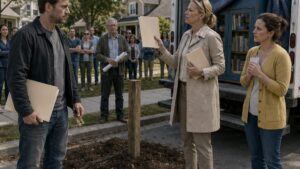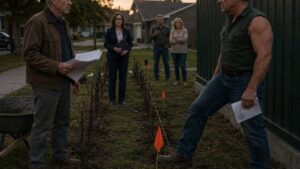
The HOA Ordered Him To Destroy The Room Built For His Dying Mother Before The Entire Neighborhood Learned The Truth
Chapter 1: The Letter Delivered At The Pool Gate
The envelope was taped to the gate of the community pool.
Paul Miller saw it before he saw the person walking away.
A white HOA seal glared at him from the front.
His stomach tightened.
Most HOA letters arrived through the mail. Anything delivered by hand meant somebody wanted it noticed immediately.
He looked across the empty patio. Rows of lounge chairs sat folded beside the pool. The meeting platform stood at the far end like a small stage.
No one was there now.
Still, he felt watched.
Paul pulled the envelope free.
EMERGENCY COMMUNITY ASSEMBLY.
His eyes moved lower.
MANDATORY ATTENDANCE REQUIRED.
Then lower.
PROPERTY VIOLATION HEARING.
He already knew what it was about before he opened the rest.
The addition.
The room behind his house.
The room he had built for his mother.
He stood motionless for several seconds.
Then he folded the paper and walked home.
The addition wasn’t fancy.
It wasn’t even finished.
The flooring didn’t perfectly match the rest of the house.
One corner still needed trim.
The paint color was slightly off.
But it allowed Nancy Miller to sleep without climbing stairs.
It allowed a hospital bed to fit beside a window.
It allowed sunlight to reach her face every morning.
To Paul, it was the most important room in the world.
Nancy sat near the window when he entered.
A blanket covered her legs despite the warmth.
She looked thinner than she had a month earlier.
She noticed the paper immediately.
“Another one?”
Paul forced a smile.
“Nothing important.”
She raised an eyebrow.
“You’ve never been able to lie.”
He set the envelope on the kitchen counter.
Nancy watched him carefully.
“The room?”
Paul nodded.
For a moment neither spoke.
The silence felt older than the house itself.
“They finally decided?” she asked.
“Emergency hearing.”
Nancy looked back toward the window.
“I told you this would happen.”
“You told me not to build it.”
“I told you they would punish you for building it.”
Paul sat across from her.
“I’d do it again.”
That earned a small smile.
“I know.”
The smile disappeared quickly.
Both understood the problem.
The room had been built after Nancy’s health worsened.
Paul had filed paperwork.
He had requested approvals.
He had waited months.
The HOA never gave a clear answer.
Eventually he built it anyway.
At first nobody complained.
Then Sharon Roberts became HOA president.
Everything changed after that.
Nancy glanced toward the backyard.
“You shouldn’t fight them because of me.”
“I’m not.”
“Paul.”
He looked away.
Nancy knew him too well.
She always had.
“What happens if they order demolition?” she asked quietly.
Paul didn’t answer.
Because he already knew.
He couldn’t afford lawyers.
He couldn’t afford rebuilding.
He couldn’t afford another place equipped for her care.
The addition wasn’t just wood and drywall.
It was time.
Comfort.
Dignity.
Days she might never get back.
A knock interrupted them.
The neighbor stood outside.
An older woman who lived two houses away.
She held a casserole dish.
“Thought I’d bring dinner.”
Paul thanked her.
The neighbor stepped inside and lowered her voice.
“I heard about the meeting.”
News traveled fast.
Paul sighed.
“Apparently.”
The neighbor hesitated.
Then she glanced toward Nancy before speaking.
“You should prepare yourself.”
Paul frowned.
“For what?”
The neighbor leaned closer.
“The vote’s already decided.”
The words landed harder than the notice.
“What do you mean?”
“I overheard board members talking after last week’s landscaping meeting.”
Her voice dropped further.
“They weren’t discussing whether you’d lose.”
She paused.
“They were discussing how soon.”
Anger flickered across Paul’s face.
“That’s not a hearing.”
“No.”
“It’s punishment.”
The neighbor looked uncomfortable.
“Most people know that.”
Paul stared.
Most people know.
The phrase echoed in his head.
For years he had paid fines.
Accepted warnings.
Filled out forms.
Stayed polite.
Stayed quiet.
Because arguing with the HOA always seemed pointless.
Now he wondered how many others had done the same.
The neighbor left soon after.
Nancy watched him from her chair.
“You look surprised.”
“I guess I am.”
“About what?”
“That everyone knows.”
Nancy gave a tired laugh.
“People always know.”
Paul stood near the back door.
The addition sat only a few yards away.
A simple room.
One window.
One ramp.
One promise.
He remembered the weeks spent building it after work.
The late nights.
The borrowed tools.
The sore muscles.
Every nail had been driven with one thought in mind.
Keep her home.
The next morning he visited the HOA office.
A narrow building beside the clubhouse.
The receptionist barely looked at him.
He requested records connected to his hearing.
She disappeared into the back room.
When she returned, she handed him a thick packet.
Rules.
Regulations.
Violations.
Photographs.
Inspection reports.
Enough paper to fill a binder.
Paul flipped through them.
Then he stopped.
One photo showed his addition.
Another showed the neighboring fence.
Another showed landscaping near the driveway.
Everything seemed documented.
Everything seemed official.
Yet something felt wrong.
He carried the packet outside.
The neighborhood looked exactly as it always had.
Fresh paint.
Decorative mailboxes.
Small additions.
Patios.
Garden structures.
Storage sheds.
Suddenly he started noticing things.
A covered porch that exceeded size limits.
A detached workshop.
A room extension.
None of them appeared temporary.
None of them appeared hidden.
Why were those still standing?
Why was his the emergency?
That afternoon he sat at the kitchen table comparing photographs.
Nancy watched quietly.
Eventually she spoke.
“You’ve started asking questions.”
“Maybe I should’ve years ago.”
Nancy folded her hands.
“Maybe.”
Paul looked down at the stack of papers.
Authority printed on every page.
Signatures.
Dates.
Rules.
Threats.
The weight of paper felt enormous.
Yet the more he studied it, the less solid it seemed.
As evening approached, he stepped onto the front porch.
Across the street, two residents stopped talking when they saw him.
One looked embarrassed.
The other looked sympathetic.
Neither crossed the road.
Neither offered help.
But both knew.
That realization stayed with him long after they disappeared inside.
Later that night, while organizing the documents, he noticed something strange.
A permit reference number cited in one report.
He searched the neighborhood records online.
The same type of addition appeared elsewhere.
Approved.
Another.
Approved.
Another.
Approved.
His wasn’t unique.
Not even close.
Paul stared at the screen.
For the first time since receiving the notice, fear gave way to something else.
Suspicion.
Maybe this wasn’t about the room at all.
And if it wasn’t, then the question keeping him awake suddenly became much larger than demolition.
Why was Sharon Roberts so determined to tear down his house’s smallest room while ignoring everyone else’s?
Chapter 2: The Rules That Applied To Only One House
The next morning Paul stood in the middle of the street holding his phone.
Across from him sat a house with a covered patio extension.
He took a photograph.
Then another.
Then another.
The structure clearly exceeded the same dimensions listed in his violation packet.
Nobody stopped him.
Nobody questioned him.
By noon he had photographed six properties.
Each contained modifications similar to his own.
Some were larger.
Some were newer.
One looked like it had been built only months earlier.
All remained untouched.
Paul returned home with a growing knot in his chest.
The issue wasn’t whether rules existed.
The issue was who those rules applied to.
Nancy sat at the kitchen table sorting old family photographs.
She noticed the pictures on his phone.
“Research?”
“Something like that.”
He showed her.
Nancy studied each image.
Her expression hardened.
“Those aren’t exactly hidden.”
“No.”
“They know about them.”
“Looks that way.”
Nancy handed back the phone.
“I think you’ve already figured out what this is.”
Paul didn’t answer.
Because he had.
He simply didn’t want to believe it yet.
That afternoon he visited the HOA office again.
The receptionist recognized him immediately.
Her smile disappeared.
“I need permit records.”
“For what properties?”
Paul listed several addresses.
The receptionist typed silently.
Her posture stiffened.
“Some records aren’t available.”
“Why?”
“Administrative restrictions.”
Paul almost laughed.
Administrative restrictions.
Another layer of paper.
Another locked door.
He left before frustration pushed him into an argument.
Outside, someone called his name.
A man from three streets over.
Paul knew him only well enough to wave occasionally.
The resident approached cautiously.
“Can we talk?”
Paul nodded.
The man glanced around first.
Making sure nobody watched.
That alone told Paul plenty.
“I heard you’re fighting the board.”
“I’m trying to understand what’s happening.”
The resident looked uncomfortable.
Then he reached into his truck and pulled out a folder.
“My workshop violated regulations too.”
Paul stared.
The man handed over several pages.
Inspection notices.
Violation reports.
Letters.
Then one final page.
Approved exemption.
Signed.
Stamped.
Case closed.
Paul looked up.
“Why’d they approve yours?”
The resident shrugged.
“I asked Sharon.”
“And?”
“We’re friends.”
The answer arrived without shame.
Almost without awareness.
As if favoritism had become normal.
Paul felt something shift inside him.
The resident lowered his voice.
“You didn’t get this from me.”
Then he walked away.
Paul remained standing beside the truck long after it disappeared.
That evening he spread documents across the dining table.
Nancy watched quietly.
One file beside another.
Violation.
Exemption.
Violation.
Approval.
Violation.
Waiver.
A pattern emerged.
Not proof.
But a pattern.
For years he had assumed every resident played by the same rules.
Now that assumption looked embarrassingly naive.
His phone rang.
An unknown number.
He answered.
No response.
Only silence.
Then the call ended.
A few minutes later another arrived.
Again silence.
Again disconnected.
Nancy noticed.
“Who is it?”
“I don’t know.”
But he suspected.
The feeling followed him into the night.
The next day, a new notice appeared in his mailbox.
Meeting date confirmed.
Three days away.
Emergency hearing.
Final determination.
The language sounded less like a hearing and more like a sentence already written.
Paul folded the paper.
For years he would have accepted it.
For years he had.
That realization bothered him more than the notice itself.
He had mistaken endurance for wisdom.
Maybe Sharon counted on that.
Maybe the entire system did.
Near sunset someone knocked at his door.
When Paul opened it, nobody stood there.
Only a small package resting on the porch.
No label.
No return address.
Inside lay photocopies.
Permit approvals.
Financial summaries.
Board meeting notes.
Paul flipped through them rapidly.
His pulse quickened.
Several addresses matched properties he had photographed.
Exemptions granted.
Fees waived.
Violations dismissed.
One name appeared repeatedly beside approvals.
Sharon Roberts.
Then he reached the final page.
A handwritten note.
Just one sentence.
LOOK AT THE HOA MAINTENANCE ACCOUNT.
Nothing else.
No signature.
No explanation.
Nancy watched from inside.
“What is it?”
Paul stared at the documents.
“I think someone wants me to keep digging.”
“Who?”
“I don’t know.”
And that frightened him almost as much as the papers themselves.
Because anonymous help meant someone was afraid.
The question was whether they feared being wrong.
Or feared being right.
Chapter 3: The Files Hidden Behind The Budget Reports
Paul opened the envelope again before sunrise.
The handwritten note lay on the table beside his coffee.
LOOK AT THE HOA MAINTENANCE ACCOUNT.
Simple.
Specific.
Impossible to ignore.
He drove to the public records office as soon as it opened.
The building sat downtown between a tax office and a title company.
Nothing about it looked important.
Yet inside were decades of documents.
The clerk directed him toward association filings.
Paul requested maintenance reports connected to the HOA.
The clerk raised an eyebrow.
“That’s a lot of paperwork.”
“That’s fine.”
An hour later several thick binders sat before him.
Paul turned pages slowly.
Line after line.
Expense after expense.
Most appeared ordinary.
Landscaping.
Pool maintenance.
Lighting repairs.
Insurance.
Then he noticed something strange.
A recurring vendor.
The same company appeared repeatedly.
Large payments.
Small projects.
Minimal descriptions.
He wrote down the name.
Kept reading.
The company appeared again.
And again.
And again.
The amounts grew larger.
Paul felt the first real pulse of alarm.
This was no longer about permits.
A shadow fell across the table.
The clerk returned.
“Finding what you need?”
“Maybe.”
The clerk glanced at the documents.
Then at Paul.
Something unreadable crossed her face.
“You aren’t the first person to ask questions.”
Paul looked up immediately.
“What does that mean?”
But the clerk had already stepped away.
The statement lingered.
Not the first.
How many others had tried?
How many had quit?
Hours later Paul requested supporting records tied to one of the larger expenditures.
The clerk searched.
Then frowned.
“Missing.”
“What?”
“The supporting file.”
“Missing how?”
She checked again.
Still frowned.
“No attachment.”
The explanation made little sense.
Large expenditures normally generated detailed records.
Contracts.
Invoices.
Receipts.
Something.
Instead there was a hole.
A gap where information should have existed.
Paul copied everything he could.
When he finally left the office, the folder under his arm felt heavier than paper should.
Back home he spread the documents across the table.
Nancy watched him work.
The stack grew steadily.
“What did you find?” she asked.
“Maybe nothing.”
She smiled faintly.
“That means you found something.”
Paul showed her the numbers.
Nancy studied them.
“I don’t understand budgets.”
“Neither do I.”
“But?”
Paul tapped one page.
“This company keeps getting paid.”
“For work they didn’t do?”
“I don’t know.”
The uncertainty frustrated him.
Pieces existed.
The full picture didn’t.
That evening another surprise arrived.
A community email.
Sent by Sharon Roberts.
Every resident received it.
Paul opened it immediately.
The message referenced the upcoming hearing.
Then came the paragraph that froze him.
Certain residents have attempted to spread misinformation regarding HOA operations. These actions threaten community trust and may result in additional penalties.
No names.
No direct accusation.
Yet everyone would know who she meant.
Paul stared at the screen.
His phone vibrated.
A text from a neighbor.
You should stop before you make things worse.
Then another.
She’s saying you’re lying.
Then another.
Be careful.
Fear crept in.
Not because Sharon attacked him.
Because it was working.
The papers suddenly felt fragile.
What if he misunderstood them?
What if he was wrong?
What if all of this ended with his mother losing the room anyway?
Nancy entered quietly.
She read the email.
Then sat across from him.
“You look tired.”
“I might be chasing ghosts.”
Nancy shook her head.
“No.”
“You don’t know that.”
“I know you.”
Paul looked away.
Years of caring for her had made him doubt himself.
Every decision revolved around medical appointments, medications, schedules.
Fighting people required energy he rarely possessed.
Sharon understood that.
Maybe she always had.
Nancy reached across the table and touched one of the financial reports.
“If this was only about our room, they would’ve voted already.”
Paul frowned.
“What do you mean?”
“They wouldn’t spend this much effort attacking you.”
The thought lingered.
Because it felt true.
The demolition order might be the visible fight.
But perhaps something larger sat behind it.
The next morning Paul made a decision.
He searched for investigative journalists.
Most never replied.
One name appeared repeatedly.
Charles King.
Known for exposing municipal waste and local corruption.
Paul hesitated before sending the email.
Then attached documents.
Permit records.
Budget reports.
Photographs.
The anonymous note.
Everything.
He pressed send.
Hours passed.
Nothing.
Evening arrived.
Still nothing.
Paul began regretting it.
Then his phone rang.
Unknown number.
He answered.
A calm voice spoke.
“This is Charles King.”
Paul sat upright.
“I wasn’t sure you’d call.”
“I almost didn’t.”
The answer wasn’t encouraging.
“But?”
A pause.
Paper shuffled somewhere on the other end.
“You either found something interesting,” Charles said, “or you’re very confused.”
Paul almost laughed.
“Which one do you think it is?”
Another pause.
Longer this time.
“I don’t know yet.”
The uncertainty was honest.
And for the first time in days, honesty felt like progress.
“Can we meet?” Paul asked.
Charles answered immediately.
“Maybe.”
Then came the words that kept Paul awake that night.
“If you’re right, this isn’t about one room anymore.”
Chapter 4: The Reporter Who Refused To Trust Easy Stories
Charles King arrived ten minutes late.
Paul had already finished half a cup of coffee and checked the door six times.
When the journalist finally entered the café, he carried no notebook, no camera, nothing that suggested investigation.
He looked more like a teacher than a reporter.
Charles sat across from him.
“You brought everything?”
Paul slid a folder across the table.
Charles opened it.
For nearly fifteen minutes he said almost nothing.
He examined permit approvals.
Financial reports.
Violation notices.
Photos.
The anonymous note.
Occasionally he circled something with a pen.
Most of the time he simply read.
Finally he closed the folder.
“You know what’s missing?”
Paul felt his stomach tighten.
“What?”
“Proof.”
The answer hit harder than expected.
Paul frowned.
“There are patterns.”
“There are suspicions.”
Charles pushed the folder back.
“Those aren’t the same thing.”
Paul stared at the documents.
After days of digging they felt substantial.
Yet hearing someone else reduce them to suspicion stripped away much of their weight.
Charles leaned back.
“I’ve spent twenty years looking at stories like this.”
“So you think I’m wrong.”
“No.”
The answer surprised him.
“I think you might be right.”
“Might?”
Charles nodded.
“And if you’re right, I need evidence strong enough to survive daylight.”
Paul looked down.
Part of him wanted to argue.
Another part knew Charles was doing exactly what he should.
“You think I want this to be true?” Paul asked quietly.
Charles studied him.
“No.”
That answer carried more respect than sympathy.
The journalist gathered the papers.
“I’ll look.”
“That’s it?”
“For now.”
Paul exhaled.
For now sounded dangerously close to never.
Before leaving, Charles paused.
“One more thing.”
Paul looked up.
“Don’t get emotional in public.”
“What?”
“If Sharon wants a fight, she wants you angry.”
Charles stood.
“Angry people make mistakes.”
Then he walked away.
The advice lingered long after the café emptied.
Unfortunately, the next few days made anger increasingly difficult to avoid.
Word spread through the neighborhood.
People noticed Paul asking questions.
Some avoided him.
Others whispered when he passed.
One afternoon a resident stopped him near the mailboxes.
“You’re causing trouble.”
Paul turned.
The man shrugged.
“Maybe Sharon’s strict. But property values matter.”
The statement sounded rehearsed.
Like something repeated often enough to become truth.
Paul started to respond.
Then stopped.
A week earlier he would have walked away immediately.
Now he forced himself to stay.
“Do you think my mother should lose that room?”
The resident hesitated.
For the first time uncertainty entered his face.
“That’s not what I said.”
But it was close enough.
The conversation ended there.
Yet Paul noticed something important.
The certainty wasn’t as solid as before.
Cracks existed.
People simply pretended otherwise.
That evening Charles called.
“Can you meet tomorrow?”
The question arrived abruptly.
“Did you find something?”
“Maybe.”
The next day they met at a different café.
Charles arrived carrying a thicker folder.
He dropped it onto the table.
“What am I looking at?”
“Complaints.”
Paul frowned.
“From who?”
“Residents.”
Charles opened the folder.
Inside sat copies of old correspondence.
Letters.
Emails.
Violation appeals.
Requests for hearings.
Dozens of them.
Some stretched back years.
“They all complained about Sharon?”
“Not exactly.”
Charles flipped through pages.
“Different issues. Different people.”
Paul scanned several.
A denied fence request.
A landscaping dispute.
Parking enforcement.
Architectural violations.
Individually they looked ordinary.
Together they felt different.
A pattern of intimidation.
A pattern of selective decisions.
A pattern of people eventually giving up.
“Where’d these come from?” Paul asked.
Charles smiled faintly.
“People talk when they think someone might finally listen.”
The statement stayed with Paul.
For years nobody listened.
That realization felt almost worse than the corruption itself.
Charles pointed toward one letter.
An elderly resident had challenged a fine.
Months later the violation disappeared.
No explanation.
No hearing.
Nothing.
“What happened?” Paul asked.
“No record.”
Charles pointed to another.
Then another.
Inconsistent outcomes.
Missing explanations.
Unusual exemptions.
Enough irregularities to raise questions.
Not enough to prove everything.
Yet.
For the first time Paul saw his situation differently.
He wasn’t an exception.
He was simply the latest target.
The realization made him feel less alone.
And far more angry.
That evening another surprise arrived.
A knock at his door.
When Paul opened it, a longtime resident stood outside.
A man known for supporting the HOA at every meeting.
Paul almost expected criticism.
Instead the resident handed him a folder.
“I should’ve done this years ago.”
Paul blinked.
“What is it?”
“My violation records.”
“Why?”
The resident looked exhausted.
“Because Sharon threatened my wife when she was sick.”
The words emerged quietly.
Almost reluctantly.
As if saying them aloud finally made them real.
Paul opened the folder.
More notices.
More warnings.
More selective enforcement.
The resident shook his head.
“I convinced myself it was normal.”
Then he left.
Paul stood in the doorway long after.
Inside the house Nancy sat reading.
He handed her the folder.
She examined it.
Neither spoke immediately.
Finally Nancy looked up.
“They’re not alone anymore.”
Paul followed her gaze.
The folder joined the others on the table.
Paper stacked upon paper.
Not authority this time.
Testimony.
By the end of the week, the dining table had disappeared beneath documents.
Then the final blow arrived.
An emergency HOA announcement.
Mandatory assembly.
Attendance encouraged.
Final determination regarding the Miller property.
Three days away.
Sharon wasn’t delaying anymore.
The decision was coming.
Paul called Charles immediately.
“The meeting’s happening.”
Charles was silent for several seconds.
Then he said, “Good.”
Paul frowned.
“Good?”
“Pressure makes people reveal themselves.”
That wasn’t particularly comforting.
“What if we don’t have enough?”
Charles answered carefully.
“Then we keep looking.”
Paul looked toward the stack of folders.
The clock felt louder than usual.
Three days.
That was all.
Before hanging up, Charles said one final thing.
“I’ll be there.”
Paul froze.
“As a reporter?”
“No.”
The answer puzzled him.
Then Charles added:
“For now, nobody should know I’m coming.”
Chapter 5: The Assembly Designed To Break A Man
The crowd started gathering nearly an hour before the meeting.
By sunset the community pool patio was packed.
Residents stood shoulder to shoulder.
Some carried folding chairs.
Others remained near the edges, watching quietly.
The atmosphere felt less like a neighborhood meeting and more like a public trial.
Paul noticed it immediately.
Everyone already expected a verdict.
The raised HOA platform overlooked the crowd.
Board members shuffled papers.
Microphones waited on the long table.
Stacks of documents sat arranged neatly before Sharon Roberts.
She looked completely comfortable.
As though the outcome belonged to her.
Maybe it did.
Paul stood near the back with Nancy in a wheelchair.
She insisted on attending.
Nothing Paul said changed her mind.
A nurse remained beside her.
Nancy’s face looked pale.
The effort of simply being present cost her energy she barely possessed.
Still, she refused to stay home.
“I want to see them say it,” she had told him.
Now she watched the platform silently.
The crowd parted as Sharon approached the microphone.
Conversation faded.
The meeting began.
“Thank you all for attending.”
Her voice carried easily across the patio.
Professional.
Controlled.
Practiced.
Paul suddenly understood how she had survived politics.
She knew how to perform authority.
Sharon reviewed routine business first.
Budget updates.
Landscaping reports.
Pool maintenance.
The delay felt deliberate.
Like a predator enjoying the wait.
Finally she reached the final agenda item.
“The Miller property.”
A ripple passed through the crowd.
Paul stepped forward.
Sharon lifted a packet.
“After review by the board, multiple violations have been confirmed.”
The packet rose higher.
As if the paper itself carried unquestionable truth.
“The unauthorized addition remains noncompliant.”
Paul opened his mouth.
Sharon continued talking over him.
“The board therefore recommends mandatory removal.”
The words landed heavily.
Nancy closed her eyes.
For a moment Paul forgot the crowd existed.
All he saw was the room behind his house.
The bed.
The window.
The promise.
Sharon continued.
“Personal circumstances do not exempt residents from community standards.”
Several people shifted uncomfortably.
Even Sharon seemed to sense it.
So she pushed harder.
“Rules must apply equally.”
Paul almost laughed.
Equally.
After everything he had discovered.
After all the folders sitting in his car.
The word sounded absurd.
“I’d like to respond,” Paul said.
Sharon glanced toward him.
“No.”
The answer came instantly.
Murmurs spread through the audience.
Paul blinked.
“What?”
“The board has completed review.”
“I have evidence.”
“You had opportunities to submit documentation.”
“I requested hearings.”
“The board has ruled.”
Paul stared.
The dismissal felt intentional.
Public.
Humiliating.
Exactly as designed.
Sharon wasn’t merely enforcing a decision.
She was demonstrating power.
The crowd saw it too.
Yet nobody intervened.
Years of habit held them still.
Sharon raised another page.
“The demolition order will take effect within thirty days.”
A sharp cough interrupted her.
Paul turned immediately.
Nancy bent forward.
The nurse moved beside her.
Concern spread across nearby faces.
Nancy waved everyone back.
“I’m fine.”
But she wasn’t.
Paul knew it.
The nurse knew it.
The crowd knew it.
The moment exposed something uncomfortable.
The human cost sitting behind all those documents.
Even some board members looked uneasy.
Not Sharon.
She pressed forward.
“The association appreciates cooperation during this process.”
The sentence finally broke something inside Paul.
Not because of the demolition.
Not because of the crowd.
Because Sharon had looked directly at Nancy and continued anyway.
As if she were discussing a broken fence.
Not a dying woman.
A resident near the front suddenly stood.
“What about the other additions?”
Silence followed.
The question came from nowhere.
Sharon stiffened.
“What other additions?”
The resident named two addresses.
Then a third.
Murmurs grew louder.
Another resident spoke up.
Then another.
Questions spread through the crowd.
Not rebellion.
Not yet.
But doubt.
Visible doubt.
For the first time all evening Sharon lost control of the room.
Only briefly.
Yet Paul saw it.
Fear.
Tiny.
Quick.
Real.
Sharon recovered immediately.
“Those situations are unrelated.”
The answer satisfied almost nobody.
Still, the board moved to vote.
Paper shuffled.
Hands prepared to rise.
Paul felt every muscle tighten.
This was it.
The moment.
The end of patience.
The end of silence.
The end of pretending.
Sharon raised the demolition packet once more.
“The motion passes.”
Something snapped.
Paul walked toward the platform.
Fast.
Purposefully.
Board members froze.
The crowd fell silent.
Nobody knew what he intended.
Neither did Sharon.
Her confidence wavered.
For the first time all evening she looked uncertain.
Paul reached the table.
His eyes fixed on the board’s presentation laptop.
Then he wrapped his hand around it.
And lifted it from the table.
Chapter 6: Nobody Leaves Until The Truth Is Settled
The laptop flew from Paul’s hands.
For a fraction of a second it seemed suspended above the crowd.
Then it slammed into the concrete.
The crack echoed across the pool patio.
Plastic shattered.
The screen exploded into black fragments.
Gasps erupted from every direction.
Silence followed.
Complete silence.
Sharon stared at the ruined machine.
One board member jumped backward.
Another looked as if he had forgotten how to breathe.
Paul stood motionless.
Years of swallowed frustration suddenly occupied the same space as everyone else’s fear.
No one spoke.
Then Paul swept his arm across the table.
The thick stack of financial files scattered into the air.
Pages erupted like a storm of white birds.
Hundreds of documents drifted across the patio.
Residents instinctively reached for them.
The board lunged to stop them.
Too late.
The papers were everywhere.
“What are you doing?” Sharon shouted.
Her composure cracked for the first time.
Paul didn’t answer.
Instead, he stepped away from the platform.
The crowd parted.
Confusion followed him like a wave.
He walked directly toward the main double doors leading into the clubhouse.
Someone called his name.
Someone else yelled for security.
Paul ignored both.
At the doors, he grabbed the lockbox used during community events.
A microphone stand rested nearby.
He ripped it free.
Metal scraped against concrete.
The sound made several people flinch.
Then he swung.
The stand crashed into the lockbox.
Once.
Twice.
The third strike shattered it.
The lock snapped.
Pieces clattered across the ground.
Residents stared.
Board members shouted over one another.
Paul secured the doors.
No one would be leaving through them.
Then he turned.
The microphone stand still hung in his hand.
His chest rose and fell heavily.
The crowd waited.
Every eye on the patio fixed on him.
Paul pointed toward the board.
His voice thundered across the gathering.
“Nobody leaves this room until the truth is settled!”
The words rolled through the crowd.
A challenge.
A demand.
A declaration.
For a moment nobody moved.
Not Sharon.
Not the board.
Not the residents.
The spell of routine had finally broken.
Sharon recovered first.
“You’ve lost your mind.”
Paul dropped the microphone stand.
The metal clanged loudly.
“No.”
His voice sounded calmer now.
“I finally stopped pretending.”
Several residents looked down at the scattered documents.
One picked up a page.
Then another.
Soon dozens of people were reading.
Questions began immediately.
“What is this?”
“Why was this payment approved?”
“Look at this amount.”
A board member tried collecting pages.
The crowd refused.
The power dynamic shifted so quickly it seemed unreal.
For years residents had treated HOA paperwork as unquestionable.
Now those same papers were being examined.
Doubted.
Compared.
Discussed.
Truth had entered the room disguised as paperwork.
Sharon stepped toward the microphone.
“These documents are being misrepresented.”
No one responded.
That frightened her more than anger would have.
People were reading.
Thinking.
Comparing.
Paul reached into a folder he had carried all evening.
He held up permit approvals.
“Three additions approved.”
Another sheet.
“Two violations dismissed.”
Another.
“Five exemptions.”
He looked directly at Sharon.
“None of them belonged to me.”
Murmurs spread again.
A resident near the front raised one of the papers.
“My address is on this.”
Heads turned.
The resident looked stunned.
“I got approved in two weeks.”
Another voice joined in.
“So did I.”
Then another.
The crowd was beginning to connect the pieces themselves.
Paul no longer needed to explain everything.
That realization strengthened him.
For years he had believed he was alone.
He wasn’t.
The board had depended on everyone remaining isolated.
Once people compared experiences, the illusion weakened.
Sharon sensed it too.
She grabbed the microphone.
“You don’t understand how governance works.”
The statement came out sharper than intended.
A few residents laughed.
Not loudly.
But enough.
Enough to wound.
Sharon’s face reddened.
“These rules exist for a reason.”
“They don’t exist for everyone,” someone replied.
The response came from the crowd.
Not Paul.
That mattered.
The room had changed.
Paul saw it.
Residents saw it.
Even Sharon saw it.
For the first time, she no longer controlled the conversation.
A police siren sounded faintly somewhere beyond the neighborhood.
The noise barely registered.
The real confrontation remained here.
One board member stood abruptly.
“We should adjourn.”
“No,” several residents answered immediately.
The word spread.
No.
No.
No.
A simple response.
Years overdue.
Paul felt something loosen inside him.
Not victory.
Not yet.
But possibility.
Then Sharon made a mistake.
A desperate one.
She pointed at Paul.
“He’s manipulating all of you.”
The accusation might have worked a week earlier.
Now it landed differently.
Because too many people held evidence in their own hands.
Too many stories suddenly matched.
Too many memories resurfaced.
The crowd no longer saw a troublemaker.
They saw a pattern.
Sharon recognized it a second too late.
Fear flashed across her face.
Real fear.
The kind that appears when authority stops being believed.
Then a sound came from the side of the clubhouse.
A door opening.
The noise cut through every conversation.
Heads turned simultaneously.
Paul looked toward the side entrance.
His expression didn’t change.
Sharon noticed.
And suddenly she understood.
Something else was coming.
The side door swung wider.
A figure appeared in the doorway.
Then another.
Then another.
Chapter 7: The Day The Citations Fell Like Rain
Red camera lights glowed in the darkness beyond the doorway.
The crowd froze.
Charles King stepped onto the patio first.
Behind him came a camera operator.
Then another.
A producer followed carrying equipment.
The bright lens pointed directly toward the board.
No one spoke.
For several seconds the only sound came from the hum of recording equipment.
Charles looked toward Sharon.
Then toward the residents.
Finally he spoke.
“We’ve been documenting this investigation for weeks.”
Sharon’s face drained of color.
The crowd erupted.
Questions collided with accusations.
Board members began talking over one another.
The camera continued recording.
Steady.
Unblinking.
Uninterested in excuses.
Charles raised his voice.
“Everything happening tonight is being preserved.”
The words landed harder than any accusation.
Because they transformed the meeting.
This was no longer a neighborhood dispute.
It was evidence.
Sharon grabbed the microphone.
“You had no right—”
Charles interrupted.
“The public records gave us that right.”
The crowd shifted.
Residents who had remained cautious all evening suddenly stood taller.
Paperwork no longer belonged exclusively to the board.
Truth didn’t either.
Paul watched the transformation unfold.
Not because of him alone.
Because people were finally seeing one another.
The resident who had received special treatment looked ashamed.
Others looked angry.
Several looked relieved.
As though years of confusion suddenly made sense.
Charles gestured toward the documents scattered across the patio.
“We verified multiple irregularities.”
He didn’t exaggerate.
Didn’t dramatize.
That made the statement stronger.
“Residents deserve answers.”
The crowd responded immediately.
They began speaking.
One after another.
Stories emerged.
Dismissed complaints.
Threatened fines.
Selective enforcement.
Missing hearings.
Years of silence broke apart in minutes.
Sharon tried repeatedly to regain control.
Each attempt failed.
No one wanted another speech.
They wanted explanations.
And explanations were in short supply.
A distant siren grew louder.
This time everyone heard it.
The sound approached quickly.
One board member attempted to leave.
Residents blocked the path.
Not violently.
Simply refusing to move.
“No.”
The same word again.
No.
The simplest rebellion imaginable.
Police vehicles entered the parking area moments later.
Officers crossed the patio.
The crowd parted.
Questions were asked.
Documents were reviewed.
Names were recorded.
The atmosphere changed once more.
Not chaos.
Accountability.
Sharon approached an officer.
Paul couldn’t hear the conversation.
He didn’t need to.
The officer’s expression never softened.
Charles quietly handed over copies of records.
Another officer spoke with residents.
Then another.
One by one, people volunteered information.
The silence that had protected the board for years evaporated.
Nancy watched from her wheelchair.
Her eyes remained fixed on the scene.
Paul knelt beside her.
For the first time all evening, neither spoke.
Words felt unnecessary.
The room.
The promise.
The fight.
Everything had led here.
Nancy touched his hand.
“You finally stopped carrying it alone.”
Paul swallowed hard.
She was right.
That had been the real burden.
Not the paperwork.
Not the fines.
The belief that nobody else would stand beside him.
An officer approached Sharon.
A brief conversation followed.
Then another.
Finally the officer gestured toward the parking area.
Sharon’s shoulders stiffened.
The crowd understood before anyone announced it.
The reaction spread instantly.
Residents reached into folders.
Into bags.
Into pockets.
Citation notices emerged.
Warning letters.
Violation reports.
Fine statements.
Years of paper authority.
Someone threw one.
It fluttered through the air and struck a board member’s shoulder.
Then another followed.
And another.
Soon dozens filled the sky.
Not dangerous.
Not violent.
Just paper.
The very thing the board had used for years.
Pages drifted downward like rain.
Citation slips struck jackets.
Warning letters landed at Sharon’s feet.
Violation notices floated across the patio.
The image felt surreal.
The crowd wasn’t throwing objects.
They were returning them.
Returning fear.
Returning humiliation.
Returning years of submission.
Officers escorted board members away.
No one cheered at first.
People simply watched.
The spell had finally ended.
Then applause began somewhere near the back.
Slow.
Uncertain.
Others joined.
Not for punishment.
For release.
For relief.
For the realization that power had never been as absolute as everyone believed.
Paul stood quietly beside Nancy.
The cameras continued recording.
Residents continued talking.
Officers continued gathering information.
Life moved forward.
Not perfectly.
Not instantly.
But forward.
Nancy looked toward the addition visible beyond the nearby houses.
The room remained standing.
A simple structure.
A bed beside a window.
Nothing extraordinary.
Yet it had exposed an extraordinary truth.
Paul followed her gaze.
The room had never really been the issue.
Fear had been.
And fear looked much smaller now.
As the last citation drifted to the ground, the crowd no longer resembled a collection of isolated residents.
They looked like neighbors.
The story has ended.